




Abstract
In urban acoustics, the design of built environment substantially impacts the environmental noise of our everyday lives, as the built environment constantly reflects the sounds of human or non-human actors in its vicinity. The effects produced by these reflected sounds significantly depend on the geometric characteristics of the surrounding building façades. Despite their impact, the façade characteristics are often excluded from urban acoustic simulation models. As a result, sound reflection and scattering that are specifically related to building façades remain largely unexplored in noise control at the urban scale. Inspired by computational design tools used for exploring room acoustics, we investigate how a computational approach enables the analysis of geometric characteristics of façades to simulate urban acoustics during early design processes. This paper introduces a rule-based characterisation framework that enables the representation of geometric façade characteristics and their relationships with acoustic constraints in the form of rules. Our first results showed how these rules allowed for capturing and reconstructing façade geometries based on the given acoustic constraints. We believe that this novel approach empowers designers to describe their initial design ideas in a formalism that can be dynamically adapted to various dimensions, such as urban acoustics, and to reconstruct the form throughout the design process.
Introduction
Due to urbanization and the consequent densification of cities, the world’s population is increasingly exposed to environmental noise. 1 Environmental noise is defined by the European Commission as ‘unwanted or harmful outdoor sound created by human activities’ 2 and it includes noise caused by all kinds of transportation or industrial activity. The urbanization causes an extra increase of environmental noise because the building façades constantly act as sound reflecting surfaces. 3 The resulting sound reflections amplify the outdoor noise levels by means of returning the sound back from the façades into the streets. The effects produced by these reflected sounds are significantly influenced by the geometric characteristics of the building façades. 4 In numerical methods of wave acoustics, the façade surfaces are described by their shape and their impedance, which would nominally be very accurate, if one could specify the surface properties with high accuracy- which is a problem in practice. Consequently, the building façade characters are often excluded from urban acoustic simulation models despite their impact. Because façade surface shape descriptions would significantly increase the complexity of the calculations, sound reflection and scattering that are specifically related to building designs remain largely unexplored in noise control at the urban scale.
In the field of architectural acoustics, evaluative simulation processes and analysis tools are integrated with digital form generation processes, which are specifically explained for façade designs in Section 2.1. This integration has empowered designers to combine acoustic performance objectives with architectural goals.5,6 However, architectural acoustics is mostly concerned with absorption of the sound rather than its reflection and scattering, which would be crucially important in the case of urban acoustics. Architects usually rely on computer simulation software like Odeon 7 and Pacyderm8,9 in their design processes as they predict the acoustic performance of architectural spaces apriori. However, because such software is based on geometrical acoustics (GA), they are still limited to simulate the sound reflection and sound scattering.10-13 Based on the principles regarding sound reflection and scattering of surfaces,14,15 the sound scattering performance of certain types of geometries can be described with design rules, thereby continually compute design forms. 16
Section 2.2 explains rule-based approaches in the context of architectural design, such as shape grammars, and how they offer an efficient method to computationally analyse and generate façade geometries. To briefly describe, shape grammars 17 provide a computational method to formalise relations between 2D or 3D shapes via shape rules. Section 2.3. describes how the employment of such shape rules enable researchers to explore and describe designs computationally, such as analysing existing façade geometries. 18 Moreover, rule-based computation is used to derive digital design and fabrication strategies for façade geometries. 19 Recent advancements in architectural design and room acoustics have demonstrated that computational design paradigms provided innovative digital workflows to asses acoustic diffusion and sound scattering together with design features of the architectural space. 20 These computational design approaches have later inspired and provided data for the automatization of room acoustics and architectural design, 21 thereby pushing towards acoustically informed design workflows.
Inspired by the computational design methods and tools used in exploring room acoustics and architectural design, we investigate how a computational approach can be used to analyse the geometric characteristics of façades. The aim of this paper is to incorporate acoustic behaviour into the early stages of the architectural design process. We present our contributions as follows:
Section 3 introduces a novel rule-based framework that relies on two concepts: the design parameter space and the design rules. In Section 3.1, we present two building examples with significantly different façade geometries to demonstrate theapplicability of our rule-based characterisation framework. Section 3.2 explains how this framework combines the acoustic and architectural design parameters using rule formalisms. The rules that capture the spatial relationships for each individual element of the façade aretermed as single character rules. The rules that describe how these elements are composed are referred to as composition character rules. A specific rule structure allows for combining the acoustic and architectural parameters together in one single format by using algebraic notations. Due to such a rule formalism, domain-knowledge can transfer from one design space to the other. Section 3.3 illustrates this knowledge transfer between the acoustic and architectural design spaces.
The single and composition character rules are particularly important in the case of acoustics because they represent the periodicity in the harmonic (tonal) sound waves. Such periodicity results in a very significant interaction with the surface structures, which is known in physics as “phase gratings”. Therefore, surfaces with periodic structural elements have an outstanding impact on exactly how sound is bouncing back from the façade. The geometry of the design element and the sound wavelengths, thus, must be studied in a joint process. Accordingly, a reconstruction rule is termed to describe how single and composition rules should be adapted according to the acoustic constraints of the design space. It should be noted that, our work is not restricted to perfectly periodic structures; it can also include arbitrary patterns of design elements.
Section 4 presents our results showing how these rules allowed capturing and dynamically reconstructing façade geometries based on the given acoustic constraints. In this dynamic reconstruction process, updated forms were computed to represent what the façade topology looks like at various sound wavelengths. These forms are new because they were not part of the actual architectural façade design in question, but rather an interpretation of how this façade behaves at the given sound wavelength. In Section 5, we discuss how the presented rule-based framework bridges the gap between the design spaces of architecture and acoustics. We also reflect on how the rules support a relatively fast and scalable evaluation of architectural acoustics.
We believe that this novel rule-based approach empowers designers to describe their initial design ideas in a formalism that can be dynamically adapted to various dimensions, such as urban acoustics, and to reconstruct the form throughout the design process.
Related work
Urban acoustics and façades
Building façades play a vital role in terms of experiencing urban acoustics since they reflect and scatter sound. 22 As already discussed by Kang, 23 a common approach to this task involves using the image source method or the ray-tracing techniques, assuming that the building façades and street surfaces are smooth and reflect the sound specularly (“incidence angle equals reflection angle”). For surface structures which are not small compared with the wavelengths under consideration, however, other models have been proposed for taking diffuse reflections into account. 24 They and many others studied the effect of surface and object scattering and subdivided the sound field into a specular and scattered field. In general, by using numerical wave models such as the boundary element method (BEM) or the finite-difference time domain model (FDTD), the nominally exact wave propagation can be computed as along as the geometric model and the acoustic boundary conditions are exactly known. 25
For practical reasons, mainly to increase computational efficiency, the state-of-the-art models in soundscape planning and noise mapping are based on geometrical acoustics (GA). In GA, sound is assumed to propagate as rays, so the sound properties due to its wave nature is neglected. 26 Consequently, all wave-based phenomena such as scattering and diffraction are only approximated, thus excluding specific data and processing steps for distinct directional reflection patterns. In acoustic computer simulations with GA, absorption coefficients, scattering coefficients and edge diffraction models are used.26,27
The challenge in such reflection modelling in the angle dependence, while all of that is also -frequency dependent. The interaction of a sound wave incident on a surface is, therefore, extremely complex. For this reason, averages in frequency bands and averages over sound incidence angles are used to obtain estimates for the total reflected field under random-incidence conditions. 28 By doing so, the information about the directional characteristics of the specific façade structure under test is lost. This one particular problem which is tackled in our work.
Rule-based computational design and grammars
Rule-based computational design methods refer to a systematic approach in design and architecture where predefined rules or algorithms are used to guide the design process, such as shape grammars, L-systems, agent-based modelling. Shape grammars were initially developed by Stiny and Gips 17 to formalise relations between 2D or 3D shapes via shape rules. The core capability of these rules is to generate complex shapes with emergent properties, i.e., the properties that the designer did not define nor expect beforehand. 29 The logic of shape grammars was extended to formalising the relations between material properties and mechanical manipulations, thus enabling creative exploration of material characteristics. 30 Moreover, making grammars 31 explored the creative potential of physical making by relating the sensing of a thing to its perceptible changes. Representing these relations by way of rules potentially allows for modelling physical making processes, from which various creative opportunities/designs could be generated. The applications of rule-based computation were extended to digital manufacturing such as to explore the fabrication design space by relating motion trajectories of fabrication actions to 3d-models. 32 Moreover, the rule-based computation of manual building practices enabled discovering the design space in terms of relation between physical form and building parameters. 33 In architectural education, shape grammars find a valuable role in teaching and bridging the gap between manual exploration and computational design. This rule-based approach empowers students to engage in hands-on experiments in terms of fabrication while learning about design principles, unit transformations, and material qualities, preparing them for more advanced computational design techniques. 34
As the application field becomes more complex, such as in case of digital fabrication or manual building practice, the rules should represent multi-dimensional relationships among various design paramaters. Yet, most rule notations afford one-dimensional rule relations, i.e., one rule application is followed by another rule application. Adding multi-dimensional relations among rules, such as quad grammars, 35 could potentially provide a more elaborate design computation and exploration.
Rule-based façade analysis and design
The research advances in computational design demonstrate the significant impact of rule-based approaches, such as shape grammars, 36 in various aspects of façade analysis and design. For example, the rule-based approach of shape grammar serves as the foundation for innovative generative design strategies, considering structural demands and design criteria, showcasing the efficiency and effectiveness of generative design. 37 On the other hand, this rule-based approach can be used as a reverse engineering method to decode the intricate visual compositions in contemporary architectural façade designs. For instance, recent studies highlighted how seemingly simple rules can give rise to complex façade compositions, shedding light on the versatility and creative potential of shape grammars. 18
The rule-based logic of shape grammars also prove instrumental potential in heritage preservation, as demonstrated in the reconstruction of historic façades. By using such logic, researchers formalized and generated façade elevations that celebrate the architectural heritage, ensuring its preservation and newfound understanding. 38 Similarly, the application of shape grammars in regenerating damaged features of traditional façades showcased their ability to conserve architectural elements deeply rooted in culture and history. 39 In summary, these studies collectively underscore the diverse applications of rule-based computation in façade design, spanning structural optimization, creative exploration, educational empowerment, heritage preservation, and cultural conservation. The logic of rule structures serves as a versatile tool in addressing multifaceted challenges within the realm of façade characterisation, analysis, and design.
Rule-based characterisation of façades
In our research, we introduce a novel computational approach for describing spatialrelationships of a façade in forms of rules. These rules then allow for dynamically reconstructing façade geometries based on any given constraint set, such as acoustic constraints. This section describes the rule structure, introduces a set of constraints within acoustic parameter space, and explains how these rules establish an informed design and fabrication workflow.
Example façades
We selected two buildings for decoding their façade characters as seen in Figure 1. The first building, referred to as Façade-1, was designed by ACAU Architects in Geneva.
40
It has a modular design which stands on wooden piles instead of having a solid core. The walls and soffits inside were made of load-bearing stacked-plank elements, and the floors were constructed from cross-laminated boarding. The façade was constructed based on an insulated post-and-beam structure, lined internally with stacked-plank slabs (3 m × 3 m) and externally with oak-strip cladding (25 mm × 130 mm). The spatial modules within the building were interconnected using screw bolts, composing the façade design into a regular grid. The façade appears almost flat, with the maximum depth between structural elements being approximately 13 cm. Selected façades: Refugee Quarters in Geneva on the left (photo credits: Marcel Kultscher) and Preston Bus Station on the right (photo credits to BDP). Façade-1 (on the left) constitutes of planar surface combinations placed on a grid composition, whereas Façade-2 (on the right) includes curved surfaces on a longitudinal composition.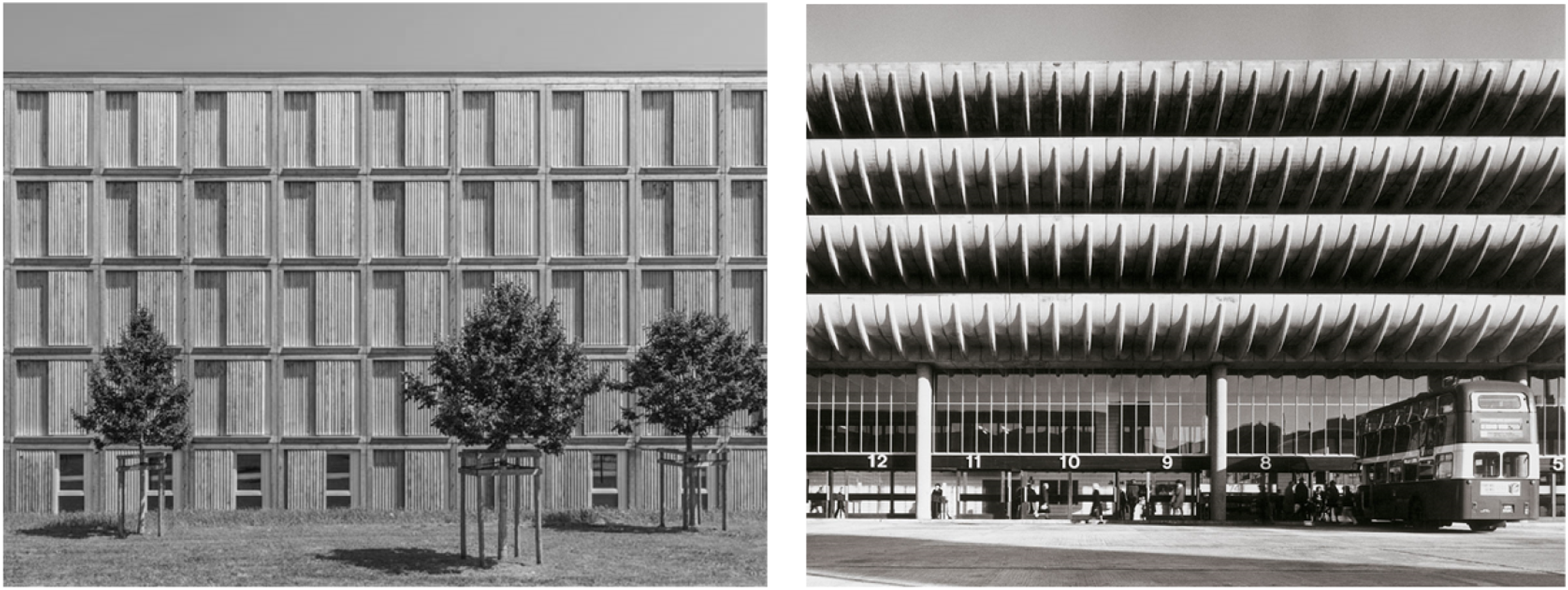
The second building is the iconic Preston Bus Station, one of the significant examples of brutalism in Preston, UK, designed by Keith Ingham and Charles Wilson of Building Design Partnership with E. H. Stazicker. 41 The distinctive precast concrete elements, cantilevered out from the parking decks, create depths of approximately 3 m while defining the striking curves of the 190-m-long façade. In this paper, we refer to the façade of Preston Bus Station as Façade-2. As seen in Figure 1 there is a significant contrast in terms of geometric characteristics between Façade-1 and Façade-2. Accordingly, the power of rule-based characterisation would be tested for defining linear and curvilinear façade characters as well as capturing both flat and voluminous acoustic samples.
Rule-based characterisation framework
The rule-based characterisation framework allows for defining the type of a façade character, describing its properties, and encoding its spatial relationships by design rules. Design rules represent the geometry of a façade character in a specific algebraic notation system. Accordingly, these rules can be combined with each other for more elaborate façade designs or altered based on a set of constraints (Figure 2). Rule-based characterisation framework for analysing façades. This framework consists of two main parts: the design parameter space and the design rules. The design parameter space describes the domain specific constraints to analyse the façade characters and the design rules define spatial relationships of façade characters. It should be noted that octave band 10 exists, but it is excluded from our framework because it refers to ultrasound, which is not perceived by human, thus not relevant for our work.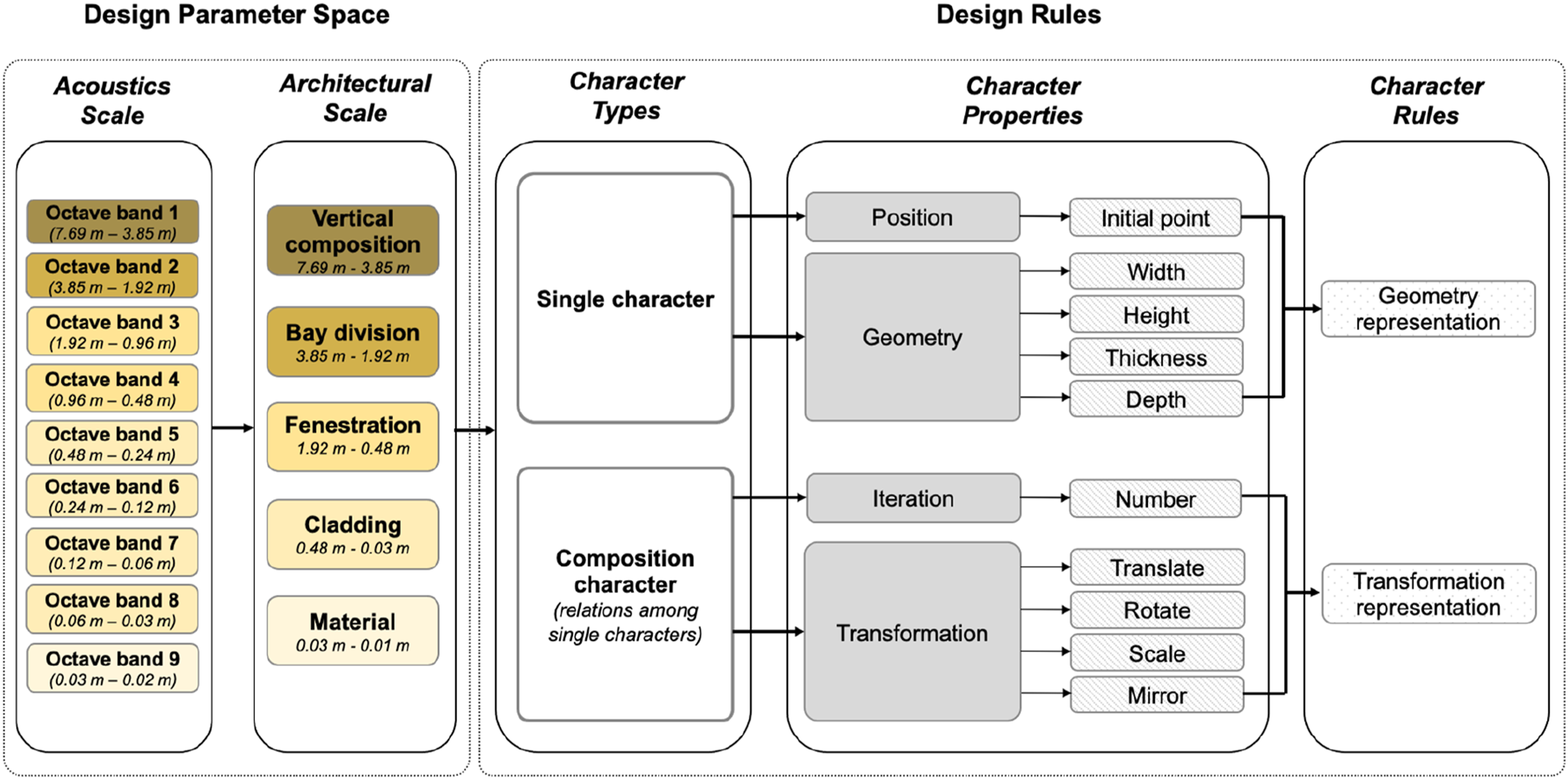
Design parameter space
Acoustic scale and samples
The acoustics scale is expressed by using the wavelengths of the 9 octave bands from 63 Hz to 16 kHz which cover the human hearing range of frequencies (roughly 20 Hz to 20 kHz). Frequencies are multiplied with a factor of 2 from octave to octave, which also correspond to the octave intervals on a piano keyboard. The wavelengths, accordingly, cover a range from 2 cm to almost 8 m. The wavelengths of sound incident on a surface play a crucial role in the analysis of the reflection of scattering. As mentioned in the introduction, the interaction involves the periodicity of sound waves and their projection of wavelengths onto the surface structure, as shown in Figure 3. Each time the projected wavelength matches the structural period, a kind of coincidence and phase-matching occurs, thus leading to a prominent sound reflection into this specific direction. Projection of the incident soundwave wavelength λ on a periodic surface with a structural wavelength Λ.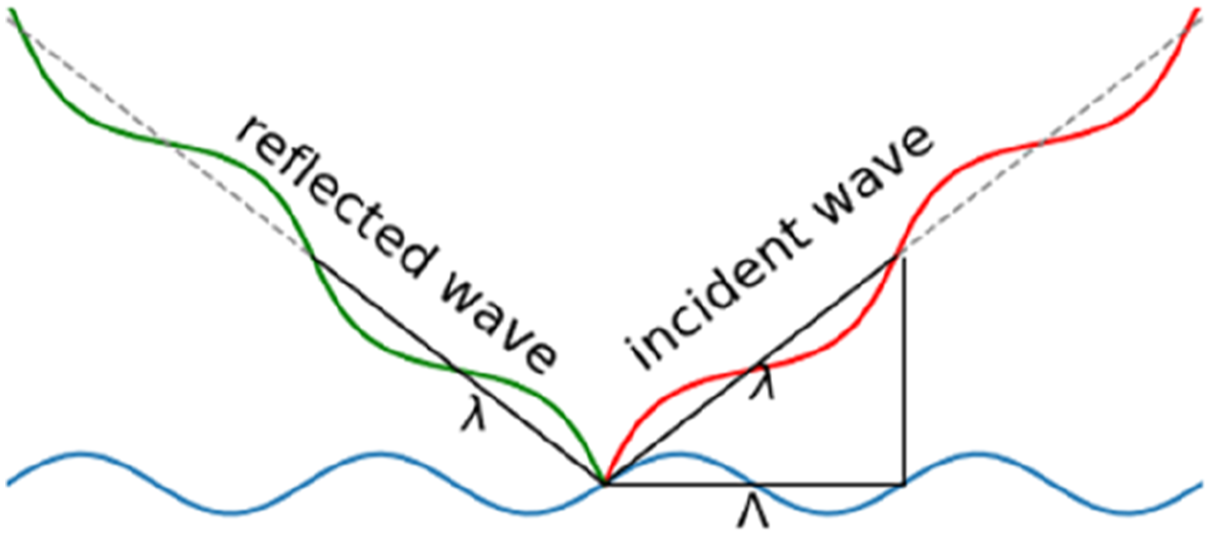
We study this effect by using numerical and experimental methods where surface samples are irradiated with sound from specific incidence angles. The sound scattering pattern is then determined by computation or measurement and analysed in its directional characteristics. Actually, the samples shall represent surface shapes of infinite extent. This approach is valid as long as roughly minimum 10 repetitions are present in the actual façade structure. By doing so, we can obtain representative surfaces in various scales. The only reference which determines the absolute scale is the wavelength of interest.
Accordingly, real-scale samples for the lowest octave band of 63 Hz, would have repetitions of several meters, and for the highest octave band have repetitions of just a few centimeters. The same result, however, can be obtained by setting the surface shape sample to a fixed size which is easy to handle in measurements, and to scale the wavelengths (frequencies) to match the desired ratio of the sound wavelength, λ, divided by the structural repetition size, Λ. In the following, frequencies and wavelengths on the one hand, and structural repetition on the other, are discussed on the basis of this ratio.
Architectural scale
The metrics of wave lengths allow for mapping the octave bands to an architectural scale that represents façade dimensions. The octave band 1 corresponds to vertical composition of a façade, which defines the vertical arrangement of floors of adjacent levels. The vertical composition of a building varies depending on its function and design, yet it mostly changes within the metrics of octave band 1, 7.69 m to 3.85 m. The octave band 2 defining a range between 3.85 m – 1.92 m corresponds to bay division of a façade. The bay division refers to the visual separation of the façade into distinct sections or bays, which can relate to how rooms are organised inside. The octave bands 3 and 4 conform to fenestration scale of a façade in the range between 1.92 m – 0.48 m. The fenestration describes the arrangement, design, and placement of windows, doors, and other openings in a façade. The octave bands from 5 to 8 are combined to describe cladding design space of a façade from 0.48 m to 0.03 m. The cladding comprises the outer layer or covering of a building’s façade, typically made of materials such as stone, brick, metal, glass, or composite panels. Finally, the octave bands 9 and 10 correspond to the material scale which is in the range between 0.03 m – 0.01 m. Material scale includes the texture and pattern of the cladding elements and the ornaments used in the façade design.
Design rules
The concept of rule-based characterisation framework is inspired by the computational design theory of shape grammars. 36 A shape grammar formalises the relations between 2D or 3D shapes within rules that are represented by algebraic notations. A shape rule defines a transformation of a shape S into S,′ which is represented as S → S′. The right arrow symbol (→) denotes the replacement of S by S′. In a shape grammar, a right arrow (→) formalises all kinds of transformations that change S to S′. As this formalism allows for encoding basic shapes into much complex ones that even cannot be foreseen, 29 we propose to use such a formalism to decode underlying spatial relationships of relatively complex façade designs.
Algebraic notation and its technical implementation
Our notation system depends on a set of operators (Figure 4). The operator symbol (:) notation denotes the assignment of a value. The symbols, that are shown in parenthesis, denote recursive (⋅) or simultaneous (◦) rule application, as well as the bi-conditional (↔), transformational (→) and conditional relations (∥) among rules. The transformation (→) is applied onto another rule that is shown within parenthesis symbol (()). These symbols enable to combine single rules like translation functions along X, Y, Z axes (tx, ty, tz) and rotation functions (rx, ry, rz) about the X, Y, and Z axes recursively (⋅) or simultaneously (◦). This methodology was firstly introduced as Fabrication Grammars, which extended the rule-based computational making to adaptive fabrication systems.
42
For the purpose of analysing façade compositions, we include translation, rotation, scale and mirror operations and these operations as well can be combined recursively (⋅) or simultaneously (◦). Adapting this methodology to capture characteristics of building façades shows the versatile computational capabilities of such a rule-based system. The rule-based characterisation framework enables to describe façade characters by way of rules. The rules become configured based on an algebraic notation system. This notation system consists of a set of operators that define the relationships between rules and two types of formation for rules that describe the spatial relations of a façade character.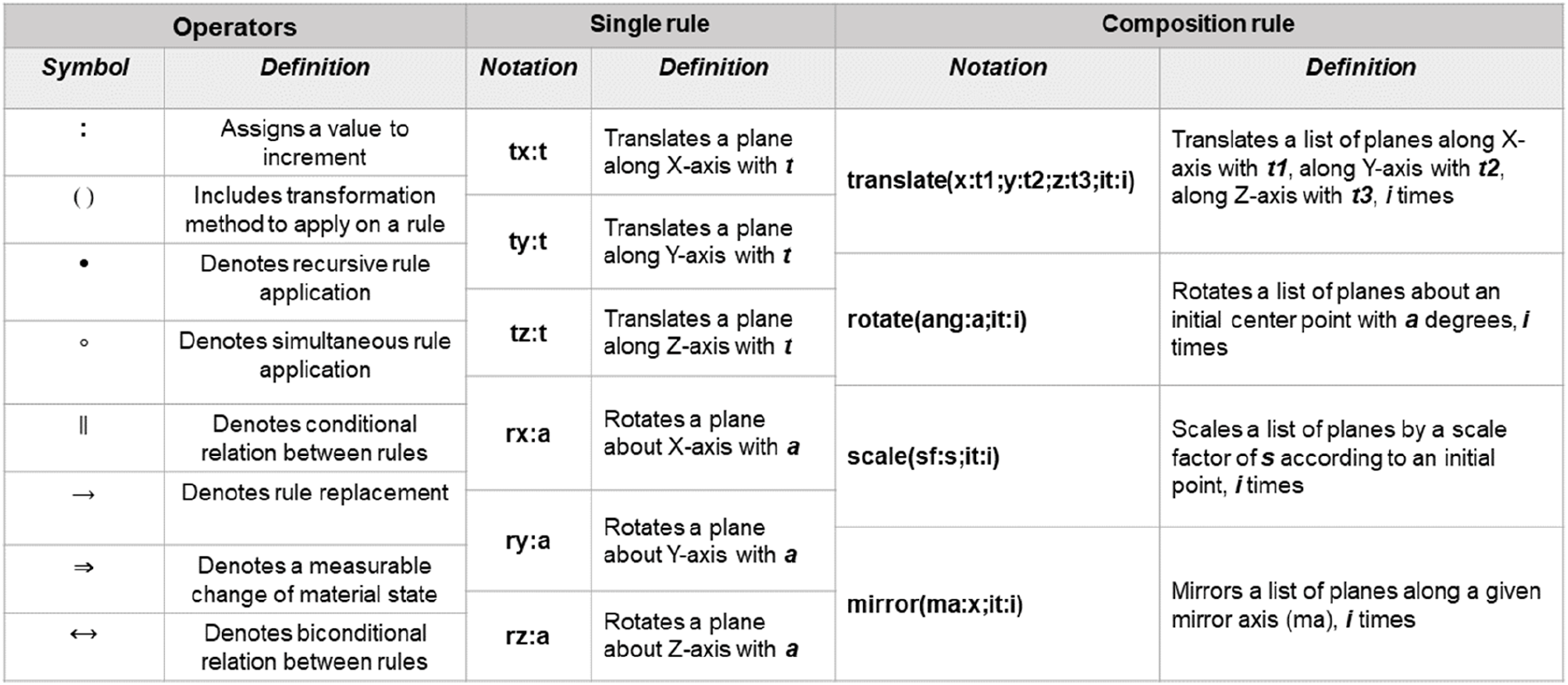
We implemented the algebraic notation system by developing a rule compiler as an add-on software that works in Grasshopper,
43
a visual programming interface integrated in the widely used computer-aided design software Rhinoceros.
44
This add-on provides custom-designed components to generate façade representations in the forms of rules. For example, Figure 5(a) shows the unique precast concrete elements of Façade-2, along with a 3d model as seen in Figure 5(b). First, the Rule Generator component produces rule notations describing the precast concrete geometry as a single façade character (Figure 5(c)). The generated rule notations represent the spatial relationships of Façade-2, enabling its characters to be constructed at any location and in any number. (a) Photo of Preston Bus Station, showcasing the uniquely curved precast concrete elements (photo credits: Gareth Gardner) and (b) its 3D model. (c) The custom-developed software add-on comprises components that capture the spatial relationships in a rule structure based on algebraic notations. 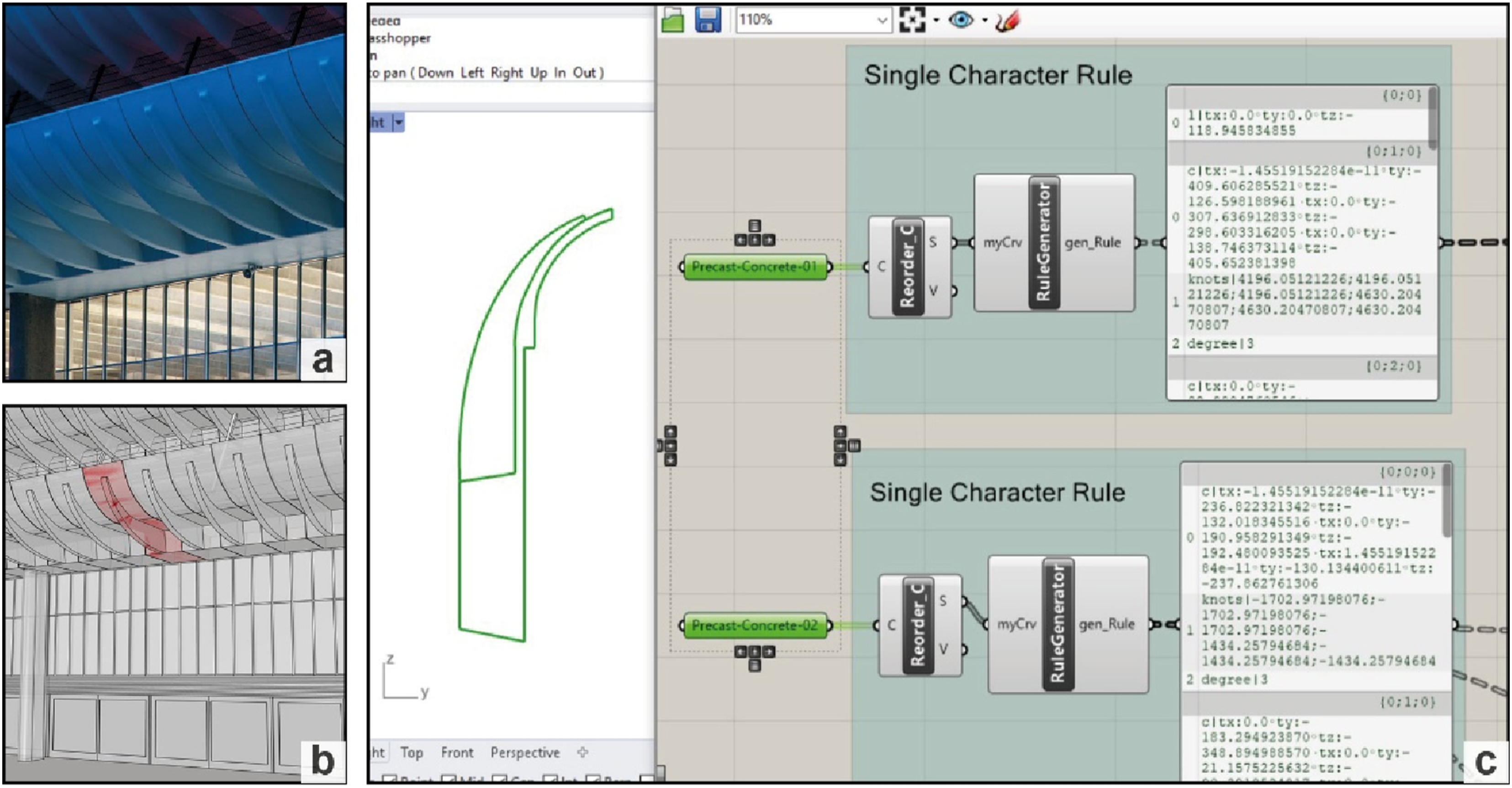
Figure 6(a) shows how the generated rule notations were used as an input into Plane Generator (PLN_Gen) component. This component automatically creates essential planes of the character geometry, which were then visualized by Geometry Visualization (Geo_Vis) component. Composition Encoder (CompEnc) component applied iterative transformations to the previously created essential planes based on a composition rule that describes the periodicity, as seen in Figure 6(b). Finally, Figure 6(c) demonstrated overall façade visualization which was computed by Composition Geometry Visualization (Geo_Vis_Comp). The custom-developed software add-on enables the conversion of algebraic rule notations into computational representations of (a) single façade character geometries and (b, c) their composition. The selected components in Grasshopper interface are highlighted and they correspond to the geometry visualised on the left-hand side of each image.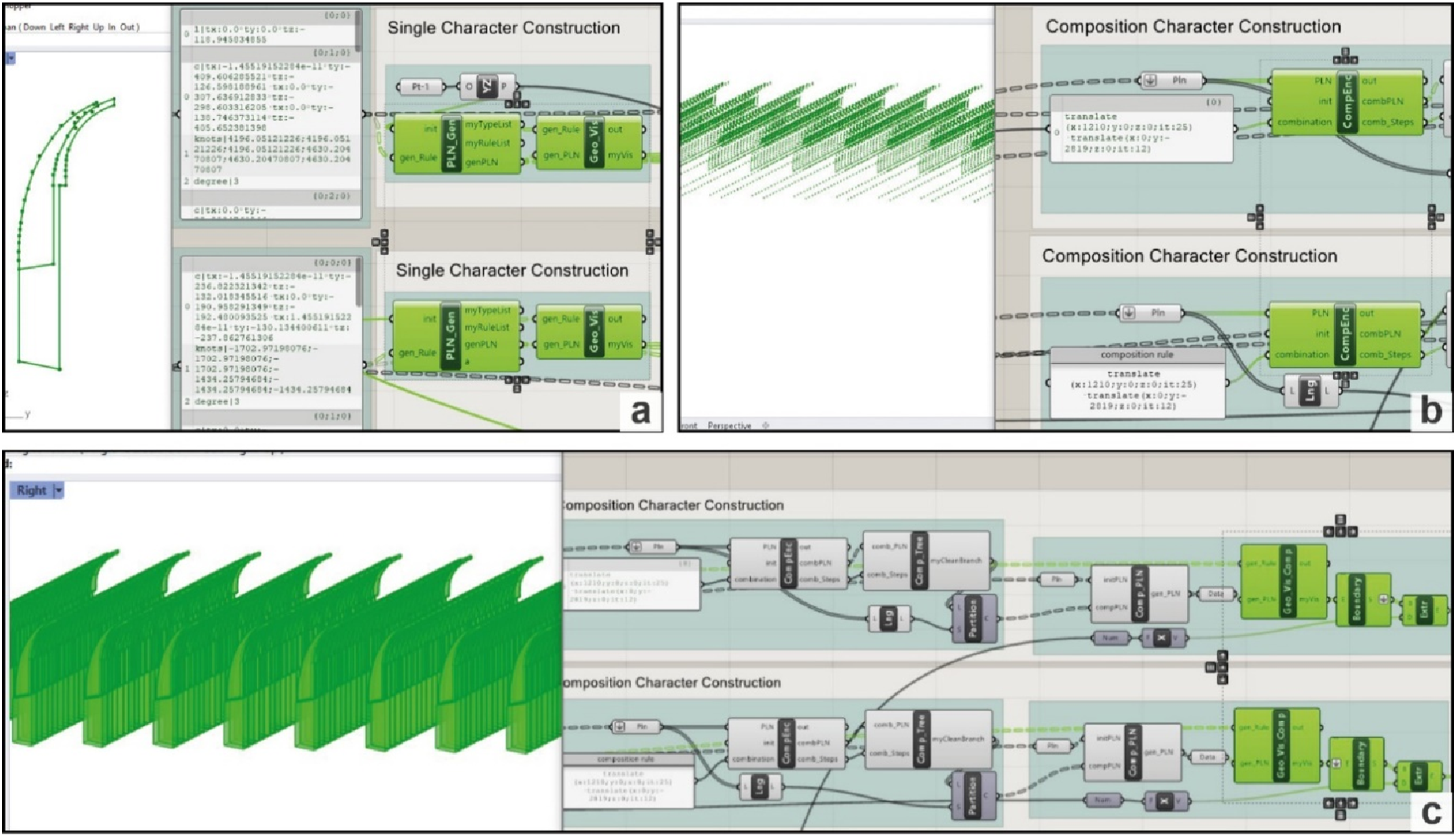
Single character rule
A single character rule defines the spatial relationships of a façade element, such as window frames, lodges, or cladding elements. First, an initial reference point should be defined for the overall façade to describe the position of each single character relative to it. Consequently, the relations among single characters of a façade become preserved. Figure 7 shows that the reference point (init), which was defined to be the same as the initial point for the roof seal character of the Façade-1. Subsequently, the initial point for every other single element was described relative to this reference. Façade-1 consists of five single characters, excluding the window frames, in instances where all the shutters are closed. These single characters are the roof seal, the roof beam, the larch frame, and the planks which form the front and the back shutters. It should be noted that the roof seal and roof beam, as they do not repeat in the façade design, are not relevant façade characters for the acoustic scattering simulations. However, they may be relevant in other design-related scenarios, so the rules for each single character rule were described in table. The top image demonstrates the selected initial reference point (init) and labels for the single characters of Façade-1. The table at the bottom illustrates the rule-based single and composition character analysis for Façade-1.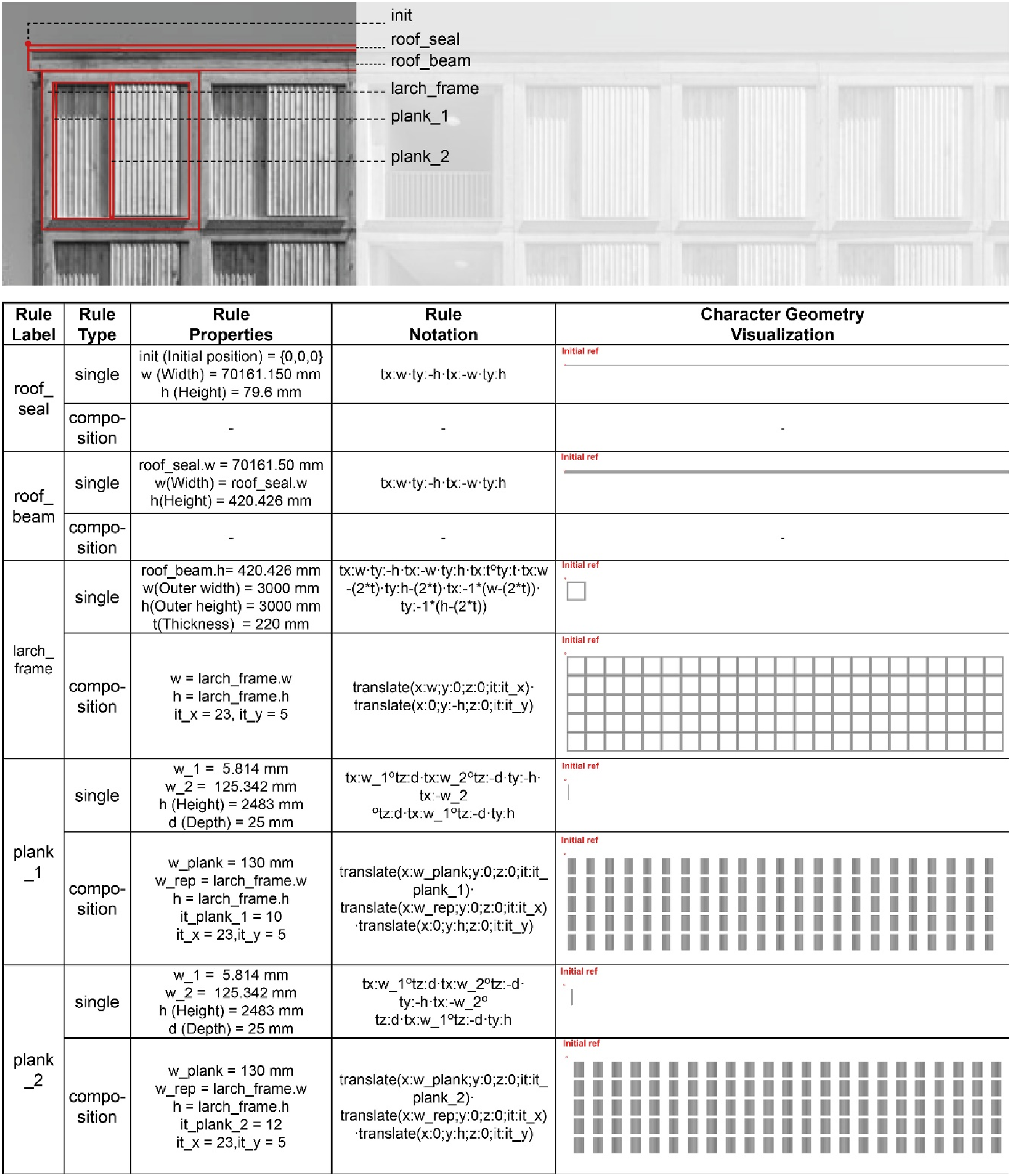
The roof seal, for example, represented a basic longitudinal rectangular character of the Façade-1. It had three properties: the initial position (
Façade characters constitute of linear geometries are relatively straightforward to describe as explained above. The rule notations can be even written manually based on the measurements of the character geometry. For example, Figure 8 (left) demonstrates how the rule lists described the geometri of larch frame character in Façade-1 (left) and precast concrete character in Façade-2 (right). The larch frame character had a rule list, denoted as The rule list for the larch frame character of Façade-1 was denoted as 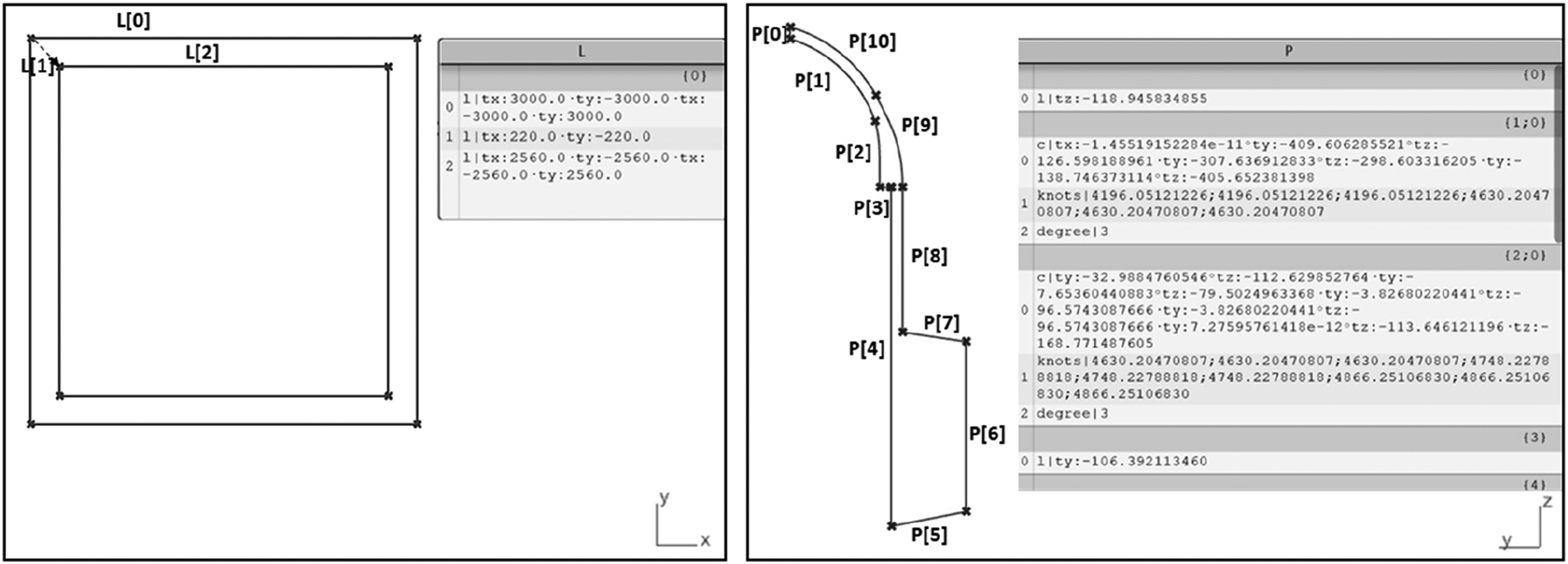
While
However, we need more information than the distance for describing the curves. Therefore, we developed an algorithm that decodes points, knots and degree of a curve. The points, known as control points, determine the general path and shape of the curve. The knots are values that assign parameterization to the curve, helping to control how the curve interpolates between the control points; they essentially influence the curve’s progression along its length. The degree of the curve refers to the mathematical degree of the underlying polynomial function. By calculating the distance between the points of a curvilinear segment, the points are represented in the form of:
Previously mentioned custom developed Grasshopper component, Rule Generator (Figure 5-(c)), combines the linear and curvilinear rule formalisms and recursively adds the rules into a nested list. Subsequently, these nested lists are used to construct and reconstruct the character geometry that these rules are capturing.
Composition character rule
A composition character rule describes how a single façade element is repeated within the overall façade structure. By using the algebraic operators together with translate, rotate, scale and mirror operations, the designer defines the repetition of a single character in a façade design. Façade-1 comprised three composition characters that represent the repetition of the larch frame, as well as the oak planks for both the back and front shutters. The composition rule, defined as
Reconstruction rules
A reconstruction rule describes how single and composition rules should be adapted according to the constraints of a design space, which in our case are acoustic constraints. For instance, when the sound wavelength exceeds the repetition distance of a façade element, its geometric characteristics become irrelevant for sound reflection. Consequently, irrespective of its geometry, that element behaves as a flat surface. The reconstruction rules control then which surfaces should become flattened, thereby dynamically reconstructing the façade geometry depending on the acoustic constraints. For example, Figure 9 shows the reconstruction rules for the single character Reconstruction rules dynamically adapt the design rules of façade characters based on the design parameter space constraints.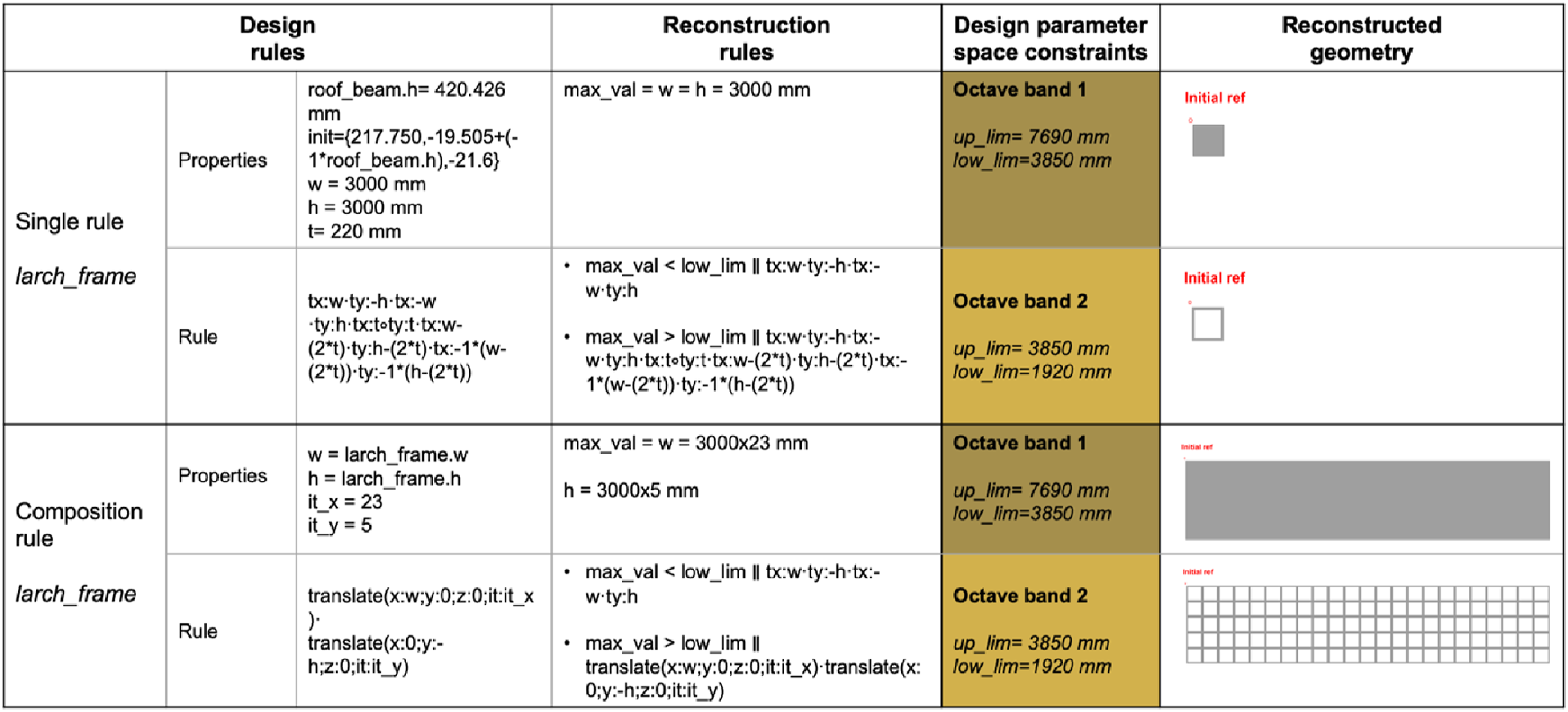
Acoustically informed design and fabrication workflow
The acoustically informed design and fabrication workflow, as illustrated in Figure 10, introduces a novel approach that empowers designers to encapsulate essential design characters within a set of rules, by using the algebraic notation system described in Section 3.2.2.1. These rules serve as the foundation for a multi-faceted process: Acoustically informed design and fabrication workflow. (a) Form and fabrication toolpath simulation: The rules are not static but dynamic entities. They enable automatic form and toolpath simulations of initial design concepts. By assessimg both, designers then refine their design ideas, captured in rule formalisms. (b) Fabrication program generation: Once a design idea is refined, the rules generate a robot program that controls the fabrication of façade samples. By examining the outcomes, designers gain insights into the intricate interaction between the material and the fabrication tool. This knowledge feeds back into the design process, with rules being adapted to account for the affordances and constraints of both materials and fabrication tools. (c) Acoustic data integration: The workflow integrates acoustic simulations into design processes. These simulations yield sound scattering descriptors, which represent the acoustic properties of the design. These descriptors are then embedded in the rules as constraints, thereby includingacoustic behaviours as a part of the design. (d) Physical acoustic testing: To validate the design’s acoustic performance, physical samples are fabricated for acoustic tests in real-world scenarios. The results of these tests allow for comparing and refining sound scattering patterns, ensuring that the final design aligns with the desired acoustic performance.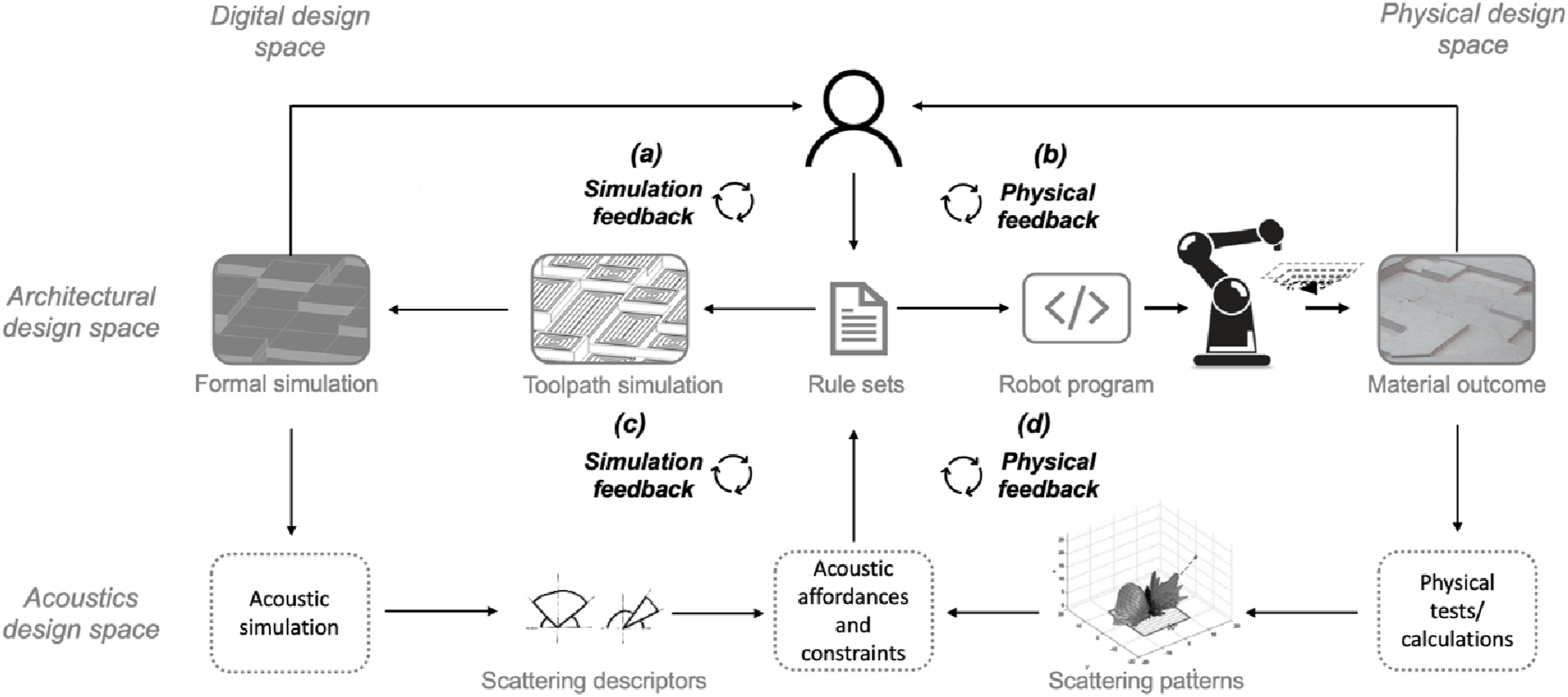
The acoustically informed workflow not only aims to streamlines the design and fabrication processes but also ensures that acoustic properties are proactively considered and optimized throughout the entire design process, resulting in more comprehensive and effective solutions to urban acoustics. It should be noted that this paper focuses on only the simulation feedback loop
Results
In this section, we present our results demonstrating how the rule-based characterisation framework allowed for capturing and dynamically reconstructing façade designs based on the given acoustic constraints. We created acoustic samples with the reconstructed geometries for sound scattering simulations.
Dynamic reconstruction of façade designs
Façade designs dynamically changes with sound wavelengths as the reconstruction rules adapt the single and composition rules of façade characters. As explained in Section 3.2.3, by adapting the character rules, the reconstruction rules modified the spatial relationships within the character geometries. For example, the first row of Figure 11 showed how the overall façade became one single surface because the sound wavelength in octave band 1 (7.69 m – 3.85 m) was too large to hit the façade characters, such as the larch frames (width and height 3 m) or the repetition of the frames (at each 3m). As there was no repetition of any character, no acoustic sample was produced. On the other hand, the sound wavelength in octave band 2 (3.85 m – 1.92 m) could hit the larch frame structure, so the façade reconstruction with this character and the circular acoustic sample was shown in the second row of Figure 11. The first and the second rows of Figure 12 showed how the individual precast elements repeating at every 1.23 m become reconstructed as one continuous surface because the repetition distance is smaller than the sound wavelength thresholds in octave bands 1 and 2. Moreover, all cladding elements of Façade-2, except the ones support inclined glazing repeating at every 4.182 m, became completely flattened. Reconstruction of Façade-1 across the octave bands of the acoustic scale. Rule-based representation allowed for the flattening of façade geometries when the sound wavelength in the chosen octave band surpassed the size and repetition distance of the façade character. Reconstruction of Façade-2 across the octave bands of the acoustic scale.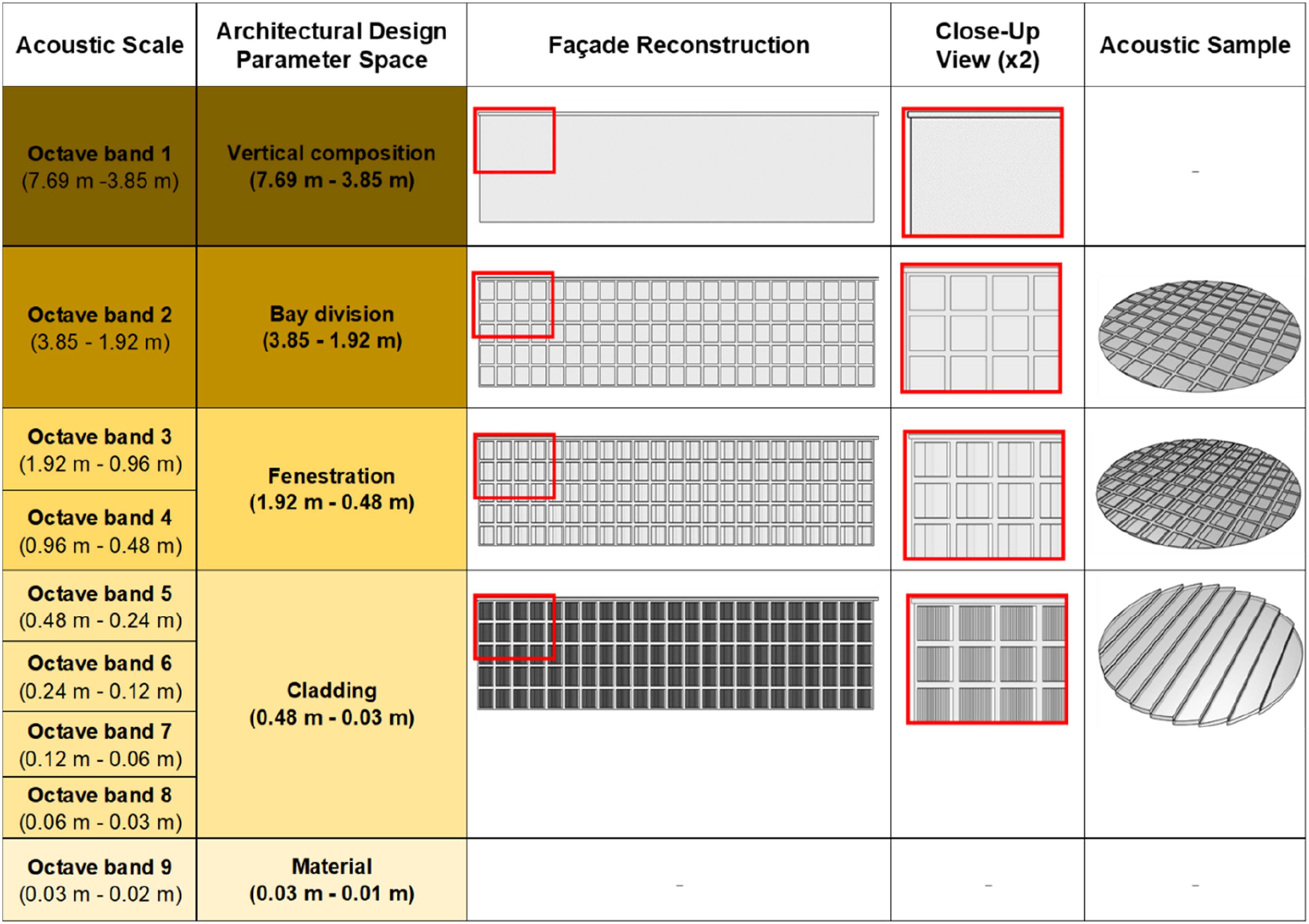
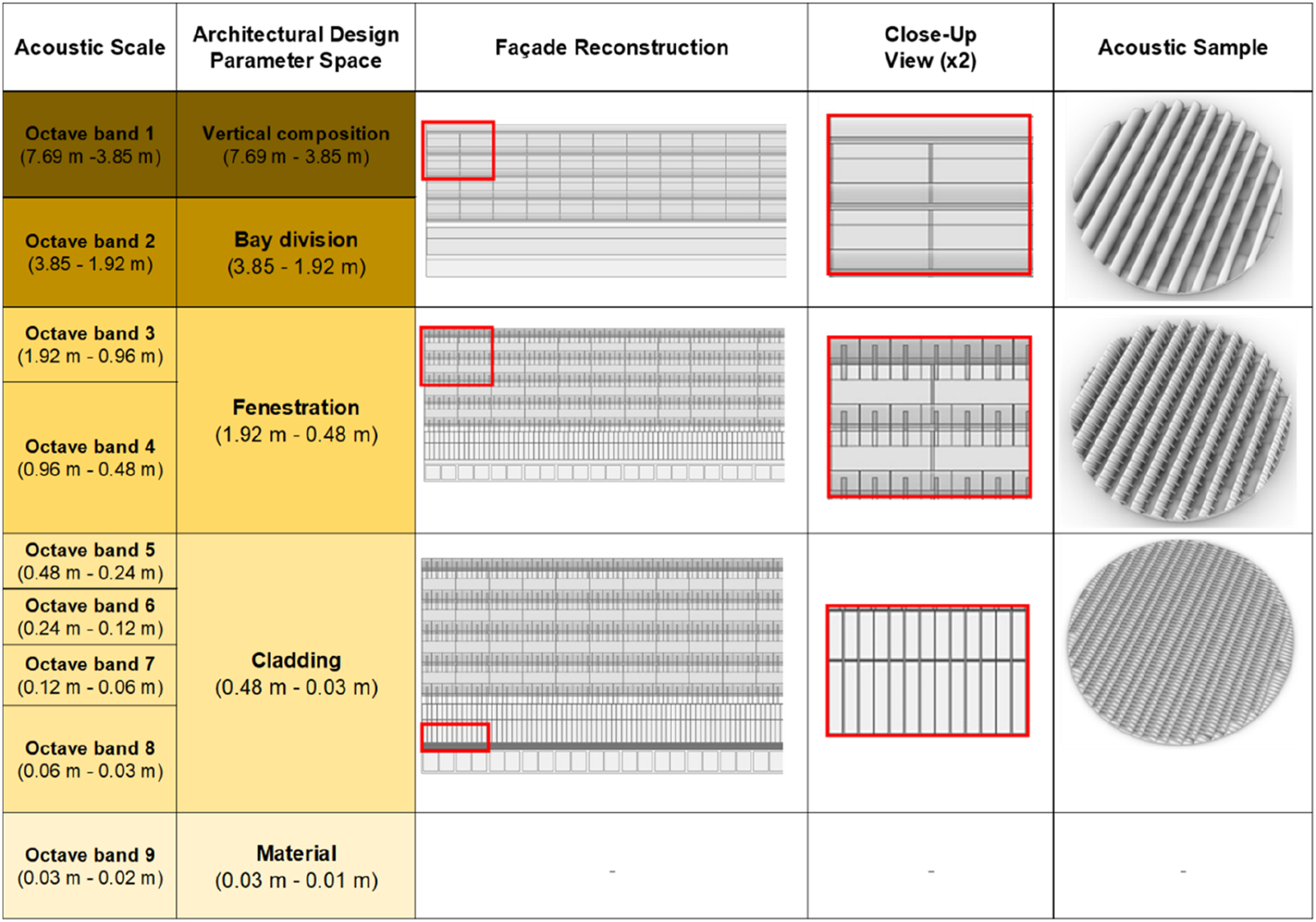
The third and the fourth rows of Figure 11 demonstrated how the sound wavelengths in octave bands 3 (1.92 m – 0.96 m) - 4 (0.96 m – 0.48 m) were small enough to hit the shutter surfaces yet surpassed the width and the repetition distance of the oak planks. Consequently, the shutters at the front and back were represented as flat surfaces, reconstructing a character composed of two levels of rectangular prisms, which did not originally exist in the actual façade. The repetition of this new geometry was also captured within a circular acoustic sample (Figure 11, fifth column, third row). The third row of Figure 12 showed the individual precast elements which would scatter and reflect the sound in octave band 3 and 4, so the acoustic sample included these elements.
Moving through the octave bands involving smaller sound wavelengths corresponding to the cladding architectural scale listed in Figure 11, the plank characters involved in sound scattering and reflection as well. As a result, the overall structure of the original façade was reconstructed, and the repetition of plank character became represented in an acoustic sample. Similarly, Figure 12 demonstrated the composition of cladding elements became relevant as the wavelengths decreases. As a result, the precast concrete elements and cladding grids were represented in the acoustic samples. The rules dynamically reconstructed façade designs across the octave bands. The rule-based definition of geometric characters provided this modification based on the design parameter space constraints, e.g., the sound wave lengths in the use case of urban acoustics.
Acoustic simulations
The Boundary Element Method (BEM) was employed to computationally model the reflected sound pressure from the sample. The simulations were conducted across a range of nine values of λ/Λ (wavelength in air-to-surface-wavelength) per octave, and subsequently, the sound pressure average for each octave band was calculated. The results are presented in Figure 13, which illustrates the reflected sound pressure behaviour for the cladding sample of Façade-1 under a fixed incident direction across different octave bands. Reflected sound pressure for cladding sample of Façade-1 for (left) octave band 5, with Λ/λ = 0.5, (middle) octave band 6, with Λ/λ = 1, (right) octave band 7, with Λ/λ = 2.
As expected, the result reveals that in octave band 4, the sound reflection was characterized by predominantly specular behaviour. Octave band 6 exhibited a noteworthy increase in scattered sound pressure into directions outside of the “specular lobe”. Furthermore, the findings for octave band 7 indicated an even more pronounced scattering effect, with sound energy propagating in multiple directions. In contrast, Figure 14 shows the reflected sound pressure for the bay division sample of Façade-1, located in the octave band 3 category, which is the upper octave band for this category. Due to the rather small depth of the surface structure, the sound was only specularly reflected and not scattered. This behaviour is very similar for the other octave bands, namely the sound is not scattered but specularly reflected. Reflected sound pressure for bay division sample of Façade-1 for octave band 3, with Λ/λ = 2.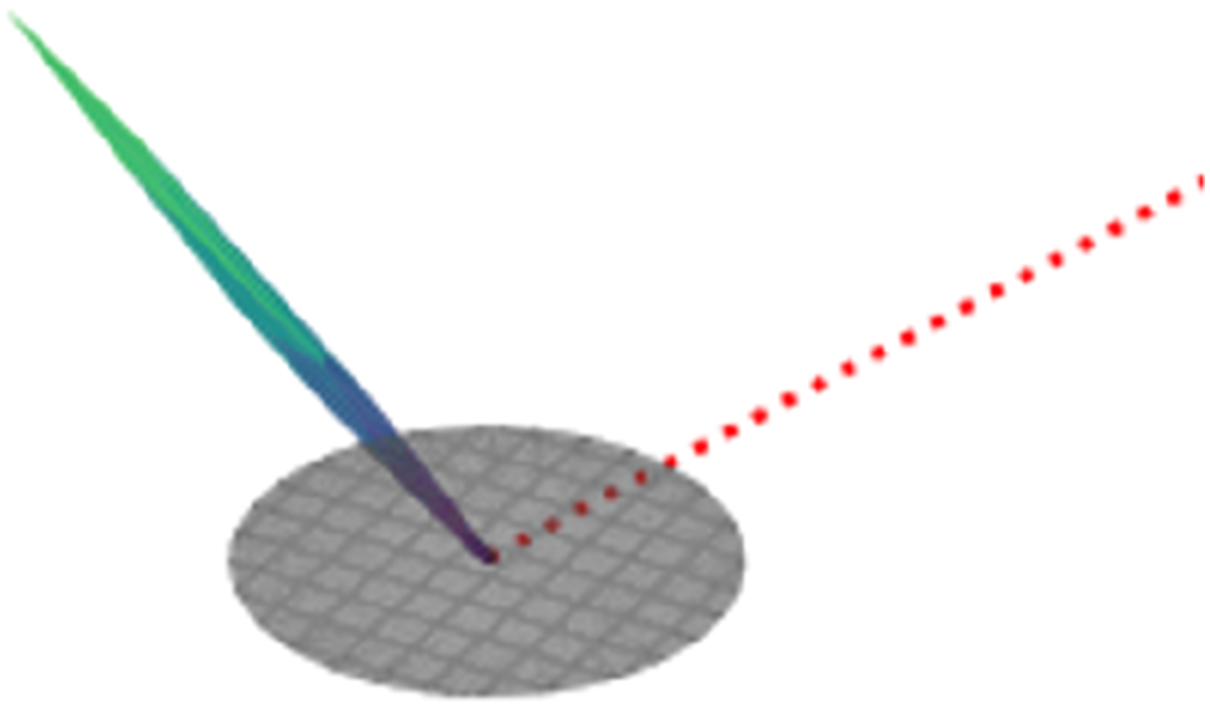
Figure 15 shows the reflected sound pressure of the bay division sample from Façade-2. In comparison to Façade-1, the reflective characteristics appeared similar for the lower octave band 4, but diverged for the remaining octave bands. The bay division sample from Façade-2 provided less scattering. In contrast, Figure 16 illustrates minimal specular reflected sound, which means the sound was scattered for all presented octave bands. This could be due to the complexity, the large depth and the protrusion of the surface structure. Reflected sound pressure for cladding sample of Façade-2 for (left) octave band 3, with Λ/λ = 0.5, (middle) octave band 4, with Λ/λ = 1, (right) octave band 5, with Λ/λ = 2. Reflected sound pressure for bay division sample of Façade-2 for (left) octave band 1, with Λ/λ = 0.5, (middle) octave band 2, with Λ/λ = 1, (right) octave band 3, with Λ/λ = 2.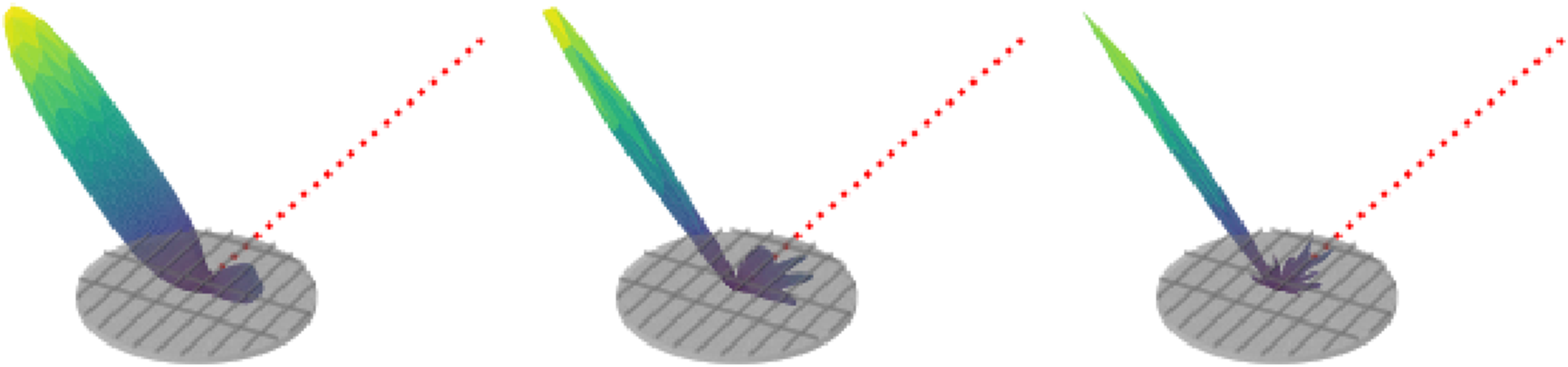
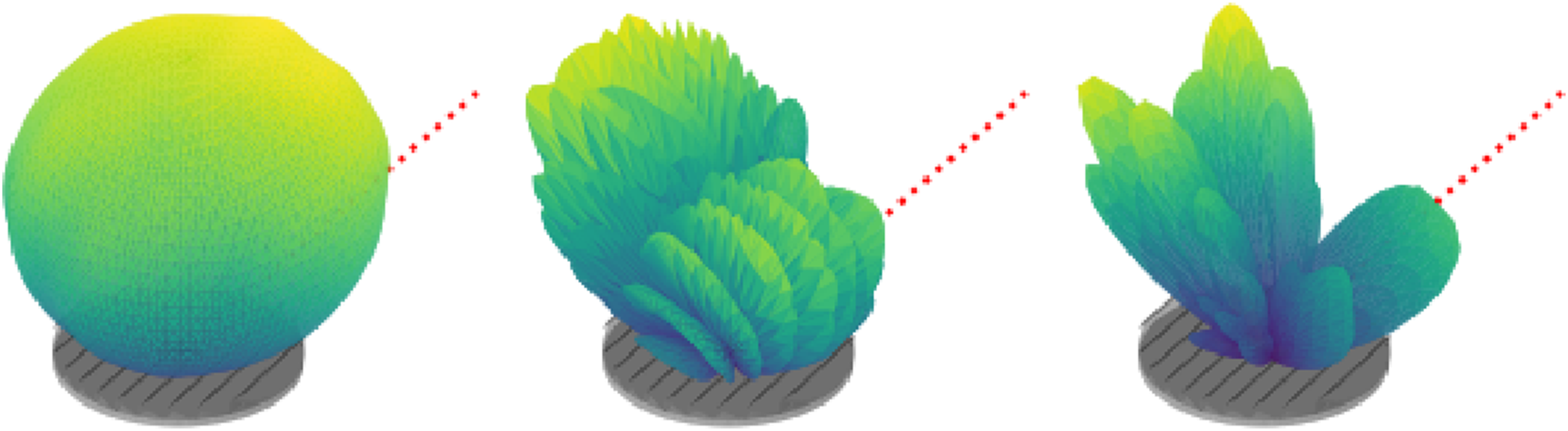
This pronounced difference between the presented results highlights a crucial point: the nature of sound scattering is not only based on the Λ/λ ratio, but also by the intrinsic characteristics of the sample’s surface structure, e.g., geometry of façade characters. In this case, the depth of the surface is much smaller relative to the surface wavelength Λ, so that there is not scattering for the presented octave bands. Conversely, when the surface depth is relatively large, significant scattering occurs for all presented octave bands. These findings underscore the importance of considering the specific surface structures when evaluating sound scattering phenomena.
Discussion
Based on the results presented above, first, we discuss how our novel rule-based approach allows for more fluent collaboration amongst domain experts from architecture and acoustics. Later, we reflected upon how the rule-based representation of geometry empowered a lightweight and scalable analysis of architectural acoustics.
Bridging the gap between architecture and acoustic design spaces
The rule-based characterisation framework integrates the urban acoustic constraints into architectural design, thus merging these separated processes in one single workflow as seen in Figure 10. The algebraic notation of rules (Figure 4) provides a basic structure to encode design and acoustic constraints in the same format, so that these rules can be combined at will. The reconstruction rules (Section 3.2.3, Figure 9), then allowed for dynamic reconstructions of façades across various acoustic parameter spaces, namely octave bands, incorporating the spatial impact of the design form in sound reflection and scattering. The priliminary developmet of a Grasshopper add-on shows the potential of design tools that integrate urban acoustics into design. In addition to the application fields of structural optimization, 37 creative exploration, 30 educational empowerment, 34 heritage preservation, and cultural conservation,38,39 our study proved the power of rule-based systems within the realm of architectural acoustics.
Towards lightweight and scalable representations of geometry
Rule notations provide easily computable representations of façade geometries without heavy geometric data, e.g., meshes. Since these notations represent the façade geometries as strings of text (seen in Figures 11 and 12), computations with such data is significantly faster than those with geometric data. Opting for strings of text, i.e., rules, over geometric data in computing façade geometries, especially when data must be redefined frequently (e.g., at various wavelengths), has several advantages. Rule notations are inherently more flexible and less complex in structure than geometric data. As a result, they allow for easier modification and redefinition. This simplicity in manipulation reduces the computational overhead and complexity of geometric data, which often requires recalculating multiple coordinates and relationships between points, lines, or shapes. Additionally, string data storage is typically more compact and less demanding in terms of computing memory, further enhancing its suitability for applications that demand agility and efficiency in data handling and processing.
We believe that such lightweight and scalable geometric representations established by rule notations promises an efficient and flexible design, analysis, and visualization across various contexts and scales in both architectural and acoustic design spaces. This is especially important in fields of architecture and engineering where detailed representations can be resource-intensive, and models need to be adaptable to different scales.
Conclusion
We present a novel rule-based characterisation framework for analysing spatial relations of building façades within the case of urban acoustics. This framework relies on two concepts: the design parameter space and the design rules. The design parameter space involves the constraint sets for both acoustics and architecture, while the design rules describe the single and composition characters of façades. This paper presents an algebraic rule notation system and a grammatical compiler software that converts geometric characteristics of facedes into rule notations. An acoustically informed design analysis established by way of rules since these rules dynamically changes according tothe acoustic constraints, thus integrating acoustic information and analysis into design in one single workflow. Subsequently, we demonstrated the design capabilities of our rule-based approach by combining rules to dynamically reconstruct façade characters for various sound wavelengths. Our findings indicated the effective capture and reconstruction of façade geometries without heavy computation or mathematical executions. We posit that this innovative rule-based approach enables designers to articulate their preliminary design concepts using a formalism that’s flexible across different dimensions, like urban acoustics, and to reshape the design consistently throughout its evolution.
Footnotes
Acknowledgements
We would also like to express our gratitude to Jonas Kempin for his diligent work in collecting information and drawings of façades, as well as to students, Tina Rahmani and Doğa Su Kiralioğlu, for their contributions to the modeling of the selected façades.
Declaration of conflicting interests
The author(s) declared no potential conflicts of interest with respect to the research, authorship, and/or publication of this article.
Funding
The author(s) disclosed receipt of the following financial support for the research, authorship, and/or publication of this article: This study is supported by Deutsche Forschungsgemeinschaft (456072683). The acoustic simulations, presented in the paper, were performed with computing resources granted by RWTH Aachen University under the project rwth1245.
