




Abstract
Parametric design and gamification rely on quantitative factors that can be easily translated into computer language. However, measuring and quantifying the complex urban qualities poses a challenge. This leads to the question of how to incorporate complex spatial quality into parametric design. This research, therefore, proposes a method to parametrize and quantify urban qualities by extracting main spatial qualities from three main sources, developing a comprehensive list of qualities that can be effectively parametrized, breaking them down into more tangible parameters, and assessing their interrelations within a system model. The results reveal that although urban qualities are complex, they are better defined and parametrized when their relations and originating factors are fully investigated. Furthermore, qualities are classified according to their degree of connection to other qualities within the system model and the nature of these connections. This classification results in six categories: Main Instigator, Mediating and Consequential qualities, as well as Minimally, Moderately, and Highly connected qualities. This research contributes to urban parametric design by providing a method to parametrize urban qualities and gamification fields, allowing developers to implement city complex qualities into the games.
Introduction
Converting urban or architectural qualities to qualitative parameters and categorizing them into a tangible quantitative assortment was a trend that followed the modernism movement and parametricism. 1 However, postmodernism, a cultural and context-based style, criticized this over-emphasis on the quantification of qualities. 2 In other words, proponents of postmodernism argued that qualities could lose their rich meaning when assessed or attached to numbers. Assigning numbers to a neighborhood’s qualities or its architectural space design, for instance, would be quite complicated and, in some cases, impossible. A lot of parametric architecture and urban design crises are entrenched in the issue that place qualities cannot be quantified. 3 However, computers inevitably play a significant role in the contemporary design process, and parametric design is expanding. 4 Parametric design cannot incorporate these qualities since it is tailored for fragmented, repeatable, and measurable parameters.5–8 Another issue is that since urban features are qualitative, it is tough for game developers to incorporate them into game platforms. Games related to urban design mostly focus on quantitative parameters, such as environmental factors like energy efficiency, 9 decarbonization, sustainability, 10 and urban/physical design factors 11 since these aspects are tangible, and players can change them and see the results in real time. However, qualitative and intangible urban characteristics receive less attention on these platforms because it is challenging to conceptualize how players could engage with these parameters, and it is difficult to determine the best approach to score these qualities.
The importance of this research lies in the rapidly expanding of Artificial Intelligence (AI) and the need for quantification and parametrization qualities and provide computers with human-like ways of thinking and analysis. While the field of architecture and urban design has extensively studied built environment qualities, the extent to which this qualitative data can be effectively translated to computers remains insufficiently explored. Therefore, computer games were selected to explore the quantification of these qualities since they are simpler and do not entail the complexity found in architectural and urban design platforms. In reality, the urban environment comprises a multitude of social, cultural, historical, and human-related factors, which further amplifies the difficulty of the task. Through this interdisciplinary research, we seek to make two significant contributions. First, we propose a method to incorporate qualitative data into more tangible and objective parameters, benefiting the field of urban design. This approach opens up new possibilities for understanding and representing urban quality. Second, we hope to increase urban knowledge and awareness among game players and the wider public by combining the areas of gamification and urban design. Buildings and built environment can serve as educational agents to teach the community about sustainability.12,13 Therefore, a game that focuses on the built environment as its main objective can educate and engage the community, prompting them to consider their built environment and sustainability values. This interdisciplinarity promotes a deeper understanding of the complexity of cities and the need for a systematic approach.
To do that this research aims to answer the following questions: What are urban qualities, and how can we parametrize or quantify them? How can we implement these qualities and these quantified parameters on a neighborhood game project? How could we track the relationship between these qualities in the game project? These questions will be answered by exploring possible ways to parametrize urban qualities and define their relationships with each other.
Quantifying qualities and the complexity of urban qualities
Quantitative methods have been believed to confer a measure of scientific authority and legitimacy to research results. However, they also run the risk of ‘‘scientism.’’ In other words, they appear to imitate scientific methods, cloaking results in the objectivity of the methods of the natural sciences. 14 Also, if we want to avoid that these methods become dangerously misleading in complex human-related problems, then we must base them on the careful discussion of the imponderables and on the measurable elements of a total situation.14,15 Descartes’ dualism between the measurable res extensa and the incommensurable res cogitans, which has been a crucial aspect of Western metaphysics, ultimately needs to be reconsidered. It is necessary to acknowledge that quantity is just one of the many qualities, and that all decisions, including those involving measurement, inherently possess qualitative aspects. This shift in perspective calls for abandoning the notion that quantity is the sole determinant of reality and embracing a more comprehensive understanding of qualitative dimension.14,15
More specifically, qualitative and quantitative parameters are different in nature, and they serve various purposes. Quantitative parameters are easy to measure and are based on mathematics. They are repeatable and can easily be validated; however, they are mostly fragmented and need to be attached to meaning. On the other hand, qualitative parameters are consistent, based on interpretations, often very rich, unmeasurable, and unpredictable. They are hard to track and follow, and they are mostly based on context. For the most part, the urban design literature has not attempted to objectively measure and quantify perceptual, phycological, and urban aesthetic qualities; instead, it merely asserts their importance. 16 In other words, qualities could lose their rich meaning if assessed with or attached to numbers. Data that has been stripped of its context does not constitute information, similar to how ‘‘sound bites’’ on television are fundamentally ambiguous, rarely to be taken at face value. 14 Therefore, how would we make built environment qualities comprehensible with the binary logic of computer codes? The first step would be to convert qualities to quantities in such a way as to be understood by computer game logic.
“Quality” in urban design is rife with complexities and pitfalls mainly because there has been no clear, accurate definition used uniformly across the literature. For example, the Cowan Dictionary of Urbanism reveals ambiguities in definitions of urban (design) qualities. It refers to a broad range of vague urban-related factors: (Urban design) quality ‘should not be taken to relate only to the external appearance of buildings and their surroundings. It must also include matters of fitness for purpose, environmental performance, social and economic sustainability, responsiveness to user needs and the aspirations of the local and national community,
17
317)
However, in a move away from the complicated ways of defining the quality of urban design and toward the preparation for action, design qualities can now be defined as urban design principles, dimensions, criteria, elements, etc. For instance, Lynch, 18 in a theory of city form, discusses seven dimensions including vitality, sense, fit, access, control, efficiency, and justice. None of them are single dimensions; all of them refer to a cluster of qualities. In his integrative theory, Sternberg 19 considers the city through components such as livability, legibility, and vitality. These components have broad meanings and refer to a wide range of city qualities. Breaking down abstract and intangible concepts into smaller, tangible elements is a method for defining and measuring complex quality. For instance, the intricate concept of “context” can be deconstructed into various components such as social, cultural, historical, and physical/environmental factors.20,21
In spite of the challenge of defining complex city qualities, and with some negligence and leniency, we could say that the quality of urban design has generally been the answer to the ideas developed over the past 40 years. Urban quality discussion was a response to the challenges and shortcomings of modernism, 22 which have weakened some qualitative aspects of the built environment and have inclined toward measurable and tangible elements. This process changes the core of architectural and urban practices because, unlike quantitative factors (which have a precise definition and can be measured), quality is a comprehensive concept, and it cannot be analyzed without considering and comparing other influential factors.
Gamification and its potential in quantifying qualities
Gamification refers to the “use of game mechanics in non-gaming contexts” 23 to enhance the processes enacted and the experience of those involved. 24 It is “the phenomenon of creating gameful experiences.” 25 It broadly refers to technological, economic, cultural, and societal developments in which reality becomes more gameful and thus it can help participants gain skills, motivational benefits, creativity, playfulness, engagement, and overall positive growth and happiness. 26 The widespread interest that gamification is garnering lies in its potential to strengthen engagement, change behaviors, and support innovation. 27
Research in the gamification field can be categorized into three main domains: (1) theory-driven empirical studies, (2) design methods, and (3) application areas. 28 The first area, empirical gamification research, attempts to answer the blanket question “does gamification work?” by testing a wide diversity of gamified systems with an equally wide range of effect measures.29,30 This research provides practitioners with knowledge that helps them understand and predict how and when a particular design will be effective or not,31,32 pp. 34-39). The second approach, design methods, involves conducting systematic research on challenges, heuristics, tools, and methods around designing gamification.33–35 This method could help researchers determine the type of logic that would need to be implemented in a game platform and how it should be done. Third, the “deepening and extension of application contexts” refers to a vital aspect of gamification design in the context of application: not all activities and contexts lend themselves equally well to gamification.28,31,36–38
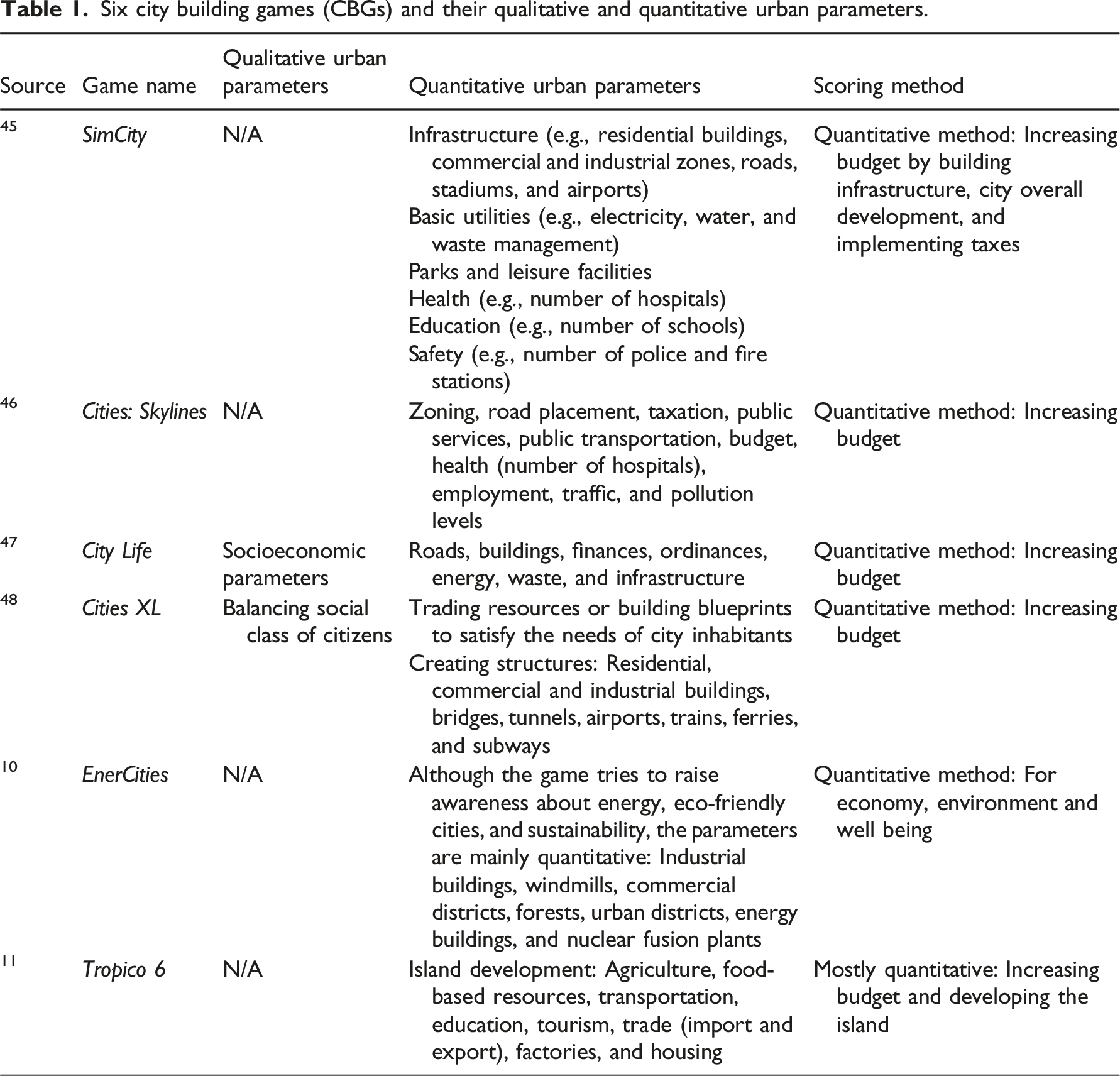
Six city building games (CBGs) and their qualitative and quantitative urban parameters.
Research gap
As reviewed in the previous section, research on urban-related games and gamification focuses on quantified concepts such as Co2 emissions, mobility, energy transition, climate adaptation, traffic, AQI, infrastructure, and physical management of cities because, due to their quantitative nature, inserting them into the game (through binary computer language) is straightforward. In some cases, researchers and game developers have tried to incorporate qualitative factors (e.g., education, health, and safety), but their scoring method was still quantitative, which means, for example, that urban safety was merely relegated to the number of police and fire stations in the city. Moreover, education and health are broad topics that encompass a wide range of parameters; equating these to the number of schools and hospitals in the city is problematic. Moreover, in gamification research, some projects have tried to quantify qualities, but they have merely succeeded in focusing on some quantified aspects individually. This narrow assessment camouflages the qualities’ relationships and the substantial interactions at play. Most of this research proposes measurable indices to assess one specific city quality (e.g., walkability), without addressing other attributes that might directly or indirectly affect this quality.
Method
The methodology consists of three main phases (Figure 1). Its purpose is to facilitate the development of a novel framework that enables the parameterization of complex concepts to a certain extent. To achieve this framework, the following steps must be undertaken. The first phase is the extraction of common overarching qualities in urban and architectural design into domains of concern based on a review of three seminal sources. The second phase of the methodology is the deconstruction of these qualities, extracted from the first phase, into subjective and objective parameters. In identifying these subjective qualities, the researchers aim to understand which objective qualities can satisfy the pure qualitative urban and architectural elements. In the third phase of the methodology, the researchers analyze the relations between qualities using two different analysis grids. This step helps us better define and parametrize qualities since they are assessed in relation to other qualities and in relation to their effect on a whole system. The overall research method and steps.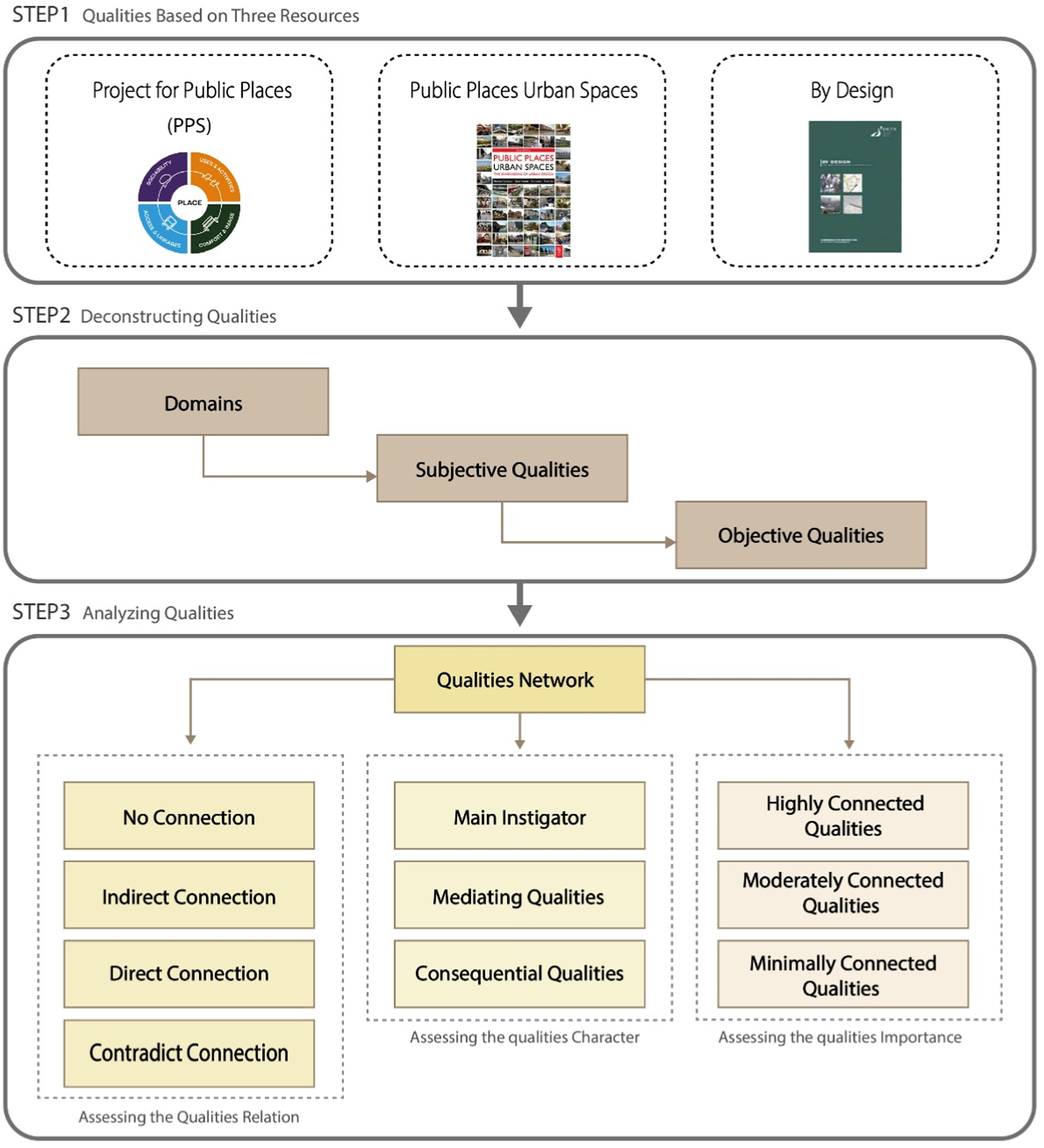
First phase: Extraction of common qualities from three seminal sources
Urban design is an interdisciplinary field by nature since it tackles different and divergent issues under the umbrella of city complexity. Sternberg
19
explains that urban design does not have one certain cohesive guideline, and all urban design guidelines can be correct if they apply properly. These pluralities in determining urban qualities might exist because each urban guideline considers specific urban challenges and tries to respond to them. Hence, attaining a comprehensive urban guideline is nigh impossible due to the complexity of urban issues. In the case of this research, a list of urban qualities that have a high potential for quantification is preferred; accordingly, the researchers have adopted an expert elicitation method to classify urban qualities and develop a framework for urban quality with high potential for parameterization. The expert elicitation team is composed of a panel of four experts (two architects, an urban designer, and an urban planner), including the authors of this paper. The aim is to assess available urban framework that comprehensively categorize urban qualities. These frameworks will enable us to take on a consensus-based approach to synthesizing urban quality, and it will allow us to end up with a comprehensive list of the ones that have more potential to parametrize. Three prominent sources were selected: PPS,
49
Public Places Urban Spaces,
50
and By design
51
These sources were selected according to three criteria: 1. The researchers tried to be more oriented toward theories formed in the cycle between academia (Public Places Urban Spaces) and practice (PPS and By design) with emphasis placed on implementation aspects, and the sources that are cited in several urban projects. 2. The researchers selected sources that are developed both by government (By design) and non-governmental structures (PPS). 3. The researchers prioritized sources that were general, possible to adopt in different contexts, and summarized (By design), and detailed (PPS and Public Place Urban Space). 4. And finally, the researchers adopted sources that are multi-dimensional (Public Place Urban Space), provide guidance (By design), and conceptual model (PPS).
These three selected sources help us narrow down the list of qualities into the domain of concerns in a consensus-based process. A comparative study of each of the indices in these frameworks was conducted to synthesize the main domains of concern. Next, only those domains of concern that could be measured and quantified were selected. The researchers extracted eight overarching domains from the three aforementioned sources. The following criteria are considered for each domain. • The selected qualities need to be homogeneous on one scale and consistent with each other • They should not be subsets of each other or have an overlap • A concept/quality cannot be reduced to another • A concept/quality should not be inferred from another • A concept/quality should not be united with another concept.
Second phase: Deconstructing\translating qualities
Mostly, the urban design literature has not attempted to objectively measure and quantify perceptual, phycological, and subjective urban qualities; instead, it merely asserts their importance. 16 However, environmental conditions and urban qualities can be classified as either “objective” or “subjective.” Objective criteria generally refer to quantitative data, and the majority can be described using various statistics (e.g., percentage of homes vacant in a neighborhood, the average distance from home to a public green space, the amount of green space per inhabitant, traffic volume, and noise).52–54 These criteria have been widely used because they are seen as being more rigorous. 55 On the other hand, subjective criteria are often based on personal feelings, perceptions, and attitudes and are usually qualitative; 56 nonetheless, these criteria can be extremely important to the communities they concern. Furthermore, they may incorporate factors not directly affected by the built environment, which may be outside planners’ control, such as the “neighborliness” of the people living there. Experts in urban planning and design may provide a middle ground for identifying factors thanks to their training in objective factors combined with their experience working with urban communities and, therefore, their familiarity with more subjective factors.
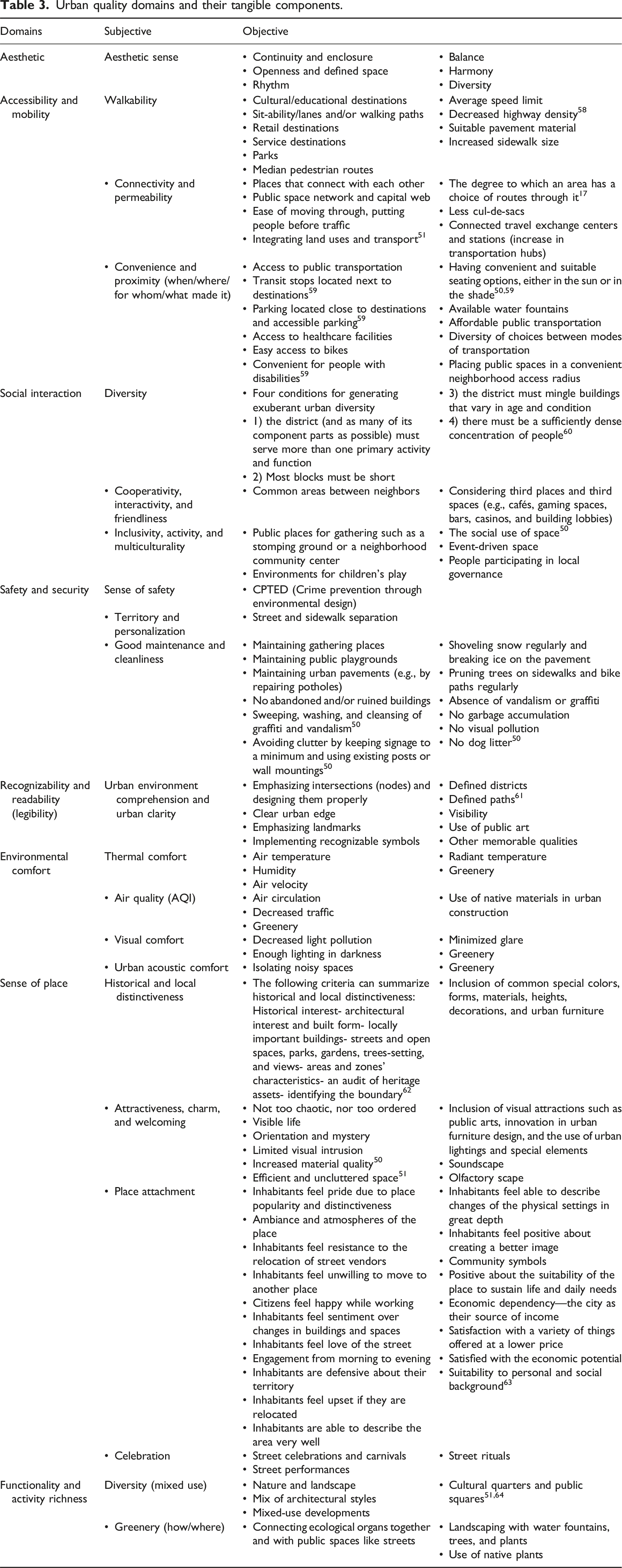
In the next step, the expert team in this research explores the subjective and objective parameters of the eight extracted domains in the first phase. These eight domains needed to be elaborated on since they were still too abstract and difficult to measure and parametrize in their larger scales of concern. Accordingly, using the questions that follow, we returned to our comparative consensus-based analysis and we extracted finer details for each of these broad qualities in order to clarify and deconstruct complex concepts into more tangible qualities: • What is the purpose of this quality in the neighborhood? • Does this quality have any effect/reflection on the physical environment? • How does this quality improve/deteriorate the neighborhood’s physical environment? • Who is the target audience (e.g., pedestrians, bikers, building inhabitants, elderly people, women, and children) of this quality? • How does time (e.g., day, night, and seasons) and place (e.g., neighborhood center/hub or a narrow alley) affect this quality?
The results of this process supply us with 21 subjective qualities. Although they are more detailed than the eight domains, they remain subjective and cannot be implemented into the game platform since they are not tangible. To reach tangible and concrete qualities, the researchers took another step to minimize the abstraction of qualities: we tried to discern which tangible urban interventions improve or deteriorate these subjective qualities. This approach allowed us to deconstruct each quality into tangible and measurable parameters—a fundamental step to quantifying qualities.
It should also be mentioned that in this research, “translating” qualities into quantities refers to the process of representing qualitative aspects in a quantitative manner without altering their fundamental nature. It involves assigning numerical values to qualities to make them comprehensible for computer language. On the other hand, “breaking down” the qualities pertains to objective or tangible qualities that can be subdivided into smaller components. This division serves to reduce the complexity of these qualities while facilitating their quantification. “Deconstructing” qualities applies to subjective qualities with less apparent entities, requiring a more profound analysis to prepare them for quantification.
Third phase: Analyzing qualities
This phase consists of two steps. In the first step, the relationship between urban qualities in the same consensus-based approach was assessed. In the second step, based on the results acquired from the first step, urban qualities’ importance, their connections to other qualities, and their individual role in the whole system were evaluated.
Assessing the relation between the qualities
To assess the relation of urban quality, the researchers first try to answer this question: What is the essence of the connection and relationship between qualities? There are three methods for understanding and quantifying qualities. The first is to measure qualities like what Anders Celsius did to create a thermometer. However, in this manner, only one quality can be assessed, and the effects of others cannot be considered. For example, in Celsius’ case, numbers represent mere temperatures; they do not provide more information about air quality. The second approach is to consider a set of qualities and organize them into a hierarchical system, similar to what Abraham Maslow 57 did to categorize human needs, a kind of causation and phasing. Achieving fundamental quality is a prerequisite for going to a higher quality level. However, in reality, qualities perform in an integrated manner and have strong connections—they do not follow a hierarchical structure. This relation highlights the necessity of a third approach to consider qualities and their relations in a comprehensive and holistic way. This approach is applied to this research to assess cities’ qualities in their complex cluster by considering their relations.
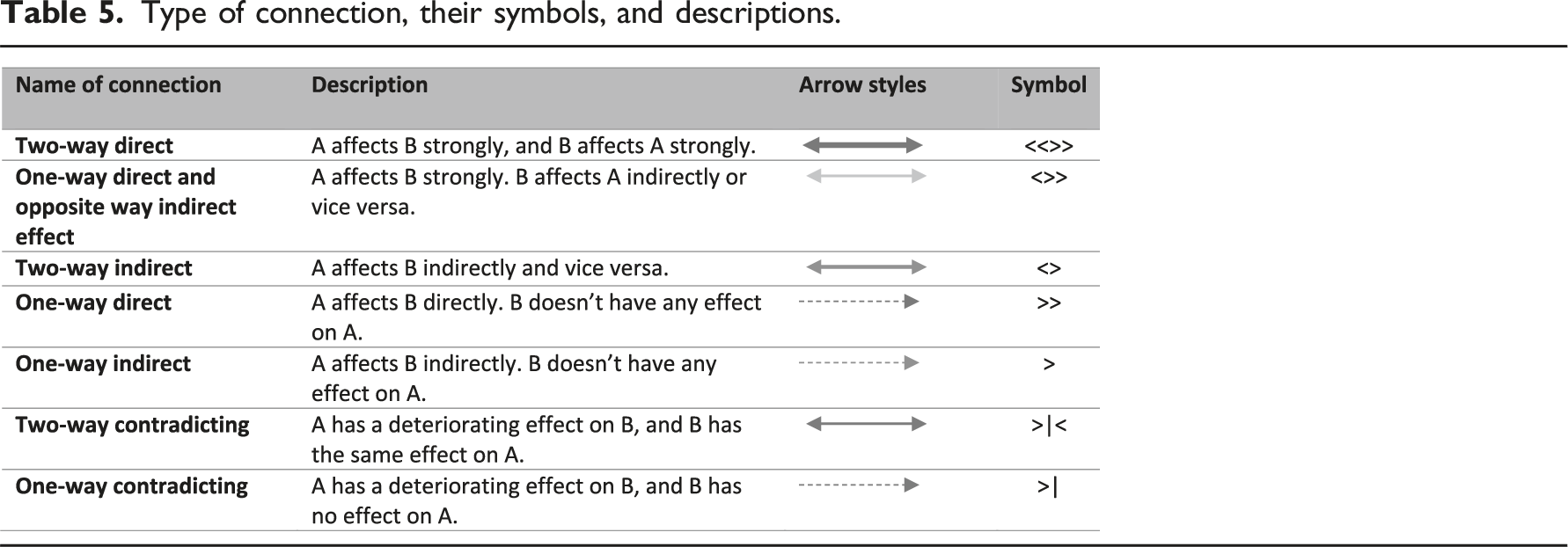
In this approach, after deconstructing the qualities and changing them into more tangible parameters, we asked ourselves, what is important about the 21 finer details? How can we assess overall urban qualities based on these parameters? As seen in many cases, urban qualities are highly dependent upon other parameters and are interlinked—but how? We need to be able to first understand these connections in order to eventually “parametrize” the overall qualities. Therefore, we define four types of relations between qualities:
Different connection types of qualities and their ratings.
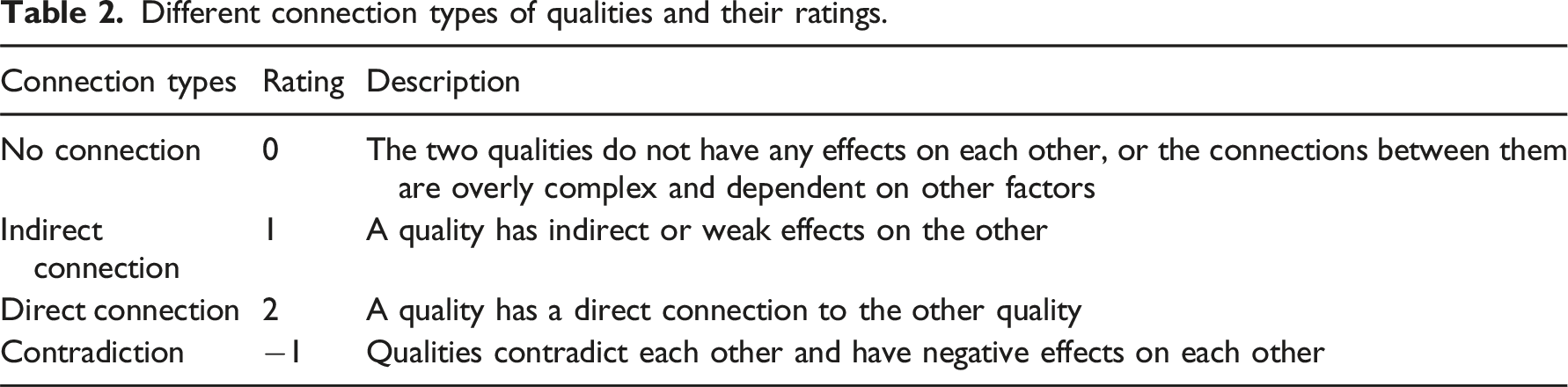
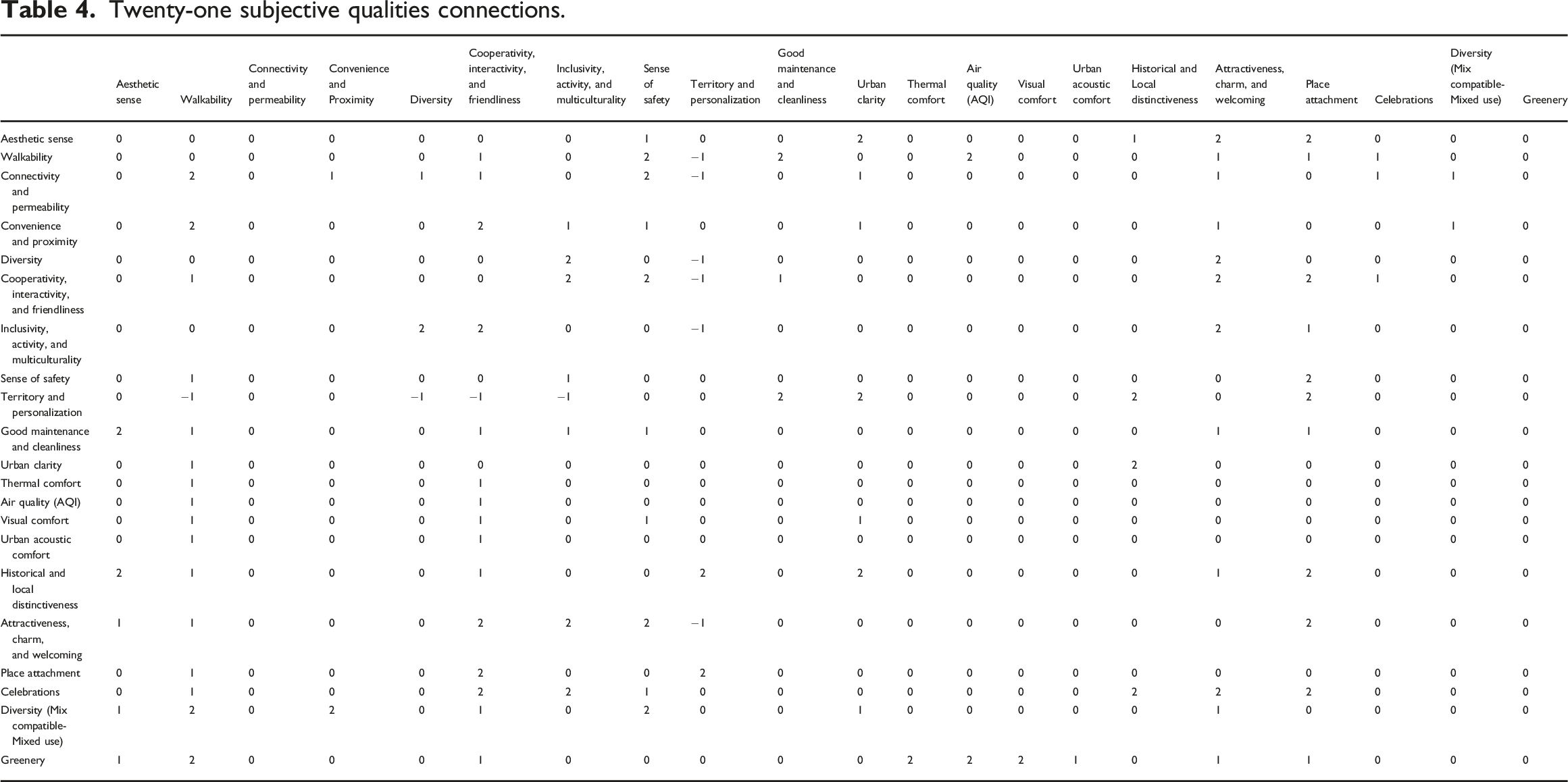
Let us assess the quality of “walkability” against all other qualities as an example of how this correlation is adopted. Walkability would strongly influence the sense of safety, good maintenance and cleanliness, and air quality of a place. It would have an indirect influence on friendliness, welcoming, attachment, and celebrations of places. However, it may have a counterproductive effect on “territory and personalization” as this quality, even if it aims to welcome specific communities, may also decrease the sense of “place for all,” as it may be overly focused on a singular type of community. Also, it may not affect the aesthetic sense of place, diversity, the urban acoustics, the historical and local distinctiveness, or the greenery of places. It is important to mention that the qualities’ relationship is assessed in two ways. For instance, it is clear that a place’s walkability doesn’t affect place’s greenery; however, a place’s greenery could have a direct and strong effect on walkability.
Determining and evaluating the effectiveness, characteristics and influence of qualities
Determining the character and the role of qualities in the network of qualities was not the initial purpose of this article; the necessity revealed itself while the researchers were analyzing qualities. The formation of an integrated network of qualities actually caused clarity on the role and the place of the qualities in the network. Therefore, mapping out each quality in the network of qualities provides us with a means to facilitate their parametrization and define them in a more detailed manner. The process of defining and characterizing qualities is based on two steps: In the first step, the researchers assess the characteristics of each quality and its role in the whole system of qualities. In the second step, we assess the importance of a quality and assess its connectivity to other qualities in the network according to the number of connection it shares with other qualities. I. Quality Characteristics
After assessing the qualities, their connections, and the relation between qualities, we deduced that qualities have different characteristics and play different roles within their network. Some qualities mainly affect other qualities. The rest are more malleable and are affected by other qualities without having much of a wide-reaching effect themselves. In other words, qualities are weighted differently in the network, which enables us to categorize them into three groups: • • • II. Importance and connectivity of the qualities



Aside from how qualities are affected by or affect other qualities, it is essential to assess if they are highly connected to the network of qualities or if they act more independently. This classification is based on the number of relations a quality can make to other qualities (without considering the type of connections). This logic helps us to categorize qualities into three levels: • If a quality has a relationship with more than 11 other qualities, we define the quality as highly connected. • If the quality has a relationship with anywhere from 7 to 10 other qualities, then the quality is moderately connected. • If the quality has relationship with less than 6 other qualities, then the quality is minimally connected.
Results and discussion
Urban quality domains and their tangible components.
Twenty-one subjective qualities connections.
Type of connection, their symbols, and descriptions.
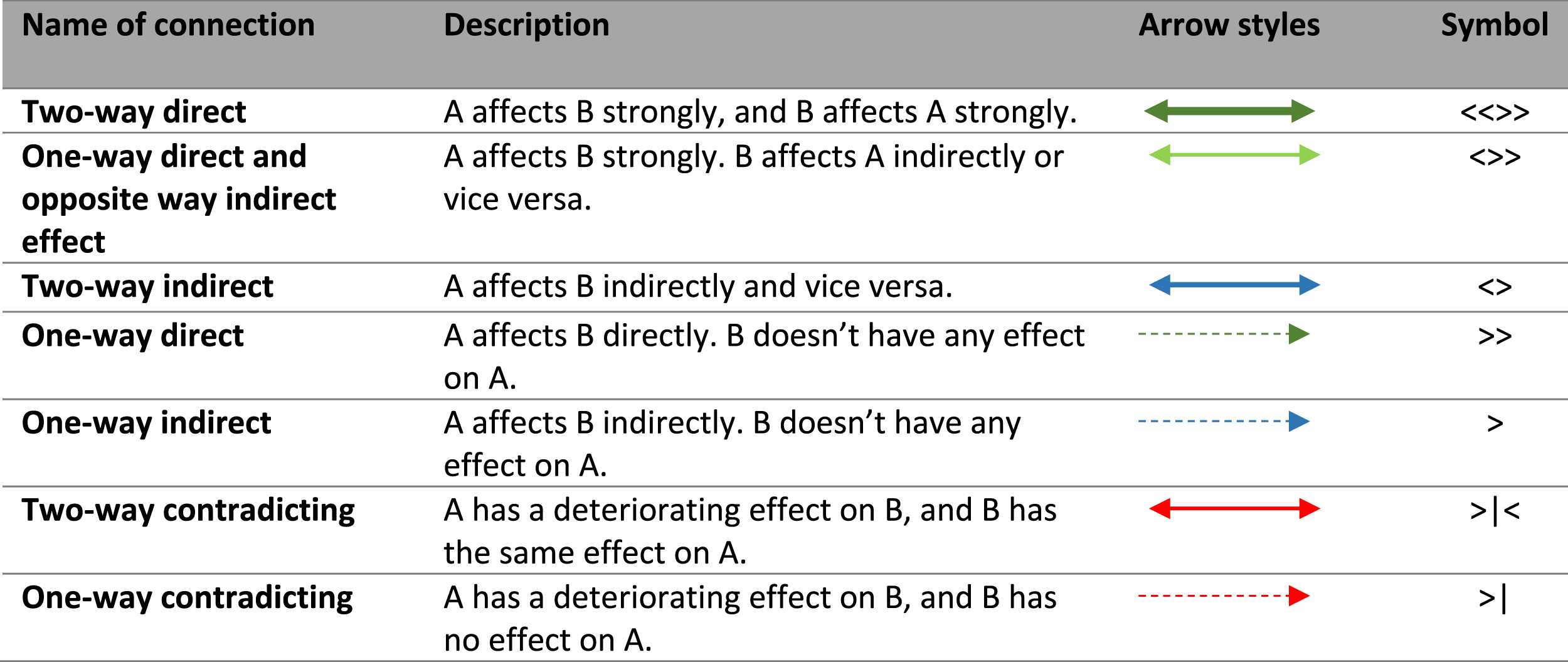
The researchers built a network that outlines the 21 subjective qualities based on their defined connections. Figure 2 shows the network of urban qualities. It illustrates that qualities have different characteristics and roles based on the number and weight of arrows connected to them. Therefore, assessing qualities in the network helps us understand them in the context of other qualities, which is more helpful in an urban setting. However, our proposed rules are merely an agreement between authors to better understand the role of qualities in the complex network of city qualities—they cannot be generalized as urban qualities, and their connections are overly complicated and should be contextualized in each particular situation. Twenty-one Urban qualities and their connections.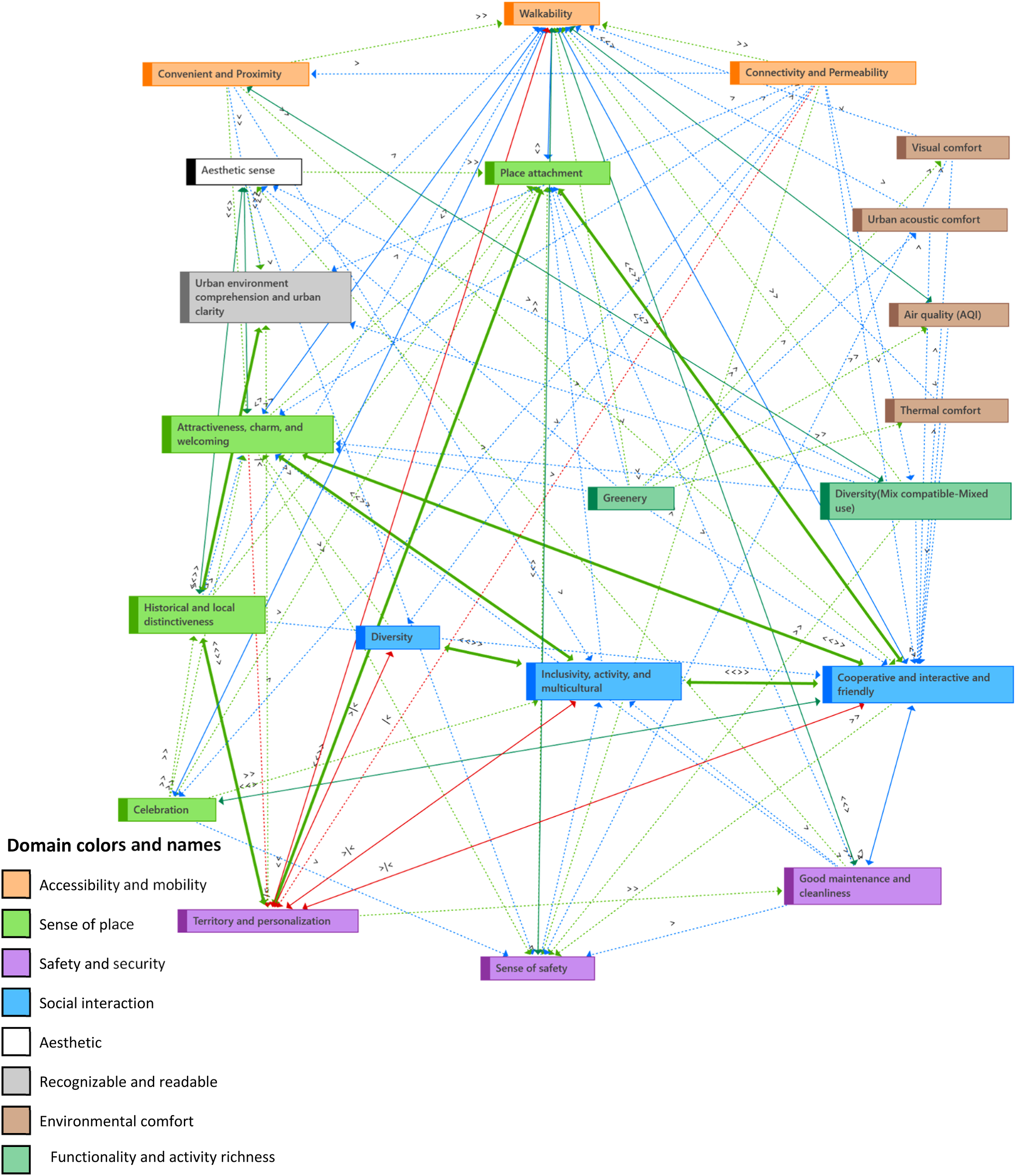
Following the steps of our proposed method, after completing the network of qualities, the characteristics of each quality in the network were assessed. As mentioned earlier, they have been categorized into three groups: primary quality (main instigator), mediating quality, and consequential quality. Regarding their importance and the weight of their connections, they are classified as highly connected, moderately connected, and minimally connected qualities.

Qualities’ relationships and their level of influence.
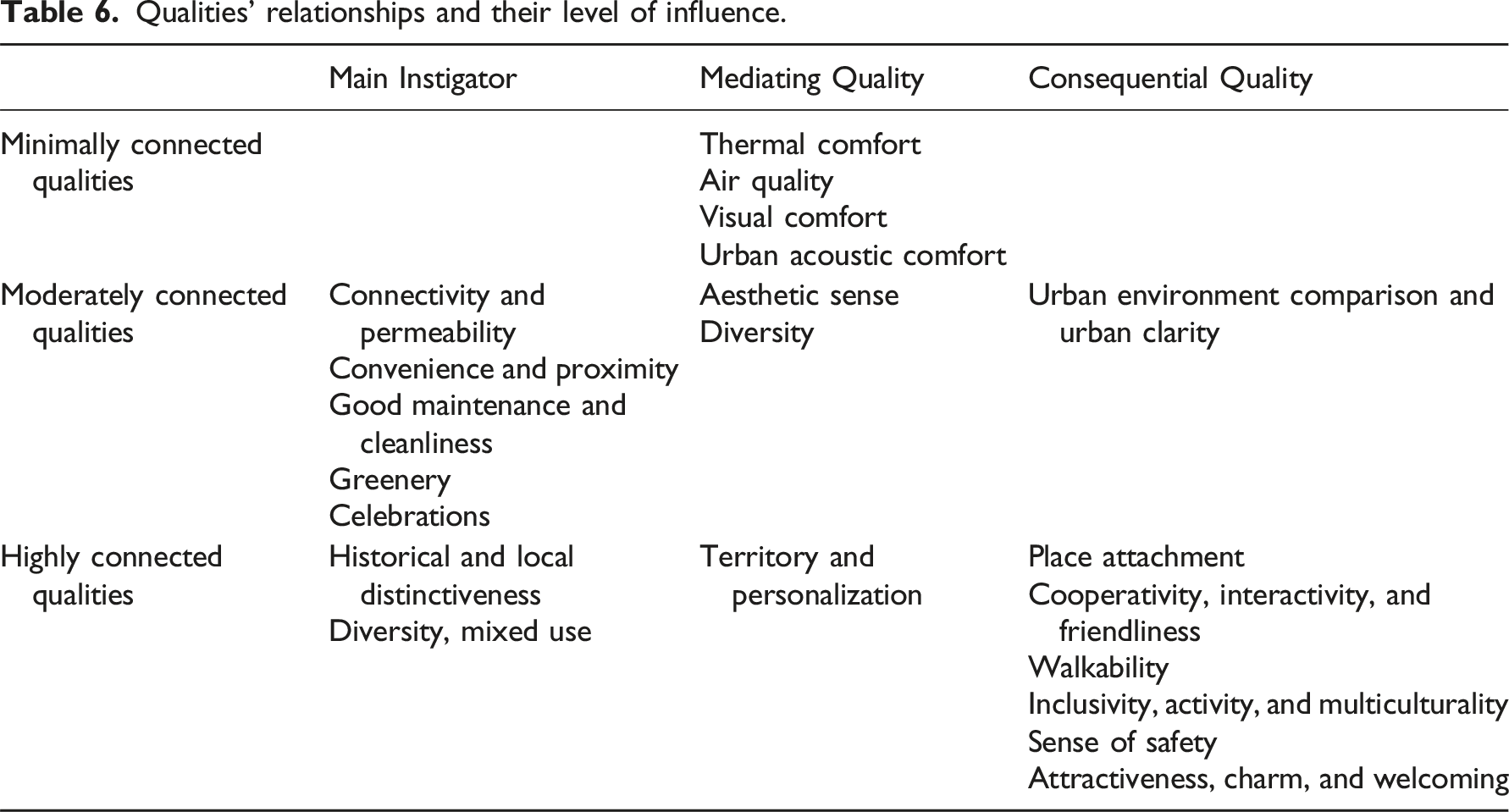
Based on these classifications, parametric urban designers can quantify purely urban qualitative parameters since the relationship and the level of influence of qualities are, to some extent, explored and defined. This enables them to translate these qualities into measurable and understandable parameters and incorporate them into computer design processes. Also, game developers can implement qualitative urban factors in their game platforms since they can score urban qualities based on the results of this research. Eight domains discovered in this research could be the main scoring criteria. The game player can change urban physical and non-physical parameters and see the changes in the eight domain’s scores. For example, by considering the “sense of safety” parameter, the player could improve the safety score by increasing the “walkability” of the area, its “inclusivity, activity, and multiculturality,” and its “place attachment.” Consequently, improving these qualities requires changing some physical parameters listed under the objective sections. In the case of “walkability,” reducing road width, improving pavement materials, adding more sidewalks, etc., are all possible objective and physical interventions. Besides these objective parameters, the player could also improve “walkability” by enhancing other subjective parameters that directly and indirectly affect “walkability.” For instance, neighborhood “good maintenance and cleanness” and improving “air quality” will strengthen “walkability.” These parameters are assessed in Table 4.
The relation network developed in this research can serve as a base for game-scoring logic. Also, the games designed based on this logic would have didactic aspects since the player could see the effect of their small changes on other qualitative parameters and see the urban structure as a network of diverse parameters. Our suggestion for game developers who would like to implement this system is not to quantify the scoring system since the relationship between these qualities is so complex, and this paper and further research can only serve to reveal a modicum of the complexity of urban qualities and their relationships. Therefore, the researchers would suggest using a qualitative scoring system (e.g., a color spectrum grid or emojis), to display progress and changes in urban design. Further research can develop creative qualitative ways to visualize these parameters in order to decrease the complexity of urban qualitative parameters and improve the didactic purposes of city building games.
Research limitation and future research
This research attempts to convert neighborhood qualities to quantitative parameters and measurable parameters that could then be applied in a computer program. However, there are certain research limitations, as follows: First, the researchers acknowledge that reducing qualities to quantities (or assigning numbers to qualities) leads to the degradation of what makes said qualities unique, but it is presently the only way to adopt a common language between computers and humans. Second, the researchers focused on selecting qualities that could be thoroughly analyzed and delineated through objective parameters. However, certain qualitative spatial parameters, such as the sense of belonging and place identity, were not included in this research due to their intricate and abstract nature. Future research could explore methodologies to effectively quantify these complex parameters. Third, although this research approach to the problem was comprehensive, the researcher did not have the opportunity to thoroughly parameterize each quality or propose a precise measuring and scoring index for them. Further investigation could delve deeper into each quality, considering its connection to the other qualities identified in this study, and propose quantitative indices for each parameter. This would contribute to a more detailed understanding of the subject matter. Finally, even subjective parameters are not fixed; they are based on interpretation. Each person has their own perception of subjective qualities. Therefore, future research can delve deeper into human interpretations of these qualities and introduce a ranking system based on specific contexts and individual interpretations.
Conclusion
The researchers proposed a method to deconstruct, quantify, and parameterize purely qualitative urban qualities so that they could be incorporated into a computer game platform. The literature review indicates that most gamification research or game project developers have difficulty incorporating qualitative data into the computer’s binary language. In order to aid with the implementation of complex urban qualities into a game platform, the researchers broke them down into eight main domains using an expert elicitation consensus method. This study used three generic urban standard quality classifications PPS, Public Places Urban Spaces, and By design to build our theoretical framework. As explained earlier, the main reason for selecting these three benchmarks is that each one attempts to deconstruct the “qualities” concept differently in different aspects and scales. They do, however, have a lot of commonalities and intersections. Our proposed framework integrated these three approaches to make a comprehensive list of qualities that could be parameterized. Next, each domain in greater detail was defined according to subjective qualities, making them smaller and more comprehensible. These subjective qualities were described according to completely tangible objective parameters. In this way, the purely qualitative concept is broken down into quantitative physical and tangible parameters. However, assessing and parameterizing one quality without considering other qualities is not sufficient since quality is intricate and has complex relations; relationships need to be investigated to achieve a realistic understanding of urban qualities. Therefore, as a third step, quality connections were classified into four types: direct connections, indirect connections, no connections, and contradiction. The results were represented in a network graph, considered to be the main outcome of this paper. This approach helped us understand urban qualities relations and interaction. Finally, the relation of these qualities provided us with a new metric that revealed the qualities’ role in the whole network. The researchers classified them into one of three quality types: primary quality (main instigator), mediating quality, and consequential quality. Also, qualities were categorized as either highly connected, moderately connected, or minimally connected. This categorization could provide game coders with a quality metric to incorporate into their game platforms. Also, this research contributes to urban design since there has been an attempt to quantify neighborhood qualities in parametric urban design. Further research could take a step forward to explore possible ways of grading and implementing these parameters into game platforms and parametric design.
Footnotes
Declaration of conflicting interests
The author(s) declared no potential conflicts of interest with respect to the research, authorship, and/or publication of this article.
Funding
The author(s) disclosed receipt of the following financial support for the research, authorship, and/or publication of this article: This work was supported by the Social Sciences and Humanities Research Council of Canada.
