




Abstract
Shape grammars allow a designer to explore a diverse and broad design space. Especially among architects and engineers, the opportunity to evaluate numerous alternatives in the conceptual phase facilitates creativity. Since the introduction of shape grammars 50 years ago, significant research and development have been performed: new applications, combinations with optimisation and integration in digital environments, among others. Consequently, there is a need to map the existing literature to encourage further progress in the field and a lower threshold for those interested in learning more about shape grammars. This study, therefore, presents a systematic mapping of shape grammars in architecture and engineering. Mapping is performed by identifying a query of relevant keywords used in five databases, with the results forming the basis of the mapping. Each of the included articles is then screened to filter out those that do not fit the content criteria. The remaining publications are then evaluated and organised based on the attributes’ application, research type, implementation, engineering and optimisation. The outcome is organised in explanatory illustrations and tables. The final discussion highlights the extensive work performed with shape grammars in the generation of two-dimensional floor plans, an increase in digital development in recent years and the need for further research. The findings indicate a gap between the state of the art and the necessary level of applicability for shape grammars to be an attractive design tool, especially for non-experts.
Introduction
Motivation
In a society increasingly influenced by the digital revolution that has taken place over recent decades, the demands for both architects and engineers to design effective, intriguing, and innovative structures have increased. Especially in the conceptual design phase, the possibility of quickly exploring and evaluating a diverse range of feasible design options facilitates well-informed decisions made by the designer, particularly when structural and environmental interests are included. Moreover, for a sufficient impact to be made, these methods should be readily available for a broader range of users, not only experts and researchers in academia, as is often the case today. Algorithm-aided design (AAD) aims to provide the user with tools to realise the objectives mentioned above. By utilising the continual growth in computational capacity, a designer can make parametric models where the influence of one or several parameters on the final structure can be investigated. However, the design space is still limited within the extrema of the parameters. Another approach that aims to alleviate this problem is to use rule-based operations in design.
In 1972, Stiny and Gips released a publication proposing shape grammars 1 ; derived from the formal grammars used in linguistics by Noam Chomsky, 2 this formal language describes the generation of shapes using a rule-based formulation. Parallel to the development of shape grammars, the digital revolution granted scientists and professionals computational capacity, which seemed impossible at the time of Stiny and Gips’ introduction of the topic. Computational capacity has enabled the implementation of shape grammars in a digital environment, thereby facilitating the exploration of even more diverse and exciting structures.
In 1981, Koning and Eisenberg presented a shape grammar derivation for the design language of Frank Lloyd Wright’s prairie houses, 3 proving the applicability of shape grammars for architectural purposes and general shapes. Moreover, Mitchell included the practical considerations of available materials and fabrication methods in his description of functional grammars, 4 including physical constraints in the rules deriving architecture. Subsequently, numerous publications combining architecture and engineering with shape grammars followed. Additionally, novelties in the topics are often accompanied by a novel name for the grammar application – making the landscape hard to navigate for those interested in learning more about shape grammars. This study introduces an indispensable systematic mapping of the application of shape grammars in architecture, identifying current trends and knowledge gaps and providing a database of relevant articles.
Definitions
Shape grammars
Stiny and Gips first introduced shape grammars in their pioneering paper in 1972. 1 Using the definitions established by Stiny in his paper ‘Introduction to shape and shape grammars’, a shape grammar has four components: (1) a finite set of shapes (2) a finite set of symbols (3) a finite set of shape rules (4) an initial shape. 5 These rules are applied recursively as, for example, transformations, Boolean operations, and additions or divisions of shapes. Despite of a fairly straight forward definition, the possibilities of making shapes with shape grammars is vast; for a meticulous historical description and evaluation of shape grammars since its origin, refer to Terry Knight’s ‘Shape and Other Things’. 6
In architecture, a popular application of shape grammars is the generation of floor plans: rotations, splits, scaling and symmetry are just some of the many rules applicable for this purpose. Additionally, structurally conscious rules that assign materials to elements and dimensions, for example, beams and columns, could make the process more structurally aware.
Design space
This is the domain of all possible solutions given by a problem’s parameters. Consider a simple parametric example of a cube with three parameters, that is, width, length and height, ranging from 1 to 10 with a step size of 1. The design space for this cube is then all the possible configurations made by any combination of the three parameters. Hence, 103 = 1000 possible cubes exist in this design space. For more complicated models, the number of parameters and, thus, the design space quickly increase.
Shape annealing
This is a method using simulated annealing 7 for the optimisation of shapes and structures. The concept is analogous to the cooling of metal. At high temperatures, particles move around at high speed. When cooled, the movement decreases until they are finally at rest. Similarly, shape annealing initially explores a large variety of solutions at the beginning of the procedure, and the best performing solution is selected as the current solution. Gradually, the ‘temperature sinks’, and the changes in geometry become smaller, for example, slightly varying the dimensions of truss elements.
Graphic statics
This is a visual and intuitive method for designing and analysing discrete structures. Based on simple geometry and force polygons, the designer quickly observes how the geometry of an element and the forces within relate to one another.
Genetic optimisation
This is a popular optimisation routine based on the theory of natural selection. An optimisation routine consists of several generations containing a pre-defined number of solutions called a population. In the first generation, random solutions are generated to form an entire population. From this population, the solutions (or individuals) performing best based on one or several objectives are used as parents for the next generation. Using these well-performing individuals as parents for the next generation, increasingly better solutions will emerge through each generation.
Objectives
For a shape grammar to be an integral part of a design process, it must be easily implemented, appropriate for optimisation, and manageable for non-experts. Therefore, the presented work aims to establish an overview of the development and state of the art of shape grammar applications in architecture and structural engineering by a systematic mapping of the field. To that end, some research questions are formulated:
What is the aim of shape grammars in existing research?
How are engineering perspectives included in the derivation?
How are shape grammars implemented?
How are these factors affecting the use by non-experts?
The remainder of this study will first present the research objectives related to the mapping process in this section, followed by a presentation of the research method in the Research Method section; the mapping scheme used to categorise the findings follows in Mapping Scheme, after which the findings are given and assessed in Discussion; finally, Conclusion draws conclusions from the findings.
Research method
A systematic mapping is chosen to answer the work’s research objectives; realising that this methodology is often mistaken with a classical literature review, the steps taken in this process are thoroughly described in this section.
Unlike a more classical literature review, systematic mapping aims to identify all relevant literature within a research field and to categorise it based on relevant topics and applications. This study takes inspiration from Petersen et al.8,9 who present a procedure for gathering and categorising as much relevant literature as possible within a reasonable amount of time. Although the method is not yet generally known and accepted in engineering, pertinent examples of successful mappings, such as the work of Labonnote et al. 10 exist. Mapping procedures support the identification of knowledge gaps in the literature while reducing the risk of neglecting relevant articles, thus enabling a more accurate concentration of available resources where they are most needed.
In short, a search query is defined and used to search through several online databases before gathering all results for a screening process where irrelevant publications are filtered out, as illustrated in Figure 1. Subsequently, a thorough classification process aiming to answer the initial research questions from the above page follows.
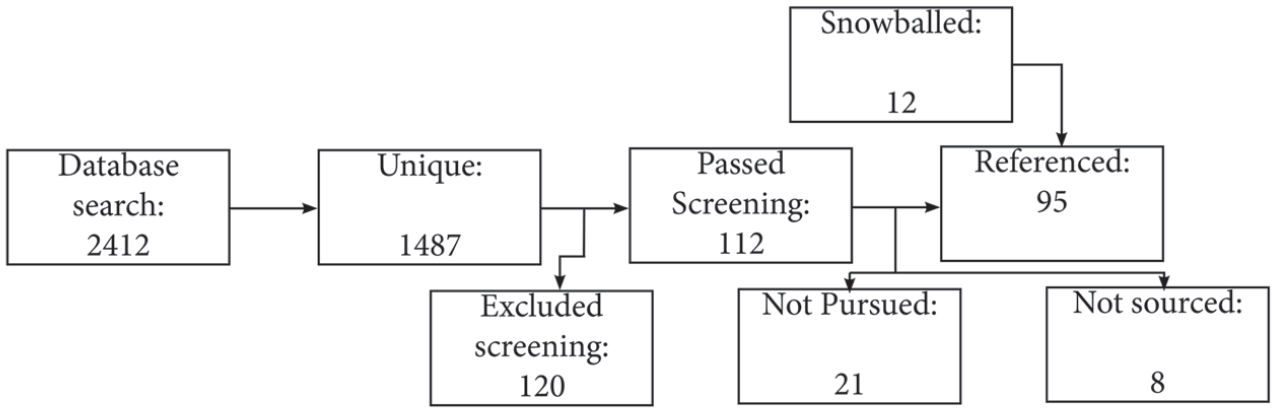
Flowchart representing the mapping process from beginning to end.
Search phrasing/database search
The relevant articles were gathered from the following online databases: Scopus,
11
Oria/NTNU,
12
Web of Science,
13
Engineering Village
14
and ScienceDirect.
15
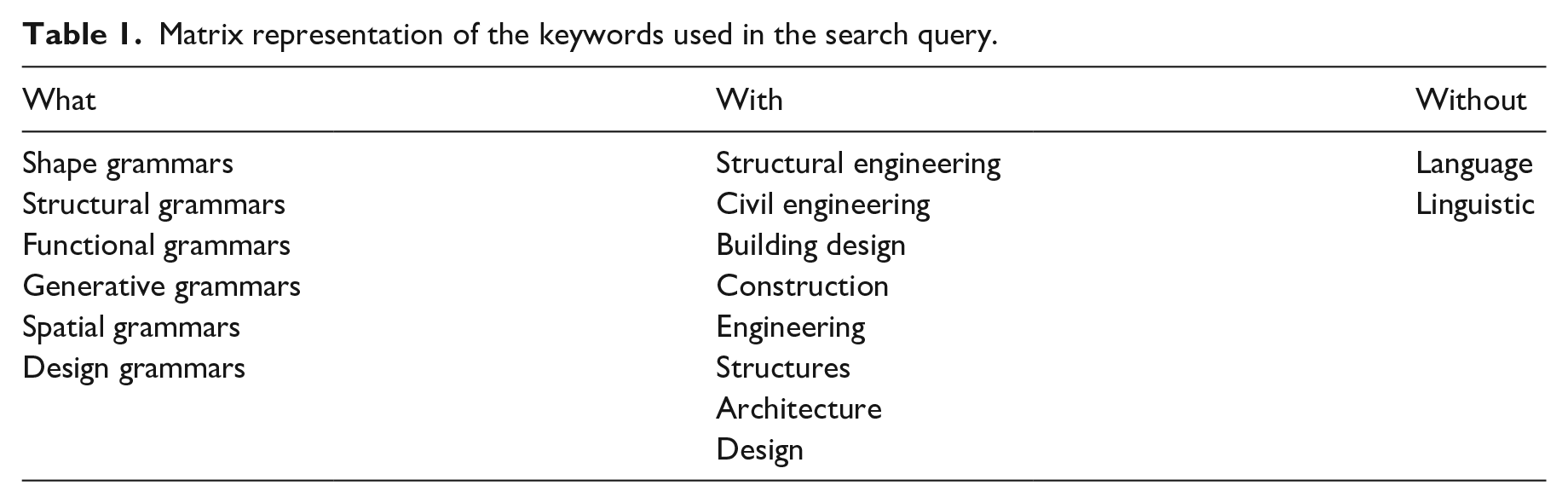
The same search query was used for all databases, as presented in Table 1. The columns are joined together by the Boolean operators ‘AND’ or ‘NOT’, whereas the elements within each column are joined by the ‘OR’ Boolean, as shown below: (SHAPE GRAMMARS OR STRUCTURAL GRAMMARS) AND (STRUCTURAL ENGINEERING OR CIVIL ENGINEERING) NOT (LANGUAGE OR LINGUISTIC)
Matrix representation of the keywords used in the search query.
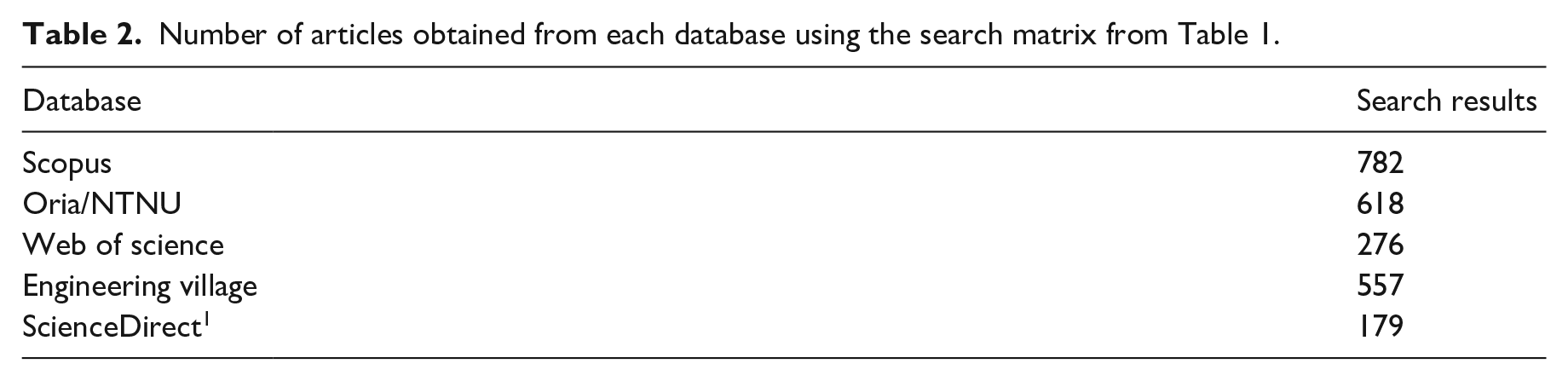
The search was carried out on 8 February 2021. Table 2 presents the number of articles obtained from each database. After removing duplicates, 1855 publications remained and were considered for the screening process.
Number of articles obtained from each database using the search matrix from Table 1.
Screening
For the screening process, the inclusion of publications was determined based on both quantitative and qualitative inclusion criteria. The quantitative criteria were as follows:
Written in English.
Published in a peer-reviewed journal. This criterion is included due to the amount of literature and the fact that one project often results in several conference papers, proceedings and a journal paper. Moreover, peer review is likely to ensure a greater overall quality of the included publications.
Published in 1985 or later. 2
Full-text available online.
The qualitative criteria were as follows:
The abstract mentions the use of shape grammars – either in their original form or as a derivation.
The topic of the article concerns buildings or other structures where architecture or structural engineering has an influential impact on the design. Examples are houses, bridges, facades and other building elements. Architectural fields such as urban layout planning and road maps are not included due to their lack of structural engineering concerns. Similarly, topics where structural engineering is vital but architecture is negligible are not included.
Verification
After the screening process, 83 publications were retained for further mapping. Before undertaking this process, a snowballing procedure 16 seeking relevant publications from the references of the included publications – provided that they fulfil the inclusion criteria – was performed to ensure a representative mapping; 12 additional articles were obtained from this procedure.17–28 Subsequently, another iteration of snowballing was undertaken without yielding new results, and 95 publications composed the final collection.
However, reading through the included publications, a noteworthy tendency possibly affects the mapping: different applications of shape grammars tend to receive a new name based on their application, possibly causing articles of relevance to remain undiscovered. This tendency is readily shown in Figure 2; here, a word cloud represents the different words preceding or following ‘grammar(s)’ to highlight the variation in terminology. Despite significant variation, all articles use the term ‘shape grammars’ at least once. Therefore, it is assumed that articles introducing a novel name for shape grammars that reflects their objective have to introduce the concept of shape grammars and are thus covered by the search query used in this mapping study.
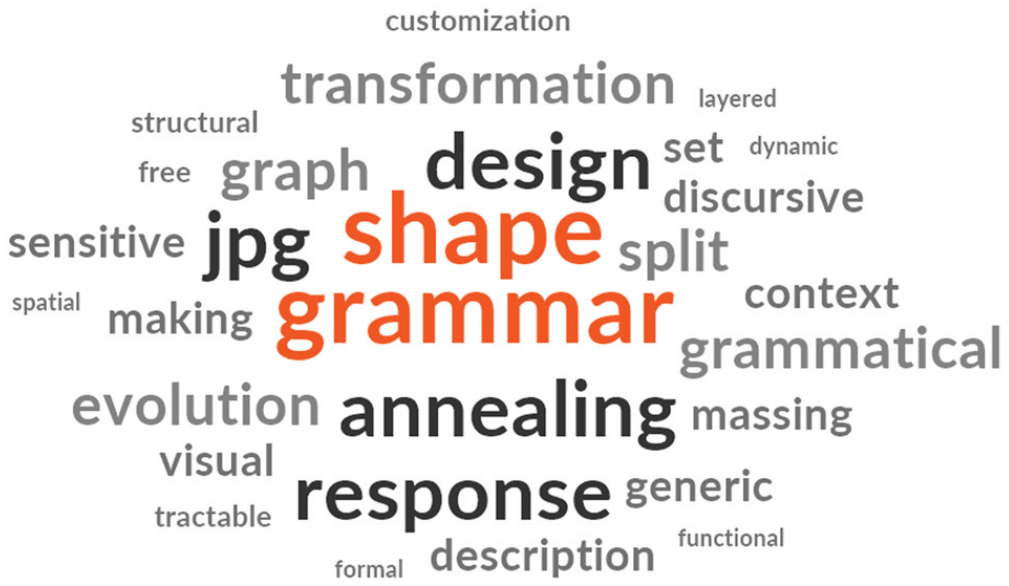
World cloud illustrating the variation in terminology for the same underlying shape grammar procedure.
Classification and mapping scheme
Next, the 95 publications were subjected to detailed reading to identify patterns and topics answering the research questions of the Objectives section. Three attributes were defined: research type, application and implementation; moreover, two YES/NO attributes describing optimisation and engineering aspects were included. The publications are credited with optimisation if the derivation of shape grammar objects uses an automatic procedure to improve the final result. Engineering aspects are credited for publications that evaluate or restrict the shape derivations by taking engineering considerations into account. These could address any aspect, for example, structural and environmental engineering, and rely on an analysis or a rule of thumb.
Mapping scheme
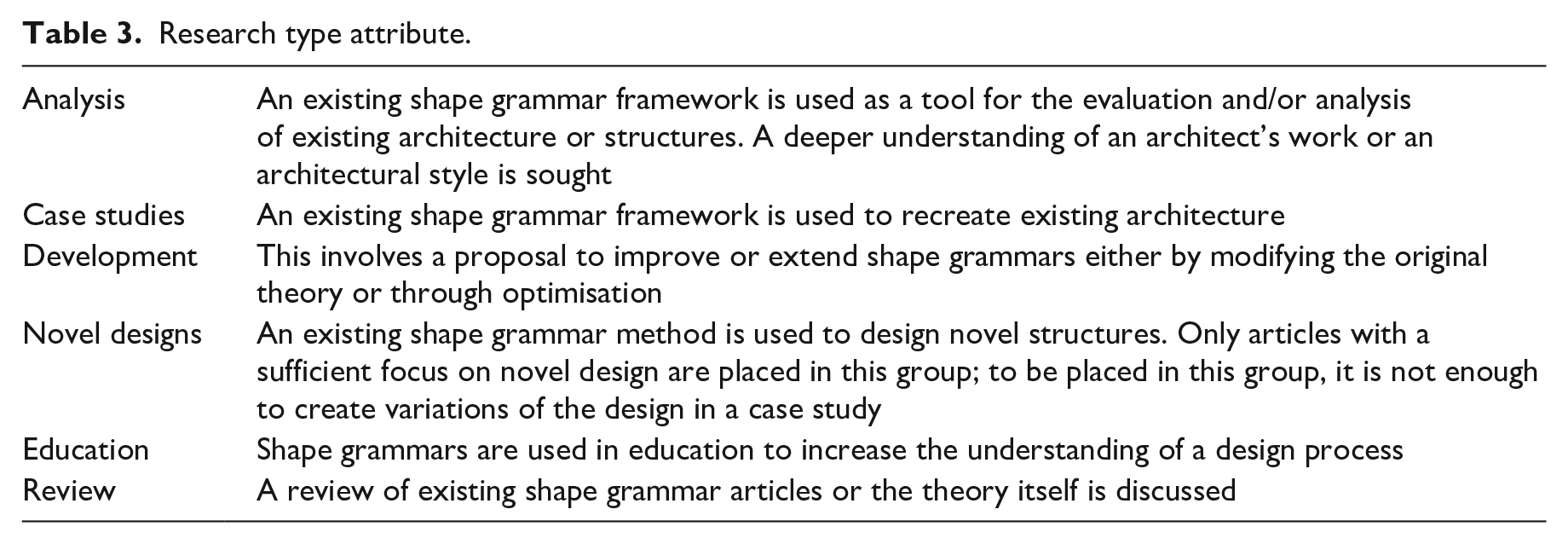
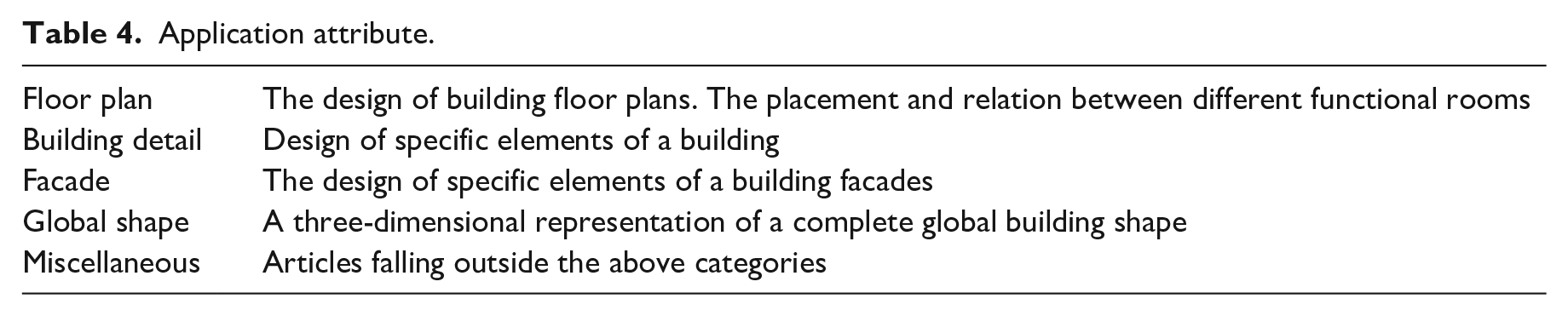
The three attributes identified in the previous section are defined in detail below, with the categories of each attribute presented in Tables 3–5.
Research type attribute.
Application attribute.
Implementation attribute.

Research type
This attribute defines the motivation for the application of shape grammars in the publications. It is divided into six categories covering the overall objectives of the research.
Application area
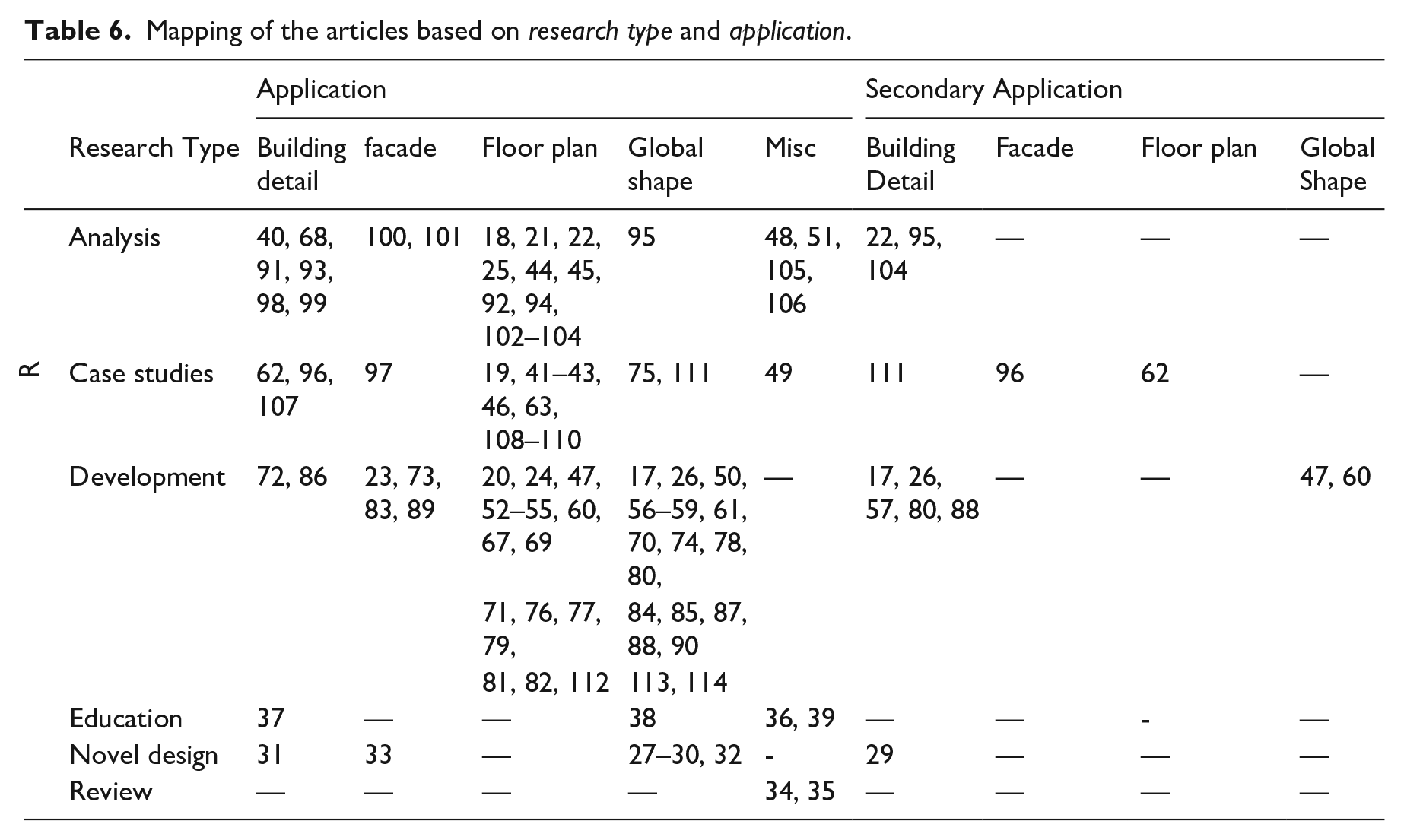
For which parts of a structure are the shape grammar applied? Here, the articles are categorised based on the main application in the article, which is not necessarily the application stated in the abstract. Moreover, in cases where multiple applications are present, the dominant application is used for this attribute. The secondary application is listed in Table 6 for the reader’s perusal. Articles without an appropriate category are placed in a miscellaneous category to avoid confusion.
Mapping of the articles based on research type and application.
Implementation
If shape grammars are to be available to non-experts, the implementation of an interpreter is a paramount concern. This attribute identifies how the articles address the implementation of shape grammars and, consequently, how available they are for untrained persons.
Results and discussion
This section presents and discusses the outcome of the mapping process described in the previous section to answer the defined research questions. First, the application and research type attribute results are presented and discussed, first separately and then together. Next, the presence of optimisation and engineering considerations follows, after which there is a final evaluation of the impact of computers on the application and implementation of shape grammars. The distribution of publications within each attribute is presented in the three bar graphs in Figure 3. For the application attribute, some publications contained two applications of almost equal significance; although only one application per publication is used in the mapping, Table 6 includes the secondary application in the relevant publications.
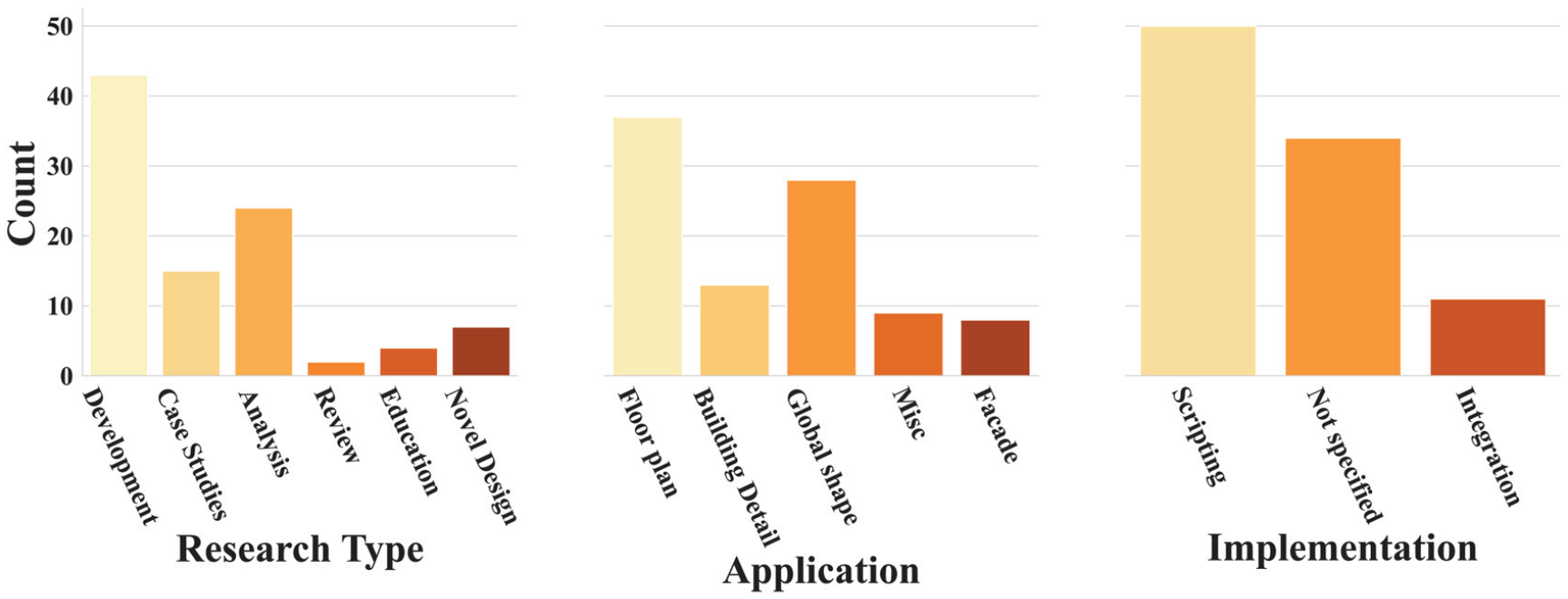
Distributions of publications within the categories of each attribute.
Research type
For the research type attribute, Figure 3 shows that 86% of the publications either examine the development of shape grammars or use the framework to analyse or recreate existing architecture in analysis and case studies.
For novel design, relatively little research seems to have been conducted, with only 7% of the publications belonging to this category.27–33 These are the publications where the main contribution is the generation of new design with existing theory, not an example of new architecture created with the novel method in a publication, of which there are several.
Finally, the mapping yielded two and four publications that are categorised as review and education, respectively: Sönmez presents a review of methods for automatic architectural design task, including shape grammars, 34 while Woodbury describes and discusses set grammars and design spaces concerning computer-aided design in detail. 35 Abdelmohsen establishes a course exploring design through generative methods, 36 Wu implements a shape grammar for teaching students about Chinese bracket systems, 37 while Sedrez and Pereira present their work on fractal shapes as a tool for increasing students’ knowledge of shape vocabulary, 38 Ashton, on the other hand, takes inspiration from the work of Frank Lloyd Wright in her shape grammar-inspired mathematics class. 39 From this point, the categories education and review are not further discussed, as the theory and application of shape grammars are secondary concerns.
Application area
The application of shape grammars in the mapped publications is diverse, ranging from detailing Greek orders 40 to modelling entire buildings. 29 As shown in Figure 3, floor plan generation is the most common application, accounting for 39% of the total publications. Most publications in this category use shape grammars to derive two-dimensional plan layouts, with some investigating traditional vernacular houses 41–44 and others investigating churches and libraries.18,45 Some publications demonstrating the generation of three-dimensional buildings are also included in this category in cases where only two-dimensional grammar rules are used, and the third dimension is formed by an extrusion from this plan.25,46,47
Global shape, the second most popular application, accounts for 29% of the publications. Although buildings are the most frequent topic, truss design and other applications are also included. The final three categories are relatively equal in the number of publications. The misc category is used when none of the above categories are appropriate, for example, erecting a thin-tile vault 48 and the rapid prototyping of physical models. 49
Application and research type
Further pursuing an understanding of the trends, the two attributes research type and application are plotted together as a bubble chart in Figure 4. As previously mentioned, the most popular application areas are floor plan and global shape; for research within the development attribute, both applications are predominant. Also interesting are the case studies and analysis categories within research type: Floor plan is, by far, the most popular category compared to global shape, for which only two publications are present in each category. A plausible interpretation of this finding could be the complexity in designing a shape grammar interpreter for global shapes compared to floor plans. The application attribute of novel design substantiates this further: no publications aspire for novelties in floor plans, whereas six publications pursue novelties in global shapes. One also finds one article each in this category for both building detail and facade. Building detail is scattered relatively evenly within research type, although analysis is the most populous category with six publications; however, the meagre number of publications belonging to this category – the same applies for the facade category – does not provide sufficient data for well-founded conclusions. Contemporary modelling in building design is seldom two-dimensional. Thus, shape grammars’ feasibility to model three dimensional structures such as buildings and bridges is a key feature for it to be used by a larger amount of users. Nevertheless, when looking at the objectives of the publications mapped as development, few of the publications seem to focus on this – both in floor plans and global shape. Hohmann et al. 50 is an interesting publication concerning the usability of shape grammars for three-dimensional building models. Their work identifies shape grammars’ flexibility as a promising tool in the digital reconstruction of buildings and the lack of existing knowledge regarding modelling complex three-dimensional geometries. Another interesting point is the general need for expertise in a programming language – which is further discussed later.
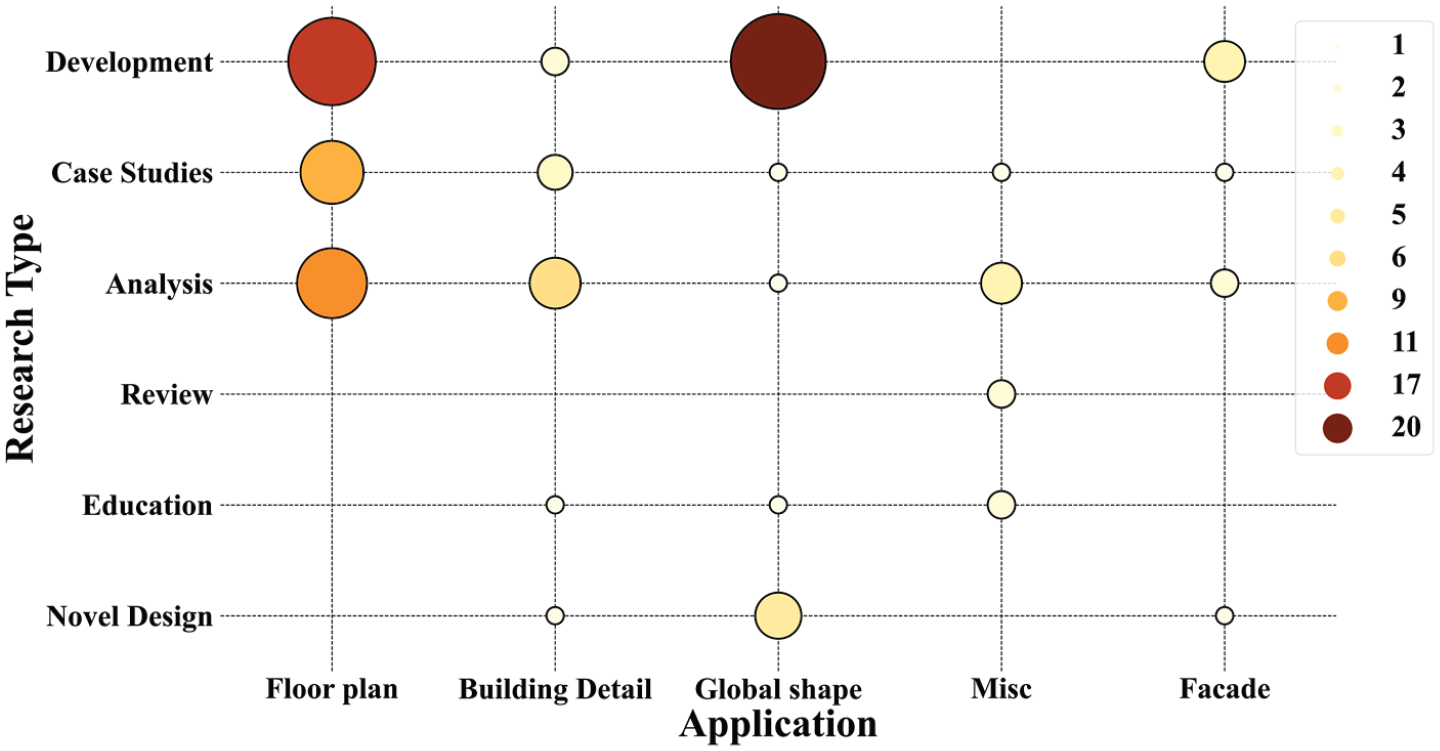
Distribution of publications by research type and application. The magnitude and intensity of the bubbles indicate the number of publications within each category.
Optimisation and engineering
This section further discusses the results of the Application and Research Type section by considering the presence of optimisation routines and engineering matters in the publications. Figure 5 breaks down the bubble plot in Figure 4 to a swarm plot; each dot represents a publication, while the colour manifests the presence of optimisation. Twenty publications, or 21%, incorporate some optimisation routine in their shape grammar application. Most articles with optimisation, totalling 14 in numbers, are located in the development category of the research type attribute. Apart from those, there are five articles concerning novel design: four on global shape and one on a facade problem. For global shape, three publications27,28,30 are applications of shape annealing theory, 7 and one uses grammatical evolution 3 to design shelters. 32 Vazquez et al. optimise the brick layout of masonry screen walls to enhance their environmental performance. 33 The final article is located within analysis and contrasts classic optimisation with graphic statics and finite element methods and shape annealing with grammars. 51 Considering the application area of the optimisation articles, global shape and floor plan are the most occurring, with 10 and five publications, respectively; the remaining publications are evenly distributed among the remaining categories, with one in building detail, one in miscellaneous, and two in facade.
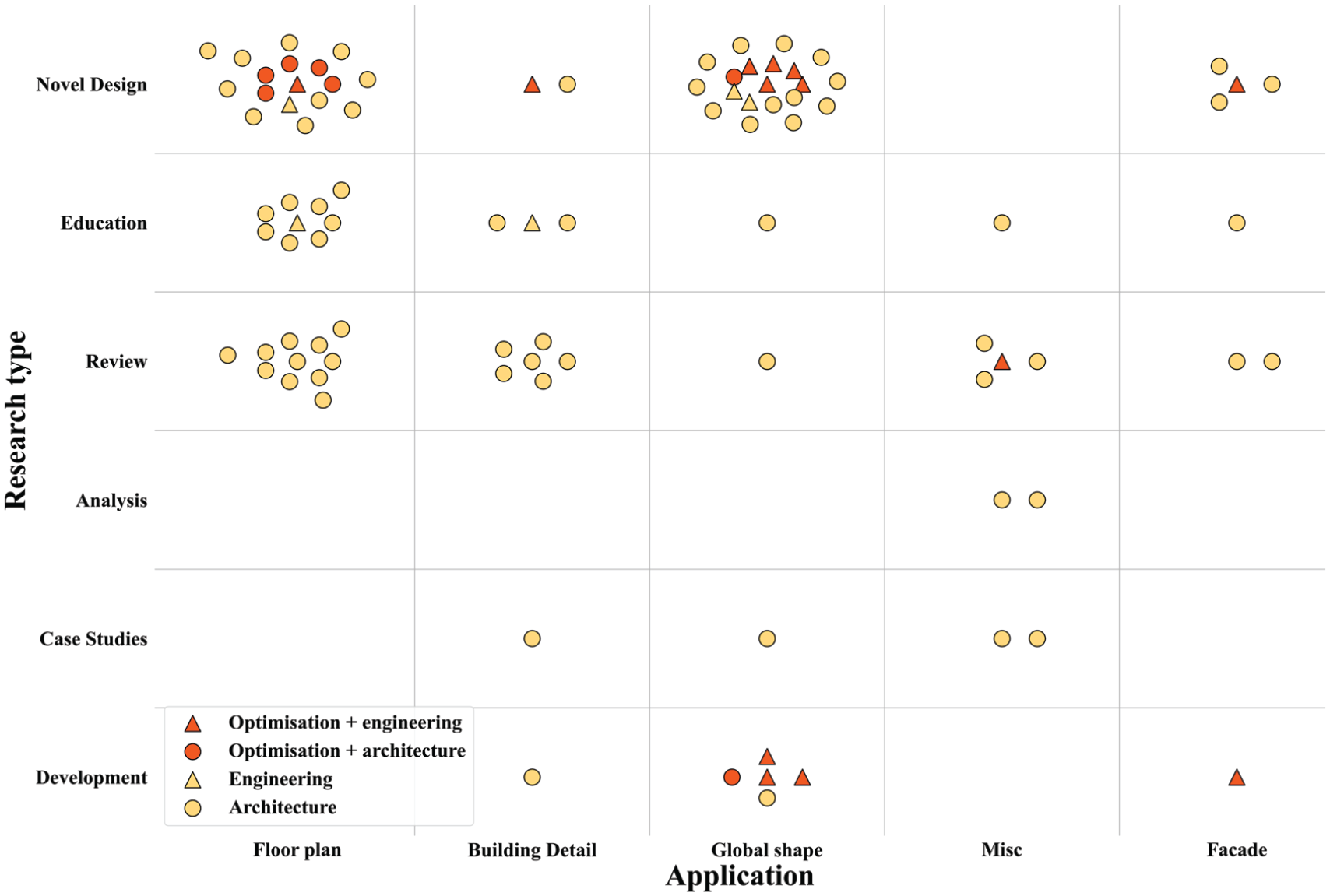
Swarm plot presenting the categorisation of publications with respect to the engineering and optimisation attributes.
Moreover, in Figure 5, (a) further distinction is made between those articles incorporating engineering concerns and those with a purely architectural design; see the Mapping Scheme section. In addition to colours indicating optimisation, diamond markers exhibit the publications where engineering considerations are present. Of the 19 publications including optimisation, 13 also involve engineering; only six publications optimise for architectural purposes, of which four belong to floor plan52–55 and the others belong to global shape.32,56 Table 7 presents all the articles that include optimisation.
Papers where optimisation is a substantial part of the work.

The publications where both optimisation and engineering are significant parts are predominantly categorised as global shape. The general themes for these publications are shape annealing for truss design and grammatical evolution for global shape optimisation. In the publications where shape annealing for truss design is employed, the authors of the original publication, Shea and Cagan appear as contributors in all the other publications employing this method. For the remaining optimisation articles, the diversity among authors and research groups is more significant. Furthermore, only two publications seek to develop an optimisation routine in combination with shape grammars for ‘regular’ buildings, that is, houses and offices: the first, by Phillipp Geyer from 2008, uses multidisciplinary design optimisation for the generation of building models 57 ; the second, written by Boonstra et al. in 2020, is part of a larger project designing a toolbox for the spatial design optimisation of buildings. 58 Finally, there are five publications in which engineering aspects without optimisation appear: one combines graphic statics with shape grammars when designing equilibrium structures 59 ; another evaluates the energy performance of the building envelope after the grammar derivation 60 ; a third uses a spatial zoning procedure for structural designs 61 ; and the final two use knowledge-based constraints and design codes,62,63 respectively.
Impact of computers on shape grammars
This final section discusses the impact of computational development on shape grammar research. Figure 3 shows how most articles describe either a case-specific implementation of shape grammars through scripting or no description of their implementation. Only 11 cases offer integration into commercial software, such as SketchUp, 64 CityEngine 65 and Grasshopper 66 ; 50% of these publications opted for Grasshopper,33,36,40,59,67,68 thus demonstrating the possibility of extending the functionalities of existing software with third-party extensions. For a user already familiar with Grasshopper or another software, the threshold for experimenting with shape grammars might be lower when the user interface and basic functionalities are known beforehand, mitigating the need to familiarise oneself with new software for each specific shape grammar application. Moreover, such implementations allow shape grammars to be part of a more extensive pipeline of operations in a complete design process. Table 8 provides a complete overview of the publications where either scripting or the integration of an interpreter is described. The bar graphs in Figure 6 further reveal how the implementation of grammar interpreters has been solved over the years; here, each category of the implementation attribute is represented by different colours in the bar chart. Notice how articles with either no description or scripting are somewhat proportionally distributed each year – from 1985 to 2020. The first publication where integration into commercial software is demonstrated, appears as late as 2008 by Philipp Geyer. 57 He demonstrates the implementation of a multi-objective optimisation with shape grammar inside the commercial software
Papers where the shape grammar interpreter is described.
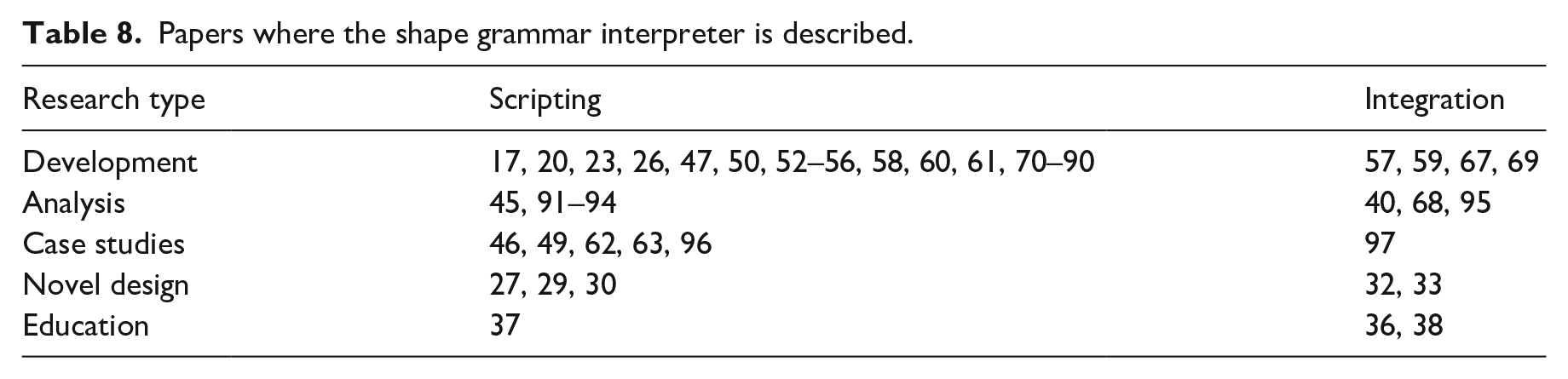
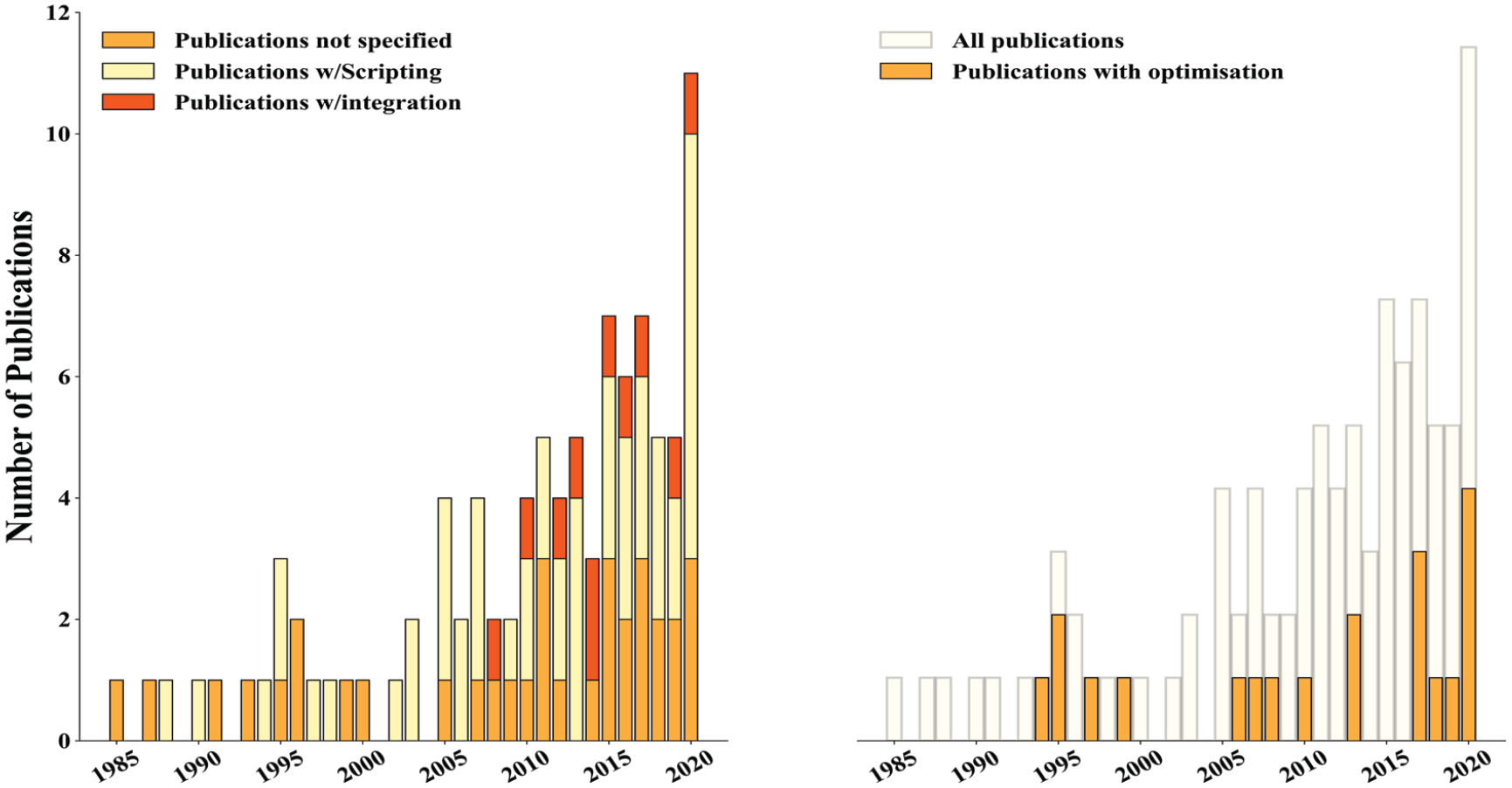
Distribution of publications within each year of publication.
ModelCenter, for an industrial hall building. Despite the entire category of integration articles being published after this, only in 2014 was more than one article published,36,69 indicating that further research is necessary in the coming years. The publications using Grasshopper as the tool for implementation take this one step further. For non-experts, it is not viable to create their own shape grammar interpreter – nor to download shape-specific engines from academic research – when starting with shape grammars in projects. Consequently, using familiar software while experimenting with new ideas and techniques could facilitate extended use of shape grammars. As such, Grasshopper is a promising software; it is popular among both engineers and architects due to the intuitive workflow, numerous third-party extensions, and an open-source developer community. Beginners can learn from a vast range of tutoring videos and an intuitive user interface, whereas experts benefit from the possibility to customise and extend the functionalities. Not to mention the full integration into the CAD program Rhino. Despite all of this, the findings in the mapping, where only six publications integrate their research into Grasshopper, is somewhat surprising, especially when perusing the content of these publications. The benefits of integrating a shape grammar implementation inside Grasshopper is clearly demonstrated, for example, by Vazquez et al. 33 who illustrate how other third-party plug-ins can be connected to their interpreter; hence, enabling, for example, optimisation of sunlight without having to implement this function themselves. However, none of the publications encapsulates their interpreter into a new shape grammar plug-in for others to use — leaving undiscovered territory between experts and novices ripe for future research projects.
Computational development can also explain the distribution and evolution of optimisation features. The publications including optimisation and the total number of publications per year are illustrated in Figure 6; there are seemingly two clusters of articles including optimisation: one containing articles in the 1990s and the other containing publications after 2006. In the first cluster, the same researchers appear in 4/5 of the articles. These are the same authors as discussed concerning shape annealing in the subsection – and are more likely to reflect a competent research group on the topic than a general trend shared among several institutions and research groups. Regarding authors, the other cluster is more diversified than the first. Grouping them by contributions from different authors, where an author can be present in one group only, the 15 publications of this cluster are divided into 12 groups, indicating more diverse applications and a broader appeal among researchers.
The continual increase in publications per year within the scope of this article, combined with the growth in optimisation, as mentioned above, and digital implementation, indicates optimistic prospects for further development of shape grammars in general and combined with engineering applications in particular.
Conclusion
This study presented a systematic mapping of shape grammars in architecture and engineering – a topic that has seen a continuous annual increase in publications since 1985 and that, therefore, is in need of systematic mapping to evaluate the current landscape. Three primary attributes were used in response to the research objectives from Objectives; the integral takeaways are as follows:
Despite the diversity of shape grammar applications, most historical progress concerns the generation of floor plans without any engineering considerations.
When including structural engineering, optimisation generally follows. Initially, the combination of shape grammars and engineering usually involved optimising truss structures; more recently, examples of increasingly advanced generations of more complex grammars have been demonstrated. An increased computational capacity seems to stimulate a more sophisticated use of shape grammars in design.
Performance-driven optimisation in combination with shape grammars was demonstrated by a handful of researchers on truss structures in the 1990s. In the last 15 years, there have been more diverse optimisation applications in buildings and structures, including objectives such as structural efficiency, environmental performance, solar energy generation, and floor plan layout.
The implementation of shape grammars is primarily performed in case-specific interpreters with a graphical user interface designed specifically for the task at hand – demanding relatively high expertise by the user. Since 2008, the integration of shape grammars as third party plug-ins to commercial software have emerged. Eleven percent of the evaluated publications implemented their interpreter in commercial software.
Considering the presented findings, the recent increase in the integration of interpreters and performance optimisation, number of articles, and variety of applications within the articles predict an encouraging direction for the use of shape grammars as a design tool encouraging better and more diverse solutions than would otherwise be possible, for example, through the combination of grammars and evolutionary optimisation. Nevertheless, more research on the implementation and facilitation of access to non-experts is needed before shape grammars can be deemed attainable to a broader range of practitioners.
Footnotes
Acknowledgements
We would like to thank the Norwegian Railroad Directorate for the funding of this work and Bane NOR for their support and intellectual resources. An appreciation is also directed toward Bunji Izumi, Steinar Hillersøy Dyvik, and Marcin Luczkowski for their feedback and discussions.
Declaration of conflicting interests
The author(s) declared no potential conflicts of interest with respect to the research, authorship, and/or publication of this article.
Funding
The author(s) received no financial support for the research, authorship, and/or publication of this article.
