



Abstract
To address calls from industry regulators regarding the need to improve leadership in the Further Education (FE) sector in the UK, we considered the lived experiences of those perceived as high-performing, effective leaders (n = 17) in different industry sectors with a view to developing an evidence-base that could be transferred to the FE sector. Through semi-structured interviews that were subsequently analysed using experientially orientated reflexive thematic analysis, characteristics of high-performing, effective leaders were categorised into three themes: personal, interpersonal, and professional. Additionally, education and ongoing professional development, experiential learning, and significant others were identified as key mechanisms that affected leader development. High-performance environments (HPEs) were conceptualised as being context informed yet underpinned by a person-centred philosophy, where individuals’ basic psychological needs are satisfied to the extent that they can perform consistently and achieve their objectives. To develop and maintain an HPE, participants indicated the importance of several factors including clear communication of the organisation’s vision and strategy. Our research adds to the extant understanding of high-performing, effective leaders and HPEs in a way that can be contextualised and used to inform key processes within the FE sector.
Introduction
Further Education (FE) colleges in the UK deliver post-compulsory education and training to a vast number of learners in provisions that range from basic skills to degrees and apprenticeships. Due to the valuable mix of academic, occupational, and vocational education offered, FE colleges have a unique role to play in the delivery of the UK Government’s skills agenda and are thus considered an essential part of the UK’s educational infrastructure (Department for Education, 2021b). Despite the devolution of educational policy in the UK, FE colleges are commonly seen as decisive in supporting cross-government initiatives linked to ensuring the UK becomes a global hub for innovation and facilitating the improvement of social, cultural, environmental, and economic well-being for all people (see Augar Review, 2019; HM Treasury, 2021). Considering such contextual drivers, it is important that FE college leaders are confident and competent in planning, leading, and executing strategies to ensure that personal and organisational performance meet the expected standards of key quality indicators (e.g., progress in learning and skills, well-being and attitudes, and teaching and learning). As a result, it has become acknowledged that to raise standards in FE, leadership development should be a prime driver of education strategy (cf., Estyn, 2020; Scottish Government, 2022).
In line with other education providers, FE colleges are inspected periodically by devolved regulators (e.g., Office for Standards in Education, Children’s Services and Skills [Ofsted], England; Estyn, Wales) to measure the quality of their service and educational provision, with leadership and management being a specific inspection quality criterion (see Department for Education, 2021a). Estyn (2015a) have previously reported an ongoing link between the quality of leadership in FE and the quality of outcomes for learners, with almost 90% of those institutions inspected that gained an ‘excellent judgement’ for standards also gaining an ‘excellent judgement’ for leadership and demonstrating strong leadership cultures. More recently, Estyn (2020) detailed that in over a quarter of inspections since 2010 there were ‘significant shortcomings’ linked to aspects of leadership that required improvement, with that figure rising to around half in some instances. Further, through review of over 100 Ofsted inspection reports, Pearson (2022; UK’s largest qualification awarding body) found that where education providers ‘required improvement’ against the quality of education criterion, 80% of these were also deemed to require improvements in leadership and management. The consequences of inadequate leadership in FE have been demonstrated to extend to institution financial difficulties and poor organisational culture. Indeed, researchers have highlighted how FE staff often perceive their leaders and managers to be ineffective at managing morale, which negatively impacts organisational success as staff feel depersonalised and demotivated (O’Regan & Painter, 2023). Concerns have, therefore, been raised regarding the lack of succession planning and limited number of well-tailored professional development opportunities for leaders, resulting in individuals being promoted into leadership roles without the necessary skills to engage in effective leadership practice (ColegauCymru, 2022; Scottish Government, 2022). Despite such insights, and the growing recognition of the need to improve the quality of leadership across all educational sectors, it is reported that researchers have largely overlooked the nuanced context of FE, instead focusing on the compulsory (e.g., pre-16 years old) and higher (e.g., University) sectors (Cantor & Roberts, 2021; Relly, 2020). Thus, researchers have argued that little empirical evidence and applied interventions exist on leadership in the FE sector including its development and related behaviours (O’Regan & Painter, 2023).
In accord with recent inspectorate reports, it has been recommended that the environment that FE leaders cultivate to increase the probability of individual and organisational high-performance (e.g., consistently higher performance than most peer organisations in the same sector over a prolonged period, Jones et al., 2009) and success (e.g., achievement of key quality indicators) should also be more thoroughly explored (Cantor & Roberts, 2021). Based on their applied experiences across different sectors, Jones et al. (2009) suggested that in successful organisations the environment is just as important as the people performing in it, and leaders should, therefore, seek to develop high-performance environments (HPEs) that are focused on delivering clear and outstanding results. Jones et al. proposed an HPE model, at the core of which is leadership. Jones et al. argued that leaders drive the HPE through interacting with situational (e.g., organisational resources) and human (e.g., attitudes and beliefs) factors. These interactions, coupled with organisational culture (e.g., processes, innovation, and human well-being) are thought to encompass the HPE (Davies, 2021; Jones et al., 2009). Conceptualising HPEs in this way may appear relevant for educational leaders as in the FE sector there is an expectation that leaders must cultivate an environment that is focused on consistent organisational progression through self-improvement, learning, and raising standards (Daniëls et al., 2019; Relly, 2020).
Building on Jones et al.’s (2009) work, Blanchard (2018) proposed that organisations that have developed an HPE do not rely on cultivating a charismatic leader but adopt a vision that endures beyond the leader. The role of leadership in HPEs shifts, therefore, from privileged status and power towards more complex, participative, collaborative, long-term processes with leadership assumed at every organisational level (Davies, 2021). In HPEs, leadership emerges from everywhere with individuals stepping up when required, reducing the hierarchical reliance on formal leaders or a few peak performers alone (Blanchard, 2018). In education, researchers have reported that leadership like this has made a positive difference to organisational performance due to increased teacher commitment, social interactions, cooperation, participation in decision making, and enhanced learner outcomes (Leithwood et al., 2019).
While some attention has been given to the way in which high-performing, effective leaders work to achieve their outcomes, Davies (2021) suggested that potentially less focus has been placed on the leader themselves and the characteristics they require when building an HPE. From their research in various performance arenas (e.g., sport, business, and military), Jones et al. (2009) proposed that to create an environment where high-performance is virtually inevitable, high levels of vision, support, and challenge from leaders is required, highlighting that the leader’s role is to minimise constraints and maximise support so that their followers can excel and fulfil their potential. Spicer et al. (2011) also suggested that high-performing, effective leaders are adaptive, agile, transformational, innovative, great communicators, strategic thinkers, visionary, evidenced-based decision makers, and authentic. Similarly, within education, researchers have reported that several cognitive (e.g., reflexivity), social (e.g., working collaboratively), and psychological (e.g., resilient) attributes were significant predictors of leadership effectiveness (ColegauCymru, 2022; Muijs et al., 2006). Therefore, any organisation that can identify and action mechanisms that challenge, support, and develop such characteristics in leaders can enhance the potential for the construction of an HPE, which is subsequently likely to improve the organisation’s chances of success.
A potential approach to improving leadership in FE is the observation of effective leadership in different industries and the subsequent dissemination of key practices back into FE (Ali et al., 2020). Indeed, observational methods and the sharing of best practices (e.g., what works in action) are becoming more widely advocated, with researchers arguing for the potential value inherent in crossing industry boundaries for radical innovation, continuous development, and performance improvement (Enkel & Heil, 2014). For instance, Mahankali and Nair (2019) highlighted the rapid progression of the healthcare profession due to the adoption of innovative practices from various industries (e.g., aviation, telecommunication, formula one racing, and retail). Further, when researching methods used to improve business performance, Ali et al. (2020) found that vicarious learning experiences from other sectors were an effective method to enhance innovation and overall performance. Similarly, Versland (2016) reported that leaders in effective schools (as identified by devolved inspectorates, such as Estyn, 2015b) had visited and used expertise from other schools and businesses to enhance their practice, with Dobell (2018) stating that these methods could be used for the development of HPEs in educational settings. Researchers have also recommended the efficacy of leadership modelling (i.e., where a person makes sense of another’s actions and then shapes and adopts similar actions in the context of their own practice) as it is suggested that leadership skills are somewhat universal and once acquired are transferrable (e.g., Jolly et al., 2019). Humphrey and Hughes (2021) argued that regardless of context ‘success leaves clues’, and lessons and ideas can be contextualised and used to improve performance and the environments in which performance is enacted. Collectively, such findings suggest that, irrespective of industry, lessons can be learnt and exchanged in attempts to improve leadership and help FE colleges better position themselves to consistently achieve high standards by constructing HPEs (Jolly et al., 2019).
Given the emphasis placed on improving leadership in the FE sector, the lack of research that considers both the individual leader and the environment they create to facilitate high-performance in FE, and the value of learning concepts from other sectors to inform developments in FE, there is a need for researchers to critically examine the concepts of effective leadership and HPEs (cf. Cantor & Roberts, 2021; Daniëls et al., 2019). Thus, we aimed to explore the lived experience of these concepts from those identified as high-performing, effective leaders in different industry sectors with a view to developing an evidence-base that could be transferred to the FE sector. Specifically, we: (a) examined the characteristics of effective leaders; (b) investigated how the characteristics of effective leaders in different environments are developed; (c) sought to better understand how HPEs can be conceptualised; and (d) explored how effective leaders construct and maintain HPEs. By sampling participants from industries outside of FE, we attempted to produce findings that could foster radical innovation and performance improvement in FE through vicarious learning and modelling. In doing so, it was thought that a cross-sectoral approach would develop the novel insights required to challenge the boundaries and entrenched views regarding leadership in FE. Consequently, we aimed to inform strategies designed to improve FE leadership performance and subsequently help FE colleges to strive for excellence, increasing the likelihood of key performance indicator attainment.
Methods
Philosophical position and research design
Our study was underpinned by ontological relativism. From this position, data are collected through a process of ‘active cooperative enterprise’ (Gergen, 1985, p. 267), where participants’ lived experiences and social realities are understood through interaction with the researcher. We adopted a qualitative research design, built on the epistemological position of constructivism. To actualise this approach, we engaged in discussions with participants around the concepts of high-performing, effective leadership and HPEs and then making sense of participants’ collective experiences through the development of themes representative of both the individual and whole sample (Sparkes & Smith, 2013). In adopting such a collaborative approach to data collection and sense-making, we recognised that value-free inquiry and theory-free knowledge development were not possible (McKay et al., 2021). Accordingly, a critical friend approach (Smith & McGannon, 2018) was used throughout the process to maintain a sense of collective awareness relating to any subjective biases regarding the data. This helped to enhance the interpretation of data and improve research credibility (McKay et al., 2021).
Participants
Using a process of purposeful and snowball sampling (cf. Patton, 2015), we selected participants based on the following criteria: (a) had been in a senior leadership position for more than 10 years; (b) were publicly recognised as being an expert in their field; and (c) were currently working in a successful business (based on industry-related performance metrics). It should be noted that the identification of high-performance leaders in certain sectors (e.g., military and National Health Service) is inherently complex. In this study, these participants were selected due to the extensive amount of training they undertake, the high-stakes environments they lead in, and the advanced expertise required in their roles. Further, we recruited individuals who had 10 years or more experience in senior leadership roles under the premise that their longevity provided an indication of the consistency of their performance. It was anticipated that by recruiting such participants, we would interview elite individuals able to provide information-rich answers regarding high-performing, effective leadership and HPEs.
The sample consisted of 17 senior leaders (men = 11; women = 6) ranging in age from 36 to 61 years (M = 51; SD = 7) and leadership experience from 15 to 38 years (M = 30; SD = 7). To protect the anonymity of our participants, we are unable to provide information relating to their specific positions, but to offer some insight we recruited (for example) a: UK University Vice Chancellor (ranked top 10 by the Times HE); Head of Coaching at an internationally acclaimed elite football organisation; National Health Service Head of Department; Chief Constable of a UK Police Force; CEO of a Government Department; Head of Performance at an international sports team; and UK Special Forces Officer.
Data collection: Interview guide
We adopted a semi-structured interview approach that was facilitated by a guide (see Supplemental material). This was designed to ensure that all participants were asked the same questions while allowing flexibility to investigate additional lines of enquiry based on participant responses (Patton, 2015). The interview guide consisted of five sections containing general questions and non-directional probes (e.g., ‘Please provide an example of how that looks in practice’). First, participants were asked a series of introductory questions designed to settle them into the interview and to get them thinking about the main concepts under investigation (e.g., ‘Please spend a few minutes telling me about your leadership background’). Second, participants were asked about leadership (e.g., ‘How would you define effective leadership?’) and their lived experience of it. The third section focused on high performance (e.g., ‘What do you believe high-performance is?’). Fourth, participants were asked to discuss the building and development of HPEs including how these might be measured (e.g., ‘How did you start the process of building an HPE? What were the key steps and milestones?’). The closing section considered the trustworthiness of the interviews, allowing the participant to reflect on whether they were able to tell their whole story in a non-directed manner (e.g., ‘Did I influence you in any way?’). The guide was tested through one pilot interview, with a matched sample participant, and some minor changes were made to question structure, wording, and probes following feedback to improve the flow of the interview.
Procedure
On receiving Institutional Ethics Board approval, a period of participant sampling was conducted. This involved contacting a range of individuals who met the selection criteria, using publicly available company contact records, and inviting them to take part in the study. During the initial correspondence, potential participants were provided with a participant information sheet and consent form, allowing them to make a fully informed decision about participation. To supplement the process, those who agreed to participate in the study were asked if they knew of others who met the criteria and might be willing to participate (snowball sampling). Those who volunteered their participation took part in an online one-to-one interview at a time of their choosing. All interviews lasted between 48 and 79 minutes (M = 64; SD = 10), were audio recorded in their entirety, and subsequently transcribed yielding 295 pages of single-spaced text.
Data analysis and methodological rigour
To make sense of our data we adopted a process of reflexive thematic analysis with an experiential orientation (RTA; see Braun & Clarke, 2021). RTA aligned to our position of ontological relativism and constructivism because the process highlights the active role played by the researchers, who use their relevant knowledge to construct meaning within and across the data. Following Braun and Clarke’s recommendations, we adopted six analytical stages. First, we gained familiarity with the data by reading and re-reading the transcripts. Second, initial coding of the data, where meaningful ideas in the data were identified in relation to the study aims, was performed by author 1. To check and challenge this process, the remaining members of the research team acted as critical friends (cf. Smith & McGannon, 2018) so that comparative analysis and discussion could occur (e.g., to check any potential bias in construction of the characteristics of high-performing, effective leaders). Third, the agreed codes were organised into descriptive themes by author 1, with the research team questioning the meaning and position of each constructed theme, thus improving collective confidence that each code had been appropriately located. Fourth, the same processes were adopted to interpret the relationship between the descriptive themes to develop overarching interpretive themes. Fifth, the research team critically discussed the definition of each theme to ensure it was distinct, and traceable back to the raw data so that the rigour of the analysis procedures could be considered (Braun & Clarke). Here, our aim was not to reach a unanimous agreement on the interpretation of the data but to challenge each other’s judgements in a reflexive manner (Smith & McGannon). Finally, author 1 produced a report of the findings, selecting appropriate extracts from the transcripts to support the codes and themes that related back to our research aims.
To further improve methodological rigour throughout our study, we adopted Tracy’s (2010) eight big tent criteria. Specifically, we sought to ensure that the project (a) was a worthy topic (e.g., novelty of exploring HPEs across contexts for transfer to FE); (b) could make a significant contribution (e.g., constructing a framework to support FE leadership); (c) constructed rigorously (e.g., nature of the sample); (d) demonstrated sincerity (e.g., discussion of impact of philosophical position on data collection); (e) demonstrated research credibility (e.g., critical friend approach); (f) presented resonance (e.g., provision of raw data quotes); (g) met ethical requirements (e.g., fully informed, voluntary and consenting sample); and (h) had meaningful coherence (e.g., clear link between aims, philosophy, method, and findings).
Results
In line with the aims of this study, the results are structured into four main sections: (a) characteristics of high-performing, effective leaders; (b) high-performing, effective leadership development; (c) conceptualisation of HPEs; and (d) the construction and maintenance of HPEs. In each section, the themes and associated sub-themes constructed from the analysis procedures are presented along with raw quotes from the participants that best represent the findings. The aim in each section is to present information in a way that is meaningful to the reader and allow them to deeply engage with the experiences of those involved (McKay et al., 2021).
Characteristics of high-performing, effective leaders
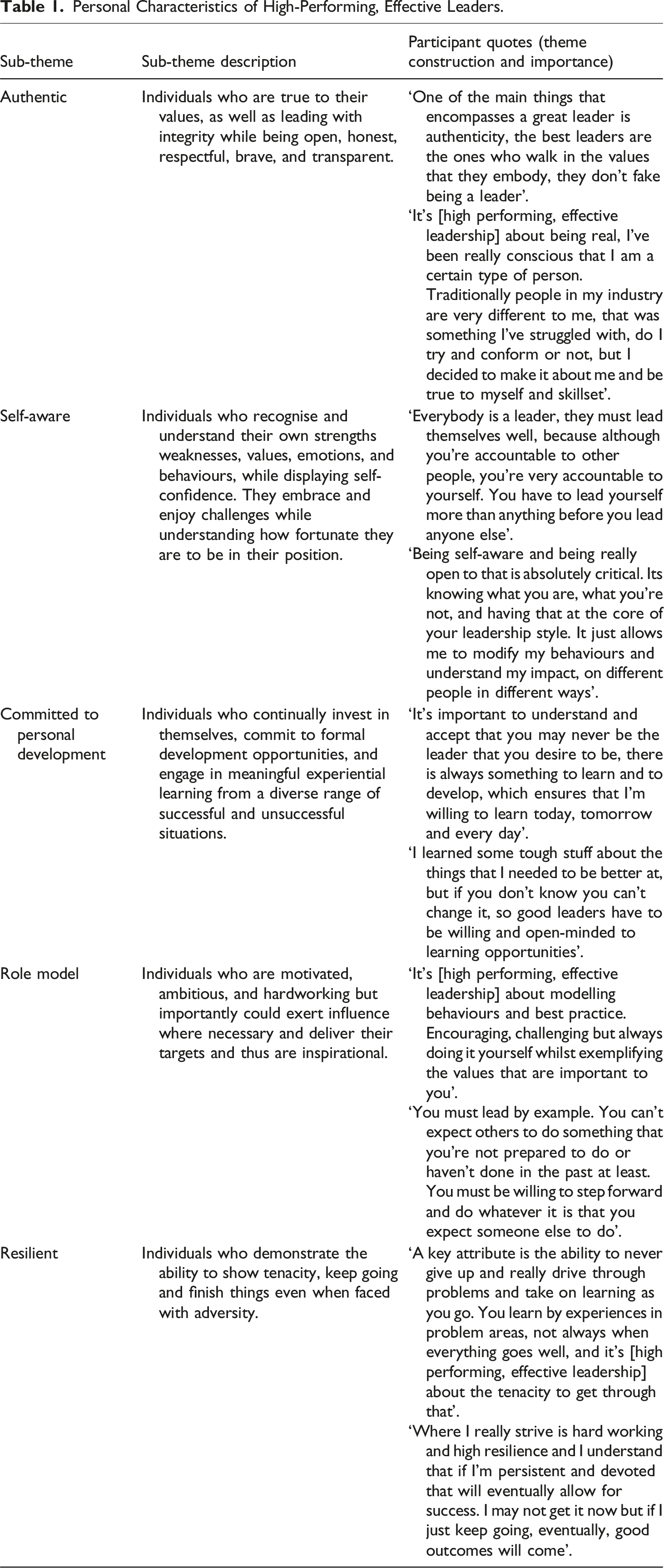
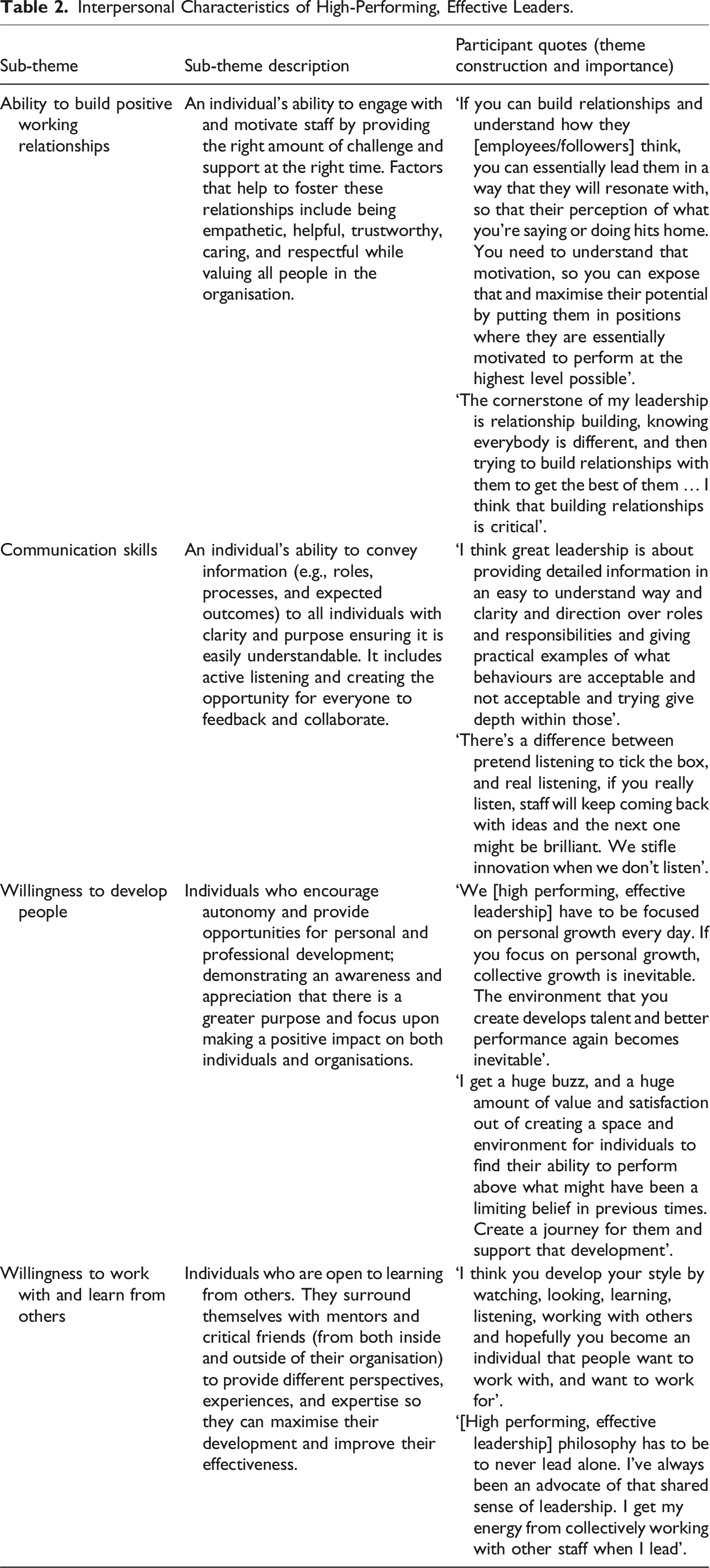
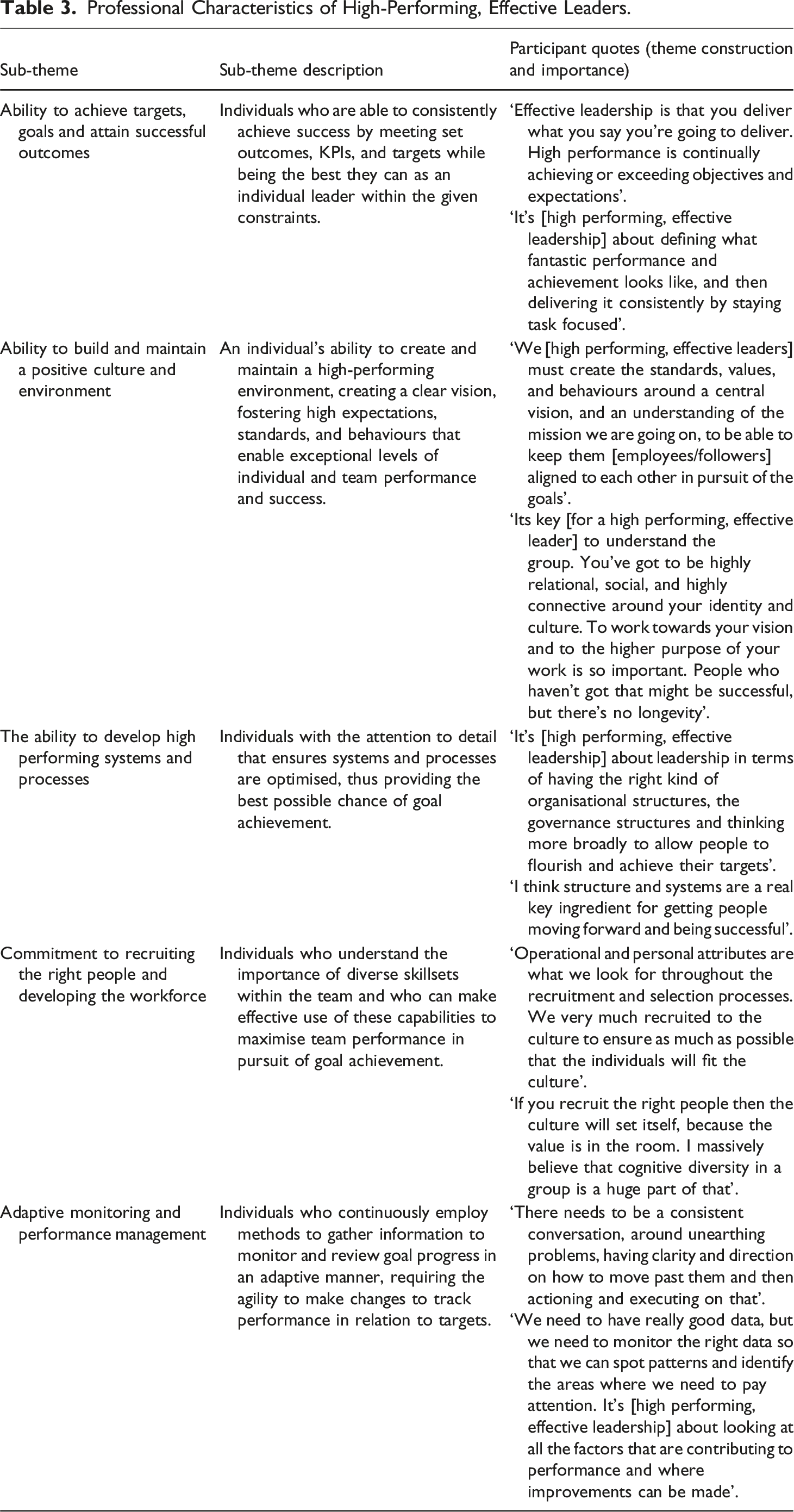
In consideration of the characteristics required to achieve high-performing, effective leadership, participants were asked to discuss those deemed as most valued/important in an attempt to profile only those factors that can be attributed to high performance and effective practice. In doing so, participants detailed a range of factors that have subsequently been categorised into three themes: personal; interpersonal; and professional. These themes are presented in separate tables, which contain (a) the specific characteristic (sub-theme); (b) a description of the characteristic that has been constructed from the participants’ views; and (c) associated participant quotes that support the construction and importance of each characteristic.
Personal characteristics
Personal Characteristics of High-Performing, Effective Leaders.
Interpersonal characteristics
Interpersonal Characteristics of High-Performing, Effective Leaders.
Professional characteristics
Professional Characteristics of High-Performing, Effective Leaders.
High-performing, effective leadership development
Regarding high-performing, effective leader development, three sub-themes were constructed: formal education and ongoing professional development; experiential learning; and significant others. Participants’ views were based on both how they had developed as a leader as well as the processes they currently employ to develop leaders within their organisations.
While the type of formal education and professional development activities varied amongst participants (e.g., qualifications; workshops; conferences; reading; podcasts), many expressed that such activities had been beneficial in helping them to ‘develop the knowledge necessary to manage the demands associated with effective leadership’. Several participants also reported how such ongoing formal learning activities allowed them to ‘remain current to modern trends and cultural perspectives’, with systematic and structured learning opportunities being linked closely to the development of professional characteristics particularly. For example, one participant acknowledged, ‘Doing a qualification in an area I was working in provided a theoretical underpinning for the stuff I knew. It [qualification] actually helped me to join up what I was seeing in practice with significant amounts of research’. Indeed, all participants recognised the need for leaders to be motivated and committed to continuous formal learning and development activities as they saw engagement with ongoing education as a vital aspect of improving and maintaining performance. It was stated, ‘It’s good having a gut feeling but by doing academic qualifications really helped because I had this massive body of research and skillset to access it, to support my actions’. Finally, participants acknowledged that to achieve the status of a high-performing, effective leader, individuals should embrace novel methods and tools for their personal and professional development as a way of engaging with knowledge and skills in more meaningful ways: I'm an academic by nature and I very much see what I do now as being rooted in my need to understand concepts of leadership in relation to how I view the literature and research. I use that to inform what I do so I understand what it provides me, and it keeps growing my need to keep challenged and keep academically on a level that I require. I honestly believe that when I am studying and learning and I'm a better leader.
Although formal education and ongoing professional development was widely deemed as necessary and important, all participants emphasised that their development as high-performing, effective leaders had been most influenced by learning both explicitly (e.g., reflecting on experiences) and implicitly (e.g., conversations/working with others) from a host of different experiences. Participants specifically referred to how they had benefitted from adopting an attitude that values experiential learning and drives the motivation required to continuously challenge themselves to progress their knowledge, skills, and behaviours. For example, participants explained, ‘Learning is what really motivates me. I’m always looking for the next [learning opportunity]. I always look at what can I get from the experience … linked to what I can do to challenge myself to get better’ and ‘You will never be the leader that you desire to be. There is always something to learn, particularly from your experiences, something to develop and continuing to push boundaries, which helps us to always try to be better’. To elaborate, participants emphasised the value of exposing themselves to diverse experiences, with it being recognised that ‘the more diverse the path the better’ as varied experiences were thought to enhance learning and encourage individuals to check and challenge habitual practices that could potentially be improved. For example, one participant stated, ‘You [leaders] are a product of your environment and I’ve been fortunate with the range of different leaders and different contexts along the way, these have helped to guide my journey and been beneficial in helping me to challenge everything’. Indeed, participants described how they looked for (and still look for) opportunities to push themselves out of their comfort zone, creating a willingness to experiment with new ideas and practices, to continue their development. To support learning through such processes (or experiences), participants highlighted that for them to develop they needed the support of ‘safe environments in which you feel as though you can make mistakes, learn from them, and make improvements’. Another participant detailed: Learning and development depend on how you look at things that you've done wrong. A key thing is that mistakes I've made have helped me learn valuable lessons that I may not have learned had I not made the mistake or had the opportunity to make sense of them.
One process thought to enhance purposeful and meaningful experiential learning, recognised by participants as a mechanism to facilitate more effective leadership and thus a key skill for leaders to develop, was reflective practice. Participants widely acknowledged that they consistently reflected on their performances (e.g., ‘[As a leader] you have to make time to reflect on your performance’) to better understand how their own strengths and limitations may have influenced the experience and, subsequently, what opportunities they had to improve and/or maintain the quality of their practice. This is best represented in the following quote: I might have to have a difficult conversation with a member of staff; that’s a tension for me, a struggle, because of my disposition, but I know nothing grows straight. In terms of character and effective leadership I understand that to be effective, you've got to reflect on those difficult moments purposefully and to learn from them.
Linked to these approaches to experiential learning, participants also specifically emphasised the beneficial impact of learning from significant others. Participants detailed how they had to identify the ‘right people’ to learn from, be willing and open to ‘what those individuals might have to help improve our own way of doing things’, and connect with these significant others in a meaningful and reciprocal manner. Indeed, in reference to the importance of working with and learning from high-performing individuals in different industries, one participant stated, ‘We watch them [high-performing individuals from other industries], observe them, be around them and then mirror actions where appropriate and that’s really helped me to mould my actions and improve me’.
Participants specifically recognised the importance of formal mentoring experiences for their development as high-performing, effective leaders. Through mentoring, participants outlined the benefits gleaned from ‘mentors who look at leadership through different lenses’, and how, ‘[mentor’s] different perspectives challenged my views of leadership’, which resulted in, ‘[through mentoring] I’ve worked out that leadership is essentially universal across different contexts and so there are valuable lessons to be learnt [from those working in different contexts]’. Participants also acknowledged how building less formal relationships with ‘critical friends’ had aided their development, particularly as these individuals were thought to offer the necessary support mechanisms to help them better understand themselves and their own performance: ‘Great leaders have that network of people who support and advocate for them but are not frightened to just say “you’re up your own backside on this one and come back down to earth.”’ Participants described how when critical friends offer feedback it comes from a place of trust and individuals are, therefore, more likely to listen and act upon the information. For example, ‘I have a group of people that I trust who are honest with me. They tell me if they think something’s wrong, and that’s hugely important; they can say things that I may not want to hear but I need’. Similarly, participants highlighted the value they had taken from asking questions, receiving feedback from, and listening to their own employees (followers). For example, ‘Whenever I’ve led a team, I always ask for feedback, and I think I’ve learned a lot about what I’m good at and where I could improve by listening to what others have to say’.
The construction and maintenance of high-performance
Clarifying concepts: The high-performance environment (HPE)
Although participants shared the view that HPEs should be understood from a humanistic (relational) rather than a physical perspective, they also agreed that a universal understanding of HPEs is difficult to obtain as HPEs are context driven. Thus, while the importance of themes such as value-laden culture, value-driven behaviours, maximising human potential, and valuing interpersonal relationships may be relatively common in discussions of HPEs, and lessons can be transferred from one HPE to another, leaders must formulate their own understanding of the concept of HPEs in relation to the context of their business and industry. For instance, one participant emphasised: HPEs are contextual, what’s high performing in one environment might be different to another. It’s [HPEs] being the best that you can be and creating the best environment possible within all the constraints and resources you've got, whilst getting real clarity over what is it that we want to achieve.
In attempting to clarify the concept of the HPE, participants referred the requirement for all resources to be maximised to ‘push the boundaries to be the absolute best you can as individuals, teams, and organisations’. Other participants described, ‘[HPEs] are where leaders work to get the maximum out of others, figuring out how they work and perform individually and then how they can work effectively together, maximising positive group dynamics’ and ‘[HPEs] are those where individuals and teams are challenged to continuously improve and work towards achieving goals through emphasising effectiveness and supporting growth’. In relation to this, there was an overarching view that HPEs were those in which there is an appropriate balance between ‘challenge and support’; individuals and teams are challenged to adapt to demands and strive towards goal achievement while being supported in their efforts to do so and yet given the autonomy they require to excel. Here, participants emphasised the importance of ‘psychological safety’ and a ‘balance between well-being, performance, and achieving tasks’. For example, ‘[A HPE is one in which] staff feel safe to challenge us [leader] and each other under the idea that we work together collaboratively’ and ‘You can’t have a HPE if staff don’t have autonomy, or if they don’t feel trusted to do their job’.
Participants widely discussed the notion that teams operating in HPEs are successful in achieving targets and then are given the capacity and resources to learn how to ensure ongoing, consistent success. One participant outlined, ‘A HPE at an institution, a business, allows it to achieve its objectives, exceed its objectives and continually exceed expectations’. Similarly, another participant acknowledged, ‘[HPE are formed when there is] the creation of a system in which talented individuals are able to perform above and beyond what they probably thought was capable, and consistently do that whilst achieving their primary objectives’. Related to this, participants reported how HPEs require everyone to be ‘accountable to the company’s values, the standards and expectations’. Indeed, participants indicated that HPEs require ‘clarity over values’ and ‘the expectation that individuals’ and teams’ behaviours align with the [company] values’. Value-driven behaviours were thought to help create connection between individuals within teams that ‘adds to a sense of pride around the work they [staff] do feeling that it [goal striving and achievement] has a “higher meaning” or “purpose.”’
Constructing and maintaining high-performance environments (HPE)
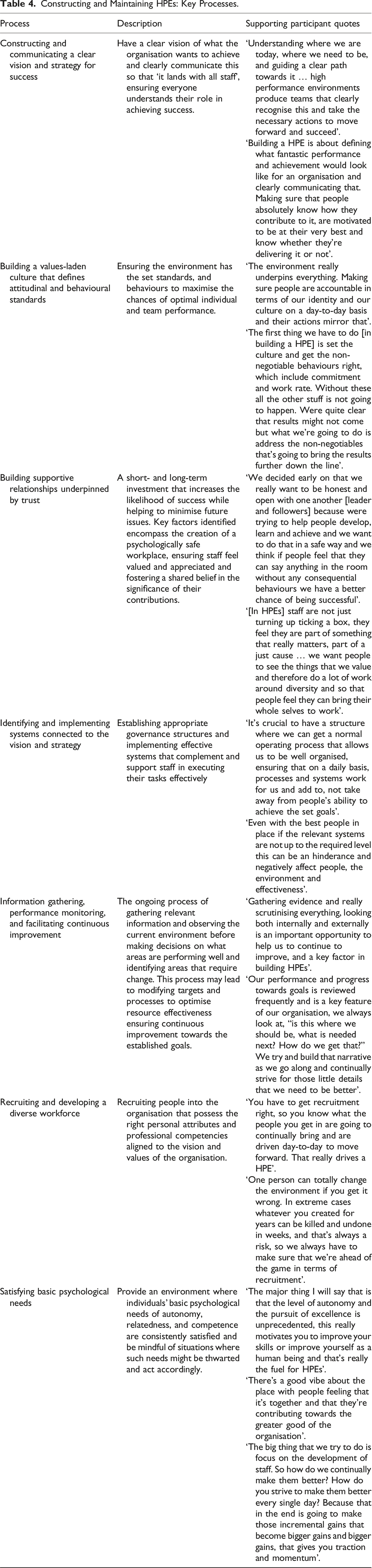
Constructing and Maintaining HPEs: Key Processes.
Discussion
Effective leadership is widely recognised as a key driver for institutional quality and learner success in FE (Cantor & Roberts, 2021). However, regulator (e.g., Ofsted) inspections have widely highlighted significant shortcomings in FE leadership that have been reported to compromise institutional standards (e.g., achievement of learner-related metrics) and resilience (e.g., financial stability; Pearson, 2022). Given that the success of FE colleges is essential for the achievement of the UK Government’s education and skills agenda, calls have been raised for researchers to address the paucity of empirical work conducted in FE and focus on the critical examination of leadership and the environments that leaders create (O’Regan & Painter, 2023). The purpose of this study, therefore, was to explore the concepts of effective leadership and HPEs from those perceived as high-performing, effective leaders across a range of different sectors. By accessing cross-sectoral experiences, we sought to develop novel insights that could be transferred to the FE sector and subsequently challenge existing views regarding leadership in FE. It was thought that such an approach could support the innovation in leadership development required to help FE colleges strive for excellence.
We found that for leaders to be high performing and effective, they require an amalgamation of personal, interpersonal, and professional characteristics (see Tables 1–3), which are developed through formal means but, perhaps more significantly, through experiential processes. Further, participants in our study highlighted how HPEs are key to individual and organisational performance and goal achievement with the leader’s role in developing HPEs seen as critical. Finally, humanistic principles were prevalent in discussions regarding HPEs and effective leadership, with the importance of satisfying individuals’ basic psychological needs (BPNs; autonomy, competence, relatedness, Ryan & Deci, 2020) for maximising the human performance widely recognised (see Table 4).
The nature of high-performing, effective leadership and HPEs: Lessons learned for FE
While the concept of maximising human performance to achieve organisational targets is not a novel concept, it has been argued that when exploring factors that facilitate performance, researchers have overlooked the environment (Anwar & Abdullah, 2021; Jones et al., 2009). However, participants in our study, who operated in a diverse range of industry contexts, were unwavering that the environment leaders help to create and maintain is a critical facilitator of individual and organisational success, and something that they consciously prioritised. Despite such findings, there has been a clear dearth of understanding regarding the concept of HPEs across industry sectors (Anwar & Abdullah, 2021). Our findings indicate that HPEs are those in which targeted goal striving designed to optimise individual, resource, and organisational performance is emphasised; person-centred approaches that effectively satisfy individuals’ BPNs are employed; and outcome driven processes are adopted in a way that supports consistent goal attainment. Further, HPEs require clarity regarding organisational culture (e.g., clarity of vision, values, and communication) and are supported by flexibility to allow processes to adapt to the unique contexts and constraints in an organisation and thus ensure ongoing progress.
Although the participants in our study were largely unequivocal in their views that high-performing, effective leadership and HPEs must result in consistent goal attainment and continued organisational growth, they established the centrality of people within the process of achieving these outcomes. Our participants emphasised the key role of the leader in the construction and maintenance of HPEs, acknowledging how leaders need to communicate the organisational vision, values that drive behaviours, and individual and collective targets. Doing this helps establish clarity and allows individuals to understand what is required for them to make a positive contribution (see Table 4). It has been proposed that leaders who are able to align individuals to collective vision, values, and goals are able to enhance job satisfaction, organisational commitment, and work-related performance (Saks et al., 2022). Our participants also outlined how, to achieve such outcomes, leaders need to themselves live the values that underpin the HPE and role model–associated behaviours. Researchers have highlighted how those leaders who are seen to hold themselves accountable to the standards expected of the workforce are likely to influence the attitudes and behaviours associated with high performance and subsequently improve productivity and organisational success (Nzuva & Kimanzi, 2022).
Our participants indicated how high-performing, effective leaders are those who are willing to share responsibility and attribute success to the efforts of the collective rather than to themselves or other individuals. This view of what is required from leaders to create HPEs supports the contentions of other researchers who have argued that successful teams are those that are engaged, collaborative, and where individuals have agency and feel valued (e.g., Bloom et al., 2020). While there is a need for a clear line of command, operationally, HPEs require a commitment to accept a flatter hierarchical structure where the workforce feel connected to organisational values, understand and enact industry-relevant performance-related processes, and are willing and able to be accountable (Joseph & Ideraola, 2021; Nzuva & Kimanzi, 2022).
Given how the participants in this study stressed the importance of the collective for HPEs, where leaders and their followers work collaboratively and in synergy, as well as the focus placed on organisational culture, goal striving, and achievement, it appears vital that leaders seek to create and support the conditions that allow their workforce to thrive. Human thriving is understood as a state in which individuals concurrently experience well-being, development, and performance (cf. Passaportis et al., 2022). Conceptualising thriving in this way fits with our participants’ suggestions that to form and maintain HPEs, leaders must embrace the notion that an organisation’s greatest resource is its workforce and, thus, adopt person-centred approaches that support individuals’ agency, professional growth, and performance (see Table 4). Researchers have argued that building organisational cultures on person-centred principles help create psychologically safe environments (e.g., where people feel able to express themselves without fear of judgement) that enhance creativity, satisfaction, motivation, and productivity due to employees feeling valued (Newman et al., 2017).
The person-related outcomes associated with the conditions that allow individuals to thrive are also linked to the experience of mental well-being (Passaportis et al., 2022). Mental well-being is thought to be associated with both hedonic (e.g., happiness, satisfaction, and positive effect) and eudaimonic (e.g., living a meaningful life; connected to values) factors that orientate a person to cope with stressors, maximise their potential, and make a positive contribution to society (cf. Baldock et al., 2020). As a result of the potential impact of individuals thriving in the workplace, it appears necessary to place people at the centre of the process of constructing an HPE. Accordingly, leaders must be willing to adopt a facilitative approach through which individuals are given a degree of autonomy while understanding their position and responsibilities in respect of the collective (Anderson et al., 2019; Reitzig, 2022). Indeed, in accord with the findings of other researchers (e.g., Jelinkova and Lostakov, 2016), our participants were clear that HPEs are often established when staff feel genuinely cared for, have a strong sense of community, feel connected through relationships built on professionalism and respect, and feel as though they have the resources (personal and organisational) to succeed.
To create the conditions required for HPEs (e.g., a person-centred focus to facilitate human thriving), our findings attest to the value of leaders prioritising the satisfaction individuals’ BPNs (Ryan & Deci, 2020). Ryan and Deci suggested that to facilitate optimal functioning for growth and integration, as well as for constructive social development and well-being, it is imperative that the BPNs of autonomy (e.g., a sense of control and volition), competence (e.g., a sense of capability), and relatedness (e.g., a sense of connection) are supported. Organisations that create environments designed to satisfy staff BPNs, experience increased collaboration (Anderson et al., 2019), innovation (Palepu et al., 2020), and improved morale (due to self-actualisation, perceived control, attachment, engagement, and reduction of fear) to create high performance and a competitive advantage (Reitzig, 2022).
By referring to the importance of supporting individual professional growth and development, our participants acknowledged the benefits of increasing perceptions of competence in the workforce. Participants also referenced value in the flattening of hierarchies, the need to facilitate individual’s willingness to embrace agency, and, in HPEs, workers accepting individual and collective responsibility (i.e., autonomy). In relation to our participants’ experiences of HPEs, considerable emphasis was also placed on leaders’ abilities to build and sustain positive working relationships with the workforce (relatedness). It is thought that through alliances (leader–employee; peer-to-peer) where individuals feel they can be honest, are trusted and respected, and yet challenged to promote professional growth, workers are more likely to enact behaviours aligned to organisational values and feel more connected to the company and individuals within it (Quade et al., 2020). Relatedly, researchers have argued that satisfying the need for relatedness may reduce staff turnover (Moore & Hanson, 2022).
To be able to enact effective, high-performance leadership, and subsequently create HPEs, our participants outlined several developmental processes that may be pertinent for FE colleges. First, participants detailed the importance of providing leaders with evidence-informed training designed to help individuals develop the values, beliefs, characteristics, attitudes, and behaviours required for high performance. Despite Estyn (2015b) and Ofsted (2019) detailing how the quantity and quality of leadership development directly impact the effectiveness and improvement of educational establishments, researchers have recognised that individuals are often appointed into FE leadership roles based on their academic resumes rather than on whether they possess necessary leadership knowledge, skills, and experience (Daniëls et al., 2019). Accordingly, our findings regarding the nature of HPEs and the associated human and environmental conditions could be used to form part of future leader training programmes (e.g., education and training on BPN satisfaction and the enactment of person-centred practices). This would help to ensure that training opportunities are fit for purpose, have a focus that extends beyond the traditional leadership content, and are contextually relevant in relation to considering high performance as a mechanism to facilitate positive organisational sector outcomes (Lacerenza et al., 2017). Such training programmes may better equip leaders to enhance the effectiveness of their leadership behaviours and improve performance (Flaig et al., 2020).
Second, our participants recognised the importance of leaders engaging in ongoing professional development as a way of checking, challenging, and adapting who they are and what they do to meet the changing needs of the HPE and the staff who work in the organisation. In agreement with other researchers (e.g., Tran & Nghia, 2020), we argue that ongoing development provision should be individualised based on the needs of the leader and propose that such development-based activities should target the development of the personal, interpersonal, and professional characteristics identified in the current study (see Tables 1–3). The characteristics of effective, high-performing leaders identified in this study could be used as part of FE leaders’ performance reviews where they profile themselves identifying strengths to be built on and area that require explicit developmental focus. Such an approach would give the leader the autonomy to identify their own needs, which is likely to enhance motivation to engage in developmental activities and ensure that bespoke training is provided (Ryan & Deci, 2020). Linked to this, our participants advocated that opportunities for leadership training and development should be afforded to all staff who aspire to be leaders as a way of satisfying their need for autonomy and competence and to prepare them for the transition into a leadership role. It is thought that by adopting an organisation-wide policy for developing leaders, FE colleges can develop robust professional learning cultures in which succession planning is considered at every level and proactively nurture the leadership potential of all staff (Tran & Nghia, 2020).
Finally, our participants highlighted how effective, high-performing leaders make the most out of working with others throughout their entire leadership careers. For example, the importance of observing and modelling other people’s performance behaviours, both within their organisation and across different sectors, was viewed by our participants as critical for their own development. Our participants also recognised the value in having people they could trust to act as critical friends as vital to their ongoing ability to operate as effective, high-performing leaders. Having access to role models and critical friends has been suggested to support the decision-making process, create positive challenge, facilitate interpretation and act as catalysts for change, alert leaders to issues, and help to shape outcomes (Frost & Durrant, 2003). It has been reported that leadership behaviours are learned by observing and listening to others and that having people that leaders trust, who provide feedback, and they listened to was key to encouraging more effective practice (van Diggele et al., 2020). The implementation of mentoring and shadowing programmes, as well as offering FE leaders the facility to spend time in other organisations, could be seen as beneficial mechanisms to aid the development of effective, high-performing leaders (and the development of HPEs; Tran & Nghia, 2020).
Limitations and future directions
To demonstrate the reflexivity of the research team, several limitations are considered. First, while we attempted to sample high-performing, effective leaders using externally recognised criteria, we appreciate that there may be some subjectivity in recognising individuals as high performing. Second, in an attempt to develop the novel insights required to challenge existing views regarding leadership in FE and support potential innovation in this area, we drew on the established benefits of exploring phenomena (e.g., HPEs) in one sector (e.g., business and military) and transferring learning to another (e.g., FE; Jolly et al., 2019). However, we recognise that while some principles of high-performing, effective leadership and HPEs can be adapted across sectors, others may be decontextualised and thus, in this case, not compatible with the unique socio-political and regulatory constraints of FE. Consequently, our findings need to be considered and applied carefully in accord with the specific contextual, cultural, and pedagogical values of FE. Without such contextual sense-making, FE institutions potentially risk a surface-level adoption of the principles established in our research that fails to achieve meaningful or sustainable improvement. To further develop the evidence-base, researchers should, therefore, seek to explore the views of leaders in FE recognised as high performing by regulatory bodies (e.g., Ofsted). Such research would allow for a more context-specific exploration to be conducted that may better establish the facilitators and barriers to leadership and HPE development in FE. Finally, we sought the views of leaders without considering those of their followers. Triangulating the views of multiple stakeholders would offer a more holistic understanding of effective leadership and HPEs as well as what works in practice. Researchers should consider sampling all stakeholders (e.g., management; administrators; teaching staff; business support) that may be best positioned to extrapolate the mechanisms that facilitate high performance in FE by adopting case study methodologies.
Conclusion
As pressure on FE leaders and colleges in the UK to perform continues to grow, the need to enhance effectiveness and efficiency may never have been more pronounced (Scottish Government, 2022). Indeed, MEDR (2024, new inspectorate for Wales) have stated that their strategic priorities focus upon maintaining and enhancing the quality of the tertiary education system, seeing leadership as a critical conduit in FE institutional success. The development of more effective, high-performing leaders who consider and consciously build HPEs should, therefore, be a consideration of all FE colleges. To support this, we aimed to investigate the characteristics of high-performing, effective leaders and HPEs to generate novel evidence-based insights that could facilitate the improvement of various processes within FE colleges, and consequently the performance of both individuals and organisations. Our findings, garnered from the experiences of leaders across a range of sectors, indicate that leaders in FE need to develop the characteristics required to facilitate the development and maintenance of an environment that is designed to optimise individual, resource, and organisational performance. To do this, leaders need to ensure clarity regarding organisational culture, adopt person-centred approaches that effectively satisfy individuals’ BPNs, and support individuals’ ability to thrive. Further, leaders need to be willing to flatten hierarchical structures to encourage responsibility and accountability across the workforce for performance management. Finally, there is a clear need to ensure that individuals are provided with the necessary training and development programmes to ensure they develop the characteristics required to successfully transition into FE leadership roles and subsequently operate effectively and enact high performance. Given the potential significance of these findings, we encourage all FE colleges to critically consider how they might apply our insights with a view to enhancing overall success through changing the focus of their strategy to one that embraces the concept of high performance.
Supplemental Material
Supplemental material - Exploring High-Performing, Effective Leaders, And the High-Performance Environments they Create: Constructing a Framework to Improve Leadership in Further Education
Supplemental material for Exploring High-Performing, Effective Leaders, And the High-Performance Environments they Create: Constructing a Framework to Improve Leadership in Further Education by Neil Smothers, Lee Davies, Sheldon Hanton, Gina Dolan, and Brendan Cropley in Journal of Adult and Continuing Education.
Footnotes
Declaration of conflicting interests
The authors declared no potential conflicts of interest with respect to the research, authorship, and/or publication of this article.
Funding
The authors received no financial support for the research, authorship, and/or publication of this article.

Supplemental Material
Supplemental material for this article is available online.