



Abstract
This paper introduces the concept of transformative digital competence in the context of digital transformation and the shift towards lifelong learning ecosystems. Relating to transformative learning theory and its German counterpart, Transformatorische Bildungstheorie, the paper addresses three research questions: 1) What kind of digital competences are required to navigate the lifelong learning ecosystems? 2) What barriers hinder the development of these digital competences in lifelong learning ecosystems? 3) What preconditions enable learners to cultivate appropriate digital competences? The paper critically examines digital competence development policies by reviewing frameworks such as OECD’s 2030 Learning Compass and the EU’s Digital Competence Framework (DigComp). It identifies limitations in these policy-oriented approaches, highlighting three major barriers to effective digital competence development. To overcome these barriers, the paper introduces the concept of transformative digital competence, emphasizing both creative-productive and critical-reflexive digital skills. It presents findings from the DigiTaKS* project, which investigates students’ attitudes towards digital competence development and the implications for adult education and lifelong learning in Germany. This study aims to contribute to the understanding of digital competence within lifelong learning ecosystems and provide insights into effective policy and practice.
Keywords
Introduction
Digital literacy is regarded by international policy actors worldwide – depending on the point of view – as a core foundation (OECD, 2019a), a key competence for lifelong learning (European Commission, 2019, p. 10), powerful facilitator and a catalyst of individual learning (UNESCO Institute for Lifelong Learning, 2022, p. 4), or at the core of employability (CEDEFOP, 2022, p. 6). Numerous attempts have been made to systematize and measure digital competences within frameworks like, amongst others the EU’s DigComp (Carretero et al., 2017; Vuorikari et al., 2022) and the UNESCO Digital Literacy Global Framework (UNESCO Institute for Statistics, 2018). The models underlying these frameworks primarily conceptualize digital competence as the combination of knowledge, skills, and attitudes necessary to navigate the digitalized world successfully. Other frameworks adopt this competence-based perspective but focus on slightly different aspects, such as the OECD 2030 Learning Compass (OECD, 2019a) or German WBGU’s Zukunftsbildung (Future Education) for a digitalized world (WBGU, 2019).
This paper aims to highlight the role of digital competences within the broader context of emerging ecosystems of lifelong learning in educational policy as introduced by Singh (Singh, 2023, 2024a, 2024b; Singh et al., 2022). In doing so, we follow Ehlers critical interpretation of policy terms as ‘empty signifiers’ (Ehlers, 2019, p. 23), whose precise meaning becomes apparent only within a specific context.
1
Although based on models created mostly in scientific contexts, we understand descriptors and definitions in digital competence frameworks as products of policy processes, not scientific concepts in themselves. In this way, we aim to discuss the policy-oriented concept of lifelong learning ecosystems and its intended means of digital competence development, bring to light conceptual limitations and address them by reaching beyond the aforementioned attempts of categorization in competence frameworks. To this end, we propose the concept of transformative digital competence and examine its implications. We address three central research questions. (1) What kind of digital competences are required to navigate the lifelong learning ecosystems? (2) What barriers hinder the development of these digital competences in lifelong learning ecosystems? (3) What preconditions enable learners to cultivate appropriate digital competences?
To explore these questions, we first review the concept of lifelong learning ecosystems. We then analyze its relationship to digital competence development policies by examining two key frameworks. Based on this analysis, we discuss conceptual limitations and identify three potential barriers to digital competence development in lifelong learning ecosystems. Subsequently, we introduce our concept of transformative digital competence to address these barriers from a research-driven perspective. Finally, we support our concept with data and findings from an ongoing research project on students’ digital key competences and conclude by discussing implications for applying transformative digital competences within lifelong learning ecosystems.
The shift to lifelong learning ecosystems
Singh describes a shift from systems of adult education to lifelong learning ecosystems that highlights a significant transformation in global educational policies, resource mobilization, and practices over the past five decades (Singh, 2023, 2024a; Singh et al., 2022, 2023). According to her findings, this transformation is driven by the need to adapt to changing socio-economic conditions and the growing importance of lifelong learning in a knowledge-based economy, intensified by technology and visible especially through resource mobilization.
Singh identifies the start of the shift to ecosystems of lifelong learning in the post-war adult education systems of the 1970s, which traditionally focused on providing vocational and non-vocational education to adults through formal and non-formal means. This approach was still characterized by a clear demarcation between different types of education and associated institutions, with a strong emphasis on supply-based, teaching-oriented sectors. However, the limitations of this system became increasingly apparent as the demand for more flexible, learner-oriented, and demand-based educational opportunities grew, facilitating intensified changes since the 1990s (Singh, 2024b, pp. 15–16; Singh et al., 2023, pp. 200–201). Singh bases her observations on the policy shift to lifelong learning ecosystems on policy analysis of several important global stakeholders, including OECD and the World Bank (Singh, 2023) as well as UNESCO (Singh, 2024a).
Three significant policy changes described in her analysis play an important role in our research questions: First, there is a shift from a teaching-oriented approach to a learning-oriented approach. This change, instead of focussing solely on the delivery of education through formal institutions, emphasizes facilitating learning opportunities accessible to individuals throughout their lives, breaking down the traditional boundaries between vocational and non-vocational, formal and non-formal education (Singh, 2023; 2024b). Yet this shift does not change the instrumental perspective on human capabilities: ‘While education systems epitomise an instrumental view of education [ by implying its purpose, e.g., in emancipation or human capital], Lifelong Learning Ecosystems represent an instrumental view of learning’ (Singh, 2024b, p. 24).
Second, the role of the state in education shifted from predominant funding and decision-making for adult education to a regulatory role. This involves engaging in cost-sharing models with other stakeholders such as private companies, civil society organizations, and individuals due to limited resources since the late 1980s (Singh, 2024b, p. 16; Singh et al., 2023, p. 206). This shift reflects a broader trend towards the privatization and decentralization of education, emphasizing partnerships and collaboration among various stakeholders, strengthening market-driven approaches.
Third, international intergovernmental organizations, especially OECD, the World Bank, and UNESCO, have been instrumental in shaping national and sub-national policies (Singh, 2024b, p. 17). This influence encouraged countries to adopt more flexible and inclusive approaches to education (Singh et al., 2023, p. 77). It first aimed at economic growth and development, later at sustainable development in light of the increasing policy convergence towards the Sustainable Development Goals (SDGs) by UNESCO, World Bank, OECD, and EU (Košmerl, 2024).
Furthermore, Singh highlights several challenges associated with the implementation of lifelong learning ecosystems that are relevant for our research: One major issue is the persistently unequal access to learning opportunities (Singh et al., 2023). While policies and frameworks may be in place, actual participation of adults in lifelong learning remains uneven, with marginalized groups often being left behind. Additionally, the shift toward a more market-oriented approach to education raises concerns about the commodification of learning and the potential for increased social stratification (Singh, 2023). As we will show, these challenges persist when examining digital competence development as well.
Digital competences and lifelong learning ecosystems
To address our first research question – ‘what kind of digital competences are needed to navigate the lifelong learning ecosystems?’ – we relate the key changes and challenges described above to the context of digital competence development and recent educational policy orientations. To establish a connection between digital competence development and lifelong learning ecosystems, we first review two important models of international stakeholders: OECD’s 2030 Learning Compass (OECD, 2019a; 2019b) and the EU’s Digital Competence Framework for Citizens DigComp (Vuorikari et al., 2022). As indicated by the phrase ‘to navigate’ in our research question, we emphasize the shift from teaching-oriented adult education systems to learner-oriented lifelong learning ecosystems, highlighting the character of digital competence as an individual key competence. This perspective, as we will demonstrate, is partly visible in both reviewed models.
A common basic characteristic in both OECDs 2030 Learning Compass as well as EU’s DigComp framework is an understanding of competence as a combination of knowledge, skills and attitudes (KSA). While the OECD added ‘values’ as an additional component (OECD, 2019a, pp. 109, 129), the DigComp project adopted the concept from the European Qualification Framework project (Carretero et al., 2017; Council of the European Union, 2017). The 2030 Learning Compass project strives to support countries’ formal education systems by developing ‘a vision of education’ (OECD, 2019a, p. 8) focused on individual and societal well-being. Toward this goal, it describes various competences that aim to enable students’ agency to shape the future and relates them to individual learning. Although primarily focused on formal secondary education, the project recognizes the importance of all types of education, whether formal, non-formal, or informal, and of lifelong learning (OECD, 2019a). The DigComp project was initiated to ‘identify the key components of Digital Competence in terms of the knowledge, skills, and attitudes’ (Ferrari, 2013, p. 2) and systemize them in a common European framework. By developing competence descriptors, DigComp was aimed to create a shared understanding of digital competences that could be validated at the European level for all levels of learners. Although it never achieved widespread formal adoption across member states, it evolved into a policy-shaping tool for the EU’s digital decade policy (European Commission, 2024; European Union, 2022). This policy focuses on digitally upskilling the entire European population and involves collaboration with other stakeholders such as the International Labor Organization (ILO), UNESCO, UNICEF, and the World Bank (Vuorikari et al., 2022).
Therefore, both frameworks encompass conceptual descriptions of personal digital competences, dedicated to (educational) policy development. Where the EU sets its larger goal at a sustainable and social coherent green and digital twin transition (Muench et al., 2022), OECD’s Learning Compass is set to foster ‘transformative change’ (OECD, 2019a, p. 6), minimize phases of ‘social pain’ (ibid., p. 7) and contributing to a ‘future for better lives and for individual and societal well-being’ (ibid., p. 8). Their practical contribution, however, remains largely conceptual. While the DigComp framework has seen multiple applications in specified frameworks, for example, for education, organizations, and consumers, and was even adopted into national frameworks in Austria, Belgium, France, and Spain (Vuorikari et al., 2022, pp. 55–60), the OECD 2030 learning compass relies on curriculum implementation for student and teacher education alike as its application strategy (OECD, 2019a). The concrete methods for acquiring these far-reaching digital competences remain vague, despite both projects providing some considerations.
Both frameworks acknowledge the significant limitations in describing digital competences over the long term, especially considering rapid technological advancements. While the DigComp framework has undergone multiple revisions since 2013, the OECD recognizes that many digital skills will become rapidly outdated (OECD, 2019b). This underscores not only the need for continuous reformulation of the described KSA, but also the necessity of constant reskilling for individuals across various roles, such as employees, students, learners, and professionals, to sustain their digital competence. Both frameworks address this issue by emphasizing the personal capability of individuals to adapt to new developments in technology, employment, and society. According to the 2030 Learning Compass, workers will not only need to acquire new skills continuously, requiring flexibility and a positive attitude towards lifelong learning and curiosity to do so as a ‘new combination of skillsets’ (OECD, 2019b, p. 8) that includes metacognition as well. Similarly, in the DigComp framework, individual digital competence development is described as a distinct element within the competence area of problem-solving. Related KSA are defined as including the ability to broaden or update digital competences according to personal or professional needs (Ferrari, 2013). Later revisions provide more detailed competence descriptions, such as knowing about digital learning opportunities and how to adopt them for individual use, the ability to self-assess digital capabilities and having a general disposition to keep learning and to educate oneself (Vuorikari et al., 2022). It becomes clear that, while both frameworks are primarily oriented toward educational policy, they place considerable responsibility for learning efforts on the learners. As Singh concludes, the state and other stakeholders are supposed to ‘facilitate the learners in becoming self-directed’ (Singh, 2024b, p. 20). This not only involves engaging learners in decision-making processes, such as through (non-)participation, rather than focussing solely on the delivery of digital education for adults through (top-down) formal institutions. It obliges them with the responsibility to be aware of their own learning needs as well.
On the other hand, this responsibility connects the conceptual description of individual competences in the frameworks with a (sustainable) transformation of education systems, economic paradigms and societal orientations within their broader policy context. In the OECD’s case, this is strongly visible in the three transformative competencies that students need in order to contribute to and thrive in the contemporary world, and shape a better future: ‘creating new value, reconciling tensions and dilemmas, and taking responsibility’ (OECD, 2019a, pp. 16–17). These transformative competencies, like digital competences, are based on knowledge, skills, and attitudes and values, where the latter refer to the principles and beliefs that influence individual choices, judgements, behaviours, and actions. In the EU’s case, digital competences are seen as one component of the larger Key Competences for Lifelong Learning reference framework (European Commission, 2019), which relates them to other competence frameworks for entrepreneurship, languages, democratic culture, or life competences (Vuorikari et al., 2022). The key competences for lifelong learning framework aims at ‘[s]upporting people across Europe in gaining the skills and competences needed for personal fulfilment, health, employability and social inclusion […] to strengthen Europe’s resilience in a time of rapid and profound change’ (Council of the European Union, 2018, p. C189/1).
Summarizing on our first research question, the type of digital competences required to navigate ecosystems of lifelong learning are. • Set within a broader context of personal competences to achieve societal goals and support individuals to prosper; • In need of continuous reformulation (of the encompassed knowledge, skills and attitudes), but also constant reskilling; • To a considerable extent within the responsibility of the individual learners.
In the following section, we will highlight some important limitations that come with this policy-oriented concept of digital competences described in the two influential frameworks.
Barriers to digital competences in lifelong learning ecosystems
The development of digital competences within lifelong learning ecosystems is confronted by various significant challenges. These barriers could critically hinder the development of digital competences necessary to serve the larger goals formulated in the frameworks and related policies.
The first barrier we want to address is that lifelong learning ecosystems may focus too heavily on employability, neglecting other areas of digital competence. With the European Commission (2019) seeing digital competence as a key competence for lifelong learning, positioned ‘at the core of employability’ (CEDEFOP, 2022, p. 6) this includes the risk that (non-)formal digital competence development might primarily emphasize affirmative and uncritical attitudes toward digitality tailored for employment-related applications. Consequently, the critical and reflexive attitudes described in both frameworks could remain underdeveloped. Considering that according to the Adult Education Survey 83% of participation in adult education and training in Germany is job-related (Bilger & Koubek, 2024, p. 18), and 56% of all adult and continuing educational activities are conducted partially or predominantly online (ibid., p. 66), this risk is far from marginal. While both frameworks intend to connect individual digital competence development with broader goals grounded in universal values such as individual and collective well-being, employment has been, and continues to be, the primary focus in OECD and EU adult educational policies (Schiller, 2018). Furthermore, although lifelong learning ecosystems ostensibly provide more room for learners because the control of the state is decreasing (Singh, 2024b), the instrumental view of learning in policies underscores the necessity for a thorough development of attitudes in alignment with the principles articulated in the two frameworks.
This connects to the second barrier we aim to address: Lifelong learning ecosystems with an overly strong focus on employment might ‘lead to provisions where only work-based opportunities for a certain section of adults (those with resources in the broader sense) are to be promoted while the rest will be left out’ (Singh, 2024a, p. 2). This phenomenon is discussed as the Matthew effect in adult learning (Blossfeld et al., 2020) 2 and has been researched empirically (e.g. OECD, 2024). Similarly, the concept of a digital divide (van Dijk, 2013, 2020) can be understood as an equivalent effect in digital competence today. Structural (dis)advantages can be ‘inscribed in digital technologies […], corrupt[ing] the idea of equality and equal opportunities at its core’ (Ahlborn & Verständig, 2024, p. 344). As digital competence is increasingly seen as integral to overall societal participation (CEDEFOP, 2022; UNESCO Institute for Lifelong Learning, 2022), a divide between those who competently use digital technologies and those who do not now has a broader social impact. This impact can ‘reinforce inequalities and unequal distribution of resources’ (van Dijk, 2020, p. 33). While in former decades, access to digital devices and services was the primary divisor, it has now shifted to disparities in digital skills and attitudes (van Dijk, 2020). This shift is also reflected in international large scale studies were digital skill gaps have been identified between male and female, and urban and rural populations (OECD, 2024). In contrast, not having access to the internet or a computer is no longer cited as a primary reason for non-participation in adult or continuing education in Germany (Bilger & Koubek, 2024). In summary, the equal provision of learning opportunities for digital competence development is challenged by a Matthew effect (especially in non-formal learning, Blossfeld et al., 2020), while the general opportunity to participate in learning and society (Wolf & Koppel, 2017) is increasingly impacted by a competence-based digital divide.
A third barrier relates to the market environment in which digital technologies and services, especially educational technology (EdTech) operate. Whether unknowingly, or due to a lack of viable alternatives, formal and non-formal education provisions, along with informal digital learning activities, may inadvertently support the agendas of digital technology companies. These companies often prioritize financial returns or the consolidation of (market) power (Trittin-Ulbrich et al., 2021, p. 14) over educational goals. One notable example is the phenomenon of lock-in effects: When significant time and effort are invested in establishing a digital infrastructure, or digital services are designed to function interdependently, it becomes challenging to abandon these systems – even if they prove harmful to the learners using them (cf. Zerforschung, 2024) or lead to increased costs and dependencies compared to alternative solutions. Educational policies can exacerbate this issue by embracing ‘ideas of education as an administratively controllable process geared towards (economic) usability’ (Nysieto, 2024, pp. 185–186) as in the German national education platform (ibid.). With the state retreating to a primarily regulatory role and reducing public funding in lifelong learning ecosystems (Singh, 2024a), alternative stakeholders’ contributions often come with conditions. A current example is the application of AI technologies in education (AIED). These technologies have the potential to either amplify or alleviate existing inequities (Holstein & Doroudi, 2022), but they are frequently developed and controlled by large technology companies rather than educational providers.
Transformative digital competence in the DigiTaKS* project
To address these barriers, we apply our concept of transformative digital competence (TDC) that seeks to bridge the systematic yet descriptive features of digital competence frameworks with a deeper understanding of how these competences are developed. This concept was developed within the DigiTaKS* 3 research project (Digital Key Competences for Studies and Profession) to encompass both creative-productive and critical-reflective dimensions of digital competences, and to operationalize them for multi-method research (Rathmann et al., 2022; Schmidt-Lauff, 2025a; Schmidt-Lauff et al., 2022).
Conceptual considerations
We regard the concept of Transformative Digital Competence as particularly suitable for addressing the shortcomings of the described frameworks, especially concerning their vague conceptualization of how competencies are actually acquired. To achieve this, our concept combines two interpretations of the term ‘transformative’: first, it incorporates the collective dimension of social transformation found within the broader policy context of these frameworks, and second, it aligns this with the individual dimension of learning. This dual perspective is achieved by adopting elements from transformative learning theory (Cranton & Taylor, 2012; Mezirow, 2000, 2018) and its German counterpart Transformatorische Bildungstheorie (Koller, 2012, 2022; Nohl, 2016) both prominent in adult and continuing education research. This combination allows us to investigate the acquisition of digital skills and attitudes which are inadequately detailed in existing policies and frameworks, placing it in the context of emerging lifelong learning ecosystems.
At the start of the DigiTaKS* project, we adopted the concept of transformative digital competence from Martin’s competency model (Martin, 2006), originally developed to serve as a foundation for a European framework (DigEuLit). For Martin, ‘digital transformation’ represents the highest level of digital competence, achieved when innovative applications of digital skills enable creativity and foster significant change within professional or knowledge domains (ibid., p. 156). In our approach, transformative digital competence integrates creative and productive aspects of digital engagement with the critical-reflective competences emphasized by the German Scientific Advisory Board of the Federal Government for Global Environmental Conditions (WBGU). The WBGU advocates these competencies as essential for a critically ‘enlightened and dignified’ society (WBGU, 2019, p. 31), in addition to the OECD’s transformative competences described earlier. Furthermore, the WBGU connects transformative competences to sustainable development, highlighting the importance of critical thinking, self-efficacy, and creativity. These competences are deemed vital for navigating rapid and profound transformations while addressing ethical and normative challenges (WBGU, 2019).
Apart from these policy-sided perspectives, we draw upon a strong body of research in German educational and social sciences focussing on digital competences, skills, and literacy to avoid falling into the trap of using ‘empty signifiers’ as described by Ehlers (Ehlers, 2019, p. 23) for policy terminology. While ‘digital literacy' is more prevalent and scientifically grounded (Schmidt, 2024), ‘multiple situated literacies’ (Pötzsch, 2019, p. 222) have been formulated in the past (conf. Falloon, 2020) that refer to more narrow sets of skills, like todays ‘AI literacy’ (Eager & Brunton, 2023). Although the term digital literacy is sometimes used to refer to technological skills and occasionally incorporates elements of critical reflection, such as in ‘critical data(fication) literacy’ (Hartong & Sander, 2021), we adopted Falloons approach of replacing a skills-focused digital literacy in favour of broader digital competency models that recognize the more diverse ‘knowledge, capabilities and dispositions needed’ (Falloon, 2020, p. 2451). This particularly includes emphasizing critical reflection of digital technologies that Pötzsch (2019) regards as essential to his concept of critical media competence which is acquired through self-reflective educational processes. Within the larger German scientific media education discourse, digital competence has, in certain contexts, replaced the term media literacy (Schlottmann & Gerholz, 2022, p. 37). Consequently, our reinterpretation of Martin’s term transformative digital competence bridges educational theory and empirical research on one side with systematized classifications of digital skills found in policy frameworks on the other. In summary, transformative digital competence encompasses critical media competence aimed at the creative, productive, and critically reflective co-shaping of digital transformation processes. To encapsulate this idea, we coined the term Digital Change Agents, referring to individuals who leverage their digital practices to influence and contribute to a culture of digitality that is equitable and inclusive for all.
Operationalization of transformative digital competence in DigiTaKS*
Our research project follows a multi-method longitudinal design (cf. Rathmann et al., 2022; Schmidt-Lauff, 2025b) that comprises the following aspects. (1) development of a theoretical concept of transformative digital competence (as laid out above), (2) an empirical analysis of the preconditions (initial situations) and influencing factors (ongoing) involved in the acquisition of transformative digital competences by higher education students in the social sciences, who are envisioned as future digital change agents, (3) the formulation of a comprehensive model for transformative digital competence development.
Although we acknowledge that creative and productive digital knowledge and skills can be developed through cumulative learning and instruction in formal or non-formal settings, we question whether this approach is adequate for fostering critical-reflective attitudes. Contradicting the instrumental concept of competence levels that the systematization in the DigComp framework is based on, we view critical thinking and the corresponding attitudes as personal capabilities developed independently, to be applied later in digital contexts. Transformative digital competence, therefore, relies on cumulative learning processes for digital knowledge and skills, alongside critical-reflective capabilities that evolve into attitudes in the digital world. This distinction underscores the need to differentiate between such cumulative learning processes and those that cultivate critical-reflective attitudes. To operationalize this differentiation, we integrate elements of transformative learning theory (Illeris, 2014; Mezirow, 2000, 2018) and Transformatorische Bildungstheorie (transformative education theory, Koller, 2012, 2016, 2022; Nohl, 2016; Nohl et al., 2015). Both theories emphasize the role of crises and self-reflective processes in fostering attitudes during competence development.
Despite some terminological and conceptual differences, both theories propose that transformation occurs ‘when people are confronted with challenges for which the well-rehearsed figures of their relationship to the world and self are no longer sufficient’ (Koller, 2022, p. 17, own translation). In Marotzki’s earlier works on Transformatorische Bildungstheorie, according to Koller (2016), criteria such as growth in reflexivity and an increase in the complexity of the relationship to the world and the self are used to distinguish transformative processes from other (cumulative) learning processes. Tracking such transformative learning processes at individual empirical survey points in time seems nearly impossible. Instead, essential points of the process must be identified and observed. One critical point lies in the triggers for transformation processes, which, as Nohl (2016) concludes, can be disorienting dilemmas (in Mezirow’s sense) or ‘emergence-structured’ (Nohl, 2016, p. 171, following Marotzki and Schütze), characterized by unexpected occurrences. To operationalize these increases in reflexivity and complexity in world- and self-relations during digital competence development, we focus on changes in social practices as interactions of the subject and digital as well as real-world artefacts, following Reckwitz’s (2003) theory of practice approach. In our longitudinal study, we concentrate on changes in the subject’s digital practices, analyzing the events surrounding these changes for transformative elements. To contextualize these changes effectively, we examine the preconditions for digital competence development of students next.
Transformative digital competences of higher education students
With this in mind, we address our third research question: What preconditions enable learners to cultivate appropriate digital competences? In the research project DigiTaKS*, the scope of research is on digital key competences for studies and profession, framing students as future specialists and leaders in their respective fields (Breitschwerdt et al., 2025; Schmidt-Lauff, 2025b). Notably, our study sample consists of student officers at Helmut-Schmidt-University/University of the Federal Armed Forces Hamburg (HSU/UniBw H), Germany, further emphasizing their future role as decision-making digital change agents within the armed forces who will contribute to the digital transformation within the military. The data and results presented in this section are partly the subject of another publication in German in an edited volume from the project (Schiller, 2025).
Sample overview
Aligned with the overarching logic of the DigiTaKS* project, a total of three study cohorts of the Faculty of Humanities and Social Sciences at HSU/UniBw H were examined using a multi-method approach. The cohorts, spanning 2021, 2022, and 2023, included a total of 549 students from pedagogy, psychology, and history, of which 39.7% identified as females 4 . Quantitative questionnaire surveys were conducted at the beginning of the study course to collect data on largely time-stable characteristics, as well as a broad snapshot of existing digital practices and students’ self-assessed digital competences. These surveys achieved an average response rate of 43.7% (N = 549, n = 249). Additionally, 31 qualitative episodic interviews (Flick, 2011) were conducted (t = 22:47h recorded conversation). These interviews focused on episodes in which students addressed digital challenges, providing deeper insights into their self-assessments, identifying contexts for competence acquisition, and uncovering potential impulses for transformation. The interviews were analyzed following Kuckartz’ (2019) methodology of qualitative content analysis.
Preconditions for transformative digital competence development
According to Martzoukou et al. (2020), studies widely consider students to be digital competent when entering higher education. However, their digital literacy is often ‘taken for granted or assumed to be at an adequate level, rather than being assessed, remediated, and amplified’ (Martzoukou et al., 2020, p. 1436). This assumption aligns with van Dijk’s (2020) concept of a third-level digital divide which focuses on relevance and readiness to use digital technologies. It surpasses the second-level divide, however, which centres on digital skills and usage practices. Following this division, we understand digital skills and usage as the first precondition to transformative digital competence development (Martzoukou et al., 2020).
Student digital competence assessment and usage practices.
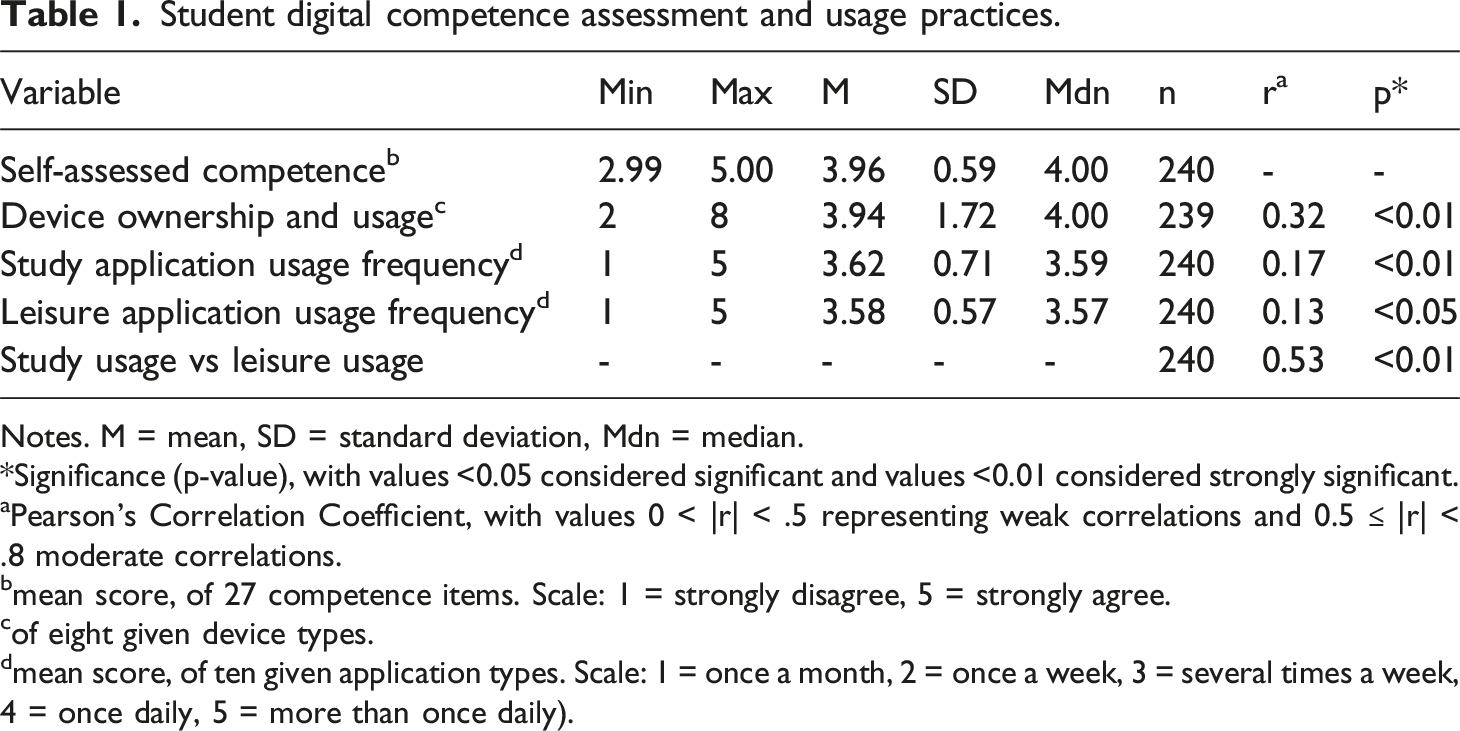
Notes. M = mean, SD = standard deviation, Mdn = median.
*Significance (p-value), with values <0.05 considered significant and values <0.01 considered strongly significant.
aPearson’s Correlation Coefficient, with values 0 < |r| < .5 representing weak correlations and 0.5 ≤ |r| < .8 moderate correlations.
bmean score, of 27 competence items. Scale: 1 = strongly disagree, 5 = strongly agree.
cof eight given device types.
dmean score, of ten given application types. Scale: 1 = once a month, 2 = once a week, 3 = several times a week, 4 = once daily, 5 = more than once daily).
Additionally, students were asked to report their frequency of usage of ten types of digital applications, categorized for studies and leisure purposes. These applications included, among others, messengers, office software, social networks, or virtual reality applications. Based on the responses, mean scores were calculated for study-related usage and leisure-related usage, serving as indicators of affinity and readiness to utilize digital applications. To further examine the relationship between both scores, the Pearson correlation coefficient was again calculated, revealing a significant positive correlation. These results indicate that students who frequently use digital applications for study purposes tend to do so for leisure activities as well.
The Pearson correlation coefficient for both study and leisure scores with the self-assessed competence score demonstrates significant, albeit weak, positive correlations. This finding indicates that students who exhibit a higher frequency and broader range of digital device and application usage, whether for study or leisure, tend to rate their self-assessed digital competences higher on average. Based on these observations, the first precondition can be summarized as digital affinity, which shows considerable variability within the sample. This variability challenges the widespread assumption held in universities that students generally begin their studies with adequate digital skills, suggesting that addressing this precondition is essential for fostering transformative digital competence development.
Context importance for digital competence development.
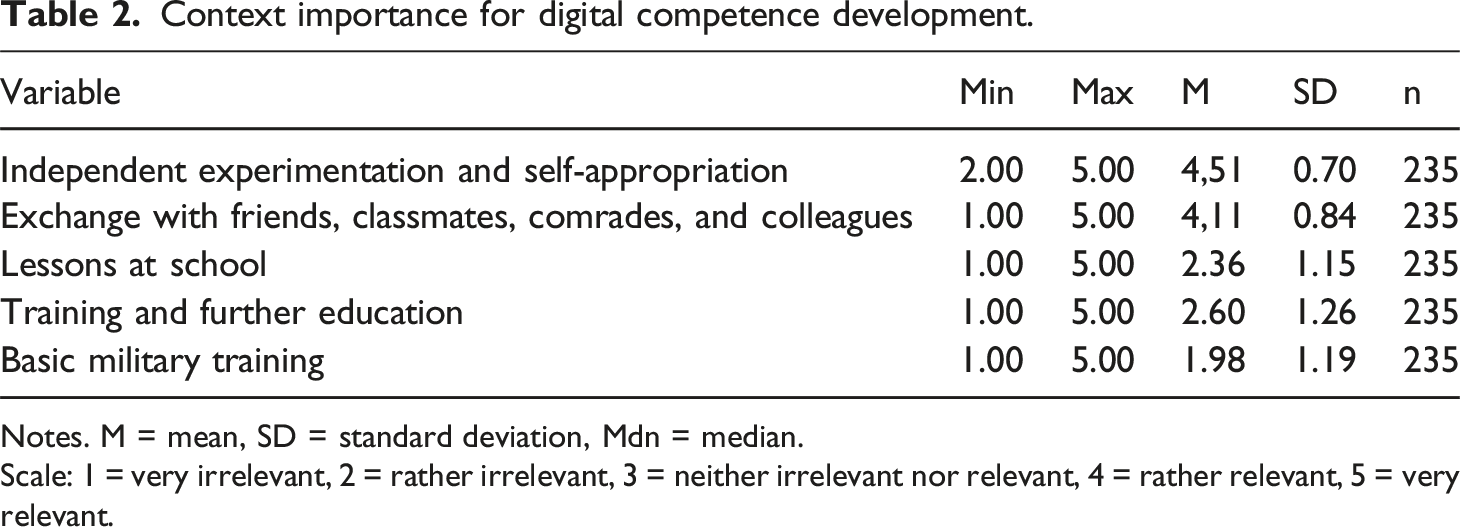
Notes. M = mean, SD = standard deviation, Mdn = median.
Scale: 1 = very irrelevant, 2 = rather irrelevant, 3 = neither irrelevant nor relevant, 4 = rather relevant, 5 = very relevant.
To further assess the relevance of institutional teaching in digital competence development, a sample of interview participants (N = 31) was asked: ‘Where do you see responsibility for promoting digital competences? Is it with the individual (learner) or with the institution (university)?’ Responses were systematically categorized using a 3-point scale: statements attributing responsibility solely to the individual, statements assigning responsibility exclusively to the institution, and statements suggesting shared responsibility. A quantification of encoded segments in the transcripts revealed the following distribution: In 14 statements from 11 interviews students placed responsibility solely to the individual learner; 25 statements from 18 interviews said responsibility rests entirely with the institution; and 26 statements from 21 interviews advocated for a shared responsibility. Individual responsibility was typically linked to initiative (‘because I’ve always taught myself everything’ ‘from intrinsic motivation’), with students emphasizing the importance of proactively acquiring digital competences or taking up provided offers for digital skill development. For example, a psychology student demanded that ‘individuals must also take responsibility themselves’. Institutional responsibility was largely framed within the principle of ‘teach what you test’, as students expected universities to provide learning opportunities for the digital skills required to pass study-related assessments. The results underscore the findings of the quantitative analysis (cf. Table 2), highlighting the importance of informal learning within formal higher education programs: ‘the expansion of digital competence actually takes place unconsciously; that’s something that continues with every course’. In cases of shared responsibility, aspects from both sides combine. As a history student put it: ‘I think it’s also partly the responsibility of the learners to teach themselves a little bit’, yet ‘if there is anything new that is specific, then it would be best for the university or the university lecturers to take care of it’. While individuals should show motivation and should engage with the digital and embrace it, institutions should impart core skills or the basic foundation on which individuals can then build their digital competence. This analysis underscores that students predominantly view digital competence development as a shared responsibility, with distinct roles for both individuals and institutions.
Discussion: Contribution of the research to the identified barriers in ecosystems of lifelong learning
Based on the findings of our research, we examine how they contribute to addressing the identified shortcomings in educational policy and the challenges of digital competence development within lifelong learning ecosystems. Our first research question was: ‘What kind of digital competences are needed to navigate the lifelong learning ecosystems’. Building on Singh’s findings that lifelong learning ecosystems apply an instrumental understanding of learning in favour of teaching, we identified these competences as being part of broader personal competences essential to achieving societal goals and supporting individual prosperity. They also require continuous reformulation and constant reskilling with considerable responsibility placed on the individual learners. We identified several equity challenges for a digital competence development sufficient to meet the larger goals of both EU and OECD frameworks and related policies. Within these frameworks, explicit formulations on how critical digital competence is acquired were notably missing. This omission highlights a gap in digital competence development, which we articulated as three barriers. The central critique on the conceptual level is that without thorough understanding on how critical thinking and corresponding attitudes are generally developed, the frameworks fail to serve their stated broader goals. They instead overemphasize employability-related digital skills, perpetuating digital divides and related persistent educational inequalities. To address these issues, we proposed our concept of transformative digital competence, which focuses on developing attitudes in the form of know-why through transformative learning processes. This concept is connected to the systematizations of digital skills described in the frameworks as the corresponding know-how. However, the question that remains is: What mechanisms within lifelong learning ecosystems can compensate for the decline in state-funded (or at least state-supported) opportunities for emancipatory education to foster critical attitudes that apply to digital contexts as well? If the instrumental understanding of learning persists in the frameworks, their formulation of critical capabilities might remain all just empty words. To counter this understanding, we introduced the figure of the digital change agent; a carrier of transformative digital competence. These individuals are envisioned as filling the gap left by diminishing opportunities for emancipatory education, thereby bridging the divide and advancing critical digital attitudes alongside practical digital know-how.
As an exemplary group for future digital change agents, we presented data on students from humanities and social sciences who are also candidate officers in the German Federal Armed Forces. Our empirical research revealed that students are not seeing themselves as inherently digitally competent at the start of their studies per se, suggesting that addressing this precondition is crucial for transformative digital competence development. Our findings clearly demonstrate that an affinity towards using digital devices and technologies correlates positively with self-perceived digital competences. If self-assessed digital competence is significantly tied to digital affinity, it seems important to find modes in addressing both affine and non-affine student groups appropriately. Students widely acknowledge their individual responsibility for being motivated to engage with the digital, but they expect institutions to take responsibility for their digital skills development as well. Employing suitable learning settings for this shared responsibility can be regarded as a further precondition for successful transformative digital competence development. If many students lack important digital skills, in addition to critical thinking capabilities which are widely regarded as fundamental goals of higher education alongside the curricular professional knowledge and skills, the institutions must take steps to create such shared responsibility learning settings. However, digital skills are absent in most German higher education curriculums for non-technical study programs today (Meinunger, 2022), underscoring the importance of integrating informal digital learning opportunities into academic courses. This corresponds to the evaluation of learning contexts for digital competence development by students, who deem informal contexts highly relevant. At the same time, formal contexts are perceived as having minimal impact on digital competence development. These results strongly suggest that informal learning opportunities should be created intentionally within formal educational settings such as higher education, especially by teaching staff. This could be done, for example, by applying problem-based learning settings that require students to engage with digital tools and technologies as well, promoting the emergence of transformation impulses in the sense of transformative learning theory.
In conclusion, the barriers to suitable digital competence development in lifelong learning ecosystems can be addressed through two interdependent strategies: (1) addressing the shortcomings of instrumental learning concepts in educational policy by expanding them to transformative digital competence development and (2) fostering this development by creating informal digital learning opportunities within formal education settings in practice to empower future digital change agents. Combined, these two strategies can support digital competence in becoming both the ‘key competence for lifelong learning’ and the ‘powerful facilitator and catalyst of individual learning’ it is intended to be in the policies cited initially. Instead of merely performing in technology-assisted learning settings, transformative digital competence development fosters student agency in digital learning. It can empower students to become digital change agents, critically reflecting on digital progress and challenges in their professional careers, co-shaping work practices creatively and innovatively and redefining digital competence ‘at the core of employability’ in an emancipatory sense. This would have positive influence on the further development of lifelong learning ecosystems described by Singh which are marked by the blurring of traditional boundaries between vocational and non-vocational, formal and non-formal education as well as concerns regarding the commodification of learning and its potential to increase social stratification.
Footnotes
Acknowledgements
The research presented in this paper was conducted within the project “DigiTaKS* – Digital key competences for study and work – development of a model for transformative digital competence advancement for students (Digitale Schlüsselkompetenzen für Studium und Beruf – Entwicklung eines Modells zur transformativen digitalen Kompetenzentwicklung Studierender).
Author contribution
The following researchers contributed to this research. Prof. Dr. Sabine Schmidt-Lauff: Project lead and concept, counselling. Dr. Jörg Schwarz: project concept. Dr. Therese Rosemann: Co-development of quantitative and qualitative instruments and collection of data. Marie Rathmann, M.A.: Co-development of quantitative and qualitative instruments and collection of data.
Declaration of conflicting interests
The author declared no potential conflicts of interest with respect to the research, authorship, and/or publication of this article.
Funding
The author disclosed receipt of the following financial support for the research, authorship, and/or publication of this article: This research paper is funded by dtec.bw – Digitalization and Technology Research Center of the Bundeswehr in the project DigiTaKS*. dtec.bw is funded by the European Union – NextGenerationEU.
Ethical approval
All survey instruments (quantitative questionnaires, interview guides) used in the research presented in this paper were approved by the General Data Protection Officer of the institution where all research was undertaken (Helmut-Schmidt-University/University of the Federal Armed Forces Hamburg). Further ethical approval was not necessary for the presented study results, as guidelines from the institution were the study was held do not require them for quantitative surveys and interviews within the institution itself. Survey participation was anonymous and voluntary.
Informed consent
All interview participants signed a comprehensive declaration of consent that can be revoked at all times.

Data Availability Statement
The data is not yet available but will be available through a German repository after publications from the project are finished.