




Abstract
Higher education institutions offering education in design need to review their teaching content in relation to a changing society and digitalization. In emerging post-digital era higher education is in a state of change. Metacognitive skills and a focus on digitalized world’s competencies are becoming integral components of curricula in modern days. During the 21st century emphasis in design education has been on design thinking, user-centered design, and the utilization of service designers. On the other hand, contemporary designers are expected to have the capacity to navigate complexity and address wicked problems. Designers are now being called upon to contribute to complex problems, in a highly decentralized and heterogeneous contexts within development processes that are increasingly connected. The change in the field of design and in the professional definition is so rapid that there is no curriculum that can predict the future. This raises two research questions: What are future competences for designers? How these changes should be considered in the design education? The scope of this systematic literature review encompasses scholarly works published in international peer-reviewed academic journals during the period spanning from 1.1.2018 to 31.3.2024. The primary objective is to discern evolving perceptions of the design profession in the future and to identify the key competencies that emerging designers should adeptly master as they navigate the landscape of a digitalized working environment.
Introduction
This research focuses to higher education in design. Design education includes a wide variety of degrees and programs and there is no simple way to define what is included to design education. Typically, design education is perceived as visual communication design or interior architecture, but it is also seen as to include for example service design and systemic design. This research concentrates at design education and potentially closely related study eras in the design field due to Industry 5.0 effects on one’s ability to understand and design complicated processes.
Design education in higher education is facing multiple challenges due to digitalization, societal, technological and global transformations. The most recent change to which also education must react, is the post-digital era, so-called Industry 5.0, to which contemporary western society is shifting. The above-mentioned societal changes affect at curricular level to content and from a pedagogical point of view to learning environments and didactic solutions. Design education has traditionally prioritized the acquisition of technical skills, proficiency in tools and software, robust understanding of visual aesthetics and design principles. However, the advent of post-digital world, the integration of advanced artificial intelligence tools, and the emergence of complex, wicked problems have fundamentally reshaped the landscape of opportunities for designers, influencing the nature of employment. This systematic literature review (SLR) focuses on changes in design education. Design education as a term encompasses very different types of education; those that are less affected by post-digital transformation and those where the changes are more significant. In this literature review, the results are reflected in particular on service designers whose field of activity and employment positions have grown and become more complex.
The conventional paradigm of a lifelong employee within an industrial company has given way to a more dynamic professional model, characterized by a succession of diverse roles and engagements (Meyer and Norman, 2020; Voûte et al., 2020). The transformation in the competencies required from designers has occurred at a rapid pace, and the alignment between educational preparation and the demands of the professional sphere may not always be seamless. Designers now necessitate an exploratory mindset coupled with a diverse set of competences encompassing economic, environmental, social, and technical domains. These multifaceted skills are imperative for crafting innovative solutions within the dynamic context of a rapidly changing, digitalized world (Voûte et al., 2020).
Change in service designers’ skillset can be described as changes in societal demand from products, via services to the systematic level of societal change (Voûte et al., 2020). Contemporary designers work collaboratively and increasingly with problems that address complex and wicked problems in society or at global level (Suoheimo, 2020). On the other, the emphasis in design education has traditionally been in product design, interface design and in interaction design (Voûte et al., 2020). The design profession and the context for design practice have both changed significantly over the past 50 years (Alvelos and Barreto, 2022; Carter et al., 2019; Frascara, 2020; Lahdenperä et al., 2022; Ramírez-Montoya et al., 2022; Redström, 2020; Schneorson et al., 2019; Scuotto et al., 2023; Siddiq et al., 2023; Zhen and Kai, 2020). Furthermore, during the last 10 years the demand for design education is even more topical.
Design education and designers as service developers, have critical role to play in the post-digital world. As design is both materially and immaterially engaged, world-building activity it has a significant role to play in the future ecosystems of people and societies. Design is complicit in the problems we are facing, and it informs and shapes how people live (Wilde 2020). How to make this shift is an intricate design problem - to address it we need to be educating designers and design researchers with new mindset. As Manzini notes “These changes require designers to rethink themselves, to rethink how they operate and reshape their position in society” (Manzini 2009: p.6).
Every ingredient in the designers’ competences has broadened and deepened during 21st century. Voûte et al. (2020) describes the competences followingly: • the inputs: technologies such as artificial intelligence and digital connectivity • the outputs: from products to services and beyond; all realistic improvements are on the table • the methods: from intuitive through predictive to iterative • the actors: from professional designer and experts to facilitated users and other stakeholders • the values: from a focus on utilitarian values and functions for individual users to socio-cultural values and societal challenges such as obesity and global warming
Understanding change and reacting to it is revolutionary for the future of design education and employment prospects. This research aims to bring together the recent research done on design education and construct a base for design educators on framing novel design education. In addition, this research further contributes to the work of design education researchers, education practitioners and students by presenting current research and outlining the gaps on implementation challenges. By examining the research and outlining the findings the article contributes to design curriculum development internationally. Research on design education and the need to change it are not missing (Frascara, 2020; Friedman, 2019; Noël, 2020; Whitney and Nogueira, 2020; Wilde, 2020), but a consensus regarding on what to include in the curriculum that is both current but also enables rapid change in design as a profession. This research fills a gap of providing up-to-date review on the matters affecting on higher design education from the perspectives of working life and changes in society.
The research answers the following questions: What are future competences for designers? How should the new competences be considered in design education?
Definition of concepts
Design education
In addition to growing numbers of niche design education, the field of design itself has expanded significantly in recent years; designers are more and more applying their skills in a wide range of areas including organizational design, service design, sustainable design and systematic design. Designers are no longer seen only as craft men but also as strategic planners of the digitalized age. Friedman (2019) presents four themes around which design education has traditionally been built: performance, systemic, contextual and global. These four groups define the future of design and design education. Today most design education address the first group, performance based, and only few schools provide relevant training in systematic and in contextual framework and only very few covers global challenges in their education (Friedman, 2019). Wilde sees the challenge of design education as two folded: designers must equip the skill of transformative innovation and the society have to learn to recognize the potential of design – beyond material and interaction aesthetics so that designers may leverage their world-making skills towards profound and meaningful impact (Wilde, 2020). Thus, the goal of design education is to provide society with responsible, knowledgeable and skilled professionals who can help people better to achieve their goals (Noël, 2020).
Digitalization pushing the transformation of design education
This study looks at design education in a Western context and examines the phenomenon in the light of for example by the European Commission. The research mirrors the results in Finnish higher education in design, where the design education content is diverse and faces the same pressure for change as in the rest of the world. Global challenges unfold in the context of the fourth industrial revolution. In 2016 the World Economic Forum positioned this revolution as the most intense and important challenges that human must wrestle with (Schwab, 2016). The first industrial revolution was the shift to fossil fuels to energy and mechanical power. The second (in the decades around 1900) brought breakthroughs in electricity distribution, wireless and wired communication etc. The third industrial revolution began in the 1950s with the development of digital systems communication and new ways of generating, processing and sharing information. The fourth industrial revolution is the fusion of technologies that blur the lines between the physical, digital and biological spheres, it is disrupting almost every industry in every country, and it is expected to transform entire systems of production, management and governance (Schwab, 2016). At the moment western society is going through a transitional phase the inflection point of the fourth and fifth industrial revolution.
For designers to be able to act as active participants in the fourth industrial revolution they need to be skilled in physical, digital and in biological spheres. They need the capacity to respond and shape even unexpected advances in technology (Wilde, 2020). The fourth industrial revolution created new context for the design process. Some forms remain the same as some change drastically. Meyer and Norman divide these challenges in four groups: performance, systemic, contextual and global challenges (Meyer and Norman 2020).
21st century has increasingly been characterized by products involving digital interactions and digitalization both of material goods and services. Digitalization is often associated with dematerializing the material (Norman, 2001). Built-in user interfaces and software applications operated through smart phones have become major components of a growing number of products (Oygür and Karapars, 2019). Latest change brought by digitalization, is artificial intelligence (AI). AI holds a lot of potential for the design world, but for this to happen the hype around it needs to be deconstructed. Artificial intelligence is not replacing designers, instead it can work as an augmented intelligence to speed up the design process and optimize performance. Since 2017 there have been academic initiatives to introduce new paradigm over fourth industrial revolution, that is Industry 5.0. In 2021 European commission published a report titled “Industry 5.0: Towards a Sustainable, Human-centric, and Resilient European Industry.” Industry 5.0 supplements current Industry 4.0 by focusing more on research, innovation and human-centric approaches. The report also recognizes resilience and sustainability issues as part of requirements for digitalization and AI adoption (Shadravan and Parsaei, 2023). Industry 5.0 is new concept and many of the articles have been published before the concept of Industry 5.0 was introduced. The elements of change and the fifth industrial revolution brings along are noteworthy to raise as one of the main findings of this research. Therefore, higher education must be able to provide professionals who are able to anticipate the societal change requirements set by Industry 5.0.
Digitalization and competence
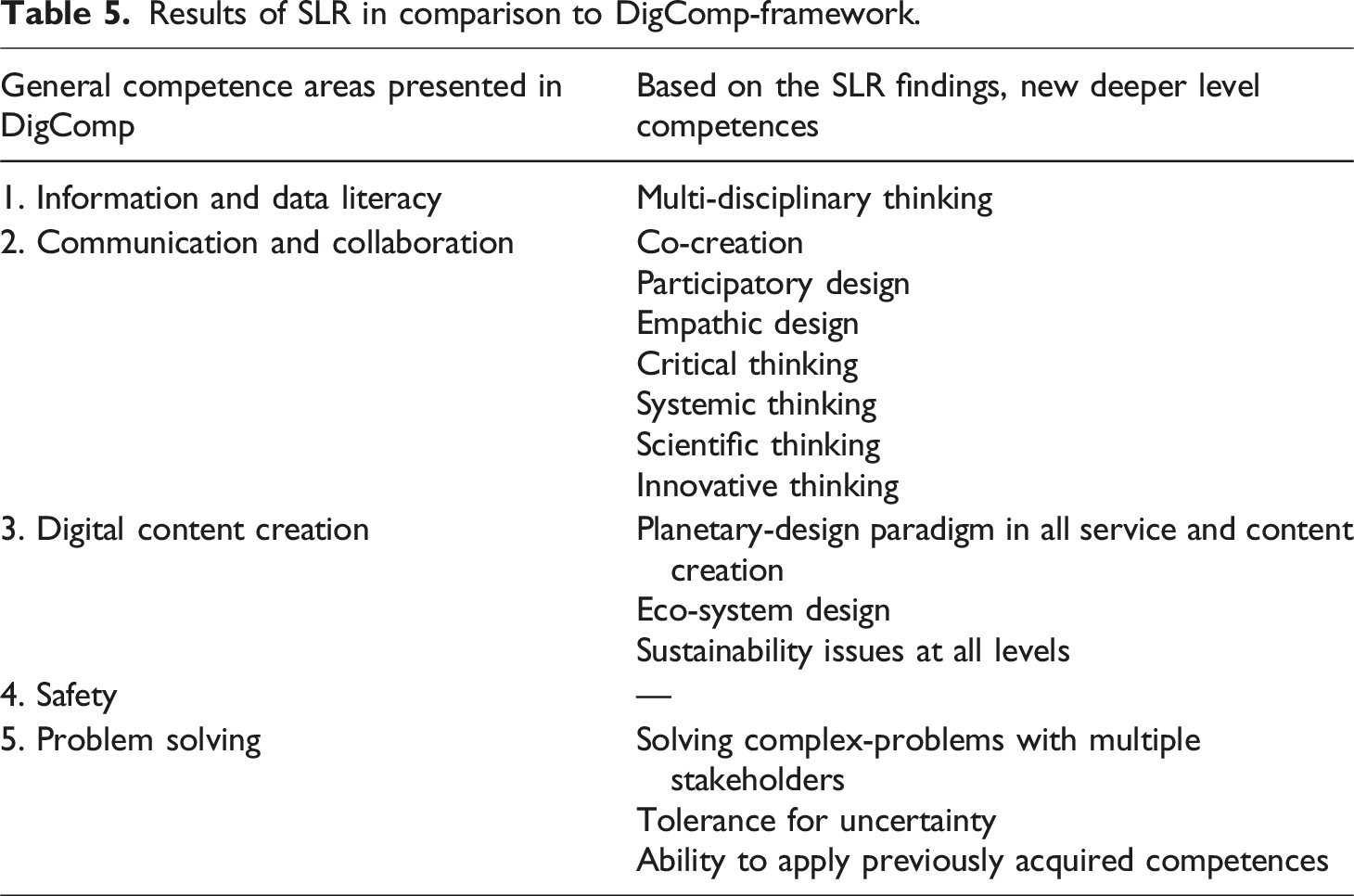
Digitalization refers to situation where social life is restructured around digital communications and use of digital technologies. Digitalization sets also new demands for individual professional; this affects also people working on design. One way of framing the changing competence is to observe it through European Commission DigComp framework. DigComp framework is a useful tool for examining the competencies of design education and comparing the contents in relation to the generally expected understanding. Therefore, the framework is also used in this study: it helps to outline what special skills supplementing the DigComp framework are specifically expected from designers based on existing research.
DigComp competences by European Commission (European Commission, 2018).
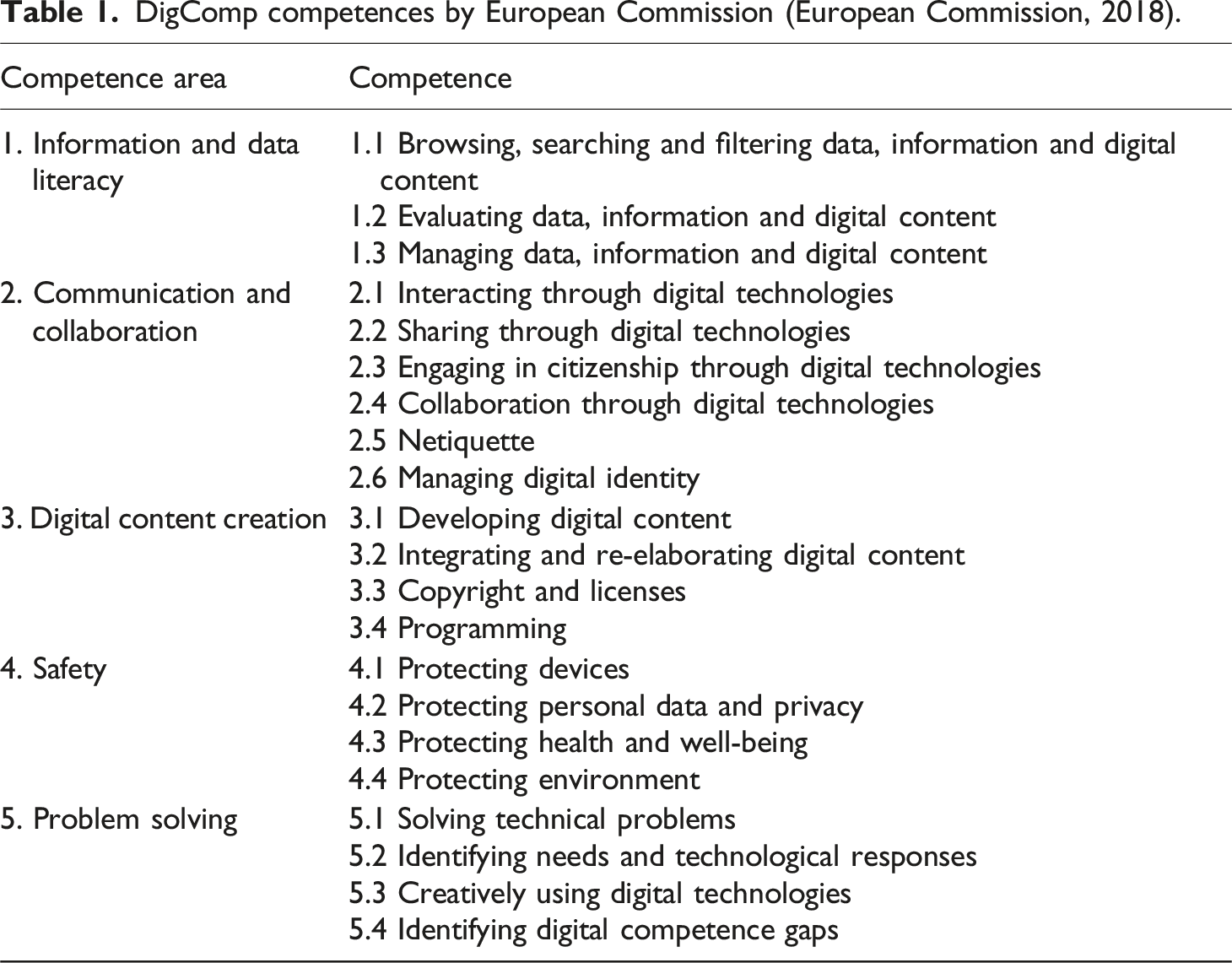
The levels consider competence level in complexity of tasks, autonomy and in cognitive domain. Whereas on Foundational level complexity of tasks is simple, autonomy is achieved with guidance and cognitive domain is based on remembering, on the other hand on Highly specialized level individual is able to resolve complex problems with limited solutions, autonomy is achieved by integration to professional practice and guiding others and cognitive domain is fulfilled by individual’s ability to create new solutions and practices (Vuorikari et al. (2022); Vincenza Ciasullo et al. (2018), (p. 163) define digitalization more than just technological process, instead digitalization is “marking new socio-technical structures through digital artefacts and changing the artefacts themselves.”.
DigComp framework provides good benchmark for mirroring the results of this SLR. DigComp framework and supplements from SLR are presented in Discussions.
Working life and industry needs for designers’
In principle, curricula at higher education are built so that they take into account working life needs and the competences expected from graduating students. Curriculum development is a balancing act between current skills and anticipating the future. The rationale for curriculum reform is drawn from several sources. A significant part of the needs of working life is gathered from statistics. With Finland as an example curriculum part of the data used is gathered by Finnish National Agency for Education (FNAE). Statistics provide information about designers’ employment entry, regional placement and employment status one, three and 5 years after graduation. They also offer general information on the tasks that students have been employed in after graduation. To give an idea of design students ‘career paths this research looked annual statistics of career monitoring survey done to the students graduated 5 years ago, that is 2018. 114 alumni (major in design) from universities of applied sciences responded to 2023 career monitoring surveys by FNAE. In 2023 career monitoring survey 23% of those who responded to the survey currently work in design-, development and administrative positions. 11% work in communications and media, 9% work as consultants and 9% in other artistic positions. Comparative data on university graduates was not available since design majors are fragmented into different faculties depending on the university and the survey data is gathered based on degree title. At the same time, according to Professional Association for Design between 2016 and 2026 design related employment growth happens in networked communication, rising 15% from current positions. Secondly, growth happens in creative aspects of software design and programming (Davis, 2018). The data is formed by U.S. Bureau of Labor Statistics Occupational Outlook and could be interpreted that similar phenomenon is actualized in Europe as well.
Shifting from Industry 4.0 to Industry 5.0 demands for systematic transformation to many businesses. Digital technologies become an ever more central part of life both on individual and employer level and they have huge role to play in enabling more sustainable and circular economy. Economic and societal transformation at this level affects and offers new career opportunities for designers. Industry needs people trained to understand complexities, think in systems and reflecting in cycles and iterations (Cezzar, 2020; Dixson-Declève et al., 2022).
Methodology
This study applied the methodology of systematic literature review. Systematic literature review (SLR) is a summary of previous research on a specific topic of essential content. It is used to map discussion and the ones that are interesting in terms of scientific results are screened out and important studies (Salminen, 2011). SLR is explicit and reproducible method for identifying work produced by researchers, scholars and practitioners (Fink, 2020). Its goal is to seek answers to a specific research question by identifying and interpreting what is known about the topic. Additionally, it helps to collect all related publications and documents that fit our pre-defined inclusion criteria to answer a specific research question (Fink, 2020). SLR uses unambiguous and systematic procedures to minimize the occurrence of bias during searching, identification, appraisal, synthesis, analysis, and summary of studies (Mengist et al., 2020). SLR is by nature a secondary research method in which primary data is analyzed to get the understanding on the research question’s existing research. Systematic reviews aim to present a fair evaluation of a research topic by using a trustworthy, rigorous, and auditable methodology (Kitchenham and Charters, 2007).
One important reason for conducting SLR is to gain overall understanding on the research and gather ideas from researchers interested in same topic. This review collected ideas on how design education and its future is seen among scholars and how should design education be developed in higher education. According to Pati et al. (2018), SLR provides a comprehensive view of knowledge formed in existing studies, this may also include contradictive findings (Siddaway et al. 2019). This study focused especially on design education at higher education level and the competences needed in future curriculum development. The review seeks to analyze the future competences outlined in future studies of development on design education.
Planning the review
This study consists of five phases: planning the review and its protocol, identifying the relevant studies, conducting the review, analyzing and synthesizing information and finally reporting the process and findings (Siddaway et al., 2019). The PRISMA guideline was followed to ensure a systematic way of working (Page et al., 2021). PRISMA is an evidence-based minimum set of items reporting in systematic reviews and meta-analyses.
The research questions What are future competences for designers? How should the new competences be considered in design education? will deepen and perhaps even widen after conducting the literature review. Therefore, some articles not necessarily explicitly concentrate on design education but concepts near to research question, such as digital agency (Siddiq et al., 2023), plurality of design narratives (Alvelos and Barreto, 2022) or digital self-efficacy (Ulfert-Blank and Schmidt, 2022).
Identifying relevant studies and conducting review
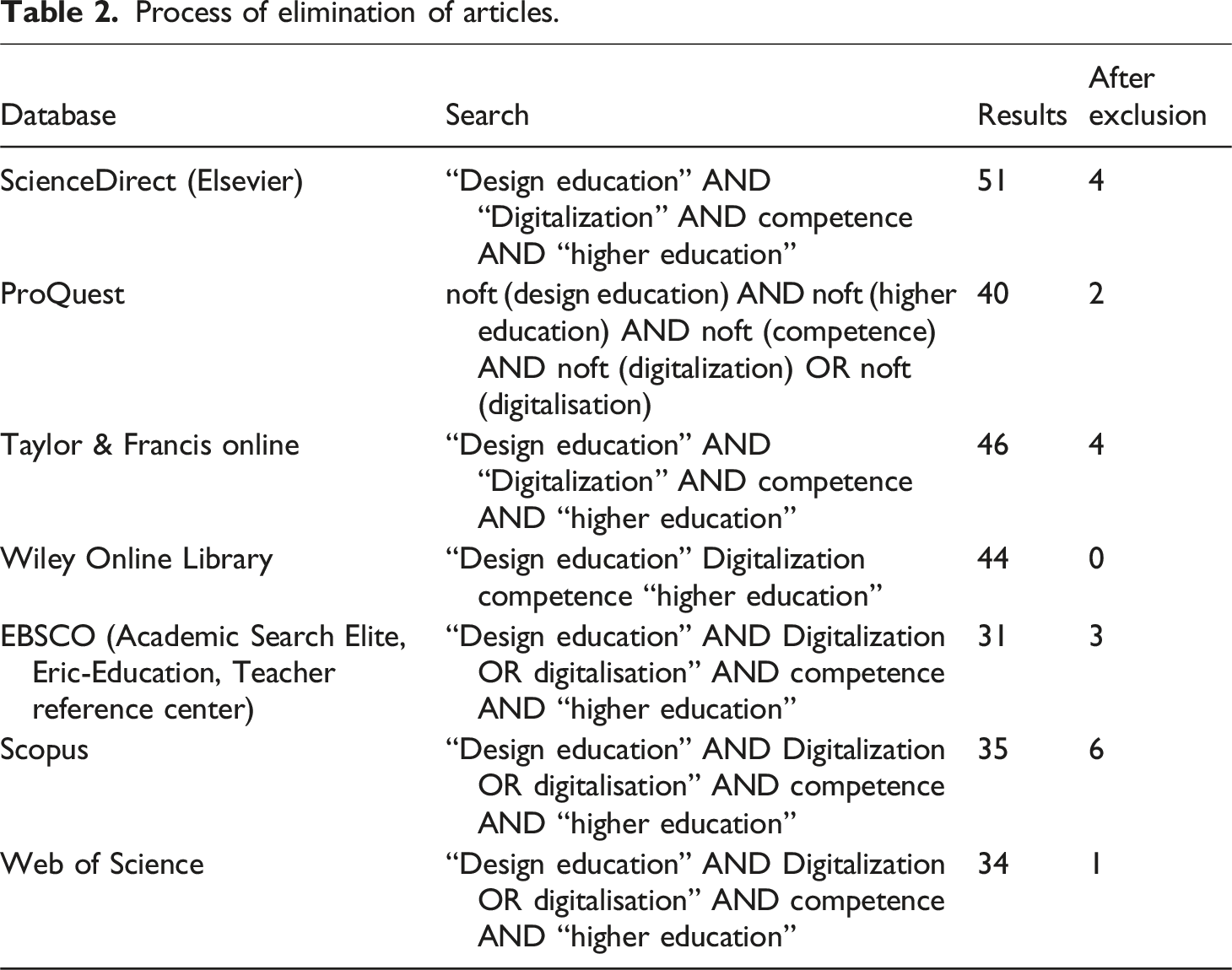
Data extraction process began with identification from searching seven relevant databases. The databases that were searched to identify relevant studies included ScienceDirect (Elsevier), ProQuest, Taylor & Francis online, Wiley Online Library, EBSCO (Academic Search Elite, Eric-Education, Teacher reference center), Scopus and Web of Science. The selection of these databases was based on their publishing profiles, relevance to the theme and accessibility. The search process was finalized by the end of March 2023. Relevant peer-reviewed (full text), English language articles published between 1.1.2018-31.3.2024 were searched using scientific databases.
Process of elimination of articles.
Inclusion and exclusion criteria in the first phase of the search.
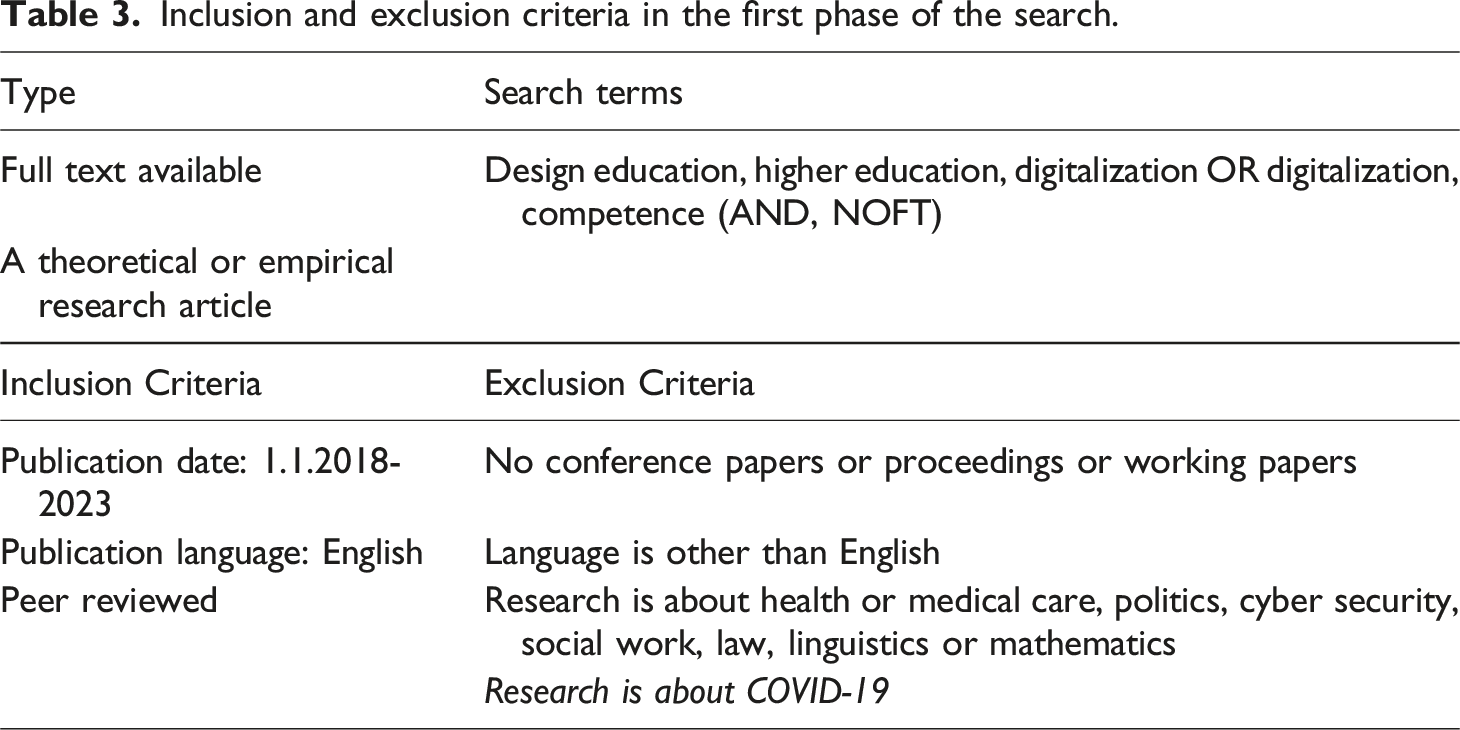
Figure 1 describes the process of elimination during the systematic literature review. In the first phase the databases were searched using the keywords relevant to the study. After duplicates were removed screening of the articles was conducted and irrelevant articles removed. Finally, the remaining articles were analyzed using preliminary coding. Identification and screening process for the literature used in the study.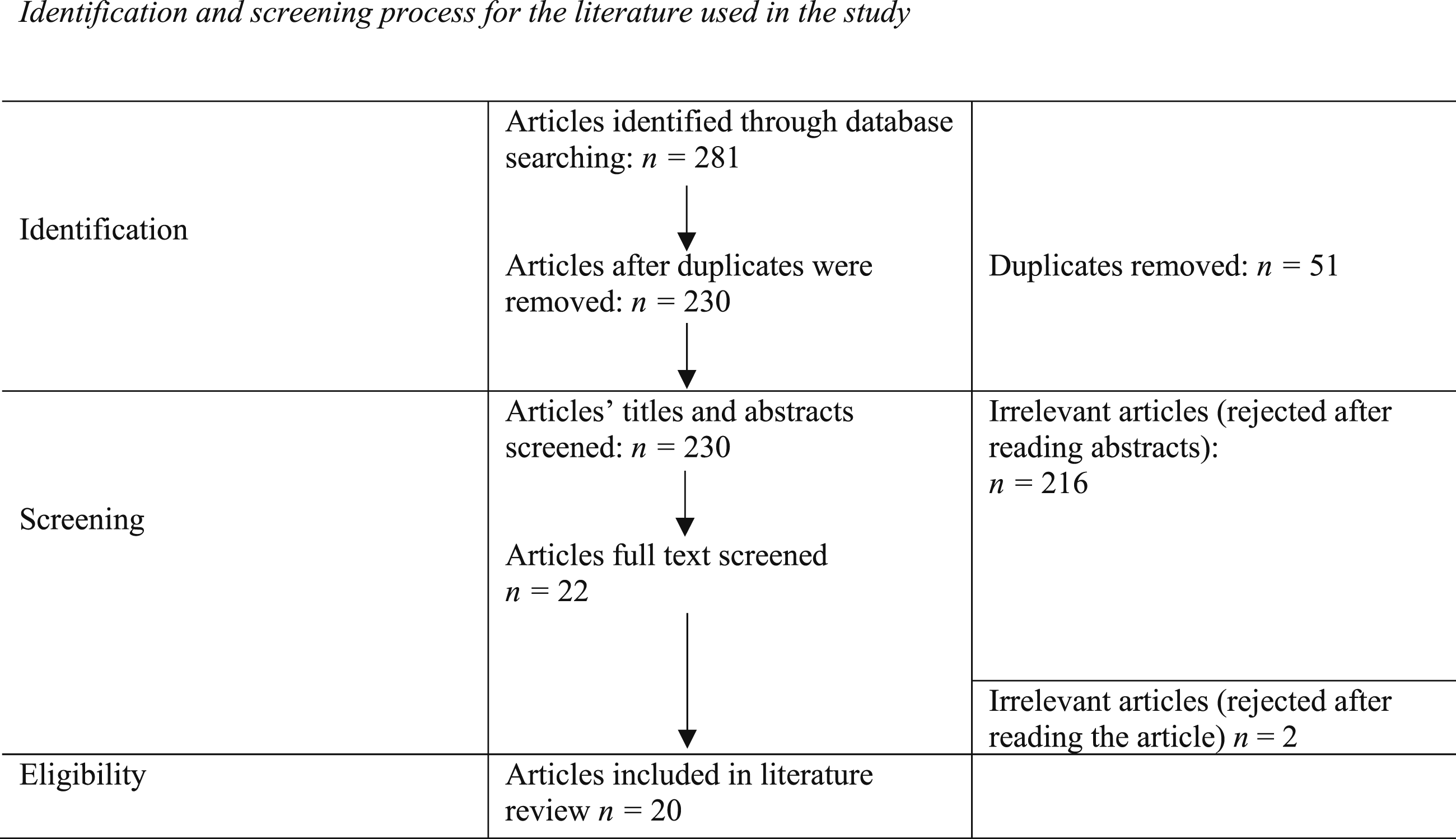
The first search returned 281 results after which all the abstracts were read by the first author and their relevance to the research questions were compared. After evaluation of 281 articles all together 20 articles were chosen for more in-depth screening.
Analyzing and synthesizing
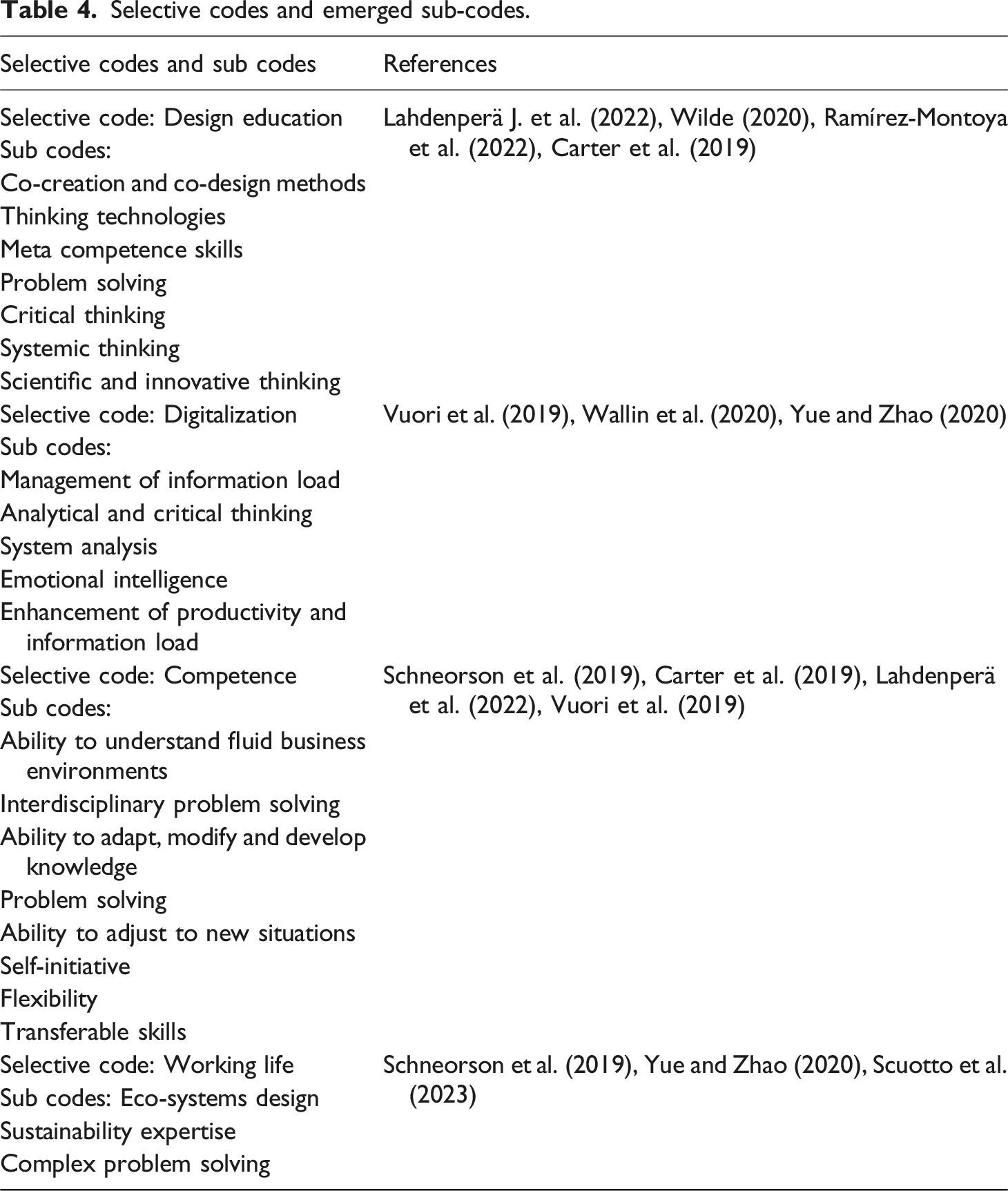
The coding proceeded with deductive content analysis in which pre-determined set of categories or codes were set. Coding and analysis were done by the first author. Codes were determined according to two interrelated research questions: What are future competences for designers? How should the new competences be considered in design education? The keywords of this research, and therefore the selective codes as well, were: design education, competence, working life and digitalization. The articles sought research information on the changes faced by design education, the competences needed in working life, the changes in working life caused by digitalization and the skills of employees.
Subsequently the information was divided in two separate tables one containing basic information of the article (theoretical background, methodology, sample size, instruments, findings and future research questions) while the other table contained findings by coding system.
Data analysis
The articles were reviewed using a content coding method. Coding is commonly used term in analysis of the data. Coding is necessary for the generation of categories and later for theory. The process of coding begins with open coding for the researcher to identify incidents that create concepts. Secondly in the process follows selective coding to concrete the core categories. Finally, coding helps to find relationships between the related concepts and core categories (Konecki, 2018). This research followed previously discussed coding process: in first phase of the data analysis the subject area was carefully examined so that the chosen keywords would offer the correct results. Then, selective codes were formed based on core material gathered in the first phase of the data analysis process. Selective codes in this research were design education, digitalization, competence and working life.
Selective codes and emerged sub-codes.
Results
The objective of this systematic literature review is to analyze the articles chosen for this study to answer two interconnected research questions: What are future competences for designers? How should the new competences be considered in design education? The articles chosen for this research were versatile in handling issues from industrial, educational and competence perspectives. Neither one of the articles handled all the observed issues in it instead they concentrated mainly in one of the topics. The analysis reveals the research gap for lack of the studies in which all the matters – digitalization, competence, design education and working life – are reviewed in one study.
During the research process it came obvious that the digitalization as a concept is no longer the main changing factor when discussing the actual changes happening in society. The latest phenomena which to be considered in the process of future design curriculum development is the Fifth Industrial revolution, Industry 5.0. It came obvious through analysis that digitalization at its boundary conditions have been taken into account in current design education but the focus in forthcoming development phase should be in comprehending the Industry 5.0 has in the competence expectations (Scuotto et al., 2023). Therefore, the presentation of results is depicted in relation to the findings and new understating of the researched articles. That is, instead of mirroring the results against the digitalization framework the findings are described in correspondence of Industry 5.0 which includes digitalization’s competencies by default.
RQ1: What are the future competences for designers?
Selective codes Competence and Working life and their sub-codes revealed the transformation in the competences that are expected of future designers. The impact of post-digitalization and rise of Industry 5.0 emerged clearly out of coding. Coding clearly revealed a change in the increasing number of global challenges and systemic problems as part of working life and thus in the everyday lives of designers.
Industry 5.0 addresses greatest challenge humanity has faced - climate change and biodiversity collapse. To able to tackle the challenges at hand global community needs to accept the forthcoming systematic change at all levels of societal operations. Interdisciplinary problem-solving competences are essential when operating as a designer in the social and global environment. The paradigm shift rewards resilient, sustainable, regenerative and circular economy businesses rather that support overproduction and consumption (Dixson-Declève et al., 2022). The shift form Industry 4.0 to Industry 5.0 demands change not only to industry but also to the education sector which need to further emphasize sustainability and problem-solving competences.
Industry 5.0 emphasizes environmental policy and sustainability. Partly because of this, competencies that further helps to ensure the designing and developing the future goods and services are to be emphasized in curriculum level as well. Facilitation and re-sourcing skills are the basic competences to be taught, including systems thinking, anticipation, normative competency, strategic competency, collaboration, critical thinking, self-awareness, and integrated problem-solving. Designers need further develop their creative practices and bottom-up approaches to be able to move between diverse and divergent disciplines (Wilde, 2020). Integrative thinking, enabling analysis, synthesis, problem-solving, and continuous learning are the meta-competences that should be included in curriculums descriptions. Scientific, critical, and systemic thinking is required to enable them to respond the contextual challenges that are required of them to practice their profession and commit as citizens to the transformation of the environment (Ramírez-Montoya et al., 2022).
Changing working life brings along more complex and interconnected forms of cooperation to which designers must have competent knowledge and competence. As knowledge work embodies more ambiguity and more complex interactions than traditional work, it also demands more personal involvement, self-initiative, flexibility, autonomy and often mobility (Vuori et al., 2019). The artifacts, atmospheres and services designers can contribute are exponentially growing due to demands of sustainable solutions (Frascara, 2020). To carry their role as participants in fifth industrial revolution designers’ need to be skilled in physical, digital, and biological spheres. They require the capacity to respond to and shape rapid, even unexpected advances in technology that are sensitive to societal and environmental impact. They need skill in estrangement and the capacity to stay in a place of “not knowing” for as long as possible if they are to develop something new (Wilde, 2020).
The focus is no longer on the object alone, but the eco-systems, including organizational structures and social problems (Schneorson et al., 2019). Environmental and societal changes affect at all levels of sensemaking. Those who design the goods and services in these environments must see the system as a whole, not just independent parts of it. Understanding of complexities arise from analytical and critical thinking competences, ability to collaboration and teamwork. Competences for future designers could be announced as Zhen and Kai (2020) describe transferable skills; the capacity not only to think and understand disciplinary or interdisciplinary knowledge and competencies, but also to transfer and apply knowledge and skills in relevant ways in the world. In short, transferable skills refer to the ability to adapt, modify and develop knowledge, understandings and competencies, to use appropriately in different circumstances.
RQ2: How should the new competences be considered in design education?
Selective codes Design education and Digitalization and their sub-codes enhance the paradigm shift from digital and service design to wicked problems and process design. While the competence and working life codes highlighted the impact of social change on the designer’s work, for the second research question the codes highlighted the pressure for change in relation to thinking skills.
Design education should pay closer attention to coping with complexity and how the teaching and learning methods support students’ capabilities working in complex environments which fifth industrial revolution brings along (Redström, 2020). Understanding of fluid business environments is at core of every future designer’s core knowledge. Designers are required not only to be creative in their expected work but also to have deep understanding of intertwingled business environments and stakeholders needs (Schneorson et al., 2019). Mavri et al. (2020) suggests close collaboration and sharing of creative processes through social participation in real-world industry - academia cooperation. Communities of practice should be encouraged and enabled on low level.
It is not so much that modern design problems are more complex than previous ones, but rather that coping with complexity is a fundamental driver of change in design—the perceived radical increase in complexity is not only because of external change such as societal and technological development, but most importantly also due to an increasing ambition and ability within design to both appreciate and address such complexity (Redström, 2020: p. 85). Authenticity, from a learning perspective, involves the assignment of ill-defined problems in interdisciplinary settings, active ties and collaboration professionals and experts in the field, and—crucially—industry-driven criteria and feedback to guide the ensuing work (Mavri et al., 2020). Competencies for sustainable economy and ability to solve complex problems independently and creatively during the working process to the rise of the knowledge economy and framework for Industry 5.0 (Zhen and Kai, 2020).
Rather than teaching skills related to processes and working methods of an age that has ended, we need to teach for the inherent instability of the circumstances at hand (Papanek, 1972). We need to equip designers to respond not only to urgent crises such as climate change, ecosystem collapse, social and environmental injustices, war, mass migration, poverty, food scarcity, and more; but also, to as-yet-unknown possibilities. A critical challenge for design in the context of global challenges is to bring together diverse stakeholders without compromising stakeholder perspectives or watering down experimental methods (Wilde, 2020).
Working with the complex problems requires thinking skills that may not be sufficiently taught in design education at the moment; critical, systemic, scientific, and innovative thinking. Critical thinking is the intellectually disciplined process of actively and skillfully conceptualizing, applying, analyzing, synthesizing, and evaluating information acquired or generated by observation, experience, reflection, reasoning, or communication as a guide to belief and action. Systemic thinking is the underlying reasoning that students must develop to analyze and understand complex global systems and phenomena. Scientific thinking is higher order thinking that helps students face the era of global competition to overcome various problems. It involves logical, analytical, systematic, inductive, and deductive thinking to solve problems. It includes defining, identifying, and formulating alternative proposals and determining the best solutions (Ramírez-Montoya et al., 2022: p.2).
According to Lahdenperä et al. (2022) the best solution to develop these competencies is to commit in co-creation pedagogy where teachers, students and industry work alongside with shared problem. Intense collaboration is nothing new in higher education, but in Industry 5.0 environment it is a necessity to be further developed. Collaboration among key stakeholders, learning to apply open-strategy and innovation methodologies are the core competencies while working with complex problems (Ramírez-Montoya et al., 2022). Meyer and Norman (2020) continue the same matter on how students should learn how to use specialized knowledge of all the different disciplines involved and that way work toward common understanding ton the complicated matter. This co-work enhances positive outcome and reinvigorates how to approach complex problems and grand societal challenges (Wilde, 2020). Transferable skills are the capacity not only to think and understand disciplinary or interdisciplinary knowledge and competencies but also to transfer and apply knowledge and skills in relevant ways in the world. They refer to the ability to adapt, modify and develop knowledge, understanding and individual competencies to use appropriately in different circumstances (Carter et al., 2019). Wilde (2020) remarks the importance on the ability to debate between differences on current issues and the practically explore different solutions and even vision how alternative futures might tangibly unfold.
In essence, new technology-driven practices expect the future workforce to employ competences that are not yet known or taught by today’s educational institutions (Lahdenperä et al., 2022). Being able to vision future and implement the tools and products for Industry 5.0 needs and expectations, creativity and flexibility in thought are the core competences for future designers. Despite the many interpretations of the word “creativity”, the general view is that it is a multidimensional variable consisting of four characteristics: Fluency: the ability to generate a considerable number of ideas and directions of thought for a specific problem, Flexibility: the ability to consider as many uses and classifications for a particular item or subject as possible, Originality: the ability to consider ideas that are unusual and even refuted, rather than those that are self-evident, banal or statistically ordinary and Elaboration: the ability to expand on an existing idea and develop it (Ivancovsky et al., 2021; Scuotto et al., 2023).
Discussion
When conducting the research, an effort has been made to understand the research object viz., design education in terms of actors influencing it from different directions. Existing current research has been challenged by comparing research findings to newer and so far, less researched social themes in relation to design education that is, sustainability thinking and moving from a user-oriented design paradigm to a planetary design reference framework. As the research has progressed, the findings have been refined in relation to the design curricula. In the last stage of the design thinking reference framework, where the service is tested, the results of this research will be shared for the use of design educators.
Results of SLR in comparison to DigComp-framework.
Conclusion
The starting points of the research are in Finnish education and especially in the development of Finnish design education. The goal of the research was to find out how design education should be developed so that it best meets the needs of the future. The starting point of the research was the idea of digitalization-induced changes in designers' competencies. The research was carried out to answer two related research questions: What are the future competencies of a designer? How should the new competences be considered in design education?
Based on the literature review, the most significant areas for development and areas to be considered in curriculum work are 1. Changes brought about by Industry 5.0 at the societal level, which are directly reflected in the skill needs of designers and design competences. 2. Complex problems, which require new kinds of thinking skills, reflexivity and the ability to act genuinely in diverse work communities and projects.
Based on the SLR designers’ future competences are critical thinking, cooperation in multidisciplinary work groups, systemic understanding and communication skills. The common competencies can be specified as follows and therefore also reflected in the curriculum development: Industry 5.0 places special pressure on designers to take over the design principles of sustainable development, eco-systems design, and the ability to utilize sustainable development design skills in various situations. Planetary design, as a difference to Industry 4.0 user-oriented design, is emphasized in all activities. In complex problems, on the other hand, the competences relevant to curriculum work that emerged are related to problem-solving abilities, modifying design principles in new situations to respond to the need in question, and the ability to always update the know-how to meet the current need.
The pressures for change regarding research questions therefore focus on increasing meta-skills in teaching. Design operating models and practices are now at a crossroads. Industry 5.0 affects sustainability thinking in all design work. Design itself has greatly expanded its scope in recent decades, expanding from an original practice anchored in aesthetic and functional parameters to areas that now encompass strategic, perceptual, and ideological concerns. Buchanan (2001) had already envisioned the changing role of designers as drivers of socio-cultural innovation by combining knowledge from different specialties and creating new frameworks to support positive cultural change (Alvelos and Barreto, 2022).
In the future, designers are expected to have good communication skills, cooperation skills, and the ability to take over design methods that support multidisciplinary design. Therefore, DigComp framework can be supplemented with deeper level competences as shown in Table 5. Organizations need more people with future competences and fewer people with basic skills (Lahdenperä et al., 2022; Schneorson et al., 2019). The Industry 5.0 operating environment requires co-creation pedagogy and the skills for multidisciplinary teamwork that arise from it (Lahdenperä et al., 2022). Complex problems can be managed and developed with existing design methods that take the sustainability aspect into account even better. Methods such as: design fictions, critical speculative design, critical participatory design, embodied design, transitional design, theory and other forms of critical intervention, bringing the future and making the world. Design scholars need to link situated concerns, planetary sciences and governance (Wilde, 2020).
Limitations and directions for future research
As with all research, this research also has its limitations. First, since the search terms for this research and for the databases were limited, some relevant studies might have been missed. Second, the topic of the review is under constant change and possibly by the time this review is published there is already new phenomena and new design paradigms to be included to the topic. The review finds are directive and certainly need further and deeper investigating. Considering the context of this review it might be useful for the design degree programs as they develop their curriculums. Teachers may also find this study useful as they design their courses. The meta-competences found in this study could be implemented in versatile study modules to all study levels and without students’ prior knowledge.
Furthermore, this review offers several opportunities to future research on the implications of Industry 5.0 in future education in general and as well how to deepen, on concrete level, industry-academia collaboration.
Footnotes
Declaration of conflicting interests
The author(s) declared no potential conflicts of interest with respect to the research, authorship, and/or publication of this article.
Funding
The author(s) received no financial support for the research, authorship, and/or publication of this article.
