




Abstract
This study investigates actors’ preferred format (print or electronic) for their scripts when preparing for a performance project (screen, stage, voiceover). It builds on a body of research into reading format preferences of students in academic settings. Like academic reading, actors must internalize their text for the successful completion of their task. They must also memorize their lines and imbue them with characterization, movements, emotions, expressions, reactions, motivations, and vocal intonations. Data gathering was conducted through an online survey, and the authors used descriptive, comparative, and thematic analysis methods. Results were mapped to the Reading Event Analysis Model, a guide to predict readers’ format preferences depending on contexts. Results from 357 actors in 27 countries show they overwhelmingly prefer print format for various reasons. These reasons are similar to those of college students but carry unique nuances. Actors recognize memorization as key to most performance tasks, and mobility while learning as essential. They find the low-tech qualities of print most conducive to achieving their professional goals. Findings from this study of an alternative learning context broaden our understanding of the many types of reading and readers. Implications may be applied to pedagogical approaches of reading instruction for children and adults.
Introduction
[The script] must be read over and over, and with each additional reading we must guide ourselves by what was established the time before. (Legendary acting theoretician Konstantin Stanislavski, 1981)
Mortimer Adler’s classic How to read a book (1972) identifies three purposes for reading: entertainment, information, and understanding. He discusses the various types of reading: scanning, skimming, and linear reading (reading all the way through), that, by definition, engage with the text at different levels. Readers employ different types of reading depending on their purpose and context. Scholars have been expanding on, testing, and reinterpreting these ideas ever since. Reuben Brower et al. (1962) developed the concept of slow reading to describe when readers pay close attention to the words and their meanings in a text. Similar concepts include close reading, critical reading, engaged reading, proactive reading, and deep reading. In today’s media rich world however, reading occurs in multiple formats, not just print. How compatible are different mediums with different reading strategies and purposes? In recent years, a growing body of inquiry has studied the reading format preferences and behaviours of students in academic settings, with attention to the impact of the format (print or electronic) on learning. The results suggest that the context of a reading task – its purpose, difficulty, and other factors – is linked to format preferences and outcomes. The workplace is another setting where reading to learn occurs. This study investigates the format preferences within a particular workplace setting – that of professional actors when they must learn a script and prepare for a role. No previous studies of this population’s format preferences and behaviours were found.
Similar to tertiary students who must read and internalize their texts in order to reach their academic goals, actors must internalize their lines to achieve their professional goals. Both employ some of the same reading strategies as will be discussed below, but actors must also imbue their readings with characterization, movements, emotions, expressions, reactions, motivations, and vocal intonations for dramatic effect. In this paper, we compare and differentiate between the students’ academic reading behaviours and the ‘whole-body’ reading strategies employed by actors (Cole, 1992). We define academic reading as the interaction with a text ‘by taking notes, making connections between the text and what [one] already know or [has] experienced, and asking critical questions about the material’ (University of Toronto Scarborough, nd). Actors’ whole-body reading strategies go beyond notetaking and critical engagement to include audio, visual, tactile, and kinaesthetic learning behaviours.
Most professional actors receive their scripts via email and must learn them in preparation for an upcoming project: audition, commercial, voiceover, a minor or major role in a film, or stage production. Do they keep the scripts in electronic format, print them out to read, or transfer them onto other digital devices? Which format do they prefer to use in their professional capacities? Why and under what circumstances? Do they prefer a specific format because they believe they learn and retain their lines on it best?
While researchers in the fields of memory, psychology, and cognition have looked at how actors learn and memorize dialogue, no scholarly literature was found on professional actors’ script format preferences and behaviours. The goal of this study is to investigate this unexplored learning context, to use insights to broaden our understanding of the many types of reading, and the impact of format choices. We focus specifically on attitudes; we do not test efficiencies, but we do ask on which format the actors believe they learn and retain their lines best. To address all these issues, we investigated one primary and five supporting research questions:
Do actors express a preferred format for reading and learning scripts for professional projects? • Why do they express preference for one format or another? • Do preferences or strategies vary depending on the context of the reading? • Do they believe they learn their lines best from a specific format? • Do they believe they retain their lines best from a specific format? • Do preferences vary by age, gender identification, or country of residence?
We expand on our existing knowledge about readers’ format preferences and behaviours, and test whether or not results can be mapped to the Reading Event Analysis Model (REAM). REAM is a guide to predict readers’ format preferences depending on contexts. Implications could be applied to the education of reading teachers, public speakers, radio and voice artists, storytellers, drama therapists, and other performance readers.
Review of the literature
Actors use many of the reading skills students use to prepare for their academic tasks, particularly highlighting, annotating, and notetaking. We therefore review selected studies of tertiary students’ format preferences and behaviours. The largest study on this topic is the Academic Reading Format International Study (ARFIS) and we focus on its findings and methodologies. The REAM was developed from ARFIS and other studies, and proposes to guide predictions of format preference depending on the contexts and circumstances of a reading event. We then examine the scholarly literature of how actors prepare for roles to draw comparisons with students to demonstrate how this current study helps fill gaps in our current understanding.
Format preference studies
‘You can confidently expect to see the phrase “students prefer print over digital” in the results section of any study conducted between 2010 and 2015, and likely for many more years to come’. So asserted Bernd Becker in his review of studies of students’ reading format preferences and reading competencies in different formats Becker (2015, p. 232). The majority of studies up to 2015 support this preference claim (Dilevko & Gottlieb, 2002; Foasberg, 2014; Li, Po, et al., 2011; Liu, 2006). Students believed print enabled better learning engagement (specifically highlighting and annotating), creating a more effective learning experience.
These attitudes appear consistent in studies performed over the last 10 years, including investigations into the impact of COVID-19 on students’ attitudes (Mizrachi & Salaz, 2022; Secker & Tilley, 2022; Matthews & Johnson, 2023). Because of lockdowns during the epidemic, most educational institutions moved to remote learning and students, unable to access their libraries, were forced to rely on electronic texts. Researchers wondered if this new reality affected attitudes towards working with electronic texts. Students reported that they missed their print texts and expressed frustration and burnout. They also noted suffering more physical ailments such as headaches and eye strain, from staring at their computer screens for so many hours a day.
ARFIS and REAM
From 2014 to 2018, researchers in the ARFIS team used a single instrument to gather data from 21,266 tertiary students in 33 countries on their academic reading format preferences and behaviours (Mizrachi et al., 2021). ARFIS is the largest study of tertiary students’ format attitudes and behaviours performed to date. The amalgamated data showed approximately 70% preferred print over digital for their academic readings. Majorities in all countries preferred print as well, but these majorities varied among countries (Mizrachi et al., 2018).
The ARFIS instrument consisted of 16 Likert-style statements, six demographic questions, and one open-ended comments prompt, and was translated by each country researcher into the local language. In order to analyze the comments, Mizrachi and Salaz (2020) categorized each of the respondents as print preferrers, electronic preferrers, or neutral according to their responses to the Likert statements. The results of this categorization method were consistent with the amalgamated descriptive data analysis and showed that 71% (n = 15,110) of the respondents scored as print preferrers. The current study uses this methodology for analysis of actors’ format preferences.
Of all the students categorized as print preferrers, 2,005 from 23 countries provided comments in English. From these, a randomly drawn sample of 328 were analyzed and compared to the 325 comments in English by electronic preferrers. The leading factors for preferring print were: Better learning engagement (highlighting, annotating); better learning quality (remember, focus); convenience (portability, don’t need internet); health issues (less eye strain, back/shoulder/headaches); and the tactile aspects of print. Students preferring electronic format cited cost, efficiency, and convenience the most, as well as learning engagement (finding key terms in the text), health issues (lighter than books), and environmental concerns (Mizrachi & Salaz, 2020).
Students’ also noted context-driven considerations for preferring one format over another which could sway them to use either format. These included the length, goal, and difficulty of the reading. The researchers thus surmised that the question was not whether students preferred print OR electronic format but rather WHEN did they prefer print and WHEN electronic? (Mizrachi & Salaz, 2020).
Building on findings from ARFIS and other studies, Salaz and Mizrachi created the REAM which considers the various contexts in order to determine an individual’s likely format preference for a unique reading event (2022). REAM consists of three factors: Difficulty of Learning from the Text, Reader Objectives, and Access. Each factor contains 2–4 dimensions, and each dimension contains conditions that may tip the preference towards print or electronic format for a specific reading event. Details of REAM are discussed below.
Studies of how actors prepare for roles
There are many guidebooks on actor training and acting methodologies, but a search for studies on professional actors’ reading behaviours when preparing for a project returned few relevant results and no mention of format preferences at all. Complicating the search was the fact that key terms: actors, scripts, reading, formats, and behaviours, have many connotations in academia. Studies of actors include explorations of their strategies when preparing for roles (Bandelj, 2003; Zhang, 2024), the place and process of memorization in role acquisition (Noice & Noice, 1999; Noice et al., 2000), and studies of coaching dyslexic actors (Bartram, 2021; Leveroy, 2015).
Playwright David Cole describes the inherent physicality of reading for role preparation in his book Acting as Reading (1993) and how it differs from silent reading. ‘[A]ctors are to an unusual degree “whole-body readers…,”’ (p. 31). Whole-body reading involves both physiological (eye, mouth, throat movements) and cognitive mechanization as well as interpretive and intrapsychic aspects – ‘the assimilation of fantasy material’ (p. 33). It can be considered a form of deep-reading related to that used by students engaging with their academic material, and others seeking to internalize new and/or vital information. Cole’s work from the early 1990s is, of course, antecedent to the ubiquity of digital reading devices found today. Thus, he could not have foreseen how a reading format might affect ‘whole-body reading’.
Noice and Noice have been studying the cognitive processes of professional actors since the late 1980s, and their insights are informative to this study. Their 2002 summary of related research describes a two-step procedure. Before beginning to learn their lines, experienced actors study the script in great detail in order to extrapolate and analyze the intentions and motivations of their character. ‘The deep processing involved calls upon such learning factors as perspective taking, problem solving, elaboration, causal attribution, distinctiveness, and overlearning’ (p. 7). The second phase is the rehearsal/performance stage, ‘which involves activation of those cognitive-emotive-motor processes inherent in all genuine human transactions’ (p. 9).
We see from their work that experienced actors engage in a deep learning process to bring their character to life. But like Cole’s observations, their discoveries could not delve into the possibility of multiple format choices. Today, actors engage with their scripts using print and/or electronic formats. They may be asked to audition for roles using a self-recorded video clip or a videoconferencing application such as Zoom. Which format do they prefer for their preparations and why?
Methodology
Instrument and distribution
To address the research questions, an anonymous online survey was constructed. It was derived from the validated ARFIS instrument, but adapted to the professional context of working actors. The revised instrument was assessed for face validity by a member of the target response population, a professional actor. With his assistance, the instrument was then validated further by piloting the survey among 10 other working actors. After revisions, the final survey consists of:
Six questions with closed responses: Print, Electronic, Either/Depends: • On which format do you usually receive your scripts? • How do you prefer to receive your scripts? • Which format do you prefer to use when rehearsing your roles? • Which format do you prefer to use at a table reading
1
? • With which format do you learn your lines fastest? • With which format do you retain your lines best?
Two questions offered Yes, No, or It Depends responses: • Does your format preference depend on the type of project? • If you receive a script electronically, do you usually print it out to read?
One open comment prompt: • Please elaborate on why you prefer print or electronic script formats when preparing for a role.
Space for any further comments.
The survey asked three demographic questions regarding age, gender identification, and country/countries of residence. It was approved by the Internal Review Board (IRB) at UCLA.
The actor assisting the research team distributed the survey through professional channels, including the Internet Movie Database (IMDb) and personal connections with the request to forward the survey to other professional contacts. Thus, convenience and self-selection sampling methods of data gathering were employed. Distribution was set to begin in May 2023 but was delayed until the conclusion of the prolonged writers’ and actors’ strikes. Data gathering thus began in December 2023 and continued through February 2024.
Population
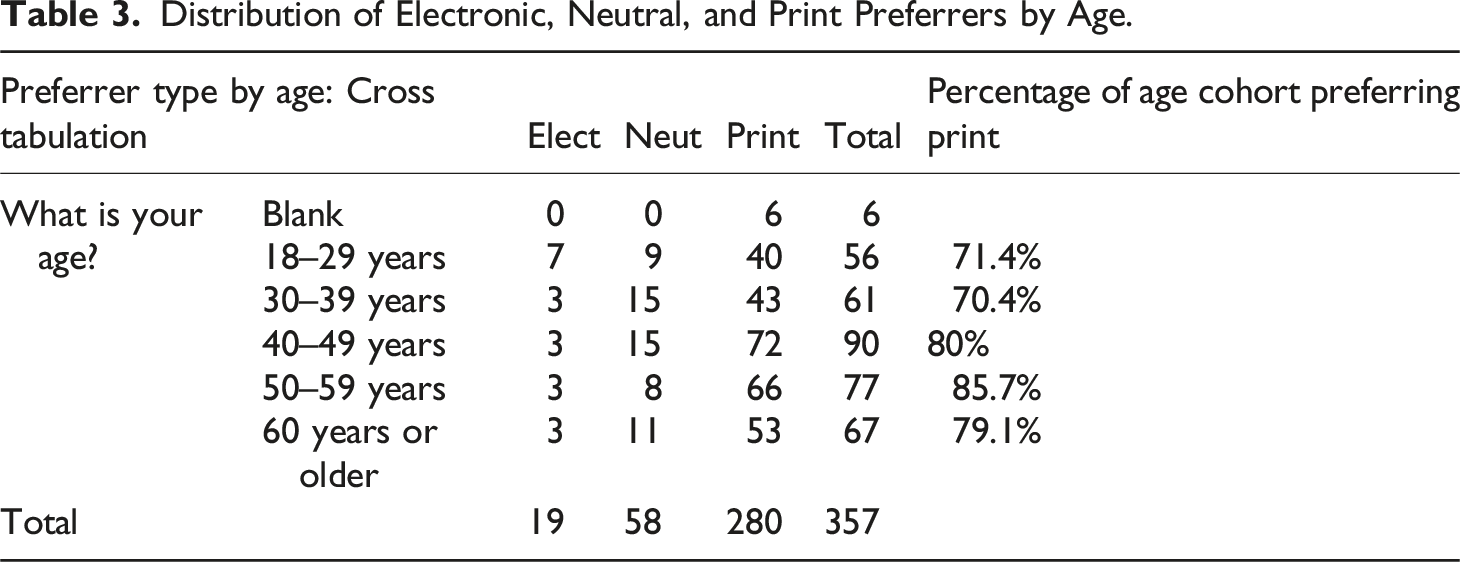
Responses were received from 357 professional actors residing in 27 different countries. Most of the respondents (n = 267, 74.8%) live in the US or Canada. Of these, 11 respondents (3.1%) reported holding residence in a second country outside of North America. Six respondents (1.7%) did not answer this question. Respondents reported their age by decade groupings from 18 to 60 years old or more. The 351 responses to this question showed a fairly even distribution with 40- to 49-year-olds being the largest group (n = 90, 25.6%), and 18- to 29-year-olds the smallest (n = 56, 16%).
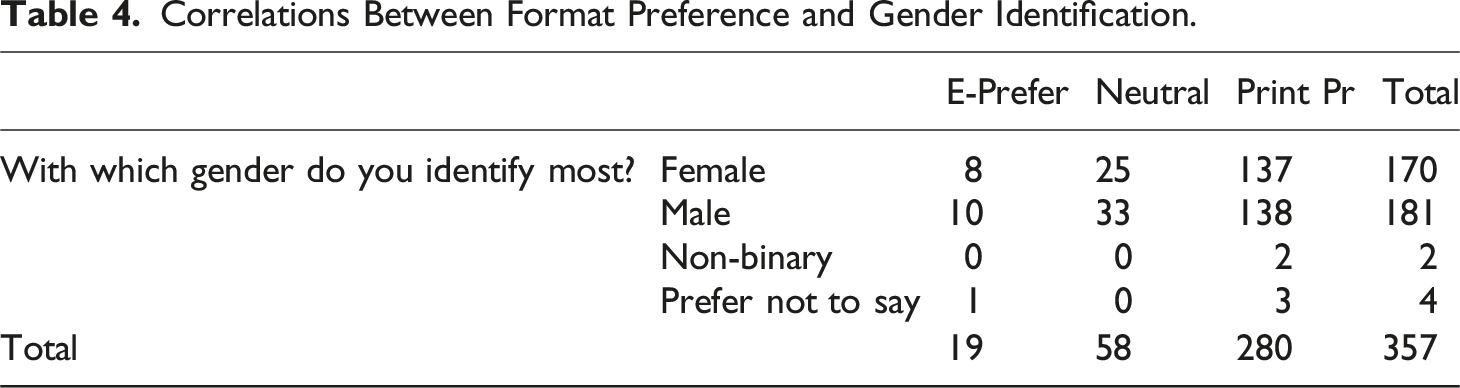
Approximately half of the respondents (50.7%, n = 181) identified as male and 47.6% (n = 170) as female. Two actors (0.6%) answered ‘non-binary’ and four (1.1%) replied ‘Prefer not to say’.
Results
Descriptive results
Responses to the first question showed that 72% of actors (n = 257) receive their scripts electronically, but results were mixed for how they prefer to receive their scripts. Approximately half (n = 182, 51%) prefer to receive electronically; 72 (20%) answered either format; 69 (19%) stated print; and 34 (10%) said it depends. Thus, it appears that most actors are satisfied with receiving their scripts electronically. However, over 70% of respondents (71.4%, n = 255) replied that if they receive a script electronically, they usually print it out to read. This indicates a preference for actually reading the script in print. In the comments sections, several wrote that while they would prefer to print their scripts, the costs involved often prohibit them from doing so. Others stated that it depended on the type of role or project.
Questions 3 and 4 asked about format preferences in specific contexts: when rehearsing a role, and at table readings. Questions 5 and 6 explored which format the actors believed they learn their lines fastest, and with which they retain their lines best. Results show overwhelmingly that most actors prefer to use print when rehearsing their roles and at table readings, and believe they learn their lines faster and retain them best when using a print script. The chart in Figure 1 clearly shows the preference for print in these situations. Format preferences by context.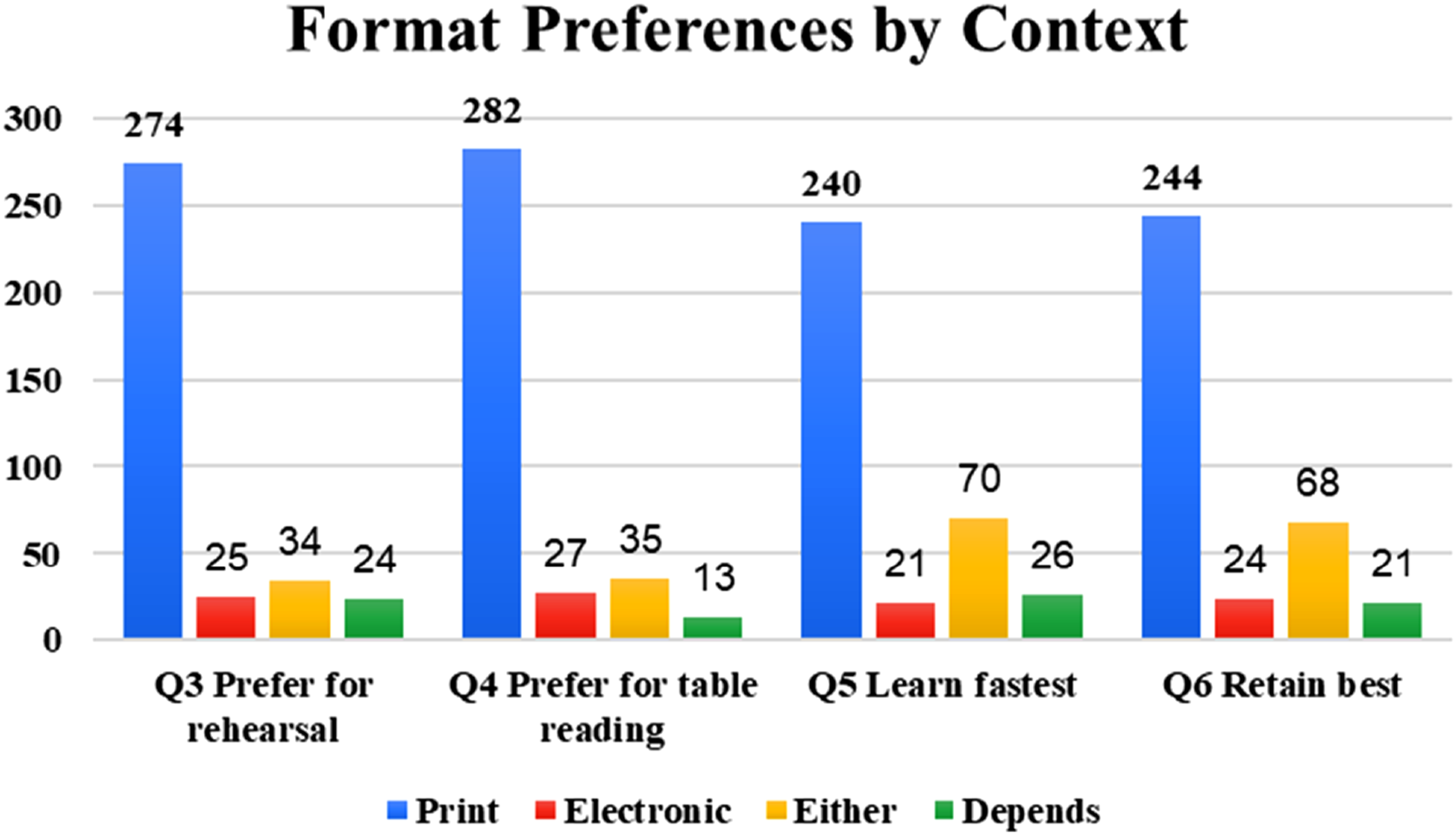
When asked if their format preference depended on the type of project, 64% (n = 231) said no, but 35.3% of respondents (n = 126) answered that the type of project did impact their format preference. Below is one of the several explanations: • ‘It all depends. For stage, print. For voiceover work, digital. For commercials, digital. For film, print. (depending on how big the part is). For auditions, print. For musicals, print’.
Comparing overall print, electronic, and neutral preferrers
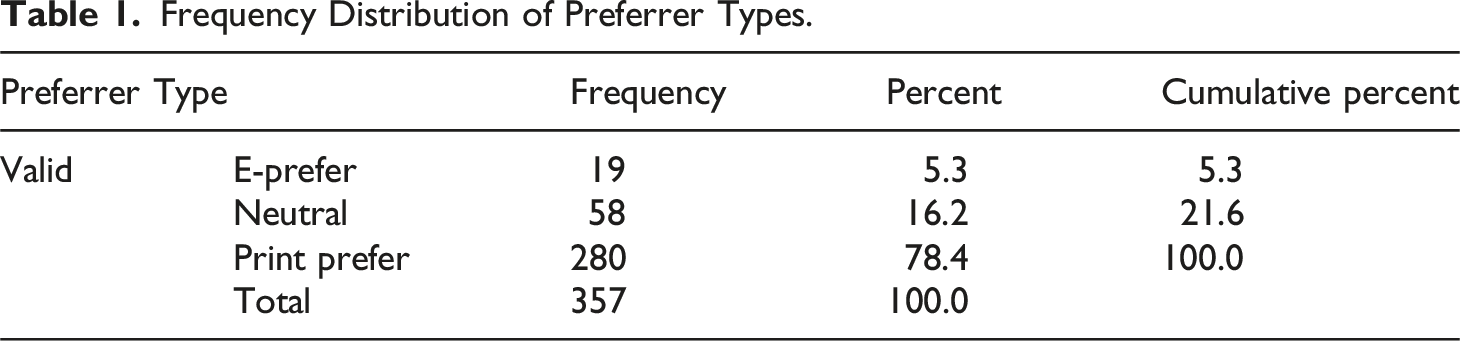
Respondents were classified as either ‘print preferrers’ or ‘electronic preferrers’ based on their responses to questions 3, 4, 5, and 6. These questions focus most directly on readers’ use of the materials and how they believe they learn and remember information from those materials. For each question, responses were scored as follows. If the reader answered: Print: 1; Either or Depends: 2; or Electronic: 3; across 4 questions, the minimum score was 4 and the maximum was 12.
The four question items were assessed for reliability and internal consistency using a test of Cronbach’s alpha across all 357 responses for each question item. The resulting reliability coefficient for these four items is .807, well above the general target of 0.7 for Cronbach’s alpha, and indicating a highly internally consistent scale. After data gathering, no questions were excluded and the results were combined into categories as follows. • • •
The average score across 357 respondents was 5.36 with a standard deviation of 1.9080.
Frequency Distribution of Preferrer Types.
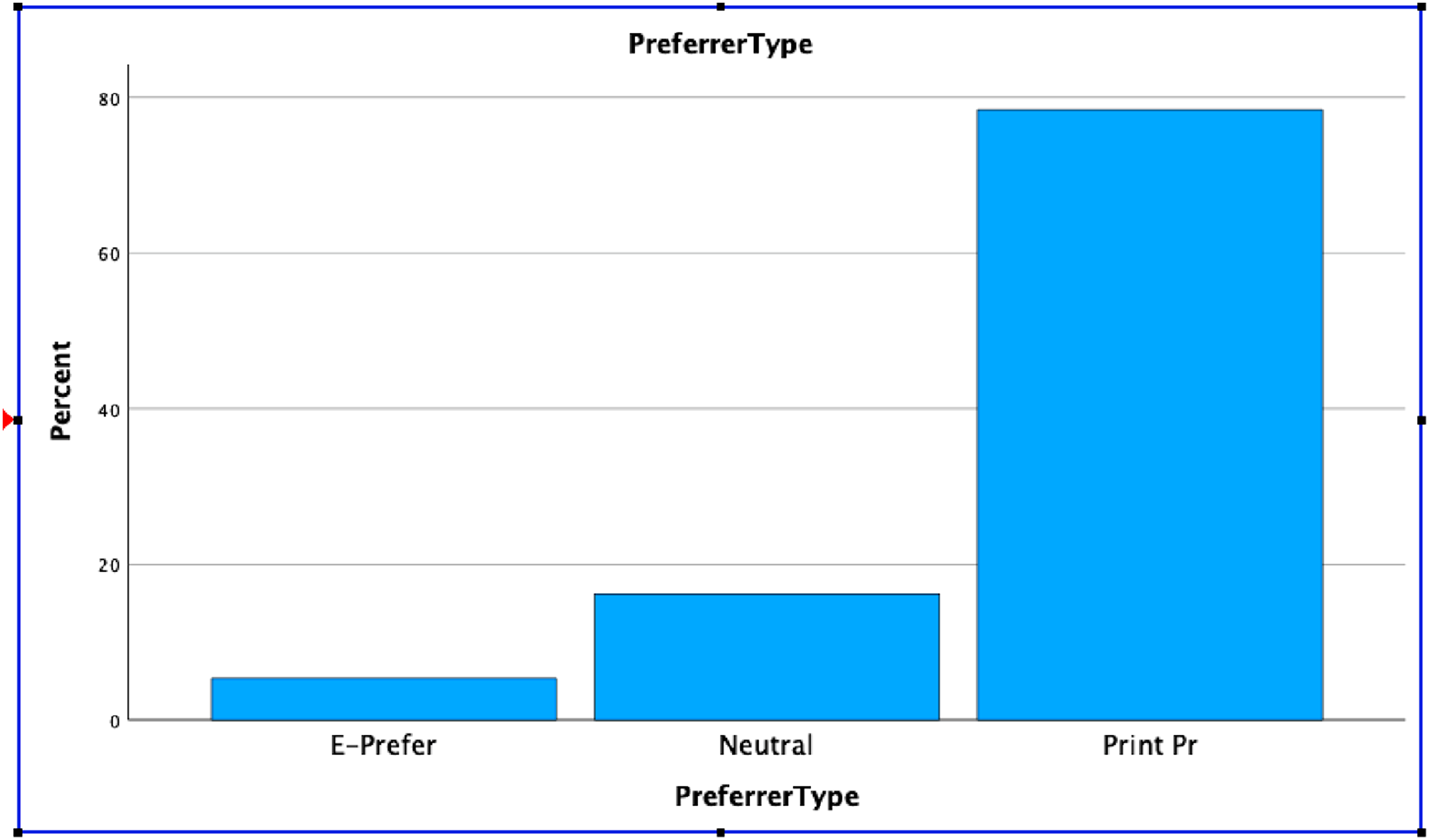
Comparison of format preference types.
Characteristics of print and e-preferrers
Preference by country of respondent
Total Print Preferrers, e-Preferrers, and Neutral Readers by Country.
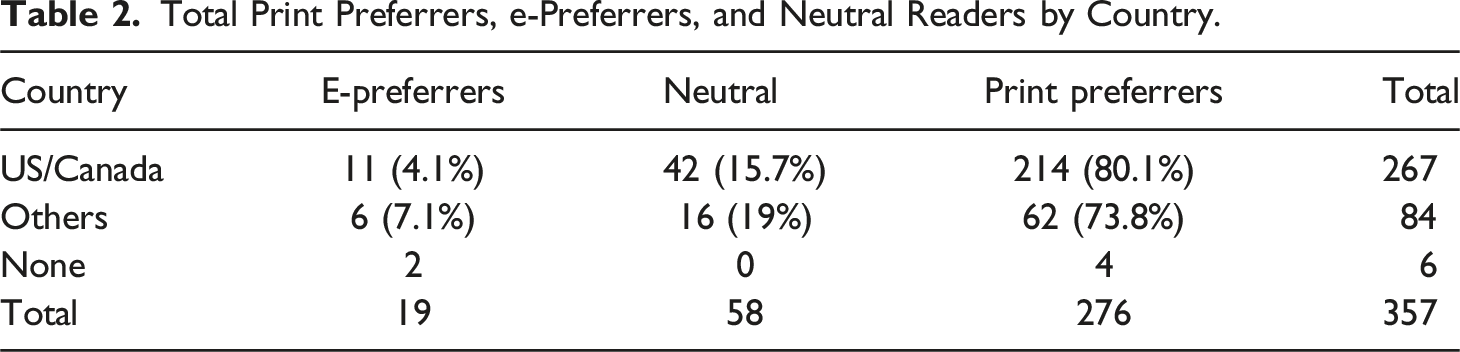
Using the common non-parametric statistical Kruskal–Wallis H test, we confirmed that the distribution of e-preferrers and print preferrers is not significantly different based on country with print preference dominating all locations. If we exclude non-respondents and conduct a Mann–Whitney U test on the remaining two groups, US/Canada and Others, we also see a statistically non-significant result for differences in rank distribution.
Age
Distribution of Electronic, Neutral, and Print Preferrers by Age.
Gender
Correlations Between Format Preference and Gender Identification.
Format qualities actors liked or disliked
The researchers independently analyzed the responses as to why actors preferred print or electronic scripts when preparing for a role, and the circumstances that produce a mixed or ‘depends’ response. Basic themes were uncovered and more specific codes created from these themes. Analysis was manual; one researcher utilized Atlas.ti to organize and tag comments while the second used Excel. Researchers then compared their codes to synthesize and refine them. The initial review of the two coding schemas showed substantial similarities. For example, one researcher coded annotating (A) and highlighting (H) scripts separately while the second researcher combined them into one code (A/H). When the separate A and H codes were combined, they were nearly equal in number to the A/H – 142 versus 149. Across themes, the frequencies recorded by the two researchers varied slightly in this manner, but the relative importance of the different categories determined by both coders was highly consistent. Codes were synthesized, amended as warranted, and finalized.
Why actors like print
Print Preference Codes and Frequencies.
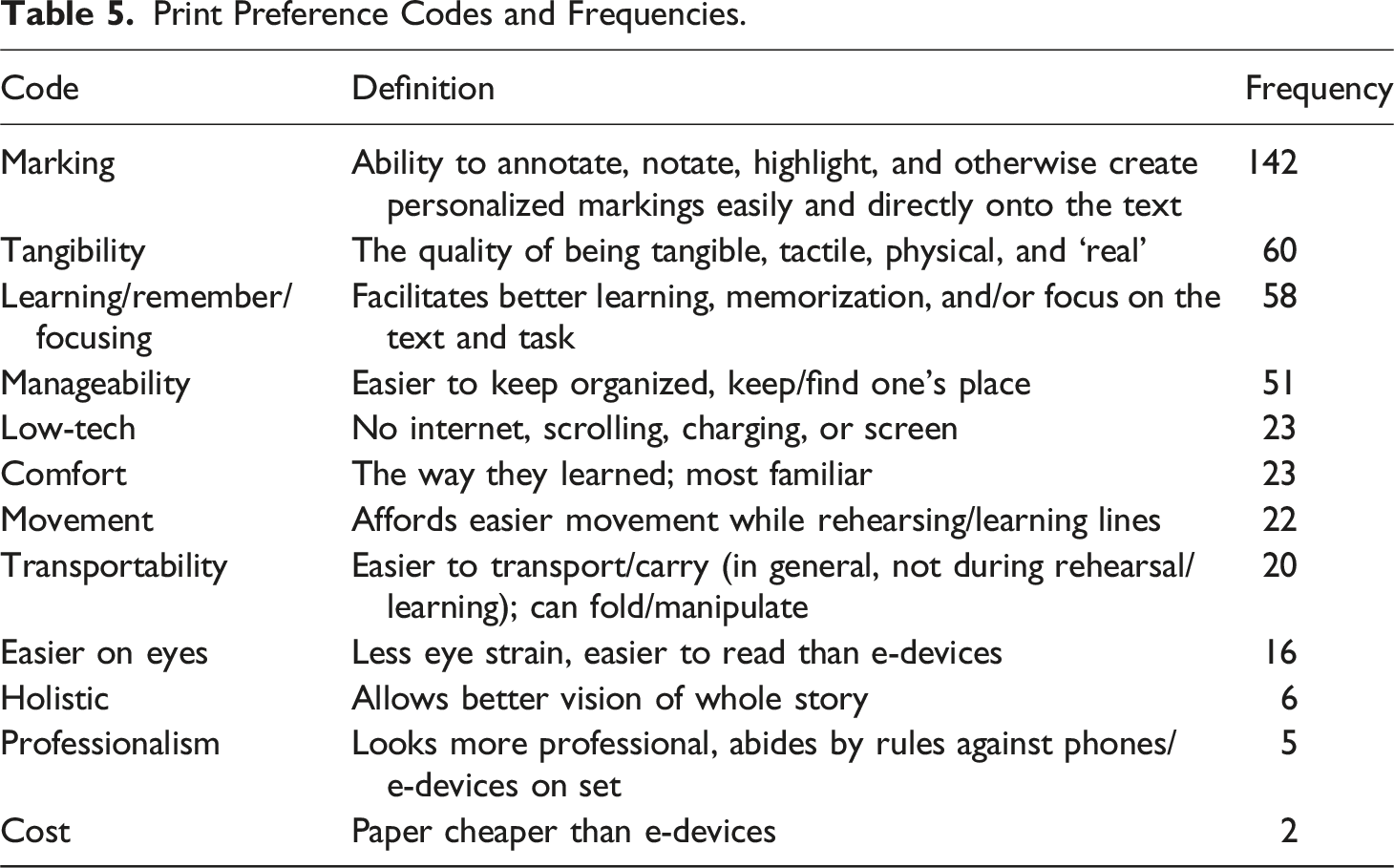
We can regroup these codes into three broader themes: role preparation and rehearsal use, physical attributes, and culture. We observed that many comments discussed how the physical format aids the process of role preparation; many discussed preferring the tangibility or tactile quality of print; and many commented on aspects of workplace and/or disciplinary culture; for instance, perceptions of ‘professionalism’, on-set rules and norms, and attitudes about the impact of digital media on the arts. Selected comments below help illustrate these themes: • Role preparation and rehearsal use: Marking, moving, learning, holistic ○ ‘It is easier to embody the physicality of the role as I practise actually moving around…’ ○ ‘Printing allows you to see more at once, and to write … your intentions, objectives, adverbs, movements, gestures, thoughts about the character or dialogue’. ○ ‘Taking notes by hand. The more senses I can engage, the better’. • Physical attributes: Tangibility, manageability, low-tech, transportability, easier on eyes ○ ‘I like to hold the scripts to get the energy into my hands’. ○ ‘I don’t have to scroll to read printed script’. ○ ‘Easily accessible and doesn’t require wifi’. ○ ‘I like feeling it in my hands, and holding it while I’m rehearsing and don’t yet have the lines memorized. I need to be one with my script’. ○ ‘The cell screen is too small to see the words’. ○ ‘My prep work requires paper. I write notes, take it with me in the car, on walks, etc.’ • Culture: Comfort, professionalism, cost ○ ‘…when filming and auditioning, they won’t let you hold a phone…’ ○ ‘Print is much more comfortable’. ○ ‘Digital is destroying the work and the arts’. ○ ‘Everyone needs to know that there are “NO PHONES ON SET” with professional productions. So paper scripts are the only option’. ○ ‘I find great comfort and confidence in using a printed script’. ○ ‘I’d probably print more scripts if I owned a printer’. ○ ‘With a printed script in hand… I don’t look like I’m on my phone when in reality I’m studying my lines’.
Why actors like electronic
Definitions and Codes of Comments Favouring Electronic Formats.
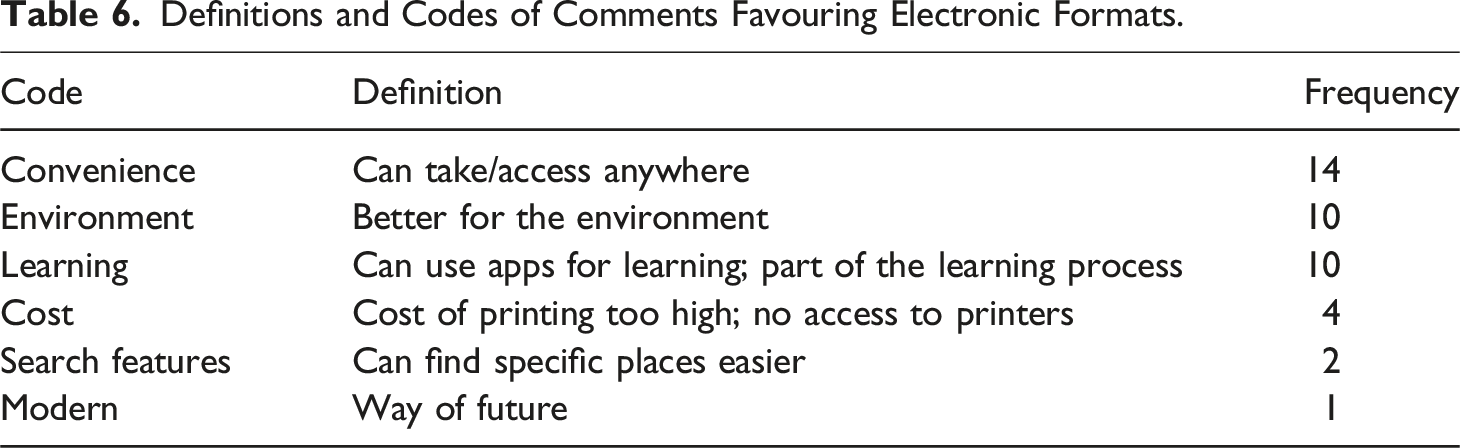
Selected comments that illustrate these beliefs: • ‘I just prefer a more modern approach with my tablet and apple pencil’. • ‘I can view it anytime with electronic. Print is too cumbersome’. • ‘Using electronic format you can upload it to an online learning app which is really helpful for cues, timing, you get a better feel for it’. • ‘Electronic is environmentally friendlier and I can have it on all my devices and access it everywhere anytime’.
Depends – Contexts when either format may be used
Conditions for Use of Either Format.
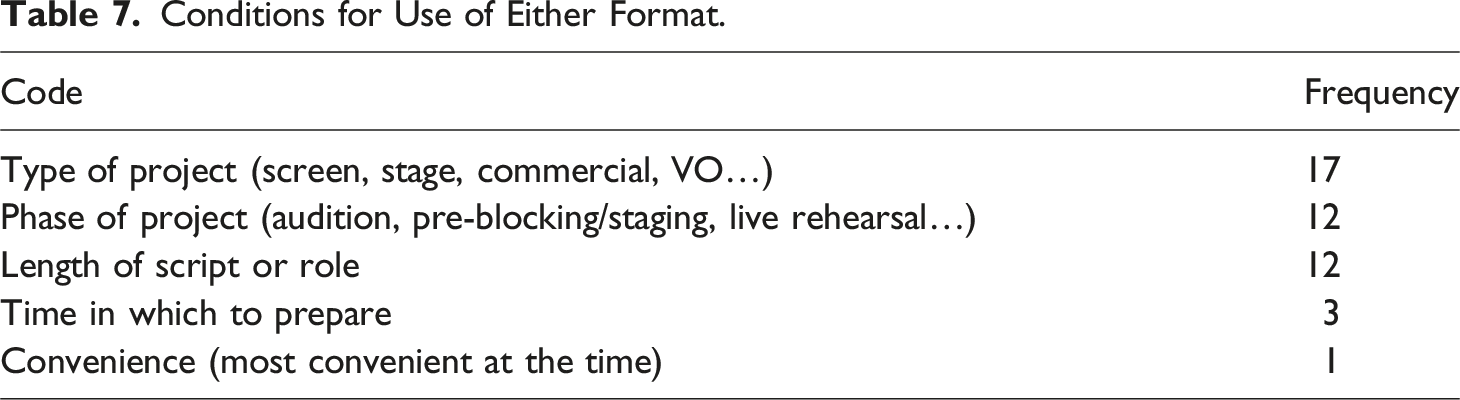
Selected comments illustrating these conditions: • ‘If auditioning, I always print the sides on paper; if just reading a script I prefer electronic as it saves on paper and can be easier to read; if learning a role or performing, it is much easier to have the paper with me…’ • ‘It all depends on the project. Commercial, TV or Film and also by the length of the scene’. • ‘Sometimes I prefer to memorize it on paper …But if it’s not too many lines I’ll just memorize it electronically’. • ‘It really depends on how much time I have to work with the script, if I am [rushing] I don’t print it since it feels like a waste…’ • ‘I prefer print for any amount of text larger than an audition, especially for deep studying and preparing a role…Sometimes, for smaller or commercial auditions I may leave it as digital as there is not much study involved’.
The comments show that many respondents’ preference for either format depends on the degree of memorization involved. When more memorization and preparation is demanded, when the script is longer or the role more involved, print becomes the preferred method. Some respondents stated that they were fine using electronic scripts when the task of memorization was minimal or non-existent. They often preferred electronic devices for voiceover work. The actor is not on camera or stage and is not required to memorize their part, and any noise from turning pages is eliminated. These comments illustrate this point. • ‘For VO I prefer to work from digital – I am generally in my booth, it’s easier to work from a screen, and I don’t need to worry about the sound of page turning’. • ‘Voiceover I prefer electronic because I don’t need to memorize voiceover, and it’s silent in the booth’.
Many respondents said they preferred or were more amenable to electronic reading early in the preparation process when memorization is not yet expected. They often integrate both formats as part of their preparation process. • ‘Electronic works for any table reads where the writer doesn’t want the actors to make notes with questions or thoughts on the script’. • ‘Always PRINT unless I’m doing a table-read over zoom’. • ‘I like the electronic version for the preparation sessions; once we reach the final draft, I prefer the printed version’. • ‘I prefer to screenshot my lines and view them on my e-device during my preparation for a role, but I will resort back to print for live rehearsals’. • ‘I highlight my lines prior to printing. I use paper copy to make blocking notes while rehearsing. I use both methods to memorize lines depending on where I am’.
One actor provided a very detailed account of how they integrate both formats into their learning process that includes flashcards, audio recordings, writing lines out by hand, highlighting on both formats, practicing with family and friends, printing out highlighted versions ‘to fold in various ways’, and reading lines out loud using either format ‘while riding an exercise bike or walking a treadmill’. They have used these methods since childhood and find them ‘especially helpful when I am cast late in the production process without much time until the first shoot or opening night’.
Discussion
In response to our primary research question, results clearly indicate that the vast majority of actors in this sample express a general preference for scripts in print format when learning and rehearsing their professional projects. They strongly believe that print facilitates better learning, focus, memorization, and ease of movement. Respondents overwhelmingly appreciate the inherent physical and low-tech properties of print that enable them to make notes directly and easily. Statistical analyses show no significant differences in attitudes by gender identification or country of residence.
Slightly higher print preference percentages were seen among the older age cohorts than younger. Earlier studies of tertiary students present the opposite – younger, less experienced students show a slightly stronger preference for print than older students. By definition, populations in studies of tertiary students are going to be heavily skewed towards younger adults. Over 70% of respondents in the ARFIS study were between 18 and 24 years of age (Mizrachi, Salaz, et al., 2021). By contrast, only 16% of the actors responding to this survey were under 30. Age was not investigated as a factor in the studies of adult professionals’ format preferences. Therefore, the discrepancy could be explained as: random chance; a difference in age-related preferences attributable to the professional practice context and/or purpose of reading; insight that was not available in earlier studies due to an under-representation of older respondents in the overall dataset; or other. More investigations into the reading format preferences of adults of all ages in the workplace, especially in the post-COVID era, are needed to secure a better understanding of this question.
Analysis of the comments indicates that the extent of memorization and the amount of movement demanded in a role are key conditions that impact actors’ format behaviours. This is consistent with studies demonstrating the importance of enactment (movement) to the memorization process of actors (Noice & Noice, 1999; Noice et al., 2000). Thus, using an e-device for performing voiceover work in which no blocking or memorization is involved is ideal for many. Electronic devices may also be suitable during the early stages of role preparation before memorization is expected and staging has begun. This would be what Noice and Noice (2002) described as the first stage of role learning before the rehearsal/performance stage ‘which involves activation of cognitive-emotive-motor processes’ (p. 9). College students prefer print for their academic reading needs, but rarely identify memorization (which differs from ‘remember’) or movement while learning as factors. They agree that print allows a greater depth of engagement with the text through highlighting and annotating and thus facilitates a more effective learning experience. Similarly, many students are open to or prefer using electronic devices when a text is shorter or easier. It is therefore easy to imagine that undergraduates studying Elizabethan literature for the first time and actors preparing for a major role in a play by Shakespeare would both prefer to use print format.
Actors emphasize the importance of freedom of movement while learning their roles; two even described themselves as kinaesthetic learners, that is, they believe they learn best when body movements are also involved. And the tangible/tactile qualities of print, which allow freedom of movement and whose qualities appear to provide a sense of reassurance, are very important to this population. Because movement is essential to characterization – gross and minor motor movements, facial expressions, body language, and engagement with other actors, they must fuse the story into their muscle memory. The necessity of this aspect of multisensory learning and whole-body reading is not revealed in the studies of tertiary students. For the vast majority of actors in this study, print format is still the superior medium when preparing for roles requiring memorization and movement. Mizrachi and Salaz (2020) reported that tactile features of print were among the factors that tertiary students liked as well, but they did not note it nearly as prominently as the actors.
Ancillary actions are the extra steps needed to enable a primary action, and the ancillary actions involved in using electronic apps appear to interfere with broader adaptation of digital formats among actors. This is seen in comments describing the ease with which they can notate their print scripts even though many digital programs do include highlighting and annotating. Actors describe their greater comfort with the low-tech affordances of print such as turning pages rather than scrolling. A minority of respondents describe using apps specifically as learning aids, but the ancillary steps involved – that is, choosing the ‘right one’, downloading it onto multiple devices, and learning to become a proficient user – may act as barriers to their use by others. Individuals provided descriptions of why they prefer digital for early stages of role preparation, which shows a degree of adaptation to new technologies. But as performance time approaches, the attitude shifts to greater print dependence as expressed in the comment, ‘I will resort back to print for live rehearsals’.
Length and complexity of a role, especially when memorization is demanded, is another factor actors consider when choosing a format. This is consistent with earlier studies of students who note that when a reading is long and especially important they will prefer print. Time pressure can steer users towards choosing electronic devices over print. It is difficult to surmise from the comments, but possibly the association of print with deeper learning and substance and electronic with ephemerality and superficiality, whether conscious or not, leads the user to think that in a time crunch, electronic is more efficient.
The ‘no phones on the set’ rule parallels the ‘no phones in the classroom’ policy some professors try to enforce, especially in smaller discussion groups and seminars. Rings, vibrations, and other digital sounds cause distractions to everyone. The users themselves cannot fully focus on their physical environments when on their phones. It is understandable that phones with cameras and other recording mechanisms are banned from sets and performance preparations in order to avoid professional indiscretions.
Respondents in this and earlier studies note their belief that electronic format is better for the environment. They describe their reluctance to print on paper more than necessary and their efforts to recycle paper when possible. This seems to be a universal awareness, but it does not dictate behaviours for most actors or students. And like students, not all actors have ready access to a printer; many lament the expenses involved in printing. Students however are expected to obtain their own textbooks and reading materials, which can cost several hundreds of dollars per term. If they can access their readings digitally, borrow them from the library, or some other source, they are strongly inclined to do so. Actors do not have to purchase their scripts.
Analysis through the lens of the Reading Event Analysis Model (REAM)
REAM consists of three factors: Difficulty of Learning from the Text; Reader Objectives; and Access. Each factor contains 2–4 dimensions, and each dimension contains conditions that may tip the preference towards print or electronic format for a specific reading event. The complete model is shown in Figure 3. Factors and dimensions are shown in the left and centre columns, and conditions in the right column. Symbols in the dimensions column indicate which can be influenced by interface designers and engineers The Reading Event Analysis Model (REAM).
2
 ; classroom educators
  ; institutional policy or practice
  ; or national regulatory and economic policies
  . A reader’s decision to use electronic or print format for a specific reading event depends on the conditions.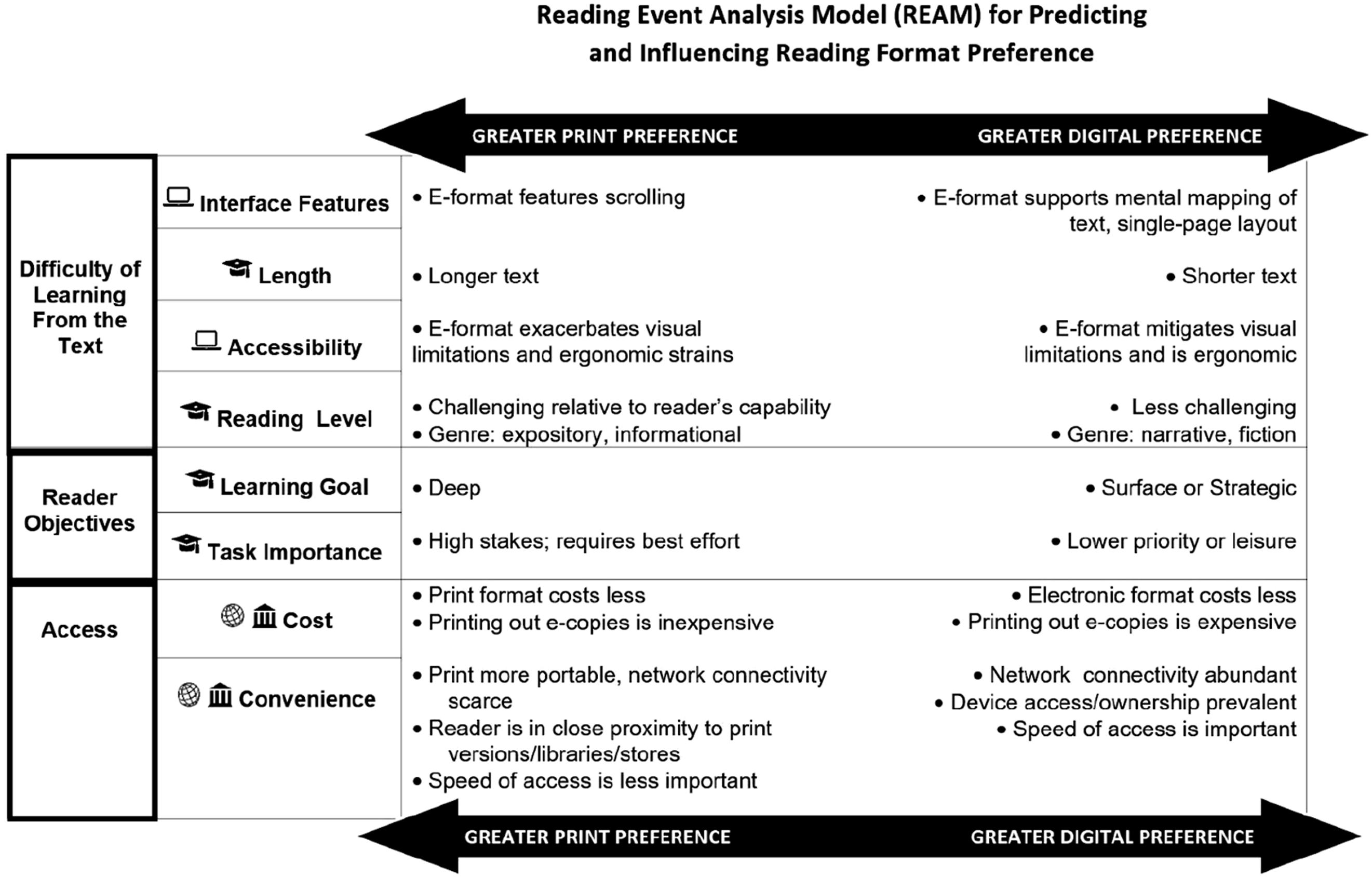
When actors’ comments regarding the favoured features of print and electronic format are mapped to the conditions affecting format choice in REAM, most findings support the model. As professionals, actors recognize that most role preparation requires deep learning strategies and their best efforts – conditions listed in the Reader Objectives factor. Many respondents note that the type of project influences their format preference. Print is favoured for longer roles, and projects that demand more memorization and movement. Actors overwhelmingly expressed their belief that print is more conducive for learning and memorization – deep learning goals. Portability, speed of access and costs are conditions listed in the Access factor. The most frequent comment favouring print described the ability to mark on it easily. This is not specifically listed in the model, but can be inferred through the dimension of interface features. While many e-formats do offer tools for marking and annotating digital texts, users do not seem to find these as effective or intuitive as print-based marking, which may be why users gravitate towards print formats for deeper learning tasks. Other codes: tangibility, comfort, professionalism, and holistic view, do not fit as easily into the model.
Features favouring electronic format among actors such as convenience and cost match conditions in REAM. The use of learning apps, search features, and integrating digital into the learning process can be inferred in interface features. Concern for the environmental effects of print is not represented in the model. Perhaps a fourth factor, Inherent Format Attitudes, should be added to the model to increase its range of contexts. The dimensions would include familiarity with format, comfort level, environmental concerns, and attitudes such as professionalism and modernity.
Limitations
More than 170,000 professionals are members of the Screen Actors Guild-American Federation of Television and Radio Artists (SAG-AFTRA), and 50,000 theatre actors and professionals are represented by the Actors’ Equity Association union (many performers belong to both). Results from the 357 respondents in this study present an initial glimpse of the considerations professional actors make when choosing which format to use for their role preparations; we cannot draw broad generalizations about all actors. It is also known that results from convenience and self-selection sampling methods of data gathering cannot be generalized to the entire population. But the fairly even distribution of demographic representation in this study does support the strength of the findings.
Conclusion
This is the first study known to investigate the reading format preferences among professional actors preparing for a performance project. The respondents recognize the centrality of memorization to the success of most of their projects, especially after the initial auditions and read-throughs. They overwhelmingly prefer print format for the low-tech and tangible features that enable them to mark, move, and rehearse easily. Because of these affordances, actors can focus on their job without distractions like internet access, battery life, or losing their place while scrolling, and they acknowledge that print creates the best learning experience. Most conditions expressed by the respondents were successfully matched to REAM. However, expanding REAM to include a factor that reflects the reader’s personal attitudes and biases regarding formats is an area to explore further. We recommend testing REAM with more studies using different populations to continue to build and refine a more complete model. Studying the format preferences of musicians learning a performance piece could also add new perspectives. Results of the age factor in this study show a slightly stronger preference for print among older respondents. This diverges from pre-COVID studies of tertiary students. It is recommended that further investigations of format preferences among professional adults in the workplace be conducted to test whether age is a significant factor. If enough support is generated, then a reader’s age should also be a condition in REAM.
Results from this study support the use of multisensory reading and reading out loud as pedagogical techniques in the classroom and in informal educational settings for strengthening reading skills. Becker (2023) defines multisensory educational strategies as those that engage more than one sense at a time. Multisensory learning strategies are used especially by educators working with dyslexic individuals (Birsh, 1999). But all students may benefit from using gentle or whole-body movements during their reading like the actors in this study. As technology continues to develop, electronic devices will become more user friendly – perhaps so much like paper that print format becomes obsolete. But until that day arrives, these actors will continue to prefer print format when preparing for their professional projects.
Footnotes
Acknowledgements
The authors would like to thank Professor Naomi Baron for reviewing this manuscript and providing her valued feedback and comments.
Declaration of conflicting interests
The author(s) declared no potential conflicts of interest with respect to the research, authorship, and/or publication of this article.
Funding
The author(s) received no financial support for the research, authorship, and/or publication of this article.
Permission to use material reproduced from another source
The authors are the creators of the Reading Event Analysis Model (REAM), reproduced in this paper from: Salaz, A. M., and Mizrachi, D. (2022). A proposed Reading Event Analysis Model (REAM) for determining likely reading format preferences. Journal of Documentation, 78(2), 190-206.
Ethical statement

Data Availability Statement
The data that support the findings of this study are available from the corresponding author upon reasonable request.