



Abstract
There is general consensus within students and staff in higher education that designers have to be ‘eco-conscious’, making decisions every day that will consciously or non-consciously impact their carbon footprint in multiple ways, from the files they are saving, to the designs they are creating. However, in further/higher education, it is still not discussed widely, or in depth, as part of delivery. In communication design, this is particularly difficult, due in part to the multiple, nuanced considerations surrounding methods, processes, practices, and outputs listed as part of the discipline. This paper will specifically explore issues of student perception around relevance, and personal choice verses institutional expectations which internally shape working practices in academia, and beyond into their professional lives. By using data and insights gathered from interviews and focus groups of current communication design students, this paper discusses the relationship of the design student, their creative process, and the value of the practice when considered against sustainability within pedagogy and practice, leading to the need for delivery to be shaped towards the agenda more definitively, relevantly, and in parallel to learning outcomes and assessment.
Introduction
Communication design, as a profession, has been recognised since the late 19th century (Meggs & Purvis, 2012). As the discipline has expanded so has its relative value. The Design Council estimated in 2022 that the UK design sectors contribution to Gross Added Value totalled £97.4bn (Design Economy 2022). There are many outputs attributed to the design disciplines (Manzini, 2014), meaning scale and understanding of the environmental impact of ‘design’ is problematic to determine. In communication design, this is particularly difficult, due in part to the multiple, nuanced considerations surrounding methods, processes, practices, and outputs listed as part of the discipline (Bonsu et al., 2022; Papanek, 1972).
Globally, governments and agencies defend the need for a ‘sustainable society’ (Estrada 2021). Alongside this, the responsibility of higher education (HE) has led to calls to re-structure their systems to help tackle sustainable practices and grow said society (Tirado-Olivares 2021). The UK government policy is limited in its consideration of HE (Tam, 2022), with suggestions such as a ‘sustainability lead’ being placed in all education settings lacking the required need for shared responsibility across educators to affect change (Tilbury, 2019).
This paper primarily investigates how universities need to actively understand the needs of discipline specific design students in relation to curriculum development. It specifically considers communication design, where focus groups of current undergraduate students sought to establish what they already consider, believe, and understood about sustainable development relative to their practice. Through analysis of the qualitative data uncovered, we established gaps in existing knowledge, and considered why these gaps exist, with consideration of the dynamics of collected responses applied against Construal Level Theory; and what we can interpret as the next stage of pedagogical development, as an institutional starting point. It concludes that if we can adapt delivery and assessment that is initiated through consistent and meaningful student reflections on sustainability, then they are more likely to be active participants in the sustainability solution of their own practice. Furthermore, this reinforces the need of educators to instil these values and processes holistically across delivery, moving beyond surface solutions into a practice that is built on a foundation which contextually recognises the sustainability agenda.
The issue
The 1987 Brundtland Report, responsible in underpinning the objectives listed in the Sustainable Development Goals, stated that development is needed to evolve to meet ‘the needs of the present without compromising the ability of future generations to meet their own needs’ (Brundtland, 1987). Nearly four decades on, sadly, this view is still reflective of the same need for swift and radical change to transform technological, social, cultural, behavioural, institutional, and organisational thinking (Ceschin & Gaziulusoy, 2016).
The impact of consumption of (finite) resources has been widely noted (Vance et al., 2015), where contemporary trends consider the looming ‘point of no return’ (Belisle et al., 2022). This represents a continually growing concern about the severity of human actions in the anthropocene (Eriksen, 2022), where considerations often circulate environmental catastrophe (Pajardi et al., 2020), seen to impact rises in phenomena such as ‘eco-fatigue’ (Moscardo & Pearce, 2019) and ‘climate anxiety’ (Taylor, 2023). Outcomes from a 2021 IPSOS survey note that those under 35 years old (born after the ultimatum of the Brundtland Report) are 66% more fatalistic, believing ‘it is “too late to fix climate change”’ (IPSOS, 2021). This also reinforces the immediate need to integrate and embed sustainable practice and understanding as part of education/eco-pedagogy (Misiaszek, 2022). At the core of this lies a possibility to make real, albeit small, changes that may not immediately solve the critical issue of climate change but could counteract fatalist mentalities linked to notions of scale/severity.
The design sector
Papanek’s (1972) Design for the Real World supported notions of socially responsible design, linking the sector to growing concerns around fetishised consumption and an emergent need to consider sustainable design practice (Keitsch, 2012). Since the latter part of the 20th century, terms such as ‘overconsumption’ (Sun et al., 2022), ‘hyperconsumption’ (Dimitrova 2022), and ‘impulse buying’ (Zafar et al., 2021) are commonly used and have been considered growing ‘problems’ (Dhandra, 2019; Wheeler, 2012), with the implication that these practices have directly added to the global climate agenda (Dimitrova 2022). Design plays an integral part in meeting these wants through creating methods, means, and artefacts (physical and/or digital) to consume (Narimanfar & Ashtiani, 2021). Rogers and Bremner note that ‘design is expanding […] to encompass ever-wider disciplines, activities and practice’ (2017: 21). This growth in the array of outputs attributed to the design disciplines means that the scale of the sector and the environmental impact of ‘design’ is difficult to determine.
Approximations estimate that 90% of material used in the production process of design goes to waste (Van Der Laken, 2021), reflecting a lack of awareness of the severity of designs contribution to environmental issues. Relatively consistent efforts have been made to consider wasteful practice in a number of design disciples, namely furniture design (Bumgardner & Nicholls, 2020), fashion (Hur & Cassidy, 2019), architecture (Ragheb et al., 2016), and product design (Ceschin & Gaziulusoy, 2016). These disciplines reflect more ‘material’ means of manufacture and output, with the potential to adopt and integrate a ‘reduce, reuse, recycle’ mindset (Braungart & McDonough, 2009). Historic considerations often focus on physical waste, with growing (but limited) concerns now noting e-waste (Kazancoglu et al., 2020) and the carbon impact from digital activity/outputs (Wut et al., 2021).
The complexity of this in the context of the design process is evident across communication design (Mukendi et al., 2020). Here, the outputs are, in the main, transient, with posters, packaging, advertising, websites, etc. all subject to relatively limited temporal usefulness, comparative to certain other design practices. The move towards a ‘circular economy of design’ is less reflected in such outputs when considered against disciplines such as product design and fashion (Vicente 2020). Yet like these disciplines, the outcomes of communication design (those seen by the public) are often the result of significant design processes, including research, ideation, conceptualisation, prototyping, testing, and analysis; involving vast amounts of people, materials, and (digital) power.
Beyond this, the role of communication design to promote consumption leads to further questions surrounding not just how designs are manifest but to what end (Bonsu et al., 2022; Papanek, 1972); the same consideration outlined in Garland’s original First Things First manifesto (and other iterations which have followed). There is a need to further reflect on communication design’s various methods with Bonsu et al. (2022) suggesting four main areas of consideration: the designer’s behaviour, design method/process, materials and tools, and after use of the designed product. It is likely that, in order to shift industry attitudes, these considerations would need to be strategically aligned to design education, thus shaping the future of design itself (Ceschin & Gaziulusoy, 2016; Tilbury, 2016).
Design education
Where concentrated efforts have been made to integrate notions of sustainability across multiple disciplines (in design and beyond), ‘universities and colleges are currently seen as contributing to the sustainability crisis and reproducing the paradigms which underpin our exploitative relationships with people and environment’ (Tilbury, 2011: 2). Amarel et al. summarise that ‘universities should “lead by example,” promoting a development pattern consistent with the environmental protection’ (2015: 156). A more recent report from the Environmental Association for Universities and Colleges (EAUC) stated that universities need to ‘declare a climate emergency and set challenging targets to reach net-zero emissions by 2030’ (EAUC, 2021).
Encouraging steps have been made by the sector in relatively recent history (Leal Filho et al., 2019), with the UN’s 2012 report recommending a more integrated method for delivery of sustainable development be enhanced within HE. Universities across the United Kingdom are working to improve their organisations’ carbon impact, driven by a sustainability agenda focused on economic, environmental, and societal well-being (Tilbury, 2019). Many have introduced carbon management strategies with green initiative schemes becoming normalised, and improved working partnerships in local and global communities. The 2012 report sought to ensure a holistic and integrated approach to pedagogy, reorienting HE to address sustainability in practice (Tilbury, 2019; Wals 2012).
While these considerations broadly concentrate on the role of HE, subject specific discussion focused on the design discipline has received less attention (Tilbury, 2019; Wals 2012). Fleming’s (2013) book Design Education for a Sustainable Future makes positive steps towards offering an overview of relevant areas of importance, and more recent publications have concentrated on the imperative need to further integrate sustainability into teaching (Lobo, 2020; Watkins et al., 2021). Research in fashion pedagogy notes the need to consider the product lifecycle and waste as part of the design process (Gam & Banning, 2020). Similarly, product design education deploys notions around the circular economy being integral to student output (Vincente, 2020). However, the discipline of communication design is generally undervalued and under researched (Harland, 2020; Meron, 2020). There has been no real significant focus on the notion of sustainably driven pedagogical practice, surrounding curriculum content and student submissions. Where current discussions across design in HE may seek to shift delivery (methods and content), any overview of student understanding, their current knowledge and interpretation of sustainability in the context of their own practice, is neglected. Yet individuals can hold varied meanings of what might constitute sustainable practice, reflecting gaps and inconsistencies in their understanding which would be necessary to address in order for them to deliver comprehensive, sustainably focused output (Boarin et al., 2020). These gaps are likely a result of a lack of environmental consciousness, the absence of a consistent definition of sustainability, and its nature to overlap all aspects of practice (Salas-Zapata and Ortiz-Munoz 2019).
Theoretical approach
The complexity of the ‘sustainability problem’ has made it difficult to define (Ciegis, 2009; Salas-Zapata and Ortiz-Munoz 2019). This is further met by issues around willingness and the ability to engage found across multiple agencies (Schiano & Drake, 2021). Where willingness does exist, it may still reflect limitations in knowledge and (cognitive) biases in attitude (Nuchter et al., 2021).
This issue has been scrutinised utilising various means across multiple fields, with the scale and ‘distance’ of the issue often identified as inhibiting individual perceptions and actions (Tonn, 2021). The temporal nature of the environmental crisis can be considered against Construal Level Theory (CLT), arguing that individuals view things in the ‘abstract’ when the ‘thing’ in question is ‘psychologically distant’ from them (Septiano et al., 2022). This ‘abstractness’ can also be spatial (too far away from here geographically), social (something experienced by others, not me), and hypothetical (likeliness of it happening), and has been used as a baseline to analyse the data collected (Amit et al., 2009). Perception as to the distance of ‘climate change’ reaching a climax is difficult for individuals to understand (Pahl et al., 2014), meaning their responsibility to act remains abstract (Wang et al., 2019). The desire to change may also be governed against perceived reward relative to action in the present. Temporal discounting outlines the conflict between short-term benefits relative to long-term benefits. This has been considered against the lack of willingness to engage with large-scale environmental policies (Sparkman et al., 2021), and in the consideration that individuals are more likely to act on small environmental initiatives with immediate visible benefits (Hardisty & Weber, 2009). To effectively offset the potential abstraction of climate change (issues relative to distance and scale), propositions have been made that indicate action is more likely when linked to affect and emotions (Brosch, 2021). This demonstrates the need to fully understand the recipient motivations to enact meaningful mindset change and influence decision-making processes (Hoggett 2019).
Lozano (2010) offers a relatively comprehensive list of issues related to developing (or not) sustainability focus into the HE curriculum. Several key considerations note, ‘lack of SD awareness, confusion about SD, Broadness of SD’ (639), yet this focuses on organisational responsibility and action, neglecting student knowledge and/or interest. In Damico et al.’s (2022) study, they conclude that depth of knowledge regarding the multifaceted impact of SD is low and ‘it is necessary to integrate the topics […] to provide students with better tools to fulfil their global responsibilities in their future professional work’ (15). In order to shape curriculum, it is necessary to uncover what current students know, understand, and consider in relation to sustainability and their discipline. Furthermore, the incorporation of ‘student-led’ curriculum design (Hallett et al., 2018) is likely to further offset concerns surrounding the abstract nature of climate change and fatalistic tendencies, encouraging depth of connection to certain notions around sustainable practice.
Rather than solely frame this around long-term future goals, there is an opportunity to build consideration into assessment and submission. The potential of this introducing a feedback loop based on adapting behaviour, as outlined as early as Tyler's (1949) landmark curriculum book, Basic Principles of Curriculum and Instruction, is not to be underestimated in a long-term sustainability focus seeking to change developing practice at undergraduate level and beyond. This protocol would aim to offset a problem identified by Lozano et al. (2015) where: ‘Incorporating some material or creating a stand-alone introductory SD course could appear as a relatively simple starting point for institutions. However, such steps tend to result in the students learning and studying for that particular course but not being able to integrate SD principles into their professional life’ (206).
This leads to two research questions: RQ1: How do communication design students approach the complexity of ‘Sustainability’ regarding their knowledge and practice? RQ2: How can this inform and shape programme development around sustainable practices?
Methodology
Twenty-four undergraduate students participated in small in-person focus groups of 4–6. All students were enrolled on a communication design degree. Students are often utilised as research candidates, and their contextual awareness is critical in determining relevant findings and subsequent actions (Berender 2004; Carver et al., 2010). The groups were from within the researcher’s own faculty, as the study needed systemic inquiry and understanding due to a vested interest in the subject specific teaching/learning environment aligned to sustainability. While the groups and researchers are aligned to the same faculty, the students were not taught by the researchers, mitigating pressure to consent to participate (Bartholomay & Sifers, 2016). The sample was divided equally between male and female students with ages ranging from 19 to 23 years. Five members of the overall group were international students. Three students had returned from working in the creative industries for a placement year. These students all had experience of the curriculum having spent 2–3 years on the course, positioning them as knowledgeable as to current content and practices delivered. While there can be issues associated with focus group research, mainly associated with confidentiality and anonymity (Masadeh, 2012; Cyr, 2016), the potential to gather exploratory data around unknown issues (Duerlund et al., 2019), consisting of both individual assessments and group opinion (Cyr, 2016), alongside the ability to adapt lines of questioning to encourage depth and breadth of considerations (Krueger 2015), makes this methodological approach a clear choice for the research aims listed above. Semi-structured questions were used as discussion starting points. Each question was formulated around themes to allow the widest application to discussion to gather perceptions and individual viewpoints.
The focus group discussion themes based around Bonsu et al.’s four areas of consideration listed above (2022): 1. What is sustainability? 2. What is your role as a designer in relation to sustainability? 3. Can we think about digital environmental impact and discuss? 4. Can we think about how you consider sustainability and how your education covers this? 5. What are your thoughts about the expectations in your practice within the university? 6. Does sustainability matter? 7. How can we do this better as a university practice, specific to your course?
The focus groups of 4 or 6 had 90 minutes each of discussion, all audio recorded, and transcribed. The two researchers acted as the facilitators during the discussion, having a peripheral role and to ensure opportunity for participants to contribute (Sim & Waterfield, 2019). Due to the fact the groups knew each other, we expected their existing dynamic to generate a good level of conversation, with the group sizes producing a variety of unfragmented discussions (ONyumba et al., 2018). The method also allowed for consensus to be achieved around interpretation and understanding of issues (Cyr, 2016), further enforcing the method in uncovering what students do, and do not, know around their practice and sustainability.
A thematic coding process was adopted regarding analysis of focus group responses, further utilising open coding practices (Visser et al., 2021). Thematic analysis has seen much discussion relative to its methodological application to qualitative analysis (Byrne, 2022), with Braun and Clarke’s contribution to the field being imperative in adding further rigour to practice (2006). Practices surrounding open coding (Williams & Moser, 2019), in parallel to content analysis practice (Neurendorf, 2018), assisted in identifying large-scale considerations relative and relevant to communication design study and sustainability. The first stage of analysing the data led to the initial coding of keywords before systematic coding for dissemination. Exploring students’ views and understanding provided invaluable insights that could be applied to teaching and learning in communication design, and potentially more widely.
Findings
A practice of reflective pedagogy framed the investigation and subsequent analysis. An introspective review of curricula to understand current practice within communication design teaching, what was delivered, understood, and interpreted by students and where gaps in knowledge exist, was imperative (Bailey, 2012). Using the ERA cycle as a basis (Jasper, 2003), students were asked to consider their experience as part of the programme and reflect on this in the context of their existing knowledge of sustainable practice in their discipline (Image 1). Subsequently, possible actions have been interpreted throughout the following sections, emphasising the need to address previously unknown and unassumed areas of relevant concern. Adapted model of the ERA cycle (Jasper, 2003).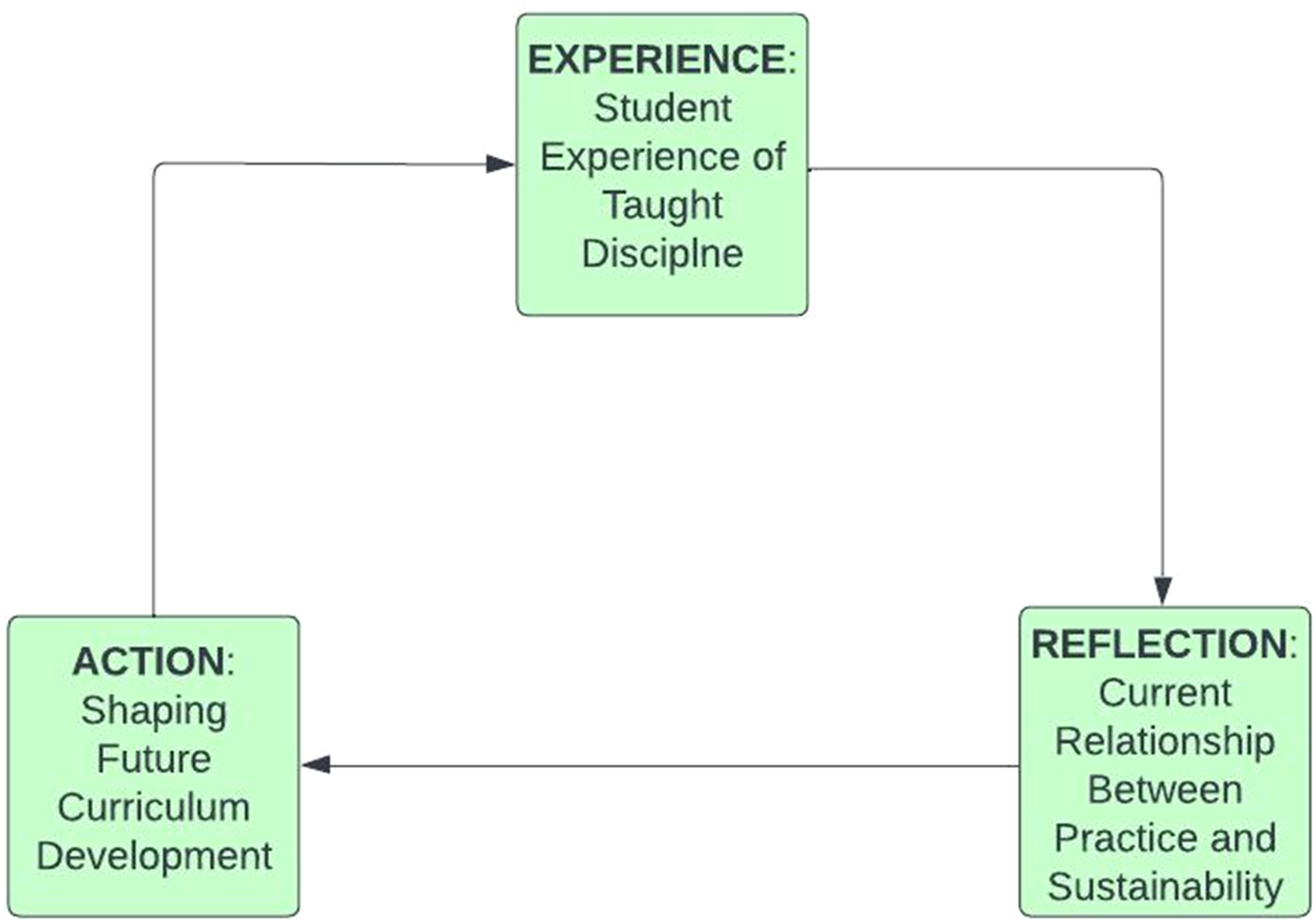
This allows for findings presented here to frame future research and action in the form of curriculum development considerations, acting as the foreground to underpin what is deemed relevant and necessary within delivery across communication design studies.
Understanding sustainability
Opening questions posed to the focus groups started with an understanding of what the students recognised as sustainability and what they believed their own role was, as a designer, in relation to sustainability.
Aside from a general confusion as to what ‘sustainable’ specifically meant, the overview appeared to show that the majority thought, in their own practice, this reflected paper use, or ‘better’ paper use. Students appeared to lack the ability to holistically consider their practice, potentially offering surface level solutions to the complexity of sustainability, ultimately lacking critical reflection related to both craft and digital outputs (Bosio & Waghid, 2023). Paper waste was perhaps seen as a ‘quick fix’, and while this is important, further analytical focus needs to be instilled into their method. Energy consumption, life cycling and repurposing, soy inks, challenging the brief; none of these were mentioned. Several participants commented that the process of constantly producing paper to show tutors and lecturers was ‘done for the sake of it’, and many noted that they feel design tutors like physical quantity, as a proof of work; this issue was raised frequently. The group also discussed the fashion and trend of sustainability, in so far as this is something experienced by others, but not them; the implication being that ‘the trend’ would pass, evidencing a psychological social disconnect. It is difficult to place a value on this, as if we, as educators, do not educate on the importance of the issue related to tangible practice outputs; then how do students understand the mechanisms to achieve it? Given the lack of sustainability training within HE (Pena-Cerezo et al., 2019), further consideration of discipline-centric knowledge development is required as part of recognised staff development, to be redeployed within delivery and curriculum development.
Students discussed the conflict of the issue, and its relationship with communication design, where much of the output as a student, and throughout the industry, contributed to the wider problem, as opposed to assisting it. Another further point of interest raised across the groups was the belief that sustainability in context referred to the designed asset educating the wider public about climate issues, as opposed to their own practice being sustainable. They believed that their ‘job’ was to make sustainability more ‘common’ in other people’s lives. This demonstrates the need for current curriculum delivery to make further, nuanced definitions as to sustainable practice in context (Yadav, 2023).
The digital output
The surprise of the focus groups was that most of them did not understand that their digital activity could also have an environmental impact, even though they acknowledged that they thought they saved files that were ‘too big’, without understanding why that may be environmentally problematic. ‘I have never considered it, or that I would even have to’ was the dominant response during this discussion. All the participants, bar one student, relayed that they had not considered that ‘digital’ was a sustainability issue, even though there was an acknowledgment that they knew of data farms, and thought these may be ‘terrible for the environment’. As data farms are not highly visible in the UK landscape, and this is something all had not seen in reality, there may be a geographical spatial disconnect. Data is so far away, so physically intangible, and potentially abstract, that it was difficult for the group to find a reference point and make a judgement. Every participant without exception had not realised that digital work contributed to a carbon footprint. This demonstrates a need to engage in mindful reflection as part of practice, previously highlighted in the work of Manchada et al. (2023). Demonstrating and disseminating the link between material consumption (paper) and digital output/s is crucial in developing consciousness as to the impact of such practices within communication design.
A developing student consciousness
There is a need to consider the notion of developing a clear student consciousness across current HE design pedagogy. The focus groups insights indicated that there is a need to embed notions of conscious design in the fundamental processes taught, bringing it front of mind at the start of (and throughout) projects from day one. Where many students believe they understand sustainability, and/or would consider it within their design, this knowledge is limited in terms of real, definitive, practical action: ‘You do hear it all the time on the news and there feels an inevitability that we are going to have to do something about it’. The group did not feel it was pressing and potentially could not picture the affect that their output may, or may not, have environmentally. One student commented that they could not see what difference one course, at one university, in one country could make, so what would be the point of changing? This egocentric view again highlights a temporal distancing of the issue. Methods need to be galvanised when taught with this information and further underpinned through consistent reflection of processes, both in regard to individual student practice and pedagogical delivery/development (Bailey, 2012).
Many of the groups believed the responsibility lay with the educators, and agreed upon reflection, that there was an opportunity to include environmentally considerate practices across the process. There was also a consensus that this needed to be consistent throughout the course and embedded upon arrival, with the aim of making sustainable consideration habitual.
Great (sustainable) expectations
The value of paper is now low. We can, as designers, mass produce; we can communicate easily, and we can over-produce. The students raised questions around the consistent need to produce physical work (printing) versus the expectation for them to do this as part of their programme of study. Many students commented that they will re-run multiple test prints if the printer quality is poor (e.g. leaves a mark on their work) disposing of the previous iterations. They will scan and re-print work and/or they will photocopy hand-drawn work. While this could be conceived as a lack of environmental awareness or care from the students, it is more likely reflective of the systems in place relative to taught practice and assessment.
A purist approach is likely needed to instigate necessary levels of change (Thorpe, 2007), where a reinvention of assessment across all design pedagogy, involving wider scope for learning, economic literacy, and citizenship, will lead to a sustainable shaped design future. The more we, as educators, challenge current practices, and do not use unsustainable methods in our teaching and delivery expectations, the more unacceptable overuse will become. As one of the group stated, ‘unless you know, you can’t design with it in mind’. This is not to condemn use of materials and craft but rather to reconsider elements of them, creating a different mindset, understanding reuse, design repurpose, materiality trials, and empowering individual student agency.
So what?
There was consensus across the groups that if they entered industry, they will not be able to be sustainable designers in practice as they believed that the industry is focused on ‘money making’ alone. They also commented that they would not have the confidence to challenge the assumption of an employer. While a number of students evidenced fatalist mentalities towards climate change (Wamsler & Brink, 2018), one particular student expressed this in the context of the creative industries, as they believed that the sector is lacking engagement in the issue, so why should they engage. This raises the question as to how educators frame the actions to be taken, and how students can adapt and adopt this thinking for undergraduates to feel empowered and graduates to move confidently into the creative industries. Educators need to embed these principles across programmes and institutions and, ultimately, influence industries to elicit individuals to engage in consistently meaningful implicit practice, moving to the ‘collective solidarity needed to accomplish radically ambitious transformation in the present and near-future’ (Taylor, 2023, p. 162).
The student designers do have an awareness of climate issues to some degree, but application of knowledge to practice is lacking and directed towards material resources and consumption. Many of the students believed that sustainability, conceptually speaking, was so complex that there was little point considering it in their practice. One of the group suggested, ‘that when you are at university, it doesn’t matter if you are sustainable or not, there is no incentive to change’, and ‘I’ve desensitised myself to sustainability then I don’t restrict myself in answering briefs’. This highlights that the group thinking is that climate change and sustainability is something happening somewhere else but not on their own patch. This is important to address as the students feel this is an area that is ‘too big’, they are failing in tackling, or knowing how to value it and tackle it, in their own space and in real time. This requires further integration of cooperative engagement between staff, peers, and organisations engaged with climate agendas, shaping module and programme outcomes to reflect sustainable practices and increase future motivations to act (Hansmann, 2010).
A number of the design modules are factored around social and climate issues and not necessarily on the aesthetic outcome per se, while others determine the finished artefact more specifically, but it is a balance that both design tutors and students find difficult. Current learning outcomes (LOs) do not include any explicit adjustments for sustainability thinking, even though a significant number of students opt to produce final year projects tackling complex design responsibility and sustainability themes. All focus groups noted clear suggestions about pushing this further, embedding relevant considerations within their programme.
The students’ perceptions of the state of the world need to be evaluated in respect of their, and our, longer-term goals, both as HE providers in design and as a planet (Taylor, 2023). While they understood the abstract goal (positive steps towards climate change solutions), the main issue appears to be in determining effective action in their practice and situating the issue in both current time and place, that is, climate change is happening here, and now, and how do students experience it? It would be useful to challenge institutions to add sustainability-based learning outcomes, with the ability to incorporate notions of sustainability across all disciplines, yet with the flexibility to mould outcomes to subject specific outputs.
Conclusion
In response to RQ1, the detachment within the groups was tangible when in discussion. Across the participants, there was a general agreement that they did not actually know what it was they could do, yet they all had a desire to do something if they understood what it was they could, and should, consider in their practice. Students had previously tackled relatively complex issues or ‘wicked problems’ through projects but had come to the conclusion that ‘the sustainability problem’ was too large and complex for them to understand what difference they could make as a designer in the creative industry. It was difficult for the group to construe that this problem is happening now and therefore if they could change their design behaviours accordingly. The focus was very much on the tutors to provide the evidence, to narrow the distance of ‘the problem’ in order for the concept to no longer be an abstract, potentially hypothetical ‘thing’ happening in another location. These findings reflect that they value the concept of sustainable practice, but notions related to scale and distance inhibited their ability and willingness to be active in contributing positively to the issue (Salas-Zapata and Ortiz-Munoz 2019). There is a need to deconstruct sustainability in a manner that can be situated within their immediate frame of reference.
The responses overwhelmingly indicate a focus on paper consumption as part of the curriculum. While it has been noted that this may appear an obvious suggestion from the participants, it also reflects an achievable objective, perhaps necessary in igniting ‘achievable’ action. However, this focus is offset by the need for further depth of deliberation around sustainable practice. This was particularly lacking when noting digital consumption and carbon impact where there is a need to embed this as part of delivery. Ultimately, the groups understood that communication design practice was negatively affecting climate change, but they require further direction in order to achieve positive results and incorporate considerations into all aspects of their practice.
Regarding RQ2, participants noted the need to focus on sustainability as part of pedagogy more definitively and consistently, the emphasis being on teaching staff to direct and deliver content which assisted in framing the problem. There is a need for knowledge to be imparted but a further need to consider this in terms of managing the issue and remaining realistic. Further suggestions comment that there is potential to embed sustainable considerations within LOs which impact outputs produced at all levels. This introduces the need to incorporate a reflective feedback loop or Virtuous Cycle (Brosch, 2021; Jasper, 2003) which starts with discussion/knowledge, and is considered in development and demonstrated in practice/output to be assessed. Consistent reflection triggered at multiple stages of delivery maintains focus, and incorporating this as part of assessment could be seen as an active, integrated, and relatively immediate response to the wider issue. While this study focuses on one undergraduate degree programme and the nuances of pedagogy and practice may not be reflected more widely across HE, it does demonstrate the need to offer students further explicit and manageable direction as to sustainability, driven largely by specifics of curriculum and academic staff.
Communication design and communication design education are burgeoning areas of research potential. This paper aimed to discuss the value of the practice when considered against sustainability within pedagogy and practice, leading to the need for delivery to be shaped towards the agenda more definitively, relevantly, and in parallel to LOs/assessment. While this could be realistically achieved at a programme level (and will be the consideration of future investigation), this needs to be conducted in symbiosis with wider focus from all stakeholders across HE institutions. Current broad strokes towards sustainability integration across HE have merit but, in current iterations, can only be incorporated so much into practical action at a grassroots level (Tilbury, 2019).
Footnotes
Declaration of conflicting interests
The author(s) declared no potential conflicts of interest with respect to the research, authorship, and/or publication of this article.
Funding
The author(s) received no financial support for the research, authorship, and/or publication of this article.
