



Abstract
The EU policies about what to achieve and how to achieve through the education and training of adults have developed like norms for the EU member states which they find difficult to flout. With the declaration to achieve the European Education Area (EEA) by 2025 and its targets by 2025 and 2030, the EU has laid down a framework for developing the future education systems in the member states. The paper argues that in its present form, the unintended consequences of the EU EEA policy are not only enhancing the Matthew Effect but will also make the disadvantaged learners invisible in the long run. Therefore, by encouraging the member states to adopt a narrow approach of target achievement irrespective of the needs of the marginalised adult learners, and not including the concerns of these adult learners in its own policy, the EU appears to do the opposite of what it claims to promote through the EEA.
Keywords
Introduction
The EU policy papers like guidelines, consecutive evaluations (through the Education and Training (ET) Monitors) and feedback (country-specific recommendations under the European Semester) about what to achieve and how to achieve through the education and training of adults have developed like norms for the EU member states. Member states aligning with these norms for several reasons like resources offered by the EU and avoiding naming and shaming through statistical raking. For the member states, this may become demanding not only in terms of policy formulation, implementation and evaluation, but also in terms of mobilising and committing resources for the same. Apart from the expected policy outcomes, stakeholders who invest resources, aim at specific returns and commit resources accordingly. Thus, while the guidelines and targets lay down the framework within which policies are formulated, implemented and evaluated; resource mobilisation strategies, guided by the interests of those who pay, play a crucial role in determining the content of policies. Both not only play a decisive role in shaping the education systems but also influence the way outcomes are shared among different stakeholders.
The declaration to achieve the European Education Area (EEA) by 2025 and its targets by 2025 and 2030 are one such instance where the EU has laid down a framework for developing the future education systems among the member states. Since the education for children and young people is already well organised in the EU, the EEA and its targets are specifically relevant for the education of adults – an area still awaiting better organisation, resources and opportunities for all throughout their lifespan. A crucial component in this are the EU evaluation and feedback mechanisms which promise positive ‘report cards’ for member states is they align their policies with the EEA and keep progress on track with the EEA targets despite ignoring all other educational needs in their respective contexts.
Therefore, it is relevant to dig deep into the EEA policy and its targets, analyse the adult learning needs they address, and understand the possible consequences for adult learners whose needs are left unaddressed. Further, it is also relevant to understand why the EEA policy and its targets have such consequences, where are the gaps and what potential interventions can be made to address the needs of the adult learners who are left out. Thus, the paper analyses not only the EEA policy and its targets, that is, the policy and its outcomes but also scrutinises the existing resource mobilisation strategies of the member states to achieve those targets, that is, the means to achieve those outcomes and the type of consequences such means may lead to.
The research questions for the paper are how and why the EU member states (not) changing their resource mobilisation strategies for the education and training of adults to achieve the European Education Area and its targets by 2025 and 2030? What are the consequences of (not) changing these strategies for adult learners?
The point of departure for the paper is the 2017 EU declaration to achieve the EEA by 2025 claiming to ensure a better future for the EU citizens (EC, 2014, 2017). The method of policy analysis and comparative approach are used to analyse the data which includes relevant EU policy documents regarding the EEA, relevant ET Monitors and European Semester documents and CEDEFOP statistics about financing adult learning in EU member states for working age adults (relevant target group for the EEA targets), and some additional data from the OECD regarding statistics about participation of adult learners. The conceptual framework comprises Schuetze’s generalisation about financing lifelong learning systems, concepts of Comparative Advantage, Bounded Rationality, Returns on Investment in Education, Matthew Effect, Affirmative Action, and Trickle-down Effect, and Structuration Theory by Giddens.
The paper argues that in their present form, the unintended consequences of the EU EEA policy and its targets are leading to a positive evaluation of adult learning policies in member states and thereby not necessarily encouraging them to change their strategies if they meet certain targets specified by the EU and in accordance with what is recommended in the EU evaluations and recommendations. The most preferred EU model appears to be the engagement of stakeholders in mobilising resources (and thereby fulfilling their interests too) rather than encouraging the state to pay for everything and focus on affirmative action for the disadvantaged learners. Since the EU targets do not address the needs of the disadvantaged adult learners adequately and the stakeholders do not necessarily identify the benefits from including these disadvantaged learners according to the data that is presented in evaluations, EU’s influence on shaping the education systems in member states is not only enhancing the Matthew Effect but also creating an invisible marginalisation of disadvantaged learners in the long run which is the opposite of what the EU is claiming to promote through the EEA.
Conceptual framework and operational definitions
Matthew Effect implies the socially observable phenomenon of an increasing gap among the advantaged and the disadvantaged in the society due to initial advantages and disadvantages (Rigney, 2010). In education, the effect is widely visible when high-skilled, high-paid learners from advantageous socio-economic backgrounds manage to avail opportunities and advantages in learning while the low-skilled, low-paid, unemployed learners coming from disadvantaged (poor, rural, etc.) backgrounds are unable to avail opportunities and advantages in learning (OECD, 2019a; Singh, 2023; Singh et al., 2022).
The intensification or mitigation of the Matthew Effect depends upon contextual factors. If the environment including provisions, awareness, resources, etc., is conducive for learning, disadvantaged learners might avail opportunities to move up the virtuous spiral of prosperity and favourable opportunities. On the contrary, if barriers exist, despite remaining at par in real terms, disadvantaged learners might become worst in relative terms as compared to those who start from an advantageous position and keep availing opportunities in life.
Giddens argues that the interplay of the structure (interpreted as learning ecosystem including provisions, resources, etc. in the context of this paper) and agency (interpreted as the learner in the context of this paper) explain the social phenomena about changes in societies in favour of or against the interests of certain stakeholders (interpreted as advantaged and disadvantaged learners in the context of this paper) (see Giddens, 1984). In concrete terms, the structure in which the agency or the learners are embedded form the lifelong learning ecosystems (including the context, inputs, processes, outputs and their interplay). Depending upon who pays for what, the organisation of these LLL ecosystems can be categorised in three ideal models: (1) The Social Emancipatory Model where lifelong learning is for all, state pays for everything; (2) the Mixed State-Market Model where lifelong learning is for those who wish and are able to participate, state and market remove barriers against participation to facilitate learning, individuals are responsible to find and avail opportunities; (3) the Human Capital Model where lifelong learning aims at generating human resource for the labour market while individuals are responsible for the consequences of their learning choices and raising resources for the same (Lifelong Learning Platform, 2020; Schuetze, 2009). Thus, especially when the state has limited intervention and equal opportunities in principle (open access for everyone) (i.e. the Mixed State-Market or the Human Capital Model), possibilities for further marginalisation of the disadvantaged learners prevail because such learners are relatively less capable of availing learning opportunities.
Matthew Effect can be addressed when trickle-down economics works (Böhm et al., 2015). Investing in the already advantaged and young learners is supposed to give optimum returns on investment in education as per the concrete calculation about the rise in their income and the number of years an individual can stay on the labour market. The outcomes generated from the optimum use of resources (putting resources to their best use in terms of generating returns on investment) based on comparative advantage (making those learners perform who may generate the best outcomes with least resources) can be redistributed among different stakeholders through affirmative action or positive discrimination (giving preferential treatment to the disadvantaged based on their disadvantages).
The redistribution of benefits is, however, easily explained in a hypothetical manner than executed in reality. The bounded rationality (understanding of a situation and decision-making based on this understanding which may be limited to factors like availability of information, perspective, etc.) of stakeholders might influence the equitable sharing of benefits negatively unless strong intervention in favour of redistribution is made by some authority, for instance, the state. 1 Further, the disadvantaged in this case, would always be at the receiving end and at the cost of the advantaged, while the advantaged may not get what they would get out of their efforts (or both financial and non-financial investments) otherwise, if they did not have to share the benefits with the disadvantaged. Such situations are unsustainable (not relevant in the long run) and disrupt the balance in the society.
In the paper, these abstract ideas are tested against the concrete reality of the EU provisions in the context of achieving the EEA by 2025.
Review of literature
Creating regimes, frameworks and constructs, followed by measurements is one of the crucial means of extending influence by international organisations over states (Singh, forthcoming a). Since the measurements of inputs and their relationships to outcomes can be complex and difficult to be agreed upon among stakeholders; goals or targets achievable over a certain period are a widely used policy tool (Schmelzer, 2016; Singh, 2023). The influence of international organisations is further enhanced through systematic monitoring of progress of states and respective feedback recommendations to achieve them if states fall short of the expected progress level (Singh, 2020). Generating comparative data and ranking the compared states may generate enormous pressure on states to induce action and align their policies in a way to achieve better rankings (Singh, 2023; Singh et al., 2023). When the EU collects and makes comparative data for EU member states publicly available while ranking them as high-performers, above average, average or low performers; the member states are appreciated or named and shamed for their performance along certain parameters in alignment with specific policies, respectively (Singh, 2017). Thus, targets are an important means to shape the policies of states directly or indirectly (ibid.; Singh, 2020).
The policy alignment of states for diverse reasons may not be necessarily beneficial for all stakeholders. Several stakeholders face unintended negative consequences of such alignments. For instance, an excessive focus on enrolments under the EFA program in low and middle-income countries led to learning poverty 2 (Singh et al., 2023; World Bank, 2022).In several instances, the states have limited policy choices to reject the influence of international organisations because of policy linkages or trade-offs across different policy areas and path dependency where specific policy choices are (un)available due to the decisions of stakeholders over time (Singh, 2023).
One predominant policy area in which international organisations cast major influence, at least in countries with secured primary and secondary education, is education of adults or adult learning. EU has limited scope for intervention up to secondary education because it is already well organised (Ehlers, 2019; Singh, 2023). Adults still do not have complete access to learning opportunities throughout their lifespan, comprise the core of the labour markets and fuel the economy as human resources, have the resources and the decision-making over spending and therefore, are a lucrative and approachable target group for economically oriented organisations like the OECD and the EU (EC, 2017; 2020a; OECD, 2019; Singh, 2020).
With the shift towards the knowledge economies where knowledge is capital, the relevance education of adults has further increased and placed the learner in the centre of the education systems (Ehlers, 2019; Singh et al. 2022). This has not only facilitated a shift from teaching-oriented supply-based systems to learning-oriented demand-based systems but has created challenges as well for those who abstain from learning (Ehlers, 2019; OECD, 2019). Participation and non-participation are thereby, widely used parameters to analyse the effectiveness of learning ecosystems where non-participation in learning is a major disadvantage for all stakeholders (OECD, 2019b; Karger et al., 2022; EC, 2023). The degree of (non)participation might further depend upon the learning needs which are different for the wage earners, the career-makers and the self-owners (Hoejrup, 1984 in Ehlers, 2000).
Still, investment in adult learning is challenging, even among the most prosperous and abundant economies because of the huge costs involved (Popovič, 2021; Biao, 2022; Singh et al. 2022). Adults comprise the largest section of the population with varied learning needs and complicated calculations of learning costs like income foregone, child care costs, etc. (Ehlers, 2019; Singh, 2023). Further, since adult learners already benefit from investments in their initial education (during school, etc.), and have the possibility to pay, they are expected to share learning costs as adults (OECD, 2004; Schuetze, 2009; Singh, 2023). Apart from them, other stakeholders who benefit from learning and can share the costs for learning (ibid.). These could be private companies and groups or associations like social partners (ibid.).
Most data about participation and non-participation of adult learners includes the working age population and offers which are relevant for employability because most stakeholders who invest their resources in adult learning expect concrete returns on their investments (Singh, 2020). While states also need to report the use of public money in concrete terms, private companies and social partners expect measurable returns on investment to show profits to shareholders and social partner members, respectively. However, focus on certain stakeholders only, may have unintended consequences for other stakeholders (for instance, non-working age population), pushing them to the receiving end (Kovács et al., 2022; Boeren et al., 2023; Singh et al. 2022; 2023). The OECD suggests that co-financing is the best possible solution to finance adult learning because all stakeholders benefit from it and the state cannot and need not afford to pay all the costs (ibid.). For those (like adult learners from disadvantaged backgrounds, unemployed or low-income adults) who are unable to pay, the state may mobilise resources and offer affirmative solutions (ibid.).
The paper explores the role of the EEA and its targets in this regard.
Achieving the European education area by 2025 and its targets
In 2017, building upon the Copenhagen (on Vocational Education and Training) and the Bologna (General Higher Education) Processes, the EU declared to create the EEA by 2025 (EC, 2020a, 2022b). It includes the creation of a whole ecosystem of education and training for governance, cooperation and interaction among EU member states for a sustainable and prosperous future in Europe (ibid.). 3 The EEA contemplates education as a means of personal fulfilment, employability, and active and responsible citizenship for all EU citizens which should enable them to participate in the society in a constructive manner (ibid.). Despite being instrumentalist (defining education as a means and not an end in itself), the EU approach has grown much wider than its previous approach on education in terms of how returns on investment in education are calculated (EC, 2013; 2014).
The funding for the EEA has been allocated in the EU multiannual financial framework from 2021–27. It aligns with the Next Generation EU initiative, launched to recover from COVID-19 but aiming at more than just recovery (EC, 2020a, 2020b). The EU aims at building education systems which are able to prepare individuals and societies for not only achieving prosperity but also to deal with uncertainty and crises situations in a constructive manner.
The EEA policy is built upon the foundations of the European Pillar of Social Rights including the rights to inclusive education, training and lifelong learning; and the EU Growth Strategy aiming at a sustainable and green future. Further, the EU insists that education for social market economies, democracy, diversity, human rights and social justice is a core component of the European way of life and should continue to be the same through the EEA. In principle, the contemplation of the EEA appears inclusive and equitable. Further, it is an instrument for policy alignment with the OECD and the UN global initiatives for education to which the EU member states are committed (Council of the European Union, 2023).
To concretise the achievement of the EEA, the EU has proposed certain targets to be achieved by 2025 and 2030, and a corresponding Enabling Framework.
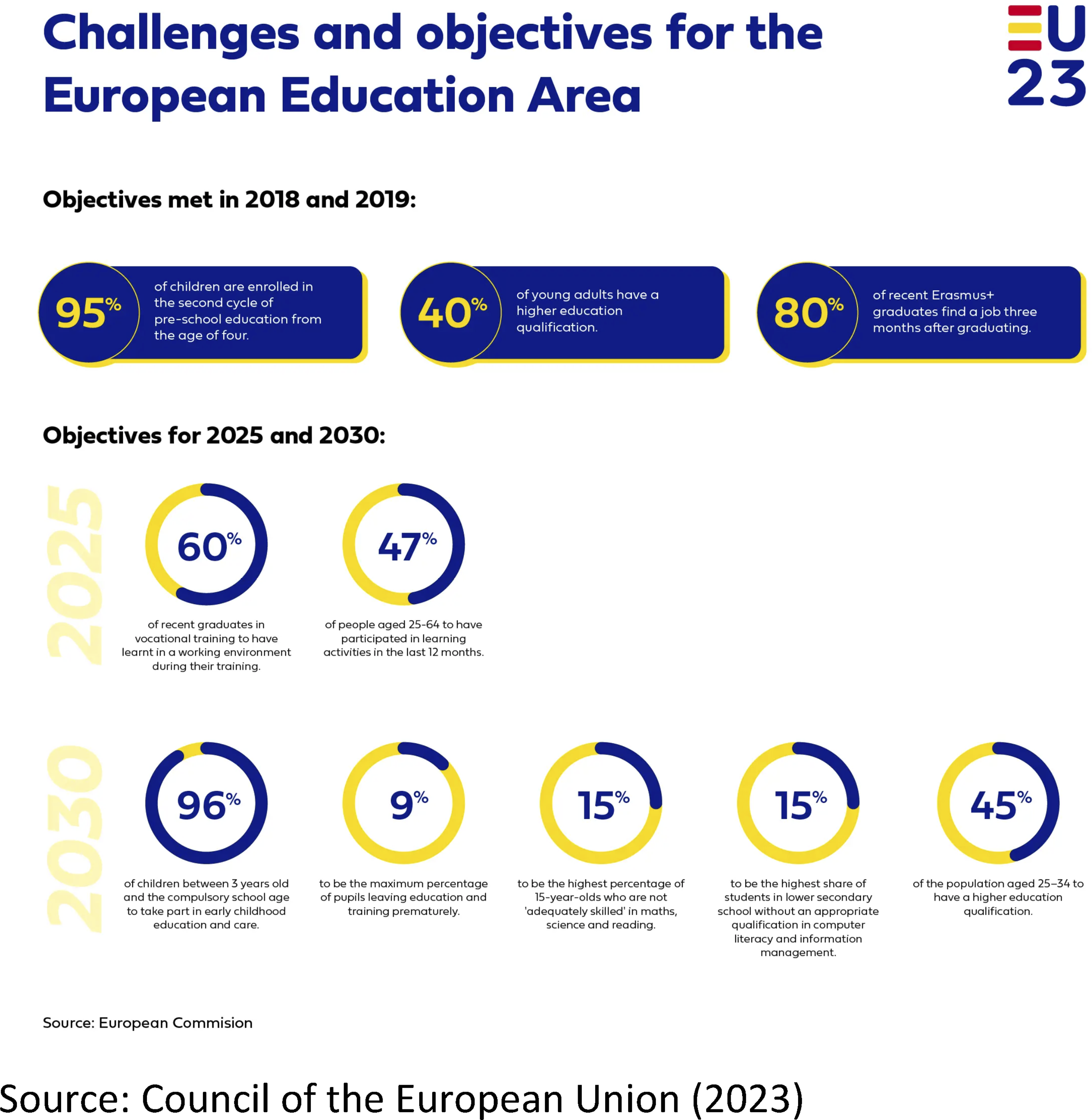
By 2025, 60 % of the VET students should participate in work-based learning while 47% of the 25–64 years old adult learners should take part in learning every year (EC, 2020a). By 2030, adult learners (25–34 years old) with tertiary education should increase to 45% (EC, 2020a). Furthermore, there are targets regarding the younger population including 15-year old low-achievers, low-achieving students in their eighth year of schooling regarding digital literacy, children in early childhood education and early school leavers. Among different targets, the only focus on adults is either those who are younger or less than half of the total number (47%) irrespective of the kind of achievers they are and irrespective of their socio-economic background. The considerations regarding who these adult (non)participants are, is not included. Out of 5 targets for 2030, only one deals with young adults while the rest deal with the younger population. Through the Enabling Framework, the EU utilises comparable evidence for policy alignment by offering evaluations (in ET Monitors) and country-specific recommendations (in European Semester recommendations).
The ET Monitors trace that the progress of the EU member states along the EEA targets since 2022 (EC, 2022a). Among the 40 action areas proposed by the EU to achieve the EEA, 14 strategic initiatives provide the core framework for action for member states, prioritised for policy alignment (EC 2022b). Among these 14 priority areas, not even a single one focuses on addressing the needs of the low-educated, marginalised older adults. The focus is primarily on youngsters and 47% of the working age population, as already mentioned in the targets of the EEA (EC 2022b). Further, among the proposed initiatives, digitalisation of education, mobility in education, recognition of skills and quality assurance, joint degrees and cooperation in higher education is mentioned (EC 2022b). Concluding the evaluation, it is mentioned that the progress towards the EEA is on track among member states and they need to enhance quality in education, use of resources in a more effective manner, and strengthen the monitoring in education (EC 2022b). Notably, neither in the present, nor the near future, there is any possibility apparent in the EU statements about addressing the challenges of participation faced by the older and marginalised adults. Despite the fact that the EU mentions diversity, immigrants, people with disabilities and the like, it relies on member states to engage the stakeholders and populate the figures for the 47% of adults who should participate in learning for meeting the EEA targets. Thus, the measurement of progress along the EEA targets narrows down the scope of investment in the education of adults, leaving out those who are not able to participate among the top 47%. The ET Monitor 2022 has included a new indicator showing that the socio-economic status of learners at 3 years of age influences their learning patterns throughout life. If parents are low educated, from rural background and old, children are more likely to participate less in learning, even when they grow as adults (EC, 2022a). On the contrary, if parents are highly educated, coming from non-rural backgrounds and younger, their children remain actively engaged in learning throughout their lives (EC 2022a).
While the EU focusses on skills, general education is missing (EC, 2023). The focus is on work-related provisions. Apart from what is measured, there is a possibility that member states are willing to take care of the rest of the adults (outside the working age) and those who are not in the 47% participating (eg. those who are low performers, coming from rural areas, with poor education background, have uneducated parents and the like) adults. This depends upon their provisions for preferential treatment of the marginalised adults. The OECD data shows that the existing patterns are leading to an increasing gap among the advantaged and the disadvantaged learners (OECD, 2021). 31% (about one-third) of the unemployed and 18% of the employed inactive learners did not engage in learning due to financial constraints, thereby indicating that the unemployed (those who are not supported by employers) learners experienced resource constraints (OECD 2021). The non-participation data shows that the low-educated, middle and low-skilled workers, and individuals with socio-economic disadvantages are often at the receiving end with the existing provisions in OECD countries (including the EU member states) (OECD, 2021, p: 19). While about 40% highly educated adults abstain from participating in adult learning, the number goes to 80% when they are low educated. During COVID, the learning hours per week of middle and low-skilled workers dropped to about 3 as compared to high-skilled workers who invested about 5 hours per week in learning (ibid.). Learners from disadvantaged socio-economic background have more challenges, first in transition from learning to work, and afterwards, in availing opportunities for further learning (ibid.).
Patterns of resource mobilisation in EU member states according to Schuetze’s framework regarding who pays for what.

Source: CEDEFOP (2020)
Provisions with preferential treatment for the unemployed, low-income, low-qualified (qualified upto lower secondary level) and after prime age (50–55 years of age) adult learners in EU member states.
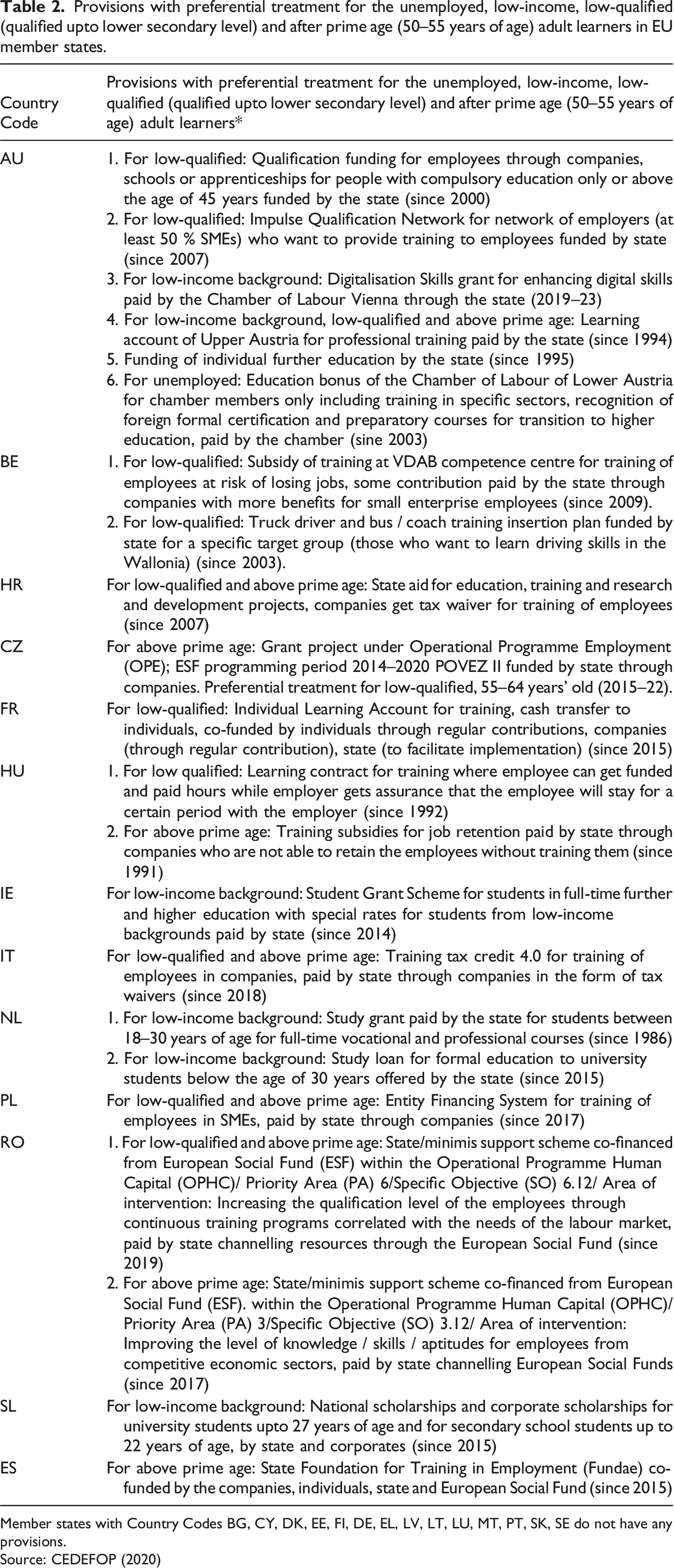
Member states with Country Codes BG, CY, DK, EE, FI, DE, EL, LV, LT, LU, MT, PT, SK, SE do not have any provisions.
Source: CEDEFOP (2020)
The table shows offers available for working age adults. Individual learners usually pay the costs that are difficult to measure. Participation in countries with social partners or predominant role of the state (France) to ensure opportunities for all is higher.
In 14 out of 27 EU member states, there are no provisions with affirmative action or preferential treatment for disadvantaged adults.
An analysis of country-specific European Semester recommendations from 2022 shows that the EU does not give recommendations to member states if they are doing fine in relation to meeting the targets as per evaluations in the ET Monitors and other databases that precede the European Semester recommendations (EC, n.d).
Discussion
Using the pandemic as a window of opportunity, the EU has pushed the EEA policy forward to promote more resilient, responsive and future-oriented education systems in member states. However, the unavailability of concrete data about adult learners and the opportunities available to them beyond working age and for general offers which may not lead to concrete economic outcomes reflects the (non)priorities in policies. While the ET Monitors do not differentiate about the nature of participants (advantaged or disadvantaged learners), the European Semester recommendations do not highlight the lagging non-participants in adult learners and suggest improvements regarding the same. To meet the targets, therefore, it is possible that the numbers are populated by figures from advantaged learners and rest are left on their own.
The EEA and its targets have narrowed down the focus of educational investments in member countries on addressing the given targets and excelling in them. The EEA policy is inclusive and broad in terms of how it is contemplated (based on the European Pillar of Social Rights) but the focus on the targets make it narrow. Since the achievement of targets is equated with the achievement of the EEA, EU member states are going to get their evaluations based upon the targets only irrespective of how inclusive the EEA is contemplated in principle.
The financing patterns show that most EU member states have a hybrid of the Mixed State-Market Model and the Human Capital Model followed by the Social Emancipatory Model (with affirmative action for disadvantaged learners). The state and the private companies are major investors in adult learning during working age. The state is usually providing continuing education, further training opportunities, tax waivers, rebates, grants to companies and individuals, fixed contributions to training funds and guarantee for loans. The private companies and the employees usually share the training costs. If the employees do not leave the workplace where they have received training, they are supposed to cover the training costs by generating profits for the company and sharing them with the company by accepting a certain salary. The costs of paid education leave are either recovered from profits in a similar manner or paid by the state in various ways. Apart from investing in the training costs, private companies also contribute to funds managed by the state or the social partners and pay tax. Social partners use the contributions of different stakeholders in providing training and individuals, apart from paying back training costs through work or directly, pay through loans and bear all the uncalculated costs of training.
Even though the overall approach of financing adult learning aimed at the labour market reflects a Human Capital Approach partially, a hybrid of more than one model exists in each member states. In reality, a combination of many characteristics develops gradually over time and space. In general, lot of individual costs are covered by the state, companies and social partners depending upon several conditions which implies that the Mixed State-Market model predominates. The Human Capital Model follows because all countries have a payback clause and individuals have to bear the costs if they want free to follow their own choices in learning. The Social Emancipatory Model gets the lowest priority. Out of 27 member states, only 14 have provisions for affirmative action and thereby, tend to provide learning opportunities for all and pay for those disadvantaged adult learners who may find it difficult to pay for themselves. This implies that in most member states the 47% adult learners who are populating the EEA target figures and earning progress at par for member states include those who are willing and can participate and those who can take bear the costs of their participation. Therefore, despite ensuring the needs of the disadvantaged learners, member states are able to get a positive evaluation.
The state is the predominant actor in redistributing the benefits of investments in adult learning to the disadvantaged learners by bearing the costs of extending opportunities to them and by promoting the trickling-down of benefits. Unlike other stakeholders mentioned above, the state (at least in principle in the EU member states) has a macro-level, long-term approach which favours the extension of opportunities for as many as possible. This makes the state invest in adult learning in general and in affirmative action in particular. Since it is too costly for state to bear the costs of adult learning for all adults and meet their individual needs, it has to mobilise resources from other stakeholders and share the costs. Other stakeholders, however, do not necessarily share the rationale of the state and their bounded rationality leads to specific investment patterns. Usually, stakeholders other than the state abstain from funding offers that do not give concrete returns on investments. While private companies as profit-making entities are concerned with generating profit, they intend to invest on those who generate the optimum profit for them. As investments in highly motivated, highly competent adult learners can increase their returns on investment, investing in the learning of disadvantaged learners is not necessarily the best option for them. Social partners are concerned with their members who pay the membership fee. These members could be companies or individuals (usually employed, who can pay the membership fee) because of which they invest in specific offers only. Individuals who have the liberty to choose the kind of offers they want to pursue, have to bear the expenses for offers not covered or additional costs which are either left by other stakeholders or remain uncalculated because of their vagueness. Further, if they avail loans, they have to ensure the repayment later. This implies that the disadvantaged learners can only avail learning offers if the state is facilitating the same through affirmative action. The rest may not necessarily favour them. In fact, while using public money on learning offers, the state needs to justify its stand to other stakeholders like tax paying individuals, companies, voters, pressure groups (social partners) and the like. Thus, for offers without concrete returns, attracting investments in education can be difficult despite their relevance. This explains the lack of importance given to general offers that may not necessarily or directly lead to economic outcomes.
Conclusion
The existing provisions and cost-sharing patterns for adult learning among the EU member states favour the learners who are willing to and are able to avail learning opportunities. A lot of responsibility lies on the individual learners who are expected to share the costs. Even though the state and other stakeholders have already invested in everyone’s education during childhood and young age, data about participation in adult learning shows that low-paid, low-educated (those usually completing compulsory education only), unemployed and older adults coming from a poor socio-economic background lag behind high-paid, highly educated younger (up to the age of 40) adults coming from well-to-do socio-economic backgrounds. Thus, despite the investment during early and young years of education, the difference among the advantaged and the disadvantaged learners remains. With inequitable opportunities and lack of enough positive affirmative in terms of preferential treatment, disadvantaged adult learners often fall off-track in learning and keep on adding to the social costs as well. Digitalisation and AI are going to push most of the non-participants out of jobs in future and for some, if the situation still does not deteriorate in real terms, they will lag behind in comparative terms as they might fall off the learning track. Thus, Matthew Effect is going to increase in the EU member states.
Since the EU is laying down the framework, setting targets and collating data, it has the possibility to highlight the gaps and unintended consequences of the strategies adopted by the member states. On the contrary, the EU is providing a positive feedback if the targets are achieved and does not necessarily highlight the needs of the disadvantaged learners, which are the unintended consequences of the strategies adopted by the member states. This is why, the member states are not encouraged to change their strategies in favour of the disadvantaged adult learners and their needs remain unaddressed.
Thus, the EEA policy appears to be inclusive in principle but the existing EEA targets narrow it down to the extent of making it exclusive and pushing the disadvantaged learners at the verge of an invisible marginalisation. It channels resources in a certain direction and keeps track of the member states by evaluating their progress through ET Monitors and giving them feedback through the European Semester recommendations, thereby pushing the alignment of policies accordingly. Due to path dependency, it is difficult to imagine that the EU member states will go backwards and ignore the EU progress evaluation and feedback to meet the needs of the learners who remain unnoticed. Therefore, it is now for the EU to broaden the targets and include the disadvantaged learners in progress evaluations (ET Monitors) and feedback (European Semester recommendations) to ensure the visibility of these invisibly marginalised learners due to its oblivious approach towards them. If the EU member states are not able to redistribute the benefits among everyone, alter the rationality of the stakeholders, and the targets remain unaltered, the unintended consequences may be negative in terms of invisible marginalisation of disadvantaged learners, rising social costs, inequality due to knowledge gaps which further project to all aspects of individual lives, and thereby, almost opposite of what the EU claims to promote in principle through the EEA.
Footnotes
Declaration of conflicting interests
The author(s) declared no potential conflicts of interest with respect to the research, authorship, and/or publication of this article.
Funding
The author(s) received no financial support for the research, authorship, and/or publication of this article.
