



Abstract
The study evaluated the relevance and effectiveness of primary school teachers’ professional development policy and practices in Oromia Regional State. The researcher used a mixed method with concurrent triangulation design. The researcher selected a total of 618 samples of the study using different sampling techniques such as purposive, convenience, stratified, and simple random sampling techniques. The data were collected from primary sources of data such as teachers, mentors, principals, supervisors, coordinating committees, and parents using questionnaires, interview, focus group discussion, document examination, and observation. The researcher analyzed the data using mean, standard deviation, one-way ANOVA and post-hoc test, and thematic narration. The findings of study showed that teachers’ professional development practices were powerless to update professional competencies and improve professional and innovative pedagogical practices in classrooms. Primary school teachers were not learning proficiently from continuous professional development practices to ensure basic and specific professional competencies required in classrooms. The implementations of reflective activities such as action researches, classroom observation, differentiated learning, collaborative learning, microteaching, and lesson studies couldn’t contribute to practical changes. The study forecasts the requirement of context specific policy framework and practical toolkit for newly deployed and experienced teachers rather than focusing on the generic policy document.
Keywords
Introduction
Background
The quality of instructional system depends on professionally competent teachers who educate the 21st century learners in conducive learning milieu where in Ethiopian context, the mission of Ministry of Education as indicated in the old CPD framework (MoE, 2009; 2019) is something that makes “a better teacher, principal, and supervisor” regardless of the aptness of its target, contents, methods, and intersecting cultural contexts in which it operates. The contextual dynamics such as political, economic, and social environment inclined to affect teachers’ motivation to aspire for teaching profession in general and CPD activities in particular (Esayas & Congman, 2021). The other dynamics related to school policy settings such as school work culture, curriculum practices, leaderships, and local contexts of schools where teachers’ CPD enacted affect implementation of its activities (Adams & Mann, 2020; Palmer & Noltemeyer, 2019). This influences the quality of teachers’ professional competencies and students’ learning outcomes. Similarly, poor attraction of teaching as career (Tesfaye, 2014), teachers’ poor motivation (Aweke, 2015), and job dissatisfaction affected the implementation of CPD activities in schools. The lack of motivation, awards, and reimbursement forces teachers to resist participating in CPD activities (Osman & Warner, 2020). Teachers work with poor motivation doesn’t want remain as teachers with one day if they get the chance to leave the profession (Aweke, 2015). Teachers’ CPD practice which is occurring in hard context attracts teachers into teaching profession (Martin & Christopher, 2020). Thus, teacher’s motivation is an energetic factor that determines implementation of CPD activities to maintain lifelong learning.
Teachers’ CPD has been intensified worldwide recognizing that teachers are the most significant agents in the implementation of educational reforms (Ping et al., 2020), and CPD became an important component of teacher’s policy reforms and practices throughout much of the world (Bolitho & Padwad, 2013; Kennedy, 2016). It is an indispensable component of a comprehensive system of teaching-learning process that supports the development of competencies students need to attain (Darling-Hammond et al., 2017; Evans, 2018). Teacher’s CPD has potential effects to make schools more appealing and relevant for school entities and create equal opportunities to improve professional practices for all teachers required in classrooms (Malik et al., 2019). The CPD practice is required as long as teachers remain in professional careers to attain the 21st century competencies and skills (Fullan, 2016), whatever method of professional development is delivered, and teachers are the focus of learning new competencies (Hargreaves, 2014). This is the direct result of professional development policy that advocates a need for schools and teachers to be accountable to implement instruction that will lead to students’ success (Hochberg & Desimone, 2010). Thus, teachers’ professional development practices focus on executions of effective critical features (Desimone, 2009; Desimone & Garet, 2015). However, Sims and Fletcher-Wood (2020) criticize that the dependence of professional development programs on specific features characterizes interventions as effective or not is logically unsound since all core features contribute to the success of the program.
Among the school-related factors affecting students’ achievements, quality of teachers matter the most in making differences (Hattie, 2009). Yet the executions of innovations that lack authentic evidences diminish the interests of teachers and professional learning success (Guskey, 2018). The in-service CPD activities were expected to improve individual teacher’s professional skills and acquisition of knowledge beyond the basic training initially required post-completion of pre-service program (MoE, 2009; MoE, 2019). The three types of CPD activities proposed to be implemented in Ethiopian primary schools are induction program, proper CPD practices, and individualized CPD activities. These activities are proposed for novice and experienced teachers to enrich content knowledge and pedagogical skills (Desimone & Garet, 2015). Thus, teachers assure the development of basic and specific professional competencies.
MoE (2009) discussed that the grand ambition of the policy framework prospects targeted at upgrading and updating teachers through CPD opportunities to improve classroom practices. Thus, the qualities of teachers and students’ learning outcomes depend on the extents of executions of school-based CPD practices (MoE, 2015). Aptly, the inclusion of CPD activities in performance evaluation persuades engagements of teachers and applications of acquired knowledge and skills in the classroom setting and beyond that. Thus, the success of teacher’s CPD depends on three intersecting contexts such as the participant level (the learner and provider), the type of contexts (targeted knowledge, skills, and dispositions), organization, and facilitation of educational process (Desimone, 2009; Egert et al., 2018). However, professional development program that works in one context may not work in another context (Murphy, 2013). These intersecting contexts are related to the “who, what, and how” of teachers’ professional development practices. Likewise, professional development practices are seen as a process, not an event in that it needs to provide teachers with specific, concrete, and practical ideas related to the day-to-day operations of classroom instruction (Guskey, 2002). Moreover, Desimone and Garet (2015) stated that CPD has greater success when connected to teachers’ specific lessons through reflective activities. Thus, primary school teachers’ professional development has potential benefits on the implementation of differentiated pedagogical practices and improving students’ learning engagements in classrooms (Girma & Dawit, 2022).
On top of increasing significant benefits of professional development practices in Ethiopian primary schools, the questions of licensing and relicensing teachers are another patterns tied to CPD policy and practices. Maybe, professional license is reasonably an important issue, and in the meanwhile, teachers’ CPD is a growing interest to cope up with the ongoing changes to improve quality of education (Fekede & Tynjala, 2015). Pertaining to teachers’ professional renewals, MoE licensing and relicensing directorate agency has centrally prepared competency testing exams and has given to teachers. However, CPD activities limited to teachers’ content and pedagogical knowledge are not aligned with the contents of competency testing exams. Thus, many teachers who sat for examination were not able to meet the minimum competency standards set to take professional license.
Professional learning groups of practices such as teachers, principals, cluster resource center (CRC) supervisors, and experts were given golden opportunities to participate in CPD activities thinking that it makes them better professionals (MoE, 2009). Moreover, Solomon and Kassa (2019) suggest that CPD practices provide teachers with significant access to new ideas, experiential learning, and professional dialogues. Teachers’ CPD is increasingly viewed as a promising way of helping teachers meet the demands placed on them by ever expanding accountability measures (Fekede & Tynjala, 2015). Collaborative participation of teachers in well-planned and implemented CPD activities improves professional knowledge, beliefs, and skills (Abraham, 2019; Dawit et al., 2018). Therefore, teachers’ participation in CPD practice contributes to competency development in a sustainable time.
Furthermore, when the discrepancy between teachers’ CPD rhetoric at national level exists and its actual practices at school level (Gemeda et al., 2014), quality of instruction will be deteriorated at classroom level. The collaborative school-based CPD practices focus on identification and application of new learning strategies such as reflective practices and feedback into their daily instruction (Darling-Hammond et al., 2017). Thus, the implementation of new learning strategies encourage teachers to learn together and from each other in CPD practices in order to improve their subject matter knowledge and pedagogical knowledge.
Problem statement
The Ethiopian Ministry of Education prepared CPD policy framework document at national level (MoE, 2009, 2009b). This policy reform document was prepared centrally and distributed to regional, zonal, and district education offices to implement school-based CPD activities based on prioritized needs of the government, school, and personal teacher to avoid uncertainties and ambiguities during implementations of the program (MoE, 2009). Accordingly, the CPD policy framework (MoE, 2009) document was proposed for teachers with a clear structure and rationale to implement CPD through four consecutive cyclical phases. These are need diagnosis, planning, doing, and evaluation stages for at least 60 hours per year keeping a record of it in the learning and assessment portfolios. The policy framework and practical toolkit are prepared to monitor CPD interventions targeted at improving teachers’ practices in classrooms. Because, professional accountability of learning communities of practice influences curriculum implementation since collegial efforts take a central sphere in educational practices (Girma & Dawit, 2023).
It is equally important to note that challenges encountered the implementation of activities are associated with static nature of CPD policy framework and lack of symbiotic relationships between professional development reforms such as basic professional development through induction program and in-service CPD practices related to professional competency development. The CPD practices employed in teachers’ discomfort zones have not brought favorable achievement of objectives targeted at upgrading academic status and updating competencies. Nevertheless, some understandings about CPD policy framework and initiations made to implement it, and inconsistent successes achieved were documented at the ministry of education level.
Although the effects of CPD interventions depend on teachers’ experiences and motivation to learn to change their professional practices (Desimone, 2009; Guskey, 2020; Kennedy, 2016), prescriptive assignments of CPD activities may not have much effects on teachers’ performance and students’ learning outcomes. The analysis of findings disclosed that CPD practice in Ethiopia is considered a top-to-down, less relevant contents and bureaucratic activity that has little to do with teachers’ duties (Dereje, 2015; Esayas & Congman, 2021; Wondem, 2015). The direct assigned technical principals assign teachers with top-down routine activities without motivating them to learn from CPD practices to change their practices. Regarding professional learning of teachers in Ethiopia, Fekede and Tynjala (2015) confirm that teachers are positioned at the margin of knowledge generation and become deliverers of pedagogical directives mandated by top-down edicts. Although CPD practices improve teachers’ understanding of what and how to suggest contents and methods, the contents of CPD were generic and less relevant to teachers’ motivation and classroom practices (Wondem, 2015). Similarly, Dereje (2015) discusses that CPD practices do not have the basic professional development features because of its repetitive contents from time to time. Abraham et al. (2019) further suggested that teachers lacked awareness about professional development regarding knowledge construction and pedagogical understanding of professional policy and practices in the classrooms. Thus, improving teachers’ accountability and commitment in professional learning activities improve instructional practices in primary classrooms (Girma & Dawit, 2023).
Based on the identified theoretical, methodological, and practical gaps between CPD policy and practices from the local studies carried out in different corners of the country, one can primarily learn and share a lot of experiences. Yet, adaptation and contextualization of differentiated pedagogical practices in classrooms and connecting them to the real life of learners were not aligned with teachers’ professional learning opportunities and strategies (Girma & Dawit, 2022). Similar gaps are summarizing by signifying that the local studies did not examine the policy framework based on CPD practical toolkit, principles, professional standards, and performance indicators. The alignments and tensions of CPD needs among the government, school, and personal teacher were not carefully studied. The previous studies did not highlight the degree of alignments and in-differences between CPD policy and its actual practices. Thus, to bridge policy, methodological, and implementation gaps, this research evaluated the quality of primary school teachers’ professional development policy implementation in Oromia Regional State, Ethiopia based on conceptualization of targets, contents, methods/process, and contexts.
Objectives
The main objective of the study was to evaluate the suitability of primary school teachers’ professional development policy implementation and conceptualization of targets, reflective contents and activities, process, methods and contexts in which it occurs.
More specifically, the study helps to: 1. Evaluate the perceptions of stakeholders regarding the suitability of teachers’ professional development program policy and practices in terms of purpose, contents, process, methods, and context to improve their knowledge and pedagogical practices. 2. Evaluate the extents to which teachers’ professional development policy and practices are conceptualized and contextualized in the schools’ contexts. 3. Examine the participations of veteran and novice teachers’ in reflective activities; action researches, lesson studies, differentiated learning, portfolios, material development, collaborative, and self-learning. 4. Evaluate the status of teachers’ CPD practice supporting system using ICT and innovative digital learning? 5. Identify major factors affecting transformation of teachers’ professional development program policy into actions.
Research questions
This section presents basic research questions raised and answered in the study. These are as follows: 1. To what extent are teachers’ professional development policy and practices suitable in terms of purpose, contents, process, methods, and context to improve professional knowledge and pedagogical practices? a. How do teachers perceive and participate in professional development program policy reform? b. How much aligned are professional development program policy prospects and its actual practices? c. How well are professional development program needs at policy, school and personal teacher levels recognized? 2. How well are teachers’ professional development program policy and practices conceptualized and contextualized in the schools’ contexts? 3. How much competently participating are veteran and novice teachers’ in reflective activities; action researches, lesson studies, differentiated learning, portfolios, material development, collaborative, and self-learning? 4. How well are teachers’ CPD practices supported by ICT and innovative digital learning? 5. What are the major factors affecting transformation of professional development program policy into actions?
Significance
As teachers’ professional development policy and practices are the central points of inspiration to development of teachers’ professional competencies, it has the following significance to the larger audiences. The study has social implications because it assists teacher educators, educational planners, curriculum developers, and policy makers to take remedial action by connecting teachers’ CPD practices to professional renewal (licensing and relicensing) and career growths to improve classroom practices in addition to enhancing their competencies. The findings of the study are relevant to educational practitioners and recommend strategies to address standards related to professional knowledge, practices, and engagements. The findings of the study contribute to the rebirths of quality of primary school teachers through practice-embedded transformative reflective activities which further contribute to teachers’ competency development and students’ learning engagements and outcomes.
Definition of operational terms
The veteran and novice teachers are experienced and newly deployed beginner teachers, respectively. Suitability is the relevance and effectiveness of the program and practices, respectively. Professional learning is defined as the efforts of teachers or professionals’ engagements in an active learning process to develop their professionalism (confirmed professional knowledge, pedagogical skills, and positive attitudes). Professional development is a lifelong learning through which teachers formally and informally grows from one career level to the next level. Conceptualizing and contextualizing refer to clearly understanding and adapting the program policy and practices, respectively.
Conceptual framework
Teachers’ CPD program implementation was best determined and guided by the qualities of its purpose, contents and activities, methods and process, and the context in which it occurs. Regarding this, it is essential to assess the status of teachers’ professional learning in terms of the purpose (why), contents and activities of experience (what), methods of delivery (how), and the context in which it occurs (where, when, who, and whom) (Guskey, 2020). Thus, a conceptual framework summarizes teachers’ CPD implementation based on answering the following four common questions. These are (1). Why are teachers learning from CPD practices? (2).What is teachers learning from CPD practices? (3) How are teachers learning from CPD practices? (4). Where are teachers learning?
Methodology
Method and Design
A mixed research approach with concurrent triangulation design was employed based on practicability of purpose of the study and interests of the researchers. The selection of this method focused on four important criteria that influence the design of mixed methods. These are timing, weighting, mixing, and theorizing procedures (Creswell, 2014). Therefore, the researcher employed four procedures such as design of objectives, basic research questions, data collection instruments, data collection process, and data analyses process. The design of the objectives, basic research questions, data collection instruments, data collection procedures, and analysis were occurred because this method helps the researchers to converge or merge qualitative and quantitative data to provide a more comprehensive analysis of the research problem than either approach (Creswell & David, 2018).
Sources of data
The data were collected from both primary and secondary sources of data to acquire adequate evidences with respect to the study. The researchers identified four categories of primary sources of data to examine suitability of primary school teachers’ CPD policy and its actual practices. These are teachers, coaches and mentors, principals, cluster supervisors, CPD committees, schools’ CPD coordinators and experts of schools at districts, zones, region and MoE levels, and parents selected from parent-teacher-association (PTA) members. Besides, the secondary sources of data were CPD annual and action plans, practical toolkit, portfolios, and action research documents.
Sample sizes and sampling techniques
The sample size of each target population was determined believing that the ideal sample size is large enough to be selected economically in terms of both time and complexity, and small enough to be manageable and specific for analysis (Creswell, 2014; Creswell & David, 2018). The sample size for a probability sampling process depends on population size but also the confidence level and confidence interval. Thus, four key factors in sampling process have been judged. These are sample size, its representatives, and parameters of samples, access to get the samples and sampling strategy to be used (Cohen et al., 2018). Unlikely, in a non-probability sampling, the central purpose of the study governs the selection of participants in that each type of sample seeks to represent itself.
Target population and sample sizes.
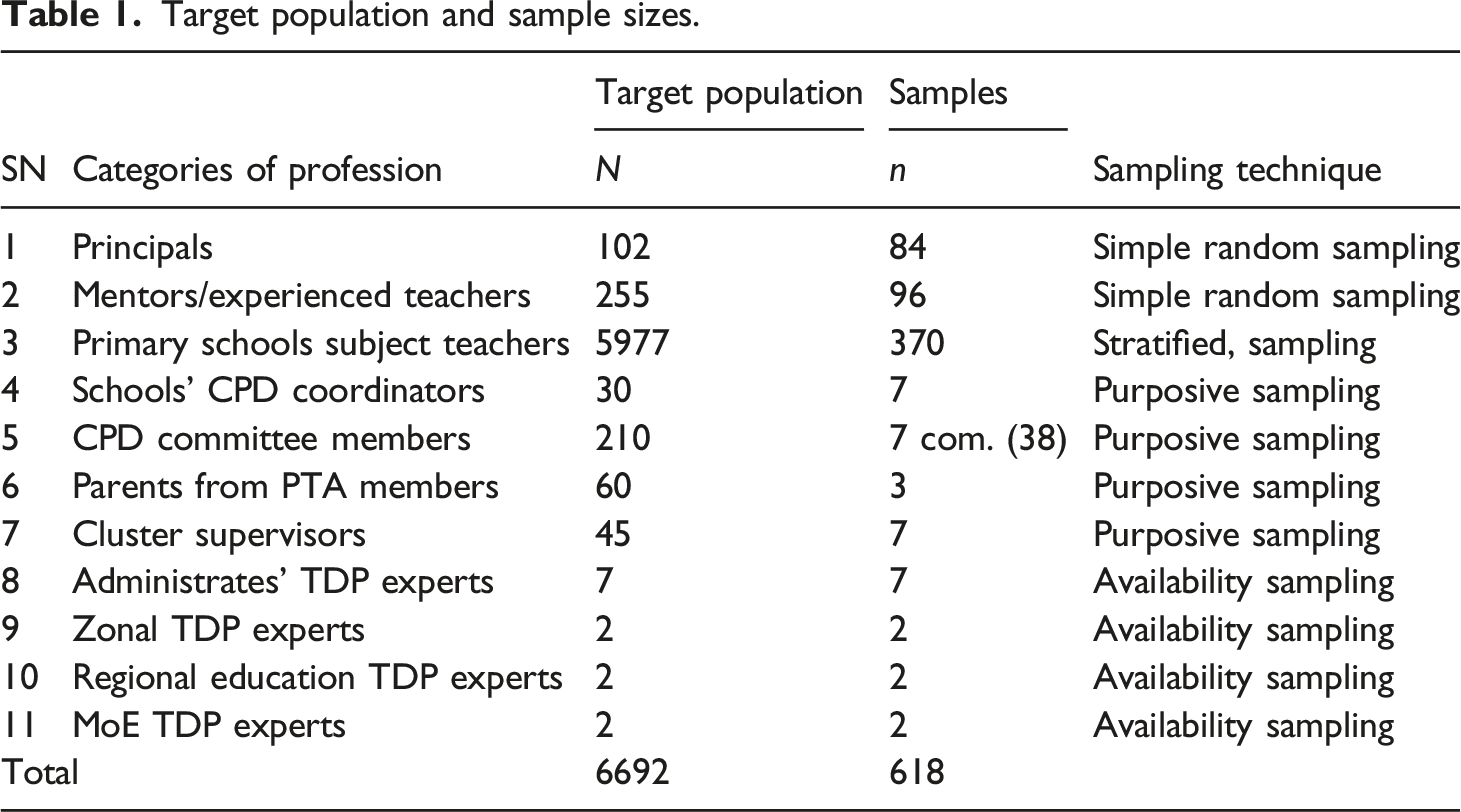
Table 1 showed that a total of 618 respondents were selected from 6692 target population using different non-probability and probability sampling techniques. Thus, 550 participants (84 principals, 96 mentors, and 370 teachers) were responded to questionnaires. 30 participants (7 schools’ CPD coordinators, 7 cluster supervisors, 3 PTA members, 13 teacher development experts (TDP) were interviewed, and 7 CPD committees (38 members) were engaged in focus group discussion.
Data collection methods
The multiple data collecting instruments used in this study were self-constructed questionnaires, unstructured interview, focus group discussion, observations, and document examination. Regarding this, Creswell (2014) suggested that employing multiple data collection tools help the researcher to strengthen inadequacies and ensure triangulation.
Validity and reliability of data collection tools
Expert reviewers checked validity of the instruments through reading and commenting before undertaking a pilot test. Then, the researchers made a pilot test in one-two sample primary schools on at least 88 participants to obtain insights for establishing appropriate design and procedures for the main study. By using a pilot test result, it was important to establish the reliability of the items for a meaningful data collection process (Fraenkel & Wallen, 2008). The Cronbach alpha value = 0.857 > 0.800) and accepted to continue final data collection.
Data triangulation
The researcher made methodological triangulation for the quantitative and qualitative data as it helps to crosscheck and provide confirmation and completeness to balance the data. This increased credibility and validity of the results and obtain confirmation of findings through convergences of different perspectives in the study. In addition, the researchers triangulated the data across different groups of study participants and beneficiaries (sources of data) to examine if different groups of beneficiaries have benefited differently and crosscheck their responses (data) for credibility.
Methods of data analyses
The quantitative data were coded to the level of phrases for understanding, tabulated, presented, and analyzed by using descriptive and inferential statistics, and the qualitative data were narrated thematically. Thus, descriptive statistics and inferential statistics were designed to make assumptions about the characteristics of wider population (Cohen et al., 2018). Accordingly, descriptive statistics such as the mean was used to check the normal distribution of data, and the standard deviation measures the spread of data about the mean value. It is useful in comparing sets of data, which may have the same mean but a different range, and a one-way ANOVA was used to check the mean differences among respondents opinions.
Results
Participation of teachers in continuous professional development policy reforms
Means and standard deviation of teachers’ participation in CPD reform.
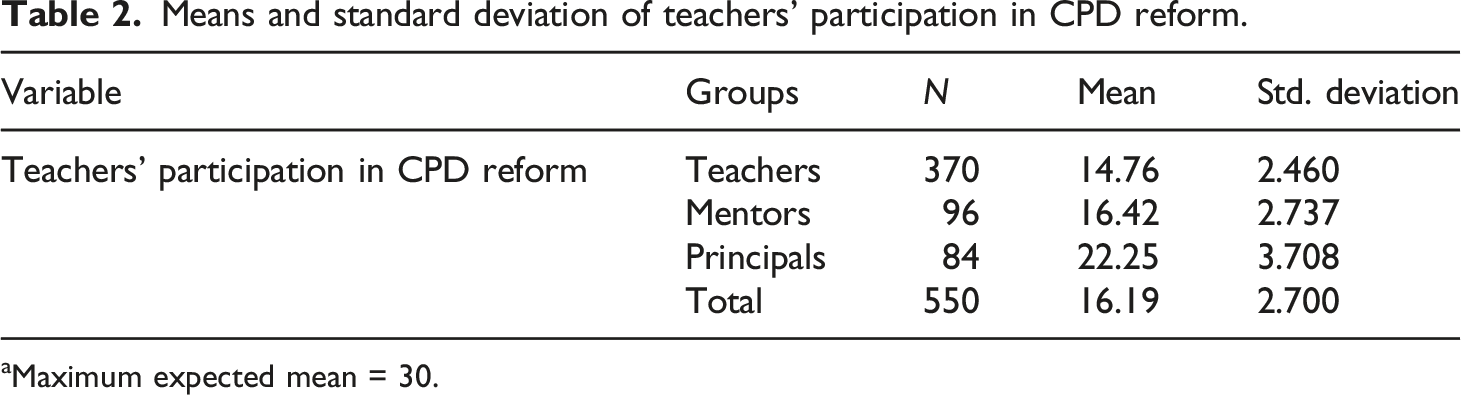
aMaximum expected mean = 30.
One-way ANOVA across the three groups of teachers’ participation in reform.
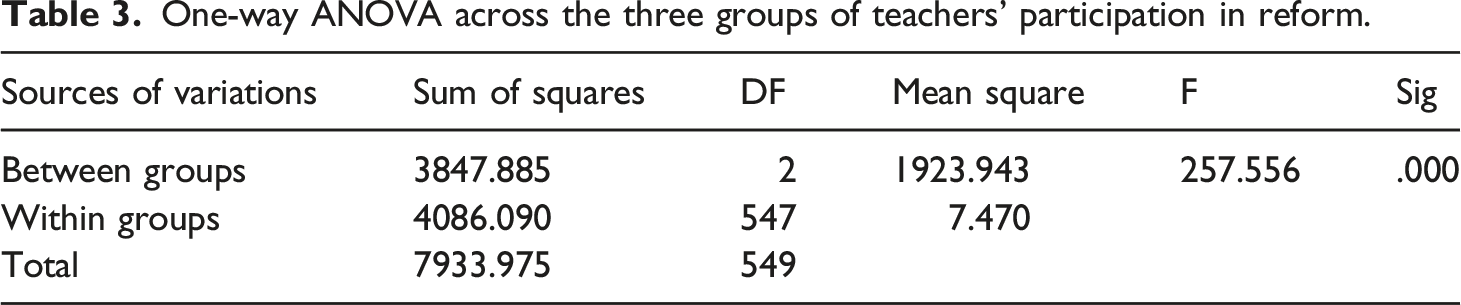
Tukey’s post-hoc test analysis result.
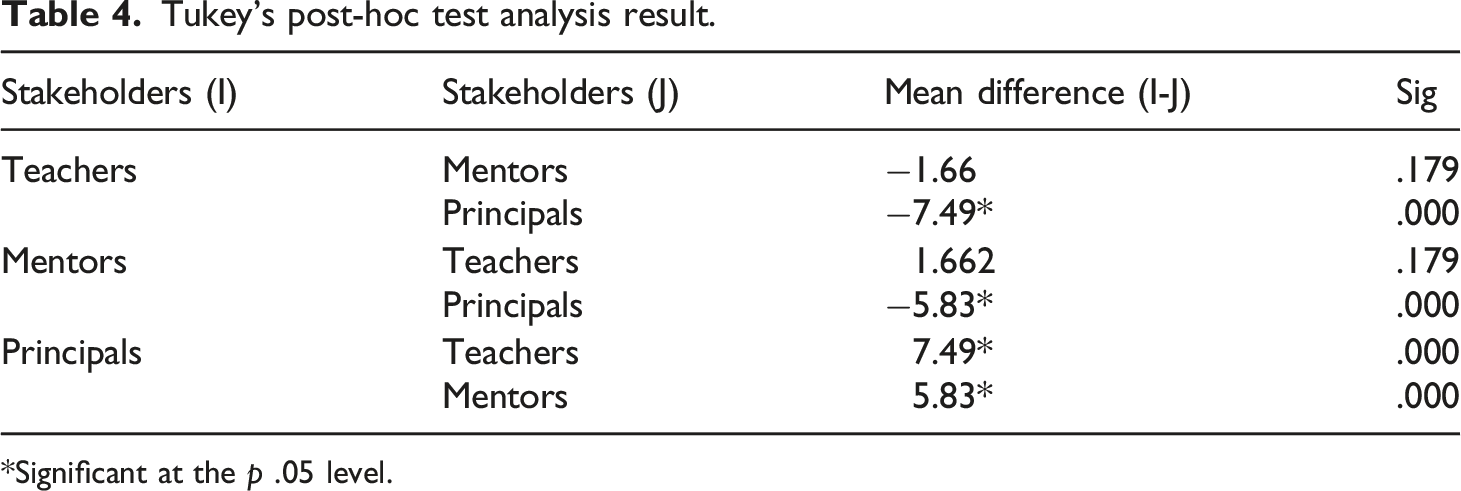
*Significant at the p .05 level.
Table 4 showed that the results of multiple comparisons indicated that the awareness, common understandings and participation of stakeholders on CPD reform rated by teachers was significantly lower than those of mentors, and principals with the mean differences of 5.830 and 7.490, respectively. Relatively, the principals have positive awareness about CPD practices followed by mentors and teachers, but they didn’t work hard on experienced teachers and novice teachers to change CPD policy into practices in their corresponding schools.
Regarding to the interview-guiding question, “do you think that teachers were participating in their continuous professional development policy reform?” one of the interviewee suggested about teachers’ participation in professional development reforms as follows: ‘Although teachers were the change agents and the forerunner implementers of curricula in schools, for unknown reasons most of the time the policy-makers and educational planners neglected teachers’ participation in professional development reforms. No one has given attention to teachers to participate in the discussion of policy issues related to education, teaching profession and teachers’ CPD practices. Simply, the government body (MoE) is waiting for excellent implementation of the curricula without creating conducive learning environment and producing fertile grounds for teachers’ PD practice. Theoretically, the education policy framework, teachers’ CPD practices, professional competencies, and students’ learning outcomes possess symbiotic relationships’ (IP-20:14/2/2022).
To the same question, teachers who were participated in the dialogue about awareness, common understanding, and participation of primary school teachers in CPD policy reforms mirrored out their views as follows: ‘A teacher, ‘M’ in FGP7 team suggested that according to the CPD policy blue print and framework, teachers are trying to undertake CPD practices year to year as a mandatory to stay in the profession. Otherwise, no one identifies and measures the changes observed or new knowledge constructed and skills developed from CPD practices (19/12/2022) Moreover, a teacher, ‘Z’ in FGP7 stated that the system leverage from policy at the national level to school at the local level lack awareness and common understanding about professional standards to measure teachers’ competencies and judge the new competencies teachers develop from time to time and its application to improve classroom works or practices. Thus, there were mismatches between theory at policy level and practice at the school and classroom levels (19/12/2022).
Appropriateness and effectiveness of teachers’ CPD policy and practices
The purposes of CPD policy in practices
Means and standard deviation of the relevance of CPD purposes.
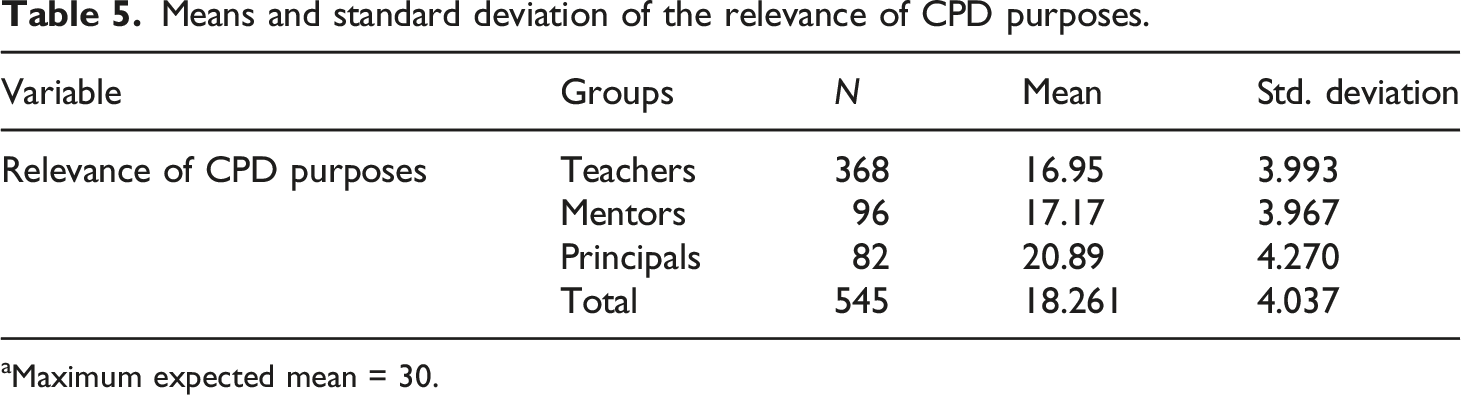
aMaximum expected mean = 30.
One-way ANOVA across the three groups on relevance of CPD purposes.
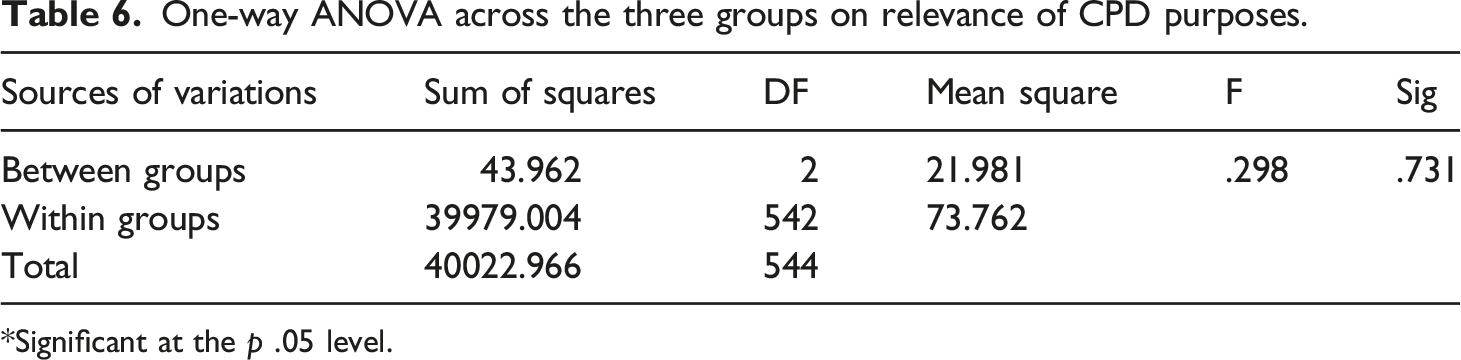
*Significant at the p .05 level.
Table 6 showed that, according to a one-way ANOVA result, there was no a statistically significant difference of means for three categories of respondents [F (2, 542) = .298, p = .731] at the p > .05 level about the relevance of CPD focusing at updating, upgrading, improving classroom practices, and students’ learning outcomes.
Similarly, regarding the interview question, do you think that teachers’ CPD practices occurred in primary schools relevant to the purposes designed in its framework and practical toolkit?, one of the interviewee revealed that the targets of teachers’ CPD are updating and upgrading professional competencies and academic status, respectively. However, ‘While introducing the program in 2009 academic year, practitioners thought as if teachers update their skills and knowledge, and upgrade academic levels from one status to another status. However, though some teachers construct subject matter knowledge, and develop methodological skills. Teachers’ CPD practices did not contribute to upgrading system. This makes insignificant contributions to teachers’ classroom practices and students’ learning outcomes as well (IP-12: 17/12/2022).
The other participant made reflection to the same question that the renewal of teachers’ professionalism through licensing and relicensing versus their engagement in CPD practices as narrated as follows: ‘The government forgot the issues of licensing and relicensing teachers in the Ethiopian context let alone districts. Nevertheless, if I am not mistaken, MoE at agency level prepare examination centrally on the subject matter knowledge and pedagogical skills were quite different from the proposed CPD activities. The interviewee reported that he has full information that the majority of teachers who sat for the competency testing examination were not able to get the pass mark. On top of this, the pass mark is also as high as 62.5%. Teachers who were teaching grade 1–4 have no opportunities to get access to the contents of the subject matter though the competency examination focuses on grades 7 & 8 subject matter knowledge. In his school still now, only two teachers were successful from 16 teachers who sat for the examination. Even, there was no recognition for those succeeded’ (IP-6: 05//3/2022).
Moreover, the other participant argued to the same question that the functions of CPD practices comparing its professional advantages and disadvantages. The interviewee suggested that ‘The disadvantage of CPD surpasses its advantage in our context. Because teachers assume CPD as something that is fatigue to them rather than updating their proficiency and upgrading their academic status, and improve student learning. Similarly, the value given to CPD in teachers’ job performance evaluation or work efficiency was very insignificant and less than 5% in all primary schools under investigation’ (IP-7:12/12/2022).
The contents of CPD policy in practices
Means and standard deviation of the relevance of CPD contents.
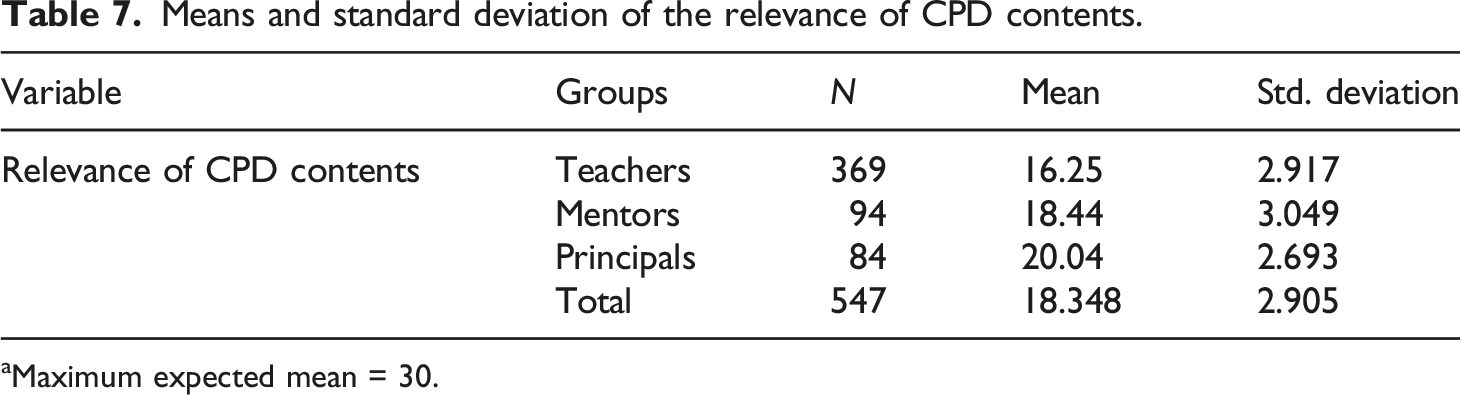
aMaximum expected mean = 30.
One-way ANOVA across the three groups on relevance of CPD contents.
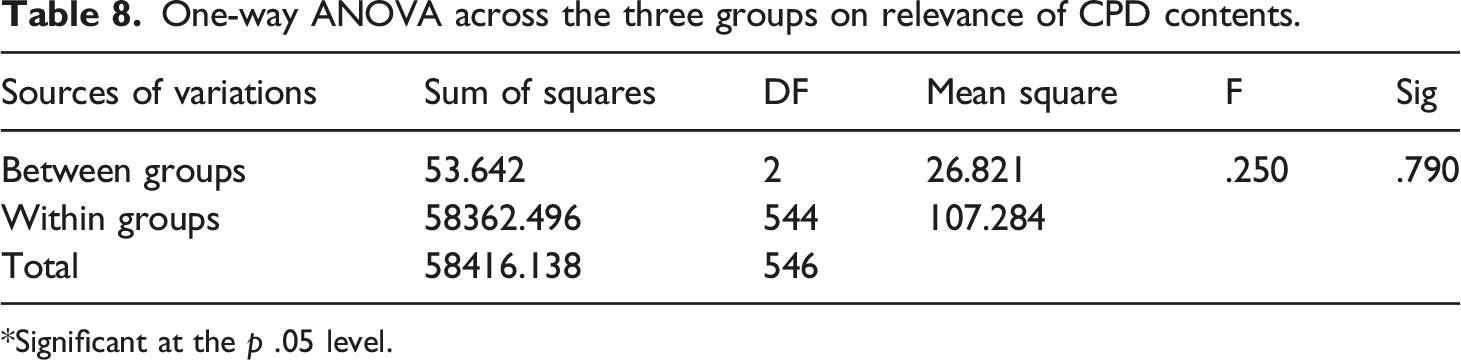
*Significant at the p .05 level.
Table 8 showed that there was no statistically significant difference at the p > .05 level in mean scores for the three groups of respondents [F (2, 544) = .250, p = .790]. Thus, the average means of respondents are below the expected mean indicating that the contents are repetitive and generic rather than relevant to specific lessons of teachers.
In addition, the interviewee discussed the contents and activities included in CPD practices pertaining to the question, “do primary school teachers use effective professional development features and reflective activities to improve their classroom practices?” Hence, the interviewee summarized that ‘Teachers usually derive their CPD plan from the school’s annual CPD plan prioritized needs. Practically, it will make teachers not authentically decide on their CPD contents and activities. This trend challenged teachers not to improve their subject matter knowledge and pedagogical skills through doing action researches, differentiated learning, critical friend classroom observation, lesson studies, autobiographical reflections, individualistic learning and collaborative learning. This shows that there was no coherence between teachers’ prior knowledge and CPD practices at hand. These practices forced teachers to implement routine managerial activities, i.e. minimizing students’ absenteeism, dropout and late comers rather than actively learning to construct knowledge and acquire skills about their disciplines’ (IP-3: 23/12/2022).
The second participant summarized long-lived experiences about the types and implementation of CPD contents in primary schools as reflected below: ‘Although teachers were trying to use active learning methods, formative continuous assessment, effective classroom management and action researches, some teachers did not include pedagogical activities in their CPD contents. Because, teachers consider pedagogical practices as their day-to-day-professional activities though their utilization in the classroom was not enough to predict improvements in their classroom practices and students learning outcomes. For example, some teachers have misconceptions on the identification and utilization of varieties of active learning methods and formative continuous assessment techniques. Most of the time, teachers often think group discussion as the only active learning method and use it repeatedly, and giving many tests and group assignments as the only continuous assessment techniques due to low professional competencies’ (IP-20: 19/12/2022).
The third participant said that action researches as contents of CPD practices in primary schools as follows: ‘A single mentor was mentoring many senior teachers were doing action researches to improve their professional practices in classrooms and to fulfill the criteria of academic promotion. However, teachers usually do individual action researches and try to implement it to improve classroom problems. Sometimes, the topics of action researches teachers usually do were unrelated to the curriculum or subject matter contents they were teaching since the practice of collaborative learning of teachers through CPD at the departmental level was weak’ (IP-5: 23/5/2022).
However, the other participant argued claimed about the paradigm shifts made on the categories and implementation of contents of CPD practices in a particular school by showing that ‘The contents of CPD practices shifted from routine activities to the content of the subject matter teachers were teaching in his/her school. Teachers discussed this issue in CPD meetings due to many teachers failure in competency testing examination. Teachers identified that the failures of competency testing examination rooted from the misalignment between teachers work and examination contents. The examination contents usually cover the subject matter knowledge and pedagogical knowledge of grades 7 and 8. However, teachers who were teaching grades 1-4 were disadvantageous because the examination was different from the major or minor fields of their study’ (IP7: 12/3/2022).
The other categories of participants in FGP5 carefully discussed the appropriateness of contents of CPD practices in the opposite direction as follows: ‘Teacher, ‘R’ reported that the disconnections between the CPD plans and actions observed in schools were due to lack of professional standards of selection of professional contents, and lack of standards of monitoring and evaluation system of professional contents (25/12/2022). Teacher, ’T’ justified that the lack of trusts and emphases of teachers to implement CPD activities affected the achievement of destinations like improving professional competencies required for classroom practice and students’ learning outcomes (25/12/2022). A deputy principal, ‘S’ stated that there was a discrepancy between the proposed CPD contents and the contents teachers were planning to do their CPD activities. These limitations further widen the gaps between the policy expectation and practical toolkits, and actual practices at the school or personal teachers’ level (25/12/2022). Furthermore, the researcher witnessed from the examination of 15 portfolio documents of teachers working in the sample primary schools using document extraction checklist, open-ended questions, and observation (Ob3) throughout data collection times that the contents of their two years CPD practices were almost similar and entirely focused on managerial activities. This showed that the majority of teachers were not competent enough to make decisions on their CPD contents related to specific lessons, and transformative reflective activities; action researches, self-learning, collaborative learning, and autobiographical narratives. The practice of school-based CPD practices have less significant to the renewal of teachers and maintaining standards of excellence in teaching. This assists teachers to bridge the gaps between the curriculum and actual practices (Document review, open-ended questions and observation: 10/12/2019-08/6/2022).
The Methods/Process of CPD Policy in Practices
Means and standard deviation of the relevance of CPD methods of delivery.
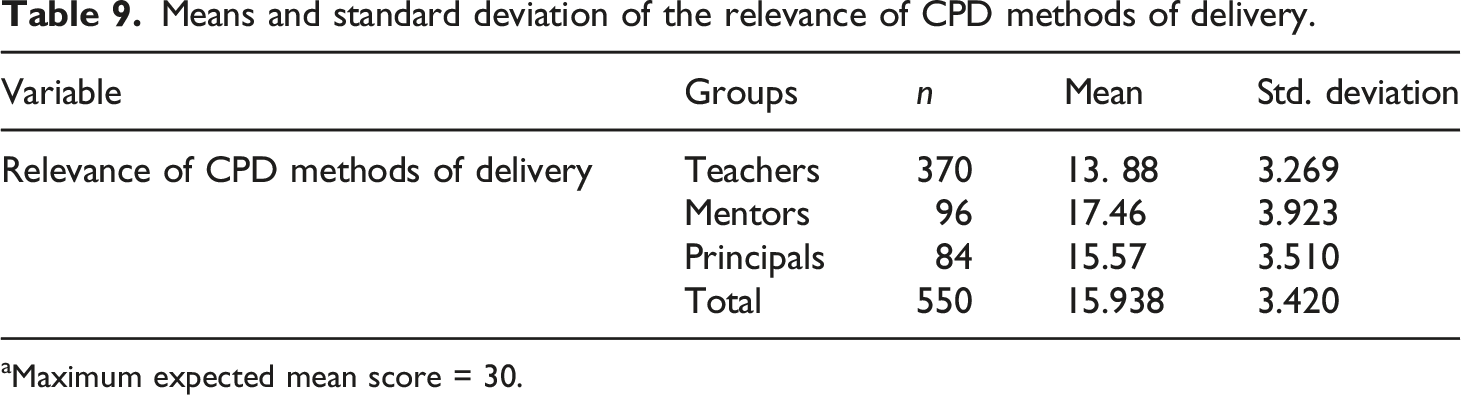
aMaximum expected mean score = 30.
One-way ANOVA across the three groups on relevance of CPD delivery.
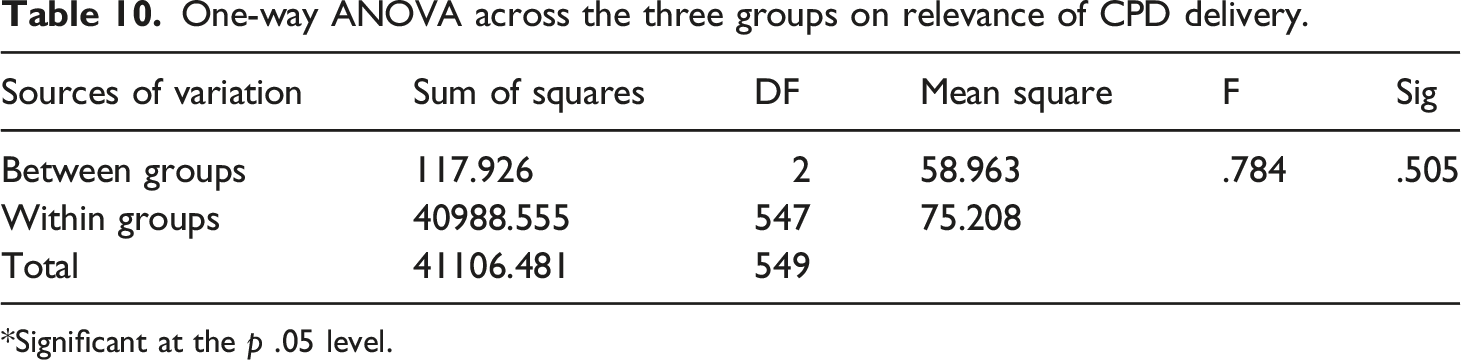
*Significant at the p .05 level.
Table 10 showed that there was no statistically significant difference at the p > .05 level in means for the three groups of respondents [F (2, 547) = .784, p = .505]. The respondents unfavorably perceived that professional development delivery was fragmented, not practice-embedded, and not continuously experiencing in their respective primary schools.
The interview participants illuminated the implementation of CPD activities from the points of their professional experiences while responding to the question “to what extent is CPD implementation in primary schools continuous and job-embedded?” Accordingly, one of the participants stated the witnessed professional experiences in Oromia Regional State as follows: ‘The provision of school-based CPD was somewhat a generic one-fits-all and one shot-off type. The school starts to implement the program and then stop somewhere due to lack of organized and continued monitoring and follow up strategies, lack of accountability, motivation and reinforcements. The interviewee understood that the practices of teachers’ CPD lacked motivation and rewards. It lacked common understanding about its practices among professional expertise in the profession, lack of awareness creation training and lack of indicators of performance and professional standards sets for teachers. These misconceptions affected ongoing practices of CPD of teachers’ (IP-4: 17/12/2022).
The other participant witnessed that collaborative professional learning practices in the schools from inbuilt classroom supervisions of teachers and CPD practices in primary schools that ‘There was positive culture of using active learning in classroom such as critical friend observation to assess and evaluate their peers’ subject matter content knowledge and pedagogical skills at the department levels. They make peer reflection post each classroom observation session. However, these activities lacked continuity in that only for a maximum of 3–5 times/individual teacher/year. If you like, you can see from the learning portfolios of teachers or departments. Unlike to CPD practical toolkit guidelines, there was no self-assessment practice culture among teachers in our schools. Moreover, the interviewee stated that she neither witnessed both motivation and rewards for best performing teachers in CPD nor punishments for those who were not participating in it’ (IP-10: 15/1/2022).
The contexts of CPD policy in practices
Means and standard deviation of the relevance of CPD contexts.
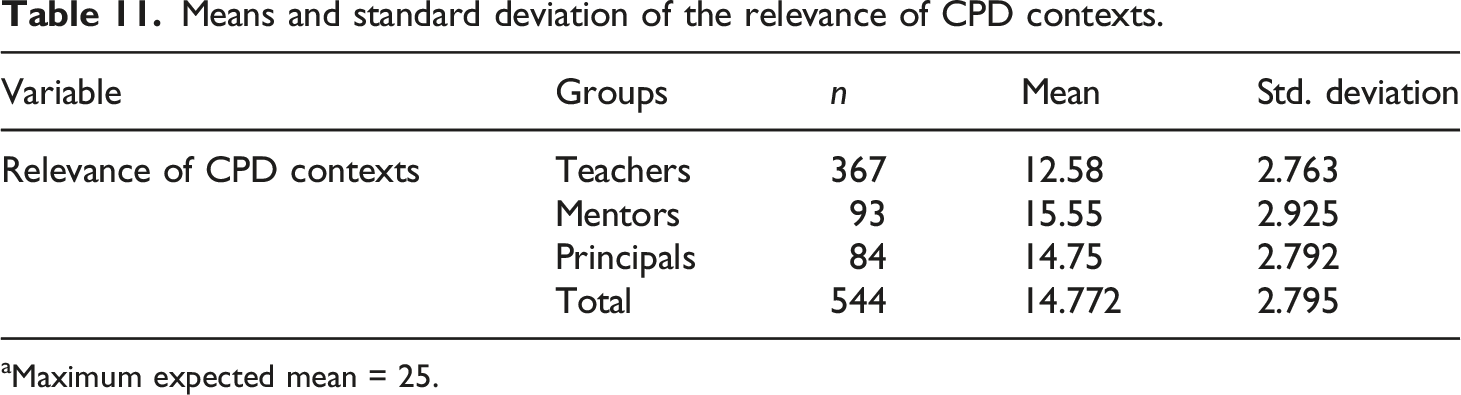
aMaximum expected mean = 25.
One-way ANOVA across the three groups on relevance of CPD context.
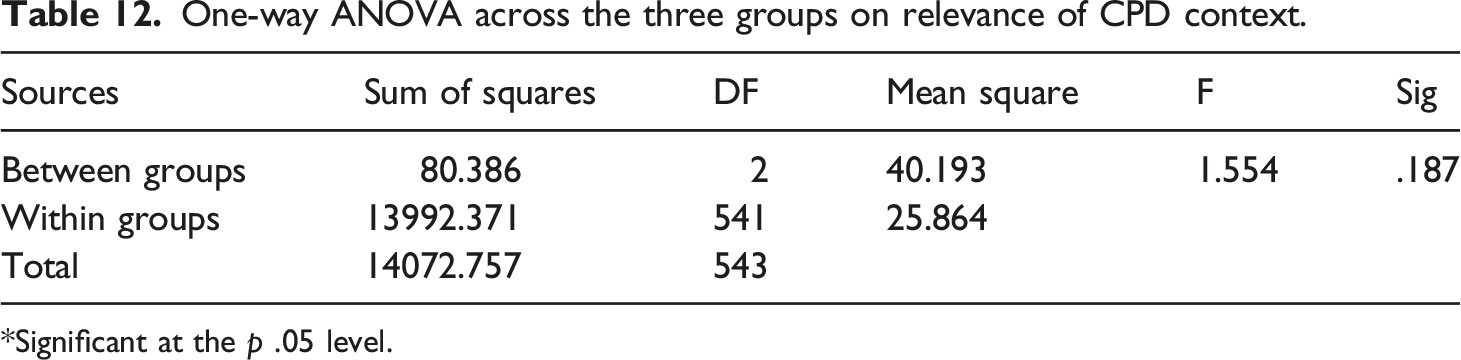
*Significant at the p .05 level.
A one-way ANOVA in Table 12 showed that there was no statistically significant difference at the p > .05 level in mean scores for the three groups of respondents [F (2, 541) = 1.554, p = .187]. Therefore, the respondents unfavorably perceived that the contexts in which CPD policy assumption was put into practices, that is, it is a generic one-size-fits-all under different contexts of primary schools.
Horizontally, one of the interviewee analyzed the contexts such as the nature of learning groups, place, and duration of sustained time while responding to the question, “how well do primary school teachers effectively solve contextual classroom problems using competencies they gained from CPD activities?” ‘Teachers discussed about their CPD activities formally in schools and informally at their homes. Both collaborative and individualized professional learning practices were promising both inside and outside the schools. The duration suggested in the policy framework was 60 hours per a year. If teachers do really, it takes more than 60 hours per a year. Nevertheless, what is the danger behind this phenomenon is that teachers were copying from each other which is wastage of resources and times’ (IP-14; 16/1/2022).
The other participant confirmed that the challenges associated with communication and supports needed from professional development groups of practice in their CPD activities. ‘The CPD key stakeholders particularly, principals, supervisors and TDP experts must pass through PD practices such as need diagnosis, planning, doing and evaluating the impacts. However, only teachers were doing CPD although it is something that makes them better professionals. Because of CPD key stakeholders’ lack of professional practices, the supports they give to teachers in light of CPD practices were minimal and not optimized. While they were asking them the questions related to PD activities, their responses were most probably, I do not know. Thus, the supports provided by experienced teachers to beginner teachers were not inspiring and lacked structural flow of feedback’ (IP-16; 18/7/2022).
Furthermore, one of FGP6 team reflected that the alignments between CPD and SIP created conducive learning contexts for teachers to implement their CPD. However, ‘Teacher ‘P’ commented that the government has brought this package from outside without studying about it. The national government expected similar results without identifying contexts and the same outputs from all teachers, different work conditions of teachers, leaderships, and accountability levels of teachers (16/1/2022). The other participant, teacher, ‘D’ stated that in few schools they were observing the integration of CPD and SIP to improve the quality of schools and teachers by using appropriate school resources. However, this program needs and separate budget allocation in their schools (16/1/2022). Another teacher, ’V’ remarked that his school was not able to provide even easy supports such as papers, pens, and refreshments to sit together to discuss actively about their subject matter during their extra time at school (16/1/2022).
Implementations of transformative reflective activities
Means and standard deviation of teachers’ engagements in CPD reflective activities.
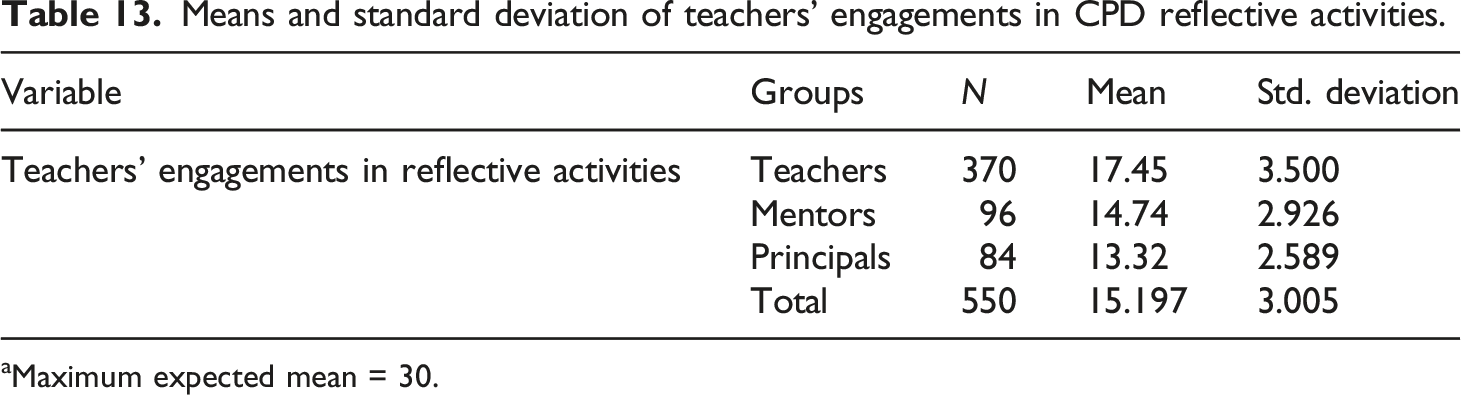
aMaximum expected mean = 30.
One-way ANOVA among the groups on the reflective practices.
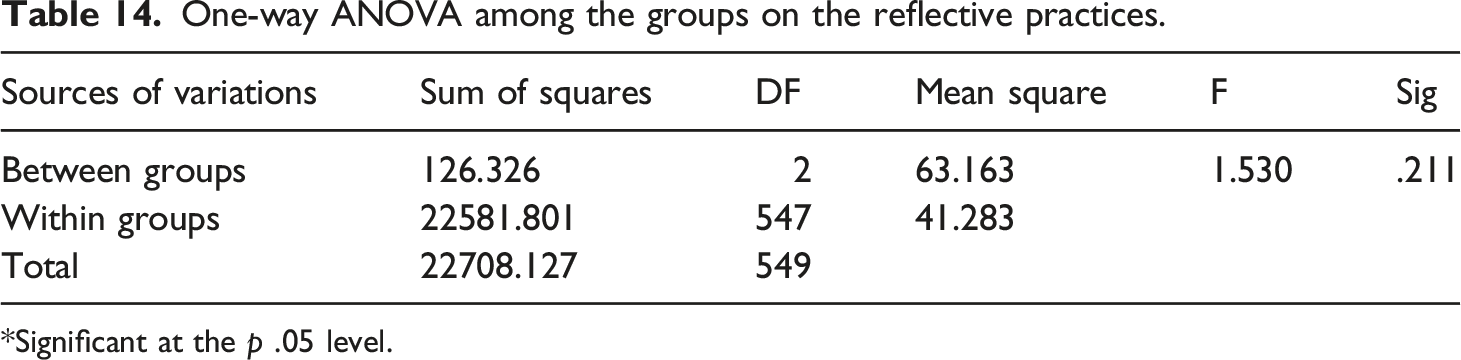
*Significant at the p .05 level.
Table 14 showed that there was no statistically significant difference of mean scores among the three groups of respondents [F (2, 547) = 1.530, p = .211] at the p > .05 level. Furthermore, there are relationships between transformative reflective activities, participation of teachers in different reflective practices and teachers’ competency development.
While responding to interview-guiding questions “how well do primary school teachers use transformative reflective activities to improve their professional competencies and skills in their CPD practices?” one of the participants summarized that ‘Teachers usually write their curriculum vitae and autobiography at the beginning of CPD activities and compiled to their assessment portfolios but they did not make self-reflection, and peer reflection. Teachers did not make efforts to realize reflection for-action while planning, reflection-in-action, and reflection-on-action while doing and evaluating CPD respectively. Thus, implementations of action researches, self-learning from information and communication technologies, lesson studies, differentiated learning and autobiographical narration have shown little contribution to knowledge construction and the development of tangible skills’ (IP-15:12/11/2022).
The FGP1 discussed about the importance of teachers’ CPD practices to improve teachers’ professional practice in the classroom one after the other as follows: ‘…. A deputy principal, ‘G’ stated that most primary school teachers have no competencies to learn themselves for at least 60 hours/year without supports, The interviewee meant that self-learning is difficult especially for novice teachers. Further extends her views that mentors did not get motivation, and professional values to induce novice teachers with responsibilities (19/10/2022). The other teacher ‘T’ extended his views that their mentors and coaches were complaining and not willing to take the responsibilities of assisting teachers at different professional hierarchies. This encounters contributed to the deterioration of the program (19/10/2022). ‘The other teacher, ‘X’ suggested that the system itself has problems related to provisions of professional and technical assistances. I think that it lacked special structure, rationales and attention on how to update teachers to be competent (19/10/2022).
Discussion
The findings of the study showed that the provided awareness raising training to improve stakeholders’ opinions and common understandings, and participation of key practitioners such as teachers, principals, and supervisors in CPD reforms are not cable to improve classroom practices. For instance, the awareness of key stakeholders and practitioners’ of CPD policy framework didn’t enable them change the policy at theory level into its actual practices to ensure quality of instructional practices in classrooms. This finding contradicts with the perspectives and empirical findings of known researchers such as Guskey (2002) who suggested that teachers are key to the success of reform initiatives as they are ultimately the ones in charge of enacting the reform initiatives within the classrooms. In addition, Fullan & Hargreaves (2013) confirmed that teachers’ professional development cause successful educational change or something new. Thus, when it is linked to a specific innovation, teachers’ professional development practices and its strategies go hand in hand. Therefore, these experiential learning practices and changes were missing from Ethiopian CPD policy framework and its actual practices in schools.
The findings study further indicated that although the purposes of CPD policy and practices were suitable, they were not achieved by teachers because of lack of awareness, motivation, and professional competencies among professional learning groups. Therefore, teachers could not update their professional competencies, and upgraded their academic status. In addition, the primary schools were unable to renew teachers’ professional competencies (knowledge, skills, and attitudes), improve classroom practices, and students’ learning outcomes. This finding contradicts with the policy expectation that stated that CPD makes me “a better teacher, principal, or supervisor” (MoE, 2009).
The findings of the study demonstrated that the policy framework and its practical toolkit document lacked clear contents and activities to improve teachers professional and pedagogical competencies required to implement the curriculums. This finding opposes with the empirical findings and outlooks of scholars who stated that effective CPD program practices tend to focus on specific contents such as a new curriculum or content (Darling-Hammond et al., 2017; Egert et al., 2018). The findings associated with content-focus professional development is concise with the finding of Dereje (2015) that identified that CPD practices in the study areas do not have basic professional development features because of the generic repetitive plans and contents. In addition, the finding of this study showed that the coherence of prior knowledge and CPD contents of teachers contradicts with the evidence of Desimone (2009) which connects specific contents, standards, and policies. This indicates the extent to which teacher’s learning is consistent with teachers’ prior knowledge, skills, and beliefs. This practice was missed from primary school teachers’ CPD policy framework and practices in primary school under investigation and affected the quality of teachers’ professional and pedagogical competencies.
The findings of the study revealed that the methods and process of CPD practices were highly fragmented and lacked best practices and continuity. The tasks were not embedded in their job and not ongoing process in terms of coherence of prior knowledge of teachers to create new and knowledge, and unable to develop appropriate and innovative pedagogical skills through active learning process. In addition, collegiality professional learning and reflections (need diagnosis, planning, doing, and evaluating) were not well incorporated and exercised in teacher’s CPD practices. The other challenges were the lack of provision of appropriate monitoring, follow-ups, motivation, and reinforcements for actively participating teachers. These findings contradicted with the empirical findings of Guskey (2002) who stated that to be successful, professional development practices must be seen as a process, not an event, and it needs to provide teachers with specific, concrete, and practical ideas that directly relate to day-to-day operations of their classrooms. In addition, the findings of this study did not satisfy the implementation of teachers’ effective CPD features which enable participation from teachers in similar local contexts such as teachers from the same grade level, disciplinary concentration, school, or departments participate actively in the same learning opportunities collectively (Desimone, 2009; Hochberg & Desimone, 2010) although collegiality is described in CPD of teachers as the cure of all “diseases” in schools (Kelcthermans, 2004).
The findings of the study showed that the alignments between CPD policy framework and practices were weak when evaluated from the points of the purposes achieved, contents addressed, process and contexts in which it takes place. The effectiveness of CPD practices are determined by the relevance of providers and learners, the contents, and the organization and facilitation of the learning experiences. The existing empirical finding revealed that teachers’ CPD cannot be something that is developed out of contexts hoping that it would work in all possible sets of contexts (Courtney, 2007). Thus, the generic one-size-fits-all slogans are not possible when it comes to teachers’ CPD practices in specific schools.
The findings of the study demonstrated that most teachers were not proficiently participating in proposed reflective activities such as action research, collaborative and individual learning, differentiated learning, lesson studies, material development, professional training, experiential learning, and critical friend classroom observation to enhance their competencies in the disciplines they were teaching. Therefore, teachers did not possess professional competencies to learn from CPD practices through collaborative and individualized learning without mentoring and coaching supports. Therefore, CPD practices include networking, collaboration, and active learning opportunities such as ongoing observation, reflection, feedback, and analyzing the contexts of professional learning (Darling-Hammond et al., 2017; Desimone, 2009).
The findings of the study indicated that the suitability of teachers’ CPD program determined and guided by the qualities of its purpose, contents and activities, process, methods, and the context in which it occurs. Therefore, it is essential to assess the qualities of teachers’ professional learning in terms of the purpose (why), contents and activities of experience (what), methods of delivery (how), and the context in which it occurs (where, when, who, and whom) (Guskey, 2020). Therefore, the effectiveness of teachers’ CPD program depends on the purpose, contents and activities, process, methods, and contexts such as learning environment policy (Kennedy, 2016; Blandford, 2001; Pedro, 2016).
Conclusions
The researcher examined the existing quality of primary school teacher professional development policy and practices based on adapted framework revolves around policy purpose/target, contents and activities, process and methods, and the contexts under which it is operating. The study concluded that educational reforms and teachers professional development program practices shared symbiotic relationships and ensured flexibility to accommodate the needs of all professional development practitioners and stakeholders. Without uplifting awareness, common understandings, and professional competencies of target professional learning groups, the practicability of teachers’ professional development reform will be questioned and the intended aims of the program cannot be achieved. The participation of primary school teachers in professional development reforms created authenticity and confidence in the first line implementers took accountability and shared responsibilities among practitioners. The study participants (teachers, mentors, school’s CPD coordinators, CPD committees, principals, CRC supervisors, parents, and TDP experts found at different educational levels) shared strong opinions about the quality of primary school teacher professional development policy and practices in terms of targets, contents, process, and contexts to the schools’ level. However, the study showed that the relevance and effectiveness of school-based teacher CPD practices were insufficiently addressed when evaluated from the points of the purposes achieved, contents addressed, methods, and contexts in which it occurred. Although transformative reflective activities have the potential effects to transform CPD policy into its actual practices, the CPD activities were not fully implemented by the majorities of novice and experienced teachers via conceptualizing and contextualizing reflective activities. This indicates that only some senior teachers have got access to develop professional competencies, and participate in action researches, materials and portfolios development, classroom observation, lesson studies, differentiated instruction, collaborative, and self-learning. These problems were stemmed from lack of awareness, common understanding, material and trained human resources, and infusion of political expectations in the teaching profession. The implementation of reflective activities contributed limited improvements of professional competencies to the targeted knowledge, skills, and dispositions of teachers. Similarly, shortcomings such as lack of common understandings about the policy reform documents created rooms for uncertainties among stakeholders including teachers. Therefore, the alignments of teachers’ professional development practices and career growth paths lacked focus by practitioners of the program
Recommendations
The researcher advice the CPD program stakeholders and practitioners such as supervisors, TDP experts and coordinators at MoE level working on teachers’ recruitment, career structure, and inbuilt supervision to implement the following suggestions to bridge the theoretical, conceptual, practical, and knowledge gaps pertaining to teachers’ professional development at policy and school levels. These are as follows:
Educational reforms and teachers’ professional development practices share symbiotic relationships to ensure their flexibility to accommodate the needs of all professional development practitioners. Nevertheless, without conceptualizing or having awareness, common understanding, and professional competencies of the target professional learning groups, the practicability of teachers’ CPD reform is under question mark to achieve intended aims of the program. Therefore, teachers’ CPD coordinators at MoE and Regional levels should disseminate the requirements of new CPD policy reform by creating linkages to the existing practices.
Teachers’ CPD policy framework and its practical toolkit should possess at least the requirements for why, how, when, and in what contexts teachers’ are participating in CPD practices to learn to develop new professional and pedagogical competencies, improve classroom performance, and student learning outcomes. Therefore, MoE and Regional education bureau should work on renewing, restructuring and redesigning teachers’ CPD policy framework and its practical toolkit based on critical features of teachers’ CPD, contextual factors related to school policy environment, leaderships, and teacher professional identity metaphors. The framework should be inclusive, non-generic, and dynamic based on the science and principles of CPD program to improve vertical and horizontal lines of communication among CPD key stakeholders. This should support practitioners to align prioritized needs of personal teachers, the schools, regional, and MoE at the national level. The Ministry of Education should adjust the situations for preparation of handbooks containing guidelines, principles and professional standards for effective mentoring and coaching practices to strengthen the cohorts of competent coaches and mentors at the national and regional levels who initially prepare those at zonal education bureau, district education office, college of teacher education, and the school level. The Ministry of Education should design the schedule or plan for quarterly coach mentor workshops and seminars of experience sharing practices to make frequent evaluation, and review the approaches of CPD practices and standards of quality of primary school teachers.
The development of global ideas to take local policy actions to improve teachers’ professional development requires strong commitment and motivation of educational leaders. Regional education bureau should devise strategies and monitor the implementation of all rounded development of soft skills needed ahead of professional development practices of teachers. Thus, regional education bureau should plan and coordinate short-term training, workshops, seminars, and self-learning at all educational levels to improve professional competencies of teachers. These capacity-building practices improve communication, leadership, time management, problem-solving, personal, and collaborative career management skills. These professional skills contributed to the effectiveness of teachers’ CPD practices. For the benefits of the young generation they are teaching the classroom, teachers should be professionally accountable, responsible, conceptualize, contextualize, and committed to implement their continuous professional development program by assuming that the program helps them to update their professional and pedagogical competencies required in classroom and helps them upgrade their academic status from one to the next career level.
Limitations and further research
The current study has potential effects to promote professionalism of teachers’ through effective implementation of professional development and improve professional competencies required in classrooms. However, teachers were not properly doing their professional development tasks in some schools. Therefore, further research will be suggested to identify diverse factors related to improving teachers’ professionalism (confirmed knowledge, skills, and attitudes) and teaching profession.
Footnotes
Declaration of Conflicting Interests
The author(s) declared no potential conflicts of interest with respect to the research, authorship, and/or publication of this article.
Funding
The author(s) received no financial support for the research, authorship, and/or publication of this article.
