



Abstract
Lifelong education has proven to be a significant challenge in the policy arena. The combination of formal education and labor-centered institutions has pressed the development of different mechanisms to understand the role of human capital accumulation in socioeconomic mobility and organizational performance. While the narratives of lifelong education have primed labor and educational studies across developed economies, in the case of developing economies, those logics appear contested by development economics conditions. In this paper, I use the context of the expansion of the graduate educational market and its policy reforms to analyze how a developing economy copes with a change in the availability of a highly educated workforce. Using panel and pseudo-panel data, I examine the evolution of educational returns for the graduate workforce in Chile between 1990 and 2018, considering the differences between industries and public and private sectors. The results point out that there are no public-private differences and high heterogeneity across economic sectors. The policy- and individual-level consequences are discussed.
Introduction
The current debates on education are tainted with the historical experience of developed economies. That influence appears in concepts, ideas, strategies, and even policy prescriptions regarding increasing human capital endowments in national economies. Examples of those elements appear in the ideas behind the formulation of human capital theory (Becker, 1962), the problems of socioeconomic stratification conditional to educational access (Bills, 2016), development strategies based on the knowledge economy (Organisation for Economic Co-operation and Development, 1996), and more recently in the sustainable development goals (SDG) (United Nations, 2022).
The literature regarding those elements will bring a critical causal connection: education and training will lead to enhancing workforce productivity, increasing the overall efficiency of the national economy, and consequently, improving the social welfare and national economies’ overall performance (Charlot & Malherbet, 2013; Lynton et al., 1983; van der Meer, 2009). The evidence available using the human capital framework—although highly economicist, fragmentized, and highly instrumental (Robeyns, 2006)—has connected educational access and policies to long-range goals such as the SDGs. For example, the SDG 4 of quality education is supported by the differential impact of education’s quality on economic performance (Benos & Karagiannis, 2016), and the SDG 10 of reducing inequalities appears to be somewhat conditioned by the problem of educational inclusion and educational access (Erosa et al., 2010; Vandekinderen et al., 2018). At the same time, SDG 5 of gender equality has a long stream of research connecting human capital accumulation with the problems of gender bias in the labor market, including educational practices in primary and secondary education (Canals et al., 2023; Lavy & Sand, 2018).
Although the disciplinary focus in the analysis provides diverse angles for those relationships, the causal connection between educational market development and the evolution of the labor market has risen as critical for the policy arena. In this sense, concerns regarding labor markets and the workforce’s adaptation processes have proliferated in the specialized research through the ideas of lifelong learning (Centeno, 2011), educational mismatch (Leuven & Oosterbeek, 2011), the problem of educational credentialism (Collins, 1979; Dore, 1976), and more recently, large initiatives for workforce reskilling (World Economic Forum & The Boston Consulting Group, 2018).
Nevertheless, these theories, approaches, and evidence from developed countries could not be informative for policy prescriptions regarding educational policy development for developing economies. For example, the expansion of educational systems across developed countries occurred in a very early time frame compared to developing economies (Marginson, 2016), situating the discussions regarding educational mismatch and credentialism in the labor market on highly different historical and economic grounds (Didier, 2021b). Countries such as the United Kingdom, Germany, and the United States began to deal with mismatches between supply and demand for a highly educated workforce and the subsequent employability crisis (Kivinen & Ahola, 1999; Mcquaid & Lindsay, 2005; Towl & Senior, 2010) from the eighties when countries in Latin America and Asia were expanding their preschool and compulsory education levels (Ancheta Arrabal, 2019; Di Gropello, 2006). This differential timing on educational timing is also related to the possibilities of labor market adaptation to the changes in the production process organization due to technological change (Autor et al., 2008). In this regard, Didier (2024) explores how the differential timing of higher education massification has significant and contradictory effects when educational mismatch economic models are applied to developing countries. The findings show that workers could receive positive returns to overeducation during the process of labor market adaptation, in contrast to the stylized facts dragged from the analysis of developed countries’ experience analysis.
This paper considers that the differential timing also correlates with the institutional evolution of the lifelong education system, where the availability/scarcity of advanced education credentials can play a relevant role in defining the expected returns to education and career development strategies. The time frame for market analysis, the institutional development, and the policy environment will provide a specific set of conditions for workers to engage in educational attainment decision-making (Didier, 2018). I use the case of Chile, a Latin American high-income developing country that has implemented educational-oriented policies to increase the availability of educated workers, consistent with the efforts and institutional mechanisms of other countries in the region. Rather than focusing on the expansion in the graduate enrollment, I focus the analysis on how the labor market reacts and adapts to that enhanced provision, looking for differential patterns of human capital valuation across the labor market. I use a panel and pseudo-panel data sets to model the educational returns from 1990 to 2018, considering the time before educational expansion and the late process of academic market maturity.
The rest of the paper is organized as follows: First, I present the analytical framework considering the definitions of lifelong education and its institutional dimensions, then describe the Chilean case. Then, I introduce the methodological approach, methods, sample, and statistical modeling. Later, I present the results of the statistical analysis, and finally, I discuss the consequences for policy development and individual educational decision-making.
Lifelong education and educational attainment decision-making
This section attempts to frame the perspective of lifelong education and learning policies within the discussion of economics, considering the approach from education economics. This strategy considers that, although educational policy research has pointed to economic theories in this regard to be reductionist, policymakers and policy specialists have shown a great acceptance of the rationale behind those theories to justify government intervention and place public funding to educational systems. In this sense, the analytical tools and literature on the economics of education translate educational debates on access and continuum development of skills through life into a policy perspective.
Lifelong education and lifelong learning perspectives
The literature regarding the coevolution between labor and educational markets is filled with contingent frameworks, theories, and ideas aiming to make sense of the past, current, and future challenges for educational and labor policies (e.g., economic models of labor economics relating to education and job market outcomes as job matching (Blasco & Pertold-Gebicka, 2013), signaling (Spence, 1973; Stiglitz, 1975), and job sorting (Lanning, 2014)). During the past decades, economies across the world have faced several challenges to sustain their competitiveness and productivity levels while they were facing global phenomena such as the waves of technological change, selective industrialization and de-industrialization, and the evolution of economic cycles (Didier, 2021a; Goos et al., 2014; Jaimovich & Siu, 2020).
One standard policy tool to make sense of those challenges was the concept of lifelong learning and the institutional response to lifelong education. A simple approach to those matters will show that there was a spreading assumption among policymakers and scholars that the uncertainty faced by workers required a proactive approach to keep their skills and knowledge updated in a manner that allowed labor mobility and further employability (Berdrow & Evers, 2014). While lifelong learning was responsible for keeping workers’ skill sets updated (Stenfors‐Hayes et al., 2008), lifelong education represented the institutional adaptation to a continuing demand of workers to access training and education (Holmwood, 2014). That institutional differentiation has led to a debate on the conditions to access the different alternatives for formal and informal learning and the institutional mechanism to certify skill acquisition (Cruikshank, 2008; Shan, 2009; Wain, 1991).
From a policy perspective, distinguishing between learning and education allows for disentangling the discussions between the educational practice and individual skills for learning from the policy environment supporting skill acquisition and certification. In this sense, occupational certificates and licenses could be separated from access to tertiary education, and both could be differentiated according to the behavior of the graduate education educational and labor markets. While there is some consensus in the background that encompasses those elements for policy design (Didier, 2018), the consequences for the economic system and the labor market configuration will be moderated by the specific combination of institutions ruling the skill updating and skill upgrading.
Economic perspective on educational system configuration
Economic theory has framed the problem of skill acquisition and its outcomes mostly from two complementary approaches: the human capital theory and the signaling theory. The first aims to explain how companies reward workers’ potential productivity, connecting skills, education, and tenure with job performance (Becker, 1962; Mincer, 1958). The second considers the problem of coordination between labor supply and demand, attributing to education an informative role in allowing employers to make projections of the future productivity of potential workers and allowing likely workers to signal their skill sets and abilities to prospective employers (Spence, 1973; Stiglitz, 1975). Both theories have shaped policymakers’ understanding of the relevance of investment in education, whether focusing on income distribution or its effects on the efficiency of the production process.
While there are different levels of analysis using both theories, at the individual level, the investment in education is determined by the structure and configuration of the labor market and the expectancies of workers. Although there is little influence of individuals on the labor market structure, with regards to individual decision-making, there are at least two decisions: first, how much time will be devoted to acquiring new skills (general and specific human capital) and, second, how much effort will be signaled by obtaining a credential or finishing a study program. Following the rationale of signal theory, individuals will invest in education until the point in which they would have no return to further education. This limit has been used for economics of education to study the sheepskin effect, referring to the additional wage premium of finishing an educational level. In this sense, the institutional logic of lifelong education will be constrained by the degree to which the labor market positively values credential holding.
Whether the economics perspective could represent a sound rationality behind individual decision-making and the engagement in lifelong learning career strategies, the mentioned perspectives present at least three kinds of issues in describing the problem of continuing education: first, those perspectives have faced significant problems in adjusting to the socio-historical phenomena of educational expansion. While the stylized facts regarding human capital acquisition have shown a strong and stable connection between education and labor market outcomes (e.g., employment or wages) (Deming, 2022), the expansion of educational systems has produced a set of coordination problems between employers and employees summarized in the ideas of educational or skill mismatch (Duncan & Hoffman, 1981; Park & Shahiri, 2019). Second, the connection between educational attainment and wage distribution has been subject to critical examination, questioning if the base of human capital valuation comes from the scarcity/demand relationship as in the case of the positional goods approach (Di Stasio et al., 2016) or if that valuation is grounded in the institutional and extra-institutional domains for educational credentials as in the educational credentialism approach (Brown & Bills, 2011). Third, and what is more related to the argumentation of this paper, the problem of credential inflation, where the pattern of requiring higher levels of education is disentangled to job complexity or the actual demand for skills and abilities (Van de Werfhorst, 2009).
A simple model for lifelong education policy analysis
Using lifelong education as a framework to encompass the problem of educational returns requires assuming a policy perspective, connecting the socio-historical context in which the educational system is situated, the institutional background (education and labor policies) or policy environment, and the expected outcomes. Those dimensions are summarized in the Figure 1: Lifelong education policy process.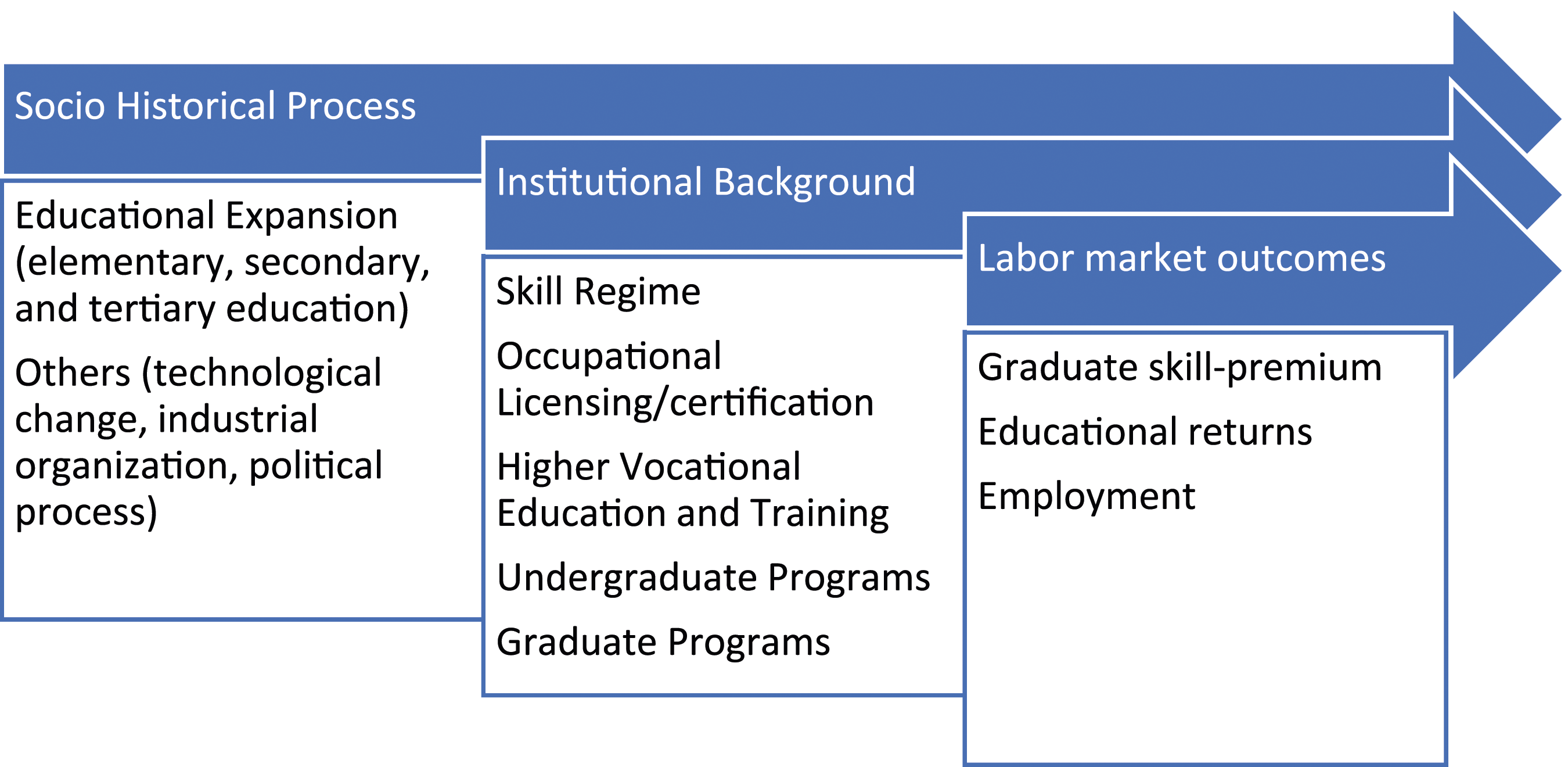
The socio-historical dimension covers the material ground in which lifelong education policies occur. For simplicity, I emphasize the process of educational expansion (covering all academic levels), whose nature and timing depend on the country-specific set of conditions. Simultaneously, as is documented in the literature, other phenomena co-occur as the waves of technological change (computerization and digitalization processes, and more recently automation and digital economy), the evolution of the political process of democratization, industrial organization, and national economies’ structure.
In the case of policy environment or institutional background, the joint structures covering the relationship between skill acquisition and labor market reaction are cataloged considering their natures, covering the skill regime, the occupational licensing or certification institutions, the Higher Vocational Education and Training (HVET) institutions, the undergraduate education programs, and graduate-level programs. At the same time, the expansion of the educational system provides an uptrend to the need for specialization and skill updating; how each country processes that educational demand will depend on their institutional development. In that sense, the prior dimensions define the labor market outcomes, setting boundaries to individual expectations regarding the relationship between human capital-based career strategies.
A policy perspective on the Chile case
A brief history of Chilean process
Chile has been categorized as a high-income developing country in the Latin American region based on the metrics provided by the World Bank (2024). In economic terms, Chile is the fifth largest economy in Latin America, presenting the largest GDP per capita in the region (only LATAM countries), a highly open economy based on the exports of mining and agriculture commodities, with a strong trend in the last 20 years of increasing the relevance of service economy (Didier & Perez-Comisso, 2024). The poverty levels are the lowest in the region, and there is a low degree of informality in the labor market (Economic Commission for Latin America and the Caribbean (ECLAC), 2024), showing favorable conditions for human development.
In Chile, the expansion of higher education occurred through implementing liberal reforms in the education system. During the dictatorship regime (1973–1990), the Government deregulated the educational market, allocating the responsibility for educational provision to private and for-profit institutions and underfunding public institutions at every level (primary, secondary, and tertiary education). Later, in the 2000s, the Chilean Government implemented two policies to continue the expansion: an educational loan system based on family credit in 2005 (Uribe, 2017) and a gratuity for the 50% more vulnerable population in 2016. While the first and second waves of expansion did not change the public supply of higher education enrollment, the reform of 2016 included the creation of public higher education institutions at universities and higher-level vocational education institutions. The student loan system increased the enrollment of students in the higher education system, doubling the number of students enrolled in a 12-year lapse and eliminating the gender gap in access to undergraduate-level higher education (CNED, 2019).
The Government developed two key policies to support access to advanced degrees and qualifications for graduate-level studies. In order of relevance, the first was a nationwide scholarship system named Beca Presidente de la Republica (Ministry of Social Planning), and later, the current system called Becas Chile (Ministry of Education and after, Ministry of Science), also named the program of advance human capital formation (PFCHA in Spanish). The PFCHA is a long-lasting program developed by the Government to promote human capital accumulation through a scholarship system for master’s and doctoral programs in Chile and abroad. This policy increased the number of doctors by 4,681 and masters by 5,238 (Salas et al., 2017). It continues its expansion by including new funding tools for medical specialties or priority investment in graduate courses. For national universities, this policy and graduate loans have implied strong support for developing advanced educational levels in Chilean universities (Riveros et al., 2016), reflecting the significant increase in enrollment in graduate studies. Figures 2 and 3 show the evolution between 2005 and 2018 undergraduate and graduate studies. Evolution of first-year enrollment to undergraduate programs 2005–2018. Data from CNED. Evolution of graduate enrollment 2005–2018 in Chilean universities. Data from CNED.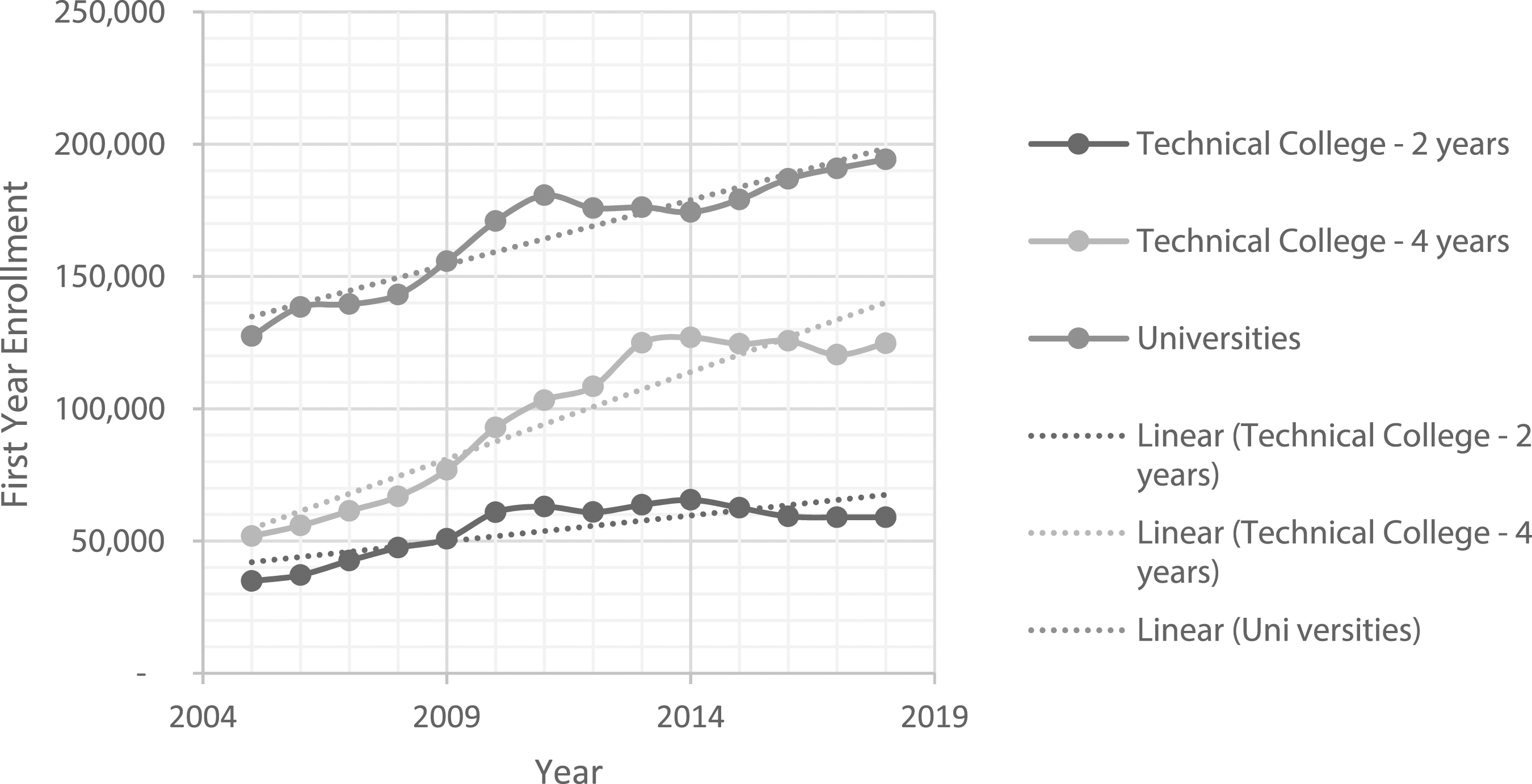
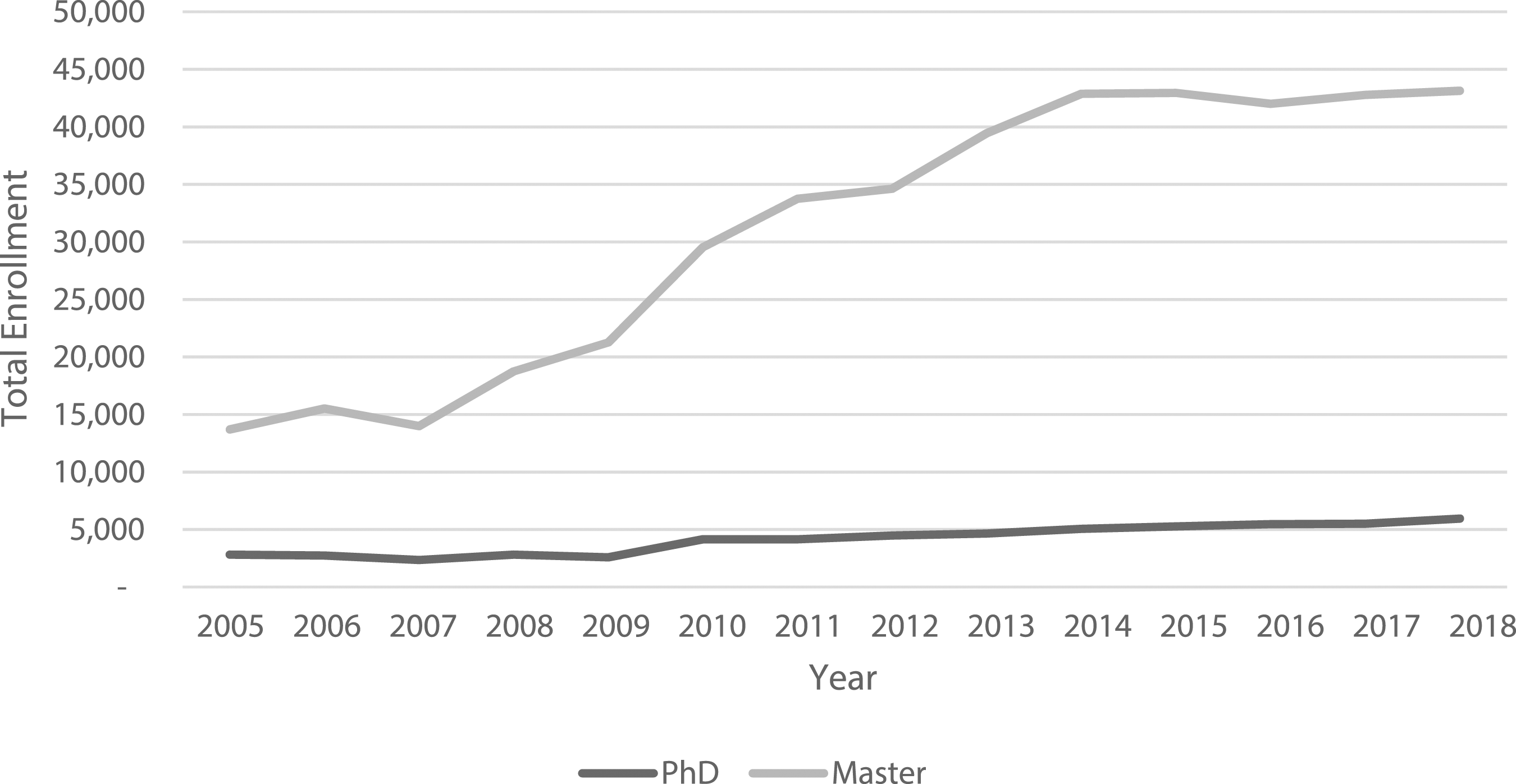
An emergent problem related to the increasing production of a highly educated workforce supported by PFCHA is the non-organic evolution of the graduate job market. Indeed, increasing the number of people holding master’s and doctoral degrees represents an edge for economic development literature (Deming, 2022). However, the complexity of the Chilean economy has not increased at the same pace. That is consistent with the evaluation of the evolution of the occupational structure of the labor market, where the proportions of white-collar, medium-level, and blue-collar jobs markets have not changed significantly since the early nineties, only changing the returns of education for the white-collar job market (Didier, 2021a; Gasparini et al., 2021).
Figure 4 shows the evolution of Chilean economic complexity between 2005 and 2018 using the economic complexity index (ECI). ECI captures the diversification of the economy across the industries and their relevance in the national economy (Mariani et al., 2015), allowing measuring the potential development of a given economy. Lower values indicate more concentration in a specific production cluster, while higher values show a more diversified economic structure. As observed, before the second wave of expansion in the higher education system, Chile’s economic complexity remained stagnant at around the same levels between 2005 and 2018. Evolution of economic complexity index 2005–2018. Estimates are based on Internal Revenue Agency reports.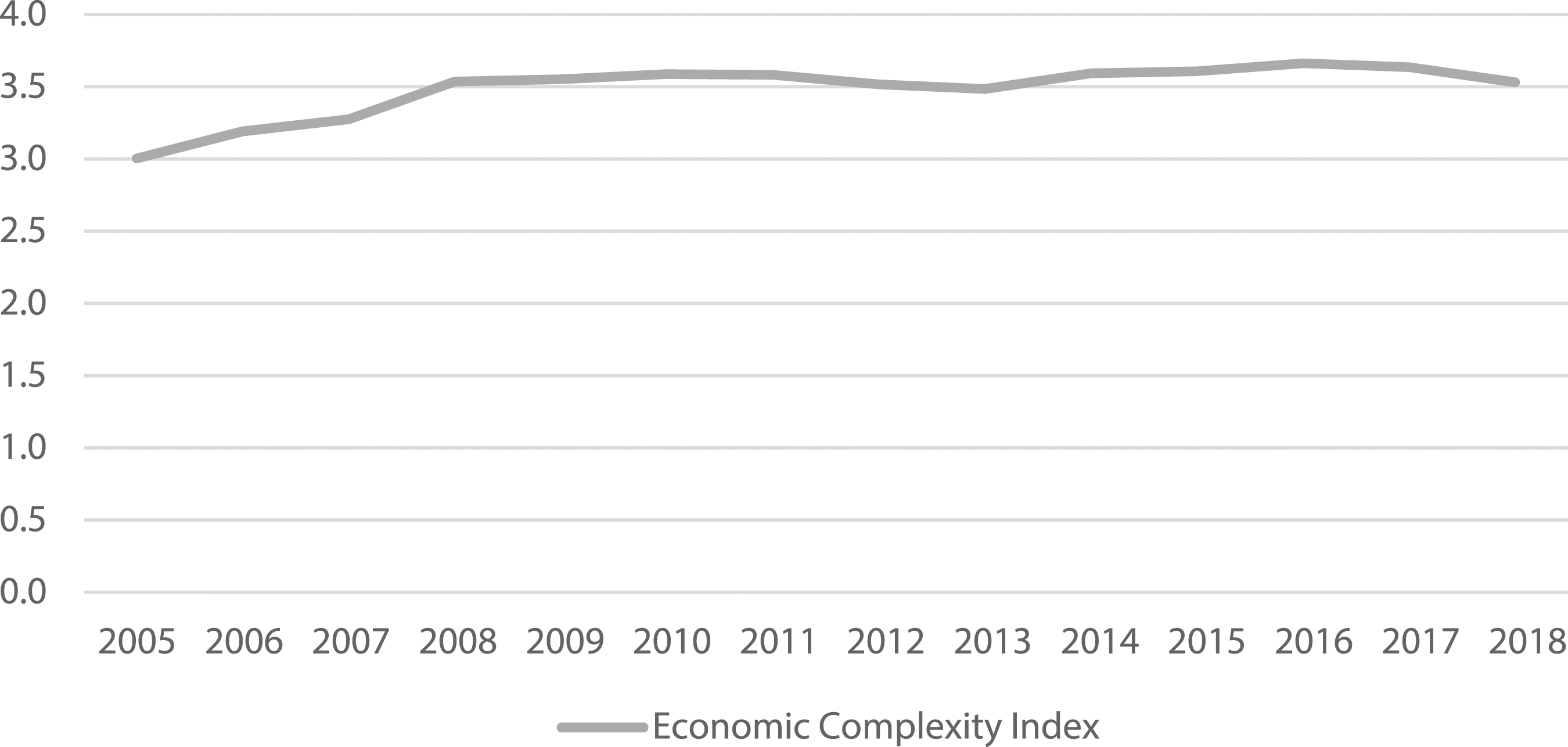
Regarding the industrial organization, the Chilean economic structure is still based on oligopolistic competition in the most relevant sections of the economy (Schneider, 2009, 2016), and the significant areas of the GDP are explained by financial services and commodities extraction (Banco Central de Chile, 2016). At the same time, the government incentives for R&D activities and research funding have not followed the increased availability of advanced human capital, creating large spaces for underemployment and precarious labor relations for highly educated workers.
The policy challenge: Employment, wages, and economic development
While the policy environment has been supportive of increasing workers’ human capital accumulation through formal education, the institutions that reign over the skill regime and occupational licensing and certifications have shown little development in the last 20 years, being subject to redefinitions by each administration and lacking enough stability to ensure a recognizable ground for non-formal learning (Didier, 2018, 2022). That is the case of ChileValora, a public agency that aims to promote occupational certifications, which has faced several problems in increasing the adoption by workers and employers (e.g., unknown institutions, low information, and difficulties in the assessment of its usefulness) (IPSOS Chile, 2023; Wunder, 2021).
Currently, there is an emerging wave of science policy political debate about the future of the advanced human capital formation policy instruments, which covers the financial dimension (reduction of the number of fellowships and scholarships for national or international graduate programs) (Blume-Kohout & Adhikari, 2016; Davenport, 2004), the benefits distribution due to human capital accumulation (appropriability of educational returns vs. social welfare benefits) (McMahon, 2018), the eligibility and focusing strategies for policy instruments (broad disciplines vs. specific areas of national interest) (Teixeira & Queirós, 2016), or the focus on entrepreneurship innovation or base science public investment (Mulligan et al., 2022).
Additionally, there is a rising concern about the absorption capability of the labor market for the growing stock of advanced human capital (Gonzalez & Jiménez, 2014; Labraña et al., 2021; Pinto, 2016). The relationship between advanced degrees and job requirements is becoming complex, especially for those who access their degrees abroad. Although the PFCHA creates the possibility to follow advanced studies, information regarding the prospects in the labor market is mainly centered on professional degrees rather than specific occupational markets tied to advanced degrees. The situation is similar for master’s and doctoral degrees: low and incoherent information regarding employment prospects, market demand, and skills assimilated to the educational degree.
In this context, the dominant imaginaries related to the described problems are assimilated into the blueprints of the employability crisis developed countries’ graduate markets face. Consequently, the employability problem for graduate students becomes an issue of public interest, considering the public investment generated by the Government and the disutility carried to the society for the mismatch effect on productivity and the allocation of wages across the labor market. The international experience regarding student loans and public employment as options for loan repayment creates an alternative for allocation problems. Attracting that highly educated population to the public sector could be a policy solution for the country’s lack of academic market development and the limited diversity of the national economy. Still, this option implies immediately dealing with overeducation phenomena for the occupational market of reference (white-collar market or skilled) (Didier, 2021a), where almost any alternative of specialization after completing a higher education degree implies the reaching overeducation status (Didier, 2018).
Methods
Study objective, perspective, and hypotheses
This study aims to tackle the problem of incomplete information regarding graduate market behavior, informing policymakers and individuals about the current labor market outcomes of people acquiring graduate degrees.
Considering the dominant economic approach in policy analysis, I framed the problem of labor market outcomes based on the basic assumptions of neoclassical economics, considering the tradition of human capital and signal theories. That implies that employers consider formal education a good proxy for future productivity and make decisions regarding hiring, promotion, and wage-setting, evaluating the effort spent by workers in acquiring educational degrees.
Since the structure of the educational system moderates the educational returns, I considered the two main elements representing formal education: the number of years devoted to study in the educational system and the last academic credential obtained. The first element is the base of the human capital mincerian equation, while the second element has been conceptualized in the literature as the sheepskin effect. The sheepskin effect represents the value for the labor market on completing a degree compared to those who intended the same degree but fall into the non-completion category (Bilkic et al., 2012). While both approaches are considered in the analysis, the element of interest is how the labor market values graduate credentials and whether heterogeneity exists in that valuation. Formally, the hypotheses are:
There are inter-industry differences in the sheepskin effect associated with graduate degrees.
There are public-private differences in the sheepskin effect associated with graduate degrees.
Data
I used the data from two nationally representative surveys to create two pseudo-panel data sets. The first was the Socioeconomic Characterization Survey (CASEN), a household survey implemented by the Social Development Ministry on a bi-yearly and tri-yearly basis and seeks to describe the population’s well-being in relevant policy areas such as housing, education, occupation, health, and income (Ministerio de Desarrollo Social de Chile, 2016). Its design represents the national and regional levels, having a complex sample design. For the analysis, I included all the versions between 1994 and 2017.
For the robustness check, the source of information was the Supplementary Income Survey (NESI), a module of the national employment survey, and it has a yearly application in the last quarter of the year (Instituto Nacional de Estadisticas, 2021). NESI has national and regional representativeness; the National Institute of Statistics implements it and aims to describe the income of employed people. For the analysis, I included each version from 2010 to 2018. In addition, I had the analysis of a longitudinal version of the CASEN survey, which covered five of thirteen regions between 1996 and 2006.
Variables
Dependent variable
Following the traditional treatment of the Mincerian equation, I used the information covered by the surveys to establish the hourly wage. Then, I adjusted the values to the monetary value of 2017 for CASEN, 2018 for NESI data, and 2006 for true panel data. Then, I estimated the natural logarithm of that.
Independent variables
The independent variable in this study is the completion of a graduate degree and the industry of reference. For data treatment and the changes in the response options across time and surveys, I merged the master’s and doctoral degrees categories into a single graduate category and excluded professional certificates. Regarding Industry classification, I standardized the information regarding the different versions of the International Standard Industrial Classification of All the Economic Activities (United Nations, 2008), which experienced redefinitions in the period studied. In the case of public-private differences, I used the information regarding the employer to define whether the individual had public or private employment.
Control variables
The relevant control variables included occupation (ISCO classification) (International Labor Organization, 2022), sociodemographic information (gender, age, and schooling), employment characteristics (formality, duration of the job contract, and job tenure), year of survey, and geographical information (rural-urban and region of the country).
Empirical modeling
For the modeling, I used a regression framework to define the value of the skill premium using a fixed-effects specification. Following the tradition of human capital research, I used the following equation as a base for building the equation (1):

This equation was applied to the general sample, comparing the graduate skill premium to the general market. The analysis of public-private and inter-industry differences was based on a customization of equation (1) to include the interactions as specified in equations (2) and (3):


For simplicity, I estimated three versions of this equation to estimate the conditional graduate premium for agriculture, industry, and services. In equation (2), the term grad*Ind represents the interaction between having a graduate degree and the current employment industry cluster. In equation (3), the interaction term grad*Pub covers the conditional graduate skill premium for public sector work. The rest of the equations follow the same equation structure (1). As a general note, the estimated equations used a weighting strategy based on the inverse probability of selection.
Results
At a descriptive level, Figure 5 shows the evolution of the educational composition of the workforce during the last three decades. The trends show that since the early nineties, access to higher education has increased from 10.96% of people with some or complete higher education degrees to 24.53% in 2017. This evolution is consistent with the narratives on skill upgrading linked to educational system expansion, where the average schooling years moved from 8.4 in 1990 to 9.6 in 2018. In addition, it is possible to observe an improvement in educational completion in the same period, moving from 21% who finished their last intended academic level in 1990 to 48.7% in 2018. Evolution of workforce educational composition 1990–2019.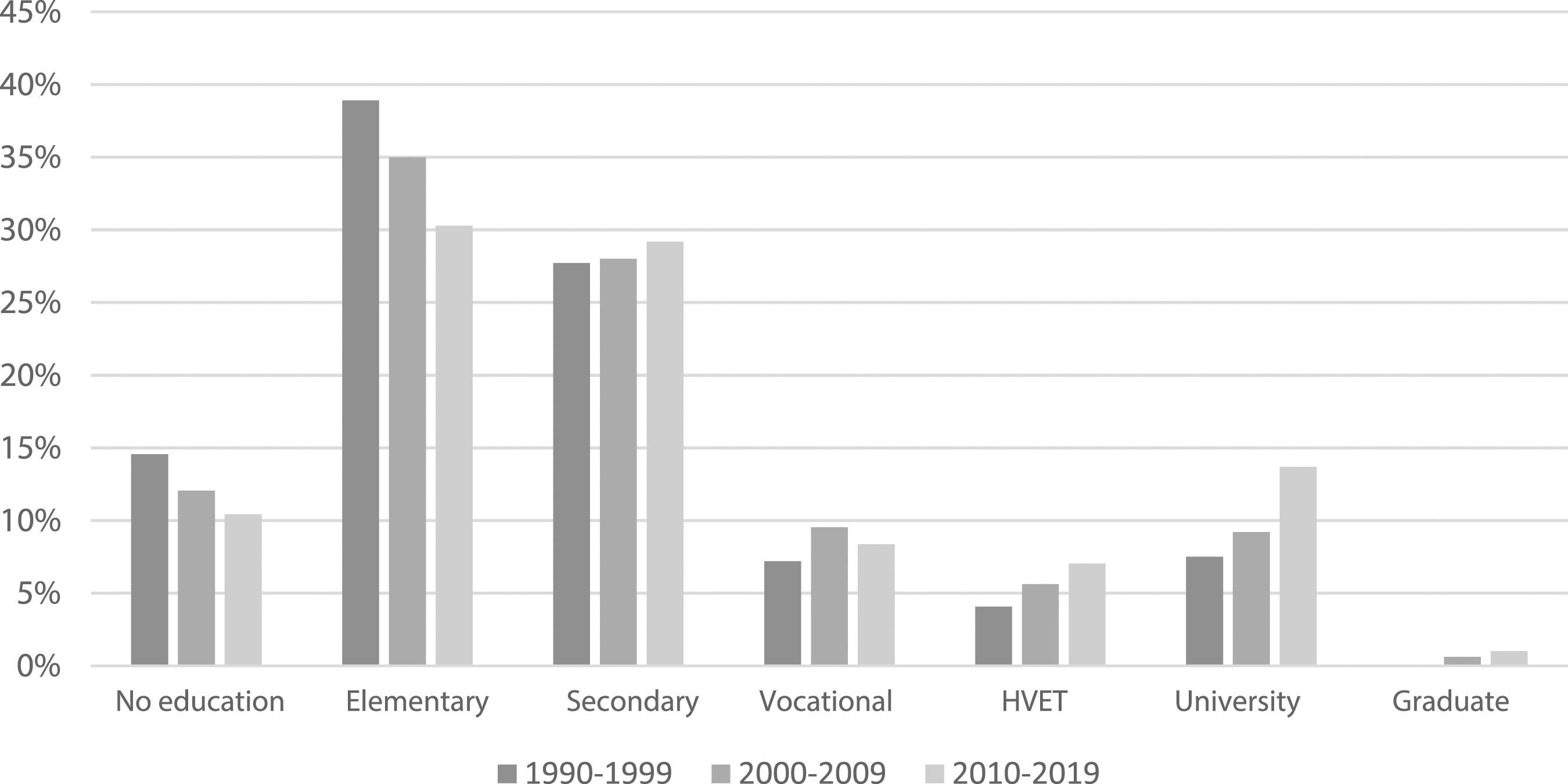
Descriptive statistics on key variables.
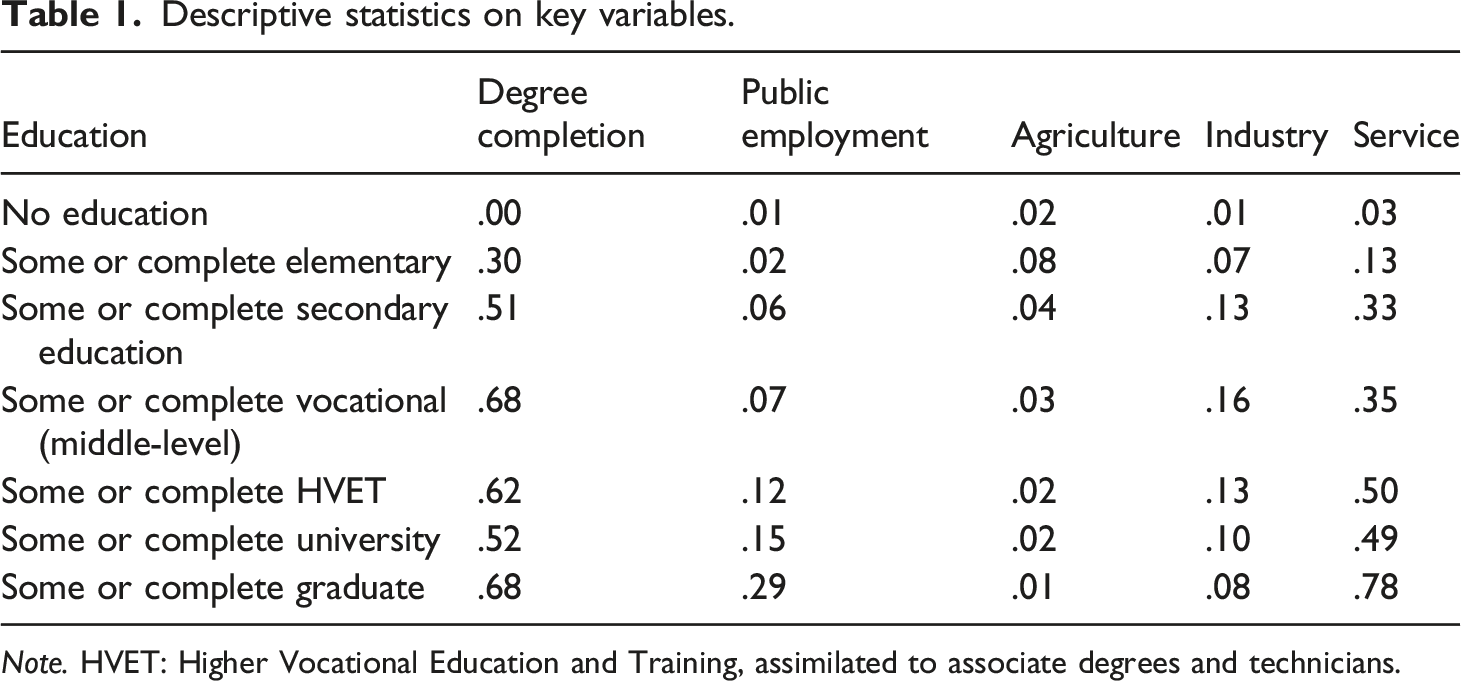
Note. HVET: Higher Vocational Education and Training, assimilated to associate degrees and technicians.
The distribution across industries shows that agricultural enterprises are based on a low-educated workforce, while service organizations favor higher levels of education in their hiring decisions. Finally, the industry cluster appears to be technical-focused in its hiring patterns, with relatively low demand for advanced degrees inside its ranks.
Estimates of higher education degree returns in the general market.
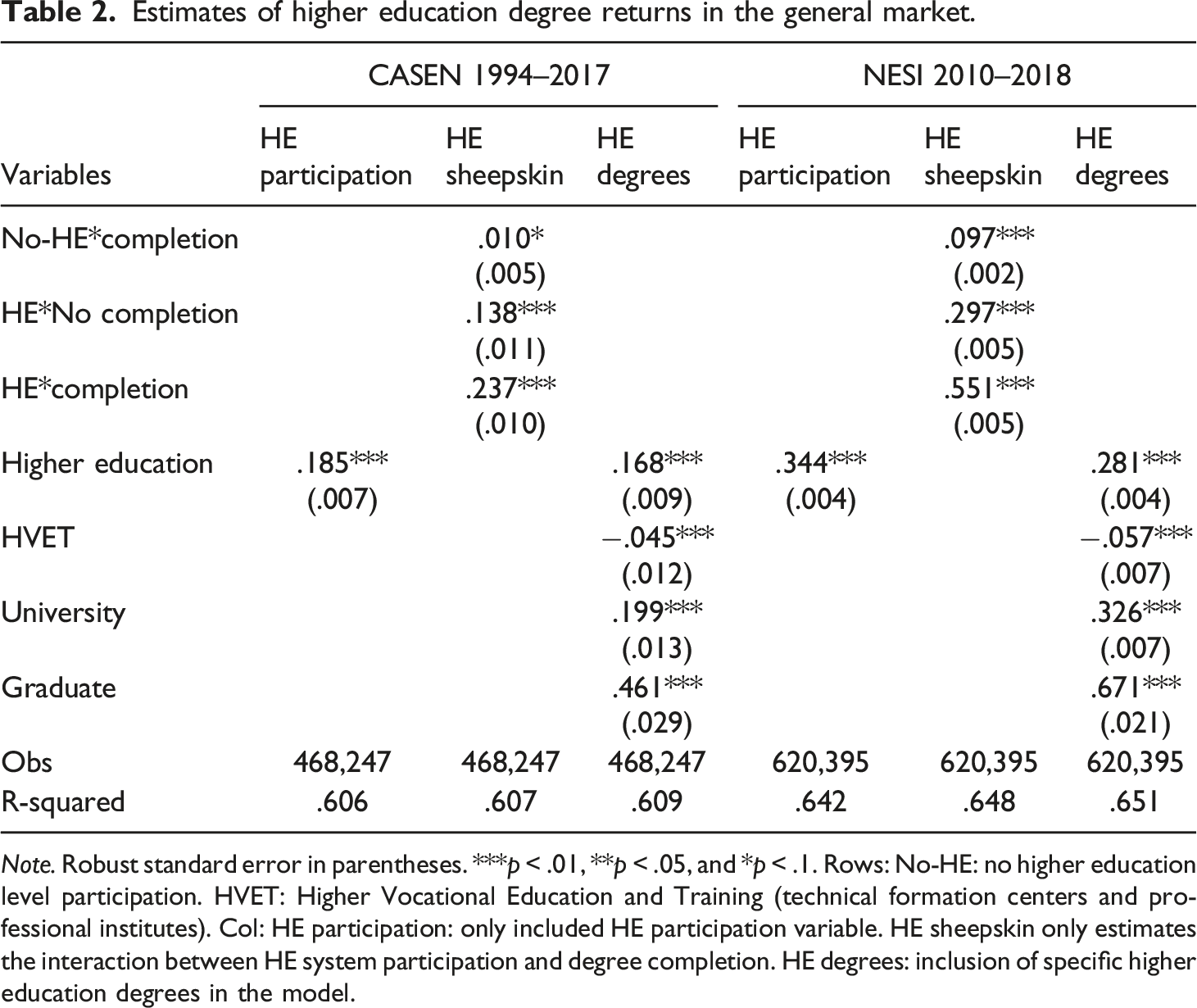
Note. Robust standard error in parentheses. ***p < .01, **p < .05, and *p < .1. Rows: No-HE: no higher education level participation. HVET: Higher Vocational Education and Training (technical formation centers and professional institutes). Col: HE participation: only included HE participation variable. HE sheepskin only estimates the interaction between HE system participation and degree completion. HE degrees: inclusion of specific higher education degrees in the model.
The results show that acquiring at least one year of higher education increases between 18.5% and 34.4% of workers’ hourly wages. This relationship decreases between 2 and 6 percentual points when the value of the different educational degrees is considered. When the interaction between HE participation and degree completion is considered, the results show that finishing secondary education increases the hourly wage by 0.1%. In comparison, only participation in the HE system increases salaries by 13.8% compared to 23.7% after completing an HE degree. When the complete set of HE degrees is considered separately, associate degrees negatively affect wages—between 4.5 and 5.7%—being the most negligible value option for the labor market for an educated workforce. In the case of university and graduate degrees, the sheepskin effect is solid and significant across both samples, ranging between 19.9 and 32.6% for university degrees and between 41.6 and 67.1 for graduate degrees. The differences in the magnitude could be attributed to the different periods of both data sets, where CASEN data capture the data before the educational system expansion, and NESI covers the time post-educational expansion, showing results consistent with prior evaluations of the HE expansion process of Chile (Didier, 2021c).
Higher education sheepskin effect by significant economic activity cluster.
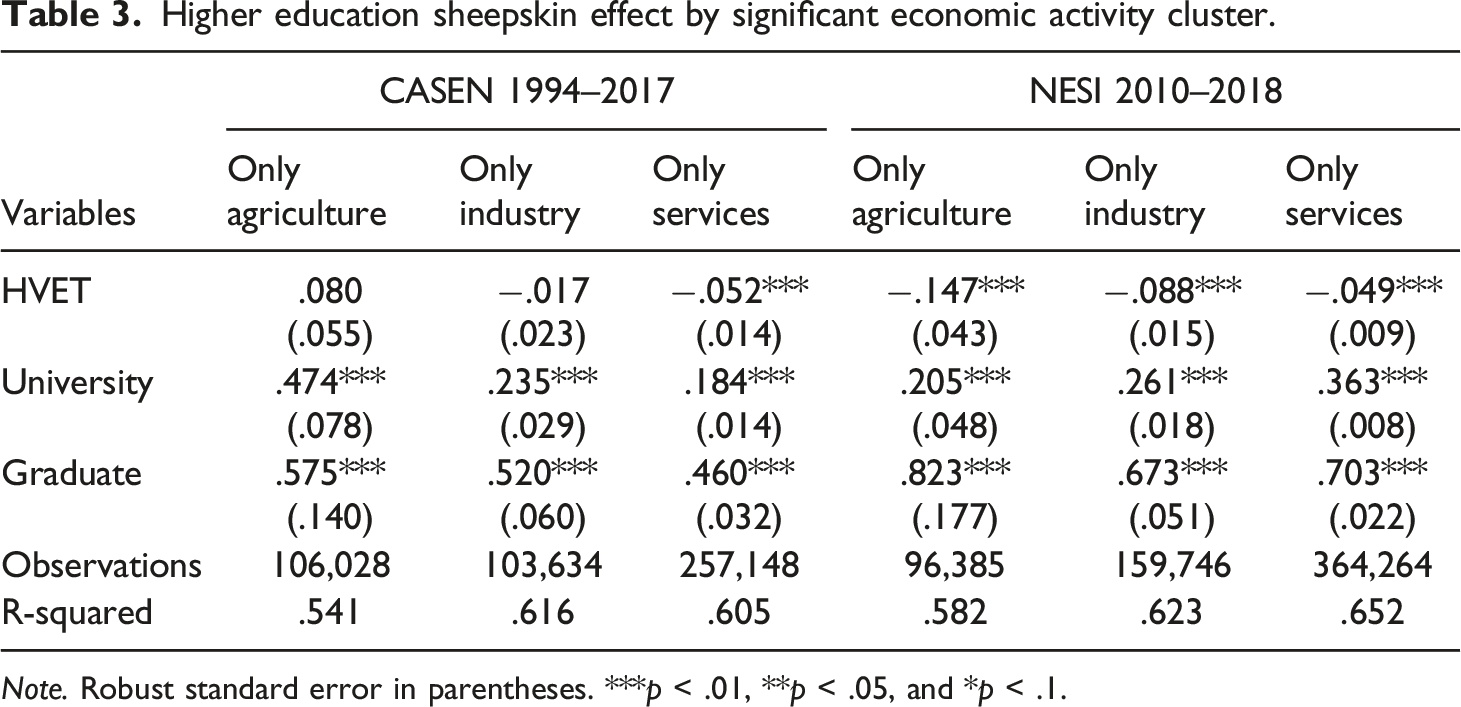
Note. Robust standard error in parentheses. ***p < .01, **p < .05, and *p < .1.
Graduate sheepskin effect interaction with significant economic activity clusters.
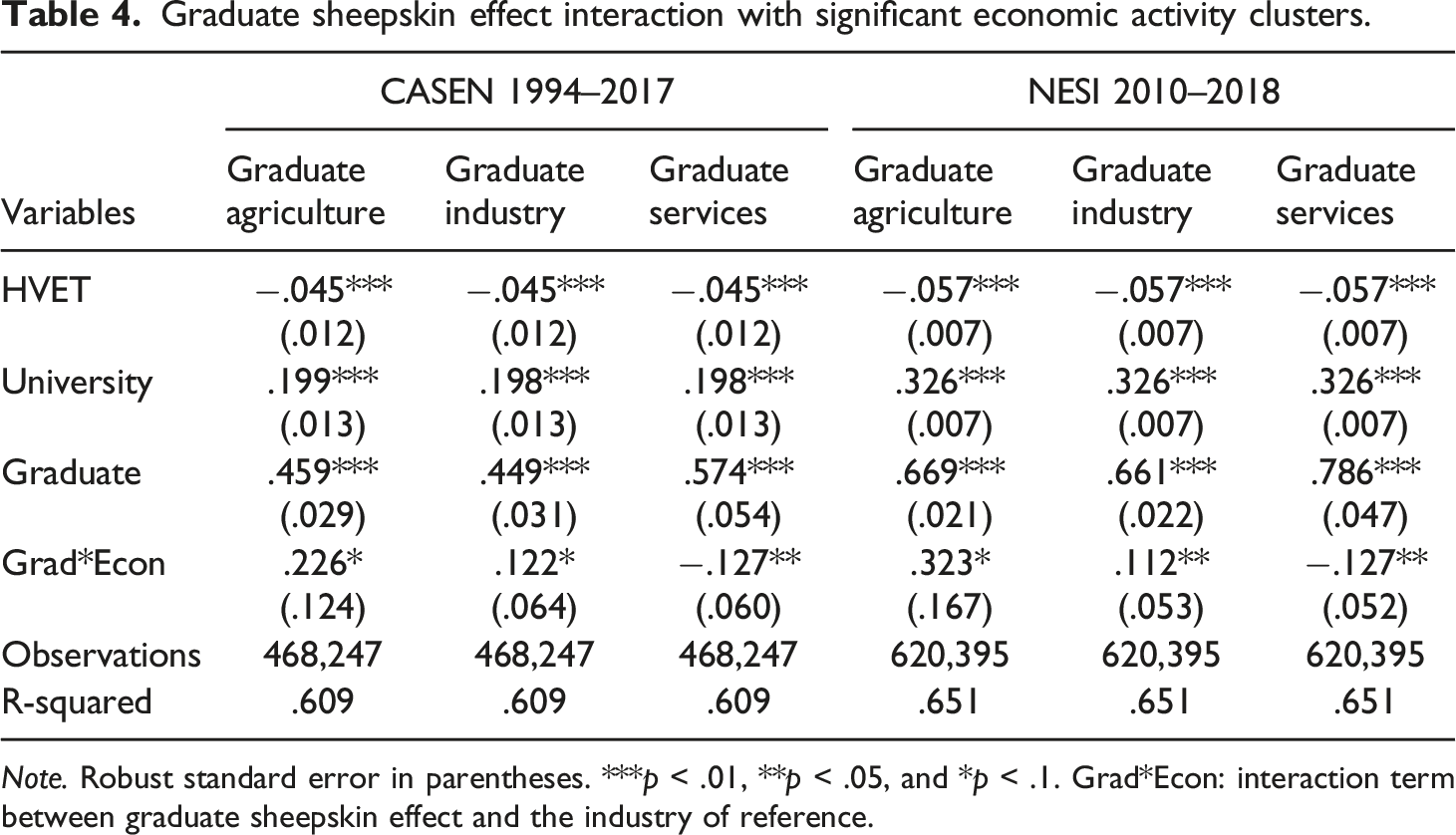
Note. Robust standard error in parentheses. ***p < .01, **p < .05, and *p < .1. Grad*Econ: interaction term between graduate sheepskin effect and the industry of reference.
The restricted sample analysis shows that HVET has no significant valuation for degree completion in agriculture and industry-related activities. The negative coefficient on HVET credentials only appears in service-sector employment for CASEN data. Still, all the economic activity clusters provide a negative sheepskin effect on HVET degrees for NESI data. In the case of university and graduate degrees, the value of the sheepskin effect is positive and significant across both data sets. In the case of the graduate sheepskin effect, there are differences across economic activities credential valuation, where agriculture holds the most critical skill premium on graduates, followed by industry cluster and services-based organizations. When the restricted sample results are compared with the application of equation (2), it is noticeable that service-sector companies have a lower valuation of graduate degrees than the other clusters. That becomes an issue, given Chile’s migration to a service economy since the nineties and the increased relevance of the service sector in the GDP.
Sheepskin effect by public employment.
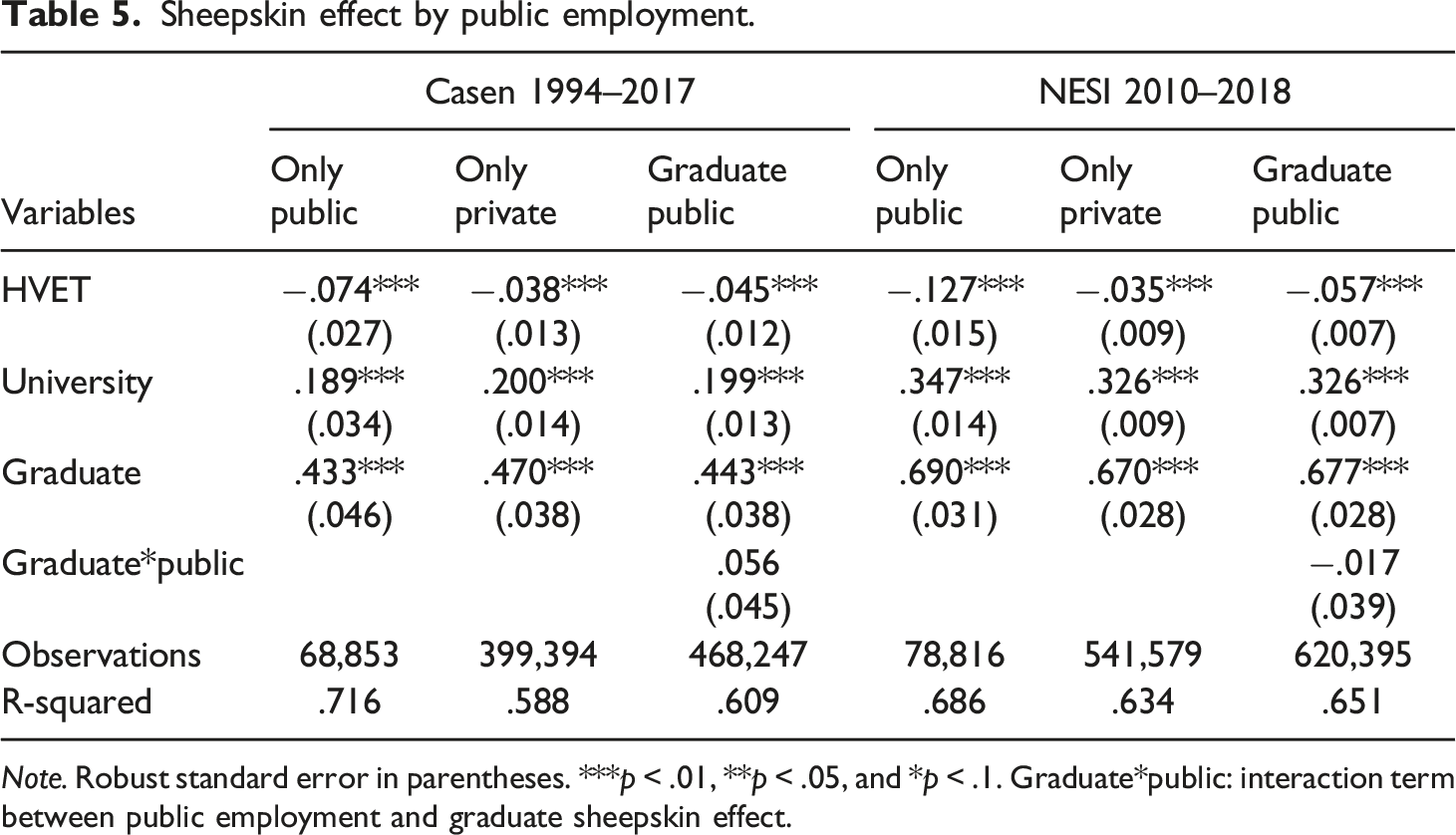
Note. Robust standard error in parentheses. ***p < .01, **p < .05, and *p < .1. Graduate*public: interaction term between public employment and graduate sheepskin effect.
Sheepskin effect by public employment and industry in CASEN panel 1996–2006.
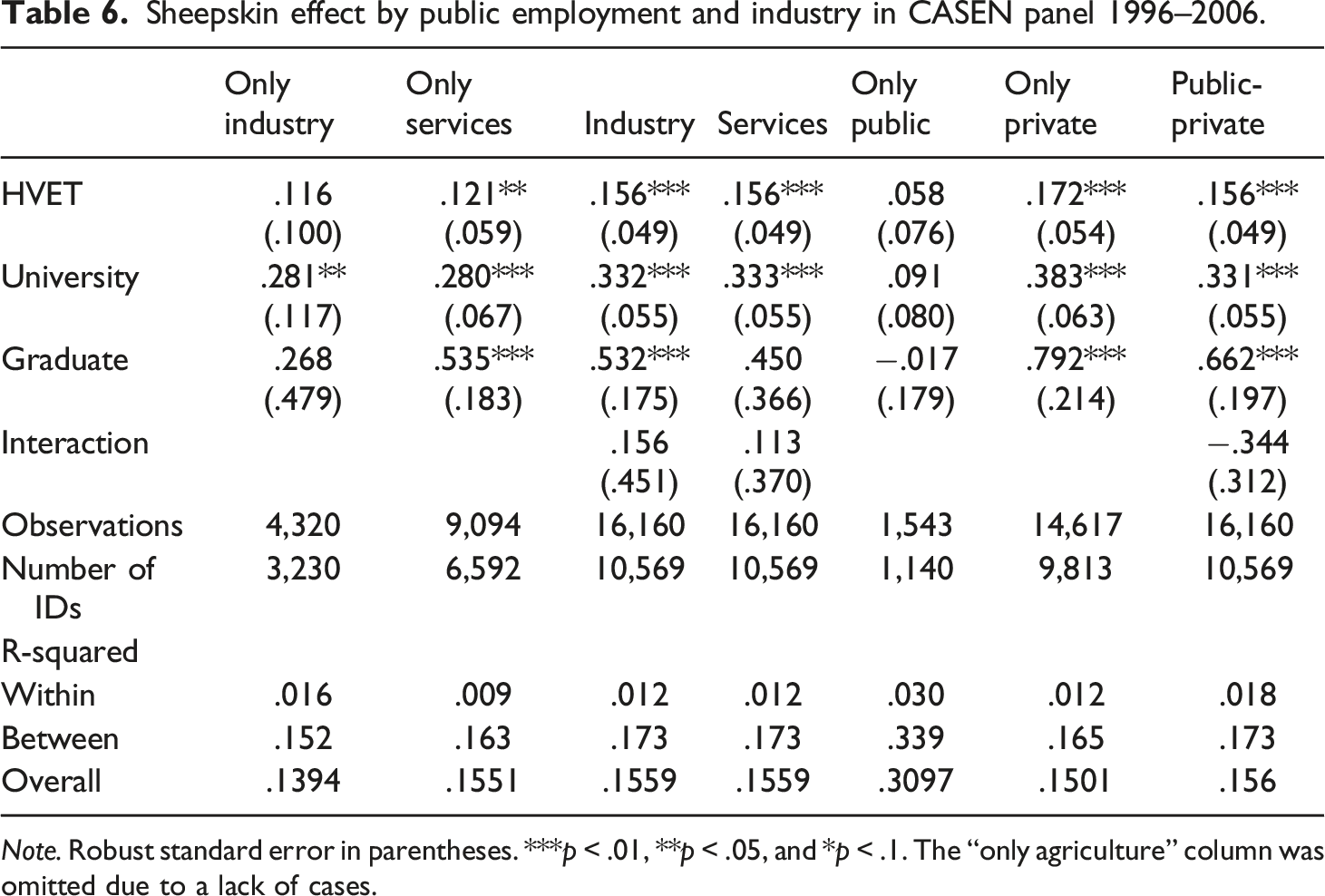
Note. Robust standard error in parentheses. ***p < .01, **p < .05, and *p < .1. The “only agriculture” column was omitted due to a lack of cases.
Discussion
This paper has attempted to situate the problem of graduate market behavior and educational returns in Chile from a lifelong education policy perspective. Using that perspective implied recognizing the socio-historical conditions that have grounded the lifelong education policy analysis in developed countries and acknowledging the differences with developing economies, as is the case of Chile. For that purpose, I described the articulation of advanced human capital programs that have fueled the expansion of the graduate market by funding national and international programs for professionals interested in pursuing advanced degrees. Then, I introduced the main elements of the current discussion on science policy in Chile, its connection with the policy instrument PFCHA, and how the policy problem has turned into a practitioner-level problem for human resources and educational administration. In this discussion section, I summarize how the analysis can inform policymakers, scholars, individuals, and practitioners regarding the situation of the graduate market.
While the political discussion regarding science policy advances and considers the development of advanced human capital endowments, the conversations need to be more comprehensive in how the structure of the national economy is conditioning the outcomes for individuals and society. The inter-industry heterogeneity is fundamentally connected with the longstanding process of migration to the service economy experienced by the country since the eighties (Didier, 2023) and the progressive diminution in the share of industry and agriculture employment in the labor market. That context gains relevance while the non-production-oriented economic activities tend to provide lower graduate skill premium than the other sectors of the economy. It also would be informative for scholarship and fellowship areas prioritization, balancing the national interest with the incentives for individuals interested in pursuing graduate degrees.
The results indicate that the stylized facts regarding graduate employability and decreasing returns to graduate education could not directly translate to developing economies (Didier, 2024). In fact, given the frame presented for the analysis, the stylized facts covering graduate market returns, educational and skill mismatches, and the employability crisis are time-sensitive and context-dependent. Thus, the study of skill upgrading and updating across the workforce should add more contextual information supporting each country’s specific dynamic rather than approaching it as a global phenomenon (Didier & Perez-Comisso, 2024). This can enhance or smooth the policy learning and adaptation process, including other variables in defining the expected outcomes for policies such as the PFCHA.
For individual decision-making, the results show that there is still a large room for investing in graduate education, especially considering the financial costs of pursuing this educational program. However, since the labor market is still adapting to the increased inflow of workforce with tertiary education (HVET and undergraduate), the returns will likely stabilize when the complete occupational market of professionals is filled by people with undergraduate degrees, allowing graduate credentials to operate as competitive advantages or differential factors in hiring for complex jobs. However, that scenario requires following developed countries’ blueprints during the past industrial revolution (third), while the process of market adaptation is running during the fourth industrial revolution.
Finally, the results could be informative for higher education administration and human resources practitioners. They generally represent both sides of the relationship between educational and labor markets. For higher education practitioners, the results show that the specialization market represented by graduate programs still holds a significant degree of viability until a market crash (given by occupational market completeness and decreasing rates of returns of graduate education). In the case of human resource practitioners, the results imply that—at least—the compensation strategies followed by companies are still aligned with rewarding human capital accumulation appropriately without delivering a generalized skill penalty associated with overeducation.
Footnotes
Author contributions
The complete research was developed only by Nicolas Didier.
Declaration of conflicting interests
The author(s) declared no potential conflicts of interest with respect to the research, authorship, and/or publication of this article.
Funding
The author(s) disclosed receipt of the following financial support for the research, authorship, and/or publication of this article: This research was possible due to the Fulbright-ANID Agreement, Doctoral Scholarship number 7938/2019.
