



Abstract
Job automation is a topical issue in a technology-driven labor market. However, greater amounts of human capital (e.g., often measured by education, and information-processing skills, including adult literacy) are linked with job security. A knowledgeable and skilled labor force better resists unemployment and/or rebounds from job disruption brought on by job automation. Therefore, the purpose of this study was to advance understanding of the association between educational attainment and literacy, and job automation risk. Using the 2012/2014/2017 Program for the International Assessment of Adult Competencies (PIAAC) data, survey-weighted linear regression was used to model the risk of job automation as a function of education, and literacy proficiency. Higher educational attainment (college or higher vs. less than high school: b = −18.23, p < .05) and greater literacy proficiency (score 0–500 points: b = −.038, p < .05) were associated with a decrease in job automation risk among the U.S. workforce.
Keywords
Introduction
The risk of job automation in the U.S. workforce is a concern, given that adverse health outcomes and poverty can stem from unemployment caused by automation (Abeliansky et al., 2020). Exponential advancements in technology can pose a threat to job security as computers and other technology replace human labor, usually at a more economical rate (Frenette & Frank, 2020). The potential fallout of job automation includes unemployment and job displacement (Autor, 2015), and a subsequent shift in the knowledge and skills needed to attain and maintain gainful employment (Frenette & Frank, 2020). Therefore, the educational attainment and information-processing skill proficiency of the workforce is a potential indicator of employment outcomes amidst job automation risk.
Theoretical framework
The current study is framed by the human capital theory, which states that human capital, including knowledge, skills, and credentials are beneficial for economic and labor market outcomes (Becker, 2009). Human capital differentiates economic outcomes by altering the opportunity structure of employment, job-related training, and skill use (Ishikawa & Ryan, 2002). That is, individuals with greater human capital may have better access to opportunities for prestigious (e.g., respected and highly paid) employment/positions, job-related education and training, and skill use (e.g., use of numeracy skills) (Yamashita et al., 2022). Thus, those with greater human capital are more likely to experience better access to employment, career advancement, and skill development, and in turn, job security, compared to their counterparts (Cairó & Cajner, 2018). In view of the human capital theory, educational attainment (i.e., degree) and information-processing skills (e.g., literacy) are considered human capital. In the rapidly evolving technology-rich society, workers need to continue updating and upgrading their human capital in order to stay competitive in the labor market (Cummins, Taylor, et al., 2015). Considering this pathway between greater human capital and beneficial employment outcomes, it is anticipated that human capital would protect workers from job automation risk. That is, without sufficient human capital such as information-processing skills, workers are likely to be at a disadvantage for upgrading necessary skills in a timely manner for the current as well as future technology-rich labor market where job automation is expected to accelerate.
Literature review
Job automation
Technological advancements have positioned computer capital as a cost-effective replacement for human labor (Deschacht, 2021). Of concern are the resultant effects of job automation within the labor market (Bessen et al., 2020). Compared to routine tasks (e.g., sales and food preparation) in jobs, non-routine tasks (e.g., health care and education) can resist automation because current technological capabilities do not allow for the coding and computerization of these tasks as easily as routine tasks (Autor et al., 2003). Although technology cannot fully substitute for all tasks in a given job, technology-driven job automation can nonetheless eradicate certain jobs (Bessen et al., 2020). In fact, some of the jobs at higher risk of automation include service, sales, administrative, construction, and maintenance occupations (Yamashita & Cummins, 2022).
However, an occupation-based approach to determining job automation risk has been criticized for overestimating risk (e.g., Frey & Osborne, 2017) while a task-based approach projected lower levels of job automation (e.g., Arntz et al., 2016). Thus, in addition to putting a numerical value to job automation risk, another important approach is to determine the characteristics of occupations that would be automated. For example, jobs that stipulate academic training would have a lower chance of job automation (Deschacht, 2021). Protective factors against job automation include jobs that stipulate high educational attainment because these jobs involve tasks that represent “engineering bottlenecks” that cannot be easily coded into an algorithm and thus automated; however, this leaves persons with lower levels of education at a distinct disadvantage in the face of fast-paced technological changes that can make it challenging to upgrade one’s skillset in time (Arntz et al., 2016).
Education
In line with the human capital theory, higher educational attainment can equip workers with knowledge and skills (i.e., the human capital) that buffer against job automation risk (Acemoglu & Restrepo, 2022). At the same time, a mismatch between the skillset offered within the education system and the requirements of a technology-biased job market can result in underemployment among persons with higher educational attainment (Frey et al., 2016). The time investment constraints of increasing one’s educational attainment to counter job automation risk also contribute to underemployment (Frey & Osborne, 2015). Furthermore, as continued technological advancements make it feasible for a broader range of tasks to be automated, achieving job security entails pivoting to jobs at lower risk of automation (Frey & Osborne, 2017) or acquiring the skills needed to perform the tasks that have evolved or emerged with job automation (Acemoglu & Restrepo, 2019).
Information-processing skills—literacy
The prominent modern international large-scale assessment of information-processing skills—the Program for the International Assessment of Adult Competencies (PIAAC) by the Organization for Economic Development and Cooperation (OECD)—defines literacy as “…understanding, evaluating, using and engaging with written texts to participate in society, to achieve one’s goals, and to develop one’s knowledge and potential” (PIAAC Literacy Expert Group, 2009, p. 8). The correlations between educational attainment and information-processing skills are well-documented. For example, while 64% of adults with college or higher degrees have a high level of literacy proficiency, only 36% and 23% of adults with a high school diploma, and less than high school education had a high level of literacy proficiency, respectively (National Center for Education Statistics, 2020b). Yet, educational attainment and literacy proficiency should not be treated as the same human capital because educational attainment is likely to be constant whereas literacy proficiency is malleable over the adult life course (Reder, 2019). Indeed, from a policy standpoint, improving educational attainment at the adult population level is challenging as most adults end their formal education by their late twenties and already have careers and other responsibilities (e.g., caregiving) (National Center for Education Statistics, 2020a). On the other hand, literacy skills can be maintained and enhanced through continuing engagement in education and training as well as skill use, and be considered as more updated human capital, than fixed educational attainment, which could have been obtained decades ago (Reder et al., 2020). Beyond the U.S. context, although European adults have similar age-bound patterns for completing their formal education (i.e., postgraduate degree program) (Dorsett et al., 2011, 2016), a significant segment of the adult population increase their educational attainment after their twenties. For example, in the United Kingdom, 14% and 37% of undergraduate and postgraduate program students were 30 years and older, respectively (Hubble & Bolton, 2021).
Other relevant factors—age, gender, race and ethnicity, socioeconomic status, social connection, health, immigration status (nativity), and volunteering (civic engagement)
The demographic characteristics of workers—inclusive of age, gender, race and ethnicity, and skills (education)—are essential to understanding automation across jobs (Deschacht, 2021). Older age is linked with institutional knowledge that positions them as assets in the labor force, while access to lifelong learning opportunities to upgrade skills is of utmost importance to keep pace with the dynamics of job automation and maintain job security (Abeliansky et al., 2020). Compared to men, women are more likely to be employed in jobs that consist of routine tasks and therefore, to face a relatively higher risk of job automation (Black & Spitz-Oener, 2010). At the same time, women are less likely to work in blue-collar industries, which are at high risk of job automation, than men (Acemoglu & Restrepo, 2022). The race-based difference is another relevant factor regarding job automation. Jobs at high risk of automation are predominantly comprised of racial and ethnic minority workers (e.g., Black and Hispanic) (Broady et al., 2021). In addition to educational attainment, another socioeconomic status indicator—income is relevant to job automation as highly paid jobs tend to face a lower risk of automation (Nedelkoska & Quintini, 2018).
Having a social network, for example, being married and living with a spouse, may impact individual decisions on employment possibly due to additional income from spouse’s employment, sense of economic security, and instrumental support regarding one’s occupation (e.g., shared caregiving responsibility) (Torr, 2011). The relationship between health and employment is tied to factors such as income level and access to employer-based health insurance, which can be disrupted by job automation, potentially resulting in adverse health outcomes (O’Brien et al., 2022). Thus, a reverse causation pathway might exist between health and job automation. Immigrants may have unique patterns of occupation selection, career advancement, and human capital development, compared to native-born workers in the United States (Liu & Portes, 2021). In view of the human capital theory, volunteering is likely linked with enhanced human capital and in turn, a lower risk of job automation (Choi & Chou, 2010; Vera-Toscano et al., 2017). With human capital as a protective factor against unemployment and job displacement from job automation, volunteering is a viable skills acquisition option that can bolster human capital (Baert & Vujić, 2018).
Taken together, job automation as the replacement of human labor with technology raises legitimate concerns about changes in labor markets and unemployment. However, the underlying issue of the job disruption created by job automation is reskilling to support job security (Bessen, 2019). Thus, efforts to increase human capital (e.g., knowledge and skills) are vital for an effective response to the potential fallout of job automation. Particularly, literacy proficiency is more malleable than educational attainment among adult populations, and therefore, important to investigate its role in the context of job automation. This study examines the pathway between human capital (i.e., educational attainment and literacy), and job automation risk. Human capital as educational attainment is more difficult to improve at the population level. Hence, in examining the pathway between human capital and job automation risk, the inclusion of literacy as a measure of human capital can offer a more feasible intervention point (Reder et al., 2020). Findings from this study will inform strategies and policy changes to prepare the labor force for increasingly dynamic labor markets, partially due to ongoing and future job automation.
Research questions and hypotheses
1. Are educational attainment and literacy skill proficiency associated with job automation risks among workers in the United States?
It was hypothesized that both education and literacy proficiency are negatively associated with the risk of job automation because of human capital (e.g., specialized skills, non-routine tasks at work, and some may even work in the job automation technology field). In other words, the higher the educational attainment and literacy proficiency, the lower the job automation risk.
Methods
Data
Data were derived from the 2012/2014/2017 Program for the International Assessment of Adult Competencies (PIAAC) U.S. Restricted Use File (RUF) (National Center for Education Statistics, 2019). PIAAC is organized by the Organization for Economic Cooperation and Development (OECD) to collect nationally representative large-scale assessment data of information-processing skills, including literacy, numeracy, and digital problem-solving skills. The information-processing skills are measured using the rigorously tested assessment tool and computer-adaptive testing design, and the details have been published elsewhere (OECD, 2016). PIAAC provides the information-processing proficiency measures as the statistically estimated set of 10 plausible values ranging from 0 to 500 points. The use of the U.S. PIAAC RUF is approved by the Institute of Education Sciences (IES) and all analyses followed the IES data security guidelines and policies in this study (license #17080026).
The U.S. PIAAC RUF data contain 12,330 respondents aged 16 years and older. For the purpose of this study, the respondents are limited to those (n = 5,890) who are of common working age (i.e., between 25 and 65 years old) and employed. After excluding those with missing values in the literacy proficiency scores (n = 760) and in any of the covariates (n = 20), the final analytic sample size is 5,110. PIAAC RUF provides the survey weights including the sampling weights (SPFWT0) and 80 replicate weights (SPFWT1-SPFWT80), which need to be incorporated into the estimation of national figures and standard errors (OECD, 2016). The power analysis is conducted using the R package—pwr (Champely, 2020). With the significance probability of .05, the conventionally accepted statistical power of .80, small effect size of .02, and 13 predictors, the minimum required sample size is 890.
Measures
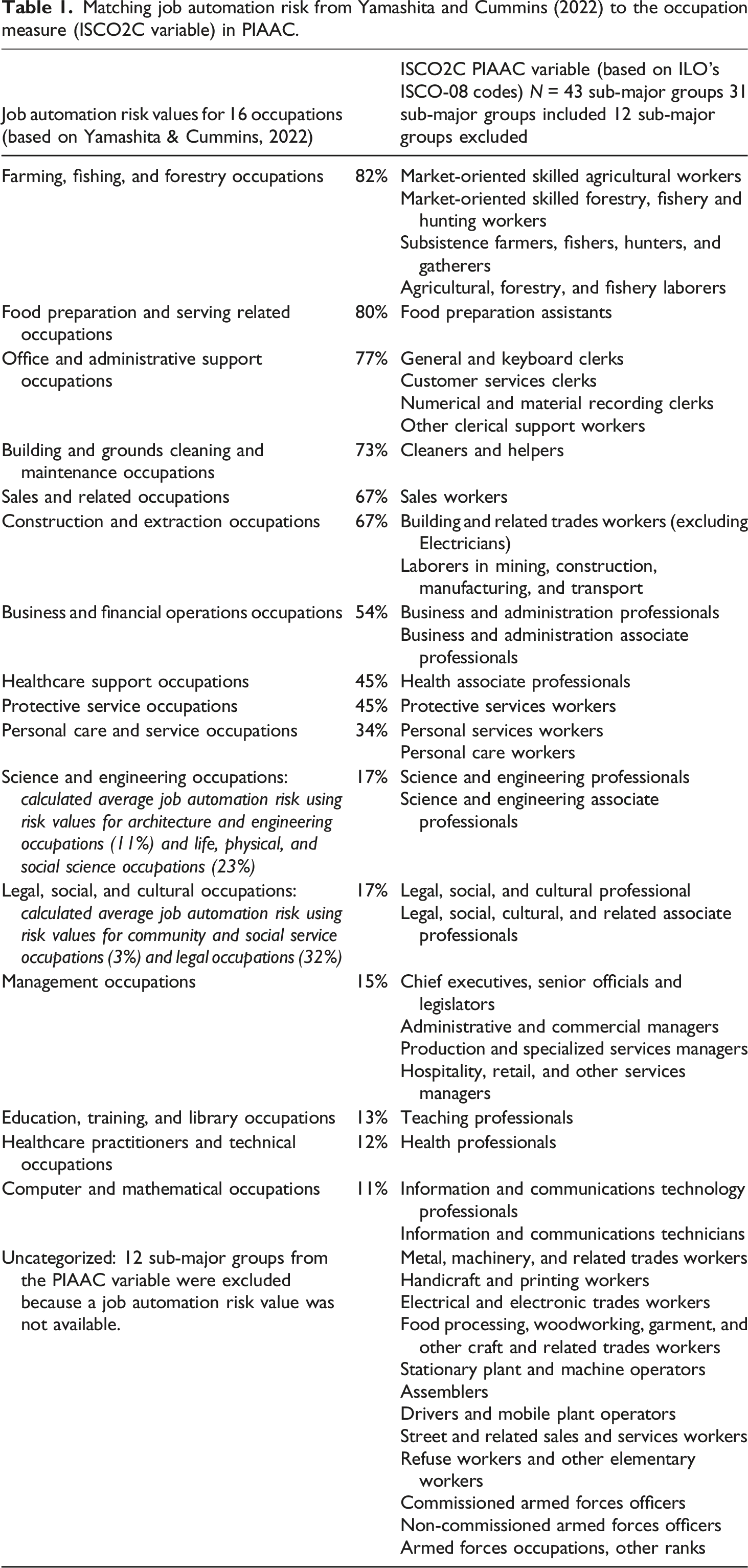
Matching job automation risk from Yamashita and Cummins (2022) to the occupation measure (ISCO2C variable) in PIAAC.
Predictor variable: Literacy proficiency is the score ranging from 0 to 500 points. The higher value indicates greater proficiency.
Covariates: Age is recorded in years. Gender is a dichotomous measure (of women vs. men [reference group]). Race and ethnicity are recorded in a series of dichotomous measures for racial and ethnic groups including non-Hispanic White (reference group), non-Hispanic Black, non-Hispanic others, and Hispanic. The income measure is the modified income quintile points (0–5: no income – the fifth quintile). Education is measured using three dichotomous measures including less than high school (reference group), high school, and college (associate degree) or higher. Self-rated health is dichotomized to (1) good health (excellent, very good, and good) and poor health (fair and poor) due to the skewed distribution. Living with a spouse is a dichotomous measure (vs. not living with a spouse). US born is also a dichotomous measure (vs. non-US born or immigrant). Finally, volunteering indicates whether the respondents volunteered for any organization or not, in the past 12 months.
Analytic approach
Weighted descriptive statistics and standard errors were first computed using the survey weights and literacy proficiency plausible values. Subsequently, considering the continuous measure of the outcome variable, the survey-weighted linear regression with the ordinary least square (OLS) estimation method was employed to model the risk of job automation as a function of education, literacy proficiency and covariates (DeMaris, 2005). The model was sequentially built from a simple linear regression model with only literacy proficiency to a multiple linear regression model with all covariates added. In order to include a set of 10 literacy proficiency plausible values, the STATA macro program, REPEST, was adopted (Avvisati & Keslair, 2020; StataCorp, 2021). The REPEST macro program estimated the models with all combination of plausible values, sampling weights and replicate weights, and returned the average coefficients with the empirically derived standard errors. The STATA command—regress was used to fit linear regressions. The model was evaluated with the R-squared (0 – 1), and the regression assumptions, such as normal distribution of the residual, zero expectation, and homoscedasticity, were checked using the visualized distributions of the residuals. Our preliminary analysis showed that all assumptions were met. The variation inflation factor (VIF < 10) indicated no sign of multicollinearity in the final model (Allison, 1999). Finally, sensitivity analysis, including the models with alternative measures (e.g., years of education and instead of educational attainment), was conducted to inspect the robustness of the findings.
Results
Weighted descriptive statistics.
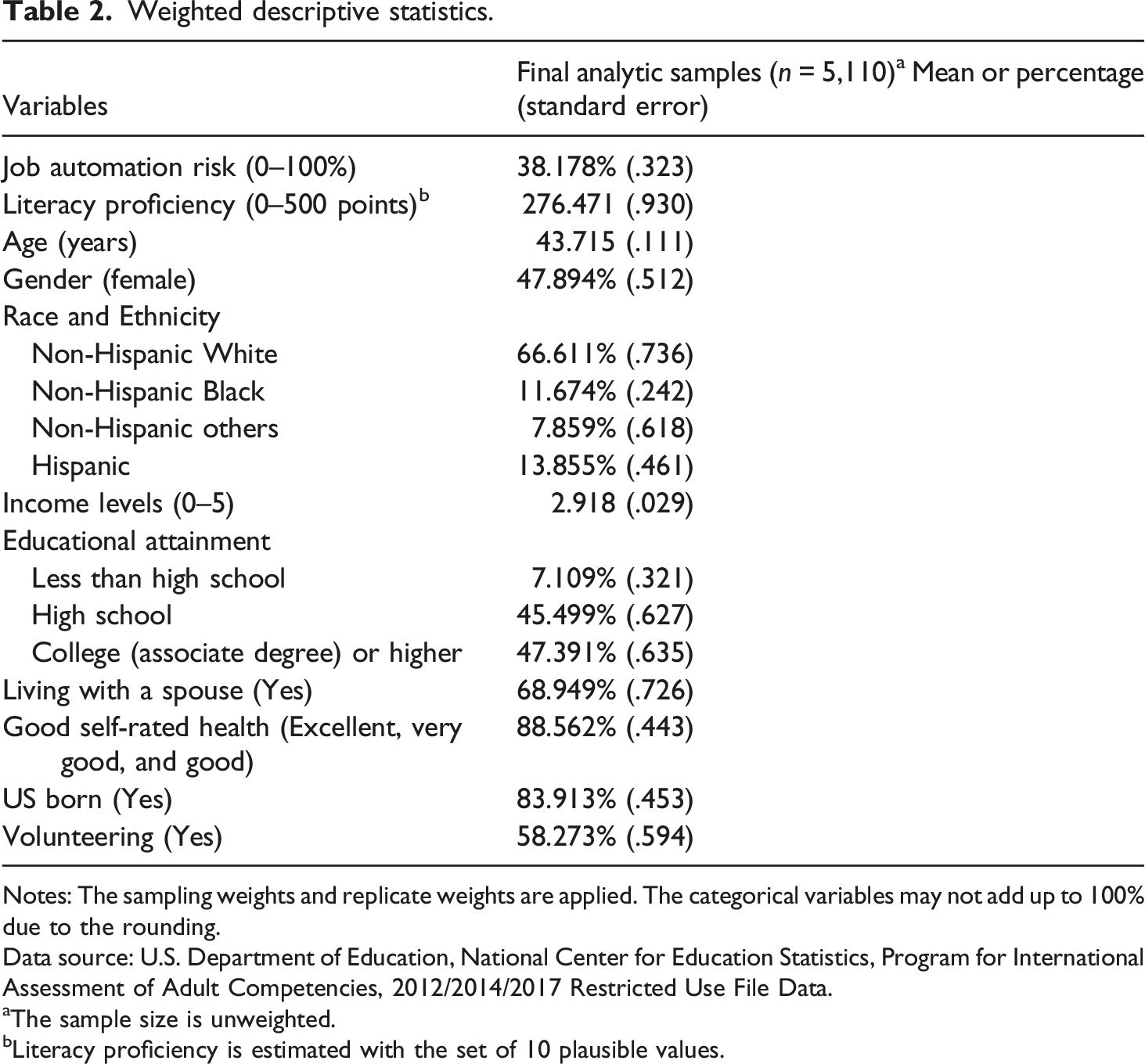
Notes: The sampling weights and replicate weights are applied. The categorical variables may not add up to 100% due to the rounding.
Data source: U.S. Department of Education, National Center for Education Statistics, Program for International Assessment of Adult Competencies, 2012/2014/2017 Restricted Use File Data.
aThe sample size is unweighted.
bLiteracy proficiency is estimated with the set of 10 plausible values.
Estimated regression coefficients on the risk of job automation.
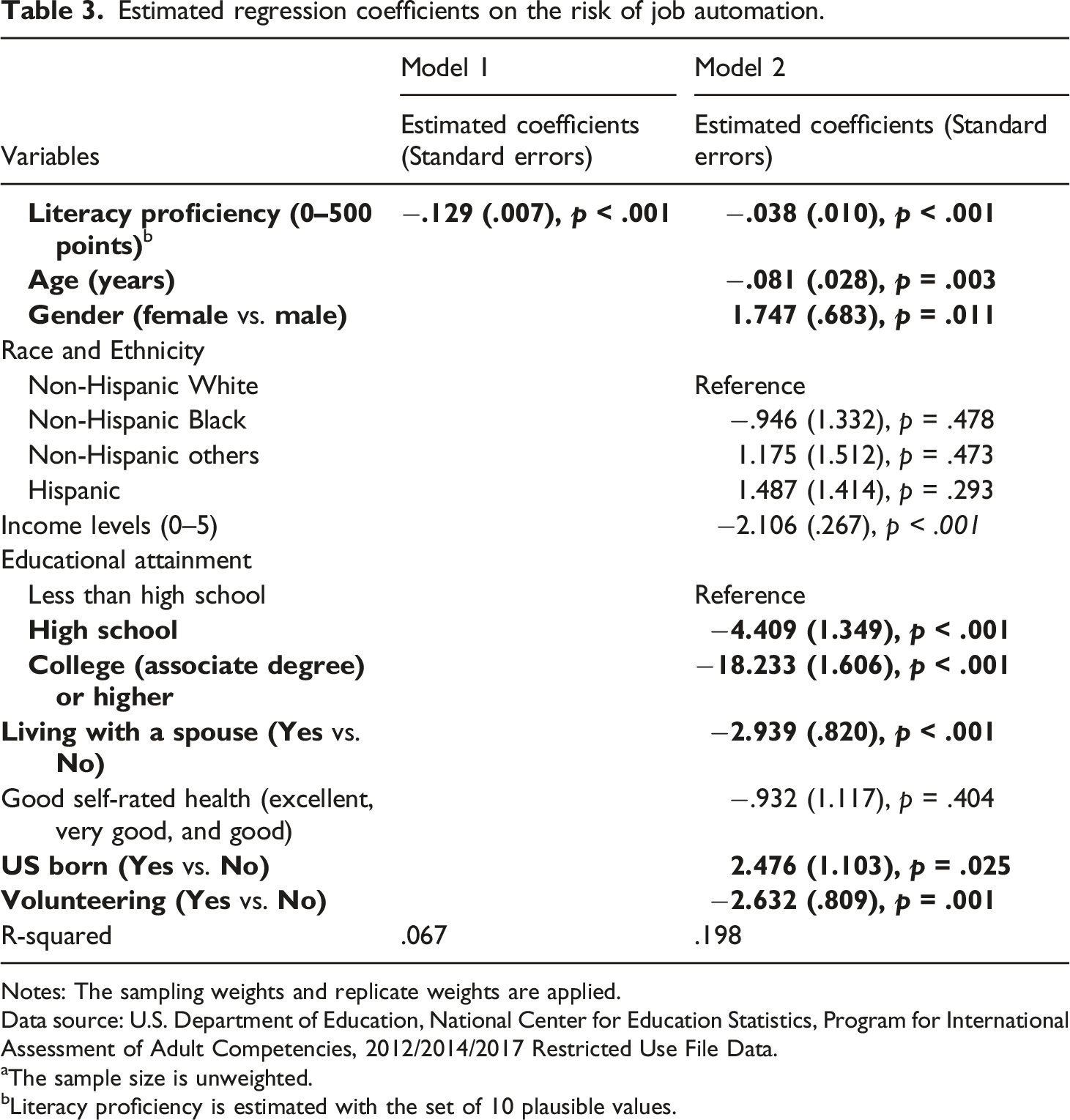
Notes: The sampling weights and replicate weights are applied.
Data source: U.S. Department of Education, National Center for Education Statistics, Program for International Assessment of Adult Competencies, 2012/2014/2017 Restricted Use File Data.
aThe sample size is unweighted.
bLiteracy proficiency is estimated with the set of 10 plausible values.
Overall, the sensitivity analysis with alternative and additional measures (e.g., an ordinal measure of self-rated health and number of household members) shows the consistency of the findings. However, when the final model was estimated with the total years of education instead of the educational attainment, the finding of literacy proficiency is not consistent. Although our follow-up analysis confirmed the incremental benefits of greater educational attainment, the inconsistent finding with the year of education measure should be noted, and results should be interpreted with caution.
Discussion
This study modeled the risk of job automation as a function of education, literacy, and the covariates. The lower the educational attainment and literacy proficiency, the higher the job automation risk. Being a woman and U.S.-born are also associated with higher job automation risk. However, older age, living with a spouse, and volunteering can be indicative of lower job automation risk. In view of the human capital theory, workers with greater educational attainment and information-processing skills are better equipped to withstand the effects of job automation because of a combination of their greater credential, abilities to learn new skills, and foundational skills (e.g., adult literacy) that are transferrable across different industries over the life course (Cummins et al., 2022). Since one’s human capital safeguards against job insecurity due to automation risk (Acemoglu & Restrepo, 2022), it follows that lower educational and literacy proficiency levels would mean a higher risk of job automation. In fact, although completing high school or a college degree or higher was associated with lower risk compared to having less than high school, the findings indicate that increasing educational attainment is associated with incremental reduction in job automation risk. Previous studies documented the roles of education and literacy in relation to job security or employability (Belzer & Kim, 2018; Yamashita et al., 2018).
The characteristics of jobs at risk of automation can help explain the gender difference in job risk. For instance, high-risk jobs often consist of routine tasks and women tend to hold jobs with more routine tasks than men (Black & Spitz-Oener, 2010). As such, considering human capital (i.e., education and literacy) is already taken into account, the gender effect on job automation risk may be due to the differing career choices or gendered employment opportunity structures by women and men in the United States. Notwithstanding the cost-effectiveness of replacing human labor with technology, the immigrant labor force might nonetheless be a more economical option that thus disincentivizes job automation (Liu & Portes, 2021). However, the selection effect regarding the immigrants who make up the U.S. workforce might tell a different story as immigrants tend to migrate to further their studies and thus may possess levels of human capital that might see them employed in low-risk jobs (e.g., STEM occupations). Therefore, given the diverse demographics of immigrants in the PIAAC dataset, the finding that immigrants are employed in low-risk occupations does not necessarily generalize to the entire immigrant population but rather refers to a skilled and educated subpopulation of the immigrant workforce (Hanson & Slaughter, 2017). Future research might utilize emerging statistical techniques, such as classification and regression tree methods, and machine learning techniques to disentangle the complex pathway and intersections across immigrant status (nativity), other characteristics (e.g., gender, race, and educational attainment), and job automation risk.
The protective effects of living with a spouse on job automation risk can be explained in two steps. First, starting early 2000s, there has been an increasingly positive association between educational attainment and currently being married (Torr, 2011). Therefore, highly educated individuals in general, and women in particular stay in marital relationships compared to their counterparts. In this respect, the human capital theory may connect highly educated married individuals and occupations with lower job automation risks (Becker, 2009). Second, occupations with non-routine tasks, such as in education (e.g., teachers) and health care (e.g., nurses), may include stressful work environments, and requirements for continuing education more than occupations with routine tasks (Applebaum et al., 2010; Ryan et al., 2017). As marriage frequently provides health benefits and social support, married couples may be able to better cope with job-related stress and stay in their occupations longer than unmarried individuals (Wood et al., 2007). The human capital value of volunteering can help to explain why volunteering was found to be associated with a lower risk of job automation (Baert & Vujić, 2018). Volunteer participation can support the acquisition of knowledge and skills that increase human capital (Choi & Chou, 2010; Vera-Toscano et al., 2017) which in turn protects against job automation risk (Acemoglu & Restrepo, 2022).
Limitations
A limitation of this study is related to the classification of job automation risk based on two different occupation classification systems. Occupation classification in PIAAC is based on the ILO’s International Standard Classification of Occupations (ISCO). However, the estimated risk values available (or used) for occupation classifications were based on the U.S. Department of Labor’s occupation classification, which are slightly different. Due to the unavailability of risk values for 12 of the 31 sub-major groups of the occupation classifications in PIAAC, these unassigned occupations were excluded from the analysis. Additionally, although the U.S. Department of Labor’s occupation classification generally matched the ILO’S ISCO, there were a couple of instances where risk values were averaged from two occupation classifications (e.g., calculating the risk of science and engineering occupations based on the average risk values for architecture and engineering occupations, and life, physical, and social science occupations; or calculating the risk of legal, social and cultural occupations based on the average risk values for community and social service occupations, and legal occupations) in order to better match the ISCO coding (see Table 1). Future research might address this methodological concern by refining the assignment of job automation risk using a weighted average or imputation, for instance.
There might be a concern about the robustness of the findings based on the sensitivity analysis that was conducted. PIAAC has two educational measures—educational attainment, which was included in the final model, and total years of education. The sensitivity analysis showed that findings from the models with different education measures were not consistent. Such inconsistency may be due to underlying interrelationships/interactions with other predictors (e.g., literacy proficiency, age, gender, and immigration/U.S.-born status). Hence, although education might be a characteristic measure of human capital, consideration of other forms of human capital (e.g., literacy proficiency) along with related sociodemographic characteristics (e.g., age, gender, and immigration status) can advance understanding of job automation risk. Therefore, future research should examine possible interactions across education and other relevant factors in relation to job automation risk. Possible omitted variable bias cannot be ruled out. PIAAC data did not include potentially relevant measures such as years at the current occupation, geographic location, conventional marital status variable, and spouses’ occupation. The future PIAAC data collection may include additional demographic, socioeconomic, and employment characteristics. Finally, the findings of this study reflect the U.S. context, and as such, differential education systems and timing in educational attainment should be taken into consideration when evaluating non-U.S. contexts. Regardless, the importance of information-processing skills is relevant to employment prospects as well as other social, cultural, and civic realms in the global community (Belzer & Kim, 2018).
Contributions
This is one of the first studies to provide empirical links between job automation risk, educational attainment, and literacy skills—with literacy skills being a form of human capital that can be improved at any stage of adult life. Overall, this study offers three important contributions. First, nationally representative empirical evidence was presented to connect the pathway from education and information processing-skills—adult literacy—to job automation risk by occupations. Previous studies primarily analyzed education and adult literacy skills, separately in the context of employment. For example, OECD reports mostly describe the bivariate associations (e.g., Nedelkoska & Quintini, 2018). Although a few studies simultaneously examined education and adult literacy in relation to individual employment outcomes (Yamashita, et al., 2018), the current study is arguably the first one to empirically connect human capital to types of occupations and job automation risks, using the nationally representative samples—accounting for other determinants. Additionally, the documentation of the importance of information-processing skills for job security amidst job automation risk supports the value of an investment in continuing adult education and training. Compared to educational attainment, literacy skills are more feasible to be enhanced over the life course (Reder et al., 2020). Yet, there has been limited empirical evidence to link literacy skills and job automation risk among the U.S. workforce. Finally, the identified individual characteristics (e.g., gender, immigrant status, and living with a spouse) inform future research focusing on human capital and job automation risk. For example, subgroup analysis of the intersections of gender and immigration may reveal underlying complex pathways to career trajectories and in turn, to job automation risk.
Implications and conclusion
Several preliminary policy implications of this study are evident. In light of job automation risk, higher information-processing skills will result in the development of a more capable workforce that can navigate through dynamic labor markets. To counter job insecurity stemming from job automation, investments are needed in skill maintenance and upgrading throughout the adult life stages (Cummins, Harootyan, et al., 2015). That is, while promoting educational attainment at the population level across adult life stages is presumably challenging, maintenance and enhancement of adult literacy skills are more feasible and beneficial above and beyond employment per se (Belzer & Kim, 2018). The onus is on both the public sector and employers to ensure resource allocation to promote adult education programs. In particular, targeted skill interventions for workers in high-risk occupations can support their reskilling. Education and labor policy interventions also need to take specific individual characteristics identified in this study—gender, immigrant status, living with spouse, and volunteering—into account. Finally, adult literacy-focused interventions may reduce financial resources (e.g., tax) for unemployment benefits. Such implication is in alignment with the amendment of the Workforce Investment Act (i.e., Workforce Innovation and Opportunity Act of 2014) (Workforce Innovation and Opportunity ACT, Public Law 113–128, 2014). Effective adult literacy interventions that can address a wide spectrum of employment-related issues are yet to be developed; however, the integrated education and training (IET) approach—a combination of multiple educational approaches with logistical support (e.g., transportation)—has emerging evidence showing positive impacts on employment (National Center for Education Evaluation, 2021). From an economic and policy standpoint, the timeliness and quality of preparation (e.g., adult literacy enhancement programs at work) for ongoing job automation will likely make significant differences in individual employment prospects and public resources for managing relevant consequences in the labor market in the United States.
Footnotes
Declaration of conflicting interests
The author(s) declared no potential conflicts of interest with respect to the research, authorship, and/or publication of this article.
Funding
The author(s) disclosed receipt of the following financial support for the research, authorship, and/or publication of this article: This work was supported by the Institute of Education Sciences (R305A200261).
