



Abstract
Child sex trafficking (CST) is the exchange of something of value for any sexual act with a minor. Public child welfare agencies are responsible for serving CST victims. In response to the critical need for training child welfare workers on engaging survivors of CST, we describe an innovative game-based training model used to train over 1000 workers in Maryland. The “Case-By-Case” game uses case studies to shape small group discussions, role playing, skill drills for child welfare workers to build their capacity to identify and engage survivors. Initial evaluations indicate a significant increase in knowledge and self-efficacy for training participants. The model may hold promise for social work education in this critical area, as well as for other types of professional training for social workers.
Keywords
Background and literature
Child sex trafficking involves the exchange of anything of perceived value for any sex act with a minor, according to the Victims of Trafficking and Violence Protection Act of 2000 (U.S. Department of State, 2021). Public child welfare agencies were given responsibility for responding to child sex trafficking victims in the Preventing Sex Trafficking and Strengthening Families Act, 2014 which defined trafficking as a type of child sexual abuse, and mandated training for workers (Preventing Sex Trafficking & Strengthening Families Act, 2014). Child welfare workers’ knowledge about child trafficking is critical, not only because of the child welfare system’s mandated role in caring for survivors of child sex trafficking, but because previous child welfare system involvement is associated with a higher rate of child sex trafficking victimization, due to risk factors such as childhood trauma, family conflict and disruption, and increased likelihood of homelessness, especially after losing services when reaching adulthood (Institute of Medicine and National Research Council, 2013; Lillie et al., 2016). Social workers and other service providers have been shown to lack awareness of the prevalence, dangers, and laws related to child sex trafficking, and are inadequately trained for identifying and working on these challenging cases (Gibbs et al., 2018; Miller et al., 2016; Schwarz, 2019), which can lead to victims remaining unidentified (Macy & Graham, 2012) and at risk of continued victimization (Jordan et al., 2013). Increased training on best practices for child welfare workers has been a repeated call from the social work and health professions literature (Ahn et al., 2013; Bales & Lize, 2005; Ferguson et al., 2009). Public child welfare agencies have developed training to meet survivors’ needs (see Ferguson et al., 2009), but training quality is understudied (Preble et al., 2020). We aim in this article to describe an innovative training model for child welfare workers on engaging with victims of child sex trafficking.
Games and stories in professional learning
Game-based learning (GBL) is one approach to exploratory learning (Sugahara & Lau, 2019) which is the investigation of one’s environment and lived experiences with educator and peer support (De Freitas, 2006). Centering experience and problem-solving over content dissemination, learners are encouraged to collaborate with peers and educators while applying existing knowledge (Whitton, 2010). This approach is supported by the Cognitive-Experiential Self-Theory of Personality (Epstein, 2003) positing that people are of two minds: our experiential mind that “…learns directly, thinks quickly, pays attention to outcome, and forgets slowly…[while]…our rational mind learns indirectly, thinks deliberately, pays attention to process, and forgets rapidly” (Thiagarajan, 2003, p. 1). The most frequently cited reasons for using GBL are its motivational functions and player engagement through a variety of mechanisms including affective, behavioral, and sociocultural engagement (Plass et al., 2015). As learners problem-solve, interpret information, and apply inductive reasoning, they develop competence and increase engagement with the content (Ke et al., 2016).
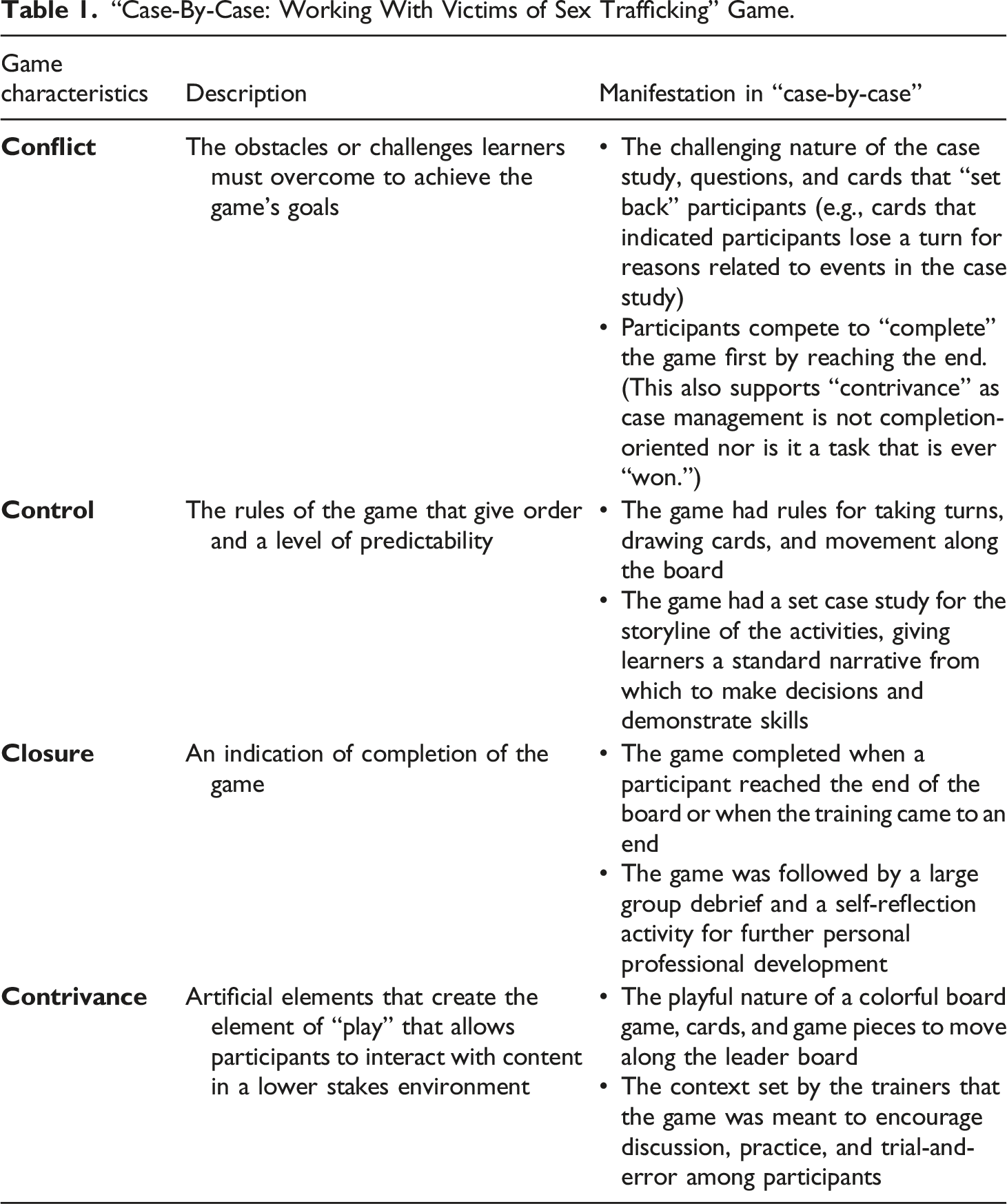
Interactive and experiential learning strategies designed to promote application have been mapped to Kirkpatrick’s (1959) third level of evaluation: the degree to which we can expect participants’ behavior to change because of training. With GBL as a subset of experiential learning, Stolovitch and Thiagarajan (1980) indicate games require four concepts to differentiate them from other interactive learning strategies: conflict, control, closure, and contrivance.
When used as a learning technique, storytelling can create empathetic connections to others’ experiences, and build familiarity and trust that can open training participants to learning (Boris & Peterson, 2018). Stories can be utilized to deliver complex content in approachable ways that learners can access from a variety of perspectives (Boris & Peterson, 2018). GBL, when paired with a story arc, can elicit an emotive rather than transactional interaction that differs from typical professional training experiences (Burke, 2014). Case studies paired with games, in contrast to simulations, can promote trial-and-error, help learners take risks, make mistakes, and encourage participation rather than framing undesirable outcomes as failure—what is sometimes referred to as “graceful failure” (Plass et al., 2015).
The Engaging Child Victims of Sex Trafficking training curriculum
In 2015, University of Maryland Baltimore School of Social Work collaborated with Maryland’s state child welfare agency, Department of Human Services, and Healthy Teen Network, a technical assistance and training nonprofit focused on adolescent health, to create and pilot a training titled Engaging Child Victims of Sex Trafficking. This comprehensive training aimed to equip child welfare professionals with skills and knowledge to identify and respond to child victims of sex trafficking in a trauma-informed and victim-centered manner (Finigan-Carr et al., 2019). Using subject matter experts on trafficking and adult learning principles, this was an eight-hour professional development in-service training that covered the definitions, manifestations, and typologies of child sex trafficking, as well as policy directives, laws, and protocols for handling such cases. The training employed a mix of modalities, including lecture, videos by trafficking survivors, group activities, and an in-depth case-study game (called Case-by-Case: Working with Sex Trafficking Victims (Case-by-Case)) in which participants work together to progress through real-life case studies and practice skills learned earlier in the training. Specific content of both the didactic and game-based sections of the training included: trafficking-related vocabulary, identifying trafficking cases, case types and dynamics (trafficker-controlled, familial, gang-controlled, and non-trafficker-controlled), mapping reported child trafficking cases around the state in rural, suburban and urban areas, risks and vulnerabilities to child trafficking, methods of recruitment and control, health and mental health impacts of the experience of being trafficked (including trauma bonding), engaging with survivors, and preparing survivors for potentially re-traumatizing interaction with law enforcement, as well as state policy and state and national reporting requirements. State-specific trafficking risk factors, such as a central location, interstate highways and trucking, low-cost airlines, vulnerable, high-poverty communities, and transnational gangs are also presented, and contrasted with international trafficking and with smuggling.
The theory base of the training was survivor-centered and trauma-informed (Harris & Fallot, 2001; Substance Abuse and Mental Health Services Administration, 2014). The views, power, knowledge, and direction of survivors were centered with planning and design of the training from child sex trafficking survivors, with training content in survivors’ voices, via video testimonials, and with child trafficking risks, impacts, and prevalence data centered on victims’ experiences, rather than law enforcement system views. This also had the effect of presenting survivors from an empowered perspective at times, reflecting the varying degree to which survivors see themselves as victims (see Dank et al., 2014; Lutnick, 2016). More broadly, the training was grounded in trauma theory and trauma-informed care (Harris & Fallot, 2001), with content focused on the teaching general approaches and specific clinical skills that are effective with highly, chronically, and multiply traumatized survivors of CST. This included teaching on stages of change and trauma-informed pacing, as well as how to prepare survivors to interact with law enforcement and systems that are likely to be re-traumatizing.
Between 2016 and 2017, University of Maryland Baltimore School of Social Work piloted the training and conducted a series of focus groups with workers. After edits were made to the curriculum based on the pilots and focus group findings, the training curriculum was finalized in June 2017. The curriculum was standardized with a detailed trainer’s manual, participant workbook, and Case-by-Case game materials. In 2017, the state child welfare agency issued a statewide policy requiring a two-part training on sex trafficking as part of the Core Curriculum for all new child welfare staff, and the statewide rollout of Engaging Child Victims of Sex Trafficking began. From 2016–20, over one thousand staff were trained. By 2020, existing workers had been trained, and the course became part of the onboarding of new child welfare workers. At this same time, a synchronous online version was launched, in response to the pandemic.
Creating this training posed several challenges, primarily because even introductory material on human trafficking is dense and can be complicated. Human trafficking presents differently in communities across the globe (Council of Foreign Relations, 2022); therefore, it was critical to explain how human trafficking manifests in the state. Additionally, the curriculum required content on the state child welfare agency’s official policies in responding to trafficking cases and their requirements for caseworkers. As this was a mandatory training for child welfare staff, the audience was geographically and demographically diverse and included professionals with a wide variety of job duties, education levels, and years of relevant experience. Lastly, one of the most challenging aspects was the deeply upsetting nature of training material; asking participants to focus on such a heavy topic for 8 hours can be emotionally and cognitively taxing.
The Case-by-Case game
The Case-by-Case game used four unique case studies derived from common characteristics of child sex trafficking cases to ensure participants learned about varied survivor experiences spanning ages, genders, and victim circumstances. Throughout the game, participants responded to questions related to their assigned case studies and on child sex trafficking more generally while moving along the game board (Figure 1). “Case-by-case” game board and cards.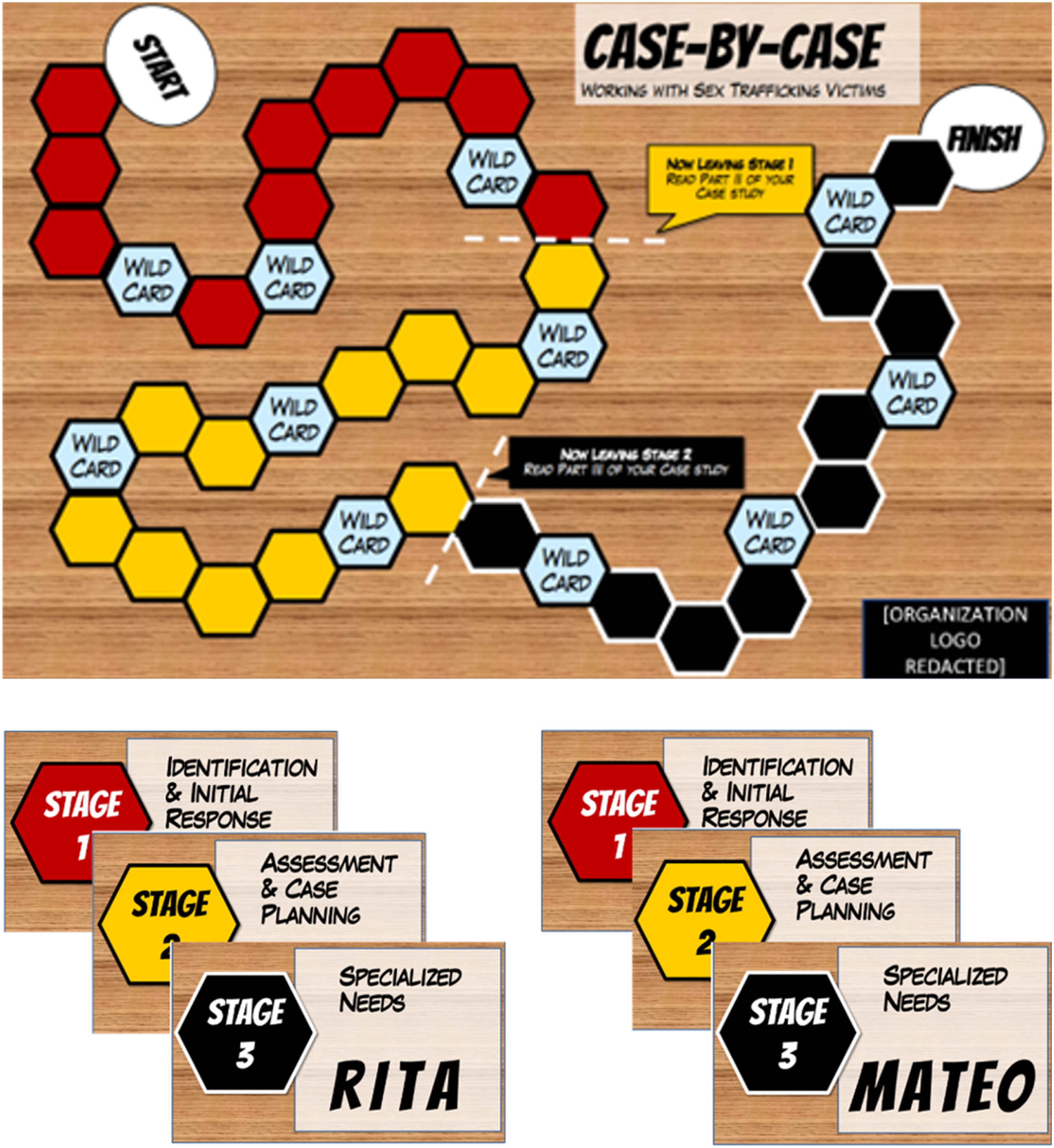
“Case-By-Case: Working With Victims of Sex Trafficking” Game.
During play, training participants were assigned to small groups of two to four people and provided a game set that included: a game board; game pieces; a printed case study; and three bundles of game cards with questions that mapped to the case study’s stages and a fourth set with general questions about child sex trafficking regardless of the case study (“Wild Cards”). Wild cards reinforced earlier training content with statements such as: Imagine your client is a foreign national trafficked in our state who is a key witness in the Federal case against his trafficker. He is co-committed to the Department of Juvenile Services and the Department of Social Services. There could possibly be four attorneys representing your client in different roles, name 3 out of the 4 possible types of attorneys. Question topics included definitions, and typologies of child sex trafficking, risk factors, psychological and physical impacts of CST, as well as the basics of policy directives, laws, and protocols for handling such cases. The case study and game cards were broken into three stages corresponding to three stages of case management ((1) victim identification, (2) case management, and (3) ongoing treatment and support). Examples of case study-based questions included: To assess for trafficking, name 4 things you would
Between stages, a trainer paused the game and engaged the large group in a short discussion about specific skills. The game’s structure appeared to encourage discussion, trial-and-error, risk-taking, and participation among novice and veteran workers. A true simulation might have felt more formal and could have discouraged this level of interaction.
Evaluating Case by Case
The Engaging Victims of Child Trafficking training was evaluated over the course of five years using quantitative survey data including open-ended questions (n = 1061), and post-training focus groups (n = 29). Regression analyses showed that the training was associated with a positive change from pre-to post-training on both knowledge (R2 = .472) and self-efficacy (R2 = .381), even when controlling for pre-training knowledge and self-efficacy, gender, race, experience, and position (Harmon-Darrow et al., 2023).
An open-ended question at the end of the post-training survey asked, “do you have any additional questions?” More than 150 people wrote comments about the training, of which most were positive statements about the training (52 comments) and the trainers (23 comments), who were often called “knowledgeable.” Sixteen participants wrote that they loved the game and thought it was interactive, fun, stimulated discussion, required learning to be applied to cases, and reinforced key learnings. It was also criticized by 16 people who mostly wished it were shorter. One participant felt the game made those with less previous content knowledge on trafficking feel badly.
Three qualitative focus groups were held with nine to ten trainees in each (n = 29; see Burruss-Cousins et al., 2023). Within a larger dialogue about the whole training, child welfare workers talked about the fact that the small group work using the game allowed them to hear the wisdom of fellow workers, not just the trainers: that game, we had quite a few groups going on, and we did spend a lot of time really talking about it, and just about the situation and how it would be handled, and … it gave you the insight of different workers, and how they would handle things.
Another training participant felt that the game helped untangle the complexity of child trafficking cases: …playing the board game that was associated with this training, … having examples and kind of like working through those examples. I think for me in, in any trainings like this, it’s beneficial to hear what sex trafficking can look like. Because there’s a lot of moving parts. …these situations are kind of messy, and trying to figure out all the pieces is challenging.
Taken together, the survey data, open-ended survey responses, and focus groups show that the game-based training was a participatory, effective, collaborative method of teaching new knowledge, skills, and confidence to child welfare workers learning to identify, serve, refer, and engage with survivors of child sex trafficking.
Conclusion
Game-based learning uses gameplay mechanics to make learning more interesting and engaging (Plass et al., 2015). Games can be used to teach difficult topics, such as child trafficking, in a way that focuses on skills building allows the learner to receive instant feedback and acknowledgment. Through the Case-by-Case game, child welfare workers applied knowledge and skills learned via traditional professional development modalities using stories in a low-stakes environment. The game allowed participants to perform new behaviors and learn material that otherwise may have been abstract, distant, and challenging, which shows promise for the use of GBL for future trainings for child welfare workers on CST or other complex subject matter.
Footnotes
Acknowledgments
The authors acknowledge the significant contributions to the development of the curriculum under study by Janet Max of Healthy Teen Network, and Sharon Henry, formerly with University of Maryland School of Social Work.
Declaration of conflicting interests
The author(s) declared no potential conflicts of interest with respect to the research, authorship, and/or publication of this article.
Funding
The author(s) received no financial support for the research, authorship, and/or publication of this article.
