




Abstract
Diverse national and local policies represent efforts to guarantee inclusive and equitable quality education and provide lifelong learning for all (SDG4). Their effects have the potential to alter local access to education. There has been a lot of research on the factors that led certain universities to embrace distance learning programs in their local communities, but relatively little has been done to examine how these changes can affect the perceptions of the larger community approach to investigating public opinion. This study investigates community perceptions of distance learning through community learning centres in Ghana’s port city, Tema Metropolis – which supports various educational activities – using semi-structured interviews. Although community members expressed concerns about the possible socio-economic effects of learning centres, we discovered that individual students who used the learning centres were driven to pursue distance learning largely for its educational advantages. Our research demonstrates that the scope and speed of distance learning made possible by community learning centres has influenced local communities such as the Tema Metropolis and beyond. To guarantee that community learning centres encouraged by DE policy are administered effectively and fairly, such implications must be considered in research, policy, and planning.
Introduction
Effectively responding to continuing education requires transformational changes across all sectors, including high-quality resources, and the enthusiasm and learning skills to benefit from them (Taylor et al., 2020). As governments worldwide seek to meet their quality education (SDG4) commitment under the 2015 New York Agreement, the effects of ensuring inclusive and equitable quality education and promoting lifelong learning opportunities for all are often disproportionally felt by local and regional communities (Thummaphan & Sripa, 2022; Kostoska & Kocarev, 2019). Although they may be slightly different, the terms distance education (DE) and distance learning (DL) are used interchangeably throughout this paper. Distance learning may include e-learning, online learning, virtual learning, books, audio, video, and correspondence courses; distance learning programmes may include classroom instruction: This is known as blended learning (see Agyekum, 2020; Agyekum, 2023; Kwapong, 2022). Transitions to distance education (DE) or distance learning (DL) through community learning centres offer numerous socio-economic opportunities including increasing access to education in the local communities. However, careful and inclusive planning is necessary to foster social acceptance and minimise inequality and enhance effectiveness and efficiency in the educational system (Agyekum, 2022; Shaeffer, 2019). One such initiative is the use of community learning centres, as a vehicle for promoting of adult and lifelong learning, typically in response to local community needs (Rogers, 2019; Ahmed, 2014). Community learning centres and DL initiatives have long been recognised as inclusive and sustainable education strategy (Stanistreet et al., 2020; Wheeler et al., 2018), but set to expand alongside mainstream educational systems following recent commitments made by the European Union (Zalite & Zvirbule, 2020), the United States, Canada, and France (Wotto, 2020). For community learning centres (CLCs) to credibly support DL efforts, policy processes must not only effectively incentivise potential learners to adopt such community learning centres (Ilgaz, 2019) but also ensure the cumulative effects of these individual decisions at the CLCs are just and well managed (Lopes & McKay, 2020; Brockett & Hiemstra, 2018).
CLCs (formerly known as Worker’s Colleges) were first introduced in Ghana in the 1960s through the Regional Capitals to support workers in their continuing education needs. In 2014, these Centres were transformed into CLCs to allow not only workers but also individuals seeking to continue their education not through the regular on-campus university education. CLCs can deliver continuing education using the ‘Blended Model’, including 2-year diploma and 4-year degree programmes. The University of Ghana operates 11 Community Learning Centres across Ghana’s 16 regions. The Learning Centres pursue a vision and strategic goals that are consistent with the University of Ghana’s vision and strategic plan. In terms of functions, the Learning Centres are ‘Centres of Excellence’ that aim to provide world-class technology-enhanced adult and continuing education, as well as professional continuing development programmes, to prospective clients or potential adult learners who want to further their education. The Centres are led by a senior faculty member with a PhD who reports to the Dean of the School of Continuing and Distance Education at the University of Ghana. Many Learning Centres have cutting-edge computer laboratories, video-conferencing rooms, and smart classrooms, among other features that facilitate teaching and learning. The Sakai Learning Management System (LMS) software is used to make learning ubiquitous for many adult learners who pursue Diploma and Degree programmes at the Learning Centres via the DE mode (operating in a blended mode where students are engaged online during the week and attend tutorials at the centres on weekends).
CLCs are recognised to have large educational and economic potential, including supporting senior high school (SHS) leavers without the required qualification for university education through a tailored programme called ‘Mature Access Course’ for individuals 25 years and above and direct admission to individuals with the required university qualifications. However, concerns have been raised over barriers to participation (Agyekum, 2022), in addition to the overall support services of learning centres being issued (Amponsah et al., 2021; Biney, 2021). For a lack of participation and awareness, many community members have resorted to remedial schools for their educational needs. At the time of writing, 106 active remedial schools were identified in the Tema Metropolis (Ghana) and surrounding communities, assisting high school leavers without the required qualification for university education in various West African Examination Certificate Courses (WAECCE courses).
The majority of high school leavers seeking to better their grades for higher education in the Tema metropolis use remedial schools instead of the CLCs. The CLC’s approach aims to support high school leavers and others who otherwise would not have access to university education through the Mature Access and Entrance Examination for individuals 25 years and above. Individuals have the option to apply directly to university programmes in the CLCs after completing and passing the Mature Access Course in English Language, Mathematics, and Logic. A much smaller number of community members use the CLCs compared to the remedial schools for unknown reasons. The CLCs approach involves similar management activities to the main University campus programmes, except that it is a blended approach (60% online and 40% face-to-face) with the face-to-face tutorials held during the weekend (to allow full-time workers to participate). Private or individual organizations run the remedial schools for profit. They accept high school graduates who want to improve their exam results to pursue higher education opportunities. CLCs and remedial schools both assist senior high school graduates who lack the necessary qualifications for a university education. While the CLCs absorb them through a tailored program called ‘Mature Access Course’ in which Access students must pass entrance exams in Mathematics, English, and Logic to gain admission to the CLCs programs, the remedial schools organize the same high school programs to prepare them to retake the WAEC exams. Another distinction is the age of the prospective student. While the Mature Access applicants at the CLCs require a minimum age of 25, there is no age limit for the remedial schools.
Both the remedial students and schools have come under scrutiny due to concerns over the lack of recognition by the Ghana Education Service (GES) and that remedial students do not show any sign of seriousness, affecting the smooth teaching and learning in remedial schools (Oduro-Ofori et al., 2014). Research has shown that remediation is costly to students who are made to pay fully for their remedial education (Calcagno & Long, 2008). In Ghana, the remedial cost is borne by the students themselves since it is privately owned.
From an educational perspective, CLCs have been identified as suitable for literacy and basic skills; continuing education and vocational skills; and liberal, popular, and community education and citizenship skills all associated with lifelong education (Belete et al., 2022). These three key fields of learning were adopted by UNESCO’s General Conference in 2015, including its definition of Adult Learning and Education (ALE). In addition, the CLCs may share facilities like libraries, and sports centres (Belete et al., 2022; Author, 2020), and the current pandemic has shown the need to reflect more on new forms of blended learning. While the student population in the Tema CLC of the University of Ghana (UG) is low relative to the remedial schools, the CLCs do offer value as they ‘are increasingly recognized as playing an important role in providing education opportunities, meeting local communities’ needs’ (UNESCO 2021, p. 265). However, the CLCs are vulnerable because of a lack of infrastructure, remaining marginal to other educational institutions. Therefore, CLCs are in dire need of better recognition in our communities, services, and support (Belete et al., 2022).
Incentive-based policies that aim to facilitate continuing education, such as distance education, focus primarily on the motivations of individual students (Ilgaz, 2019). Within the peer-reviewed literature, there is a wealth of information on economic and non-economic factors that influence the adoption of DL (Sahin et al., 2022; Hasani et al., 2020; Ahmed et al., 2018), management practices (Rumble, 2019) and distance education specifically by individual learners (Im & Kang, 2019). Individual adoption decisions are known to be strongly influenced by social networks and norms, including community perceptions, for DL (Abbas et al., 2019; Cho et al., 2017) and other educational practices (Bervell & Umar, 2020; Sarrab et al., 2013). Yet, there has so far been limited research on how the adoption and spread of DL at CLCs is being perceived by local communities (Lytras et al., 2022). Community perceptions are important as they determine the level of public engagement and acceptance, which either hinders or enables DL policy success (Panigrahi et al., 2018; Sivo et al., 2018; Phirangee, 2016). As national and sub-national educational policies translate to institutional changes in CLCs (e.g., access and programmes) in communities, an understanding of community perceptions of such changes are needed to ensure that continuing education occurs in line with local priorities.
This research therefore explores community perceptions of a CLC in the Tema Metropolis, Ghana. Specifically, we aim to: (1) understand the community-level perceptions of the CLC in the locality, (2) determine the extent to which community perceptions influence the acceptance and adoption of CLCs by local potential students, and (3) what opportunities might exist to effectively engage with those concerns. By bringing perspectives of community members into focus, the paper thus contributes to the growing discourse on CLSs towards realisation of SDG4.
Study Region
The Tema Community Learning Centre (TCLC) is one of the 11 CLCs established by the UG to provide pre-tertiary and tertiary education to communities across the country. Tema is a medium-sized coastal city, which is recognised for its largest harbour in Ghana. It is located 25 km east of the capital Accra
The metropolis is characterized by remedial schools, which are widespread and rapidly absorb high school leavers who could not make it straight to tertiary institutions and it is often used as a vehicle for higher education during periods of out-of-school (Oduro-Ofori et al., 2014). While it is relied upon particularly when students fail their qualifying examinations (WACCE) to higher institutions, the productive value of remedial schools has come under serious scrutiny as they charge exorbitant fees with poor learning conditions and repeated failure of adopters. The rapid spread of these schools, particularly after frequent lower-than-average expectations, can have implications for individual well-being and the educational sector while posing a threat to realisation of SDG4. CLC is established to maintain educational success, especially for SHS leavers without the required passes for higher education. The spread of the remedial schools in the Metropolis creates additional pressure on the educational landscape and greater urgency to provide an efficient and appropriate alternative is warranted.
Overview of Methodology
The community perceptions of learning centres are investigated in this study using a qualitative, interpretive methodology (Braun et al., 2016; Cresswell, 2003). We employed semi-structured interviews, which enable both the researcher and the participant to expound on key topics and present novel ideas while keeping the major interview questions in mind. This method’s use does not impose preconceptions on the participants; instead, it gives them the freedom to freely express their thoughts and feelings about the study’s topic (Agee, 2009). A pilot study was carried out to explore the appropriateness of the interview questions to seek information on the context this study hopes to explore, but the semi-structured approach allowed the development of themes over time as new key questions and themes emerge. These responses were later used for data analysis and interpretation.
Following Research Ethics Approval from UG, our research approach enabled an in-depth exploration of key themes and issues from the perspective of participants, to understand the dynamics of the CLC in the study area. Participants were categorised by social and organisational groupings during the data analysis process to make effective comparisons (Hennink & Kaiser, 2022). Comparisons are made when there are multiple focus groups within the same study. Thus, it would be difficult to demonstrate how perceptions are influenced and how participants’ perceptions from different groups delineate from one another.
Participant Recruitment and Interviews
Participants were recruited using the ‘snowballing’, technique (Kaplan et al., 1987), beginning with known students accessing CLCs, contacts with local staff of CLCs, and students and organisers of remedial classes with knowledge of the Tema Metropolis and/or knowledge on distance education opportunities in the CLC. This recruitment method is more likely to acquire willing participants because informants can make suggestions based on their experience with the participants (Dubé et al., 2021). The study aimed to identify participants from three broad groups: community members who are accessing the Tema CLC (distance education students), and those who have completed high school but not attending remedial classes (prospects for distance education) living in the Metropolis (including those involved in petty trade); the Tema CLC representatives (Coordinators Organisers, and Administrators); and representatives of remedial school providers who promote and oversee remedial classes, and lastly remedial school students.
We looked at the importance of CLCs (which provide degree and diploma programmes in blended mode) to the creation of alternative mainstream university education in a broad sense. In the Tema Metropolis, we conducted qualitative research at seven pre-tertiary remedial schools, paying at least one visit to each institution. We observed and took part in a variety of educational activities at each remedial school while maintaining a field journal. We had casual interactions with managers, educators, students, and non-students, which we also documented in our field journal. Finally, we conducted 23 semi-structured interviews with all the categories of participants that ranged in length from 40 minutes to an hour and a half. The objective was not to generalise, and the semi-structured interviews give opportunity for further probing for depth of information. The interviews for each group were brought to a close at the point of saturation. It must be emphasised that similar but different questions were asked to the various respondent groups. The interviews were taped, and the primary author transcribed them verbatim. All participants were identified and given an identification number. Member checking, described by Candela (2019) as a method of credibility by returning findings to participants, was achieved by confirming transcripts with participants to ensure their results were reflected precisely. Recruitment persisted until code saturation, which allowed for the development of important themes (Saunders et al., 2018). Out of the 25 identified potential participants, we were able to conduct 23 interviews, including those with three distance education students, five high school students who were engaged in various activities including trade, but not in remedial classes, three CLC representatives, four managers from pre-tertiary remedial schools, and eight remedial class participants. Issues discussed include experience with CLC policies, distance education programme, advising roles, remedial school systems, educational dynamics, mainstream university education, and socio-economic systems and respondents were able to speak from several different perspectives.
In-depth interviews for the study were conducted between August and October 2022. The purpose was to enable us to better comprehend changing realities and seek clarification on topics brought up in earlier interviews (Vincent, 2013). To improve the interview guide and make sure the questions adequately addressed the research objectives, two pilot interviews were conducted with some learning centre representatives who were familiar with both the Tema Metropolis and the perspective of the CLCs, as well as a researcher who was familiar with semi-structured interviewing techniques. The interview questions focused on the participant’s role and experience with CLCs and the study place; programmes and mode of delivery at the CLCs–distance mode; benefits and effects of the CLC to the local area and communities; the impact of CLCs on the community at present and in the future; and suggestions for improvement or support.
Analysis and Interpretation
Transcripts from tape-recordings were compared to the field journal, and a thematic analysis that involves participants grouping based on the number of participants conducted. The responses were coded to find common themes (Nowell et al., 2017). The interpretation sought to make sense of the themes, place the findings in context, and highlight their importance with the alignment of community interests and the efficacy of policy effectiveness (Creswell, 2003). The primary author analysed the data, and to make sure that coding was used consistently, co-authors, as well as the usage of the literature, were used to cross-check and validate themes and interpretation. To analyse the data, NVivo 12 Pro (International, 2018) was utilized (Sutton & Austin, 2015).
Findings
Participants’ Socio-demographic Profile.
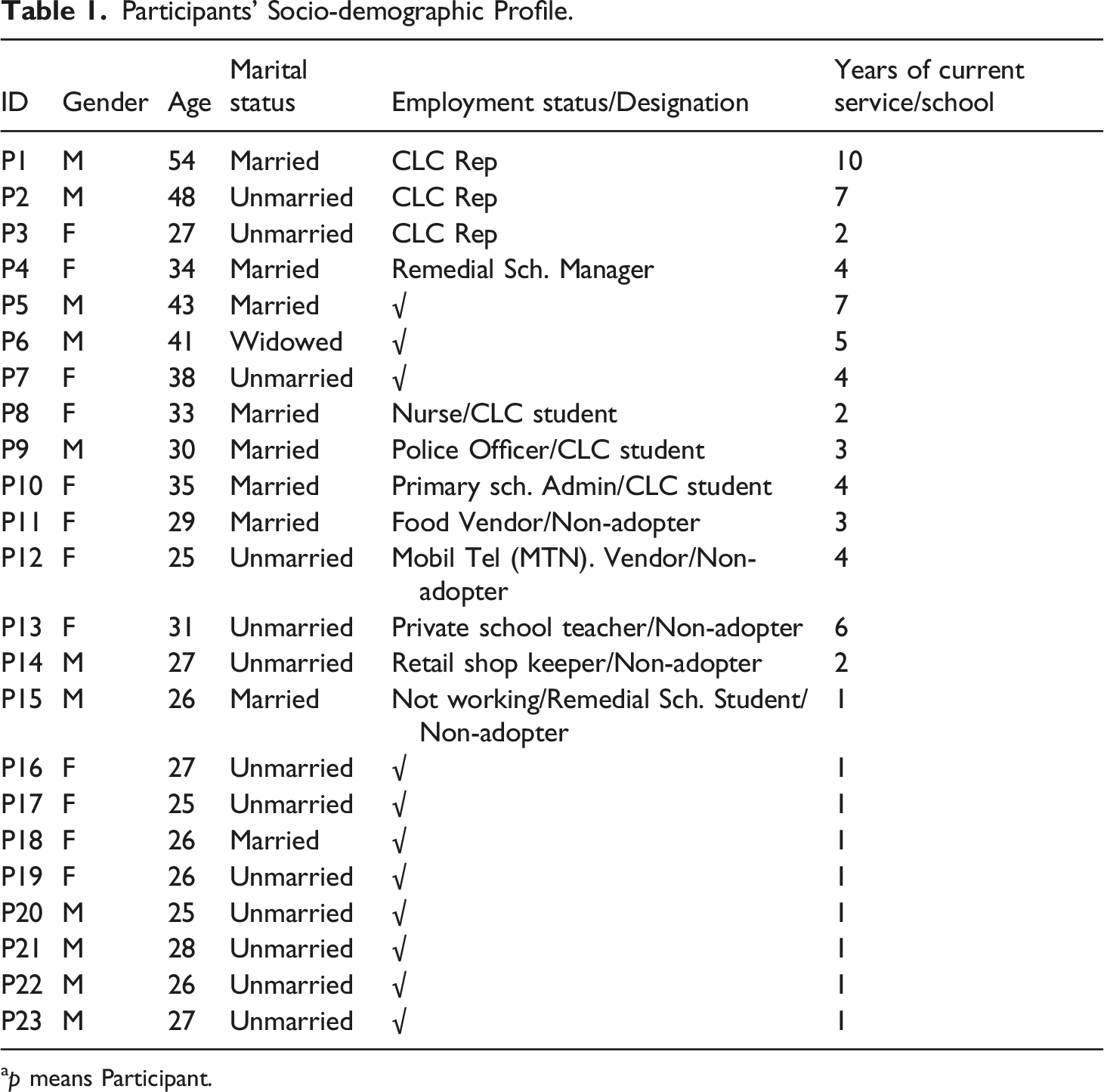
ap means Participant.
Educational and Financial Opportunities
The greatest drivers amongst individual adopters of DL in the CLCs were the opportunity to work during the weekdays and attend classes during the weekend, and the additional flexibility of attending to family. This affordance of working to maintain income sources and at the same time learning to improve one’s conditions of life was considered to facilitate a more sustainable and viable CLCs programmes. Some individual adopters noted that despite low patronage from the community, the financial affordances presented by DL in the CLCs were a primary driver of adoption, especially considering the existing financial and family pressures on their educational path. One adopter discussed the contempt they experienced when they first adopted DL in the CLC, however, found the ability to work and study at the same time from the programme more strongly reinforced their decision to adopt: ‘… the CLC gives you the opportunity to school as well as work, and that is the major driver’. (Participant 8).
Educational burdens, such as financing and attending classes on regular basis during the week days from regular university programmes (i.e., regular university and college programmes) were highlighted as a source of economic and psychological strain for a number of potential students. Most participants in the study acknowledged that the diversification opportunity offered through DL in the CLCs was a ‘saving grace’ for many who, due to these pressures, were struggling to maintain their educational and financial obligations. In spite of having reservations about the CLCs’ programmes, there was consensus amongst the participants that opportunities have been created not only through providing higher education programmes through DL but also knowledge and skills that would empower members and boost community development. Generally, adopters of CLCs suggested the educational opportunities outweighed potential setbacks and reservations highlighted by the broader community. Some adopters suggested there is potential indirect impact on learners’ finances to the wider region; both favourable and unfavourable impacts were discussed. “… great opportunity, studying and working at the same time, that’s making money to support oneself… it’s a good student strategy, you can make a lot of money by working during the weekdays without abandoning your work… that makes your life a bit easier. It means that instead of having to be on campus till completion, you can be here a few weekends.” (Participant 1).
Both adopters and non-adopters in the study area considered that the financial certainty achieved through learning at a CLC, particularly for full-time working adults and the additional, regular income assured over its duration, was a major driver of adoption and overall socio-economic sustenance in comparison to regular on-campus programmes. However, it was stated by several participants that this financial sustainability is only a short-term solution, and that those who did not adopt were not willing to sacrifice their regular on-campus life for a ‘here and now’ opportunity.
CLC and remedial school participants also identified income sustainability for adult workers leading to greater income regularity and satisfaction in the CLCs. A number of participants from these groups expressed that they encourage students to have multiple income streams to support their education and the CLCs are the best institutions to achieve these strategies. They also indicated that a common misconception among the community is that the CLCs are not attractive and the distance programmes are limited and highlighted that better communication and reaching out to the community would be beneficial in addressing these concerns.
Other Community Learning Centre Potentials (literacy, basic skills)
CLC representatives and adopters considered that distance programmes in the CLCs provided a range of economic and educational co-benefits to the broader community, including not only higher education programmes but also knowledge and skills that would empower members and boost community development, sustained employment opportunities, and financial security for students/adopters. In addition, social benefits included family and friend relations in the community, short commute distances to CLCs and access/engagement in community activities and services (such as funerals, religion, etc.). However, very few community members shared this view. Community members generally agreed that CLCs’ programme, such as the undergraduate programmes created a ‘different institution’ with a lack of better programmes, increased dropout and completion issues and an inability to attain the standards of other higher education institutions in the main universities. There was some disagreement between participant groups on the extent of some co-benefits. Individual adopters within the community were able to recognise some educational benefits in terms of flexibility, however, generally perceived that some of the CLC programme’s shortfalls, such as the limitation of better programmes, were more detrimental to CLCs than not. Also, individual non-adopters of the programme in the community in the same vein, did mention the lack of better programmes as a limitation. All my friends say it. CLCs have so many constraints. How do they want young people to come and take those courses? (Participant 12). They should offer better programmes, they will become vital for community life around here, otherwise the LC will die, I think (Participant 14).
CLC representatives and adopters had a more optimistic outlook regarding potential benefits, although it was recognised that there had not been outreach or reporting on the educational and socio-economic benefits in the local community. It was mentioned by a few of these participants that educational co-benefits are achievable at CLCs where sustainable management practices are put in place. However, it was indicated that there is a need for effective communication and publicity on CLCs’ in the study region to evaluate the benefits and impacts of the CLC programmes.
Non-Active Involvement and Apathy
A common perception by community members was the importance of potential adopters in the area, which includes a dense population in the Tema metropolis (huge youth population). Densely growing Tema and the surrounding communities referred to by several participants as a ‘bumper harvest’, was considered to increase enrolment in the CLC. CLC adopters associated non-active involvement with lack of infrastructure and CLC adopters labelled ‘inappropriate students’ by their regular on campus university students. The concept of ‘inappropriate student’ refers to the perception that students in the CLCs are not being managed and treated well, and the students do not have any campus life. They also expressed concerns that DL generally prohibits different business and science programmes and encourages and attracts poor students leading to the production of graduates that are not as good as regular university students. Community members (non-adopters) also associated the lack of involvement in CLC programmes with non-active management, and while not much was known about the details of CLC programmes in the area, they said the community felt its effects like ‘adult literacy centres’. Broadly, CLC was viewed as a centre for adult literacy training and not as an option for higher education by community members.
Non-adopter participants expressed concerns that increased CLC uptake in the area promotes continuing education and productivity in the region. However, there appears to be greater concern around remedial schools becoming the dominant vehicle for continuing education amongst high school leavers across the landscape, as it is attributed to reduced quality education and training, leading to an undesirable landscape with limited socio-economic development. “So, the remedial schools are spreading, and it’ll take probably some years for people to know other alternatives. Why isn’t their more participation in the CLCs…? I don’t think it has to do with they don’t want to. They don’t know how, and when they do, they don’t understand it. They don’t understand what they are seeing/hearing, and they get turned off because it’s not friendly for them.” (Participant 5).
Some participants, predominantly representing the CLC and adopters, claimed that the perceived lack of well-managed facilities and ‘inappropriate students’ are issues that existed before Workers’ Colleges were transformed into CLCs, and that the CLC methods do not allow for non-active involvement. Despite this, students/adopters identified this as a major perception and credibility issue in the area. However, there was some recognition in the community that CLC activities are not solely responsible for issues such as non-active involvement and lack of quality education in the area – instead, CLC is seen to be accelerating these issues. One participant (No.4) observed, ‘there’s certainly an educational benefit for the participants. Whether it has direct benefits to the community is something that remains to be seen’. Thus, the positives or negatives of CLCs were identified, but it is still early to make judgements about impact.
A major theme discussed amongst CLC representatives, and some remedial schools, was community conflict. It was suggested by these participants that negative commentary about the CLC programmes derived partly from jealousy from non-adopters who were not eligible for enrolment in the CLC. The local perception, according to one participant, is that CLC students are rewarded by their managers for doing very little in their academic performance. It was recognised that in our educational landscapes, where the government provides marginal financial support, some people struggle to generate enough income for their educational needs. Where the CLC has been able to supplement some students’ incomes (i.e., working and studying at the same time), others are not eligible (e.g., remedial schools); which has caused some discontent within the community.
Educational Uncertainty
There was a strong perception from community members that the CLC is based on business rather than education. Disappointing experiences with the Centre on separate occasions have also left local people in the community sceptical of the Centre’s success and educational certainty. There is a general mistrust of CLC management-related schemes because previously, certain policies have not worked or have received major criticisms from the community. Community members, mostly students/adopters, discussed the unease and uncertainty associated with dropouts, missing grades, and what happens after the programme period to graduation. CLC students also voiced their concern about their position as a minority group (compared to regular on-campus students) within the larger university space with little political voice: “I don’t want to say it’s lower expectations. I think it’s [CLC] different expectations now, everyone has a certain expectation, whether good or bad. The CLCs don’t threaten you equally, but you need to have more sense of the need to conform” (participant 10).
These concerns included the influences that higher-level university policies and decisions will have on the distance programme and the certainty of CLC as an institution. “How it actually works is that you need enough energy and time in your life, and money, to make that kind of sacrifice for your education” (participant 9).
As a region that relies predominantly on private remedial schools for their continuing education, community members pointed to considerable uncertainty regarding how the CLC will impact their educational future. There appeared to be a very superficial understanding of the CLC and DL (as an institution) within the community, with several participants admitting to a strong scepticism and reluctant acceptance of the CLCs.
Policy Concerns
In discussing the implications of the CLC, several participants suggested that a change in the CLC programmes to allow students to have a variety of courses to choose from would address the issues of ‘not too good’ programmes in the CLCs. This theme also raised questions regarding infrastructural imaginings of the landscape. One CLC participant described the ‘landscape’ effect created by management practices and stipulated it was unattractive to students that want to enjoy university life. While locals recognised the need for a better landscape through redevelopment to uplift the CLC’s image, most participants agreed that the ability to allow for better programmes would increase willingness to accept DL in the CLCs. Many also indicated it would facilitate a readiness by the universities to give admissions to highly qualified students in the CLCs, reduce the fears and concerns associated with dropouts and completion, and create a more balanced ‘natural’ state of the environment. For example, participants also suggested re-evaluating the type of academic programmes appropriate to the region, such as tailored programmes that may allow for greater active involvement: “I think, a lot of the… whether the programme diversity or… the environment, it’s just people don’t know what to do, they are uncomfortable” (participant 6). “It’s a kind of lower expectations. It’s true” (participant 21).
Participant six resisted the suggestion that from a well-structured higher education environment are the results of ‘lower expectations’, refusing to make a normative judgement. Later, she underscored that the acceptance of CLCs is not a lifestyle choice but a consequence of convenience. CLC participants, exempting other participants, expressed caution about running programmes without an assessment of the regional context and careful consideration of whether enough research has been conducted to determine the impact of CLC.
Outreach: Information and Communication
The lack of continuous flow of information was identified as a major contributor to communication problems and poor perception of the CLC at the individual and community level. CLCs have WhatsApp or email communication channels with students. While those few CLCs seem to have utilized technology as best as possible with seamless communication to the community via videos, online guides and support, it is a unique challenge for many CLCs. They may have to evaluate how effective their outbound communication has been and whether local communities can get the information they are intending to receive in the first place: “Generally, there’s a need for communication and information resource (including strategies) for CLC management who have a vested interest in the programme that can give accurate advice.” (Participant 16).
The main source of information about CLC in the Tema area is through mini posters and flyers, which facilitate and serve the few people who come across them. Participants reported instances where poor advice had been provided to prospective students. While community members appreciated that CLC provided educational benefits for local adopters, they generally held low regard for communicators and information flow, who were perceived to exhibit disingenuous and unreliable communications towards community members. This relates to a perceived ‘… need to ensure that the CLC is well-strategized in that what people are telling community members [potential students] is reliable’ (Participant 2). Some participants identified the need for more accurate, simple information from representatives of the CLC with no vested interests. The Tema CLC was suggested by participants as potentially filling this role, however, one participant noted that the Centre groups cannot maintain this role due to limited resources and staff.
Community members pointed to a lack of UG’s messaging to the regions, which was believed to contribute to a lack of community understanding and acceptance of its CLCs. One participant made comparisons to CLCs outside of the UG CLCs that have seen greater acceptance of DL programmes and indicated that the perceived lack of acceptance most likely stems from concerns about fewer programme options available to students (such as lack of Master’s programme in the CLCs). In CLCs where DL had been widely communicated, this participant found there was greater adoption, thus recommending the need for better communication and improvement of information flow in the Tema area.
Discussion
This research aimed to explore community perceptions of the UG’s CLC within the Tema Metropolis. Since the introduction of the CLC, the Metropolis has experienced educational change through DL at a low pace: close to 400 distance learners (Tema Learning Centre Report, 2022) have graduated since the CLC started in 2014. Our findings show that the financial incentives offered by the CLC through work and study have motivated the working adult to adopt DL, despite community and individual concerns over potential infrastructural and educational uncertainties. Impacts of the CLC on socioeconomic development have been minimal in the region due to a mismatch between expectations held by the community and the educational opportunities facilitated by DL. We find that while CLC representatives and students considered that the CLC provided a range of co-benefits to the broader community, very few community members shared this view. There is also still uncertainty and reservation around the longer-term impacts of the CLC in the community.
One of the most significant findings of the study is that, despite shared concerns with the community, individual CLC students chose to adopt DL primarily for economic benefits. There are many examples in the literature of distance learners being motivated by indirect economic incentives, such as saving time and money on travelling to campus on regular basis as well as learning outside of work, which does not affect the result of their effort (Tosheva & Gancheva, 2015). However, the literature also emphasises that economic incentives alone cannot be relied upon for DL adoption and acceptance – curriculum, expectancy-value aspects of motivation as well as social and contextual factors (Hartnett, 2018) are also critical for long-term policy success. In the study area, participants were primarily concerned that the CLC programmes do not serve the employment needs of the community and the wellbeing of the economy, due to the selective nature of the DL programmes.
Our results suggest some conflicting community perceptions of the CLCs’ distance programme with its provision of educational and economic incentives. On one hand, students who adopted DL were seen to receive educational and co-benefits for doing what is perceived to be less rigorous in their pursuant of higher education, in contrast with conventional standards. On the other hand, perceived marginalisation of non-adopters from the economic benefits of CLCs reportedly contributed to jealousy, which drove the spread of negative commentary amongst the community. Nichols (2016) also observed that distance learners are perceived to be not formally equivalent to on-campus provisions in a study in New Zealand. These negative perceptions and social impacts, including those relating to the value of the programme, did not appear to outweigh the socioeconomic benefits derived from CLCs for individual adopters in our study area. Notwithstanding, our findings suggest that it is crucial to consider the values, perceptions, and attitudes held by community members concerning policies that have the potential to transform CLCs. For example, it was acknowledged in our study that greater flexibility around the CLC programmes has been the cause of increased willingness to participate. Such contextual information can also assist in implementing effective processes for community participation (Lovett et al., 2018).
Non-adopter participants in this study perceived that distance programmes at the CLCs decreased active learning and changed the overall appearance of what they considered to be a higher education environment, disrupting the expected standards. As observed in two Russian universities (Markova et al., 2017), although degree students overall positively evaluated their DL experiences, they face some learning challenges regarding practical and effective communication patterns. Such experiences and perceived narratives around DL in CLCs are well entrenched and have existed for years (Bergdahl & Nouri, 2021).
Nevertheless, DL in the Tema CLC challenges the local community’s perceptions of what defines a higher education institution’s environment. Our findings point to an overall opposing view to the operation of CLC in the community because of the perceived challenges and threats that DL poses to active involvement, quality, and sustainability in higher education. Similar community perceptions due to challenges in the CLCs are found in other regional CLCs where degree and diploma programmes are run. Perna et al. (2014) reported that retaining students is a key challenge with a high attrition rate. Author (2022) also discuss the concept of identity in distance learning, whereby community norms and expectations around higher education institutions shape community beliefs and acceptance of DL from CLCs. Where there is the ability to undertake consultation and outreach before the introduction of distance programmes in particular communities, addressing concerns and identifying potential contextual and compositional factors may assist in the level of acceptance, adoption, and impact in these communities. Community values, perceptions, and beliefs play a large role in acceptance and adoption; this highlights the importance of understanding community perceptions, engaging with locals and addressing local values to achieve programme success (Author, 2022; Abbas et al., 2019; Panigrahi et al., 2018). Eskasoni et al. (2022) emphasise that reaching out to the community, including sharing physical space and resources with community organizations, expanding volunteering opportunities, and workshops with community organizations are necessary to ensure community acceptance of CLC initiative that aims to transform and shape communities.
Community mistrust undermines policy success and acceptance of CLC programmes (Wamaungo 2013; Kelly, 2017; Williams, 2018). In the Tema LC, this mistrust was largely credited to a perceived lack of better programmes, awareness and rigorous information campaigns in the community. The CLCs as a solution to the higher education needs of communities is no doubt influenced by the perceived value (educational or otherwise) of existing programmes. Within the study region, the existing infrastructure and the limited programmes have left a different legacy – one that appears to be increasingly at odds with the needs of the community, particularly the youth. Opponents of the CLC programme have negotiated this disjuncture by appealing to alternative form of education – remedial schools where the opportunity for better programmes might be possible. At the same time, the lessons from the CLC appear to be more of a cautionary tale for the university management, serving as a reminder that there is the need for extension work through awareness creation – providing independent and accurate information to the community was identified across all participant groups in our study. Baumber (2022) similarly identified a need for information campaign to build trust in adult education centres to highlight the source of mistrust between the community and the learning centres.
Policy uncertainty is identified across the literature as a major barrier to the adoption and acceptance of CLCs and lifelong education (Walters et al., 2014; Orlovic Lovren & Popovic, 2018; Tagoe et al., 2022), which was also strongly reflected in our research. CLC representatives were primarily concerned about how the programme and policy uncertainty might influence the educational benefits delivered by CLCs. The participants were concerned with how the CLC programmes might impact the region in terms of employment effects and ongoing interest in science and technology programmes, which participants were concerned would demoralise the youth in the community.
Recommendations for Future Research and Policy
The study’s results show that while opinions about the CLC in the Tema Metropolis ranged from favourable to unfavourable, there was a general worry about the potential educational and economic effects of the Centres programmes and management. It is interesting to note that, despite attempts made during interviews to concentrate on perspectives within the larger community, attention was given to non-adopters while talking about perceptions and concerns. This is unsurprising given that individual non-adopters are the target market for the adoption of the CLC programmes, but based on talks in the community or observations, it seemed that the larger community had a limited understanding of the CLC. Earlier on, the Centre hosted informational sessions and workshops that were perceived as valuable, although it was evident that there needed to be representatives from all the sectors receiving the programme information and impacts on the community, either favourable or unfavourable. Participants in this study who were CLC representatives and students said they were hesitant to challenge specific community stereotypes they believed to be false out of concern that doing so could amplify the influence of those attitudes. But there were costs to not addressing problems. Participants in this study suggested that the CLC representatives were acting as the ‘information campaigners’, however, it turned out that the representatives cannot often do so due to a lack of staff and resources.
It should be noted that information sessions typically lack the participatory processes needed to effectively engage the community and resolve misunderstandings of the programme’s impacts, even though building the capacity of reliable CLC representatives can help provide ongoing support and advice to potential students (Carey, 2013). For their long-term support, it is essential to ensure that community involvement in programme development is developed and preserved (Alemdag et al., 2020). The financial opportunity and flexibility (working while learning) aspect in particular has a propensity to disregard the larger community perception and concentrate on changing individual behaviour, although this context ultimately determines programme effectiveness (Lovett et al., 2018). Programme development and communication processes can benefit from the incorporation of local knowledge and needs.
Future research should look to understand how financial sustainability for workers on CLC programmes feeds into local economies since economic incentives were found to be the primary motivator for adoption and acceptance. According to Sardain et al. (2016), many economic analyses on CLCs leave out the benefits to the community, potentially undervaluing the programmes themselves. Community members accept that CLC programmes provide indirect financial freedom to adopters (i.e., affords them to work and study), but it is unclear how this affects the overall economy. Addressing local perception about low participation may be made easier by knowing how the CLC influences the local economy. In addition, further research could look into the contributions of CLCs to primary or secondary education. This was outside of the scope of our paper. We were curious about post-secondary education in the CLCs.
The findings of this study, despite the small sample size, are nevertheless highly pertinent because public policy interest in CLCs for DL is perhaps at an all-time high in recent times. The Government of Ghana’s $4.5 million Distance Learning and Education Sector Resilience Fund and a $200 million World Bank’s Support Fund to help increase broadband access to strengthen the digital innovation ecosystem, and also help close the digital divide are just a couple of the initiatives and strategies that many Ghanaian higher education institutions have now implemented since the arrival of COVID-19 to further encourage DL programmes (World Bank, 2022). Future research is necessary because it is unknown how much these occurrences may affect CLCs beyond what has been reported in the media.
Overall, our findings highlight the significance of taking into account community perceptions in CLC policy and research, as well as how community values, attitudes, and perceptions influence acceptance of this programme. Typically, CLC programme is marketed and framed as a way for individual adopters to enhance and empower individuals and provide educational and social co-benefits. However, our findings and the low participation that has occurred in the Tema CLC suggest that such an individualistic lens has significant flaws. Up to a third of potential adopters enrolling in remedial schools rather than CLCs does not appear to have been foreseen by the Management of CLCs, which would necessitate their careful monitoring of both material and nonmaterial impacts would surely have been identified. Since there is a strong likelihood that the CLC DL programme will lead to significant socioeconomic change, policymakers, and researchers should take note of what is known about the CLC initiatives. This includes the significance of participatory, deliberative processes for minimizing the spread of remedial schools and their effects on CLC enrolment efforts on the youth.
Conclusions
Our research confirms that community mistrust and policy uncertainty are significant impediments to the adoption of CLCs, whereas economic rewards (in the form of work and study) serve as the primary motivator. However, our findings also highlight the role that ingrained local attitudes, values, and beliefs played in the Tema CLC’s negative community opinions of distance programmes, which in turn affect individual adoption. It was discovered that the widespread of remedial schools in the communities posed challenges to social norms and expectations around CLC programmes. To support a just and well-managed transition from high school to CLC programmes, our research emphasises the urgent need to incorporate community needs and values into the design and execution of future CLC initiatives (Groulx et al., 2021). While national-level action on distance education is necessary, a local understanding of the issue is crucial for successful mitigation results and for coordinating continuing education efforts with challenges to the programmes and infrastructure. Continuing education policy is rarely simple, and its potential effects on the economy, society, and individual well-being must be evaluated (Neimeyer et al., 2019). While initiatives like the CLC continue to focus on individual student adoption, policymakers must acknowledge that CLC may promote rapid and extensive changes in the higher education environment. To ensure that unfavourable outcomes, such as community impacts and trade-offs between remedial schools and CLCs, are early handled and achieved, careful policy formulation, implementation, monitoring, and assessment are required. In areas where the benefits of CLC programmes are most likely to be realised, community impacts can be maximised and managed with the help of transition planning that involves participatory and deliberative procedures (Osborne & Hernandez, 2021).
CLC could provide a pathway for reskilling and upskilling, such as the vocational training for entrepreneurship recommended by CONFINTEA VII Marrakech Framework for Action from 2022 (UNESCO Institute for Lifelong Learning, 2022 2023), which are required to meet society’s changing needs. CLCs support the commitment to ‘ensure inclusive and equitable quality education and promote opportunities for all’. This study supports the report of the International Commission on the Futures of Education (UNESCO, 2021), ‘Re-imagining our Futures Together: A New Social Contract for Education’, which emphasises that with the right to quality education, we can ensure lifelong learning and promote a sustainable future.
DL will continue to expand and become a part of economic and educational policy, and it will be crucial to take social implications into account to determine the amount of support from the community. The findings of this study suggest that community perceptions and good communication are crucial to CLC decisions since, in the end, the adoption and acceptance of programmes are what will determine whether or not a policy is successful.
Footnotes
Declaration of Conflicting Interests
The author(s) declared no potential conflicts of interest with respect to the research, authorship, and/or publication of this article.
Funding
The author(s) received no financial support for the research, authorship, and/or publication of this article.
