



Abstract
University students’ passion for their studies has been previously demonstrated to be important for both their academic performance and their personal well-being. However, no studies to date have explored the role of passion for one’s studies on both academic and personal outcomes in a single model. The present research sought to determine the role of passion in adult university students’ self-regulated learning and psychological well-being (Study 1), as well as the process by which passion shapes these outcomes, namely academic emotions, in Study 2. It was hypothesised that harmonious passion would positively predict both self-regulated learning and psychological well-being in Study 1. Furthermore, the mediating role of academic emotions between passion and outcomes was tested using a prospective design over time in Study 2. Results provided support for the proposed model. Implications for future research and practice focusing on the role of passion in facilitating adaptive emotions, use of self-regulation and well-being in adult students are discussed.
University students are required to navigate through one of the most challenging and significant periods in their lives. Successfully completing an undergraduate degree can have major implications for students’ futures, such as entering into their desired career or continuing their education in graduate school. Additionally, there are other important aspects of their lives that students have to manage simultaneously, such as social and familial relationships, maintaining personal well-being, and for some, the transition to adulthood and financial independence. Accordingly, research in the field of undergraduate education has focused on both students’ academic outcomes such as academic motivation (Barron & Harackiewicz, 2001; Simon et al., 2015), academic emotions (Goetz et al., 2007; Pekrun et al., 2017) and self-regulated learning (Pintrich, 2004; Zimmerman & Schunk, 2011), as well as personal/social outcomes such as social support (Bernardon et al., 2011; Maymon et al., 2019), mental health and well-being (Stallman, 2010; Verger et al., 2009), financial behaviour (Falahati & Paim, 2012; Jariah et al., 2004) and other lifestyle factors such as eating habits (Deshpande et al., 2009) and alcohol consumption (Bewick et al., 2008). However, little research has looked at both academic and personal outcomes in the same study. Additionally, no research to date has explored the role of passion in shaping both academic and personal factors in undergraduate students, and the mediating processes that contribute to the relationship between passion and these outcomes. Passion for one’s studies appears important as postsecondary studies often determine the professional course of students’ lives, and it additionally reflects passion for the field of one’s future career. Thus, could passion for university studies shape students’ academic and personal experiences during the degree process? Would these effects be the same whether their passion is in harmony with the rest of their lives, or obsessive in nature? The present research sought to answer these questions with two studies with two distinct designs, exploring the differential role of passion type on adult undergraduate students’ academic (academic emotions, self-regulated learning) and personal (psychological well-being) outcomes.
The concept of passion
Passion is explored in the present research through the lens of the Dualistic Model of Passion (DMP; Vallerand, 2015; Vallerand et al., 2003), in which passion is defined as a strong inclination toward an object, activity, concept, or person that one loves (or strongly likes), highly values, invests time and energy in on a regular basis, and that is a part of one’s identity. Furthermore, the model proposes two types of passion: harmonious passion (HP) and obsessive passion (OP). The first type of passion is internalised autonomously into the self, or in other words, the individual freely accepts the object of passion as important, without any contingencies attached to it (Deci & Ryan, 2000; Mageau et al., 2011; Ryan & Deci, 2000). HP can be described as passion that is significant but not overpowering, in harmony with other aspects of the self as well as one’s life domains (e.g. work, relationships, etc.), and is expected to lead to adaptive outcomes. OP, on the other hand, results from a controlled internalisation of the object of passion, which means that the values and regulations associated with the activity that one loves are internalised with contingencies attached to it (e.g. self-esteem, feelings of social acceptance, etc., Lafrenière et al., 2011; Mageau et al., 2011), and therefore the individual may have a hard time controlling their urge to engage with their passion (Vallerand, 2015). Thus, OP may be damaging to one’s other life domains (e.g. could put strain on relationships due to time spent on the passionate activity), and lead to less adaptive outcomes.
Passion in education
Over 25 studies conducted with thousands of students from different countries and educational levels reveal that students are passionate about their studies in general (Bélanger et al., 2013; Stoeber et al., 2011), as well as about more specific educational activities such as science (Mageau et al., 2009), music (Bonneville-Roussy et al., 2011, 2013), sports and dance (Mageau et al., 2009; Rip et al., 2006) and dramatic arts (Vallerand et al., 2007). Due to this prevalence of passion for educational activities, it becomes important to determine the role of HP and OP in important outcomes such as academic performance, as well as psychological and physical well-being. Results from the numerous studies exploring HP versus OP in education provide support for the DMP, and reveal that HP for one’s studies positively contributes to psychological well-being such as life satisfaction, purpose in life and happiness (St-Louis et al., 2018, Study 1; Stoeber et al., 2011). Such benefits are cultivated through processes that are facilitated when one engages in an activity out of HP, such as positive affect (Rousseau & Vallerand, 2008), mindfulness (St-Louis et al., 2018) and flow (Carpentier et al., 2012; Lavigne et al., 2012). Since engagement in academic activities typically happens for several hours a day on a regular basis, experiencing these positive self-processes repeatedly has a favourable effect on psychological well-being. OP, on the other hand, inhibits such adaptive self-processes (Carpentier et al., 2012), and therefore undermines psychological well-being.
Similar results were found with other well-being outcomes (Bureau et al., 2017; Padham & Aujla, 2014; Rip et al., 2006; Stoeber et al., 2011), with students who demonstrate HP for their academic activities exhibiting better health indicators (e.g. high energy) and less negative health-related behaviours (e.g. excessive drinking, disordered eating, sleeping deprivation), while the opposite pattern was found for those with OP. When it comes to performance, however, one would expect different results; since both types of passion increase activity engagement (i.e. deliberate practice, Ericsson et al., 1993), it is reasonable to assume that both HP and OP would lead to high performance levels. Studies with student athletes (Vallerand et al., 2008, Study 1) and dramatic art students (Vallerand et al., 2007, Study 1) support this assumption by demonstrating that both types of passion lead to skilful performance through deliberate practice. However, while both HP and OP facilitate performance through mastery achievement goals, or a focus on developing competence and task mastery (Bonneville-Roussy et al., 2011; Vallerand et al., 2007, Study 2; Vallerand et al., 2008, Study 2), only OP positively predicts performance-approach goals (a focus on outperforming others) and performance-avoidance goals (a focus on avoiding being outperformed by others), which are associated with more negative psychological and emotional experiences during goal engagement (e.g. anxiety) and decrements in performance over time (Elliot & Harackiewicz, 1996). Thus, to fully understand the role of HP and OP in the undergraduate experience, it is important to identify the nature of psychological mediators that may contribute to both learning and well-being in these students.
Self-regulated learning and academic emotions
One process that shapes such outcomes in higher education is the relationship between self-regulated learning and academic emotions. According to Pintrich (1995), self-regulated learning (SRL) involves three dimensions: regulating one’s observable behaviour, motivation and affect and cognition in the learning context. Thus, the student attempts to control these dimensions in order to achieve a desired goal (e.g. getting an A on the exam). This goal provides the benchmark by which students monitor their performance and make any necessary adjustments. According to Pintrich (1991), goal achievement and the necessary adjustments are accomplished with five main strategies, ranging from surface to deep learning: rehearsal (reciting items to be learned), elaboration (making cognitive connections between items to be learned), organisation (clustering, outlining, or selecting main ideas), critical thinking (applying previous knowledge to new situations for the purpose of decision-making, problem-solving, or critical evaluation) and metacognitive self-regulation (awareness and control of cognition). Finally, the SRL theory emphasises that it is the individual student who must be in control of the three dimensions, not an external agent such as a parent or a teacher. While this definition of SRL seems consistent with the previously discussed harmoniously passionate student, no research to date has explored passion and SRL in one model. Instead, research on SRL in higher education often focuses on a variety of other factors that shape the use of SRL strategies, such as intrinsic versus extrinsic motivation (Husman et al., 2004; Mills & Blankstein, 2000; Swafford, 2018), institutional factors that shape the use of SRL strategies (e.g. discipline; Jacobson & Harris, 2008; Vanderstoep et al., 1996) and interventions to improve self-regulation strategies (Cazan, 2013; Narciss et al., 2007) among university-level students.
One factor that has been consistently found to shape the use of SRL in higher education achievement settings is academic emotions. Achievement emotions are defined as emotions directly tied with academic activities or outcomes (Pekrun, 2006). The antecedents and consequences of achievement emotions in educational settings have most explicitly been examined as part of the control-value theory of achievement emotions (CVT, Pekrun, 2006). More specifically, according to the CVT, achievement emotions are determined, in part, by cognitive appraisals of control and value. Control appraisals refer to perceptions of controllability over achievement-related actions and outcomes. More specifically, action-control expectancies refer to beliefs that an action can be performed (i.e. self-efficacy, Bandura, 1986), while action-outcome expectancies refer to beliefs that a given action will lead to a desired or prevent undesirable outcomes (i.e. studying will result in good grades). Finally, situation-outcome expectancies refer to beliefs that a situation will produce a given outcome with versus without action, (e.g. an exam will be failed if no studying is done). Value appraisals refer to the personal importance of these academic activities and outcomes (e.g. intrinsic and extrinsic value).
Achievement emotions can be examined based on the dimensions of valence (positive vs. negative) and activation (activating vs. deactivating). Valance refers to the differentiation between positive states and negative states (e.g. positive emotion of enjoyment vs. negative emotion of anger), and activation denotes the variation between activating and deactivating physiological states (i.e. increase vs. decrease in measures of arousal, such as elevated heart rate when experiencing anxiety vs. relaxation when experiencing relief, Pekrun & Linnenbrink-Garcia, 2012). By classifying achievement emotions as a function of their valence and activation, four categories of emotions emerge: positive activating (e.g. enjoyment, pride and hope), positive deactivating (e.g. relief), negative activating (e.g. anxiety, anger and shame) and negative deactivating (e.g. boredom and hopelessness). Although some studies have found relationships between passion and emotions (e.g. HP positively related to positive emotions during activity engagement, and OP positively related to negative emotions, Mageau & Vallerand, 2007; Vallerand et al., 2003), no studies to date have examined the relationship between achievement emotions specifically and passion.
Research on self-regulated learning and achievement emotions
According to the CVT, once achievement emotions are experienced, they are proposed to affect students’ motivation, learning, academic achievement and life satisfaction (Pekrun, 2016). However, different combinations of valence and activation yield different learning outcomes. Positive activating emotions (e.g. enjoyment) are assumed to draw students’ attention to the learning task, facilitate the usage of flexible learning strategies (e.g. elaboration, critical thinking, metacognition, Artino & Jones, 2012; Pekrun et al., 2002; Ranellucci et al., 2015) and are positively related with motivation, effort, self-regulation of learning and academic performance (Pekrun et al., 2002, 2007, 2011; Villavicencio & Bernardo, 2013).
Negative activating emotions such as anxiety are negatively related to self-regulation strategies such as self-monitoring (Ranellucci et al., 2015). Students who experience such emotions waste their cognitive resources with irrelevant thinking and worry, thus reducing their abilities to remain focused on their work (Pekrun et al., 2002). Furthermore, negative activating emotions are negatively related with the use of learning strategies (e.g. anxiety, anger and shame with elaboration, Pekrun et al., 2002), satisfaction with studies and academic achievement (e.g. test anxiety, Cho & Heron, 2015). However, negative activating emotions are also able to trigger extrinsic motivation in students who want to avoid failure which enables the use of rigid learning strategies (e.g. rehearsal, Pekrun, 2006, Pekrun et al., 2002, 2011).
Negative deactivating emotions (e.g. boredom) also reduce persistence, effort, intrinsic motivation, attention, as well as promote the usage of shallow information processing methods and are negatively related to students’ use of learning strategies (e.g. elaboration, metacognitive self-regulation and critical thinking, Cho & Heron, 2015; elaboration and metacognition, Artino, 2009; Artino & Jones, 2012), hinder academic performance (see also Pekrun et al., 2002, 2014), lead to low satisfaction with studies and low continued motivation to remain enrolled in a given program (e.g. online courses, Artino, 2009; Cho & Heron, 2015) and are positively correlated with students’ external regulation of learning (Pekrun et al., 2011). Taken together, academic emotions appear to influence not only the use of SRL strategies and performance, but also the overall psychological well-being of university students across disciplines.
The present research
The previously reviewed literature supports the role of HP in adaptive outcomes in educational settings, while OP is either unrelated to such outcomes or contributes to maladaptive outcomes. Furthermore, HP has typically been found to facilitate positive emotions, whereas OP typically predicts negative emotions. However, what is still unknown is how passion shapes SRL and psychological well-being simultaneously, and furthermore, how passion shapes academic emotions (i.e. enjoyment, boredom and anxiety), and how these emotions, in turn, predict students’ use of SRL as well as their psychological well-being over time. While most studies focus on either educational attainment or students’ well-being, the present research sought to explore the simultaneous impact of passion and academic emotions on both academic (i.e. SRL) and well-being (i.e. psychological well-being) outcomes. Thus, the present research is the first to integrate three conceptual frameworks into a single model: the DMP (Vallerand, 2015; Vallerand et al., 2003), achievement emotions (Pekrun, 2006) and self-regulated learning (Pintrich, 1991, 1995). It therefore provides insight into the process by which passion contributes to the different aspects of the adult academic experience as well as general psychological well-being simultaneously. In Study 1, we aimed to test the role of passion in shaping the use of SRL strategies and predicting adult students’ psychological well-being. It was of particular importance to establish the role of passion in both academic outcomes (SRL) and more general psychological outcomes (well-being) simultaneously in order to demonstrate whether passion for one’s studies has specific academic effects, or one’s that expand beyond the academic domain to shape more general life experiences. Once these relationships were established in Study 1, we examined academic emotions as possible mediators for the relationship between passion, SRL and well-being. Specifically, we assessed the process by which HP and OP shape undergraduate students’ academic emotions (i.e. enjoyment, boredom and anxiety), and how these emotions, in turn, predict changes in SRL and psychological well-being over a six-month period. Tests of normality were conducted for all study measures, revealing normal distributions based on the skewness and kurtosis of the data.
Study 1
Study 1 aimed to examine how passion for one’s studies predicts SRL and psychological well-being in undergraduate students. Since HP has been previously found to provide access to adaptive self-processes in educational settings (St-Louis et al., 2018, Study 1; Stoeber et al., 2011), it was hypothesised that HP would positively predict the composite use of SRL strategies as well as psychological well-being. Alternatively, because OP limits or even prevents such access, OP was expected to negatively predict SRL and psychological well-being.
Method
Participants and procedure
Participants were 279 undergraduate students (54.5% male) with a mean age of 28.00 years old (SD = 7.10 years), and who reported spending an average of 24.42 hours a week on their studies (SD = 15.69 hours). Most of the participants were from the United States (96.2%), and from the fields of social sciences (e.g. psychology; 22.3%), followed by the formal sciences (e.g. mathematics; 17.6%), the humanities (e.g. history; 15.4%) and the natural sciences (e.g. biology; 15.1%). Finally, 75.6% of participants reported a full-time student status, and completed an average of 3.97 semesters in their programs (SD = 1.88 semesters) at the time of the survey. Participants were recruited through Amazon Mechanical Turk, a reliable crowdsourcing platform for data collection
Measures
Passion for studies
The Passion Scale (Marsh et al., 2013; Vallerand et al., 2003) includes two six-item subscales assessing HP or OP toward one’s studies. A sample item for HP includes ‘My studies are in harmony with the other activities in my life’ (α = .88), while OP was assessed with items such as ‘I have almost an obsessive feeling for my studies’ (α = .89). All items were answered on a 7-point Likert scale, ranging from 1 = ‘I do not agree at all’ to 7 = ‘I very strongly agree’. Research over the past two decades has repeatedly supported the validity and reliability of the Passion Scale through confirmatory factor analyses with a variety of passionate activities (see Vallerand, 2015) and findings in line with the DMP (Curran et al., 2015; Marsh et al., 2013; Vallerand et al., 2008, 2010, 2015).
Self-regulated learning strategies
SRL was evaluated with three subscales from the Motivated Strategies for Learning Questionnaire (MSLQ; Pintrich, 1991): rehearsal, elaboration and critical thinking. A sample item for the Rehearsal subscale includes ‘When I study for my favourite class, I practice saying the material to myself over and over’ (α = .78), while a sample item for the Elaboration subscale includes ‘I try to relate ideas in this subject to those in other courses whenever possible’ (α = .84). Finally, the Critical Thinking subscale was evaluated with items such as ‘When a theory, interpretation, or conclusion is presented in class or in the readings, I try to decide if there is good supporting evidence’ (α = .81). These three learning strategies were selected to capture a range of flexible and rigid SRL strategies. All items were scored on a 7-point scale ranging from 1 = ‘Not at all true of me’ to 7 = ‘Very true of me’.
Psychological well-being
Psychological well-being was evaluated with a single 6-item subscale from the Optimal Functioning in Society scale (OFIS) that includes items pertaining to satisfaction with life (e.g. ‘I have discovered a satisfying life purpose’; Diener et al., 1985), meaning in life (e.g. ‘I understand my life’s meaning’; Steger et al., 2006) and happiness (e.g. ‘I am generally happy’; α = .94; Lyubomirsky & Lepper, 1999). All items were scored on a 5-point scale ranging from 1 = ‘Do not agree at all’ to 5 = ‘completely agree’.
Results and discussion
Descriptive statistics for all studies were analysed with SPSS 20.0 (IBM, 2011). Means, standard deviations and bivariate correlations among the model variables are presented in Table 1. AMOS 24 (Arbuckle, 2014) was used to test the hypothesised models in both studies. Tests of normality were conducted for all study measures, revealing normal distributions based on the skewness and kurtosis of the data. Finally, all analyses were conducted on the raw data file using full information maximum likelihood estimation, which automatically deals with data missing at random (Collins et al., 2002). The present model was tested using structural equation modelling with paths corresponding to the hypotheses presented above. The following fit indices were examined in order to evaluate the fit of the model to the data: the comparative fit index (CFI), Tucker–Lewis index (TLI) and the root mean square error of approximation (RMSEA). To represent satisfactory fit to the data, the CFI and the TLI should be .95 or higher, while the RMSEA should be .06 or lower (Kline, 2011; Tabachnick & Fidell, 2007). Finally, to evaluate the overall use of SRL strategies, SRL was included in the structural equation modelling (SEM) main analyses as a second-order latent construct, with the three measured SRL strategies (rehearsal, elaboration and critical thinking) as the first-order latent factors. The model is presented in Figure 1.
Descriptive statistics and bivariate correlations – Study 1 (n = 343).
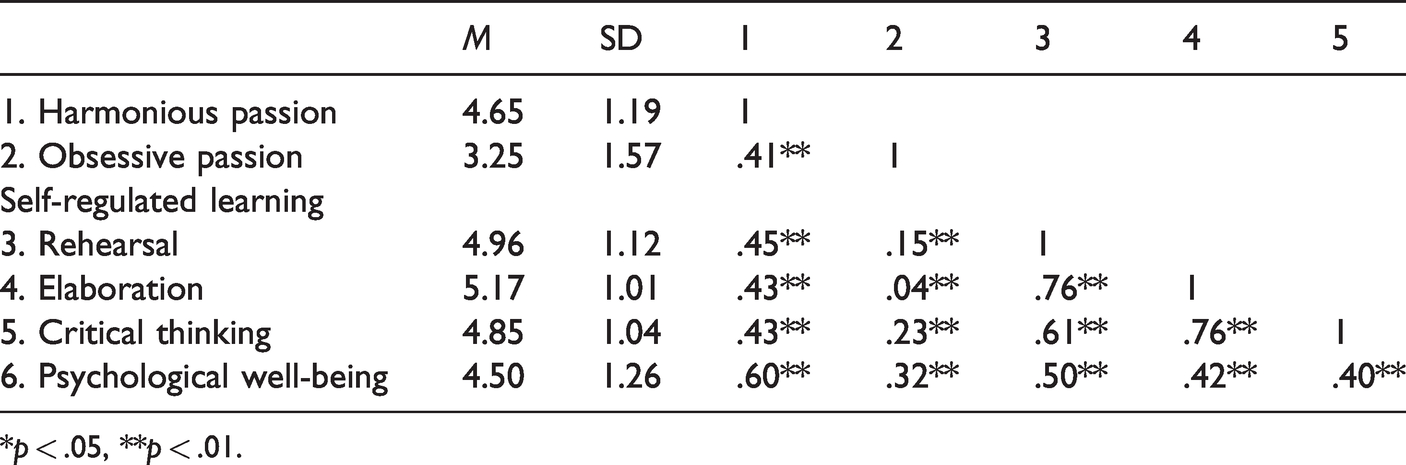
*p < .05, **p < .01.
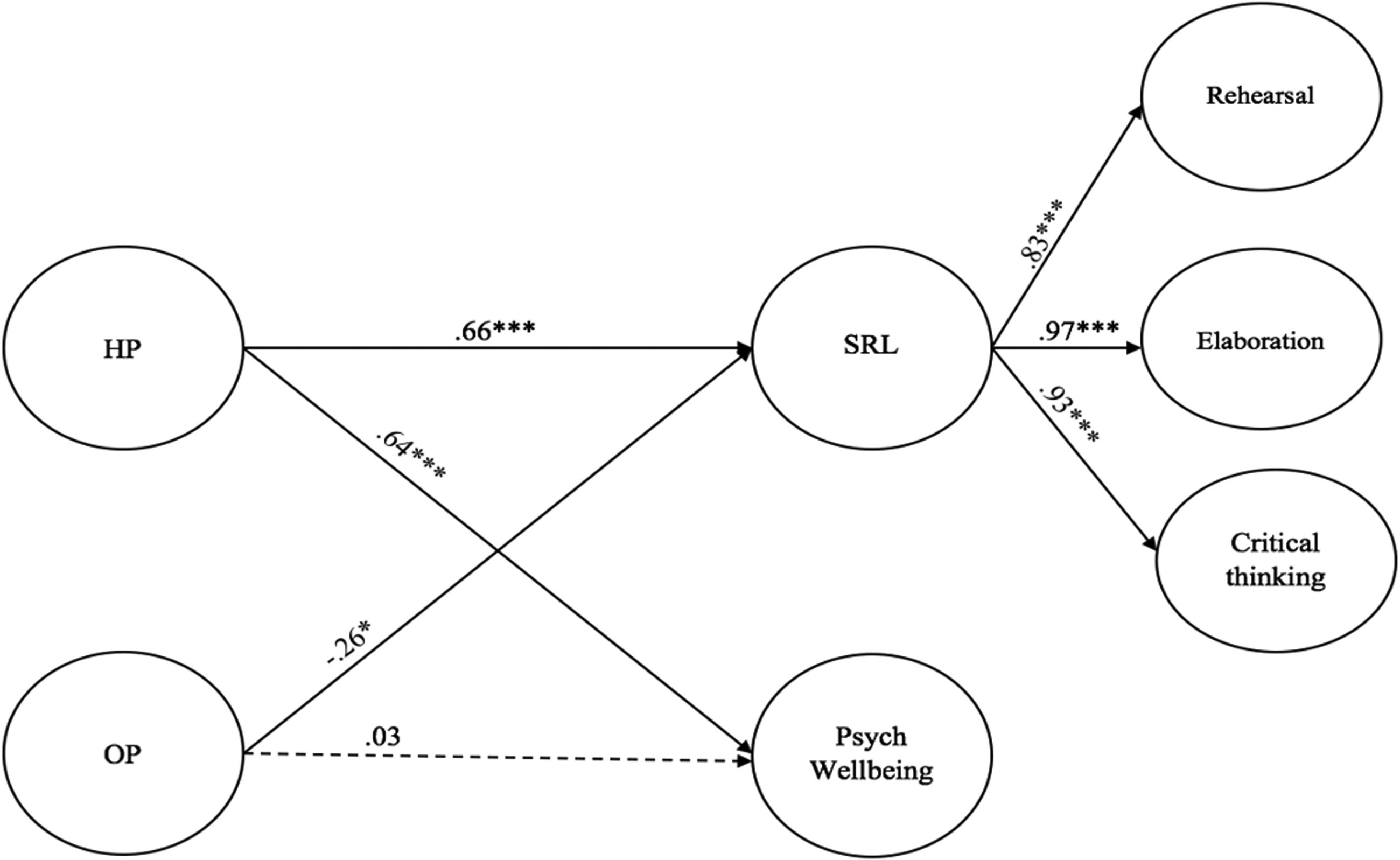
Results from the structural equation modelling analysis: Study 1. Standardised path coefficients are presented, *p < . 05, **p < . 01, ***p < . 001. Analysis conducted with measurement model.
The model had a satisfactory fit to the data: χ2 (df = 465, N = 279) = 893.594, p < .001, CFI = .918, TLI = .901 and RMSEA = .058 [.052; .063]. Results provide support for the hypothesised model. HP positively predicted SRL (β = .66, p < .001) and psychological well-being (β = .64, p < .001), while OP negatively predicted SRL (β = −.26, p < .05) and was unrelated to psychological well-being (β = .03, ns). In sum, the present findings supported the hypothesised model. These results suggest that HP toward one’s studies is a strong positive predictor of both the use of SRL strategies and psychological well-being, while OP toward one’s studies negatively predicts SRL and is unrelated to psychological well-being.
Study 2
The purpose of Study 2 was to replicate and extend the results of Study 1. In Study 1, we examined the relationship between passion and SRL, while in Study 2 we evaluated academic emotions (enjoyment, boredom and anxiety) as potential mediators in this relationship. Previous literature on passion and emotions (Rousseau & Vallerand, 2008; St-Louis & Vallerand, 2015) has revealed that HP tends to facilitate, and OP to undermine, positive emotions, while the opposite pattern can be observed for negative emotions. Positive academic emotions, in turn, were previously found to facilitative adaptive educational practices, such as SRL (Pekrun et al., 2002, 2011) as well as contribute to overall well-being (Pekrun, 2016), while negative academic emotions hinder the use of SRL (Ranellucci et al., 2015). More generally, Fredrickson’s (2013) broaden-and-build theory of positive emotions posits that experiencing positive emotions broaden the individual’s capacity for adaptive cognitive processes (such as SRL), thus allowing for building enduring skills and practices. Thus, Study 2 aims to combine these literatures and explore a novel process, whereby passion predicts academic emotions, and academic emotions, in turn, predict SRL and well-being.
Additionally, while Study 1 used a cross-sectional design, Study 2 used a prospective design in order to add a predictive element to the relationship between academic emotions and SRL. Finally, in Study 2, we examined changes in the outcome variables over time, therefore evaluating increases or decreases in SRL and well-being. This was done by measuring the model variables at two time points in time (six months apart) in order to evaluate both the directionality and changes over time in the outcome variables. HP was expected to positively predict enjoyment while negatively predicting boredom and anxiety. Conversely, OP was expected to negatively predict enjoyment while positively predicting boredom and anxiety. In turn, enjoyment was expected to positively predict changes in SRL and psychological well-being over a six-month period, while boredom and anxiety were expected to negatively predict changes in these outcomes.
Method
Participants and procedure
The study included 266 undergraduate students (55.3% male) recruited through Amazon Mechanical Turk, with a mean age of 31.03 years old (SD = 8.16 years), and who reported spending an average of 18.47 hours a week on their studies (SD = 12.69 hours). All the participants were from the United States, and most of the participants were from fields of social sciences (e.g. psychology; 24.4%), followed by the formal sciences (e.g. mathematics; 22.2%), the humanities (e.g. history; 17.3%) and professions (e.g. business; 17.3%) and the natural sciences (e.g. biology; 15.8%). Finally, 46.6% of participants reported a full-time student status and completed an average of 4.00 semesters in their programs (SD = 1.94 semesters) at the time of the survey. Participants completed an online questionnaire assessing their passion toward their studies, their SRL strategies, psychological well-being and demographic information. Six months later, all participants completed a follow-up questionnaire that included measures of academic emotions, SRL strategies and psychological well-being.
Measures
Time 1
Passion for studies
The Passion Scale (Marsh et al., 2013; Vallerand et al., 2003) was once again used to measure passion for participants’ studies, with two six-item subscales assessing HP
Self-regulated learning strategies
SRL was evaluated in this study again with three subscales from the MSLQ (Pintrich, 1991): rehearsal (α = .76), elaboration (α = .86) and critical thinking (α = .82).
Psychological well-being
As in Study 1, psychological well-being was evaluated with a single 6-item subscale evaluating satisfaction with life, meaning in life and happiness (α = .93).
Time 2
Academic emotions
Participants’ academic emotions were evaluated with the Achievement Emotions Questionnaire (AEQ; Pekrun et al., 2011). The AEQ evaluates academic enjoyment with items such as ‘I enjoy the challenge of doing my coursework’ (α = .86), academic boredom with items such as ‘Engaging in my academic work bores me’ (α = .95) and academic anxiety with items such as ‘I get tense and nervous while doing my coursework’ (α = .91). All items were scored on a 5-point scale ranging from 1 = ‘Strongly disagree’ to 5 = ‘Strongly agree’.
Self-regulated learning
SRL was evaluated with the rehearsal (α = .80), elaboration (α = .88) and critical thinking (α = .86) subscales from the MSLQ.
Psychological well-being
Psychological well-being was evaluated once again with the same psychological well-being subscale as in Time 1 (α = .92).
Results and discussion
Descriptive statistics for all study variables were analysed with SPSS 20.0 (IBM, 2011). Means, standard deviations and bivariate correlations among the model variables are presented in Table 2. The present model was tested using SEM with paths corresponding to the hypotheses presented above. To assess change in outcomes over the course of the six-month period, path analysis on the manifest residualised change scores was conducted (Crocker et al., 2003; Gunnell et al., 2017; Zumbo, 1999). Each residualised change score was obtained for each dependent variable by conducting a regression analysis with the T2 measurement entered as the dependent variable and the measurement at Time 1 entered as the independent variable. Results for the hypothesised model revealed that the model had an acceptable fit to the data, χ2(df = 16, N = 266) = 57.305, p < .001, CFI = .976, TLI = .947, RMSEA = .069 [.050, .089]. The model is presented in Figure 2.
Descriptive statistics and bivariate correlations – Study 2 (n = 266).
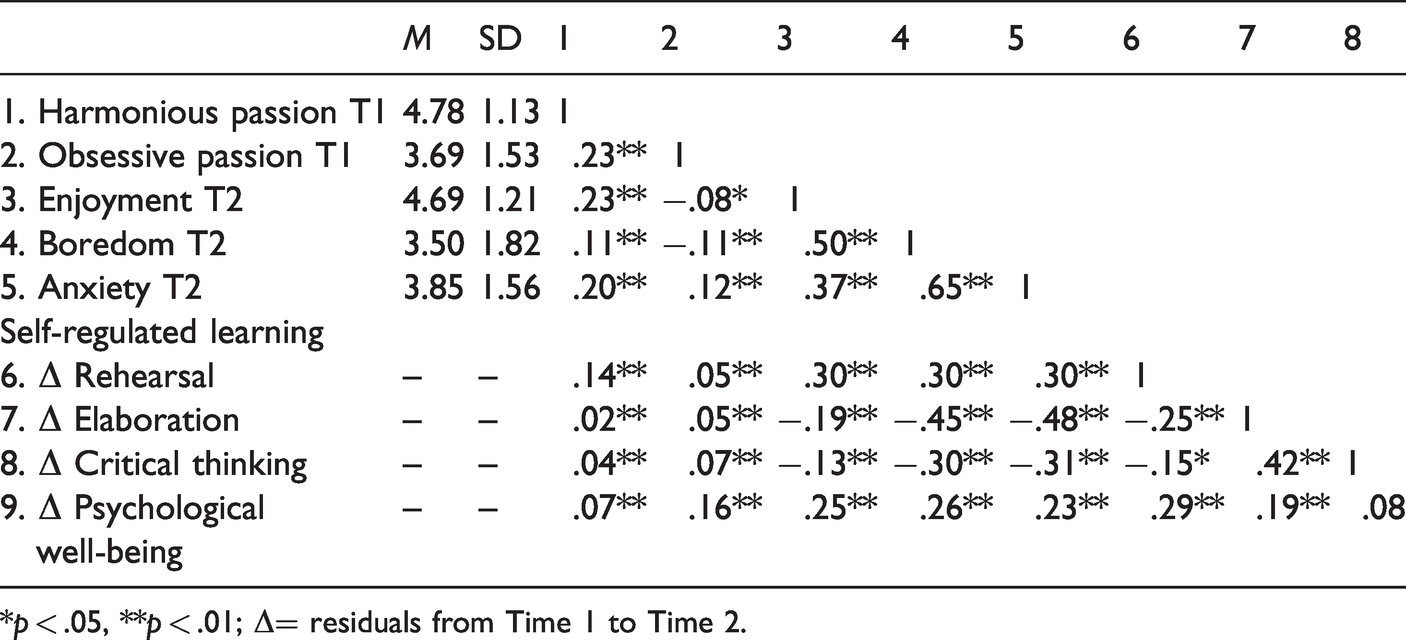
*p < .05, **p < .01; Δ= residuals from Time 1 to Time 2.
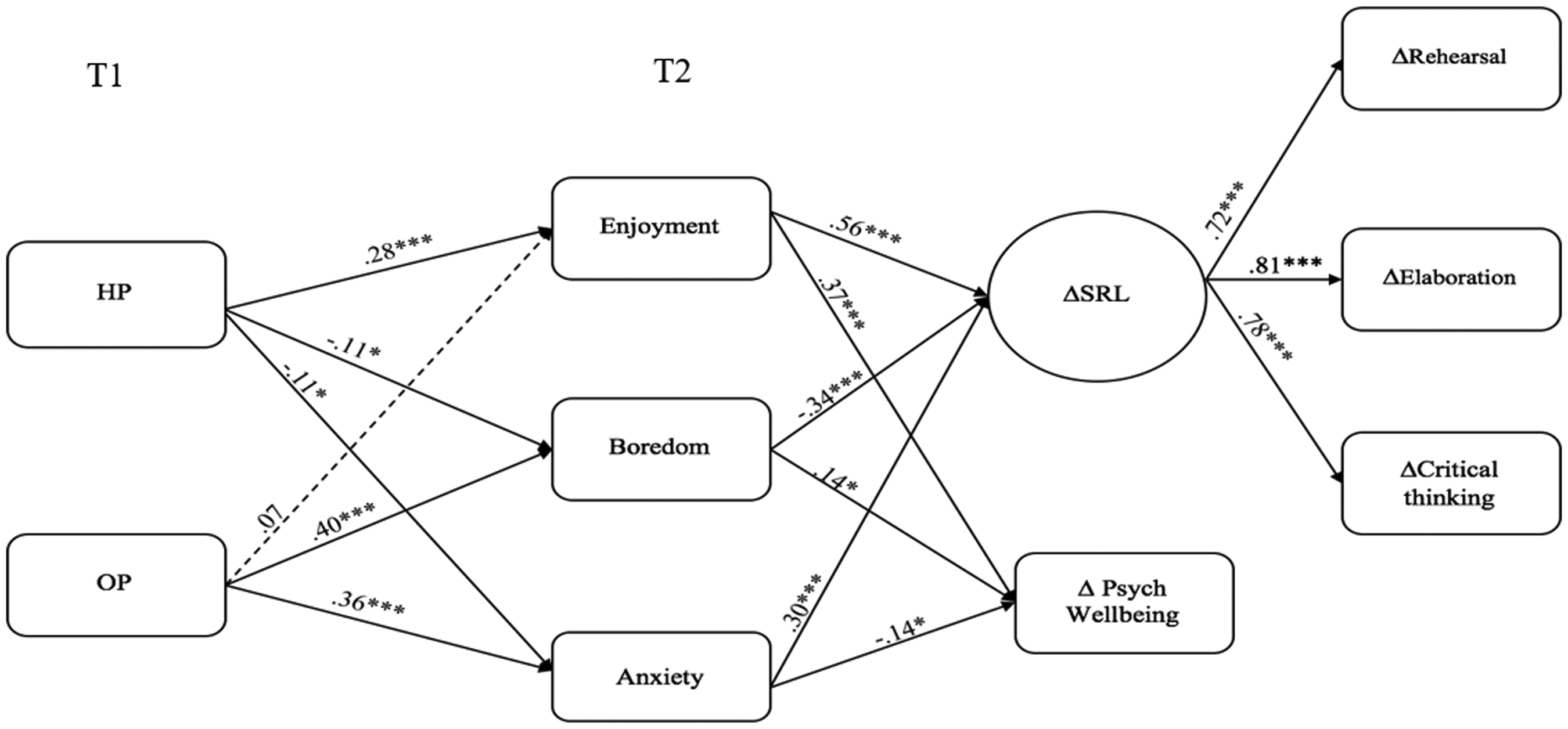
Results from the structural equation modelling analysis: Study 2. Standardised path coefficients are presented, *p < . 05, **p < . 01, ***p < . 001. Analysis conducted with standardised measures.
Results provide partial support for the hypothesised model. HP at Time 1 positively predicted academic enjoyment (β = .28, p < .001) and negatively predicted academic boredom (β = −.11, p < .05) and anxiety (β = −.11, p < .05) at Time 2. In contrast, OP at Time 1 was unrelated to academic enjoyment (β = .07, ns) and positively predicted academic boredom (β = .40, p < .001) and anxiety (β = .36, p < .001) at Time 2. Finally, academic enjoyment was a positive predictor of changes in SRL (i.e. increases in self-regulated learning) from Time 1 to Time 2 (β = .56, p < .001), as well as a positive predictor of changes in psychological well-being from Time 1 to Time 2 (β = .37, p < .001). Boredom, on the other hand, negatively predicted changes in SRL (β = −.34, p < .001) and positively predicted changes in psychological well-being (β = .14, p < .05) from Time 1 to Time 2. The opposite pattern was observed for academic anxiety, which positively predicted changes in SRL over a six-month period (β = .30, p < .001) and negatively predicted changes in psychological well-being (β = −.14, p < .05). Indirect effects were explored to further test the mediating role of academic emotions in the relationships between passion and SRL and psychological well-being. Bias-corrected bootstrapped 95% confidence interval estimates indicated that only enjoyment significantly mediated the relationship between HP and SRL (β = .021; 95% CI = .013 to .029, p < .001) and psychological well-being (β = .024; 95% CI = .016 to .035, p < .001), while only boredom significantly mediated the relationship between OP and SRL (β = −.008; 95% CI = –.014 to −.002, p < .05) and psychological well-being (β = −.006; 95% CI = −.011 to −.001, p < .05).
These results suggest that engaging in one’s studies with HP enhances enjoyment, while protecting one from boredom and anxiety. OP in students, on the other hand, positively predicted boredom and anxiety but was unrelated to academic enjoyment. In turn, while enjoyment positively predicted changes in SRL and psychological well-being, boredom negatively predicted changes in SRL, while positively predicting changes in psychological well-being. Finally, anxiety positively predicted changes in SRL and negatively predicting changes in psychological well-being, over the course of six months.
General discussion
The present paper explored the role of passion in predicting SRL and psychological well-being in two studies. In line with past research on passion in educational settings, we posited that HP would positively predict the use of SRL strategies as well as psychological well-being, while OP was expected to negatively predict these outcomes (Study 1). Furthermore, we hypothesised in Study 2 that academic emotions would serve as mediators in the passion-outcomes relationships. Specifically, HP was expected to positively, and OP to negatively, predict enjoyment, while the opposite patterns were expected for boredom and anxiety. In turn, enjoyment was expected to positively predict changes in SRL and psychological well-being over a six-month period, while boredom and anxiety were expected to negatively predict changes in the outcomes (Study 2). To test these hypotheses, two studies were conducted with over 500 undergraduate students from a variety of institutions and disciplines, and with two distinct research designs.
Overall, the results provided support for the hypotheses with the exception of the relationships between boredom and psychological well-being, and anxiety and SRL. First, in Study 1, HP was found to be a strong and positive direct predictor of SRL and psychological well-being, while OP negatively predicted SRL and was unrelated to psychological well-being. Study 2 extended these results by demonstrating the process by which passion shapes SRL and psychological well-being in undergraduate students. Specifically, HP was a positive predictor of enjoyment six months later, while being a negative predictor of boredom and anxiety six months later. On the other hand, OP at Time 1 was a positive predictor of boredom and anxiety six months later, while being unrelated to academic enjoyment. As expected, academic enjoyment positively predicted changes in SRL and psychological well-being over a six-month period, while boredom was a negative predictor of changes in SRL but a positive predictor of changes in psychological well-being. Interestingly, anxiety positively predicted changes in SRL from Time 1 to Time 2, but negatively predicted changes in psychological well-being. Finally, only academic enjoyment was found to mediate the relationship between HP and changes in SRL and psychological well-being, while only boredom mediated the relationship between OP and changes in SRL and psychological well-being. The present results lead to several implications.
Passion as a determinant of academic emotions, SRL and well-being
A first implication of the present research is that the type of passion differentially shapes academic emotions, SRL and psychological well-being in university students. As hypothesised, since HP provides access to adaptive self-processes (St-Louis et al., 2018, Study 1; Stoeber et al., 2011), it was a positive and strong predictor of both SRL and psychological well-being in Study 1. Furthermore, HP positively predicted academic enjoyment in Study 2, while negatively predicting boredom and anxiety. This is consistent with past research that found that HP does not only lead to adaptive self-processes, but can also protect from maladaptive ones (St-Louis et al., 2018). OP, on the other hand, was unrelated to psychological well-being and negatively predicted SRL. When it comes to academic emotions, OP was unrelated to academic enjoyment, while positively predicting boredom and anxiety.
These results are in line with past research on passion in higher education (Vallerand, 2016), and further contribute to this literature by demonstrating that being passionate about one’s studies is not enough to cultivate performance and well-being benefits; the type of passion matters greatly. Specifically, a passion that is autonomously internalised, without any contingencies attached to it, and is in harmony with other aspects of the student’s life (e.g. relationships, hobbies, etc.) is associated with more adaptive, and less negative, academic emotions, more frequent overall use of a wide range of SRL strategies, and better psychological adjustment. On the other hand, when a student’s passion for their studies is internalised in a controlled manner (e.g. with pressure from an external agent), is associated with certain contingencies (e.g. self-esteem, social acceptance) and is in conflict with other areas of the student’s life, the student is likely to experience more negative academic emotions, use SRL strategies less frequently when learning and experience lower levels of psychological well-being.
Overall, the present findings contribute to a growing body of literature demonstrating the differential effects of the type of passion on a variety of academic (e.g. academic performance, goal orientation; Bonneville-Roussy et al., 2011; Vallerand et al., 2007, 2008) and personal (psychological and physical well-being; Bureau et al., 2017; Padham & Aujla, 2014; Rip et al., 2006; St-Louis et al., 2018; Stoeber et al., 2011) outcomes at the university level. The present research extends previous research by incorporating three theoretical frameworks (passion, achievement emotions and SRL) into a single model, including both academic and personal outcomes in one model, and demonstrating that while being passionate for one’s studies would appear important and beneficial, it is the quality of the passion is what matters most. Thus, a practical implication for the present research would include supporting students’ autonomy in the process of making academic decisions, both major (e.g. choosing an undergraduate thesis topic) and minor (e.g. choosing a course essay topic), in the university context.
Academic emotions as determinants of SRL and psychological well-being
A second implication of the present findings is that different academic emotions have long-term implications for both academic and well-being outcomes. In the present research, we chose to explore three of the most common academic emotions: enjoyment, boredom and anxiety. Academic enjoyment, perhaps the most widely explored positive academic emotion, was a positive predictor of adaptive outcomes (SRL and psychological well-being) as expected. This is in line with previous research that found enjoyment to enhance the use of SRL strategies by focusing students’ attention on the task at hand (Artino & Jones, 2012; Pekrun et al., 2002; Ranellucci et al., 2015), and, more generally, increasing academic efforts, self-regulation and performance (Pekrun et al., 2007, 2011; Villavicencio & Bernardo, 2013). The results for boredom and anxiety were somewhat less straightforward. Specifically, we predicted that boredom would be a negative predictor of both SRL and psychological well-being, and although it did negatively predict changes in the use of SRL strategies, it positively predicted changes in psychological well-being over a six-month period. While research unanimously demonstrates that boredom is detrimental for academic achievement (Daschmann et al., 2014; Goetz & Hall, 2014), some research has found that some coping strategies for academic boredom include seeking meaning and purpose in the academic setting, thereby increasing the significance and meaningfulness of students’ academic context (Hubbard, 2019). Thus, following this conceptualising, it becomes plausible that while boredom is a negative emotion that is maladaptive for academic progress, it may nonetheless increase students’ personal search for purpose in the academic setting specifically and in life in general, thereby increasing meaning in life.
Results for anxiety as a predictor of changes in SRL and psychological well-being were also only partially supported. As predicted, anxiety was a negative predictor of changes in psychological well-being over a six-month period. This is in line with previous research on academic anxiety and its detrimental effects on subjective well-being (Steinmayr et al., 2016). However, of interest, anxiety positively predicted changes in SRL. One possible explanation of these results is that negative activating emotions, such as anxiety, have been demonstrated to trigger motivation to avoid failure among students and facilitate the use of ‘shallow’ SRL strategies, such as rehearsal (Pekrun, 2006; Pekrun et al., 2002, 2007, 2011). Other research (You & Kang, 2014) found that anxiety could lead to an increased use of SRL strategies in students with high perceived academic control appraisals. This research suggests that when students believe that they are capable of using SRL strategies effectively, and using these strategies will lead to achieving a desired outcome, anxiety can facilitate this process of SRL strategy use. Finally, some cross-sectional studies (Kesici & Erdogan, 2009; Kesici et al., 2011) found anxiety to be positively associated with SRL, thus implying that perhaps anxious students use more SRL strategies as a coping mechanism for their academic anxiety, although the directionality of this relationship was not tested. For example, a student anxious about their academic performance may use SRL as a way to increase the likelihood of better performance in the course, thereby relieving some of their academic anxiety. Past research by Bélanger et al. (2013) has shown that under conditions of expectant failure (or fear of failure), participants with high OP demonstrated improved performance, while those with low OP did not. Thus, more research is needed to replicate these findings in academic contexts and fully understand the circumstances under which anxiety may provide access to performance enhancement strategies, such as SRL.
In sum, it appears that university students who are passionate about their studies may have two trajectories with regard to academic and personal outcomes: one is a harmonious trajectory which leads those with HP for their studies to experience more positive academic emotions, less negative academic emotions, better psychological well-being, as well as more frequent use of SRL strategies. The other trajectory, which is associated with OP, leads to negative academic emotions, less frequent use of SRL strategies and is either unrelated or marginally related (e.g. through boredom) to psychological well-being. Thus, the present results indicate that not all passion is created equal, and that these differences are important to consider when examining the role of passion in university students’ academic and personal outcomes.
Limitations and future research
The present research includes some limitations. First, although the two studies used differential designs (i.e. cross-sectional and prospective), both are correlational designs. Future research should thus try to replicate the present findings while using an experimental design to induce passion for academic activities (Bélanger et al., 2013; Lafrenière et al., 2013; Schellenberg et al., 2016). Such a design would provide support for the directionality of the results and verify the causal relationship between passion, academic emotions, SRL and psychological well-being. Second, the present research sought to understand the process by which passion predicts SRL and psychological well-being. Future research is necessary to explore the role of passion and academic emotions in other outcomes related to students’ optimal functioning in education such as objective academic performance, relationships at school, etc. Third, it is important to note that the sample is self-selected from the Amazon Turk platform. Forth, all data in the present research represents self-report data and no objective measures were included. Finally, some of the present findings (e.g. boredom as a predictor of psychological well-being, anxiety as predictor of SRL) were unanticipated and await replication. Thus, future research should examine these relationships more closely in order to gain deeper insight into the ways in which boredom, as well as other negative emotions, may contribute to psychological well-being and SRL.
Footnotes
Declaration of conflicting interests
The author(s) declared no potential conflicts of interest with respect to the research, authorship, and/or publication of this article.
Funding
The author(s) received no financial support for the research, authorship, and/or publication of this article.
