



Abstract
This article uses the theoretical lens of situational action theory to develop two hypotheses about the relative rates of crime that occur when pupils with certain crime propensities spend time in schools that they perceive to have certain moral contexts. These hypotheses are tested with data from the School and Community Environment Survey and a dual-methods analytical approach. Single-level negative binomial modelling is used to explore the statistical interaction between propensity and moral context in relation to criminal offending. Simple contextual analysis is then used to explore the impact of the convergence of propensity and perceived moral context on criminal offending in schools. Findings from both methods of analysis demonstrate that pupils with high crime propensity who perceive a weak moral context engage in criminal behaviour at the highest rates in schools. Findings from the simple contextual analysis also suggest that the criminal behaviour of those with high propensity is most sensitive to the influence of perceptions of school moral context. This article makes an important contribution to the criminological knowledge base surrounding the role of individuals’ perceptions of their environment and offending. It also contributes to the debate around the suitability of different methods for testing the assertions of SAT.
Introduction
Schools are one of society's key institutions. In the United Kingdom (and many other parts of the world) attendance at school is legally required and, as a result, young people spend a significant amount of time in schools (see e.g. Berg and Cornell, 2016; Wikström et al., 2012) at an age where crucial biological and psychological development occurs (see e.g. Blakemore and Choudhury, 2006; Blakemore and Robbins, 2012). Unfortunately, evidence from the United Kingdom (Hayden, 2009; Wikström and Butterworth, 2006) and around the world (see e.g. Akiba et al., 2002) suggests that a significant amount of criminal behaviour occurs in schools and the associated consequences can be serious for victims (Farrington and Ttofi, 2011; Holt et al., 2015), perpetrators (Rudasill and Rimm-Kaufman, 2009; Stipek and Miles, 2008), witnesses (Gronna and Chin-Chance, 1999; McDermott, 1980) and teachers (Dicke et al., 2014; Ferguson et al., 2012). The prevention of criminal behaviour in schools should, therefore, be a top priority for policymakers, practitioners, and scholars. Criminology can play a role in this project by identifying the causes of criminal and problem behaviour in schools, exploring how schools develop their crime-relevant traits, and examining the role schools play in shaping the development of their pupils’ crime-relevant traits.
Purpose of this article
This article focuses on the first of these three tasks – identifying the causes of criminal and problem behaviour in schools. To do this, the theoretical lens of situational action theory (SAT) is applied to the school context to develop a set of hypotheses about the relative rates of crime that occur when pupils with certain crime-relevant traits spend time in schools with their perceived crime-relevant traits. These are tested with two different analytical approaches and data from the School and Community Environment Survey (SCES) (McSharry, 2022).
Literature review
The last 60 years have been a period of methodological and theoretical development for research into pupil behaviour in schools. Rudimentary, early studies have been replaced by sophisticated, multi-level studies, which have identified statistical relationships between problem and criminal behaviour in schools, pupil characteristics (including sex, age, ethnicity, social class, family circumstances, low academic ability, anti-social values, poor parenting practices, delinquent peers, anger and poor school bonding) and school characteristics (including local community socio-demographic characteristics, intake socio-demographic characteristics, size, school policies, staff action, pupil–staff cohesion, the perceived clarity and fairness of rules, and the effectiveness of school discipline practises) 1 (Cook et al., 2010; Gottfredson, 2001). Unfortunately, however, developing the identified characteristics into a comprehensive causal explanation of problem and criminal behaviour in schools has proved difficult (Gottfredson, 2017).
The application of SAT (Wikström, 2019a) to the school context may help the development of the school crime knowledge base by identifying the key causes and causal mechanisms that lead to criminal behaviour in schools. 2 SAT's central argument is that crimes occur as the result of the perception choice process, triggered by an individual interacting with their setting and perceiving a motivation to act, such as a temptation – the opportunity to satisfy a desire or honour a commitment; or a provocation – frictions which cause upset, frustration, or anger (Wikström, 2019b: 10). According to SAT, two key causal factors influence the perception choice process: propensity and moral context. Propensity consists of an individual's morality and the cognitive functions that underpin their ability to exercise self-control when required. These factors influence an individual's tendency to perceive and choose crime as an action alternative. Moral context is the setting's perceived moral norms and the perceived levels of monitoring, intervention and sanction that deter the breaking of those norms (Wikström et al., 2012).
As an explanation of all crimes, at all times, in all places (Wikström and Kroneberg, 2022), the application of SAT to criminal behaviour in the school setting is appropriate. Schools, however, are a distinct type of environment, with unique features and, as such, careful consideration must be given to the conceptualisation of the moral context in this setting. Previously, the concept of ‘collective efficacy’ has been incorporated into wider tests of SAT as a measure of moral context within neighbourhoods. Collective Efficacy theory argues that there will be lower rates of crime in neighbourhoods where there is social and moral cohesion around pro-social values and where residents are willing and able to intervene to uphold behavioural norms (Morenoff et al., 2001; Sampson et al., 1997). According to SAT, collectively efficacious environments have a strong moral context which deters crime through clear anti-crime moral norms and the perceived levels of monitoring, intervention, and sanctions to uphold these norms (Wikström et al., 2010).
Important differences between schools and neighbourhoods, however, likely impact how collective efficacy is established and functions. There are two distinct groups of individuals in schools – staff and pupils, each with explicit roles. Pupils attend schools to learn and develop, while teachers aim to educate pupils and facilitate their healthy development. As part of this role, teachers manage pupils’ behaviour through both informal social control, such as verbal instructions and formal social control, such as school disciplinary procedures. Scholars have argued that as agents of formal social control, teachers who are perceived as legitimate because they consistently enforce clear and fair school rules are more likely to form cohesive working relationships with pupils (Gregory et al., 2010). Perceptions of fairness allow schools to organise communally around a set of values and, in doing so, establish pro-social behavioural norms (Bryk et al., 1993; Bryk and Driscoll, 1988; Payne et al., 2003) and are associated with lower levels of problem and criminal behaviour in schools (Cook et al., 2010; Gottfredson et al., 2002; Gregory et al., 2010; Welsh, 2000). It has also been argued that the age of school pupils means that they rely on emotional support from adults (Gregory et al., 2010) and therefore schools in which teachers are perceived to be caring and supportive, are more likely to experience cohesive pupil–staff relationships and lower levels of problem and criminal behaviour (Berg and Cornell, 2016; Gregory et al., 2010; Hung et al., 2015; Lee, 2012; Wang and Dishion, 2012; Zullig et al., 2014).
The legitimacy and support components can be incorporated into an adapted concept of ‘school collective efficacy’, which refers to the general perception of the willingness and capability of members of the school community to engage in informal and formal social control to enforce school rules. The perceived efficacy is facilitated by social cohesion based on respectful, trustful, and supportive relations between pupils and staff; and moral cohesion based on the legitimacy derived from clearly defined and consistently enforced school rules. This conceptualisation integrates criminological and educational research and bridges the gap between SAT's assertions about moral contexts and existing conceptualisations of crime-relevant characteristics of schools, such as ‘communal organisation’ (Bryk et al., 1993; Bryk and Driscoll, 1988), ‘positive school climate’ (Gottfredson et al., 2005) and ‘authoritative school climate’ (Gregory et al., 2010).
Integrating school collective efficacy as a measure of school moral context into the situational model of SAT produces a set of hypotheses about the relationship between crime propensity, individual students’ perceptions of school moral context (perceived school moral context) and criminal offending in school. According to this model, crime will occur at the highest rates for pupils with high crime propensity who attend schools that they perceive to have a weak moral context (weak school collective efficacy). Pupils with higher crime propensities will be more sensitive to the perceived crime inducements of the setting because they lack the morality and ability to exercise self-control, which would allow them to resist the perceived crime inducements of the setting. Pupils with low crime propensity will be unlikely to engage in criminal behaviour in any perceived setting. Their personal morality corresponds with criminal laws, and their ability to exercise self-control will allow them to resist the crime inducements of their school, even if they perceive it to have a weak moral context. These assertions form hypotheses 1 and 2 (summarised below).
Hypotheses
Pupils’ crime propensity and perceptions of weak school moral context will be positively associated with criminal behaviour in school, and the highest rates of school crime will occur for high propensity pupils who perceive a weak school moral context.
The rate of criminal offending in school for pupils with high crime propensity will be more sensitive to the influence of perceiving a weak moral school context than pupils with low crime propensity.
Method
Sample and procedure
The current study uses data collected in the SCES, which was conducted throughout 2017 in schools in Cambridgeshire, Hertfordshire and the nine boroughs of Northeast London (all of which lie within Southeast England) (McSharry, 2022). All 188 co-ed, non-selective and non-fee-paying schools in the region were contacted and asked to participate. 3 Thirty-four schools fully participated in the project, meaning a final uptake of 18%. Table 1 presents the characteristics of schools that participated in SCES. Participating schools vary substantially by the percentage of pupils for whom English is an additional language (ranging from 78.9% to 2%), the percentage of pupils who receive free school meals (FSM) (ranging from 76.5% to 5%) and the schools Ofsted rating 4 with six schools being rated ‘1’, 20 schools being rated ‘2’ and eight schools being rated ‘3’ or ‘4’. While the uptake rate of schools within SCES is low, the characteristics of schools within the sample do not appear to be dramatically different from those in the region (Table 1 provides a comparison).
Characteristics of SCES and regional schools in 2017.

Notes: SCES: School and Community Environment Survey; EAL: English is an additional language.
Data available from the Department for Education website at: https://www.compare-school-performance.service.gov.uk/schools-by-type?step=default&table=schools®ion=all-england&for=secondary.
As the influence of age was not relevant to this project, it was decided to focus on Year 9 pupils (aged 13–14) because at the time of data collection, 13 and 14-year-olds were excluded from school (formally removed either temporarily or permanently by the school) more than any other age group in England and Wales (Office for National Statistics, 2020). The majority of these students had also been in their schools for at least two years and so were likely familiar with school behavioural norms and the willingness of teachers to enforce them. Within schools, 30 pupils were sampled randomly from the register with randomisation software. The surveys were delivered in person by researchers and completed anonymously by participants on computers. Eighty-six pupils were absent on the day of the survey and were given a URL to complete the survey in their own time, out of which 30 completed the survey and 56 did not. Twelve ‘malicious’ or ‘mischievous’ responders (see, e.g. Robinson-Cimpian, 2014) were removed from the data set, leaving a final sample of 952 pupils from 34 schools (an average of 28 per school). There was no missing data. Almost half the pupils were female, for over a third English was not a first language, 41.2% were non-white, and 31.5% received FSM (see Table 2).
SCES pupil demographics.

Note: SCES: School and Community Environment Survey.
Measures
Crime propensity
Crime propensity was measured with a generalised morality scale and a generalised ability to exercise self-control scale, which have been used frequently in previous tests of SAT (see, e.g. Wikström et al., 2012). The general morality scale contained 16 items, which asked participants to report whether different behaviours were ‘not wrong at all’, ‘a little wrong’, ‘wrong’ or ‘very wrong’. Behaviours on the scale included minor infractions, such as ‘go skateboarding in a place where skateboarding is not allowed’, substance abuse and serious crimes such as ‘use a weapon or force to get money or things from another young person’ (taken from Wikström et al., 2012). Answers were coded and summed so that high scores indicated lower morality, and the scale alpha was 0.87. The general ability to exercise self-control scale contained eight items asking participants to report whether they ‘strongly disagreed’, ‘disagreed’, ‘agreed’ or ‘strongly agreed’ with statements about their impulsivity, risk-taking and future orientation. Items included, ‘when I am really angry, other people better stay away from me’ and ‘I sometimes find it exciting to do things that may be dangerous’ (taken from Wikström et al., 2012). Answers were coded and summed so that high scores indicated poor self-control, and the scale alpha was 0.7. Pearson's correlation between the two scales was 0.478, significant at the <0.001 level. The two scales were standardised, and Z-scores were added and then standardised again to give an overall standardised crime propensity score, with high scores indicating high crime propensity. Crime propensity was normally distributed with a mean of 0 and a range of 7.26.
Weak perceived school moral context
Pupils’ perception of the moral context in their schools was measured with a school collective efficacy instrument adapted from Wikström's (2012) school collective efficacy scale. The school collective efficacy measure consisted of a social and moral cohesion scale and a social-control scale. School moral and social cohesion was measured with a nine-item scale, which asked participants to report whether they ‘strongly disagreed’, ‘disagreed’, ‘agreed’ or ‘strongly agreed’ with statements about their school. Items on the scale included statements about relations between staff and pupils, perceptions of staff treatment and support of pupils, perceptions of fairness and clarity of school rules, such as, ‘teachers and pupils at my school respect each other and get on well’ and ‘pupils at my school know how they are expected to behave’ (for full scale, see McSharry, 2022). The scale was coded and summed so that high scores signified weak perceptions of moral and social cohesion. The scale alpha was .84. Social control was measured with an eight-item scale asking pupils whether social control was ‘very likely’, ‘likely’, ‘neither likely nor unlikely’, ‘unlikely’ or ‘very unlikely’ in their school in different scenarios. Items included scenarios where minor rule-breaking had taken place, such as ‘if a pupil at your school was wearing inappropriate uniform in the school building, how likely is it that your teachers would find out and do something about it’ and more serious rule-breaking such as ‘if there was a fight on school grounds and someone was beaten up or threatened, how likely is it that other pupils or teachers would break it up’ (for full scale, see McSharry, 2022). The scale was coded and summed so that higher scores signified weaker social control. The scale alpha was 0.81. The Pearson's correlation of the two scales was 0.543, significant at the <.001 level. The two scales were standardised, added, and then standardised again to give an overall weak moral context score, with high scores indicating weak moral context. Perceptions of school collective efficacy were normally distributed with a mean of 0 and a range of 7.048.
Criminal behaviour in SCES schools
Participants were asked to report the frequency with which they had engaged in nine criminal behaviours at school in the past 12 months, including theft, assault, vandalism, selling banned substances, and possession and use of weapons. As is a common finding in crime surveys, most participants (60%) reported no crimes, while a few participants reported a high number of crimes, the highest of which was 208. This created highly skewed data with a mean of 5.5 and a standard deviation of 19.2 (see Figure 1). Table 3 reports the prevalence and frequency of offences, with offences ranked by prevalence. The most prevalent and frequently reported offences were theft from a pupil (prevalence 23%, mean 1.8), theft from a school or member of staff (prevalence 21%, mean 1.6) and assault on a pupil (prevalence 21%, mean 1.5). The least prevalent and frequently reported offences were assault on a member of staff (prevalence 1.7%, mean 0.03), assault with a sharp weapon (prevalence 0.08%, mean 0.03) and selling banned substances (prevalence 0.6%, mean 0.04).

Crime descriptive statistics and distribution histogram.
SCES individual crime descriptives.

Note: SCES: School and Community Environment Survey.
Analytical strategy
Hypotheses 1 and 2 are interactive hypotheses which make assertions about the crime that occurs under the convergent conditions of individuals with their propensity in environments with their perceived moral context. In line with the assertions of Hardie (2020), this article employs a dual analysis approach to avoid some of the difficulties and pitfalls associated with testing interactive hypotheses with a single analytical method. The first part of this strategy is regression analysis. Single-level, negative binomial regression models are used to analyse the relationship between pupil crime propensity, pupil perceptions of school moral context and the frequency of criminal behaviour (Hypothesis 1). Negative binomial regression was chosen because crime is a count variable (Hilbe, 2011). Although the SCES data is hierarchical (students nested within schools) and therefore suitable for multilevel modelling, exploring the hierarchical structure of the data and between-school differences in offending is beyond the scope of this article. 5 Instead, the current study focuses on analysing the offending that occurs under the convergent conditions of crime propensity and individual perceptions of moral context with regression and simple contextual analysis. As such, single-level regression is employed, with cluster-robust standard errors to account for the hierarchical structure of the data (Cameron and Miller, 2015). Multiplicative interaction terms are calculated, and then ‘marginal effects at representative values’ (MERs) analysis is conducted to explore the impact of perceived moral context on criminal behaviour at different fixed values of propensity (Hypothesis 2). The predicted number of criminal behaviours at different combinations of propensity and perceived moral context is then calculated. MERs analysis, which assesses the impact of a particular variable on the dependent variable across a range of values of another independent variable within a model (Buis, 2010; Williams, 2012), is employed because of the difficulties with interpreting the size, direction and significance of interaction terms in non-linear models (Ai and Norton, 2003; Bowen, 2012).
While the regression and multiplicative interaction term approach has previously been used to analyse pupil behaviour (see, e.g. Eklund and Fritzell, 2014; Top et al., 2017) and to test the assertions of SAT (see, e.g. Antonaccio et al., 2017; Beier, 2018), some proponents of SAT argue it does not provide a satisfactory test of the assertions of SAT because it measures statistical interaction and not the impact of convergent conditions of individuals in settings (Hardie, 2020). To overcome these issues, Wikström and others have used simple situational analysis to analyse the frequency of offending under different convergent conditions (Hardie, 2019; Wikström et al., 2012). Simple situational analysis involves capturing the convergence of individuals and environments and then comparing the relative rates of offending that occur under the different convergent conditions or propensity and moral context (Hardie, 2020). 6 This article uses this approach to analyse the contextual data collected in the SCES project (simple contextual analysis). The analysis is contextual and not situational because the environmental unit measured in SCES was the school, and schools are too big to be considered a single setting.
This study captures convergence by categorising individuals according to their crime propensity and how they perceive their school environment and using the intersection of these categories to create propensity-perceived moral context groups (see, e.g. Hardie, 2017; Wikström et al., 2012). Once these groups are captured, the rates of offending are compared. Given the large outliers in the highly skewed SCES data, the median rate of offending is the main focus of the comparison, as it is less susceptible to the impacts of large outliers. A 3-D bar graph aids the comparison of the offending rates between propensity-perceived moral context groups. Where possible, multiplicative, comparative ratios should be calculated between propensity-perceived moral context groups and marked on the graphs (i.e. the rate of offending in ‘group A’ was 1.4 times higher than in ‘group B’). However, the median level of offending for several propensity-perceived moral context groups was 0, so it was not possible to calculate a comparative ratio. The significance of differences between groups is analysed with a Brunner-Munzel test, which tests the null hypothesis that the probability that a randomly selected observation from ‘group A’ will be larger than one from ‘group B’ is equal to ‘0.5’ (Fagerland and Sandvik, 2009). This test is non-parametric, so it is suitable for non-normal data and does not assume that variance within groups is the same (Brunner and Munzel, 2000; Fagerland and Sandvik, 2009). p-values are calculated and marked on the graphs. p-values above ‘.05’ are considered not significant.
Results
Regression analysis
Table 4 presents NB2 7 negative binomial regressions predicting the rate of criminal behaviour 8 in school. Large values for the alpha (a measure of overdispersion) in both models and a highly significant Wald test of the alpha (p = .000) strongly suggest the data is over-dispersed, justifying the use of negative binomial regression. 9 In strong support of hypothesis 1, Model 1 shows that propensity and weak perceived moral context are highly significant predictors of criminal behaviour. Incidence rate ratios (IRRs) suggest that a one standard deviation increase in propensity, and a one standard deviation increase in weak perceived moral context are associated with a 135% and a 61% increase in criminal behaviours, respectively. Model 2 introduces a multiplicative interaction term, which is significant, below 1 (negative), and slightly improves the Nagelkerke R2. The IRRs for propensity and weak perceived moral context increase slightly in Model 2.
Negative binomial regressions with cluster-robust standard errors predicting the number of crimes.

Notes: IRR: incidence rate ratio.
*p < .05, **p < .01, ***p < .001.
(Cluster-robust standard errors for clustering within schools.)
All independent variables are Z-standardised.
The first part of the MERs analysis explores the marginal effect of weak perceived moral context on crime at different levels of crime propensity 10 and is presented in Table 5 and Figure 2. Table 5 shows that the marginal effect of weak perceived moral context is significant for individuals with propensity between 0.5 of a standard deviation above and 0.5 of a standard deviation below the mean, but becomes insignificant at one standard deviation above and below the mean. In contrast to Hypothesis 2, the confidence intervals presented in Figure 2 suggest that the marginal effect of weak perceived school moral context is not significantly different at any of the selected values of propensity. This is also supported by pairwise comparisons of these estimates, which were all highly insignificant (presented in Appendix A). These findings provide no evidence that the offending of high propensity pupils is more sensitive to the influence of perceiving a weak school moral context and, in fact, suggest that for those with the highest propensities, the perceived moral context of their school is not a significant predictor of criminal offending in schools. The second part of the MERs analysis predicts the number of crimes at nine combinations of crime propensity (0.5 standard deviation below the mean, mean and 0.5 standard deviation above the mean) 11 and weak perceived school moral context (one standard deviation below the mean, mean and one standard deviation above the mean) (presented in Table 6 and Figure 3). In line with Hypothesis 1, the predicted crimes are higher at high levels of propensity; for example, a high-propensity pupil who perceives a weak school moral context is predicted to commit 8.31 crimes a year, whereas average and low-propensity pupils are only predicted to commit 6.19 and 4.63 crimes in these circumstances, respectively. In contrast to Hypothesis 2, however, the similarity of the slopes for the different propensity groups does not suggest that the offending of high-propensity pupils is more sensitive than other pupils to the influence of a weak perceived school moral context.

Average marginal effects of weak perceived moral context on criminal behaviours, at representative values of propensity, with 95% CIs.

Predicted crimes at representative values of crime propensity and perceived moral context, with 95% CIs.
Marginal effects of weak perceived school moral context on criminal behaviours, at representative values of crime propensity.

*p < .05, **p < .01, ***p < .001.
Predicted number of crimes at representative values of propensity and weak perceived moral context.

Simple contextual analysis
To capture the convergence of types of people in types of perceived settings, individuals were first divided into three (almost) equally sized groups according to their propensity, forming low, medium, and high groups. Participants were then split into two groups according to how they perceived their school's moral context, creating an above-average group (weak perceived moral context) and a below-average group (strong perceived moral context). 12 The intersection of propensity and perceived moral context created six propensity–perceived moral context groups. Groups were not equal in size (group sizes are presented in Appendix B), with significantly higher levels of low-propensity pupils perceiving their school to have a strong moral context and significantly higher levels of high-propensity pupils perceiving their school to have a weak moral context (the χ2 statistic is 108.066 with a p-value of .000).
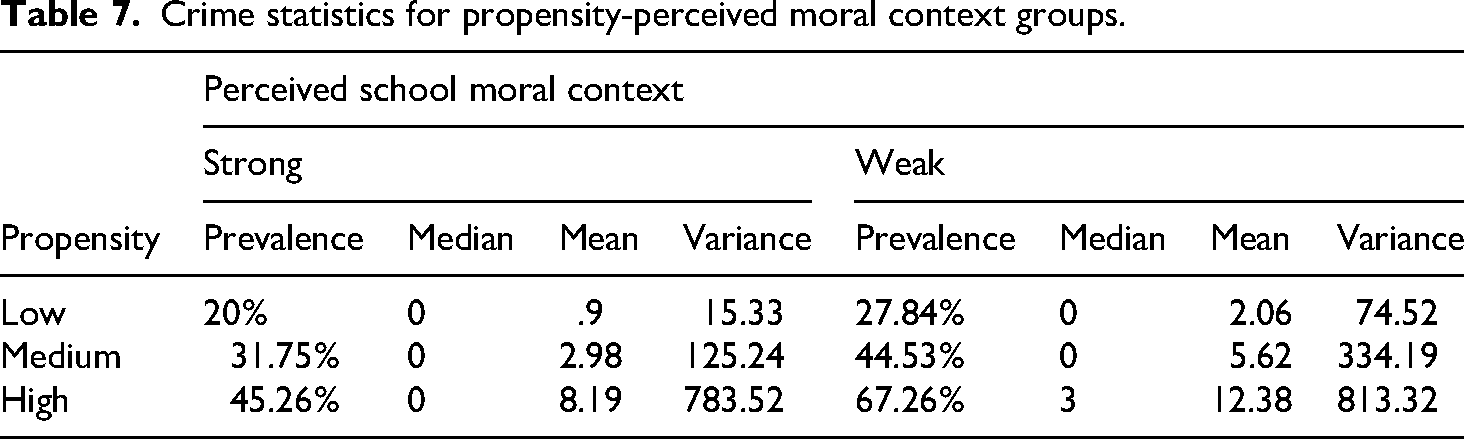
The median rates of criminal offending in the perception-conceptional groups support hypothesis 1 (see Table 7 and Figure 4). Pupils with high crime propensities who perceived their schools to have weak moral contexts report the highest prevalence, median rate, and mean rate of criminal behaviours. These pupils make up 23.4% of the SCES participants but are responsible for 52.9% of the crimes recorded in SCES (2760 crimes). 67.3% of these pupils report at least one crime in the past year, with a median rate of three crimes. In all the other groups, the median level of offences is zero, including even high-propensity pupils who perceived their school to have a strong moral context. The Brunner-Munzel tests show that the level of offending amongst the high propensity weak perceived moral context group is significantly higher than all other groups. These findings strongly support Hypothesis 2, suggesting that high-propensity pupils are the most sensitive to the influence of weak perceived moral context, which does not appear to affect the median rate of offending for other propensity groups.

Median crimes in the past year, by propensity-perceived moral context group.
Crime statistics for propensity-perceived moral context groups.
Discussion and conclusion
This study provided a clear mechanistic explanation of the causation of crime in schools, outlining two hypotheses identifying the causally relevant factors and their relationship to criminal behaviour in schools. Hypothesis 1 asserts that pupils’ crime propensity and perceptions of weak school moral context will be positively associated with criminal behaviour in school, and the highest rates of school crime will occur for high propensity pupils who perceive a weak school moral context. Hypothesis 2 asserts that the rate of criminal offending in school for pupils with high crime propensity will be more sensitive to the influence of perceiving a weak moral school moral context than pupils with low crime propensity. These were tested thoroughly, first with a traditional regression approach and secondly with simple contextual analysis. The findings from both approaches support Hypothesis 1, showing that pupils with higher crime propensity and those who attended schools that they perceived to have a weak moral context offend at a higher rate. Hypothesis 2 enjoyed mixed support. The simple contextual analysis provided strong support, suggesting that only the rate of criminal behaviour among high-propensity students was significantly affected by a weak perceived school moral context. Remarkably, the majority of high-propensity students did not offend if they perceived a strong moral context in their school. The regression analysis, however, did not find any strong evidence of statistical interaction between propensity and weak perceived moral context and thus no evidence that propensity influenced sensitivity to the perceived environment.
While the findings from the regression analysis are not in line with Hypothesis 2, they are not entirely unexpected. Firstly, it is notoriously difficult to detect and interpret interaction within OLS models (see, e.g. Edwards, 2009; Jaccard et al., 1990), and these difficulties increase when negative binomial models are used (Ai and Norton, 2003; Bowen, 2012). Secondly, and perhaps more importantly, regression analysis does not provide the most appropriate test of hypothesis two. The regression methods used in this paper calculated an inferential statistical model, which explained criminal behaviour in schools as a function of the independent variables crime propensity and perceived moral context. MERs analysis was then used to assess whether the strength of the relationship between perceived school moral context and criminal behaviour in school is statistically dependent on an individual's propensity (see Hardie, 2020: 89–90). Findings suggested that this relationship was not statistically significantly dependent. However, as Hardie points out, statistical dependence is not the same as convergence, and the true test of convergence is to capture, report and compare the actual crime rates that occur under the convergent conditions of certain individuals with their propensities in certain environments with their different perceived criminogenic features (Hardie, 2020). The simple contextual analysis presented in this article employed this approach and found evidence in support of Hypothesis 2. These conflicting results, therefore, arguably add support to the assertions that regression methods are not the most appropriate methods for testing interactive hypotheses. As Hardie points out, researchers, ‘should be wary of concluding “no interaction” from a single method or model of multiplicative interaction’, particularly if, ‘that interaction has already been evidenced using spatio-temporally linked data’ (2020: 64).
It is this author's belief that, as a whole, the findings in this article support Hypotheses 1 and 2 and have implications for policy and practice. Firstly, they suggest that if schools can foster strong perceptions of school moral context, particularly amongst pupils with high propensities, then there will be lower levels of offending in schools. Secondly, they suggest that if schools can aid pupils in developing low crime propensity, there will also be less offending in schools. While these findings make an important contribution to the school's crime knowledge base, further research is needed to overcome some of the limitations in this paper. Although individual pupils’ perceptions of their school were measured and the data was spatio-temporally linked, the analysis in this study did not assess whether schools differed in either pupil perceptions of moral context or the level of criminal offending. SCES data is suitable for this type of analysis, and work is currently underway in both these directions. Secondly, the level of the environmental unit measured in this study (the school) was too large for situational analysis. Schools contain many different settings: classrooms, canteens, corridors, gyms, halls, and playgrounds. These different settings likely have different moral contexts and different levels of criminal behaviour. Future studies should aim to capture this variation and measure perceived moral context and crime within immediate settings. This will allow for situational analysis to assess the influence of the interaction between the individual and their immediate setting on offending.
Footnotes
Ethical approval
Ethical approval was sought and granted from the Ethics Committee at the Institute of Criminology, Cambridge.
Funding
The author(s) disclosed receipt of the following financial support for the research, authorship, and/or publication of this article: This research was conducted as part of my PhD which was funded by an ESRC Doctoral Training Scholarship (Grant No. 1503617).
Statements and declarations
This article has been adapted from my PhD thesis:
McSharry, L. (2022). Disentangling School Climate: Analysing the causes of problem and criminal behaviour in schools through the theoretical lens of SAT [Apollo – University of Cambridge Repository]. 
My thesis has been published in the University of Cambridge Repository.
Where possible, I have adapted and paraphrased the text contained in this article, but there is significant similarity to sections of my thesis, particularly in the methodological and results sections of the article.