



Abstract
Volunteer monitoring occupies an important yet under-researched role in detention regulation. This article examines volunteer detention monitoring using original empirical data about prison Independent Monitoring Boards and police Independent Custody Visitors. Using a novel cross-institutional and cross-scale approach to data analysis, we draw on 129 semi-structured interviews with detainees, custody staff and monitors, alongside 41 days of non-participant observation in three prisons and three police custody suites. We find that volunteer monitors: (a) are inconsistently accessible to detainees, (b) face barriers observing and evaluating detention, (c) are viewed as low-status, low-impact actors and focus on individual bureaucratic failings rather than systemic issues and (d) face difficulties navigating inherent institutional power dynamics that challenge the independence of monitoring, exert pressure on monitors to be unobtrusive and deferential, and assimilate monitoring into processes of custodial control.
Keywords
Introduction
In many jurisdictions, citizen volunteer bodies have access to detention institutions, which Owers (2014: 211) argues can ‘provide an essential link with the community and a continuity of monitoring’ between formal inspections. Volunteer monitoring is a core component of UK detention regulation (Behan and Kirkham, 2016; Kendall, 2018) and exists internationally, partly due to Britain's colonial influence on prison systems (Stern, 2010). European jurisdictions including Germany, 1 the Netherlands 2 and Belgium 3 also operate volunteer prison monitoring schemes.
In England and Wales, Independent Monitoring Boards (IMBs) oversee prisons, and Independent Custody Visitors (ICVs) oversee police custody. Each scheme mobilises over 1000 volunteers (ICVA, 2022; IMB, 2025) to monitor conditions and address grievances, aiming to prevent rights abuses and assure the legitimacy of incarceration (Behan and Kirkham, 2016; Owers, 2010) as part of the UK's National Preventative Mechanism (NPM) under the UN Optional Protocol to the Convention against Torture (OPCAT). IMB and ICV schemes are run locally; each prison has its own IMB, while Police and Crime Commissioners operate ICV schemes. Nationally, IMBs are supported by a Ministry of Justice Secretariat and ICVs by the Independent Custody Visitor Association (ICVA), a Ministry of Justice and member-funded umbrella organisation. Volunteer monitors operate within wider tripartite detention regulation systems comprising monitoring, inspection and complaints-handling functions (Behan and Kirkham, 2016). In prisons, these roles are respectively carried out by IMBs, His Majesty's Inspectorate of Prisons, and the Prisons and Probation Ombudsman; and in police custody, by ICVs, His Majesty's Inspectorate of Constabulary and Fire and Rescue Services, and the Independent Office for Police Conduct. Complementary international mechanisms include the European Committee for the Prevention of Torture, and the UN Subcommittee on Prevention of Torture and Other Cruel, Inhuman or Degrading Treatment or Punishment.
S.6 of the Prison Act 1952 establishes and grants IMBs – known as Boards of Visitors until 2001 – the ability to ‘at any time enter the prison and […] have free access to every part of it and to every prisoner’. In 2004, ministers placed a duty on IMBs to ‘satisfy themselves as to the humane and just treatment of those held within the establishment and […] adequacy of the programmes preparing them for release’ (IMB, nd). Local IMBs conduct regular visits, respond to prisoner applications, meet with governors, and publish annual reports organised under four headings: safety, humane treatment, health and wellbeing, and progression and release (Owers, 2010). IMBs also observe Segregation Review Boards to ensure procedural compliance (Prison Service Order 1700: Segregation). A national report is also published annually.
Volunteer police custody oversight is a more recent development, emerging from Lord Scarman's report into the 1981 Brixton riots (Kendall, 2018: 36–39), and is, to our knowledge, a development unique to the UK. ICV schemes are required under s.51 of the Police Reform Act 2002 and shaped by the 2013 Code of Practice on Independent Custody Visiting. Forty-two schemes across the UK organise volunteers to make unannounced visits to police custody suites, speak with detainees and assess their ‘rights, entitlements, wellbeing and dignity’ (ICVA, nd a).
Advocates assert multiple benefits of volunteer detention monitoring. Tomczak and Buck (2019: 187) write that the potential for volunteer monitoring ‘to further humane and just treatment deserves attention’. ICVA claims that ICVs ‘prevent torture and ill treatment of detainees and deliver effective oversight […] to ensure a safe environment and deliver public reassurance’ (ICVA, nd b). Stern (2010: 4) contends that IMBs improve ‘the treatment of prisoners… through actual presence…of people from the outside world’. IMBs’ presence, Stern argues (2010: 4), mean that for managers ‘it is probably not worth it to leave the showers unrepaired, the mail unsorted and the violence unreported because it will all be discussed at the Board's monthly meeting’. In the USA, Simon (2018: 161) argues that monitoring can make ‘correctional governance both more legitimate and more effective at promoting the human rights of prisoners’.
Others are more sceptical. Padfield (2018: 75) cautions against uncritical endorsement of volunteer monitoring given the lack of robust evidence of its impact. Morgan and Liebling (2012: 1115) question IMBs’ ‘credibility’, pointing out that they lack ‘real existence in the general management structure of the Prison Service…; members feel that nobody listens to them; and many prison staff feel that board members need to ‘get real’ in interpreting their role’. Kendall (2018, 2022) argued that ICVs lack independence, do not shape policy or standards, and serve as symbolic markers of transparency rather than meaningful oversight mechanisms.
Despite the rhetorical and practical prominence of volunteer detention monitoring, empirical scholarship remains peculiarly sparse. Kendall (2018: 1) laments that custody visiting ‘has been almost completely ignored by police scholars’. His study of one ICV scheme found that volunteers were not effective and ‘very rarely challenged the police’ (Kendall, 2022: 128). Roffee (2017: 1) suggests that IMBs may enhance accountability through informal dialogue, but are ineffective at reporting accurate performance data, for example, on equality and diversity issues, advocating a more professionalized, trained and consistent volunteer base aligned with the state's monitoring requirements.
Critique has also emerged from practice. (Former) members have questioned IMB abilities to challenge wrong-doing in prisons, their independence, and volunteers’ class, age and racial background (Cawley, 2017; Mallet, 2016; Padfield, 2016; Sullivan, 2016). A commissioned review found the ‘IMB system was struggling to be fit for purpose’ (Karen Page Associates, 2014: 20), highlighting conflict between local IMBs, which valued their autonomy, and the national secretariat, which saw IMBs as fulfilling a specific public function. The UN Subcommittee for the Prevention of Torture (2019: 51–54) echoed concerns about independence, noting that the IMB Secretariat continued to be ‘line managed by civil servants of the Ministry of Justice’ and questioning the ‘functional independence’ of IMB structures. A Criminal Justice Alliance report critiqued ICV effectiveness in addressing race and gender disparities amongst detainees (Ali & Pittaway, 2021). While highlighting examples of progress, such as improved menstrual care provision, the report identified weaknesses in data collection, training quality and understanding of indirect discrimination, advocating greater diversity, stronger structural support and enhanced training.
Although analyses of volunteer monitoring are rare, burgeoning literature considers carceral oversight more broadly. Scholars have examined regulation frameworks (Behan and Kirkham, 2016; Deitch, 2020; Tomczak, 2021; van Zyl Smit, 2010), inspection methodologies and cost effectiveness (Shute, 2013) and perceptions among staff and prisoners (Curristan and Rogan, 2022; van der Valk et al., 2021). However, most empirical scholarship is siloed ‒ narrowly focusing on one mechanism or within a single institution, neglecting regulatory systems as a whole and limiting potential points for intervention (c.f. Behan and Kirkham, 2016).
Processual approach: Working across scales and institutions
We adopt a novel cross-scale and cross-institutional approach, using data drawn primarily from local custody environments to assess the broader functioning and potential of volunteer detention monitoring, and treating volunteer monitoring as a common regulatory form albeit with contextual variations across prison and police custody. In this section, we show that our approach valuably and innovatively develops a cross-scalar analytical perspective that can consider both the cumulative effects of networks of micro-level (inter)actions and contextual nuances.
The selection of scalar vantage points has plagued penal research and sustained the division between macro and micro research traditions (Bosworth and Carrabine, 2001). Garland (2001: vii) advocated that scholars ‘go back and forth between the general and the particular, the big picture and the local detail, until alighting upon a level of analysis that seems to offer the optimal vantage point’. But analytical and regulatory scales are not neutral. Following prison privatisation during the 1990s, prisons’ regulation focused ‘
One might argue that prison and police custody are distinct institutional fields, with divergent histories, functions and organisational logics. Drawing on processual ontology, we illustrate that a cross-institutional lens disrupts the limiting tendency to study regulatory practices in silos. Many criminal justice systems lack ‘vision for how the component parts of the system contribute overall’ (Borakove et al., 2015: 2), resulting in fragmented systems. Criminological scholarship typically reproduces institutional silos, for example, treating policing and imprisonment as distinct domains rather than components of a system (Liebling, 2000). This fragmentation limits interdisciplinarity and constrains capacities to cut across criminal justice institutions. By looking beyond top-down, linear models of agency and change (Tomczak, 2021), our networked approach identifies volunteer monitoring as a mediating practice, that can enable and contest the transfer of norms and practices across custody settings. In doing so, we open space for cross-pollination between monitoring schemes and conceptualise criminal justice and its oversight as a system of interconnected institutions.
Analysing how volunteer monitoring operates across systems of custody, rather than within siloed institutions, requires an approach that can move across micro and macro scales without extrapolating unduly, contra Garland's notion (2001: vii) of an ‘optimal vantage point’. Our approach is to examine micro-level findings regarding volunteer detention monitoring as a component of how detention and detention regulation broadly are made, unmade and remade by networks of actors and interactions. This approach is informed by processual conceptualisations of power and organisation as precarious effects that continuously emerge from interactions between heterogeneous actors (e.g., laws, policy documents, frontline actors) (Kinkaid, 2020; Latour, 2005; Müller, 2015; Rutzou and Elder-Vass, 2019). This perspective transcends the macro/micro binary, to explore how institutional dynamics emerge from diffuse interactions rather than top-down directives (see Tomczak, 2017, 2021).
ICVs and IMBs are networks of small-scale visits, dialogues, observations and interventions which cumulatively have unparalleled access to and significant information about closed institutions. Their impact cannot be understood solely by examining published outputs – although this is often the default mode of analysis (Behan and Kirkham, 2016; Roffee, 2017; Woodall and Freeman, 2021). Documents alone shed little light on the impacts of volunteer monitors within detention, their interactions with officials at all levels, and the social meanings attached to their visits and reports (Maynard-Moody and Musheno, 2003). And while their presence may appear relatively small and their power limited, the cumulative impact of multiple decentralised and seemingly small-scale actions of volunteer monitoring, at least potentially, could influence broader institutional distribution of power (Tomczak, 2017: 58–59).
Argument and contribution
We offer a rich, empirical account of volunteer monitoring across distinct sites of detention, addressing both Padfield's (2018: 74) call for ‘a great deal more research, particularly qualitative research, to understand the inter-relationship of the various external monitors and their impact on those who work and live in prisons’ and Liebling's (2000) recommendation to bridge prison and police custody scholarship. Our study is grounded in local institutional contexts, drawing on original qualitative data from 41 days of observation across three prisons and three police custody suites, and 129 interviews with detainees, staff and monitors. Its analytic ambition is broad: across volunteer monitoring and detention regulation, underpinned by processual ontology that, although little used in penology, provide valuable approaches to examining organisation that contrast with, for example, macro-level Foucauldian or Durkheimian analyses (Tomczak, 2017). This article addresses the limited body of knowledge about IMBs and ICVs, highlighting the scale of volunteer involvement, their access to closed detention settings, their remit under OPCAT and the institutional resources so invested across police and prison custody. This article also aims to reorient the nature and ambition of criminal justice detention regulation scholarship by breaking open the institutional structures that too frequently bound analyses and conceptualising volunteer monitoring as a cross-institutional process that holds system-wide potential. Whilst our observations were gathered from a limited number of sites in England and Wales, volunteer detention monitoring can be found throughout the UK and Europe and is often advocated for the USA (e.g., Simon, 2018). Although there are important contextual nuances between detention institutions and sites, we hypothesise that our findings would be resonant to extant and planned volunteer detention monitoring activities internationally, although further empirical research is required to test this.
Using a novel cross-institutional and cross-scale approach to analysis of a substantive and original dataset, regarding a widely under-researched dimension of penal oversight, we find that volunteer monitors: (a) are inconsistently accessible to detainees, (b) face barriers observing and evaluating detention, (c) are viewed as low-status and low-impact actors and focus on individual bureaucratic failings rather than systemic issues and (d) face difficulties navigating the institutional power dynamics of custody sites due to an expectation of unchallenging monitoring and aspects of monitoring which participate in custodial control. Although we did not evaluate the ‘effectiveness’ of monitoring per se, our findings suggest that the claims made by some commentators about their preventive role in relation to serious rights violations are overstated (Simon, 2018; Stern, 2010). We conclude, mobilising our processual approach of working across scales and institutions, that volunteer monitors could enhance their power and reach through cooperation or incorporation with Inspectorates and more meaningful cooperation with the collective, democratic power of detained and criminalised people. Central to progress is acknowledging and mitigating risks of capture, whereby monitoring becomes complicit in sustaining detention rather than offering an independent challenge to penal power.
Methodology
This article draws on data from a large, mixed-method, multi-site research project (2022–2027) investigating criminal justice detention regulation. For this article, we analysed a data subset comprising 129 semi-structured interviews with detainees, staff and volunteer monitors, and 41 days of non-participant observation across three prisons and three police custody suites.
Police custody data included 32 staff and 28 detainee interviews and 26 days of observation across three forces in the North of England, South of England and Wales, in 2023 and 2024. Access was enabled through fast-track vetting and local permissions from custody management following email approaches to over 20 forces. Interviews with staff and detainees were organised by researchers during observation hours. Detainees were approached in cells and interviewed at a time that would not delay case processing. All on-site interviews took place in private rooms, with a small number of staff interviews taking place on TEAMS.
Prison data included 28 staff and 29 prisoner interviews and 15 days observation in three category B and C prisons in the Midlands and in the South of England, in 2024. Access was authorised by HM Prison and Probation Service National Research Committee and obtained through prison governors following email approaches to 20 prisons by email. Staff interviews were organised in advance, in coordination with the prison's liaison and interviews were conducted on site, with a small number of staff interviews via TEAMS. Interviews with prisoners were conducted on-site in a private room and arranged according per negotiations with establishments: in two prisons, staff circulated an advertisement to which interested prisoners responded and in another, researchers approached prisoners in libraries and wings to participate. Across detainee interviews, extensive time was given to explaining the project and ensuring that participants could provide informed consent.
Twelve volunteer monitor interviews were also conducted. Participants were invited through internet searches and institutional gatekeepers. Sampling was purposive (Denscombe, 2021), reflecting a range of monitoring roles and organisational affiliations. Interviews took place in 2023 and 2024 both in person and TEAMS. In two interviews, two volunteers were included for participant convenience.
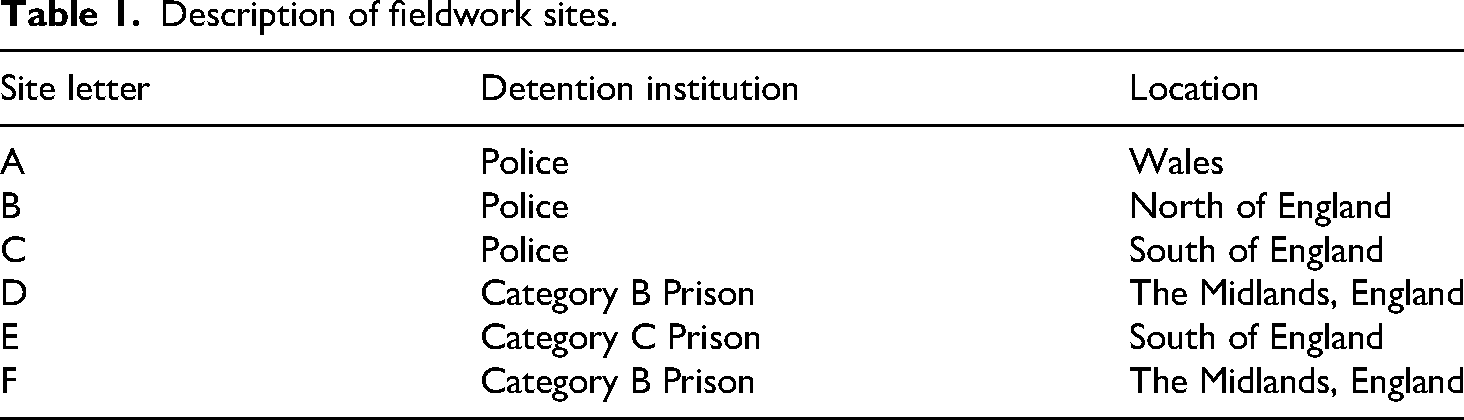
Interviews are labelled with a Letter-Type-Number code (e.g., B-detainee-34, Monitor-05), where the letter indicates the institution, as described in Table 1.
Description of fieldwork sites.
Ethical approval was granted by the University of Nottingham. To manage risks associated with empirical work in custody settings, we developed detailed policies including a Standard Operating Procedure for empirical work, Risk Management Plan and Unexpected Findings Policy. All interviews were recorded with permission, using encrypted dictaphones, and files were securely transferred, transcribed, pseudonymised, then deleted per data management protocol.
Monitor and detention staff interviews lasted between 45 and 93 min, and detainee interviews between 15 and 61 min. Interviews were semi-structured, directed by an interview schedule that asked participants to reflect on (a) their experience of custody and its problems, (b) their experience of custody regulation broadly and volunteer monitoring specifically, and the extent to which these efforts responded to the problems of custody, (c) the ways custody and its regulation could be improved and (d) connections between their activities and other regulators. Observation took place in various custodial spaces, including prison wings, prison libraries, staff offices, meeting rooms and police booking in desks. Researchers observed and took notes about interactions between staff, detainees, monitors, environments and objects.
Our dataset has clear limitations. Our findings are not representative for any participant groups (or subgroups). We did not collect demographic data about participants. Access to detainees was mediated by institutional staff, who designated detainees deemed low-risk as suitable for interview. In some cases, we were directed towards detainees by staff. This gatekeeping enabled access to prisoners who had experience of regulatory processes but meant staff significantly influenced who we spoke to. This was an exploratory research project by design, which prioritised breadth over depth in data collection: for example, one ICV visit was observed directly, forming valuable indicative data but making no claim to representativeness. Due to the difficulties in navigating access, the time spent observing in prisons was in total less than in police custody despite our best efforts.
Analysis was informed by Braun and Clarke's (2022) iterative and reflexive approach to thematic analysis. After familiarisation, we developed a semi-inductive semantic coding scheme to track perceptions of regulation and to trace how regulatory assemblages were formed and obstructed through interactions between monitors, prisoners and other custodial actors. Researchers then coded the full data set, using fine-grained specific meaning codes (e.g., ‘slow response’, ‘problem raised’). These codes were reviewed and grouped into semantic themes (grouping perceptions such as ‘barrier to access’, ‘problems for observation’) and latent themes (tracing deeper assumptions and structural logics such as ‘participation in custodial practice’ and ‘problem for independence’) (Braun and Clarke, 2006: 85). Coding was conducted by three researchers working collaboratively to ensure consistency and connections between codes (Maguire and Delahunt, 2017) and, following processual ontology, taking care to build findings by learning from the actors rather than imposing deductive assumptions. The findings presented below present the data that illuminate our research questions about the role and effectiveness of volunteer monitors in both prison and police custody.
Findings
Awareness and accessibility
Scholars highlight low awareness of prison oversight bodies: van der Valk et al. (2021) report low prisoner awareness of inspection and oversight bodies in the Republic of Ireland, while in Spain, Aizpurua et al. (2025) found low awareness of the European Committee for the Prevention of Torture, especially amongst non-Spanish speakers and short-term prisoners. We expand this lens to highlight that, without awareness and accessibility, detainees cannot engage with monitors to challenge poor treatment. In our police custody research, awareness of ICVs was nil: zero of the 28 detainees interviewed reported having met an ICV or knowing who they were. This aligns with ICVA's finding that only 2.8% of detainees in 2024–2025 (27,000 of 978,315) were visited by ICVs (ICVA, 2025). Moreover, ICVs do not operate an applications process, meaning detainees cannot request contact.
In contrast, all 29 prisoners we interviewed were aware of the IMB, although this awareness did not equate to consistent accessibility within prisons, across which volunteer numbers and capacities vary. IMBs often concentrated on induction and segregation wings, with less presence in living areas. As one prisoner explained: You see them a lot on induction wing […] but not on the top wings […] in dispersal [high security prison] I would complain to them, they would go and do that and them boom it would be sorted. Then they [staff] would be on top because they wouldn’t want the IMB on their case whereas in here […] I haven’t seen them. (F-Detainee -06)
In the absence of face-to-face contact with monitors, prisoners can submit paper-based ‘applications’, using a system similar to the prison's own complaints procedures. Prisoners criticised this system as slow, opaque, and ill-suited to the conditions of confinement. It takes […] weeks maybe months before they come and see you. (D-Detainee-04) I requested to speak to one and it was the same case then, they was too busy, fill out a form, obviously filled out a form, put that in and I have obviously not spoken to anyone yet. (D-Detainee-05)
For some, this lack of accessibility reinforced perceptions that monitors were disconnected from prisoners’ concerns: I want the oversight to be more transparent. More contact with prisoners from the IMB. To my mind they have no idea of what it's like to be here. (D-Detainee-02)
Moreover, making an IMB application is not necessarily confidential. In some prisons, application boxes are visible to staff or placed behind gates, meaning that prisoners risk stigma and vulnerability to retribution (Banwell-Moore and Tomczak, 2023): I wouldn’t do it because it is just […] another bit of paperwork, it is another bit of… ‘oh are you moaning?’ You know what I mean? … I know how it goes. I don’t want to be labelled a moaner. (F-Detainee-06) I have to fill in a form and that form has to go in one specific post box which is behind the locked gate. So I can’t freely access that, which I believe is deliberate by the prison. It doesn’t make it impossible because you get an officer to go and put it in the box but…I’m going to use the word shit again, but staff have a shit list. And if you make their lives harder they don’t like it. (F-Detainee-10) Where the IMB box is, it is blocked off by a gate, and there is not always staff available for you to ask if you can open up the gate so you can go through and post it. […] Why can’t you just have an IMB box on the wing? (F-Detainee-08)
For prisoners with limited literacy or institutional support, the written application process presented further barriers to accessing monitors, forming a significant concern given the prevalence of literacy needs among criminalised populations (Holland et al., 2023; Snow et al., 2015): You’re dealing with people in prison…they lack resources available or help to be able to put a case together or to write things and you know articulate it in a way that they can put their case forward, so now when they made that system really difficult because you have to write to them, I am sure they have sorted a decrease in that amount of complaints. (E-Detainee-08)
In sum, our findings highlight significant limitations in the awareness and accessibility of volunteer monitoring schemes. This limits the possibilities for volunteer monitors to respond to and engage with prisoner concerns, and impedes the formation and strengthening of regulatory networks between monitors and prisoners.
Independent observation
NPMs should be established to possess ‘functional independence’ [OPCAT, Art 18(1)], including access to all relevant information; untrammelled access to all places of detention; the opportunity to have private interviews with detainees; protection for those who gave information and confidentiality of that information; and the right to report findings publicly (Arts 19 and 20). IMBs are granted substantial prison access under s.6 of the Prison Act 1952, ‘any member of an IMB may at any time enter the prison and shall have free access to every part of it and to every prisoner’. In practice, IMBs visit each prison up to five times per week (IMB, 2022), although critics highlight the predictability of visit timing and the rarity of night-time monitoring (Leech, 2016). In contrast, S.51 of the Police Reform Act 2002 allows local policing bodies to determine what access and powers ICVs receive. Legislation does not ensure that, for example, ICVs have access to all custody suite areas or to observe critical moments such as arrest and interview. ICVs cannot view CCTV footage (College of Policing, 2024), and do not monitor strip searches, drug testing procedures or the booking in process. Visits typically occur two to three times per week at each police detention suite (ICVA, 2022).
During our police custody observations, we observed an ICV visit to a 50-cell suite. In the hour-long visit, two ICVs visited five of the 33 detainees and only two visits involved a substantive interaction. ICVs were explicitly directed towards the more amenable detainees by police staff, which was unchallenged by the ICVs. Upon walking onto one wing, an ICV asked the detention officer ‘who are the nice men in here?’ The ICVs avoided speaking to a detainee held under immigration powers who they suspected did not speak English. One ICV said to an officer: ‘You’re just holding them here to take them away aren’t you?’, as if this detainee were exempt from potential rights abuses. Interviews with ICVs confirmed the tendency to be directed to detainees by the police. We are taking advice from custody staff, who not to speak to, because that could technically be used to stop us from seeing certain individuals for other reasons […] I have to take their word for it, which is not ideal but I do try to at least look at them through the hatch to see if, you know, in case there was a lot of blood on the wall. (Monitor-15)
A member of staff confirmed this approach: You are not going to let them speak to an angry person are you? For their safety. So you sort of, they see the nicer ones. […] We are not going to put them in a cell where someone has crapped all over it, […] so they are slightly shadowed away from that. (B-Staff-03)
A custody sergeant identified how ICVs’ views were limited by this dynamic: They don’t always see everybody because some people are too high risk for them to see, so are they really getting a full view of what is happening as such? […] They see the ones that are calm and compliant. (B-Staff-06)
Whilst there is a need to mitigate risk, this detainee selection indicates the systematic exclusion of groups particularly vulnerable to abuse and mistreatment. Skinns (2012: 101) argues that police treated people impartially in custody ‘except in relation to certain kinds of suspects, most notably the non-compliant and the disreputable’: precisely the kinds of detainees ICVs are least likely to encounter.
Police custody suites have been well documented as sites of violence and pain (Skinns and Wooff, 2021) in which large numbers of strip searches are carried out (Duff and Kemp, 2024). However, the ability of ICVs to witness events that involve direct violence and rights infringements is limited. ICVs don’t monitor strip search […] how would they? (Monitor-01)
The use of restraint and force also did not form a central concern to some ICVs: If somebody is complaining about force, or use of force I always advise them, “well if you want to make a complaint you are perfectly entitled to do so. Either in person or through your legal representative.” So, but I don’t see force, or use of force as much of an issue, from what I observe. (Monitor-19)
Given their limited access, ‘the role of an ICV is fundamentally interactive with both detainees and police staff’ (College of Policing, 2024). ICVs rely on what the small proportion of included detainees disclose during short conversations at the cell door. If a detainee makes a complaint, ICVs are not permitted to review CCTV. One of the questions we ask is, “is the CCTV working?” to which the answer is, yes and actually we can see it, at a distance, that it is working. But we have no right to look at the CCTV footage. (Monitor-19)
This problematically positions ICVs as adjudicators of detainee credibility. Some ICVs relied heavily and uncritically on custody records and staff accounts to corroborate or refute detainees’ claims. Respondent 1: A lot of the detainees sometimes… some of them can make up things […] but everything in here is logged, no matter what time of the day it is or whatever, […] so we can look at the record and say well hang on he has had his medication? Because some will say ‘I am not having medication’. Respondent 2: Yes they will swear blind that they have not been… not been offered a solicitor, they have not had their medication and we know that obviously once it is on a custody record it is there, it is evidenced. Respondent 1: We look at the record and we can see, and it even tells you what time they were actually contacted […] Respondent 2: But they are not in here for no reason are they really so? They are always going to have a biased attitude. (Monitor-30)
Other ICVs were much more sceptical of this approach. I can ask the custody staff and what they tell me can be as true or not true as what is written in the custody records, […] if they tell me all ‘oh he already had food’ or ‘he had been offered food but he declined’, it may or may not be true, I have no way of checking that, even if I looked at the custody record. (Monitor-15)
These divergent approaches highlight inconsistency in practice and significant epistemological limitations of custody monitoring. Custodial institutions hold significant power to produce documentary records – a power that detainees lack (Foucault, 1991). Some monitors’ reliance on institutional narratives undermines their independence, to which we return below.
These limitations are not unique to ICVs. Prisoners also raised concerns about IMBs’ abilities to independently assess complaints. The IMBs need to do an investigation in the applications. They’re independent so they should do their own look at it. Rather than repeat the application and what the prison said. (WP3DInt03) They can only take your case, go and speak to the governor about it, OK erm and that is pretty much as far as I see and then they would come back and tell you what the answer is from the governor, that is all. (E-Detainee-08)
Although IMBs have a broader investigatory remit than ICVs, for example, IMBs’ National Monitoring Framework provides guidance about ‘having the right to obtain information’ to ‘evidence-check from different angles’ (2021: 9), prisoners felt that in practice, IMBs merely repeated the contents of their own application. Thus, while IMBs and ICVs exist to provide independent scrutiny, their ability to do so is hampered by structural limitations to select detainees, directly observe events and access surveillance.
Remit, status and impact
Under the OPCAT, volunteer monitors are tasked with preventing torture and ill-treatment. Yet, our data suggest that volunteer monitors primarily mediate relatively low-level disputes and address failures of bureaucracy, being perceived as low-status actors with limited influence over systemic change.
Prisoners described IMBs as useful regarding isolated administrative issues – such as missing property, delays in adding phone numbers to approved call lists, and missing wages (e.g., D-Detaintee-5, D-Detainee5, and F-Detainee-3). In many cases, prisoners used the IMB to chase a delayed or unsatisfactorily resolved complaint. As one prisoner explained: We worked it all out and it equated to £70 they owed him [in missed wages]. He got on to IMB, IMB came straight down, they had a look, and they said ‘right leave that with us’. […] Yes, so that problem has virtually been resolved. (F-Detainee-03)
Others felt that IMB involvement could add credibility to complaints and expedite a response. They do as much as they can physically do without having any power. But it does help if you get IMB involved, and they write a report which is in your favour, which 9 times out of 10 they probably in the prisoner's favour but prisoners don’t take it to IMB if they feel that they are in the wrong. (F-Detainee-01) Loads of people moan about the IMB because they are not very helpful, but they can be helpful. […] In relation to complaints they can email the person you have complained to encourage them to give an answer, inquire what has happened since and stay in touch to make sure things are being done and they can come to meetings with you when you meet with the managers and stuff, so they can be good but again you need to be concise, and you need to be right. (F-Detainee-10)
However, regarding more serious grievances, IMBs were less effective. One prisoner, who reported being falsely accused of smuggling contraband, described how neither the internal complaints system nor the IMB led to resolution. The IMB? Yeh, that's rubbish. I was falsely accused of bringing something in and they banned my mum from visiting me for three months. I hadn’t touched her, she had nothing and they found no evidence. […]. I complained using a Comp 1 and then a Comp 1A [internal prison complaint forms] and then to the IMB. […] The IMB application didn’t help at all – they just read back my complaint and what the prison said and gave me the address for the PPO [Prison and Probation Ombudsman]. The PPO haven’t responded yet. My solicitor has requested the CCTV but five months later it hasn’t been shared. (D-Detainee-03)
In this difficult case, the IMB served only as a signpost to the external complaints Ombudsman. While the open-ended IMB application process allows diverse issues to be raised, their lack of clear remit and investigative capacity risks deepening prisoner frustration and eroding trust.
Prisoners’ reluctance to use the IMB often related to their perceived low status and power. I have dealt with the BOV [Board of Visitors] in the past and I just thought they don’t really carry as much weight as what I thought. […] They do get doors gently but firmly shut, slammed in their face you know by people higher up. (F-Detainee-02)
Staff shared this view. Some saw IMBs as a tool of senior management, selectively drawing on IMB feedback when convenient and ignoring it when not: There was an incident that kicked off that I responded to and that an IMB member happened to witness, and myself and another one of the CMs [Custody Managers] were put forward for a commendation by the IMB. Swept away and we never heard another thing about it […] Senior management will pick out what they want to make a point about something but it is like a lot of things we do, […] as long as it is saying what they want to, but as soon as it says something completely different it is just guidance and we don’t need to listen to it. (D-Staff-01)
Others felt that IMBs lacked the institutional knowledge to pose meaningful challenges: I would struggle to see much direction coming from them… So they are novices right, so they are not professionals, they don’t understand prison necessarily… they don’t understand the prison organisation and […] prison rules in much depth and frankly, I feel I can bamboozle them if I need to. (E-Staff-02)
In police custody, ICVA and ICV reports foreground sanitary product availability, provision for neurodivergent people and facility conditions (ICVA, 2024). Staff interviews evidenced how ICVs emphasised provision for sanitary supplies and vegetarian diets and disrepair in custody suites (A-staff-10, A-staff-02, and B-staff-09). Staff generally had low a low opinion of ICV feedback: Very, very rarely do we get any sort of meaningful feedback, whether it is some custody visitors or anything else. (A-Staff-09) The main thing is food and stuff like that, […]. I am not really sure that prisoners really understand what the person is there for […] We always get a good report back anyway, generally no issues at all. (B-Staff-02) Interviewer: Do you think they have a useful input in to what goes on here? Respondent: I will be honest with you, no not really. I really don’t think they do. (B-Staff-08)
One ICV felt that this limited focus meant that volunteer monitoring was not having a substantial effect upon custody. I don’t think it is really doing the job […]I mean it probably does when we are lucky and we pick something up on that one day a week we are in […] So I think overall I think it's a nice idea but I’m really wondering how much it really does. (Monitor-15)
While Roffee (2017) reminds us not to underestimate the potential preventative impact of volunteer monitors’ mere presence, our analysis shows a persistent mismatch between the organisational missions of IMBs and ICVs ‒ to improve standards and prevent torture and mistreatment ‒ and the low-level issues which occupy much of their time and perhaps deflect attention from engaging with more complex issues or developing a richer regulatory networks. Further, it questions the ability of such low status and power actors to meaningfully influence custody practice, particularly in the absence of an adaptive strategy for their limited power to cut across scales in a complex reworking of authority (Tomczak, 2021).
Navigating institutional power
Volunteer monitors must navigate institutions with hierarchical and insular staff cultures, in which staff define themselves against those that they imprison (Crewe, 2011; Skinns, 2012), and are constituted by a dynamic, unequal power struggle between staff and prisoners (Crewe, 2011; Kemp and Tomczak, 2023). Responding to Behan and Kirkham's call to examine how oversight systems address ‘penal culture and power imbalances’ (2016: 433), this section draws out ways that monitors face pressure to a) align with institutional expectations and b) function in ways that participate in custodial control.
Staff expectations
Prison staff commonly viewed volunteer monitors with suspicion: I feel like they are watching you and what can you do wrong and ‘why have you done this?’ (E-Staff-03)
Acceptance of volunteer monitors appeared contingent on their cooperation with staff: The IMB who actually works with us, […] listens to the prisoner as well, but then when explained our defensible decision process or talk it through they actually say ‘OK I see your point’ […] Those ones that are not difficult. They work with us yes. (E-Staff-Int09)
Some staff went further: wanting IMBs to act for staff as well, rather than prioritising prisoners: I am not a huge fan erm because they are supposed to be there for prisoner and staff but I find […] find the majority aren’t really interested in staff, it is more about prisoners. (E-Staff-01) Some IMB members are really good, engage with the staff as well, some IMB members don’t engage with the staff and engage with the prisoners only, it is not supposed to be that, it is supposed to be for both. (E-Staff-03)
This expectation may reflect the IMB's legacy as Boards of Visitors, which addressed staff concerns. However, the IMB's current remit prioritises prisoner welfare (IMB, 2021: 3). Staff demands for balanced treatment risk eroding this mandate and reveal underlying tensions over institutional status and competition for recognition in a context where staff feel undervalued (Crawley and Crawley, 2013). This raises questions about regulatory capture – that is, the inability of regulators to challenge the authority that they are established to oversee (Ayres and Braithwaite, 1991).
Similar dynamics were evident in police custody. Officers consistently praised ICVs for being unobtrusive, cooperative, and useful channels to escalate their own concerns. They don’t seem to bother you. They will grab a detention officer and they will do what they need to do, they will have a very brief word with the [sergeant]… see you’re very busy, and they tootle off. They are not in your face, they are not saying ‘why has this happened? Why has that not happened’, none of that. Very friendly and I think they are good asset for coming in. (B-Staff-10) All I have ever got is positive from custody visitors […] if we haven’t got something that we need, we haven’t got the right staffing and we need them, then the way to do it is to put it through the voice of the custody visitors […] to say ‘you are understaffed, your suite is poor, you have got no CCTV’. (B-Staff-11)
However, when ICVs challenged custodial practice, police were often dismissive: I think it is almost the erm rose tinted glasses aspect of not really erm aware and appreciative of what is going on, the risk that is involved. (B-Staff-08) Personally I don’t understand why we have them […] it is so transparent what happens in custody now. There are some very nice custody visitors, but we also have some that don’t really understand how custody works. And they are very critical. (C-Staff-05)
Some ICVs we spoke to adapted to this expectation, taking an unobtrusive and unchallenging approach to their role: I never, ever directly criticise a Custody Officer. I suggest that perhaps this should be done, or maybe that should be done differently. But I would never, ever say, you’ve done that incorrectly. That's not the way. And it's not our role. (Monitor-19)
Custodial institutions create pressurised, judgemental environments in which monitors are expected to create minimal interference. This pressure may be difficult for volunteer monitors to consistently withstand, especially given internal guidance to IMBs to ‘maintain good relationships with staff’ (IMB, 2021: 10), and raises important pressures about recognition and mitigation of inherent pressures on volunteer monitoring.
Participation in control
Beyond adapting to institutional expectations, monitors risk becoming assimilated into the logics of custodial control. In police custody, ICVs sometimes helped to avoid low-level complaints from detainees: I guess they influence us when they go and have a chat with the detainees, I always want my detainees to be happy with us and been well fed and got blankets and stuff because I don’t want them [detainees] giving me a gob full. (A-Staff-07)
We observed ICVs helping to pacify complaints about, for example, not being allowed to wear trainers in cells. The ICVs explained the reasons for the rules regarding shoelaces, and beyond that, explained that the rules were for the detainee's own benefit. Turning to the Detention officer, the ICV said: I always try to reassure them that you will look after them. (E-Observation notes) Respondent 2: Yes, I feel we’re almost like a buffer…it also… it diffuses quite a lot of situations as well because […] it just helps just for them to sometimes just to speak to somebody. (Monitor-30)
Certainly, having someone to talk to may be beneficial for some detainees. However, ICVs were observed to share information with the police. Respondent 1: The minute you turn around and say to them ‘we are nothing to do with the police, we’re just here as an independent, you know to look on to you and make sure you’re OK’, they seem to settle down and open up to us and then we can relate that back to the officers or the inspectors. (Monitor-30)
On one hand, ICVs present themselves to detainees as independent observers. On the other, they funnel information, collected under the auspices of being independent, to the police (see also: Elger et al., 2015). This can bypass detainee choices about disclosures and potentially aids the police rather than detainees.
ICVs also have the goal of reassuring the public about safety in police custody (ICVA (nd b). As one visitor put it: We help erm put the message out there regarding the police. As I said earlier, I don’t think they get the recognition that they deserve. (Monitor-30)
However, there is a critical distinction between delivering public reassurance through robust and transparent monitoring, and performative reassurance through the mere existence of monitoring. This complicated further by ICV governance structures. Whereas IMBs are constitutionally independent from the prison service, ICVs are managed, appointed and report to Police and Crime Commissioners. As one senior custody officer said: ICV's really are advocates of the office of Police and Crime Commissioner […] You know, set of eyes that come in and kind of hold us to account on behalf of the PCC [Police and Crime Commissioner]. (B-Staff-01)
Yet, PCCs are electorally ‘responsible for the totality of policing in their force area’ (Association of Police and Crime Commissioners, nd) and therefore both accountable to the public for police performance and this oversight of police performance.
In summary, volunteer monitors are shaped by the inherent power dynamics of custody institutions, which risk monitoring becoming tools of custodial control. For oversight to be more than symbolic, monitors must creatively and apparently of their own initiative resist pressures to be unobstructive, collaborative, aid custodial staff in managing risk and dissent and, in the case of ICVs, be formally independent from policing.
Discussion: Reimagining volunteer monitoring?
Drawing on extensive yet non-representative interview and observation data, this article presents four findings. First, detainees face multiple barriers to accessing volunteer monitoring, including inconsistent presence and reliance on paper-based applications (IMBs) and in cell visits (ICVs). Second, monitors have limited ability to independently evaluate mistreatment in custody, due to resource constraints and methodological reliance on ex post facto reports rather than observation or investigation. Third, there is a disjuncture between the formal remit of volunteer monitoring – that centres overarching torture prevention and rights protection – and the in-practice focus on low-level bureaucratic and complaints system failures, with volunteer monitors seen as low status and low influence actors by both staff and prisoners. Finally, we identify inherent and interrelated dynamics that challenge the independence of monitoring and that do not appear to be acknowledged or mitigated by volunteer monitoring organisers: (a) custodial environments exert pressure on monitors to be unobtrusive and deferential, and (b) monitoring can participate in custodial control for example, calming detainees, information gathering about detainee problems and performing public reassurance. These indicative findings raise important critical questions about the practice and potential of volunteer monitoring across local, national and international networks, although attention should be given to contextual nuances between detention institutions and sites.
Seeking to improve volunteer monitoring is a complicated endeavour. The very purposes of monitoring are multiple and vague, and entangled with the contested purposes of the criminal justice system itself (Padfield, 2018). Our article has indicated at least five potentially diverging purposes for volunteer monitoring: preventing torture and ill-treatment under OPCAT; improving ‘outcomes for prisoners and detainees’ (IMB, 2021: 4); ensuring a safe environment for detainees (ICVA, nd b); delivering public reassurance regarding police detention (ICVA, nd b); and, for detention staff, supporting the operations and efficiency of custodial institutions. As illustrated, it not evident that the structures and practices of volunteer monitors are adequate to seek these goals, which reinforces the symbolic role of monitoring: legitimising the operation of custody in the absence of evidence that monitoring systematically improves conditions.
Since volunteer monitors are just one aspect of the UK's NPM and wider detention regulation apparatus, a full critical appraisal of their work would benefit from drawing together these findings with analysis of the full gamut of regulatory processes and powers under OPCAT, individually and in sum. In lieu of this, we offer the following discussion of potential ways forward for volunteer monitors. Extant critiques have emphasised training and professionalisation (Ali and Pittaway, 2021; Roffee, 2017) in response to limitations of volunteer detention monitoring. Our approach and findings indicate that this is insufficient. Improving the impact of volunteer monitoring would require transforming monitors into actors with ability to engage consciously in detention's dynamic power imbalances (Kemp and Tomczak, 2023). Following Bosworth and Carrabine (2001: 513), ‘agency is a practical accomplishment that can challenge or maintain prevailing power relations, providing the possibility that prisons may be altered from the inside out by those very individuals who are subject to its control’. How volunteer monitors acknowledge, engage with and challenge the power relations that constitute carceral spaces is, therefore, central to their potential impact. Significantly, our processual approach of working across scales and institutions indicates that volunteer monitors could enhance their power and reach either through cooperation or incorporation with Inspectorates and voluntary sector actors, or through more meaningful cooperation with the collective, democratic power of detained and criminalised people. Central to this is acknowledging and mitigating risks of regulatory capture by the institutions and imperatives of criminal justice, whereby monitoring becomes complicit in sustaining detention rather than offering independent oversight.
Regarding ICVs specifically, reconstituting ICVs as ‘monitoring boards’ rather than mere ‘visitors’ may increase their standing, and separation from Police and Crime Commissioners would be a step toward operational independence (Kendall, 2018). The abolition of Police and Crime Commissioners presents an opportunity to reimagine the role of ICVs in ways that bolster their independence from the police and police culture. Their practice must include less predictable patterns of observation that cover all aspects of custody, in ways that are not only directed by police. And if ICVs are to make a significant contribution to reducing the harms of criminal detention, their remit needs to include oversight of decisions to detain, suitability for detention and the effectiveness of processes to divert people in custody from criminal justice and toward appropriate forms of care and support. For IMBs, their impact could be improved in two ways. Firstly, by coordinating more fully with the inspectorate such that their continuous findings are incorporated into the formal assessment of prisons during intermittent inspections. Secondly, IMBs could adopt a community organising mind-set, which seeks to work collaboratively and over the long-term with groups of (former) prisoners to advocate better treatment and rights adherence (see e.g., Prison Reform Trust, nd).
For both organisations, recruitment and capacity must not only increase but also target individuals that can embody the more independent and pro-active stances we suggest and who possess the interpersonal skills, backgrounds and values to gain and sustain the trust of imprisoned people. Given difficulties of recruiting volunteers, this may require the inclusion of further paid roles within IMBs and ICVs. Investigation and observation could be improved through volunteer access to CCTV and other monitoring technologies in ways that are not managed and directed by the organisation and authorities that they are monitoring. Finally, the role of police and prison oversight needs to be separated institutionally from the performative aim of ‘delivering public reassurance’. While none of these changes are a replacement for the substantial changes that are needed to the criminal justice system itself, particularly in terms of rates of detention, they may help volunteer monitoring be a catalyst for the transformative change that is necessary (Kemp and Tomczak, 2023).
Footnotes
Acknowledgements
We would like to thank Dr Matthew Hall, Dr Roxanna Dehaghani, Ruth Elmer and Alex Elliot for their research support.

Ethical approval and informed consent statements
The research project received ethical approval from the University of Nottingham for all strands of primary empirical research. Additional HMPPS NRC approvals were received for the research in prisons. Police vetting approvals and local permissions from the prisons and police forces were also obtained. All interview participants provided informed consent in line with project protocols.
Funding
The author(s) disclosed receipt of the following financial support for the research, authorship, and/or publication of this article: This work was supported by the H2020 European Research Council (grant number: 949289).
Declaration of conflicting interests
The author(s) declared no potential conflicts of interest with respect to the research, authorship, and/or publication of this article.
Data availability statement
Data are not publicly available due to their containing information that would be highly likely to compromise the privacy of research participants. The project has opted out of Article 29.3 of the European Research Council Model Grant Agreement (Horizon 2020 Open Research Data Pilot).