



Abstract
This study delves into the profiles of individuals awaiting trial in Portugal, examining their sociodemographic, clinical and criminal backgrounds to elucidate the factors influencing pre-trial detention decisions. Analysing a cohort of 198 individuals (78.3% men), our findings challenge common assumptions, revealing that the majority of pre-trial detainees exhibit a low propensity for violence, often facing non-violent charges. Notably, the study contradicts the prevailing belief about leniency towards women, as female detainees, primarily first-time offenders with non-violent charges, reported lower violence risk, higher levels of familial support and higher rates of employment at the time of detention. Additionally, the research identifies key variables associated with a higher risk of violence among pre-trial detainees, emphasising age, prior convictions and recent remand status. These results underscore the imperative for early interventions tailored to this high-risk group. Overall, this work contributes crucial insights, prompting a reconsideration of pre-trial measures and advocating for more nuanced approaches in cases where less severe alternatives may be warranted.
Keywords
Introduction
Pre-trial detention in Europe and in the Portuguese context
According to the European Court of Human Rights, pre-trial detention (PTD) is mostly used to prevent alleged offenders from absconding, obstructing the judicial procedure, continuing criminal activity or disturbing public order. Contrary to these prevailing assumptions, it is important to note that a standardised practice is notably absent across diverse European nations (and globally) (Martufi and Peristeridou, 2020a). Indeed, the lack of universal guidelines for the application of PTD could be perceived by the variety of terms used for this measure (e.g., pre-trial, remand and preventive detention) (Coventry, 2017). Moreover, the different guidelines regarding the framework underlying this measure, as well as the different categories of unsentenced prisoners among different European countries, make it problematic to compare the distinct realities (Morgenstern, 2009). However, there is a common acknowledgement that PTD is overused in many jurisdictions (Martufi and Peristeridou, 2020b; Open Society Justice Initiative, 2011). Indeed, there is evidence that, despite the laws that prevent PTD from being used inappropriately, there are systematic failures to respect these principles (European Commission, 2016; Fair Trials, 2022). Also, according to official data, the rates of remand prisoners (RP) among European countries vary widely (Aebi and Tiago, 2019), which could suggest that different orientations exist regarding the decision to detain someone without being sentenced (Morgenstern, 2009).
In Portugal, PTD may only be imposed if there is a strong indication of the commission of an offence punishable by a prison sentence exceeding 5 years. Furthermore, one of the following criteria must be satisfied: the suspect or defendant has fled or there exists a substantial risk of flight; there is a potential threat to the integrity of the inquiry, particularly regarding the collection, preservation, or veracity of evidence; or there is a potential risk of public disorder or the continuation of criminal activity (Law number 79/2021 of the Portuguese Criminal Procedure Code, article 14). Thus, according to Portuguese law, if these factors do not apply, PTD must be replaced by alternative measures.
Since PTD should only be used to ensure the proper conduct of legal proceedings or to protect the victim or society, it is essential to ensure that this measure is not applied for punishment and rigid deprivation of liberty (OSCE, 2008). It is, therefore, crucial to thoroughly analyse and understand the specific characteristics of individuals subjected to these measures in order to assess whether their circumstances justify the application of what is often considered a measure of last resort.
Consequences of PTD
PTD has a substantial impact on detainees’ lives as well as their families and society (Open Society Justice Initiative, 2011; Schönteich, 2013). On the individual level, RP tend to present severe difficulties in adapting to the prison environment, which is aggravated by the uncertainty about the criminal proceedings (Moreira and Gonçalves, 2012). Indeed, there is a considerable amount of evidence that underlines the remand status as a risk factor for psychological dysfunction (Gonçalves et al., 2016; He et al., 2001; Holley et al., 1995; Townhead, 2007). A recent systematic review highlighted the high prevalence of mental problems in those awaiting trial in prison (Andrade et al., 2022), stressing the fact that among this group, psychological dysfunction seems to be the rule and not the exception. Despite this, RP are usually neglected from interventions and from educational and vocational opportunities (Schönteich, 2013). Also, RP might face problems related to the loss of jobs and homes, which could make it difficult for them to reintegrate into the community (Open Society Justice Initiative, 2011; Schönteich, 2013).
On the familial level, there is an amount of evidence that underlines the negative consequences of PTD (Pelvin, 2019). Indeed, the impact of putting an individual on remand might enormously affect the familial stability in both the short and long term. This is especially evident in the case of women with young children, who often had to be detained alongside their mothers (Open Society Justice Initiative, 2011). Also, previous works emphasise the disproportionate use of PTD for women, claiming that this measure should be pondered with caution and only applied when others seem not to be suitable (Townhead, 2007).
Finally, on the social level, PTD also involves some important (but often neglected) implications related to the economic cost of the measure and its contribution to mass incarceration (Dobbie et al., 2018; Dobbie and Yang, 2022; Open Society Justice Initiative, 2011).
The present study
Few studies have scrutinised who the individuals awaiting trial in prison are. Both national and international official data confirmed that similarly to those sentenced, RP are predominantly men, even though females are more vastly represented in the remand group than in the group of sentenced prisoners (General Directorate of Reintegration and Prison Services [DGRSP], 2023; Sarre et al., 2006). Despite this, little is known about the characteristics of those who are on remand, even though such acknowledgement would be particularly important to verify if the assumptions for PTD are being well applied. For example, if two of the conditions for this measure rely on the high levels of risk and dangerousness, as well as on the severity of the alleged crime, it would be important to confirm if those who are being held on remand present a significant risk for violence and are detained due to an alleged serious crime.
Taking this gap into account, the present study aims to characterise those who are awaiting trial in Portugal, elucidating their sociodemographic and clinical characteristics, their criminal history, as well as their risk of violence. Additionally, we intend to analyse some variables that might influence the decision to hold them on remand, particularly their familial support and their employment status. Finally, this work also has the secondary goal of understanding which sociodemographic and criminal variables seem to be associated with an increase in the likelihood of having a high risk of violence, contributing to the understanding and assessment of the dangerousness of those awaiting trial.
The findings of this study are expected to provide a deeper understanding of the profiles and characteristics of individuals held on remand, shedding light on whether the application of PTD aligns with its intended purposes. By identifying patterns and discrepancies in the use of this measure, this research has the potential to inform policymakers and judicial authorities on how to refine the criteria for PTD, ensuring that it is applied equitably and effectively. Furthermore, the study could contribute to broader discussions on the balance between public safety and the rights of individuals awaiting trial, offering valuable insights into how PTD is utilised within the Portuguese context and how it compares to international practices.
Methods
Procedures
First, this work was approved by an ethical commission and was authorised by the DGRSP. Data were obtained from April 2021 to February 2023 in three prisons in the north of Portugal, including a female penitentiary. Participants were recruited using the convenience sampling method. Those who agreed to participate signed an informed consent and were informed about the confidentiality of their participation, their right to refuse to continue at any moment of their participation, and the absence of risk or benefit from this participation.
Participants
The present study included a total of 198 individuals (78.3% men) who were awaiting trial in prison. Participants were detained for a variety of alleged crimes (including drug trafficking, property crimes, driving-related crimes, criminal possession of a weapon, domestic violence, crimes against society or against the state, crimes against personal liberty and security, offences to physical integrity, sexual crimes and murder or murder attempt). The mean age of participants was 39.20 (SD = 11.108) ranging from 18 to 79 years old.
Measures
The Portuguese version of the Violence Risk Scale (VRS, Wong and Gordon, 2006; Andrade et al., 2024) was designed to evaluate the pre-trial detainees’ criminogenic needs, responsivity and treatment changes. The Portuguese version of VRS is composed of six static and 19 dynamic variables that should be scored on a four-point response format (0, 1, 2 or 3), based on file reviews and a semi-structured interview. The total score is obtained by the sum of static and dynamic variable ratings and indicates the overall risk of violence. The higher the score, the higher the individuals’ risk of violence. The Portuguese version of VRS presented good internal consistency, with a Cronbach alpha of .90 for the total scale.
Participants answered a sociodemographic questionnaire to gather sociodemographic and clinical information, while juridical-legal variables were collected from the respondents’ individual files.
Results
This study included a total of 198 individuals who were awaiting trial in detention at the time of data collection. Most participants in our sample were men (n = 155, 78.3%), and almost all were Portuguese (n = 196, 93.9%).
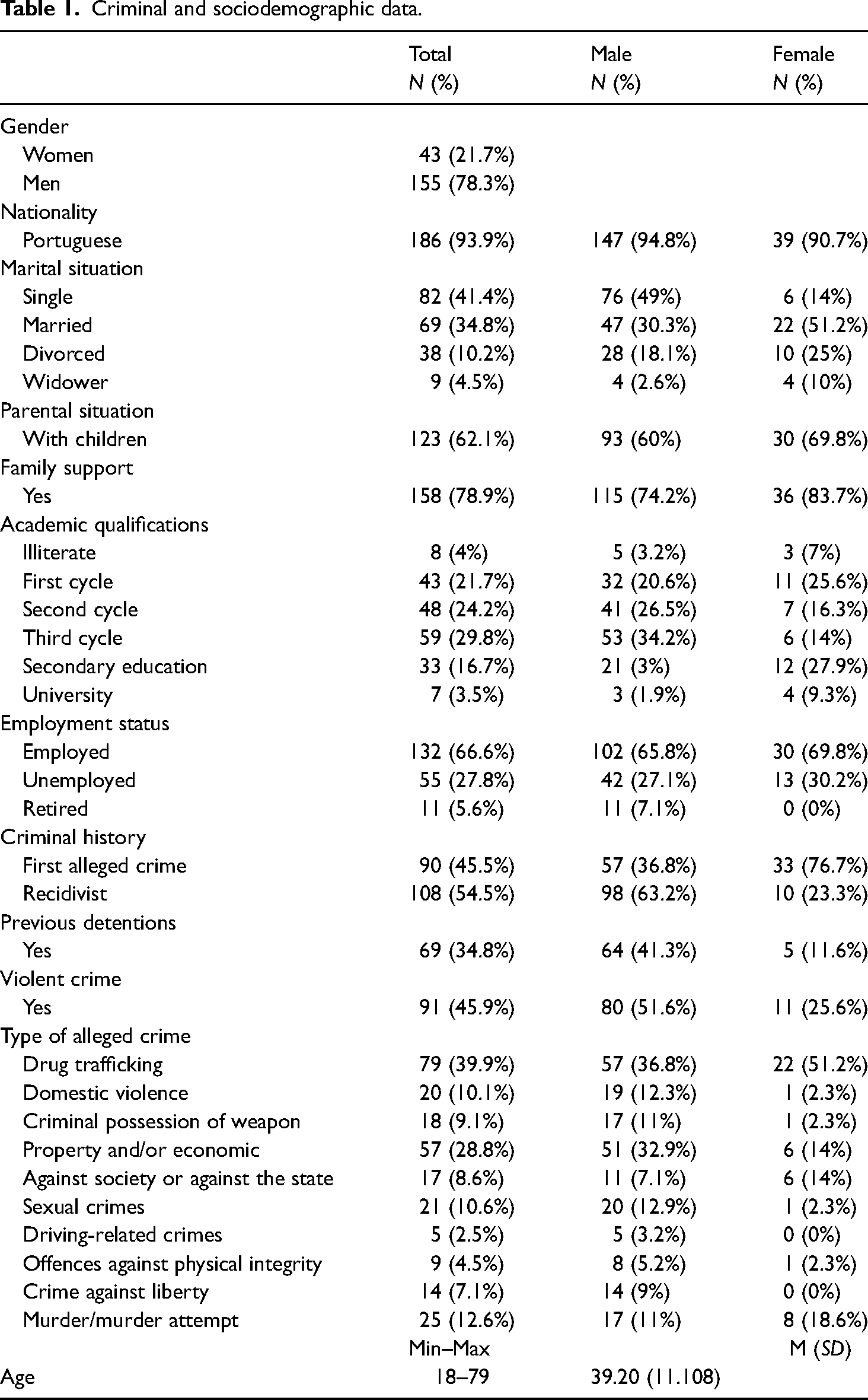
Sociodemographic and criminal variables are summarised in Table 1.
Criminal and sociodemographic data.
Familial situation
Regarding marital status, a higher percentage of participants were single (n = 82, 41.4%), even though when analysing separately both men and women, a higher percentage of women were married (51.2%), while a higher percentage of men were single (n = 76, 49%). A chi-square test of homogeneity was run to examine the relationship between familial situation and gender. The relation between these variables was significant (χ2(3) = 20.731, p < .001).
Most respondents had children (n = 123, 62.1%) and reported to have familial support during the detention (n = 123, 62.1%), and these rates were higher in women (n = 30, 69.8% and n = 36, 83.7%, respectively) than in men (n = 93, 60% and n = 115, 74.2%, respectively). A chi-square test of independence showed that there were significant associations between gender and parental status (χ2(3) = 13.667, p = .003). Despite this, there was no significant association between gender and familial support (χ2(1) = 0.524, p = .469).
Academic and professional situation
The Portuguese educational system consists of several stages. Basic education is divided into three cycles: the first cycle includes grades 1–4, for children aged 6–9; the second cycle includes grades 5 and 6, for children aged 10–11; and the third cycle includes grades 7–9, for children aged 12–14. Secondary education is for students aged 15–18, covering grades 10–12, which is similar to high school in the United States. Finally, higher education includes university degrees. In our study, the majority of participants reported having completed either the third (n = 59, 29.8%) or the second (n = 48, 24.2%) cycles, and this tendency was observed when analysing the male participants alone. However, our results also showed that female participants had a higher variation in their educational attainment levels. Concretely, compared to men, more women reported being illiterate (n = 3, 7%) or having completed the first cycle (n = 11, 25.6%), at the same time, they reported more having completed the secondary education (n = 12, 27.9%) and a university degree (n = 4, 9.3%), and only a small percentage indicated to have completed the second or third cycle (n = 7, 16.3% and n = 6, 14%, respectively). Despite this, results from a Mann–Whitney U test revealed that there was not a statistically significant difference between men and women in their academic achievement (U = 3085, z = −0.766, p = .444).
Considering the employment status, most participants stated that they had a job before the detention (n = 123, 66.6%). A chi-square test of independence indicated that there was no significant association between gender and professional situation (χ2(4) = 8.935, p = .063).
Mental health history
In our sample, most of the participants (n = 133, 67.2%) reported taking psychiatric medication at the time of the data collection. Even though the frequencies were high in both men and women, comparing the two groups, our findings revealed that female detainees stated more frequently to use prescription drugs (n = 35, 81.4%) compared to their male counterparts (n = 98, 63.2%). A chi-square test of homogeneity was run to examine the relationship between the variables, and the results ascertained that there was a significant difference (χ2(1) = 5.040, p < .025).
Only a small percentage of the participants affirmed to have previous suicide attempts (n = 62, 31.3%). Nevertheless, again, our results showed that women presented higher rates (n = 19, 44.2%) in comparison to men (n = 43, 27.7%). A chi-square test of independence revealed that this difference was significant (χ2(1) = 4.232, p < .040).
Criminal history
More than half of the participants included in this study were recidivists (n = 108, 54.5%). Despite this, considering the female respondents alone, results showed that most of them were accused of an alleged crime for the first time (n = 33, 76.7%). An independent t-test was carried out to test the significance of such differences, and the results showed a statistically significant difference (95% CI [−1.02, −0.45], t(196) = −5.030, p = .001, d = −.87).
Regarding previous experience of imprisonment, most individuals were in prison for the first time (n = 129, 65.2%), and this was true for both men (n = 91, 58.7%) and women (n = 38, 88.4%). Despite this, we ran an independent samples t-test to scrutinise if both groups contrast at a meaningful level, and our results confirmed the existence of statistically significant differences (95% CI [−0.93, −0.29], t(196) = −5.030, p < .001), indicating that women were more likely than men to be in prison for the first time. The effect size, as measured by Cohen's d, was 0.87, indicating a large effect.
Overall, less than half of the participants were accused of an alleged violent crime (n = 91, 45.9%). Indeed, a higher percentage of participants were accused of an alleged drug trafficking (n = 79, 39.9%) or a property and/or economic crime (n = 57, 28.8%), followed by murder/murder attempt (n = 25, 12.6%), sexual crimes (n = 21, 10.6%), domestic violence (n = 20, 10.1%), criminal possession of a weapon (n = 18, 9.1%), crimes against society or against the state (n = 17, 8.6%), crimes against liberty (n = 14, 7.1%), offences against the physical integrity (n = 9, 4.5%) and driving-related crimes (n = 5, 2.5%).
Notwithstanding this, analysing men and women separately, men report greater rates of violent alleged crimes (n = 80, 51.6%) compared to women (n = 11, 25.6%). An independent t-test was carried out to analyse if these differences were meaningful, and results confirmed a statistically significant difference (95% CI [−0.78, −0.17], t(196) = −3.072, p = .002), with large effect size, as measured by Cohen's d (d = −.53). Although the higher rates of alleged crimes were drug trafficking and property and/or economic crimes, following the general tendency, comparing to women, men reported larger extended alleged crimes of domestic violence (n = 19, 12.3% vs. n = 1, 2.3%), criminal possession of a weapon (n = 17, 11% vs. n = 1, 2.3%), sexual crimes (n = 20, 12.9% vs. n = 1, 2.3%), crime against liberty (n = 14, 9% vs. n = 0, 0%), even though female participants reported greater rates of murder/murder attempt (n = 17, 11% vs. n = 8, 16.6%). Finally, compared to their male counterparts, women tended to show less criminal versatility compared to men.
Risk of violence
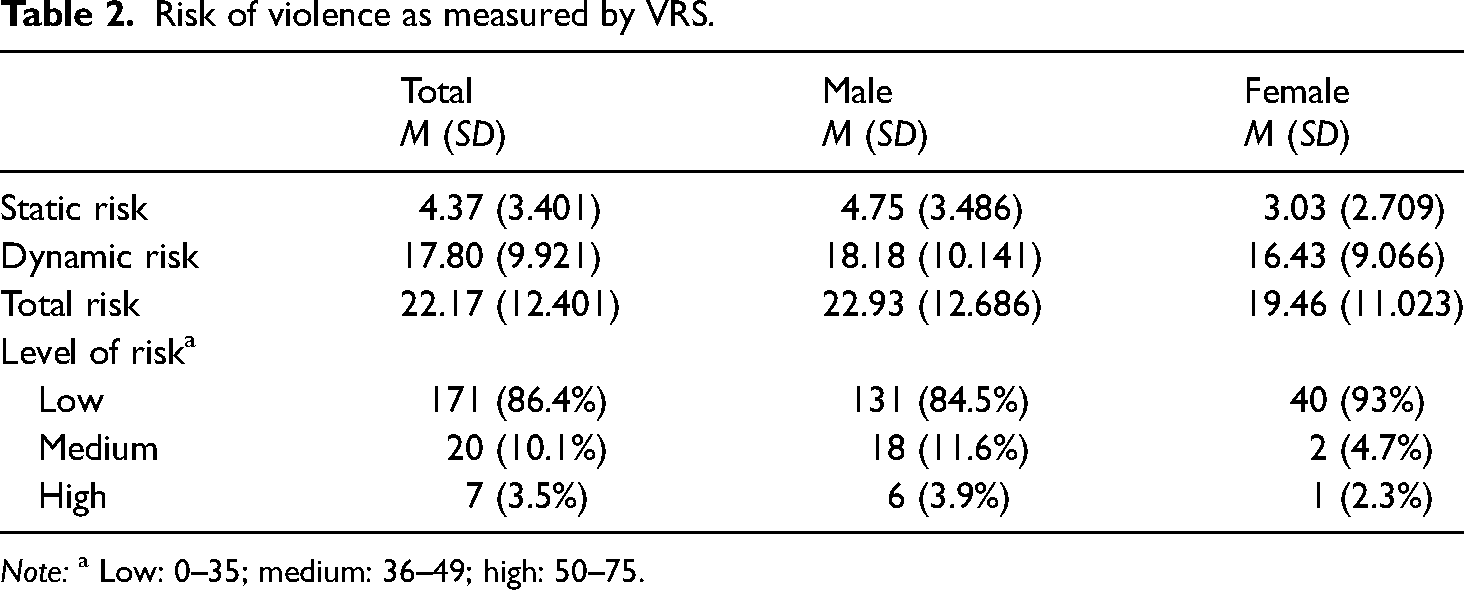
Overall, our findings showed that RP included in this study present a low risk of violence (n = 171, 86.4%), and this tendency was also verified when analysing both men (n = 131, 84.5%) and women (n = 40, 93%) separately. An independent t-test was run to examine if there were differences between men and women, and the results revealed the non-significant differences (95% CI [−0.258, 0.56], t(196) = −1.263, p = .208, d = −.218). Despite this, results indicated that, compared to the female counterparts, male participants reported higher levels of risk of violence in static, dynamic and total scores. Mean scores are presented in Table 2.
Risk of violence as measured by VRS.
Note: a Low: 0–35; medium: 36–49; high: 50–75.
A one-way analysis of variance (ANOVA) was conducted in order to understand if such levels of violence differ between individuals with different criminal histories. We compared three groups: (i) individuals who were alleged first-time offenders; (ii) individuals who have one past sentence; and (iii) individuals who have two or more past sentences. The differences in the level of risk violence were statistically significant between groups (F(2, 195) = 11.16, p < .001). The effect size, eta squared (η²), was 0.10, indicating a medium effect. Particularly, there was an increase in the level of risk from the group with first-time offenders (M = 17.93; SD = 9.74), to the group with one previous sentence (M = 24.19; SD = 11.90), to the group with two or more past condemnations (M = 26.54; SD = 13.99). Tukey post hoc test revealed that the increase in violence was statistically significant between the group of first-time offenders and the group with two or more past condemnations (p = .018) and between the group of first-time offenders and the group with two or more past sentences (p < .001).
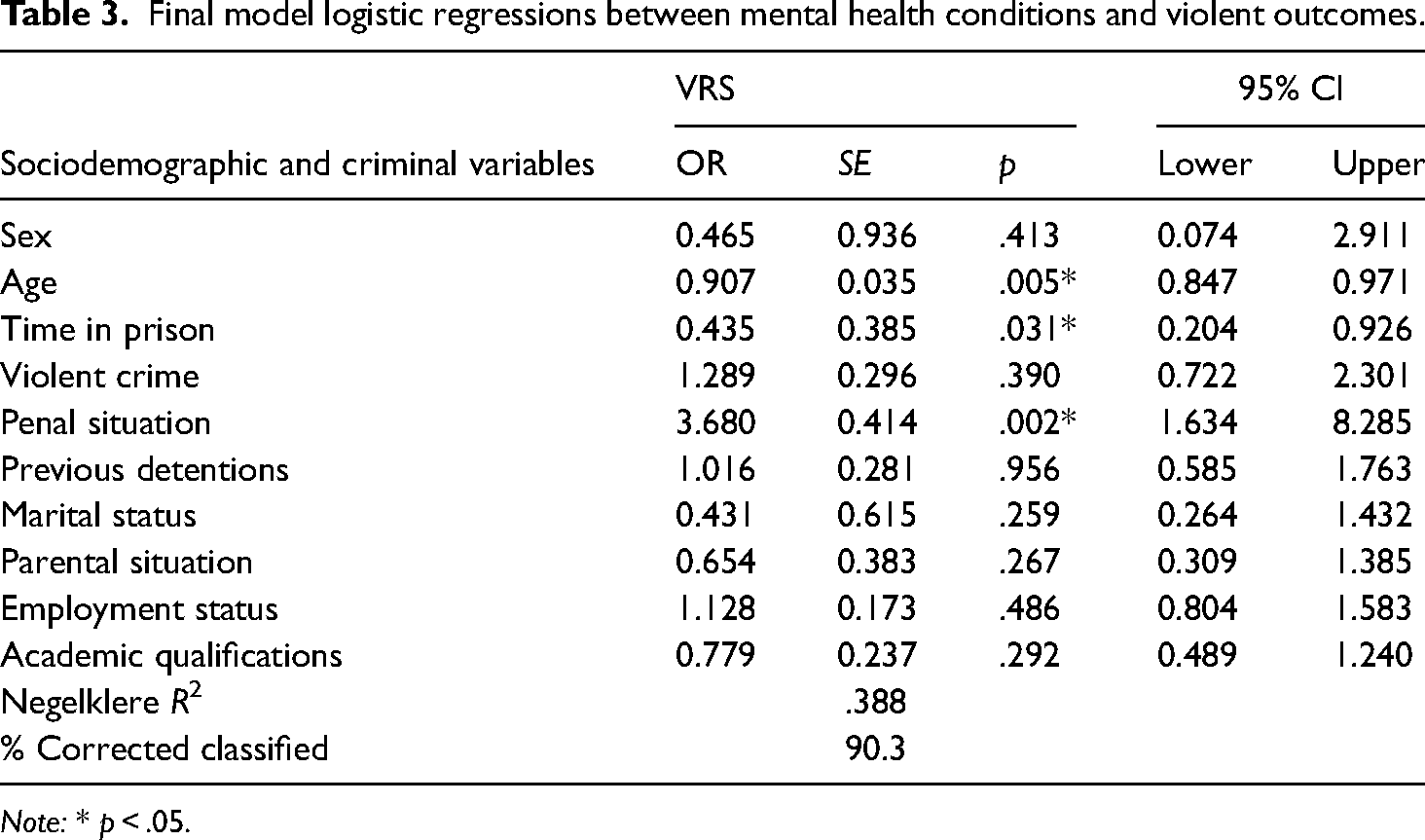
In order to understand the effects of sociodemographic (e.g., age, sex, marital status, parental situation, employment status and academic qualifications) and criminal variables (e.g., times in prison, alleged violent crime, penal situation and previous detentions) on being at high or low/medium risk of violence, we conducted a multivariate logistic regression (Table 3). Our findings showed only age, time in prison and penal situation (i.e., first-time offender or recidivist) were found to be linearly related to the logit of the dependent variable. Particularly, increasing age (OR = .907, p = .005) and time in prison (OR = .435, p = .031) were associated with a decrease in the likelihood of exhibiting a high risk of violence. On the other hand, our results showed that being a recidivist (OR = 3.680, p = .002) was associated with an increase in the likelihood of having a high risk of violence.
Final model logistic regressions between mental health conditions and violent outcomes.
Note: * p < .05.
Discussion
The primary focus of this investigation was to provide a comprehensive analysis of the sociodemographic profiles, criminal records, mental health histories and propensity for violence within the population of RP in Portugal.
In accordance with the national statistics, our sample primarily comprised individuals who held Portuguese citizenship and were predominantly male (DGRSP, 2023). Even though foreign detainees are a minority in Portugal (European Union, 2022), we consider it relevant to underline that the rate in our sample is lower compared to the official statistics (DGRSP, 2023). One possible explanation for this discrepancy relates to the limitation of excluding from the data collection individuals who were unable to speak and comprehend Portuguese or English, and consequently, its portrayal of foreigners, as those with limited language proficiency may not be adequately represented. Likewise, even though the percentage of women incarcerated has been increasing over the last decade (PORDATA, 2022), men represent the biggest part of the prison population, including those on remand. Despite this, we consider it interesting to note that women exhibit a greater presence in the PTD population (9.6%), compared to the representation of those who are already sentenced (6.5%) (DGRSP, 2022), which could suggest that the leniency often presumed for women may not apply during the pre-trial phase.
Also, we found that, generally, most participants had children at the time of detention, and most of them reported having familial support, and the rates were higher in women. We believe these results to be important because, although theoretically protective, these factors might not have a significant impact on the decision about PTD. Also, even previous literature showed that women are considerably less likely to be incarcerated compared to men (Doerner and Demuth, 2014); this preferential treatment is not evident when it comes to drug-related offences (Chatsverykova, 2018), and most of our female participants are detained due to a drug-related crime. Also, as mentioned in previous studies, it could be that women who are mothers and have familial childcare responsibilities might have harsh treatment within the judicial systems (Castro-Rodrigues and Sacau, 2012).
Moreover, in terms of academic qualifications, most of our participants reported having either the second or third cycles completed, which is significantly below the Portuguese average (INE, 2023). Previous evidence has already pointed out the negative correlation between education level and the likelihood of being arrested (Lochner, 2020), and our results might be in line with such an assumption. Additionally, most participants mentioned being employed before detention, which is also, theoretically, a protective factor (Evans et al., 2012) and hence reinforces the possibility of applying an alternative to detention.
Regarding mental health, most participants reported taking psychiatric medication. While both men and women reported high frequencies of use, our study revealed that female detainees reported a higher prevalence of prescription drug use when compared to their male counterparts. Previous evidence suggested that women tend to present higher rates of psychiatric problems (Tyler et al., 2019), and this tendency seems to also be applied to those who are awaiting trial (Binswanger et al., 2010). In line with this, even though only a small percentage of individuals reported having previous suicide attempts, such prevalence was much higher in women, confirming the previous studies’ conclusions (Dye, 2011; Fazel et al., 2017).
With regard to the criminal variables (criminal history, previous detentions, type of alleged crimes), most individuals in the present study were recidivists, even though most of them were in prison for the first time. Also, most of them were accused of an alleged non-violent crime. A possible explanation for the fact that most individuals were in prison for the first time even though they have a history of criminal activity relies on the fact that, within the Portuguese legal system, prison sentences lower than 5 years tend to be suspended in their execution, that is, being served in the community, under supervision/probation. It could be that, as most of our participants were non-violent defendants, they had previous non-violent crimes that were served in the community. As discussed in previous work, often, individuals sentenced to a community order might present a higher risk of continuing to offend if such sentences are not clearly communicated and implemented, failing to address their criminogenic needs, and because of that, many of them might ending up in prison (Andrade et al., 2021). Despite this, our findings revealed that compared to men, the female group was more likely to be first-time alleged offenders and to have lower rates of alleged violent crime. We consider these results to be very meaningful because previous research focused on sentenced individuals indicates that women tend to receive more lenient decisions (Doerner and Demuth, 2014; Fridel, 2019). However, our study appears to contradict these conclusions, highlighting that, at least in our sample, women do not seem to receive a lenient decision, at least during the pre-trial phase.
Also, our results showed that most of the individuals in our sample presented a low risk of violence, and this was also true when analysing men and women separately. We consider these results particularly intriguing because one of the primary reasons why people are sent to PTD, which is considered a last resort measure, is public safety. Because of that, it would be expected that most individuals would pose a danger to society (Kim et al., 2012), which seems not to be true. Despite this, our findings suggested that comparing men and women, male participants demonstrated a higher risk of violence. Considering all the mentioned variables, again, these results are tremendously remarkable because we might anticipate that the application of the measure goes beyond the assumptions that foresee its implementation, which have been ascertained in recent studies (Heard and Fair, 2019; Martufi and Peristeridou, 2022).
Particularly, this study suggested that the supposed ‘last resort’ measure seems to be applied beyond such last resort situations, as seems to be the case for imprisonment after trial (Castro Rodrigues et al., 2019). Indeed, PTD was applied to individuals who present protective factors that diminish their risk of absconding (e.g., most of them have familial support and had a job at the time of detention), as well as those who do not represent a danger to society that justifies their detention. This seems to be especially true in the case of women, since most of them are accused of committing a non-violent crime for the first time, presented a low risk of violence, and reported to have children and a job at the time of detention. Indeed, previous evidence has underlined that judicial measures are usually more punitive for women who do not represent a threat to society (Castro-Rodrigues et al., 2022; Gelsthorpe, 2007), and this work shows that this is also applied in the pre-trial stage. Concretely, our study emphasised that despite that PTD was primarily intended for serious and violent crimes (e.g., murder, sexual crimes, domestic violence, or offences against physical integrity), most participants in our sample were detained for an alleged non-violent crime (mainly for drug trafficking or property crimes), and most of them did not represent substantial dangerousness as confirmed by the violence risk assessment. Therefore, in our view, these findings embody important implications, prompting reflection on how and why this measure has been applied by judges, with a focus on understanding whether the underlying assumptions are being followed.
Finally, and to the end of elucidating which individual conditions might be associated with high levels of dangerousness, this study also proposed to examine the role of different sociodemographic and criminal variables on the risk of violence. Results indicated that only age, time in prison and penal situation were associated with the risk of violence. First, increasing age was associated with a decrease in the likelihood of exhibiting a high risk of violence. This result is in line with previous evidence that underlined that ageing is a factor that correlates with the decrease in violent conduct (Andrade et al., 2024; Santos et al., 2019; Wong and Gordon, 2006). Second, time on remand was associated with a lower level of violence. This finding is predictable in the light of previous research since the initial period of detention is associated with more difficulties in prison adaptation (Gonçalves et al., 2016; Moreira and Gonçalves, 2012; Wooldredge, 2020), and therefore, over time, the levels of stress might have a relative decrease (Walker et al., 2014), and risk disruption and violence might follow the same decline. Finally, our results showed that being a recidivist was associated with a higher risk of violence, which also was underlined by past research (O’Neil et al., 2004). Indeed, a recent study that compared individuals who were recidivist with non-recidivist detainees found that those who have a history of past criminal activity were more likely to present antisocial, borderline and aggressive-sadistic personality and higher levels of physical aggression (Molina-Coloma et al., 2021). Likewise, previous research underlined that individuals with a higher risk of violence have a much higher probability of re-offending and returning to the prison system (Andrews and Bonta, 2017; Cochran et al., 2014; Olver et al., 2022).
Conclusion
To the best of our knowledge, this is the first study to outline the sociodemographic, clinical and criminal characteristics of those who are held in remand in Portugal. Our findings revealed that most individuals who were awaiting trial in prison were, as expected, Portuguese and male. Despite that, our results portrayed the fact that most RP seem not to exhibit a substantial propensity for violent conduct, and most were subject to detention on account of allegations involving a non-violent crime. This was particularly intriguing because two pivotal criteria for the implementation of this measure hinge upon the severity of the crime and the dangerousness of the individual, which seems not to be the case for most individuals in our sample. Moreover, we consider these findings to be very relevant because they contradict the belief that women might receive more leniency on their judicial measures. Our study revealed an opposite tendency, since most women were accused of committing a crime for the first time, were detained for a non-violent offence, and presented a lower risk of violence, in addition to reporting having children, familial support and a job at the time of the decision. Considering all this, we think this work represents an important contribution to the current knowledge because it reinforces the well-reported notion that PTD might be applied indiscriminately, encompassing cases that could have a less harsh measure.
This study also informed about the variables that are associated with a higher risk of violence. From our perspective, these findings are highly relevant because most studies that explore this relationship were limited to sentenced prisoners. Our study confirmed that being younger, having previous convictions and having recently been held in remand is associated with higher levels of violence. This result is extremely important because it underlines the need to structure early interventions and conditions that aim to reduce the violence risk in those who represent a more significant threat.
Despite these contributions, the results reported herein should be considered in the light of some limitations. First, our resulting sample is not gender balanced, which can have some limitations on the representativeness of the female group. Nevertheless, this is illustrative of the different rates of men and women in the prison context. Furthermore, in some analyses, the sample size is very small, which may limit the generalisability of our findings. Also, this study did not attend to other variables that might have influenced the decision for the PTD measure, which is a limitation to fully understanding the decision-making process. We suggest that forthcoming research might delve into the factors influencing judges’ decisions to choose this measure, thereby gaining a deeper understanding of the phenomenon.
These results provide an important contribution to both Portuguese and international research on forensic populations, especially given the limited attention to scrutinising and characterising populations awaiting trial in prison. Considering the difficulties and vulnerabilities of RP, we believe this work is crucial for improving our understanding of PTD and highlighting the need for better scrutiny of this measure.
Footnotes
Author contributions
All authors contributed to the paper preparation.
Declaration of conflicting interests
The authors declared no potential conflicts of interest with respect to the research, authorship, and/or publication of this article.
Funding
The authors disclosed receipt of the following financial support for the research, authorship, and/or publication of this article: This work was supported by the FCT – Fundação para a Ciência e a Tecnologia.
Ethics approval and consent to participate
This study was conducted at the Psychology Research Centre (UID/PSI/01662/2013), University of Minho, and it was approved by the University of Minho Ethics Commission (CEICSH 051/2021). All procedures performed were in accordance with the tenets of the Declaration of Helsinki.
