



Abstract
In his editorial, David Smith listed comparative research as a key priority for the journal and European criminology. The diversity of European nations regarding various social, institutional, political and cultural features provides rich opportunities for comparison and theory testing. Publishing in the European Journal of Criminology (EJC) necessarily requires one to think comparatively, even if data are drawn from a single country. The goal of this piece is to evaluate the geographical and comparative coverage of EJC articles since 2004. Specifically, I extracted information on the sample and countries named in the abstracts or methods and described patterns of comparative research across empirical articles. I find that, while the majority of studies were based on single-country data, authors often framed the goals and analyses of a given study within the relevant social, political, or institutional European context. However, despite establishing these comparative frameworks and goals, there was still a substantial bias toward case studies and data from certain countries: namely, the United Kingdom, the Netherlands, Sweden, and Germany. In essence, this means that the EJC reflects primarily Western European criminology. However, the idea of a truly European criminology, and likewise a journal with similar ambitions, is inherently comparative. For that reason, we must continue to push the boundaries of European criminological theories and knowledge by advocating for comparative designs, high-quality comparable data, and international collaborations beyond Western Europe.
In his editorial, David Smith (2004) listed comparative research as a key priority for the European Journal of Criminology (EJC) and European criminology. The diversity of European nations regarding various social, institutional, political and cultural features provides rich opportunities for comparison and theory testing (see in relation to European penology, Hacin, 2025). In addition, new tools and data have become available, making comparative criminology more accessible. The goal of comparative criminology is not only to identify generalizable patterns and mechanisms of crime, but also to identify the boundaries of criminological theories (Karstedt, 2001). Publishing in the EJC necessarily requires one to think comparatively, even if data are drawn from a single country (see also discussions about comparisons in this collection, Di Ronco, 2025; Hamilton, 2025). In other words, the editorial requirement that papers are ‘relevant to the European context’ requires authors to consider how and why the theories, data, laws or policies examined in their study relate to a broad, diverse range of European countries. European countries therefore provide a ‘natural laboratory’ with rich data on crime and criminal justice across different social, cultural, political, and policy contexts (Karstedt, 2021).
In Smith's (2014) follow-up to his first editorial, he reflects on the distribution of countries represented in the journal. His descriptive analysis shows that the majority of studies were conducted using data from the United Kingdom (n = 37, 21.9%), followed by the Netherlands (n = 27, 12.6%) and Sweden (n = 16, 7.4%). He concludes that the coverage across Europe is uneven and that there was ‘an unhealthy prevalence of articles from and about the UK’, although there is ‘a clear movement towards participation among a number of Eastern European countries’ (p. 16). This piece reflects on to what extent Smith's comparative ambitions have been realized and the next steps for comparative research in European criminology. Specifically, I aim to update Smith's assessment of geographical coverage in the journal in order to assess to what extent comparative research and representation have developed over time.
Methods and data
In order to describe and evaluate to what extent empirical articles in the EJC are comparative in nature, I manually extracted the titles and abstracts from all published articles from Scopus since the beginning of the journal in 2004 (search date: 6 May 2025). I removed several articles that were listed as EJC articles but were published in another journal, as well as one duplicate article, a correction, and a book review. The result was 827 articles either published online or in press.
Article titles and abstracts were reviewed by myself and hand-coded to extract information on the geographical coverage of all papers. The coding scheme included the number of countries mentioned in the title or abstract, as well as the specific countries that were mentioned, if any. Articles that did not specify empirical country context or data were coded as ‘other’. These were primarily studies that did not have an empirical aim (i.e., theoretical or conceptual papers, editorials, commentaries, introductions or conclusions to special issues), or reviews that summarized existing literature. It is important to note that many of these papers may also have comparative designs or goals (implicitly or explicitly), as for example, reviews of literature often included studies drawn from a number of countries. However, given that the focus here for practical reasons is on empirical studies, and because many theoretical and conceptual papers did not specify a geographical scope (or only very broadly), these studies were not coded alongside empirical papers. This does not mean that these papers do not contribute to comparative knowledge; on the contrary, some explicitly aim to advance comparative research (Nelken, 2009; Sozzo, 2022). Indeed it would be quite interesting to examine to what extent theoretical papers acknowledge the generality of the claims they make, and to what extent these general claims are tested using comparative or international data.
The number of countries (sample size) and country names were extracted based on the empirical analyses as stated in the abstract (i.e., quantitative or qualitative data, case studies, descriptive trends, and legal or policy analyses). Countries within the United Kingdom (i.e., England, Wales, Scotland, and Northern Ireland) were coded together as the United Kingdom. Individual countries were not coded for larger comparative analyses (n > 10 countries). In some cases, the specific number or countries under study were not specified in the abstract, in which case more information was sought from the full text. Three articles did not explicitly state where data were collected, so in these cases, the country was inferred from the text and author's affiliation. Some articles did not use data from a country in the traditional sense but instead covered broader transnational problems or legal issues (n = 18, labeled ‘multiple’ in the coded data). Of these 18 articles, six articles covered transnational crimes such as human trafficking, one article examined transnational corporate bribery, three articles examined historical developments across multiple countries or polities (some of which no longer exist), six articles assessed online networks (e.g., the Dark Web), and two articles included broader assessments of European law. 1
Results
Figure 1 shows the frequency of different (country) sample sizes across all papers, grouped by single-country studies (n = 1 country), small (n = 2–5 countries) and medium-sized (n = 6–10 countries) comparative case studies, larger comparative analyses (n = 11–30 and n = 30+ countries), studies covering ‘multiple’ or transnational cases, and nonempirical articles and reviews (‘other’). The results show that the vast majority of studies focus on a single country context and data (n = 574). It is important to note that, while many of the studies use data from one country, this does not necessarily mean there is no comparative element to the paper. A number of articles frame the focus of their case study in relation to broader European trends, policies or existing geographical gaps in knowledge (e.g., Nelken, 2015; Slade and Vaičiūnienė, 2018), in particular noting the dominance of research conducted in the United States or United Kingdom (e.g., Wermink et al., 2015). Nevertheless, the dominance of single-country studies is a stark contrast to the much lower number of studies that use data or case studies from multiple countries (total n = 163 using some kind of data from more than one country). The United Kingdom was the most commonly studied single-country context (n = 118), followed by the Netherlands (n = 104), and Sweden (n = 40).
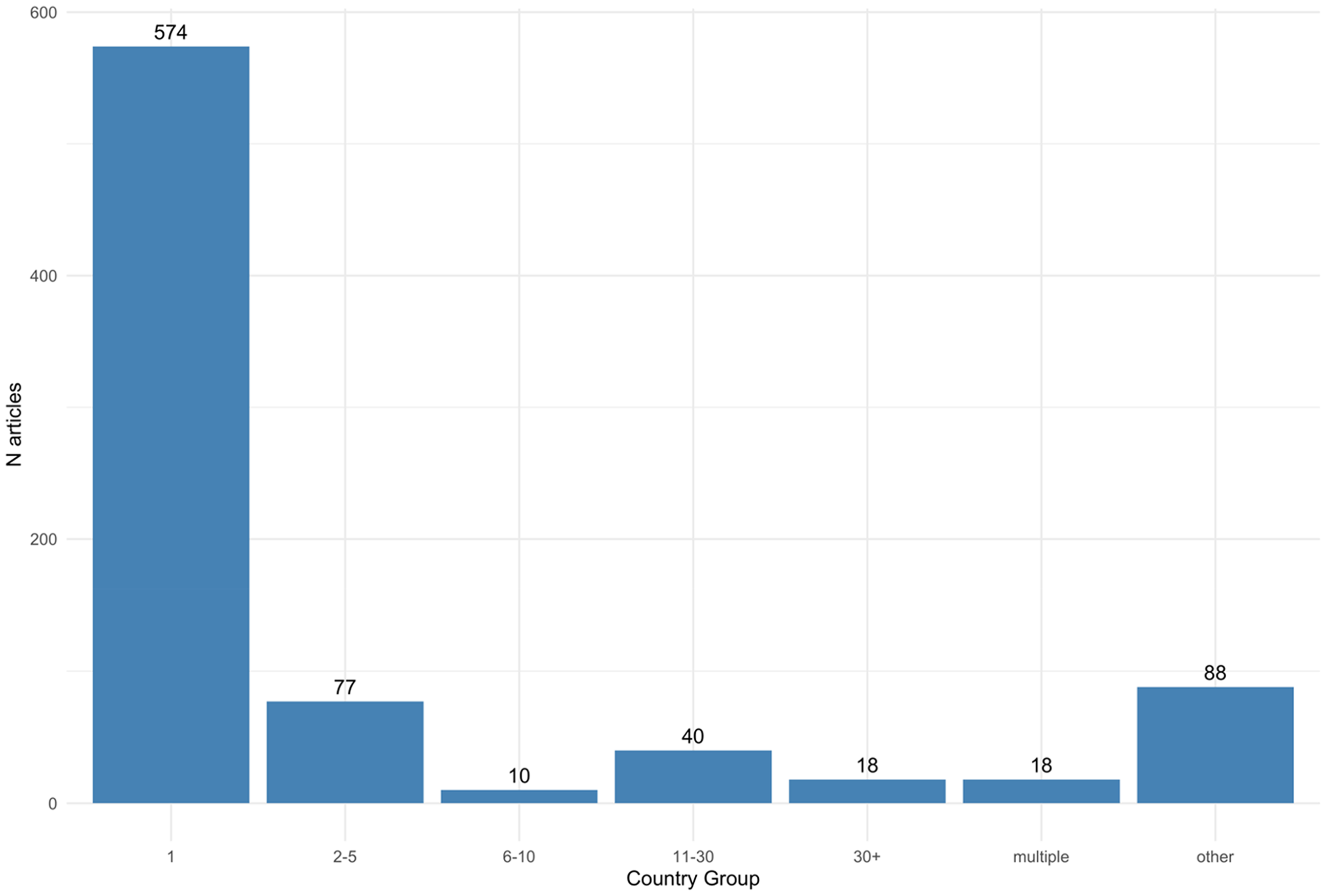
Number of countries in each study (grouped).
Next, I extracted all named countries from empirical papers in the dataset to get a more complete picture of the countries studied individually and in a comparative manner. Figure 2 displays the number of times each country is mentioned, excluding studies in the ‘multiple’ group (i.e., transnational or historical samples) and cross-national research where the sample size was greater than 10 countries. It is important to note that previous reviews of cross-national research have shown that the samples tend to be biased toward western, industrialized countries, particularly English-speaking and Western European countries (Koeppel et al., 2015; Nivette, 2011).
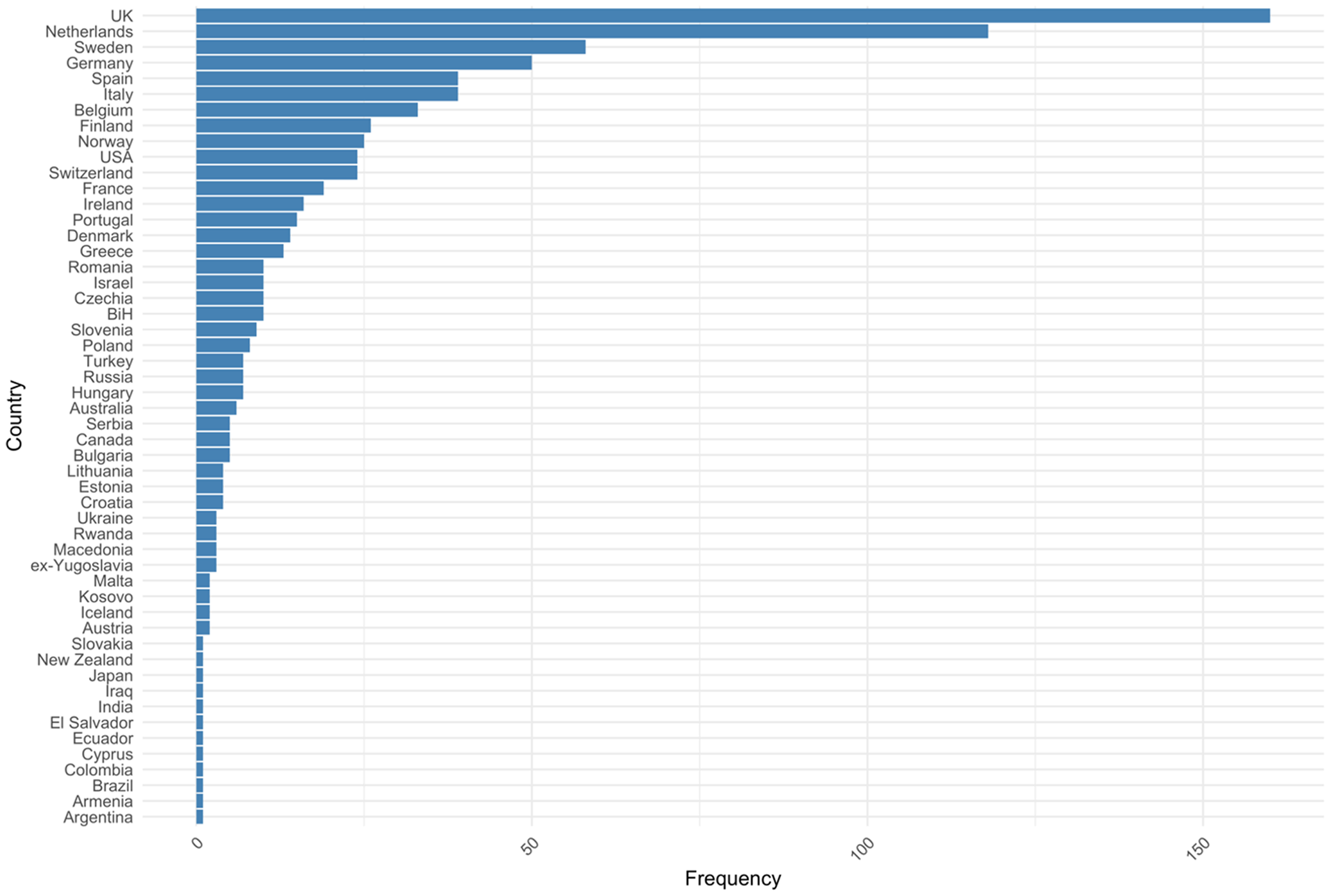
Frequency of countries mentioned explicitly at least once across empirical articles.
The results displayed in Figure 2 show that a small number of countries are most prevalent in European research on crime and criminal justice in the journal. The top 10 countries represented were (in descending order): the United Kingdom, the Netherlands, Sweden, Germany, Italy, Spain, Belgium, Finland, Norway, and the United States.
While this is informative about which countries are most often studied, it does not tell us how and when countries are compared with each other. In order to visualize these connections, I coded which countries were included in each study sample (up to samples of n = 10 countries). This allowed me to map the network of countries explicitly mentioned and their comparisons to other countries across study samples (Figure 3(a) and (b)). Network graphs were constructed using igraph in R (Csardi and Nepusz, 2006).
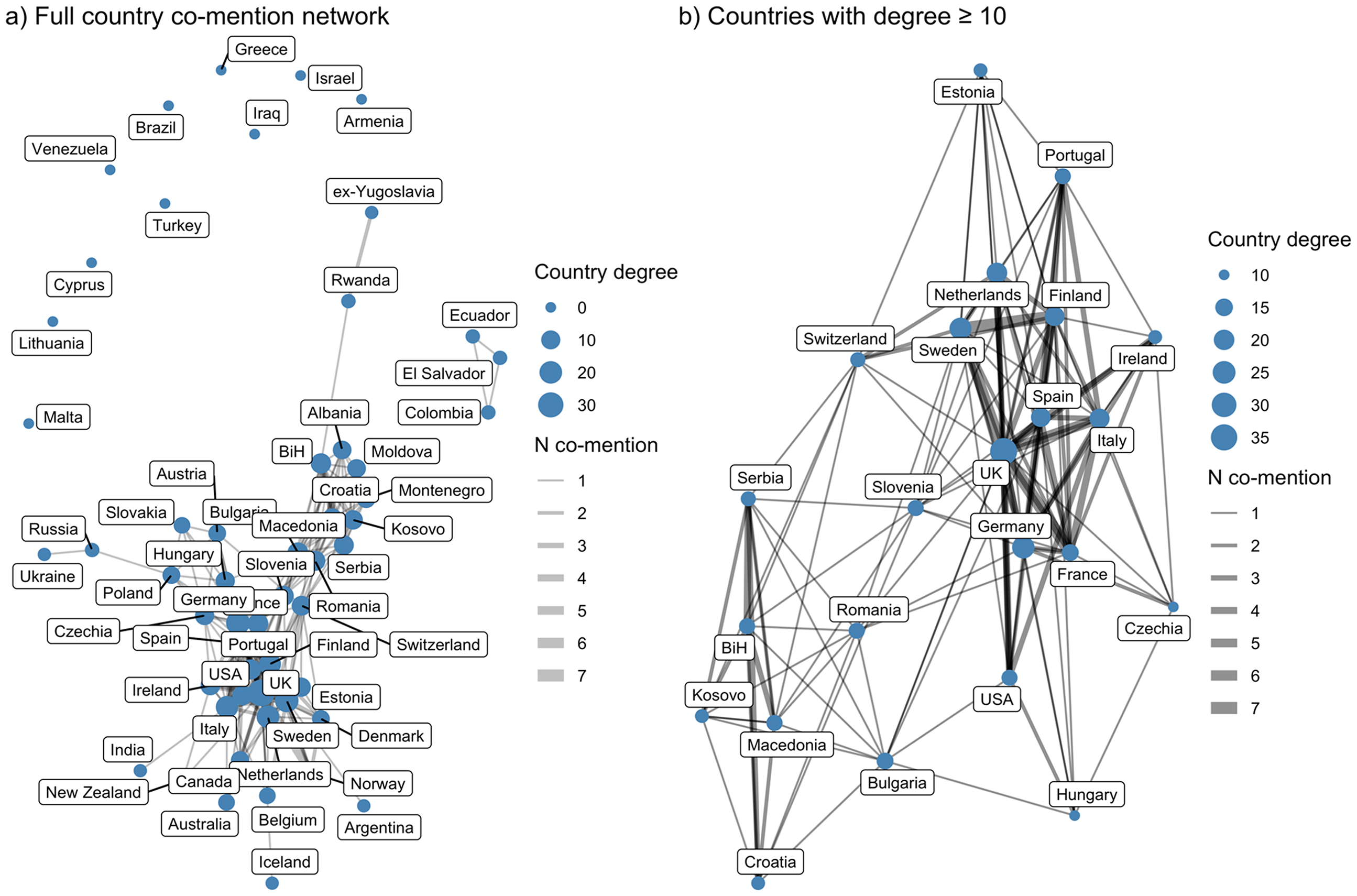
Network visualization of countries mentioned and compared.
The width of the (gray) lines represents the ‘strength’ of the connection between two given countries (named co-mentions here, or edges/ties in social network analysis terms, Saqr et al., 2024). A thicker line therefore means that two countries were more often included together or compared with each other on different contexts, policies, or data across the sample of empirical articles used here. The size of the (blue) circle represents a given country's degree, or the number of times a country appears in a set of comparisons across studies. Note that a single-country study will appear in the graph as a node, but will have a degree of 0, as the country is not explicitly compared with any other country within the article. Countries with higher degrees are more ‘connected’, meaning they are used in samples or case studies and compared more often with other countries. The maximum degree was 37, held by the UK, indicating that the UK was included in a comparative sample 37 times, the most out of any country. Figure 3(a) displays the entire network of countries mentioned (sample n ≤ 10 countries), and Figure 3(b) focuses on countries with degree values greater than 10 (highly compared countries).
Figure 3(a) and (b) reveal certain patterns of country comparisons. For example, clusters of country comparisons can be identified, such as those between former Yugoslavian countries (i.e., Serbia, Croatia, Bosnia and Herzegovina, Kosovo, and Macedonia), Eastern European countries (i.e., Poland, Slovakia, Czechia, Hungary, and Russia), and ex-Yugoslavian countries and Rwanda (compared international tribunals, see Holá et al., 2012). Some countries are not (explicitly) connected or compared to others, many of which are non-European (e.g., Brazil, Iraq, Colombia, El Salvador, and Ecuador). When focusing on countries with higher degrees (≥10), two main clusters of comparisons emerge. The largest cluster with strong ties (co-mentions) includes the same main Western European countries (i.e., the United Kingdom, the Netherlands, Sweden, Germany, France, and Spain), and the smaller cluster reflects comparisons within the Balkan region. Notably, however, comparisons between Western European and Balkan countries are relatively infrequent.
Discussion
This editorial contribution provides a general overview of the geographical and comparative coverage of empirical studies in the EJC. It demonstrates that while the EJC has advanced toward Smith's (2004, 2014) goal to make comparative research a priority, there is still room to develop. First, by its very nature, the EJC motivates comparative thinking, which was often visible in article abstracts and introductions. Even if the majority of studies were based on single-country data, authors often framed the goals and analyses of a given study within the relevant social, political, or institutional European context. However, despite establishing these comparative frameworks and goals, the majority of case studies and data were drawn from certain countries: namely, the United Kingdom, the Netherlands, Sweden, and Germany. Even within these top countries, more than twice as many studies focused only on data from the United Kingdom and the Netherlands compared to the next two most frequently studied countries (Sweden and Germany). Smith's conclusion that there was ‘an unhealthy prevalence of articles from and about the UK’ (p. 16) in 2014 seemingly remains relevant in 2025. However, on a positive note, his observation that more Eastern European authors and data would participate in the journal is also true. This growth seems to be driven by comparative research within and across Balkan countries. Nevertheless, the number of these studies still remains relatively low compared to those using data or cases from Western Europe.
There may be several reasons for these differences. For example, more papers using data from Western European countries may simply reflect a stronger embeddedness of criminology in research institutes and universities, leading to more researchers actively working on criminological questions and thus more submissions from those regions. There may also be differences in the amount of research funding and dedicated research time between institutions in, for example, the United Kingdom, the Netherlands and Germany, compared to other countries. In addition, the availability of administrative or government data, accessible online survey infrastructures (e.g., Prolific, YouGov), and large-scale national surveys may provide more opportunities for data collection and analyses for researchers in these countries. Finally, while the EJC offers language editing services, the expectation to write in English may create a language barrier for some researchers across Europe and beyond. These barriers are not easy to overcome, and although many are outside of the editorial team's control, it is imperative that we as a team continue to do what we can to actively encourage submissions and work with authors from underrepresented areas.
Visualizing the comparative networks showed that the top Western European countries were also most often compared with each other. It is important to note that Eastern and Southern European countries may be undercounted as the network analysis did not include large-n comparative studies, which often used large-scale cross-national surveys such as the European Social Survey or International Self-Report Delinquency Survey. Even if these were explicitly counted, the relative ranking of the mentioned countries would likely remain very similar, as those surveys include Western European countries too. The descriptive and network analysis also illustrates that small-n comparative studies are still relatively uncommon in the journal compared to single-country analyses. Yet these more detailed comparative studies can be highly valuable for theory development and testing (e.g., Beckett and Godoy, 2010; Kaarbo and Beasley, 1999; Zimring et al., 2010).
Taken together, this short descriptive analysis suggests that empirical articles in the EJC reflect primarily Western European criminology. To what extent this geographical bias has influenced the state and knowledge within European criminology is beyond the scope of this editorial. It does however suggest that, if we take published empirical articles as our sample, any general claims we want to make about European knowledge on crime and criminal justice are still rather limited. In order to achieve Smith's comparative ambitions, more comparative research is needed from outside the main European players. Importantly, I do not mean to imply that submissions from these ‘main players’ should be reduced or discouraged, nor is my intention to diminish the valuable impact these studies have had in advancing knowledge about crime and justice in Europe. Rather, I would advocate for all criminologists – in Europe or elsewhere – to consider how comparative research can enhance understanding of one's own context as well as identify more general patterns, mechanisms or effects (see also Di Ronco, 2025 in this collection). Thinking comparatively and beyond one's own context is not just an exercise of inclusivity, but an important step in advancing criminological theory and knowledge.
Of course, not all studies necessarily need to be comparative or include data from more than one country. However, the idea of a truly European criminology, and likewise journal, is inherently comparative. The EJC and the European Society of Criminology have made strong advances toward this goal, as editors and presidents, even since Smith's editorials, have highlighted the necessity of comparative and international research for European criminology (e.g., Bijleveld, 2023; Tonry, 2015; Vander Beken et al., 2021, see also Treiber and Hardie, 2025 in this collection). Likewise, the EJC's editorial requirement to consider the relevance to the European context already advocates for comparative thinking, regardless of theory, methods, or data. Even so, this editorial's analyses show that we must continue to push the boundaries of European criminological theories and knowledge by advocating for (even more) comparative designs, high-quality comparable data, and international collaborations beyond Western Europe.
Footnotes

Funding
The author received no financial support for the research, authorship, and/or publication of this article.
Declaration of conflicting interests
The author declared no potential conflicts of interest with respect to the research, authorship, and/or publication of this article.