



Abstract
The current study examined the relation between parental substance abuse and the child's attitude towards violence, and whether this relationship is mediated by parental involvement and the child's self-control. The study used self-report data from the Second International Self-Reported Delinquency Study, a large international study that included data from schools in 30 countries and covered topics related to delinquency and victimization of 12- to 15-year-old students (N = 68,507). With the use of a multilevel analysis, the results of this study show that there is a significant positive relationship between parental substance abuse and the child's attitude towards violence. Furthermore, the findings suggest that parental involvement and the child's self-control both mediate this relationship. Additionally, we found a significant indirect contextual effect for the self-control mediation, indicating that the mediational path gets stronger in countries with a higher prevalence of parental substance.
Introduction
Worldwide, alcohol contributes to about three million deaths per year, and excessive alcohol consumption is responsible for 5.1% of the global burden of disease (World Health Organization [WHO], 2018). What can make alcohol dangerous is its addictive effect. Excessive use of alcohol can disrupt the dopamine system, which affects brain reward mechanisms and can result in alcohol addiction (Tupala and Tiihonen, 2004; Vengeliene et al., 2008). The same effect could be achieved with the excessive use of drugs such as cocaine and heroin, as they also target the dopamine system and are highly addictive (Koob and Volkow, 2010). About half a million people worldwide die each year from the harmful effects of drug use, and about 35 million people are problematic drug users (WHO, 2021). Given their similar effects and underlying mechanisms, alcohol abuse and drug abuse are collectively described as substance abuse.
Besides the fact that substance abuse can have a major impact on the user, it often also has a major impact on the user's immediate family. The impact of substance use on the immediate family of the user is also referred to as the collateral damage- or spill-over effects of substance abuse (Martikainen et al., 2018). Examples of spill-over effects are paying less attention to the family and therefore less involved parenting (Calhoun et al., 2015; Pihkala and Sandlund, 2015). The quality of parenting can have consequences for the social development of children and also for the attitudes, norms and values they develop (Ferreira et al., 2018; Wills and Dishion, 2004). Studies have shown that parents who have experienced problems with substance use are more likely to engage in more harsh parenting practices, such as spanking or threatening to hit a child, than parents who did not experience problems with substance use (Calhoun et al., 2015; Gershoff, 2002). Additionally, parents who have experienced problems with substance use can be less consistent in disciplining their children. This inconsistency in the application of discipline has shown to predict rule breaking, attention problems and even aggression in children (Schroeder et al., 2006). Also, parental substance abuse may influence the ability of parents to meet the basic needs of their children. These basic needs are important for children to develop social values, such as not using violence when angry (Ferreira et al., 2018).
Importantly, a tolerant attitude towards violence at a young age (such as making hostile attributions or generating aggressive responses) can turn into serious violent behaviour later in life (such as starting a serious physical fight against a weaker individual) if no action is taken (Bjelošević et al., 2020; Moffitt, 1993; Thomas et al., 2008). A tolerant attitude towards violence can be defined as seeing violence as normalized and a way to have fun, necessary to be respected, a way to increase self-esteem, and a legitimate way to solve arguments or to prove oneself to others (Cuervo et al., 2018; Ruiz-Hernández et al., 2020). Violence, also amongst children, is a global phenomenon (Sinclair et al., 2022) and can cause major problems in the life of victims, perpetrators, and also for society as a whole (Bjelošević et al., 2020). In other words, the sooner a tolerant attitude towards violence is detected, the better serious forms of delinquency can be prevented.
Attitudes are not only important predictors of behaviour, but they are also contagious (Cohen and Prinstein, 2006; Dishion and Tipsord, 2011). According to Cohen and Prinstein (2006), risky and aggressive attitudes are associated with higher status and more popularity among peers. In addition, young people are often susceptible to popular views and status (Choukas-Bradley et al., 2015; Li and Wright, 2014). Children who believe that having a tolerant attitude towards violence will bring them higher status are more likely to imitate those attitudes (Cohen and Prinstein, 2006; Dishion and Tipsord, 2011). A tolerant attitude towards violence can therefore be easy to adopt for children. In addition, it seems reasonable that attitudes, such as greater tolerance towards violence, can be adjusted in childhood when attitudes are most flexible and changeable (Heckman, 2006).
The underlying mechanisms explaining children's attitude towards violence are currently not well understood, and the role of parents is often overlooked. A key question to be answered, then, relates to how parental substance abuse relates to how children differ in their attitude towards violence. Moreover, the mediating roles of parental involvement and the child's self-control in this relation will also be considered to better understand variations in attitudes towards violence among children.
Parental substance abuse and the attitude towards violence of children
Different perspectives from psychology, criminology and sociology suggest a relationship between parental substance abuse and the attitude towards violence of children. First, children with parents who have experienced problems with substance use compared to children who do not have such experiences have an increased risk of developing serious psychological problems later on in their life (Goossens and Van der Zanden, 2012). This can be explained by the fact that parents who have experienced problems with substance use pay less attention to their children and their potential problems. For instance, parents who have a problem with substance use often have to spend time using or recovering from the use of substances and are therefore less involved with their children (Lipari and Van Horn, 2017). As a result, the parents are less able, or even not able at all, to meet the basic needs of the child, such as autonomy and feelings of connectedness (Yotyodying and Wild, 2016). Meeting the basic needs of the child can be important for them to develop social values, such as how to act when in an argument and to not use violence when they are angry and to learn how to deal with others (Ferreira et al., 2018). How parental involvement could have an effect on the child's attitude on violence will be further discussed below.
Second, parental substance abuse can cause parents to be more easily irritable and angry with their child when they do not behave the way the parents want them to (Schroeder et al., 2006). Additionally, parents who have experience with problematic substance use can be more inconsistent in disciplining their children. This inconsistency has shown to predict rule breaking, attention problems and aggression in children (Schroeder et al., 2006).
Third, there is an increased risk that children experience domestic violence if one or both parents abuse one or multiple substances (Donohue et al., 2006; Prevoo and Bulten, 2016). This may involve intimate partner violence, but also violence by parents aimed at children. Studies have shown that parents who have experience with substance use problems are more likely to engage in harsh parenting styles (Calhoun et al., 2015; Gershoff, 2002). Examples are threatening their child to use violence when they do not behave or spanking them. Children who live in a household where domestic violence or intimate partner violence is present generally are more at risk to develop behavioural and emotional problems than peers who are not confronted with domestic violence (Devaney, 2015; Meltzer et al., 2009). Subsequently, such children are less able to control their own emotions and tend to engage in more risky behaviour (Carter et al., 2022; Lloyd, 2018). The exposure to domestic violence or intimate partner violence can lead to the children being more likely to engage in physical aggression and generally respond less appropriately when dealing with certain social situations compared to their peers from nonviolent homes (Dargis and Koenigs, 2017; Graham-Bermann and Levendosky, 1997; Graham-Bermann and Perkins, 2010). As a result, these children may have a different attitude towards violence than children of parents who have experience with problematic substance use. For the child having parents who have experienced problems with substance use, the threshold to use violence will possibly be lower when they experienced violence, and violence may be more normalized (Meltzer et al., 2009).
Third, parental substance abuse can lead to significant stress among children (Fuller and Rodríguez, 2021; Wlodarczyk et al., 2017). Children can end up in stressful situations because of their parents, for example when they start driving under the influence of alcohol or drugs. In addition, the mechanism for coping with stress in children who experienced problems with parental substance use is less developed (Fuller and Rodríguez, 2021). Stress, therefore, can have a major impact on their social life. When stress is chronically experienced, this results in the possibility for people to become irritable and violent (Sandi and Haller, 2015). Chronic stress is accompanied by less control over emotions, and it can lead to the possibility for children to express these emotions in aggression. Based on the argumentation above, the first hypothesis for this project is formulated as follows: parental substance abuse has a positive relation with the child's attitude towards violence.
The mediating role of parental involvement and self-control
Parental involvement is important in the development of social-emotional functioning and behavioural adaptation at a young age (Ferreira et al., 2018; Wills and Dishion, 2004). For adolescents, it is important that they can rely on a parent or parents to help them with the struggles they face, such as fights at school or being bullied (Ferreira et al., 2018). Moreover, a lower level of parental involvement can be associated with a greater risk that their children engage in delinquent behaviour (Hill and Blokland, 2020; Pinquart, 2017). The less the child's basic needs are met, the less likely the child is to internalize social values and the more the child's positive development is limited (Avdibegović and Brkić, 2020; Yotyodying and Wild, 2016). This suggests that when there is low parental involvement in a child's life, the child is less likely to develop a strong social-emotional functioning system and will possibly internalize less social values, which can influence the attitude of the child regarding violence. However, no study has ever analysed this relationship between parental involvement and attitude towards violence. The second hypothesis is as follows: the relation between parental substance abuse and the child's attitude towards violence is mediated by parental involvement.
In addition, self-control may mediate the relationship between parental substance abuse and attitudes towards violence. Self-control is the tendency 1 to adjust inner responses and to interrupt, and not act on, impulses (Tangney et al., 2004). High self-control is, in comparison to low self-control, for example, related to achieving higher grades in school, a lower risk of using substances such as alcohol and drugs, and a better control of emotions (Tangney et al., 2004). Low self-control can be an important predictor of criminal and violent activity (Baron, 2003; Gottfredson and Hirschi, 1990; Junger, 2004; Moon and Alarid, 2015; Tangney et al., 2004). According to the self-control theory (Gottfredson and Hirschi, 1990), self-control is mainly formed in childhood as a result of the parenting process (Steketee et al., 2016; Vazsonyi and Huang, 2010). The actions of parents, such as disciplining the child when they show aggressive behaviour and learning their child to avoid acts that can cause long-term negative consequences, will contribute to a higher level of self-control of the child. This important role of parents in the formation of the child's self-control is supported by several studies (Bağatarhan et al., 2022; Ferreira et al., 2018; Wills and Dishion, 2004).
Even though the relationship between self-control and criminal behaviour (such as violence) is well established in the literature (Baron, 2003; Junger, 2004; Moon and Alarid, 2015; Gottfredson and Hirschi, 1990; Tangney et al., 2004), the relation between self-control and the attitude towards violence remains unclear. This is a significant gap given that prior research suggests that self-control appears to be related to parental substance abuse as well as the child's attitude towards violence. First of all, the bond between parent and child can be relatively weak if a parent has experience with the problematic use of one or multiple substances (Lipari and Van Horn, 2017). The main focus of the parents, in this case, is on the use of the substance, and this takes a lot of their time. This reduces time for positive parent–child activities, such as playing a new game, going for a walk or doing crafts together, which allows the parents to act as external regulators of children's emotions and behaviour (Ferreira et al., 2018). These parent–child shared activities can provide children with the necessary support to develop self-control, because children gain an understanding of causes and consequences of their feelings, and it gives them the motivation to achieve self-control (Ferreira et al., 2018). Importantly, a higher degree of self-control can enable the children to protect themselves against potential bad influences from parents, for example, those caused by substance abuse (Wills and Dishion, 2004). For instance, children with high self-control are less vulnerable to abusing substances, even when there is a family history of substance abuse. Self-control ensures that they have developed skills and restraint to protect them against vulnerability in such areas (Wills and Dishion, 2004).
In addition, self-control can be expected to be causally related to the attitude towards violence. Self-control theory, as proposed by Gottfredson and Hirschi (1990), is based on the premise that the decision to commit a crime is influenced by the short-term, immediate benefits. In other words, self-control can be interpreted as a lack of consideration of delayed consequences of actions such as violence (Burt, 2020; Van Gelder and Frankenhuis, 2024). Therefore, people low in self-control may find violence to be more appealing as they are more likely to discount the longer-term negative consequences of violence when compared to individuals high in self-control, for instance, in embracing street code attitudes endorsing the use of violence as a response to disrespect from others (Intravia et al., 2018).
This translates to the third hypothesis, which is as follows: the relation between parental substance abuse and the child's attitude towards violence is mediated by self-control.
Besides considering the main hypotheses, it can be expected that there are differences between countries when it comes to the relation between having parents who have experienced problems with substance use and the child's attitude towards violence.
Countries differ greatly in the extent to which they tolerate the expression of anger and to which instances of child abuse and domestic violence are more common (Ramirez et al., 2007). The attitudes towards violence of different countries are affected by historical, political, social and economic processes of the different countries (Nayak et al., 2003). Considering the diverse backgrounds of different countries, it is crucial to recognize that certain policies may have varying effects across different nations. Failing to consider these differences would imply that the findings of this study are universally applicable to all countries in the same manner. We therefore explore potentially heterogenous effects among different countries.
To investigate the hypotheses, this research uses an extensive self-report dataset with data collected in 30 countries around the globe. This ‘Second International Self-Reported Delinquency Study’ (ISRD-2) gives the opportunity to examine the child's attitude towards violence across various countries around the world.
Methods
Data
To test our hypotheses, we used the publicly available ISRD-2 dataset (Enzmann et al., 2015). This cross-sectional dataset focuses on delinquency and victimization of 12- to 15-year-old students. 2 By means of a self-report questionnaire, students reported on various topics such as their personal characteristics, family, crime at school, attitude towards violence and their engagement in criminal behaviour. The ISRD-2 dataset continues to be widely used in studies concerning issues related to youth delinquency and victimization (Enzmann et al., 2010; Holt et al., 2020; Posick and Rocque, 2015). Specifically, some of the studies that used the ISRD-2 study dataset have also focused on concepts relevant to this current study, such as attitude towards violence (Cuervo et al., 2018), and self-control of youths (Back et al., 2018; Vazsonyi et al., 2021). However, none of these studies has tested our predictions.
The study was conducted in 30 countries, mainly European countries, but also in the United States, the Caribbean and South America. 3 Originally the number of participating countries was 31, but Canada is not included in the dataset because of internal data protection policies (Marshall and Enzmann, 2012). The aim was to have 2100 youths participate and complete the questionnaire per country. The final dataset consists of 68,507 juveniles, of whom 50.5% are girls and 49.3% are boys and a median age of 12–16 years old.
There were two stages in the sample selection procedure. First of all, a selection was made of cities and smaller towns within the different countries. The aim was to include, for each country, at least five cities and/or smaller towns in the study. In addition, care was taken to ensure that the locations per country that are being studied were representative for each specific country. For the second phase of the sample selection, a random sample was drawn from students in the selected cities and smaller towns, taking into account a proportional distribution of students across different school types. For example, public and private schools, vocational schools and technical and academic schools are proportionally represented (Enzmann et al., 2015). The questionnaires were generally conducted in a classroom setting and were completed under the supervision of the researchers or teachers. Further details regarding the dataset and procedures can be found in Enzmann et al. (2015).
Measuring dependent, independent, and control variables
In line with prior research using this dataset (Cuervo et al., 2018; Steketee et al., 2013; Vettenburg et al., 2013), attitude towards violence was operationalized by averaging five items into a scale (α = .71). The five items asked whether violence was perceived as fun, as necessary to be respected, as a means to retaliate, and whether it is normal for boys to want to prove themselves in physical fights with others. Response options ranged from 1 (‘fully agree’) to 4 (‘fully disagree’). 4 A higher score on this attitude towards violence scale indicates a more positive attitude towards violence.
Parental substance abuse is included as a dichotomous variable (also see Snyder and Smith, 2014). The question used to measure this concept is: ‘Have you ever experienced problems with one of your parents with alcohol or drugs?’ (0 = no; 1 = yes).
Parental involvement was measured by three items that conceptually capture this variable as operationalized by Wright and Beaver (2005). 5 The first item was the amount of perceived parental supervision on a three-point scale. The other items in the scale are related to spending time with their parents (on a six-point scale) and eating dinner with their parents (measured on an eight-point scale). The answer categories are related to how often the event described in the question had occurred. To combine these items, they were first transformed into a 0–100 scale using the Percentage of Maximum Performance approach (Cohen et al., 1999). The questions were combined into a scale (α = .44). A higher score on this scale indicates a higher level of parental involvement. Although the Cronbach's alpha for the scale of parental involvement is relatively low, prior research has shown that low internal consistencies do not undermine validity, as only test–retest is an important predictor of validity and not internal consistency (McCrae et al., 2010). Besides, the Spearman–Brown prophecy formula (Brown, 1910) suggests that if we would expand the scale to a 12-item measure, then the Cronbach's alpha would be .73, which is quite similar to the alpha of the 12-item measure used by Wright and Beaver (2005).
Self-control was measured using 12 items of the Grasmick self-control scale (Grasmick et al., 1993). The scale includes four dimensions of self-control, namely impulsivity, risk-taking, self-centredness and temperament. For each dimension, three items were included in the questionnaire. Again, the response options ranged from 1 (‘fully agree’) to 4 (‘fully disagree’). The statements were averaged into an overall self-control scale (α = .71), where a higher score means a higher degree of self-control.
To exclude the potential influence of other factors on parental substance abuse and the child's attitude towards violence, seven control variables were included as robustness checks in additional analyses reported in the supplemental files. These control variables were chosen because a relationship with the explanatory variable, the outcome variable, or both was expected (e.g. Meulewaeter et al., 2022; Weiss et al., 2003; Wills et al., 2008). 6 We included controls for the age and gender of the child (0 = boy; 1 = girl). 7 In order to also include characteristics of parents in the study, items were included assessing whether the father and/or mother has a paid job (0 = no; 1 = yes). It was also measured whether the respondent has experienced several serious quarrels or physical violence between the parents (0 = no; 1 = yes) and whether the respondent has used alcohol and/or drugs before (0 = no; 1 = yes).
Table 1 presents the descriptive statistics for our sample. Table 1 shows that few respondents reported to have experienced problematic alcohol and/or drug use from their parents.
Description of the variables included in the analysis: mean (standard deviation), minimum and maximum value of the sample.
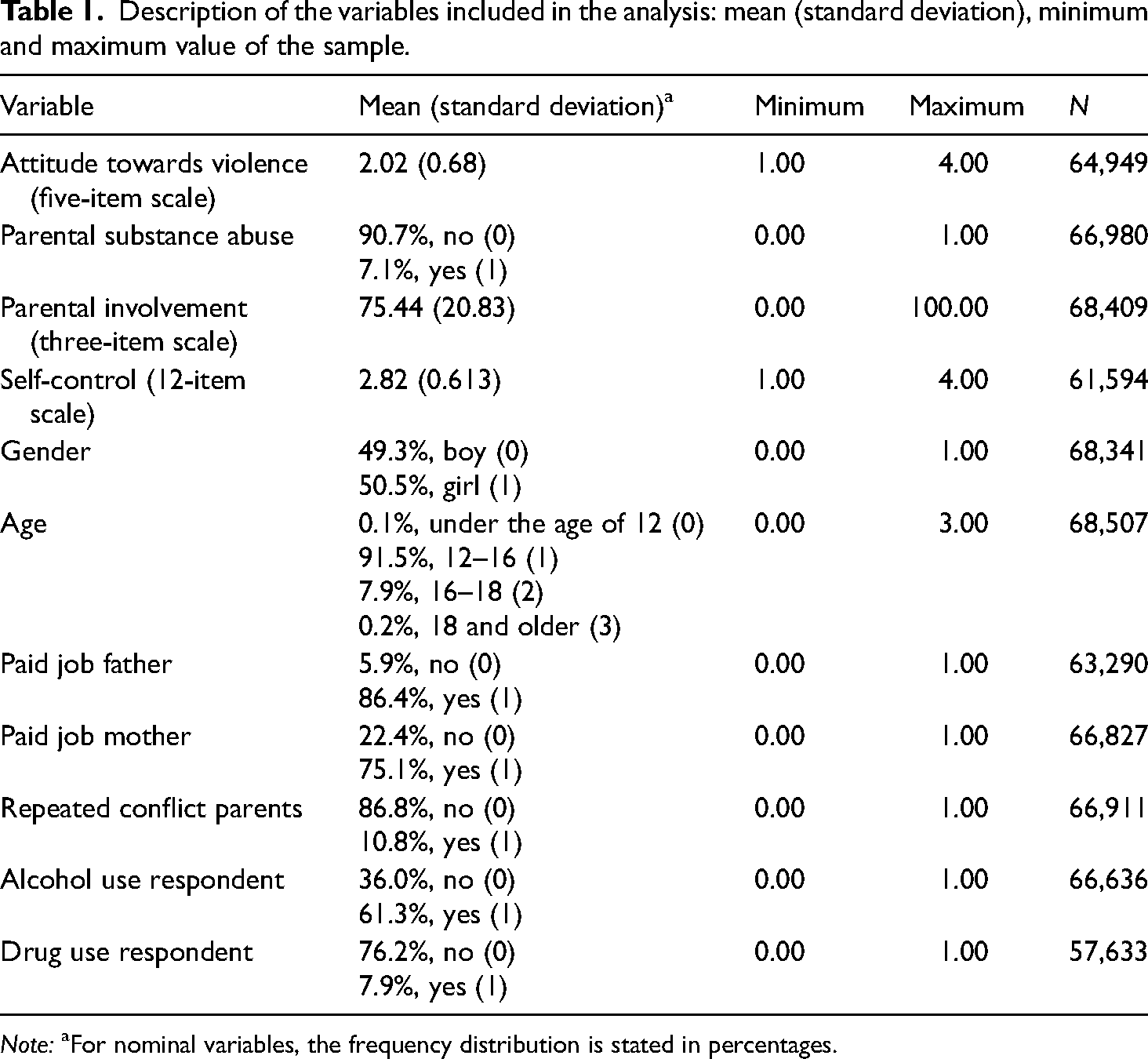
Note: aFor nominal variables, the frequency distribution is stated in percentages.
Data analysis
The data used in this study is nested, which means that the individual cases (level 1) are nested in countries (level 2). To take into account the nested structure of the data, the hypotheses were tested by conducting multilevel analyses in SPSS Statistics (a statistical software platform; version 24.0.1) using the MLmed macro for multilevel mediation (Rockwood, 2017). Multilevel analyses take into account that effects may vary across the different countries (Peugh, 2010). Moreover, a multilevel analysis is necessary when the assumption of independence is not guaranteed because of nested data (Peugh, 2010). Before the multilevel models could be estimated, the scale variables were standardized using z-scores. We determined whether the variables should be treated as random or fixed effects by using the deviance test for the goodness of fit of the model. A context-dependent variable was treated as random if treating the variable as random was significantly better than treating it as fixed, and if the within-person variance of the random effect was significantly different from zero (Ratnapradipa et al., 2018; Rocque et al., 2015). This was only the case for self-control.
The estimation of the different models requires first testing whether there is a significant relation between parental substance abuse and the child's attitude towards violence, without taking into account any other (mediating) variables. In addition, it needs to be established whether parental substance abuse is related to the mediating variables. Therefore, the mediating variables parental involvement and self-control were added to the model, and two separate multilevel analyses were performed to check for the direct effect of the independent variable on both mediating variables.
In the analysis using the MLmed macro for multilevel mediation, no missing data was included. The sensitivity analysis shows that omitting the missing values makes no difference in the findings (see Supplementary Appendix). 8
We inspected the standardized residuals to check for outliers on the individual level. Since the standardized residuals had no higher or lower values than −3 and 3, it can be concluded that there are no outliers present at the individual level. Additional analyses showed that the assumption of a linear relationship between the dependent and independent variables was not violated in the current study, as well as the assumption of homoscedasticity. Only the assumption of normality was not met. Since we use a large sample in the current study, it is not expected that this causes major problems for the analyses (Gravetter and Wallnau, 2004). To reduce the possibility of errors we will use a significance level of .01 when analysing the multilevel models (Abdi, 2007).
Results
Bivariate associations
The bivariate statistics are reported in Table 2 and show the relationship between all variables included in the analysis. 9 The findings relevant to answering the hypotheses will be discussed with an interpretation of the effect sizes based on Funder and Ozer (2019). The results show a significant positive correlation between parental substance abuse and the child's attitude towards violence, although the strength of the correlation is very small (r = .07; p < .001). This means that children who reported to have experienced parental substance abuse are more tolerant towards violence. Furthermore, both self-control and parental involvement are identified as possible mediating variables. The correlation between self-control and attitude towards violence is large and significant (r = −.58; p < .001). The negative correlation means that a higher degree of self-control is associated with a less tolerant attitude towards violence. The correlation between parental substance abuse and self-control is negative and small (r = −.10; p < .001), which means that children who have experienced parental substance abuse have a lower degree of self-control. The negative and moderate correlation between parental involvement and attitude towards violence (r = −.24; p < .001) indicates that a higher degree of parental involvement is associated with a less tolerant attitude towards violence of the child. The small to moderate correlation between parental involvement and parental substance abuse (r = −.16; p < .001) suggests that children who experienced parental substance abuse also experience a lower degree of parental involvement. In addition, the calculated correlations between all variables presented in Table 2 do not indicate multicollinearity, since the majority of correlations were statistically significant but small- to medium-sized.
Bivariate relationships between all variables included in the analysis (Pearson’s r and odds ratio).
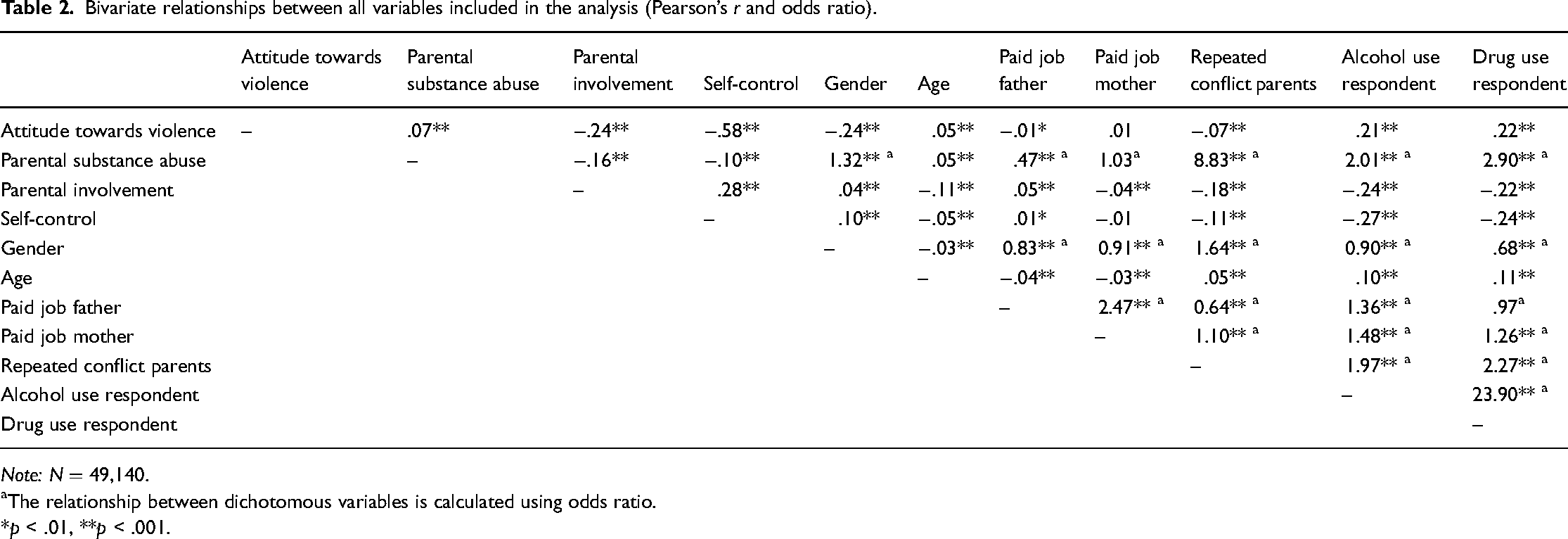
Note: N = 49,140.
aThe relationship between dichotomous variables is calculated using odds ratio.
*p < .01, **p < .001.
Hypothesis testing
Results from the multilevel model, studying the relationship between parental substance abuse and the child's attitude towards violence and the mediating roles of parental involvement and self-control, are reported in Figures 1 and 2. In order to answer our hypotheses, we will look at the within-effects of the multilevel models, as these deal with individual differences; the between-effects are attributed to differences between countries.
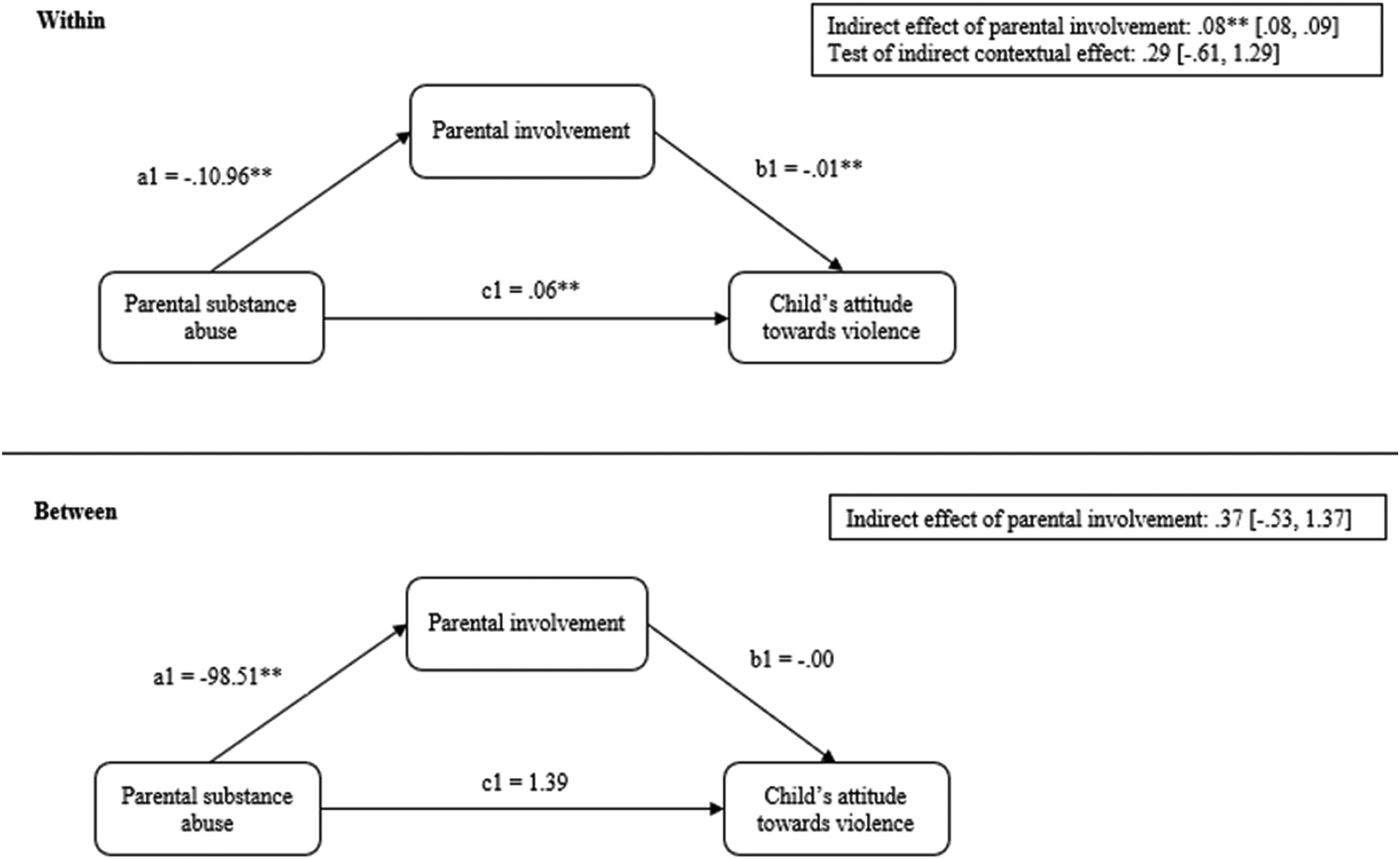
The mediating effects of parental involvement on the relationship between parental substance abuse and the child's attitude towards violence.
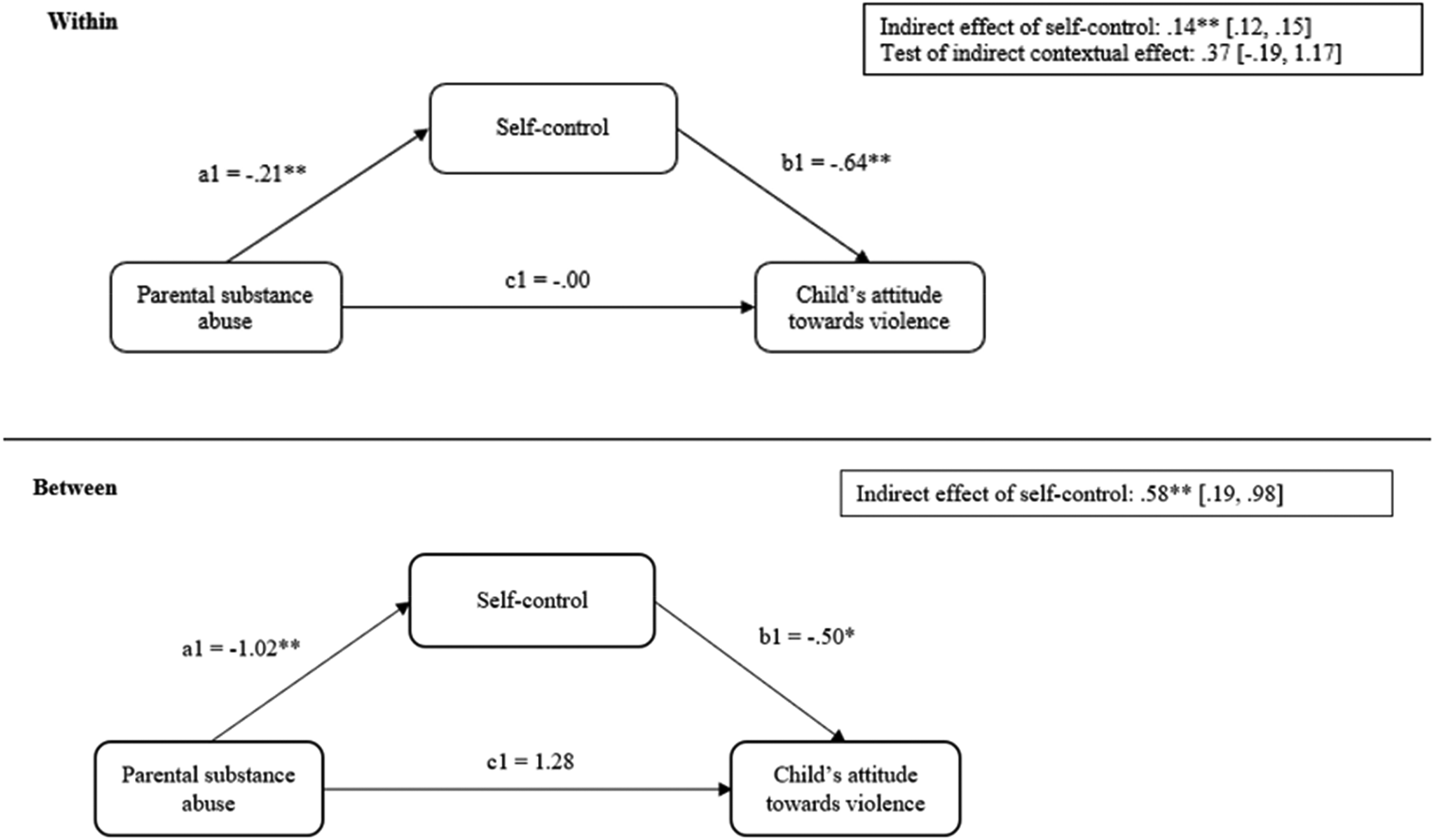
The mediating effects of self-control on the relationship between parental substance abuse and the child's attitude towards violence.
In line with our first hypothesis, Figure 1 shows that parental substance abuse shows a positive and significant association with the child's attitude towards violence (b = 0.06; p < .001) when controlled for parental involvement. This suggests that children who have experienced parental substance abuse have a higher tolerance towards violence than children without this experience.
To answer the second hypothesis that parental involvement mediates the relation between parental substance abuse and the child's attitude towards violence, we use Figure 1. Figure 1 shows a negative and significant association between parental substance abuse and parental involvement (b = −10.96; p < .001; see Figure 1, path a1), and a negative and significant association between parental involvement and the child's attitude towards violence (b = −0.01; p < .001). The latter matches the expectation that more parental involvement leads to a lower tolerance towards violence. Taken together, the relationship between parental substance abuse and the child's attitude on violence is mediated by parental involvement.
Lastly, to test the third hypothesis, we use Figure 2. Figure 2 shows that the relationship between parental substance abuse and the child's attitude towards violence is mediated through the child's self-control. A significant indirect path emerged as parental substance abuse was significantly related to self-control (b = −0.21; p < .001), and self-control shows a negative and significant association with the child's attitude towards violence (b = −0.64; p < .001), which also corresponds to the expectation that higher self-control leads to lower tolerance towards violence (see Figure 2, path b1). Taken together, these results support our third hypothesis that the child's self-control mediates the relation between parental substance abuse and the child's attitude towards violence. 10
Variations between contexts
To be able to assess whether there is a significant difference in the mediation effects of parental involvement and self-control between the different countries that are included in the analyses, we look at the between-effects in Figures 1 and 2. Figure 1 shows that the mediation model for parental involvement is not significant on the between level, as there is no significant association between the child's attitude towards violence and parental substance abuse and parental involvement. However, there is a significant association between parental substance abuse and parental involvement (b = −98.51; p < .001). Figure 2 shows that there is a significant mediation between parental substance abuse and self-control (b = −1.02; p < .001) and between self-control and the child's attitude towards violence (b = −0.50; p = .007). When comparing the within- and between-level mediations, the indirect contextual effect indicates that this difference was statistically significant as the Monte Carlo confidence interval did not include zero (Rockwood, 2017). This significant indirect contextual effect indicates that the mediating effect of self-control on the relationship between parental substance abuse and the child's attitude towards violence gets stronger the higher the level of parental substance abuse in the country.
Discussion
The aim of this study was to provide estimates of the relationship between parental substance abuse and the child's attitude towards violence, and of the mediating role of parental involvement and child's self-control. Multilevel analyses allowed us to test three hypotheses by analysing the ISRD-2 (2005–2007) dataset. This dataset includes 68,507 youths between 12 and 15 years old from 30 different countries who completed self-reports regarding their delinquency and victimization.
Results indicate that children who experienced parental substance abuse were significantly more likely to have a tolerant attitude towards violence. Moreover, the relationship between parental substance abuse and the child's attitude towards violence was mediated by parental involvement and by the child's self-control. Children who experienced a higher level of parental involvement were less likely to have a tolerant attitude towards violence, and children who experienced parental substance abuse also experienced a lower level of parental involvement. Moreover, children with a higher degree of self-control were less likely to have a tolerant attitude towards violence than children with a lower degree of self-control. Parental substance abuse was also related to lower levels of self-control of the child. The results further suggest that the mediating effect of self-control is stronger for countries with a higher level of parental substance abuse. Taken together, all three hypotheses were supported by the results of this study, and we found some evidence for variations between contexts.
The strengths of our study are the size of the sample, the representativeness, and the possibility to include information from a wide range of countries. The large sample size across several countries around the globe (N = 68,507) and the high response rate of this study contribute to the representativeness and validity of the study. Furthermore, the use of a multilevel analysis is a methodologically responsible way of analysing nested data (Peugh, 2010).
Though the current study goes considerably beyond prior work, our contributions must be considered alongside some limitations. Among its weaknesses is that we cannot account for all confounding variables, as observational data always remain vulnerable to hidden bias resulting from unobserved variables. For instance, genetic factors are not available in our data but play an important role in intergenerational transmission of criminality and personality traits (e.g., Latvala et al., 2022; Van de Weijer et al., 2014; Van der Laan et al., 2023). Therefore, caution is warranted when interpreting our results in terms of the strength of associations, as such confounds may inflate the observed effects. This issue may be particularly relevant at the cross-national level (Bryan and Jenkins, 2016). Conducting studies that include an even more extensive set of confounding variables, including biological and socio-cultural factors and more countries, thus remains desirable to show whether our findings are indeed consistently found. Several specific variables to consider in future research include (relative) deprivation and parental neurocognitive functioning, as they have been identified as relatively strong predictors of the intergenerational transmission and development of deviance, substance abuse, and self-control (e.g., Boutwell and Beaver, 2010; Cauffman et al., 2005; Lee et al., 2013). Prior research also showed that parent–child resemblance in low resting heart rate accounts in part for intergenerational transmission (Bertoldi et al., 2024). It is further worth noting that rather than studying variables in isolation, it may be particularly important to include interactions between genetic and environmental characteristics, as environmental factors may have differential effects (Azeredo et al., 2019; Van Hazebroek et al., 2019). Examples include interactions between social risk and factors like over-arousal and prenatal risk. Including such confounds in future analyses could potentially nullify observed relationships, as these third variables may underlie the observed relations. For instance, our findings may primarily reflect more specific processes through which poverty relates to various negative life outcomes and their intergenerational transmission. If confounding variables indeed explain a (large) part of the relationships found, then the effectiveness of policy or programmes implemented based on our results will also diminish. Additional studies should, therefore, be conducted prior to implementing policy and programmes targeting specific populations to ensure that they are indeed effective. It is important to note that some caution is further warranted, because the strength of the main association was considered to be very small. However, such small effects can have larger consequences over the longer term (Funder and Ozer, 2019).
The second limitation to be taken into account when interpreting the results is that the questionnaire was conducted in the period between 2005 and 2007. This could mean that the results may no longer be representative for the current time. An example of this is the higher base rate of aggressive behaviour amongst young people in America. Such as more serious threats of violence in American high schools (Cornell, 2020). However, there is also a linear decrease in bullying victimization in Europe and North America (Cosma et al., 2020). Currently, the dataset of the third version of the International Self-Report Delinquency Study (ISRD-3) is being finalized and will soon be made available to the public. This dataset was collected in the same countries and four additional countries between 2012 and 2019. Future work using the ISRD-3 to replicate our findings and test the robustness of our results is needed.
Third, using data from self-report questionnaires, there is a possibility that respondents have given socially desirable answers. For example, it can be difficult for the child to admit that one or more parents experienced problems with alcohol and/or drug use because they are ashamed of this. Despite the guarantee that the data will be anonymized, it is possible that respondents present their personal situation more positively than it actually is, for example, to paint a more positive self-image (Hart et al., 2015). On the other hand, there is a possible bias because of mischievous responders. Mischievous responders are (mainly) youths who provide extreme and sometimes untruthful answers to questions, because this is funny to them (Robinson-Cimpian, 2014). This can be the case when, for example, reporting their attitude towards violence. Therefore, a critical next step is to go beyond self-reports only and to also include administrative data and/or other reports.
Fourth, another potential limitation is the relatively low Cronbach's alpha of our measure of parental involvement, as this may underestimate the relations. However, do note that this relatively low Cronbach's alpha is comparable to that of other short questionnaires (e.g., De Vries, 2013). Specifically, when we applied the Spearman–Brown prophesy formula (Brown, 1910), it was clear that we would get a Cronbach's alpha of .74 if we could have expanded it to 12-item measure, which is similar to 12-item long parental involvement questionnaires (Wright and Beaver, 2005). Moreover, other research has also shown that this loss of validity may be actually close to zero, as internal consistency relatability seems to be unrelated to validity, and only test–retest reliability does play a significant role for validity (McCrae et al., 2010).
Finally, with the finding of the cross-national effect when it comes to the mediating role of self-control in the relationship between parental substance abuse and the child's attitude towards violence, further research could determine which variables at the country level can explain these between-country results (e.g., cultural differences, differences in addiction treatment, differences in high- and low-income countries). For example, the CLASH model (a model of CLimate, Aggression, and Self-control in Humans) describes how societies closer to the equator have to deal with a warmer climate, are relatively more harsh and unpredictable, are more likely to face natural disasters, and are more at risk to threats to harvests in agriculture but also parasitic and infectious diseases (Van Lange et al., 2017). Besides, individuals in countries that are closer to the equator, tend to adopt faster life strategies, have a less strong future orientation and also a lower level of self-control. These mechanisms are important determinants of aggression and violence and demonstrate how country-level and individual-level variables may be related (Van Lange et al., 2017). When factors contributing to country differences concerning the mediating effect of self-control are known, these can lead to more localized and tailor-made interventions to improve self-control and ultimately the possibility to make recommendations that reduce the risk of a tolerant attitude towards violence.
With these caveats and calls for future research in mind, this study offers the possibility to take a first step with creating some tentative policy recommendations that could reduce tolerant attitudes towards violence and potentially violent behaviour. A specific suggestion for policy would be to pay particular attention to the parental involvement and the child's self-control, for example by setting up special programmes in schools that focus on improving self-control with a particular focus on the group of children who experienced parental substance abuse as our results suggest that this may decrease tolerant attitudes towards violence among children to some extent. After all, schools are important places for the development of young people (Eccles and Roeser, 2011), and problems arising due to experiencing parental substance abuse can be effectively counteracted in school settings. In addition, programmes for reducing the involvement of children in violence are mainly implemented in school settings (Gavine et al., 2016). Research confirms that social development programmes can help children to develop pro-social skills to enable them to deal with arguments and solve problems without using violence as a coping mechanism (Gavine et al., 2016), and that programmes to improve self-control are effective in reducing delinquency and behaviour problems (Piquero et al., 2010). Our results further indicate the need to customize policy and programmes per country to match the different school systems and the historical, political, social and economic backgrounds of different countries. In addition, considering the potential importance of parental involvement, it may be beneficial to engage parents regularly in school activities, such as field trips or sports days, to foster attention to the child–parent bond. It is important, however, to exercise caution when interpreting the results and formulating policy implications based on the observed relationships, due to the possibility of hidden bias and the strength of the associations found. To better understand which policies and programmes are effective, more research is needed.
Supplemental Material
sj-docx-1-euc-10.1177_14773708251329721 - Supplemental material for The relation between parental substance abuse and the attitude towards violence of the child and the mediating role of self-control and parental involvement: A cross-national multilevel analysis
Supplemental material, sj-docx-1-euc-10.1177_14773708251329721 for The relation between parental substance abuse and the attitude towards violence of the child and the mediating role of self-control and parental involvement: A cross-national multilevel analysis by Jasmijn van der Veen, Ard J. Barends and Hilde T. Wermink in European Journal of Criminology
Footnotes

References
Supplementary Material
Please find the following supplemental material available below.
For Open Access articles published under a Creative Commons License, all supplemental material carries the same license as the article it is associated with.
For non-Open Access articles published, all supplemental material carries a non-exclusive license, and permission requests for re-use of supplemental material or any part of supplemental material shall be sent directly to the copyright owner as specified in the copyright notice associated with the article.
