



Abstract
There are considerable contextual differences, both between countries and municipalities, in the degree to which first- and second-generation immigrants are involved in crime. This study aims to understand such variation better, focusing on the local level. It examines whether municipal variation in self-reported crimes among Turkish- and Moroccan-Dutch men residing in 30 representative Dutch cities (n = 902), including the four largest cities, is associated with municipal variation in multicultural attitudes, or ‘community multiculturalism’ (CM), among the native-Dutch living in these municipalities (n = 2556). We propose and test a mechanism-based theoretical model that links Berry's acculturation theory to general strain theory, social bonding theory, and collective efficacy theory. In line with a previous study using police data, the self-reported offending incidence is indeed considerably lower in municipalities with higher CM levels than in other, demographically comparable municipalities. The empirical evidence suggests that the association between CM and immigrant crime is caused by CM promoting social control in the immigrant group, both at the individual and community levels.
Introduction
Immigrants’ context of reception – the economic, legal and social conditions in the destination country (Portes and Rumbaut, 2019) – codetermines immigrant incorporation patterns and related outcomes such as crime. Societal attitudes and policies on migration-related diversity constitute important contextual elements, and there currently is a rich academic and public debate on the advantages and disadvantages of multiculturalism – typically understood as a national policy approach. Bloemraad and Wright (2014), for instance, highlight possible advantages and report that immigrants experience less discrimination and higher a level of social and institutional trust under multiculturalism. Others dispute multiculturalism is necessarily advantageous, and argue it may unintendedly hamper immigrants’ positioning on the labour market to the extent newcomers are less pressured into learning the destination country's formal language(s) (cf. Koopmans, 2010, 2013). In Berry's (2011, 2017) acculturation theory, which informed the present analysis, multiculturalism does not necessarily pertain to policies; it is an ‘acculturation orientation’ or ideology in the receiving society that – through policies or otherwise – seeks to facilitate immigrants’ and ethnic minorities’ equitable participation, while allowing these groups to maintain heritage cultures to a notable extent. 1
Internationally comparative studies like those conducted by Bloemraad and Wright (2014) and Koopmans (2010, 2013) can collect no more than suggestive evidence on the (dis)advantages of multiculturalism, as they cannot easily control confounders: if international variation in a given outcome is correlated with specific integration policies, it is typically hard, if not impossible, to assess whether immigrant incorporation policies cause the relationship or whether it reflects international differences in the immigrant population composition, labour markets, different admission policies, and so forth. Such methodological limitations are among the reasons why scholars have increasingly become interested in intra-national contextual variation (Bean et al., 2012; Glick Schiller and Çaǧlar, 2009).
One intriguing contextual difference, both internationally and intra-nationally, pertains to what could be called ‘immigrant origin crime’ (for brevity reasons shortened to ‘immigrant crime’ in this article): crime among foreign-born residents (‘first-generation immigrants’) and their native-born children (conventionally labelled ‘second-generation immigrants’). 2 While both generations tend to be overrepresented among suspected and convicted offenders in Europe – in some countries more than in others – they are not, or considerably less, overrepresented in traditional immigration countries, including the United States, Canada and Australia (Bersani, 2014; Bucerius and Tonry, 2014; Kubrin et al., 2019; Lynch and Simon, 1999). Furthermore, there is relevant local-level variation in immigrant crime (Piopiunik and Ruhose, 2017; Van San and Leerkes, 2001). In the Netherlands, for example, the degree of overrepresentation of Moroccan-origin residents among local crime suspects differs between municipalities from 1.3 to 4.2 and is generally lower in cities than in smaller towns (De Boom et al., 2013).
We carried out two interrelated research projects to better understand contextual variation in immigrant crime and its relation to multiculturalism. The first project's findings have been published earlier (Leerkes et al., 2023); the present contribution reports on the second project. Both projects focus on local-level multicultural attitudes, or what we call ‘community multiculturalism’ (hereafter: ‘CM’), rather than multicultural policies, which are typically determined at the national level. In discussions of national policy models, acculturation preferences are often overlooked, let alone local-level variation in such preferences. Considerable local-level attitudinal variation nonetheless exists even in small countries like the Netherlands, our focal country. Ethno-cultural diversity tends to be perceived differently in cities than in more rural environments (Maxwell, 2019; Schwarz et al., 2014) but there also is attitudinal variation among municipalities with comparable demographics (Martínez-Ariño et al., 2019; Leerkes et al., 2023).
The first research project examined how local-level variation in CM among native-Dutch residents living in the four largest cities and 31 other representative municipalities was negatively associated with the number of registered suspected crimes among all male inhabitants (ages 12–65) with a first- or second-generation Turkish or Moroccan background living there in 2010 (Leerkes et al., 2023). This was done by adding aggregated survey information as a municipal-level variable to a population database with micro-level crime suspect data and other administrative information on all registered residents. CM was measured using the Netherlands Longitudinal Survey (NELLS), Wave 1, a large sociological survey on the living situation of the Dutch population, carried out in the 2008–2010 period. CM was found to be associated with a lower number of crime suspects in both immigrant groups, especially among first-generation immigrants, especially in municipalities with larger immigrant communities.
In the second project, on which the present article focuses, we did not use police data but also used the NELLS to measure (self-reported) criminal behaviour, and conducted more direct tests of three causal mechanisms that, in our view, promote a negative relationship between CM and immigrant crime, namely: (a) strain reduction (cf. Agnew, 2005, 2016), (b) facilitation of individual-level social bonds (cf. Hirschi, 1969) and (c) facilitation of the immigrant group's involvement in, and contribution to, group-level informal social control or ‘collective efficacy’ (cf. Sampson, 2012). Our aim to uncover such mechanisms is inspired by Hedström (2005), who defines causal mechanisms as processes or sequences of events that lead to specific outcomes, emphasizing that understanding social phenomena requires the uncovering of these mechanisms rather than merely identifying statistical associations between variables.
Triangulating police data and self-reported offending data via two interrelated projects is crucial, as both measure criminal behaviour imperfectly. Crime suspect data evidently measures criminal behaviour, but also captures residents’ reporting behaviour and law enforcement practices (cf. Newburn, 2003). Self-reported offending data, in turn, is subject to underreporting and is limited to lighter forms of crime among samples of people who are willing and able to participate in surveys.
A main strength of the NELLS, which also includes information on relevant causal mechanisms, is that it can help rule out two alternative interpretations of the negative association between CM and offending found in the first project, namely (1) that it merely points at local variation in residents’ reporting behaviour and law enforcement (e.g., that a lower punitiveness towards immigrants under CM decreases formal punishment), and (2) that the association is due to reverse causality as immigrant crime may decrease CM. Demonstrating an association between CM and self-reported crime weakens the first alternative interpretation, and if we can find evidence supporting the hypothesized causal paths from CM to immigrant crime, which is not possible using administrative data, the plausibility of the second interpretation diminishes. Data on self-reported offending is generally considered suitable for such theory testing (cf. Junger-Tas and Marshall, 1999). We thus ask: Is there a negative relationship between CM and the degree of self-reported offending among first- and second-generation immigrant men with a Turkish or Moroccan background, and, if so, can that relationship be explained by differences in the degree to which these men experience strain, social bonds and community collective efficacy?
The analysis pertains to the same municipalities as in the first project, and similarly focuses on men – as men commit most crimes 3 – with a Turkish or Moroccan migration background. As a robustness check, we also verified whether CM is associated with two other measured indicators of regional variation in criminal involvement that are less susceptible to social desirability bias, namely, (a) social deviance (e.g., hanging around, unwarranted work absenteeism, drug use) and (b) criminal victimization.
The focus on respondents with a Turkish or Moroccan migration background is partially inherent to the NELLS, which was designed to be representative for the native-Dutch and the two immigrant groups – the two largest ethnic minorities in the Netherlands. A considerable number of men with a Turkish or Moroccan background participated (n = 1108) and answered questions about criminal behaviour (n = 921). The two immigrant groups also are uniquely suitable to investigate the relationship between CM and immigrant crime. Due to the recruitment practices for ‘guest workers’ in the 1960s and 1970s, the initial immigrants migrated to municipalities scattered across the country (Stearns et al., 1974), from where they initiated family reunification processes (Leerkes and Kulu-Glasgow, 2011). Both immigrant groups thus had similar starting positions and limited influence on their local context of reception, arguably giving their spatial distribution quasi-experimental properties.
Theory and hypotheses
Community multiculturalism
In Berry's (2011, 2017) acculturation theory, multiculturalism constitutes one of four ideal-typical ‘acculturation orientations of the dominant group’, which result from two analytical dimensions being juxtaposed: (a) the degree to which immigrants are allowed/promoted to preserve the heritage culture, and (b) the degree to which immigrants are allowed/promoted to participate in the host societies’ institutions. A dominant group with a multicultural orientation tolerates that immigrants and their descendants preserve the heritage culture to a considerable extent, while inviting them to socially participate on an equal basis. The other orientations are ‘melting pot’ or assimilationism (participation on an equal basis is allowed provided cultural differences have been diminished, which typically requires adaptation on the part of the immigrant group), segregationalism (the heritage culture may be maintained, but equal participation is not welcomed) and exclusionism (the heritage culture may not be maintained and equal participation is discouraged). In Berry's model, multiculturalism fosters integration, where immigrants maintain their heritage culture while achieving significant social positioning in the destination country through labour market participation, education, and citizenship. Assimilationism, segregationism, and exclusionism are assumed to promote assimilation, separation and marginalization respectively.
While research confirms that immigrants’ preferences and outcomes are indeed bi-dimensional (Berry, 2017), there is some evidence that the dominant group's orientation, especially when attitudes rather than formal policies are considered, tends toward one-dimensionality. This could be attributed to assimilationism, segregationism, and exclusionism all involving some form of exclusion of migration-related diversity (cf. Bourhis, 2017). In our first project, we indeed found that municipal variation in the Netherlands in CM varies ‘diagonally’ in Berry's two-by-two model, from exclusionism to multiculturalism (Leerkes et al., 2023). We therefore contrast CM and exclusionism when discussing the influence of the dominant group's acculturation orientation on immigrant crime. The one-dimensionality of acculturation preferences in the Netherlands could imply we should perhaps use the term ‘community inclusionism’ (cf. Bean et al., 2012) rather than CM. We nonetheless stick to Berry's terminology, as future research may identify the other community acculturation preferences elsewhere.
Relation to crime: Mechanisms and hypotheses
In what follows, we offer a multicausal, mechanism-based explanation of the influence of CM on crime, which combines insights from general strain theory, social bonding theory, and collective efficacy theory. While these theories emerged in different schools of thought (i.e., the functionalist and rational choice paradigms), we do not see them as contradictory. The three theories all lead us to expect a negative relationship between CM and immigrant crime (H1) – especially when relatively unorganized forms of street crime are considered, which predominate in the NELLS.
General strain theory, a prominent theory explaining crime proposed by Agnew (2005, 2016), builds on Merton's (1938) classical anomie theory. It posits that stressors and negative emotions drive individuals to commit crimes. To counterbalance or correct these stressors and emotions, people may engage in corrective action, including crime. Anger is especially conducive to motivate criminal behaviour as it decreases concerns regarding the consequences of one's actions. Strains do not automatically result in crime. For example, the stronger a person's self-esteem, the higher the probability strains result in other forms of coping than crime (Agnew, 2016).
Agnew (2016) identifies three main strain types: the inability to achieve valued goals, the loss of positively valued stimuli, and the presentation of negative stimuli. Several characteristics of these strains determine their criminogenic potential. The more severe, frequent and lasting a strain, the more likely it is to motivate anger and crime. Subsequently, interpersonal conflict and depression have been identified as motivating factors for criminal behaviour (cf. Anderson et al., 2015; Broidy and Agnew, 1997). For people with a migration background, another source of criminogenic strain is perceived ethnic discrimination (Leerkes et al., 2019; Verkuyten et al., 2019), as it will be perceived as painful, unjustified and largely out of control.
Another, more indirect, source of strain is having a relatively low socio-economic status (SES), especially when the immigrant group is relatively well-established, as is the case for the two focal immigrant groups. Settled immigrant groups increasingly compare themselves with reference groups in the country of immigration, not just the country of origin. With a lower education and income, it is harder to access primary labour markets and to buy valued products or services, and criminal activities may partially be aimed at overcoming such constraints and/or to cope with the anger they may produce (Agnew, 2016).
Immigrants are less likely to perceive discrimination when multiculturalism is socially accepted, and Berry and Sabatier (2010) report that integration is associated with higher levels of well-being and self-esteem that can help people deal with strains without committing crimes. Multiculturalism is assumed to facilitate integration, and Bloemraad and Wright (2014) indeed find that immigrants perceive less discrimination in countries with multicultural policies.
There is more disagreement on the effects of multiculturalism on SES. Koopmans (2010) contends that multiculturalism may slow down immigrants’ social positioning, but Fleischmann and Dronkers (2010) and Bloemraad and Wright (2014) contend that multicultural policies are not associated with worse outcomes. A study comparing different cities in Europe and the United States indicates that inclusive local-level attitudes are associated with better socio-economic outcomes (Bean et al., 2012). Most studies thus suggest that CM weakens first- and second-generation immigrants’ exposure to strains and improves immigrants’ ability to deal with possible strains through coping mechanisms other than crime. Consequently, we hypothesize that the association between CM and immigrant crimes decreases after controlling interpersonal conflict, depression, perceived ethnic discrimination and SES (H2). 4
Hirschi's (1969) social control theory argues social bonds help individuals restrain themselves from committing crimes: a person's desire and/or opportunity to commit crimes is assumed to be inversely related to attachment to family, neighbours and institutions (‘attachment’), dedication to conventional norms and values (‘commitment’), participation in conventional activities (‘involvement’) and/or beliefs in conventional norms (‘belief’).
Different forms of social and institutional trust indicate these bonds: bonds both require and produce trust. Particularized trust pertains to the quality of the attachment with known people, such as family, friends and acquaintances. Generalized trust pertains to trust in members of the society in general and is associated with morality and sociability (‘commitment’ and ‘belief’). Institutional trust pertains to a person's confidence in institutions like the police and justice system and gives an idea of a person's belief in, and commitment to, conventional norms, laws and legal procedures. Religiousness is an additional indicator of attachment, commitment and belief. It offers individuals a clear normative orientation, which typically reduces crime (cf. Baier and Wright, 2001). Labour market attachment, for example, whether persons have stable employment or work more irregularly, also is an important attachment indicator predicting criminal involvement (cf. Ramakers et al., 2015).
CM facilitates such trust, religiosity and labour market attachment by allowing immigrants to develop ties to both the receiving society and the immigrant group's culture and institutions. Compared to exclusionism, it is more likely to grant immigrants opportunities to take on equitable roles (e.g., joining the police), which should foster institutional and generalized trust. ‘Integrated’ immigrants also typically have better intra- and interethnic contacts (Berry, 2006), and if multiculturalism facilitates such ties, as Berry would argue, then CM should be associated with higher particularized trust levels. The literature is somewhat ambivalent about the CM–religiosity and CM–labour market attachment relationships. Berry's theory implies a positive relation between CM and religiousness as it facilitates immigrant groups in maintaining heritage cultures, also in relation to religion (Berry, 2006). However, some research suggests exclusionism may promote ‘reactive religiosity’, especially among second-generation immigrants (Fleischmann and Phalet, 2012). Koopmans (2010) finds that immigrant unemployment is relatively high in countries with multicultural policies, but provides insufficient evidence for a causal relationship. Bean et al.'s (2012) study, by contrast, suggests inclusive local-level attitudes promote immigrant labour market attachments.
All in all, the literature leads us to expect a positive relationship between CM and social bonds as indicated by social and institutional trust and, possibly less so, religiosity and labour market attachment. We thus hypothesize that the negative association between CM and immigrant crime decreases after controlling for social bonds in the form of particularized, generalized, and institutional trust, religiosity and labour market attachment (H3).
Collective efficacy theory (Sampson, 2012) argues that communities can reduce crime by exerting external social control. While social bonding theory mostly sheds light on ‘internal social control’ by highlighting social ties at the individual level (e.g., whether a person has stronger or weaker attachments), collective efficacy theory focuses on ‘external social control’ at the community level. A collectively efficacious community can socially control community members who would be inclined to commit crimes, for example, because they experience strains or have weaker internalized controls.
The individual-level ties that CM facilitates can thus be expected to have effects in the aggregate at the community level. A community's willingness and ability to solve shared problems requires that enough community members trust each other, and are willing and able to socialize with neighbours, for example. Additionally, a community's willingness and ability to intervene, and blend informal and formal social control, depends on its trust in the police (cf. Yesberg et al., 2023). Religious communities, too, similarly reduce crime by exerting (informal) social control (Brauer et al., 2013; Wang and Jang, 2018). Stronger institutional trust and religiousness under CM at the individual level can thus similarly be expected to also have aggregated effects at the community level. We thus hypothesize that the association between CM and immigrant crime decreases after controlling the local immigrant group's perception of neighbourhood efficacy, trust in the police, and religiousness (H4).
Data and methodology
Data came from Wave 1 of the Netherlands Longitudinal Lifecourse Study (NELLS), a large-scale sociological study on the opinions and living situation of people living in the Netherlands (Tolsma et al., 2013). Basic demographic and socio-economic variables, such as age, household structure and education, were measured using face-to-face interviews, which were followed by a self-completion questionnaire. Most information used here, including the information on criminal offending, is from the self-completion questionnaires, which are less sensitive to social desirability bias than interviews.
The NELLS (N = 5312) is representative for the Dutch population aged between 15 and 45, including Turkish- and Moroccan-Dutch minorities, who were oversampled. The survey was carried out between December 2008 and May 2010 in the four largest cities and 31 other randomly selected Dutch municipalities. About half of the Turkish- and Moroccan-Dutch minorities were residing in these 35 municipalities. The NELLS researchers enriched the data by adding information from Statistics Netherlands on certain neighbourhood and municipality characteristics, including urbanization (municipality) and ethnic composition (neighbourhood).
We made several choices when deciding on our analytical sample. CM was measured using native-Dutch respondents only (n = 2556), while the regression analyses only pertain to male respondents with a first- or second-generation Turkish or Moroccan migration background (n = 1107). Most missing data pertained to the dependent variable: 17% of the 1107 respondents did not answer the questions on offending. Listwise deletion was used to deal with missing data on the independent variables, but respondents who did not provide information about their income – about 10% of the 921 men who answered the questions on criminal offending – were kept in the analysis by creating a dummy ‘income missing’. Multiple imputation was not used, as all other independent variables only contained 19 missing values (2.1% of 921), while missing values for income were unlikely to be missing at random (e.g., because respondents with informal or illegal incomes are more likely to skip income questions), which is a requirement for multiple imputation. Our final analytical sample consisted of 902 observations across all models. These men were living in 138 different neighbourhoods across 30 different municipalities (5 municipalities lacked respondents with a Turkish or Moroccan migration background who answered the questions on offending). In project 1, we conducted separate analyses by immigrant group, generation, and local immigrant group size. Here, we conducted a pooled analysis, as the NELLS yields insufficient observations to break down the findings by subgroup.
Dependent variable
Five items measure criminal behaviour. Respondents were asked if, in the last 12 months, they had been involved in the following activities: ‘stolen something from a person or a shop’, ‘damaged or demolished property of others’, ‘carried a weapon (knife, gun)’, ‘threatened someone’, and ‘kicked or punched someone or participated in a fight’. Respondents could answer on four-point Likert-scales (‘never’, ‘once’, ‘two–three times’ and ‘four times or more’). They could also answer, ‘I don’t want to say’, which was coded as missing. We summed reported crimes per respondent, coding ‘never’ as 0, ‘once’ as 1, ‘two–three times’ as 2.5 and ‘four times or more’ as 4. As a robustness check, we also verified whether CM is associated with social deviance and criminal victimization. Social deviance is indicated by the self-reported number of incidents in the last month involving undue work absenteeism or truancy, drinking too much alcohol, using drugs, and hanging around in the street at night. We similarly summed incidents per respondent, coding ‘never’ as 0, ‘once’ as 1, ‘two–three times’ as 2.5 and ‘four times or more’ as 4. Criminal victimization pertains to house burglary, property destruction, pickpocketing, robbery, criminal threat, or violence. Respondents indicated whether they had experienced these crimes in the last 12 months, and we summed the number of reported yeses per respondent.
Independent variables
There is considerable debate on defining and operationalizing ‘community’ (Shearer et al., 2007). We used measures at both the municipal and neighbourhood levels, basing our decisions on the level used on substantive arguments (e.g., ‘will this aspect of collective efficacy mostly operate at the municipal level or at the neighbourhood level?’) and statistical arguments (‘which operationalization leads to the best model fit?’).
The dominant group's acculturation orientation was operationalized by averaging relevant scores of all inhabitants with a native-Dutch background (operationalized as having two parents born in the Netherlands) by municipality. We engaged in extensive deliberations regarding Berry's concept of the ‘dominant group’. Given the substantial ethnic diversity in the Netherlands, particularly in urban areas, it may have been appropriate to also include ‘established’ first- and second-generation immigrants, such as Dutch citizens with a migration background, in the measure. We decided to only use the scores of respondents with two Netherlands-born parents as Berry describes the dominant group in ethnic rather than civic terms, and we wanted to remain close to his theory. The municipal level is the most appropriate level for this community measure, as most people spend ample time outside of their direct neighbourhood, while relevant policy decisions are also taken at the municipal level – for example, whether institutions that matter to the immigrant community are facilitated (CM may also promote certain local level policies and codetermine the implementation of certain national policies; cf. Jørgenson, 2012).
The following items measured tolerance: (1) It would be better for our country if all inhabitants had the same customs and traditions, (2) It would be better for our country if different beliefs exist, (3) It would be better for our country if all inhabitants spoke the same language, and (4) Immigration to our country must stop to reduce tensions. These items were measured on five-point Likert scales ranging from 1 ‘disagree strongly’ to 5 ‘agree strongly’. After reverse coding inversely worded items, where ‘agree’ indicated low multiculturalism, we obtained a scale with fair internal consistency (α = 0.65). Reliability could not be improved by dropping items.
To measure perceived social distance to Turkish- and Moroccan-Dutch communities two similar three item sets were used, namely: ‘I have a problem with someone of Turkish/Moroccan origin' (1) 'becoming my boss', (2) 'moving next door', and (3) 'marrying my son/daughter’. The questions were measured on three-point scales: 1 ‘no problem at all’, 2 ‘not a problem’, and 3 ‘would be a problem’. The Cronbach's alpha for perceived social distance indicated excellent internal consistency (α = 0.93).
The aggregated scores on tolerance strongly correlated negatively with aggregated social distance (r = −0.78), and the items loaded strongly on one underlying construct. We therefore decided to calculate a single score on a 1–3 scale, which we called community multiculturalism (CM), by averaging the scores for tolerance, which we recoded to a 1–3 scale, and the inverted scores for perceived social distance. In Berry's model, variation in CM thus runs ‘diagonally’ from exclusionism to multiculturalism. Segregationism and assimilationism cannot be separately identified at the municipal level in the Netherlands.
The NELLS was not specifically designed to analyze the CM–immigrant crime relationship but contains ample data on mediating variables (e.g., strains, social bonds, collective efficacy) and relevant confounders (e.g., urbanization, age). To operationalize strain theory, we used (a) interpersonal conflict, (b) depression, (c) perceived ethnic discrimination and (d) SES. Interpersonal conflict was measured by averaging four items (α = 0.72): ‘Do you occasionally have conflicts with the following persons': (a) 'your family', (b) 'your friends', (c) 'your colleagues or fellow students', and (d) 'people in your neighbourhood’, each measured on a four-point scale (1 'never', 2 'seldom', 3 'occasionally', 4 'often'). Depression was measured by averaging 16 four-point items from the CES-D scale (Radloff, 1977) (e.g., ‘during the last week I felt depressed’, ‘during the last week I felt people didn’t like me’; α = 0.94). Perceived ethnic discrimination was operationalized by averaging six items: ‘Did you in any of the following situations experience that you were discriminated on the basis of your ethnic background': (1) 'during a job application', (2) 'at work', (3) 'at school', (4) 'on the street, in stores, or in public transport', (5) 'in associations or sports clubs', and (6) 'during nightlife or discotheques'? The answer options were 0 ‘no, never’, 1 ‘yes, once in a while’, and 2 ‘yes, quite often’; α = 0.82.
Respondents’ SES was assessed using income and educational attainment. Net monthly income of the respondent, and his possible partner, was classified into ‘low’ (up to €1499), ‘middle’ (€1500–€2499), and ‘high’ (€2500 or more). Educational attainment (in the Netherlands or elsewhere) was classified into ‘no formal education or primary education’, ‘secondary education’ (high school, lower professional education), and ‘tertiary education’ (higher professional education, university degrees). If respondents were still attending school their unfinished educational level was used.
The mechanisms theorized by social bonding theory were operationalized using five individual-level variables: particularized trust, generalized trust, institutional trust, religiosity and labour market attachment. Particularized trust was measured with ‘I know many people I can trust completely’ with answers ranging from 1 ‘totally applicable’ to 4 ‘totally not applicable’. Generalized trust was based on ‘Nowadays you really do not know who you can trust’, measured on a Likert-scale ranging from 1 ‘completely agree’ to 5 ‘completely disagree’. Institutional trust was based on ‘Please indicate how much trust you have in the police and justice’, with four answering options ranging from ‘a lot’ to ‘very little’. Religiosity was based on ‘How important is religion to you personally?’ with answering options ranging from 1 ‘very important’ to 5 ‘not important at all’. Self-reported labour market attachment was dummy-coded as ‘has been unemployed during some periods since one's first job’ and ‘has always been employed since one's first job’, with ‘currently employed’ as the reference.
Four indicators operationalized the mechanisms highlighted by collective efficacy theory (cf. Oberwittler and Wikström, 2009; Sampson, 2006; Yesberg et al., 2023). At the neighbourhood level, we measured the immigrant groups’ perceived neighbourhood collective efficacy using six 4-point items (ranging from 0 to 3): 'people in this neighbourhood' (1) ‘greet each other’, (2) ‘trust each other’, (3) ‘get along well’, (4) ‘know each other’, (5) ‘like to help each other’, and (6) ‘would say something against youth causing nuisance’ (α = 0.84). The scale thus covers the two main collective efficacy dimensions: neighbourhood social cohesion and willingness to act in the collective interest. We calculated the average score per neighbourhood among all Turkish- and Moroccan-Dutch respondents, including female respondents, each time excluding the respondent's score, so as to increase the independence between the individual-level and supra-individual measures. Furthermore, we included the average level of intra-ethnic neighbourhood contact among Turkish- or Moroccan-origin residents, using the question ‘How often do you have personal contact in your neighbourhood with somebody of Turkish origin’ for Turkish-origin respondents, and a similar question on contact with Moroccan-origin residents for the Moroccan-Dutch respondents. The answer categories ranged from ‘never’ (1) to ‘(almost) everyday’ (7). At the municipal level, we similarly calculated the local immigrant community's average trust in the police and justice system and its average religiousness. We also experimented with measures that were based on the scores of all local respondents (including native-Dutch-origin respondents), which led to comparable findings, but a somewhat worse model fit. 5
Confounders
At the municipality level we controlled for degree of urbanization taken from Statistics Netherlands with three categories: ‘small town or big village’, ‘small city’ and ‘big city’. Criminal behaviour is generally more prevalent in big cities (Glaeser and Sacerdote, 1999), possibly suppressing the effects of CM, which also has a positive relationship with urbanization (a comprehensive correlation matrix is shown in Table A1 in the appendix). Additionally, we controlled for the percentage of co-ethnics at both the municipal and neighbourhood level using Statistics Netherlands data, to rule out the possibility that CM-related differences in social bonds and collective efficacy merely reflect contextual differences in the opportunity and/or need to interact with co-ethnics. 6 The percentage of co-ethnics is defined as the number of first- and second-generation immigrants of Turkish (for ‘Turkish’ respondents) or Moroccan (for ‘Moroccan’ respondents) origin as a percentage of all residents in the municipality and neighbourhood respectively. Furthermore, we controlled for neighbourhood ethnic diversity: respondents in municipalities with higher CM tend to live in neighbourhoods that are more ethnically diverse, which potentially suppresses the CM effects, since (street) crime typically increases with ethnic heterogeneity (cf. Bernasco and Luykx, 2003). This was done by calculating the Herfindahl-Hirschman Index (HHI) of the respondents’ neighbourhoods using Statistics Netherlands data (cf. Glas et al., 2021). 7
We included four individual-level demographic controls that potentially suppress the CM–crime relationship: (a) immigrant generation; (b) age, and its square divided by one hundred to take the age–crime curve into account; (c) living with a partner and/or child; and (d) living with parents. First-generation immigrant respondents are foreign-born; second-generation respondents are born in the Netherlands and had at least one parent born in Turkey or Morocco.
Both age and household composition are well-known crime predictors (Glowacz and Born, 2015; Hirschi and Gottfredson, 2017). First-generation immigrants are often found to have a lower prevalence of criminal behaviour than their native-born descendants (Bersani, 2014), even if only limited generational differences in self-reported offending have been found (Leerkes et al., 2019). Associations with CM were also conceivable, especially because of its relationship with urbanization. For example, because of spatial assimilation second-generation immigrants may move from the largest cities to certain smaller towns with lower CM levels. Living in a nuclear family is less common in big cities than in smaller towns. Additionally, we controlled for national origin to account for possible ethnic differences in offending; the Turkish-Dutch are typically found to have somewhat lower crime rates than the Moroccan-Dutch (Bovenkerk and Fokkema, 2015), although ethnic differences in self-reported offending are small (Leerkes et al., 2019).
Of the control variables included, there are indeed significant correlations between CM and living in a big city (r = 0.72), neighbourhood ethnic diversity (r = 0.57), percentage of co-ethnics in the municipality (r = 0.20) and neighbourhood (r = 0.19), being a first-generation immigrant (r = 0.07), and living with a partner and/or child (r = 0.07). In a multivariate model with robust standard errors only living in a big city (p = .04) and age (p = .07) turn out to have a significant independent effect on CM. We obtain comparable results, with somewhat weaker CM effects, if we omit from the models all potential confounders apart from living in a big city and age. 8
Analytical strategy
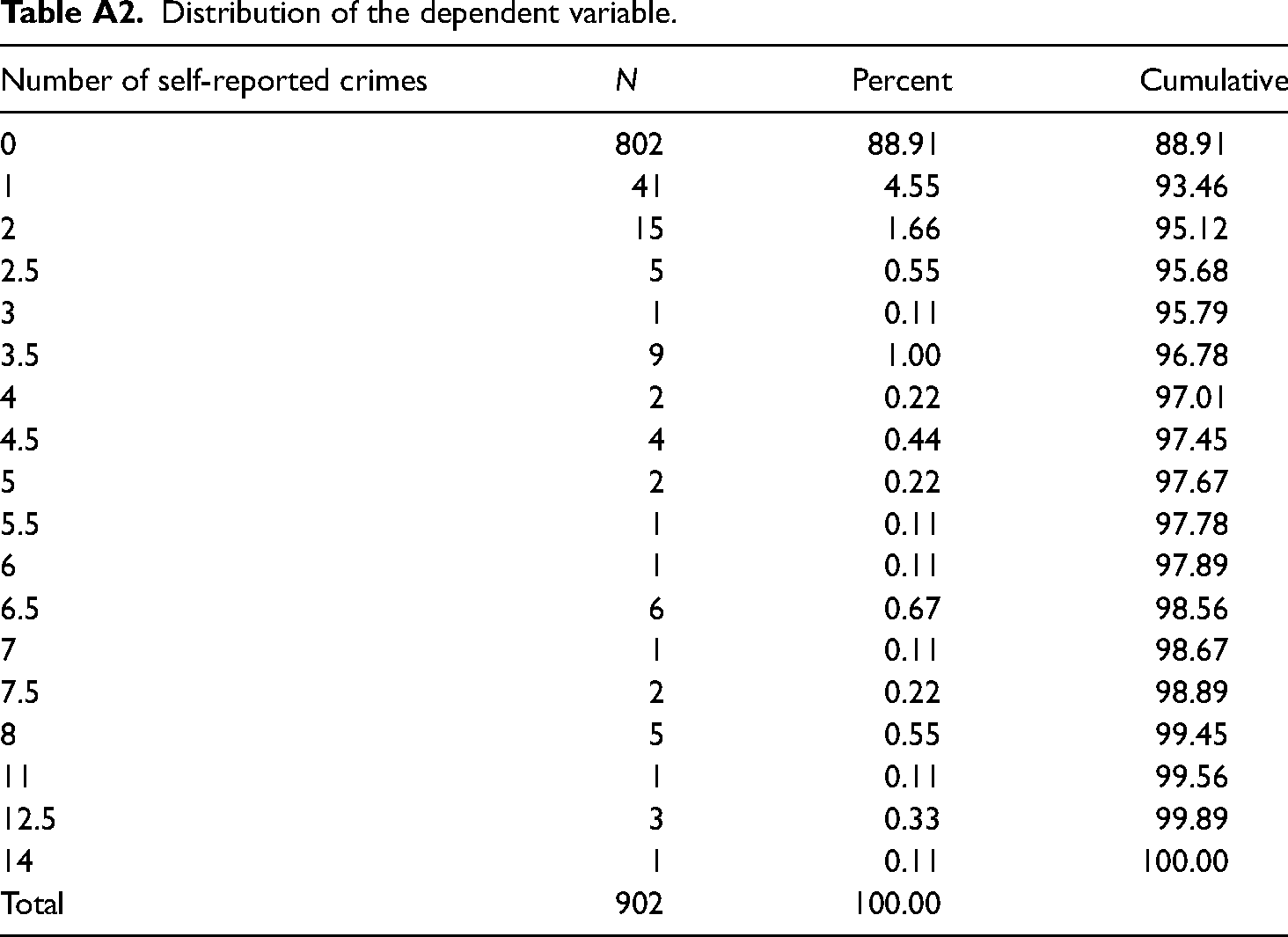
The hypotheses were tested in Stata 17 using weighted negative binomial regression with robust standard errors allowing for clustering of observations at the municipal level. Robust regression was preferred to multilevel regression, because the NELLS includes individual-level weights only, making proper weighted multilevel analyses difficult (highly similar results were obtained using unweighted multilevel analysis). Negative binomial regression was used because the dependent variable – the amount of self-reported crimes – was highly skewed (cf. Land et al., 1996; see Table A2 in the appendix for its distribution). We tested whether the variables of interest had linear relationships with self-reported offending and found that interpersonal conflict and depression did not, which led us to include squared terms for age and depression and to log-transform interpersonal conflict. 9
We estimated six models with criminal behaviour as the dependent variable. M1 and M2 gave an idea of CM's total effect on self-reported offending. M1 specified the relation between CM and criminal behaviour, while controlling for the demographic confounders described. In M2, we added the SES indicators since SES is unlikely to only mediate CM's effects on crime, and can also be seen as a confounder. M2 gives a more conservative – arguably too conservative – estimate of CM's total effects on immigrant crime, as it was argued under H2 that SES mediates some of CM's effects. In M3–M5, we respectively added the more direct strain indicators, the social bonds indicators, and the collective efficacy measures. In M6 we combined all M1–M5 variables in a comprehensive model.
H1 was tested by assessing whether CM has a negative effect in M1 and M2. Subsequently, H2 was tested by comparing CM's coefficient in M3 to M2, and, less conservatively, by comparing the coefficient in M2 to M1. H3 and H4 were tested by comparing CM's coefficient in M2 to M4 and M5 respectively. Seemingly unrelated regression techniques, using the stata suest command, were used to test whether differences between the models are statistically significant. We estimated marginal effects of CM on self-reported crimes to concretize its effect size and conducted postestimation tests to check for possible multicollinearity issues, which we found acceptable. 10 We also estimated M1–M2, without perceived discrimination, for native-Dutch men as an additional control, which showed no CM effect on criminal offending among native-Dutch respondents (not reported). As a final robustness check, we regressed social deviance and criminal victimization on CM, using the same controls as in M1.
The sample's descriptive statistics, after listwise deletion, are presented in Table 1. Self-reported crimes, with values ranging from 0 to 14 incidents, have a mean of 0.36 and a relatively high standard deviation (SD = 1.45), confirming its skewness. Community multiculturalism, assessed on a 1–3 scale, has a mean of 2.11 and ranges from 1.84 to 2.28. The respondents’ ages range from 14 to 49 years, with an average age of 31.82 years (SD = 9.11). First-generation immigrants represent 66% of the respondents, and about half of the men lived in big cities, reflecting the urban concentration of the immigrant population. The final two rows of Table 1 show information on social deviance and criminal victimization, which were used as a robustness check. 11
Descriptive statistics.
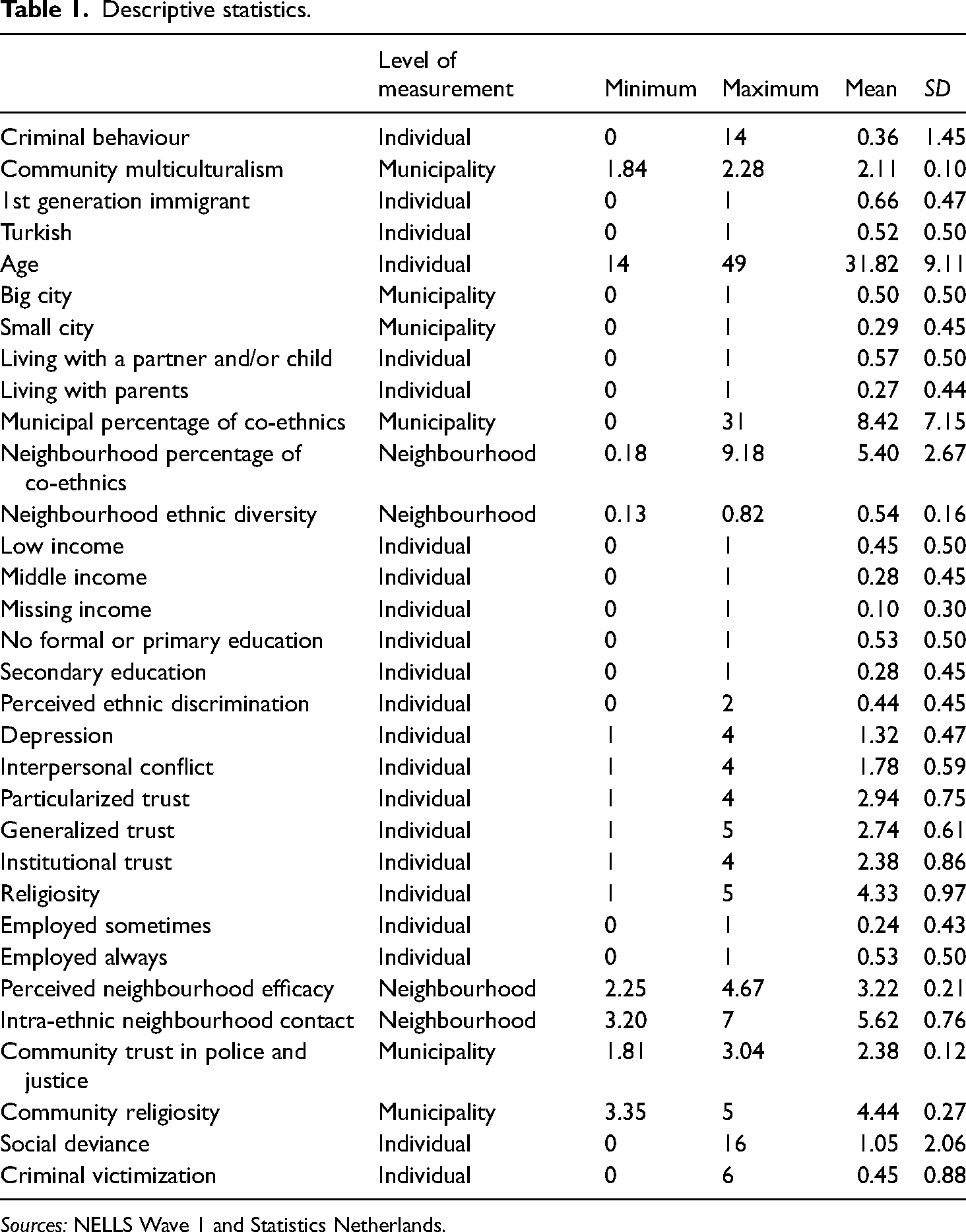
Sources: NELLS Wave 1 and Statistics Netherlands.
To illustrate the findings in an accessible, descriptive manner, we created a simple figure of the relationship between CM and self-reported crime. This was done by calculating separately for (a) larger cities and (b) other municipalities the average crime incidence for the municipalities with the 50% lowest scores on CM compared to the average for municipalities with the 50% highest scores. 12 The 50% municipalities with the lowest CM scores were identified separately among big cities and other municipalities as the relationship between CM and crime is confounded by urbanization.
Results
Figure 1 first illustrates the bivariate relationship between CM and self-reported criminal offending in (a) big cities and (b) other municipalities using the methodology explained. The average crime incidence (self-reported crimes per person) is about 0.7 per person lower among the men living in big cities with higher CM levels than among the men living in big cities with lower CM levels. Among the respondents living in other municipalities the difference is about 0.1 crimes per person. Importantly, these figures do not control for possible confounders apart from urbanization; CM's effect among smaller municipalities becomes stronger, and is significant, when additional confounders are considered. 13
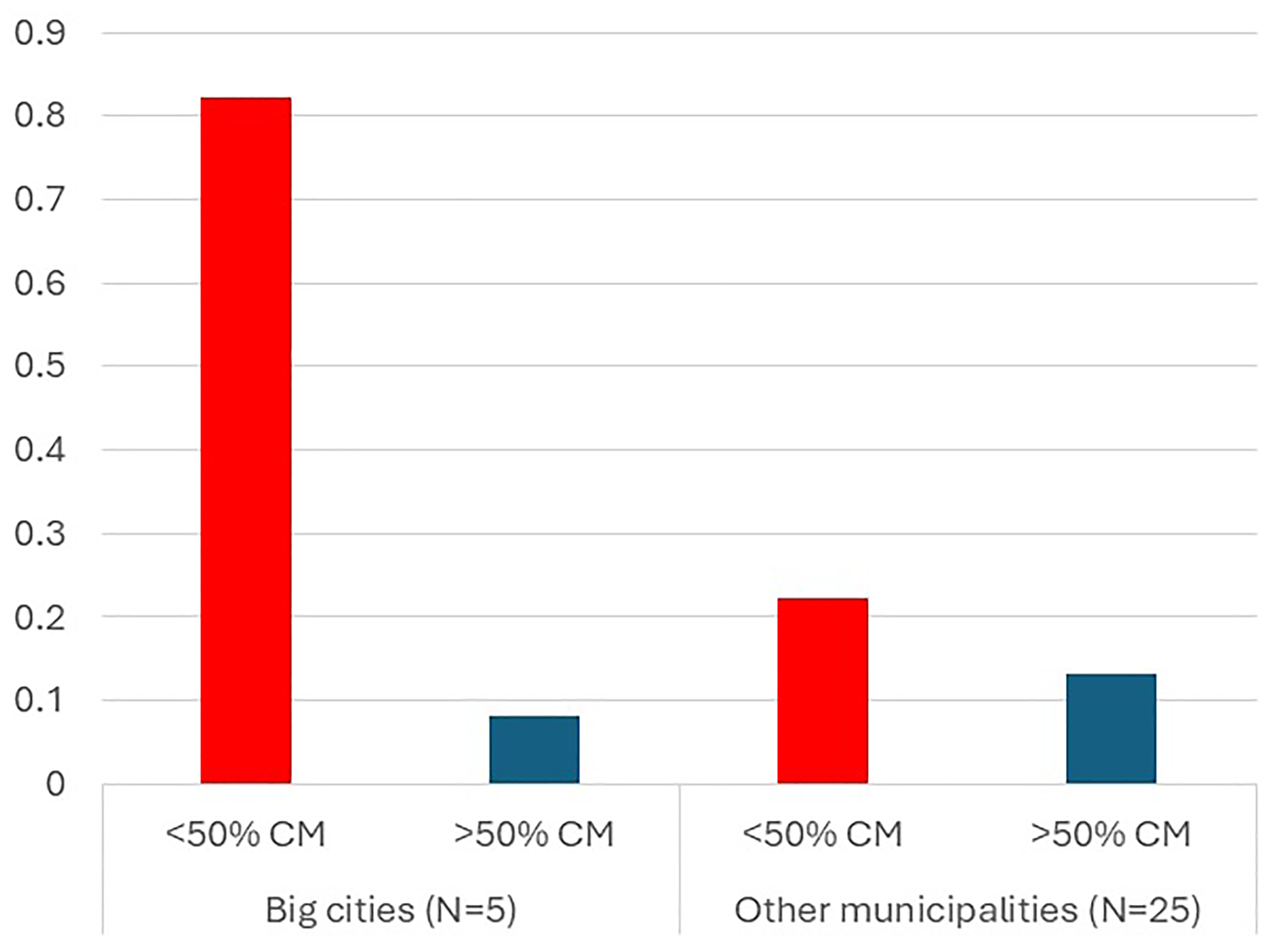
Average self-reported crime incidence by level of CM in big cities and other municipalities. Sources: NELLS Wave 1 and Statistics Netherlands.
Table 2 presents the main regression results. In M1, CM has a negative effect on criminal behaviour: a one-unit increase in CM decreases the difference in logs of the expected number of offences by 12.88 (p < .001). Here, an increase in CM of two standard deviations is associated with, on average, 0.60 fewer self-reported crimes per respondent.
Negative binomial regression results for the independent variables on self-reported criminal behaviour (unstandardized effects).
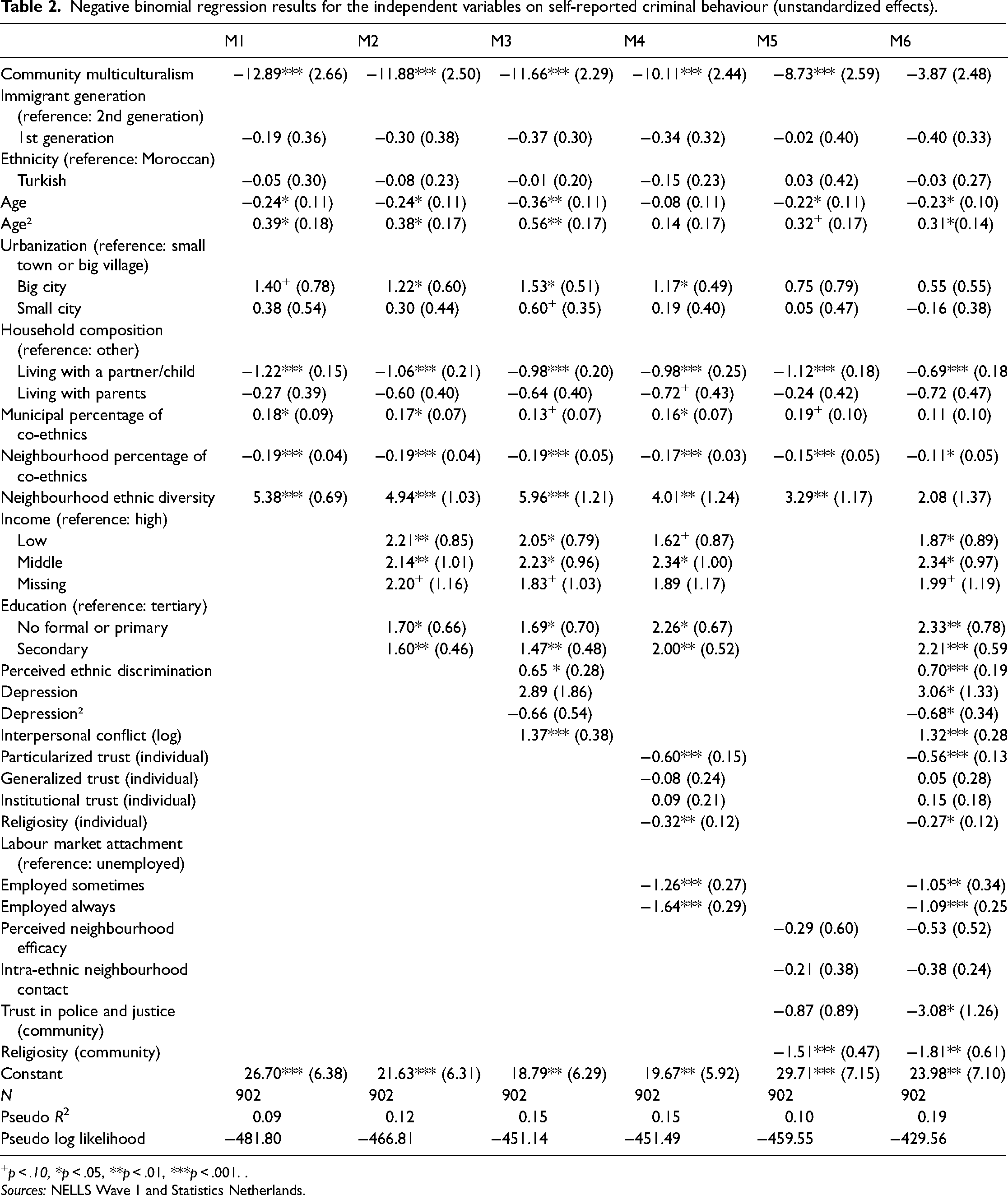
+p < .10, *p < .05, **p < .01, ***p < .001. .
Sources: NELLS Wave 1 and Statistics Netherlands.
SES indicators are added in M2, giving a more conservative estimate. The CM coefficient then goes down from −12.89 to −11.88 (p < .001). Here, two standard deviations in CM are associated with 0.38 fewer self-reported crimes per respondent. We thus accept H1: CM is associated with significantly lower immigrant crime levels. It turns out that the decrease in CM's coefficient from M1 to M2 is statistically insignificant (χ2 = 0.96; p = .33), suggesting that favourable status attainment is not the main explanation of the lower crime incidence under CM.
M3 adds the more direct strain indicators interpersonal conflict, depression, and perceived ethnic discrimination, which cause the CM coefficient to go down slightly to −11.66. If we conservatively assume that only the difference in the CM coefficient between M2 and M3 is related to CM-reducing criminogenic strains, the measured effects of strain reduction are 2% ((−11.88 − −11.66/−11.88) × 100), which is not statistically significant (p = .76). Perceived discrimination is somewhat less common under CM – the correlation between CM and perceived discrimination is −0.08 (p < .05) – but does not explain lower offending under CM.
If we assume that the difference in CM's coefficient in M1 and M2 is fully due to CM facilitating SES, which seems unlikely, then strain reduction explains about 9.5% of its effect on crime ((−12.89 − −11.66/−12.89) × 100). However, the reduction from −12.89 in M1 to −11.66 in M3 is still not statistically significant (p = .24). We therefore do not accept H2.
M4 adds the individual-level social bonds indicators to M2, leading the CM coefficient to go down from −11.88 to −10.11, a significant decrease of 14.9% (p < .01). We thus accept H3: the negative association between CM and crime is partly explained by individual-level social bonds. Additional analyses (not shown) indicate that particularized trust, religiousness, and labour market attachment contribute to the decrease, while generalized and institutional trust do not (institutional trust is positively associated with CM but does not independently predict immigrant crime).
M5 adds the collective efficacy indicators, leading CM's coefficient to significantly decrease by 27% (p < .01) from −11.88 to −8.73 (p < .01), leading us to accept H4. Community religiosity, community trust in the police and perceived neighbourhood efficacy contribute to the decrease (not shown). When testing all theories simultaneously in M6, CM's coefficient no longer significantly differs from zero (b = −3.87, p = .12).
Additional evidence for H1 comes from M7 and M8 (see Table 3): CM also is negatively associated with social deviance and criminal victimization, both correlates of offending that are less susceptible to underreporting. Here, two standard deviations in CM are associated with 0.5 fewer incidents of social deviance in the last month, and 0.3 fewer types of criminal victimization per respondent in the last year.
Negative binomial regression results for the independent variables on social deviance and criminal victimization (unstandardized effects).
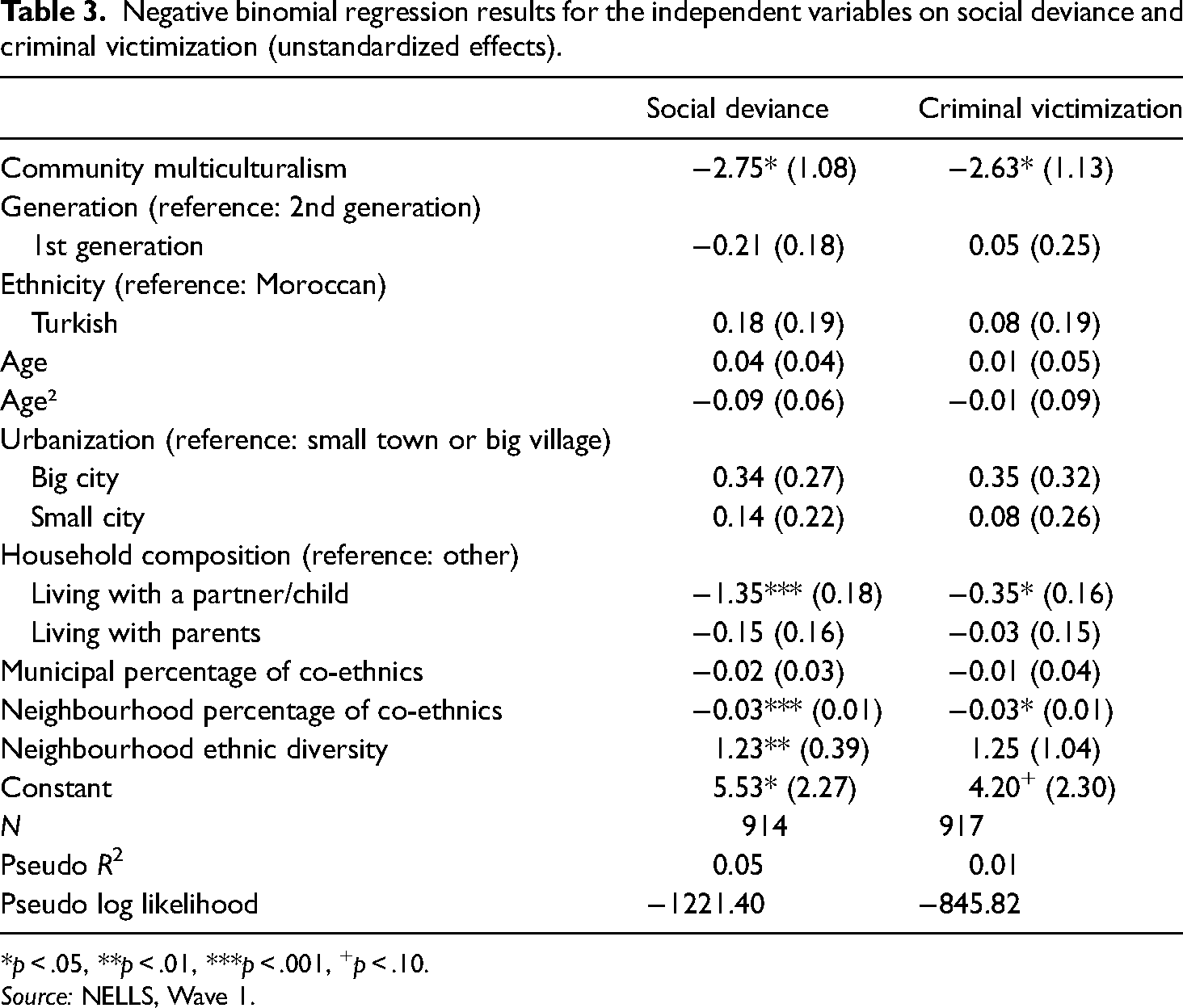
*p < .05, **p < .01, ***p < .001, +p < .10.
Source: NELLS, Wave 1.
Discussion
Contexts of reception codetermine immigrant incorporation patterns and related outcomes such as crime. Departing from Berry's acculturation theory, we conducted two interrelated research projects, which aim to (a) contribute to the discussion on the (dis)advantages of multiculturalism for immigrant incorporation and related outcomes, (b) help solve the puzzle of the contextual variation in immigrant crime through linking Berry's theory with relevant sociological-criminological theory, and (c) show the usefulness of going beyond the country-level and formal policy models when studying immigrants’ context of reception and its influences. An important reason to conduct two separate projects is that the available administrative and survey data have specific methodological limitations and strengths.
In the first project (Leerkes et al., 2023), we focused on registered offending using police data, employed two-stage regression techniques to control reverse causality, and conducted some indirect tests of the mechanisms via which CM was hypothesized to reduce immigrant crime. The second project, reported here, focused on self-reported measures of criminal behaviour and used survey data to conduct more direct tests of the assumed causal mechanisms and rule out the possibility that CM only affects law enforcement, and not criminal behaviour as such.
Both projects indicate that men with a Turkish or Moroccan migration background commit fewer crimes in municipalities where multicultural attitudes are relatively prevalent than in demographically similar municipalities where such attitudes are rarer. In the first study, two standard deviations in CM were found to be associated with between 2.3 and 8.5 fewer suspected crimes per 100 men of Turkish- or Moroccan-Dutch origin in the 12–65 age span; here, we find that two standard deviations in CM are associated with 60 fewer crimes per 100 men of Turkish- or Moroccan-Dutch origin in the 15–45 age span – or 38 fewer crimes when SES is controlled. Both projects indicate that CM's effects are stronger in strongly urban environments than in less urbanized municipalities. Furthermore, we find negative associations between CM and social deviance, and between CM and criminal victimization.
Because of data limitations it is more difficult to explain these associations. Dutch administrative data are quite rich, yet obviously lack individual-level information on criminogenic strains and social bonds. The NELLS is a sociological treasure but has not been specifically designed to understand the CM–crime relationship. Ideally, we would have liked to have had access to more direct measurements of assumed causal mechanisms (e.g., depression is an indirect measure of criminogenic strains and only pertains to depression in the last week, while the measure on criminal offending is on the last year; various crime-inhibiting social bonds could also have been measured more directly).
Despite these methodological challenges, we found indirect (project 1) and more direct (project 2) evidence that CM reduces crime among men with a Turkish or Moroccan migration background (a) by strengthening their social bonds, including their intra-ethnic bonds, and (b) by promoting the immigrant group's involvement in local-level collective efficacy. There is insufficient evidence that CM diminishes crime by decreasing strains, at least not via perceived discrimination, interpersonal conflicts and depression. In both projects, we furthermore find that CM's effects on crime hardly decrease after controlling SES (2% in project 1, about 8% in project 2).
All in all, the combined findings suggest that community multiculturalism reduces immigrant crime, especially among foreign-born in big cities where the size of the immigrant group has reached a certain threshold, and that CM mostly produces these outcomes by promoting social control at both the individual and community level, including in the immigrant group itself.
One might argue that the statistical associations between CM and immigrant crime measures indicate reverse causality, wherein immigrant crime decreases CM rather than the converse. Although a controlled randomized experiment was obviously not conducted, the available evidence does suggest that CM reduces immigrant crime. First, when different indicators and/or known correlates of criminal behaviour are empirically examined, we consistently find patterns that are, for the most part, in line with plausible theoretical expectations. Second, in the first project two-stage regression techniques were used that help to control reverse causality, and the effects were still found. Third, the literature shows that contextual variation in immigration attitudes is relatively constant over time and seems unlikely to respond strongly to immigrant crime levels (Hiers et al., 2017; Van de Vijver et al., 2008). Fourth, it seems unlikely that other local contextual factors caused local-level immigrant crime variation: we find the effect when contextual variations in urbanization and ethnic composition as well as individual-level demographic and socio-economic variables are controlled, and also do not observe similar patterns among native Dutch men (reported in project 1). Finally, the two selected immigrant groups arguably represent a quasi-experiment as the initial immigrants from Turkey and Morocco were distributed across Dutch municipalities in a quasi-random manner due to the Dutch labour recruitment practices. These communities had, for the most part, similar socio-economic starting positions and were entitled to the same rights under the Dutch national immigration and integration policies. We do of course admit that selective migration can never be completely ruled out, and that groups with a more privileged background and/or higher levels of social and institutional trust or religiosity may somehow have been overrepresented among those who settled in multiculturally oriented municipalities (on selective migration and crime also see Bovenkerk and Fokkema, 2015).
We do not assert that CM eliminates all immigrant crime or necessarily reduces all types of crime. When comparing the two projects, CM is more strongly associated with self-reported offending than with registered crime, which may indicate that CM primarily reduces relatively common and ‘lighter’ forms of crime that surveys like the NELLS measure. Possibly, CM has a different effect on ‘organized’ crimes that require higher levels of trust and better inter- and intra-ethnic relations, and are underrepresented in police and survey data.
Future research could investigate in greater detail the relationship between CM and other relevant outcomes (e.g., perceived discrimination, religiousness, well-being, trust, neighbourhood contacts). Criminologists may want to delve deeper into the observed effects of CM on criminal victimization and learn more about migration and criminal victimization, which is an underdeveloped field of inquiry (cf. McDonald and Erez, 2007). Furthermore, we could examine whether local or national differences in CM are associated with contextual differences in ethnic selectivity in the criminal justice system (e.g., whether it influences whether residents report suspected immigrant crime to the police or affects stereotyping among criminal justice professionals). Finally, researchers could examine whether CM is associated with better outcomes in the population at large when levels of ethno-cultural diversity reach a certain threshold. Arguably, migration-related diversity puts pressure on social cohesion, especially at the local level (cf. Glas et al., 2021; Van der Meer and Tolsma, 2014), but the present analysis suggests that such effects partially depend on how we all deal with that diversity.
Footnotes
Acknowledgements
We would like to thank two anonymous reviewers, who have helped us considerably in improving the manuscript. We are also grateful to the NELLS researchers for making such valuable data available to the research community. During the redrafting of the manuscript, the first author received support from the Dutch Research Council (NWO), grant NWA.1518.22.060.
Funding
The author(s) disclosed receipt of the following financial support for the research, authorship, and/or publication of this article. This work was supported by NWO (grant number NWA.1518.22.060).

Notes
Appendix
Distribution of the dependent variable.
| Number of self-reported crimes | N | Percent | Cumulative |
|---|---|---|---|
| 0 | 802 | 88.91 | 88.91 |
| 1 | 41 | 4.55 | 93.46 |
| 2 | 15 | 1.66 | 95.12 |
| 2.5 | 5 | 0.55 | 95.68 |
| 3 | 1 | 0.11 | 95.79 |
| 3.5 | 9 | 1.00 | 96.78 |
| 4 | 2 | 0.22 | 97.01 |
| 4.5 | 4 | 0.44 | 97.45 |
| 5 | 2 | 0.22 | 97.67 |
| 5.5 | 1 | 0.11 | 97.78 |
| 6 | 1 | 0.11 | 97.89 |
| 6.5 | 6 | 0.67 | 98.56 |
| 7 | 1 | 0.11 | 98.67 |
| 7.5 | 2 | 0.22 | 98.89 |
| 8 | 5 | 0.55 | 99.45 |
| 11 | 1 | 0.11 | 99.56 |
| 12.5 | 3 | 0.33 | 99.89 |
| 14 | 1 | 0.11 | 100.00 |
| Total | 902 | 100.00 |