



Abstract
There is considerable international and local-level variation in immigrant crime. In this article, we propose a theoretical model to better understand that contextual variation. Furthermore, we present the results of our first attempts to empirically assess the validity of the framework, focussing on local-level variation in crime among residents of Turkish or Moroccan origin in the Netherlands. The proposed model connects Berry's acculturation theory to criminological theories, using relevant findings from the immigration acculturation literature as starting points. It theorises that host societies with a ‘multicultural acculturation orientation’ tend to reduce immigrant crime by fostering informal social control and attenuating criminogenic strains. The empirical analyses explore whether local-level variation in multicultural attitudes among the native-Dutch indeed predicts municipal variation in the number of registered suspected crimes among first- and second-generation immigrants, focussing on men of Turkish or Moroccan origin residing in 35 Dutch cities. The empirical analyses are based on a unique database that combines aggregated survey data, which were used to measure natives’ acculturation attitudes, with administrative microdata, including micro-level police data. Evidence is found for a protective effect of local-level multiculturalism for first-generation immigrant crime in particular, especially for immigrant men living in larger local immigrant communities. We also find stronger effects for the more cohesive and societally accepted Turkish-Dutch group than for the more fragmented and excluded Moroccan-Dutch.
Keywords
There are international and local-level differences in the degree to which the foreign-born (‘first-generation immigrants’) and their direct native-born descendants (conventionally labelled ‘second-generation immigrants’) are represented in crime statistics relative to the population with two native-born parents (hereafter: ‘native population’). While first- and second-generation immigrants tend to be overrepresented among suspected and convicted offenders in Europe, they are not, or less, overrepresented in traditional immigration countries, including the US, Canada and Australia (Bersani, 2014; Blom and Jennissen, 2014; Bucerius and Tonry, 2014). Some studies have similarly documented local-level variation in registered immigrant crime (De Boom et al., 2013; Piopiunik and Ruhose, 2017; Van San and Leerkes, 2001). In the Netherlands, for example, the overrepresentation of Moroccan-origin residents among crime suspects differs between municipalities from 1.3 to 4.2 (De Boom et al., 2013). For reasons of brevity, we will call criminalised behaviour among first- and second-generation immigrants ‘immigrant crime’, while fully acknowledging that second-generation immigrants never migrated. 1 We use the term ‘population with a migration background’ when referring to both generations combined.
The aim of this paper is to better understand how the ‘context of reception’ (Portes and Rumbaut, 2006) – that is the economic, legal and social conditions in the destination country that structure newcomers’ life chances and incorporation trajectories – influences immigrant crime. More specifically, we consider how ethnic majority preferences regarding immigration and ethno-cultural diversity – or what Berry (2011) calls the ‘acculturation orientation of the dominant group’ – co-determines the prevalence of criminal behaviour among residents with a migration background. In so doing, we highlight multiculturalism, an acculturation orientation that is characterised by a relatively strong tolerance for ethno-cultural differences, combined with a relatively high willingness to allow immigrants’ societal participation on an equal basis.
The article aims to help answer the puzzle of contextual variation in immigrant crime, while also seeking to contribute to the broader academic body of literature examining the (dis)advantages of multiculturalism for immigrant incorporation and related outcomes, including perceived discrimination, trust, and labour market positioning (cf. Bloemraad and Wright, 2014). Both Lynch and Simon (1999) and Koopmans (2010) have speculated about the causes of international differences in the prevalence of immigrant crime. Lynch and Simon argue that immigrants are more likely to be perceived as ‘criminal’ in relatively exclusionary countries (in their analysis: the European countries and Japan) than in the traditional immigration countries (United States, Canada, Australia) and speculate that such labelling fosters crime via self-fulfilling prophecies. The authors do not explicitly discuss multiculturalism, but show that crime levels are especially low in multiculturally oriented countries. 2 Koopmans compared immigrant to native incarceration rates of eight European countries, and reports that the Netherlands and Sweden, both known for their multiculturalism during the period covered, had relatively high rates. 3 While Koopmans does not elaborate on criminological theory, he speculates that multiculturalism promotes immigrant crime in generous welfare states by allegedly putting less pressure on immigrants’ language acquisition, thus slowing their socioeconomic attainment.
The article consists of two parts. First, we tentatively theorise how the acculturation orientation of the dominant group influences criminal behaviour among residents with a migration background in our view, and why we expect multiculturalism to decrease criminal behaviour among residents with a migration background. In line with Lynch and Simon's approach, we propose that multiculturalism reduces criminal behaviour among first- and second-generation immigrants by fostering informal social control, while also diminishing relevant criminogenic strains, such as perceived discrimination. While Lynch and Simon use labelling theory, our perspective is inspired by cumulative (dis)advantage theory (Grattet, 2011; Sampson and Laub, 1997), which argues that the way in which the wider society labels groups and individuals – here: whether there is a more inclusionary or exclusionary stance toward immigrants and migration-related diversity – triggers various processes in the social environment that co-determine levels of social control and perceived strain, and hence work to the (dis)advantage of those so labelled.
In the second part of the paper, we explore the usefulness of the proposed framework by examining how local-level variation in ‘everyday multiculturalism’ (cf. Wessendorf, 2013) in the Netherlands – hereafter: community multiculturalism (CM) – is associated with the prevalence of immigrant crime among the two largest ethnic minorities in the Netherlands: the Turkish- and Moroccan-Dutch. The empirical focus is thus on local-level attitudes rather than national policies. While scholars typically assume national homogeneity in the acculturation orientation of ‘the’ dominant group (e.g. Canadian multiculturalism vs. French republicanism) (cf. Bloemraad and Wright, 2014), there also is considerable local-level variation in natives’ acculturation preferences (also see Bean et al., 2012; Glick Schiller and Çağlar, 2009; Martínez-Ariño et al., 2019). Local-level preferences, and local-level integration policies, are relatively independent from national policies (cf. Joppke, 2017; Van de Vijver et al., 2008). The analyses are guided by the following question: Are Turkish-Dutch and Moroccan-Dutch male immigrants and/or their sons suspected of fewer crimes in municipalities where the acculturation orientation of residents of Dutch origin tends toward multiculturalism and, if so, is there any indications that such effects are related to local-level differences in the men's exposure to informal social control and relevant strains?
The empirical focus on the local level has an important methodological advantage: hypotheses on the effects of immigrants’ context of reception are hard to test when comparing countries, as countries have rather different immigrant populations (e.g. Latinos in the United States, Algerians in France), while their immigration laws and criminal justice systems also differ considerably; such confounders are easier to eliminate when looking at subnational variation among the same groups.
The empirical analyses are based on a unique combination of micro-level administrative data from Statistics Netherlands (SN), which include police data, and aggregated sociological survey data from the Netherlands Longitudinal Lifecourse Study (NELLS), a large survey conducted between 2008 and 2010 on the living situation and attitudes of the Dutch population, which became publicly available in 2013 (De Graaf et al., 2010). The survey was conducted in the four largest cities and 31 other representative Dutch municipalities, and is representative of the general population, as well as the Turkish- and Moroccan-Dutch.
The motivation for the empirical focus on Turkish- and Moroccan-Dutch men is explained in the section ‘Data and methodology’. In the next section, we first theorise why we expect immigrant crime to be relatively low in social contexts where the acculturation orientation of the dominant group tends towards multiculturalism.
Theory and hypotheses
Multiculturalism and integration
According to Berry's (2011, 2017) acculturation theory, immigrant and the ethnic majority or ‘dominant group’ face two basic issues: whether or not to maintain the heritage culture and group identity, and whether or not to seek interethnic contact and equitable societal participation, implying four ideal-typical acculturation orientations. A dominant group has a multiculturalist acculturation orientation when it is relatively tolerant toward ethno-cultural differences, while allowing interethnic contact and equal participation. Assimilationism (or ‘melting pot’) is a preference by the dominant group to allow interethnic contact and equal participation, provided that immigrant abandon their heritage culture. A tolerant dominant group shunning interethnic contact prefers segregationism; an intolerant dominant group avoiding interethnic contact tends to exclusionism. 4
Berry distinguishes four corresponding immigrant acculturation varieties, and contends that the dominant group's orientation co-determines their relative prevalence. Multiculturalism is assumed to facilitate integration, meaning that immigrant maintain heritage cultures to a notable degree while interacting with the dominant group on an equitable basis, such as by participating in common institutions (e.g. education, labour markets, housing markets, nationality) on an equal footing. Assimilationism is assumed to promote assimilation: immigrant abandon heritage cultures and merge with the dominant group. Segregationism promotes separation: immigrant maintain heritage cultures while developing limited interethnic ties. Exclusionism fosters marginalisation: immigrant lack interethnic contact and give heritage cultures, resulting in immigrant groups that are both excluded from the mainstream and unorganised intra-ethnically.
While immigrants’ acculturation outcomes are known to be bi-dimensional, there is some evidence that the dominant group's preferences – especially when it concerns attitudes rather than formal policies – actually tend toward one-dimensionality. Attitudinal variation mostly seems to run ‘diagonally’ in Berry's two-dimensional space, namely from exclusionism to multiculturalism. As Bourhis (2017: 7) puts it: “[M]ajority group members who endorsed the assimilationist, segregationist, and exclusionist orientations shared in common the rejection of minorities while wishing to avoid them as colleagues at work, as neighbours, or as best friends”. We indeed found that municipal variation regarding the dominant group's acculturation preferences mostly runs from exclusionism to multiculturalism (see next section), which suggests that CM should perhaps be called ‘community inclusionism’ (also see Bean et al., 2012). We nonetheless stick to Berry's terminology, as future research may identify the other acculturation orientation elsewhere. In what follows, we simplify the discussion somewhat by mostly contrasting the theoretically expected outcomes under multiculturalism to the expected outcomes under exclusionism. 5 The discussion is also focussed on relatively unorganised types of crime that are likely to catch the public eye, and predominate in police data and crime surveys (cf. Newburn, 2003).
Multiculturalism, integration and crime
Lynch and Simon (1999) report suggestive evidence that international variation in immigrant imprisonment rates increases with the degree to which residents of the host society perceive immigrant as criminal. They interpret the association using labelling theory, which argues that people are more likely to commit crimes after society has labelled them as ‘criminal’ since they begin to identify as such. Here, we propose an alternative theoretical elaboration that is inspired by cumulative disadvantage theory (Sampson and Laub, 1997), a theory that combines insights from labelling theory and other sociological/criminological theories, especially social control theory. Contrary to labelling theory, cumulative (dis)advantage theory does not make the problematic assumption that those labelled as criminal necessary internalise the label (cf. Grattet, 2011). Instead, it argues that the social environment tends to respond differently to those labelled as criminal, usually in ways that make additional offending more likely, such as by weakening ties to conventional institutions, thus amplifying the initial disadvantage of the negative label over time.
We similarly argue that the host society's view of immigrant and migration-related diversity – arguably a form of ‘labelling’ – changes the ways in which the host society responds to migration and diversity, which may trigger various mechanisms that co-determine immigrant crime. In our view, theories on informal social control are essential theoretical ingredients when understanding these indirect paths between CM and crime, as there are various indications that CM fosters immigrants’ social bonds, and promotes both inter- and intra-ethnic collective efficacy, especially in contexts where many residents have a migration background. We also propose to use general strain theory, given the evidence that multiculturalism attenuates relevant strains by increasing migrants’ opportunities to obtain bicultural ‘integration’, which is generally the preferred acculturation outcome among first-generation immigrants in particular (cf. Berry, 2011, 2017; Van de Vijver et al., 1999), and by decreasing perceived discrimination (cf. Bloemraad and Wright, 2014). Although we recognise that these criminological theories stem from different sociological schools of thought, we see no inherent contradictions between them.
Figure 1 summarises why we expect that multiculturalism, focussing on local-level CM, is associated with lower levels of crime in comparison with exclusionism. First, by promoting individual-level integration of residents of immigrant origin to both the wider society and the immigrant group, CM will (i) strengthen migrants’ individual-level social bonds and (ii) reduce strains that may motivate such residents to commit crimes (the individual-level paths in the figure). Second, we contend that CM has emergent properties at the supra-individual level by facilitating both intra- and interethnic aspects of collective efficacy in migration receiving contexts, which will further reduce crime among residents of immigrant origin, including among those with weaker social bonds and/or who experience considerable strains (the community-level paths in the figure). The three paths thus impact immigrant crime because of two main causal mechanisms, namely (1) social control, which controls given criminal inclinations (both social bonds theory and collective efficacy theory do not really explain ‘criminal motive’) and (2) strain attenuation, which gives people fewer reasons to develop certain criminal motives. In what follows, we elaborate on the figure, and formulate five hypotheses that could be tested with the administrative data.
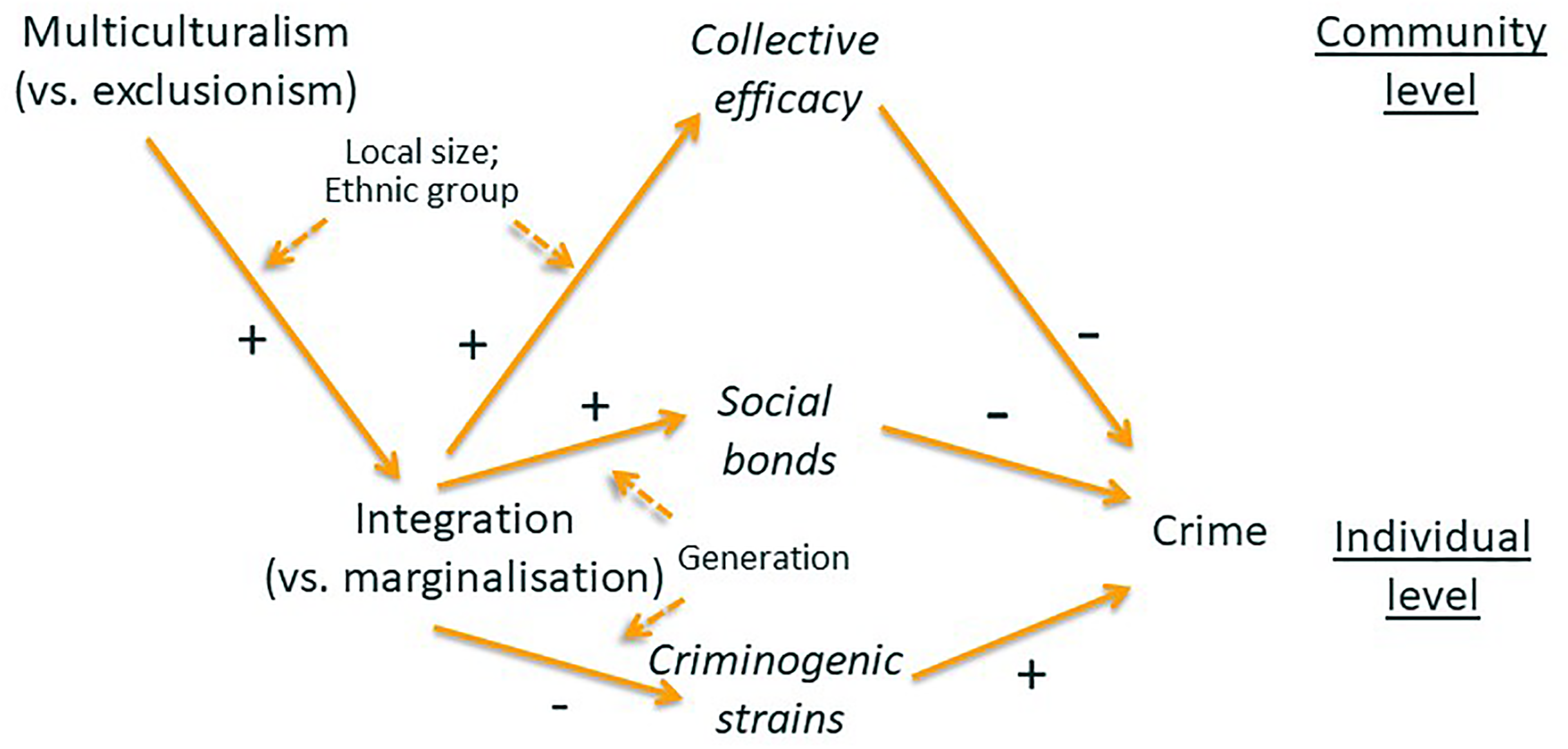
Theorised paths from community multiculturalism to immigrant crime.
Hirschi’s (1969) social bonding theory argues that social bonds have the effect of restraining individuals from committing crimes: strong attachments to family, neighbours and institutions (‘attachment’), a strong dedication to conventional norms and values (‘commitment’), a strong participation in conventional activities (‘involvement’), and/or a strong belief in conventional norms (‘belief’) are assumed to represent forms of informal social control that reduce a person's inclination to commit crimes.
By allowing immigrants to develop ties to both the receiving society and the immigrant group's culture and institutions, CM will facilitate such social bonds. Bloemraad and Wright (2014) indeed find that immigrants have higher levels of social and institutional trust in countries with a strong multicultural orientation. CM is also likely to informally control criminal behaviour ‘intra-ethnically’, by fostering immigrants’ bonds to institutions that are specific to the heritage culture, such as religious institutions: in Berry's acculturation theory, CM facilitates the maintenance of the heritage culture without fearing repercussions, also in relation to religion. 6 Immigrant who score high on integration, as defined by Berry, also have better intra- and interethnic contacts (Berry, 2011, 2017).
Based on Merton's classical anomie theory, general strain theory (Agnew, 2016) argues that stressors and negative emotions may motivate people to commit crimes. Three main types of strain exist: the inability to achieve valued goals, the loss of a positively valued stimuli, and the presentation of negative stimuli. A low socioeconomic status (SES) may represent a strain that may motivate immigrant to commit crimes, especially when immigrant expect upward social mobility. Another example of a relevant criminogenic strain is perceived ethnic discrimination (Leerkes et al., 2019; Simons et al., 2003). Bloemraad and Wright (2014) report that (first-generation) immigrants perceive less discrimination in countries with a strong multicultural orientation. There is more disagreement in the literature on how multiculturalism affects SES. As was mentioned in the introduction, Koopmans (2010) contends that multiculturalist policies slow down immigrants’ social positioning, but Bloemraad and Wright (2014) find no evidence for worse socio economic outcomes under multiculturalism. A study comparing European cities indicates that inclusive local-level attitudes are associated with better socioeconomic outcomes for immigrant (Bean et al., 2012). 7
Turning to community-level paths in Figure 1, we assume that individual-level integration, fostered by CM, may has emergent supra-individual effects, especially when local-level ethnic diversity and the size of the immigrant group reach certain thresholds. Collective efficacy theory (Sampson, 2012) argues that communities may reduce crime by exerting external social control. Residents in cohesive and well-organised communities may successfully address shared problems including crime. We theorise that such community characteristics are relatively likely in immigration receiving contexts under CM, because of higher levels of social and institution trust and stronger intra- and interethnic ties. Although increases in ethnic diversity may put pressure on local-level collective efficacy (cf. Van der Meer and Tolsma, 2014), and may increase urban crime (Leerkes and Bernasco, 2010; Wikström et al., 2012), the literature on immigrant acculturation suggests that multiculturalism attenuates these effects to some extent, especially by promoting the involvement of people with a migration background in local-level collective efficacy (see e.g. Favell (1998) and Wessendorf (2013) on multiculturalism and social cohesion in multi-ethnic societies). Higher levels of institutional trust and lower levels of perceived discrimination should also promote minorities’ willingness to partner with local police, which further strengthens informal (and formal) social control.
First-generation immigrant in particular often have more intra-ethnic than interethnic social contacts (see Huijnk and Andriessen (2016) for data on the Turkish- and Moroccan-Dutch). Therefore, we should not underestimate the importance of ‘intra-ethnic’ efficacy for controlling immigrant crime. As Waters (1999: 99) writes: “Solutions to the problem of youthful crime have long focused on the amount of control a particular community exercises over its young males. […] That such programs can contribute to controlling youthful crime is not really doubted. However, it is also recognized that in a broad sense, organisations that are able to provide such control [such as athletic leagues, schools, and churches] are often specific to the ethnic groups concerned [italics added], and are outgrowths of local collective life”.
Our main hypothesis follows from the discussion in the above. We hypothesise:
Additional hypotheses
As informal social control and criminogenic strains are not directly measurable using administrative data, we were unable to conduct direct tests of the assumed theoretical mechanisms (such tests were conducted when analysing self-reported offending (Leerkes et al., 2020)). We nonetheless examined whether there is suggestive, indirect evidence for the proposed mechanisms. This was done by formulating and testing three additional, tentative hypotheses, which are briefly discussed in what follows.
Local size of the immigrant group
If the effects of CM are partially mediated by intra-ethnic aspects of collective efficacy, then CM should have stronger effects in municipalities where the ethnic community is relatively large than in municipalities where it is small: the heightened opportunities to organise ‘ethnic’ institutions under CM may only be realised if the immigrant group reaches a ‘critical mass’ in terms of population size (cf. Bevelander and Pendakur, 2012; Fischer, 1975). A larger local size of the immigrant group also makes immigrants’ trust, including its trust in the police, more decisive for local collective efficacy.
Ethnic group cohesiveness and acceptance
The degree to which CM actually promotes social bonds, reduces strains, and facilitates intra- and interethnic aspects of collective efficacy, may differ per immigrant group; not all immigrant groups have the same ‘integration potential’ in a given context. In the present case, the crime suppressing effects may be more pronounced for the Turkish-Dutch than for the Moroccan-Dutch as the former immigrant group is known to be more willing and able to organise itself (Engbersen et al., 2006; Fennema and Tillie, 1999), experiences less discrimination (Andriessen et al., 2014), and has more social capital, including more combined intra- and interethnic social contacts (Huijnk and Andriessen, 2016; Van Tubergen and Völker, 2015).
Generation
If CM's assumed effects are partially rooted in its tolerance for the maintenance of the heritage culture, then its effects should decrease with generation. 8 Because of well-documented generational increases in assimilation (cf. Heath and Schneider, 2021), the advantages of being able to partially maintain the heritage culture are likely to decrease in later immigrant generations. Van de Vijver et al. (1999) indeed report that second-generation children prefer integration less than first-generation children do, and increasingly prefer assimilation. Such a reduction in the preference for integration suggests that being able to be ‘integrated’ in Berry's sense – that is, by maintaining a significant part of the heritage culture – is associated with less strain reduction in the second generation than in the first. Additionally, Bloemraad and Wright (2014) report that multiculturalism, which is associated with higher levels of trust (and perceived discrimination) among first-generation immigrants, does no longer have such effects in the second generation. The paths going from CM to social bonds thus also seem to be weaker for later generations.
The foregoing discussion implies the following tentative hypotheses:
Data and methodology
Data
We added aggregated information from Wave 1 of the NELLS survey as a municipal-level variable to the Social Statistical dataBases (SSB) of SN. The NELLS, which was used to measure the local-level acculturation orientation among the native-Dutch, is a nationally representative sociological survey (N = 5312) conducted in the four largest cities and 31 other, randomly selected, municipalities on the attitudes and living situation of the Dutch population in the 15–44 age span (De Graaf et al., 2010). The SSB contains individual-level police information on all registered inhabitants, as well as comprehensive demographic and socioeconomic data.
Empirical scope
The explorative empirical analyses focussed on men who, according to government registrations, resided in the 35 NELLS municipalities on September 30th 2009, who had a Turkish or Moroccan background, and who were between 12 and 65 years old at the time (N = 89,300 for the first generation, and N = 52,085 for the second generation). These 35 municipalities contain about half of the people with a Turkish or Moroccan background.
The empirical focus on these two immigrant groups has three main reasons. Firstly, the native-Dutch NELLS respondents were specifically asked about their attitudes with regards to residents of Turkish and Moroccan origin, not other immigrant groups. 9 Secondly, all respondents, including those of Turkish or Moroccan origin, provided information about their (petty) criminal offending, and operationalisations of relevant causal mechanisms (e.g. perceived discrimination, neighbourhood contacts, trust, religiousness). In a follow-up study, we could therefore also analyse the relationship between CM and self-reported offending, and conduct additional, more direct tests of the analytical framework that is described in the previous section (Leerkes et al., 2020). Such data triangulation is, in our view, crucial to obtain robust conclusions, as police data and self-reported offending are both imperfect measures of criminal behaviour. 10 Thirdly, these two immigrant groups have various properties that make them particularly well-suited to explore the effects of CM. Most residents with a Moroccan or Turkish background are descendants or other relatives of the ‘guest workers’ who immigrated to the Netherlands and other Western-European countries during the 1960s and early 1970s (Lucassen and Penninx, 1997). Due to the recruitment practises, the initial labour immigrant, who had similar socioeconomic backgrounds and starting positions, were scattered in a quasi-experimental manner across a large number of different municipalities, from where they initiated family reunification and formation (cf. Leerkes and Kulu-Glasgow, 2011). These municipalities include semi-urban and more rural contexts where other immigrant groups (e.g. postcolonial immigrant) are typically absent. There also is considerable local variation in the size of both immigrant groups: in some municipalities there are few residents of Turkish or Moroccan origin, in other municipalities there are much larger communities and a considerable ‘ethnic infrastructure’. Both groups also have a substantial adult second generation. Finally, the two groups are interesting comparative cases as the Turkish-Dutch are generally considered more internally cohesive and integrated with the ethnic majority than the more fragmented and excluded Moroccan-Dutch (cf. Fennema and Tillie, 1999).
We focus on men as men commit most crimes: for example, in 2010, the incidence density of registered offending was about eight times higher among Turkish- and Moroccan-Dutch men than among Turkish- and Moroccan-Dutch women (0.110 against 0.014). The 12–64 age span was chosen because the lion's share of populations’ registered crime involvement occurs then, while criminal behaviour is only punishable from the age of 12.
Measurements
Crime. The dependent variable is the number of crimes an inhabitant was suspected of having committed in 2009. The data pertain to felonies (in Dutch: misdrijven); common misdemeanours, such as traffic misdemeanours, are excluded. SN periodically removes suspects acquitted of a charge, or whose charges have been dismissed due to unlawfully acquired evidence. There are eight SSB crime categories: property crimes with and without violence, traffic crimes, drug crimes, vandalism, sexual crimes, (other) violence against persons, and other crimes. Due to space constraints, we only present models predicting the total number of criminal antecedents in 2009, regardless of type of crime. However, we conducted explorative analysis for the eight types of crimes separately, and briefly summarise the results in the section ‘additional analyses’.
Community multiculturalism
The local-level acculturation orientation of the dominant group, the central independent variable of interest, was measured using Wave 1 of the NELLS. We had extensive discussions on Berry's concept of the ‘dominant group’, which has become less self-evident given considerable levels of ethnic diversity under ‘superdiversity’ (cf. Vertovec, 2007). We operationalised it by only using the attitudes of respondents with two Netherlands-born parents. Even in the ‘minority-majority cities’ (Amsterdam, Rotterdam and The Hague), the ‘native-Dutch’ are still by far the largest and most well-established group. CM was measured by combining measures of tolerance and social distance in the NELLS.
Four items measured tolerance: It would better for our country if (a) all inhabitants had the same customs and traditions; (b) different religious beliefs exist, (c) all inhabitants spoke the same language; and (d) immigration to our country has to stop to reduce tensions. Six items measured perceived social distance to residents with a Turkish or Moroccan background respectively: I have a problem with someone of Turkish/Moroccan origin (a) becoming my boss, (b) moving next door, (c) marrying my son/daughter.
Respondents could answer the tolerance items on 1–5 Likert scales from disagree strongly (1) to agree strongly (5), resulting (after inversely coding items a, c and d) in a scale with Cronbach's alpha = 0.66 (reliability could not be improved by dropping items). The social distance items were measured on 3-point scales (‘no problem at all’, ‘not a problem’, ‘would be a problem’), resulting in a scale with Cronbach's alpha = 0.93. We combined the scores for ‘Turks’ and ‘Moroccans’ because of their strong correlations. As expected, perceived distance to the former immigrant group was nonetheless somewhat lower than to the latter group (on average: 0.1).
The degree of tolerance correlates negatively and strongly with perceived social distance (r = −0.78), and principal component analysis (PCA) confirmed that the items measured a single latent variable. 11 We therefore calculated a single score on a 1–3 scale, which we called CM, by averaging the aggregated scores for tolerance, which we recoded to a 1–3 scale, and the inverted aggregated social distance scores. Figure 2 shows the correlation between community tolerance and distance. It highlights the four largest cities in the Netherlands, which are in the upper left quadrant of the figure. While CM is correlated with urbanisation, there are considerable differences between municipalities of similar size and similar ethnic diversity levels, for example, between Amsterdam and Rotterdam.
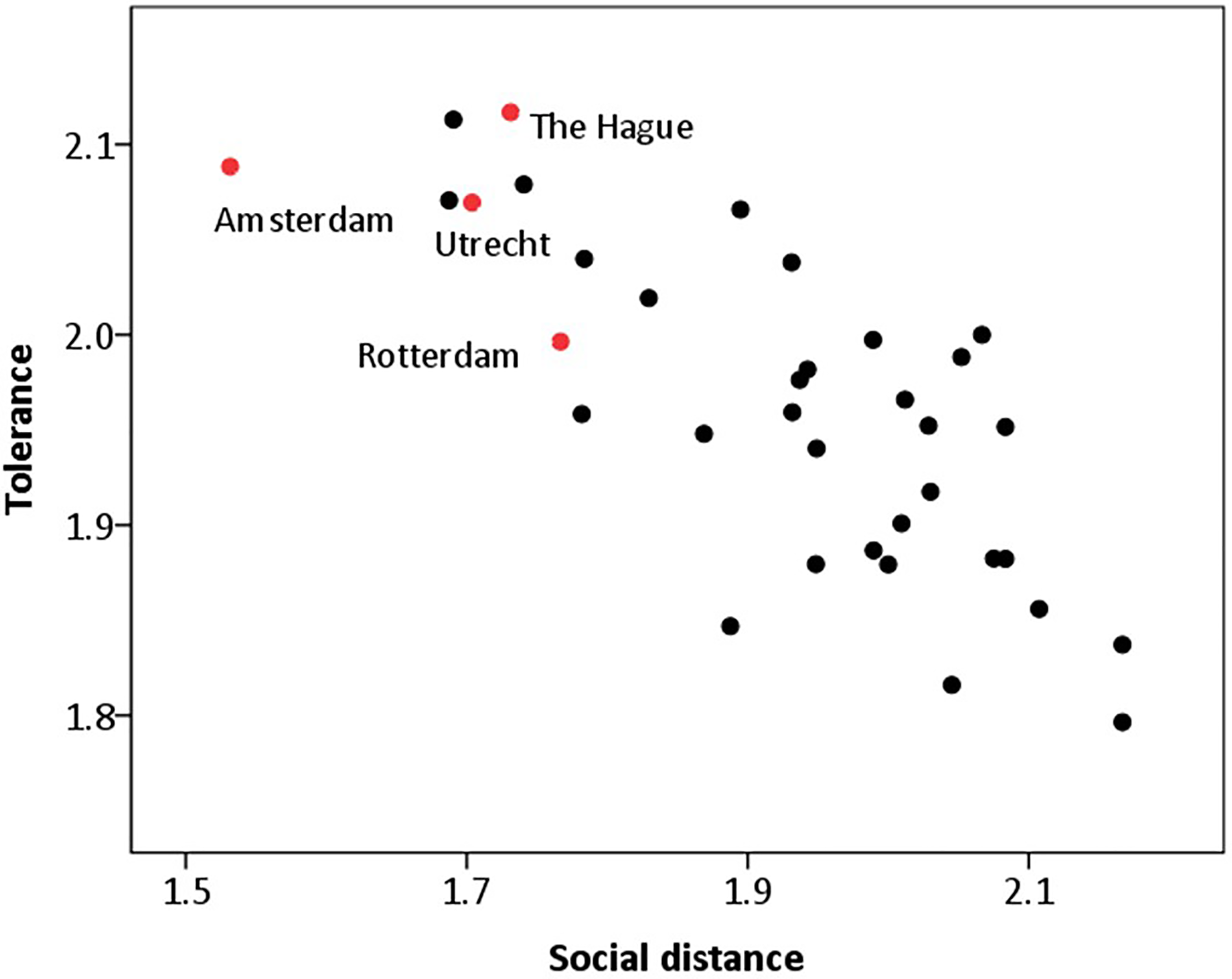
Tolerance and perceived social distance in the four largest cities and the other NELLS municipalities.
Apart from the four largest cities, the names of the NELLS municipalities may not be revealed. We can nonetheless show the clear regional variation in CM in Figure 3, which was made by extrapolating the scores for the 35 NELLS municipalities to the remaining municipalities, using administrative municipal-level data and election results (R2 = 0.83). 12 CM peaks in university towns and in the more internationally oriented West of the Netherlands (Randstad), and is lower in more regionally oriented areas, especially the province of Limburg in the South and the Dutch Bible Belt, running from the South-West to the North-East.
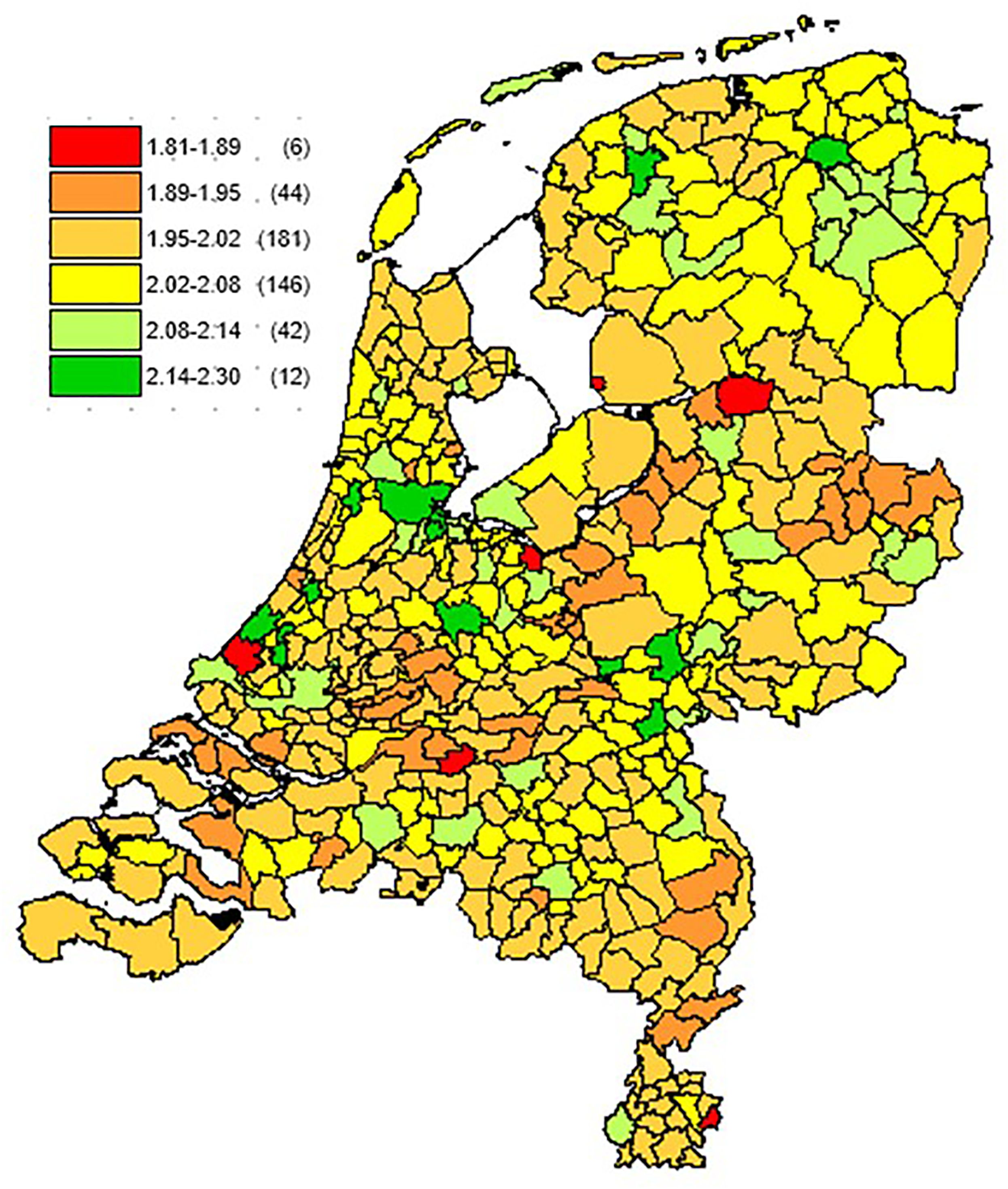
Estimated spatial distribution of community multiculturalism in the Netherlands divided into six categories.
We distinguish between first- and second-generation immigrants of Turkish and Moroccan origin, using SN definitions. It defines ‘migration background’ as having one or two foreign-born parents. The foreign-born who do not have two native-born parents have a first-generation migration background (being foreign-born with two native-born parents counts as having non-immigrant origin, according to SN). Native-born individuals with at least one foreign-born parent are second-generation immigrants. Migration background is subdivided into national origin according to the parents’ country of birth, which enabled us to establish whether a person was of Turkish or Moroccan (parental) descent. National origin is determined by a person's country of birth, but for second-generation immigrants the mother's country of birth is decisive, unless the mother's country of birth is the Netherlands, in which case SN uses the father's country of birth. Native-Dutch people have two Netherlands-born parents.
Evidently, categorisation in terms of (parental) country of birth does some harm to the diversity within each category, so defined. The Turkish-origin group, for example, also includes a minority of residents that self-identify as ‘Kurd’ rather than ‘Turk’, and a (small) minority of those that SN labels ‘second-generation immigrants with a Turkish or Moroccan background’ are actually children of interethnic couples, mostly couples that also include a ‘native-Dutch’ partner. We have tried to do some justice to such diversity by comparing two national origins, and by analysing the first and second generation separately.
Other variables
All other variables are from SSB, which includes individual-level data by the municipalities, the Tax Authority and several (semi-)governmental organisations on demographic characteristics, education.
In addition to country of origin and generation, we took the following variables in order to assess confounding and, in the case of SES, possible mediating effects: the municipality's level of urbanisation (4 categories, from ‘not very’ to ‘very high’), age, household situation (7 categories, based on household type and position in the household), the highest educational level followed in the Netherlands using the Dutch standard education classification (4 categories: ‘low’, ‘intermediary’, ‘high’ and ‘unknown’), the household's income (5 percentile categories and ‘unknown’) and the person's income source (‘employee’, ‘freelancer/entrepreneur’, ‘unemployment benefit receiver’, ‘student’, ‘other’). In order to consider possible moderating effects of the local co-ethnic community size, we counted the total number of first- and second-generation immigrants of Turkish origin (for ‘Turks’) and of Moroccan origin (for ‘Moroccans’), by municipality (men and women, all ages).
Analytical strategy
Multilevel negative binomial regression analysis was conducted, predicting the number of crimes a man with a Turkish or Moroccan background was suspected of having committed in 2010. As an additional control, some models were also run for native-Dutch men ages 12–64 (N = 956,862). Negative binomial regression was used because the dependent variable is highly skewed. Random intercepts multilevel analysis was used to address clustering of observations at the municipal level. We estimated models for the first and second generation separately.
In order to test Hypotheses 1, we controlled level of urbanisation, age (and its square and cube to take the effects of the classical and commonly accepted age-crime curve into account), and household situation in Model 1. SES indicators were added as additional controls in a separate model (Model 2), as SES may partially mediate the effect of CM on immigrant crime. The possible effects of municipal variation in economic opportunity were thus controlled at the individual level. We also ran model 1 and 2 for native-Dutch men.
Hypothesis 2 was tested by adding an interaction between CM and a dummy indicating whether there were less or more than 1200 co-ethnics in the municipality. We chose 1200 as the cut-off point because it splits the 35 NELLS municipalities where men of Turkish/Moroccan descent were residing into two more or less equal groups of 17 (>1200) and 18 (<1200) municipalities, while ‘ethnic’ institutions (e.g. mosques, sporting clubs, neighbourhood organisations) indeed seem easier to establish when the number of co-ethnics surpasses 1200. Hypothesis 3 and 4 were tested by examining whether the interactions between CM and national origin were significant, and by comparing results for the first and second generation.
The literature suggests that exclusionist attitudes are produced by perceived economic and cultural threat, not immigrant crime: the more people feel secure about their social status, the more they support multiculturalism (Berry, 2017). Contextual variation in immigration attitudes is also relatively constant over time (Hiers et al., 2017; Van de Vijver et al., 2008). The variation in Figure 3 indeed overlaps with broader, historically determined cultural variation.
There is nonetheless a possibility of ‘reverse causality’: if immigrant crime reduces CM, we would be overestimating the causal effects of CM on crime. We addressed these concerns by also conducting two-stage regression analysis: here, the local of CM was first predicted using two predictors (‘instruments’) that are known to be associated with immigration attitudes, yet are unlikely to be related to immigrant crime, namely the percentage of higher and lower educated in the municipality. In a second stage, the predicted level of CM was used as an independent variable, instead of the original NELLS scores. This methodology assumes that eventual endogenous effects (here: the effects of immigrant crime on CM) are filtered out from the independent variable (here: CM), as they should end up in the error term. The instrumentation was performed using the following equation (R2 = 63.8%): Y = 2.310 + −0.01402% lowly educated native-Dutch residents in the municipality + 0.00824% highly educated native-Dutch residents in the municipality. 13 Tests for overidentification showed that the predictors are sufficiently exogenous.
Table 1 shows the descriptives of the variables used in the regression analysis, by generation, and for native-Dutch men. Both immigrant groups are concentrated in larger cities. Their average household income and educational levels indicate that both groups are still socioeconomically disadvantaged compared to the native-Dutch group, but we also see generational assimilation: in the second generation, there is a larger percentage of men who have followed higher education, a higher percentage in the higher income percentile categories, and some suburbanisation is occurring, leading to settlement in municipalities with fewer co-ethnics.
Descriptive statistics.
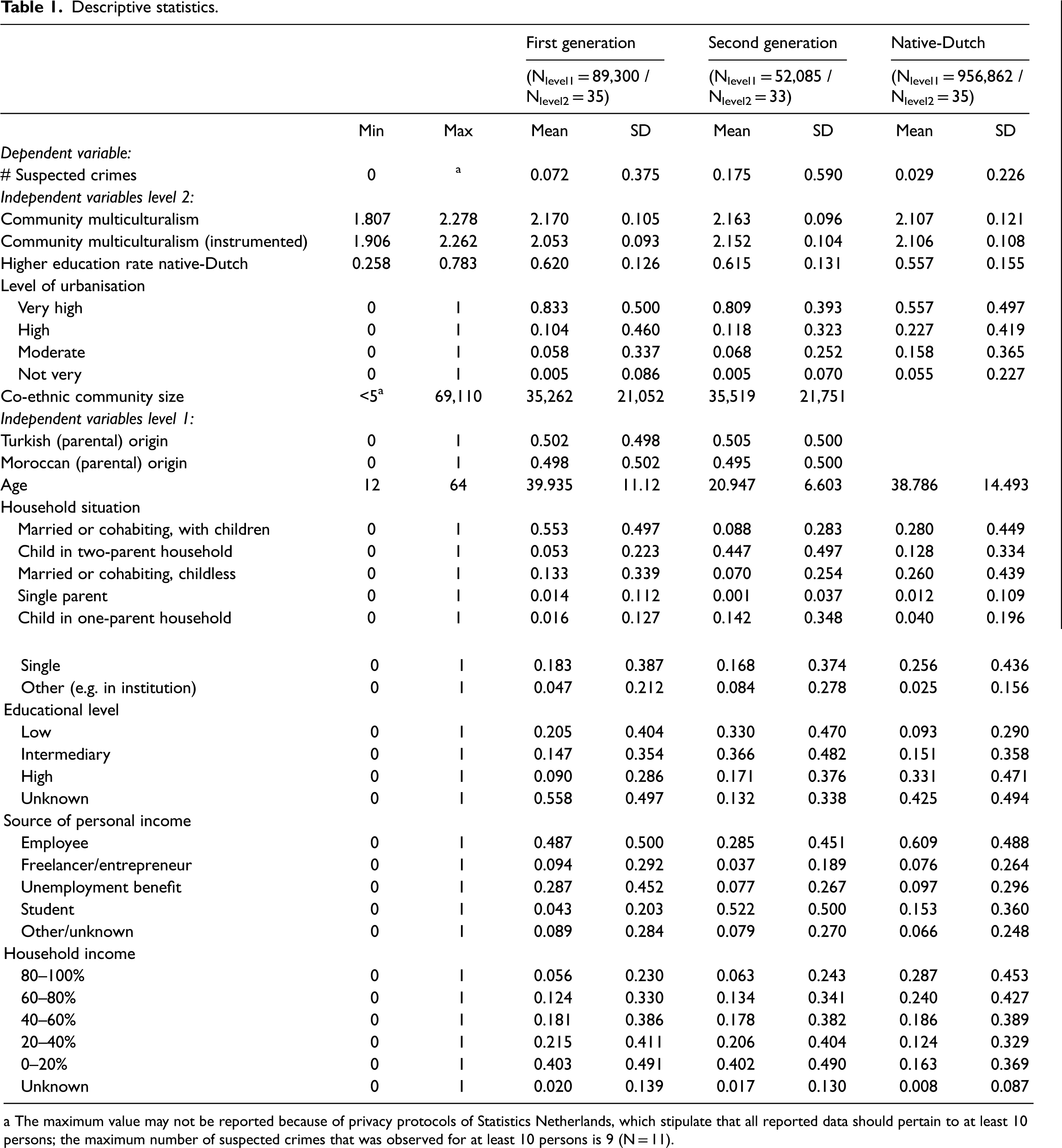
The maximum value may not be reported because of privacy protocols of Statistics Netherlands, which stipulate that all reported data should pertain to at least 10 persons; the maximum number of suspected crimes that was observed for at least 10 persons is 9 (N = 11).
Findings
Multivariate results
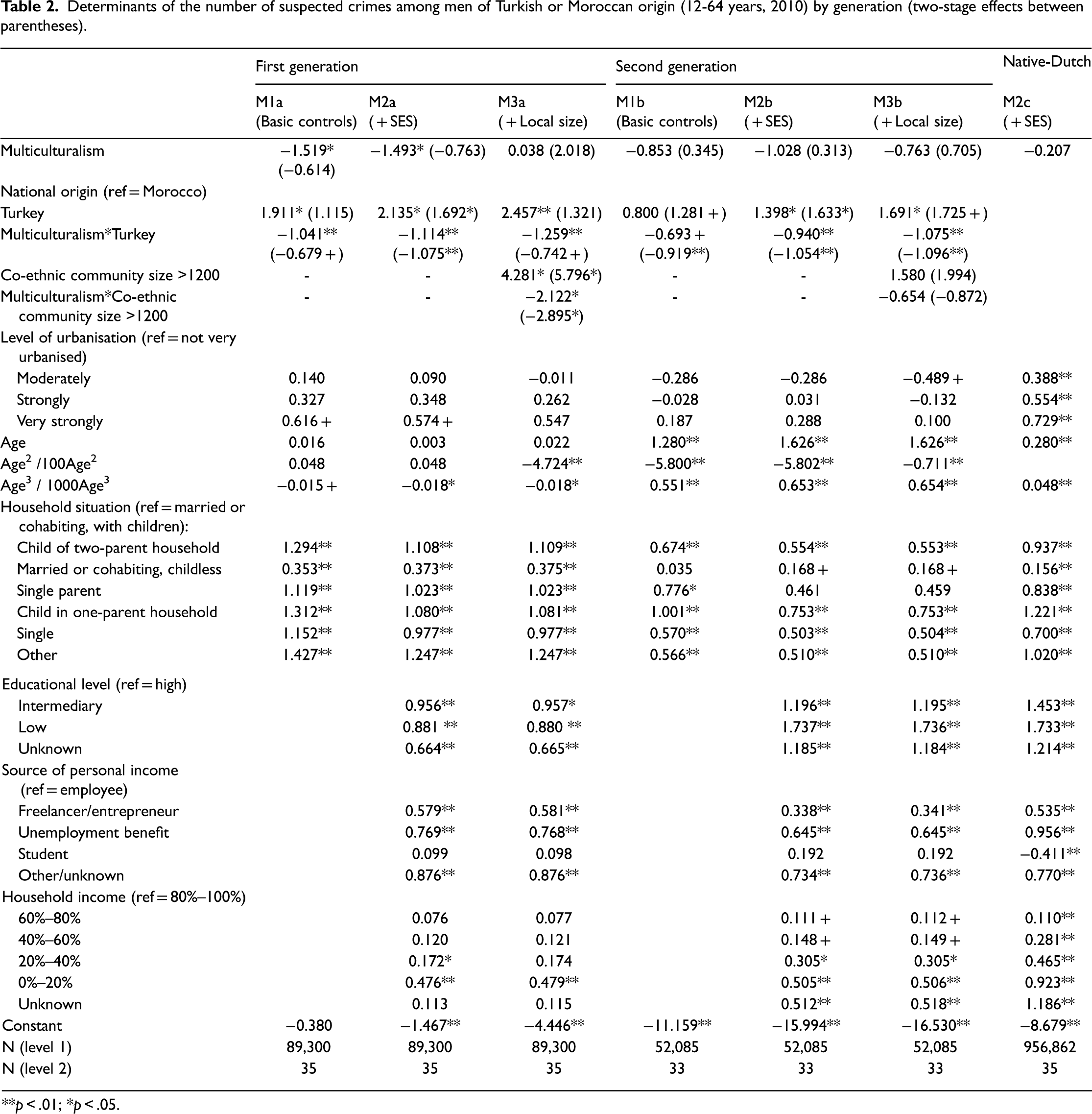
Table 2 shows multivariate results for the immigrant groups by generation, and for native-Dutch men. Effects obtained using two-stage regression are shown between parentheses.
Determinants of the number of suspected crimes among men of Turkish or Moroccan origin (12-64 years, 2010) by generation (two-stage effects between parentheses).
**p < .01; *p < .05.
Hypothesis 1 – men with a Turkish/Moroccan background commit fewer crimes in municipalities where CM is relatively strong – is partially accepted: it is accepted for the Turkish-Dutch, but the findings for Moroccan-Dutch men are more ambiguous. In Model 1, including in the two-stage models, Turkish-origin men of both generations are suspected of fewer crimes in multiculturally oriented municipalities than in municipalities that tend toward exclusionism. For the Moroccan origin group, the hypothesis is only confirmed for the first generation and in the regular regression models (e.g. Model 1a: b = −1.519, p < .05). In Model 2, CM still has an effect in the Turkish-Dutch group and, in the regular models, among first-generation Moroccan immigrants. Apparently, CM (also) affects immigrant crime via other paths than socioeconomic attainment. After controlling SES, the effect of CM is somewhat weaker for the Moroccan-Dutch, and slightly stronger for the Turkish-Dutch. No significant effects are found for native-Dutch men (Model 2c).
We partially accept Hypothesis 2 – the effect of CM increases with co-ethnic community size – on the basis of Models 3a/b: CM has a stronger effect in municipalities with at least 1200 registered co-ethnics than in municipalities with fewer co-ethnics, but only among first-generation men. The latter generational difference could indicate that ‘intra-ethnic’ forms of collective efficacy are more effective in socially controlling first-generation than second-generation immigrant men (also see Waters, 1999). In all models, the interaction between CM and having a Turkish background is significant, which confirms Hypothesis 3 – the effects of CM are stronger for the Turkish-origin group. Finally, when comparing the models for first- and the second-generation men, we find stronger effects of CM for the first generation for both origin groups, which confirms Hypothesis 4. In none of the models, CM has a significant effect for second-generation men with a Moroccan background.
Figure 4 illustrates the findings for a ‘typical’ Turkish- or Moroccan-Dutch man who, because of his age (21), has an elevated risk of becoming a crime suspect. Such men typically live in (very) strongly urbanised municipalities, are typically employed with a low income, and have followed, or are still following, a low education (first generation) or an intermediary education (second generation), and are a partner in a childless couple (first generation) or live with their parents (second generation) (see the means in Table 1). The figure, which is based on Models 3a (first generation) and 2b (second generation), shows the number of expected crimes per 100 of such men under strong CM, which we define as the average value in the NELLS municipalities plus one standard deviation, and weak CM, which we define as the average minus one standard deviation. A difference of two standard deviations is somewhat larger than the difference between the cities of Amsterdam and Rotterdam (1.6).
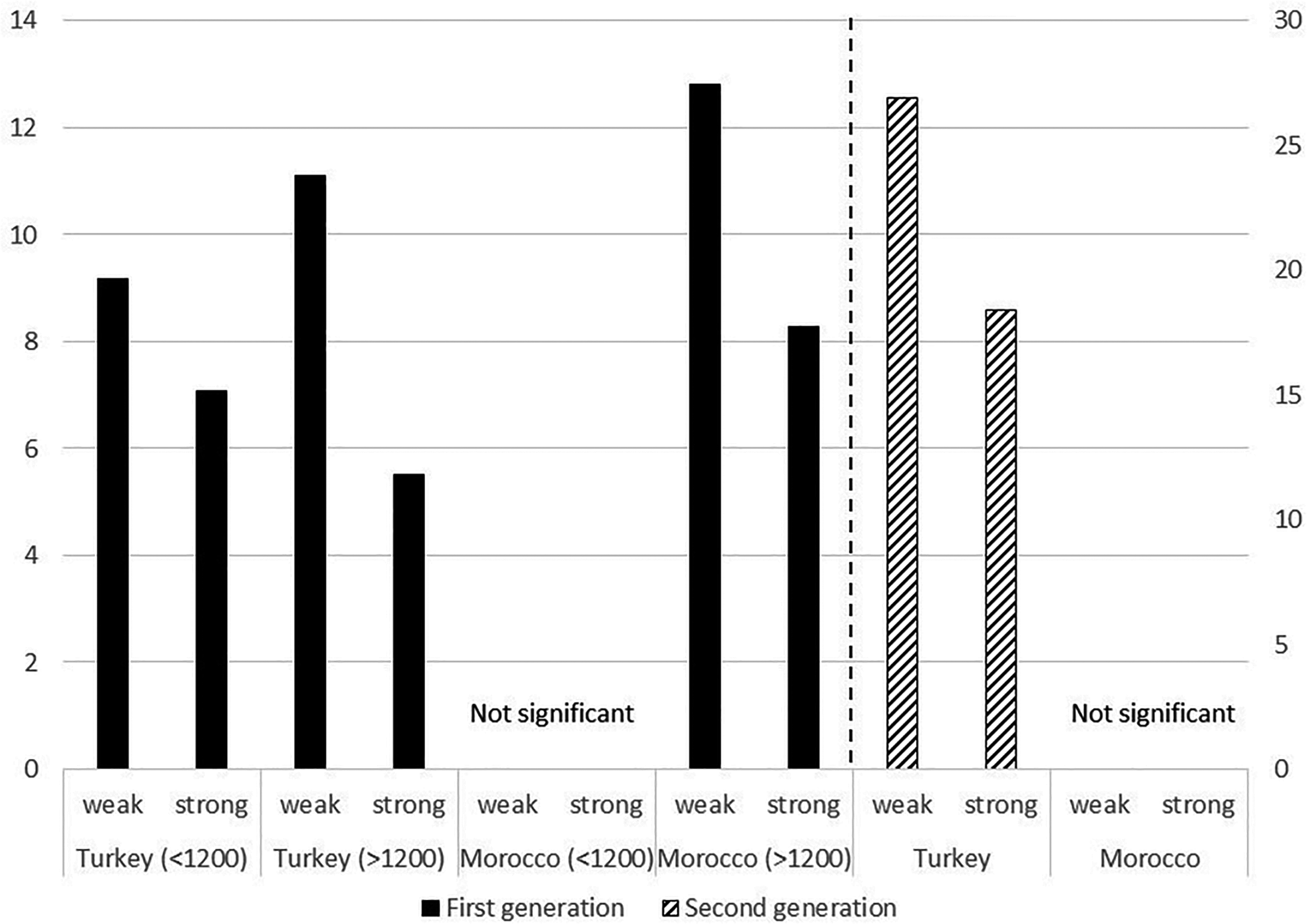
Expected registered crimes in 2010 per 100 ‘typical’ first- and second-generation immigrants of Turkish and Moroccan origin, under different levels of community multiculturalism and co-ethnic group size.
When the local number of co-ethnics does not exceed 1200, a first-generation ‘Turkish’ man benefits modestly from a multicultural climate: the difference is 2.3 registered criminal cases per year per 100 men with the characteristics mentioned. When the number of co-ethnics exceeds 1200, strong multiculturalism is associated with between 5.6 (‘Moroccans’) and 7.7 (‘Turks’) fewer crimes per 100 men. For the second-generation man with Turkish roots, the difference between weak and strong CM is associated with 8.5 fewer registered crimes per year per 100 men.
Additional analyses
We conducted various robustness checks and additional explorative analyses (results available on request). Different specifications led to similar results (e.g. logistic instead of negative binomial regression, additional first-generation models with controls for age of migration and duration of stay in the Netherlands). The models were also run, with comparable results, for all Dutch municipalities (n > 400) using extrapolated scores. Furthermore, we explored the effects of CM on the eight types of crime available in SSB. The coefficients were significantly negative for traffic crimes, property crimes without violence, and, for first-generation Turkish-Dutch men, drug crimes. The coefficients were negative but insignificant for vandalism and sexual crimes, and positive but insignificant for property crimes with violence, other non-sexual violence against persons, and other crimes. CM thus mostly seems to reduce relatively common, non-violent types of crime. We also ran models for Turkish- and Moroccan-Dutch women and similarly found significant negative effects of CM, including among second-generation Moroccan-Dutch women. Finally, we ran pooled models, with dummies for each origin group, for all other non-Dutch national origins (>300) living in the NELLS municipalities, and found that the CM measure, though focussed on ‘Turks’ and ‘Moroccans’, had an overall negative, but weaker effect on immigrant crime for both generations.
Conclusion and discussion
There is considerable international and local-level variation in registered immigrant crime, but its underlying causes are unclear; scholars that have speculated about these causes have reached contradictory conclusions (Koopmans, 2010; Lynch and Simon, 1999). We propose a theoretical framework that connects Berry's canonical acculturation theory with criminological theories on social control and criminogenic strains, and report the results of our first attempts to assess the validity of the proposed framework, focussing on local-level variation in registered immigrant crime in the Netherlands.
The article is primarily inspired by Lynch and Simon’s (1999) analysis, who speculated that relatively exclusionist contexts of reception, where immigrants risk being labelled as ‘criminal’, tend to create their own self-fulfilling prophecies. Our take on the existing literature on immigrant acculturation and crime is that relatively inclusive contexts, which are characterised by multiculturalism, do indeed reduce immigrant crime. However, we contend that they do so for a combination of reasons that cannot be adequately explained under one ‘grand’ criminological theory. We therefore propose a multicausal, mechanism-based approach that combines insights from criminological theories that are essential in our view, given the existing social-scientific findings on multiculturalism and immigrant acculturation.
Our empirical findings are in line with Lynch and Simon's findings: we similarly find that registered immigrant crime is lower in relatively inclusive environments. However, we also find suggestive evidence that CM has a conditional negative effect on immigrant crime. It is associated with a lower number of suspected crimes among Turkish- and Moroccan-Dutch men, but the effects are concentrated among first-generation men living in larger immigrant communities, and are stronger for the Turkish-Dutch (a relatively cohesive and, in the period of study, relatively well-accepted immigrant group) than for the Moroccan-Dutch (a more fragmented and socially excluded group). No effects were found for second-generation men of Moroccan descent.
We conclude the article by discussing some limitations of the present analyses and suggesting some avenues for future research.
Firstly, the analyses are based on cross-sectional data, and in spite of using two-stage regression techniques we cannot completely rule out the possibility that the observed effects are also caused by reverse causality. Future research could therefore examine how multiculturalism and immigrant crime are interrelated over time. 14
Secondly, the analyses are based on police suspect data, an imperfect measure of criminal behaviour that also captures the probability that the authorities learn about suspected criminalised behaviour, and register it with a view to prosecution. That probability is relatively high for unorganised, visible street crimes, while immigrants may also be more strictly ‘monitored’ than natives, for example because of ethnic profiling (Bezemer and Leerkes, 2021; Van der Leun and Van der Woude, 2011) or immigration policing (i.e. the tracing of administrative immigration violations, which may lead the police to also observe crime among immigrant communities). Fortunately, such concerns are largely irrelevant here, since we primarily compare legal residents from two immigrant groups with a similar socioeconomic profile. A more pressing issue is whether CM influences the probability of immigrant crime being officially ‘observed’. If it reduces that probability, say because residents put less pressure on the police to punish immigrants or because local police pay less attention to migration policing, we overestimated CM's effects on offending. If CM increases that probability – say because local immigrant groups are more willing to report crimes to the police – we underestimated it. Given the reliance on police data, we cannot exclude the possibility that CM has a different effect on crimes that police data do not measure well. It could be, for instance, that better opportunities to obtain integration under CM create opportunities to commit certain non-street crimes.
An interesting avenue for future research would be to examine how CM affects punishment. In the Netherlands, the overrepresentation of first- and second-generation immigrants increases after each phase in the criminal justice system (i.e. it is higher among crime suspects than among respondents reporting criminal behaviour in surveys, higher among those prosecuted than among non-prosecuted suspects, and higher among prisoners than among those prosecuted) (Boon et al., 2018; Leerkes et al., 2019). Possibly, CM attenuates these inequalities in the sanctioning of criminal behaviour.
A third limitation is that it is hard to test theoretical mechanisms using administrative data, which led us to formulate various tentative hypotheses to explore the framework's validity of more indirectly.
Because of the two latter limitations, additional empirical tests are warranted, which could also promote further theory development. Recently, we triangulated the present findings and conducted additional tests using self-reported offending data from the NELLS survey, which also includes more direct information on the assumed causal mechanisms (e.g. perceived discrimination, social and institutional trust, religiousness, neighbourhood contacts). The outcomes are consistent with the present results and framework (Leerkes et al., 2020). In fact, we find stronger effects of CM on self-reported offending than on registered crime, which confirms that CM is primarily associated with relatively common, somewhat less serious forms of crime, which surveys capture better than police data. Outside of criminology, additional empirical research is warranted on the relationship between the dominant's group acculturation orientation and immigrants’ acculturation outcomes. Studies on acculturation outcomes abound, and there are many studies on immigration attitudes and policies. However, few studies have actually tested hypotheses about the assumed relationships between the dominant's group orientation and immigrants’ acculturation outcomes (cf. Bloemraad and Wright, 2014).
A final limitation of the analysis is that the dominant group's acculturation preferences in the Netherlands tend toward one-dimensionality, rather than the theoretically assumed two-dimensionality in Berry's theory, which led us to compare CM to exclusionism. Possibly, researchers in other countries can also identify assimilationism and segregationalism more clearly, and estimate their effects on immigrant crime as well.
Footnotes
Acknowledgements
We thank the editor, four anonymous reviewers and the migration feedback group at Erasmus University Rotterdam for giving valuable feedback on earlier versions of the manuscript.
Declaration of conflicting interests
The author(s) declared no potential conflicts of interest with respect to the research, authorship, and/or publication of this article.
Funding
The author(s) received no financial support for the research, authorship and/or publication of this article.
