



Abstract
Situational Action Theory's (SAT) situational model is being increasingly applied to study rule-breaking behaviours. Given this rapidly growing interest, it is timely to review the state of empirical support for the model and identify conceptual and methodological challenges in order to guide future studies in more appropriate tests of the model. This paper systematically reviews 37 quantitative tests of SAT's situational model that were published during the 5 years from 2016 to 2020 to formulate and then answer the following research questions: (1) What samples and offences have been studied to investigate the situational propositions put forward by SAT, and what are the most needed kinds of studies and replications? (2) What is the state of empirical support for SAT's situational model? (3) What are the challenges and what improvements are required for future tests of SAT's situational model? and (4) What clarifications and refinements are a theoretical priority? Overall findings of the review highlight the utility of SAT's situational model in investigating a diversity of rule-breaking behaviours across a range of ages and countries. However, the review also makes clear that when reviewed as a whole, this literature encounters methodological pitfalls and theoretical imprecision. These limitations must be addressed as empirical tests of SAT's complex situational model become increasingly nuanced and highly specified. Thus, building on the findings of the systematic review, the paper explores these complex limitations and specifies the theoretical and methodological refinements required to advance the study of person-environment interaction in acts of rule-breaking.
Recurrent acronyms
ISRD: The International Self-Report Delinquency Study is a large, ongoing international research collaboration investigating juvenile offending and victimisation across 35 countries. For further information, see www.northeastern.edu/isrd/.
PADS+: The Peterborough Adolescent and Young Adult Development Study is a complex longitudinal study (N = 716) specifically designed to test SAT. For detailed information about the study design, see Wikström et al. (2012: 44–106).
RQ: research question.
SAT: Situational Action Theory is a ‘general, dynamic and mechanism-based theory of crime causation’ (Wikström et al., 2018: 12) that integrates person- and environment-oriented explanations of crime (Wikström, 2004, 2019; Wikström et al., 2012).
Introduction
In 2004, Per-Olof Wikström proposed Situational Action Theory (SAT; Wikström, 2004, 2019; Wikström et al., 2012) which he describes as a ‘general, dynamic and mechanism-based theory of crime causation’, effectively integrating person- and environment-oriented explanations of crime (Wikström et al., 2018: 12). The theoretical framework offered by SAT has gained a great deal of attention in recent years, with a review of studies published between 2006 and 2015 finding largely supportive results of the theory's situational model (Pauwels et al., 2018). While only five years of research passed since the studies covered by Pauwels et al.'s (2018) review, this period, from 2016 to 2020, witnessed a substantial increase in research investigating the propositions put forward by SAT's situational model.
SAT also comprises the social model, and more recently the developmental ecological action (DEA) model (Wikström, 2005; Wikström and Treiber, 2019; Wikström et al., 2024). However, this review is focussed on only the situational model which has received the most empirical attention—owing largely to its novel approach in explaining acts of crime, its clear implications for empirical research, and no need for longitudinal research designs.
The situational model of SAT
‘The situational model of SAT aims to explicate the key situational factors that influence the process that moves people to engage in acts of crime…’ (Wikström, 2014: 77; see also, Wikström et al., 2018; Wikström and Treiber, 2016). To allow a succinct explanation of this process, Wikström (2019: 265) provides the following equation which is referred to as the PEA hypothesis of SAT:

The PEA equation highlights the central relevance of the interaction between propensity and exposure for SAT because this interaction initiates the perception-choice process. Within this perception-choice process, two interrelated but distinct principles help to describe whether and under what circumstances an act of crime may occur: the principle of moral correspondence and the principle of the conditional relevance of controls (PMC and PCRC; Wikström et al., 2012; Wikström and Treiber, 2007). The former describes an interaction whereby the personal morals of an individual are broadly aligned with the moral context of a setting they are in. If both the personal morals of an individual and those of the setting encourage (or discourage) crime, then crime is highly likely (or unlikely). In this situation, the choice component of the perception-choice process often plays no role, as the person likely only perceives one option, crime (or no crime). The choice component only becomes particularly relevant in situations of conflicting moral rule guidance and is best described via the principle of the conditional relevance of controls. This principle expresses the influence of controls on an individual's choice to commit (or not commit) an act of crime. These controls, according to SAT's situational model, are self-control and deterrence. If the setting encourages crime, but the personal morals of an individual discourage crime, whether a person will offend is primarily dependent on their ability to exercise self-control (whereby self-control is the ability ‘to act in accordance with his/her morality in the face of temptations and provocations’; Wikström et al., 2010: 1004). Alternatively, if the person's morals encourage crime, but the setting discourages it, the outcome is largely determined by deterrence.
Key findings of Pauwels et al. (2018)
Pauwels and colleagues’ (2018) review identified 35 papers, published between 2006 and 2015, that investigated the three most studied interaction effects proposed by SAT's situational model, that is, the interactions between (a) propensity and exposure (PxE), (b) propensity and deterrence (PxD), and (c) personal morality and self-control (MxSC). Besides revealing strong support for the model, their review identified several considerations for future research.
First, they highlighted a clear overrepresentation of samples of youth in the studies reviewed, along with a lack of variability in both the offences investigated and the countries in which the samples had been drawn (only two of the 35 studies were conducted outside of Europe). Second, they identified problematic measurement and operationalisation of key SAT constructs. Many of the studies included used either proxy measures, such as legal cynicism in lieu of personal morality, or partial measures of propensity (i.e., not combining moral rules, emotions and self-control), which, as the authors noted, raises the issues of conceptual drift and, correspondingly, incommensurability. Third, their review highlighted the challenge of collecting (and analysing) situation-level exposure data.
Current review: Aims and research questions (RQs)
As evidenced by the number and nature of citations to date, Pauwels et al.'s (2018) review has proved a useful resource for those designing and carrying out tests of the situational model of SAT, over and above the contribution made by summarising the state of empirical support for the model. Pauwels et al. did not deliver substantive theoretical developments. Similarly, by undertaking a review of studies and their empirical findings, this paper aims
to provide valuable and detailed guidance to researchers as to the specifics required for more appropriate tests of the situational model, but also to identify the challenges that must be addressed by future theoretical specifications of the situational model in order to progress the empirical study of situational interaction within the framework of SAT.
The review conducted by Pauwels et al. (2018) identified several considerations for future tests of SAT's situational model. The increasing pace of growth of studies investigating SAT's situational model means that it is timely to not only review the state of empirical support for the model but also assess the extent to which the challenges identified by Pauwels et al. (2018) are still evident. This review also builds on the previous review to identify emerging problems and deepen the comparative analysis of the key features of studies and their findings. This approach has produced additional, and more specific, recommendations for future empirical research and theoretical development to the previous review. Allowing too long to pass before doing so risks wasting resources on new but inadequate datasets and a range of studies that either do not truly empirically test the model or offer inappropriate conclusions. Moreover, unchecked, the quickly developing body of literature would become too unwieldy to sufficiently assess to provide practical/actionable recommendations for future research.
This study started by systematically searching for studies published online in the five years between 1 January 2016 and 31 December 2020 that have investigated SAT's situational model. We reviewed the details of each eligible study, including the study site and sample, various aspects of study specification and design, analytic strategy and theoretical interpretation.
This paper presents a systematic description of the studies, followed by a review of empirical support for the situational model of SAT. We analyse these empirical findings in light of the various strengths, challenges, inconsistencies and shortcomings identified within the reviewed studies, and discuss the implications for improvements to the appropriateness of the empirical test of the situational model. This paper is structured around the following research questions and analytical discussions relating to empirical tests of the situational propositions put forward by the situational model SAT:
RQs and analytical discussions
RQ1: What samples and offences have been studied?
What are the most needed kinds of replications, study samples and crime types? RQ2: What is the state of empirical support?
How does the state of empirical support compare to the findings of Pauwels et al. (2018)? RQ3: What are the problems with empirical tests of the model?
What improvements to empirical tests of the model are required?
Problem 1: Interaction relationships tested:
Are the proposed interaction relationships appropriately addressed? Problem 2: Operationalisation of constructs:
How can we refine constructs in terms of measurement and operationalisation? Problem 3: Study design:
What improvements are required in terms of study design to maximise the appropriateness of empirical tests? Problem 4: Analytical strategy:
What is the most appropriate analytic strategy to assess situational interaction? RQ4: What theoretical clarifications and refinements are required in order to answer questions raised by inconsistent findings, misspecifications and misinterpretations of recent empirical research?
Method
Search strategy and selection of studies
We conducted a systematic literature search by adhering to the Preferred Reporting Items for Systematic Reviews and Meta-analyses (PRISMA) statement (Moher et al., 2009). The present review included only studies that (a) were written in English, 1 (b) explicitly tested SAT's situational model, (c) are published in peer-reviewed journals and (d) quantitatively tested for interaction effect(s) hypothesised by or inferred from SAT's situational model. Databases including PsycINFO, ProQuest, Web of Science and Scopus were searched using combinations of ‘situational action theory’, ‘conditional relevance of control*’, ‘situational model’, ‘moral*’, ‘self-control’, ‘deterren*’, ‘exposure’, and ‘propensity*’. Databases were searched for peer-reviewed studies published online between 1 January 2016 and 31 December 2020. 2 As displayed in Figure 1, 37 studies were identified for inclusion in the current review. 3
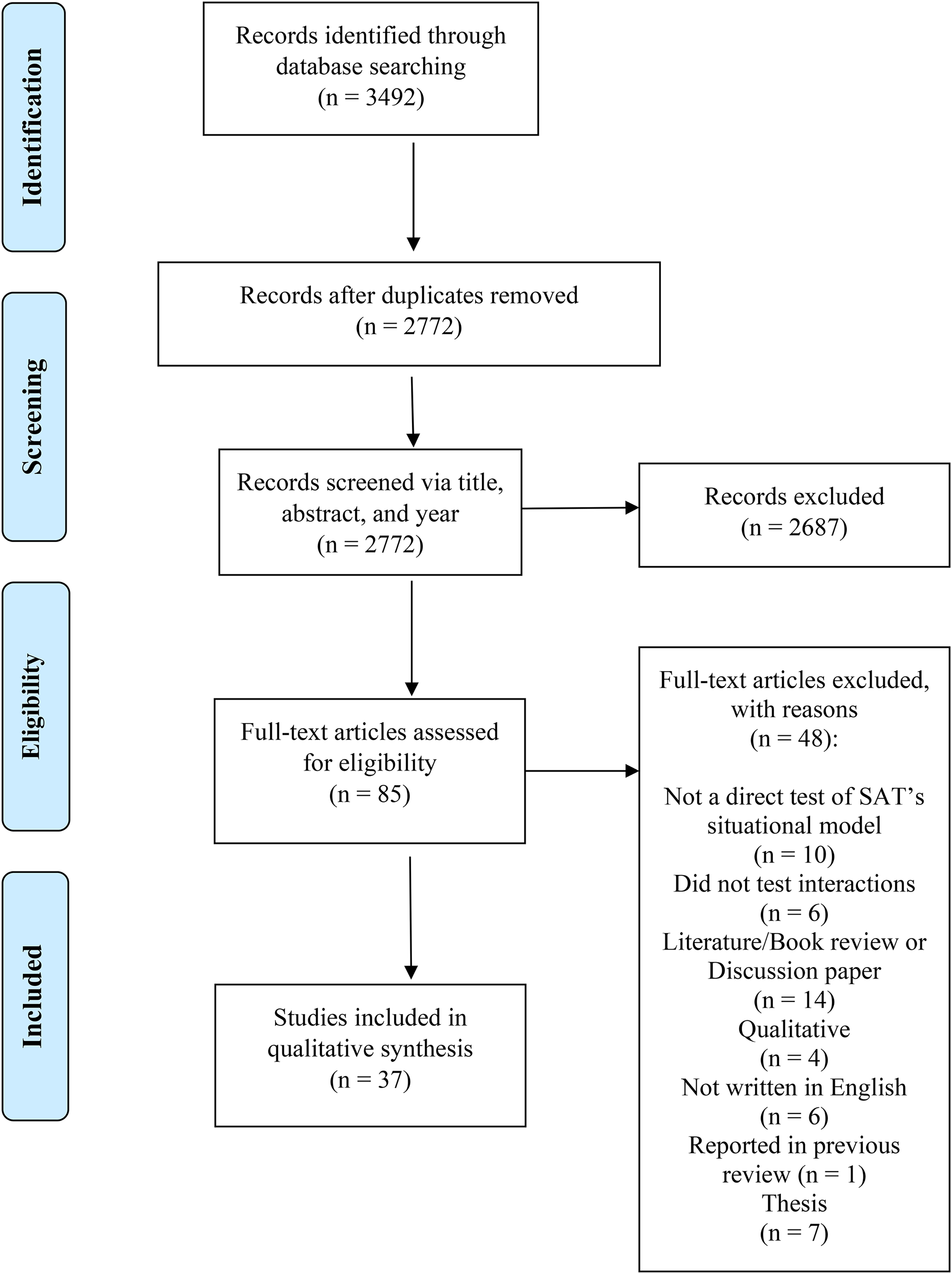
PRISMA flowchart of studies included in the systematic review.
After the search, we screened the reference lists of the studies identified and also asked prominent SAT researchers to provide their own list of relevant studies in order to identify any eligible references that might have somehow been missed by the systematic search. These supplementary checks were not strictly necessary but since they did not identify any additional studies, they provided additional confidence in the systematic review by indicating that the search strategy employed was sufficient.
Review method
Following the approach of Pauwels et al. (2018), the 37 studies were organised into categories by their corresponding empirical tests (PxE, MxD, MxSC, and Other; see Tables 1–4); where the categories reflect the most tested interactions during the review period, not the only or most appropriate ones theoretically. Studies that tested more than one interaction relationship appear in multiple tables.
Interaction between crime propensity and criminogenic exposure (PxE).
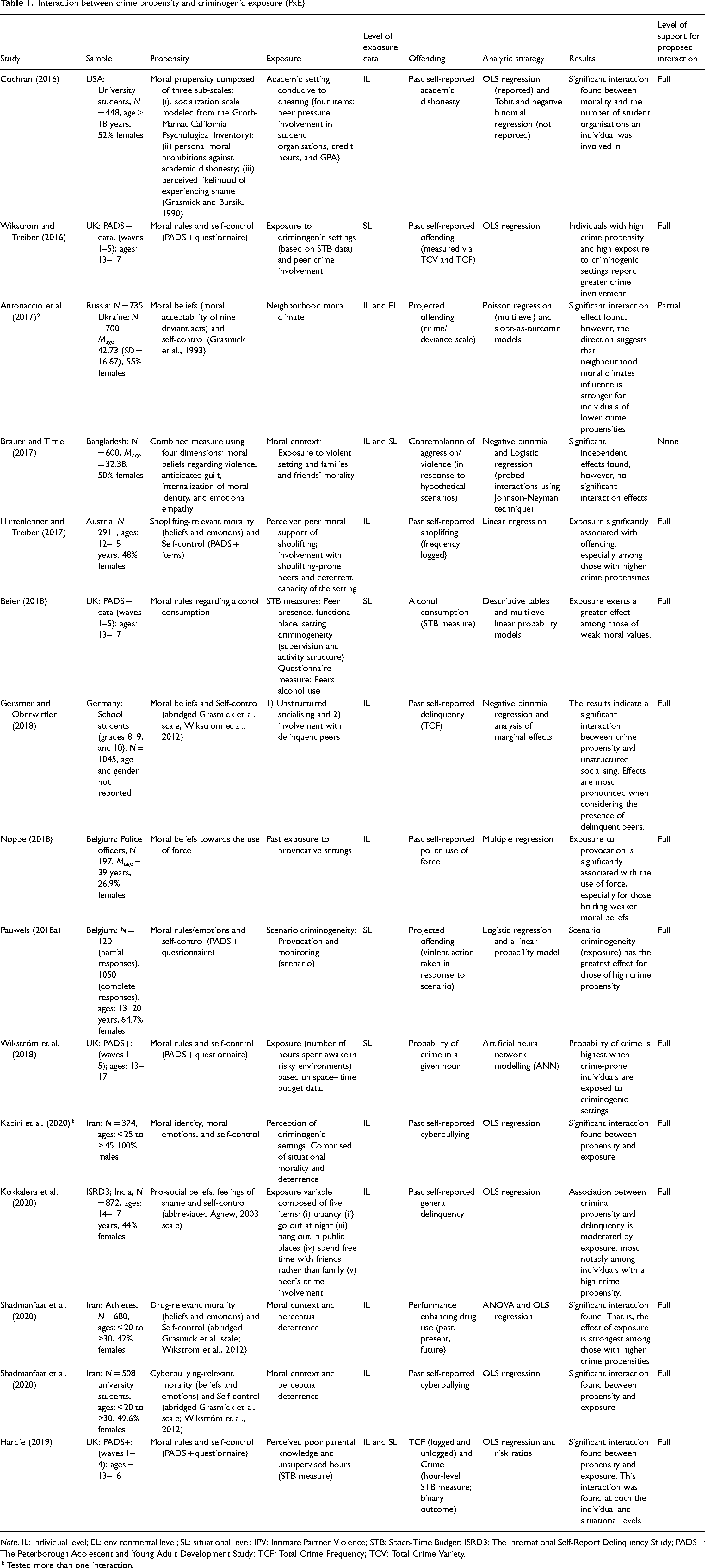
Note. IL: individual level; EL: environmental level; SL: situational level; IPV: Intimate Partner Violence; STB: Space-Time Budget; ISRD3: The International Self-Report Delinquency Study; PADS+: The Peterborough Adolescent and Young Adult Development Study; TCF: Total Crime Frequency; TCV: Total Crime Variety.
Tested more than one interaction.
Interaction between morality and self-control (MxSC).
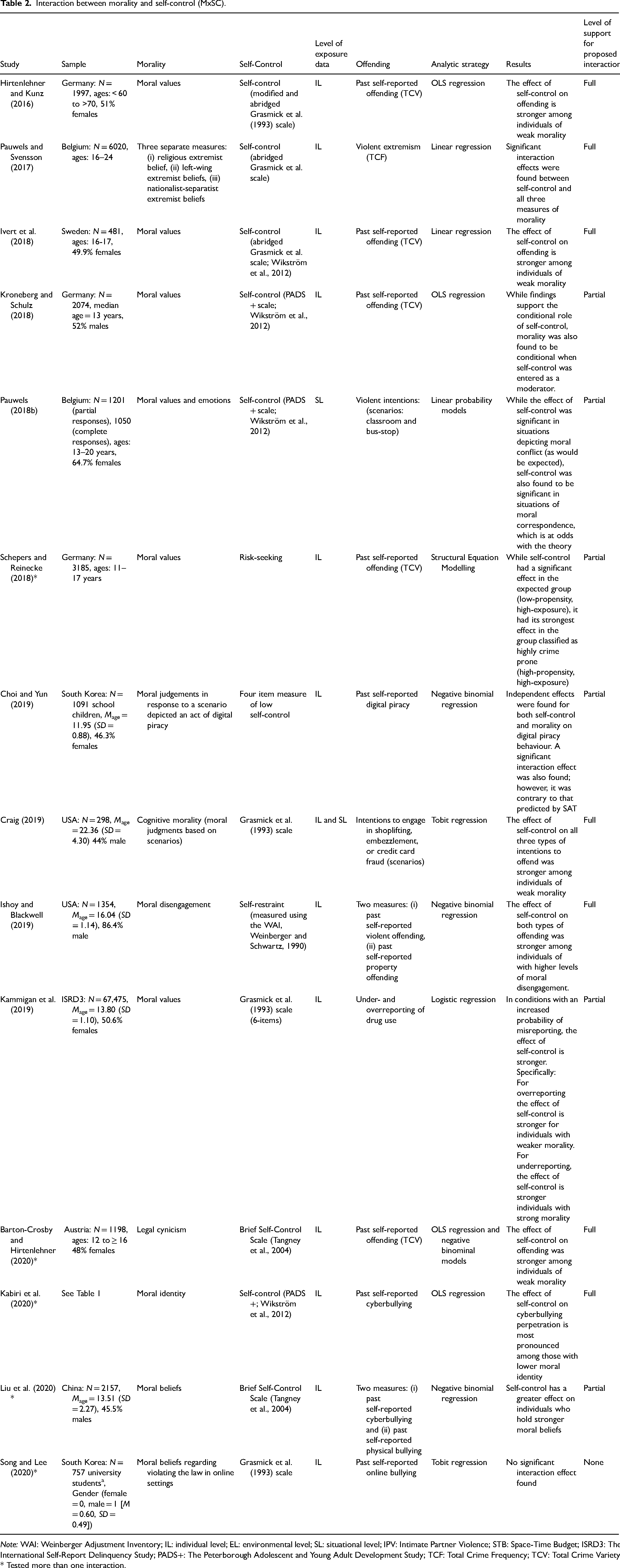
Note: WAI: Weinberger Adjustment Inventory; IL: individual level; EL: environmental level; SL: situational level; IPV: Intimate Partner Violence; STB: Space-Time Budget; ISRD3: The International Self-Report Delinquency Study; PADS+: The Peterborough Adolescent and Young Adult Development Study; TCF: Total Crime Frequency; TCV: Total Crime Variety.
Tested more than one interaction.
Interaction between morality and deterrence (MxD).
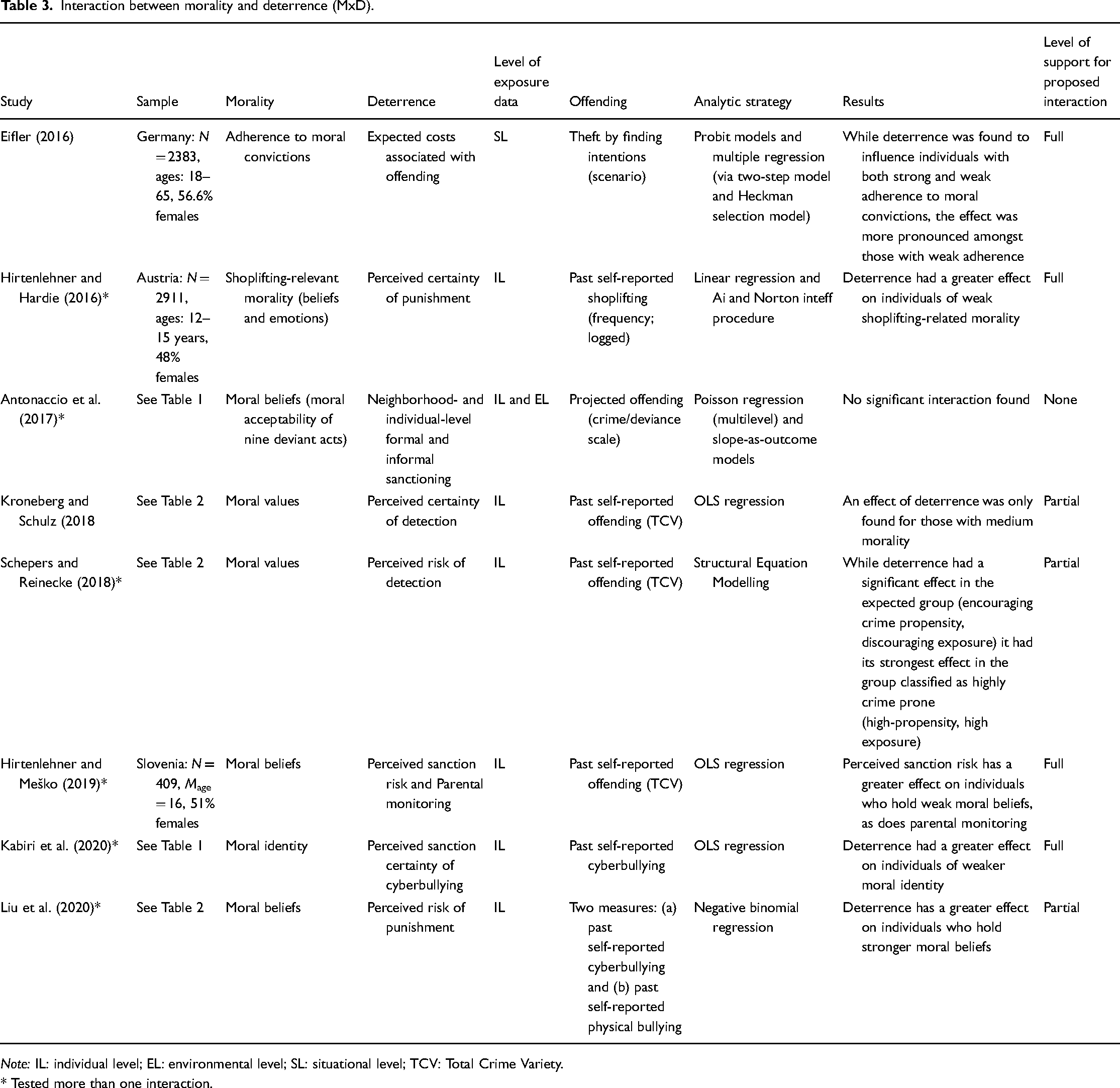
Note: IL: individual level; EL: environmental level; SL: situational level; TCV: Total Crime Variety.
Tested more than one interaction.
Other Proposed Interactions.
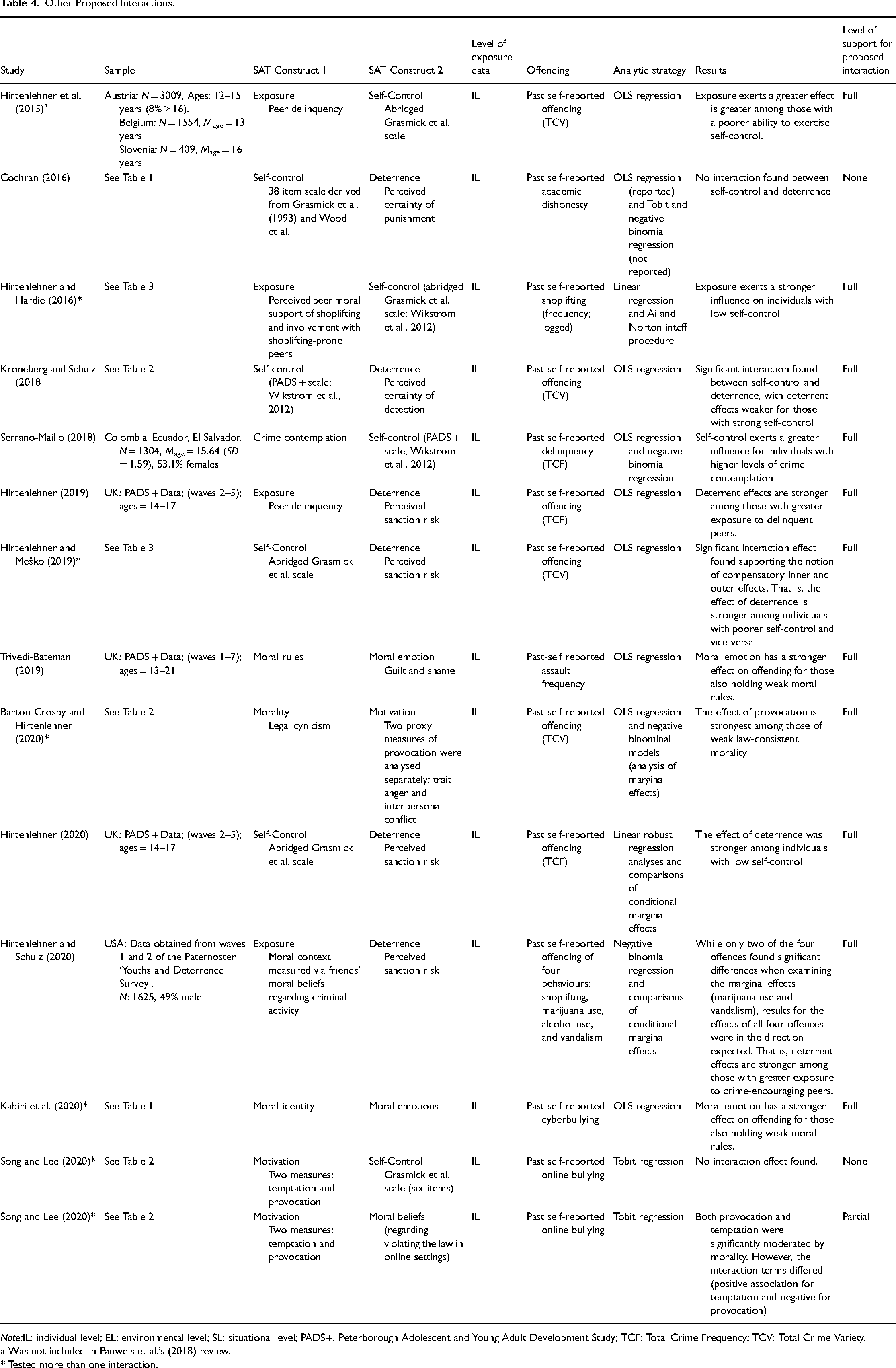
Note:IL: individual level; EL: environmental level; SL: situational level; PADS+: Peterborough Adolescent and Young Adult Development Study; TCF: Total Crime Frequency; TCV: Total Crime Variety.
Was not included in Pauwels et al.’s (2018) review.
Tested more than one interaction.
In an important development, while the previous review reported the findings for the interaction between propensity and deterrence (PxD; Pauwels et al., 2018), this review reports the findings for the interaction between morality and deterrence (MxD; Table 2) because all studies within the review period (2016–2020) did so. This will be discussed further in addressing RQ3 Problem 1.
Following a thorough examination of all the identified studies, the review tables (Tables 1–4) were systematically populated with the crucial aspects of sample and study design relevant to answering our RQs. Finally, studies were distinguished as either finding full, partial or no support for the propositions of SAT.
The information included in the review Tables 1–4 largely replicates the previous review (Pauwels et al., 2018), with a key addition. As they noted, testing the situational model requires specific data. Indeed, as elaborated by Hardie (2020), an understanding of differing levels of exposure data and the concept of convergence is crucial for appropriate examination of person–environment interaction proposed by the situational model of SAT, as this has direct implications for the conclusions that can be drawn, especially regarding the nature of the interaction (a key focus of SAT's situational model). For this reason, in the current review, we additionally incorporated the level of the exposure data in the information tables about the included studies and their research designs.
The analysis first involved review, comparison and summary of the key features of the studies and a summary of the level of support inherent in the study findings. We then identified and analysed similarities, differences and patterns among the 37 studies. To facilitate learning from studies that both do and do not find support for the situational model of SAT in order to answer our RQs, we conducted a comparison of the features of studies in relation to their findings.
Review summary by interaction relationship
The interaction between propensity and exposure (PxE)
This review identified 15 studies that examined the interaction between propensity and exposure. As shown in Table 1, 13 (87%) found full support for the proposed interaction (criminogenic exposure exerts a greater effect among those with a higher crime propensity), one study found partial support (Antonaccio et al., 2017), and one find no support (Brauer and Tittle, 2017). Of those studies that found full support, eight were conducted in Europe (53%), four were conducted in Asia and the Middle East, and one was conducted in North America. Eight of these supporting studies (n = 7 Europe, n = 1 Asia and the Middle East) utilised samples of youths (53%). As for the offences investigated by the studies that found full support, most examined past self-reported offending, except one which measured hypothetical intentions to offend using a scenario approach. Six studies employed either crime variety or (total) crime frequency scales (46%), while the remaining six examined specific crime types (cyberbullying [n = 2], academic dishonesty, drug use, violence, shoplifting, police use of force). In these fully supporting studies, propensity was largely operationalised in accordance with the theory, that is, a combination of morality (albeit many studies failed to include a measure of moral emotions as specified by the theory) and self-control. Only one of the supporting studies did not, instead using a measure of moral beliefs (without self-control; Noppe, 2018). In contrast, exposure was collected and operationalised in a variety of ways, ranging from questionnaire measures of exposure to various aspects of the moral context (individual-level exposure data) to STB and scenario designs (situation-level exposure data). OLS regression was mainly employed to analyse interactions, particularly in non-situation-level data; however, one study made use of artificial neural network modelling, which is novel in this application (for discussion of analytical methods used to test PxE interaction, see Hardie, 2020).
The one study that found partial support was conducted in Europe using data captured at both the individual and environmental level to analyse projected offending (crime/deviance scale) among a sample of adults (Antonaccio et al., 2017). The only study to find no support examined violent intentions via hypothetical scenarios amongst a sample of adults living in Bangladesh (Brauer and Tittle, 2017). Both studies used non-linear analyses to examine the proposed interaction effect and of these, only Antonaccio and colleagues (2017) combined morality with self-control as a measure of crime propensity.
The interaction between morality and self-control (MxSC)
Fourteen studies examined the interaction between personal morality and the ability to exercise self-control (see Table 2). Seven (50%) found full support for the proposed interaction effect, that is, self-control is generally expected to have a larger effect among individuals who consider crime as an action alternative (i.e., those holding weaker moral rules). Of these, four (57%) were conducted in Europe, two in North America, and one in Asia and the Middle East. Three (43%) of the supportive studies sampled adults (Asia and the Middle East, n = 1; Europe, n = 1; North America, n = 1). As with studies investigating the PxE interaction, most used individual-level data to examine past self-reported offending (total crime variety, total crime frequency and specific crime types), only one study examined hypothetical intentions to offend via the use of scenarios (situation level). Morality in these studies was measured using scales of moral rules, moral identity, legal cynicism and the ability to morally disengage. Self-control, in most studies, was measured using the PADS + abridged version of the Grasmick et al. (1993) scale (Wikström et al., 2012) or varying items from the Grasmick et al. (1993) self-control scale itself. However, other measures of self-control were also used, such as self-restraint (via the Weinberger Adjustment Inventory; Weinberger and Schwartz, 1990), and the Brief Self-Control Scale (Tangney et al., 2004). Most studies finding full support used OLS regression (71%), either by itself or in conjunction with a non-linear analysis (e.g., negative binomial), while others used solely non-linear analyses such as Tobit or negative binomial regression.
Six studies (46%) found only partial support for the interaction between morality and self-control (Asia, n = 2; Europe, n = 3; ISRD3, n = 1). While all six studies examined samples of youth, five investigated past self-reported instances of offending (individual level) via the use of OLS (n = 1), negative binomial regressions (n = 2), logistic regression (n = 1) and structural equation modelling (n = 1), while the remaining study used linear probability modelling to examine violent intentions in response to a scenario (situation level). The study that found no support for the proposed interaction utilised only non-linear Tobit regression to examine past self-reported cyberbullying among a sample of South Korean youths at the individual level.
The interaction between morality and deterrence (MxD)
As displayed in Table 3, eight studies examined the interaction between morality and deterrence (SAT leads to the generalised expectation that deterrent effects would exert a greater influence among those with a weaker law-relevant morality, though see further, below). Of these, four studies (50%) found full support for the interaction between morality and deterrence (Asia and the Middle East, n = 1; Europe, n = 3), three found partial support (Asia and the Middle East, n = 1; Europe, n = 2), and one found no support (Europe). Of those studies that found full support, two (50%) examined samples of youth, as did all three of the studies that found partial support. The study finding no support examined a sample of adults. The eight studies operationalised the construct of morality in varying ways including the adherence to moral convictions, moral values, moral identity and moral beliefs and emotions regarding shoplifting. Deterrence was primarily measured using scales of perceived risk of detection and/or certainty of punishment. All except one study examined past self-reported offending (the remaining study examined theft intentions via a scenario approach [situation-level]). The four studies that found full support used either OLS regression or OLS regression in conjunction with a non-parametric analysis. The studies finding partial support used structural equation modelling (n = 1), OLS (n = 1) and negative binomial regression (n = 1). The study finding no support utilised Poisson regression.
Other interactions
The review also identified 13 studies (analysing 14 interactions) that examined the effect on crime of other interactions inferred from the theory (Table 4). All but three found full support for their respective studied interactions, which were the following: the interaction between exposure and self-control (criminogenic exposure is generally expected to exert a stronger influence on individuals with low self-control; n = 2; both found full support); the interaction between exposure and deterrence (deterrence effects are generally expected to be stronger for those with greater exposure to criminogenic settings; n = 2; full support); the interaction between self-control and deterrence (the effect of deterrence is generally expected to be stronger among individuals with low self-control, while for those with a high ability to exercise self-control, deterrence is expected to have a lesser effect; n = 4; full support, n = 3; no support, n = 1); the interaction between moral rules and moral emotions (moral emotion is expected to have a stronger effect for those also holding weak moral rules; n = 2; full support); the interaction between crime contemplation and self-control (self-control is expected to have a greater effect among individuals who consider crime as an action alternative; n = 1; full support); the interaction between motivation and morality (the effect of motivation is stronger among those with weaker morality; n = 2; full support, n = 1; partial support, n = 1); and lastly one study examined the interaction between motivation (temptation/provocation) and self-control (no support).
All but one study examined past self-reported offending among samples of youth. Nine studies were conducted in Europe, one in Asia, two in North America and one in South America. Exposure to criminogenic settings was captured at the individual level in all eight studies and was operationalised via questionnaire items measuring peer delinquency and involvement with delinquent peers supporting acts of crime. Deterrence was measured via perceived sanction risk, while 50% of studies measured self-control using the PADS + abridged version of the Grasmick et al. (1993) scale (Wikström et al., 2012). The measurement of morality varied, including moral rules, legal cynicism, moral beliefs and moral identity. All studies that found full support for their respective interaction effects used OLS regression, or negative binomial regression with the inclusion of a comparison of the marginal effects. The studies that found partial and no support for their respective interaction tests employed either OLS (n = 1) or Tobit regression (n = 2).
RQs and analytical discussions
RQ1: What samples and offences have been studied to investigate the situational propositions put forward by SAT? (Tables 1–4)
While still mainly centred in Europe (n = 23, 62%), there were several studies conducted in countries in Asia and the Middle East (Bangladesh, China, India, South Korea and Iran; n = 8, 22%), North America (USA; n = 4, 11%), South America (Colombia, Ecuador, El Salvador; n = 1, 3%) and one using data from a range of countries gathered by the ISRD-3 (n = 1, 3%). Most of the findings from these countries outside Europe were just as supportive of the situational model as studies conducted in Europe. Sample sizes ranged from 197 to 67,475 participants. Over a quarter (n = 10, 27%) of the studies examined samples of adults, with results indicating a similar degree of support for the theory in studies of adult populations as youth (discrepancies in findings systematically relate to analytical method rather than sample age, see further below).
Six (16%) of the 37 studies investigated self-reported intentions to offend (five of which used scenarios), and the remaining 31 (84%) examined self-reported past offending. In terms of the crime types investigated: 17 studies (46%) investigated offending via total crime variety (TCV) or total crime frequency (TCF), seven studies investigated differing forms of violence (intentions, assault, police use of force, and violent extremism), four studies investigated bullying (both physical and cyberbullying), three studies investigated theft (scenarios and past shoplifting behaviour), two investigated drug-use (under- and over-reporting of drug use and performance enhancing drugs), one study investigated four separate acts of rule-breaking (shoplifting, vandalism, marijuana use and alcohol use), and the remaining three studies investigated academic dishonesty, digital piracy and white-collar crime, respectively. Notably, studies of rule-breaking behaviours that are perhaps more normalised (both culturally and among many of those present in settings) than traditionally studied crime types such as violence and burglary either did not find any significant interaction effects or found them to be in a direction contrary to what SAT posits (e.g., digital piracy, Choi and Yun, 2019; cyberbullying, Liu et al., 2020; Song and Lee, 2020).
What are the most needed kinds of replications, study samples and crime types?
This review found that research investigating the situational model of SAT has made substantial advancements in sampling variability and the crimes investigated by the included studies varied greatly. This diversity, both in terms of sampling and offences investigated, not only addresses the limitations identified by Pauwels et al. in their 2018 review but is also supportive of SAT being distinguished as a general theory of crime (Wikström et al., 2012).
Despite the broadening focus of SAT-related research, there are still some research gaps. First, cross-national comparisons of the situational model would be beneficial for furthering our understanding of the cross-cultural applicability (or not) of the theory.
Second, there is a need for future studies to investigate additional crime types, especially those crimes deemed less serious, as this may help to investigate the largely unexamined habitual pathway of the perception-choice process. Mixed findings from studies of more or less ‘serious’ crime types suggest that further study of more normalised (both culturally and among many of those present in settings) rule-breaking behaviour is required. Arguably, the perceived moral context relating to more normalised rule-breaking behaviour is weaker. SAT's principles of moral correspondence and the conditional relevance of controls dictate that those with weak personal law-relevant moral rules would be less likely to deliberate about these more ‘morally acceptable’ behaviours because there is limited moral conflict between person and setting. Furthermore, only those with stronger law-relevant moral rules relating to these behaviours would enter into deliberation, during which, given the context of the moral incongruency, SAT suggests that self-control would be most relevant. This is in line with the findings and interpretations of Liu et al. (2020) and Song and Lee (2020) in their investigations of cyberbullying amongst students in China and South Korea, respectively. More research is needed to test this hypothesis regarding more ‘morally acceptable’ rule-breaking behaviours, and crucially, more theoretical guidance on the habitual nature of some kinds of rule-breaking behaviour and acts of crime is required.
RQ2: What is the state of empirical support for SAT's situational model?
The first two columns of Table 5 summarise the findings about the level of empirical support found in all the reviewed studies (Tables 1–4). Overall, the interaction between propensity and exposure was the most tested relationship proposed by or inferred from the theory, and it was the most fully supported, proportionally (n = 15; 87% full support). This review identified 13 studies that investigated 14 ‘other’ SAT-relevant interactions. These involved various constructs and included aspects of morality, exposure, self-control, deterrence and motivation. Of these interactions investigated, 79% found full support. The least supported interactions were those between morality and self-control (n = 14; 50% full support) and between morality and deterrence (n = 8; 50% full support). The appropriateness of these variously specified tests of the situational model is discussed below.
Extent of support for interaction effects by analysis type.
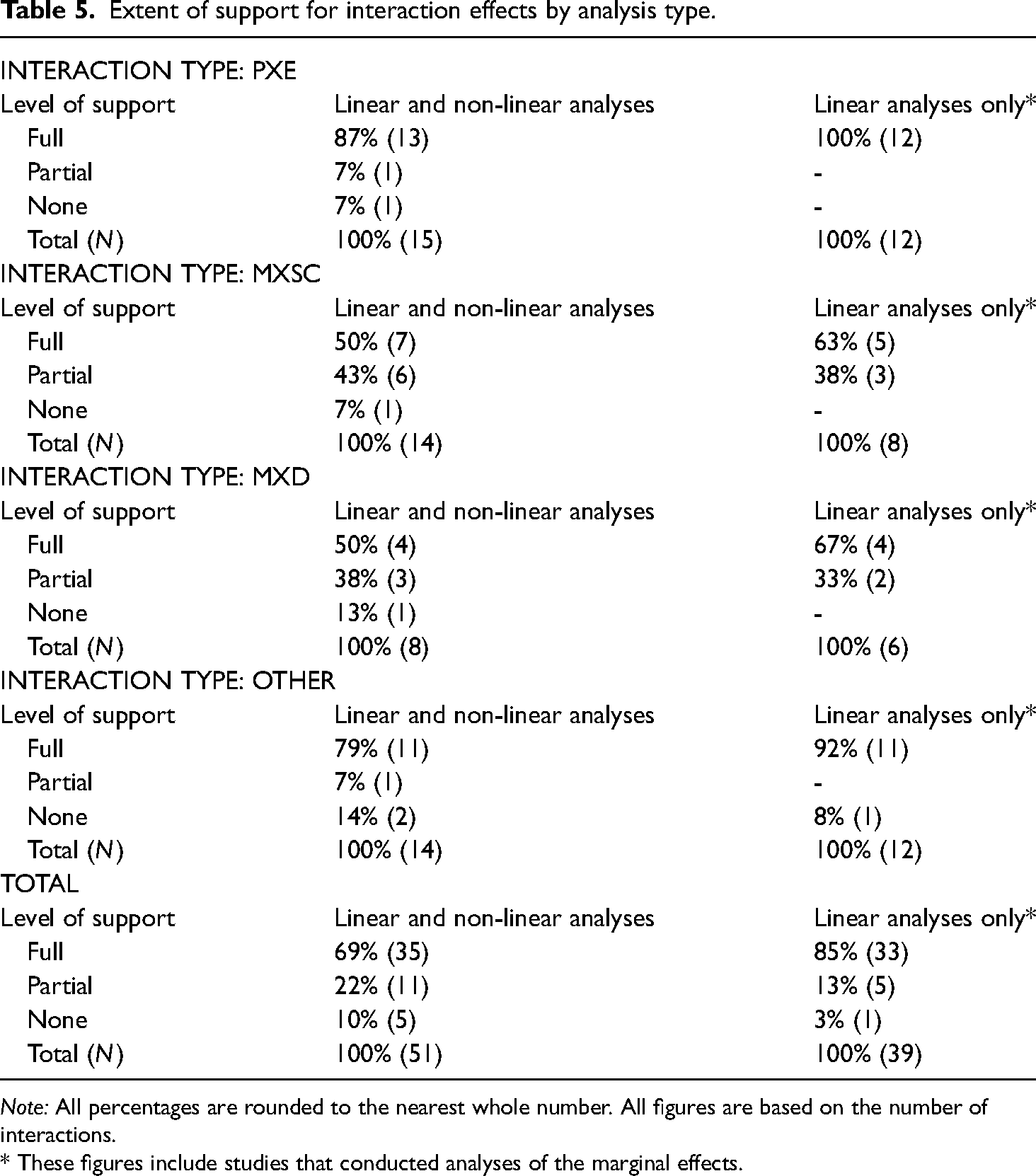
Note: All percentages are rounded to the nearest whole number. All figures are based on the number of interactions.
These figures include studies that conducted analyses of the marginal effects.
Note that many of the 37 studies included in the review tested multiple interaction relationships. Over two-thirds (n = 35; 69%) of the 51 tested interactions contained in the 37 studies reviewed found full support for the relationship proposed by or inferred from the situational model of SAT.
How does the state of empirical support compare to the findings of Pauwels et al. (2018)?
There has been a rapid increase in the rate of research investigating SAT's situational model, with 37 studies identified within the five-year period of this review (2016–2020; 7.4 studies per year), compared to the 35 studies identified by Pauwels et al. (2018) in the prior ten-year period (2006–2015; 3.5 studies per year). Overall, over two-thirds (69%; n = 35) of the 51 interaction relationships reviewed found full support for the interactions proposed by or inferred from SAT, compared to a similar proportion of the studies (72%; n = 36) reviewed by Pauwels and colleagues in 2018.
However, analysis for this most recent review indicates that the strength of empirical support varies according to the nature of the interaction relationships tested, and the data collection and analysis methods used. This review therefore highlights tensions that call the optimal appropriateness of some of these tests into question, meaning that despite a good deal of ongoing support for the situational model of SAT, there are still aspects of these tests that require improvement in the study of situational interaction within the framework of the theory. These are discussed below.
What are the problems with empirical tests of the model, and what improvements to empirical tests of the model are required
Problem 1: Interaction relationships tested
The overarching interaction proposed by the situational model is PxE, where P represents propensity (combined measure of personal moral rules/emotions and self-control) and E represents exposure (combined measure of moral context and ability to enforce its norms, e.g., deterrence). Tests of this PxE interaction can be considered tests of the ‘core’ of the model.
However, many studies in this review period did not combine these constructs as detailed above in a test of PxE. Instead, like the previous 2018 review, this review identified studies of additional interactions that were testing supplementary implications of some of the theory's core propositions including the principles of moral correspondence and the conditional relevance of controls. Such tests can be considered tests of the ‘nuance’ of the situational model. This review therefore reflects continuing advancements in the empirical literature during this period towards investigating the ‘nuance’ of the situational model beyond the ‘core’ PxE interaction (including the emerging MxD studies in this review period which replace the PxD studies reviewed by Pauwels et al. (2018)).
This review shows that the findings of these studies of the nuance of the model (MxSC, MxD, Other; Tables 2–4) showed a more mixed consistency with SAT than tests of the core model (PxE; Table 1), though the derived hypotheses, methods and interpretations of findings of these studies varied. This review identifies a trend that research investigating the principles of moral correspondence and conditional relevance of controls has mostly been conducted and interpreted in isolation (e.g., MxSC, MxD, etc.). These kinds of studies could be termed ‘Phase 1’ of tests of the nuance of the situational model. Whilst these studies contribute valuable insight into processes, examining interactions in this way fails to allow for the complex conditional inter-relationships proposed by the full situational model (i.e., they are only partial tests), which might account for the more mixed findings of these studies.
Instead, to truly test the situational model of SAT, the nuance of the interactions beyond the core PxE relationship needs to be tested simultaneously, with reference to the conditional nature of some of the proposed interaction relationships.
Last, ‘motivation’ was listed in the ‘other interactions’ section of this review due to the limited studies that investigated its effects (Table 4). For, SAT, ‘[m]otivation initiates the action process and is therefore necessary for action’ (Treiber, 2017: 58), yet is not sufficient for it since ‘…different people may respond differently to the same motivator under the same circumstances, while the same person may respond differently to the same motivator under different circumstances’ (Treiber, 2017). Given this, the crucial role of motivation within the situational model deserves more empirical attention in future studies.
Are the proposed interaction relationships appropriately addressed?
The first area of potential improvement in future studies of the situational model relates to the nature of the interaction effects proposed by SAT. As identified above, a key challenge for future research regarding the model will be the development of at least some studies that permit and can tolerate the simultaneous testing of interactions and conditional effects. These studies will make up ‘Phase 2’ of testing the nuance of the situational model.
This entails capturing at least elements of all relevant aspects of both the person (personal moral rules/emotions and self-control) and their exposure to a criminogenic setting (moral rules and ability of the context to enforce these, e.g., deterrence). In addition, new studies should find ways to capture and separate perceptions of action alternatives and the deliberative choice between them (or habit) (see already Sattler et al., 2022). Such challenges require complex and probably large study designs, but these will allow researchers to better evidence the effects of distinct mechanisms and conditional effects more clearly at specific points in the perception-choice process.
However, for this work to be most effective, SAT should be refined to state the finer-grained mechanisms of perception and choice; specify which interaction relationships should and could be tested and in what ways they need to be tested together to adequately reflect the specificity of the situational model; and also describe the limitations of tests otherwise.
Problem 2: Operationalisation of constructs
Measures of the core concepts of SAT must be valid and reliable in order to consider empirical findings and use them to initiate and guide improvements to the theory (Wikström and Kroneberg, 2022).
Operationalisation of morality
The measurement of morality (both personal morality and moral contexts) varied greatly between studies and differed in the degree to which it was an appropriate operationalisation of the theoretical construct (Tables 1–4). This has not helped in alleviating the issues of conceptual drift and incommensurability initially raised in the review by Pauwels et al. (2018).
SAT conceptualises personal morality as a set of value-based rules of conduct about what is the right or wrong thing to do (or not to do) in particular circumstances (Barton-Crosby, 2020; Wikström, 2014, p. 76; Wikström et al., 2012, p. 12). Reviewed measures of personal morality included scales capturing legal cynicism, moral identity or the ability to morally disengage, which are not adequate operationalisations of morality as conceptualised by SAT. Notably, moral emotions were lacking in many operationalisations of personal morality.
A moral context consists of the moral rules of the setting and its ability to enforce its moral rules (Wikström et al., 2012). Operationalising contexts continue to challenge researchers. During this review period, it is notable that the nature of those present in settings has been recognised as an important and often neglected part of moral contexts (Hirtenlehner and Hardie, 2016; Kroneberg and Schulz, 2018); however, this has meant that this complex and multi-faceted construct is now often operationalised in studies of the situational model of SAT using single individual-level proxy measures such as best friends’ morality (Hirtenlehner and Schulz, 2020), perceived peer delinquency (Schepers and Reinecke, 2018), a combined measure of both (Hirtenlehner and Hardie, 2016), or the presence of pro-social parents (Hardie, 2019).
Some reviewed studies did capture additional aspects of moral contexts, such as structural and social characteristics of home neighbourhoods (Antonaccio et al., 2017), schools (Cochran, 2016) and violent settings (Brauer and Tittle, 2017), though these were also unidimensional measures of context.
Previous PADS + research ambitiously developed a single binary situational-level measure to characterise criminogenic moral contexts that combine individual-, situational- and environment-level data from multiple sources and data collection methods (Wikström et al., 2010, 2012). Researchers in this review period further built on this earlier work to model the effect of the various aspects of the moral context (Wikström et al., 2018). This powerful and complex measure of context is costly to replicate, however.
Studies using experimental methods that allow for the manipulation of features of settings (Brauer and Tittle, 2017; Craig, 2019; Eifler, 2016; Pauwels 2018a, 2018b) continue to show great promise in this review period, but again the contextual features still lack complexity.
How can we refine morality in terms of measurement and operationalisation?
The review findings make clear that appropriately operationalising constructs remains an ongoing challenge that was initially highlighted by Pauwels et al. (2018). Indeed, as they concluded, this inconsistency in operationalisation also most likely accounts for some of the mixed results found in this review. The SAT morality concept continues to be only loosely operationalised by some studies of the situational model of SAT. In addition, this review additionally notes that SAT states that the moral emotions of guilt and shame reflect the relative strength of a particular moral rule and should be included in measures of personal morality (Wikström et al., 2012). Empirical findings that moral emotions exert a stronger influence on offending those holding weak moral rules (Trivedi-Bateman, 2019) reinforce the need for future research to include moral emotions when operationalising personal morality, though some clarity regarding the interactive or additive nature of this combined construct is required.
The difficulty in operationalising moral contexts is primarily due to the variability inherent in this construct, especially when utilising survey-based measures (individual-level data). Despite developments observed during this review period, future studies must continue to address the complex nature of moral contexts, for example, that the moral rules of the people present in those settings can conflict with each other (e.g., parents vs. peers), and that moral rules can conflict at different levels of the same context (e.g., cultural norms and legal rules), though arguably the most salient moral rules might be those most proximal in settings.
Some researchers go to great lengths to render complex and multiple aspects of moral contexts to single variables (see above; Wikström et al., 2010, 2012, 2018); however, this is complex, time-consuming and expensive. Arguably, despite even these exceptional data, the measure of the moral context is still quite a crude reflection of reality.
Additionally, it remains a challenge that what is criminogenic about settings varies dramatically according to several factors (e.g., crime type, sample, context, etc.), which in turn makes it difficult, and not necessarily desirable, for researchers to consistently measure exposure across studies and offences. In future, we need to capture far more nuance in moral contexts (e.g., interpersonal interactions), while at the same time being more discerning as to what features of the moral context would be relevant to particular samples for particular acts of rule-breaking (see also, Hardie, 2017: 318–321). For example, anonymity could be argued to be more relevant in forming a measure of the moral context for investigations of cyberbullying than it would be for school yard bullying, while peer influence and supervision may be of more relevance for youths than for adults. While various technological advances may cautiously be fruitfully utilised to better capture moral contexts (for discussion and examples, see, Bernasco et al., 2022; Hardie, 2017 : 319; Hardie and Wikstrom, 2021; Snaphaan and Hardyns, 2021), further theoretical development of SAT would also help in clarifying these issues and priorities.
Operationalisation of controls
Within SAT, deterrence is defined as ‘when a setting's deterrent qualities (perceived threats of immediate or future consequences) succeed in making a person act in accordance with its moral norms when she or he considers breaking them’ (Wikström et al., 2024: 57). Thus, the perceived ability of the setting to enforce its moral norms and the extent to which a person is susceptible to the deterrent cues in a setting is crucial to the role of deterrence in action decision-making. This emphasis on perception makes deterrence a situational construct within SAT because to be deterred, a person must first interact with the features of the setting that enforce its moral norms. This situational conception of deterrence is supported by the literature on differential deterrability (for discussion, see, Hirtenlehner, 2020). As observed during the previous review period, generalised measures of risk perceptions lack specificity as to whether an individual refrains/refrained from an act of rule-breaking due to the particular deterrent cues (enforcement feature) of the setting they were operating in at the time an act of crime was considered (Pauwels et al., 2018). In continued contrast to SAT's concept of deterrence, most studies in this review period also operationalised deterrence as generalised measures of the perceived risk of detection and/or punishment (Tables 3 and 4).
Many of the findings involving or regarding self-control in this review were based on individual-level data and apply the abridged version of the Grasmick et al. (1993) scale used in the PADS + study (Wikström et al., 2012) (Tables 1, 2 and 4). However, as highlighted in the previous review (Pauwels et al., 2018; see also Hasselhorn et al., 2024), the Grasmick scale was originally developed to investigate Gottfredson and Hirschi's generalised trait concept of self-control, whereas SAT's concept of self-control is a situationally variable ability to adhere to one's own personal law-abiding moral rules when influenced to act otherwise (Wikström et al., 2010; Wikström and Treiber, 2007, 2016). In operationalising self-control as a trait-like concept (via the use of the Grasmick scale or similar), as opposed to capturing its situational nature implied by SAT, there is ‘discrepancy between conceptualization and operationalization’ of the construct, thereby introducing a degree of systematic error (De Buck and Pauwels, 2022: 138; see also, Hasselhorn et al., 2024; Kroneberg and Schulz, 2018). Indeed, this continued discrepancy has likely contributed to the ongoing mixed findings regarding the effect of self-control found within this review period.
How can we refine controls in terms of measurement and operationalisation?
The operationalisation of controls (deterrence and self-control) did not change much between the two review periods; though recent vibrant discussion about the concepts (e.g., De Buck and Pauwels, 2022; Hasselhorn et al., 2024; Hirtenlehner and Schulz, 2020; Hirtenlehner and Leitgöb, 2021, 2024) will hopefully continue and result in the development and testing of more specific and eventually more appropriate measures.
The recent and growing empirical attention to the situational aspect of deterrence is very welcomed; however, we observe that studies must address the issue that which particular ‘enforcement feature’ is relevant and salient to individuals in a particular setting will differ according to the crime type and sample because there are enforcement features that act as deterrents beyond the threat of legal sanctions or reprimand that require further consideration. In addition, within the framework of SAT, it is possible that enforcement features may also, via different mechanisms, play a role in other aspects of moral contexts. For example, the presence of monitors (e.g., parents) could alter the perceived likelihood of detection and sanction but might simultaneously (by virtue of their own strong moral rules), also influence the perceived moral rules of the setting (Hardie, 2017). Nuanced studies of deterrence, influence and monitoring should take care to delineate these mechanisms and find ways to test them independently to avoid erroneous conclusions based on conflated evidence.
The continued disparity between the concept and measure of self-control in tests of the situational model of SAT means that by now, there is wide agreement that there is a need to develop a scale that more accurately depicts the theory's situational definition of self-control (e.g., De Buck and Pauwels, 2022; Hirtenlehner, 2020; Kroneberg and Schulz, 2018; Pauwels et al., 2018). Recent work to develop such a scale that captures individuals’ ‘ability to adhere to their morality when challenged’ demonstrates promise and warrants further discussion and testing (Hasselhorn et al., 2024). While development of a more appropriate generalised self-control scale is welcomed for individual-level studies, we assert that no such individual-level survey scale can fully capture the situationally variable nature of this construct as defined by SAT, and that ideally, at least some future tests of the complex and conditional role of self-control within SAT's situational model should focus on collecting situation-level measures of self-control.
Problem 3: Study design
Nine of the 51 reviewed investigations of interactions were conducted at the situational level, seven of which (78%) found full support, compared to 67% (n = 28) of the 42 individual-level findings in the reviewed studies. While there are certainly instances of situation-level data being used in the reviewed studies (24%), only four of those used real-world data collected using a Space-Time Budget methodology rather than randomised hypothetical scenarios, and the vast majority (76%) used individual-level survey-based measures of exposure. The findings of many of these studies were as supportive of the propositions of SAT as those using Space-Time Budget or scenario measures, perhaps demonstrating the remaining utility of individual-level data in testing person-environment interactions – providing that conclusions are drawn at the appropriate level and limitations regarding the assumption of co-occurrence are acknowledged (Hardie, 2020).
What improvements are required in terms of study design to maximise the appropriateness of empirical tests?
The novel perspective offered by SAT's situational model brings with it implications for the kinds of study designs and data collection methods required to examine its propositions. Chief among the implications of the situational model is the need for researchers to recognise and acknowledge differing levels of exposure data, lest they fall foul of an ecological fallacy (Hardie, 2020).
Within the SAT framework, Hardie states that ‘[e]xposure refers to the convergence of a person (and their circumstances and characteristics) and an environment (and its circumstances and characteristics) in time and space’ (Hardie, 2020: 37). Therefore, an ecological fallacy occurs in situational research when ‘inferences about the outcome of situations (person-environment convergences) are deduced from inferences about the person or environment which experienced those situations’ (Hardie, 2020: 27).
For example, exposure data gathered at either the individual or environmental level (e.g., traditional questionnaires and community surveys, respectively) are limited to analysing dependence (statistical interaction); conversely, exposure data captured at the situation-level (Space-Time Budgets or scenarios; see Hardie and Wikström, 2021; Wikström et al., 2012, respectively) are capable of evidencing convergence (situational interaction) (Hardie, 2020).
Given this, the findings of studies that have appropriately gathered and examined situation-level exposure data should not easily be dismissed by any contradictory findings from studies of statistical interaction in individual- or environment-level exposure data, even when those situation-level studies are smaller or less numerous (Hardie, 2020). Indeed, Antonaccio et al. (2017: 231) acknowledge that ‘…because of the existence of supportive findings of prior research using spatiotemporal data…’ their contrary findings regarding the interaction between propensity and exposure were likely due to data limitations (having used individual- and environmental-level data), rather than indicating a lack of support for the situational model. Primarily this is due to the ability of situation-level data to satisfy the assumption of co-occurrence, as it can spatiotemporally link individuals to the environment to which they were exposed when a particular behaviour was performed – thereby evidencing convergence (Hardie, 2020). In doing so, researchers can move beyond identifying moderating variables (the primary function evidenced when studying dependence) and evidence the causal mechanisms underlying behaviour, free from problematic assumptions of co-occurrence.
This important issue was alluded to by Pauwels et al. (2018) in their previous review; however, it has been increasingly appreciated and explicitly acknowledged in the reviewed studies (e.g., Antonaccio et al., 2017; Pauwels, 2018a; Wikström et al. (2018)) and developed in wider literature during the period covered by this review (e.g., Hardie, 2020; Wikström and Treiber, 2016). However, this review shows that studies using situation-level data, particularly real-world situation-level data, are still rare. Such data are crucial for studying the role of complex multi-faceted contexts in the more nuanced simultaneous interaction relationships that are now at the forefront of research testing the situational model of SAT.
Therefore, more future research designs should strive to measure exposure at the situation level, via existing methods (Space-Time Budgets or randomised scenarios) – or by developing alternate methods to capture the spatio-temporally relative convergence of features of individuals and environments (Hardie, 2020; Wikström and Kroneberg, 2022). One such novel and innovative method is the ‘method of experiential cascades’ which aims to deconstruct interactions and experiences (methodofcascades.com; Roman, 2022) and has major potential if applied to the study of situational interaction.
Otherwise, by experimentally manipulating features of settings, scenario studies (such as those detailed in this review) and experiments (e.g., using wearable technology to facilitate immersive manipulated virtual reality) can provide a powerful way to study moral contexts and situational interaction within the framework of SAT (Hardie, 2020). A virtual reality scenario methodology has already demonstrated utility for examining individual responses to environments in the instigation of violence (Van Gelder et al., 2019), and a new project using the ‘method of cascades’ (Roman, 2022) and immersive virtual reality in an RCT aims to study police tactical decision-making, conflict de-escalation and positive action outcomes (VR-TACTIC), though neither do so within the framework of SAT. Recently a new methodological framework that ‘utilises real-time decision-making by study participants immersed in experimentally manipulated VR environments, along with process tracing techniques that allow researchers to open the black box of decision-making’ has been promisingly applied to the Situational Model of SAT (Herrmann, 2024), with empirical testing ongoing.
Problem 4: Analytical strategy
An additional analysis shows that the findings of the review are different when disaggregated by analytical methodology. Impactfully, if findings from analyses using solely non-linear methods (and with no assessment of marginal effects) to assess interaction (n = 12) are excluded from the review (see Table 5), the proportion of the interactions tested that evidence full support of the situational model rises to 85% (n = 33 of 39). This notable difference in results suggests that the analytical method selected for assessing interaction really is crucial to the findings. These differential findings highlight how researchers should take special care when devising and conducting analysis and add to the ongoing debate about the most appropriate methods for assessing interaction that is discussed next.
What is the most appropriate analytic strategy to assess situational interaction?
Although there is room for improvement, analysis of situation-level data for evidence of situational interaction arguably demands less complex methods than individual or environment-level studies since the interaction is inherent in the data structure rather than in the analysis (Hardie, 2020). However, the analysis of situation-level data is ripe for the development and application of more sophisticated and powerful analytical methods, which will likely come from outside of Criminology. A key challenge for the analysis of convergence at the level of situations is to take account of measurement error without deconstructing the situation-level data (Hardie, 2020).
Alternatively, the more common studies of non-situation-level data require analysis of statistical interaction (Hardie, 2020). Almost all of the reviewed studies of statistical interaction that used parametric analyses (i.e., OLS regression) found support for their respective interaction effects, while those using non-parametric, for the most part, (e.g., negative binomial regression, Tobit regression, etc.) did not. The fact that this review reveals apparent differences in the level of support for SAT by the analytical method used (Table 5) deserves attention in future. At the very least, as others have already advised, due to methodological complexities in assessing statistical interaction, studies should conduct a range of different analytical techniques on the same data (Hardie, 2017, 2020; Hirtenlehner and Hardie, 2016). However, we further argue that this striking finding demands more research that specifically aims to evidence the relative appropriateness of various analytical methods for studying interaction. For example, methodologically focussed studies could use multiple different analytical methods (i.e., including both linear and non-linear methods) on the same data because differences between studies are held constant (e.g., design, measures, data collection tools, data level, sample composition and country).
A starting point for such statistical methods research could be that studies during this review period have already cited evidence that while the use of non-parametric analyses helps to overcome the skewed nature of offence data that is aggregated to individuals or environments, they often do not perform well in capturing significant interaction effects. Non-parametric methods should be used in conjunction with graphical representations to aid in interpretation (Greene, 2010) or, if using negative binomial models, analyses of the marginal effects (Hilbe, 2011). Examples of these techniques can be seen in the studies conducted by Barton-Crosby and Hirtenlehner (2020), Hirtenlehner (2020) and Gerstner and Oberwittler (2018), which may help to explain why these studies, despite using non-parametric analyses, found evidence of the respective statistical interactions they were testing, and why others using other non-parametric approaches did not.
Future research should also consider alternative techniques made more readily accessible by recent advancements in statistical computing, such as SEM (e.g., De Buck and Pauwels, 2022; Rose and Hardie, in press; Schepers and Reinecke, 2018), and for larger samples (as is possible with STB data) machine learning techniques, such as the artificial neural network modelling approach used by Wikström et al. (2018) and the ‘method of experiential cascades’ (Roman, 2022). For a detailed discussion of various approaches to examining interactions under the framework of SAT, see Hardie (2020).
In addition, future empirical tests of SAT that better reflect the simultaneous and conditional nature of the interactions inherent in the situational model may require different or improved analytical methods. Examples of this can already be seen in the analytical methods of recent studies that attempt to separate the perception and choice parts of the dual process situational model. Such techniques include the use of the two-part model and the Heckman selection model (Eifler, 2016), sequential logit models (Eifler and Leitgöb, 2018), and double hurdle models (Sattler et al., 2022). In particular, methods that avoid the arbitrary categorisation of data and concepts that is required by group comparison methods should be explored in an effort to prevent over-simplified tests of the nuance of the model. The ‘method of experiential cascades’ (Roman, 2022) may again prove useful in this regard.
RQ4: What theoretical clarifications and developments would be most beneficial at this point?
The first aim of this article is to guide more appropriate empirical tests of the situational model, but this review of empirical studies and findings has also highlighted some challenges to the theoretical specification of the situational model of SAT, which, unless addressed, will continue to hamper empirical specification (aim two).
The various required theoretical ‘tightenings’ should arise from theoretical debate, rather than from varying interpretations of empirical tests (see also, Bunge, 1999; Tittle, 1995; Pauwels et al., 2018). Therefore, the second aim of this article is to collate, identify, draw out and summarise theoretical areas of confusion, and lack of clarity or specificity. This can provide a catalyst for theoretical debate that can improve the depth, breadth and precision (Tittle, 1995; see also, Wikström and Kroneberg, 2022) of the situational model of SAT. In turn, such refinements can help to improve the appropriateness and specificity of empirical tests of the model. Whilst making these recommendations, we also recognise that SAT is already one of the most detailed and nuanced theories currently guiding criminological research.
Besides the theoretical refinements and elaborations to the role and measurement of SAT constructs, mechanisms and proposed interactions already discussed, it would also be instructive for SAT to clarify and assert the nuance in the situational model. In historical context, SAT has been responding to the traditional neglect of differential perception, and the dominance of controls, in explanations of crime. This means that presentations of the theory to date have emphasised where it differs from previous theories of crime, including in necessarily simplified diagrams. Some empirical studies of the principles of moral correspondence and the conditional relevance of controls have taken too big a leap in their interpretation of this emphasis, and present or operationalise SAT without the nuance that is actually present in original presentations of the theory. Statements by SAT suggesting something is primarily the case (e.g., that self-control and not deterrence is primarily relevant to deliberations when personal moral rules are strong and the moral rules of the context are weak) or that one aspect is more fundamental (e.g., moral rules over controls in the process by which PxE interact to result in action) does not preclude the opposite. Similarly, for studies of interactions in isolation, it is convenient for methodological and analytical purposes to simplify SAT and remove nuance in order to empirically study the processes it submits. However, interpretations of such empirical tests should acknowledge that it is the test and not the theory that cannot allow for real-world violations of the simplicity imposed by the empirical test. Furthermore, the fact that real-world complexity is accommodated and can be accounted for in the situational model of SAT could be emphasised in future presentations of the theory.
Following on from tests of the core PEA hypothesis (PxE interaction), almost all tests of the nuance of the situational model focussed on the interaction relationships highlighted in this review (‘Phase 1’). Whilst these tests can provide evidence that is consistent with the situational model of SAT, they are unable to falsify the theory because they insufficiently characterise the complexity of the principles of moral correspondence and the conditional relevance of controls. Recent quantitative (De Buck and Pauwels, 2022; Hirtenlehner and Leitgöb, 2021; Rose and Hardie, in press) and qualitative (Rose, 2023) studies build on Schepers and Reinecke (2018) work approximating such theoretical complexity by analysing the effect of controls while accounting for differences in terms of varying moral configurations between person and setting. These kinds of studies could be termed ‘Phase 2’ of tests of the nuance of the situational model. While such studies represent advancements in tests of the situational model, these too ultimately fall short of accommodating real-world complexity due to insufficient variability in the sample investigated (e.g., school students, Schepers and Reinecke, 2018; small sample, Rose, 2023), poor measures of controls (see discussion point of RQ3 problem 2), key variables (e.g., moral rules due to relatively morally acceptable crime type studied, Rose and Hardie, in press) or arbitrary categorisations (i.e., creating groups by splitting the sample on key variables of interest, De Buck and Pauwels, 2022; Hirtenlehner and Leitgöb, 2021; Rose and Hardie, in press; Schepers and Reinecke, 2018). In addition, the theoretical clarifications called for in this paper will underpin improvements to these ‘Phase 2’ tests of the situational model of SAT and their interpretation.
Conclusion
This review consolidated five years (2016–2020) of research regarding SAT's situational model and analysed the studies and findings in order to reflect on problems and questions raised during this period. By addressing and analysing four research questions, the paper used the review findings and insights along with other literature, to specify directions and priorities that will benefit future empirical testing and ongoing refinement of the theory.
This review of empirical research highlighted the ongoing utility of SAT's situational model in explaining acts of crime and rule-breaking behaviour. However, we also identified a slight increase in conflicting results during this review period compared to the previous review.
We argue that many of these discrepancies reflect the increasing nuance in the tests of the model that we identified in the review. In their previous review, Pauwels et al. argued, for example, that the ‘gap between concept and measurement…is partially defused by the fact that survey-based and STB-based measures of exposure do not yield different results. The interaction effect according to which exposure matters particularly for high propensity individuals proves to be fairly robust’ (2018: 48). In contrast during this review period, as researchers have aimed for empirical tests of the detailed situational model that are more specific, comprehensive and sophisticated, such gaps have become more problematic. Throughout this systematic review of 37 studies and their findings, we have provided recommendations for future, increasingly nuanced, research, and in some cases the prior theoretical development or refinement required. The aim of these recommendations is to facilitate the most sophisticated but also appropriate tests of the situational model of SAT.
Whilst it is important to protect against type 1 error, before concluding ‘no interaction’ or ‘no support’ for the theoretical model, researchers should think hard regarding sources of type II error in their studies. These can come in many forms as highlighted in this review, primarily sub-optimal data (i.e., not situational-level) and inappropriate analysis (see also Hardie, 2020), but also poor operationalisation of constructs, insufficient samples and inappropriate specification of the test.
Ultimately, we advocate collecting situation-level data that captures the convergence of individuals in (ideally real-world) environments, with situation-level measures where possible, particularly of self-control and moral contexts (including aspects of both setting moral rules and deterrence). Situation-level data more appropriately captures the situational nature of SAT concepts, avoids the difficulties associated with analysing statistical interaction, and facilitates the testing of the more nuanced and simultaneous interaction relationships inherent in the situational model of SAT. Additionally, to increase our understanding of some of the less examined aspects of the situational model (i.e., the habitual pathway, motivation) the SAT literature would benefit from the investigation of less serious offences and acts of rule-breaking.
Crucially, however, SAT must provide further clarification on some of the more contentious points of the model. Those identified in this review as most pressing are theoretical issues that relate to the operationalisations of key constructs (i.e., morality, self-control, deterrence) as outlined above, the nuance of the conditional role of controls, and further specifics (e.g., about moral contexts) that will aid the simultaneous testing of interaction effects relevant to SAT.
In conclusion, this review confirms that the empirical support for SAT's situational model continues to grow. The gathering momentum of further investigation and discussion is certainly warranted. However, future studies should heed the specifics of our recommendations in order to provide adequate nuanced tests of the situational model of SAT that are capable of raising appropriate searching questions for theoretical developments to answer.
Footnotes
Acknowledgements
We thank the many researchers who responded to our requests for suggestions of studies to be included in the systematic review. Special thanks go to Dr Angela Watson and Professor Barry Watson for their feedback on the systematic review contained in this paper, and to the European Journal of Criminology Editorial Team and our anonymous reviewers for their instructive and productive evaluations of previous drafts of this manuscript.
Funding
The author(s) disclosed receipt of the following financial support for the research, authorship, and/ or publication of this article: The systematic review reported in this paper was supported by the Australian Government-funded Research Training Program Scholarship awarded to Chae Rose. During the production of this manuscript, Beth Hardie was a self-funded independent scholar.

Notes
Correction (March 2025):
Article has been updated to include reference ‘Eifler and Leitgöb, 2018’ in the text and reference list.