




Abstract
This study examines neighbourhood effects and their impact on inhabitants’ susceptibility to radicalization by linking standardized survey data in three German cities to data from government statistics, followed by a multilevel analysis from a total of 145 units. This allows us to control for both local and individual factors with respect to the susceptibility to radicalization. Findings show that an increased level of self-control and income satisfaction have a deterring effect against the susceptibility to radicalization. Digital activities, on the other hand, have a positive effect on susceptibility. Sociostructural characteristics at the neighbourhood level do not show a clear effect on the susceptibility to radicalization, but differences in ‘legal cynicism’ and ‘collective efficacy’ are evident in a varying pattern across the three cities under study. In the city with the highest level of social segregation, legal cynicism had a positive effect and collective efficacy had a mitigating effect on the susceptibility to radicalization. The results show that the local environment should be taken into account when explaining radicalization.
Keywords
Introduction
Radicalization to violence is a serious and latent risk for European countries, including Germany, which is the focus of this paper. The violence manifests itself in terrorist violence from various ideological groups, such as Islamist and right-wing extremist groups. Some of this terror is external, coming from foreign extremists; some is home-grown (Bundesministerium des Innern und für Heimat, 2021). All these acts emerge from individual susceptibility to radicalized ideologies. Germany, the largest country in the European Union, has faced several terrorist attacks in recent years, such as the right-wing extremist murder of nine people in Hanau in 2020, and the Islamist attack on a Christmas market in Berlin in 2016 that left 13 people dead. However, politicians and the media – and researchers – often ask how an attack could have happened only after it has taken place. Only then are the biographies of extremists, their socio-demographic backgrounds, and the extremist organizational structures around them examined to identify breakpoints that might explain their radicalization. However, many approaches that analyse individuals or organizations fall short due to a lack of generalizability and a failure to link personal and neighbourhood factors.
There is evidence that extremists use spaces in a targeted way, as shown by public prayers by Islamist groups in city centres, but also that radicalization is more likely in some places than others. A study of the eastern German city of Bautzen, for example, shows that a climate of hatred has developed there that encourages the exclusion of refugees (Rees et al., 2022). An evaluation by the Berlin Office for the Protection of the Constitution shows that the Islamist scene is concentrated in a few districts and is presumably recruited from there (Senatsverwaltung für Inneres und Sport des Landes Berlin, 2017).
The current state of knowledge regarding the social (as opposed to individual) factors influencing radicalization is limited. One unresolved question is the significance of the local context in which radicalization processes occur. If radicalization is not a random phenomenon, then it is also not a random occurrence. This study begins to address this question by analysing not only the influence of individual characteristics but also local spatial structures and their effects on the susceptibility to radicalization. Consequently, we investigate the factors that increase the likelihood of radicalization, rather than the process of radicalization itself. To this end, we examine whether spatial characteristics also influence the susceptibility to radicalization.
The analysis of neighbourhood effects to explain social action is a well-established area of urban sociology research (Oberwittler, 2004; Sampson, 2012). However, it is a relatively new aspect of radicalization research (see, e.g., Bouhana, 2019; Ilan and Sandberg, 2019). By integrating both lines of inquiry and empirically examining potential neighbourhood effects, this study makes a significant contribution to urban sociology research and conflict research. By incorporating neighbourhood effects into the explanation of radicalization susceptibility, we can employ compelling theoretical frameworks while also accounting for the social conditions that facilitate radicalization. The research question for the subsequent study is: What neighbourhood effects can be identified in relation to radicalization susceptibility? The focus of the following empirical analysis is Islamist radicalization. The current state of research on neighbourhood effects as well as on radicalization and the local environment will be reviewed below. The paper then provides an evaluation of neighbourhood effects based on data from a population survey in three major German cities.
The current state of research on individual risk factors for radicalization
Radicalization can be conceptualized as a process whereby deviant behaviour is religiously or ideologically justified, thereby becoming socially legitimized. This justification can range from advocating violence to the actual use of violence. The end of this process is extremism, which can lead to terrorist acts. However, the predisposition for extremist ideology is a crucial precondition. There are several possible characteristics and pathways that explain radicalization. In his list of potential explanatory factors for radicalization, Borum (2011) breaks down the various models into different aspects. Upon examination of the characteristics, it becomes evident that they are often aspects of negotiation between the individual and society. Examples of this include ‘Individual Radicalization through Political Grievance’ (Borum, 2011: 27) and the initial stages of Rambo's Stage Model (Borum, 2011: 23), in which the context of the individual is emphasized. This suggests that an interaction between individual and contextual factors can be assumed in general. The most pertinent characteristics that render an individual susceptible to radicalization are delineated below. Thereafter, the contextual characteristics for which there is evidence that they may influence these individual characteristics are discussed.
The scientific analysis of the individual factors that contribute to radicalization is challenging due to the lack of a single, universally evidence-based theory. Both strands of analysis, the individual and the contextual, are important for our current research. On the one hand, there is the analysis of risk factors for radicalization (Emmelkamp et al., 2020). On the other hand, researchers examine radicalization trajectories (McCauley and Moskalenko, 2017), though without any commitment to causality (Gøtzsche-Astrup, 2018). Consequently, radicalization does not have a single cause but rather individual variations. This makes it challenging to model and predict yet also worthwhile to study individual factors empirically and test their predictive power. Additionally, individual factors are rarely understood in the context of spatial conditions. Veldhuis and Staun (2009) present the root cause model (Veldhuis and Staun, 2009), which elucidates the interconnection between individual and contextual factors, such as space, and explains the susceptibility to radicalization. However, the root cause model does not directly predict the interaction of a specific bundle of characteristics that explain susceptibility to radicalization. It is evident that factors can influence an individual's openness to extremist ideology, messages and groups.
With respect to the causes of radicalization, individual influences can be examined in greater detail and linked to action-theoretical presumptions. Accordingly, if we assume that actions are norm-based and that specific norms influence a person's susceptibility to radicalization, then local influences related to the susceptibility to radicalization can also be investigated. In case-based attempts to explain radicalization, similar patterns have been repeatedly identified as influencing the susceptibility to radicalization. These include indignation over perceived grievances (Veldhuis and Staun, 2009), the search for biographical meaning or answers (Kruglanski et al., 2014), cognitive openness to ideological meaning-making (Wiktorowicz, 2005), being approached by extremist groups, and group dynamics (Horgan, 2008). Digital activities also exert a significant influence (Valentini et al., 2020), although it is necessary to distinguish between individuals without extremist attitudes and those who are already undergoing a radicalization process. While the group is concerned with the coherence of narratives, individuals who are already undergoing a radicalization process prioritize communication with like-minded individuals, with the potential to plan an attack in the most extreme cases (Gill et al., 2020).
These patterns are employed to derive characteristics that can also be operationalized empirically (Emmelkamp et al., 2020; van Hemert et al., 2014; Wolfowicz et al., 2020), which is particularly pertinent to our present study. There are three essential characteristics that facilitate the susceptibility to radicalization, but this is not exhaustive. First, there is vulnerability, which can be understood in terms of low resistance, for example, to extremist narratives. This is empirically understood in different ways, including through a lack of self-control (Costello and Laub, 2020). Second, there is relative deprivation, which in turn generates frustration. It is important to note that poverty itself is not a risk factor, but rather the perception of unjustified economic disadvantage (D’Ambrosio and Frick, 2007). This can be operationalized by satisfaction with one's income. Third and finally, there are experiences of discrimination, such as the feeling of being unjustifiably disadvantaged due to belonging to a minority. This can be operationalized through individual experiences of discrimination based on origin or ascribed cultural affiliation. A review by Zick et al. (2019) indicates that there is no single general factor or specific disposition that can be assumed to be the sole cause of prejudice. Rather, it is a combination of characteristics that must be considered, and the personal disposition of any individual must be taken into account depending on the context in which that individual is socialized.
Nevertheless, this does not negate the possibility of a correlation between the aforementioned characteristics and susceptibility to radicalization. In a broader preliminary study, we conducted 33 group interviews with young people from diverse backgrounds in North Rhine-Westphalia. The objective was to ascertain whether extremist narratives (in this case, within the Islamist context) were compatible with the interpretive frameworks of young people. The results indicate that authoritarianism, experiences of discrimination and mistrust in democracy, in particular, were associated with an increased likelihood of religiously motivated radicalization (Kurtenbach et al., 2020). This can be viewed as an indication of how individuals may attempt to compensate for their relative deprivation and experiences of discrimination. A second study, which is also fundamental to the present investigation, analyses violent extremist intentions, which can also be understood as a form of susceptibility to radicalization. Based on a population survey (n = 1502) in Germany, Rottweiler et al. (2022) employ structural equation models to examine the effects of strain, self-control and legal cynicism on radicalization susceptibility. Their approach is also beneficial because it employs a systematic integration of spatial characteristics to explain individual violent extremist intentions. Building on this, the present study employs a hierarchical data structure to examine the effect on susceptibility to radicalization. This approach allows for a sequential advancement of knowledge.
Neighbourhood effects on the susceptibility to radicalization
The assumption that variation in a susceptibility to radicalization at the neighbourhood level is not a coincidence but an expression of the neighbourhood's influence is based on the described connection to the action-theoretical perspective. If action is norm-based and if norms change, the influence itself can also be examined. The influence of spatial–contextual factors on norms is evidenced by urban sociological research on neighbourhood effects (Minh et al., 2017; Sharkey and Faber, 2014). The work of Wilson (1987), which described socialization effects not only in neighbourhoods but also as a consequence of them, provides a foundation for this understanding. The studies indicate that behaviours are not only observed but also rationalized and learned in disadvantaged neighbourhoods (Kurtenbach, 2017). Individual norms are adapted in such a way that they correspond to locally perceived challenges, which may include the social legitimization of violence (see also Anderson, 1999; Heitmeyer et al., 2019; Sharkey, 2006).
Research on neighbourhood effects has proposed various mechanisms and models designed to reveal specific neighbourhood effects. Galster (2012), for example, identified four mechanisms – institutional, environmental, social–interactive and geographical – as causes that could lead to disadvantages based on one's neighbourhood. Network models assume that contacts in the district lead to the learning and adoption of context-specific behaviours (Crane, 1991). A distinct model, designated as the ‘role model’, is analogous; however, it does not necessitate direct contact between actors within the area but rather the observation of behaviour as a potential influencing factor (Friedrichs and Blasius, 2003; Wilson, 1987). In contrast, the relative deprivation model posits that relative comparisons are a primary cause of disadvantage, as they lead to social shame and a lack of solidarity in the context of resource scarcity (Häußermann et al., 2010: 17). The spatial mismatch model, in contrast, takes an organizational perspective and concludes that disadvantages result from the inadequate provision of social and public facilities in a disadvantaged area as well as from fragmentary links to the labour market (Gobillon et al., 2007). However, it would be shortsighted to ignore the spatial–contextual embedding in these explanations. This is because people interpret their environment both situationally (Wikström et al., 2012) and in terms of the relationships they have in the place (Howley et al., 2015). Perceptions of trust in the neighbourhood play a particularly important role. For instance, interpersonal trust among neighbours is positively correlated with willingness to provide support (Gorbunova et al., 2015; Sampson et al., 1997). This experience of solidarity can serve to mitigate the impact of individual characteristics that may also promote susceptibility to radicalization.
All of these approaches posit an effect on the social acceptance or rejection of norms. In order to answer the research question, however, it is necessary to specify how the effect(s) of a neighbourhood lead to the susceptibility to radicalization. Two paths suggest themselves. The first concerns a person's information world, which encompasses the everyday experiences with information from the neighbourhood as well as the digital space (visiting websites with religious or political content) (Valentini et al., 2020). The second concerns the individual's interpretation of available alternatives; here, the concept of self-control (Gottfredson and Hirschi, 1990) is employed. It is hypothesized that individuals exhibiting impulsive and violent behaviour in conflicts are less capable of resisting ideological justifications of such behaviour.
These models thus present an explanatory analysis of neighbourhood effects, but not of the susceptibility to radicalization in particular. Here, Bouhana's S5 model is fundamental to explain the link between neighbourhoods and the vulnerability for radicalization. ‘The main purpose of S5 is to guide the formulation of inferences about what kinds of people in what kinds of contexts at what times should be considered “at risk”’ (Bouhana, 2019: 11). This model makes two important theoretical advances. First, it systematizes a link between context and the individual; and second, it explains why susceptibility to radicalization varies across places and individuals (Bouhana, 2019: 15). This is because there are characteristics at both the individual and contextual levels that interact, which is why susceptibility to radicalization always follows a contextual logic.
This suggests that a neighbourhood exerts a norm-influencing effect. Individuals in a neighbourhood may organize their own norms through experiences of disadvantage, thereby becoming able to organize their everyday lives as successfully as possible. However, this may also increase their own susceptibility to radicalization. The mechanism would then be that the norms that promote susceptibility to radicalization are influenced by the negotiation and learning processes in the neighbourhood itself. One potential explanation for the emergence of extremist ideologies is the existence of a predisposition towards such ideologies. This predisposition can manifest in the justification of deviant behaviour, which in turn can lead to radicalization. This process is ideologically charged and fosters long-term collective goals that are aligned with a ‘just society’ (according to the logic of the respective extremism). Therefore, it can be argued that consent to breaking the norms precedes the process of radicalization (Wikström and Bouhana, 2017). In conclusion, this process is contingent upon a multitude of factors, which also explains why radicalization is observed with less frequency than other forms of deviance, such as criminality or norm-compliant behaviour. Furthermore, highly radicalized individuals tend to interact with deviant subcultures.
The existence of this hypothetical mechanism cannot be assessed based on the current state of research, as there are only a few studies on radicalization from a neighbourhood perspective. These studies are usually based on the idea of the so-called crime–terror nexus, which itself is based on the observation that numerous ISIS supporters and those who left Germany previously belonged to a criminal milieu (Basra et al., 2016). Specifically, researchers began to examine the proximity–distance relationship between Islamist and criminal milieux and then developed hypotheses about individuals’ shift from one milieu to the other (Ilian and Sandberg, 2019; Tutenges and Sandberg, 2021). For instance, a Norwegian study based on 25 qualitative interviews with young Muslim men who had a criminal career and were in contact with Islamists demonstrated that they frequently encountered Islamists in impoverished and ethnically diverse neighbourhoods. Informal and somewhat amorphous networks and institutions that facilitate contact with the extremist scene are often concentrated in such areas (Linge et al., 2023: 1377–1379). The role of mosques belonging to extremist groups, which are also often found in troubled residential areas or near long-distance train stations, has also been documented (Vidino et al., 2017). Accordingly, there are at least overlaps between neighbourhood characteristics and the occurrence of Islamist radicalization. Whether specific neighbourhood effects can also be derived from this remains to be empirically researched.
Investigations of neighbourhood effects on the susceptibility to radicalization have also specifically examined the influence of stigmatization resulting from the assumed connection between space and radicalization among the public. One example of this is an ethnographic study by Kenney (2011) in a poor and predominantly Muslim district of the Spanish enclave of Ceuta. The district was labelled in media reports as a breeding ground for Islamist radicalization, but a more in-depth investigation of the everyday world did not reveal this. However, a decoupling between the neighbourhood and radicalization could not be ruled out. In a study of the Lohberg neighbourhood in the German town of Dinslaken from which numerous young people left to join the IS, Hüttermann (2018) demonstrated neighbourhood effects on jihadist radicalization. The experiences of exclusion played a primary role. Reinares et al. (2017) reached similar, also spatially related, findings in an analysis of network contacts among IS deportees imprisoned in Spain. There appears to be a positive correlation between the contact structure in a neighbourhood and the likelihood of leaving the country, which also implies radicalization beforehand (Reinares et al., 2017: 33). The studies present a complex picture of the relationship between radicalization and the local environment. It is evident that experiences of exclusion due to segregation appear to increase the risk of susceptibility.
In conclusion, two spatial characteristics have been identified as potential antecedents of a neighbourhood effect on the propensity to radicalization: social structure and sociocultural characteristics. With regard to social structure, the various studies on neighbourhood effects demonstrate a consensus that poor urban districts tend to exert disadvantageous effects. Furthermore, the concentrated cultural diversity that often correlates with poverty at the local level (Helbig and Jähnen, 2018) must be considered. Differences based on origin, especially within neighbourhoods characterized by poverty, become tangible and contribute to the likelihood of experiences of exclusion. Sociocultural characteristics in the form of shared norms can vary between a city's neighbourhoods. Additionally, numerous studies have been conducted on this topic, including those on collective efficacy (Sampson et al., 1997; Sampson, 2012; Gerstner et al., 2019) and the code of the street (Anderson, 1999; Heitmeyer et al., 2019). Consequently, the perception of a location also influences the assessment and selection of options for action, which creates a neighbourhood effect. Nevertheless, both types of spatial characteristics must be analysed in any analysis of neighbourhood effects.
The discussion of the state of research on radicalization and geographical space has highlighted various aspects that have not yet been sufficiently examined. The most relevant of these is the inclusion of aspects at the individual as well as the neighbourhood level. In order to address this, we have composed five hypotheses based on findings from current research.
H1 – Self-control hypothesis: The current research suggests that there is a general vulnerability to the legitimization of deviant behaviour, which in turn fosters the susceptibility to radicalization. Vulnerability can be operationalized as self-control. Therefore, the hypothesis is as follows: The higher the individual's self-control, the lower the individual's susceptibility to radicalization. H2 – Hypothesis on digital information: Any possible connection between the type of use of digital networks and the susceptibility to radicalization is still exclusively located at the individual level. As mentioned above, it is crucial to make a distinction between people already in advanced radicalization processes and those who are essentially susceptible to radicalization. In the analysis of the susceptibility to radicalization, political or religious narratives could create a cognitive opening and thus increase the likelihood of the susceptibility to radicalization. Accordingly, H2 postulates as follows: The more frequent the digital contact with politically or religiously charged content, the higher the susceptibility to radicalization. H3 – Hypothesis on relative deprivation: One important indicator is the experience of poverty, as the findings on social structure suggest. However, studies on social deprivation suggest that the objective poverty situation (indicated by phenomena such as the receipt of transfer payments or simply the spatial concentration of poverty) is apparently not particularly relevant but rather the perception of one's own income in comparison to a mostly undefined reference group. We therefore assume a linear effect, such that on the one hand, an increased perception of deprivation contributes to an increase in the susceptibility to radicalization. On the other hand, a more pronounced satisfaction with current income also indicates greater life satisfaction and thus a reduced susceptibility to radicalization (D’Ambrosio and Frick, 2007). Against this background, the hypothesis is as follows: The higher the satisfaction with one's own income, the lower the susceptibility to radicalization. H4 – Hypothesis concerning mistrust of the rule of law: Current research shows that other influences can be located at the spatial level that are likely to be involved in generating the susceptibility to radicalization. Based on the assumption that radicalization is based on a rationalization of deviant behaviour, this leads to distancing vis-à-vis the state or state agents. The social–interactive mechanism would then function such that when scepticism of state-related entities is perceived as a collective norm in the local neighbourhood, the susceptibility to radicalization could increase. Thus, the fourth hypothesis is as follows: The higher the level of distrust of the rule of law in a neighbourhood, the higher the susceptibility to radicalization. H5 – Hypothesis concerning interpersonal trust: The level of distrust in the rule of law somewhat contrasts with arguments about interpersonal trust in an area. If perceptions of interpersonal trust among neighbours in a given location are high and, e.g. an individual has experiences of support, it should have a positive effect on belonging within a pluralistic society – and thus limit the susceptibility to radicalization. The fifth hypothesis is as follows: The higher the level of interpersonal trust in a neighbourhood, the lower the susceptibility to radicalization.
Data and analysis strategy
Research design
The empirical basis of this study is data from standardized population surveys in the German cities of Dortmund (N = 2075), Bonn (N = 2006) and Berlin (N = 2062). These three cities were selected for analysis because the Islamist groups in these cities exhibit distinct behaviours. In Dortmund, the group is known locally but relatively inconspicuous outside the region. In Bonn, there are two local nodes of Islamist groups that occasionally have a regional impact. In Berlin, there are neighbourhoods with Islamist groups that have significant activities throughout Germany.
The surveys were conducted in cooperation with the Institut für Wohnungswesen, Immobilienwirtschaft, Stadt- und Regionalentwicklung GmbH. Sampling was carried out on the basis of statistical subdivision units. In Dortmund and Bonn, these are known as statistical areas (statistische Bezirke); in Berlin, they are referred to as districts (Ortsteile); these subunits are comparable with each other and are referred to as ‘districts’. In order to obtain a sufficient number of cases at the district level, it was necessary to use a mixed-method design with three steps, which resulted in a non-random sample in the three cities studied. This method was as follows:
First, individuals from the registered resident population were randomly invited to participate in the survey. Specifically, respondents were called and asked to participate using the randomized last digit method, which allows for the inclusion of cell phone numbers in addition to landline numbers. The response rate for the telephone survey was 28.9% in Dortmund, 10.3% in Bonn and 9.5% in Berlin. However, the response rate at the district level was insufficient to conduct robust multilevel analyses. Therefore, in all three cities, a second, additional sampling approach was implemented through a general online participation. Web links and QR codes were placed in press releases and on municipal websites, as well as in various social institutions and NGOs at the district level in each city. However, this additional method alone was not sufficient to achieve satisfactory survey participation rates at the district level. Consequently, a third additional step was taken by utilizing interviewers from an interviewer pool of the survey company. This combined approach achieved a sufficient number of respondents at the district level. It is important to note that neither the second nor the third step was based on a random sample, and thus the total sample should be considered a non-probability sample. A breakdown of the samples by survey mode can be found in the Supplemental Appendix. In order to mitigate the potential for bias in the interviews, weighting variables were created for each city, reflecting the distribution of gender and age within the respective urban district. The fieldwork phase spanned from September to November 2022.
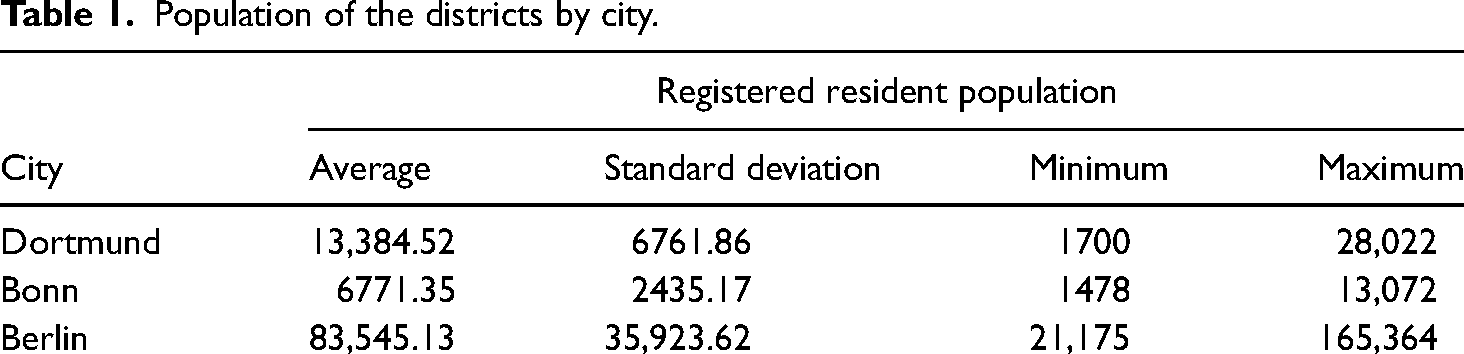
Population of the districts by city.
Operationalization
A multidimensional scale was employed to assess susceptibility to radicalization. The dimensions pertain to individually perceived experiences of discrimination, mistrust in democracy, and authoritarianism (Küchler, 2024). These three dimensions do not aim to directly measure radicalization among individuals who espouse Islamic extremist ideologies. Instead, they are designed to capture an individual's susceptibility to radicalization. The scale is therefore based on the assumption that a higher level of the three underlying dimensions increases the individual risk of adopting an extremist worldview. This susceptibility to radicalization is therefore not to be equated with extremist or even terrorist acts, as it specifically begins before or at the very beginning of the radicalization process.
One advantage of this approach is that preventive measures can be initiated at an earlier stage, which is thought to enhance their efficacy. Individuals may display tendencies but have not yet internalized a firmly established worldview. Consequently, they may be more amenable to accepting general liberal democratic values and universal human rights.
Conversely, this instrument can be utilized in general population surveys to identify early warning signs of radicalization in various segments of society. This is related to the epistemological circumstance that entrenched extremists are a target group that is by definition difficult to reach in official surveys. This is due to the fact that such surveys are often funded by institutions that are part of the establishment that extremists oppose. As a result, it is questionable to what extent general surveys can provide reliable results in this context. 2
The individually perceived experiences of discrimination are recorded in relation to two groups: those of German origin are contrasted with those of non-German origin. This classification is based on socio-demographic information about whether both parents or the respondent were born in Germany. If this is the case, a migrant background is not assumed. If at least one parent or the respondent was not born in Germany, a non-German background is assumed. The questions were designed to capture the perceived discrimination of the population defined as German against the non-German population and vice versa. The survey examined ‘perceived discrimination’ in terms of economic disadvantage, generally fair treatment, and insults and/or verbal abuse experienced on the basis of the respondent's (German or non-German) origin. Mistrust in democracy was recorded via attitudes and lack of trust towards state institutions, as well as political parties and politicians in general. The objective was to document respondents’ critical assessments of key aspects of the democratic system in Germany, particularly with regard to representative institutions. The forms of authoritarianism operationalized here are conceptually closely linked to this construct. For this study, we investigated attitudes that, first, were related to the respondents’ desire for a strong, centralizing political leader; second, that emphasized aspects related to the advocacy of tougher enforcement of laws; and third, the importance of respect and obedience to superiors. Each of the three dimensions of susceptibility was assessed using four pretested questions that employed a five-point Likert scale.
The 12 items were collectively summarized into the three dimensions described using a factor analysis. By assigning equal weight to each dimension and assuming a uniform direction of influence on susceptibility, the summary of the factor analysis forms an index, with a higher score indicating greater susceptibility to radicalization. The scale exhibits a constant Cronbach's α of ≥ 0.80 across the three cities studied. Figure 1 illustrates the average susceptibility to radicalization per city-specific district.
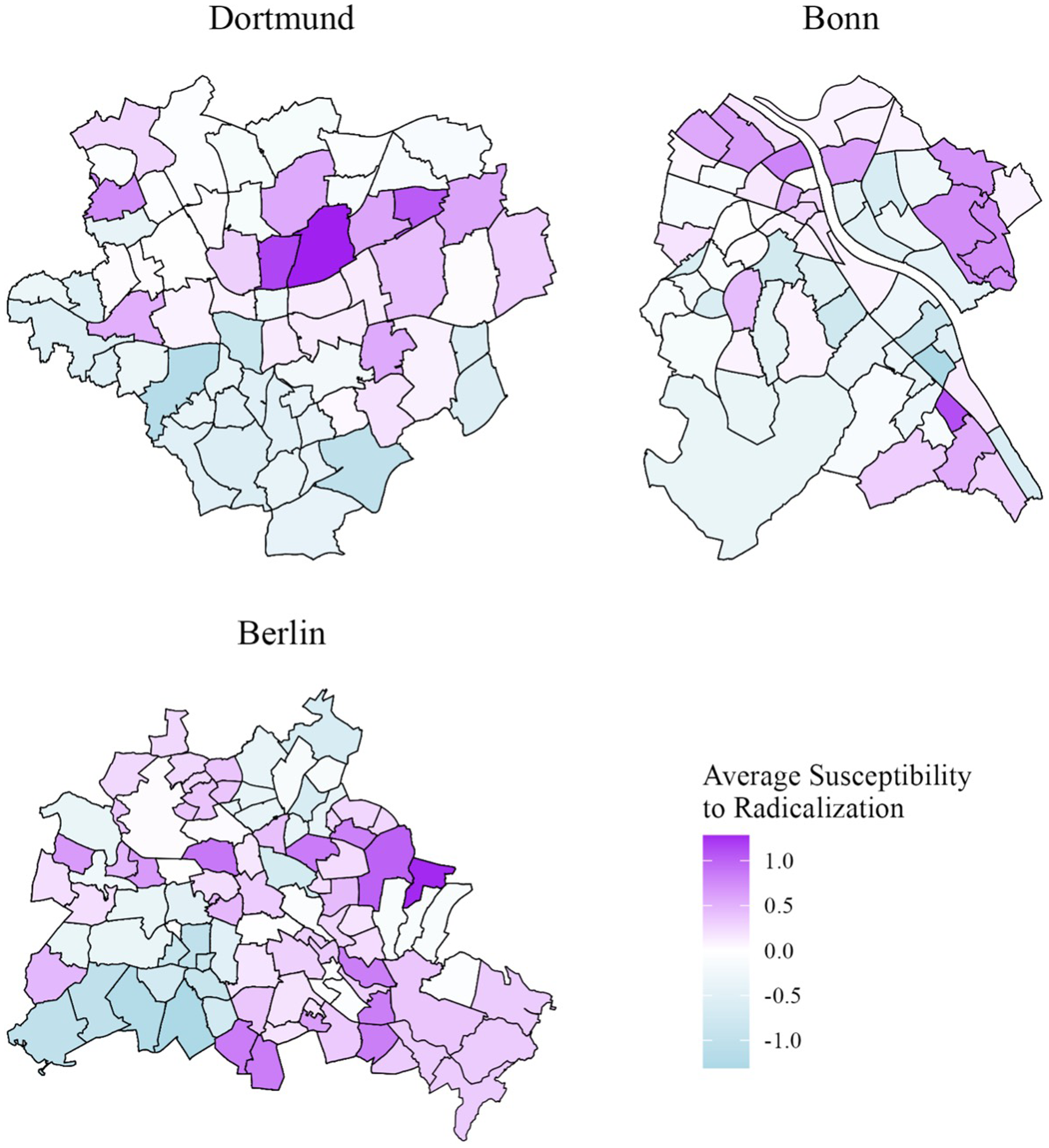
Average susceptibility to radicalization per city-specific district.
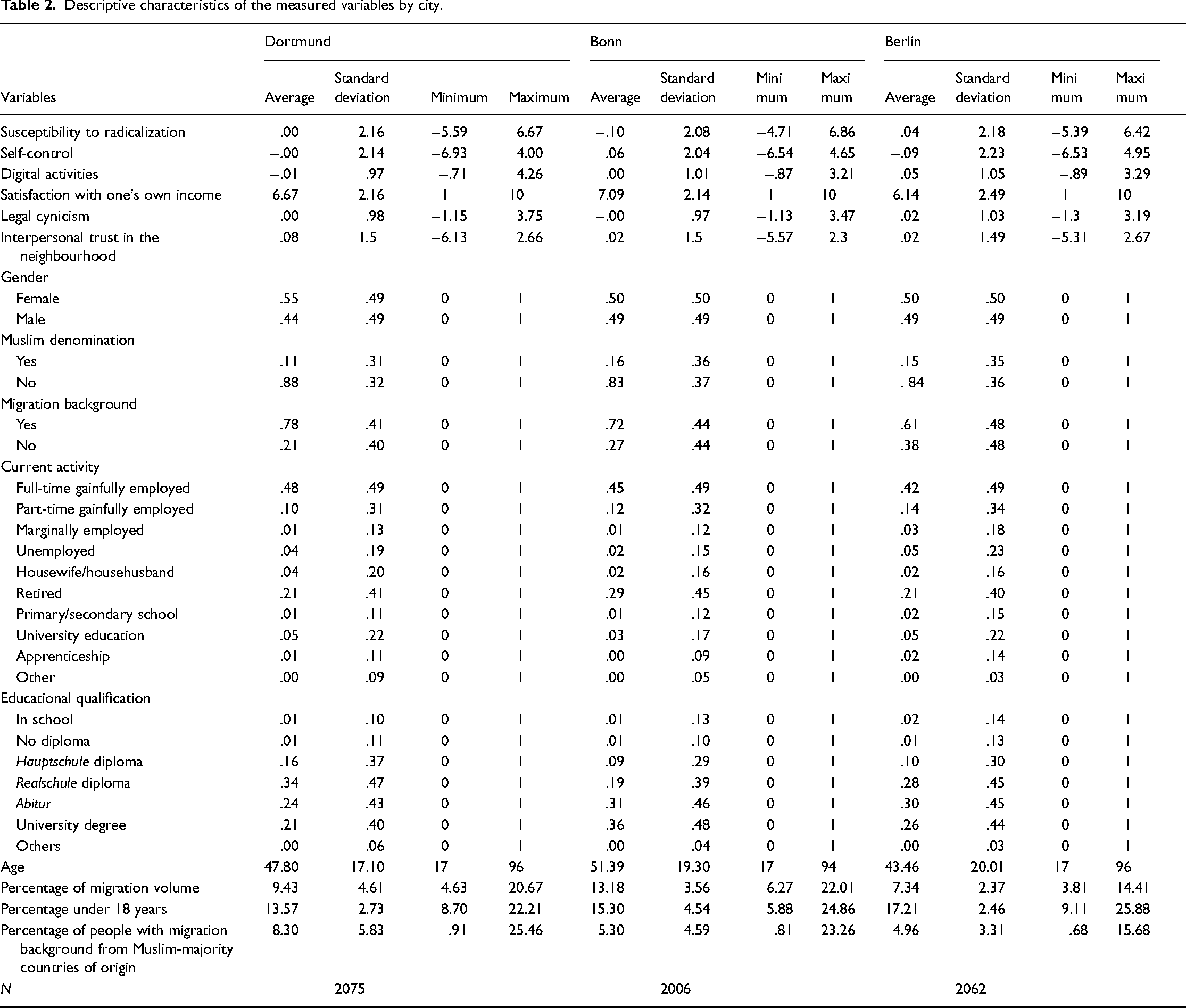
The self-control variable, as defined in H1, was measured using a well-established short scale that includes three latent subdimensions of self-control: impulsivity, risky behaviour and irritability (Seipel, 2014). These dimensions were measured by offering respondents 11 statements they had to respond to using five-point Likert scales. We carried out exploratory factor analyses to examine their responses according to core dimensions. The three resulting latent constructs were then added together to form the predictor self-control. The scale demonstrated reliability in all city samples (α = 0.83–0.87). The hypothesis posits that individuals with greater self-control are less susceptible to the process of radicalization and that self-control, or resilience, is a key preventive factor (Rottweiler et al., 2022). A descriptive summary of the key variables addressed can be found in Table 2.
Descriptive characteristics of the measured variables by city.
The digital contact with politically charged content described in H2 was quantified using four questions captuing the frequency of visiting websites with political or religious content and exchanging information on such sites. The questions were limited to a four-point rating scale, ranging from often to sometimes to rarely to never. These questions were also combined into an overall predictor of digital-use behaviour on the basis of a factor analysis. Cronbach's alpha coefficient for this survey was approximately 0.78 for all cities surveyed.
The degree of satisfaction with one's own income in H3 was gauged by the question, ‘All in all, how satisfied are you currently with your household's income?’ Respondents were invited to indicate their level of satisfaction on a 10-point Likert scale. The question also measured individual deprivation. In contrast to a supposedly objective recording of, for example, the monthly net household income of the respondents, perceived satisfaction takes into account an individual's subjective comparison of their personal life situation (Turley, 2002).
H4 refers to legal cynicism (Sampson and Bartusch, 1998), a concept that captures a lack of trust in the current legal system and its representatives. On the other hand, legal cynicism rejects the binding nature of laws, and, on the other, it facilitates possibilities for action that would be hindered in a different place and under different neighbourhood influences. Previous literature has argued that persistent experiences of injustice, factors of deprivation, and forms of social alienation contribute significantly to legal cynicism; this in turn corrodes the more widespread established system of values and norms (Kirk and Matsuda, 2011; Nivette et al., 2015; Nivette et al., 2017; Sampson and Bartusch, 1998). From an individual perspective, forms of legal cynicism serve on the one hand to classify and interpret established laws and norms. On the other hand, legal cynicism is also used to legitimize breaches of norms (Nivette et al., 2017). The questionnaire included four statements concerning such breaches of norms: (1) ‘Laws are there to be broken’; (2) ‘It's okay to do whatever you want as long as it doesn't hurt anyone’; (3) ‘People put themselves at a disadvantage if they always follow the rules’; and (4) ‘There are no “right” or “wrong” ways to get money; there are only “easy” and “hard” ways’. Respondents then used a five-point Likert scale to agree or disagree with these statements. Cronbach's alpha was between 0.70 and 0.75 for each city, indicating that this measure is satisfactorily reliable. The measure is considered as an individual characteristic in the multilevel analyses, as this promises a better explanation of the phenomenon of legal cynicism given the nature of the data as individual attitudes. Since the multilevel models used consider the nested structure of the data, this approach is not considered to be a significant drawback, as it takes into account the clustering of responses across districts. Although an ecometric approach (Raudenbush and Sampson, 1999) would be preferable, as it is more promising with respect to neighbourhood processes, a parsimonious approach was chosen here that better matches the underlying data structure and is replicable in a comparable manner for each city studied.
The characteristic of interpersonal trust in the neighbourhood evaluated in H5 was measured according to perceptions of good neighbourhood relations (Küchler, 2024). ‘Interpersonal trust’ includes aspects of neighbourhood networking and contact quality. In terms of content, we asked about aspects such as relationships in the neighbourhood, the willingness to lend each other things, or the perceived similarity of attitudes towards life. We asked a total of 10 questions and compiled the answers using a factor analysis. The scale reliably measured legal cynicism for each city's sample (α between 0.83 and 0.85). As H5 notes, we hypothesize that interpersonal trust in the neighbourhood tends to reduce the susceptibility to radicalization. Analogous to the measurement of legal cynicism, this operationalization of interpersonal trust in the neighbourhood was used as an individual characteristic in the multilevel analyses.
Information on gender, Muslim religious affiliation, migration history, age, highest educational qualification, and current primary occupation were included as control variables. In addition, official statistics concerning the district level were taken into account for our analyses. These statistics included the percentage of the migration volume in the district population, the percentage of people under the age of 18, and people with a migration background from Muslim-majority countries of origin relative to the total registered population of a given district. Countries of origin are defined as having a Muslim majority if an absolute majority of the origin country's population belongs to one or more denominations that can be considered as belonging to Islam. 3 Aggregate classification is the sole purpose of this indicator: The qualities, intensity, or any various practices of the respective denomination play no role in the definition.
The inclusion of people with a migration background from Muslim-majority countries of origin serves to statistically control for a multilayered mechanism. As already mentioned, certain factors such as discrimination or the feeling of not being accepted in society may represent experiences of stigmatization that increase the risk of radicalization. People with migration experience from Muslim-majority countries of origin may be exposed to an increased risk of falling prey to extremist ideologies due to their experiences in the German host society. It is therefore important to control for this information in statistical analyses to better examine possible factors influencing the susceptibility to radicalization. It should also be noted that the German law SGB II (basic security benefits) rate and number of people with migration background from Muslim-majority countries of origin correlate at a highly significant and positive level. For this reason, we limit our analyses to people with migration history from predominantly Muslim countries, because the two variables capture statistically similar experiences of deprivation. Moreover, SGB II statistics lack some figures due to insufficient case numbers in some smaller districts, which presented us with an information deficit. However, it is possible to offset this information deficit by using ‘people with migration background’ as a proxy indicator. A summary of the descriptive statistics of is presented in Table 2.
Statistical analysis
The hypotheses were tested using nine random intercept multilevel models, three of which were calculated separately for each city. Specifically, linear multilevel models based on maximum likelihood estimation were used to model the variation in the dependent variable (‘susceptibility to radicalization’) while accounting for the specific data structure: individuals nested within city districts. This approach effectively clustered the standard errors in the calculated models at the district level (Hox et al., 2017). In the null model, the dependent variable exhibited an intraclass correlation of approximately 0.04 across all cities. This indicates that approximately 4% of the total variance in the individual process of susceptibility to radicalization can be attributed to the district-level local urban environment. Consequently, neighbourhood effects can be theoretically attributed to this variance. A complete table of intraclass correlations can be found in the Supplemental Appendix. The subsequent models (1–3) successively expand the calculations for each city to include 1) the main predictors (i.e. those based on H1–H5); 2) individual control variables; and 3) neighbourhood control variables. It should be noted here that the quality criteria of the model evaluation improve across all the cities examined when looking at the log likelihood and the Akaike information criterion (AIC) values. The AIC for Bonn from Models 2 to 3 and the Bayesian information criterion (BIC) values across all cities exhibited a slight increase. However, the overall quality of the models within the respective cities improved as the complexity of the models increased. Table 3 provides an overview of the influence of the primary predictors. The results of the analysis are presented below, first examining the primary predictors of the hypotheses. The section then turns to the control variables used in the study.
Multilevel models in relation to vulnerability to radicalization.
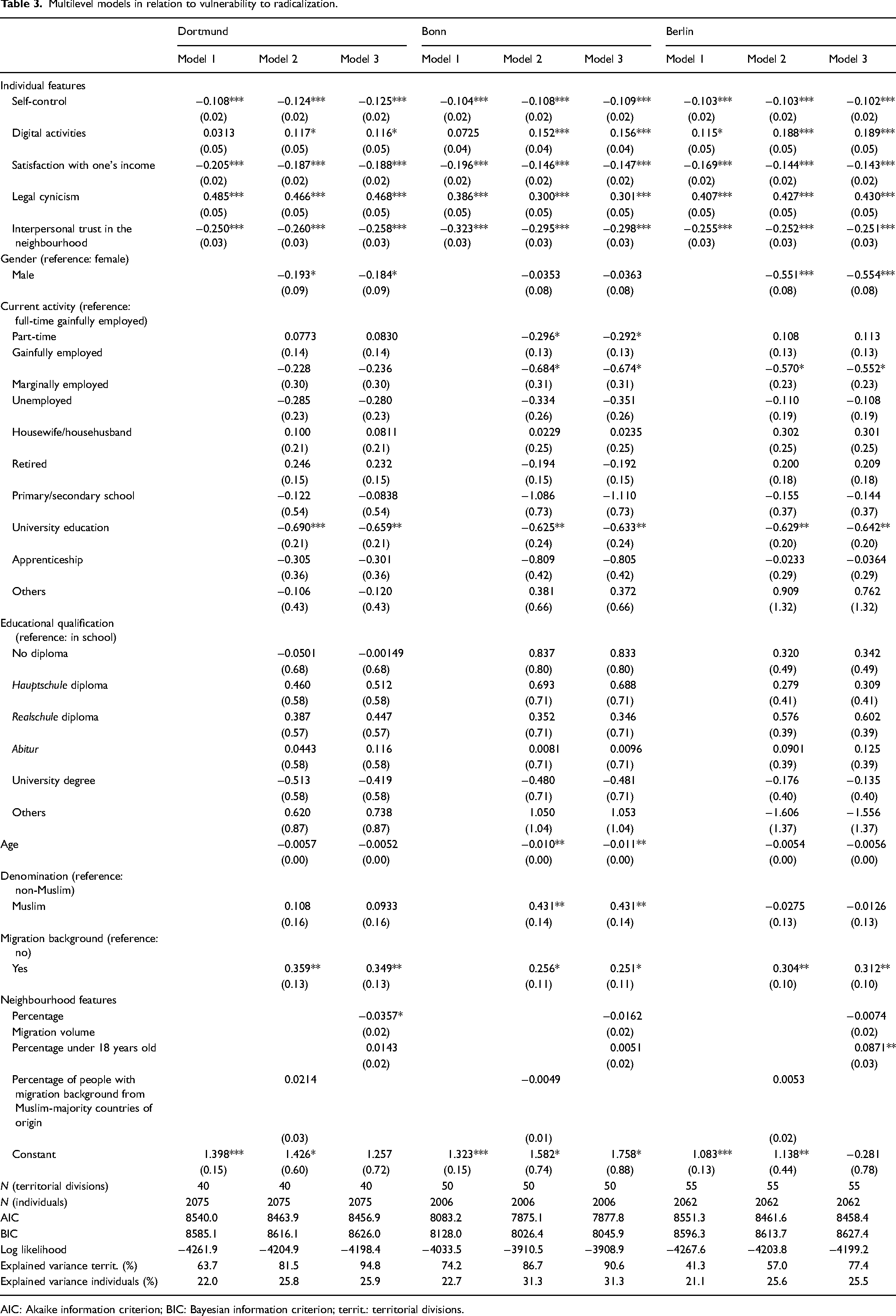
AIC: Akaike information criterion; BIC: Bayesian information criterion; territ.: territorial divisions.
Results
With respect to Hypothesis H1, self-control has a highly significant (p < .001) preventive effect on the susceptibility to radicalization not only across all models but also across all cities, such that we can confirm Hypothesis H1. For example based on Model 3, the susceptibility to radicalization for a person from Dortmund decreases by 0.12 measurement units if the reported self-control increases by one measurement unit.
In contrast, the influence of digital activities assumed in H2 as a risk factor for the increased susceptibility to radicalization is somewhat more differentiated. For example, a significant influence (p < .05) emerges for Dortmund when the control variables in Models 2 and 3 are considered. In Bonn and Berlin, this effect is, on the one hand, larger in its effect strength and, on the other hand, at a highly significant level (p < .001). Overall, a significant and positive correlation between digital activities and the susceptibility to radicalization can be identified across all cities and when controlling for the additional variables, meaning that we can also confirm H2.
When assessing satisfaction with one's own income (H3), we find a highly significant influence across all models in all three cities. This effect is robust across all cities examined, although it should be noted that the effect strength decreases slightly in Models 2 and 3 after taking other control variables into account. We can thus confirm the hypothesis that individually reported satisfaction with one's own income correlates with a lower susceptibility to radicalization. For example, for a person from Berlin, the estimated susceptibility to radicalization based on Model 3 increases by 0.14 measurement units if satisfaction with one's own income decreases by one measurement unit.
The positive influence of legal cynicism assumed in H4 was clearly confirmed. A highly significant positive effect can be seen in all cities and models. The loss of trust in applicable legal norms is thus robustly linked to an increased susceptibility to radicalization. Based on Model 3 in Berlin, it can be shown that the susceptibility to radicalization increases by 0.43 measurement units if the reported legal cynicism increases by one measurement unit.
The hypothesis of a negative correlation between interpersonal trust in the neighbourhood and the susceptibility to radicalization formulated in H5 can also be confirmed. It is possible to demonstrate a highly significant negative correlation between the two characteristics related to social attitudes, which is robust both across the individual models and across the cities. For example, if the reported interpersonal trust among neighbours increases by one measurement unit, the susceptibility to radicalization in the third model in Bonn decreases by 0.29 measurement units.
When evaluating the control variables, it is remarkable that in Dortmund and Berlin, men – in contrast to women – were associated with a lower susceptibility to radicalization at a significant level. Women therefore appear to be more susceptible to the susceptibility to radicalization defined here, which is made up of attitude-related characteristics concerning the mistrust in democracy, support for authoritarianism, and experiences of discrimination. Looking at current employment, there is a significant negative correlation in all cities between people who are studying and the susceptibility to radicalization considered here. However, the respondents’ level of education itself has no reliable correlation with susceptibility. The only place where the age of the respondents is correlated (negatively) with a susceptibility to radicalization at a significant level (p < .01) is Bonn. In addition, the effect size is very small, meaning that it is not possible to speak of a substantial and, above all, robust effect across cities. Bonn is also the only city where Muslim denominational affiliation is significantly related to the susceptibility to radicalization. At this point, it should be expressly emphasized that people of Muslim faith correlate more strongly with at least one of the three vulnerability dimensions described and that no direct causal assumption can be made. For example, people of Muslim faith in particular repeatedly report more experiences of discrimination, which is why the reported positive correlation should not be overinterpreted at this point and is rather tautological in nature. Furthermore, the effect does not prove to be very robust, as it cannot be generalized to Dortmund or Berlin. Interviewees’ stated migration background has a relatively robust influence across all the cities surveyed. Here, we can speak of a positive correlation between migration background and a general susceptibility to radicalization, which can be interpreted in a similar way to Muslim religious affiliation, as people with a migration background also report discrimination more frequently (Bertelsmann Stiftung, 2023).
No uniform effects can be identified across the cities for the characteristics at the district level. For Dortmund, there is a weak negative correlation (p < .05) between the reported vulnerability and the migration history. This effect is not found in Bonn and Berlin. Only in Berlin, on the other hand, is there a weak positive correlation (p < .01) between the number of people under the age of 18 and the reported susceptibility to radicalization. Furthermore, none of the cities surveyed showed a significant influence of people with migration experience from Muslim countries of origin.
With regard to the estimated variance components, it should be noted that for Dortmund 94.8% of the variance in the susceptibility to radicalization is explained by the predictors used in the full Model 3 at the local level. At the individual level, 25.9% of the variance is explained in this model. In relation to Bonn, the predictors of the overall model explain slightly more than 90% of the variance at the neighbourhood level and slightly more than 31% at the individual level. In contrast, the explanatory power in Berlin is comparatively low: here, the predictors at the neighbourhood level explain 77.4% – the lowest level of all cities. At the individual level, 25.5% of the variance is explained for Berlin in Model 3; please refer to Table 3 for the estimated variance shares of the other models. One explanation for the comparatively low explanatory power at the neighbourhood level in Berlin could be that more districts had to be combined here than in the other cities studied. Another explanation could indicate that the neighbourhood characteristics have a more diffuse influence in Berlin and therefore contribute comparatively less to explaining the variance in the susceptibility to radicalization.
Conclusion
The study has analysed the influence of neighbourhood influences on the susceptibility to radicalization, taking into account key individual characteristics of people. It aimed to close an empirical gap in radicalization research as well as in urban sociology research. By evaluating population surveys in Dortmund, Bonn and Berlin, which have a data structure that allowed us to draw conclusions about small-scale units, it was possible to clearly demonstrate independent neighbourhood effects.
The results initially show that higher degrees of (individual) self-control, as well as of interpersonal trust in the neighbourhood, presumably serve to deter the factors beyond the susceptibility to radicalization, which is consistent with findings from criminology-oriented studies (Clemmow et al., 2023, Emmelkamp et al., 2020, Fjellman et al., 2023, LaFree and Schwarzenbach, 2021), among others. In addition, digital activities have a significant influence on the susceptibility to radicalization, as well as dissatisfaction with one's own economic situation and increased mistrust of the rule of law. This provides evidence for the robust existence of sociocultural mechanisms that are conditioned by the neighbourhood environment. At the neighbourhood level, sociostructural characteristics have only a marginal influence on the susceptibility to radicalization. Only the percentage of migration volume for Dortmund and the percentage of under-18s for Berlin have a weak effect here.
The general answer to the research question we asked at the outset is therefore that self-control, relative deprivation, digital activities, and mistrust of the rule of law all contributed to a given individual's susceptibility to radicalization. On the other hand, interpersonal trust in the neighbourhood has a mitigating effect. All these factors are relevant for the susceptibility to radicalization and correspond with findings from current research.
The study contributes to the still young debate on radicalization and space (Bouhana, 2019; Hüttermann, 2018; Ilan and Sandberg, 2019). Two important advances have been made. First, theoretical models and empirical findings from criminological research were combined with those from sociological urban research to explain susceptibility to radicalization. Second, a comparative study of three cities was conducted using a hierarchical data structure to control for neighbourhood effects. The results suggest that space should be conceptualized as a risk factor for radicalization.
Our findings nevertheless suggest various needs for further research. For one, it was not possible to determine the exact social practices that produce neighbourhood effects on the susceptibility to radicalization. Further ethnographic studies investigating the positioning of extremist groups within a neighbourhood are useful. Furthermore, neighbourhood effect research has yet to clarify whether and how negative neighbourhood effects can be prevented or reduced. To this end, it is useful to investigate the structure of public and/or publicly funded organizations as well as the role of local volunteers. In addition, although this paper places the substantive focus on Islamism, further studies could investigate whether there are phenomenon-specific patterns of susceptibility to other forms of extremism, such as right-wing extremism we mentioned at the beginning. Furthermore, it is not clear why extremist groups behave differently in a given area. So far, it can only be stated that this is the case; an explanation would have to be sought in comparative qualitative case studies.
All in all, the findings indicate that spatial conditions should be included in any analysis of radicalization processes, because susceptibility is influenced by neighbourhood processes. For urban sociology research, our neighbourhood effect analyses indicate that the extent of social segregation within a city can exceed a specific threshold, which then unleashes more severe dynamics, such as greater distrust of the rule of law and less interpersonal trust. Overall, one's susceptibility to radicalization is not solely an individual problem but a phenomenon that is generated – and can also be prevented – based on specific locations and as a result of specific social and structural conditions.
Supplemental Material
sj-docx-1-euc-10.1177_14773708241297780 - Supplemental material for Radicalizing spaces: Neighbourhood effects on susceptibility to radicalization
Supplemental material, sj-docx-1-euc-10.1177_14773708241297780 for Radicalizing spaces: Neighbourhood effects on susceptibility to radicalization by Sebastian Kurtenbach, Armin Küchler and Andreas Zick in European Journal of Criminology
Footnotes
Acknowledgements
We would like to thank the editorial team and the anonymous reviewers for their helpful comments on the manuscript!
Funding
The author(s) disclosed receipt of the following financial support for the research, authorship, and/or publication of this article: The research project ‘Radikalisierende Räume’ (Radicalising spaces) was funded by the German Federal Ministry of Education and Research.

Supplemental material
Supplemental material for this article is available online.
Notes
References
Supplementary Material
Please find the following supplemental material available below.
For Open Access articles published under a Creative Commons License, all supplemental material carries the same license as the article it is associated with.
For non-Open Access articles published, all supplemental material carries a non-exclusive license, and permission requests for re-use of supplemental material or any part of supplemental material shall be sent directly to the copyright owner as specified in the copyright notice associated with the article.
