



Abstract
Research on public attitudes to the death penalty has been predominantly understood through single nation-states, especially within the USA. Examinations of international differences in citizens’ support for the death penalty have been scarce, particularly among continents with a high volume of retentionist nations (e.g. Asia). In this paper, we draw on a dataset of 135,000 people from across 81 nations to examine differences in death penalty support. We find that residents of retentionist nations are generally more supportive of the death penalty than those from abolitionist nations. But this general difference masks important differences both within and between countries. At the country-level, residents of abolitionist nations with autocratic political systems and those with higher homicide levels were more likely to support the death penalty than residents of other abolitionist nations. At the individual level, greater support for a strong dictatorial-type leader and perceptions of political corruption are associated with increased support for the death penalty, but only in abolitionist nations. By contrast, more frequent religious worship, perceived egalitarianism in a nation, and support for the political performance of government reduced death penalty support in abolitionist nations but increased support in retentionist nations, while belief in individual responsibility and critical views towards ethnic minorities increased support for the death penalty across both abolitionist and retentionist nations.
Introduction
Despite witnessing a general decline in the use of the death penalty globally (Amnesty International, 2020; Hood and Hoyle, 2015), there remain considerable differences in levels of public support for its use across world nations. This includes disparities in levels of support for the death penalty across retentionist and abolitionist nations, with some abolitionist nations showing higher levels of support (e.g. United Kingdom, Czech Republic), whilst other retentionist nations are more critical despite frequently using the death penalty as a tool of punishment (e.g. Pakistan, Indonesia) (See World Values Survey, 2020). Studies have identified several demographic and attitudinal factors underpinning death penalty support at the individual level, especially in samples from the United States of America. Key determinants of support include authoritarianism (Stack, 2003), minority group threat – the view that punitive attitudes can be underpinned by racialized views towards outgroups such as immigrants (Unnever and Cullen, 2010a, 2010b), religion (Grasmick et al., 1993; Unnever et al., 2010), as well as demographic factors including race and gender (Bobo and Johnson, 2004; Cochran and Sanders, 2009). However, there has been scarce examination of whether these factors have the same explanatory power in other nations, especially those in the Global South – ‘regions outside Europe and North America, mostly (though not all) low-income and often politically or culturally marginalized’ (Dados and Connell, 2012: 12).
In this paper we build on a small number of studies that have examined cross-national public attitudes to the death penalty (Stack, 2004; Unnever and Cullen, 2010a, 2010b; Unnever et al., 2010; Van Koppen et al., 2002), providing a much-needed update to the evidence base. A great deal has changed since these studies were conducted. Contexts of civil war, State coups, terrorism, and economic crises have potential bearing on citizens’ attitudes to punishment and the death penalty specifically. Assessments of whether differences in death penalty attitudes can be explained by differences at the country-level rather than at the individual level also remain rare in death penalty attitudinal research. This is a surprising lacuna, with several reasons to expect the country context will shape opinions. Many retentionist nations share common characteristics such as weaker democratic structures and a higher ratio of autocratic governmental systems (Neumayer, 2008; Pascoe, 2015). High rates of inequality, corruption and weak rule of law are also commonly found in the kinds of governmental regimes where the death penalty is overwhelmingly used (BTI, 2020).
Our analysis brings together data from Wave 7 of the World Values Survey (WVS) and Wave 5 of the European Values Survey (EVS) captured during the period 2017 to 2020. Together, the surveys cover 81 countries (in all major continents). Importantly, the WVS/EVS data includes many nations which rarely feature within comparative punishment research. Given the recognition that the death penalty is still disproportionately practiced in the Global South, especially in Asia (Hood and Hoyle, 2015; Johnson and Zimring, 2009), the WVS/EVS dataset provides a rich opportunity to examine the various demographic and attitudinal factors associated with public support towards the death penalty. The analysis focuses on differences between abolitionist and retentionist nations around the world. We focus on two key questions: 1.) whether nations which retain the death penalty are more likely to have higher levels of public approval than nations that have abolished the death penalty; and 2.) the extent that public support for the death penalty is shaped by individual (e.g. attitudinal and socio-demographic) differences and/or country-level (e.g. political structural) differences.
Individual-level explanations of support for the death penalty
A large volume of (mostly US-based) research has identified individual correlates of death penalty support. Perhaps the most consistent finding is the association between race and support for the death penalty. Whites are more supportive of the death penalty than minorities (Bobo and Johnson, 2004; Cochran and Chamlin, 2006; Peffley and Hurwitz, 2007). Animosity towards minority groups, also predicts support for the death penalty (Soss et al., 2003; Unnever and Cullen, 2007, 2010a, 2010b), as does living in a geographic area with greater racial diversity (Ousey and Unnever, 2012). Given the extreme disparities of race in the US criminal justice system, these differences in punitive views are likely underpinned by more general fears and negative attitudes towards minority groups (see also Peffley and Hurwitz, 2007).
There is mixed evidence about the role of religious values in shaping death penalty support. Some research finds that religious people tend to have lower levels of support for the death penalty and similar punitive punishments (Baker and Whitehead, 2020; Hanslmaier and Baier, 2016; Unnever et al., 2010). Across denominations, greater religious belief can help nurture humanitarian values such as forgiveness, love, and compassion. But this can vary by denomination and culture, with research showing that Evangelical Protestants have the strongest levels of support for the death penalty in the USA (Grasmick et al., 1993). This may itself be informed by a greater concentration of conservative political values which are associated with support for the death penalty (Young, 1991).
Men are consistently more likely to support the death penalty than women (Stack, 2000), an effect that remains when account is taken of potential confounding factors including gender socialisation differences, variations in social values between men and women, and differential experiences of victimisation and fear (Cochran and Sanders, 2009). 1 Various theories have been proposed to explain why women appear less punitive than men, with Gault and Sabini (2000) finding that higher levels of empathy in women influenced more lenient attitudes to crime and punishment. Age also has a role to play in predicting death penalty attitudes (see Cochran et al., 2003). Research by Anderson et al. (2017) in the USA examining death penalty support across cohorts found that support for the death penalty was highest amongst middle aged people. However, other studies have found that older age was associated with more punitive attitudes (Marsh et al., 2019). This effect may be partly the result of older people holding different moral beliefs to younger people, especially views which are more morally idealistic (McNair et al., 2019). Higher educational levels are also associated with lower support for the death penalty (Anderson et al., 2017; Bobo and Johnson, 2004; Britt, 1998; Unnever and Cullen, 2010a, 2010b). Higher education can promote greater tolerance and open-mindedness to different types of knowledge, as well as a more critical appraisal of injustice and prejudice (Department of Business, Innovation and Skills, 2015).
Political values have also been linked to differential support for the death penalty. Political conservatives are more likely to support the death penalty (Baumer et al., 2003; Bobo and Johnson, 2004; Cochran et al., 2003). Distrust in government is also connected with support for the death penalty among Whites, but not for Blacks (Messner et al., 2006). Similarly, authoritarian attitudes (e.g. higher support for established authorities, against social protest and resistance, pro-law and order) predict death penalty support, independent of values of religious fundamentalism (Stack, 2003). Belief in the principles of individualism (in contrast to an emphasis on government responsibility) has also been strongly linked to more punitive attitudes in the context of crime and punishment (Johnson, 2009; Kornhauser, 2015). Explanations for why political conservatives favour tough forms of punishment are complex. Recent research has claimed that conservatives are more likely to support stricter views on morality which are based on their need to reduce uncertainty and threat (Stewart et al., 2019), which in turn may lead to greater faith in tougher responses to punishment and crime control. Compared with liberals, conservatives are also more likely to defer to authority (Graham et al., 2009). These beliefs might play a role in explaining support for more authoritarian responses via social control and punishment, including the use of the death penalty.
Cross cultural differences in death penalty attitudes
There are two ways we might expect differences in the cultural context of a country to affect attitudes towards the death penalty. Firstly, factors measured at the country-level, including whether or not a nation has the death penalty, levels of inequality, homicide levels, and levels of peace/insecurity, may help explain differences in overall levels of support for the death penalty between nations. Secondly, the cultural context of a nation may influence the role that individually held beliefs, attitudes and characteristics may play in shaping the views of individual citizens towards the death penalty. For instance, we might expect a greater likelihood of political corruption or weaker legitimacy in government agencies in retentionist nations (where support for the death penalty is generally higher), which in turn influences individuals to believe in the death penalty as a solution to these structural deficits.
A small number of studies have examined death penalty attitudes cross-nationally, demonstrating higher average levels of support for the death penalty in specific national contexts (e.g. Stack, 2004; Unnever and Cullen, 2010a, 2010b; Unnever et al., 2010). For example, Stack (2004) found lower levels of public support for the death penalty in abolitionist nations when compared to retentionist nations. Authoritarianism and religious fundamentalism were also associated with support for the death penalty across the 17 nations in this study (mostly European nations), as were higher homicide levels – an effect attributed to an enhanced ‘desire for revenge and retribution in the population’ (Stack, 2004: 75). More recent empirical tests of death penalty support show similar effects. For example, Unnever et al. (2010) found that people in abolitionist nations were less likely to support the death penalty than those living in retentionist nations (See also Van Koppen et al., 2002). This follows US-based research showing that across States, the presence of capital punishment influences greater support for the death penalty, although the frequency of executions does not (Norrander, 2000). Unnever et al. (2010) also found greater support for the death penalty in countries with lower levels of support for women's rights, lower equality, perceptions of human rights violations at the national level, and lower confidence in the court system. The level of peace in a nation may also play a part in explaining differences in death penalty support across countries. The lowest levels of global peacefulness are currently in the Middle East and North Africa, with the majority of death penalty retentionist nations ranking high across these measures of insecurity (See Institute for Economics & Peace, 2020) 2 . Country-level factors may also influence support for the death penalty indirectly via their influence on whether a country is abolitionist. For example, Kent (2010) found that countries with the highest rates of inequality were the least likely to experience abolition, a finding paralleled by research showing that high imprisonment rates are strongly correlated with higher levels of inequality at the country level (Wilkinson and Pickett, 2009).
National context may also play a role in shaping the associations between individual characteristics and support for the death penalty. Whilst persons who engage in more frequent faith worship (e.g. attending religious services etc) are generally less likely to support the death penalty, Unnever et al. (2010) found that certain faiths (Buddhists, Muslims and Hindus) were more likely than others to support the death penalty. Since individuals from these religious denominations predominantly live in retentionist nations, it would suggest that religious affiliation is bound up with other factors at the nation-State level. This is consistent with Scheepers et al. (2002), who find considerable cross-national variation in attitudes to moral issues including abortion, with more conservative views on moral issues more likely among religious people within predominantly religious nations, rather than religious people within more secular nations.
Beyond religion, there is reason to believe that other individual predictors of support for the death penalty may operate differently in abolitionist nations when compared to retentionist nations. For example, weaker levels of legitimacy in nations where the rule of law is applied in either inconsistent, non-transparent, or corrupt ways may impact support for the death penalty. Weaker legitimacy is more likely observable in dictatorial or post-dictatorial societies, which are typically associated with higher levels of corruption (See Yadev and Mukherjee, 2016). In parallel, however, corruption can erode public support for the State. These processes may result in public reluctance to support the State in their commission of the death penalty if the processes underpinning the rule of law and sentencing are thought to be haphazard or corrupt. Similarly, legitimacy can also depend on the extent to which the State effectively responds to crime as a basis of securing social order, especially in more fragile contexts of State legitimacy and insecurity (Jackson et al., 2014). If the death penalty is thought to play a key role in deterring crime in situations of national insecurity and weak social order, public support for the death penalty may be higher.
Important national demographic differences also play a part in limiting the generalisability of theories such as the ‘minority group threat thesis’ (See Unnever and Cullen, 2010a, 2010b). The race-effect (See Cochran and Chamlin, 2006 for reviews) which has most commonly been examined in US samples has taken place within a particular history of immigration, civil rights politics and the legacy of slavery. These histories and political contexts of race are, however, far from universal throughout the globe. Factors such as the supply of labour and refugee situation in a nation plausibly inform ‘minority group threats’, in conjunction with other factors such as the political ‘othering’ of sub-populations along racial or caste lines. Distinct political or economic processes such as war, famine and natural disasters can also determine levels of migration – situations that are more commonplace in the Global South (United Nations, 2020). In the limited volume of cross-national studies, racially intolerant views are strongly correlated with death penalty support (Unnever and Cullen, 2010a, 2010b), and nations with lower levels of ethnic diversity were more likely to be abolitionist regarding the death penalty (Ruddell and Urbina, 2004). But these associations are undoubtedly complex, with public attitudes towards minorities likely affected by much larger macro policies informing individual-level beliefs (e.g. refugee or integration/assimilation of immigrants).
Additional demographic factors such as gender may also operate differently across nations in explaining relative support for the death penalty. These attitudes may be affected depending on patriarchal values, and/or lower levels of egalitarianism. Developed democracies (more likely in abolitionist nations) typically initiate greater support for gender egalitarianism when compared to more recent democracies or dictatorial regimes (Liang and Snow, 2016). In addition, large differences in levels of gender inequality exist across world nations (World Economic Forum, 2020). Concentrations of higher gender inequality are commonly found in Africa, the Middle East and Southeast Asia – regions with higher death penalty retention. Whilst caution should be observed in forming linkages between individual-level attitudes and variables at the national level, these factors do provide a useful indication of trends in comparing cross-national differences in death penalty retention and abolition, as well as whether public opinion follows suit.
To summarise, within the extant literature we identify four main hypotheses concerning individual and country-level differences in support for the death penalty. Firstly, we expect to find higher levels of support for the death penalty in retentionist than abolitionist nations. Secondly, at the country level, higher support for the death penalty is more likely within autocratic regimes, more unequal nations, nations with higher rates of homicide, a higher volume of death penalty sentences, and lower levels of peace. Thirdly, at the individual level, political values such as weaker perceived legitimacy in government institutions (e.g. police and justice system) and support for authoritarian values will likely predict support for the death penalty, although we are circumspect as to whether these predictors will operate in the same direction for retentionist or abolitionist nations. Finally, we also expect men and those possessing racially intolerant attitudes to display higher support for the death penalty across nations, although stronger religious devotion (measured by frequent worship) and education is likely to reduce support across nations.
Data
The World Values Survey (WVS) and European Values Survey (EVS) encompass 81 nations in the globe, spanning all major continents (for a full list of countries see Appendix Table A1). Both the WVS and EVS used standardised questions, with samples representative of those aged 18 and over residing in private dwellings (including both citizens and non-citizens). Sampling typically involved a random stratified sampling approach (World Values Survey, 2020). Data was usually collected via face-to-face interview with the respondent. We utilize Wave 7 of the WVS/EVS Survey, which took place between 2017–2020, with an analytic sample size of 135,000 people. For further methodological details of the WVS/EVS, see Haerpfer et al., 2020; World Values Survey, 2020).
Measures
Support for the death penalty
Support for the death penalty is measured on a 10-point scale from never justifiable (1) to always justified (10). However, the original measure is heavily skewed with approximately 50% of respondents selecting the lowest value (i.e. anti-death penalty) and another spike at the midpoint. We, therefore, create a binary version contrasting those that scored above 5 (which we treat as supportive of the death penalty) against the remainder. Results from additional analyses contrasting any support for the death penalty (scores between 2 and 10) against the lowest value or using the original 10-point scale are generally consistent. These results are included in Supplementary Tables A5 and A6 and discussed where relevant.
Individual-level variables
We include binary indicators measuring perceived trust in neighbourhood of residence, authoritarian views (support for a strong leader ‘who does not have to bother with parliament and elections’) and minority-group threat (a single item tapping whether immigrants are seen as bad for development in the nation). We also include a measure of religious identification, distinguishing nine major world religions (including no religion), which we supplemented with a measure of the frequency of worship at church/religious ceremonies.
Legitimacy beliefs are represented by the combined score from three questions measuring confidence in government, confidence in police and confidence in the justice system, all measured on four-point scales ranging from ‘Support a great deal’, to ‘none at all’. The items were combined using an item response theory graded response model (Lord, 1980), with higher scores on the latent scale representing a stronger belief in the legitimacy of public institutions (see Appendix Table A2 for full item wording and measurement model). This was supplemented by two additional measures of people's perceptions of the State covering perceived political corruption (a latent scale combining eight ordinal items, see Appendix Table A3), and satisfaction with the political performance of the government in power (a single binary item). We also include measures of individual responsibility (preference for individual compared to government responsibility), and gender egalitarianism (a latent scale combining four items, see Appendix Table A4).
Finally, we include demographic measures covering age, gender, ethnic minority status, and educational qualifications.
Country-level variables
At the country level, we identify several measures that capture differences between countries. We use public records of the number of death sentences from Amnesty International reports (a three-year average covering the period 2017–2019, See Amnesty International (2018, 2019, 2020), to coincide with the data collection period of the WVS) to measure death penalty practices. From these records, we also identified nations that were retentionist and thus active in the continued use of the death penalty, compared to those nations which were abolitionist (see Appendix Table A1).
Beyond details of death penalty practice, we also include a measure of inequality (Gini coefficient) (OECD, 2020), State autocracy (Centre for Systematic Peace, 2018), homicide rate per 100,000 (UNDP, 2012–18), and the Global Peace Index Score (a composite score measuring peacefulness of individual nations, see Vision of Humanity, 2020). Neumayer's (2008) analysis of the determinants of death penalty abolitionism highlights the importance of regime type (democracy vs. autocracy), in explaining the likelihood of maintaining the death penalty, with autocracies more likely to retain the death penalty. Baumer et al. (2003) have also utilised area-level data on homicides to assess links with public attitudes to the death penalty, thus providing a plausible case for assessing country-level measures of homicide (See also Stack, 2004 for cross-national application).
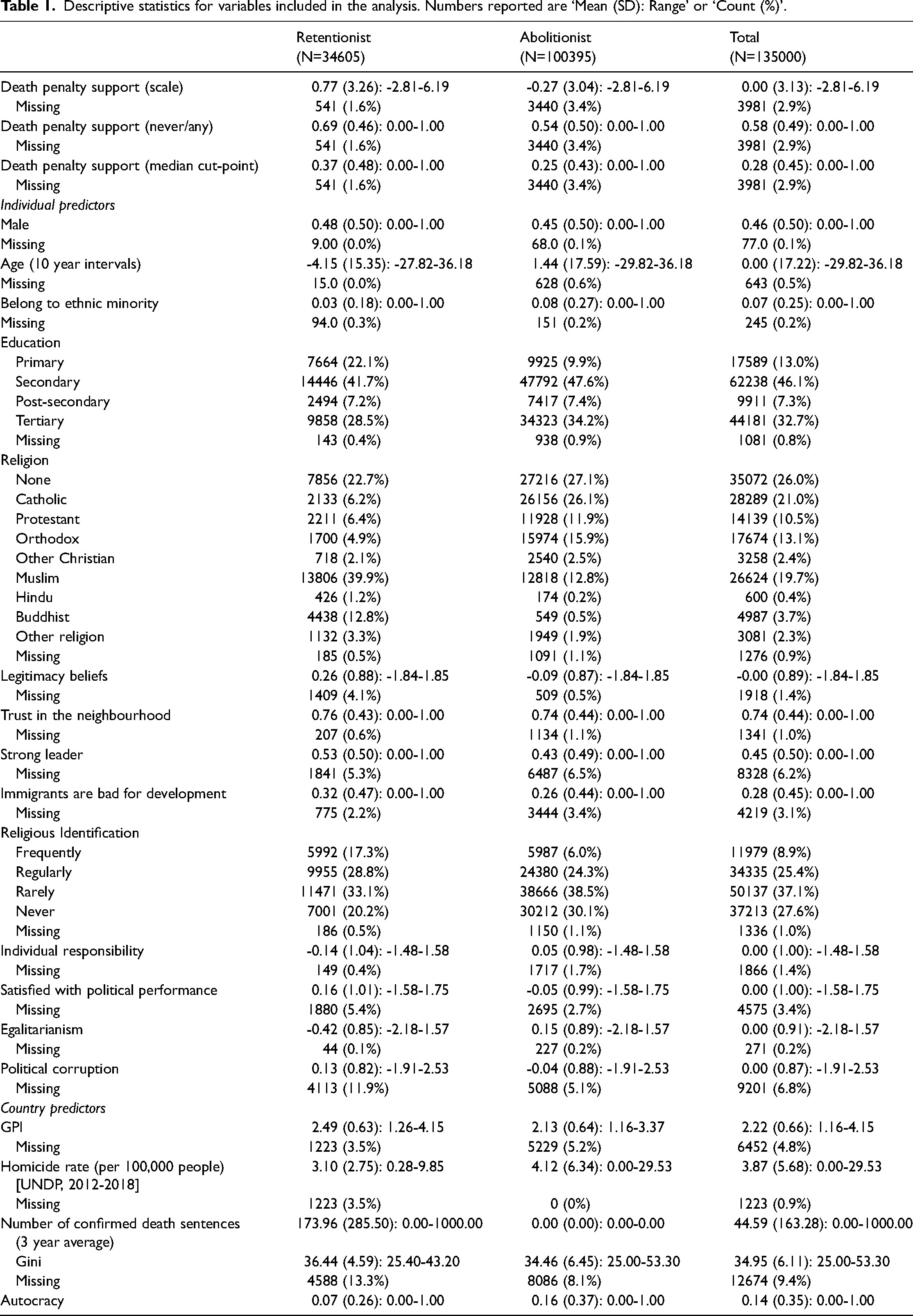
Descriptive statistics for all included variables are reported in Table 1.
Descriptive statistics for variables included in the analysis. Numbers reported are ‘Mean (SD): Range’ or ‘Count (%)’.
Analytic strategy
To assess variations in support for the death penalty we estimate multilevel logistic regression models (Goldstein, 2011) to the full sample of countries, whilst also estimating models separately on the subsamples of countries that are retentionist and abolitionist Distinguishing between retentionist and abolitionist countries allows us to examine the extent the punitive context in which people live plays a role in shaping the key drivers of support for the death penalty.
Results
There is considerable variation in support for the death penalty across countries that accounts for approximately 14% of the total variation in support (estimated from an empty multilevel model), with 70% of people in Iran reporting moderate to strong levels of support, and similar levels in Egypt and Taiwan (Figure 1, top panel). By contrast, less than 10% of people in Georgia, Armenia, Greece and Iceland are in favour of the death penalty. To a certain extent, this aligns with actual death-penalty usage, with many of the most supportive countries also identified as retentionist (Figure 1, bottom panel) and a higher mean level of support for the death penalty in retentionist nations (see the descriptive results in Table 1). However, notable exceptions exist. For example, the UK has one of the highest percentages of people showing support for the death penalty (at 40%) but remains abolitionist (a situation mirrored in the Czech Republic and Australia) whilst only around 15% of people support the death penalty in Nigeria and Bangladesh (both retentionist nations).
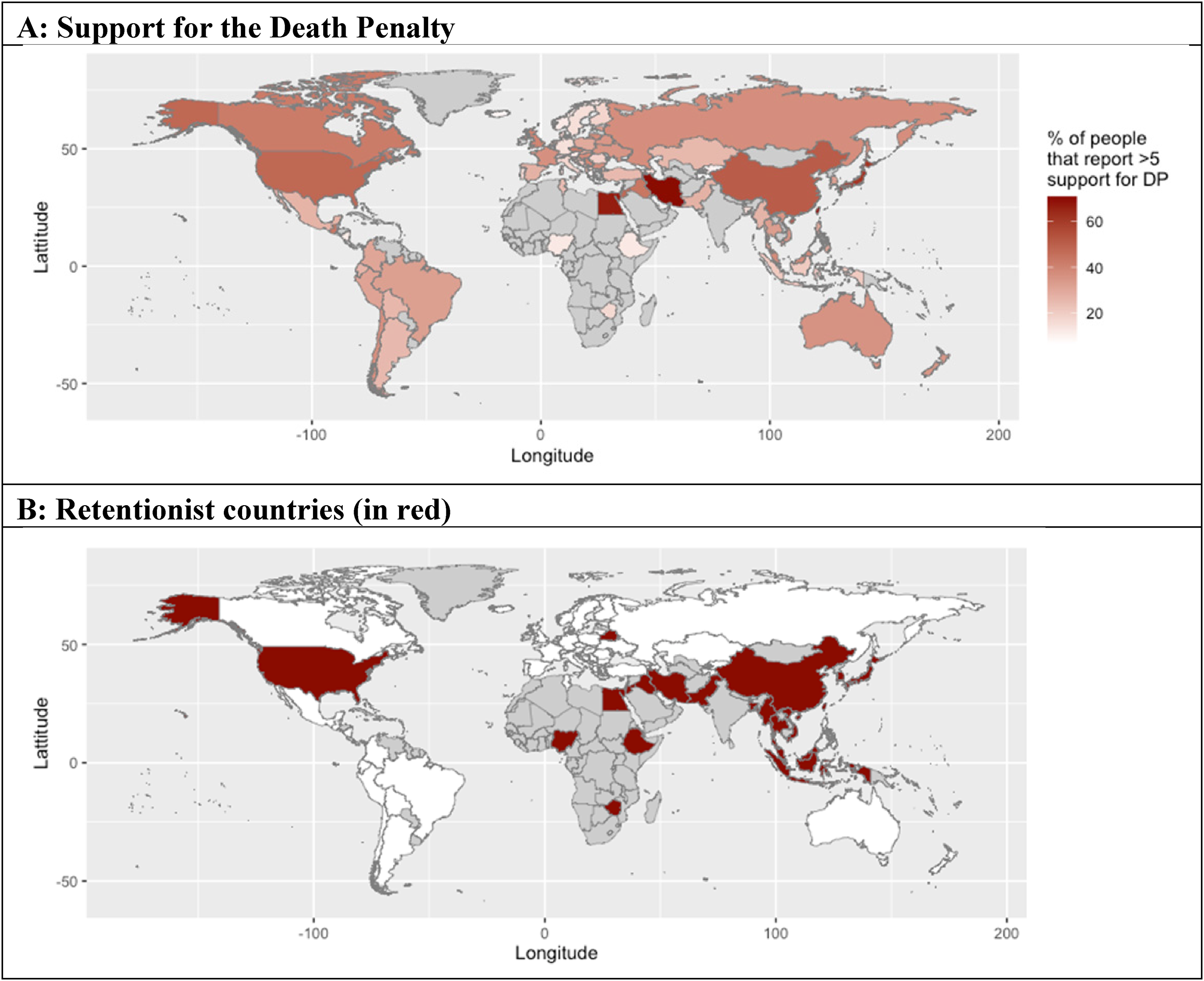
Maps displaying. (a) attitudinal support, and (b) nations retaining the death penalty.
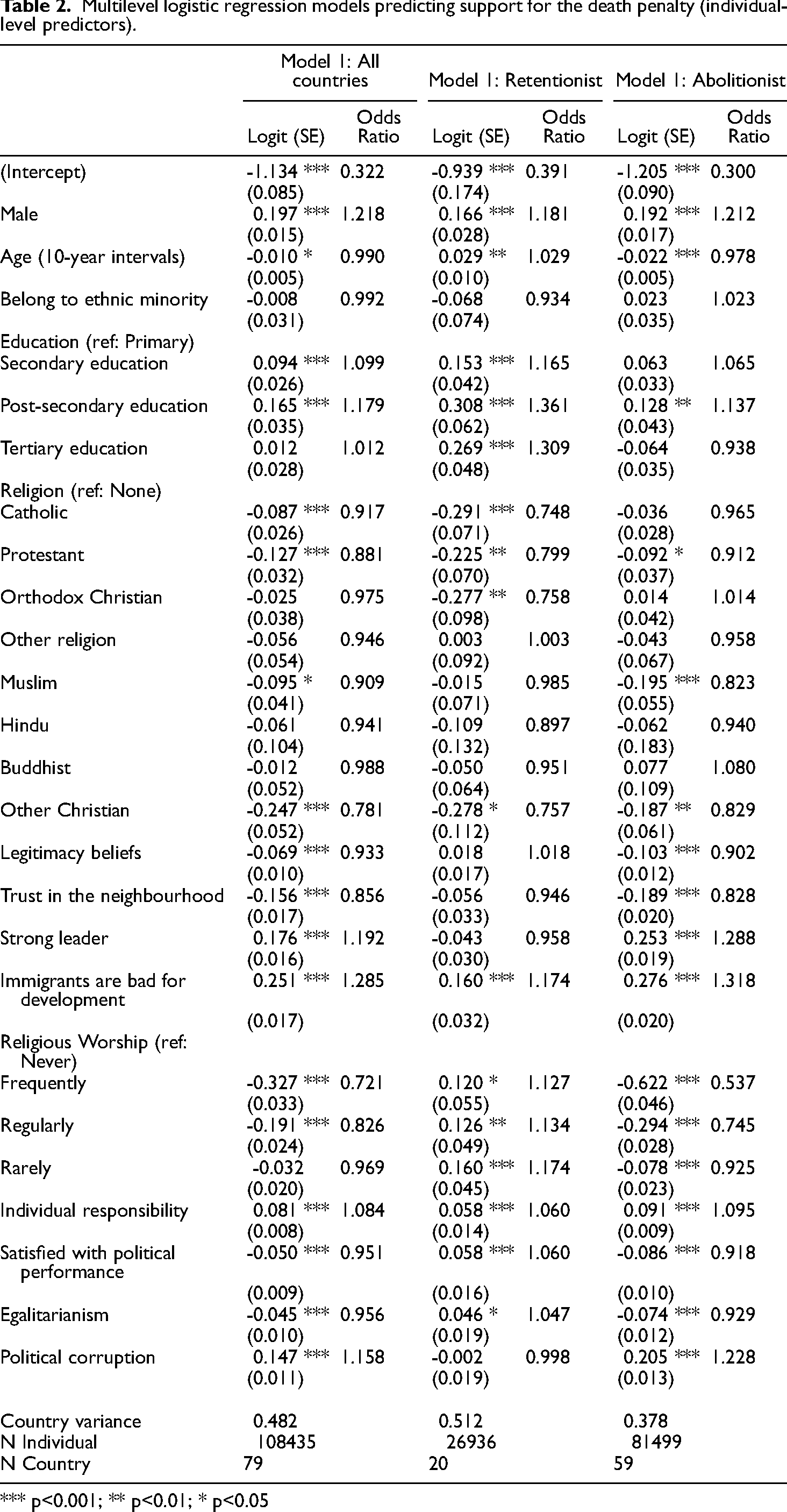
Turning to our empirical models (Table 2) we identify higher levels of support among men, a nonlinear effect of education (with the highest odds of support amongst post-secondary educated) and lower odds of support amongst older people and those engaging in religious worship. We also identify less support amongst those with greater legitimacy beliefs, more trust in their neighbourhood, believe in egalitarianism, and those satisfied with the political performance of the government. By contrast, support for the death penalty tends to be greater amongst those who respect a strong leader, think immigrants are bad for development, favour individual responsibility rather than government responsibility, and think politics is corrupt.
Multilevel logistic regression models predicting support for the death penalty (individual-level predictors).
*** p<0.001; ** p<0.01; * p<0.05
However, there are also notable differences between retentionist (column 2) and abolitionist (column 3) countries. Importantly, the influence of religion depends on whether or not the country still uses the death penalty, with lower levels of support amongst Muslim, coupled with reduced support amongst those that practice more regular religious worship. By contrast, in retentionist countries, Catholics, Protestant and Orthodox Christians reported lower support for the death penalty, whilst there was a strong increase in support identified amongst those practicing more frequent religious worship. Support for the death penalty is higher amongst older people in countries where the death penalty is still used, but lower amongst older people in abolitionist countries, whilst we identify more support amongst degree holders in retentionist countries but not in abolitionist countries.
Beyond these socio-demographic differences, we also find that legitimacy beliefs, trust in neighbourhoods, belief in strong leadership, and political corruption are only associated with support for the death penalty in abolitionist countries, with less support when perceived legitimacy (of the justice system, police and government) and trust in neighbourhoods is greater, but more support when there is belief in strong leadership and the presence of political corruption. Satisfaction with the political performance of the nation is associated with higher odds of support for the death penalty in retentionist countries and lower odds of support in abolitionist countries. Greater levels of perceived egalitarianism reduce support for the death penalty in abolitionist nations but increase support in retentionist nations. Having accounted for these differences in the populations within countries, we find evidence of more remaining variability between retentionist countries (13%) compared to abolitionist countries (10%).
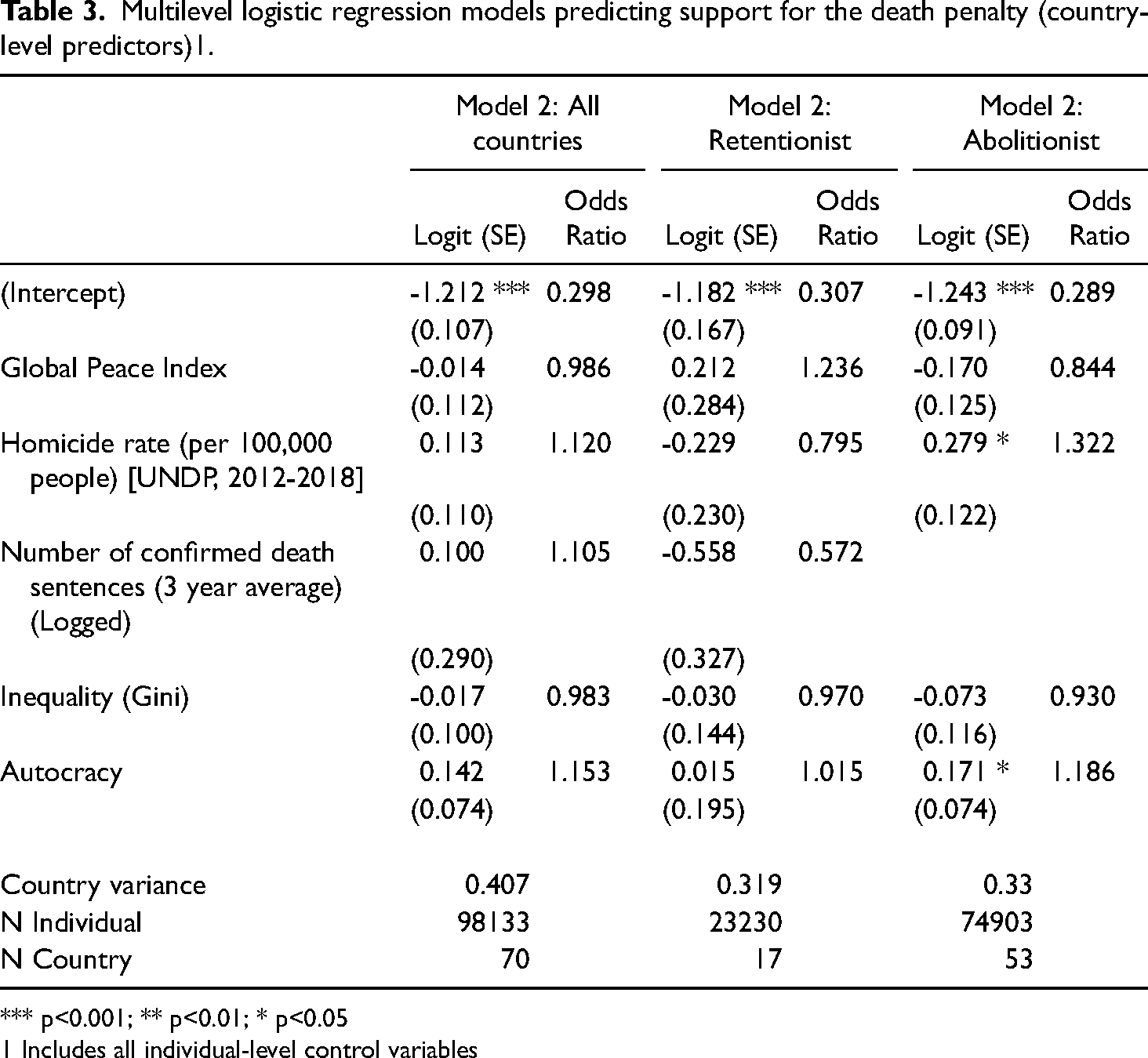
Finally, Table 3 includes the effects of the added country level variables (the individual level predictors are substantively similar therefore we do not include them here for brevity). 3 Considering all countries together, we find no evidence that any of the included country level variables are associated with differential support for the death penalty. However, this masks evidence of moderately higher odds of support for the death penalty amongst residents of abolitionist states that have a higher homicide rate. We also find that in abolitionist countries there is higher odds of death penalty support amongst those countries identified as hard-line autocracies. No significant effects of the included country-level predictors are evident in retentionist countries.
Multilevel logistic regression models predicting support for the death penalty (country-level predictors)1.
*** p<0.001; ** p<0.01; * p<0.05
1 Includes all individual-level control variables
Discussion
While criminological understandings of public attitudes towards the death penalty have been extensive within single nation studies (e.g. Anderson et al., 2017; Baumer et al., 2003; Bobo and Johnson, 2004; Britt, 1998; Cochran and Chamlin, 2006; Stack, 2000), cross-national examinations of public attitudes remain limited, with data that is now over twenty years old and limited coverage of retentionist nations (e.g. Stack, 2004; Unnever and Cullen, 2010a, 2010b; Unnever et al., 2010). This study has helped fill this void, providing important developments to understanding public opinion within and across different nations. In a context where the use of the death penalty is reducing globally (Amnesty International, 2020; Hood and Hoyle, 2015), we have assessed whether predictors of support or disapproval of the death penalty differ within and across retentionist and abolitionist nations.
We find that public opinion is more heterogeneous across those countries that still use the death penalty when compared to abolitionist countries where support is generally lower and there are fewer differences evident between countries. Although research has generally indicated that death penalty abolitionism often occurs during a regime change (Boulanger and Sarat, 2005), if public opinion is also overwhelmingly against the death penalty this might discourage any further reintroduction of this form of punishment. However, contrary to Stack (2004) who finds that abolitionism produces a steady decline in public support for the death penalty, our findings show that there are two caveats to this: abolitionist nations within autocratic regimes, and those with higher homicide levels. This is surprising given the knowledge that retentionist nations are more likely to have autocratic political regimes in operation and possess more general repressive systems of political control of their citizens. However, rates of homicide are traditionally lower in autocratic regimes compared to transitional and full democratic nations (LaFree and Tseloni, 2006) – the latter two systems more common in abolitionist societies. That higher homicide levels influenced higher support for the death penalty is consistent with Stack (2004) and could be a symptom of relative weaknesses in perceived social stability and safety in these nations.
A further central contribution of this paper is to demonstrate how a range of theoretical concepts can operate differently depending on whether the nation is retentionist or abolitionist. We identify several interesting findings. As highlighted in the research literature, debates exist surrounding the extent to which certain theoretical concepts such as ‘minority group threat’ (Unnever and Cullen, 2010a, 2010b), support for individualism (Johnson, 2009; Kornhauser, 2015) and authoritarian beliefs (Soss et al., 2003; Stack, 2003) will have significance in predicting death penalty support depending on whether respondents reside in abolitionist or retentionist nations. In fact, our measure of ‘minority group threat’ (whether immigrants are seen as bad for development) predicted death penalty support in both types of nation. Higher levels of belief in individual responsibility were also associated with death penalty support in both types of nation. This supports research findings from the USA (Johnson, 2009; Kornhauser, 2015) showing beliefs in individual responsibility are generally associated with a preference for ‘just deserts’ style attitudes to punishment (Green et al., 2006; Johnson, 2009).
More general authoritarian beliefs (e.g. views regarding obedience to authority) have also been linked with support for more punitive forms of punishment in US data (Unnever and Cullen, 2010b). Our results show support for a strong dictatorial-type leader increased support for the death penalty in abolitionist nations but was non-significant in retentionist nations. Following Stenner (2005), support for dictatorial leaders is more likely among individuals facing a perceived threat, meaning that their sources of control begin to come under challenge, resulting in the seeking out of order as an antidote to existential uncertainty. This has been demonstrated by Roccato et al. (2014) who treat crime as an external threat, showing that authoritarian and intolerant beliefs tend to be stronger among individuals residing in nations where crime rates were higher (see also Barni et al., 2016). Given that we might reasonably expect Stenner’s (2005) idea of perceived threat as a mediator of authoritarian beliefs to also operate in similar ways within retentionist nations (those which tend to operate within authoritarian regimes), the lack of statistical association between support for a strong dictatorial-type leader and death penalty support in retentionist nations is surprising. This could be because belief in dictatorial leaders is only important in countries where a deficit is assumed. That is, the desire to have a strong leader is a solution to combat high crime or other social problems, hence the connection with pro-death penalty attitudes. That authoritarian regimes are already in existence in many retentionist nations could well be a key reason for the absence of a link between support for a dictatorial leader and support for the death penalty.
In abolitionist nations, being a Muslim, Protestant or belonging to another Christian denomination reduced support for the death penalty, whilst in retentionist nations reduced support was evident amongst Catholic, Protestant and Orthodox Christians (being a Muslim was not associated with support). However, when assessing the frequency of religious worship – arguably a stronger measure of actual religiosity than denominational identification – we find that more frequent religious worship is associated with negative attitudes towards the death penalty in abolitionist nations, but the opposite in retentionist nations. The increasing support in retentionist nations runs counter to previous research which generally finds that religious worship reduces support for the death penalty, although this research was principally from the US or European samples (Baker and Whitehead, 2020; Hanslmaier and Baier, 2016; Unnever et al., 2010). One interpretation could be that religiosity is shaped by differences at the national rather than individual level, as indicated by research examining moral attitudes (Finke and Adamczyk, 2008; Gu and Bomhoff, 2012; Scheepers et al., 2002). Alternatively, importance may lie with the composition of religious groups within retentionist nations, the highest level of which is comprised of Muslims (45%), dominant especially in nations where the death penalty has high levels of support (e.g. Egypt, Iran). More frequent religious worship within dominant Muslim cultures may reflect stricter religious beliefs and practices in retentionist compared to abolitionist nations. Research has, for instance, highlighted more liberal attitudes to a range of moral issues among European-based Muslims compared to those in Eastern Europe, Asia and Africa (Pew Research Centre, 2013). One potential explanation for why certain (minority) religious denominations within abolitionist nations have less support for the death penalty can be found in theories of cultural assimilation. People from minority religious denominations may be more accustomed to fitting into more dominant and larger majority groups, which could result in a shift away from the adoption of certain attitudes and strict religious identity (Karam, 2020; Stoessel et al., 2012).
The results show that the perceived satisfaction with the political performance in the country of residence operated differently in predicting death penalty support. In retentionist nations it was associated with greater support for the death penalty, while in abolitionist countries it reduced support. In contexts such as East and Southeast Asia, for example, many of which are retentionist nations, authoritarian regimes tend to outrank democracies in receiving higher levels of public trust among their citizens (See Nathan, 2020; Zhai, 2019). In abolitionist nations, a larger proportion of which are established democracies, the opposite occurs; greater satisfaction for the State's performance (and possibly its stance against the death penalty) are associated with lower death penalty support. Furthermore, beliefs about the legitimacy of institutions reduced support for the death penalty in abolitionist nations. Invoking similar mechanisms as above, the more citizens in abolitionist nations have confidence in the government, police and justice system, the less likely they are to support the death penalty. An extensive literature exists showing that higher perceptions of State legitimacy (including the police and justice system) predict greater compliance and attitudinal support for authorities (e.g. Jackson, 2018; Linde, 2012; Tyler, 2006). Previous research by Stack (2004) in the USA also finds that greater confidence in the courts reduces the odds of supporting the death penalty.
Finally, recognising that age and education have important roles in explaining death penalty support, our results identify some intriguing differences between retentionist and abolitionist nations. The effect of having a degree (tertiary/university educated) also depends on whether the country is abolitionist (less support) or not (more support) in explaining death penalty attitudes. In previous research, higher educational levels correspond with lower support for the death penalty (Anderson et al., 2017; Bobo and Johnson, 2004; Britt, 1998; Unnever and Cullen, 2010a, 2010b). However, recognising that the majority of these studies have been conducted via samples within the USA (except for Unnever and Cullen, 2010a, 2010b), our study is the first to identify that higher education levels increase support for the death penalty in retentionist nations. The reason for this is currently unknown. One possibility is that in societies where there is a comparable shortage of higher status positions, education may result in a greater perception of competition, which may fuel intolerant beliefs amongst citizens (see Janmaat, 2016). However, this finding warrants further theoretical exploration.
Support is also higher amongst older people in countries where the death penalty is still used, but lower amongst older people in abolitionist countries. Research from the USA has found that support for the death penalty is higher among older groups (Jones, 2020; Vollum et al., 2004). For older people in abolitionist countries, many of whom grew up at a time where abolitionism was growing, particularly in Europe after World War Two, this generational context may provide some interpretation for why anti-death penalty views are held so strongly, although recent US-based research finds only partial support for this theory (Anderson et al., 2017). Alternatively, a lack of public/media debate about the death penalty is one plausible interpretation for why support is lower among older people in abolitionist nations.
Study limitations
Whilst our empirical focus is on levels of support for the death penalty, the skewed nature of our dependent variable necessitated a rather blunt distinction to be made between those individuals displaying moderate to high levels of support for the death penalty and those displaying low support or never feeling the death penalty is appropriate. Nevertheless, models using an alternative cut point (contrasting those that feel the death penalty is never appropriate against the rest) produced consistent results (see Appendix Table A5) and the country level correlation between the two measures is high (0.8). Consistent results are also evident when the full scale is used (Appendix A6). Beyond this, a measure which taps into levels of support for alternatives to the death penalty, together with how support may vary by context of the execution (e.g. agreement in cases of less serious crimes, or for the mentally ill or youth, concerns about wrongful execution etc), would have added a more nuanced understanding of public opinion (e.g. Cochran et al., 2003; Hood, 2018).
We also acknowledge the absence of measures of victimisation or perceptions of crime in the neighbourhood, both of which have been found to predict death penalty attitudes in previous work (e.g. Baumer et al., 2003). And despite a large number of countries in the World Values Survey (WVS), when focusing on the subsample of retentionist countries, the small sample size at the country level means that we are still limited in the extent that we can observe country-level effects.
Conclusion
Overall, our analyses provide a fresh assessment of cross-national variation in death penalty support, drawing on a sample of 135,000 people from 81 different nations. The central conclusions of our paper are for scholars to be attentive to the different ways that common predictors of death penalty attitudes vary in their explanatory significance, depending on status within either retentionist or abolitionist nations. In so doing, we have shown that factors used to explain death penalty support, such as authoritarianism, religiosity and State legitimacy/performance, operate quite differently across abolitionist and retentionist nations. In particular, we highlight how religious worship operates to reduce death penalty support in abolitionist nations but increases support in retentionist nations. Similarly, authoritarian attitudes increase death penalty support only in abolitionist nations. Both examples suggest that the meanings of religion, and significance of authoritarian views, are deeply woven within complex political and cultural systems regarding citizens’ views within nations. Further cross-national studies assessing death penalty opinion (and punishment more widely) should develop sensitivity to these kinds of insights. We acknowledge that the context of using predominantly Anglocentric theoretical explanations to interpret public opinion is problematic, with a greater need for theorisation for why certain variables operate differently in nations within the Global South. Our paper provides a broader application for comparative penal scholars to understand the interplay of country-individual differences in accounting for opinion of punishment. It is important as comparative scholars that we engage with survey data carefully, helping provide a critical appraisal of the extent to which mostly Anglophone explanations for public attitudes to punishment can be fully interrogated.
Supplemental Material
sj-docx-1-euc-10.1177_14773708221097670 - Supplemental material for Attitudes towards the death penalty: An assessment of individual and country-level differences
Supplemental material, sj-docx-1-euc-10.1177_14773708221097670 for Attitudes towards the death penalty: An assessment of individual and country-level differences by Daniel McCarthy and Ian Brunton-Smith in European Journal of Criminology
Footnotes
Acknowledgements
We appreciate the helpful comments of the Editor-in-Chief and the reviewers.
Declaration of Conflicting Interests
The author(s) declared no potential conflicts of interest with respect to the research, authorship, and/or publication of this article.
Funding
The author(s) received no financial support for the research, authorship, and/or publication of this article.

Supplemental material
Supplemental material for this article is available online.
Notes
References
Supplementary Material
Please find the following supplemental material available below.
For Open Access articles published under a Creative Commons License, all supplemental material carries the same license as the article it is associated with.
For non-Open Access articles published, all supplemental material carries a non-exclusive license, and permission requests for re-use of supplemental material or any part of supplemental material shall be sent directly to the copyright owner as specified in the copyright notice associated with the article.
