




Abstract
We examine the influence of social capital, subjective changes and post-release resource disadvantages on women‘s desistance and reentry pathways. Using a sample of 1478 formerly incarcerated women, we estimate logistic hybrid random-effects models to assess the influence of several factors on offending during a 7-year follow-up period. We use interviews with a subsample of women to explore the mechanisms underlying the quantitative findings. Results show that the effect of often-studied forms of social control are to a large degree dependent on (unmeasured) individual differences and circumstances, such as pre- and post-incarceration adversities, and the quality of forms of social control. A desire to desist from crime is often blocked by severe resource advantages.
Introduction
The amount of research on formerly incarcerated women is expanding rapidly, dictated by rising numbers of women in the criminal justice system worldwide and high incarceration and recidivism rates (Mowen et al., 2019; Olson et al., 2016; Sered and Norton-Hawk, 2020; Sheely, 2020; Staton et al., 2019; Walmsley, 2015). Knowledge on how women fare after release and the factors either supporting or hindering desistance efforts is pivotal for programmes aimed at reducing women‘s recidivism. It is now widely acknowledged that some of the factors that have been found to benefit men‘s post-release outcomes are also prevalent in women‘s accounts, such as employment, romantic relationships and social support (Cobbina, 2009; Griffin and Armstrong, 2003; Griffin et al., 2020; Kruttschnitt, 2016; Leverentz, 2006; Sheely, 2020; Steiner et al., 2015).
However, potentially more salient than the question of which factors, by themselves, contribute to or hinder women‘s reentry process and related desistance efforts is the question of how these factors influence these processes. Recent theorizing has brought forward a framework wherein subjective changes such as shifts in identity, motivations and cognitive transformations are regarded essential ingredients that in fact precede acquiring new forms of social capital or tightening existing ones and, hence, the initiation of the desistance-process (Giordano et al., 2002; Paternoster and Bushway, 2009). Even though this framework has the potential to increase knowledge on the mechanisms underlying success after release from prison, the discussion is still limited in three respects. First, it lacks a more nuanced appreciation of how women who are (about to be) released from prison move from a general desire and willingness to change to a set of post-release life circumstances that can support the desired new direction. Second, it remains unclear whether and if so how individual and social factors interact and reinforce one another. Lastly, it is unknown which factors, out of the broad constellation of factors typically influencing post-release outcomes, can be considered a conditio sine qua non, an absolute prerequisite for the initiation of successful reentry and desistance from crime.
The present study aims to fill these gaps. Using a sample of 1478 formerly incarcerated women, we first quantitatively examine post-release outcomes in terms of employment, homelessness, receiving income support, parenthood and romantic relationships. Next, we assess the influence of these variables, both within and between subjects, on the risk of recidivism in the 7 years following release from prison. Lastly, we qualitatively examine how women are affected by these factors and by other factors that are not easily studied quantitatively, such as drug dependency and identity changes, and which combination of factors generates the best post-release outcomes.
Social capital, identity, and post-release circumstances
In preceding years, a variety of hypotheses on how life-events such as romantic relationships, parenthood and employment could place formerly incarcerated individuals on a pathway towards desistance has come to the fore. According to Sampson and Laub (1993), age-related pro-social institutions serve to strengthen pro-social bonds that, in turn, encourage individuals to choose a life free of crime. In their view, new or renewed social bonds provide individuals with something to lose, while they also lead to a decrease in time and opportunities to engage in crime. As such, different life events have the ability to contribute to a similar outcome, namely desistance, through these mechanisms of social control. Contrastingly, Giordano and colleagues (2002) point at four cognitive transformations that must either proceed or follow upon the occurrence of life events, namely a cognitive openness to change, exposure to important ‘hooks for change‘ or turning points, such as becoming a parent or employed, the envisioning of a conventional replacement self and a change in how the individual views deviant behaviour.
Lastly, some scholars have argued that the personal self and (changes in) identity play a central role in desistance (Maruna, 2001; Paternoster and Bushway, 2009). Maruna (2001) compared narratives from desisting offenders to those of their persisting counterparts. He concluded that desisters differed from persisters in that the former described so-called ‘redemption scripts’ in which they viewed their true selves as non-offenders. Through this process of identity-reformulation, these offenders were able to desist from crime. Paternoster and Bushway (2009) argue that the desistance process begins ‘when perceived failures and dissatisfactions within different domains in life become connected and when current failures become linked with anticipated future failures’ (2009: 1105). It is through this process of what they refer to as a ‘crystallization of discontent’ (p. 1124, see also Baumeister, 1991: 304) that offenders are getting tired of their criminal life. This, in turn, leads them to imagine a possible future self that stays away from crime and to eventually act according to this new self. Taken together, all theoretical views described above assign prominence to objectively measurable life events. However, they differ in how much prominence is assigned to these life events, and during which stage of desistance they are most relevant; at one end of the spectrum (Sampson and Laub, 2003), they are considered to proceed life changes (either for the good or the bad), while at the other end of the spectrum, it is argued that life events by themselves are unlikely to change anything in the absence of identity transformations (Rocque et al., 2016).
Thus far, empirical studies examining the impact of factors that are often central in women‘s life, most notably motherhood, romantic relationships and employment, have produced mixed findings (see Rodermond, Kruttschnitt, Slotboom and Bijleveld, 2016, for a systematic overview). While some studies found that these forms of social capital are related to crime reductions and desistance (Benda, 2005; Giordano et al., 2011; Gunnison, 2001; Uggen and Kruttschnitt, 1998; Verbruggen et al., 2012), other studies found no positive effects (e.g. Zoutewelle-Terovan et al., 2014). As a result of these inconsistencies, it is difficult to draw firm conclusions on the effect of these life-events. Moreover, it can be argued that to fully understand the desistance process of formerly incarcerated women, it is important to consider that process in light of the difficult circumstances they often face (Leverentz, 2020; Sered and Norton-Hawk, 2020). As indicated by Sered and Norton-Hawk (2020), the focus on individual, internal factors brings with it the risk of ‘attributing unrealistically high levels of agency to individuals whose agency is limited by structural inequalities, discriminatory laws, poverty, homelessness, outstanding warrants, parole supervision, criminal records, poor health, and substance abuse (p. 4). Indeed, previous studies have found that women face many problems upon release from prison, related to housing, family life, mental health problems, employment and acquiring a (stable) income (Kruttschnitt and Gartner, 2005; Mallik-Kane and Visher, 2008; O‘Brien, 2001; Richie, 2001; Sheely, 2020). For example, serving a period in prison often disrupt bonds with children, and problems with family re-unification upon release are quite common (Brown and Bloom, 2009). Many women are unemployed after release from prison or are experiencing a lot of difficulties when trying to find a job (Huebner et al., 2010; Mallik-Kane and Visher, 2008). In the end, released women tend to lose confidence in their ability to gain meaningful employment altogether (Sheely, 2020). Moreover, finding housing poses one of the biggest challenges in the post-release period, and housing stability is the exception rather than the rule (Makarios et al., 2010). As such, formerly incarcerated women face multiple resource disadvantages, and these appear to be mutually reinforcing. In turn, these resource disadvantages might block opportunities to benefit from forms of social capital that have been found to reduce offending, such as motherhood and relationships. Hence, it is not to say a priori that internal factors such as agency, motivations and self-efficacy and external factors such as children and relationships are not important for success after release from prison. Rather, the question is whether they have the potential to balance the ‘co-occurrence of multiple demands’ (Richie, 2001: 380) after release from prison. And, as Visher and Travis (2003: 89) state about the difficult circumstances faced by women after release from prison that interfere with their desistance efforts: ‘avoiding crime can be the least of problems’.
The present study
As presented above, significant scholarly attention has been paid to factors supporting and hindering women‘s desistance and reentry efforts, to the presence of adverse circumstances after release from prison, and to theoretical explanations of desistance and reentry. However, far less focus has been awarded to the interplay between social capital, subjective changes and post-release resource disadvantages. In the present study, we use mixed-methods to examine this complex interplay. The study contributes to existing research in two respects. First, using quantitative as well as qualitative data enables us to examine the relative influence of a wide range of factors, while also shedding light at the underlying mechanisms and whether and if so how these factors serve to reinforce one another. Second, the relatively long follow-up period (up to 7 years after release from prison) enables us to identify factors that are pivotal immediately after release from prison, as well as factors that are important in achieving longer-term desistance.
Method
Sample
The present study is based on data on 1478 formerly incarcerated women who were released from prisons in the Netherlands 7 years prior to data-collection. Complete judicial documentation (‘rap sheets’) of these women was drawn from the Judicial Information Service (JustID), containing all cases registered at the public prosecutor‘s office, offenses from age 12 onwards (the minimum age of criminal responsibility in the Netherlands) and the corresponding verdicts. Offenses followed by an acquittal or a technical dismissal were not taken into account. We complemented this dataset with information on life circumstances such as parenthood and employment extracted from the Social Statistics Database (SSB) from Statistics Netherlands (CBS). Based on this combined information, we created a unique person-week dataset, containing information – on a weekly level – on offending and life circumstances (for more details, see below). Lastly, a subsample of 30 women was interviewed, adding additional in-depth information to the official data.
Quantitative analyses
Dependent Variable. We used the officially registered data on offending to construct a dichotomous time-varying variable assessing, on a weekly level, whether an offense was committed that ended in a conviction. Thus, for every week of the 7-year follow-up period, this variable recorded whether the individual committed an offense during that week (1 = yes, 0 = no).
Independent Time-varying Variables. We used the SSB to gain information on romantic relationships (marriage and cohabitation), parenthood, employment, and income support. For the main analyses, we constructed nine dichotomous time-varying variables on a weekly level. The variable being married recorded whether an individual was married during a specific week (1 = yes, 0 = no). The variable cohabitation was constructed to assess whether an individual was unmarried but living together with a partner (1 = yes, 0 = no). As for parenthood, we constructed two time-varying variables examining both motherhood as well as the proximity of the child. The variable child living at home (1 = yes, 0 = no) assessed whether the respondent had a child that lived with her at the same address, while the variable child living elsewhere (1 = yes, 0 = no) recorded a value of 1 for the weeks a woman (also) had a child that was not living at the same address. To examine the association with having a job, the variable employment recorded a 1 for the weeks the individual was officially employed. Income support assessed whether a woman received one of three types of income support that are most common in the Netherlands; for unemployment, disability, or public assistance. Moreover, we extracted the subtype ‘income support for homeless people‘ from the broader public assistance data, and added this fourth income support variable as an indicator of being homeless to the model. Lastly, we constructed an age variable, recording a woman‘s age on a weekly level.
Independent Time-constant Variables. To account for previous offending, we added two variables measuring detention history. First, the length (in days) of the period of incarceration before release in 2007 was measured. Second, prior periods of incarceration is a continuous variable measuring the total number of times a female was incarcerated prior to the prison term that ended with release in 2007. Lastly, we added country of birth (1 = Dutch, 0 = non-Dutch).
Analysis Technique. To assess the effect of romantic relationships, parenthood, employment, and different types of income support on the risk of offending, we constructed a person-week file, recording separate information for each week a person was observed. Their person-week file ended at the end of follow-up, when a person died (n = 78), or when a person emigrated (n = 47). Complete information was obtained for a total of 514,164 person weeks. This person-week file was used to estimate logistic hybrid random-effects models, which combine the advantages of both random and fixed effects models. This hybrid model can be written as (Schunck, 2013): yit = β0 + β1(xit – xi) + β2ci + β3xi + μi + ǫit
where subscript i denotes individual sample members and subscript t denotes the weeks in which a sample member was observed. β1 gives the within-effect estimates of time-variant variables xit, which are equal to the estimates that would have been found if a fixed effects model had been used. This within-effect is estimated by transforming scores on time-variant variables into deviations from sample members’ person-specific means. By subtracting the person-specific means, only within-person changes are regressed and the model therefore automatically controls for bias caused by all observed and unobserved time-invariant variables. For the employment variable, for example, the exponential β1 indicates the increase or decrease in the odds to commit a crime in a week someone is employed compared to a week in which this same person is not employed. In a regular fixed effects model it is not possible to include variables that are constant over time and, thus, do not change within individuals. In the hybrid random-effects models, however, estimates of the effect of such time-invariant variables can be included, and these are captured by β2 in the formula.
Qualitative analyses
Method. Semi-structured interviews were held with a sample of 30 formerly incarcerated women. The women were recruited through the Custodial Institutions Agency of the Netherlands by sending an invitation letter to their last known address. A total of 440 women, randomly chosen from the list that was used for the quantitative analyses, received a letter. Initially, 36 women agreed to participate in the study, but six women withdrew from participation (illness, not wanting to participate, no time to participate).
When they agreed to take part in the interview, the women were able to choose a preferred interview-location, most often their home. The interviews were audio-recorded and lasted an average of 1.5 h. They covered a wide range of topics, including but not limited to the women‘s criminal career, their period in prison, their family life, employment, financial status, housing, addiction, and their goals for the future. After a short introduction, all women were asked to sign a general consent form, stating that they were aware of the aims of the study and their right to end the interview at any point without further explanation. At the end of the interview, all women were given a voucher worth 25 euros.
Analysis Technique. After transcribing the interviews, multiple readings of each interview were conducted to identify common themes in the narratives related to, among other things, motherhood, romantic relationships, employment, financial difficulties, housing, and substance use. The narratives were then coded by multiple individuals independently, 1 using the qualitative data analysis programme Atlas-TI. After this coding process, all codes were thoroughly examined and interpreted in order to come to a construction of the women‘s lives after release, the meaning that was given to their broader life circumstances and specific turning points, and their struggles to desist from crime. Here, one has to keep in mind that the retrospective nature of the interviews does not allow us to be conclusive on the time-order of feelings and events, as we cannot rule out the possibility that the women‘s narratives changed as a function of time passing by.
Results
Quantitative results
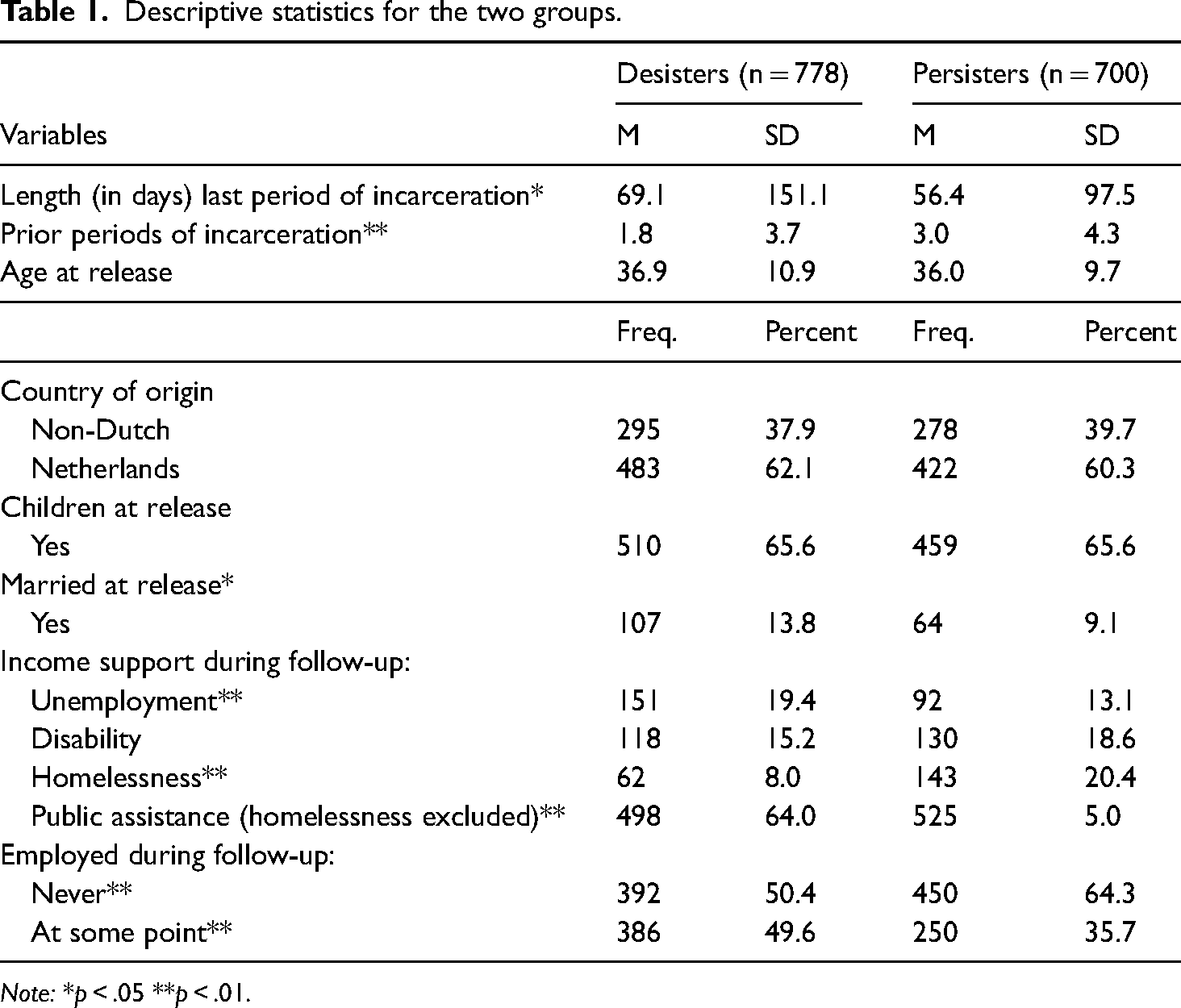
Descriptive statistics. Descriptive statistics are presented in Table 1. A total of 778 women were not registered for any offence during the 7-year follow-up (desisters), whereas 700 women did re-offend (persisters). Of the women who re-offended, 38% (n = 267) offended one time during follow-up, 18% (n = 128) offended twice, and 44% (n = 305) offended three times or more, with a maximum of 28 offences. Looking at their incarceration history, desisters had spent an average of 69 days in prison preceding their 2007 prison release, whereas persisters were in prison a bit shorter on average (56 days), a significant difference (p < .05). In general, desisters had been in prison significantly fewer times than persisters (1.8 vs. 3.0 times, p < .01). Desisters were slightly older when released from prison in 2007, although this difference was not significant. With regard to ethnic background, groups were quite similar; about 60% of the women were born in the Netherlands, and about 40% elsewhere. A minority of women in both groups was married at release, although desisters were significantly more often married than persisters (13.8% desisters vs. 9.1% persisters, p < .05). The majority of women had at least one child upon release (65.6% in both groups).
Descriptive statistics for the two groups.
Note: *p < .05 **p < .01.
Desisters were significantly more often employed at some point during follow-up than persisters (p < .01), and for more weeks on average than persisters (74 weeks vs. 40 weeks). Looking at income support, significantly (p < .01) more desisters than persisters received income support for unemployment at some point, although the average number of weeks these women received this type of support was small in both groups (8 respectively 5 weeks). Lastly, persisters more often received income support for being homeless and public assistance. They received these types of support for more weeks on average; 22 weeks for being homeless (compared to 7 weeks in the desisting group), and 170 weeks general public assistance (compared to 140 weeks in the desisting group).
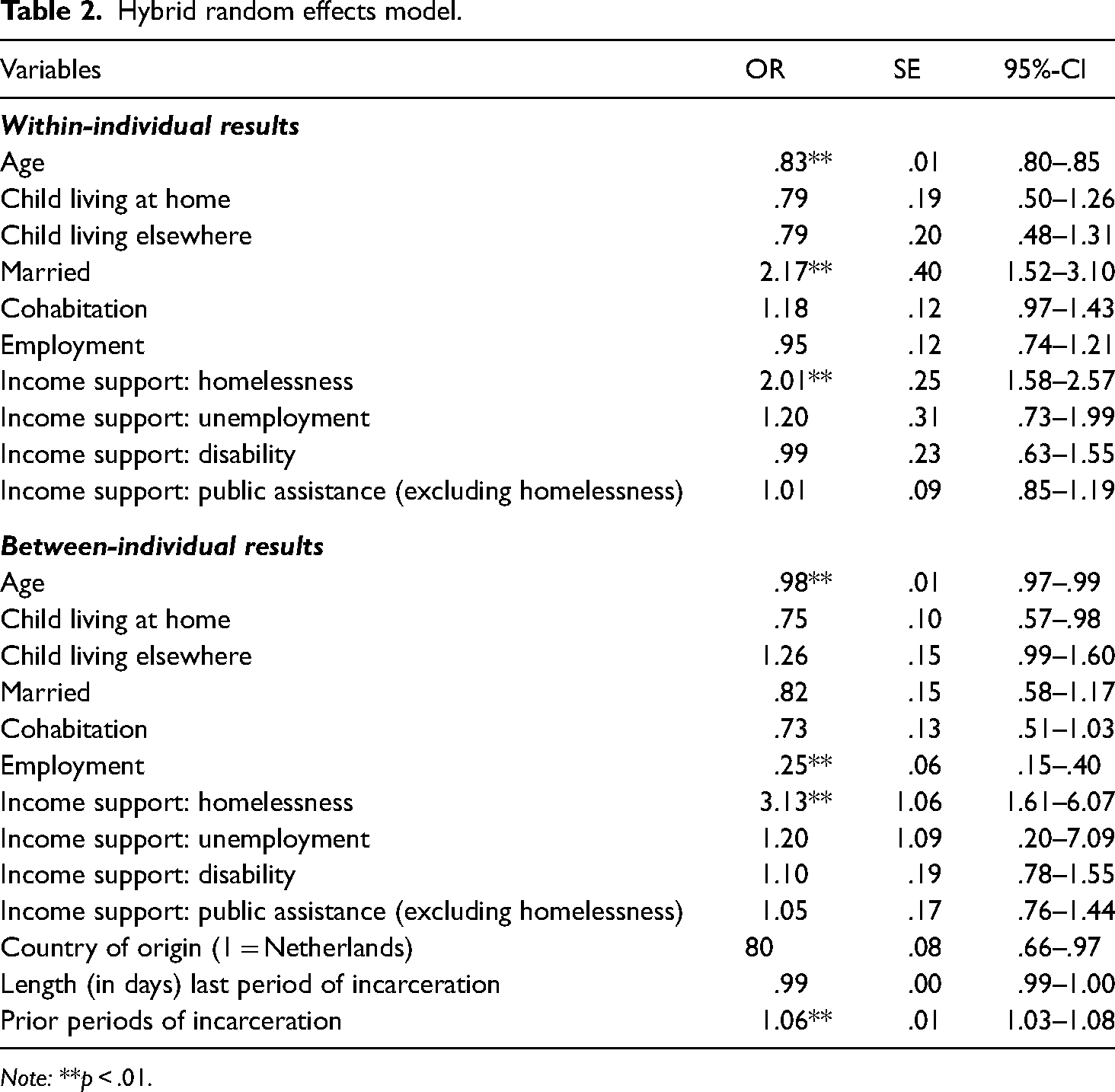
Hybrid random effects model. The results of the hybrid random effects model are presented in Table 2. Given the large number of person-weeks (N = 514,164) we test with a significance level of .01 in this analysis. The top of Table 2 shows the within-individual results. One has to keep in mind that in within-individual analyses only individuals who show variability over time on a specific variable contribute to the regression coefficients. For our within-individual analyses, this means that only the 700 persisters contribute to the regression coefficient. First, women were less likely to offend when they were older. A change in marital status was related to a change in the odds of committing a crime. In other words, the persisters had more than twice the odds to commit a crime in the weeks they were married compared to the weeks they were unmarried. Moreover, in the weeks that these women received income support for the homeless, they were two times more likely to offend, compared to the weeks that they did not receive this type of income support. The within-individual effects of the other types of income support, namely for unemployment, disability, and public assistance (excluding income support for the homeless), were non-significant in this model. Interestingly, receiving public assistance did significantly increase the likelihood of offending once ‘income support for the homeless’ was added back again to this broader public assistance variable (model not shown here). This finding indicates that the positive effect of receiving public assistance on offending is dependent on whether a woman received income support for the homeless, and not just on receiving public assistance in general. Lastly, the within-individual effects of cohabitation, motherhood, and employment were all non-significant, indicating that a change in these variables was not related to a change in crime.
Hybrid random effects model.
Note: **p < .01.
The between-individual results, in the lower part of Table 2, show that older women were less likely to offend than younger women. Between-individual differences in being married or cohabiting were not associated with the likelihood of offending. Moreover, no effect was found for between-individual differences in having a child living either at home or elsewhere. Women who were employed during follow-up were significantly less likely to offend than women who were unemployed. Similar to the within-individual results, the between-individual part of the analyses shows a substantial association with receiving income support for the homeless; women who received these benefits were more than twice as likely to offend than women who did not receive these benefits. With regard to detention history, experiencing more periods in prison increased the likelihood of offending. The length of the period in prison preceding the 2007 release did not have an effect.
A couple of conclusions can be drawn based on the combined results of the within- and between individual analyses. First, a higher age was related to decreased offending in both analyses. Second, the finding that marriage increased the likelihood of offending in the within-individual analyses but not in the between-individual analyses could indicate that those women who re-offended during follow-up were in qualitatively bad marriages, and that these marriages influenced their offending behaviour after release (explaining the crime-enhancing effect as shown in the within-individual analyses). Third, the influence of employment as found in the between-individual analyses is likely endogenous, given that this influence was not found in the within-individual analyses. These findings point at the presence of some unmeasured variables underlying both employment as well as the ability to remain crime-free. Thus, although employment can be regarded as an indicator of ‘doing better than unemployed individuals’, it does not have a causal connection to the ability to remain crime-free. Lastly, receiving a homelessness-allowance was found to increase the odds of offending in both analyses, showing that receiving this type of allowance has a strong association with offending. Although we are unable to test this inference, it is likely that this association is actually caused by the effect of being homeless, and all other problems that precede or follow upon being homeless, such as financial problems. Given the strong association with offending, being homeless can be regarded one of the more severe resource blockages faced by women upon release from prison. The question is then, whether and if so how these blockages interfere with or even counteract potential desistance-enhancing factors. The interviews shed light on this complex interplay.
Qualitative results
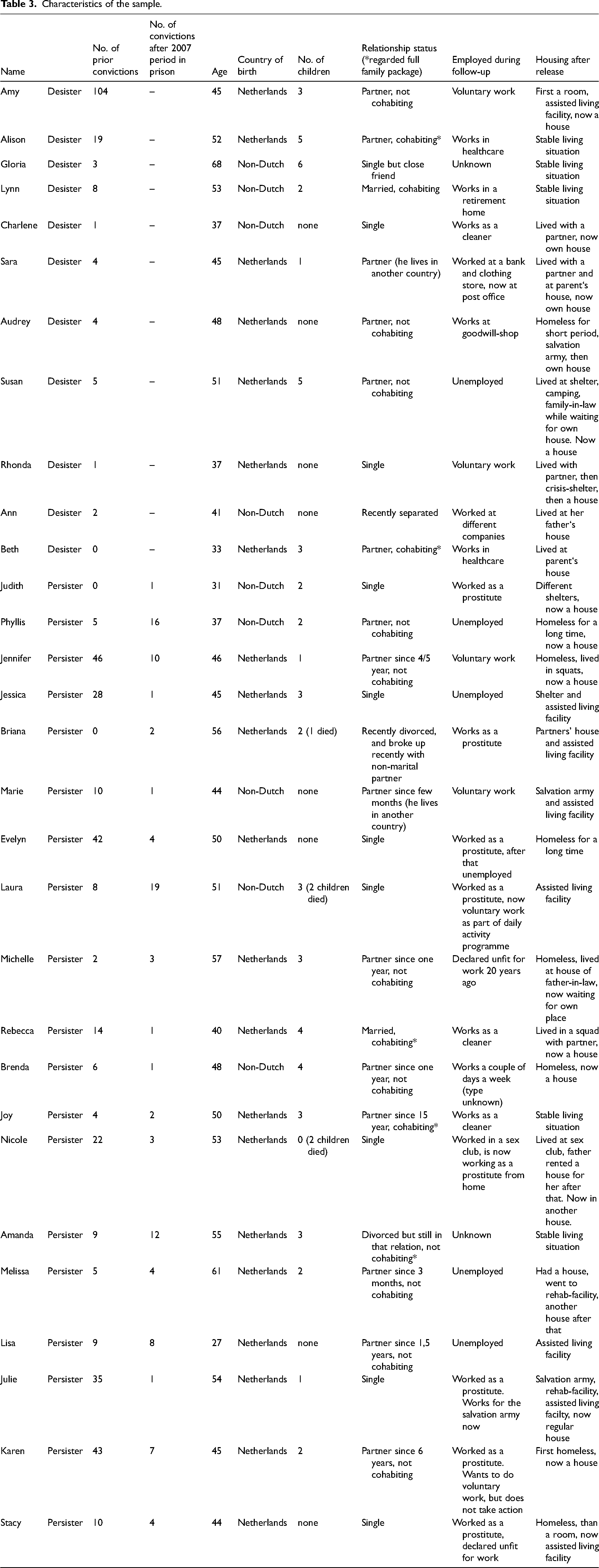
Descriptives. Table 3 presents an overview of the sample under study. The 30 interviewed women were between 27 and 68 years of age during the interview, with a mean age of 47. Of the 30 women, 11 had not been convicted for an offense during the last 7 years, and were labelled ‘desisters’. Nineteen women were registered for one or more offenses during that same time-period, and were labelled ‘persisters’. Most women (n = 21) were born in the Netherlands. About one third of the women completed a form of higher education, most often community college (n = 10). The other women had only finished high-school (n = 9), elementary school (n = 8) or had not followed any education (n = 3). The majority of women had one or more children (n = 21). Half of the women (n = 18) were in a romantic relationship at the time of the interview, while 16 women had been in a romantic relationship directly after release from prison. Only five women indicated that their current partner was the same partner as the one they had directly after release.
Characteristics of the sample.
Romantic relationships Above, we suggested that the relation between family life on the one hand and offending on the other as found in the quantitative analyses might be caused by differential circumstances surrounding these life events. The women‘s narratives show that negative romantic relationships as characterized by, for example, domestic violence and (joint) drug use have a negative influence on desistance, while leaving an abusive partner for a more prosocial one had a positive effect on the women‘s post-release lives and their desistance efforts. Interestingly, women took active steps to end their negative and abusive relationships, such as physically leaving their home, filing for divorce or finally pressing charges. The decision to end the relationship was often triggered by yet another instance of abuse or the sudden realization that things were not going to change, both referred to as ‘eye-openers’. As such, these stories show strong signs of agency, as expressed in the recurring use of terms like ‘realization’, ‘being fed up with it’, and ‘what am I doing’.
Alison (desister) had been in an abusive relationship for thirty years. She cited how her former partner was always drunk, and how she had lost contact with her mother and other close relatives because of him. About finally leaving him, she explained: And you get, you feel you are getting stronger and stronger. At first, you just let him hit you over and over again. And then, at one point, you are fed up with it, and then… yeah, that takes a long time, but then you are just done with it.
Importantly, these agentic moves away from negative relationships paved the way for forming more positive, supportive relationships, a process that featured in the accounts of both desisting and persisting women. Melissa (persister) explained how a whole new world opened up to her ever since she got together with her current partner. The fact that he was not doing any of the things that got her into trouble over and over again, such as drinking and using drugs, had helped her a great deal. Other women described how their partners had supported them in maintaining a crime- and drugs free life, for example by motivating them to go to meetings of the Narcotics Anonymous. Moreover, their partners helped them with everyday life issues and housing. Lynn eloquently described how various desistance-enhancing factors converged after forming a new, positive relationship: Because we were together. And then I had a place to stay and uh.. I slowly started to get clean… Because uh.. you have another life. You have a man, and you want uh. You wake up. You think, now I have to make a decision. Either… you die, if you continue. Or you start living in the right way. A normal life.
After ending her latest abusive relationship, Amy found a new partner. She described him as a calm person, who had brought structure into her life. As a side-effect of this new, positive relation, she stopped spending time with individuals who had been incarcerated and started to hang out with ‘just normal people‘. This reach for normality was described by other women, and could be considered as an important part of the ongoing process of desistance
Motherhood. Mothers in both subgroups expressed deep feelings of love and pride for their children, and they often mentioned their children when asked about the positive things in their lives. Moreover, they expressed a desire to turn their lives around for their children, or claimed that their children were the reason that they already started to change. The narratives revealed that being away from their children during imprisonment had been hard for mothers in both groups, and they mentioned the fear of being separated from their children as a reason to turn things around: That was terrible for me. Because… he is all that I have, I don‘t want to lose my child… Because, you know, I had time to think like shit, if I go on this way, I will lose my children for real. [Laura, persister]
In essence, the stories indicate that almost all women experienced warm feelings towards their children and that they used their children as ‘catalysts for change‘ (see also Giordano et al., 2002), with the potential to contribute to the initial phase of desistance. However, it became clear from the narratives that motherhood was not an exclusively positive experience for these women. Indeed, women in both subsamples described various factors related to motherhood that interfered with the potentially beneficial influence on a movement away from crime. First, financial difficulties played a role in their post-release lives. One woman explained that she never did anything other than stealing, and only for food. She was on social welfare after release from prison, taking care of all other family members on her own, and said it was difficult to make ends meet. Moreover, unstable family situations featured in several accounts of persisters and desisters, with children who were taken into care, lived at the house of family members or at the house of the father against the mothers’ will. Jessica (persister) described how her attempts to get her children back failed, leading her to give it all up: While I fought so hard. I had to bring my urine to the judge, you know? To show them that I really wanted it, you know? And, and.. it did not do anything. And then, after three years, I thought, the hell with it, I won‘t get them back anyway.
The narratives shed light on why some women actually managed to desist from crime, whereas their persisting counterparts, who also claimed that they wanted to change for their children, did not. First, and most importantly, it was found that the desisting mothers took active steps to resolve some of the problems that interfered with fulfilling their maternal role; they stopped using drugs, and tried to bring some kind of structure into their lives. It is likely that these changes in lifestyle impacted their desistance efforts directly, while at the same time strengthening the bond with their children, influencing their desistance process indirectly. Lynn did not have contact with her children for ten years. According to her, things were getting better when she got clean, and became more ‘present‘ as a result.
At the same time, findings showed that most of the desisting mothers experienced some kind of support, most likely from their partner. They provided them with, amongst other things, a place to stay, making it easier to focus on solving their problems and, as a result, to be better able to take advantage of being a mother. It could be then, that the influence of children alone is not enough to initiate desistance. Or, as already argued by McIvor (2015: 168), children could ‘offer a strong incentive for not resuming drug use and associated offending (i.e. supporting secondary desistance)’, but women might need more handles to get to that point in the first place. Here, again, the detrimental effect of resource disadvantages becomes apparent: whereas all women in the sample expressed a desire to stop offending for the sake of their children, women were much more likely to do so when they received different forms of practical support, lowering the obstacles.
Employment. The between-individual analyses presented above showed that being employed lowered the likelihood of offending, but that this association largely vanished after controlling for (unmeasured) within-individual factors. The Women's narratives bring us closer to an understanding of this association. Interestingly, here we see marked differences between persisters and desisters. Women who desisted from crime described other types of jobs, other reasons for carrying out their jobs, and other transformations related to having a job compared to their persisting counterparts. As for the type of jobs, three persisters had a regular paid job after release. Eight persisters were sex workers. Contrastingly, seven desisters secured a regular paid job, two desisters did voluntary work, and only one desisting woman indicated that she did not have a job and that she had not tried to find one. Perhaps even more telling are the different meanings and consequences assigned to these jobs. Women in the persisting group talked about their jobs without assigning any prominence to it. The women who worked as sex workers described their job in terms of ‘making money fast’ to buy drugs. By contrast, almost all desisting women described how their jobs had played an important role in getting their lives back on track. Most of them had made agentic moves to get a job, such as going to an employment agency, or asking other people for help in finding a job. Interestingly, these moves were not primarily motivated by financial reasons but by a desire to ‘do something different with their life’. This might explain why desisters who started doing (unpaid) voluntary work seem to have benefited as much from their new jobs as the women who secured a paid job. For all these women, being employed brought structure into their lives and made them proud of themselves. Moreover, their narratives showed a connection between their job and their identity. Amy specifically mentioned that she valued the status of employee and respected colleague highly. Ann described how having a job matched her idea of ‘not being a bad person’. Asked about what made a difference this time, Rhonda responded: At one point, you start to think differently. And then you think, oh, that's positive, or I can also do it this way. And yeah, by taking other directions, and for example start doing voluntary work, yeah, things went into a different direction. [Rhonda, desister]
This account also sheds light on the time-order of things; the woman decided that something had to change, then she started doing things differently, and then things went into a different direction.
Housing, drug use and financial difficulties. The unique challenges that formerly incarcerated individuals face when released from prison are undoubtedly impacting their efforts to desist from crime. For most women, the post-prison period was characterized by problems related to housing, drug use, and financial difficulties. Only three persisters indicated that they had some form of stable housing after release. The other women went to the streets, to a shelter, to a rehab facility or slept at their workplace. Five women progressed into an assisted living facility later on, and regarded this as an important step towards an improved life. Although some women in the desisting subsample experienced difficulties with finding a place to stay after release as well, most of them were able to go back to their own place, or to live with family members. It seems as though women in the persisting subsample faced more and bigger obstacles related to housing than their desisting counterparts, and that these obstacles prevented other potential beneficial factors from coming into play. Earlier, results of the quantitative analyses pointed at a strong crime-enhancing effect of receiving income support for being homeless. The narratives shed light on why it is almost impossible to bring about lasting change without having a place to stay. Nicole lived at the sex club where she was working after release. About her efforts to desist, she recalls: Even if you would like it [to change], you are out on the streets. And you don‘t have anything. So what then? And it‘s difficult to get income support, because you don‘t have an address. And then you end up in a circle, you know? [Nicole, persister]
Persisting women mentioned how being out on the streets has a detrimental impact on the post-release period, especially for women with drug problems: People get back on the streets. They were just starting to get clean in prison. And what do you do when you get back on the streets? You are cold, you are hungry, so you start doing coke or heroin again [Stacy, persister]
These statements are especially relevant when examining the women’s (histories of) drug use. All but one persister and eight desisters mentioned that they had used drugs at one point in their lives. More specifically, 19 persisters and 6 desisters stated that they had been addicted or described a form of usage that could be labelled as an addiction (these women referred to, e.g., an inability to ‘kick the habit’). Notably, the narratives of the persisting subgroup point at sustained problems related to drug and alcohol use after release from prison, more so than the ones in the desisting subgroup. The majority of persisters mentioned that they were either still addicted, that they had been in (and out of) treatment-programmes, or that they had kicked the habit but that they were still on prescribed methadone. Most women attributed their continued drug use to their adverse circumstances; they said they used drugs to overcome the misery of being homeless, to forget their often troubled histories, or because they felt like they had to follow the (negative) example of their partner or relatives. However, some women specifically mentioned that their drug-using behaviour was part of their identity, and that they would never stop using. Importantly, problems with drug-use seemed to be related to offending behaviour, as most drug-using women described how they had committed property offences to be able to buy drugs. As such, their drug use hampered potential desistance efforts.
Lastly, almost all women, persisters as well as desisters, mentioned a lack of income during the post-release period. The majority of women had debts. However, women in the persisting subsample mentioned more and more severe consequences related to their financial problems. They lost their house after not paying the rent for a couple of months (while their housing situation was unstable to begin with, as mentioned earlier), and/or they started working as a prostitute to earn some money. In contrast, the financial picture of women in the desisting subgroup was slightly more positive; they received help to deal with their financial problems, either through debt restructuring programs or with help from family members, or they started working to be able to pay off their debts.
Discussion
In recent years, a growing body of studies on women‘s reentry and desistance processes has broadened our knowledge on factors related to a movement away from crime (Schinkel, 2019). Yet, several uncertainties pertaining to the exact influence of specific life events and individual transformations on women‘s desistance still exist. Findings on the influence of events such as employment are inconsistent, and research on the effects of broader adverse post-release circumstances and how these interact with more subjective feelings of agency and shifts in identity is scarce. The goal of the present mixed-method study was to examine which factors influence women‘s post-release outcomes, and to unpack the mechanisms that contribute to desistance in a period that is often marked by severe resource disadvantages.
Results of the hybrid random effects analyses reinforce the idea that the effect of often-studied forms of social control, most notably marriage, motherhood, and employment, are to a large degree dependent on (unmeasured) individual differences and circumstances. Women who offended were more likely to do so in the weeks they were married. These findings support other studies that suggest that marriage in itself does not contribute to desistance, and that it can even hamper desistance efforts when of low quality (Barry, 2010; Bui and Morash, 2010; Simons and Barr, 2014). No effects were found for the influence of having children (either living at home, or living elsewhere). As for the between-individual analyses, employment was found to be negatively related to the odds of offending, but this variable did not affect offending in the within-individual analyses (thus women who re-offended were not more or less likely to offend in the weeks they were employed). Following this, it can be assumed that the influence of employment is endogenous, and the result of some underlying factors that are related to both employment and the ability to remain crime-free. Lastly, the only variables that had a substantial and consistent effect on offending were age and receiving income support for homelessness. Both within- and between-individual analyses showed that women were more likely to offend in the weeks they were younger and in the weeks they received this type of allowance.
Findings from the interviews shed light on the mechanisms underlying these findings. As appeared from the narratives, it was the meaning assigned to these forms of informal social control coupled with the women's broader circumstances that influenced their outcomes. With respect to these circumstances, and reinforcing the quantitative finding that receiving a homelessness allowance substantially increased offending risks, having a place to stay was regarded pivotal by the women. Almost all women in the current sample, desisters as well as persisters, assigned much prominence to a roof above one's head, indicating that any attempt to desist from crime and to re-integrate successfully is bound to fail if one is living on the streets. Other potential crime-reducing factors were often regarded in light of whether a woman had a place to stay. Attempts to get clean (that often started in prison) were given up once women became homeless after release, and getting a job or income support turned out to be difficult without a home address. Most women who were homeless after release resorted to prostitution or crime, regardless of whether they had children or a romantic partner. These findings are in line with other studies that point at the centrality of housing in the re-entry process (Walker et al., 2014). These findings also provide an explanation for the lack of effect of motherhood. While previous studies have often pointed at the crime-reducing effect of becoming a mother (Rodermond et al., 2016), the interviews show that motherhood often goes hand in hand with difficult circumstances, such as financial problems and instable caregiving situations. Whereas all women appeared to be highly motivated to turn their lives around for their children, women were unable to do so in the absence of practical support and important resources such as housing.
With regard to employment, desisters seemed better off than persisters. Rather than resorting to prostitution or crime to ‘make money fast’, most desisters secured some form of meaningful employment for themselves, often a job that brought structure in their lives and made them proud of themselves. This result is consistent with other studies that show that employment has the potential to act as a turning point in the lives of formerly incarcerated women, especially if the job contributes to women's feelings of self-worth (see e.g. Cobbina, 2009). Interestingly, the desisting women appeared to have set in motion a spiral of positive events, where their initial desire to form another life for themselves led them to acquire a job, after which that job reinforced both their motivation to build a new life and the positive view of themselves that the women started to have. As such, employment appeared to influence desistance indirectly, through this active process of redirecting one‘s life and buffering self-esteem. Interestingly, these processes are arguably the ‘underlying factors’ that were mentioned earlier in relation to the differential effects of employment as found in the between-individual analyses. As shown by the interviews, desisters were more likely than persisters to have a meaningful job, explaining both the positive effect of the between-individual analyses, as well as the lack of effect in the within-individual analyses. Again, however, one has to keep in mind the multiple demands placed upon formerly incarcerated women. As has been mentioned previously, persisting women seemed to fare worse after release in several regards, while they also pointed at highly adverse pre-incarceration circumstances. It is likely that these circumstances also hampered chances to secure and maintain meaningful post-release employment. Previously, Fahmy, Gricius, Chamberlain and Wallace (2021) found that factors associated with ‘job readiness’, such as prior employment and high school education, differentiated between those who did and did not find post-release employment. The authors concluded ‘the inability to find work may have catalysed their criminal involvement in the first place’ (p. 16), and that this also impacted their post-release employment outcomes. Relatedly, women have been found to be less likely than men to have friends, family or previous employers within their networks who were willing to hire them (Morrison, Bevan and Bowman, 2018). As mentioned earlier, persisting women had less of a (prosocial) network than desisting women, potentially impacting informal roads to employment. Hence, rather than arguing that desisting women were just more motivated to turn their lives around, leading to meaningful employment, we would argue that persisting women had to overcome even more resource disadvantages.
Lately, desistance from crime has been increasingly regarded in light of desistance from drug-use, for example recovery (Colman and Vander Laenen, 2012; Maruna et al., 2004; Graham, 2016). As Bachman et al. (2016a) note, it is difficult to assess whether ‘desistance from crime precedes, follows, or occurs simultaneously with recovery from drug use’ (p. 183), but some studies suggest that recovery is a crucial ingredient of the desistance process, one that tends to precede criminal desistance (Colman and Vander Laenen, 2012). Indeed, the narratives showed a marked difference between persisters and desisters related to their ability and willingness to refrain from drug-use, and continued drug use was often mentioned in relation to continued offending. Although we were unable to quantitatively assess the influence of drug use on desistance (as well as the time order of things), the narratives underline the importance of recovery and the circumstances surrounding recovery.
At the outset of this article, we described the degree to which contemporary theories on desistance assign prominence to life events and turning points, alongside the influence of subjective factors. The interviews proved especially relevant in disentangling the effect of these distinct types of variables. As described above, subjective changes related to one's identity and goals for the future appeared to be crucial components of the desistance process, thus supporting identity theories of both Maruna (2001) and Paternoster and Bushway (2009). Moreover, in the absence of these subjective changes, life events were found to be insufficient to bring about lasting change. However, once the desistance process was initiated (following upon subjective changes), life events were able to reinforce this process. As such, these findings question the direct applicability of traditional social control perspectives to women‘s post-release experiences. Notably, women's processes of desistance appear to be much more complex and intertwined, and future theoretical endeavours should try to grasp these complexities.
Importantly, for this specific group of formerly incarcerated women, the effect of subjective change was in turn dependent on the broader circumstances, most notably housing. In other words, being ‘fed up with it’, seeing another future for oneself and a willingness to change did not automatically initiate and sustain the process of desistance. Recall, for example, how Nicole said that ‘even if you would like it [to change], you are out on the streets. And you don‘t have anything. So what then?’. Her story shows that a genuine motivation to desist from crime can be blocked by circumstances formerly incarcerated women face, and that these circumstances need to be addressed for desistance to be possible at all. As such, our findings support studies pointing at the difficulties of navigating the post-release ‘hostile terrain’ (Bachman et al., 2016b: 212).
We realize that the current study is not without its limitations. First, we rightly acknowledge that classifying individuals as either desisters or persisters based on a dichotomous measurement of subsequent offending after release does not capture the complex nature of the process of desistance. Future research efforts should focus on the different phases of the actual road to desistance, rather than on desistance as a permanent status change. Furthermore, as mentioned previously, we are aware of the fact that the narratives of the women may have changed throughout the years, and it could be that they now have a different view on the events that took place several years ago. By combining the quantitative and qualitative results, we aimed to come a bit closer to establishing the time-order of things. Moreover, we agree with Braun and Clarke (2019) that doing qualitative research is about meaning and meaning-making, and about telling stories rather than about ‘finding the truth’ (p. 7). As such, we feel that describing the way women make meaning of their past is also highly important.
Lastly, and importantly, the qualitative part of the study is limited by a low response rate and a resulting selectiveness in our sample and hence, in our findings. Following this, the insights provided in the qualitative analyses should be interpreted with some caution, as these are not a priori generalizable to all formerly incarcerated women. With regard to generalizability, it is important to stress that this study took place in the Netherlands, a country that is known for its generous welfare system and a penal climate that is to a large extend focused on rehabilitation. While the penal climate moved towards a more punitive stance in the early twenty-first century, the penal welfare state is still prevalent. Notably, according to Kruttschnitt and Dirkzwager (2011), Dutch correctional officers are much more focused on resocialization and, more generally, on human treatment of prisoners than their US and UK counterparts. Hence, the Dutch welfare system and the penal climate likely impact post-release circumstances, making it difficult to generalize this study‘s findings to other contexts where safety nets are absent and punitive approaches prevail.
That said, the present analysis points at the importance of addressing subjective factors in relation to the influence of social factors on desistance, while also taking into account a broad range of circumstances as faced by formerly incarcerated individuals specifically. Although studies tend to use successful desistance and reentry interchangeable, these constitute markedly different concepts, with criminal desistance being only one component (albeit a crucial one) of the much broader process of reentry. Hence, rather than assuming that successful desistance will pave the way for successful re-integration, policy and practice should be first and foremost focusing on promoting successful re-integration, thereby giving formerly incarcerated individuals the opportunity to take advantage of their inner changes and social capital to eventually reach a state of non-offending.
Footnotes
Declaration of Conflicting Interests
The author(s) declared no potential conflicts of interest with respect to the research, authorship, and/or publication of this article.
Funding
The author(s) disclosed receipt of the following financial support for the research, authorship, and/or publication of this article: This work was supported by the Netherlands Organisation of Scientific Research, (grant number 406-11-159).
