




Abstract
While unsupervised and unstructured socialising with peers is associated with delinquency, less is known about to what extent it fits within adolescents’ daily routine activities; that is, their general, structural time use. Furthermore, research informed by the situational action theory shows that unstructured socialising increases the probability of rule-breaking acts more for individuals with higher crime propensity. Hence, structural time use might explain patterns of unstructured socialising, and crime propensity might explain why some are at an increased risk of committing rule-breaking acts during such situations. The present study aims to connect these three aspects and examine: (i) how adolescents tend to structure their time use, (ii) if their structural time use differentially places them in unstructured socialising, and (iii) whether some adolescents during unstructured socialising run an elevated risk of committing rule-breaking acts due to their morality (as part of their crime propensity) while also taking their structural time use into account. Using a sample of 512 adolescents (age 16) in Sweden, time use and morality are analysed using latent class analysis based on space-time budget data and a self-report questionnaire. Multilevel linear probability models are utilised to examine how rule-breaking acts result from an interaction between an individual’s morality and unstructured socialising, also taking structural time use into account. Results show that the likelihood of unstructured socialising in private but not in public is different across identified latent classes. Adolescents, in general, run an elevated risk of rule-breaking acts during unstructured socialising, irrespective of structural time use. In this study, these acts consist mainly of alcohol consumption. However, the risk is higher for adolescents with lower morality. Adolescents’ time use may account for a general pattern of delinquency, but accounting for rule-breaking acts requires knowledge of the interaction between person and setting.
Keywords
Introduction
Adolescents’ time use is linked to, and important for, a wide range of outcomes, including human development, health, quality of life, delinquency, and deviant behaviour (Barnes et al., 2007; Bartko and Eccles, 2003; Hunt and McKay, 2015; Larson and Verma, 1999; Viner et al., 2012). One aspect of time use central to criminology is unstructured and unsupervised time spent with peers. Prior research shows that the risk for both offending and victimisation increase under these circumstances (Beeck and Pauwels, 2010; Bernasco et al., 2013a; de Jong et al., 2020; Felson, 2009; Hoeben et al., 2020; Hoeben and Weerman, 2014; Mahoney et al., 2004; Osgood et al., 1996; Weerman et al., 2015; Wikström et al., 2012). However, adolescents spend a varying amount of unstructured and unsupervised time with peers (henceforth referred to as ‘unstructured socialising’). More generally, they are differentially exposed to criminogenic settings – parts of the environment perceivable with our senses, including any media present, which encourage acts of crime (Wikström et al., 2012: 15).
Adolescents’ differential exposure is part of their overall time use, their lifestyle (Hindelang et al., 1978), routine activities (Cohen and Felson, 1979; Osgood et al., 1996), or activity fields (Wikström et al., 2010). They generally refer to what adolescents tend to do, where, when, and with whom – which this study also refers to as ‘structural time use’. However, studies on ‘lifestyle’ and ‘routine activities’ tend not to focus on how unstructured socialising (a form of criminogenic setting) is part of a larger pattern of individual time use but focus instead on specific risky activities which may or may not be part of a general lifestyle or routine (Engström, 2021). Hence, while we know that adolescents spend a varying amount of time in unstructured socialising, less is known to what extent these differences connect to more general patterns – a structural dimension – of time use.
Furthermore, most do not commit a crime or other rule-breaking acts during unstructured socialising. So, while unstructured socialising increases the probability of rule-breaking acts, it does so more for some adolescents than others. According to situational action theory (SAT), rule-breaking acts result from a person-setting interaction (Wikström et al., 2012, 2018). Adolescents are at increased risk of rule-breaking acts during unstructured socialising depending on their crime propensity (a person’s moral rules and ability to exercise self-control) (Svensson and Pauwels, 2010; Wikström et al., 2018). This is why Wikström stresses that ‘whether or not a crime will happen depends on what kind of person is in what kind of setting’ (2020: 193, emphasis added), which in this study is referred to as the ‘situational’ perspective.
Taken literally, ‘kind of person’ could also entail a qualitative difference, or typologies, in crime propensity (Morin and Marsh, 2015). For instance, considering morality, a group of adolescents might find substance use morally permissible but are aversive towards other rule-breaking acts. Studying qualitative differences would add to the body of literature testing dimensions of SAT, as prior research generally conceptualises ‘generalised morality’ in a quantitative way, that is placing adolescents on a continuum and assuming that they attribute the same qualitative meaning to the items but at different levels.
In sum, adolescents spend time in different ways. Some adolescents are more exposed to criminogenic settings (unstructured socialising) than others, depending on their structural time use. In turn, some are more at risk of committing rule-breaking acts within these settings than others due to the situation – the person-setting convergence triggering a perception-choice process (Hardie, 2020; Wikström et al., 2010). It is important to note that the perception-choice process emerging from this interaction is proposed to be the same, regardless of the structure of time use (Hardie, 2020: 91). Integrating a situational perspective within a lifestyle/routine activities/activity fields framework is rare, probably due to theoretical and methodological issues (as clarified further below). The implication is that the situational process of a person-setting convergence could explain how unstructured socialising is not necessarily crime conducive in and of itself but contingent upon the person attending the setting.
Aim
With the situational and structural aspects of time use taken into account, the current study aims to: (i) study how, and to what extent, adolescents’ structural time use differentially places them in criminogenic settings, and (ii) if adolescents within such settings are at a diversified probability of committing rule-breaking acts due to their morality. The following questions will be examined to meet the aims:
How do adolescents cluster in groups in terms of structural time use? How are these groups differentially exposed to unstructured socialising? Do morality and unstructured socialising interact to explain rule-breaking acts when measures of structural time use are also taken into account?
Answering these research questions contributes to our knowledge about how unstructured socialising fits into adolescents’ general time-use, that is, to understand better why some adolescents might be more exposed to criminogenic settings than others. It also contributes to our knowledge about how some are more at risk of rule-breaking acts during unstructured socialising depending on their morality, that is, why unstructured socialising is more important for some individuals than others concerning the explanation of rule-breaking acts. The use of space-time budget data in this study offers the possibility of providing a more detailed description of what an adolescent does, where, and with whom compared to previous work on unstructured socialising. Prior research is generally hampered by its employment of data collected using stylised questions (Hoeben et al., 2014), together with the assumption that delinquent acts are carried out during unstructured socialising, which need not be the case (Hardie, 2020).
Background
Why adolescents have the structural time use they have, and therefore differing exposure to criminogenic settings (of which unstructured socialising is part), could be understood by questions of social and self-selection. Roughly, the former is influenced by matters outside the individual and the latter by the individual. The third point concerning the interaction between person and setting can be understood using theoretical claims made by SAT.
Social selection
The reasons individuals spend time in a certain way emerge from a complex web of individual and societal characteristics that are moderated by self- and social selection, constraints and possibilities (Sampson, 2012; Wikström et al., 2012; Wikstrӧm, 2017). When it comes to adolescents, they are generally subject to constraints from parenting, school attendance, and from living in neighbourhoods that their caregivers were able, or had, to choose (Bronfenbrenner, 1986; Gustafsson et al., 2017; Manley et al., 2020; van Ham et al., 2014). Relationships between parenting, neighbourhood, and adolescents’ personal characteristics are complex. For instance, Scarr and McCartney (1983) highlight the confounding effect of genetic influence on socialisation practices as parents provide both genes and environment [/neighbourhood] for their biological children (see also Harris, 2009). Furthermore, with increasing age, people seek out environments and experiences correlated with their genotype. This form of selection would have meaning for individuals’ patterns of opportunities in a broader sense. For instance, Manley et al. write, ‘The location of the residential neighborhood in the wider urban context is fundamental in determining the geography of opportunity and the facilities and services to which an individual has access’ (2020: 1672). That is, where people live affects their activity fields and exposure to various settings within ecological communities (Browning and Soller, 2014), which may manifest in structural differences in time use. The different settings faced in day-to-day life provide adolescents with a structure for socialisation experiences (Larson and Verma, 1999: 702; Wikström and Sampson, 2003), thus having implications for both situational and developmental outcomes. As embedded within these structural time-use patterns, unstructured socialising could be influenced more by adolescents’ self-selection.
Self-selection
Outside of school hours, adolescents tend to have the opportunity to engage in either structured or unstructured leisure activities. The nature of these activities will reflect the preferences and the choices made by a given adolescent (within certain constraints) (Larson and Verma, 1999: 721). Here, self-selection is a driving force within the boundaries framed by the social selection outlined above. Self-selection can be understood as involving a person’s preferences to carry out an activity and their capacity – personal agency – to realise those preferences. Besides the genetic underpinning outlined above, preferences are formed by the individual’s life history experiences and agency and are moderated by social, financial, and human capital (Wikström et al., 2012: 37–38). Preferences can also make individuals select into peer groups and activities, which further affects their probability of offending (Gallupe et al., 2019; Schwartz et al., 2019). One such activity is unstructured socialising, which is linked to offending (Hoeben et al., 2016).
Self-selection is important because the way adolescents choose to spend time may affect their probability of exposure to criminogenic settings and their general pattern of delinquency. At the same time, rule-breaking acts are contingent upon exposure to criminogenic settings and the individual in the setting. This refers to the fact that while unstructured and unsupervised socialising might increase the probability of rule-breaking acts, it does so more for some adolescents than for others. According to SAT, it is in the situation that the perception-choice process is triggered. People perceive (rule-breaking) action alternatives and choose to carry them out (or not) (Wikström et al., 2012).
Regarding the influence of personal differences, several studies have begun to employ a person-oriented perspective to focus on how individuals differ in their time use (Ferrar et al., 2013; Hunt and McKay, 2015). Considering the social and self-selection mentioned above, one might expect some adolescents to spend more time in unstructured socialising than others as part of a more general patterning of their time use. However, within situations of unstructured socialising, we would expect some adolescents to be more ‘situationally vulnerable’ to the criminogeneity of the setting depending on their crime propensity (Wikström et al., 2010, 2012).
Method
Data
The Malmö Individual and Neighbourhood Development Study, MINDS, is a longitudinal project aiming to study persons (Chrysoulakis, 2022; Engström, 2018; Ivert et al., 2018; Nilsson, 2016) and environments (Ivert and Torstensson Levander, 2014; Nilsson et al., 2021), and also the interaction between person and environment. The study is modelled on the British longitudinal Peterborough Adolescent and Young Adult Development Study (PADS+) (see Wikström et al., 2012, for a detailed description).
The MINDS project has been conducted in Sweden’s third largest city, Malmö. It is based on a randomised sample of approximately 20% (n = 525) of the cohort of children born in 1995 and living in the city in 2007. Three waves of data collection were conducted in 2011–2014, when the adolescents were, or were about to become, 16, 17, and 19 years of age. This study employs data from the first of these waves because it took place during the subjects’ final year of compulsory education. With the transition to upper secondary school, and with increasing age in general, changes in activity patterns and unstructured socialising are expected (Wikström et al., 2012: 256, 307). For this reason, the waves have not been merged.
Time use and rule-breaking are studied using space-time budget (STB) data, and morality based on structured interviews.
Measurements
Time use and rule-breaking. An important part of situational action theory (which PADS+ was developed to test) is the insight that methods are required that facilitate the study of the person-environment interaction. That is, an integrative approach is required that does not separate one from the other but allows the simultaneous assessment of how the two interact (Hardie, 2020; Wikström et al., 2012). The use of STB-data constitutes one such approach.
One general limitation found in prior research studying unstructured socialising is the use of ‘stylised’ questions, asking, for instance, how often a person tends to spend time in a particular type of place with only friends. Such questions cannot distinguish between what activities are engaged in, with whom, where, and when. Instead, scholars have suggested collecting more detailed data capable of differentiating time use along a spatiotemporal continuum (Hardie, 2020; Hunt and McKay, 2015; Kwan, 2018; Wikström et al., 2012). Space-time budget data constitute one type of data that links individuals and their time use.
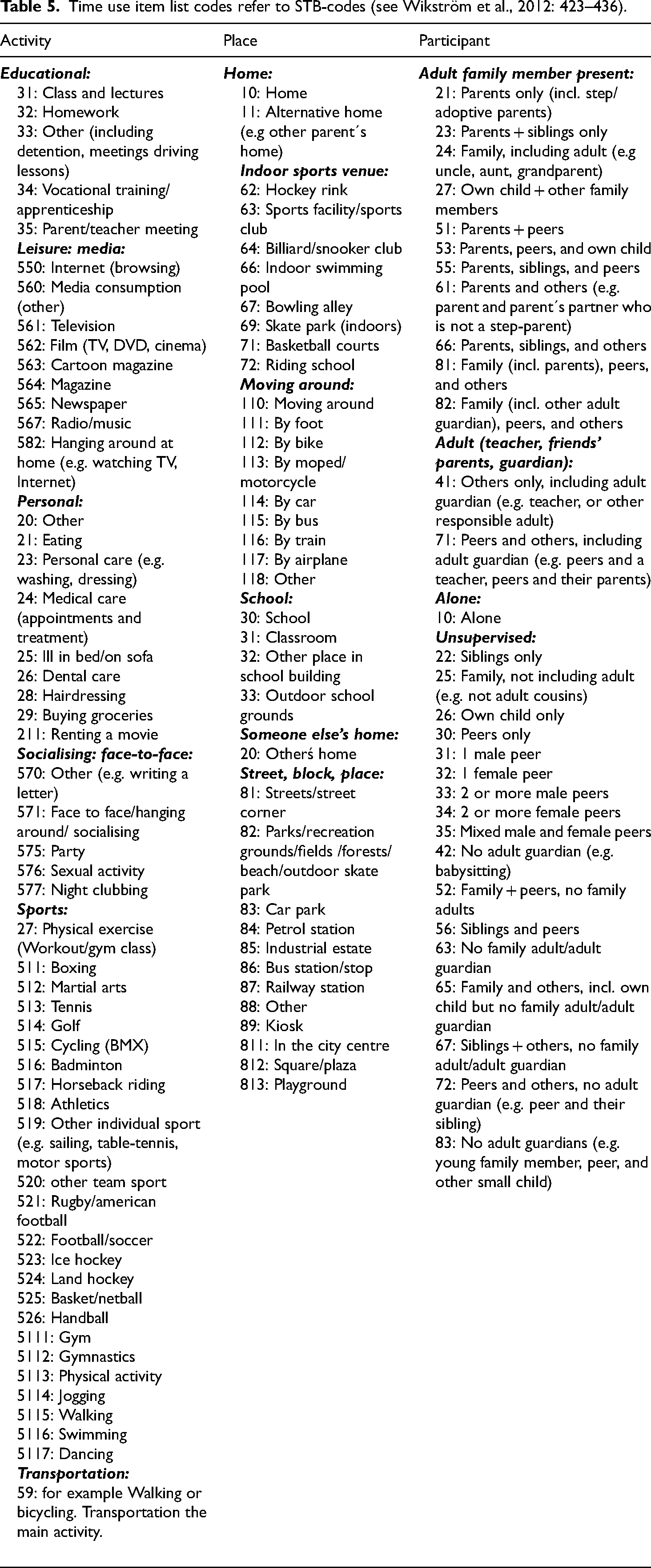
In an interviewer-led setting, the adolescent is asked to provide details on an hourly basis regarding where they were (both functional place, such as home or school, and geographic space), with whom, and what they were doing, in accordance with a battery of predefined codes (see Appendix for a full list of items used in this study, and see Wikström et al., 2012: 67–78 for a detailed description of the method).
The STB data provide information about the adolescents’ time use for the two weekdays prior to the interview and the most recent Friday and Saturday (a total of 96 one-hour time slots). Considering how infrequent rule-breaking acts are, specific questions ask about engaging in or witnessing them and falling victim to such acts. In this study, the measure of rule-breaking acts refers to the hours adolescents report consuming alcohol, engaging in a delinquent act, or being involved in a risky situation (being involved in an argument, or harassing others).
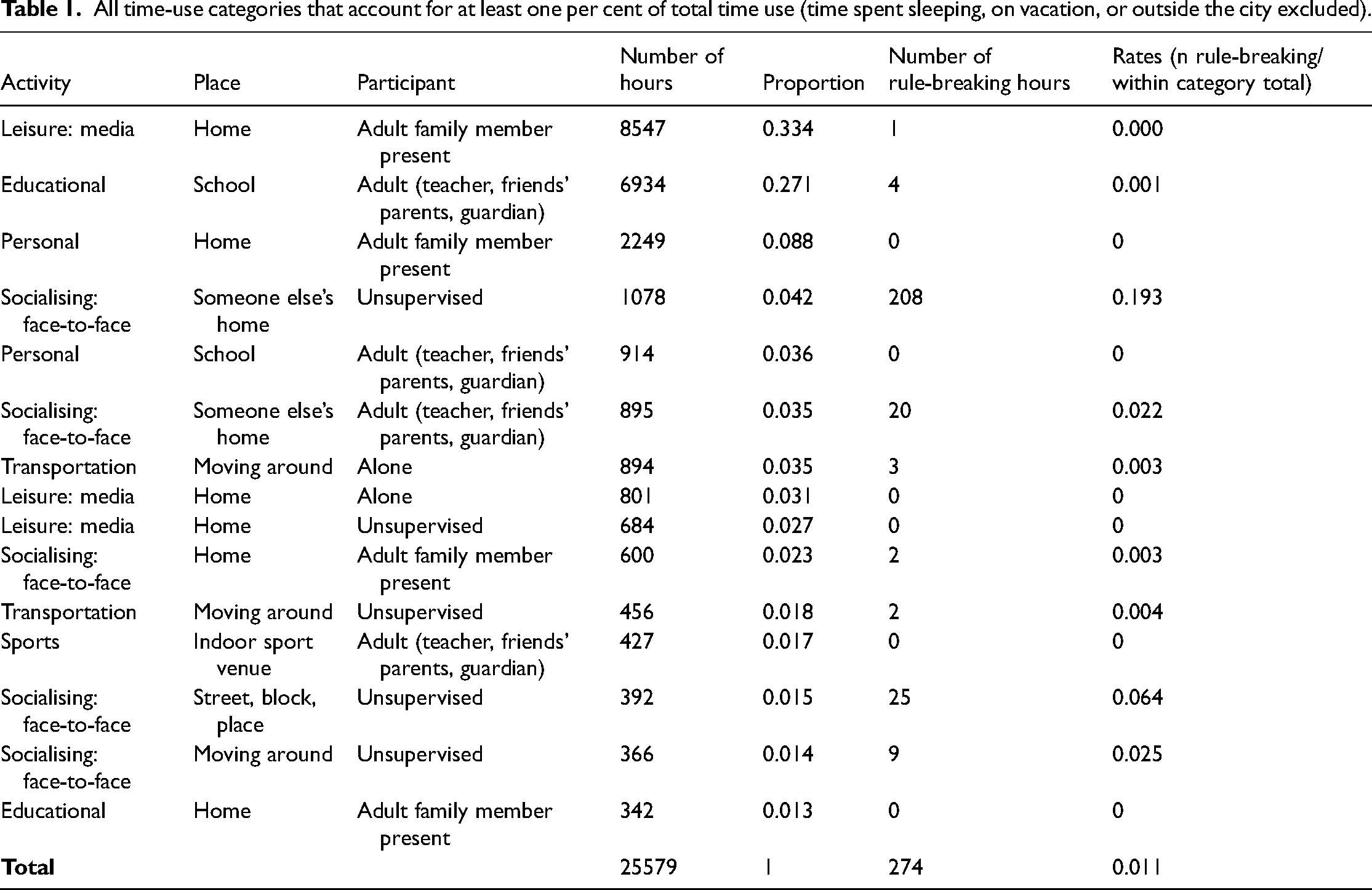
The analyses are based on the most common combinations of activity, place, and participants, defined as combinations together accounting for 80% of the total time use, and that account for at least one per cent of all the included one-hour time slots (see Table 1 below). That is, of the total number of sampled hours (N = 49,152), those spent sleeping, outside the city, and/or on vacation were excluded, leaving a total of n = 31,721 h. Of these 31,721 h, the number that met the inclusion criterion (of having been spent in one of the most common combinations of activity, place, and participants) was n = 25,579 h (80.6%), which provide the basis for the analyses. The threshold of 80% was chosen to increase the number of hours in the analyses and at the same time omit less frequently occurring combinations of activities, places, and participants. Keep in mind that the analyses aim to tap into structural time use rather than focusing on activities most salient to rule-breaking acts which, again, need not be part of adolescents’ routines (Engström, 2021).
All time-use categories that account for at least one per cent of total time use (time spent sleeping, on vacation, or outside the city excluded).
Unstructured socialising. In the situational analysis (described below), an hour is characterised as unstructured socialising if it was spent (i) with at least one peer in the absence of an authority figure, (ii) just ‘hanging around’ socialising (i.e. not online) (see ‘Socialising: face-to-face' and ‘Unsupervised’ in Appendix for more details).
The STB data provide no information on individual characteristics. To this end, we instead use data from an interviewer-led self-reported questionnaire.
Morality. SAT generally conceptualises crime propensity as a person’s moral rules, the feelings attached to these, and the ability to exercise self-control (Wikström et al., 2012). This study focuses solely on personal moral rules as they constitute the most important individual-level factor in explaining delinquency (Barton-Crosby, 2020). SAT states that rule-breaking acts result from a perception-choice process occurring in a situation. While self-control is important, SAT argues that it is primarily important in the context of a specific set of circumstances when a person’s morality discourages a rule-breaking act, but the moral context of the setting encourages it. In these circumstances, a person’s ability to exercise self-control might inhibit the act from being carried out (Wikström and Treiber, 2007). Hence, morality is viewed as the more fundamental of the two and may thus be considered sufficient to provide evidence of an interaction between person and setting characteristics.
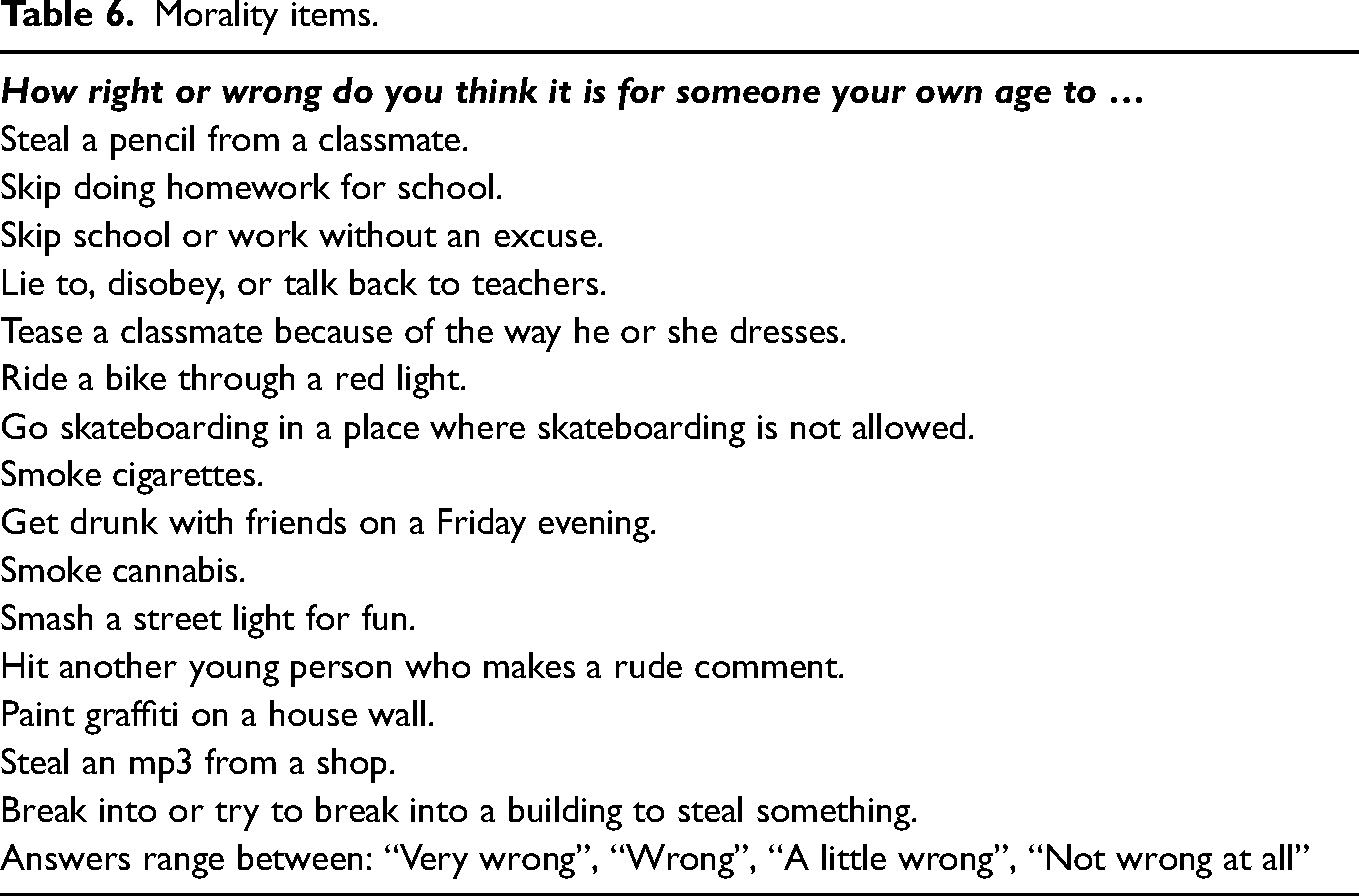
Fifteen items were used to tap into minor and more serious types of acts and substance use (see Appendix). The adolescents were asked to state how wrong it was for someone of their own age to, for instance, get drunk with their friends, hit another young person who made a rude comment, or smash a streetlight for fun. The response alternatives were organised on a four-category scale ranging from ‘very wrong’ to ‘not wrong at all’.
Prior work (Wikström et al., 2012) has also employed the question ‘use a weapon or force to get money or things from another young person’, which has been omitted here due to low variability, with very few adolescents deeming this to be ‘not wrong’ or ‘not wrong at all’.
Analytic strategy
Given the person-centred approach employed in this study, time use and morality are analysed using latent class analysis (LCA) in order to answer research questions one and two. It is a form of mixture model inferring latent (unobserved) clusters of individuals, or subpopulations, from the data (see for instance Ferguson et al., 2020; Hagenaars and McCutcheon, 2002; Muthen, 2002; Reinecke, 2010).
Following Nylund et al. (2007), the number of classes was determined primarily on the basis of theoretical interpretability, parsimony, and empirical fit indices in the form of the Bootstrapped Likelihood Ratio test (BLRT) and the (adjusted) Bayesian Information Criterion (BIC). The former is a likelihood-based technique that empirically estimates the difference distribution between a model with k classes versus k-1 classes. The BIC, instead, enables us to compare a series of specified models, with a lower value indicating a better model fit. All latent class analyses were conducted in Mplus 8.0 (Muthén and Muthén, 1998–2017) using the package MplusAutomation (Hallquist and Wiley, 2018) in R version 4.1.4 (R Core Team, 2021).
An adolescent’s highest posterior probability establishes class membership for each class, that is, their most likely class membership (Muthén and Muthén, 1998–2017: 840). This means assigning each adolescent to a particular class and disregarding the advantages of a probabilistic classification (in which adolescents would vary in class membership probability). However, it imposes less bias with high entropy values (Asparouhov and Muthén, 2021), which measure how well the model can provide well-delineated classes. Entropy values approaching one (1) indicate clearly separated clusters (Celeux and Soromenho, 1996).
The situational analyses (research question three) follow a different strategy. Here we are interested in estimating the probability that an hour involves a rule-breaking act based on variations in structural time use, morality, unstructured socialising, and the interaction between morality and unstructured socialising. To this end, we employ multilevel/hierarchical linear probability modelling (LPM), which is linear regression analysis with a binary outcome variable, taking into account that reported hours (level 1) are not independent observations as they are nested within individuals (level 2).
Hardie writes, ‘Hierarchy is not theoretically relevant because according to SAT, situations (individuals in environments; a single level in a hierarchy) are causally relevant to action, not individuals and environments (which represent different levels in a hierarchy)’, but also clarifies that the questionnaire data together with STB data ‘in practice, have a complex hierarchical ‘structure’ (Hardie, 2020: 95, emphasis in original). Hence, the clustering of hours within individuals is done for statistical rather than theoretical reasons.
While the use of linear regression analysis with binary outcomes violates the assumption of linearity, normally distributed errors, and homogeneity of variance, it avoids the problems associated with the estimation of interaction effects using nonlinear models (Ai and Norton, 2003; Mood, 2010). For instance, the common approach of assessing the product term between two predictors is neither necessary nor sufficient to provide evidence of an interaction effect in non-linear models (McCabe et al., 2021). This is not the case for LPM, which yields reliable estimates under various sample sizes and base rates of the outcome, and also does so when including interactions (Gomila, 2021; Hellevik, 2009; Jaccard and Brinberg, 2021). In short, ‘in the presence of binary outcomes, linear regression analysis is the most powerful, flexible, and the simplest strategy’ (Gomila, 2021: 707). In using LPM, we also follow others who have analysed data of a similar type (e.g. Beier, 2018). 1 These models were fitted using the lme4-package in R (4.1.4) (Bates et al., 2015).
Results
Time use
Examining the distribution of the time slots in the space-time budget data across each combination of what the adolescent did (activity), where (place), and with whom (participant), provides us with a picture of how time is spent in the sample. Table 1 presents the most common combinations, excluding hours spent sleeping, outside the city, and/or on vacation. The bulk of the adolescents’ time is spent consuming media (mainly watching TV or being online) at home under the supervision of adult family members, or attending class at school. The ‘Private, School, Friends and others’ category, which includes ‘Eating at school’, was omitted from the LCAs due to low variability.
Table 1 also presents the number of hours involving some form of rule-breaking act for each time-use category, together with the corresponding rates. In all of the analysed time-use combinations shown in Table 1, hours involving rule-breaking acts are most prevalent in the context of socialising, particularly when socialising at someone else’s home unsupervised with peers. Of the 274 h involving rule-breaking acts reported in connection with the time-use combinations presented in Table 1, 250 (91%) involve alcohol use, 13 h (4.7%) involve other rule-breaking acts, and 13 h (4.7%) involve ‘risk’. 2 Hence, ‘rule-breaking’ mainly reflects instances of alcohol use.
Latent class analyses
Time use. The analysis estimated models containing two to five latent classes (see Table 2). The five-class model replicated the best log-likelihood value but not the BLRT (despite taking measures proposed by Asparouhov and Muthén, 2012). Therefore, it was not pursued further. The four-class model indicated the best model fit based on the BLRT and BIC-values and provided well-separated classes (entropy: 0.937). However, comparing the four-class model to the three-class model indicates that the former leaves two classes in the three-class model unchanged but separates one class into two subclasses. These subclasses do not differ substantially from each other regarding the situational analyses. Therefore, a three-class solution was retained based on theoretical relevance and the principle of parsimony. All analyses have been conducted with the four-class model in the supplemental file (also containing classification tables), showing similar results.
Latent class analyses based on time use. Measures of model fit.
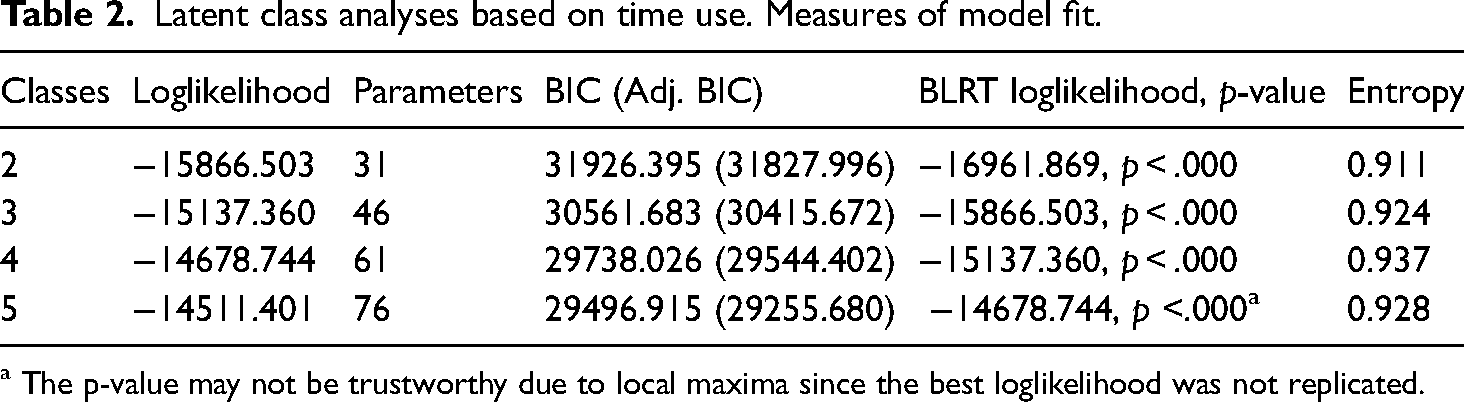
The p-value may not be trustworthy due to local maxima since the best loglikelihood was not replicated.
These three classes are summarised in Figures 1 and 2. Figure 1 includes all time-use combinations, while Figure 2 excludes the top three combinations in Figure 1 (‘Education, Home, Adult family supervision’, ‘Education, School, Adult supervision’, and ‘Leisure: media, Home, Adult family supervision’) to visualise the results better. Note also the difference in scales.
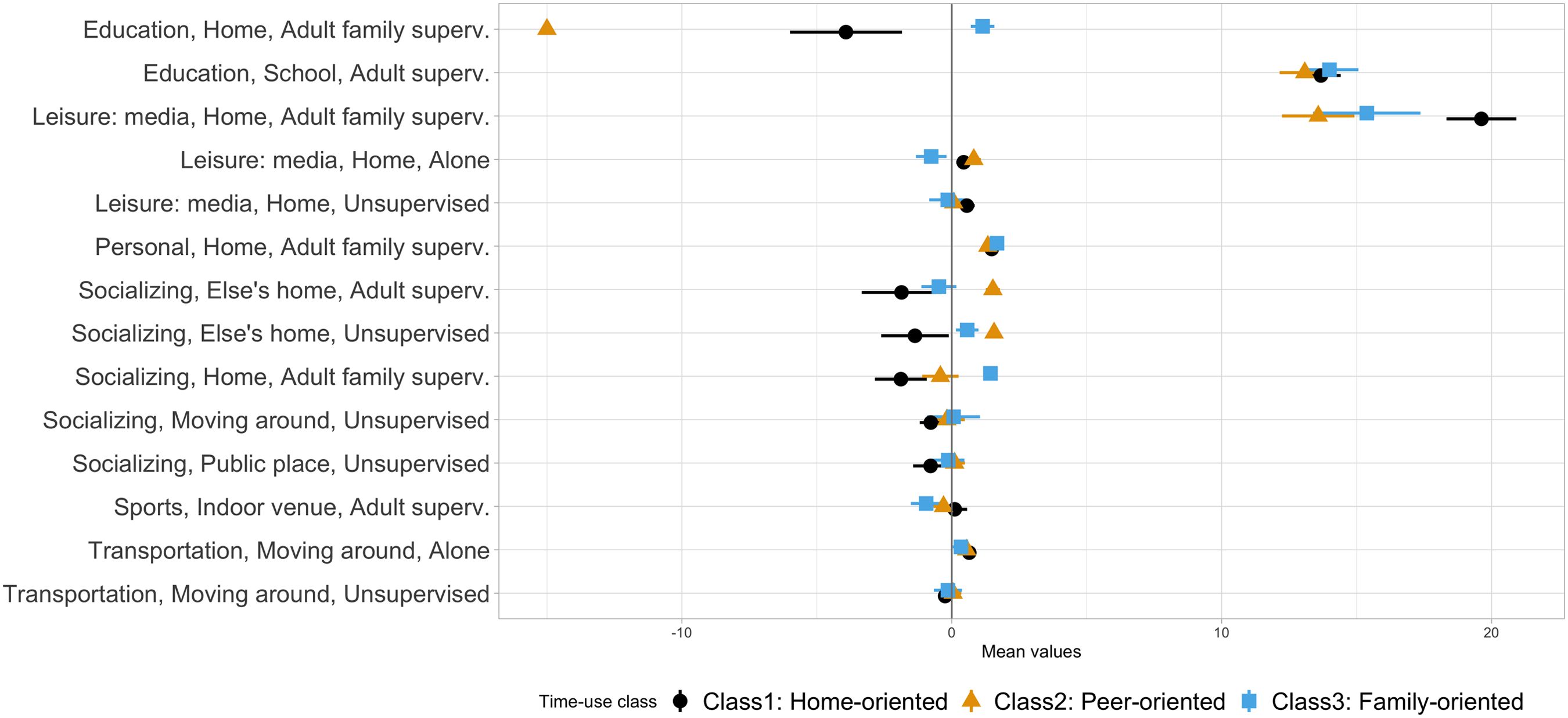
Latent time-use classes. All time-use combinations. Point estimates with 95% confidence intervals.
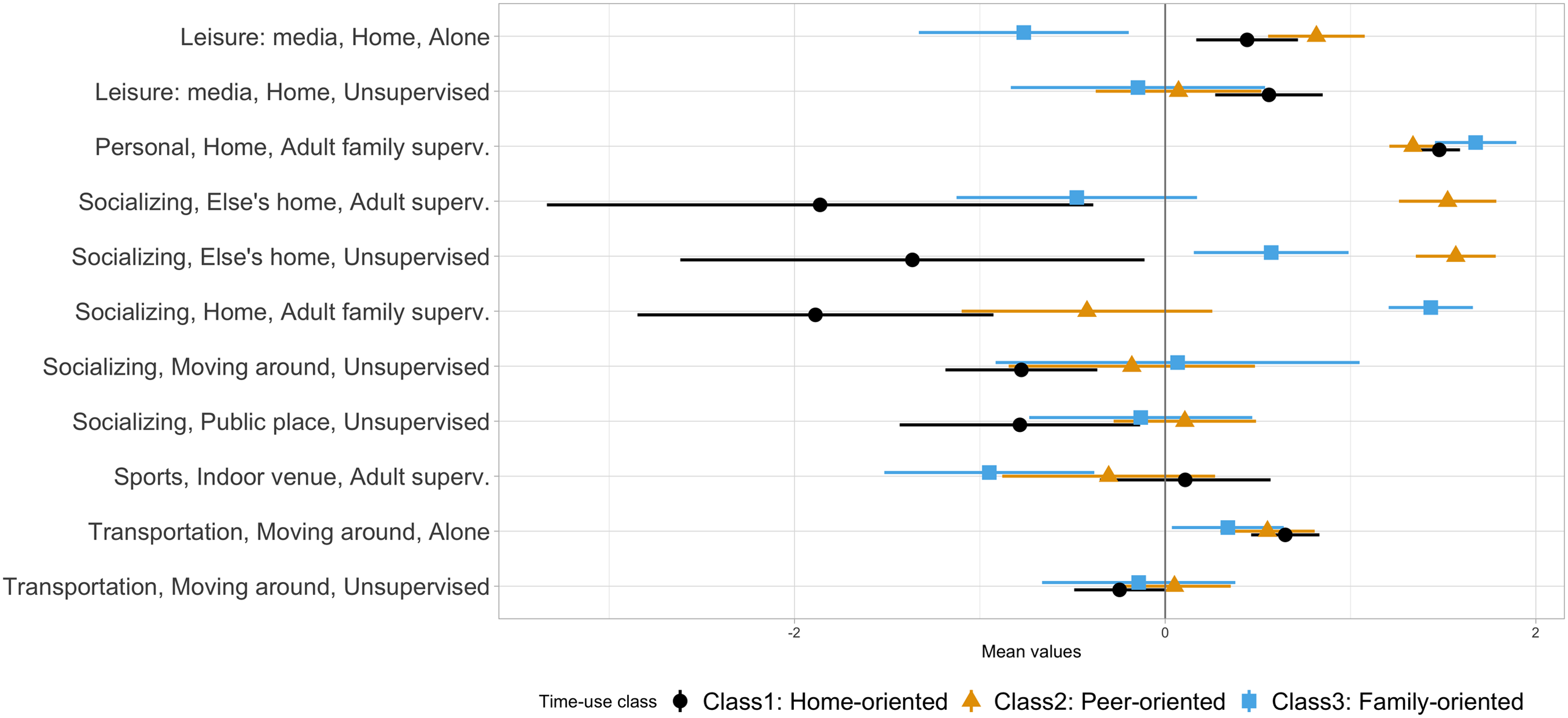
Latent time-use classes. Excluding the three combinations ‘Education, Home, Adult family supervision’, ‘Education, School, Adult supervision’, and ‘Leisure: Media, Home, Adult family supervision’. Point estimates with 95% confidence intervals.
When the three classes are compared, adolescents do not differ in their likelihood of spending time (from top to bottom in Figure 1): (i) in an educational setting in school, (ii) consuming media at home unsupervised, (iii) attending to personal matters at home (mainly eating or ‘personal care’) under adult family supervision, 3 (iv) socialising unsupervised, moving around, (v) socialising unsupervised in public, or on transportation either (vi) alone or (vii) unsupervised with peers.
The youths in Class 1 (n = 235) are most likely to spend their time at home and spend leisure time consuming media in the presence of only family, and they are less likely to spend time doing homework. These adolescents are also less likely to spend time socialising in any face-to-face context. We have therefore labelled them home-oriented.
By contrast, Class 2 (n = 170) can be described as comprising adolescents who are more likely to spend time socialising with others, particularly at someone else’s home, either unsupervised with peers or under adult supervision. They are less likely to spend time engaged in a hobby or any media consumption at home, and they are very unlikely to spend time doing homework at home. We have labelled these adolescents peer-oriented.
Adolescents in Class 3 (n = 107) can be described as being more likely to spend time at home doing homework and as less likely to spend time watching TV/movies or playing video games alone (i.e. ‘leisure: media’). When these adolescents spend time socialising, it is primarily at home under adult family supervision or unsupervised at someone else’s home. They are also less likely than the home-oriented group to engage in indoor sports activities under adult supervision. We have labelled these adolescents family-oriented.
In sum, the results reveal that adolescents vary in their general time use in some respects but are similar in others. There were clear differences between the groups in the degree of unstructured socialising in a private sphere. At the same time, there were no discernible differences in the degree of unstructured socialising in public places. Recalling the rates of hours involving rule-breaking acts noted within these different time-use combinations (see Table 1), such hours (i.e. primarily involving alcohol consumption) are more than twice as common in the context of unstructured socialising in private (someone else’s home) than in public.
Morality. The latent class analysis based on morality suggests a three-class model according to the BIC-value but a four-class model according to the BLRT test (see Table 3).
Latent class analyses based on morality. Measures of model fit.
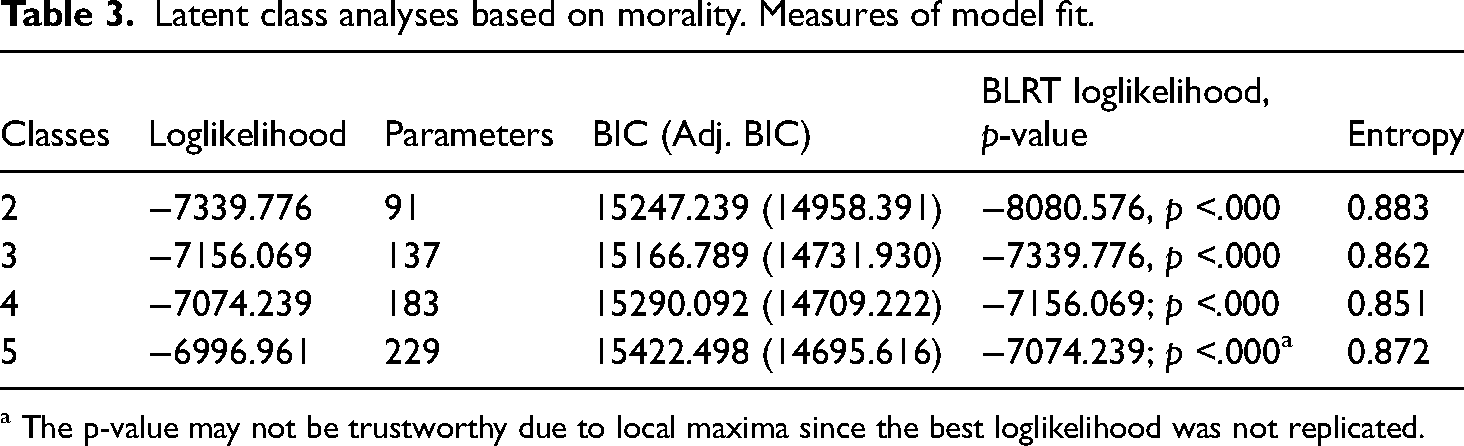
The p-value may not be trustworthy due to local maxima since the best loglikelihood was not replicated.
Both models indicate that the pattern seen across the different moral transgressions appears to be relatively similar. Each class tends to follow a similar pattern but at different levels. The results show little sign of any variation between the classes regarding what might be termed a qualitative aspect of morality. As such, the results favour an item-based approach (used in much prior research on morality and SAT). Since the models provide a form of cut-off points, the three-class model is retained for parsimonious reasons. The classes are perceived to have a strong, medium, or weak correspondence to law-relevant acts, which is why their level of morality is classified as such. 4
Figure 3 illustrates the probability of adolescents in each of the three classes responding ‘not wrong at all’ to the moral transgression items included in the survey questionnaire. The other answer alternatives follow a similar trend but at different levels. Consider, for instance, ‘skateboarding where it is not permitted’ and ‘stealing a pencil from a classmate’, which are the moral transgressions towards which all three classes (strong, medium, weak morality) are most likely to be lenient. The item ‘getting drunk with friends on a Friday evening’ is located in fourth place across all three classes concerning the degree of leniency expressed towards this behaviour.
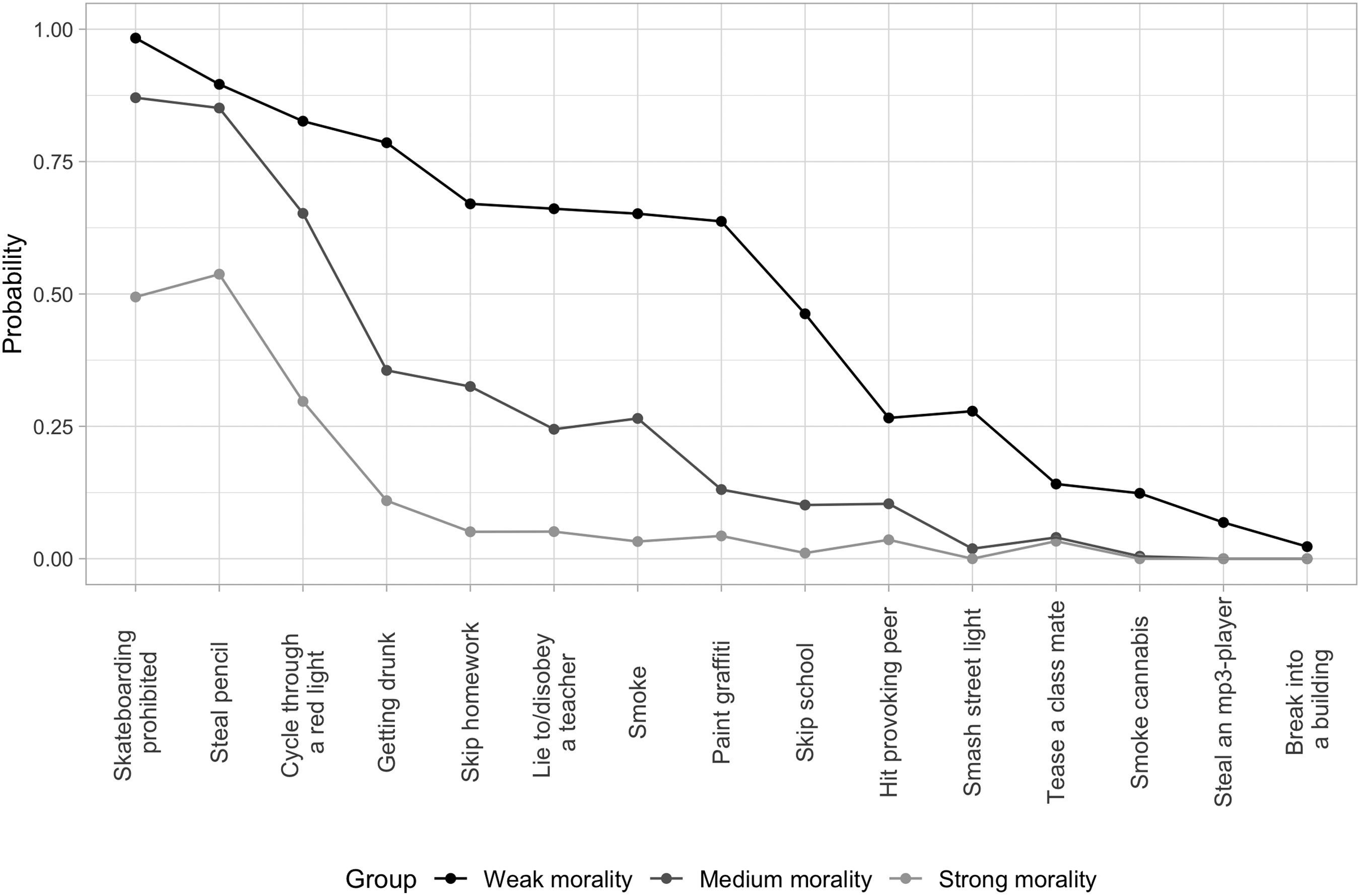
LCA morality. Probability of each class judging each item as ‘not serious at all’.
The proportion of adolescents reporting weak morality is lowest in the ‘home-oriented’ group, followed by the ‘family-oriented’ group, and largest in the ‘peer-oriented’ group (x2(4, N = 512) = 19.834, p < .001).
Thus far, results show that adolescents cluster in groups based on general time use (research question one) and that groups spend different amounts of time in unstructured and unsupervised socialising at someone else’s home (but not in public) (research question two). However, these are all structural patterns. What is lacking is a perspective on rule-breaking occurring in situations (research question three
Situational analysis
Table 4 shows the estimated probabilities that an hour of time use will involve rule-breaking as a function of general time use (Model 1), morality (Model 2), and unsupervised unstructured socialising anywhere (Model 3). Finally, Model 4 estimates the interaction between morality and unstructured socialising.
Linear probability models assessing the probability of an hour involving deviancy. Reference categories: Time-use class: Home-oriented; Morality class: Strong morality. Hours (n = 25579) clustered within individuals (n = 512).
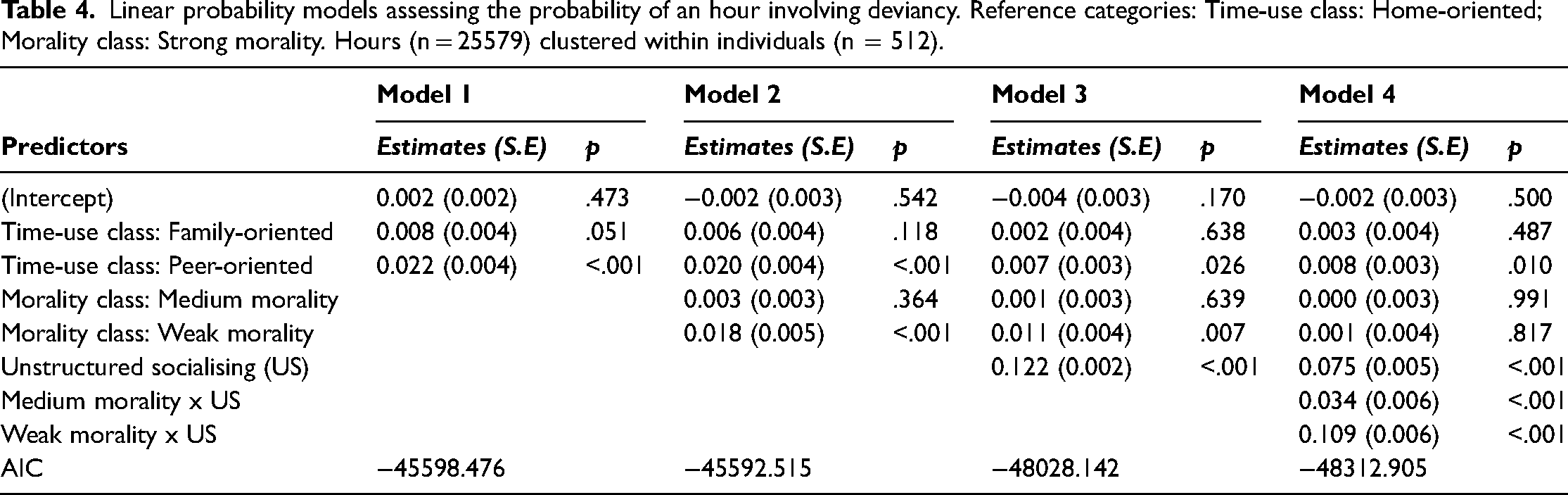
Model 1 includes only time use and shows that an hour is more likely to involve rule-breaking for those in the ‘peer-oriented’ group than the ‘home-oriented’ group. This relationship also holds when controlling for morality (Model 2). Hours spent by adolescents with weak morality, compared to strong morality, are more likely to involve rule-breaking, irrespective of general time use. Controlling for whether hours of time use are unsupervised and unstructured (Model 3) substantially increases the likelihood of them involving rule-breaking. Here, the effect of morality class membership (weak morality vs strong morality) and general time use (peer-oriented vs home-oriented) is still evident. Finally, introducing the interaction term between morality class and unstructured socialising in Model 4 suggests an interaction between the two. The probability of an hour involving rule-breaking not only increases when it is unsupervised and unstructured but more so when spent by those with weak or medium morality compared to strong morality (illustrated in Figure 4).
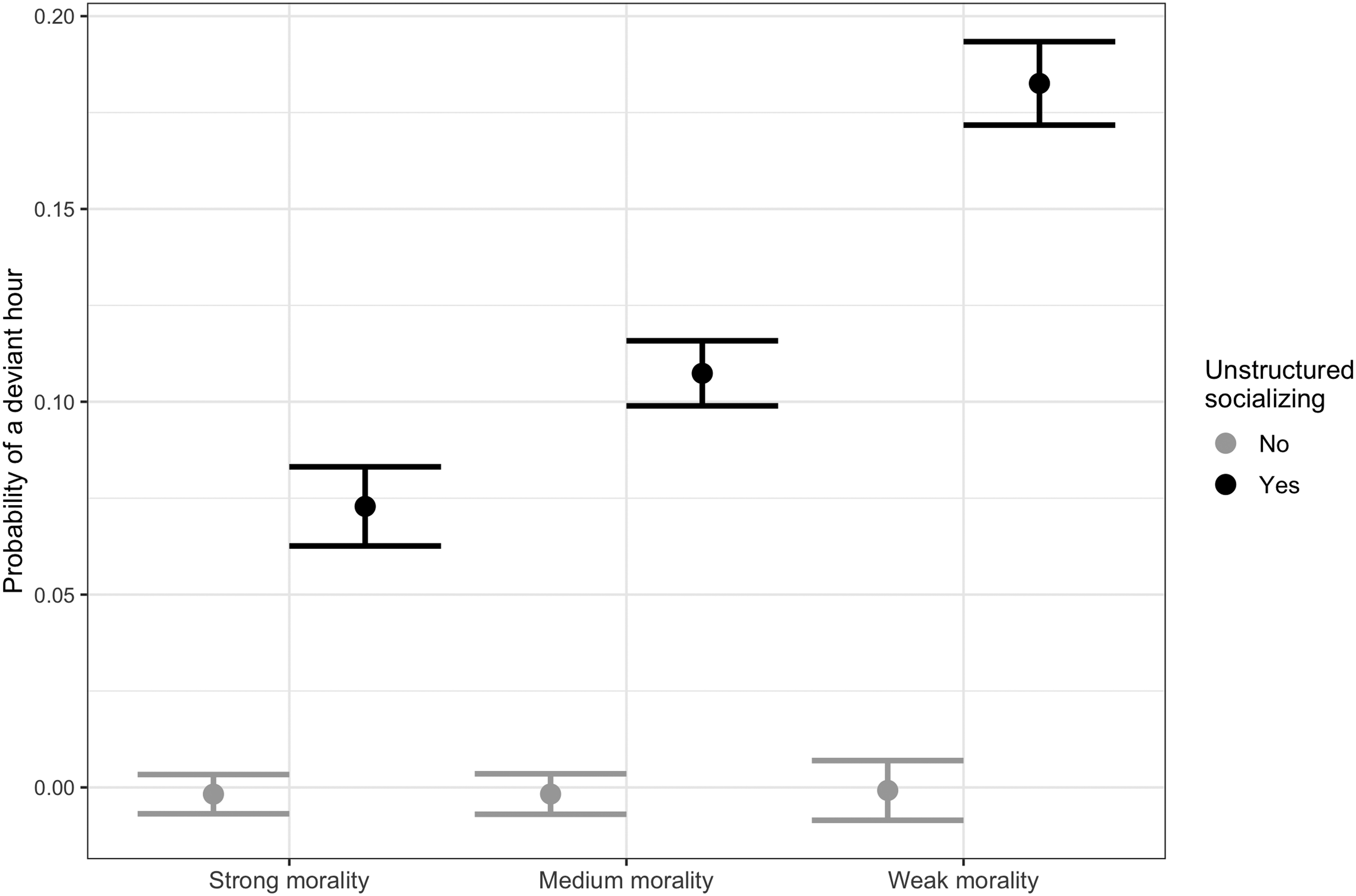
Hours involving deviancy as a function of morality class and unstructured socialising.
As in much previous research, we find that the probability of rule-breaking acts increases during hours of unstructured socialising. Unlike much of this research, however, we have also estimated individual characteristics and how they interact with environmental features using more nuanced STB data. The results suggest an interaction between morality and unstructured socialising in the sense that there is a higher probability that an hour will involve rule-breaking (primarily reflecting alcohol use in our data) if this hour is spent in unstructured socialising and the individual concerned is characterised by weak morality.
Discussion
This study explored structural time use and its relationship with situational acts of rule-breaking. More specifically, we aimed to examine adolescents’ time use in a person-centred manner and how this relates to unstructured socialising and rule-breaking acts. Regarding the latter, our results show that most reported hours in the STB data that involved rule-breaking acts reflected alcohol use. We have characterised alcohol use as rule-breaking because it is not permissible in Sweden for youths from the studied age group (aged 15) to buy or consume alcohol. Other studies based on STB-data have separated alcohol consumption and delinquency and used the former as a predictor of the latter (Averdijk and Bernasco, 2015; Bernasco et al., 2013b), with good reason given the link between alcohol and violence (Exum, 2006; Kivimäki et al., 2014). At the same time, adolescent alcohol consumption patterns tend to be replicated in young adulthood (Danielsson et al., 2010; Percy and McKay, 2015), with possible alcohol-related negative consequences (Grigsby et al., 2016; Hamilton et al., 2014). For this reason, and against the background of Sweden’s comparatively restrictive alcohol policy (Karlsson et al., 2020; Leimar et al., 2013; Nelson and McNall, 2017), we have not separated the two.
The results also show that adolescents spend time in qualitatively distinct ways. Three groups were identified, all of which were distinguishable from one another by morality and unstructured socialising (in private, but not in public). Unstructured socialising in public followed a similar pattern as unstructured socialising in private: home-oriented adolescents were less likely than others to spend time in such way. However, the difference between time-use classes was not significant, which could be due to comparatively lower rates of unstructured socialising in public (see Table 1). Considering the age of the sample participants as well as constraints, opportunities, preferences, and choice, in light of selection, it might not be surprising that the adolescents spent most of their time awake at home with their families present or at school attending class. Less time spent in public settings could, for instance, be due to aspects of parenting that restrict adolescents’ activity fields (Janssen et al., 2017; Wikström et al., 2012: 308), or as an expression of the adolescents’ preference not to spend time ‘hanging around’ in public. For instance, time spent in unstructured activities in public or semi-public settings has decreased between 1999–2017 amongst adolescents in Sweden (Svensson and Oberwittler, 2021). While the current study cannot assess forms of social selection such as parenting, it can mainly point towards self-selection. The results indicated that adolescents in the peer-oriented group had lower levels of morality. A plausible connection between personal morality and selection of settings might be peers. Consider how adolescents’ embeddedness in social networks, or lack thereof, structures opportunities (e.g. enables/restricts access to unstructured socialising in a peer’s house where alcohol consumption is most common). For instance, Weerman et al. (2018) found in their longitudinal network analyses that adolescents made ties to others with similar (delinquent) values. This expression of self-selection could thus, via peers, offer a link between morality and structural time use in general and unstructured socialising in particular. However, the lack of information on peers in this study is a limitation but a potential question for further research (more on this below).
Taking structural time use into account shows that hours of unstructured socialising are more likely to involve rule-breaking if they are also carried out by an adolescent characterised by weak morality. This echoes a core proposition of SAT, namely that the person and the setting interact. Crime-prone individuals are assumed to have a higher probability of perceiving and choosing to engage in rule-breaking acts, particularly in criminogenic settings such as unstructured socialising. The results provide support for such an interaction.
Limitations and further research
While the results illustrate an attempt to incorporate structural time use and individual characteristics into a situational framework, it is important to realise that they do not fully depict SAT or situations. For instance, we have not incorporated the ability to exercise self-control, nor do we take account of peer characteristics as a situationally important factor.
One could also raise the issue of class analysis more generally. For instance, Skardhamar (2009; 2010) critically discusses Moffitt’s (1993) dual taxonomy from theoretical and empirical perspectives. One point he raises is whether classes should be interpreted ontologically or heuristically. This study points to the value of empirical classification based on a person-centred approach. The value lies in showing that adolescents can be structured into different time-use classes and that these classes are distinguishable from one another concerning both unstructured socialising and morality. Furthermore, depending on their level of morality, adolescents are differentially affected by criminogenic settings. Still, the study does not claim to have identified ontological groups despite the ‘hard partitioning’ of class assignment, as evidenced from the discussion about a three-class model versus a four-class model. However, not modelling the probabilistic classification is a limitation. Doing so could induce uncertainty in the model and reveal if the parameters are overestimated. At the same time, entropy values for time-use classes are high, meaning that the model does a good job of delineating classes.
This study offers a snapshot in its attempt to integrate structure and situation but has not considered questions of change or transition between classes. This may be a question for further research. Another area for further research involves the spatiotemporal dimensions of time use. While the study has examined what a person does, with whom, and in what functional place, it has not tapped into when in a temporal sense, nor where in a geographical sense. These questions could, for instance, allow us to obtain knowledge of whether classes differ based on individuals’ neighbourhoods of residence.
Conclusion
Adolescents can be clustered into groups according to their time use, which places some in more ‘risky’ situations than others. When adolescents, irrespective of time-use class or morality class, find themselves engaged in unstructured socialising, this generally increases the probability of a rule-breaking act. However, the probability increases more for adolescents with weak morality. In essence, time use is important for understanding the general structuring of adolescents’ routine activities and lifestyles and explains why some spend more time in unsupervised and unstructured activities than do others. But rule-breaking acts are also contingent upon morality, which points to the importance of explaining rule-breaking acts by examining ‘kinds of persons in kinds of places’.
Supplemental Material
sj-pdf-1-euc-10.1177_14773708221097657 - Supplemental material for From structural time use to situational rule-breaking: Analysing adolescents’ time use and the person-setting interaction
Supplemental material, sj-pdf-1-euc-10.1177_14773708221097657 for From structural time use to situational rule-breaking: Analysing adolescents’ time use and the person-setting interaction by Alberto P. Chrysoulakis, Anna-Karin Ivert, and Marie Torstensson Levander in European Journal of Criminology
Footnotes
Acknowledgements
We want to thank Beth Hardie and Per-Olof Wikström for their valuable comments on a prior draft and the two anonymous reviewers for their valuable comments on later drafts.
Declaration of Conflicting Interests
The author(s) declared no potential conflicts of interest with respect to the research, authorship, and/or publication of this article.
Funding
The author(s) disclosed receipt of the following financial support for the research, authorship, and/or publication of this article: This work was supported by the Vetenskapsrådet, (grant number Grant No. 2012-05545/HS24-09/1055).

Notes
Appendix table 5
Time use item list codes refer to STB-codes (see Wikström et al., 2012: 423–436).
| Activity | Place | Participant |
|---|---|---|
31: Class and lectures 32: Homework 33: Other (including detention, meetings driving lessons) 34: Vocational training/apprenticeship 35: Parent/teacher meeting 550: Internet (browsing) 560: Media consumption (other) 561: Television 562: Film (TV, DVD, cinema) 563: Cartoon magazine 564: Magazine 565: Newspaper 567: Radio/music 582: Hanging around at home (e.g. watching TV, Internet) 20: Other 21: Eating 23: Personal care (e.g. washing, dressing) 24: Medical care (appointments and treatment) 25: Ill in bed/on sofa 26: Dental care 28: Hairdressing 29: Buying groceries 211: Renting a movie 570: Other (e.g. writing a letter) 571: Face to face/hanging around/ socialising 575: Party 576: Sexual activity 577: Night clubbing 27: Physical exercise (Workout/gym class) 511: Boxing 512: Martial arts 513: Tennis 514: Golf 515: Cycling (BMX) 516: Badminton 517: Horseback riding 518: Athletics 519: Other individual sport (e.g. sailing, table-tennis, motor sports) 520: other team sport 521: Rugby/american football 522: Football/soccer 523: Ice hockey 524: Land hockey 525: Basket/netball 526: Handball 5111: Gym 5112: Gymnastics 5113: Physical activity 5114: Jogging 5115: Walking 5116: Swimming 5117: Dancing 59: for example Walking or bicycling. Transportation the main activity. |
10: Home 11: Alternative home (e.g other parent´s home) 62: Hockey rink 63: Sports facility/sports club 64: Billiard/snooker club 66: Indoor swimming pool 67: Bowling alley 69: Skate park (indoors) 71: Basketball courts 72: Riding school 110: Moving around 111: By foot 112: By bike 113: By moped/motorcycle 114: By car 115: By bus 116: By train 117: By airplane 118: Other 30: School 31: Classroom 32: Other place in school building 33: Outdoor school grounds 20: Otherś home 81: Streets/street corner 82: Parks/recreation grounds/fields /forests/beach/outdoor skate park 83: Car park 84: Petrol station 85: Industrial estate 86: Bus station/stop 87: Railway station 88: Other 89: Kiosk 811: In the city centre 812: Square/plaza 813: Playground |
21: Parents only (incl. step/adoptive parents) 23: Parents + siblings only 24: Family, including adult (e.g uncle, aunt, grandparent) 27: Own child + other family members 51: Parents + peers 53: Parents, peers, and own child 55: Parents, siblings, and peers 61: Parents and others (e.g. parent and parent´s partner who is not a step-parent) 66: Parents, siblings, and others 81: Family (incl. parents), peers, and others 82: Family (incl. other adult guardian), peers, and others 41: Others only, including adult guardian (e.g. teacher, or other responsible adult) 71: Peers and others, including adult guardian (e.g. peers and a teacher, peers and their parents) 10: Alone 22: Siblings only 25: Family, not including adult (e.g. not adult cousins) 26: Own child only 30: Peers only 31: 1 male peer 32: 1 female peer 33: 2 or more male peers 34: 2 or more female peers 35: Mixed male and female peers 42: No adult guardian (e.g. babysitting) 52: Family + peers, no family adults 56: Siblings and peers 63: No family adult/adult guardian 65: Family and others, incl. own child but no family adult/adult guardian 67: Siblings + others, no family adult/adult guardian 72: Peers and others, no adult guardian (e.g. peer and their sibling) 83: No adult guardians (e.g. young family member, peer, and other small child) |
Appendix table 6
Morality items.
|
|
| Steal a pencil from a classmate. |
| Skip doing homework for school. |
| Skip school or work without an excuse. |
| Lie to, disobey, or talk back to teachers. |
| Tease a classmate because of the way he or she dresses. |
| Ride a bike through a red light. |
| Go skateboarding in a place where skateboarding is not allowed. |
| Smoke cigarettes. |
| Get drunk with friends on a Friday evening. |
| Smoke cannabis. |
| Smash a street light for fun. |
| Hit another young person who makes a rude comment. |
| Paint graffiti on a house wall. |
| Steal an mp3 from a shop. |
| Break into or try to break into a building to steal something. |
| Answers range between: “Very wrong”, “Wrong”, “A little wrong”, “Not wrong at all” |
References
Supplementary Material
Please find the following supplemental material available below.
For Open Access articles published under a Creative Commons License, all supplemental material carries the same license as the article it is associated with.
For non-Open Access articles published, all supplemental material carries a non-exclusive license, and permission requests for re-use of supplemental material or any part of supplemental material shall be sent directly to the copyright owner as specified in the copyright notice associated with the article.
