




Abstract
The development of effective anti-corruption measures relies on a sound understanding of underlying country-specific cultural patterns of corruption. However, finding these patterns faces the problem of ecological fallacies when tracing back the results of comparative macro-studies to the national level or of using ex-post explanations for cultural variances in experimental research designs. Thus, we ask how cultural patterns can explain country differences in the propensity to act corrupt without neglecting the aforementioned problems. Based on institutional theory, we model path-dependent cultural patterns at the macro, meso and micro levels promoting propensity to act corrupt in Poland and Russia. The results of experimental data gathered from students in Poland and Russia show that the extent to which legal nihilism and ethical dualism are institutionalized at the macro level, as well as the micro factors of gender-specific socialization and studying law, has a significant effect on the propensity to act corrupt.
Introduction
When developing anti-corruption measures, international NGOs and multinational corporations face the challenge of country-specific differences concerning both the propensity to act corrupt as well as tackling its consequences (Achathaler et al., 2011). The same anti-corruption measures can effectively lower the levels of corruption in certain countries, but produce little effect in others. The effectiveness of anti-corruption measures therefore seems to depend not only on their (technical) implementation, but also on local corruption-promoting mechanisms (European Commission, 2020).
While several cultural factors promoting corruption have been identified (Dimant, 2014; Frank, 2004), the question remains as to which of these mechanisms unfold in country-specific contexts. This is not least due to the methodological obstacles: Firstly, the country-specific conclusions concerning the causes of corruption may be subject to an ecological fallacy, since they draw upon results of comparative macro-studies (Brewer and Venaik, 2012; 2014). Secondly, experimental research designs on cultural effects on corruption propensities often use ex-post explanations of culture to explain empirical variances (Banuri and Eckel, 2012; Nonnenmacher and Friedrichs, 2013). In both cases, arguments regularly refer to the level of corruption measured by aggregated corruption indices. Thus, they do not distinguish between different forms of corrupt practices on the meso and micro level and corresponding mechanisms to explain corruption (Knack, 2007).
Against this background, we ask how country-specific cultural patterns on the macro, meso, and micro level can be integrated into an approach to explain corrupt practices which addresses the aforementioned problems. To this end, we present an empirical multilevel explanatory model, which draws upon corruption research conducted within sociology, economics, and political science, to supplement criminological literature, that has to date focused on theoretical aspects of corruption (Brooks, 2016) and individual criminogenic mechanisms (Button et al., 2018; Köbis et al., 2017).
Therefore, we first summarize the central findings of macro-studies and studies with experimental designs concerning cultural factors on corruption and outline their methodological problems. To overcome these, we develop an approach to cultural influences on corruption based on institutional theory. Using the example of Poland and Russia, we then proceed to include path-depending cultural patterns promoting corruption and extend the macro-cultural perspective on corruption by hypotheses on meso and micro factors. While Poland and Russia share the cultural heritage of real socialism, they differ in the way they have handled its consequences and in corresponding political as well as economic trajectories. Drawing on this, we depict an experimental design to test our hypotheses and present our empirical results for Poland and Russia. We critically discuss our proposed theoretical and methodological approach alongside our empirical findings. Concluding these findings, we refer to further extensions and application areas of our approach.
Cross-country research on cultural causes of corruption
Following the seminal work of Mauro (1995), a variety of structural factors and their influences on corruption have systematically been investigated in comparative macro studies based on aggregated data on the country-level (Dimant, 2014; Frank, 2004). Identifying cultural causes of corruption, cross-country research designs use established macro-cultural dimensions, especially those outlined by Hofstede (1980; 2001). Those point to high levels of corruption in societies that have huge power distance, favour certainty over risk, survival over self-expression, and the collective over the individual (Achim, 2016; Husted, 1999). They explain corruption as a means of survival in destitute economies, as an instrument of complexity reduction, and a result of the low accountability of public officials (Dimant, 2014). ‘Masculinity’ defined as focus on material achievement as opposed to concern with ‘the quality of life’, was found to increase corruption while the reverse was the case for individualism (Husted, 1999). Corruption has been high in hierarchical cultures, regardless of the extent of the control exerted by the group over the individual (Akbar and Vujic, 2014). Based on the data of the GLOBE project, further effects supporting corruption were identified, including uncertainty avoidance values, orientation towards interpersonal relationships, and individual collectivism practices (Seleim and Bontis, 2009), as well as gender egalitarianism and performance orientation (Mensah, 2014).
Regarding the link between legal culture and corruption, La Porta et al. (1999) viewed the streamlined design of common law as a factor to reduce the grey zone in which corrupt behaviour can persist and flourish. The mixed economic-cultural model by Paldam (2002) shows that former communist countries are outliers with a great deal of unexplained corruption. Emphasizing the role of the extent of exposure to democratic institutions, a Soviet past correlates positively with a low Corruption Perception Index (CPI) (Treisman, 2000). Sandholtz and Taagepera (2005) specified the path over which the historical experience of real socialism supports the propensity for high corruption levels: due to a survival orientation prompted by an inefficient economic system, corruption – once vital to the centrally planned economies – established itself and outlived the former structural conditions, gradually permeating the national cultures and embracing the opportunities created by the transition to a capitalist economy.
While recent comparative macro studies serve to quantify cultural factors on which the national level of corruption depends, the problem of the ecological fallacy does not allow the simple traceability of the results derived from macro data to the corrupt patterns on the meso and micro level (Piantadosi et al., 1988). In particular, the problem of ecological fallacy has been highlighted for the application of Hofstede's concepts of national cultures and the national-cultural dimensions of the GLOBE-Index to micro phenomena (Brewer and Venaik, 2012; House et al., 2004; Minkov and Hofstede, 2011). As a rare attempt, Kravtsova, Oshchepkov and Welzel (2017) circumvented this problem of ecological fallacy by using multi-level analysis. In so doing, they revealed differential effects of post-material values at the individual and macrosocial levels. Nevertheless, "researchers continue to use the Hofstede and GLOBE national culture dimension characteristics in an invalid manner, as if they apply to individuals and organizations" (Brewer and Venaik, 2014: 1081).
Experimental research designs try to avoid the problem of ecological fallacies by measuring cultural differences in corruption on the micro level. Although the experimental work on cultural antecedents of corruption is limited, the recent results have often diverged from expectations based on corruption indices (Banuri and Eckel, 2012; Barr and Serra, 2010; Cameron et al., 2009; Fisman and Miguel, 2007; Salmon and Serra, 2017), which highlights even more the problem of ecological fallacies. Therefore, Achim (2016) claimed that about half of the level of corruption can be explained by national culture. Experimental studies have made an important contribution to the recognition of culture-specific effects on corrupt decisions, but they do not allow systematic conclusions about the influence of cultural conditions to be drawn without hypotheses derived from theory (Hobbs, 1993). Instead, previous experimental studies often use ex-post explanations to describe relationships between cultural backgrounds and the corruption propensity. Namely, unspecific concepts of culture are usually linked to the origin of the test subjects. Correspondingly, variations in the response behaviour are interpreted retrospectively through cultural explanatory mechanisms (Banuri and Eckel, 2012).
In essence, macro studies have used aggregated indices to operationalize the (perceived) level of corruption in a country, while experimental studies have employed those indices for hypothesis formation in order to provide empirically observed deviations from expected values with cultural explanations. Although various corruption indices are consistent with one another (Ahmad, 2002), there are doubts about their construct validity for the operationalization of corruption (Frank, 2004). Firstly, indices depend on what is considered corrupt in a specific culture (De Maria, 2008). Thus, the measured perception of corruption is influenced by various factors, including the media coverage of corruption scandals (Rose and Mishler, 2007). Secondly, the focus on certain sources of index formation leads to the systematic exclusion or overvaluation of some sectors, social sub-sectors and forms of corruption (Balint and Balint, 2019; Knack, 2007). Country-specific path dependencies as well as cultural micro and meso factors have been underestimated in recent studies on culture and corruption.
For both research designs, there remain methodological doubts about their predictive power for cultural mechanisms in specific national settings. Beside the general problems of endogeneity and multicollinearity (Frank, 2004; Treisman, 2000), the problems of the ecological fallacy and ex-post explanations are particularly evident, and so is the use of aggregated corruption indices to explain country-specific corruption. In order to address the problem of ex-post explanations of the cultural anchoring of corruption, and thus country differences, it is necessary to form hypotheses based on theory. Therefore, we propose an institutional approach to determining cultural factors. To avoid the problem of ecological fallacy, we develop hypotheses on the macro, meso and micro levels using path-dependent cultural explanations (Brewer and Venaik, 2012, 2014; Pollet et al., 2014). We incorporate these hypotheses on the different levels into an experimental design which tests corruption-supporting mechanisms with the help of micro data. The aim is to overcome the respective weaknesses of previous research approaches and to provide a blueprint for the investigation of culture-specific factors on corruption.
An institutional approach of cultural effects on corrupt practices
Following a social constructivist perspective, the social definition of corruption as well as the propensity to act corrupt primarily depends on its institutional embedding in a specific cultural and social context (Tänzler, Maras and Giannakopoulos, 2012). Accordingly, institutions can be seen as objectifications of social reality, which structure social interaction via shared and legitimate understandings of reality (Berger and Luckmann, 1966). The diffusion of those concepts in form of institutionalization is enhanced by cultural linkages and theorization (Strang and Meyer, 1993). Since ‘the cultural understanding that social entities belong to a common social category constructs a tie between them’ (ibid.: 490), cultural linkages accelerate the diffusion of an institution. Theorization leads to ‘the self-conscious development and specification of abstract categories and the formulation of patterned relationships such as chains of cause and effect’ (ibid.: 492).
The emergence of social definitions of corruption in a population at a given time (Makowski, 2012) and the effect of already established institutions on corrupt decisions (Gilinsky, 2006) are interrelated. Therefore, our hypotheses on the degree of institutionalization of corruption lean on historical processes, while our explanandum is the effect of these processes on corrupt decisions in Poland and Russia today. Following Luhmann (1996), Senge (2006) typified the degree of institutionalization in a temporal, social, and material dimension. The temporal dimension refers to the duration of an institution, the social dimension to its binding nature and the material dimension to its authoritativeness. While we can narrow down the temporal dimension of corruption-promoting institutions by dating their emergence in Poland and Russia to form our hypotheses, the degree of the current social and material dimension remains an empirically open question (Hiah, 2020). To narrow our research question for an empirical approach, we follow further analytical distinctions:
(1) To integrate institutionalized concepts on the macro, meso, and micro levels into one analytical model of corruption, we choose an organizational sociological perspective since many corrupt decisions only come about in the context of organizations. Therefore, we lean on neo-institutional theory, which highlights the effect of institutional isomorphic processes at the macro level on organizational structures (DiMaggio and Powell, 1983; Meyer and Rowan, 1977), as well as the effect of institutions at the micro level by the organizational embedding of the staff (Zucker, 1977).
(2) Institutions can be conceptually divided into regulative ones, that is codified rules, such as laws, normative and cognitive ones (Scott, 1995). While there are empirical approaches to the influence of isomorphic processes on corruption, they focus on the impact of economic and political institutions, measured by structural indicators (Venard, 2009; Venard and Hanafi, 2008). Instead, we focus on cultural factors, under which we subsume normative and cognitive institutions which foster the probability of corrupt decisions as deviations from laws (Cameron et al., 2009). According to this perspective, an action must at least deviate from regulative institutions (here: anti-corruption laws) to be considered corrupt.
(3) We further distinguish between corruption for personal profit and forms of corruption which serve collective objectives rather than personal gain (Ashforth, Gioia, Robinson and Trevino, 2008; Pinto, Leana and Pil, 2008; Pohlmann, Höly and Klinkhammer, 2016). Therefore, we conceptualize the former as individual corruption and the latter as collective corruption.
Hypotheses
Based on institutional theory, we rely on short-range models to build hypotheses for specific cultural factors influencing corrupt decision-making. Those hypotheses are further distinguished analytically at the macro, meso and micro levels (Bussmann, Niemeczek and Vockrodt, 2018; Lord and Levi, 2017). In order to conduct corruption research concerning Poland and Russia in a fruitful way, it is necessary to examine the cultural preconditions on the macro level, which are deeply rooted in the respective history. Further, we have to describe how institutionalized expectations find their way into the formal structures of organizations, which can intermittently influence the likelihood of corrupt decisions by organization members. Lastly, we examine institutions, which are expressed on the micro level through socialization processes. In this form, they serve to form hypotheses, whose expression in statistical probabilities remains an empirical question.
Macro level
A comparison of existing corruption indices shows clear differences between the perceived levels of corruption in Poland and Russia. For example, the CPI ranks Poland 45st and Russia in 129th place out of 198 countries (Transparency International, 2020). In contrast, macro-cultural variables point to smaller expected differences in the level of corruption between the two countries. Russia scores 93 in the corruption-promoting variable power-distance, ahead of Poland with a score of 68, but Poland's score concerning masculinity exceeds Russia's 36. In terms of uncertainty avoidance, Poland and Russia rank close together with a score of 93 and 95 respectively (Hofstede Insights, 2019). While factors relating to cultural Soviet heritage are found in both countries (Gadowska, 2010; Sandholtz and Taagepera, 2005), they are formulated too broadly to fully explain the variance between the two countries, even taking into account the degree of democratization (Kojder, 1992; Koryś and Tymniński, 2016). Any hypothesis on the cultural anchoring of corruption at the macro level therefore requires careful exploration of path-dependent concepts within the respective country.
Regarding cultural patterns of illegal behaviour, Suhara (2004) contrasts the rule of law anchored in Western Europe with the culturally embedded Legal Nihilism in Russia. Legal Nihilism denotes a mistrust against the law in general and the law enforcement authorities as well as a lack of internalization of the law. It traces back from Tsarist Russia, which was characterized by a low degree of formal codification of the law and an arbitrary interpretation within judicial system, over the Soviet era and into the present day. The normative acceptance of Legal Nihilism was thereby supported by its embedding in the Russian cultural-philosophical discourse and its literary anchoring (Mehlich, 2020) and is still expressed de facto today in the implementation of international legal norms in Russia (Provost, 2015). Although Hendley (2012) showed – based on survey data – that Legal Nihilist attitudes lose prevalence in Russia, nearly a quarter of the respondents adhere to nihilist views in addition to 18.99% ambivalent respondents.
For Russia, Suhara (2004) also shows a historical co-development of an Ethical Dualism, according to which moral premises supersede legal ones, as ‘[t]he duality of norms, the gap between the formal and informal, and the arbitrary nature of their application make the practical norms indispensable know-how’ (Ledeneva, 2013: 1143).
Legal Nihilism has also been observed in Poland, although some authors limit its relevance to the historical-cultural influence of the communist legal culture (Kurczewski, 2001). Furthermore, Nowakowski (1996) pointed to the emergence of Ethical Dualism in Poland due to a deep-routed façade of catholic religiousness. Compared to Russia, the cultural concept of Ethical Dualism has a similar temporal anchorage, while Legal Nihilism might be less institutionalized on the temporal dimension in Poland. This suggests a culturally less favourable breeding ground for corruption in Poland and is supported by a specific ambivalence in dealing with corruption. On the one hand, the population in occupied Poland used corruption not only to survive under severe material deprivation but also to enable the growth of the underground resistance movement (Powell, 2006). On the other hand, corruption has fairly negative connotations in the collective imaginary; events such as the Confederacy of Targowica 1 ensured the Poles of close links of corruption, foreign interference, and domestic treason (Koryś and Tymniński, 2016). Notably, Targowica is still a vivid term in the Polish political discourse (Dabrowski, 2004).
In summary, the historical developments in Russia and Poland point to a devaluation of regulatory institutions, accompanied by the emergence of cultural concepts supporting corruption. However, since the emergence of these concepts in Russia dates back further, greater pervasion can be expected due to a stronger institutionalization (Gilinsky, 2006). Moreover, a mentality of patriotic anti-corruption developed in Poland, which suggests a generally lower acceptance of corrupt behaviour.
Compared to its individual forms, collective corruption has historically been accepted in Poland as a way to counteract foreign oppression. This suggests a higher propensity of corruption for the benefit of the ‘inner group’.
Meso level
In an organizational context, personnel not only make decisions influenced by their respective cultural background and the formal requirements of the organization, but they are also embedded in organizational cultural patterns and corresponding practices. These patterns structure the common paths of work through informal instructions and unwritten rules (Ashforth and Anand, 2003). In addition to the widely institutionalized skepticism against legal regulations, several corruption-promoting concepts in organizational contexts have emerged in Poland and Russia.
The concept of Feeding (kormlenie) has been established in Russia since medieval times, when civil servants were provided with food and other goods by the civilian population of their district. As an incentive to fulfil various regulatory functions despite the low level of central control, it was also regarded as a reward for civil servants, who could thus fill their own pockets (Suhara, 2004). After its official prohibition in 1555, Feeding transmuted into a ‘personalized system of allocation, (…) which became most pronounced in Putin's Russia in the form of kickbacks’ (Ledeneva, 2013: 1141). In Poland, the practice of taming the official has aimed to bring bureaucratically regulated situations to a familiar interpersonal level of plain reciprocity (Kojder, 1992). This practice is broadly accepted in its minor forms and, for instance, valuable gifts given to public health care servants are not considered corruption (Siemaszko, 1990).
The persistence of the informal rules is supported by socialization and internalization by the members of an organization (Anand, Ashforth and Mahendra, 2004; Ashforth and Anand, 2003; Zucker, 1977). Thus, work experience in Russian and Polish organizations is expected to increase the probability of corruption in that it opens channels over which concepts of Feeding and taming the official can applied in everyday decision-making processes.
Staff are often expected to achieve the organization's objectives without clearly defined means or methods of doing so. While emerging uncertainties of staff can be reduced by instructions from the principal on how to choose the means, the attribution of decision-making autonomy can, in turn, increase uncertainties. Whenever the uncertainty increases due to a lack of specifications by supervisors, recourse to previously learned unwritten rules becomes more likely (Ashforth and Anand, 2003; Katz, 1979). The relapse to corruption-promoting informal rules, such as feeding and taming the official, amplifies the criminogenic effect of the increased decision-making autonomy within loosely coupled systems (Keane, 1992).
While compliance in organizations was mainly related to formal legal requirements and their enforcement within the organization (see for Russia: Shalimova, 2014; and for Poland: Skoczylas, Karkowski and Karkowska 2017), the importance of incorporating shared social norms to prevent corruption is increasing in the context of corporate compliance. Therefore, corresponding ‘Integrity Management’ is more and more related to corporate social responsibility (CSR) and ‘corporate strategists and board-level decision makers have made conscious efforts to incorporate corporate social responsibility (CSR) into their organizations’ mission and operations in a systematic and more far-reaching way than in the past’ (Akbar and Vujic, 2014: 191f.). While CSR-strategies were often artificially implemented in the organization's formal structure, they can actually unfold their impact on decision-making processes by the staff if embedded as unwritten rules in the organizational culture. Then, an organizational cultural orientation towards the acceptance of socially shared norms could strengthen the adherence to these norms (Bussmann, Niemeczek and Vockrodt, 2018). While Legal Nihilism in general weakens the binding to formal rules and supports informal ones, Ethical Dualism points to a stronger focus on moral standards, particularly these related to the insiders/outsiders divide. Therefore, in the organizational context, moral standards seem to apply in particular to the well-being of one's own organization.
Competitive pressure from the organizational environment renders the justification of illegal means to economic ends plausible in everyday decisions (Schwieren and Weichselbaumer, 2010; Shleifer, 2004). Throughout the Soviet era, the social practice of Blat emerged as the informal exchange of favours in personal networks in response to restricted access to goods and services. In contrast to Feeding, it is not necessarily an abuse of authority and, as opposed to bribery, it rules out direct barter transactions (Ledeneva, 1998; 2001). Blat is therefore a culturally specific institutionalized strategy to circumvent competitive pressure by mutual support structures rather than by the diversion of personal gains.
Micro level
At the micro level, institutional effects may vary depending on specific individual characteristics or self-selecting processes. Therefore, drawing on the prior empirical corruption research, we examine institutional effects by gender, study major, and age.
Although extant findings generally point to a lower propensity for corruption among women compared to men (Dollar, Fisman and Gatti, 2001; Rivas, 2013; Swamy et al., 2001), some studies identify gender as an intervening factor for the propensity of corruption: Firstly, the deterrent effect of increased risk of detection on corruption is stronger among women (Schulze and Frank, 2003). Secondly, the effect of gender on the propensity of corruption was found to depend on country culture (Alatas et al., 2009b). Thirdly, women tend to be less prone to corruption in an overall less corrupt environment but the gender effect fades away in a corrupt environment (Esarey and Chirillo, 2013). Overall, the research results point to a stronger socialization effect for women to the respective normative environment. Accordingly, we hypothesise that corruption for personal enrichment, as a double breach of norms (contrary to legal requirements and contrary to collective goals) is less frequently committed by women. In the case of collective corruption dictated by unwritten rules, a stronger inclination can be expected among women owing to their socialized commitment to the immediate environment.
While future lawyers commit some status-related crimes even more frequently than their imprisoned peers (Wittich et al., 1998), the comparative analysis by Llullaku and Bërxulli (2017) shows that the readiness to engage in workplace bribery is lower among law students relative to the students of business-related courses. We expect future lawyers to resist Legal Nihilism due to the self-selection mechanisms supporting legal consciousness and trust in the rule of law. Therefore, law students in Poland and Russia will be less prone to both individual and collective corruption.
Criminological research has established a clearly negative effect of age on corruption and little differences across age cohorts (Torgler and Valev, 2006). The results of other experimental designs such as Banuri and Eckel (2015) seem to confirm that finding.
Experimental results from Poland and Russia
The experimental design
To address the problem of ex-post explanations, we used short-range theories based on an institutionalist approach to develop hypotheses on the temporal dimension of corruption promoting institutions in Poland and Russia (Diez-Roux, 1998; Nonnenmacher and Friedrichs, 2013). An experimental design allows for testing the interrelationships between our hypotheses on the different levels of analysis and the choice between legally compliant or corrupt decisions in favour of individual or collective advantages. The experiment was conducted with Polish and Russian students and is designed in a pen-and-paper format of a hypothetical but realistic case. This was intended to create a cognitive binding to the informal norms presented. Therefore, the case scenarios also were rendered in the respective national language. The laboratory experiments were complemented by one-page questionnaires to collect descriptors.
The case description sets the participant in the fictitious role of a regional manager responsible for project acquisition for the foreign branch of a multinational company. Following the description of the organizational frame, a concrete decision situation is presented. The said manager is preliminarily offered a lucrative contract by an employee of the project allocation department of a potential customer. The employee further proposes to divide 2% of the contract volume between them and the manager, which, they suggest, would ensure the contract. The respondent personating the manager has to decide between the following three options:
Submitting an offer and ignoring the proposal of the project awarding employee. Submitting an offer and paying a share of the project amount to the employee (without appropriating money themselves). Submitting an offer and sharing the two percent of the contract volume between the employee and themselves.
The decision-making situation operationalizes the dependent variable. The first option does not involve bribery and reflects a compliant decision along with regulatory expectations. As an operationalization of collective corruption, the second option involves a bribe payment to a third party in exchange for the secure acquisition of the contract without securing a part of the bid amount. The third option constitutes individual corruption since a personal monetary profit prospect on the manager's side is secured and reduces the company's turnover.
The macro level hypotheses H1a and H1b on the cultural background were operationalized by the variables ‘country of origin’ and ‘country of upbringing’ of the participants, which were both collected in the questionnaire. To operationalize H2a (work experience) on the meso level, we asked about work experience before or during studies. The hypotheses H2b (high autonomy), H2c (CSR) and H2d (competitive pressure) on the meso level were tested by experimental treatments, which we compared to a control experiment. Therefore, we designed three treatments including a frame of an organizational culture in the case description corresponding to the respective hypothesis. In contrast, the control experiment did not contain a description of an organizational culture. Participants were randomly assigned to either an experimental treatment or the control experiment. The variables to operationalize our hypotheses H3a (gender), H3b (law studies) and H3c (age) were also included in the attached questionnaire.
Results
The experiment was conducted in Poland (Jagiellonian University, Krakow) in 2020 and Russia (Saint Petersburg State University, St Petersburg) in 2019 with a total of 455 students, of which 50 (11%) were law student. Among the participants, 335 (74%) were female and 119 (26%) male. The average participant was 21 years old and studying in their 3rd year. 232 (51%) of the students had work experience before or while studying. 279 (61%) decided against paying a bribe (compliant decision) (Table 1). Collective corruption and individual corruption were chosen 88 (19%) times each.
Distribution of decisions by Polish and Russian students in the lab-experiment.
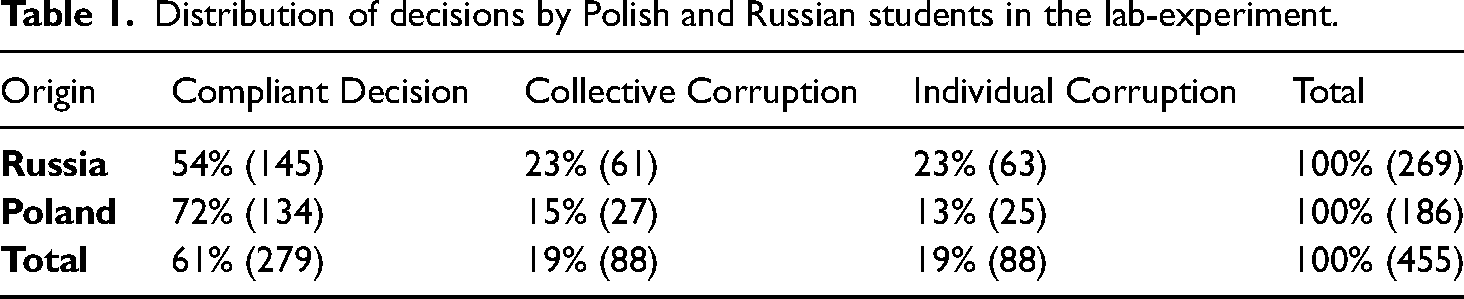
The descriptive results demonstrate an empirical variance of individual corruption and collective corruption in the response behaviour. Also, the data suggest a difference in decision-making behaviour based on origin. Although the individual/collective corruption ratio is similar within the population of Polish and Russian students, the overall corruption propensity is 18 percentage points higher among Russian students than among their Polish peers.
To test the cultural influence on corruption in Poland and Russia, we compared our macro hypotheses in Model 1 with Model 2 including the variables on the micro and meso level. Model 3 includes all significant variables from Model 2. The experimental data were evaluated using multinomial logistic regression (Table 2).
Cultural and organizational cultural influences on corruption in Poland and Russia. Multinomial logistic regression (N = 455; Basic category: Compliant decision).
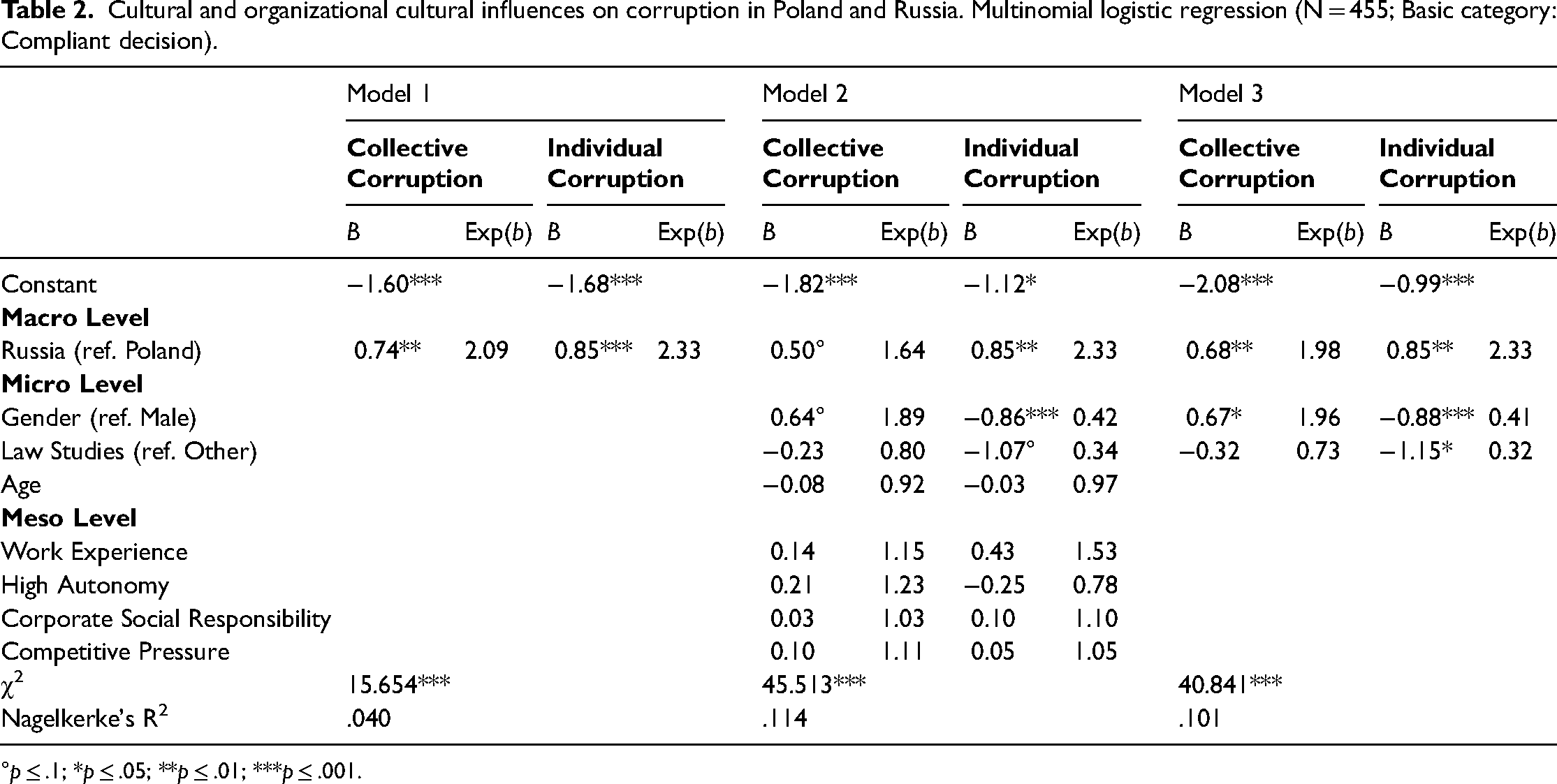
°p ≤ .1; *p ≤ .05; **p ≤ .01; ***p ≤ .001.
Comparing the Odds Ratios in Model 1 the probability of choosing collective corruption among Russian students is 2.09 times higher than a compliant decision compared to Polish students and the propensity for individual corruption is 2.33 times higher. Both results are significant and therefore support our hypotheses 1a and 1b.
In Model 2, which includes variables on the micro and meso level, the chance for Russian students to choose collective corruption instead of a compliant decision is slightly significantly 1.64 times higher as for Polish students. The chance of choosing individual corruption instead of a compliant decision is significantly 2.33 times higher for Russian students than for their Polish counterparts. Cultural factors on the meso level show no significant effects, while for the influence of work experience (H2a) and competitive pressure (H2d) the direction of effects is in line with our hypotheses. In contrast, high autonomy (H2b) has a negative effect on individual corruption and the treatment including CSR (H2c) has a positive effect on individual corruption. On the micro level, for female participants the propensity of choosing collective corruption instead of a compliant decision is, with marginal significance, 1.89 times higher than for male students, while the chance of choosing individual corruption compared to no corruption is highly significantly 2.38 times lower, thus supporting our hypothesis H3a. For law students (H3b) the data shows a decrease of collective and individual corruption by 1.25 and 2.94 respectively, relative to other students, although only the latter effect is statistically significant. While the probability of choosing collective or individual corruption is negatively correlated with the age (H3c), the effects are not significant.
In Model 3 the propensity of choosing collective corruption over no corruption is significantly 1.98 times higher and propensity of choosing individual corruption significantly 2.33 times higher for Russian students. For the variables gender and law studies, the Odds Ratios are similar to Model 2, while the results are more significant for the relation between gender and collective corruption, as well as for the relation between law studies and individual corruption.
Discussion
Regarding the choice of individual corruption over non-corrupt decisions, our data indicates strong robustness of cultural effects at the macro level relative to factors at the meso and micro levels. In contrast, collective corruption shows variance within our study population on the macro level between the models in terms of the strength of the effect and the significance of the results, especially when variables at the meso level are involved. On the micro level, the results obtained from students of law studies illustrate the dependence of cultural patterns on their specific institutional embedding. Similarly, the gender variable clearly exerts influence on the choice of individual and collective corruption. This finding also points to the importance of passing on institutional patterns through socialization.
However, generalized interpretations of the propensity to act corrupt based on lab-experiments with students should be critically questioned regarding their extern validity (Levitt and List, 2007a, 2007b; List, 2006), because the stakes and people involved, social relationships, social acceptance, and various interaction effects of real-world situations can differ significantly (Armantier and Boly, 2012; Diekmann, 2018). In this regard, while comparisons between laboratory and field experiments point to differences in corruption levels, the directions of the effects examined and differences between the influence of different settings on corrupt behaviour remain relatively stable between the two populations (ibid.; Alatas, Cameron and Chaudhuri, 2009a). Alatas, Cameron and Chaudhuri (2009a) also point out that ‘[s]tudent subjects are more representative of the general population than the subjects drawn from a specific profession’ (ibid.: 130). Thus, laboratory experiments with students are suitable for testing general causal hypotheses, but their validity for real-world situations must be confirmed by conducting them in different contexts and triangulating them with additional methods (Diekmann, 2018; McDermott, 2002). Therefore, students are particularly suitable for testing institutionalized, cultural patterns for the tendency to corruption because factual intercorrelations with structural conditions through professional experience and career-organizational embedding are still relatively low. Moreover, the stability of these patterns over time owing to socialization processes is particularly evident, especially for birth cohorts after the dissolution of the USSR. This may explain why our data does not show effects on the meso level, whereas the observed results on macro and micro level are in line with our hypotheses.
The longer temporal dimension of the institutionalization of Legal Nihilism in Russia and the culturally anchored patriotic anti-corruption mentality in Poland may explain a higher level of corruption among Russian students than among Polish students. While both institutionalized concepts impact the different propensity to act corrupt, structural factors supporting the institutional paths of corruption propensity in Poland and Russia and the intercorrelation of their historical trajectories are manifold.
Firstly, structures conducive to corruption were already established in the pre-Soviet Russia; in contrast to Central European bureaucracies, Tsarist administration developed in a specific way in that it was adapted to the existing patrimonial system. As a result, personal networks and clan structures were able to establish themselves, which to this day structurally undermine the formal bureaucratic exercise of office and support corruption (Schattenberg, 2007). Other concepts, such as kormlenie and blat, developed as informal exchange principles early in Russian history, which, as alternatives to formal market relationships, provide a breeding ground for corruption through personal agreements, networks and power imbalances (Ledeneva, 1998; 2001; 2013).
Secondly, both countries were part of the Eastern Bloc but followed different paths in the transformation-processes after the dissolution of the USSR, which separately impact the institutionalization of corruption promoting structures. For Poland, the membership in the EU reduced corruption due to democratization processes, the growing role of civil society and formal requirements of EU membership regarding anti-corruption policies, that is factors largely absent in Russia (Holmes, 2017). It appears, however, that deep-rooted domestic factors shape the transition process and influence the corruption level in a more sustainable way (ibid.). While Poland ‘faced the task of the restoration of the long European ‘tradition of market and democracy’ interrupted by external forces, […] [t]his tradition was non-existent in Russia and […] no appropriate social memory could […] be recalled. In Russia, the Soviet system came into being as a result of the organic development that arose due to the operation of domestic factors’ (Kosals, 2007: 69). Especially in Russia, informal systems, such as the aforementioned clan structures, hindered the development of new institutions which could counteract corruption in the long term (Wedel, 2003).
While there are many historical trajectories, which may influence corruption on the country level, we emphasized that the impact on the propensity to act corrupt depends on their institutional anchoring (Senge, 2006), the interaction of different institutional influences (Delmestri and Walgenbach, 2008), their field- and organization-specific embedding (Ashforth and Anand, 2003; Pohlmann, Höly and Klinkhammer, 2016), and the implementation of these patterns through gender-specific socialization (Alatas et al., 2009b) in the respective country.
Conclusion
It is not easy to draw generalized conclusions about cultural patterns in comparison between countries on the basis of aggregated cultural macro data. The presented study aims at systematically circumventing the methodological weaknesses of most research designs on cultural factors influencing corruption: Firstly, the ecological fallacy in comparative macro studies and secondly, the ex-post explanations in a series of experimental studies. Therefore, hypotheses on path-dependent cultural factors of influence on individual and collective corruption in Poland and Russia were developed following institutional theory and tested with an experimental study using data gathered on the micro level.
While cultural factors promoting corruption are rooted in structural factors, they outlast them in varying degrees of institutionalization. Therefore, we contribute to the scarce criminological literature that investigates cultural variation in white-collar crime (Jou et al., 2016). Importantly, corruption was studied here in its two forms; as occupational and as organizational crime (Clinard and Quinney, 1973). We explored the effects of differential associations at three levels and proposed mechanisms over which corruption might be favoured in the processes of cultural transmission (Sutherland, 1947). These observations highlight the role of positive general prevention in the state response to corruption; denouncing corrupt practices, norm reinforcement and promoting anti-corruption culture could prove far more effective than plain deterrence (Uhl, 2020).
On the basis of our research approach, frequent methodological pitfalls such as ex-post explanations and the ecological fallacy can thus be avoided. By referring to path-dependent institutionalized patterns, specific differences in the propensity to corruption between countries can be specified by further research and their impact can be examined analytically in a precise manner spanning different sectors, organizations and other institutional settings.
Supplemental Material
sj-pdf-1-euc-10.1177_14773708221081017 - Supplemental material for Culture and corruption: An experimental comparison of cultural patterns on the corruption propensity in Poland and Russia
Supplemental material, sj-pdf-1-euc-10.1177_14773708221081017 for Culture and corruption: An experimental comparison of cultural patterns on the corruption propensity in Poland and Russia by Alexander Fürstenberg, Sebastian Starystach and Andrzej Uhl in European Journal of Criminology
Supplemental Material
sj-pdf-2-euc-10.1177_14773708221081017 - Supplemental material for Culture and corruption: An experimental comparison of cultural patterns on the corruption propensity in Poland and Russia
Supplemental material, sj-pdf-2-euc-10.1177_14773708221081017 for Culture and corruption: An experimental comparison of cultural patterns on the corruption propensity in Poland and Russia by Alexander Fürstenberg, Sebastian Starystach and Andrzej Uhl in European Journal of Criminology
Footnotes
Declaration of conflicting interests
The author(s) declared no potential conflicts of interest with respect to the research, authorship, and/or publication of this article.
Funding
The author(s) disclosed receipt of the following financial support for the research, authorship, and/ or publication of this article: The empirical data used in our article were collected within the research program Ostpartnerschaften funded by the German Academic Exchange Service (Deutscher Akademischer Austauschdienst) and the underlying research partly by the Volkswagen Foundation.

Supplemental material
Supplemental material for this article is available online.
Notes
References
Supplementary Material
Please find the following supplemental material available below.
For Open Access articles published under a Creative Commons License, all supplemental material carries the same license as the article it is associated with.
For non-Open Access articles published, all supplemental material carries a non-exclusive license, and permission requests for re-use of supplemental material or any part of supplemental material shall be sent directly to the copyright owner as specified in the copyright notice associated with the article.
