




Abstract
On 2 February 2017, French police officers brutally abused a young black man, leading to the first wave of 2017 French riots. The present study exploits the coincidence that the focal event occurred during the survey period of the European Social Survey (ESS) 2016 (11 November 2016 – 11 March 2017) in France, thus providing the basis for a natural experiment on the effect of media reporting on police misconduct on trust in the police. Data are analysed by means of a regression discontinuity design (RDD) as well as more conventional regression analyses with heteroscedasticity robust standard errors. In line with procedural justice theory as well as institutional theory, the present study finds support for the notion that this special case of police misconduct did decrease trust in the police. In addition, people reporting a migrant background showed even less trust in the police after the event. Frequency of different media consumption does not appear to explain the deterioration of trust in the police after the event. The results of this study increase the internal and external validity of the assumption that trust in the police can be explained not only by personal experiences but also by the perceived unfair treatment of others. Results are robust to various placebo tests. There is some evidence that the effect seems to be short-lived, although the data basis is limited in this regard. Several fruitful approaches for future studies are discussed.
Keywords
Introduction
In recent years, there have been repeated cases of excessive police violence against Afro-Americans that have received worldwide media coverage – the death of George Floyd in May 2020 being only one of the last in a series of similar tragic events. Alongside the broader sociological and psychological literature that addresses police brutality in general (see, for example, Worden, 2015), some organizational theories attempt to explain abuse of minorities by police officers as the result of a militant and often xenophobic ‘cop culture’ (Armacost, 2004; Reiner, 2010). ‘Cop culture’ reinforces institutional racism (Phillips, 2011) such as disproportionate control tactics that strengthen the ‘racial hierarchy’ (Gray and Parker, 2020: 315–16), making excessive use of force against minorities more likely (Worden, 2015). As a result, police legitimacy is seemingly undermined in minority ethnic communities (Phillips, 2011). Empirical studies show that the public image of the police is often only temporarily diminished after such events (Weitzer, 2002), which has led to the police being called a ‘Teflon service’ (Reiner, 2010).
Incidents of excessive physical force by police officers against minorities, however, are not unique to the US. In the French media, for instance, police violence is a constant topic. The recent government security bill that threatens to penalise citizens who photograph police abuses suggests that the French government is aware of the danger that media coverage of police violence poses to the police and (potentially) to state legitimacy. In this study we examine the extent to which a particularly brutal case of excessive police misconduct influences attitudes towards the police in France.
Despite being a much investigated hypothesis, evidence for the effect of negative news coverage on attitudes towards the police is not entirely conclusive (Chermak et al., 2006; Graziano, 2018). The somewhat scarce evidence might be attributed to the predominant lack of causal inference in previous approaches (Graziano, 2018). Graziano concludes in her systematic meta-review of related research that ‘“media matters” where perceptions of police are concerned’ (2018: 1375), and other researchers go so far as to emphasize that ‘news media . . . subject police to critical scrutiny that erodes police legitimacy’ (Lawrence, 2000: 31).
Concerning police legitimacy, most approaches find that personal experiences with police officers (Gau, 2010), ethnicity of the respondents (Novich and Hunt, 2018; Tuch and Weitzer, 1997; Weitzer, 1999, 2002; Weitzer and Tuch, 2004), prior victimization, socioeconomic status, context of residence, political attitudes and punitive values (Roché and Roux, 2017) constitute relevant predictors. Whereas procedural justice upholds the image of the ‘Silver Bullet to good policing’ (Roché and Roux, 2017), newer studies demonstrate that deterioration in attitudes toward the police might be better attributed to a more complex phenomenon. This more recent research takes media coverage of police actions into account (Gauthier and Graziano, 2018; Graziano, 2018; Graziano and Gauthier, 2018; Graziano et al., 2009; Hohl et al., 2012).
This study employs random variation in the field period of the European Social Survey (ESS Round 8, 2016) and a case of major police misconduct in France, thus providing a natural experiment to investigate how trust in the police is affected by external shocks such as media coverage of police malpractice. The broad thematic scope and methodological composition of the ESS allows for testing a set of different hypotheses, such as the moderating effects of a migrant background and frequency of use of different media.
Although this research design has already been applied by many scholars in order to study attitudinal changes over short periods of time, most of these papers focus on the effects of major events such as terrorist attacks on attitudes towards minority groups (Castanho Silva, 2018; Legewie, 2013). So far, only a few studies have transferred this design to other contexts. One exception is the paper by Ares and Hernández (2017) on the impact of a corruption scandal on trust in politicians. To the best of our knowledge, this study is the first application of this particular design, which Muñoz et al, (2019) call the ‘Unexpected Event during Survey Design’ (UESD), in the field of police research. Most studies that had previously dealt with the effects of media reporting on police misconduct were restricted by samples from the individual cities or nearest areas where the misconduct took place (Hohl et al., 2012; Kaminski and Jefferis, 1998; Kochel, 2019; Lasley, 1994; White et al., 2018). Although this approach probably makes it easier to find an effect when it is there, it poses problems in terms of the external validity of research results. Additionally, in most of these previous studies, the assignment to either control or experimental group could not be considered to be effectively random (Kääriäinen et al., 2016), underlining the continuing need for causal pathways in this research avenue (Graziano, 2018). Our identification strategy relies on two comparable but separate analysis designs. We combine findings from a regression discontinuity design (RDD) with an ordinary least squares (OLS) natural experiment that can be considered a UESD study.
Finally, our study contributes to the existing literature by examining a new national context that is particularly interesting because France has a generally low level of trust in the police compared with other European countries (Schaap and Scheepers, 2014).
The empirical setting: The 2017 French riots
The 2017 French riots refer to two separate uproars following abuse of power by police. The first incident of unrest began on 4 February 2017, following the alleged rape of a 22-year-old black man, named Theo L., with a baton by police. The second sets of riots began when a Chinese man was shot dead by police officers in Paris in late March. However, owing to the timing of the field period of the ESS, only the first incident can be used as an exogenous shock to study its effect on trust in the police.
On 2 February 2017, four police officers approached a group of young people in a Paris suburb. Although the account of the events by Theo L. differs from those of the police officers, and it is therefore not clear who started the altercation, it has been confirmed via video surveillance that one of the police officers detained Theo while another police officer showered the group with tear gas. Because of the subsequent alleged rape with a baton, the victim had to be rushed to hospital for an emergency operation. He spent several weeks at the hospital, where he was visited by former French president François Hollande. After investigation of the incident, the four officers were placed under judicial review. Three were banned from official police activity. Minister of the Interior Bruno Le Roux also suspended the four policemen immediately as a precautionary measure.
Following the first media reports of the alleged rape of a black man, a series of violent protests against police violence began that continued until 15 February. To provide a better picture of how the scandal rose in salience, Figure 1 shows the frequencies of Google searches about the scandal. As the graph shows, the maximum peak was reached around mid-February. In the course of March, however, Google searches declined rapidly. For further details on the 2017 French riots, see Mulholland (2017).
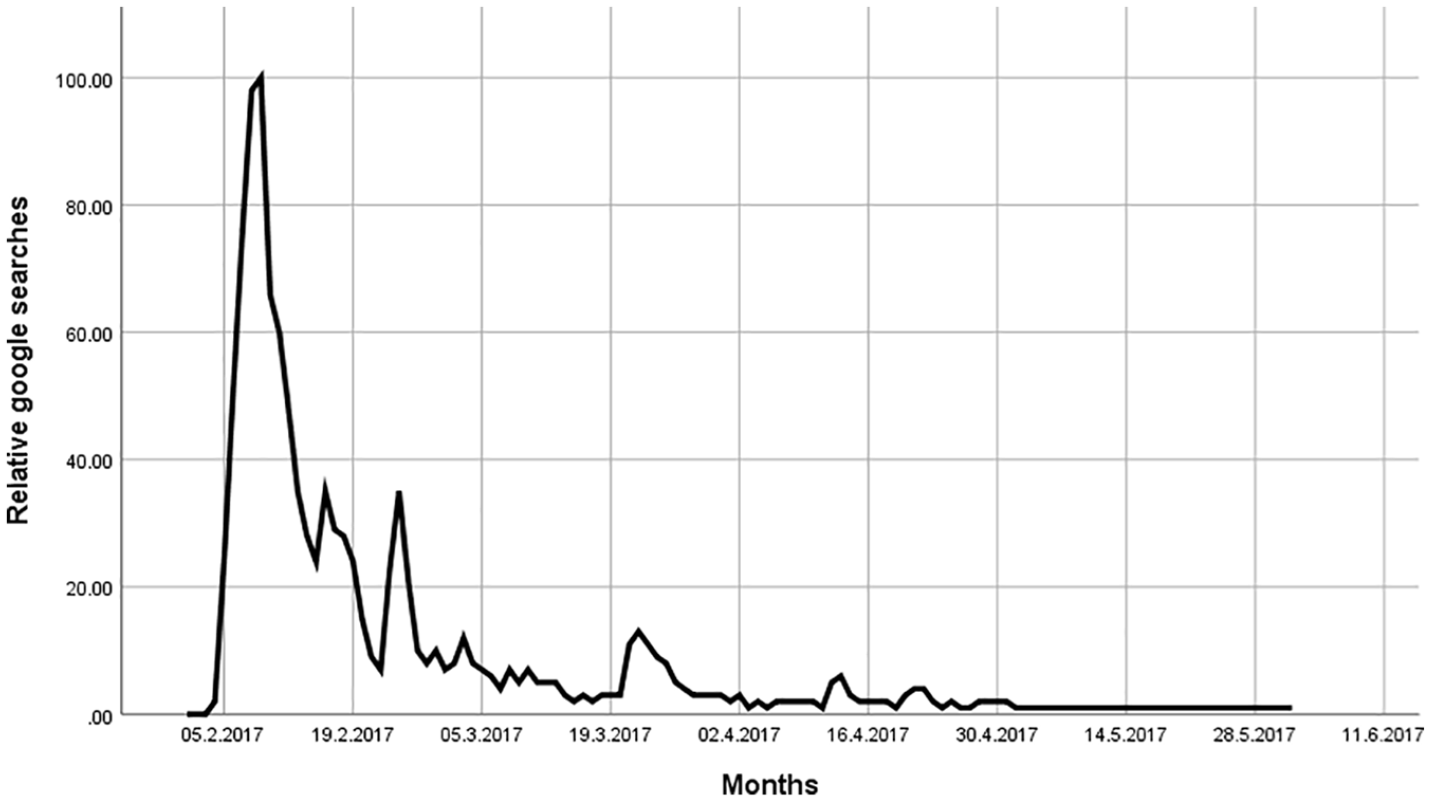
Google trends for the search theme ‘théo affair’ in the period 1 February 2017 to 1 June 2017.
Theoretical framework and hypotheses
Research into media effects on the public image of the police is limited by a lack of theoretical orientation and articulation of a causal link between event, media processing and an actual change in public attitudes (Gauthier and Graziano, 2018; Graziano, 2018). 1 By combining elaborations from various theoretical approaches, this study provides a rationale that explains the overall linkage as well as possible intensifications of the effect. Worden and McLean (2017) distinguish between two broad theoretical streams concerning police legitimacy. The first one, procedural justice theory, is rooted in social psychology. It defines procedural justice as the key determinant of police legitimacy and can clearly be considered as the most common approach in explaining attitudes towards the police (Murphy and Tyler, 2017; Tyler and Wakslak, 2004). The second stems from organizational institutionalism or sociological neo-institutionalist approaches, and is concerned with external demands that are placed on organizations and how those organizations respond (Worden and McLean, 2017).
Tyler (1988), as a major contributor to the first of these two strands of literatures, argues that citizens’ judgement about whether legal authorities act fairly is, among other issues, heavily dependent on the degree to which the authorities follow ethical principles of conduct. Although much research within procedural justice theory considers personal experience of the police as a crucial predictor of the public image of the police (Gau, 2010), there is evidence that perceived unjust treatment of others might have comparable effects (Chermak et al., 2006; Gau, 2014; Graziano and Gauthier, 2018; Maguire et al., 2017; Rosenbaum et al., 2005). Some earlier studies reveal that trust in the police is negatively affected by shocking police scandals or grave cases of police misconduct, but empirical evidence on the corrosive effect of high-profile police scandals on trust in the police still remains vague, because previous studies were – with very rare exceptions (Sigelman et al., 1997) – limited to surveys from individual cities or to non-experimental designs.
Within the sociological neo-institutionalist framework, Deephouse and Suchman argue in favour of understanding media as ‘legitimacy mediators’, ‘who make or convey implicit or explicit legitimacy assessments as a side-effect of their routine operations (Deephouse and Suchman, 2008: 69). This statement and the resulting implications for this study are comparable to the basic assumptions made by Gerbner (1970). In a radically condensed form, George Gerbner postulates in his ‘cultivation theory’, which is arguably more of a paradigm than a coherent social science theory (Morgan and Shanahan, 2010), that greater rates of television viewing will increase the likelihood of consumers assuming worldviews as portrayed on television. Because news today is received not exclusively via television, but increasingly online, these assumptions need to be adjusted in order to correspond to today’s media landscape. It is therefore plausible to assume that Internet users will adopt worldviews provided on Internet media as well. Picking up on these developments, recent empirical studies examine the influence of Internet media on police perception (Intravia et al., 2017; Roche et al., 2016).
Methodological individualism can assist in combining these different theoretical approaches. Coleman’s (1986) micro–macro model can help to describe the underlying social mechanism (also see Hedstrom and Swedberg, 1998). A local incident of police misconduct, initially at the micro level of social action, becomes public and is thus found at the macro level of social action. The way in which the incident is made public is not always transparent. Examples of this process might be a video of the incident that ends up on the Internet or a court case. Now, however, an incident is processed by the media and is therefore being witnessed by others who then, individually, alter their opinion of the police in a negative way (micro level). Through a process of aggregation or imitation, this individual change of attitude towards the police is now also found in the corresponding population as a whole, and hence results in a loss of trust in the police, again at the macro level of social action. This simple social mechanism leads to the first hypothesis of this study.
The trigger for the devastating uprisings in France is considered to be the brutal abuse of a black man in early February 2017 in Paris. As Graziano and Gauthier point out (2018), ethnicity has been an important predictor of attitudes towards the police in all previous studies. The results of the study by Chermak et al. (2006), however, indicate that blacks significantly rate police officers as less courteous and professional and report less general support for the police department compared with whites only after the intense publicity of a serious case of police misconduct in that department. This yields the second hypothesis:
Our next two hypotheses focus on the effect of the frequency of the use of different media. Corresponding to the above-mentioned assumptions, and in line with elaborations from sociological neo-institutionalism (Deephouse and Suchman, 2008), cultivation theory (Gerbner, 1970) and newer empirical hypotheses (Intravia et al., 2017; Roche et al., 2016), we expect use of traditional media such as radio or television to be associated with the focal incident. In particular, we expect that higher frequencies of media consumption correspond with clearer decreases in trust in the police through the event.
Other scholars have already indicated that more frequent media consumption of online news is related to negative attitudes towards the police, and exposure to negative news about the police might affect perceptions (Graziano and Gauthier, 2018; Intravia et al., 2017). More negative attitudes, shown by those respondents who rely most on the Internet for their news, may be the result of unfiltered access to more unfavourable news, videos and public commentary about the police than traditional media allow. The negative effect on trust could thus be stronger for frequent consumers of Internet news, because anti-police content is less likely in mainstream media than on the Internet. This idea is consistent with the central premise of cultivation theory that individuals adopt the worldviews to which they are most exposed by the media (Gauthier and Graziano, 2018). Research shows that fake news spreads faster through social media (Vosoughi et al., 2018). Hate speech moves faster through online communities when the content remains uncensored (Álvarez-Benjumea and Winter, 2018). Thus, we arrive at our final hypothesis:
Data and methods
Data
The ESS is a cross-national survey that, every two years, reviews attitudes, beliefs and behaviour patterns in European countries on the basis of probability samples gathered through face-to-face interviews. 2 We use the ESS subsample for France. The fieldwork for the French subsample took place from 10 November 2016 to 11 March 2017. Since the fieldwork period coincided with the scandal described above (2 February 2017), and since the ESS 8 includes an item asking about respondents’ trust in the police, it provides an ideal setting for a natural experiment. The French ESS sample contains 2070 valid cases. We drop all cases that were interviewed on the exact date of the event because we cannot be sure whether these respondents belong to the control (before the event) or treatment group (after the event). This reduces the main sample to n = 2060 cases. We applied the design weight provided by the ESS in all analyses. Sample sizes therefore differ between different analyses.
Dependent variable
The dependent variable ‘trust in the police’ is measured on an 11-point Likert-type item, ranging from 0 ‘No trust at all’ to 10 ‘Complete trust’. There is still no real consensus in the academic debate on whether legitimacy of or trust in the police are somewhat synonymous or distinct (Jackson and Gau, 2016; Kaina, 2008; Kearns et al., 2019; Tyler, 2004). Even if trust in the police is understood as a facet of police legitimacy (Hough et al., 2010; Kearns et al., 2019; Tyler and Jackson, 2014) or at least a cognate concept (Tankebe, 2013), the single item used in this study provides only a small fragment of the multidimensional structure that is police legitimacy (Bradford and Jackson, 2010; Hough et al., 2010). On the other hand, it is reported that the global item is highly correlated with more specific attitudes (Cao et al., 2012; Frank et al., 1996; Garcia and Cao, 2005). And, in our quasi-experimental design, a single, intuitively answerable item might be even better suited to measure possible effects than more specific items that may have too little relation to the incident. Nevertheless, we use only the single item in our study because we are restricted to the composition of the ESS.
Treatment and predictor variables
To analyse the effect of the event proposed by Hypothesis 1, 3 our treatment variable is a dummy variable Τi that is operationalized as follows:

To test Hypotheses 2–4 (interaction effects), we create three product terms with the treatment variable. To arrive at a good measurement for migratory background, we constructed a new variable called ‘migrant’, which was assigned the value 0 if the respondent’s father and mother were born in France and the value 1 if father or mother were not born in France.
To test the other two interaction effects, we used two items asking either for the number of minutes watching, reading or listening to news about politics and current affairs on a regular day (Hypothesis 3), and the amount of Internet use on a typical day in minutes (Hypothesis 4). To facilitate interpretation, these two variables were dichotomized on their respective mean. Persons below the mean were assigned the value 0; persons above the mean were assigned the value 1.
Control variables
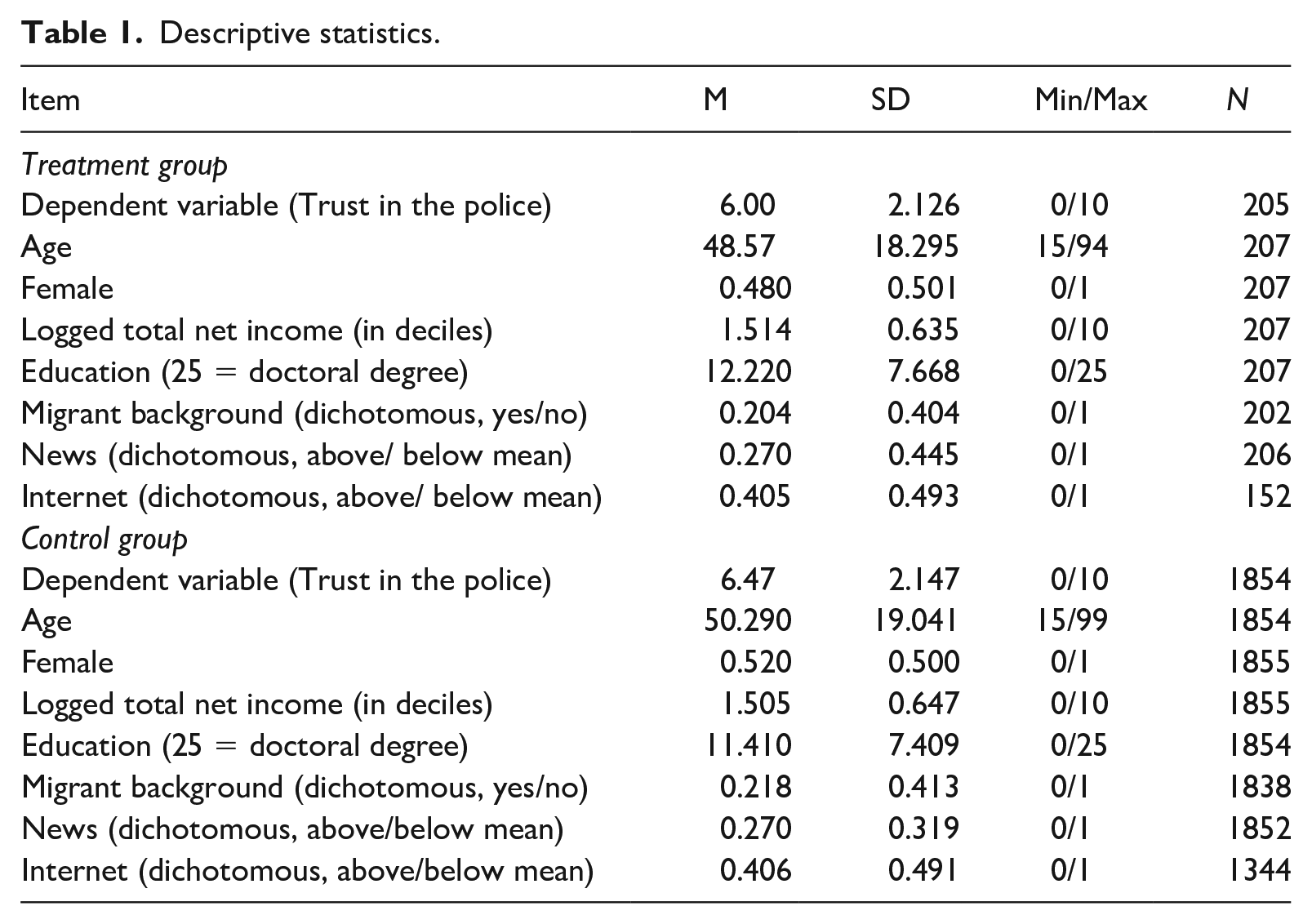
The strictly exogenous control variables consist of age of the respondents, female as a dummy variable (1 = female; 0 = male), income and education. Education was measured on a 25-point scale, where the highest value represents doctoral degree. Because of many missing values in the income variable, we assigned the mean to all missing cases. Furthermore, we logged the variable to adjust for the well-known skewed distribution in income. To give an overview, Table 1 shows summary statistics by control and treatment group for all variables.
Descriptive statistics.
As Legewie indicates (2013), there are two potential threats to an unbiased estimator of the causal effect using a comparable quasi-experimental research design. The ignorability assumption is fulfilled if the chance of being assigned to the control or treatment group can be assumed to be effectively random. Second, our identification strategy relies on the temporal stability assumption. Put simply, this assumption implies that, without the treatment, there would be no effect on the outcome. 4
To check for the ignorability assumption, an imbalance test was conducted. An imbalance test is a logistic regression with the treatment variable as the outcome, and all other variables that are used in the analyses considered as predictors. Results can be seen in Table 2. Confirming our assumption, and highlighting the data quality of the ESS, none of the variables indicates a significant effect on the treatment, implying that there apparently exists no relevant imbalance between the control and treatment groups on these variables. To test for the temporal stability assumption, a number of differently designed placebo regressions were calculated. The results are discussed in detail in the Appendix in the online Supplemental Material.
Binary logistic regression with treatment as dependent variable.
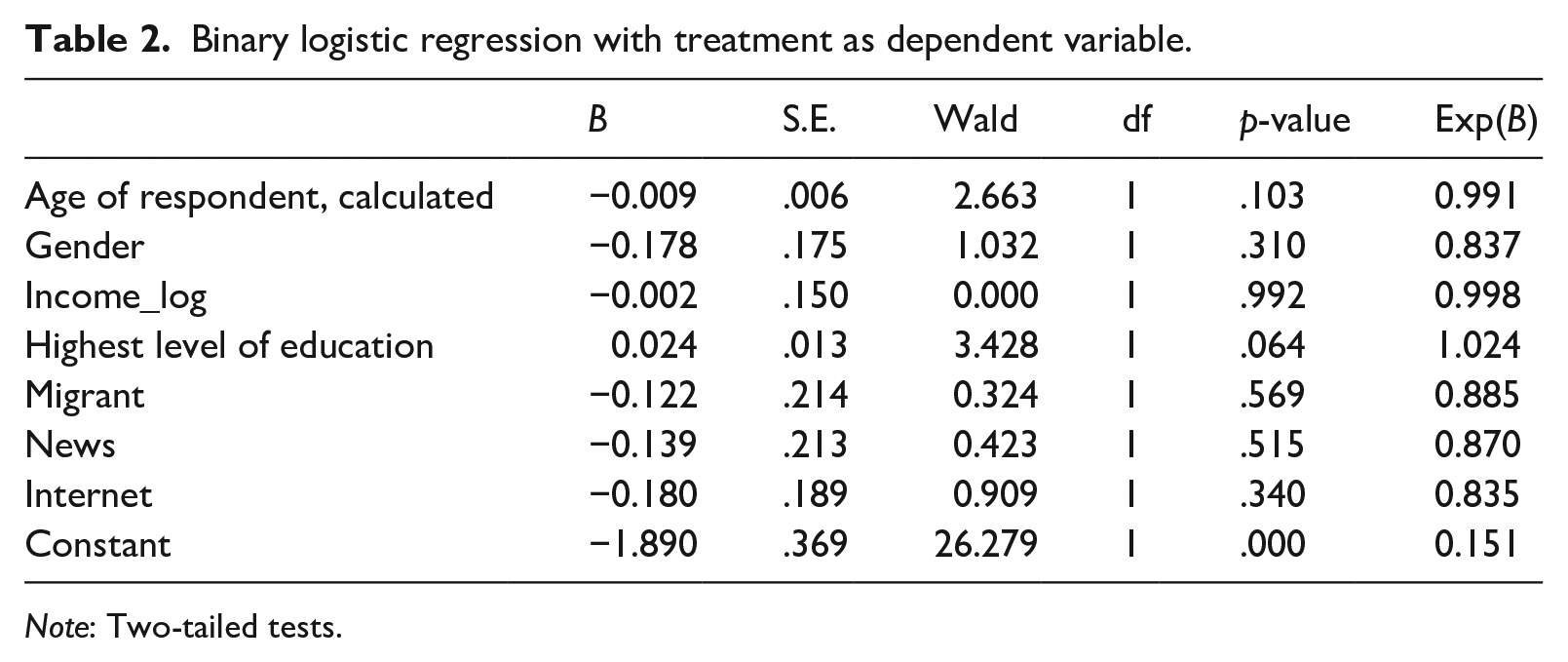
Note: Two-tailed tests.
Results
First test: Regression discontinuity
To investigate the impact on trust in the police immediately after the incident, a regression discontinuity design is used (Angrist and Pischke, 2009). In our approach, we are guided to a large extent by the practical guide provided by Skovron and Titiunik (2015) as well as recent applications that work with very similar data and designs (Castanho Silva, 2018; Van Hauwaert and Huber, 2020).
The basic idea behind RDD is that a treatment can be assigned for observations based on whether the value of a score exceeds a known cut-off (Skovron and Titiunik, 2015). Units whose scores are barely below the cut-off are therefore comparable to units whose scores are barely above it, so that any difference in the outcome is attributable to the given treatment conditional on certain assumptions that we discuss in the online Appendix.
The most important aspect in RDD applications is arguably the definition of the bandwidth. In our case, bandwidth is days before and after the incident. We create a discrete variable z (also called the running variable), which equals days before and after the event, where 0 indicates the exact day of the event. 5 We then use the Imbens and Kalyanaraman method for obtaining optimal bandwidth, which is a completely data-driven approach that minimizes an approximation to the asymptotic mean square error of our local average treatment effect (LATE) (Imbens and Kalyanaraman, 2012). Figure 2 gives an illustration of the development of our outcome immediately before and after the incident.
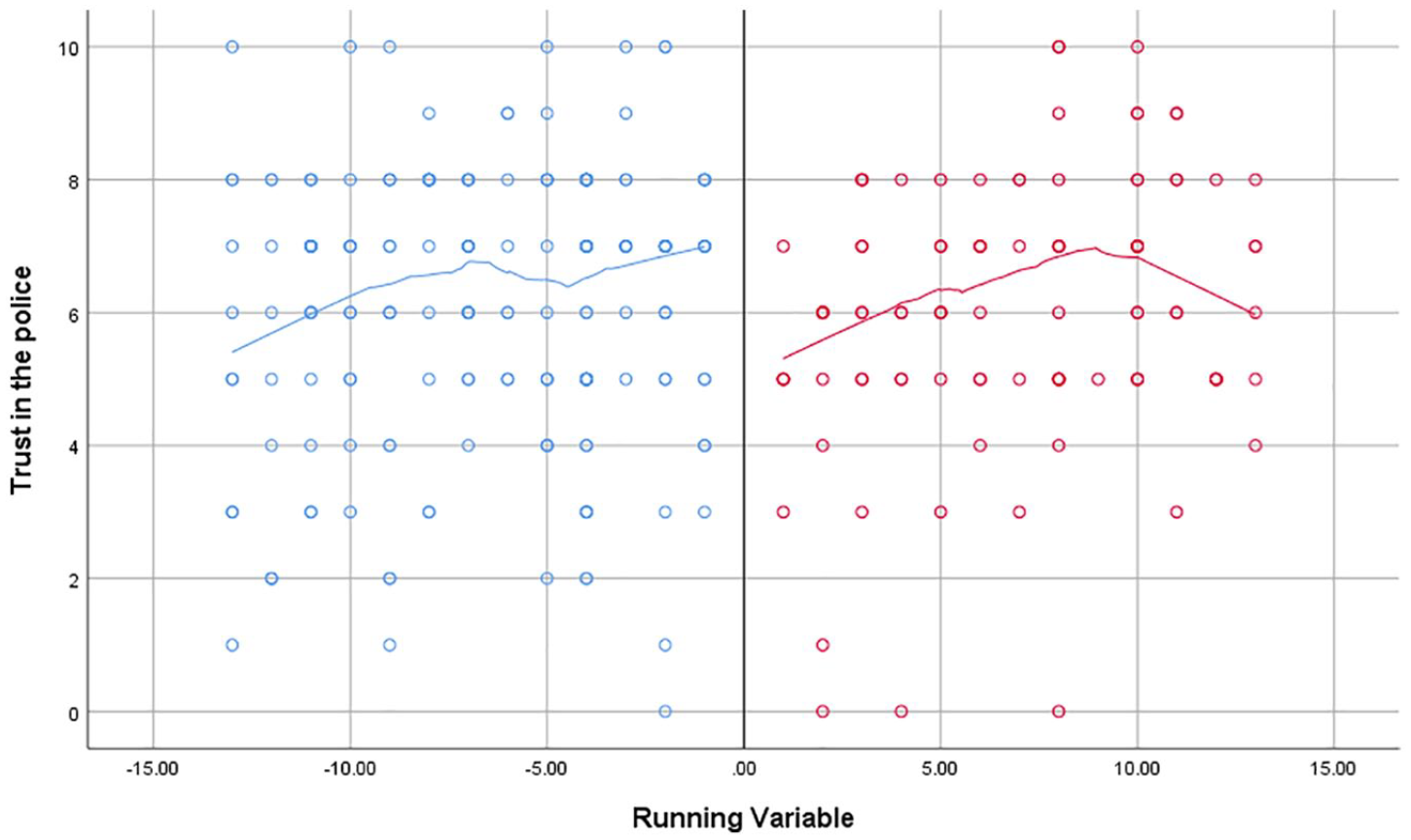
The evolution of trust in the police.
Following Skovron and Titiunik (2015) as well as Van Hauwaert and Huber (2020), we rely on two local linear estimators of the outcome (one before and one after the incident) instead of higher order polynomials, which is recommended when the running variable is discrete. 6 The difference of intercepts between these two models can be considered the regression discontinuity (RD) effect (LATE). Slope differences on the other hand can inform us about the development of the treatment effect in the days following the event. Table 3 gives an overview of the RD effects for the optimal bandwidth as well as a double and half bandwidth for estimates with heteroscedasticity robust standard errors (HC3 method is used). The analyses imply a substantial worsening of trust in the police for the optimal and double bandwidth. For example, people interviewed six days after the event show an average of 1.797 fewer points on trust in the police compared with people interviewed six days before the event. The effect is significant (p = .041). The treatment effect’s size 13 days after the event decreases to −1.436 while still being significant (p = .020). However, for the half bandwidth the effect is not significant. Non-significance might be attributable to a lack of statistical power due to low sample sizes (ntotal = 63). Although not being significant for this bandwidth, the RDD effect is still pronounced, indicating an average loss of trust in the police after the incident of 1.591 points.
RDD estimates.
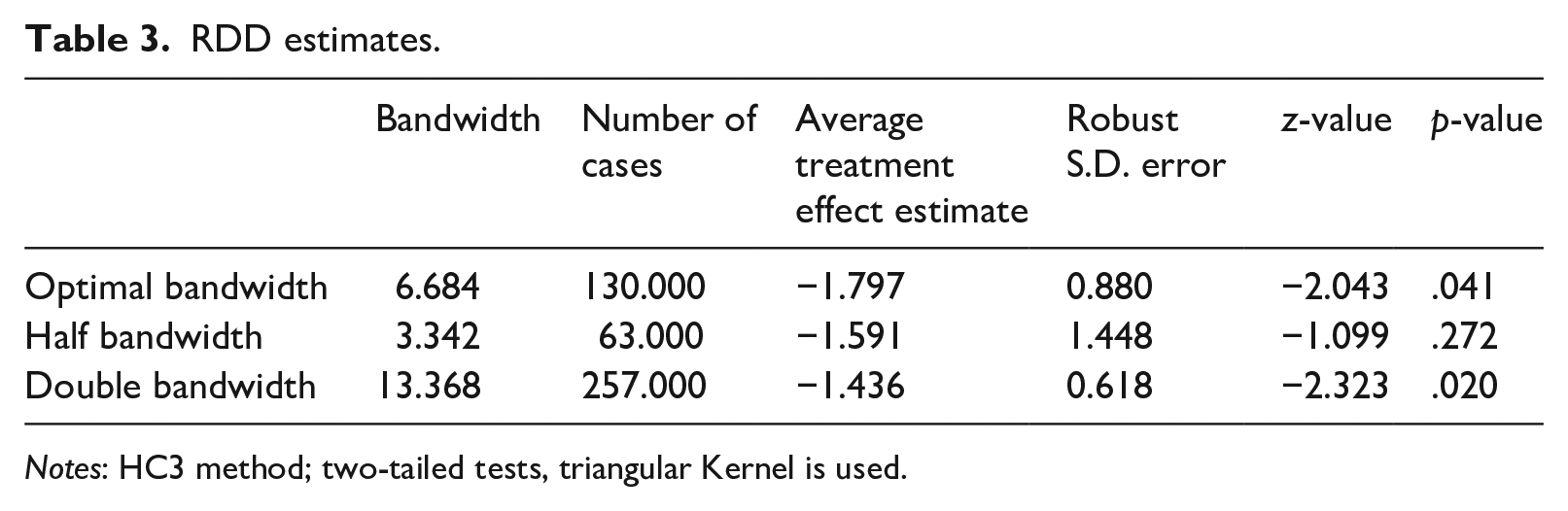
Notes: HC3 method; two-tailed tests, triangular Kernel is used.
Accordingly, these results cannot fully reject the assumptions made in Hypothesis 1, namely that we expect a loss of trust in the police for respondents interviewed after the incident. All three post-treatment models show a positive slope coefficient for zi. This, and the obvious decrease in the treatment effect’s size for the double optimal bandwidth, implies that trust might be regained quickly after the incident (see online Appendix 1, Figures A1 to A3 for a graphical illustration of all bandwidth choices and their respective conditional expectation functions). Validating the RDD by employing all placebo tests that are recommended in the literature (Skovron and Titiunik, 2015) shows that our results are largely robust (see online Appendix 2).
Second test: UESD natural experiment
Even though RDD allows for testing the immediate effect of being exposed to the treatment in a way very much comparable to a randomized control trial (RCT), it lacks a test for interaction effects (Castanho Silva, 2018). Another issue is the limited bandwidth in RDD. By using the full bandwidth of the ESS, we can make some statements about the temporal stability of the treatment effect. For example, a smaller main effect in the OLS experiment compared with RDD could indicate a weakening of the treatment effect. To arrive at a better understanding of the event’s effect on trust in the police and to test Hypotheses 2-4, a number of OLS regressions for the whole sample in the fashion specified above in the Data and methods section were run.
Before doing so, we have checked all prerequisites for an OLS estimation in a model containing all control variables and interaction effects. To avoid multicollinearity, the variables forming product terms with the treatment effect were centred at the mean (Cronbach, 1987).The Breusch–Pagan test indicates a pronounced unequal distribution of residual variances, making OLS estimates no longer efficient. Following the advice of Angrist and Pischke (2009), we compute both OLS models with homoscedasticity robust standard errors as well as models with heteroscedasticity robust standard errors (simply referred to as robust standard errors). We report only the results of the robust standard error models since estimates in robust standard error models tend to provide results that are more conservative. The R2 values of all models are generally very low, which implies that the data contain a high amount of unexplainable variability. For this reason, it should be noted that the precision of the estimates is limited.
Table 4 gives an overview of the results. We begin with a baseline model, containing only the treatment effect as a predictor, then a model with exogenous controls and finally models with a full set of controls as well as the respective interaction terms. Since the treatment variable was centred on the mean, the coefficient can be interpreted as the main effect. The results support the assumption from Hypothesis 1 as well as the results from the RDD analysis. Comparing people in the whole dataset, those respondents interviewed after the event have an average of 0.461 scale points less trust in the police than those respondents interviewed before the event (Model I in Table 4). The effect is significant (p = .002, 95% CI [−0.754, −0.169]). Adding control variables to the model does not change the main effect much. Adding strictly exogenous controls (Model II in Table 4) alters the main effect slightly to −0.416 but staying significant (p = .005, CI [−0.708, −0.124]). Adding interaction effects does not mediate the main effect as well, though it is only significant for p = .015 in Model V, which might be attributed to the large amount of missing values in the Internet control variable. Overall, these results support Hypothesis 1. However, the coefficients are considerably lower than the main effect in the RDD analysis. This result is a possible indication that trust in the police was severely shaken by the incident, but it appears that it might have been quickly regained to a certain degree. This notion can also be seen from the higher slope coefficient of the post-treatment model compared with the pre-treatment model in the RDD (see online Appendix 1).
General linear models: Parameter estimates with robust standard errors.
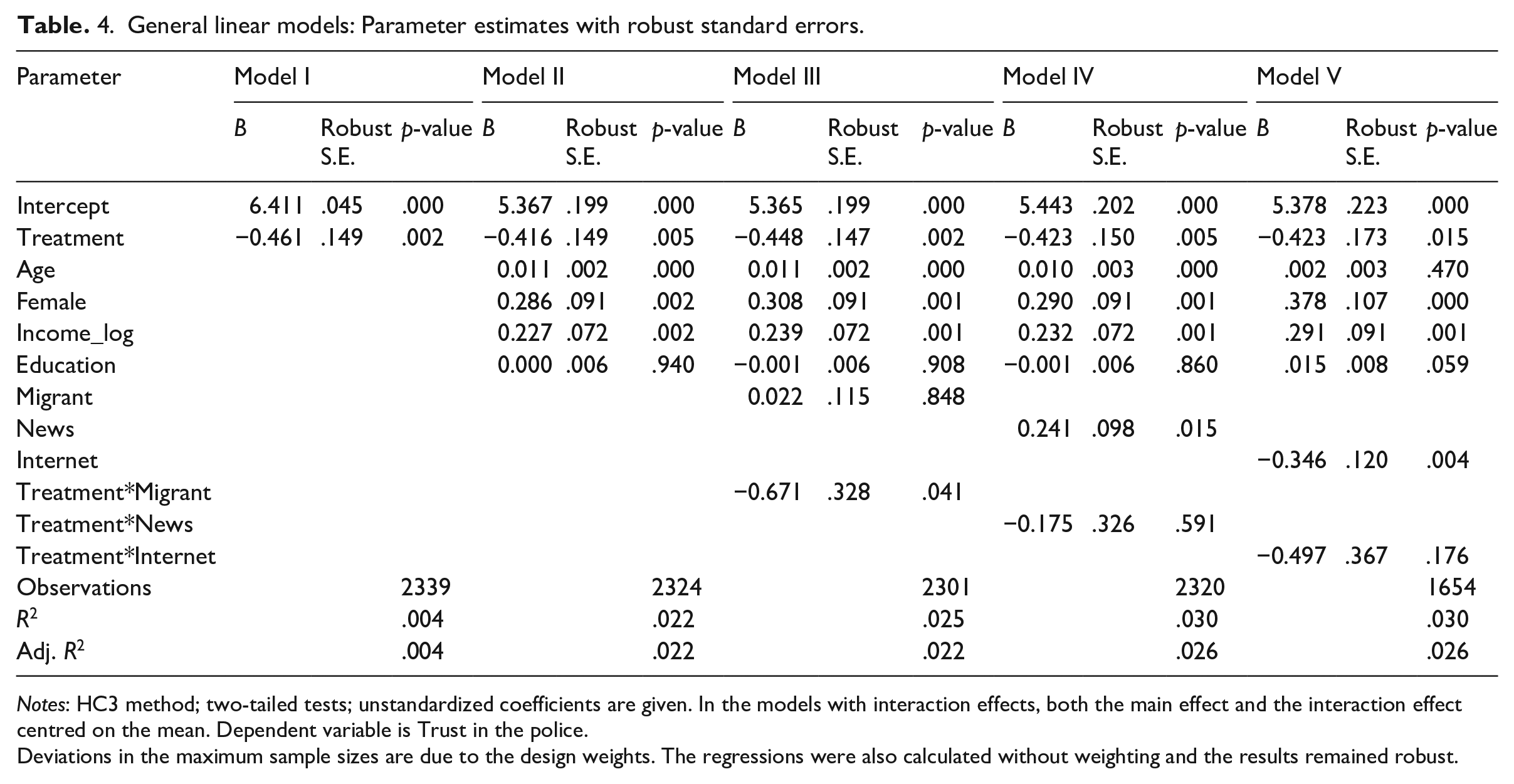
Notes: HC3 method; two-tailed tests; unstandardized coefficients are given. In the models with interaction effects, both the main effect and the interaction effect centred on the mean. Dependent variable is Trust in the police.
Deviations in the maximum sample sizes are due to the design weights. The regressions were also calculated without weighting and the results remained robust.
The interaction effect between a migrant background and the dichotomous treatment variable shows a strong effect of B = −.671, with significance of p =.041, CI [−1.314, −0.029].This finding implies that people with a migrant background interviewed after the event show an average of 0.671 scale points less trust in the police than people with a migrant background from the control group.
To provide a better graphical picture of the interaction effects, we performed a multifactorial Analysis of Variance (ANOVA). As can be seen quite clearly in Figure 3, people in the control group always report more trust in the police than do people in the treatment group. However, if they also have a migrant background, the effect is much more pronounced. Overall, the results yield evidence for the second hypothesis.
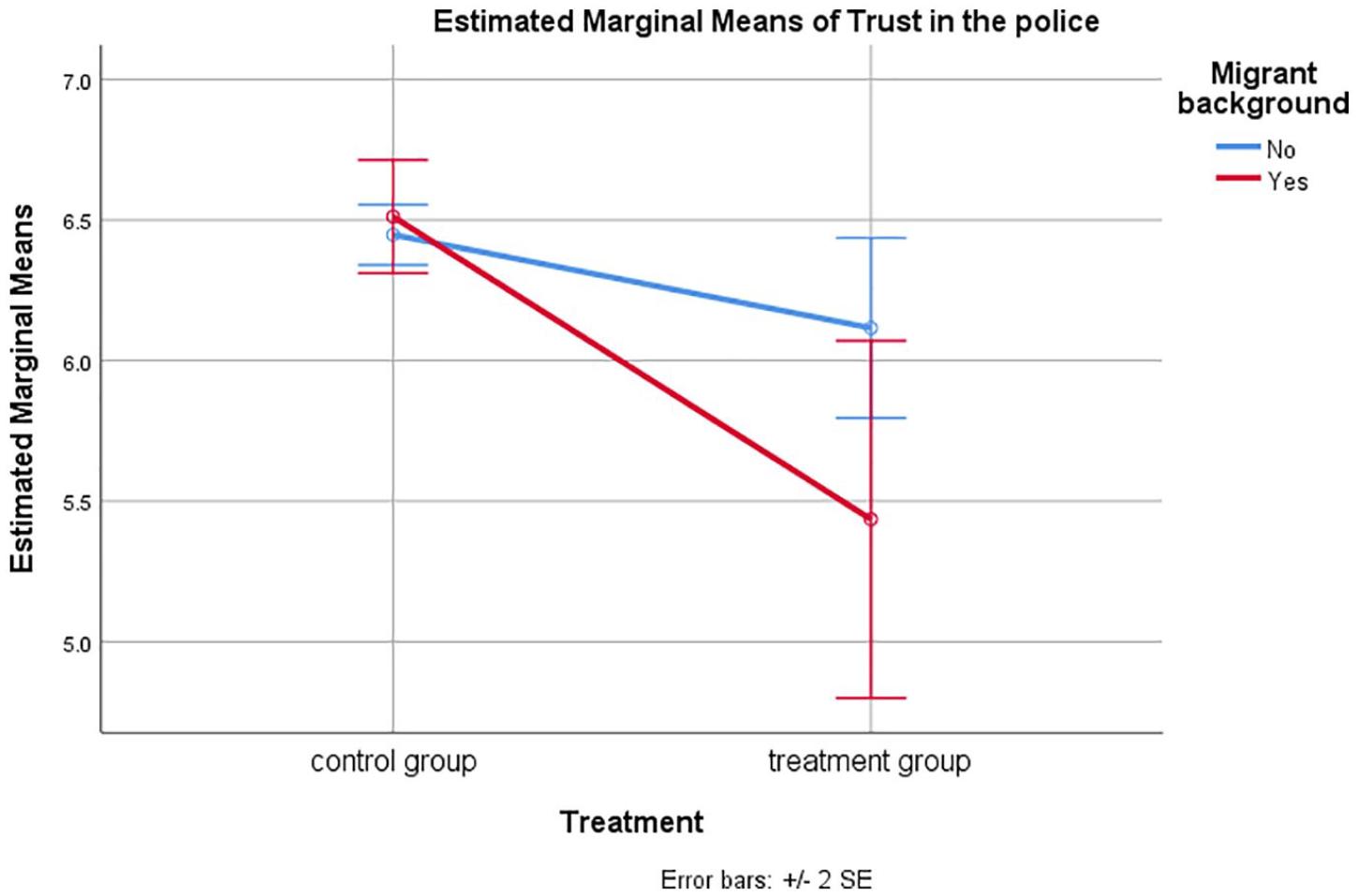
Multifactorial ANOVA interaction effects.
However, Figure 3 also shows large standard errors, which is why we conducted a new test for Hypothesis 2, where we constructed the interaction term from another variable contained in the ESS, asking respondents whether or not they belong to an ethnic minority. We coded the product term in the exact way specified above. The results are even more striking, implying an interaction effect of B = −1.836 (p = .040, CI [−3.584, −0.087]. Still, the substantial coefficient size is at the expense of an equally extreme standard error (see online Appendix 3 for the corresponding model with robust standard errors). Nonetheless, this additional analysis gives us further confidence in the ‘confirmation’ of Hypothesis 2.
Even if the polarity of the two other interaction effects (Hypotheses 3 and 4) points in the right direction, the coefficients are not significant. Frequency of media use and frequency of Internet use are apparently not associated with trust in the police after the alleged rape. However, Model VI shows a very high amount of missing values, decreasing statistical power to test the final hypotheses. Concerning the assumptions implied by Hypotheses 2–4, it seems that only Hypothesis 2 is supported by the data.
Robustness checks
Ignorability assumption
Because the scandal broke late in the fieldwork period, it might be the case that some regions in France were reached (surveyed) only before the scandal. This would lead to a potential reachability bias. We therefore re-estimated the regressions by including only regions with n ⩾ 5 observations. The main effect is still significant and shows comparable effect sizes to the previous models. However, the interaction effect between migrant background and the treatment variable is now significant only at p = .055. Unlike the main effect, the moderation effect thus appears to be somewhat more model dependent. The results can be seen in online Appendix 4, Table A19.
Temporal stability assumption
To check for the aforementioned temporal stability assumption, we tested all other institutional trust variables contained in the ESS 8. We identified a pronounced placebo result for trust in country’s parliament and a somewhat weaker effect on trust in politicians (see online Appendix 5, Tables A20–A26). We could not replicate these effects in RDD analysis, however (see online Appendix 2, Tables A5 and A7). The fact that these effects could not be identified by an RDD suggests that they were delayed from the main effect, which is the effect on trust in the police. As Muñoz et al. argue (2019), these placebo effects could be an indication that another event has taken place that might explain the loss of trust in the French parliament and its politicians as well as the effect on our actual outcome, but we could not identify any such event. On the other hand, these effects could be understood as a spill-over effect because they occurred with a time delay from the loss of trust in the police. However, since we have not made any theoretical considerations about such a transfer effect on other state institutions, such considerations remain speculative.
We then attempted to replicate the results with the French ESS 7, as well as with the German subsample of the ESS 8, because the fieldwork period coincided with the fieldwork in France. We did not find any significant results (see online Appendix 5, Table A28).
Finally, we want to refer to an important but often neglected issue in UESD studies that Muñoz et al (2019) point out. They argue that, despite the similarities of UESD and RCT, treatment effect should be interpreted only as an intention-to-treat effect rather than an average treatment effect because in a UESD environment it is more likely that respondents in the treatment group would not have been exposed to the treatment. Given the lack of appropriate manipulation checks, this is a common problem in natural experiments with survey data. Still, even though we identified substantial and significant effects in RDD and the OLS natural experiment, we want to stress that we cannot be entirely sure that all respondents have effectively been exposed to the treatment.
Interpretation and discussion in the context of existing research
The aim of the study was to investigate the effect on trust in the police of the alleged rape of a young black man by police officers, which in turn provoked the 2017 French riots. In addition, we examined whether respondents’ ethnicity as well as the frequency of consumption of different media could exacerbate the effect.
In line with both procedural justice theory and institutionalist approaches, the data analysis indicates that trust in the police has suffered considerably as a result of the incident described. This finding is the outcome not only of different regression models considering the whole fieldwork period of the ESS in France but also of the differences in intercepts concerning the RDD. The results are robust to various placebo tests, enhancing the reliability of our estimates.
Furthermore, we find evidence for the moderating influence of a migration background. After the incident, individuals whose father or mother was not born in France showed significantly less trust in the police than did comparable individuals in the control group. From these results, we conclude that the first two hypotheses can be ‘confirmed’.
Although the two interaction effects used to test the moderating influence of the frequency of use of different media had no significant impact, the coefficients point in the predicted direction. We cannot ‘confirm’ these hypotheses, but would like to reiterate that these assumptions should be reassessed in follow-up studies to avoid a possible type II error. In addition, we have no possibility of differentiating in our analyses between different media outlets. Given that the framing of information on misconduct may vary by the political orientation of the print media outlet or website, it is conceivable that not all exposure has similar effects. Obviously, exposure via, for example, Le Monde might be rather different from exposure in Libération. Concerning the Internet moderator, we are limited in our research design because the ESS 8 does not contain an item that asks directly about the frequency of consumption of Internet news media. By including such an item as an interaction term, it might be easier to find an effect when it is there.
The results of the analysis fit the link described above, which depicts a causal connection between an incident on the micro level and the macro phenomenon. This link has so far been identified mainly in the cities where the incident took place. Therefore, this study increases the external validity of the previous studies cited above. By employing a quasi-experimental design, the study can be assumed to increase the internal validity of this assumption as well. Furthermore, Chermak et al.’s (2006) as well as Kochel’s (2019) findings are supported: people in the respective peer group that suffered most in the event are more severely affected by the effect of police misconduct on trust and/or legitimacy. So far, this ‘peer group effect’ has mainly been observed among ethnic groups (Ellis et al., 2018). Depending on the type of incident, other interaction effects are also conceivable, such as social class or political ideology (Intravia et al., 2020). Because the impact is extremely sudden (see the results of the RDD analysis), the question remains of which media were used most to spread the news about the incident. A distinction between traditional and Internet media could not answer this question in the present study. The precise explanation of the mechanism between event and attitude change remains unclear. Hence, more research is necessary, which should focus especially on the diffusion of such messages in social networks and social media in general, because previous exploratory research has suggested that social media might be more likely than traditional media to spread information regarding malpractice in policing ethnic minorities (Hockin and Brunson, 2018). Additionally, there is some recent evidence suggesting that Internet and social media exposure to adverse news stories involving the police might be detrimental to police legitimacy (Intravia et al., 2020).
There are two essential reasons that lead us to believe that the effect identified here is short-lived. Firstly, the positive slope coefficient of the post-treatment model in the RDD analysis indicates an improvement of the decrease in trust (see online Appendix 1). Secondly, the regression models that examine the entire sample have much smaller effects than the intercept differences in the RDD. This result is well in line with the literature on media effects as well as with empirical findings in other contexts (Ares and Hernández, 2017; Gerber et al., 2011). Respondents in surveys are assumed to express political opinions spontaneously (Zaller, 1992), and it seems likely that this phenomenon can be transferred to trust in the police. The effect may therefore be larger immediately after the event than a few weeks later. These considerations are in line with prior work on police legitimacy and also provide some evidence that Reiner’s afore-mentioned statement about the police being a ‘Teflon service’, where even major scandals have only short-lived negative effects, might be valid in France as well (Reiner, 2010). Despite a weakening of the main effect, the effects are still substantial after five weeks for people with a migration background and even more so for people who feel that they belong to an ethnic minority, suggesting that the police are less of a ‘Teflon service’ for these respondents. In line with findings from previous studies in different national contexts (Weitzer, 2002), trust might return to its pre-incident levels for the general public. However, some ethnic groups might even after roughly five weeks feel reminded that exposure to police misconduct is unevenly distributed in society – which relates to distributive justice theory (Weitzer, 2018).
Newer studies should pay particular attention to the way in which police institutions themselves respond to such crisis events. Some rhetorical strategies may be more useful than others in restoring damaged legitimacy relatively soon after the events (Elsbach, 1994; O’Brien et al., 2020). This idea also points to the need for qualitative studies of police reactions to crisis events (Fallik et al., 2020).
Accordingly, this study contributes to the existing literature by presenting France as a new national context. Results suggest that trust in the police is not particularly stable in France. This finding is consistent with many studies in areas with a generally low level of trust in the police. In contrast, countries with a high level of trust in the police appear to be less susceptible to critique by the media (Kääriäinen et al., 2016; Thomassen et al., 2014).
Although our general finding of a decrease in trust in the police for people in the post-incident sample is consistent with a large body of prior research (Jefferis et al., 1997; Kaminski and Jefferis, 1998; Kochel, 2019; Lasley, 1994; Tuch and Weitzer, 1997; Weitzer, 2002), our results somewhat contradict findings from White et al. (2018). White and colleagues analysed the effect of the police-inflicted murder of a young black man called Freddie Gray in April 2015 in Baltimore by taking advantage of a large residential survey. Although they found little to no change in attitudes towards the police, they argue that a possible effect might have been masked by very low levels of police legitimacy and trustworthiness beforehand. Thus, the mistreatment and subsequent killing of Freddie Gray may not have been an exogenous shock, because residents were already accustomed to serious cases of police violence. Taking these considerations and results from previous research as well as our own findings together, it seems as if perceptions of the police are affected by high-profile cases of police misconduct only if the prior public image of the police was neither too bad nor too good. This might also be true for the global protests that followed the death of George Floyd in the US, which further fuelled the ‘Black Lives Matter’ movement. Thus, our study could provide another important piece of a broader puzzle of how negative police publicity affects relations between civilians and the police. Still, more research is needed to make international comparisons more accurate.
Remaining biases
This study has limitations. Given the ‘noisy’ data, our estimates are relatively imprecise. Furthermore, the available data do not permit a more precise description of the effect’s decay, because the fieldwork period of the ESS in France ended on 11 March 2017 (37 days after the event). Because the number of observations towards the end of the fieldwork period decreased, the decline of the effect may well be due to the shrinking sample size and a resulting ever-increasing fluctuation in all items. Therefore, the assumption about the effect’s decay is still somewhat speculative and should be tested in future studies.
Although we use a considerable array of analyses to check RDD assumptions, as well as both the ignorability and the temporal stability assumption empirically, there is no way to avoid all remaining bias, because these results could still be driven by unobserved variables. Additionally, Muñoz et al. (2019) urge us to a restricted interpretation of the causal effect owing to the one-sided non-compliance problem discussed above. For these reasons, it is important to exploit any possibility for comparable natural experiments and to conduct genuinely randomized control trials, systematic reviews and meta-analyses to further enhance our understanding of how police scandals erode trust in the police. Finally. the biggest limitation of this study might be the outcome variable. As elaborated above, the single item of this study can measure only a fraction of the concept of trust in the police or even police legitimacy and there is recent advice against relying exclusively on one-dimensional instruments to capture trust in the police (Morrell et al., 2020). However, as argued above, it may even be favourable for our particular study design. Follow-up studies should focus, where possible, on more complex and diverse concepts and compare those with single item measurements (Pass et al., 2020).
Supplemental Material
sj-pdf-1-euc-10.1177_1477370821998974 – Supplemental material for The 2017 French riots and trust in the police: A quasi-experimental approach
Supplemental material, sj-pdf-1-euc-10.1177_1477370821998974 for The 2017 French riots and trust in the police: A quasi-experimental approach by Christof Nägel and Mark Lutter in European Journal of Criminology
Footnotes
Acknowledgements
We would like to thank Robert C. Rickards, Laila Abdul-Rahman, Daniela Gutschmidt, the anonymous reviewers as well as the editors for helpful comments on earlier drafts of this paper. Earlier versions of this paper were presented at various conferences throughout 2020.
Funding
The authors confirm that they received no financial support for the research, authorship, and/or publication of this article.

Supplemental material
Supplemental material for this article is available online.
Notes
References
Supplementary Material
Please find the following supplemental material available below.
For Open Access articles published under a Creative Commons License, all supplemental material carries the same license as the article it is associated with.
For non-Open Access articles published, all supplemental material carries a non-exclusive license, and permission requests for re-use of supplemental material or any part of supplemental material shall be sent directly to the copyright owner as specified in the copyright notice associated with the article.
