



Abstract
Although scholars have emphasised the implications of social support for in-prison behaviour, and prison administrators worldwide use visitation as a correctional tool to manage prisoner behaviour, a few empirical studies have provided an articulate account of the visitation–misconduct relationship. This study expands research in this field by (a) addressing various features of visits, such as whether, from whom and how often prisoners receive visits and (b) examining two specific types of misconduct: aggressive and contraband. Using a combination of survey and administrative data from 3885 Dutch prisoners, multilevel analyses were conducted. Receiving visits in prison is associated with the higher probabilities of contraband misconduct, especially when partner or friends visit. Receiving visits is, however, not significantly associated with aggressive misconduct, but weekly visits from friends increased the likelihood of aggressive misconduct. Post hoc analyses suggest that visits are particularly not associated with verbally aggressive behaviours, but they are associated with lower likelihoods of physically aggressive behaviours. No significant associations were found between child or family visits and any type of misconduct. Policy implications and suggestions for future research are discussed.
Introduction
The acts of verbal and physical aggression and the presence of contraband, such as drugs and weapons, in prison can pose a risk to safety, threaten the well-being of prisoners and prison staff and adversely affect prison order (Bottoms, 1999). Scholars have proposed that strengthening prisoners’ social ties could mitigate these problems, as social support may help prisoners adjust to incarceration and improve prisoner conduct (Jiang et al., 2005). It is, therefore, not surprising to see that visitation is an important part of prison programming worldwide. Prisons in several countries also use visitation as a behavioural incentive to improve prison order (Boudin et al., 2014; Hutton, 2017). While there has been a recent surge of empirical work on the effects of visitation using articulate measures (e.g. Casey et al., 2021; Cochran et al., 2020; McNeely and Duwe, 2020), studies that have examined whether receiving visits is associated with prisoner misconduct have thus far yielded inconsistent findings. Some studies find that prisoners who receive visits engage in less misconduct (Ellis et al., 1974; Gonçalves et al., 2016; Woo et al., 2016), while others report that they engage in more misconduct (Benning and Lahm, 2016; Casey-Acevedo et al., 2004; Jiang et al., 2005; Lindsey et al., 2017) and even others find no significant relationship between the two (Clark, 2001; Goetting and Howsen, 1986).
Before the existing literature on visitation and prisoner misconduct can be reviewed, it is important to highlight that visitation is a heterogeneous experience, which may elicit heterogeneous responses. Prisoners differ not only in whether they receive visits, but also from whom and how often they receive visits. For instance, prisoners receive visits from diverse relationships, ranging from romantic partners, child(ren), siblings, grandparents to community workers. It is plausible that certain relationships may have a greater effect on misconduct than others. In addition, while some visitors may visit on a weekly basis, others only visit sporadically. Such differences may exert varying influences on prisoners’ behaviour. Although a substantial amount of research has been done on the visit–misconduct relationship, far less is known about these features (but see Cihan et al., 2020; Cochran, 2012; Siennick et al., 2013). Moreover, it is unclear how these features relate to specific types of misconduct. It is possible that receiving frequent visits may reduce feelings of stress for prisoners, resulting in less verbal and physical aggression in prison; however, receiving visits provides an opportunity to bring in prohibited items (i.e. more contraband infractions). These possibilities are obscured in prior research since studies typically use a global measure of prisoner misconduct.
Against this backdrop, the goal of this study is to advance research on the visit–misconduct relationship by examining potential links between several operationalisations of visits – whether prisoners received visits, the type of visitor received and how often they receive visits – and two prevalent types of misconduct: aggression (including both verbally and physically aggressive behaviours) and contraband. This study uses survey and administrative data on a large cohort of Dutch prisoners and multilevel techniques to examine links between visitation and misconduct.
Receiving visits in prison and prisoner misconduct
Two main arguments have been advanced in the literature to explain how receiving visits in prison relates to prisoner misconduct. First, arguments from Hirschi’s (1969) social bond theory have been applied to visitation. Visits allow for the maintenance, and even strengthening, of bonds to conventional society. Since these bonds tend to discourage anti-social behaviour and can act as a key source of informal social control (Laub and Sampson, 2003), receiving visits may reduce misconduct. However, while it is possible that visitors may disapprove of serious types of misconduct, such as aggression, they may not be as likely to disapprove of minor types of misconduct, particularly those that are noncriminal (such as possession of a mobile phone). It is also possible that visitors, especially those that are criminally involved, could even encourage misconduct by bringing in prohibited items. The second line of argument stems from strain and deprivation theories. Visits can provide emotional support, thus helping prisoners cope with the pains of imprisonment (Sykes, 1958). This improved ability to cope could reduce misconduct, especially aggression since prisoners would be less likely to act out towards those imposing the deprivations (Cullen, 1994; Lin, 1986). Even though researchers have emphasised that visits are not necessarily positive experiences nor are visitors always supportive (Meyers et al., 2017), it is still generally assumed that visits are beneficial for prisoners’ ability to cope with their imprisonment, even if visits function primarily as a distraction from prison life. While these two theoretical arguments offer differing underlying mechanisms to explain how receiving visits relates to prisoner misconduct, the type of misconduct in question seems to matter.
As evident above, the theoretical expectations are vastly different for two prominent types of misconduct: aggression and contraband. Despite this expectation, the bulk of prior research on the visit–misconduct relationship has examined how receiving visits relates to whether a prisoner received a disciplinary report for any misconduct (i.e. dichotomous, global measure), which may explain why these studies have yielded mixed findings (e.g. Benning and Lahm, 2016; Clark, 2001; Cochran, 2012; Goetting and Howsen, 1986; Lindsey et al., 2017). Studies that have examined specific forms of misconduct tend to focus on serious, violent misconduct (Ellis et al., 1974; Lahm, 2008; Reidy and Sorensen, 2020; Woo et al., 2016), even though receiving visits has considerable implications for aggressive and contraband misconduct (but these are rarely studied, see Jiang et al., 2005; Siennick et al., 2013). Concerning these types of misconduct, we expect that receiving visits in prison is related to lower likelihoods of aggressive misconduct, but higher likelihoods of contraband misconduct.
To further untangle the visit–misconduct relationship, it is also important to examine heterogeneity in visitation as this can be anticipated to differentially relate to aggression and contraband. We discuss below how the type of visitor and the frequency of visits may relate to these two types of prisoner misconduct.
Type of visitor received and prisoner misconduct
Prisoners are visited by a variety of visitors, including partners, parents, children and friends. If visits are thought to reduce aggression through alleviating stress, then any person close to the prisoner who provides a listening ear may improve prisoners’ ability to cope (as illustrated in Schuhmann et al.'s (2018) study on visits from volunteers). While some relationships may help prisoners cope with their time in prison, other relationships could be more stress-inducing. It is possible that visits from children impose greater strain if incarcerated parents are reminded of their inability to parent their children. Indeed, a few American studies on incarcerated parents find that child visits are associated with the higher levels of misconduct (Benning and Lahm, 2016), and more specifically serious, violent infractions (Casey-Acevedo et al., 2004). Notably, not all studies observed significant differences between prisoners who received child visits and those who did not (Jiang et al., 2005). If visits reduce aggression through the mechanism of informal social control, then it is likely that spouses or romantic partners have a greater effect since they are most central to theories of informal social control (Bales and Mears, 2008). Siennick et al. (2013) did indeed find that spousal visits had greater effects on disciplinary infractions. In line with these arguments, we generally expect that receiving visits from partner, family, or friends is related to lower likelihoods of aggressive misconduct, but partners will have a stronger effect. Contrastingly, we expect that receiving visits from children is related to higher likelihoods of aggressive behaviour.
With regard to contraband, any type of visitor could bring in prohibited items. Visitors are not likely to disapprove of prisoners possessing ‘harmless’, noncriminal items such as a mobile phone. Seeing the limited options available for contact, it is even possible that visitors may have an incentive to smuggle in a cell phone so that they can have more contact with the prisoner. Visitors are, however, more likely to disapprove and be less willing to bring in dangerous and illegal items such as drugs or weapons. While there may be different motivations and underlying reasons behind why a visitor may (or may not) bring a certain prohibited item, any visitor can bring prohibited items. This was evidenced in the study by Jiang et al. (2005), which found that even child visits were associated with drug and property rule violations. We, therefore, expect the following: receiving visits from any visitor type is related to higher likelihoods of contraband misconduct.
Frequency of visits and prisoner misconduct
While some prisoners receive frequent visits from one or more visitors, other prisoners are only visited sporadically. If visitors visit frequently, then they can exert informal social control by monitoring prisoners’ behaviour. Also, by visiting frequently, visitors can provide prisoners with more support, which may help them cope with the pains of imprisonment. In turn, this is likely to be most effective in reducing aggressive reactions towards prison staff or fellow prisoners (Sykes, 1958). Similarly, if prisoners can see family and friends on a regular basis, then the negative effects from separation could be tempered. For example, Siennick et al. (2013) found that Florida prisoners who had closely spaced visits were more likely to show a rapid decline in disciplinary infractions post-visit. Moreover, two other American studies examining visitation patterns and misconduct using administrative data found that consistent visitation was associated with less prisoner misconduct (Cihan et al., 2020; Cochran, 2012). While these studies imply that frequent, regular visits can be beneficial in reducing overall levels of misconduct, it is unclear whether the results apply to aggressive misconduct. Still, based on the aforementioned theoretical arguments, we expect that receiving frequent visits in prison is related to lower likelihoods of aggressive misconduct.
Contrastingly, frequent visits can be assumed to increase the likelihood of contraband misconduct since more visits provide more opportunities to bring in prohibited items. This possibility is obscured in the few studies that have examined the effects of visitation frequency by the use of a global measure of misconduct (Cihan et al., 2020; Cochran, 2012). While Siennick et al. (2013) did consider officially recorded contraband infractions, they did not differentiate between the different types of infractions in their analysis of visitation frequency. Since defiance infractions (e.g. disobeying orders, disrespecting officials) were most common in their data, their findings concerning visitation frequency are arguably most applicable to aggressive misconduct. As frequent visits provide more opportunities to bring in prohibited items, we expect that receiving frequent visits in prison is related to higher likelihoods of contraband misconduct.
The current study
As a few studies have addressed how variations in visitation differentially relate to specific types of misconduct, the current study aims to explore the visit–misconduct relationship by operationalising visits in three different ways, namely (a) the receipt of visits, (b) the type of visitor received and (c) the frequency of visits. For the type of visitor, we expand the focus from spouses and children, as is common in the visitation literature, and include family members and friends as well. We examine how these three features of visits specifically relate to aggressive and contraband misconduct, while controlling for several socio-demographic and criminological variables as well as relevant unit-level variables known to be related to receiving visits and/or prisoner misconduct. In sum, based on theory and prior research, the following hypotheses were formulated: receiving visits in prison is related to lower likelihoods of aggressive misconduct (H1). With regard to visitor type and frequency, we expect that receiving frequent visits from partner, family or friends is related to the lower likelihoods of aggressive misconduct, but partners will have a stronger effect (H2a). Contrastingly, we expect that receiving visits from children is related to the higher likelihoods of aggressive misconduct (H2b). We further hypothesise that receiving visits in prison is related to the higher likelihoods of contraband misconduct (H3). Lastly, we hypothesise that receiving frequent visits, from any type of visitor, is related to the higher likelihoods of contraband misconduct (H4).
To examine our aims and investigate the hypotheses above, we utilised multilevel techniques with self-report (visitation) and administrative (aggressive and contraband misconduct) data from a large cohort of Dutch prisoners, as such minimising the risk of inflated correlations due to shared method bias. Given that the research field is dominated by American studies, we describe below the Dutch prison context in which these data were collected.
The Dutch prison context
The Dutch Prison Service (Dienst Justitiële Inrichtingen) strives towards a positive, humane prison climate evidenced by prison regimes with daily schedules consisting of work, education and recreation. Visitation is a standard part of this schedule. Dutch prisoners have the right to one hour of visits a week with up to three unique visitors per visit (with children under 16 often not counted towards this maximum). This right applies to all regimes, including the most common regimes (prison and pre-trial detention) and more specialised regimes such as extra care (for more vulnerable prisoners), short-stay custody and persistent offenders. Notably, prisoners in open regimes do not receive visits in prison since they can see their family and friends during furlough. Also, prisoners in prison regimes can earn an extra hour of visits (maximum of two hours per week) by behaving well.
Since visitation is a right, prisoners cannot lose their visits. Prison governors can, however, alter usual visitation practices for safety reasons, for example, by letting visits take place behind glass. Moreover, prison governors can temporarily restrict access for certain visitors for a certain period, for instance, because they were caught smuggling in prohibited items. Since 1 November 2019, visitors can even be criminally charged for bringing prohibited items into prison, including noncriminal items such as cell phones (Amendment of the Criminal Code with the criminalisation of bringing in prohibited items, Article 429a). Visitors are, however, not screened or denied access due to their criminal records. While the prison climate in Dutch prisons is considered rather liberal and humane (Kruttschnitt and Dirkzwager, 2011), the amount of visitation legally allowed could be considered restrictive in comparison with some other (Western) European countries (like Belgium, see Eechaudt, 2017).
Methods
Data and sample
Data was used from the Dutch Prison Visitation Study (DPVS), which is a part of a nationwide survey study on prison climate in the Netherlands (the Life in Custody study; Van Ginneken et al., 2018). The DPVS aims to examine prison visitation from different perspectives and in all its variety. This paper specifically uses data from the 2017 data collection which targeted the full population of male and female persons, in all regimes, who were incarcerated between January and March 2017 in one of the 28 operating Dutch prisons (N = 7109). Prisoners were individually approached by research assistants to participate in the study. They were asked to fill in the Prison Climate Questionnaire (PCQ), an instrument measuring several facets of prisoners’ perceptions of prison life (Bosma et al., 2020a). Those who wished to participate were also asked for permission to match their survey data with administrative data. In total, 6088 prisoners could be reached to take part in the study. Of those approached, 4538 prisoners from 244 prison units participated and gave permission for accessing administrative data for research purposes. The overall response rate was, therefore, 81% (see Van Ginneken et al., 2018 for an extensive description of the 2017 data collection).
Since we are interested in visitation, we excluded prisoners in open regimes (N = 166) because they have furlough every weekend and therefore do not receive visits in prison. Also, 376 participants did not fill in questions concerning whether they received visits and thus were excluded from the analyses. Moreover, we controlled for several unit-level variables known to be related to misconduct. We, therefore, had to exclude four units (111 prisoners) since no unit characteristics were available. The excluded sample did not significantly differ from the included sample on aggressive misconduct x2(1, N = 4538) = 0.05, p = .825 or contraband misconduct x2(1, N = 4538) = 1.60, p = .206.
In total, 3885 male and female prisoners in prison, pre-trial, extra care, persistent offender and short-stay custody regimes were included in this study, making the study participants a good representation of the total Dutch prison population.
Measures
Prisoner misconduct
In the present study, we examined official prison records and documented if a prisoner had received a disciplinary report for aggressive or contraband misconduct in the three months prior to the data collection (or if their imprisonment was shorter than three months, since the entry into this prison; this is in line with the self-reported visitation period). Aggressive misconduct constitutes both verbally and aggressive behaviours, including arguing, using insulting, cursing or provocative language, threats or other conflicts, kicking, beating, stabbing, spitting, pushing or throwing things towards others, breaking or damaging property, including kicking or punching doors. All aggressive behaviours were included whether directed at staff or fellow prisoners. Contraband misconduct was defined as possession of or use of drugs, illegal medication, phones and other items prohibited in prison.
Visits
In the PCQ, prisoners were asked how often they received visits from partner, child(ren), family and friends in the three months prior to the data collection (or if their imprisonment was shorter than three months, since the entry into this prison). Response options were: never, monthly, weekly or daily. While prisoners in open regimes can see family and friends daily, this is not possible in other regimes; therefore, for the included sample weekly visits is the highest possible frequency. Prisoners could also choose not applicable because, for instance, they did not have a partner. For the purposes of exploring the receipt of visits, we dichotomised answers to indicate whether a prisoner had received at least one visit from any one of these visitors (0 = no, 1 = yes).
Next, we zoomed in on the type of visitor received (partner, child(ren), family and/or friends). In total, four dummy variables were created, namely, whether a prisoner received at least one visit from a partner, child, family member or friend (0 = no, 1 = yes). In order to receive a ‘1’ on the dummy variables for partner or child visits, prisoners must have indicated that they had a partner or child.
Finally, we recorded how often each type of visitor visited. We created a dummy variable indicating how frequent visits were from partner, child, family or friends (0 = monthly or less, 1 = weekly).
Individual-level control variables
In keeping with prior research into misconduct, we controlled for several socio-demographic and criminological variables, including age (in years), gender (0 = female, 1 = male), country of birth (0 = outside of the Netherlands, 1 = the Netherlands), has a partner and/or child (0 = no, 1 = yes), imprisoned for a violent offense (0 = no, 1 = yes), imprisoned for a property offense (0 = no, 1 = yes), prior imprisonments (number of prior imprisonments in the past five years) and time served (months).
Unit-level control variables
We also controlled for unit-level variables that are known to be important for misconduct in Dutch prisons (see Bosma et al., 2020b). Dummy variables were included for the type of regime: prison (reference group), pre-trial detention, extra care, persistent offenders and short-stay custody. We also included staff-prisoner ratio (number of staff on a unit divided by the number of prisoners).
Analyses
We utilised multilevel analyses in order to account for the nested structure of the data (prisoners are housed in units). Moreover, using multilevel analyses is important since it is recognised that misconduct, particularly officially recorded misconduct, is influenced by unit-level factors (Bosma et al., 2020b). Aggression, contraband, visits and various control variables were measured at the individual (prisoner) level (level 1, N = 3885). In addition, important unit-level characteristics were included at level 2 (N = 230 prison units). All independent continuous variables were centred around their grand mean before they were included in the multilevel models to allow for the easy interpretation of effects. Multilevel logistic regression analyses were performed since the dependent variables are dichotomous. Analyses were carried out using full information maximum likelihood with robust standard errors (MLR) estimation and were conducted in Mplus (Muthén and Muthén, 2017).
Results
Descriptive statistics
Table 1 shows the descriptive statistics of dependent and independent variables (including level 1 and level 2 control variables). For misconduct, around 5% of the sample received a disciplinary report for aggressive misconduct and 17% received a report for contraband misconduct. In total, 1412 disciplinary reports were coded. Of the 253 reports concerning aggressive misconduct, 50% involved incidences of verbal aggression, 33% physical aggression and 32% destruction of property (note, these do not add up to 100% since one disciplinary report can include several different types of aggression). Although the reports were not always clear as to whom the aggressive behaviours were directed at, in 60% of the reports on verbal aggression it was clear that the behaviours were directed at prison staff. For physical aggression, 55% of the reports showed that these behaviours were directed at fellow prisoners. Thus, in our data, the types of aggressive behaviour are not particularly directed at a specific party. The overwhelming majority (82%) of the reports on contraband misconduct concerned possession of or use of drugs.
Descriptive statistics (total N = 3885 across 230 units).
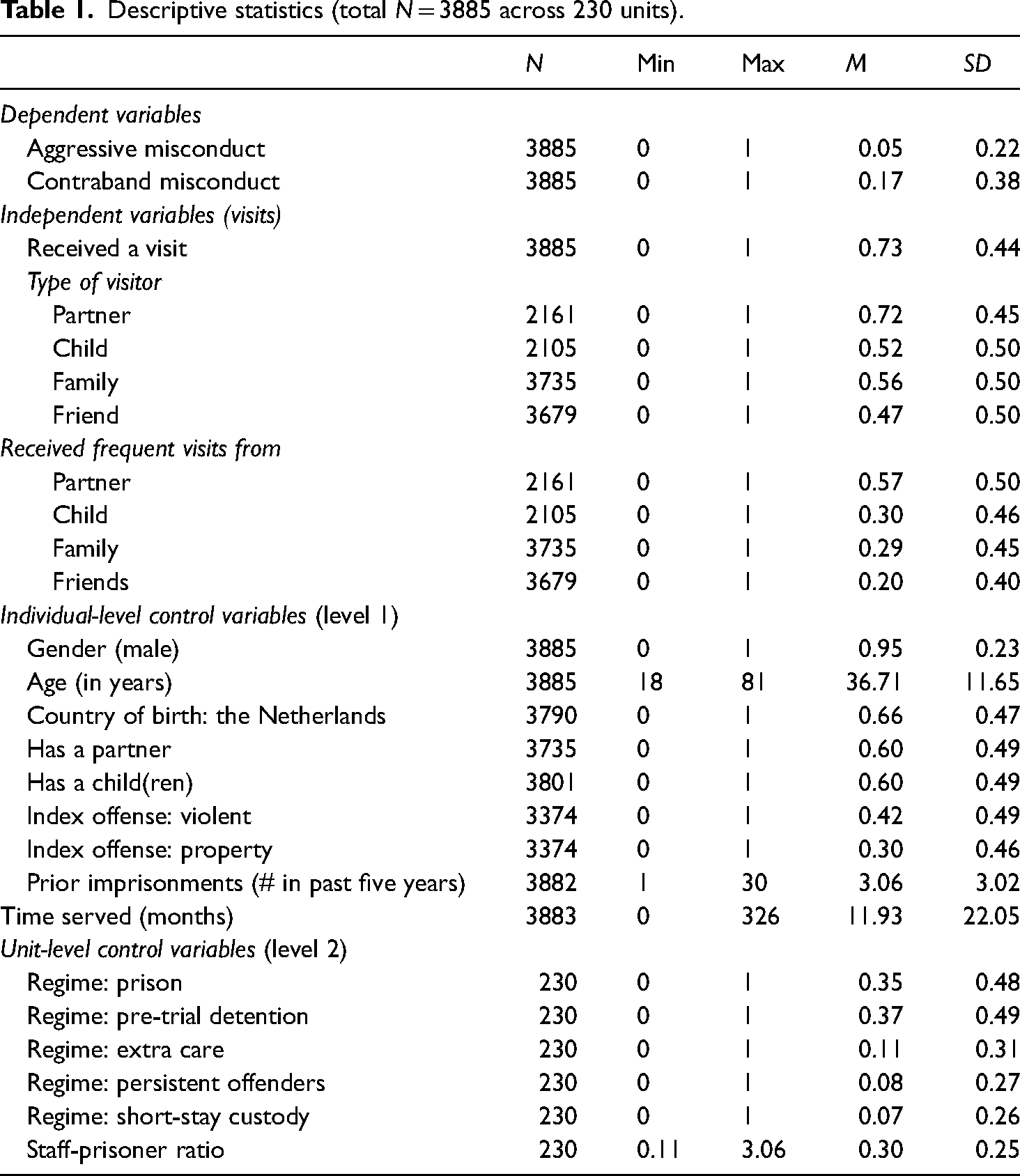
In the same period, 73% of the sample had received at least one visit. With regard to visitor type, 72% of prisoners who reported having a partner received at least one visit from their partner. Just over half of incarcerated parents received a visit from their child(ren). Around 56% of the sample received at least one visit from a family member and just under half of the sample (47%) received at least one visit from a friend. With regard to the frequency of visits, 57% of prisoners who reported having a partner received weekly visits from their partner. Nearly one-third of incarcerated parents reported receiving weekly visits from their children. Just under 30% of the sample indicated that family members visited on a weekly basis and 20% received weekly visits from friends.
Descriptive statistics for individual-level control variables show that most prisoners in this study are male (95%), on average 37 years old, and born in the Netherlands (66%). At the unit level (N = 230), most prisoners were housed either in prison (35%) or pre-trial detention (37%) regimes. On average, the staff-prisoner ratio was 0.30 (SD = 0.25), meaning there are three staff members for every 10 prisoners on a unit.
Bivariate analyses
Before proceeding to the multilevel analyses, bivariate associations between various visit measures and aggressive and contraband misconduct were examined. Table 2 shows the percentage of prisoners who received a report for aggressive or contraband misconduct per visitor type and frequency (monthly vs. weekly visits). As shown, a similar percentage of prisoners received a report for aggressive misconduct, whether they were visited or not. Small differences can be seen between the percentage of incarcerated parents who got a report for aggressive misconduct and did not receive a child visit (5.4%) and incarcerated parents who did receive child visits (3.8%). This percentage was even lower (3.3%) for incarcerated parents who received frequent child visits. Contrastingly, figures were slightly higher for prisoners who were visited frequently by partner or friends in comparison with prisoners who were not visited by partner or friends.
Percentages of aggressive and contraband misconduct by visitor type and visit frequency.
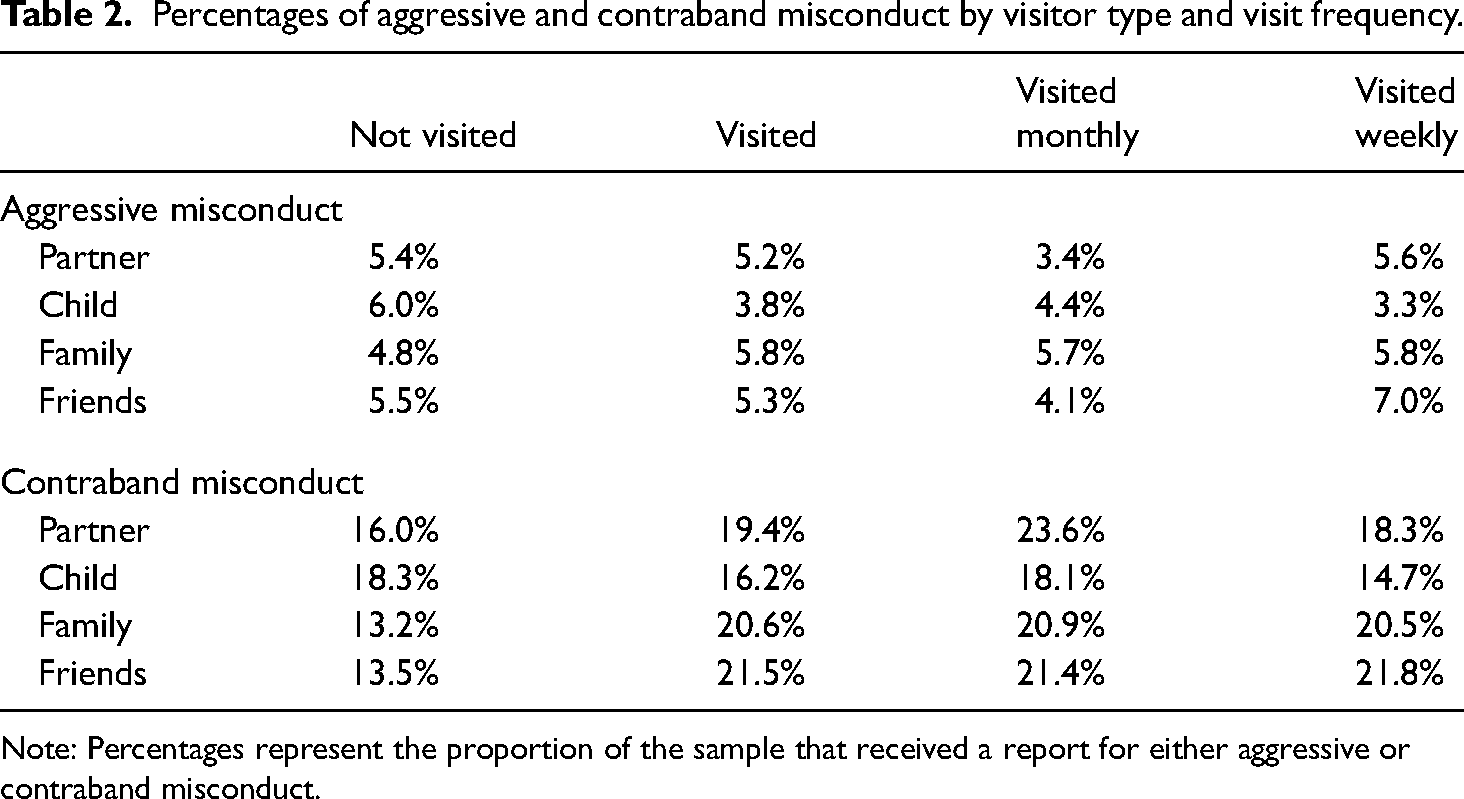
Note: Percentages represent the proportion of the sample that received a report for either aggressive or contraband misconduct.
In comparison with prisoners who were not visited, the percentage of prisoners who got a report for possessing or using contraband was higher when visited by partner, family or friends, ranging from an increase of 3.4% (partner) to 8% (friends). Prisoners who received monthly visits from partner, child or family had higher percentages of contraband misconduct in comparison with prisoners who received weekly visits. The opposite was true for friend visits, although the difference in contraband reports between monthly and weekly visits here is minimal (0.4%).
Multilevel analyses
Null models
Before proceeding with the multilevel logistic regression models, null models were estimated (not shown) to examine the amount of variation in the dependent variables (aggressive and contraband misconduct) across prison units. For aggressive misconduct, the interclass correlation (ICC) was 0.192, indicating that 19% of the variance in the odds of receiving a report for aggressive misconduct lay between units (variance = 0.79, p < .000). For contraband misconduct, this amount was higher with an ICC of 0.216, indicating that 22% of the variance in the odds of receiving a report for contraband misconduct lay between units (variance = 0.91, p < .000).
Logistic regression models
Results from the full multilevel logistic regressions models containing all explanatory variables at the individual and unit level are reported in Table 3 for both aggressive and contraband misconduct. Below we discuss the results per visit feature (receipt of visits, type of visitor received and frequency of visits) and describe firstly how they relate to aggressive misconduct, followed by contraband misconduct. We conclude with the results from all models concerning the individual and unit-level control variables.
The receipt of visits
The results from the multilevel analysis showed that receiving a visit in prison was not significantly related to aggressive misconduct. Prisoners who received visits were, however, 63% more likely to get a disciplinary report for possession or use of contrabands than prisoners who did not receive any visits.
Type of visitor received
Whether prisoners received visits from partner, child or family was not significantly related to aggressive misconduct. Receiving at least one visit from a friend, however, decreased the likelihood of receiving a report for aggressive misconduct by 34%. For contraband misconduct, prisoners who received visits from friends were 40% more likely to get a disciplinary report for possession or use of contrabands. Receiving partner visits also increased the likelihood of contraband misconduct (OR = 1.52). Receiving visits from the other two visitor types (child and family) was not significantly related to contraband misconduct.
Frequency of visits
We also explored whether the frequency of partner, child, family or friends visits is associated with misconduct, above and beyond whether they visited. No significant associations were found between weekly visits from partner, child and family and aggressive misconduct. Receiving weekly visits from friends, however, was associated with the higher likelihoods of aggressive misconduct. Because frequency effects were estimated simultaneously with visitor types effects, this finding should be interpreted as a small, positive association between weekly friend visits and aggressive misconduct (b = −0.42 + 0.57 = 0.15). For contraband misconduct, no significant associations were found for frequency of visits regardless of visitor types.
Control variables
In terms of socio-demographic and criminological variables, prisoners who are young and have a history of imprisonment had higher odds of both aggressive and contraband misconduct. This is consistent with results from prior research which finds, in high levels of agreement, that these individual characteristics are related to misconduct more generally (Steiner et al., 2014). Also, being imprisoned for a violent offense increased the odds of aggressive misconduct. Likewise, being imprisoned for a property offense increased the odds of aggressive misconduct. Moreover, being male and imprisoned for a violent offense increased the odds of contraband misconduct.
In terms of unit-level variables, several regime differences were found for aggressive and contraband misconduct. Compared with the prison regime, imprisonment in short-stay custody was related to lower likelihoods of both aggressive and contraband misconduct. Imprisonment in pre-trial detention was also related to the lower likelihoods of contraband misconduct. Imprisonment in persistent offenders’ regimes, however, are related to the higher likelihoods of contraband misconduct. Finally, more staff per prisoner decreased the odds of contraband misconduct.
Multilevel logistic regression models (N = 3885).
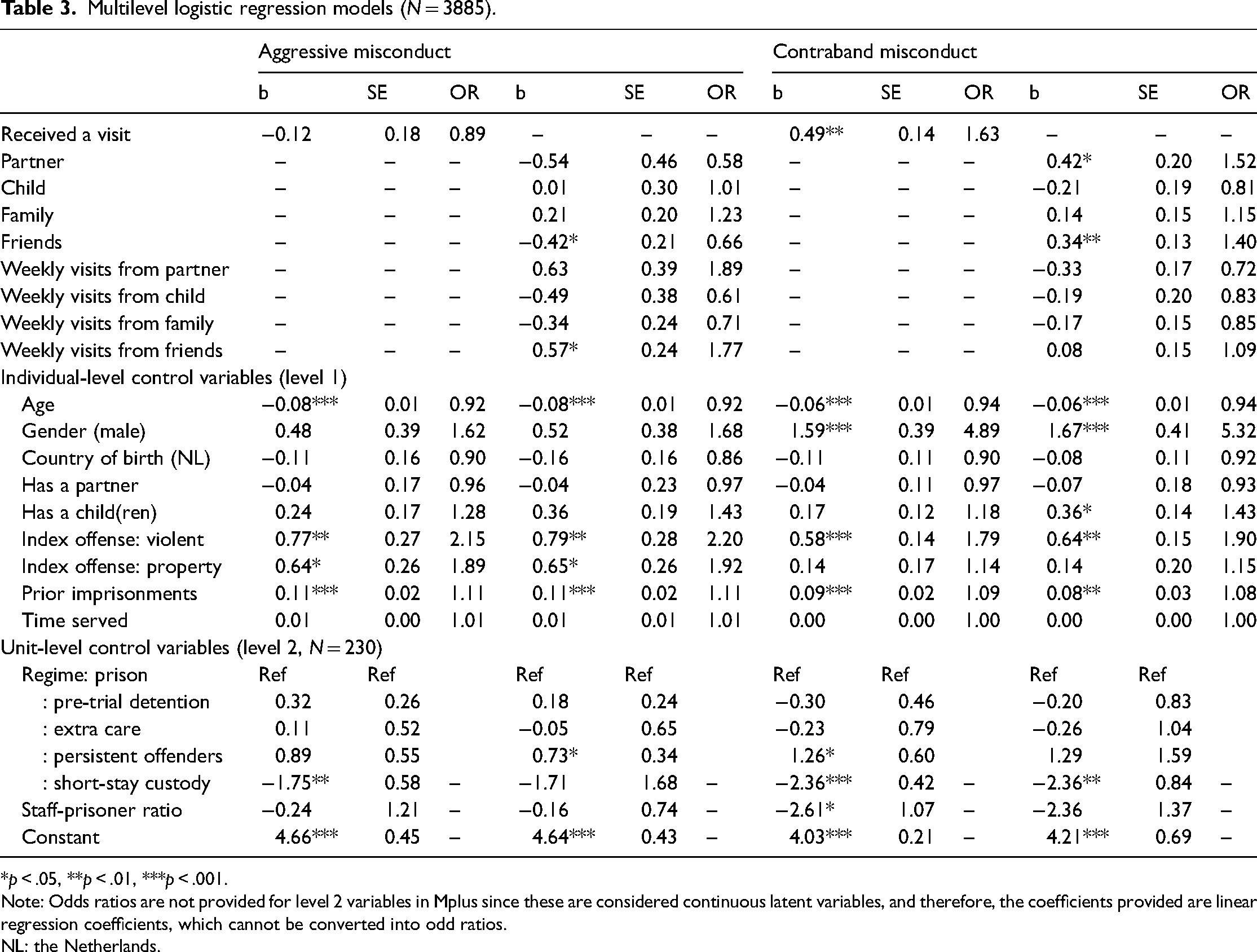
*p < .05, **p < .01, ***p < .001.
Note: Odds ratios are not provided for level 2 variables in Mplus since these are considered continuous latent variables, and therefore, the coefficients provided are linear regression coefficients, which cannot be converted into odd ratios.
NL: the Netherlands.
Post hoc analyses on verbally and physically aggressive behaviours
As we have argued in this article, it is important to specify the type of misconduct in question in order to understand more about the visit–misconduct relationship. Although several theoretical arguments and prior literature suggest that receiving visits in prison is likely to lower all types of aggressive behaviour, there are compelling reasons to separately examine verbally and physically aggressive behaviours as they constitute distinct phenomena with possibly different etiologies (Patrick, 1998; Stoliker, 2016). While official reports on verbally aggressive behaviours are likely to be directed at prison staff, physically aggressive behaviours are likely to include incidences of violence directed at either fellow prisoners or prison staff. Staff may exercise discretion when deciding to report on verbally aggressive behaviours, but this is less likely for physically aggressive behaviours due to their greater threat to prison safety. Considering this, we explored how the aforementioned visit features (receipt of visits, type of visitor received and the frequency of visits) relate to verbally aggressive (e.g. arguing, using insulting, cursing or provocative language, threats or other conflicts) and physically aggressive (e.g. kicking, beating, stabbing, spitting, pushing or throwing things) behaviours directed at either prison staff or fellow prisoners.
The results of these post hoc analyses showed that none of our visit measures were associated with verbally aggressive behaviours (full results can be found in the online supplementary materials, Table S1). Prisoners who received visits were, however, 49% less likely to get a disciplinary report for physically aggressive behaviours than prisoners who did not receive any visits. Moreover, receiving at least one visit from a friend was associated with lower likelihoods of physically aggressive behaviours (OR = 0.42). No significant associations were found for other visitor types or the frequency of visits on physically aggressive behaviours. These results were found even when controlling for the same socio-demographic, criminological and unit-level control variables used in the previous analyses. In sum, the post hoc analyses suggest that our reported finding regarding the association between receiving visits and aggressive misconduct pertains specifically to verbally aggressive and not physically aggressive misconduct, whereas the opposite is true for our finding on type of visitor.
Discussion
Although scholars have emphasised the importance of social ties for prisoner adjustment and misconduct, and although prisons worldwide allow visitation and use it as an incentive to improve prisoner behaviour, a few empirical studies have provided a detailed account of the visitation–misconduct relationship. The goal of this study was to advance research in this field by exploring how receiving visits in prison relates to prisoner misconduct. Drawing on the unique strengths of our self-report and administrative data, we examined several features of visits, including the receipt of visits, the type of visitor received and how often they visited. These measures acknowledge that visits are a heterogeneous experience. A central contribution of this study is specifically investigating how these features relate to aggressive and contraband misconduct. It is important to tease these forms of misconduct apart since theoretical arguments lead to differing predictions (see hypotheses 1–4). To test these predictions, we utilised multilevel analyses, which account for the clustered nature of the data and controls for unit-level influences. This work contributes to the visit–misconduct literature and extends this literature by studying visitation in the Netherlands. Below, we discuss and evaluate our results against our theoretical expectations and prior studies.
Receiving visits in prison and aggressive misconduct
Our first hypothesis was that prisoners who receive visits would have lower odds of aggressive misconduct. Our results show, however, no association between receiving visits in prison and aggressive misconduct in the multilevel analysis. This result is similar to two prior studies, which also found no significant associations between receiving visits and aggressive misconduct (Jiang et al., 2005; Lahm, 2008); however, there is some empirical evidence that prisoners who received visits engage in less violent infractions than prisoners who do not receive visits (Ellis, 1974; Gonçalves et al., 2016; Woo et al., 2016). We also found evidence of this in our post hoc analyses on physically aggressive behaviours. This provides some support for theoretical arguments stemming from Hirschi's (1969) social bond theory that the visit–misconduct relationship operates via informal social control since we find associations between receiving visits and serious forms of aggressive misconduct (such as kicking, beating, stabbing, spitting, pushing or throwing things towards others), but not with less serious forms of aggressive misconduct (such as arguing, using insulting, cursing or provocative language, or threats).
We further expected that frequent visits from partner, family and friends would be associated with the lower odds of aggressive misconduct (H2a). The multilevel models indicate, however, that only friend visits were associated with less aggressive misconduct, although practically the differences seem minimal (as evidenced by the bivariate analyses) and only applicable to physically aggressive behaviours (as evidenced by the post hoc analyses). It is possible that friends play a bigger role in informal social control than is often suggested in the literature. Friendships are likely to deteriorate during incarceration; perhaps, the friendships that remain are strong social ties (Volker et al., 2016). Nevertheless, we found that weekly visits from friends were associated with higher likelihoods of aggressive misconduct (but not verbally or physically aggressive misconduct directed towards prison staff or fellow prisoners). This suggests that these visits are linked to other forms of aggressive behaviour, such as destruction of property, throwing objects or beating against doors. Such acts of frustration could be associated with the visit experience. Recent literature about visitation experiences emphasises that visits are not a uniformly positive experience (e.g. Meyers et al., 2017). If visits are stressful, then prisoners may get frustrated, which could increase these forms of aggression. Perhaps this association would be more pronounced when self-report data on misconduct is examined. Official records reflect the detection and discretion of prison staff (Bosma et al., 2020b); thus, the acts of frustration are potentially less likely to result in a disciplinary report, especially when prison staff know that a prisoner had a stressful visit.
In contrast to partner, family and friends, we expected that receiving visits from children would be associated with an increased risk of aggressive misconduct (H2b). Our results show, however, no association between receiving (frequent) visits from children and aggressive misconduct (this was also found in the post hoc analyses). At the bivariate level, incarcerated parents who received weekly visits from their children seemed less likely to receive a report for aggressive misconduct; however, this association did not show when all visitor types were considered. Perhaps this association is negated by weekly partner visits which seemed related to the higher levels of aggressive misconduct at the bivariate level. Since it can be assumed that partners accompany children to visits, these opposite effects may have cancelled each other out at the multivariate level. Although past studies also identified null effects concerning child visits (Jiang et al., 2005), findings are mixed; thus, further investigations of how these visits relate to prisoner misconduct are needed.
Receiving visits in prison and contraband misconduct
Our expectation for contraband misconduct was that receiving visits would be related to the increased odds of contraband misconduct (H3). In line with this expectation, we found that prisoners who received visits had a 63% increased likelihood of receiving a report for possessing or using contrabands in comparison with prisoners who were not visited. Siennick et al. (2013) also found that receiving visits strongly increased the probability of contraband infractions. These results are understandable as there are few avenues for prohibited items to get into prisons.
Since any visitor can bring in prohibited items and frequent visits provide more opportunity to bring in such items, we hypothesised that receiving frequent visits, from any type of visitor, would increase the odds of contraband misconduct (H4). Our results, however, show that only partners and friends were associated with the higher odds of contraband misconduct (family and children were not significant). We offer a few possible explanations for this result. First, although all visitor types may be capable of bringing in prohibited items, it is possible that a certain amount of trust is necessary, which could explain why partner visits show an increased risk of contraband misconduct. Second, there is a possibility that prisoners specifically ask certain relationships to smuggle in items, so that they can still receive visits from other visitors (although, while this offers an explanation for the result from this study, with data from 2017, it is less likely that this selection effect would occur now due to the recent criminalisation of bringing prohibited items into prison). Third, it is also possible that friends are criminally involved and are facilitating such infractions by bringing in contrabands since visitors in the Netherlands are not screened nor denied access to prisons due to having a prior criminal record.
With regard to the frequency of visits, while the multilevel analyses showed no association between weekly visits from any visitor type and contraband misconduct, the figures from the bivariate analyses did show the higher percentages of contraband misconduct among prisoners who received monthly versus weekly visits. This alludes to the possibility that such sporadic visits may serve a specific purpose for prisoners (e.g. by providing them with drugs); however, these differences were not significant in the multivariate analyses. This suggests that who is visiting matters more for contraband misconduct than how often one visits. While these results partially contrast our fourth hypothesis, prior work has indicated that the relation between visitation frequency and misconduct is ambiguous and may even be reciprocal. Cihan et al. (2020), for instance, found that prisoners who were visited infrequently were most likely to be in the persistent misconduct group. Such findings could be a result of sanctions, since prisoners who receive a disciplinary report may lose their visits. While this is not possible in Dutch prisons, common sanctions for disciplinary infractions, including possession of contraband, are placement inside prisoners’ cell without television and exclusion from participation in regular programming (apart from yard time and visits) which can make it more difficult to arrange a visit. Unfortunately, since our data about visits, aggressive misconduct and contraband misconduct was reported about the same time period, we could not investigate these possibilities.
Strengths and limitations
The current study examined the association between receiving visits in prison and aggressive and contraband misconduct using multilevel analyses to test self-report visitation data and official records of misconduct. Although this study is one of the first to expand our knowledge about visitation to Western European prisons, the study is not without limitations. A first shortcoming is that the data analysed for visits, aggressive and contraband misconduct was reported about the same period (three months prior to the data collection). Due to the cross-sectional nature of our data, we cannot rule out the possibility of a reciprocal relationship (as explained above). Recently, some suggestive evidence has been found that adjustment problems in prison (in both mental health and behavioural) resulted in more visits (Gonçalves et al., 2019). For this reason, the results should be interpreted cautiously. Future research should examine whether these associations are causal by capitalising on methods that control for potential confounding influences, such as a within-persons design or instrumental variable analysis.
Next, the self-report data on visits was only available for a period of three months. While this may be warranted due to the relatively short prison stays in the Netherlands, we recognise that having data on a longer period could have different implications for aggressive and contraband misconduct (especially since prior research shows that prisoners experience varying visitation patterns during their entire prison term, see Cihan et al., 2020; Cochran, 2012). Also, having data over a longer period could make it possible to elucidate the mechanisms behind the associations found in this study. Future research, therefore, ought to include visitation data that spans an entire prison term or self-report data from a longer period.
Study implications
Notwithstanding these limitations, the current study advances our understanding of how visits relate to aggressive and contraband misconduct in Dutch prisons. Our results show that receiving visits in prison, especially visits from partner and friends, is primarily related to an increased likelihood of (drug-related) contraband misconduct. To a lesser extent, our data suggests that receiving visits, especially from friends, is related to the lower likelihoods of (physically) aggressive misconduct, but weekly friend visits are related to the higher likelihoods of aggressive misconduct. Taken together, our results point to the importance of relationship dynamics and visitation experiences when theorising and investigating the visit–misconduct relationship. Past work says little about these aspects; thus, they deserve further study. Especially useful would be studies examining the role of different visitors in relation to contraband misconduct, which could illuminate some of the findings here. Because scholars emphasise that visits are not uniformly positive, future studies should examine how experiences during visits differentially impact behaviour using, for example, self-report or observational data. Such research can illuminate under which conditions visits affect in-prison behaviour (perhaps more specifically the relation between visits and aggressive behaviour). Here, too, studies examining the effects of virtual visits on misconduct could be informative. For example, virtual visits can also provide emotional support, but removes the possibility of visitors bringing in prohibited items, so it would be interesting to know whether they affect misconduct in a similar way. Also, scholars could examine how these behaviours interrelate. For example, if receiving visits leads to more (drug-related) contraband, it is possible that drug use or drug dealing can influence levels of aggression and other types of misconduct in prison. Relatedly, the way visits and misconduct relate may differ across prisoners (e.g. males and females, short-stay and long-stay prisoners). Exploring these possibilities can help determine how to modify existing visitation programs to help temper negative prison experiences and better anticipate and manage prisoner misconduct. While we urge prison officials to be cautious in interpreting the results of this study for such purposes, our study suggests that visits may only limitedly help in diminishing aggressive behaviours but considering programs and procedures that encourage visits and improve the visitation experience could help lower incidences of physical aggression against others and objects. If correctional staff wish to minimise contraband risks in prisons, especially drug-related contraband, then closer inspection of who is visiting could be useful.
Supplemental Material
sj-docx-1-euc-10.1177_14773708211041016 - Supplemental material for Receiving visits in prison and aggressive and contraband misconduct among Dutch prisoners
Supplemental material, sj-docx-1-euc-10.1177_14773708211041016 for Receiving visits in prison and aggressive and contraband misconduct among Dutch prisoners by Maria L. Berghuis, Miranda Sentse, Hanneke Palmen, Paul Nieuwbeerta in European Journal of Criminology
Footnotes
The Dutch Prison Visitation study, as a part of the Life in Custody study, was funded by the Dutch Custodial Institutions Agency (DJI) and Leiden University. The opinions, findings and conclusions expressed in this article are those of the authors and do not necessarily reflect those of the DJI. The authors wish to thank the DJI for its support with the administration of the survey.
The author(s) declared no potential conflicts of interest with respect to the research, authorship and/or publication of this article.
The author(s) received no financial support for the research, authorship and/or publication of this article.

Supplemental material for this article is available online.
References
Supplementary Material
Please find the following supplemental material available below.
For Open Access articles published under a Creative Commons License, all supplemental material carries the same license as the article it is associated with.
For non-Open Access articles published, all supplemental material carries a non-exclusive license, and permission requests for re-use of supplemental material or any part of supplemental material shall be sent directly to the copyright owner as specified in the copyright notice associated with the article.
