




Abstract
Guardians are a potential resource of conflict de-escalation but we still know little about their actual behaviour. In this article we investigate whom among the antagonists a guardian selects as a target when they intervene in an interpersonal conflict. We investigate this using CCTV footage from Amsterdam (the Netherlands) of 46 interpersonal conflicts in public spaces involving 641 interventions by 176 individuals. We find that guardians are more likely to target antagonists: (1) who have performed the most aggressive behaviours, (2) who are not simultaneously targeted by other guardians, (3) who are from their own social group, (4) who are men. The analysis shows that the behaviour of intervening guardians is shaped by multiple aspects of the complex and often ambiguous conflict situations.
Keywords
Introduction
A growing amount of empirical research testifies that, if we want to understand interpersonal conflicts and violence, we must first understand how third parties behave in these situations (Levine et al., 2011; Phillips and Cooney, 2005; Planty, 2002; Shotland and Goodstein, 1984; Wells and Graham, 1999). Within the field of criminology, the importance of third parties has been addressed more generally by the routine activity theory. This theory asserts that one of the necessary situational conditions for a crime to take place is the absence of capable guardians (Cohen and Felson, 1979). The routine activity theory has led criminologists to investigate whether the mere presence of guardians serves as a deterrent to crime (Hollis-Peel et al., 2011). However, this passive deterrence of crime is just one aspect of what a capable guardian can do. Although some crimes are deterred by the presence of guardians, in other situations the mere presence is not enough. In these situations, guardians perform ‘the ultimate act of guardianship’ (Reynald, 2009: 4) – intervention in the conflict.
Observational studies have found that, in interpersonal conflicts, this ultimate act of guardianship seems to be the rule rather than the exception. The vast majority of assaults happen in the presence of someone who is not directly involved in the conflict (Planty, 2002), and, when present, these third parties often intervene as active guardians. The frequency of interventions by third parties in conflicts varies from about half of the observed incidents of aggression in a barroom setting (Wells and Graham, 1999) to a staggering 90 percent in a recent study analysing CCTV footage of conflicts and fights on public streets (Philpot et al., 2019a). 1
When guardians intervene in interpersonal conflicts they are faced with an additional challenge compared with guardians intervening in other types of crime, because the distinction between victim and perpetrator is oftentimes not naturally given in this type of interaction. A large proportion of these situations appears chaotic and consists of a series of mutual escalations where the primary opposing conflict parties, henceforth referred to as the antagonists, appear to be simultaneously perpetrator and victim (Collins, 2008; Luckenbill, 1977; Parks et al., 2013). This has led researchers, from the tradition of symbolic interactionism, to argue that roles such as ‘victim’ and ‘perpetrator’ function only as heuristic labels (Luckenbill, 1977) and might change in the course of a conflict (Felson et al., 1984). Guardians intervening in interpersonal conflicts thus have to make sense of the changing actions and reactions and assess whom among the antagonists they target when they intervene.
Even though guardians thus empirically appear to take an active role in real-life conflicts and have been part of the criminological theoretical canon for decades, the empirical research on what guardians actually do in interpersonal conflict situations is sparse and continues to have blind spots (Levine et al., 2011; Phillips and Cooney, 2005; Reynald, 2009, 2010). The purpose of the current article is to address this gap in the literature by investigating which characteristics influence the target selection of guardians when they intervene in interpersonal conflicts. The analysis is based on a systematic behavioural analysis of CCTV footage of conflicts recorded in the streets of Amsterdam. The analysis of the CCTV footage shows that when guardians intervene they are more likely to target antagonists: (1) who have performed the most aggressive behaviours, (2) who are not simultaneously targeted by other guardians, (3) with whom they have a pre-existing social relationship, and (4) who are male.
Target selection of guardians in interpersonal conflicts
The necessary steps guardians go through before an intervention have been detailed in a script of guardian intervention developed by Leclerc and Reynald (2015). This script lays out six preconditions that precede intervention. These steps are: (1) availability to intervene, (2) capacity to intervene, (3) noticing the offence, (4) monitoring the ongoing situation, (5) taking responsibility, and (6) deciding to intervene. These six preconditions are similar to the ‘decision tree’ that Latané and Darley (1968) formulated to describe the necessary cognitive and behavioural steps that bystanders must go through if they are to intervene: they must notice the event, interpret it as an emergency, feel personally responsible for dealing with it, and possess the skills and resources to intervene successfully. Although both models lay out multiple steps that guardians or third parties must go through before intervening, they do not describe the target selection as part of this process.
Whereas neither of the theoretical models explicitly addresses the target selection of guardians, empirical studies have documented this aspect of intervention. This research aims to document the variations in intervention behaviours and finds that guardians sometimes target the perpetrator and at other times focus on the victim of interpersonal violence (Banyard, 2015; Berkowitz, 2009; Frye et al., 2012; McMahon et al., 2013). These studies outline that guardians sometimes target the victim in order to protect them from the perpetrator and at other times target the perpetrator to stop their offensive behaviour.
The often ambiguous nature of the division of roles in interpersonal conflicts (Collins, 2008; Felson et al., 1984; Luckenbill, 1977) entails that guardians here are faced with the challenge of identifying who they should try to stop when they intervene. In situations such as sexual assaults or burglaries, victim and perpetrator roles might appear to fit the conflict situations readily. However, the assignment of these roles is not easily applicable in all interpersonal conflict situations. Rather, they are the product of interpretation and can sometimes be re-evaluated during a conflict situation (Emerson, 2015; Emerson and Messinger, 1977). Although most guardians probably agree that a victim should be helped and a perpetrator should be stopped and sanctioned, the application of who qualifies as a victim and who qualifies as a perpetrator is not always straightforward. Empirical research thus has shown that directly intervening guardians must decide whom among the antagonists they target, but the assessment of which situational factors might shape this target selection is, to our knowledge, not addressed in any scientific study.
In the current study, we investigate whom of the antagonists a guardian targets when he or she intervenes in an interpersonal conflict. Thus, in this study we do not investigate who intervenes in a conflict but rather focus on the behaviour of the guardians who actually do intervene. Since the characteristics of both the situation and the person intervening in the conflict are constant across the potential targets of intervention, these variables cannot explain the variation in whom guardians actually target. In order to explain whom guardians target with their intervention we thus turn our analytical gaze towards the behaviour and individual characteristics of the potential targets of intervention, that is, the antagonists. This focus aligns with the arguments of scholars who have argued that, to understand how individuals act in interpersonal conflicts, we should consider not only the individual dispositions of the people acting but also the behaviours and characteristics of the other people in the situation (Felson and Steadman, 1983; Jackson-Jacobs, 2013; Luckenbill, 1977). This interactional approach to crime was developed by Luckenbill, who showed the potential of studying interpersonal crimes as situational transactions where the behaviour of one individual is seen as a reaction to aspects of the situation (Luckenbill, 1977, 1980, 1981, 1982).
Inspired by this interactional approach, we have identified four situational factors – two behaviours and two individual characteristics of the potential targets – which we expect to influence whom guardians target when they intervene in an interpersonal conflict.
Behaviour of potential targets and other guardians
Aggressive behaviour of the antagonists
The first factor we expect to influence the target selection of guardians intervening in interpersonal conflicts is the relative number of aggressive behaviours performed by the antagonists. Whereas some interpersonal conflicts are characterized by mutual acts of aggression, other situations are more unidirectional (Luckenbill, 1977; Parks et al., 2013). The larger the difference between the number of aggressive behaviours performed by the antagonists, the easier we expect it to be for the guardians to unambiguously designate the perpetrator role. Following this, we expect that intervening guardians are more likely to target the antagonist who has performed the most aggressive behaviours.
However, the literature on guardianship suggests that guardians are sometimes hesitant to intervene in very violent conflicts in order to avoid personal injuries (Huston et al., 1981; Reynald, 2010). This concern for personal safety could engender the opposite effect, and thus lead guardians to target the lesser aggressor of the conflict to avoid endangering themselves. Although the literature thus agrees that the aggressive behaviours of the antagonists are relevant, it is equivocal about how it might influence the target selection of guardians.
Whereas one antagonist might be more aggressive at the beginning of an interaction, the other might be the main aggressor by the end. To accommodate this, we count the total number of aggressive behaviours performed by each antagonist prior to each intervention behaviour. The first factor we thus expect to influence the target selection of guardians is the relative number of aggressive behaviours performed by the antagonists of the conflict (H1).
Intervention by other guardians
A large literature originating from social psychology has found that ‘the individual’s likelihood to intervene decreases when passive bystanders are present in a critical situation’ (Fischer et al., 2011: 517). On a more general level, this line of research illustrates that the behaviour of the individual guardian is influenced by the actions of other guardians, or absence thereof. Although this so-called bystander effect details the inhibitory effect of the passivity of other guardians, much less research has investigated how active guardians might influence each other. A recent qualitative study found that guardians coordinate their helping behaviour with a division of labour where each guardians takes on a different task. This study, however, focused on the coordination of the helping behaviour that happens in the aftermath of conflicts (Bloch et al., 2018). Although no empirical study, to our knowledge, has investigated the coordination of guardians intervening in an ongoing conflict, the studies on passivity and helping in post-conflict settings all indicate that the target selection of guardians is influenced by what other guardians do.
We hypothesize that the actions of other guardians influence the target selection similarly to the division of labour observed in the post-conflict. The second hypothesis thus states that guardians are more likely to target an antagonist who is not simultaneously the target of other guardians than one who is being simultaneously targeted by other active guardians (H2).
Individual characteristics of potential targets
Social relationship
Guardians sometimes act as what Eck has termed ‘handlers’ (Eck, 1994). This term denotes a distinct type of guardian who has a relationship to a perpetrator and uses this handle to stop them from committing further offences (Eck, 1994; Hollis-Peel et al., 2011). The relevance of a relationship between a guardian and an antagonist has been corroborated in empirical studies that consistently have found that a social relationship to an antagonist drastically increases the likelihood of direct intervention in a conflict (Fischer et al., 2011; Liebst et al., 2019; Phillips and Cooney, 2005). This increased likelihood is often explained by the handlers feeling responsible for the actions performed by individuals to whom they have a social relationship (Felson, 1995; Fiske and Rai, 2015; Levine et al., 2011). Although these studies do not explicitly deal with the target selection of guardians, it follows from the explanation that they intervene to stop the offences of the antagonist with whom they share a social relationship. Following this, we expect that guardians will act as handlers and take responsibility for the behaviour of their peers. The third hypothesis thus states that guardians are more likely to target antagonists with whom they have a social relationship than antagonists with whom they do not have a social relationship (H3). 2
Gender
Previous research indicates that the gender composition of the antagonists might influence whom guardians target when they intervene in an interpersonal conflict. There is general consensus in the scientific literature that aggressive behaviour from a man towards a woman is judged more harshly than the aggressive behaviour from a woman towards a man (Allen and Bradley, 2018; Harris, 1991; Rogers et al., 2019; Sorenson and Taylor, 2005). This pattern has been explained with the chivalry norm, which prescribes that men should not act aggressively towards women. This norm not only discourages men from harming women but also encourages others to protect them. The norm thus leads respondents to indicate a higher willingness to intervene on a woman’s behalf (Felson and Feld, 2009) and to intervene when the perpetrator is a man (Sorenson and Taylor, 2005). Following this, the fourth hypothesis states that guardians are more likely to target men than women (H4).
Materials and methods
The empirical foundation of this article consists of CCTV footage of interpersonal conflicts collected from April to August 2017. The research group was granted access to CCTV files by the Dutch Ministry of Justice. The footage was recorded by camera operators employed by the municipality who watch the live streaming footage 24 hours a day every day of the week. The cameras are located throughout the city of Amsterdam on streets and squares that the mayor of Amsterdam’s office has selected as hot spots of crime and disorder. These areas typically include the most popular night-life zones, spots with a history of drug dealing, and known hangout spots for delinquent youths.
As part of their usual practice, the operators record any kind of violent conflict, which can be used to identify perpetrators and later as evidence in court. In addition to their usual recording practices, we instructed the operators to record any quarrel they observed irrespective of whether or not the conflict escalated into physical violence. This includes agitated verbal conflicts where the antagonists never make physical contact. The implementation of this new recording practice is apparent in the empirical material since a substantial proportion (33 percent) of the recorded conflicts contained no physical aggression.
In total, we collected CCTV footage depicting 165 conflict situations. We assessed the footage of each situation for its utility for the study. Only files that conform to the following criteria are included in the final sample:
An interpersonal conflict is visible in the recorded footage
The quality of the video (resolution, brightness and frames per second) is sufficiently high to allow the coding.
There are no or only negligible breaks in the recording.
There is at least one guardian intervening in the conflict.
Out of the original sample of 165 situations, 25 did not depict a conflict, 36 lacked sufficiently high resolution, and 72 had parts of the conflict missing (the categories are not mutually exclusive). Of the remaining 62 codeable situations, 16 did not have any guardians intervene in the conflict, resulting in a final sample of 46 situations. The final analysis thus only uses 28 percent of the material originally collected. Although this is a high loss of data, it is comparable to other studies analysing CCTV footage of interpersonal conflicts (Philpot et al., 2019b).
In order to assess whether the final sample is comparable to the original sample, we compared information on time of day and day of week for the used and discarded material and found that the material used for the analysis is statistically similar to the discarded material in regard to time and place (see Appendix 2 in the online Supplemental Material). This shows that the analysed videos are, at least as regards the temporal and spatial circumstances, comparable to the original sample.
The analysed footage contains 671 interventions, of which 30 (4.5 percent) were excluded from the analysis because at the exact time of the intervention the coder could not unambiguously identify a conflict dyad. An example of the excluded interventions is an intervention against an antagonist who performs aggressive gestures in a general direction or towards a group of people rather than towards a specific individual. The final sample thus comprises only conflicts that at the time of intervention are between two clearly identifiable antagonists. We applied this selection criterion to simplify the analysis and interpretation of data and because the sample contained very few cases where the intervention was not in a conflict between a clearly identifiable dyad. As a result of applying this selection criterion, all interventions in the analysis are interventions in clearly visible antagonistic dyads. The final sample comprises 46 situations containing 176 guardians performing 641 intervention behaviours.
Coding of CCTV footage
The coding of the CCTV footage grouped two different types of information. The first kind of information relates to behaviour. The behavioural codes describe the interactions in the situation and how these develop over the course of the conflict. The behavioural coding approach was used to gather information on the number of aggressive behaviours performed by antagonists (H1) and the simultaneous interventions by other guardians (H2). The second kind of information is the individual characteristics of the potential targets. This type of information describes characteristics that do not change throughout the course of the situation. This coding approach was used to gather information about social relationships (H3) and the gender of the antagonists (H4).
The behavioural coding is based on a coding scheme (see Appendix 1 in the online Supplemental Material) detailing definitions of relevant conflict and intervention behaviours. The coding scheme was developed through careful inductive examination of the CCTV footage identifying and defining the relevant conflict and intervention behaviours and in conversation with previously developed coding schemes used to analyse antagonist and third-party behaviours (Liebst et al., 2018; Lindegaard et al., 2017; Philpot, 2017).
The CCTV clips were coded using Behavioural Observation Research Interactive Software (BORIS) (Friard and Gamba, 2016). This program allows us to code not only the observed behaviours but also their timing. Furthermore, each behaviour is coded with an actor and a target and categorized according to whether it is an intervention or a conflict behaviour. In this study, we thus conceptualize being a guardian not as a situationally fixed role, but rather as something that can change in the course of the conflict depending on the actual behaviour. This differs from how most studies have conceptualized being a guardian, where roles are fixed for the duration of the conflict situation (for example, Felson et al., 1984; Liebst et al., 2018; Wells and Graham, 1999). Although this approach is new to the study of guardians, researchers have noted that, ‘in about half the cases where third parties are active (48 percent), third parties were originally one of the main antagonists and either the victim or offender interceded’ (Felson et al., 1984: 457). This shows that individuals often shift roles during a conflict.
These changes in roles are visible on the CCTV footage when an antagonist grows tired of the persistent interventions of a guardian and starts attacking them instead of the original target of their anger. Another example of this from the footage is a peaceful guardian who becomes increasingly frustrated with the non-acquiescence of an antagonist and eventually turns aggressive or even violent towards this person.
To allow individuals to switch roles in the course of the conflict, we scored each behaviour according to whether it was an intervention behaviour or a conflict behaviour rather than attributing fixed roles to individuals. For a behaviour to qualify as an intervention in the analysis it must live up to two criteria. First, it must be performed by individual A towards individual B who is engaged in a conflict with someone other than individual A. Second, it must be one of the following behaviours: calming hand gestures, aggressive hand gestures, non-forceful touching, blocking or holding a person back, pushing, or hauling a person off (see Appendix 1 in the online Supplemental Material for behavioural definitions). This means that in this study, every time someone performs one of these behaviours directed towards an antagonist engaged in a conflict with someone other than the person performing the behaviour, it is classified as an intervention. If a guardian performs the same behaviour towards the two antagonists at the same time, this is coded as two separate behaviours. This type of behaviour accounts for 5.8 percent of the observed interventions. We chose this operationalization because intervening towards both antagonists at the same time shows that none of the investigated factors makes the guardian select one antagonist over the other.
We also coded two individual characteristics of the potential targets. The first of these is the gender of the antagonists. This measure is based on the clothes, facial features, hair and body type of the individuals. The second individual characteristic is the social relationship between the guardian and the antagonists. This measure is based on the observed tie signals among the individuals. When humans move in public spaces, they send signs to their surroundings about their social ties. The visual appearance of social relationships has been described by Goffman (1971) and Hall (1966), who argued that the physical proximity of individuals in public spaces correlates with the social proximity of the individuals. This has since been corroborated in empirical studies observing pedestrian behaviour (Ge et al., 2012; McPhail and Wohlstein, 1982; Solera et al., 2013) and in conflict situations (Liebst et al., 2018).
Since most of the videos include footage of the antagonists arriving at and leaving the scene of a conflict, we use this information as a cue for a social relationship when it is available. If two individuals arrive at or leave the scene in proximity to each other, we take it as an indicator that they have a social relationship. Furthermore, we draw on other social signifiers such as groups wearing matching clothes or uniforms, standing close to one another, being engaged in casual conversation, holding hands, or similar signs when we assess the social relationships.
Assessment of reliability
The CCTV footage was encoded by the first author of the article. In order to estimate the reliability of the encoding of the videos, a trained graduate student independently coded all behaviours in 11 situations (24 percent). Any disagreements between the coders were resolved individually prior to the analysis. We calculated Cohen’s Kappa (κ) in order to estimate the extent of agreement in the double coded situations. In order to make the codes comparable, we gave each individual in each situation a unique identifier to allow both coders to identify the same individual in the videos. Agreement was defined as both coders identifying the same type of behaviour performed by the same actor towards the same target within the same one-second window.
The reliability should be calculated on the same level of measurement as is used in the analysis (Krippendorff, 2004). 3 When the intervention behaviours are aggregated they obtain a substantial interrater agreement (κintervent_beh = 0.62). The aggregated aggressive behaviours (hitting, kicking, pushing, throwing or aggressive pulling, wrestling/grappling, striking with an object or weapon, hauling person off, aggressive gestures, invading space) also obtain a substantial interrater reliability (κaggressive behaviours = 0.68). The variables measuring the individual characteristics of the potential targets obtain complete and almost complete agreement for gender and social relationship, respectively (κgender = 1 and κsocial relation = 0.89). In sum, these results demonstrate that our main findings are based on reliable observations (Landis and Koch, 1977).
Statistical model
In order to estimate the target selection of guardians intervening in a conflict we use a conditional logit model. The conditional logit model is a regression model that estimates the probability of selecting a specific target based on the characteristics of the available alternatives (McFadden, 1973). This estimation method compares the characteristics of the individual selected as the target of an intervention with those of the individual who was also part of the conflict dyad but was not selected as a target of intervention. The conditional logit model suits the purpose of the current article since all four hypotheses aim to understand how the characteristics of the potential targets influence the probability that a guardian targets this particular antagonist.
Since the same individuals can intervene multiple times within a conflict (that is, interventions are nested in individuals) and the individuals are sampled from the same situations (that is, individuals are nested in situations), we estimate the model with cluster corrected standard errors to correct for potential interdependences between the observations. Following the recommendation of the literature, we correct on the highest level of interdependence (the situation) to ensure that the identified clusters are independent of each other (Cameron et al., 2011). We used the clogit function in STATA to estimate the model.
Descriptive statistics
The point of departure for the current study was that interpersonal conflicts often do not have an unambiguous perpetrator. The empirical material corroborates this since only 38 percent of the guardians are intervening in conflict dyads where just one of the two antagonists has performed aggressive behaviours. This proportion is comparable to a survey finding that approximately 40 percent of conflicts are clearly one-sided (Graham and Wells, 2002). For the majority of guardians intervening there is thus a potential ambiguousness in the distinction between who is a perpetrator and who is a victim because either both or neither of the antagonists have performed aggressive behaviours.
Of the total 176 intervening guardians, 71 change the target of intervention in the course of the conflict. This shift in target selection of approximately 40 percent of the guardians indicates that something during a conflict influences their target selection. The fact that a substantial proportion of the intervening guardians change their target during the conflict emphasizes the necessity of allowing target selection to vary throughout the situation.
Table 1 shows the descriptive statistics for the variables included in the model. The table gives information on 641 chosen targets and 641 non-chosen targets, and thus 1282 observations. The unit of measurement of the table is the characteristics of each potential target measured at the point in time when each intervention behaviour takes place.
Descriptive statistics (N = 1282).
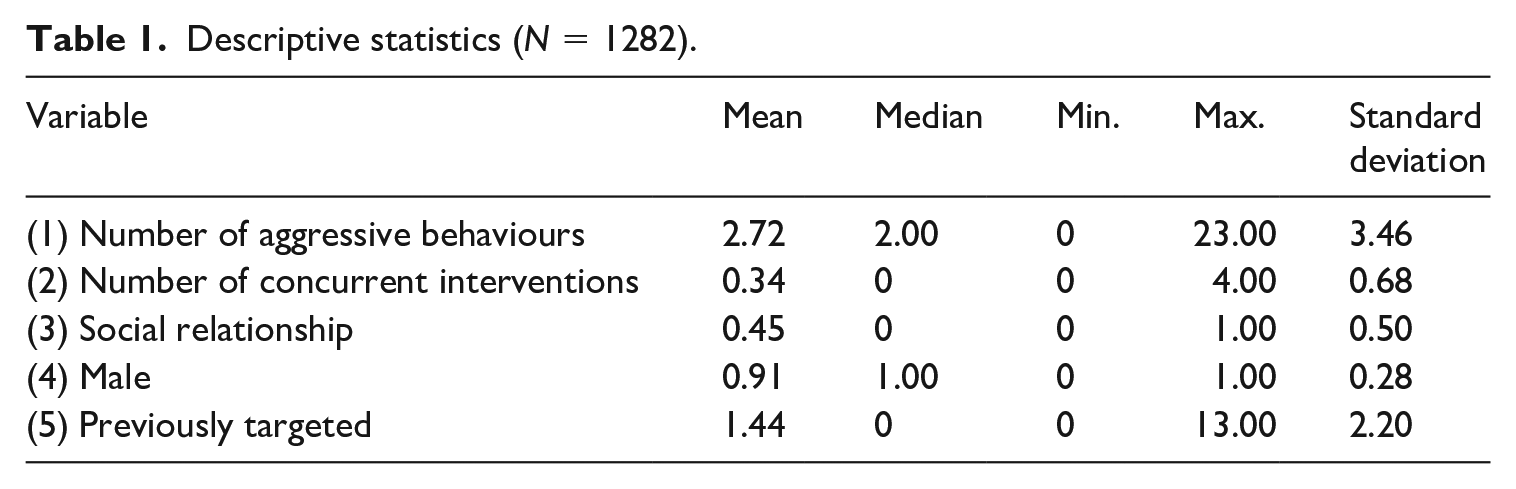
The first variable in the table is the number of aggressive behaviours performed by the potential targets prior to the intervention (see Appendix 1 for the definitions of each sub-behaviour). More than half of the potential targets of intervention have performed two aggressive behaviours or fewer prior to the point of intervention. The highest number of aggressive behaviours performed by an antagonist prior to the point of intervention is a staggering 23 behaviours. The average number of aggressive behaviours performed by antagonists is 2.7.
The second variable in Table 1 measures whether other guardians have intervened towards a potential target within the three seconds leading up to the intervention. For more than half of the interventions no one is intervening in the conflict simultaneously and the median value for this variable is therefore zero. However, about 25 percent of the potential targets are simultaneously targeted by another guardian and in some cases by more than one person. The highest number of simultaneous interventions is four.
The third variable in Table 1 shows that the guardians have a social relationship to 45 percent of the potential targets of intervention. There are thus more potential targets who are strangers to guardians than there are potential targets with whom they have a social relationship. The fourth variable in the table shows that 91 percent of the potential targets are male whereas only 9 percent are female.
The fifth variable in Table 1 is a count variable measuring the number of previous interventions by a guardian towards a specific antagonist. Although this variable is not among the hypothesized variables, it is included in the multivariate conditional logit model as a control variable. This variable is included in order to take into account that some interventions follow each other as a consequence of the same intervention. An example of this is a guardian who intervenes by briefly holding an antagonist back and then starts hauling this person away from the other antagonist. This would be encoded as two distinct intervention behaviours (holding back and hauling off), even though it appears as a single continuous action. As illustrated by the median value, most guardians have not previously intervened towards the potential targets of intervention. The highest number of previous interventions towards a potential target is 13, and the average number of previous interventions towards potential targets is 1.44.
Results
Multivariate conditional logit analysis
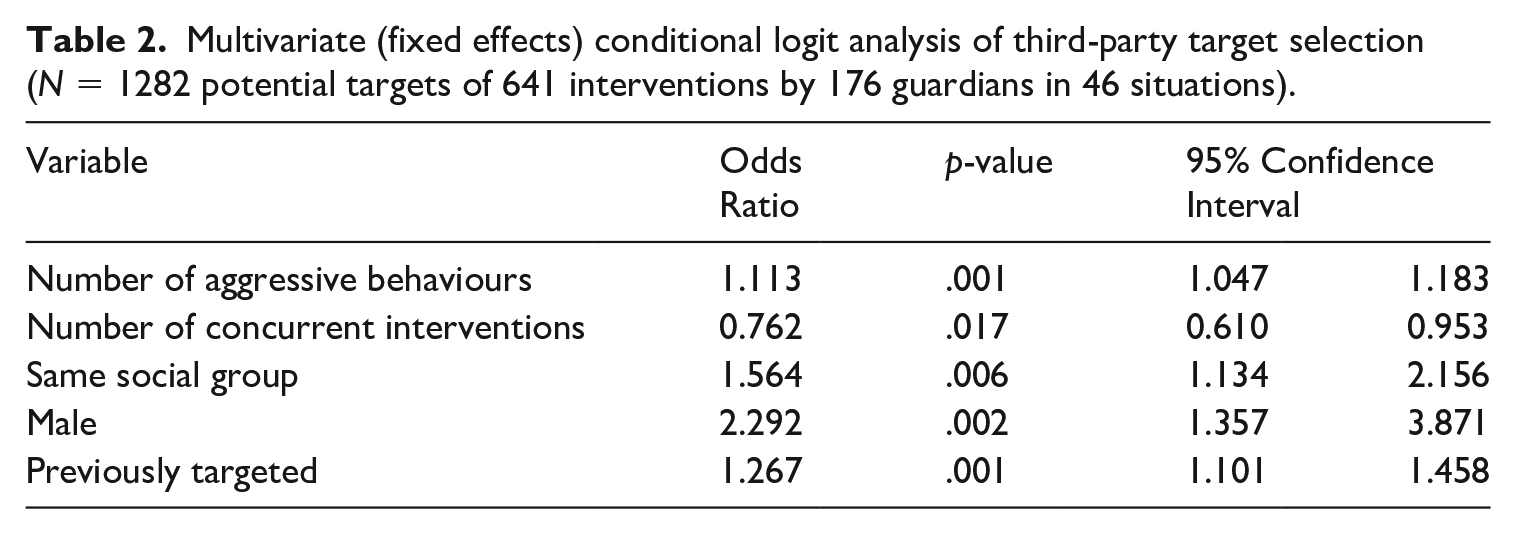
We construct a model that includes all the hypothesized and control variables. This multivariate conditional logit analysis allows for an analysis of the target selection where all variables are taken into account simultaneously. The results from the analysis are presented Table 2.
Multivariate (fixed effects) conditional logit analysis of third-party target selection (N = 1282 potential targets of 641 interventions by 176 guardians in 46 situations).
Aggressive behaviours
Table 2 shows that the effect of the relative number of aggressive behaviours performed by an antagonist prior to the intervention has a statistically significant influence on the target selection of an intervening guardian (p = .001). The analysis shows that the likelihood that a guardian targets a specific antagonist increases when this antagonist has performed more aggressive behaviours than the other antagonist in the situation. The model estimates that, when an antagonist has performed one more aggressive behaviour than his or her opponent, this increases the odds that this antagonist will be targeted by the intervention by 11.3 percent. In sum, the empirical investigation corroborates the first empirical hypothesis, which states that the target selection of guardians is influenced by the relative number of aggressive behaviours of the antagonists.
Intervention by other guardians
Table 2 also shows that concurrent intervention by other guardians has a statistically significant effect (p = .017) on whom guardians select as a target for their intervention (note, however, that this measure is not significant if the control variable is omitted from the model). The odds that a guardian will target a specific individual is approximately 25 percent smaller when another guardian is already targeting that individual. Thus, the model substantiates the second hypothesis, which states that guardians were more likely to target antagonists who are not simultaneously targeted by other guardians.
Social relationship
According to Table 2, when a guardian has a social relationship with one of the antagonists, the odds are more than 50 percent larger that the intervening guardian will target the antagonist with whom they have a social relationship. This effect of social relationship on the target selection of the guardian is statistically significant (p = .006). The result confirms the third hypothesis, which states that guardians are more likely to target individuals with whom they share a social relationship.
Gender
Table 2 furthermore shows that the gender composition of the antagonists has a statistically significant effect (p = .002) on the target selection by guardians. When a man and a woman are engaged in a conflict, the odds are more than twice as large that a guardian will target the man rather than the woman. The multivariate analysis thus confirms the fourth hypothesis stating that guardians are more likely to target men than women.
Previous interventions
The control variable counting the number of previous interventions by the guardian towards the antagonists is a significant predictor of the target selection by guardians (p = .001). Figure 1 shows how, once a guardian has intervened towards an antagonist in the conflict, they are likely to stick with this choice in later interventions. To verify the need to control for whether or not an antagonist had been previously targeted (the control variable), we also estimate the model without this variable, that is, including only the four theoretically motivated key variables. When the control variable is excluded, the sizes of the other estimates of the key variables change only slightly. However, and underlining the need for the control, when the control variable is excluded from the model, Number of concurrent interventions fails to reach statistical significance at p < .05 two-sided (see the estimates for the model with only the hypothesized variables in Appendix 3 in the online Supplemental Material).
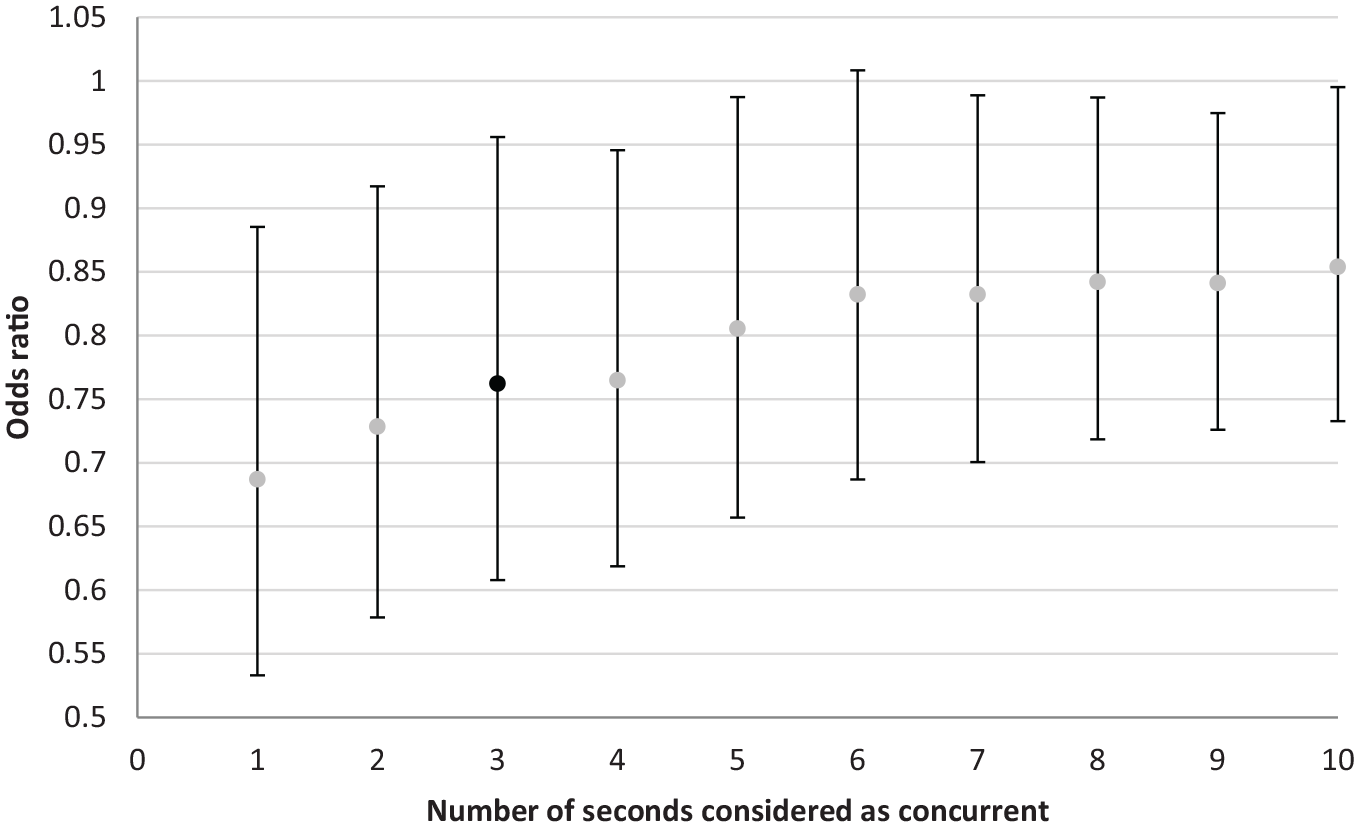
Effect size of number of concurrent interventions with a varying number of seconds qualifying as concurrent (N = 1282).
The change in statistical significance of concurrent interventions indicates that this variable is influenced by an omitted variable bias when the model is not adjusted for the variation of previous interventions. There can be many reasons for such a bias, but a potential substantial explanation for this change in statistical significance is that guardians who are in the middle of a string of intervention behaviours are less likely to be influenced by the concurrent intervention of other guardians.
Robustness of the model
In the construction of the dataset for the empirical investigation we were faced with choices among a set of viable empirical operationalizations of the hypotheses. In order to provide transparency of the process and check the robustness of the findings across these alternative operationalizations, the current section presents these alternative operationalizations.
The first hypothesis was operationalized as the relative number of aggressive behaviours by the antagonists. Another valid operationalization of this hypothesis would have been to include only the violent behaviours. This excludes aggressive gestures and invading space from the variable. This alternative operationalization does not change the significance of the measure and the odds ratio remains approximately the same (see Appendix 4 in the online Supplemental Material). This change does, however, influence the significance for the effect of interventions by other guardians. This variable becomes insignificant (p = .06) when the first variable measures violent rather than aggressive behaviours.
A second alternative operationalization would be to use a binary measure indicating which antagonist performs the most aggressive behaviours. Here again the measure remains a significant explanatory factor and the odds ratio increases (see Appendix 5 in the online Supplemental Material), which is to be expected since the measure is converted from continuous to binary.
A third alternative operationalization would be to use a binary measure indicating which antagonist performed the first aggressive behaviour, and thus started the conflict. This measure, however, does not have a significant influence on the target selection of guardians (see Appendix 6 in the online Supplemental Material). The aggressiveness of the potential targets thus proves to be robust in its influence on target selection across the first two alternative operationalizations but not in the third.
In the investigation of the second hypothesis, we operationalized concurrent intervention as an intervention that happens within the preceding three seconds. However, this number is a somewhat arbitrary decision. In order to investigate whether this choice is consequential, we ran the multivariate analysis with a varying definition of what qualifies as concurrent interventions (presented in Figure 1). This explorative analysis shows that the variable is consistently significant across all but the six second delay. It appears from visual inspection of Figure 1 that the effect size of the variable increases (moves closer to zero) when the time frame is reduced.
Discussion
The aim of this study was to investigate which factors influence the target selection of guardians performing the ultimate act of guardianship: intervention in a conflict. Whereas most research on guardianship has assumed the target selection of guardians to be self-evident, we investigated this assessment in the often ambiguous interpersonal conflicts in public spaces. We combined insights from the routine activity perspective, symbolic interactionism, and guardian script analysis to formulate four hypotheses about the influence of the behaviour and individual characteristics of the antagonists for the target selection of intervening guardians. The relevance of the hypothesized factors was empirically tested through a systematic coding and analysis of CCTV footage of a sample of interpersonal conflicts from the streets of Amsterdam.
The empirical investigation showed how the target selection of guardians intervening in interpersonal conflicts is influenced not only by the behaviour of the antagonists in the conflict but also by the behaviour of other guardians in the conflict, the social relationship between the guardian and the antagonists, and the gender of the antagonists. These results bring to the fore the complexity of the information guardians draw on when they intervene in an interpersonal conflict. To understand how guardians act in interpersonal conflict situations we thus have to take the dynamic nature of interpersonal conflicts into account.
Two types of behaviours were hypothesized to influence the target selection of guardians. The first is the behaviour of the antagonists. In the empirical model we find that an increase in the relative number of aggressive behaviours performed by an antagonist prior to the point of intervention increases the likelihood that a guardian will target this antagonist. The model thus confirms the first hypothesis stating that the number of aggressive behaviours by the antagonists influences the target selection of guardians (H1). This means that, if a guardian intervenes in a conflict where antagonist A has been hitting and kicking antagonist B multiple times while antagonist B has pushed antagonist A once, the guardian is more likely to target antagonist A, who has been the most aggressive at the time of the intervention.
The literature on guardianship was not unanimous about whether the number of aggressive behaviours would make intervening guardians more or less likely to target a specific antagonist. The empirical model shows that guardians typically target the antagonists who behave most aggressively and thus more readily fit into the role of perpetrator. This means, on the other hand, that the empirical results do not support literature suggesting that guardians target the least aggressive antagonist in order to protect their own safety.
However, the effect size of this factor is quite small. The number of aggressive behaviours by the antagonists thus seems to be an influential factor in the target selection of guardians only when one party is much more aggressive than the other. In interpersonal conflicts where the two antagonists perform almost the same number of aggressive behaviours, they have little influence on the target selection of the intervening guardians. It thus appears that guardians use the behaviours of the antagonists in their assessment of whom to target in asymmetrical conflicts only where one antagonist clearly is the main aggressor of the conflict. When the aggressive behaviours are more evenly distributed between the antagonists, and the conflict thus is more ambiguous, the behaviours of the antagonists are less influential in the assessment of the guardians.
The second behaviour we expect to influence the target selection of guardians is simultaneous intervention by other guardians. The empirical model shows that concurrent intervention by a guardian towards an antagonist reduces the likelihood that another guardian will target that same antagonist. This finding confirms the second hypothesis (H2) and the results from the previous literature that guardians influence each other, which brings about a sort of division of labour. For example, when a guardian intervenes in a conflict between antagonist A and antagonist B, he or she is more likely to target antagonist B with the intervention if another guardian is already holding back antagonist A.
Although it was apparent in the analysis of the first factor that guardians targeted the most aggressive antagonist in asymmetrical conflicts, the influence of the behaviour of other guardians shows how multiple guardians handle ambiguous conflicts. When there is no unambiguous perpetrator and victim the guardians might apply this coordination, which allows them to target multiple aggressors simultaneously and thus handle the surplus of perpetrators.
Besides the influence of the behaviours within the situation, the analysis also identified two individual characteristics of the potential targets that influence the target selection of guardians. Whereas the first two variables of the model thus show how the sequential developments of behaviour within the conflict shape the target selection of guardians, the last two factors are constant for each individual throughout the situation.
The first individual characteristic of the potential targets in the empirical model is the social relationships between the guardians and the antagonists of the conflict. The model shows that guardians are more likely to target individuals with whom they have a social relationship compared with individuals with whom they do not share a social tie. This means that, if a guardian who is a friend of antagonist A but a stranger to antagonist B intervenes in a conflict between antagonist A and antagonist B, this guardian is more likely to target antagonist A with their intervention. This finding confirms the third hypothesis (H3), which states that guardians act as handlers and take responsibility for the behaviour of antagonists with whom they have a social relationship and try to contain their offences.
Previous studies have found that social relationships between guardians and antagonists increase the chance of intervention in a conflict (Fischer et al., 2011; Levine et al., 2011; Phillips and Cooney, 2005). However, the increased likelihood of intervention shown in previous research could also be an expression of guardians intervening to protect the antagonists with whom they share a social relationship. The current study shows for the first time that guardians are more likely to target antagonists with whom they have a social relationship and to try to stop them from performing further aggressive behaviours. Although, as argued by Reicher (1996), there has historically been a tendency in the scientific literature to view groups as a source of violence and conflict escalation, this finding substantiates an understanding of social groups as self-regulating.
The second individual characteristic of the potential targets in the empirical model is the gender of the antagonists. We found that when a man and a woman are engaged in conflict it is more likely that a guardian will target the man over the woman. If a guardian intervenes in a conflict between a male antagonist and a female antagonist, the guardian is more likely to target the male antagonist. This empirical finding substantiates the fourth hypothesis (H4) and supports the chivalry norm described by the existing literature.
One interpretation of the pattern is that guardians operate out of a sort of benevolent sexism that is inherent in the chivalry norm. Following this interpretation, the norm enforces traditional gender roles, with men protecting fragile women (Felson and Feld, 2009). A contesting interpretation is that the influence of gender found in the empirical model is actually a consequence of the way the model was constructed. In the current investigation we counted the number of behaviours performed by antagonists and used this as a measure of the amount of aggression performed by the antagonists. Counting the number of behaviours is attractive in its simplicity, it but creates an equivalence that might be unreasonable. Guardians might react differently to punches by men and women because of differences in the average physical size and strength of men and women (Felson and Feld, 2009). This difference could lead to a bias that could create a pattern similar to what we see in the model. Although there thus appears to be a gender bias in the target selection of guardians, the effect of gender in the model might in fact be a question of physical strength and therefore potential danger. However, a recent study finds that, even when controlling for physical size, the gender of the antagonists still influences the side-taking of guardians (Rogers et al., 2019).
The finding that these four factors all influence the target selection of guardians shows the complexity of the assessments that precede the intervention in an interpersonal conflict in public spaces. This adds a new dimension to the script of guardian intervention (Leclerc and Reynald, 2015). Although the script details how detecting and monitoring of the situation is a necessity for intervention, the current study shows some of the work that guardians do to make sense of conflict situations. The application of the juridical terms of ‘perpetrator’ and ‘victim’ does not easily fit many of these situations and this leaves the guardians with a complex analytical task. This sense-making draws on a wide range of information within the conflicts in order to decide the most appropriate target of intervention.
The analytical challenge faced by’ guardians when intervening in interpersonal conflicts also points towards a limitation of the grand theories of crime. Whereas routine activity theory has advanced the study of crime by offering a universal framework, it also limits our gaze to focus only on what is shared across different types of crime. The current study shows how the challenges guardians face in interpersonal conflicts might be different from the universal conditions offered in the script for guardianship. Although a uniting framework offers possibilities, the current study is an example of how different types of offences entail different social processes, which call for specialized offence-specific analytical frameworks.
A limitation of the current study is the sole reliance on visual information from the CCTV footage. This seems especially pertinent for the measurement of social relationships between individuals. Although the variable had a very high interrater reliability, this measure must still be interpreted with some caution until future studies have investigated the tie signs revealing social relationships in conflict situations. Furthermore, some conflicts may, unbeknownst to us, have started or continued afterwards outside the view of the camera. In these cases, the recorded interactions do not cover the complete chain of interactions between the parties involved because any interactions outside the view of the camera necessarily remain unobserved by us.
Another drawback of basing the analysis on the visual material is that we are limited to the realized intervention behaviours. The script of guardian intervention details six necessary preconditions for intervention (Leclerc and Reynald, 2015). Because we observe the target selection of the guardians who actually intervene, we are limited to the target selection of the guardians who meet all the preconditions detailed in the script. This is a limitation of the current study, since some guardians might, for example, not be capable of intervening, and thus not meet the second precondition in the script. Other potential guardians might not take responsibility for the situation and thus not pass the fifth step in the script. However, this does not mean that these potential guardians do not make an assessment of the situation. The current investigation is thus limited to the guardians who actually intervene. To address this limitation of the current study, future studies, drawing on different data sources, might ask passive bystanders about their assessment of the situation.
Supplemental Material
Appendix_1 – Supplemental material for A CCTV-based analysis of target selection by guardians intervening in interpersonal conflicts
Supplemental material, Appendix_1 for A CCTV-based analysis of target selection by guardians intervening in interpersonal conflicts by Peter Ejbye-Ernst, Marie Rosenkrantz Lindegaard and Wim Bernasco in European Journal of Criminology
Footnotes
Acknowledgements
We would like to thank Tanja Höing and Maikel van Scheppingen of Team Technisch Toezicht of the Amsterdam Police, the municipality of Amsterdam, and Evelien Hoeben for her assistance in the collection of the CCTV footage.
Funding
The author(s) disclosed receipt of the following financial support for the research, authorship, and/or publication of this article: This work was supported by The Netherlands Organisation for Scientific Research (NWO) [015.012.043/1213].

Supplemental material
Supplemental material for this article is available online.
Notes
References
Supplementary Material
Please find the following supplemental material available below.
For Open Access articles published under a Creative Commons License, all supplemental material carries the same license as the article it is associated with.
For non-Open Access articles published, all supplemental material carries a non-exclusive license, and permission requests for re-use of supplemental material or any part of supplemental material shall be sent directly to the copyright owner as specified in the copyright notice associated with the article.
