




Abstract
The aim of this study is to clarify whether personal values explain delinquents’ and non-delinquents’ general attitudes towards legal norms. We expect that 10 basic personal values form a circular scale common to all individuals, both delinquents and non-delinquents, that people’s ratings of the importance of these 10 values predict their norm acceptance in a sinusoidal way, with higher predictability for delinquents, and that the correlations of personal values with norm acceptance are highest for those delinquents with a broad spectrum of offences. Finally, we expect that gender does not have an impact on these profiles, whereas controlling for age does. Our analyses are based on four studies on community crime prevention. The results are in line with the above expectations.
Introduction
Criminological research has made considerable progress in investigating the relationship between personal values, norm acceptance and delinquency (for example, Boers and Pöge, 2003; Goossen et al., 2016; Halpern, 2001; Hermann, 2003; Konty, 2005; Pöge, 2017; Reinecke, 2007; Seddig, 2014). The theory on universals in values (TUV) of Schwartz (1992), however, played only a minor role in this context (see Goossen et al., 2016, for an exception). Bilsky and Hermann (2016) recently reinterpreted Hermann’s research on ‘values and delinquency’ (2003) against the background of the TUV. They showed that the correlational profiles of the 10 basic values distinguished by the TUV with both norm acceptance and self-reported delinquency exhibit a sinusoidal shape, where values of the ‘conservation’ and ‘openness’ type (Schwartz, 1992) and norm acceptance proved to be effective predictors of self-reported delinquency. Building on these findings and four studies on community crime prevention, we clarify in this study whether and to what extent personal values are suitable for explaining differences in general attitudes towards legal norms. In this context, people who differ with respect to past delinquency are of particular interest.
Personal values
The TUV is a well-established value theory today (for example, Bilsky et al., 2011; Janik and Bilsky, 2015; Schwartz, 2003). It defines values as ‘desirable, transsituational goals, varying in importance, that serve as guiding principles in people’s lives’ (Schwartz, 2003: 267). The structure of different values is derived from assuming that the individual perceives actions taken in the pursuit of any one value as more or less compatible or conflicting with successfully striving for other values. Theoretically and empirically, this leads to a circle of values, where values similar with respect to their motivational content are located side by side on this circle and incompatibles opposite to each other. The order of the basic values on the TUV value circle has been found to be universalism – benevolence – tradition – conformity – security – power – achievement – hedonism – stimulation – self-direction – universalism (Schwartz, 1992, 2003; see Figure 1). The TUV model also distinguishes between four higher-order values, grouping certain neighbouring basic values into opposite segments of the value circle: self-transcendence (with the basic values of universalism and benevolence) vs. self-enhancement (power, achievement), and openness to change (hedonism, stimulation, self-direction) vs. conservation (tradition, conformity, security).
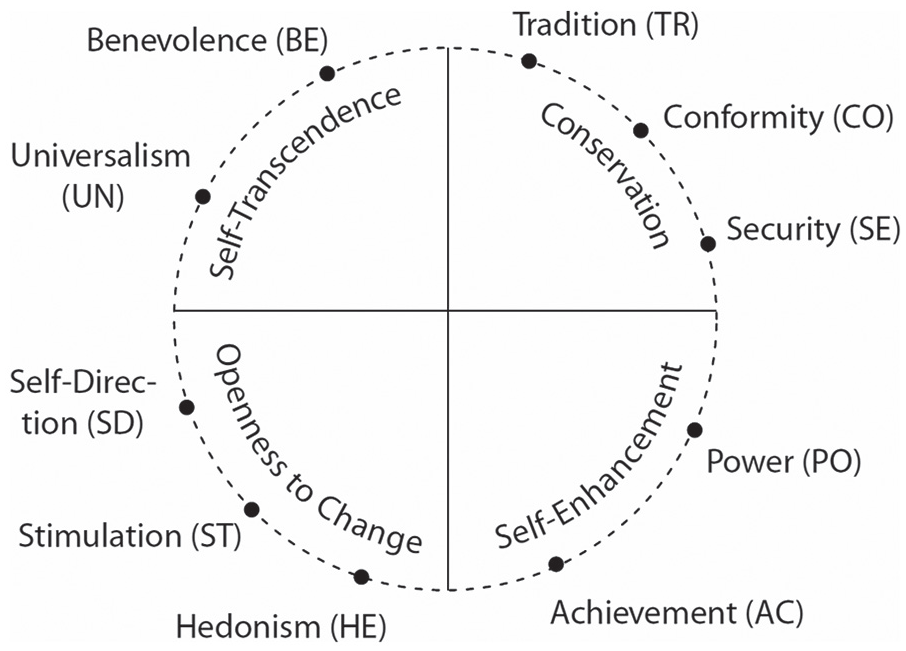
Idealized schematic Schwartz value circle.
The value circle implies a sinusoidal relationship between an individual’s importance ratings of personal values and external variables such as delinquency or norm acceptance. If value X is the value that has the highest positive relationship with some external variable Z, then moving away from X in one direction along the value circle leads to values that are increasingly less positively related, unrelated, and then more and more negatively related with Z, reaching its maximum negative relationship at the value opposite X. When moving on, negative relations should diminish, drop to zero, and finally change to positive again.
The Individual Reflexive Values Scale (IRVS; Hermann, 2003, 2014) has been repeatedly used for assessing personal values in criminological research since the 1990s. It is closely linked to Klages’ (1977, 1992) studies on the dimensions of societal value change, but it has been found that its items fit even better into the value circle predicted by the TUV (Borg et al., 2019). Bilsky and Hermann (2016) found that, when correlating the individuals’ importance rating scores for the basic values with the persons’ self-reported delinquency, conservation values were substantially negatively correlated with delinquency, and openness to change values (that is, the opposite values on the value circle) correlated positively with delinquency. Self-transcendence and self-enhancement, in contrast, did not predict delinquency. Similar but inversely signed correlations were found for the various values and individuals’ general tendency to accept norms defined by penal law (see, for example, Dietrich, 2017). The largest negative correlations were found for stimulation/hedonism, the largest positive correlations for tradition/conformity, and virtually zero correlations for achievement and universalism (Bilsky and Hermann, 2016; Borg, Hermann and Bilsky, 2017). These results lead to questions that deserve more attention.
Norms and norm acceptance
In this article, our main focus is on the relationship between personal values and the person’s acceptance of legal norms, called norm acceptance in the following. Definitions of norms concur in that ‘norms are expectations stating that something should or must be the case’ (Opp, 1982: 139). Axelrod (1986) notes that the ‘three most common types of definitions [of norms] are based upon expectations, values, and behavior’ (1986: 1096). He adds that expectation- or value-based definitions prevail when studying ‘norms as they exist in a given social setting’ (1986: 1097). Since the setting of our present study refers to the interrelationship of values and norms in the context of law, a definition suggested by Savelsberg (1993, 2002) seems most instructive; it also characterizes the current sociological conceptualization of norms. Savelsberg (2002: 277) understands norms as ‘counterfactual social expectations (Luhmann, 1972), generated in the informal realm (social norms) and by the state (law norms), that are backed by sanctions (Coleman, 1990, pp. 282–289)’. This means with respect to law norms that they are maintained by the state even when violated.
Looking more closely, norms specify both appropriate and inappropriate behaviour. In other words, they are prescriptive as well as proscriptive, thus guiding and/or constraining behaviour. However, a particular norm runs the risk of losing its compulsory function if norm violations increase in number, and threatened or imposed sanctions do not effectively stop this development. In this case, the norm loses its legitimacy in the eye of the beholder (Lamnek et al., 2000).
Whether a person complies with normative expectations often depends on contextual factors. In addition, people vary inter-individually – and often quite consistently – with respect to their readiness to accept or obey (external) norms that relate to broad classes of situations. However, these differences cannot easily be reduced to differences in personality. Rather, they are likely to result from an interaction of multiple factors. This is evident from research on compliance, conformity, dogmatism, trust, political attitudes and related topics (for example, Cialdini and Trost, 1998; McClelland, 1987; Secord and Backman, 1964; Sullivan and Transue, 1999).
In criminology, norm acceptance has been a central variable when dealing with the origin and solution of legal conflicts. It is closely linked to sanctions-based behavioural expectations (for example, Dietrich, 2017; Lamnek et al., 2000; Seddig, 2014, 2016) and denotes the degree to which norm violations are negatively connotated and perceived as bad (Hermann, 2003). In that sense, norm acceptance can be understood as a person’s overall attitude towards legal norms. That is, people relate to the notion of legal norms on three dimensions – cognitive, affective and actional – by assessing them globally in terms of very right to very wrong, by relating to them with extremely negative to extremely positive emotions, and by acting more or less against them or in accordance with them.
In studies on the values–delinquency relationship, norm acceptance has been operationalized by averaging the evaluation of norm violations across different behaviours and situations. Measured this way, norm acceptance proved to be an important mediator between personal values and self-reported delinquency (Bilsky and Hermann, 2016; Hermann, 2003, 2004).
The present study
In the following, we first check whether the value circle reported by Bilsky and Hermann (2016) can also be found in other studies on community crime prevention that use the IRVS. Next, we ask whether the sinusoidal profile of correlations between values and norm acceptance can be identified across these samples too, even when using a different value measure. Validating both the value circle and the sinusoidal relationship are preconditions for answering our central question regarding the relation of values, norm acceptance and delinquency.
Then we ask: Do the value circle and the sinusoidal profile of correlations between values and norm acceptance also hold in the same way for sub-samples that differ with respect to their delinquent past? This is to date an unanswered question. We therefore first compare non-delinquents and delinquents and then, in more detail, sub-samples of delinquents that differ with respect to the spectrum of delinquent acts committed.
Our final issue is whether and to what extent the relationship between personal values and norm acceptance depends on external variables such as gender or age. Answers to this question serve to better understand the complex interrelationship of values, norm acceptance and delinquency. The rationale for our approach is outlined next in more detail.
The value circle
Cross-cultural research has shown that the value circle seems to be a universal lawfulness (for example, Schwartz, 1992; Bilsky et al., 2011). The reason for this stability may be that values are ‘cognitive representations of three universal requirements: (a) biological needs, (b) interactional requirements for interpersonal coordination, and (c) societal demands for group welfare and survival’ (Schwartz and Bilsky, 1987: 550). The relative weight of these requirements may be different for different groups, but the principal conflicts should be the same for all populations. This does not guarantee, however, that the value circle arises in every sample. Thus, regarding our present research, it has to be shown that it also holds for samples of both delinquent and non-delinquent persons. If structural differences exist between these sub-samples, this could lead to improperly generalizing the values–delinquency relationship reported in Bilsky and Hermann (2016).
Yet, for such special samples too, it seems difficult to see how any of the three basic requirements would disappear and why their principal conflicts would not be at least similar across these sub-samples. On the other hand, although these basic requirements allow the prediction of the basic conflicts of the higher-order values, they are not sufficient to also predict a particular order of the basic values along the circle. What the TUV predicts here is the ‘typical’ finding in virtually hundreds of studies but, for example, a certain amount of swapping basic values within a higher-order value group is not uncommon (for example, Bilsky et al., 2011). Backed by these findings, we expect that the TUV value circle with its higher-order value oppositions is a common structure of criminologically diverse sub-samples, in particular delinquents and non-delinquents.
Delinquency, a possible moderator of the relationship between values and norm acceptance?
Given that the TUV value circle is confirmed for delinquent and non-delinquent sub-samples, we presume sinusoidal relationships between individual’s norm acceptance and the importance they assign to the various basic values as ordered on the value circle. Given this, conservation values (tradition, conformity, security) should show the largest positive correlations with norm acceptance and openness values (hedonism, stimulation, self-direction) should show the largest negative correlations with norm acceptance. Self-enhancement and self-transcendence values, in contrast, should remain unrelated with norm acceptance, as in Bilsky and Hermann (2016).
Beyond that, and central in the present context, we assume that delinquency moderates the relationship between norm acceptance and an individual’s importance ratings of basic values. The rationale for this supposition is that we expect non-delinquents to show a ceiling effect with respect to norm acceptance, or, in terms of assessment, to be sitting at the upper end of the norm acceptance scale because they are more likely to consider even petty offences as ‘bad’ behaviour. Delinquents, in contrast, are expected to scatter much more than non-delinquents with respect to norm acceptance. Hence, expressed statistically, personal values have much less variance to explain in the case of non-delinquents compared with delinquents; that is, their distribution of value ratings is much more skewed. Therefore, the correlations of the basic personal values with norm acceptance (called ‘correlational profiles’ in the following) should be higher for delinquents as compared with non-delinquents.
Analysing the relationship of personal values, norm acceptance and delinquency in more detail presupposes a further specification of past delinquency. In this context, it would seem appropriate to consider specific offences such as drug abuse, theft or assault. However, even with big representative surveys it is unlikely to identify sufficiently large sub-samples that have committed only one type of offence over time. Rather, specific offences occur often together with other offences (for example, drug consumption with theft). Furthermore, it will not be easy to identify individuals who have committed serious offences but no petty offences.
Landsheer et al. (1994), for instance, distinguished non-delinquents from low- and high-delinquency groups. We do the same by focusing on the breadth of delinquent acts committed. In order to characterize the breadth or spectrum of past delinquency, we distinguish mutually exclusive groups differing with regard to the types of offences committed. These groups encompass: no offences, only petty offences, petty and property offences, and the latter together with offences against integrity (physical injury/assault). Expanding on the above statistical rationale that personal values have less variance to explain in the case of non-delinquents compared with delinquents, we would expect that the size of correlations of values and norm acceptance differs as a function of the spectrum of offences committed. To put it differently, the correlational profile of personal values with norm acceptance shows the highest correlations for delinquents with a broad spectrum of offences and the smallest correlations for non-delinquents, with other profiles in between.
In our attempt to examine whether delinquency moderates the relationship between values and norm acceptance, we are breaking new ground. This concerns not only the selection and definition of the variables involved but also the validation of our findings. Although a statistical validation of our results would be desirable, choosing a proper statistical test for comparing correlational profiles is non-trivial when dealing with very skewed distributions. Simulation studies could possibly help to answer the ‘significance’ question, but this would require further studies and assumptions. Replicating our findings in further studies seems more promising but is beyond the scope of this article. Therefore, we present our results in a descriptive way and do not embark on dubious inferential statistics.
External variables: Gender and age
Finally, we ask to what extent the relationships between personal values and norm acceptance depend on external variables such as gender or age. In other words, if one controls for such variables, will values still be good predictors of norm acceptance?
With respect to gender, Schwartz and Rubel (2005) found that the strongest value difference between men and women in over 100 samples from around the world is that men tend to value power more than women do, and women tend to value benevolence more than men. The difference is small, though, but what is more important is that power and benevolence are only poor predictors of norm acceptance (Bilsky and Hermann, 2016). Therefore, gender is not expected to systematically lower the correlations of values and norm acceptance; that is, the amplitudes of the correlational profiles of men and women should not differ.
Age, on the other hand, has been shown to correlate with values that inhibit and motivate norm acceptance. For example, Borg, Hertel and Hermann (2017) report for the more than 50,000 respondents of the European Social Survey that age correlates with the importance rating for the value tradition with .33 and with individuals’ ratings of stimulation with −.33. More generally, older people strive more for conservation values (tradition, conformity, security), and younger ones for the opposite, that is, for openness to change (hedonism, stimulation, self-direction). Yet these are just the values that were most correlated with norm acceptance in Bilsky and Hermann (2016). On the other hand, people in different age groups still differ between each other in their ratings of stimulation and tradition. Therefore, controlling for age should not completely eliminate the correlations between personal values and norm acceptance. In other words, controlling for age is expected to reduce the correlations between personal values and norm acceptance; that is, the amplitude of the sinusoidal profile of correlations after control should be lower than before.
Method
Data and samples
We analyse data from four studies focusing on community crime prevention. All of them were conducted in the German federal state of Baden-Württemberg. Study 1 is central for testing our assumptions concerning sub-samples that differ with respect to their self-reported delinquent past. It was jointly run in the cities Freiburg and Heidelberg in 1998 (N = 2930, 56 percent female; age in years, mean = 39) and it covers personal values, norm acceptance and self-reported delinquency. Studies 2–4 cover personal values and norm acceptance. These studies serve to cross-validate our earlier findings concerning the circular value structure and the correlational profile of values and norm acceptance in representative samples. Study 2 was undertaken in Heidelberg in 2009 (N = 1581, 58.5 percent female; age in years, mean = 41). Studies 3 and 4 were run in Mannheim in 2012 (N = 1908; 54.5 percent female; age in years, mean = 43) and in 2016 (N = 3272; 54.7 percent female; eight age groups: 14–19, 20–29 . . . 70–79, 80 or more years, mean estimate = 45 years). Survey questions were in all cases administered in written form.
Instruments and measures
Items for measuring norm acceptance asked the respondents to assess various forms of delinquent behaviour in terms of badness (Hermann 2003, 2004): ‘How bad is . . .?’ together with a seven-point answer scale ranging from ‘not bad at all’ to ‘very bad’. The issues were appropriation of services, theft, drunken driving, bag-snatching, drug consumption, physical injury (assault), damage to property, tax evasion, social fraud, corruption, and hit and run driving. Norm acceptance was then operationalized as the mean score of a person’s ratings of ‘badness’ across these delinquent acts (Bilsky and Hermann, 2016; Hermann, 2003, 2004). 1
Personal values were assessed by using 25 of the IRVS items in studies 1–4. These items served as indicators of Schwartz’s 10 basic values and the respective higher-order values. Analyses based on data from studies 1–3 prompted us to exclude two items that had been used before by Bilsky and Hermann (2016): item 13 (‘doing what others do as well’) seemed ambiguous, relating statistically to both tradition/conservation and to achievement/power; item 22 (‘being independent of other people’) exhibited a very wide confidence region in a multidimensional scaling (MDS) analysis of the item inter-correlations, suggesting that the respondents did not have a common understanding of what this item refers to (see Table 1A in the online Appendix). As regards Study 4, the IRVS differs slightly from the versions used in studies 1–3. Thus, the item ‘adjusting my life according to Christian norms and values’ was replaced by ‘adjusting my life according to religious norms and values’. Another feature of Study 4 is that Schwartz’s popular Portrait Values Questionnaire (PVQ) was used as an additional value measure, which differs considerably from the IRVS. Thus, the PVQ does not ask the respondent to directly assess the importance of value items (for example, ‘How important is it for you to be industrious and ambitious?’); rather, it presents 21 portraits of individuals (for example, ‘It is important to him to be rich. He wants to have a lot of money and expensive things’). After each such portrait, it asks the respondent ‘How much like you is this person?’, offering a six-point response scale ranging from ‘not like me at all’ to ‘very much like me’. The respondents’ own values are inferred from their self-reported similarity to people described implicitly in terms of particular values. Because of these differences, there may be some instrument-specific effects. Comparing the results from the IRVS and the PVQ allows us to control for such effects. Centred scores were used in all structural analyses of personal values. Centring means that each person’s value ratings are subtracted from the person’s mean rating score. This transformation is supposed to control for a person’s response style, generating relative ratings of value importance, person by person. Relative priorities, in any case, are a central feature in most studies (and even in some definitions) of human values (Bilsky et al., 2015; Rokeach, 1973; Schwartz, 1992). 2
Data on self-reported delinquency were surveyed in Study 1. Respondents rated their own past behaviour with respect to 13 offences: ‘How often have you done . . . since the age of 14?’ and ‘How often . . . last year?’ The issues were drunken driving, fare evasion, minor theft, smoking pot, etc. (petty offences); damage to property, burglary, accepting bribes, tax evasion, etc. (property offences); and beating someone up, tearing someone’s handbag off (serious offences). Based on the respective answers, dichotomous delinquency scores were computed (0 = never done, 1 = done) for each of the offences.
Statistical methods
The tool that is most often used for studying the structure of value items is multidimensional scaling (Borg and Groenen, 2005; Borg et al., 2018). Indeed, the TUV value circle model is expressed in terms of an MDS geometry, that is, as a circular scale whose points represent the 10 basic values in a particular order (see Figure 1). In a first step, we used exploratory MDS to let the data speak for themselves, not enforcing, in particular, a perfect value circle and/or the higher-order oppositions onto the solution via confirmatory MDS. Our MDS analyses include benchmarking the fit values (that is, the stress indexes) against random-data norms in the sense of Spence and Ogilvie (1973). We also run permutation tests to hedge against chance, use bootstrapping to generate confidence regions of the points in MDS space, and compute stress-per-point measures for detecting possible ill-fitting items (see Mair et al., 2016). All MDS analyses are done using the
Results
The value circle
Indexes of the relative importance of the 10 basic values were first constructed for studies 1–4 on the basis of the IRVS and the PVQ items, respectively. This led to five sets of value importance indexes. The inter-correlations of the value indexes of each data set were then subjected to two-dimensional (ordinal) MDS (see Figure 1A in the online Appendix). The fit of the MDS solutions was excellent in each case. The stress coefficients were .040, .037, .038, .048 and .028 for the IRVS and the PVQ, respectively. This is far below the Spence–Ogilvie benchmarks for random simulation data: the expected stress for random data is .190, with a standard deviation of .022. Permutation tests also indicate that the model fit is highly significant in each case (p = .00 for each study). Moreover, the confidence regions of the value points are all very small, so that the MDS configurations can be considered stable; that is, the positions of their points are estimated with precision and the points should not be moved. No particular points showed signs of poor fit or outlier behaviour.
All five MDS solutions show circular configurations, with the 10 basic values ordered on this circle almost perfectly as predicted by TUV (Figure 1A). Moreover, the 10 basic values allow the value circles to be split into four segments so that opposite circle segments represent opposite higher-order values. Again, as for the value items, this split occurs in all studies without imposing external regional constraints onto the MDS solutions.
The MDS configurations exhibit only one deviation from the TUV model as described in Figure 1: the location of security should be adjacent to the higher-order value self-enhancement (that is, power, achievement) and not to self-transcendence (that is, benevolence, universalism). Here, however, we find that security is almost opposite to self-enhancement, although still staying in the predicted segment.
For validating our expectation that the TUV value circle exists across delinquents and non-delinquents, we used the data of Study 1, because this is the only study that contains items on self-reported delinquency. First, we split the sample into ‘delinquents’, that is, respondents who admitted to at least one offence since the age of 14 (N = 2132), and ‘non-delinquents’, who reported none (N = 638). We then identified three non-overlapping sub-samples of respondents who had committed petty offences (N = 947), petty and property offences (N = 818), and petty and property offences as well as assault (N = 244). Finally, we split the sample by gender (males/females: N = 1262 / 1623), and by age (age < 31y / 31y–50y / age > 50y: N = 1027 / 1087 / 703).
MDS analyses were run separately for each of these sub-samples. Figure 2 shows the results for scaling non-delinquents and delinquents separately. Both solutions have excellent fit values (Stress is .044 and .034, respectively; far below Spence-Ogilvie norms; p = 0.00 in permutation tests; no signs of outliers in Stress-per-point tests; small confidence regions of all points in bootstrapping), and both solutions are highly similar. Each solution exhibits the value circle, grouping the values along the circle in the sense of the higher-order values distinguished by TUV. Hence, our expectation is confirmed that value structures of sub-samples differing with respect to delinquency/non-delinquency show the same TUV-predicted value structure.
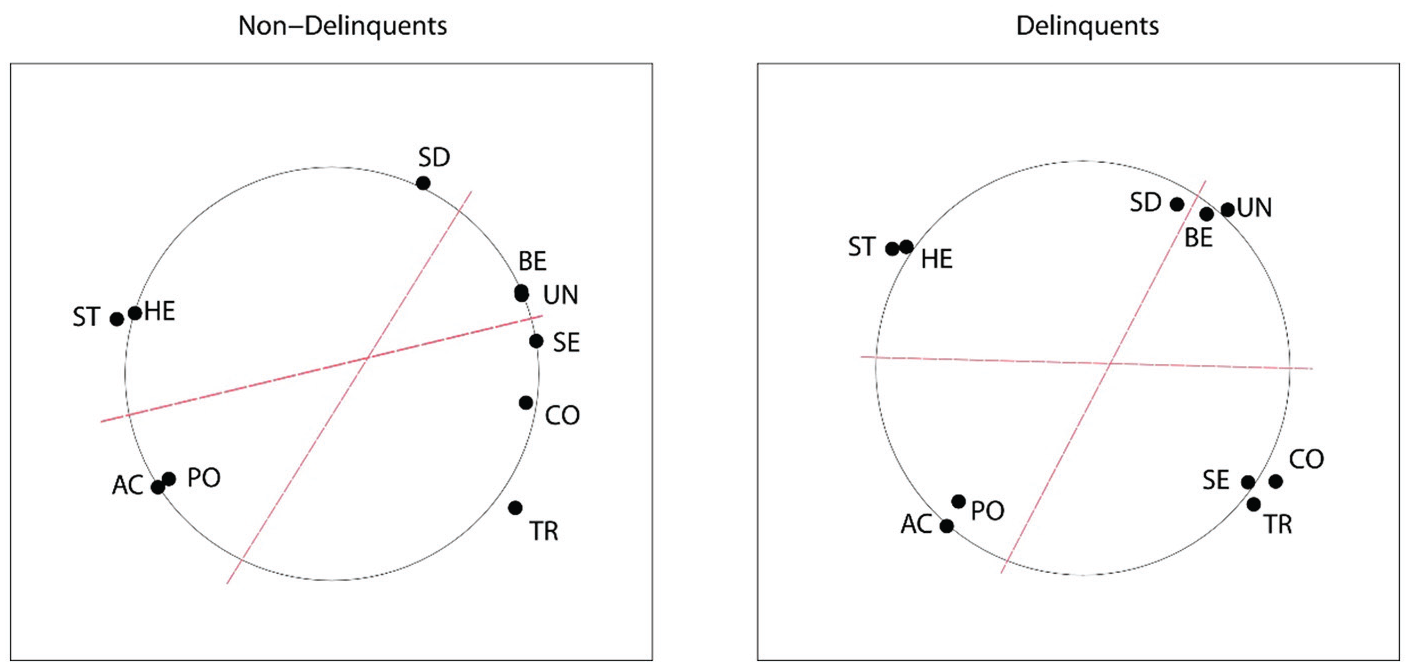
MDS configurations of the personal values of non-delinquents and delinquents, respectively, in Study 1.
Similar results are obtained for the other sub-samples, that is, for the male and the female as well as the three age group sub-samples (no figure).
Values and norm acceptance
The correlational profile of personal values vs. norm acceptance (with the values ordered on the x-axis as predicted by TUV and norm acceptance on the y-axis) was expected to show a sinusoidal shape in different representative samples, collected in different years, and using different instruments. Moreover, the sine-waves should peak at the conservation values and have their minima at the openness to change values.
Table 1 (rows 1–5) shows for studies 1–4 that openness to change values (hedonism, stimulation and also self-direction) are all negatively correlated with norm acceptance, and the values in the conservation group (tradition, conformity and security) are positively correlated, thus replicating prior findings (Bilsky and Hermann, 2016). This is true for both versions of the IRVS and the radically different PVQ assessment instrument. Self-enhancement (power, achievement) is also (mildly) negatively correlated with norm acceptance.
Profiles of correlations of (centred) indexes for personal values (using different versions of the IRVS and the PVQ21, respectively) with norm acceptance in different samples and sub-samples.
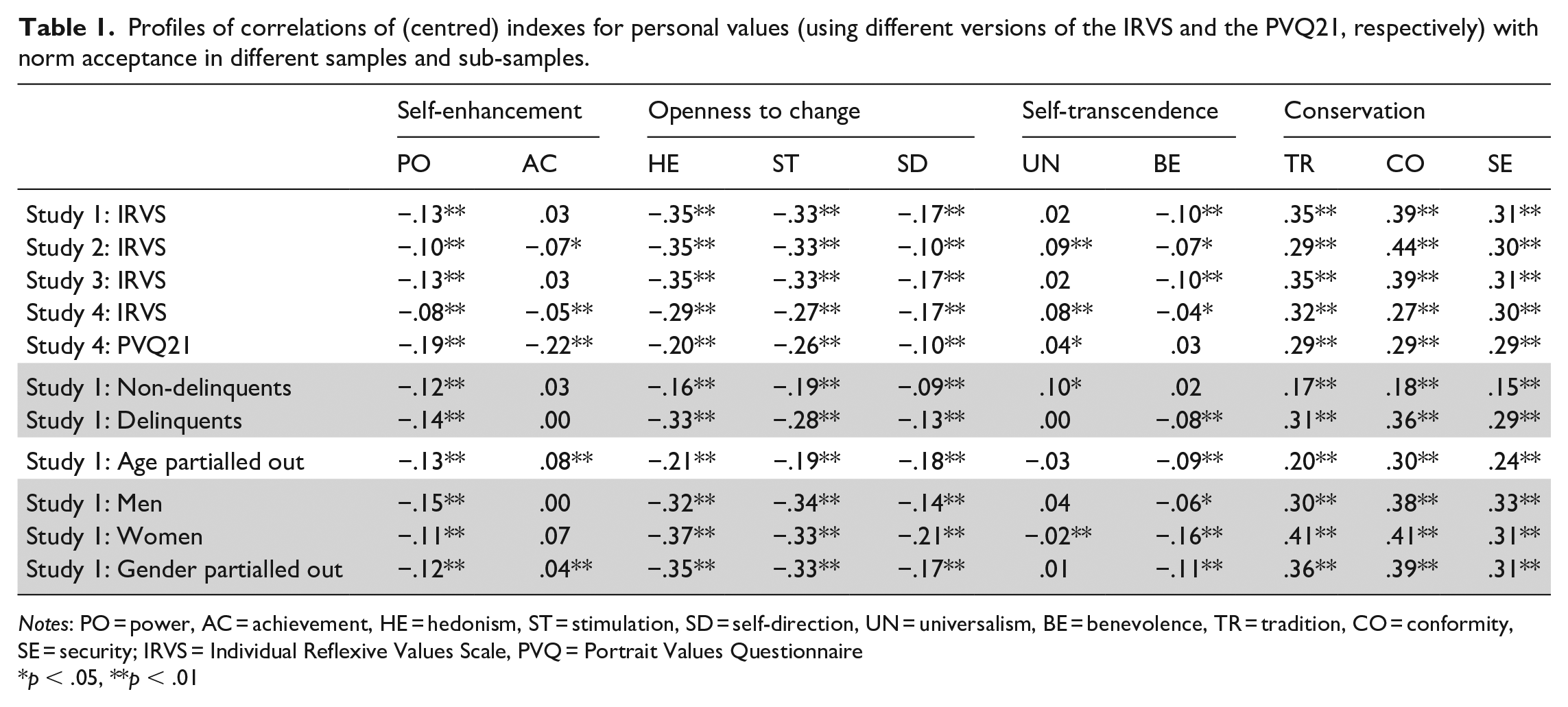
Notes: PO = power, AC = achievement, HE = hedonism, ST = stimulation, SD = self-direction, UN = universalism, BE = benevolence, TR = tradition, CO = conformity, SE = security; IRVS = Individual Reflexive Values Scale, PVQ = Portrait Values Questionnaire
p < .05, **p < .01
In order to test whether this profile also holds for individuals differing in self-reported delinquency, showing more pronounced profiles for delinquents as compared with non-delinquents, we use the respective sub-samples of delinquents and non-delinquents in Study 1. Bivariate correlations between the basic values and general norm acceptance showed the expected sinusoidal profile (Table 1, rows 6 and 7). Figure 3 shows that, in both sub-samples, norm acceptance correlated most positively with tradition, conformity and security values (conservation), and most negatively with hedonism and stimulation (openness to change). It also shows that the amplitude of the delinquent sub-sample is greater than that of the non-delinquent sub-sample. This holds for all values, as expected.
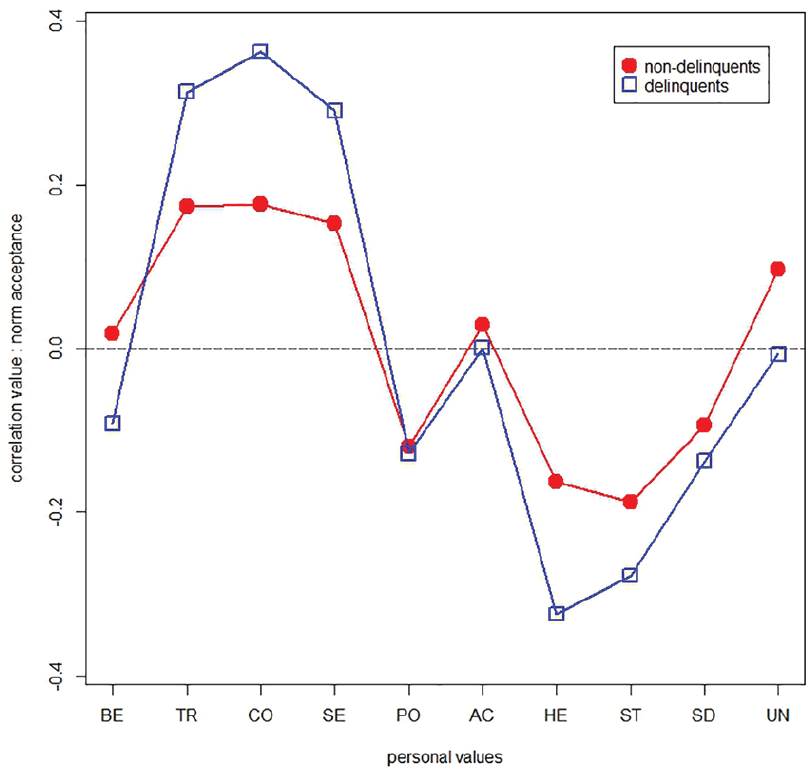
Profiles of the correlations of (centred) personal values with norm acceptance for non-delinquents and delinquents, respectively (Study 1).
The reason for this difference can be seen in Figure 4. It demonstrates for the example of the basic value tradition that the norm acceptance scores of the non-delinquent sub-group (left panel) are not only higher, on average, than those of the delinquents, but they exhibit a ceiling effect, with most people at the upper end of the norm acceptance scale. Hence, since there is little scatter, there is also relatively little to predict. Delinquents, in contrast, are more scattered along the linear regression trend.
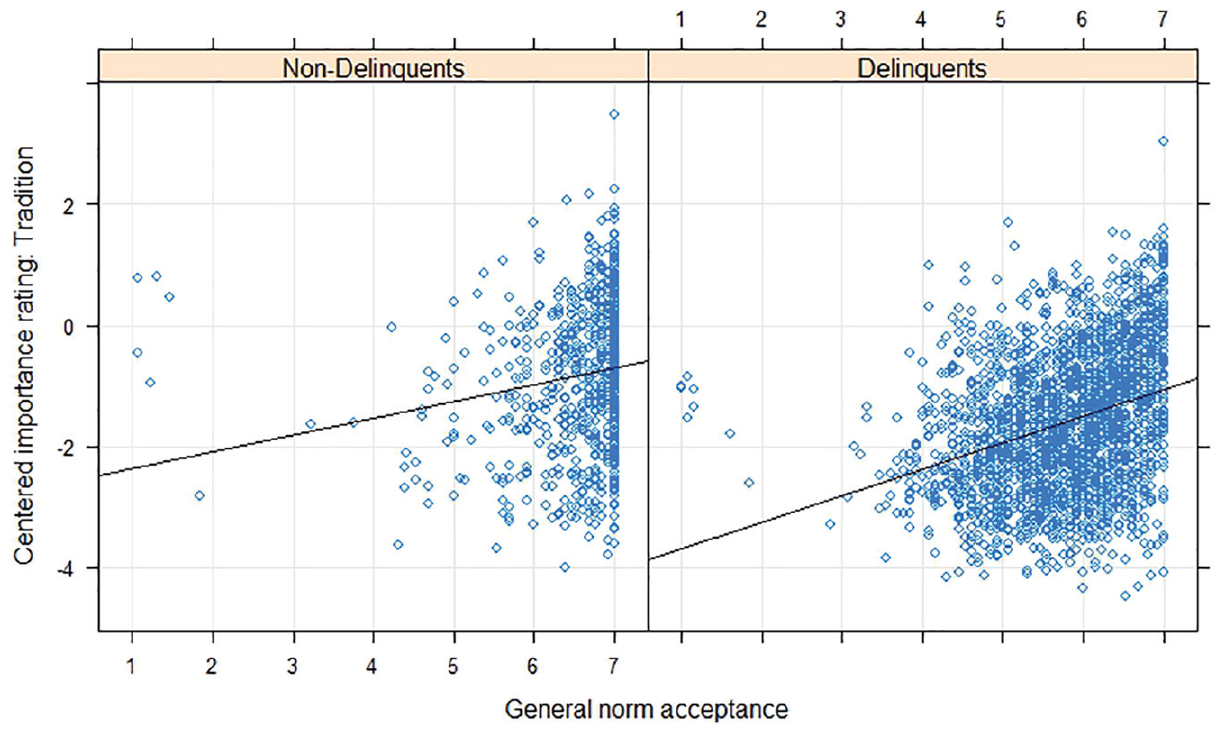
Relative importance of the personal value ‘tradition’ versus general norm acceptance for non-delinquents and delinquents (Study 1); with linear regression trend line.
Table 2 comprises the norm acceptance statistics for non-delinquents and for sub-samples of delinquents distinguished according to the spectrum of offences committed. Although we find a ceiling effect for non-delinquents again, the means of all other sub-samples indicate highly skewed distributions of norm acceptance scores too. Overall, we find a monotonous decrease in general norm acceptance from non-delinquents to strong delinquents.
Norm acceptance statistics (mean, variance) of non-delinquents and delinquents, respectively, for three classes of offences (‘badness’ scale with ‘1 = not bad at all’ and ‘7 = very bad’).
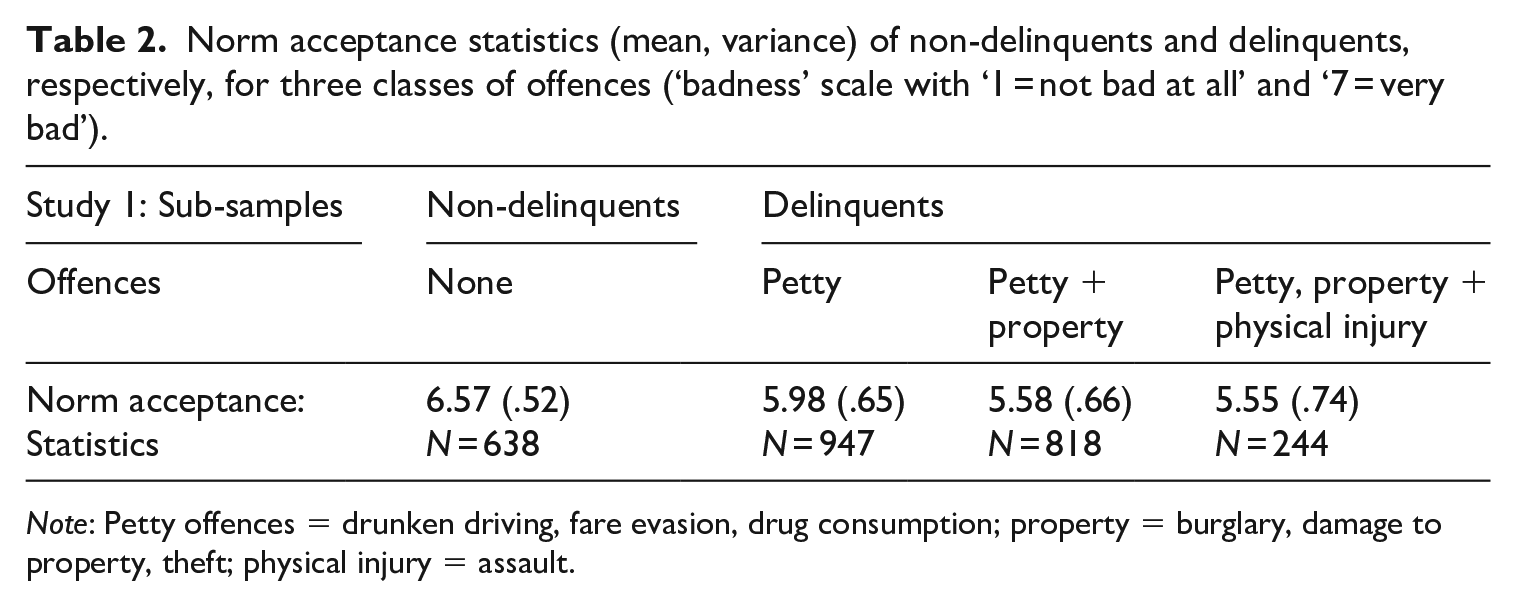
Note: Petty offences = drunken driving, fare evasion, drug consumption; property = burglary, damage to property, theft; physical injury = assault.
Finally, we find that sub-samples of delinquents with a broad spectrum of offences show the highest correlations between personal values and norm acceptance, whereas non-delinquents have the smallest correlations, and other delinquents are in between (Figure 5). This result is also in line with our assumptions.
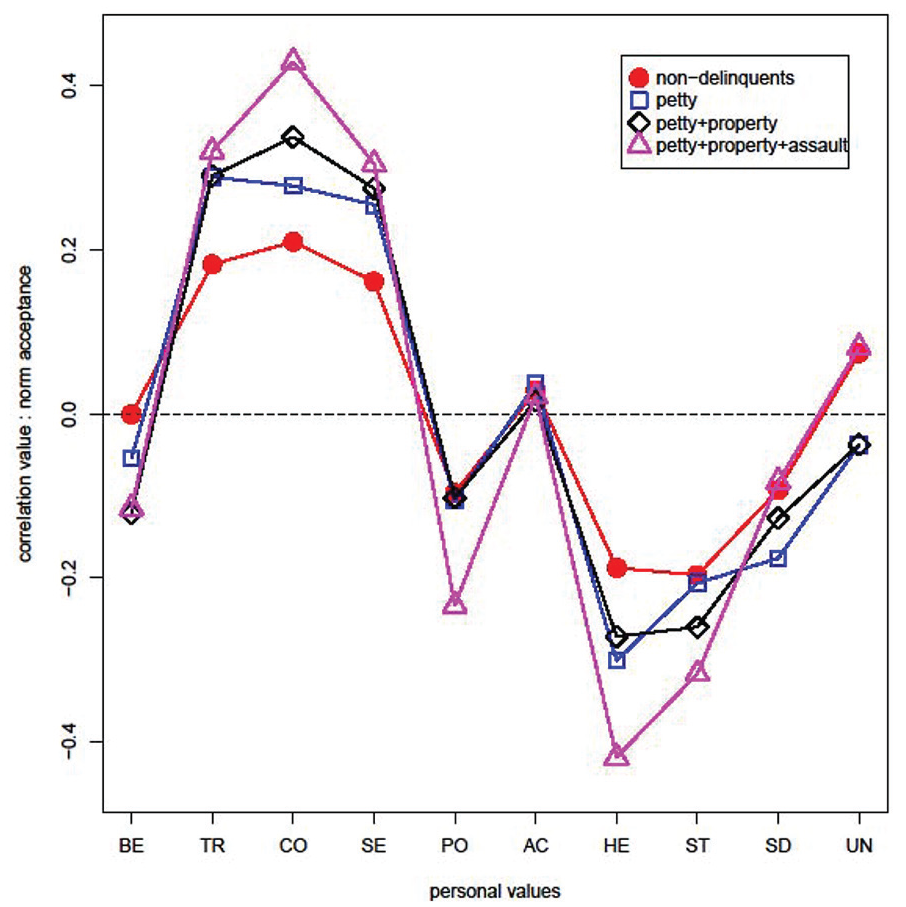
Profiles of correlations of (centred) personal values with norm acceptance for non-delinquents and delinquents, differing with respect to type and scope of delinquency (Study 1).
External variables: Gender and age
As regards gender and age, Table 1 shows that the values–norm acceptance correlations remain almost the same if gender is partialled out (Table 1, row 11). This finding matches our assumptions. The table also shows that men and women exhibit some differences (Table 1, rows 9 and 10). Women, in particular, have the highest single correlation of values with norm acceptance.
As expected, this is quite different for age (Table 1, row 8): when age is partialled out, the value–norm acceptance correlations drop considerably, in particular on the values in the openness to change vs. conservation value groups of values.
Summary and discussion
Present research
Criminological research on the interrelationship of personal values, norm acceptance and delinquency has remained largely unrelated to the dominant psychological value theory (TUV, Schwartz, 1992) until recently. The study by Bilsky and Hermann (2016) filled this gap, thus giving access to the bulk of cross-cultural research accumulated with TUV and facilitating the interpretation of research findings from a broad interdisciplinary perspective (for example, Borg, Hermann and Bilsky, 2017). The present analyses provide additional information on the extent to which personal values and the TUV value circle can serve as a theory for clarifying the relationship between personal values, norm acceptance and delinquency.
Value measures
We found that the circular value structure predicted by TUV and identified in Bilsky and Hermann (2016) could be replicated with representative samples from three more studies. The four higher-order values distinguished by TUV were clearly identified for both value items and basic value indexes. Furthermore, the 10 basic values showed the expected circular structure, except for some deviations, especially with respect to security (below). Such deviations are, however, neither uncommon nor a challenge to the theory as long as they relate only to neighbouring values (Schwartz, 1992). For achievement and power, for instance, swapping their positions on the value circle is not unusual (for example, Bilsky et al., 2011, 2015). According to TUV, the crucial feature that allows for values to be discriminated is their motivational content. Thus, values neighboured on the value circle are thought to be more similar with respect to motivational content than those farther apart; that is, they show more conceptual overlap. Values can hence be considered as multi-faceted constructs (MacCorquodale and Meehl, 1948) that cannot easily be assigned to mutually exclusive categories.
IRVS items, in addition, differ from those typically used in TUV-related research (see Klages, 1977; Hermann, 2003, 2014). Beyond conceptual overlap, breadth (that is, the number and/or heterogeneity of items) and type (for example, ranking, rating, paired comparisons, vignettes) of operationalization can affect the attribution of denotative and connotative meaning (Osgood et al., 1961) to values. This becomes obvious when reinterpreting value research in terms of TUV that originates from another theoretical basis (see Bilsky and Jehn, 2002; Borg et al., 2011, as an example). Last, but not least, it is the research (that is, crime) context of the present studies that can affect the attribution of meaning to values.
Although the aforementioned reasons may explain small deviations from the expected circular structure, the location of IRVS-based security close to self-transcendence in all four studies (see Figure 1A in the online Appendix) deserves a closer look, even though this basic value still belongs to the higher-order value conservation, as predicted by TUV. Its observed close proximity to self-transcendence and large distance from self-enhancement cannot easily be attributed to divergent instruments, since the corresponding PVQ-based index of Study 4 lies far away from self-enhancement too, and close to the basic values conformity and tradition. Cultural explanations are not plausible either since security has been located close to power in several representative German studies using the PVQ (Bilsky et al., 2011). One might, of course, speculate about semantic differences between single items that prompt a stronger affinity for power (for example, PVQ item 14: ‘. . . wants the state to be strong . . .’) or for self-direction/universalism (for example, IRV item 20: ‘living health-consciously’), respectively, thus suggesting a different location of security as a function of the value instrument used. This would presuppose, however, that, in further replications, security measured by PVQ items will pop up close to power – as in earlier studies – while remaining distant from self-enhancement and closer to self-transcendence when measured with the IRVS. Yet, for now, there is no convincing interpretation for the unforeseen location of security close to self-transcendence.
Another peculiarity of our results deserves attention too: using different value measures should not affect the relationship between values and norm acceptance. Table 1 shows, however, a correlation of −.22 between the PVQ-based value achievement and norm acceptance in Study 4, whereas the correlations with the respective IRVS-based index in studies 1–4 are close to zero. Scrutinizing the content of the respective items suggests for the PVQ that achievement serves a particular purpose, that is, to be admired and recognized by others (‘It’s important to him to show his abilities. He wants people to admire what he does / Being very successful is important to him. He hopes people will recognize his achievements’). The IRVS items, in contrast, do not articulate what purpose is served by ‘being hard-working and ambitious / succeeding quickly / being clever and more cunning than others’. One can speculate that individuals who value achievement as a means to be admired and recognized may be more interested in ‘window dressing’, in ‘showing off’, than in true achievements, and, thus, they are more likely to stick at nothing and not accept social norms. This may explain the −.22 for the correlation of achievement with norm acceptance for the PVQ in Table 1, and the zero correlations for the corresponding IRV measurements.
Personal values, norm acceptance and delinquency
All MDS analyses of the sub-samples of delinquents and non-delinquents revealed clear and statistically robust structures distinguishing the four higher-order values on the item and the basic values level, as predicted by TUV. In this respect, they do not differ from representative samples or from sub-samples relating to gender and age.
Regarding the correlational profile of values and norm acceptance, the predicted sinusoid shape was confirmed with respect to the delinquent and the non-delinquent sub-samples too. The transition from power to achievement, however, is ‘jagged’. Yet swapping the positions of these values on the x-axis would lead to more perfectly sinusoidal curves. Conservation values show the highest positive correlations with norm acceptance, and openness values the highest negative correlations with norm acceptance, as expected. Furthermore, correlations between basic values and norm acceptance were stronger for delinquents than for non-delinquents, thus showing a higher amplitude of the correlational profile for delinquents (see Figure 3).
As expected, the correlations between values and norm acceptance differ as a function of the committed offence. Thus, the sub-sample of non-delinquents shows the smallest correlations and the sub-sample with the broadest spectrum of offences (petty, property and assault) the highest, with the two other sub-samples in between. All four curves display the expected sinusoidal profile of correlations, showing the highest positive correlations for conservation and the highest negative correlations for openness values. Taking a methodological perspective, one might speculate, of course, whether a ‘badness’ scale that allows for a better differentiation towards its extremes could have reduced the observed ceiling effects (see Figure 4) and thus contributed to explaining the interrelationship of values and norm acceptance still more convincingly.
Finally, our assumptions concerning the extent to which the external variables gender and age affect the relationship between personal values and norm acceptance could be confirmed too. As seen in Table 1, gender does not systematically lower the correlations of values and norm acceptance. Controlling for age, in contrast, lowers the correlations of personal values with norm acceptance considerably.
Open issues
Despite the consistent findings presented thus far, there remain open issues that need to be considered in future research.
First, and most importantly, although our findings on the role of delinquency as a moderator between values and norm acceptance match our expectations, they are still exploratory and require further validation. In the absence of adequate statistical tests, replication studies would be desirable to cross-validate our results. However, assessing self-reported delinquency is closely tied to issues of data protection. Therefore, it is not surprising that delinquency has rarely been investigated together with personal values until today.
Second, the operationalization and assessment of delinquency is not without its problems. This applies to both the type and the frequency of occurrence. Regarding the type of delinquency, a theory-based selection of delinquent acts would seem helpful for getting a more differentiated and systematic understanding of the relationship between values, norm acceptance and delinquency in future studies (for example, Bilsky et al., 2018). As regards frequency, self-reports are likely to be biased by errors due to memory effects (for example, telescoping effects) and the varying time frames considered – not to mention social desirability. To keep such effects to a minimum, we used a simple but clearly defined dichotomous delinquency score, categorizing as non-delinquent those individuals who reported not to have shown any of the listed offences since the age of 14. Because of this strict criterion, the sub-sample of non-delinquents includes fewer than one-third of the interviewees. Whether other criteria are more appropriate for answering the research questions at hand remains to be answered by future research and best on a still broader database.
Another issue directly pertains to the definition of norm acceptance. Until now, norm acceptance has been used as a concept that is represented by one general indicator in the research on the values–delinquency relationship. This practice is backed by empirical analyses, which justify treating norm acceptance as a unidimensional moderator of delinquent behaviour (see Hermann, 2003). It is also consistent with the notion of norm acceptance as a person’s general attitude towards legal norms. Yet, although the various items used here to measure norm acceptance are all positively inter-correlated and have a dominating first principal component, a look at social science research on norms and conformity during the past 70 years shows that a notion of norm acceptance that also takes further components into account seems promising when dealing with delinquency. Thus, Licht (2008: 721) pointed to ‘a striking feature of the social norms literature – namely, the equal treatment given to norms that are profoundly different in importance and prevalence’. According to Secord and Backman (1964: 332), an adequate theory of normative behaviour ‘must explain why some behaviours and attitudes are subjected to normative control and others are not’. This implies a specification of the behaviour focused upon and, consequently, a specification of behaviour-specific norms too. Individual perceptions and expectations, together with temporary and contextual conditions, are likely to influence the appraisal of such norms, and consequently their perceived validity and liability. Legal norms, for instance, may still be applicable and binding although outdated and questioned by individual people, by individual groups, by the general public or even by legal authorities. Thus, devaluing or ignoring a particular norm while accepting others may seem more or less legitimate, depending on its scope, on its perceived importance and on whose interests it putatively serves – or impairs (for example, Bottoms and Tankebe, 2012; Lamnek et al., 2000; Trinkner and Cohn, 2014; Tyler, 2006). Discussions on the legalization of cannabis may serve as an example in this context.
Instead of treating norm acceptance as a homogeneous concept, conceiving it as a multifaceted attitude that takes different forms of delinquency into account seems a promising alternative for avoiding the confounding effects of aggregation that result from using just one general indicator of norm acceptance. First tentative analyses, which take the victims’ perspective, the type of damage caused and the seriousness of the respective offence into account (Bilsky et al., 2018), underscore the viability of such an approach, with prospects of a more differentiated understanding of the complex interrelationship of personal values, norm acceptance and delinquency. However, further research is needed to validate these findings.
There is one final caveat that needs at least mentioning – taking it for granted that people understand value- and norm-related terms as used in survey research in the same way. Personal values such as ‘self-direction’ and their theoretical components (such as ‘freedom’) may, for example, mean different things to individuals of different age and gender (Borg, 2019). Various contextual and situational factors can also affect the understanding and interpretation of such terms (for example, Carstensen and Mikels, 2005; Schwarz, 2007). This has an impact on the interpretation of findings on the relationship between values, norm acceptance and delinquency as well.
Supplemental Material
EJC10_Appendix_Figure_1ARev – Supplemental material for Utilizing personal values to explain people’s attitudes towards legal norms
Supplemental material, EJC10_Appendix_Figure_1ARev for Utilizing personal values to explain people’s attitudes towards legal norms by Wolfgang Bilsky, Ingwer Borg and Dieter Hermann in European Journal of Criminology
Supplemental Material
EJC11_Appendix_Table_1ARev – Supplemental material for Utilizing personal values to explain people’s attitudes towards legal norms
Supplemental material, EJC11_Appendix_Table_1ARev for Utilizing personal values to explain people’s attitudes towards legal norms by Wolfgang Bilsky, Ingwer Borg and Dieter Hermann in European Journal of Criminology
Footnotes

References
Supplementary Material
Please find the following supplemental material available below.
For Open Access articles published under a Creative Commons License, all supplemental material carries the same license as the article it is associated with.
For non-Open Access articles published, all supplemental material carries a non-exclusive license, and permission requests for re-use of supplemental material or any part of supplemental material shall be sent directly to the copyright owner as specified in the copyright notice associated with the article.
