



Abstract
To limit energy costs and environmental impacts related to road lighting, luminance-based designing is the best solution to provide the right amount of light on the surfaces to be lit. However, this exercise requires knowledge of the reflection properties of the road surface, which are generally unknown. Therefore, the design is often done in terms of illuminance, and luminance is estimated using the standard r-tables provided by the CIE 50 years ago. This review article presents the state of knowledge on the reflection properties of road surfaces and the internal factors (family and nature of road surface, composition, type of aggregates, binders used, surface treatments) that may influence them for road lighting applications. Although some trends emerge based on the family of road surface, the wide variety of these factors, their interactions, or the extent to which they have been studied make it difficult to establish generalisable rules. The main international consensus is the need to revise the CIE standard r-tables. This article also identifies the need for further research, and the descriptive summary of the characteristics of road surfaces and their field of use that we propose is a solid basis for carrying this out in a unified manner.
1. Introduction
In a context where the need to reduce energy costs linked to human activities is becoming ever more pressing, the significant share of street lighting in the electricity consumption by local authorities makes it an important lever for action. In France, for example, it accounts for 32% of the electricity consumed by local authorities. 1 On a global scale, it is estimated to absorb 8% of total electricity production linked to artificial lighting, on the order of 215 TWh, representing 110 Mt of CO2 emissions per year. 2 It is, therefore, essential to control this consumption by optimising the use of artificial light at night, especially as it is not without consequences for the environment and living species. 3
When lighting is necessary, offering the right amount of light to users, particularly motorists, requires street lighting installations to be dimensioned in terms of luminance. It is this parameter that is representative of the capabilities of the human visual system and, therefore, of visibility conditions when travelling. Luminance depends both on the light emitted by the luminaires and on the reflection properties of the illuminated surface. Road surfaces, therefore, play a decisive role in the design of road lighting installations.
As the reflection properties of roads are very rarely measured in practice, several classification systems have been proposed in the literature and formalised by CIE4–6 with the purpose of providing a reflection table (called r-table containing tabulated values) without the need of measuring the actual road surfaces. The classes are defined according to the specularity factor S1 (see Section 2.2 for the definition of S1) because it was demonstrated that road lighting performance criteria 7 are linked to S1, especially for the longitudinal uniformity of luminance.8–11 A first classification called the R classification was defined in the 70s and contains four classes (RI, RII, RIII and RIV).12,13 Based on Sørensen’s work,8,14 the Nordic countries defined the N classification with four classes (NI, NII, NIII and NIV).4,8,14 Both systems were included in the CIE-30 technical report. 4 Finally, the C classification with two classes (CI, CII) was introduced by Burghout.15,16 All three classifications were included in CIE 066 5 and CIE 144 technical reports 6 with the recommendation to use the C classification whenever possible. For each classification, standard r-tables are associated, with a letter corresponding to the system of classification and an Arab number to specify that this is the standard r-table associated with the class in question. The recommendations in CIE 144 report 6 for dimensioning lighting installations in terms of luminance are firstly to choose the class corresponding to the road surface in place in one of the official classifications (R, C or N) according to its specularity factor S1. 5 Then, the standard r-table associated with the class determined must be scaled to take account of the lightness of the pavement using the mean luminance coefficient Q0, 5 or, since 2001, the diffuse luminance coefficient Qd, 6 even if most lighting software only offers Q0 scaling (see Section 2.2 for definitions of Qd and Q0). The CIE recommendations, therefore, require knowledge of the pavement class and its Q0 (or Qd) coefficient, assuming that the scaled standard r-table is representative of the reflection properties of the road to be lit. However, since the reflection characteristics of a road surface are generally unknown, as are the quantities Qd, Q0 and S1, the standard class and r-table are often chosen randomly and arbitrarily, without scaling, according to habits that differ from one country to another. 17 It has been shown that failure to take account of the actual light reflection characteristics of existing pavements can lead to poor lighting10,17,18 and often to non-compliance 19 with the specifications of standard EN 13201. 7
Furthermore, these recommendations are based on the assumption that the standard r-tables established more than 50 years ago4–6 still represent the light reflection capabilities of today’s roads. However, the range of pavement types available has been greatly extended, multiplying the number of parameters (aggregates, binders, surface treatment, etc.) with a potential influence on their reflection characteristics. 20 In current practice, this lack of knowledge is not necessarily seen as a problem. In fact, most lighting installations are designed and/or controlled on the basis of illuminance, which means that the impact of the road surface on lighting quality criteria is not taken into account. But these practices can lead to energy wastage (due to oversizing of the average luminance) and/or degraded uniformities,10,17,19 which adversely affect visibility.21,22
This article reviews what is known about the reflection properties of road surfaces and the factors likely to influence them for road lighting applications. The issue is complex because these properties depend on both internal factors linked to the composition and application of road surfaces and external factors such as the effect of the age of the surface, traffic, or the impact of the environmental conditions to which it is exposed. In Part 1 of our review, we will only focus on the internal factors, considering stabilised road surfaces. The external factors (age, traffic and climatic conditions) are presented in Part 2 23 of the review and suggests to wait two years to have a stabilised road surface.
The composition of a road surface varies greatly from one type of road surface to another, and its components could have a strong influence on its optical properties. It depends on the binder, the aggregates used (type, colour, especially the level of lightness, size, etc.), their particle size distribution (continuous or discontinuous formula in the case of porous asphalt mixes), the way the surface is laid, and in the presence of a surface treatment (brushing, hydro-blasting, etc.). As all these components and treatments form a whole road surface, it is really difficult, if not impossible, to study their individual impact on the reflectivity of road surfaces.
The second section of this review article presents some basics concerning the composition of road surfaces, their reflection properties and current global practices for dimensioning lighting in terms of luminance. The third section presents the methodology of this literature review. The fourth section examines the impact of pavement composition on its ability to reflect light, also considering its spectral behaviour. The fifth section questions the representation of the current CIE standard r-tables for representing road surface variability. Finally, the conclusion and perspectives summarise this literature review and present prospects for future research.
2. Road surface basics
2.1 Composition
Roads and urban surfaces generally consist of a rock-based material (in the form of aggregates or blocks) and a binder (bituminous, cement, synthetic, etc.). The choice of road family and nature depends on use, in particular safety and comfort, but also aesthetics and legibility, and can vary greatly from country to country. There are several families of pavement used in urban, suburban and interurban areas: bituminous mixture, surface coating, mastic asphalt, cast-in-place cement concrete, concrete paving blocks and natural stones. Figure 1 presents pictures of several road surfaces. These families have different mechanical and physical modes of operation, and each of them also has a wide range of properties and levels of performance as described in Appendix A.
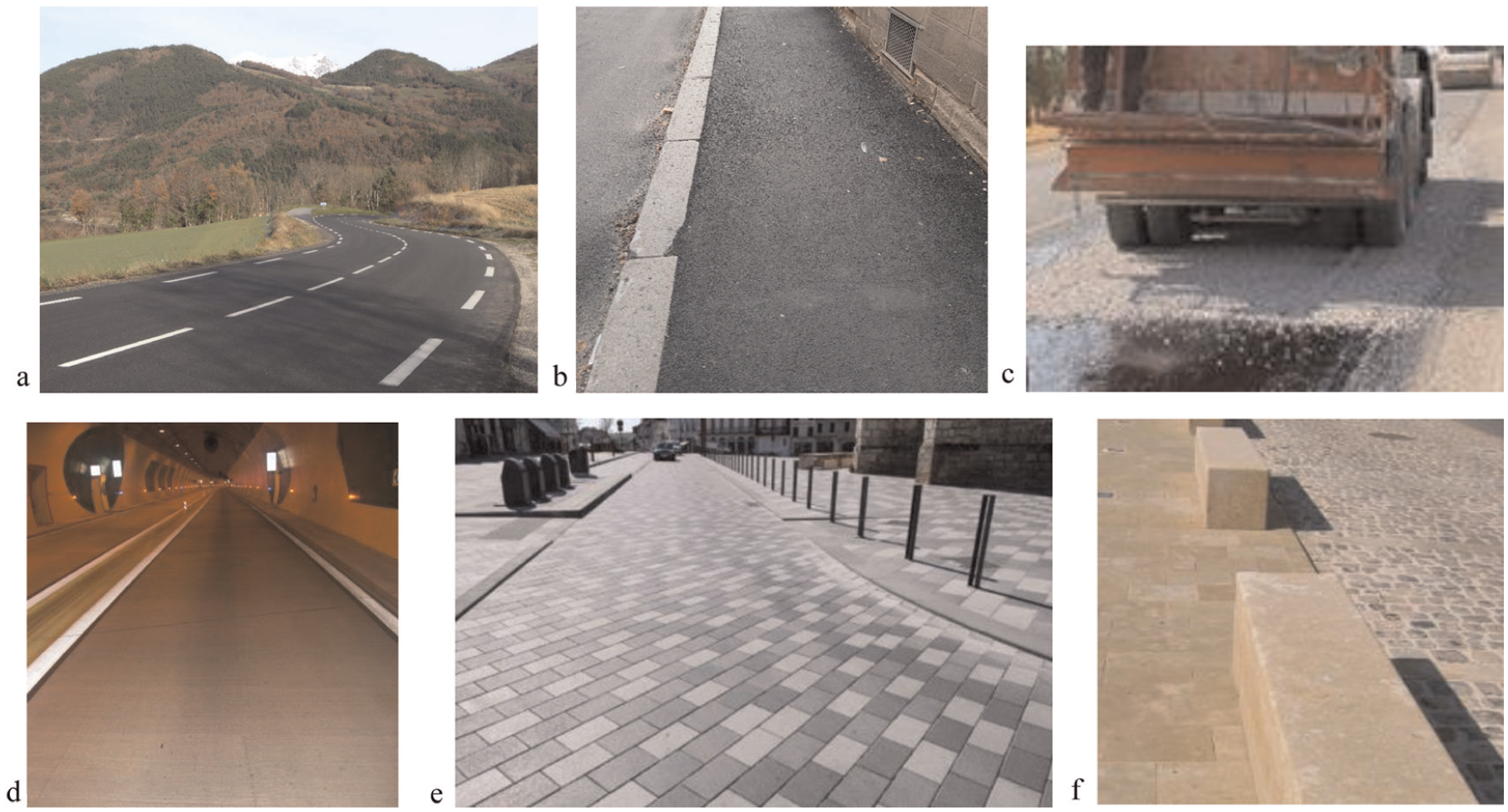
Photographs of different families of road surface: bituminous mixture ((a) asphalt concrete, (b) mastic asphalt), surface dressing (c), poured cement concrete (d), concrete paving blocks (e) and natural stone (f)
Different types of binders are used to agglomerate aggregates together. Conventional bituminous binders are black and very shiny (Figure 2(a)). Clear binders (generally plant-based, bio-binders or synthetic binders) are characterised by a pale amber colour and by a lighter, matt appearance (Figure 2(b)). Cement binders have a light to very light grey appearance, depending on the type of cement chosen (Figure 2(c)).
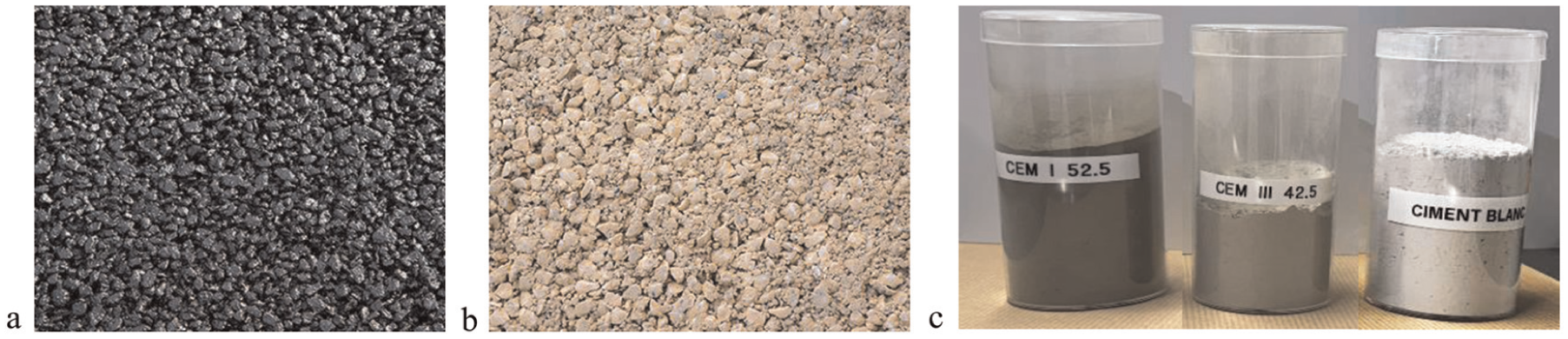
Pictures of bituminous mixture with a classical binder (a), a synthetic one (b) and a cement powder with different visual aspect (c)
The texture of the road is a physical feature describing its irregularities and deviation from a planar surface. Based on the scale of the irregularities, the road surface texture can be divided into two sub-groups. The microtexture corresponds to surface irregularities with horizontal dimensions ranging between 0 mm and 0.5 mm, invisible but sensitive to the touch. It is produced by the surface properties (sharpness and harshness) of the individual aggregates or other particles of the surface which comes in direct contact with the tyres. The macrotexture corresponds to surface irregularities with horizontal dimensions ranging between 0.5 mm and 50 mm and from 0.1 mm to 20 mm vertically. Macrotexture is related to aggregate size, the mixture design and laying (compaction) of the road material.
Numerous types of aggregates exist, depending on their origin, which could be either natural (extraction of sedimentary, metamorphic, or igneous rock), artificial, or recycled. They could be classified according to the smallest and largest dimensions of a given homogeneous mixture (called a batch, noted 0/10, e.g. for granular material between 0 mm and 10 mm). If all sizes are present, the pavement is called continuous. If there is a gap, it is called discontinuous. For example, porous asphalts are designed specifically to allow water to drain through the pavement.
The term coloured pavement covers a wide range of materials generally referable to two main approaches: overlay (coatings) or embedded. 24 Whereas the first technique could include paint, epoxy and other surface treatments (such as thermoplastic or methyl methacrylate) applied to the finished road surface, the second one refers to any asphalt or concrete with coloured aggregates or pigments added directly to the mixture. The use of specific aggregates, especially light or white ones is quite common. Since pigmented coloured pavements are relatively expensive to implement, they may be applied as thin layers, in the form of high friction slurry surfacing or surface dressing (e.g. chip seal).
Initial surface treatments are sometimes applied to bituminous mixtures to remove the upper layer of the binder and are almost always performed on cement concretes and natural stones. They modify the surface aspect and could give a better skid resistance, especially for cement concretes. A lot of initial surface treatments are available. Some of them are shortly described and illustrated on Appendix B.
2.2 Reflection properties
The light reflection properties of road surfaces are described by the luminance coefficient q, defined as the quotient of the luminance L at a point on the pavement by the horizontal illuminance E produced at the same point by a lighting source (Equation (1)):

This coefficient depends on the nature of the pavement and the direction of illumination and observation. In road lighting, it is determined for a conventional observation angle α = 1°, which corresponds to the perception of the road at a distance of approximately 90 m by drivers of motorised vehicles (see Figure 3).7,25
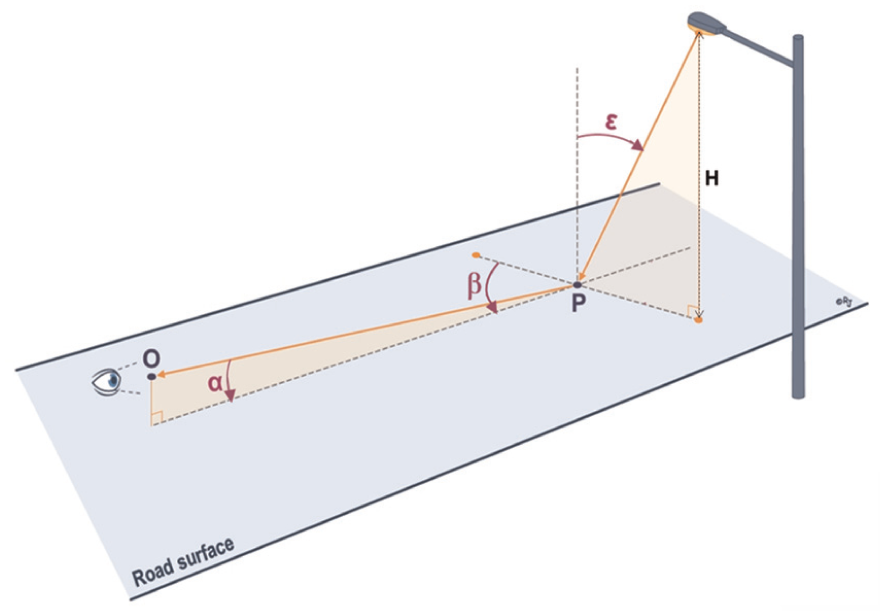
The photometric reflection characteristics of the road surface depend on the angle of observation α, and the lighting angles of deviation β and incidence ε. P is the observed point and H is the height of the luminaire
To enable dimensioning calculations, the CIE5,6 has proposed 580 preferred lighting directions defined by angular combinations: 20 values between 0° and 180° for the deviation angle β and 29 values between 0° and 85.2° for the angle of incidence ε. The amount of light reflected for these different combinations defines an r-table corresponding to the values of the reduced luminance coefficient r in sr−1 defined in Equation (2):

From this table and the values of the luminance coefficients q and r, three representative characteristics can be calculated for a global description of the surface: the specularity coefficient S1, the average luminance coefficient Q0 and the diffuse luminance coefficient Qd.
The specularity factor S1 reflects the specular character (mirror effect) of the pavement. It is defined as the ratio of reduced luminance coefficients r in two specific illumination conditions, namely

The average luminance coefficient Q0 represents the proportion of overall light energy in the visible range reflected by the pavement. It is defined in Equation (4) and expressed in cd.m−2. lx−1 (or sr−1). Q0 is calculated by integrating all the values of q in a solid angle Ω0 corresponding to all the directions of incidence of the light defined by the defined combinations of β and ε.
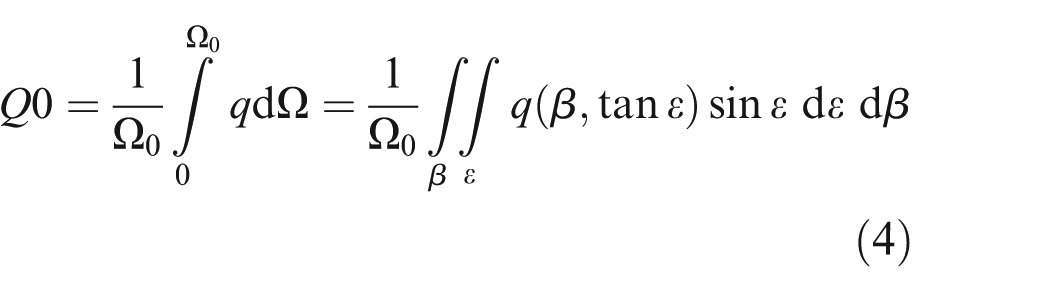
with
It is classically calculated by applying a weighting table recommended by the CIE5,6. But with current calculation resources, it can easily be determined by the trapezoidal integration method. 26
The diffuse luminance coefficient Qd expresses the proportion of total light energy in the visible range reflected by the surface under diffuse illumination. It is defined as shown in Equation (5) and expressed in cd.m−2 lx−1 (or sr−1).
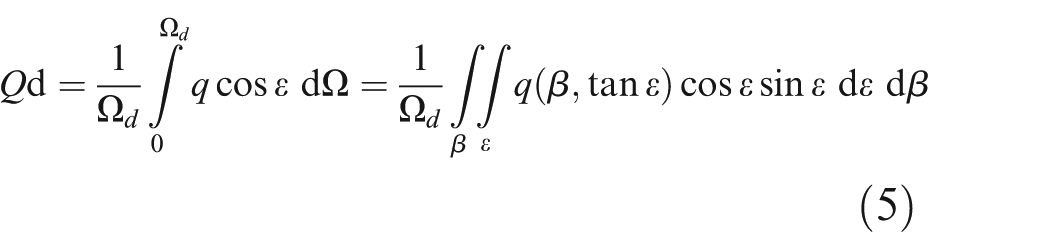
with
Although Qd is calculated as Q0 from the values of q in road lighting applications, the reference to diffuse illumination is more suggestive of natural daylight conditions. For this reason, Qd is preferentially used to assess the visibility of road markings6,27 in daylight conditions. Nevertheless, since 2001, the CIE 6 recommends using Qd rather than Q0 for scaling standard r-tables, and recent work 28 suggests that the systematic use of Q0 in most lighting software for scaling should be reconsidered.
The reflection indicatrix (also known as the photometric solid) is a representation of the spherical coordinates of the r-table projected onto the X0Z plane, where X is the traffic axis and Z is the normal to the road plane. In Figure 4, the projection is
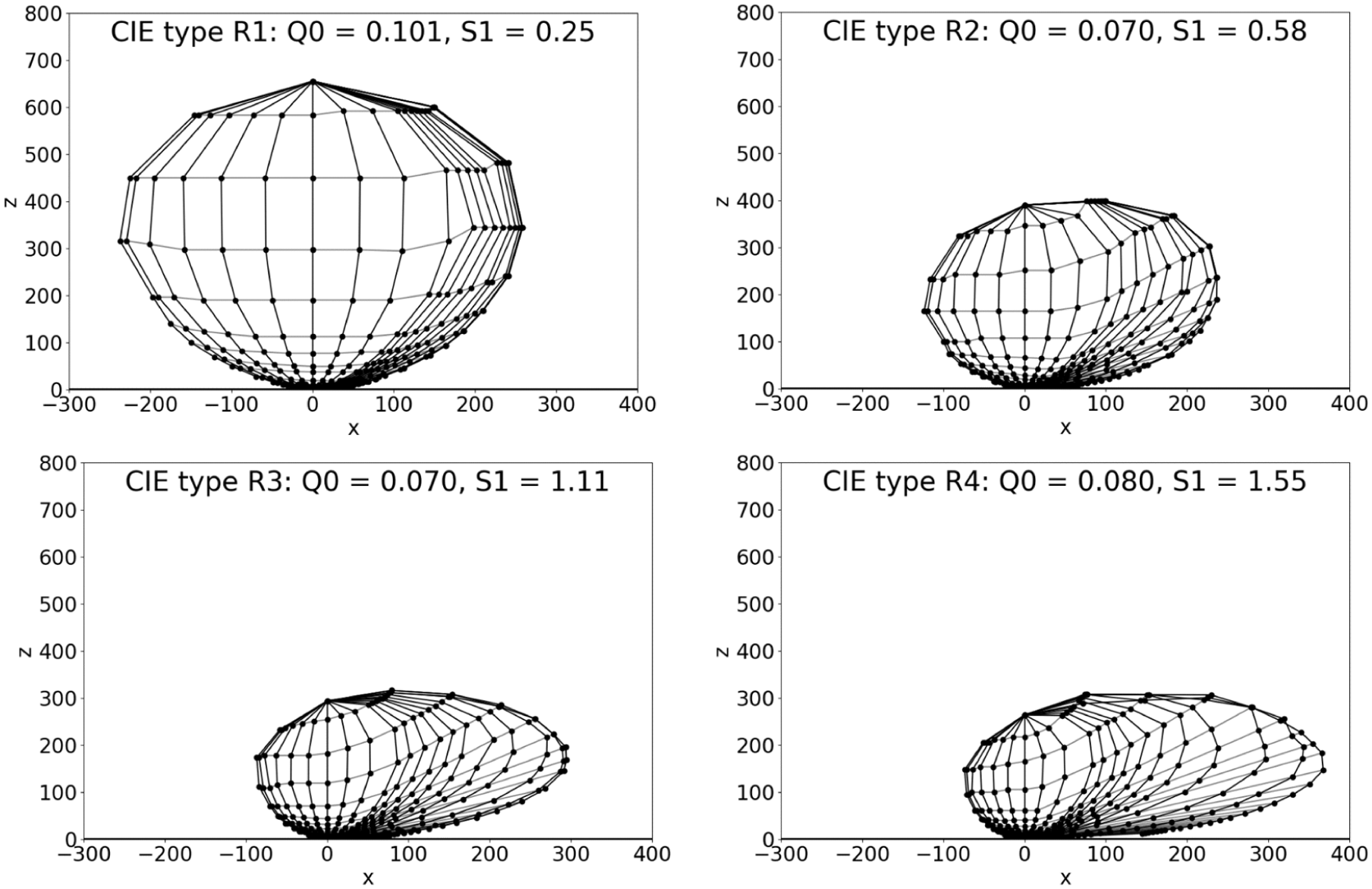
Reflection indicatrix of CIE standard r-tables R1, R2, R3 and R4. It is a 2D projection in the XOZ plane. The circulation axis corresponds to X, with X-axis values equal to
2.3 Actual practices
A review of the use of the different systems of classification proposed by the CIE was conducted in the EMPIR SURFACE project 25 and completed in 2019. This review of actual practice was updated considering the following references29–32 and is presented in Table 1. As shown previously, 33 it is confirmed that the most used class (respectively standard r-tables) for lighting design are RIII and CII (respectively R3 and C2), whose photometric characteristics (Q0, Qd and S1) are very close.
Recall of the different CIE classification systems, with the name of the class defined with Latin numbers and the name of the standard r-tables defined with Arabic numbers to avoid confusion. The last column indicates the country use of these CIE reference data for their lighting design calculations in luminance
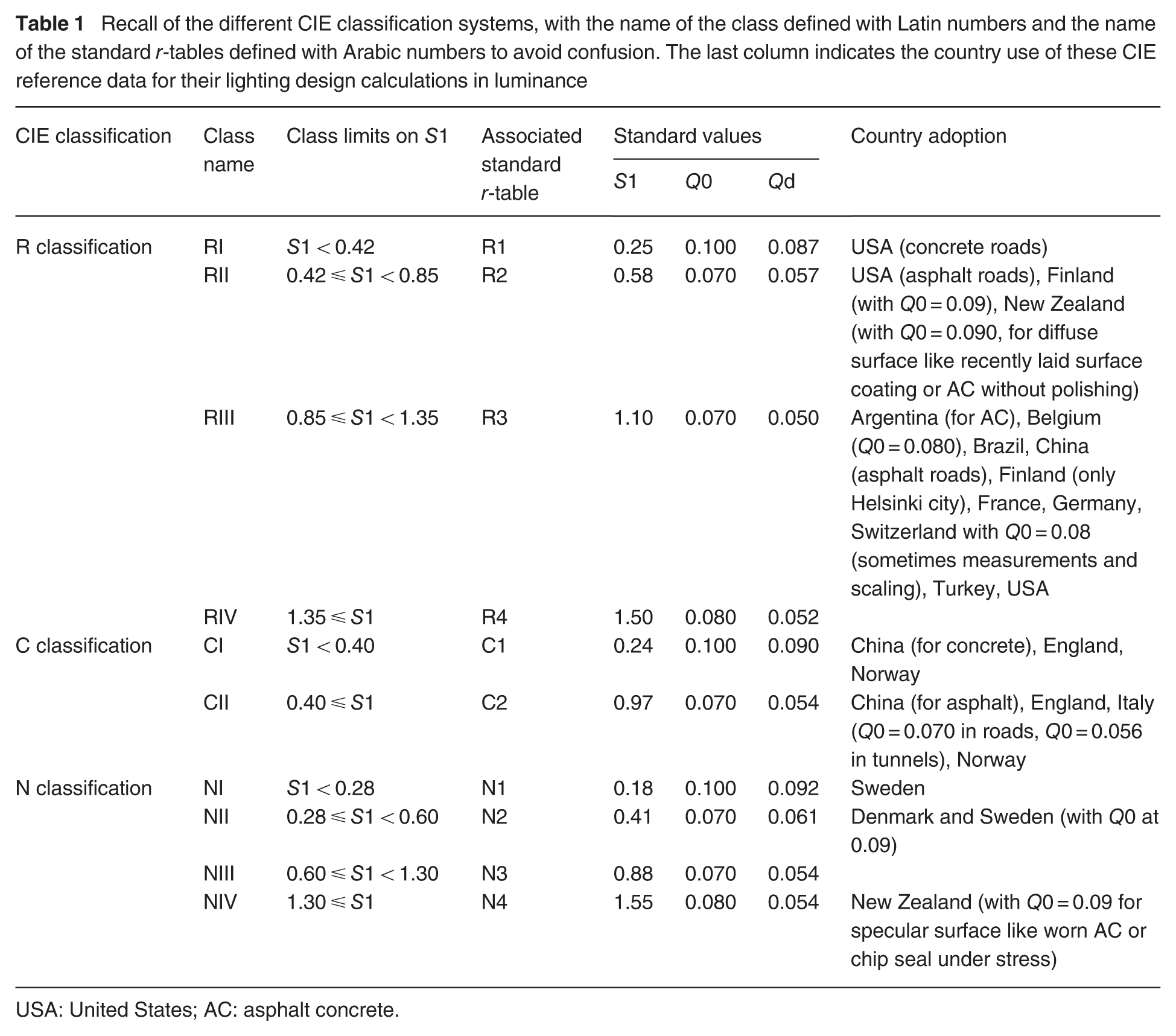
USA: United States; AC: asphalt concrete.
As the standard r-tables were defined in the 1970s, developments in road techniques over the past 50 years raise questions about the ability of these tables to describe the reflection properties of actual roads. This article, therefore, also provides an opportunity to examine the literature on this subject.
3. Methodological aspects of the review
In this review, where the influence of pavement composition on its ability to reflect light is studied, only road surfaces in their stabilised state are considered, to be in a state representative of most of their service life. Thus, we will only consider road surfaces aged more than two years as recommended in the review on external factors. 23 This paper contains 106 references. Among them, we will focus here on the papers that studied the impact of the internal factors influencing the light reflection properties of road surfaces, thus excluding standards and methodological papers that do not contain data relevant to our review. Figure 5 shows the distribution (number of articles) of the 71 papers analysed in this review, considering the type of document, year of publication and geographical origin.
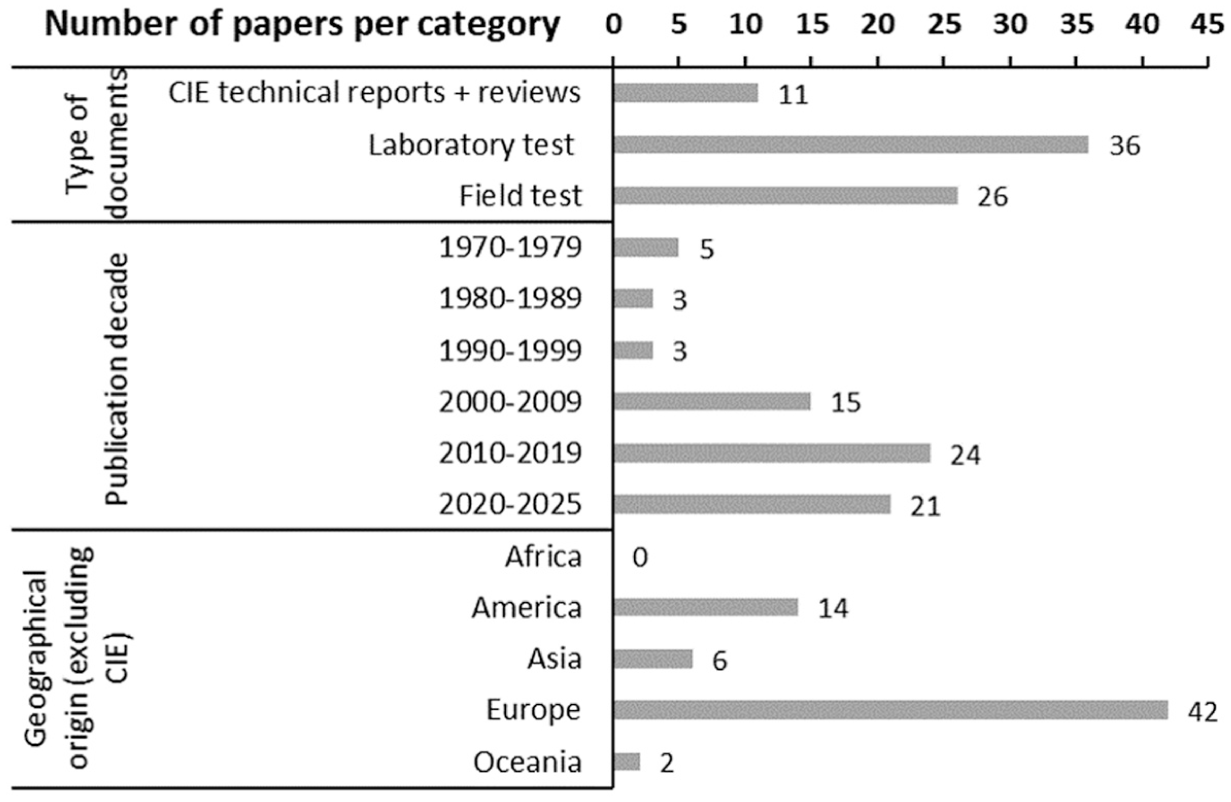
Distribution of the analysed articles according to document types, decade of publication and geographical origin. One paper 9 presents laboratory tests and field tests.
Note that there are six related CIE documents,4–6,34–36 with one cancelled, 4 and also four review papers37–40 and one expert note. 31 The results of the research studies come both from both measurements conducted in laboratory and on field, with more investigations conducted in the laboratory. The temporal distribution shows that 63% of the work was conducted after the 2010s, as the published work mainly dates from recent years. Previous studies are either internal and unpublished, no longer accessible, or research that led to the establishment of the CIE documents, which constitute the reference but do not always allow for traceability of conclusions. The geographical distribution of articles shows that 66% of studies on the subject were conducted in Europe.
The internal factors investigated in this review are the family and nature of the road surface, the type of aggregate and binder, and the presence of an initial surface treatment. They are schematically represented in Figure 6. The external factors (age, traffic and climatic conditions) that also play a role in the reflection properties of road surfaces are the subject of the second part of this review. 23
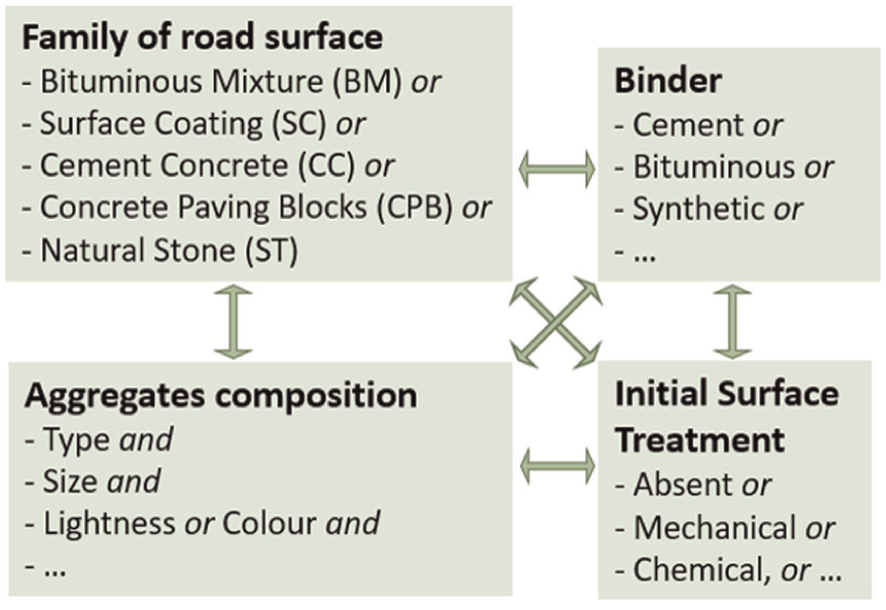
Schematic representation of the internal factors that influence the road surface reflection properties and their interrelations. The figure also introduces the acronyms used in the rest of the paper to indicate the families of road surface
The link between pavement composition and reflection properties is a complex one, since the reflection of light from materials depends not only on the texture of the road and the type of surfacing, but also on the binder used, the type, size, level of lightness and colour of the aggregates and any surface treatments. One of the difficulties was that the denominations used vary from country to country, which often makes it difficult to analyse the literature, especially for the bituminous mixture and surface coating families. A proposed summary is available in Table 2, indicating both the standard terminology41–51 and the names used in the articles synthesised in this review. The standard terminologies will be used later on in the review.
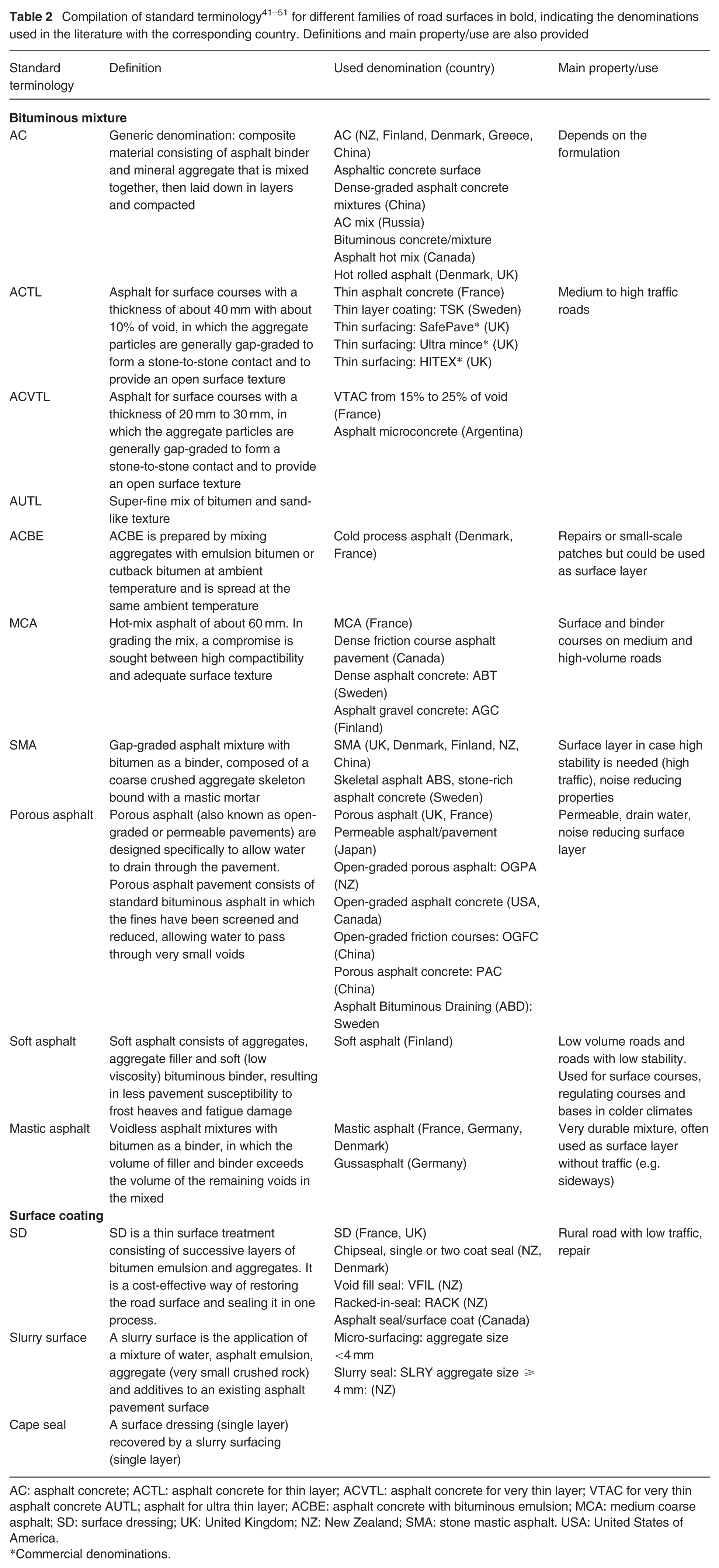
AC: asphalt concrete; ACTL: asphalt concrete for thin layer; ACVTL: asphalt concrete for very thin layer; VTAC for very thin asphalt concrete AUTL; asphalt for ultra thin layer; ACBE: asphalt concrete with bituminous emulsion; MCA: medium coarse asphalt; SD: surface dressing; UK: United Kingdom; NZ: New Zealand; SMA: stone mastic asphalt. USA: United States of America.
Commercial denominations.
For the analysed papers, the general distribution is provided in Figure 7 for the families of roads studied, with the indication of the internal factor studied.
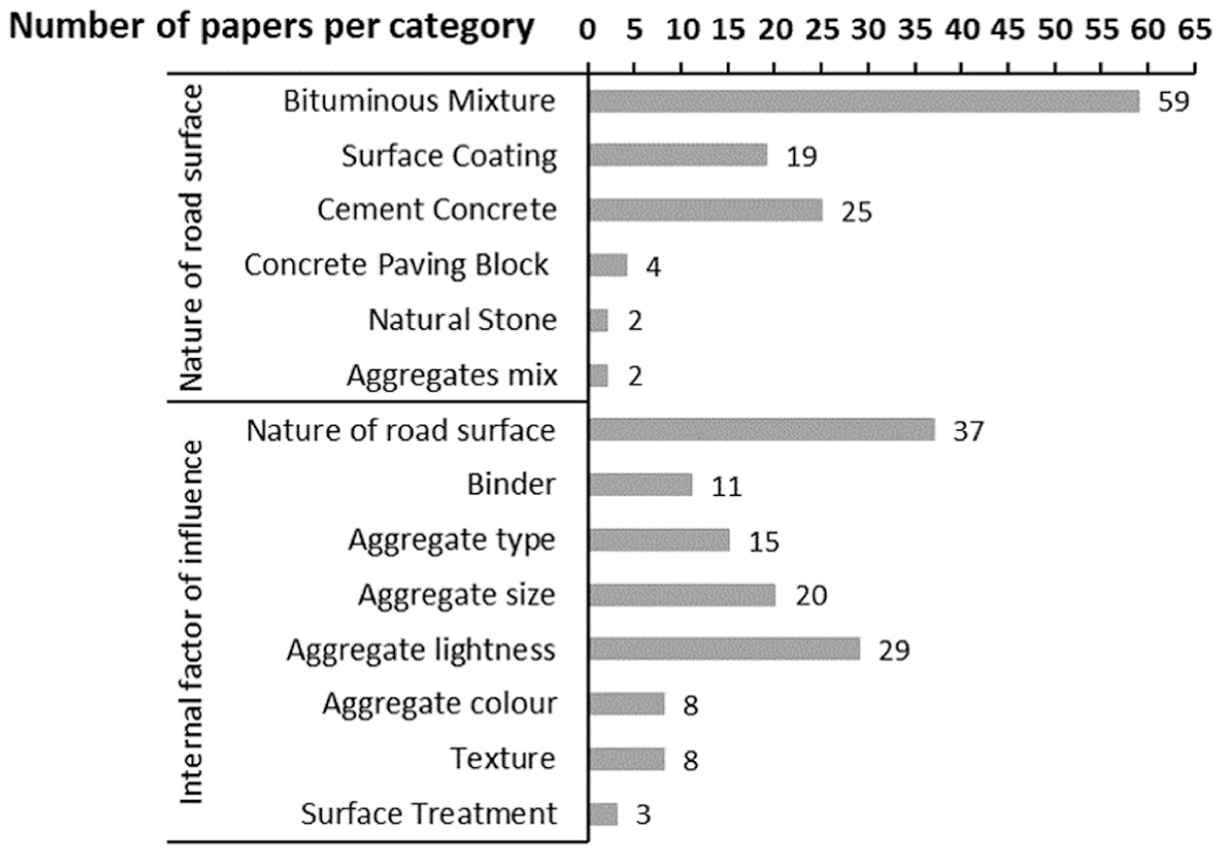
General distribution of the selected articles according to the different road families and the internal factors of influence
With regard to the family of roads, it is obvious that the vast majority of research has focused on bituminous mixtures. This result is quite logical, as these are the most common types of roads. Cement, concrete and surface coating have also been widely investigated. Paving blocks and natural stones were studied very little, even though they are very popular in urban areas. With regard to influencing factors, many investigations have focused on the nature of the pavement, and some more specifically on the binder, although these two factors are often linked. The characteristics of the aggregate used have also been extensively studied, whether in terms of its petrographic composition (referred to here as type), size or level of lightness. The influence of the colour of the aggregates, the texture of the road or the presence of a surface treatment has been less investigated.
It is also important to consider the type of measurements carried out (laboratory or field test) 37 and their representativeness: number of measurements, used method in case of laboratory test (fabricated or extracted sample). The internal factors studied, the experimental setup with the corresponding measured quantity, the method used and the family of road surface considered are presented in Table 3 for the laboratory studies, in Table 4 for field studies and in Table 5 for the studies focused on the spectral aspects.
References of the different studies conducted in laboratory with the indication of the internal factors studied (according to Figure 6), the experimental setup, the number of measurements, the type of sample and family of road surface used
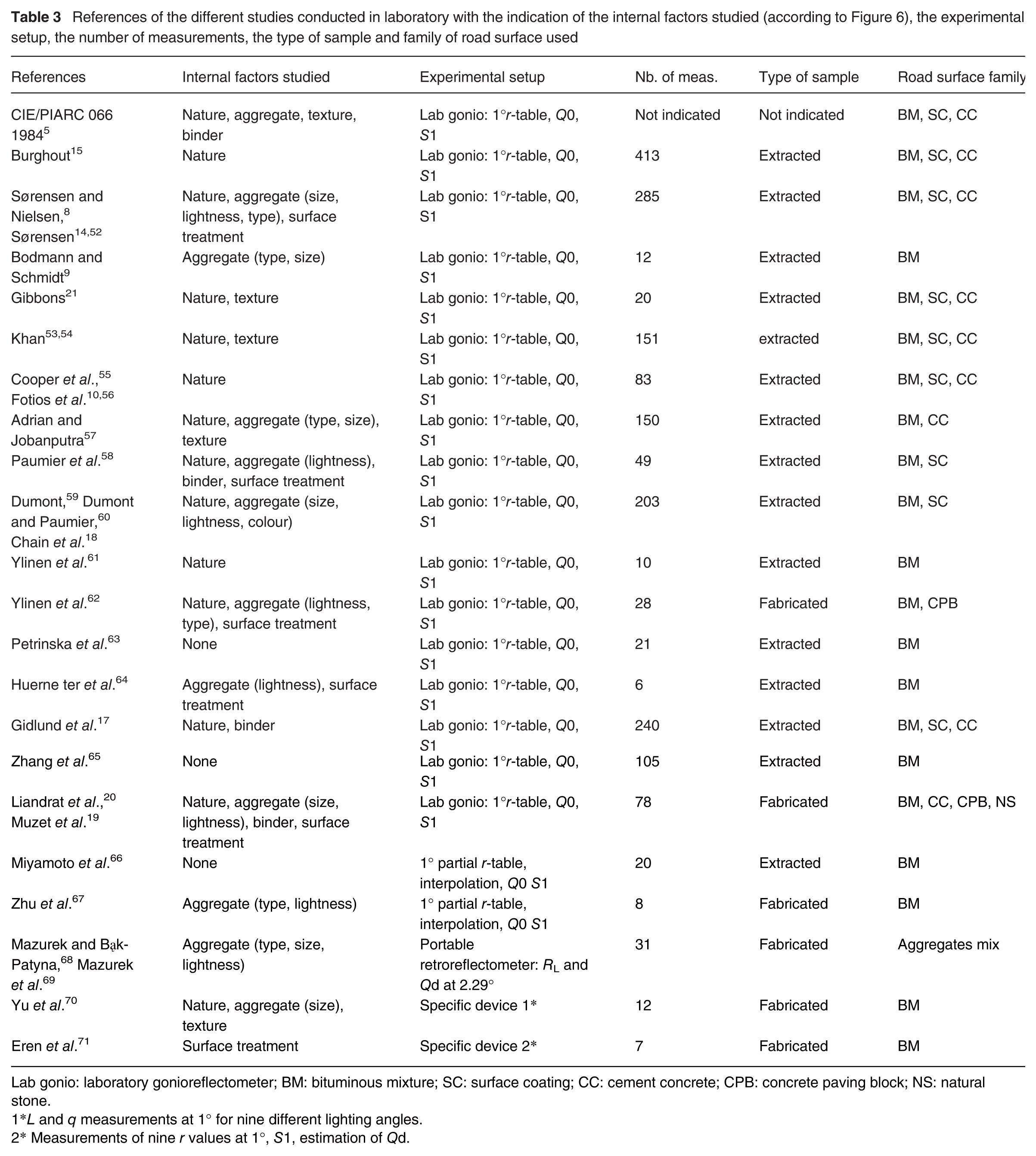
Lab gonio: laboratory gonioreflectometer; BM: bituminous mixture; SC: surface coating; CC: cement concrete; CPB: concrete paving block; NS: natural stone.
1*L and q measurements at 1° for nine different lighting angles.
2* Measurements of nine r values at 1°, S1, estimation of Qd.
References of the different field studies with the indication of the internal parameter investigated, the experimental setup and measured quantity. The number of measures and road surface family are also indicated.
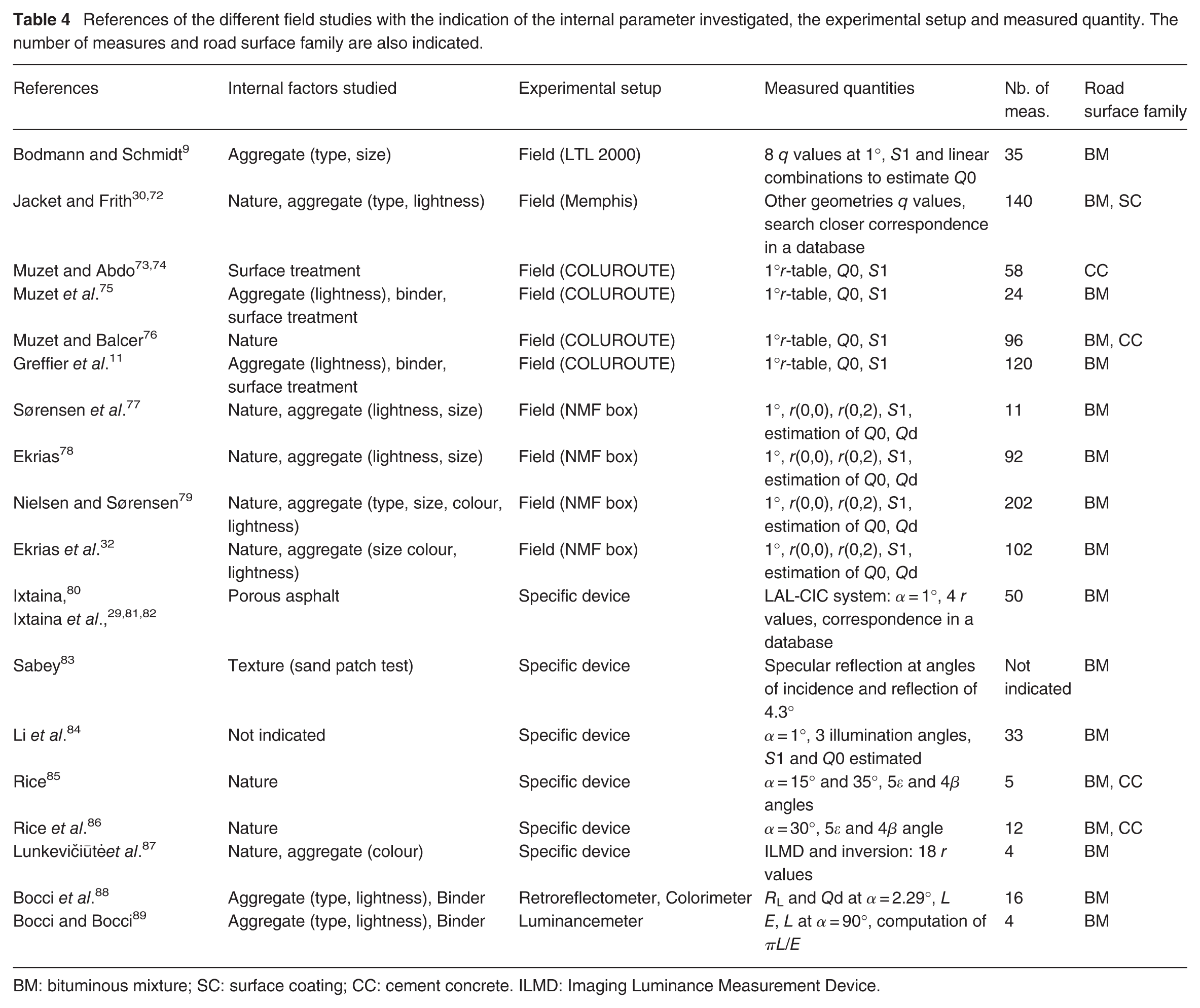
BM: bituminous mixture; SC: surface coating; CC: cement concrete. ILMD: Imaging Luminance Measurement Device.
References of the studies concerning spectral aspects, with the indication of the internal parameter investigated and the measured quantity. The number of measures, used method and family of road surface are also indicated.
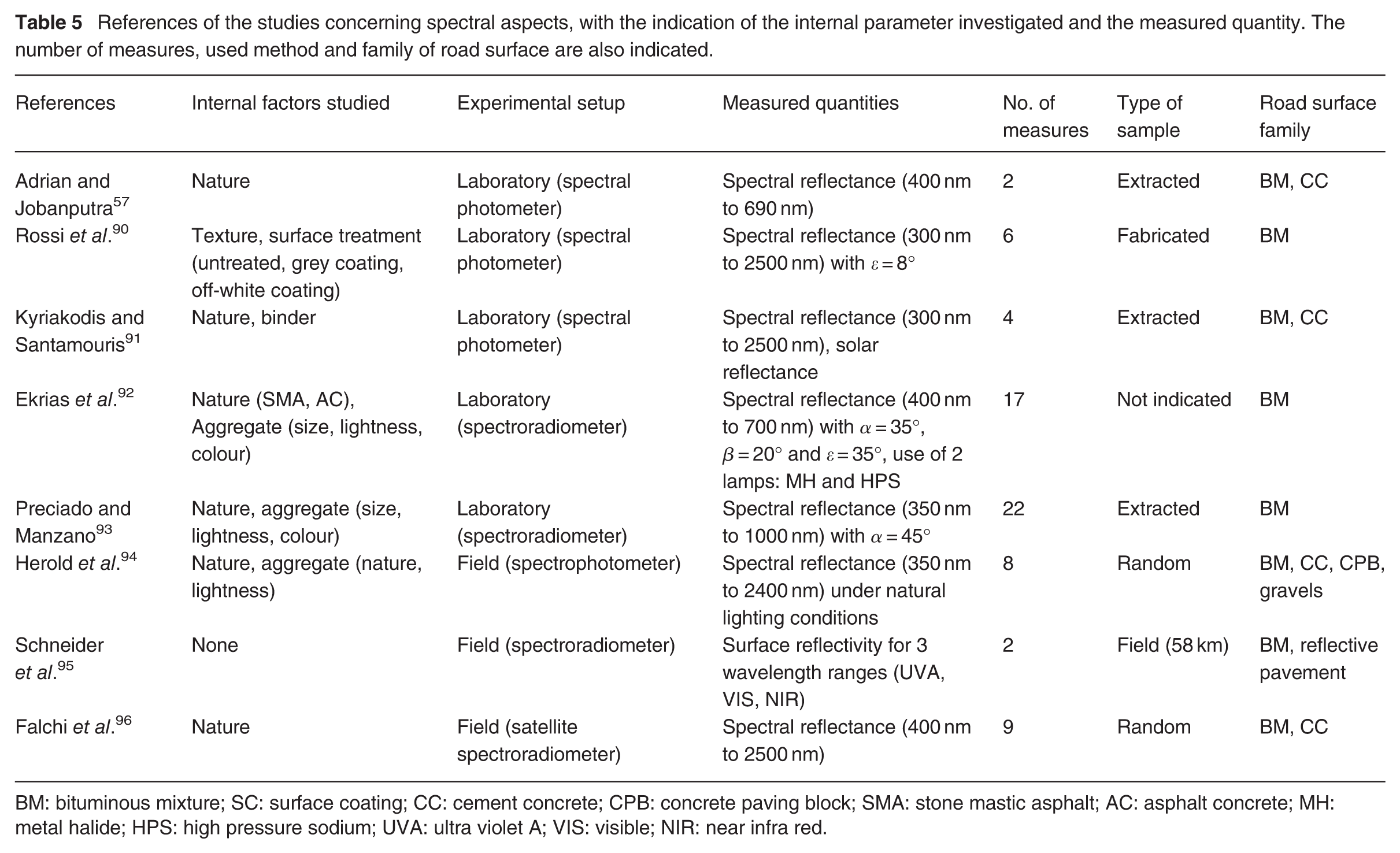
BM: bituminous mixture; SC: surface coating; CC: cement concrete; CPB: concrete paving block; SMA: stone mastic asphalt; AC: asphalt concrete; MH: metal halide; HPS: high pressure sodium; UVA: ultra violet A; VIS: visible; NIR: near infra red.
Most laboratory measurements are performed using gonioreflectometers, which measure the entire r-table at 1°. Samples are extracted in the vast majority of research (74% vs. 26% of manufactured and therefore non-trafficked cores). In some studies, other geometric configurations were used, in some cases with portable retroreflectometers typically used for road marking characterisation, with an observation angle of 2.29° in this specific case. The field studies are generally more recent, with 81% conducted after 2010, and there is an important variability of the measuring devices with 35% that do not conduct measurement at the recommended 1° observation angle. Spectral aspects were also investigated in the laboratory and in the field, either to examine both the spectral reflectance of road surfaces and the spectra of lamps, or to address issues related to urban heat islands.
The influence of these different road components on light reflection will be presented successively in the next section, which will discuss the influences of aggregates, binders, surface treatment and road surface texture in turn. Spectral aspects related to road surface will also be addressed in a specific subsection. Finally, an overall approach in relation to pavement nature will be presented, along with the issue of the representativity of the actual CIE standard r-tables.
4. How does the composition of pavements affect their ability to reflect light?
4.1 Influence of aggregate type, size, level of lightness and colour
In 2006, according to Fotios et al., 10 the relation between the size of the granular and the light reflection properties of a road was not clearly established, and there were not a lot of studies.
Photometric measurements of 150 samples extracted in North America in 1984 were analysed in 2005 57 to study the link between Q0 and the percentage of coarse aggregate. While some materials have a lower Q0 for a higher percentage of coarse aggregate (e.g. in the presence of quartzite or greywacke), this result cannot be generalised as no effect is observed for other types of aggregate.
In a French study, 58 on a classic ACVTL, the use of a more closed structure composed of 0 to 6 mm aggregates resulted in higher Q0 luminance coefficients than a structure with 0 mm to 10 mm aggregates, whatever the colour of the aggregates used. On the other hand, this study also showed that for another ACVTL using white aggregate, the formulation with the most open structure (0 mm to 14 mm aggregate) had a higher Q0 than that with 0 mm to 10 mm aggregate. Concerning the specularity, with the use of classic coloured aggregates (black or grey/green), S1 is higher when the aggregates are larger, whereas the opposite is true if the aggregates are red or white.
In the experimental campaign carried out on the most common bituminous mixtures in Sweden, which are MCA, asphalt concrete and ACTL, 79 the maximum aggregate size (which was 11 mm or 16 mm respectively) had no major influence on light reflection properties and no impact on Q0. For S1, with asphalt containing dark aggregates (granite or quartzite), their size had no effect. On the other hand, for AC/ACTL mixes with light granite and quartzite aggregates, S1 is superior for the formula with larger aggregate sizes.
Recent studies looked at the impact of the size and type of aggregates alone on the diffuse luminance coefficient Qd measured at 2.29° with a road marking retroreflectometer.68,69 According to these works, it was shown that the type of aggregate has the greatest impact on Qd: the most suitable aggregates for pavement brightening are granite, limestone and quartzite. Models for predicting the Qd of aggregates were developed using several machine learning techniques. The prediction of Qd is not accurate considering 0/2 mm grain sizes, but coarse aggregate fractions with a grain size larger than 4 mm could be used to estimate the luminance coefficient.
In China, 67 a laboratory study examined the influence on Q0 and S1 of projecting white aggregates or glass chips onto an AC, depending on the quantity projected. The addition of glass led to an increase in both Q0 and S1 and, consequently, a decrease in uniformity, so it was not considered useful. However, the addition of white aggregates led to an increase in Q0 and a decrease in S1.
Many studies have investigated the impact of using light-coloured or white aggregates to optimise the reflective properties of roads. As illustrated on the left in Figures 8 and 9, they systematically show that their addition results in an increase in Q04,5,14,20,37,58,60,62,75,79 and consequently in average luminance at constant lighting levels. As shown in Figure 8 on the right, in addition to increasing Q0, the use of white aggregates can also slightly reduce specularity5,20,37,60,75 and therefore make it easier to achieve good luminance uniformity. In some documents, percentages of white chippings are even recommended to have a noticeable effect. In the CIE 066 report, 5 for example it is stated that an asphalt mix containing 30% white aggregates will be class CI, while it will be CII if there are less than 30%. It is also indicated that for surface dressings, the chipping of white aggregates also increases Q0. In Paumier et al., 58 it is indicated that the use of 15% calcinated silex in an ACTL or an ACVTL could be sufficient to increase Q0 and have a diffuse behaviour (with class RI). In China, 67 Zhu recommends the projection of white stones at an amount of 4 kg.m−2.
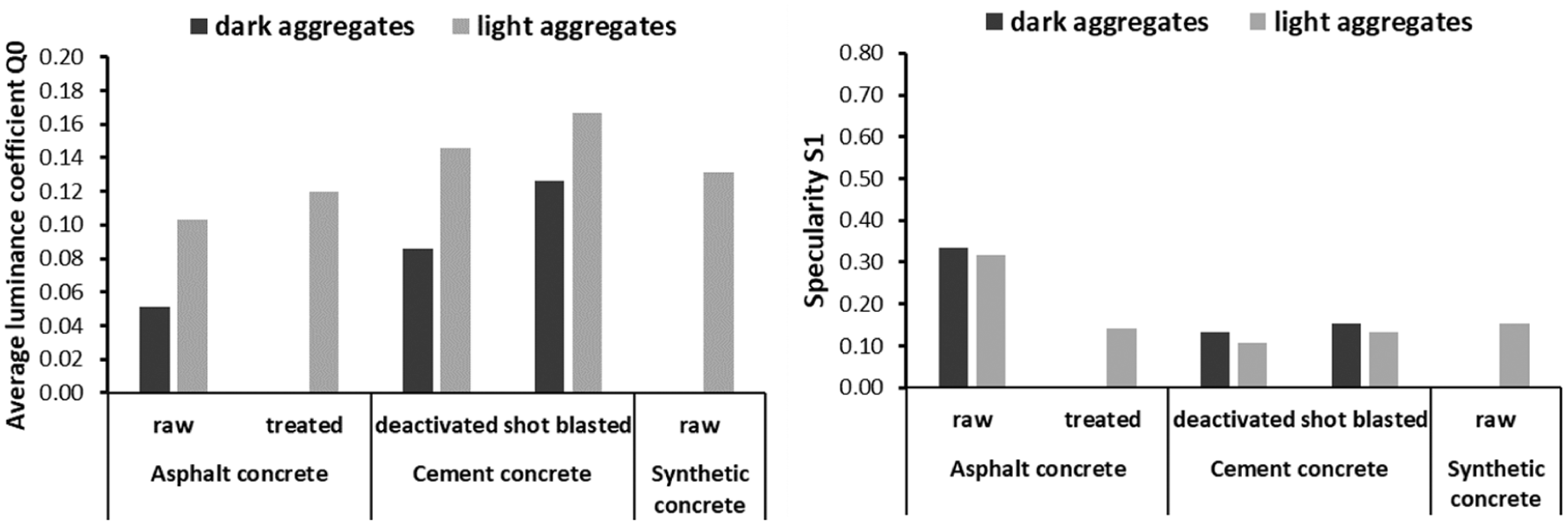
Illustration for different formulations of the effect of using light-coloured aggregates on the average luminance coefficient Q0 (left) and specularity S1 (right). These results were obtained on samples aged naturally for 30 months
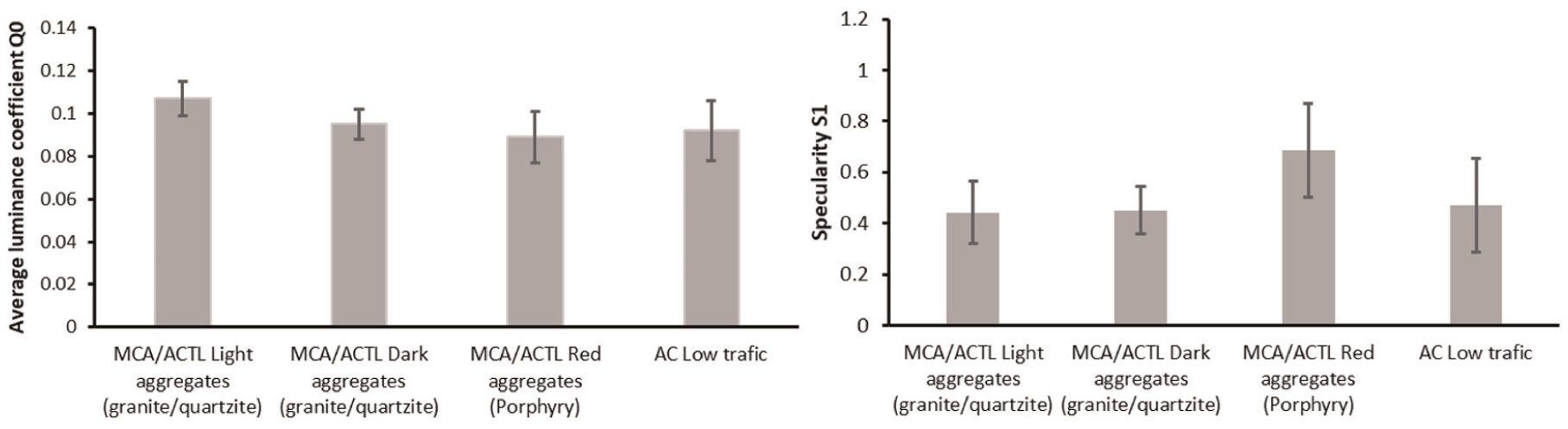
Average values of Q0 (left) and S1 (right) for several types of pavements. The error bar corresponds to standard deviations between the measurements conducted on the same type of pavements
According to the CIE 066 report, 5 the use of light-coloured aggregates is even prescribed in Denmark and Belgium, and recommended in certain regions of Germany, 37 Netherland 64 and Poland with recommendations for minimal Qd in tunnels. 69 In the CIE 066 report, 5 the C classification system is recommended and it is written ‘for public lighting purposes in dry conditions roads surfaces are preferred for which S1 < 0.4 and Q0 as high as possible’.
The impact of using coloured aggregates and/or pigments (colours other than white) on reflection properties has been less studied. It was shown that while the use of white aggregates in ACVTL has a marked effect on Q0 and S1 compared with black aggregates, this is not the case for red and grey/green aggregates. 58 In a study carried out in Sweden 79 where the red aggregates are hard magmatic stones (porphyrite), their use instead of dark or light aggregates leads to an increase in specularity, as illustrated in Figure 9 on the right. In a study of white, red, blue and green neutral pigmented asphalt, 24 there were no r-table measurements but colorimetry and Qd measurements. While the so-called neutral mixes with white limestone aggregates have a higher Qd, the differences between the three other pigment colours are less noticeable. In a recent study comparing red coloured asphalt concretes of bicycle paths to the carriageway of a classic black asphalt concrete mixture (with a different formulation), it was shown that the 18 measured r values of the red bituminous mixture were higher than the black one. 87
To conclude, the use of white aggregates systematically increases Q0 and usually decreases S1. This effect is even more marked if they are projected onto the surface. On the other hand, it seems difficult to draw conclusions about the impact of aggregate size and texture depth. Indeed, in the few studies carried out, the results are contradictory. This finding seems to depend to a large extent on the nature of the road (in the sense of its formulation, which may differ from country to country), then on the hardness 79 and/or the colour of the aggregates used. 58
4.2 Influence of the type of binder and of the road surface treatment
The impact of the binder is not generally studied alone, as it is usually combined with specific aggregates or additives. In Italy, the impact of using synthetic binder combined with white aggregates has been studied for tunnel applications.88,89 The photometric properties of specially manufactured samples 88 were evaluated using a conventional retroreflectometer (Qd measurement at 2.29°). The road with white aggregates and synthetic binder has higher values of Qd than conventional asphalt. An assessment following implementation in a tunnel was carried out after five months, 89 this time by measuring a reflectance coefficient ρ = πL/E at 1°. This again showed that the lightened road surface has a reflectance coefficient three times higher than that of conventional asphalt.
With cement or synthetic binder, Q0 is generally higher and S1 lower compared to classical bituminous binder5,10,20,56,57,74,75 (see Figure 8). This drop in specularity S1 and the increase in Q0 are even more marked using a synthetic binder with the addition of white pigments (e.g. TiO2), 75 or depending on the percentage of calcined silex added 58 or the surface projection of white aggregates.4,37,58
The effect of initial surface treatment has mainly been studied on bituminous mixtures, as its purpose is to remove the black bituminous binder in order to reduce specularity and reveal the aggregates’ lightness.
The effect of shot blasting treatment on bituminous mixture was studied by Paumier et al. 58 on a thin asphalt concrete, where the impact of the number of passes was studied. The first shot blasting treatment generates a significant decrease in the specularity S1 (from 3.66 to 0.32) with a slight decrease of Q0 (from 0.069 to 0.063). The second passage lower specularity to 0.17 and increases Q0 by about 40% (to 0.093). It was also shown that in its stabilised state (after two years of circulation or more), the specularity of a bituminous initially treated surface (water jet scrubbing) remains lower than that of the not treated one. 75 The contribution of six different surface treatments consisting of spraying white materials onto hot mix asphalt (HMA) has recently been studied in Italy on manufactured samples. 71 The white substance used was either a white polymer or a combination of cement mixed with quartz sand, with or without the addition of crushed glass or glass fibre. Regardless of the nature of the surface treatment, it resulted in a reduction in specularity and an increase in Q0, which was very significant compared to conventional untreated AC (Q0 = 0.24 for the material composed of white polymer, white powder and fibreglass).
Concerning the family of cement concrete, a French study 74 compared two different surface treatments: deactivation and brushed. It was shown that the brushed cement concrete was more diffuse than the deactivated one.
4.3 Texture of road surface
Reflection models based on geometric features 97 for computational production of realistic synthetic images, show that light reflection properties depend on the texture which is a physical feature describing irregularities and deviation from a planar surface. In terms of visual appearance, it is generally established that the rougher the surface, the more it reflects light in a diffuse pattern. 98 Is this statement also valid in the case of road surfaces?
In his 1972 report, Sabey 83 mentions studies (unfortunately no longer available) that looked at the link between sand patch test height 99 and a specularity indicator βs measured at 4.3°. Despite a significant variability, there is a tendency for rougher surfaces (i.e. sand patch test superior to 0.65 mm) to have lower βs values.
In the classification proposed in CIE 030.2 4 shown in Appendix C, it is indicated that smooth and polished surfaces are of type R4/N4, and that more the texture is rough, more the surface tends to present a diffuse nature in terms of light reflection and consequently a low specularity (R2/N2 instead of R3/N3).
In its PhD thesis, 21 Gibbons used 20 samples from a Canadian database and measured surface roughness using a prototype profilometer. There was a significant correlation between surface roughness and aggregates coarseness, but no link with the photometric indicators Q0 and S1. In Yu’s study, 70 a relationship between texture measured with a laser profilometer and q values measured at 1° (for nine illumination angles) was investigated on 12 samples. As expected, texture indicators are higher for formulations with larger aggregate sizes. In addition, the luminance coefficients q measured for the 0/10 mm formulations are higher than those for 0/13.5 mm or 0/16 mm.
In another Canadian work, 53 the influence of texture depth (again measured with the sand height test 99 ) was studied on an asphalt concrete and it was shown that the specularity factor S1 is greater and Q0 slightly greater when texture depth is lower. No other studies were found on the influence of road surface granularity and none on the influence of its microtexture. According to Fotios et al., 10 the problem with attempting to predict the reflection properties of a pavement material from a recipe is the lack of a suitable means to assess the impact of microtexture. To our best knowledge, no studies investigated this aspect since then. However, it seems that the statement coming from visual appearance studies ‘the rougher the surface, the more it reflects light in a diffuse pattern’ 98 is also valid in the case of road surfaces.
4.4 Spectral behaviour
The reflection properties of a road surface are not spectrally constant, either in the visible or near infrared range. If we first examine the overall spectral reflectance of road surfaces in the visible range while considering lighting issues, CIE technical report 150 35 is the only CIE report that addresses this aspect. It proposes characterising a surface by its reflectance coefficient ρ, which is then used to deal with obtrusive light issues, in particular upward flux ratio calculations. In Appendix E of the CIE report 150, 35 a measurement methodology is proposed by examining the ratio of the horizontal illuminance reflected by the surface in the zenith direction to the horizontal illuminance received. This appendix also lists the spectral reflectance coefficients for different surfaces according to some of their characteristics (type of pavement, age), but also according to the class of the R system to which they belong, giving the values of S1 and the coefficient r(0,0) of the r-table associated with the road surface. By comparing these reflectance coefficients with the values of S1 or r(0,0), it is very difficult to identify general trends. For example, road surfaces may have identical reflectance coefficients even though they are in different classes, with S1 values varying by a factor of five. As for r(0,0), which is an r-table value that correlates well with Qd, 77 no clear trend emerges either. So there doesn’t seem to be any systematic lesson to be learned from the characteristics or class of a road surface in terms of its spectral reflectivity, and vice versa. This can certainly be explained by the differences in the observation geometries used to obtain the reflectance coefficients (measurement of horizontal illuminance, i.e. observation in one hemisphere) and the parameters S1 and r(0,0) (measurement in the standard CIE geometry, observation at 1°).
In the visible range, the reflectance of a surface varies as a function of wavelength and a road surface cannot be described as achromatic. 38 For example, Adrian and Jobanputra 57 and Ekrias et al., 92 who are also interested in road lighting issues, have shown that, for most road surfaces, relative reflectance increases with wavelength. Based on their measurements, Van Bommel 38 illustrated this behaviour by representing relative reflectance normalised by the value at the 400 nm wavelength (see Figure 10).
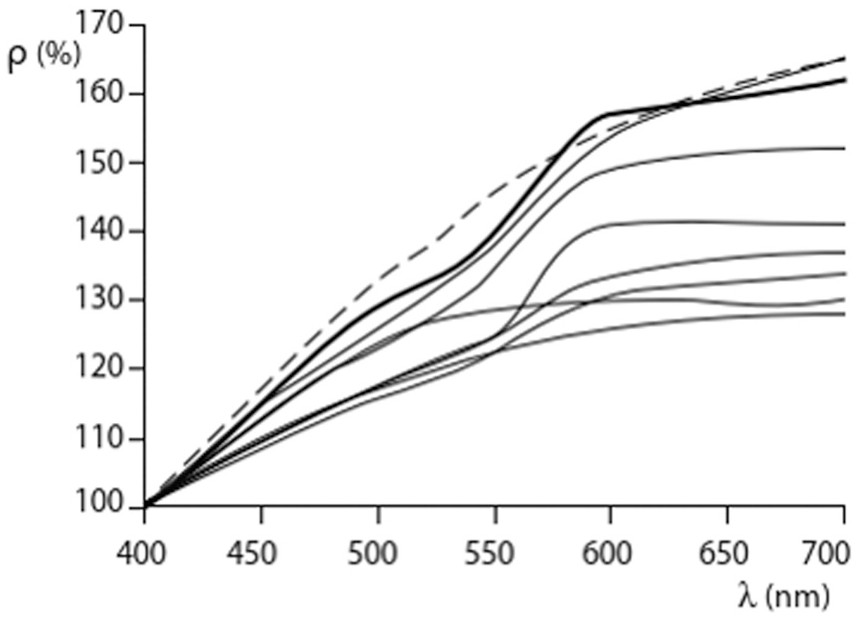
A large database of spectral measurements was also produced in 2004 by the National Center for Remote Sensing in Transportation and the University of California, Santa Barbara. This database illustrates the variations in reflectance as a function of the type of road, its colour, age or the presence of structural defects. 94 These data show the same pattern of increasing reflectance with wavelength as the more recent work by Falchi et al. 96 on 4 asphalt surfaces and 5 concrete surfaces or that of Preciado and Manzano 93 on 22 road surfaces (Figure 11).
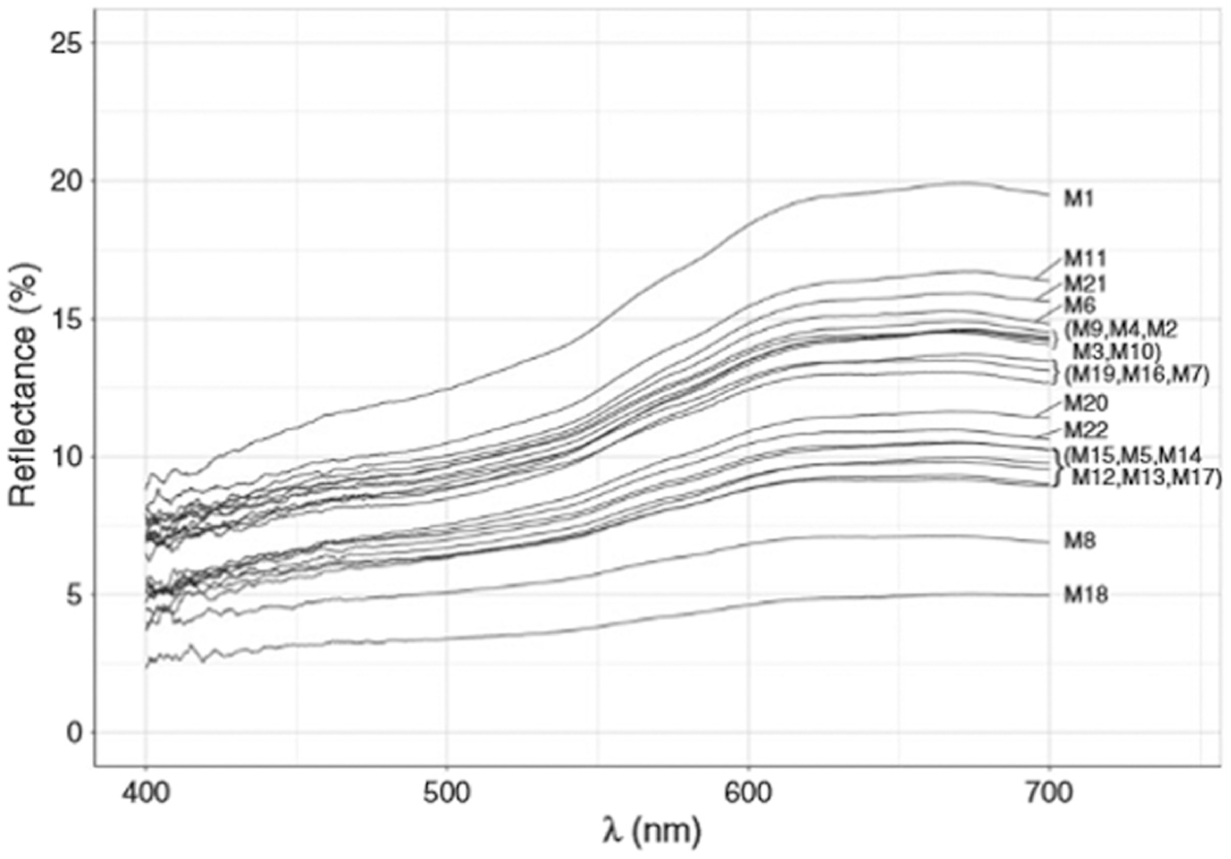
Spectral reflectance of the 22 road surface samples
All these studies could suggest that light sources emitting in orange or red wavelengths (Low Pressure Sodium, High Pressure Sodium amber LEDs) are more effective than sources with significant contributions in the short wavelengths of the visible range (Metal-Halid lamp, 3000 LEDs, 4000 LEDs). However, in photopic vision, this efficiency must be assessed in terms of luminance and the V(λ) curve tends to erase these differences in reflectance. Van Bommel 38 states that, compared with an HPS source, the reduction in luminance is around 5% for an HM source and 3% to 4% for various LEDs. Similar trends can be seen in mesopic vision. The greater absorption of road surfaces at short wavelengths (<500 nm) modifies the initial S/P ratio of lighting sources. So, while the CIE 191 report 34 recommends using lighting sources with high S/P ratios (HM, LED) for mesopic vision, these benefits can be counteracted by the effect of the reflectance of the road surface, making sources with low S/P ratios (HPS) just as, or even more, effective. However, this effect occurs at relatively high mesopic luminance (>1.5 cd m−2). 93 At the current stage of knowledge, there does not therefore seem to be any significant contribution to be made by specifically considering the spectral reflectance of pavements when dealing with road lighting issues. Thus, in the next section, spectral aspects will be disregarded in the search for the link between road type and light reflection properties.
5. Relevance of still using CIE standard r-tables
Is the use of standard r-tables still relevant to represent the variability of the road surface around the world? A correspondence between road composition and standard road surfaces was given for the CIE N and R classifications in CIE 030.2 report 4 (see Figure C1 in Appendix C). Such a correspondence table was not included in subsequent CIE documents on the subject, neither the CIE 140 36 that superseded CIE 030.2, nor in CIE/PIARC 066 5 and the CIE 144. 6 In the CIE/PIARC 066 report, 5 the C classification system added in 1986 in the British standard 100 is recommended and it is written ‘for public lighting purposes in dry conditions, roads surfaces are preferred for which S1<0.4 and Q0 as high as possible’. No such recommendation was provided in the next CIE reports.6,36 As the CIE standard r-tables were defined more than 50 years ago, with the evolution of techniques, the question of their representativeness for today’s roads arises. This question has been studied in many countries. Depending on the country and the means of measurement available, studies have been based on a few roads considered to be representative, while in others, a large-scale characterisation has been carried out (see Tables 2 and 3).
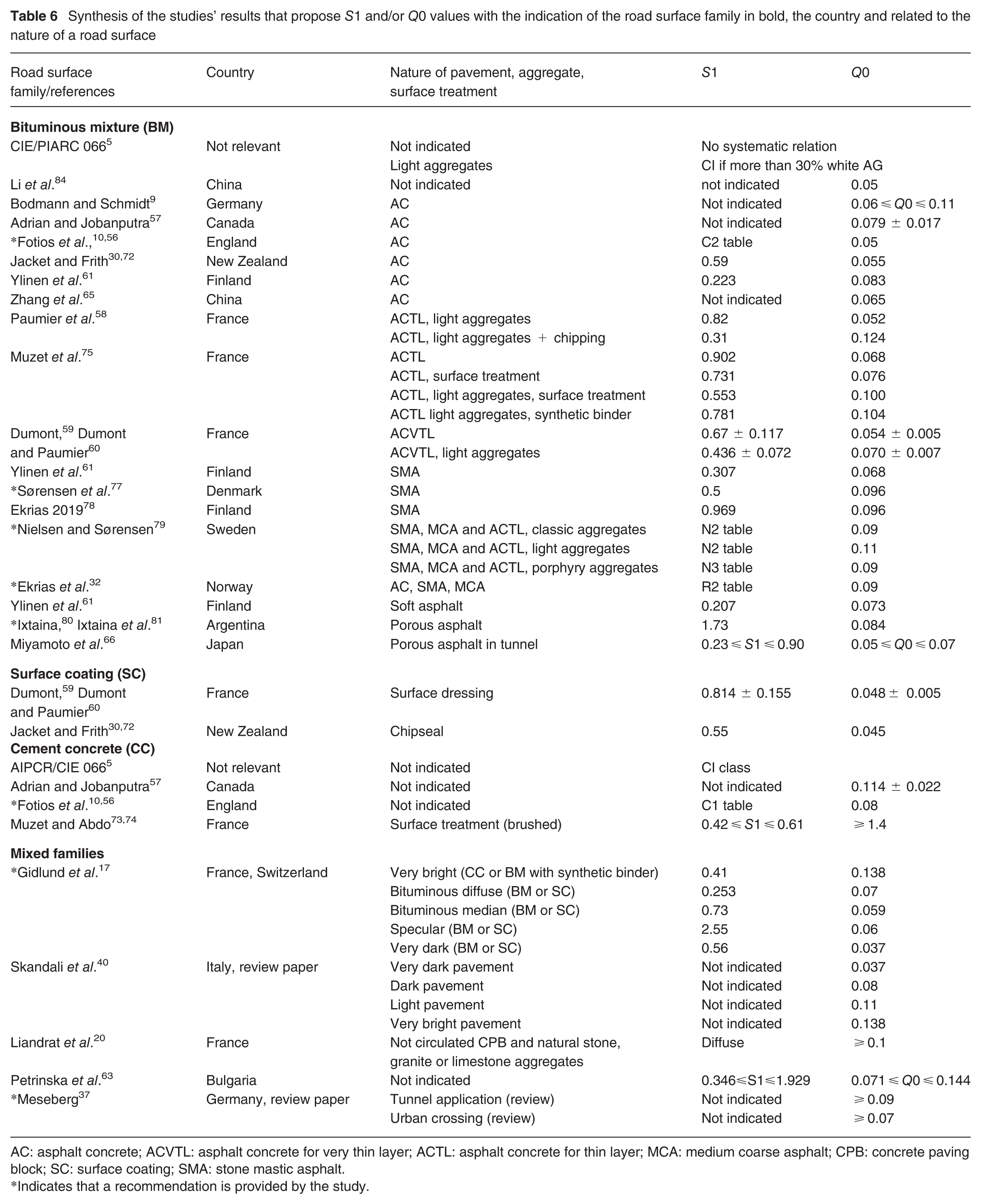
As few measurements are taken in practice and standard r-tables are generally still used, as shown in Table 1, our literature review also addressed this specific issue of their representativeness. Table 6 summarises the results of studies conducted worldwide, classified by the nature of the road surface. If the author also provides a recommendation (change requested on a standard r-table or proposal for another r-table), it is indicated by an asterisk. This table highlights both the high variability of measurement results and the predominance of studies conducted on bituminous mixtures.
Synthesis of the studies’ results that propose S1 and/or Q0 values with the indication of the road surface family in bold, the country and related to the nature of a road surface
AC: asphalt concrete; ACVTL: asphalt concrete for very thin layer; ACTL: asphalt concrete for thin layer; MCA: medium coarse asphalt; CPB: concrete paving block; SC: surface coating; SMA: stone mastic asphalt.
Indicates that a recommendation is provided by the study.
Within the BM family, it is difficult to make conclusions based on the nature of the road surface, and there are significant differences between the countries where measurements were conducted. For some, the average luminance coefficients associated with standard r-tables are too high, and 0.06 or even 0.05 are recommended. This is the case for measurements taken in Asia (China, Japan),65,66,84 New Zealand30,72 and Central Europe (France, Switzerland, England).17,59,60,75 For others, particularly in Northern Europe (Sweden, Finland, Norway and Denmark),32,61,77–79 but also to a lesser extent in Canada, 57 Q0 is not high enough and 0.09 is recommended. With regard to specularity, here again, the results vary greatly, even for the same type of pavement measured in neighbouring countries. For example, for SMA, specularity is low, between 0.3 and 0.5 in Finland and Denmark,61,77 whereas it is 0.97 in Norway. 32 This variability is even more pronounced for porous asphalt, with extreme specularity in Argentina at 1.73.80,81 However, the Table 6 confirms once again that the use of light-coloured aggregates reduces specularity and increases Q0, regardless of the country.
Few studies have been conducted on surface coatings. However, whether for surface dressing in France59,60 or chip seal in New Zealand,30,72Q0 is very low, between 0.045 and 0.053. The specularity of chipseal (at 0.55) is lower than that of SD, but these results need to be consolidated with measurements taken in other countries.
For concrete, more measurements have been taken and the results are fairly consistent. Whether in the CIE 066 report, 5 in France,73,74 Switzerland, 17 England10,56 or Canada, 57 the behaviour is more diffuse and Q0 higher than the BMs in these countries.
Finally, the only study 20 carried out on the cement paving blocks and natural stones family highlighted diffuse behaviour and a Q0 greater than 0.1. These results, obtained in France on samples that had not been circulated, need to be consolidated.
The observed discrepancies may be explained by the different nature of roads used in the different countries, with some countries using more concrete pavements and others using light-coloured aggregates more systematically. These differences in Q0 observed between studies and countries would be less problematic if a scale-up with Q0 or Qd were conducted. Unfortunately, this is not a common practice because very few measurements are carried out. 17 This is why some countries recommend scaling standard r-tables by indicating the value of Q0 to be applied (see Table 1). Other scaling recommendations have also been made by certain authors, for example in England,10,56 Denmark, 77 Sweden, 79 Argentina,29,80–82 Norway, 32 Germany 37 and in the European Empir Surface project. 17 In the vast majority of cases, these recommendations have not been followed, as Table 1 clearly illustrates. It should be noted that most of these scaling requests were made following measurements of the global indicators Q0 and S1, for which the r-table was not available.
In studies where the entire r-table was measured, they showed that even the use of a scaled standard r-table is not sufficient for correct luminance dimensioning. This is because the shape of the solid can differ greatly from standard r-tables (see Figure 12). These results were obtained by comparison with standard and measured r-tables in Argentina,29,80–82 Bulgaria, 63 China, 65 Finland, 61 France,19,60,74 Germany 9 and Switzerland 17 as well as with lighting and visibility calculations.9,10,18,19,21,53,54,74 As the uniformity criteria of standard EN 13201, 7 are correlated with the shape of the photometric solid and in particular its specularity factor S1,11,14,21 this explains the problems of dimensioning lighting installations.
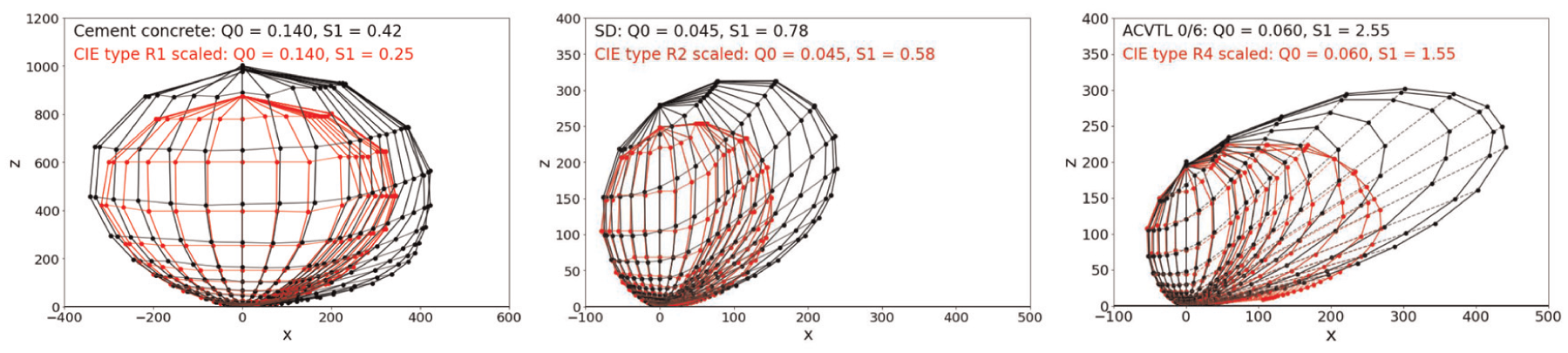
Representation of the r-tables of different types of surfaces aged of two years or more (in black) with the corresponding scaled CIE standard r-table (in red) with
In conclusion, for the 13 countries (Argentina, Bulgaria, Canada, China, Denmark, England, Finland, France, Germany, New Zealand, Norway, Sweden, Switzerland) in which studies on the representativeness of standard r-tables have been carried out, the consensus is that they are no longer suitable to represent the real light reflection capacity of road surfaces, which confirms the importance of either measurements or an update of the standard r-tables provided by the CIE.
6. Conclusion
6.1 Key learnings
This article reviewed current knowledge on the link between the composition of road surfaces and their ability to reflect light, for surfaces considered to be photometrically stabilised, that is, after two years of service. 23 The reflection properties of road surfaces depend on their family and nature, their formulation and the techniques associated with their application. The conclusions sometimes differ from one study to another, or depending on the country in which they were carried out. On this particular point, one of the difficulties may lie in the differences in terminology associated with the roads studied, and we hope that the proposed synthesis table (see Table 2) will be useful to researchers. The main trends identified in the literature are summarised below successively for each internal influencing factor studied.
Concerning aggregate type and size, it is very difficult to draw any conclusions because the studies are contradictory and seem to show that the effects are not systematic. For colour and level of lightness, the use of white or light-coloured aggregates leads to an increase in Q0 and a decrease in specularity, whatever the binder used. This effect is accentuated according to the proportion of white aggregates and when they are sprayed. Few studies have looked specifically at the impact of aggregate colour (other than white or clear) and it is not possible to draw any conclusions. Moreover, this effect is combined with the composition of the aggregate. The difference is more marked in terms of light versus dark than in terms of colour itself.
Regarding binder and surface treatment, a high proportion of bituminous binder tends to result in greater specularity of the road surface. Thus, initial surface treatments carried out on asphalt concretes with the aim of stripping the bitumen film systematically result in a reduction in specularity. The use of a lighter-coloured binder (cement or synthetic binder in particular) makes it possible to obtain a higher average luminance coefficient Q0 than with a conventional bituminous binder.
Concerning the texture of road surface, the general trend that ‘the rougher a surface is, the more it reflects light diffusely’ seems to hold true for road surfaces, although variations and exceptions exist depending on the measurement method and the composition of the road surface.
It was shown that even if road surfaces cannot be considered spectrally neutral, the variation in their spectral reflectance according to the family or nature of the road surface does not seem to provide the additional information needed to correctly design the luminance of a road lighting installation. In fact, in the visible range, spectral reflectance is uncorrelated with the photometric characteristics of the pavement for the standard observation geometry. In the current state of knowledge, the spectral properties of road surfaces seem much more important to consider when dealing with urban climatology issues, with the aim of limiting the urban heat island phenomenon.
More broadly, considering road surfaces in terms of families, it was confirmed that cement concrete is generally less specular and Q0 is higher than conventional bituminous mixture and surface coatings. Few data are available for natural stone and concrete paving blocks, even though these materials are widely used in urban environments. However, it seems that the characteristics of concrete paving blocks are close to those of cast-in-place concrete. For natural stone, this necessarily depends on the type of stone used, although it is possible to achieve high Q0 values for light-coloured aggregates. For surface dressing, Q0 is generally low. For bituminous mixtures, it does not seem possible to generalise due to the large variety of formulations that could have an impact on the photometric properties.
All these factors and the wide variety of trends observed demonstrate that the design of road lighting installations is an exercise that must be carried out advisedly to achieve the correct luminance levels by properly integrating the reflection properties of road surfaces. This requires a re-examination of the systematic use of standard r-tables, which are no longer representative of the diversity of current road techniques, particularly in urban areas.
6.2 Perspectives
A large amount of thought is currently being given to the design and operation of road lighting installations. In addition to its energy footprint, the impact of artificial light at night on the environment is becoming a concern in everyday practice. The maturity of LEDs means that we can now take the first steps towards greater sobriety, but there are still several decisive steps to be taken, 40 particularly that of taking better account of the reflection properties of road surfaces, because they are the surfaces that are going to be lit. This requires a profound change in practices and doctrine. Luminance must become the standard, and not just theoretically through illuminance sizing and random checks based on the use of current standard r-tables. In recent years, there has been genuine unanimity in reconsidering their systematic use, and this article provides tangible evidence of the reasons for this consensus. Ideally, this should be done by carrying out measurements on real road surfaces, or if not, by updating the standard r-tables to make them more representative of changes in road techniques over the last 50 years. The CIE is fully mobilised on this subject. The ongoing work of its technical committee 4-50 ‘Road Surface Characterisation for Lighting Applications’ 101 is aimed at updating CIE 066 5 and 144 6 technical reports in the light of studies, most of which have been presented here and in the second part of this literature review, 23 which examines the impact of external factors such as age, traffic and environmental conditions.
While waiting for the CIE standard r-tables to be updated in the near future, which will already be an interesting palliative if practices continue to evolve slowly, research in the field will have to focus on two major points. The first is a better anticipation of the reflection properties of a road surface on new construction sites. Correctly estimating these properties on the basis of the pavement’s formulation and its laying process would be an opportunity to avoid installations that are still too often oversized. This has already been proposed by the CIE030-2, 4 which associates surface characteristics with lighting classes. Updating the standard r-tables could therefore be accompanied by a similar exercise.
We would also like to emphasise that in an integrated approach to urban development, all these concerns go beyond the needs of lighting alone. Road surfaces and their optical properties also have an impact during the day, and make a significant contribution to urban climatology issues39,91,95,102 because of the differences in spectral reflectance depending on the materials used. In particular, the systematic literature review by Wong et al. 39 highlights the benefits of using light-coloured aggregates or adding light-coloured pigments to pavements. All this suggests the need for more cross-disciplinary research, both within local authority departments and between companies in the relevant fields. Meeting the challenges of climate change will necessarily require integrated action.
Footnotes
Appendices
Appendix B: Description of different types of initial surface treatment
Description of some of the classical initial surface treatment with pictures on Figure B1:
Appendix C: Extract of CIE 030.2 report that proposes approximate designation of road surfaces into standard road classes
Declaration of conflicting interests
The authors declared no potential conflicts of interest with respect to the research, authorship, and/or publication of this article.
Funding
The authors disclosed receipt of the following financial support for the research, authorship, and/or publication of this article: This research was in part funded by the French National Research Agency under the REFLECTIVITY project: ANR-22-CE22-0006.
