



Abstract
As videogames become a popular medium for architectural visualisation, there is a growing need for knowledge transfer from videogame design to architecture. Light is one of the essential and active elements of game development, adding aesthetic, atmospheric and materialistic simulacra by replicating physical light. Despite the central role of lighting as a visual characteristic in both fields, the intersection of its influence across these fields remains underexplored. This transdisciplinary study explores the technical and aesthetic roles of light and dark in architecture and the simulated illumination counterparts in videogames. Adopting a comparative approach, this paper delineates light’s experiential language across different case studies, detailing how real-time lighting is a tool and a key building block in game worlds. It highlights how spatial representations in videogames not only seek to create realistic imagery but also influence spatial perception and experience – a key in which to visualise and experience these spatial representations is the use of light. The research on simulated illumination was developed through interviewing three experts in the field of videogames, and analysis of these interviews through three categories of lighting schemes that are shared across the architectural and videogame fields. By identifying and problematising theoretical and practical connections between the two fields, this paper outlines new opportunities for cross-disciplinary innovation. It aims to create a transdisciplinary skillset that can allow architects and interior designers to enhance their respective digital art-forms.
1. Introduction
Architecture is a profession dedicated to shaping space, which has long dealt with the existential dimensions of experiencing light. 1 Holl asserts, ‘The perceptual spirit and metaphysical strength of architecture are driven by the quality of light and shadow’. 2 Just as in physical environments, light and dark are fundamental elements in architectural imagery, contributing to visual understanding and atmospheric nuances. Lighting schemes in architectural visualisations create expressive spaces that engage with our pre-existing and intuitive ability to perceive.
Among different media that architects use to visualise their design ideas, videogames are becoming increasingly prevalent, alongside other industry CAD tools.3–5 With the continual development of game engines and the advent of real-time rendering techniques, visualisation artists, architects and game designers are able to achieve a dynamic lighting design that accurately simulates real-world behaviours of light and shadow within a digital space. Videogame designers have simultaneously pushed their engines to better the aesthetic appeal of their creative works and utilised the same lighting functionality in architecture as a tool to assist and guide interactivity. While a growing number of academic and professional discussions have been carried out regarding the relationship between the two disciplines of videogame design and architecture,6–11 research on technical and aesthetic aspects of simulated illumination is an underexplored topic between the two domains.
This paper investigates the ties between architecture and videogame lighting. It initiates a transdisciplinary dialogue necessary for the cross-functional evolution of both fields and aims to elucidate how game designers leverage light as a tool to evoke emotional responses and guide interactive experiences within virtual realms. Interactivity here includes exploration, navigation and manipulation of digital spaces and objects within them. By understanding light as a primary contributor to perception and experience, this transdisciplinary knowledge allows architects and interior designers to subtly enrich their interactive worldbuilding and engaging digital narratives.
2. Method
A qualitative and comparative approach was used to examine lighting schemes across architectural and videogame examples. To enhance the comprehension of videogame lighting design, this paper draws insights from semi-structured online interviews with professionals intimately familiar with the topic of simulated illumination, including Sergei Karmalsky, the art director of Metro Exodus (4A Games, 2019, Kyiv, Ukraine), Stuart Macdonald, the worldbuilding director of Control (Remedy Entertainment, 2019, Espoo, Finland), and Alex Battaglia, the technology journalist from Digital Foundry. Karmalsky and Macdonald contribute their artistic lighting expertise in videogame worldbuilding, and Battaglia’s knowledge in the historical and modern-day technological aspects of videogame lighting enriches the discourse with first-hand insights spanning across different genres.
Metro Exodus and Control, the primary case studies in this paper, are critically acclaimed videogames recognised for their stunning, realistic environments, which were achieved through the use of simulated illumination. By refining the original Metro Exodus (2019), Metro Exodus Enhanced Edition (2021) is arguably one of the most radical departures from legacy lighting solutions compared to its contemporaries. Using advanced methods of global illumination (GI), the enhanced version contains all the original content, with an in-game setting that toggles between both lighting solutions. This makes the game extremely suitable for qualitative analysis, as identical test scenarios are implicitly linked with only the rendering technique being changed in the A–B comparison. Conversely, Control’s art team wove the technical advancements of GI into the game’s thematic structures to find its language that creates a simultaneously mundane and occult world. This design philosophy was guided by Macdonald, whose background in architecture enabled the foundational integration of architectural lighting principles into worldbuilding. Control consequently offers a unique opportunity for analysis in this regard.
The examination of the first-hand knowledge from interviews is broken into two stages. Initial review in the ‘background’ section examines technical and aesthetic aspects of simulated illumination qualitatively to set up a framework for discussion. These findings are then discussed with respect to three broad lighting categories shared between physical architectural spaces and game engines: directional lighting schemes, indirect lighting and ornamental lighting effects. Through this categorisation, the study analyses cognitive aspects of lighting as a phenomenon for perception and interactivity that can elevate architectural representations of spaces.
3. Background
This review section aims to establish a framework for analysing lighting in videogame environments by separating technical and aesthetic components of this lighting for the sake of simplicity. It first focuses on the technical foundations of GI as an advanced method for simulating lighting used in both case studies for constructing realistic, and occasionally, dynamic spaces. It then reviews the current discussion of simulated illumination through key figures in architectural lighting design and the theories they present.
3.1 Technical aspects of simulated illumination
Simulating real-world light behaviour in videogames is a complex and computationally expensive process. One key mathematical model enabling this process is GI. This model replicates real lighting by simulating both direct and indirect light interactions in a virtual scene with an efficiency that makes it attainable with modern graphics hardware (Figure 1). Research on GI has spanned several decades, and it is now widely used to create believable computer-generated imagery.12–14 Specialised tools that are commonly used in architectural visualisations, including V-Ray, Enscape and Lumion, support or approximate GI to handle both direct and indirect illumination to achieve realistic lighting. V-Ray and Enscape are rendering plugins that integrate directly with visualisation software like 3ds Max: Autodesk, Revit: Autodesk and SketchUp: Trimble Inc., offering architects the means to evaluate lighting effects as part of the design workflow. Lumion: Act-3D, known for its ease of use and ability to quickly produce high-quality visualisations that approximate GI and atmospheric effects tailored for architectural presentations.
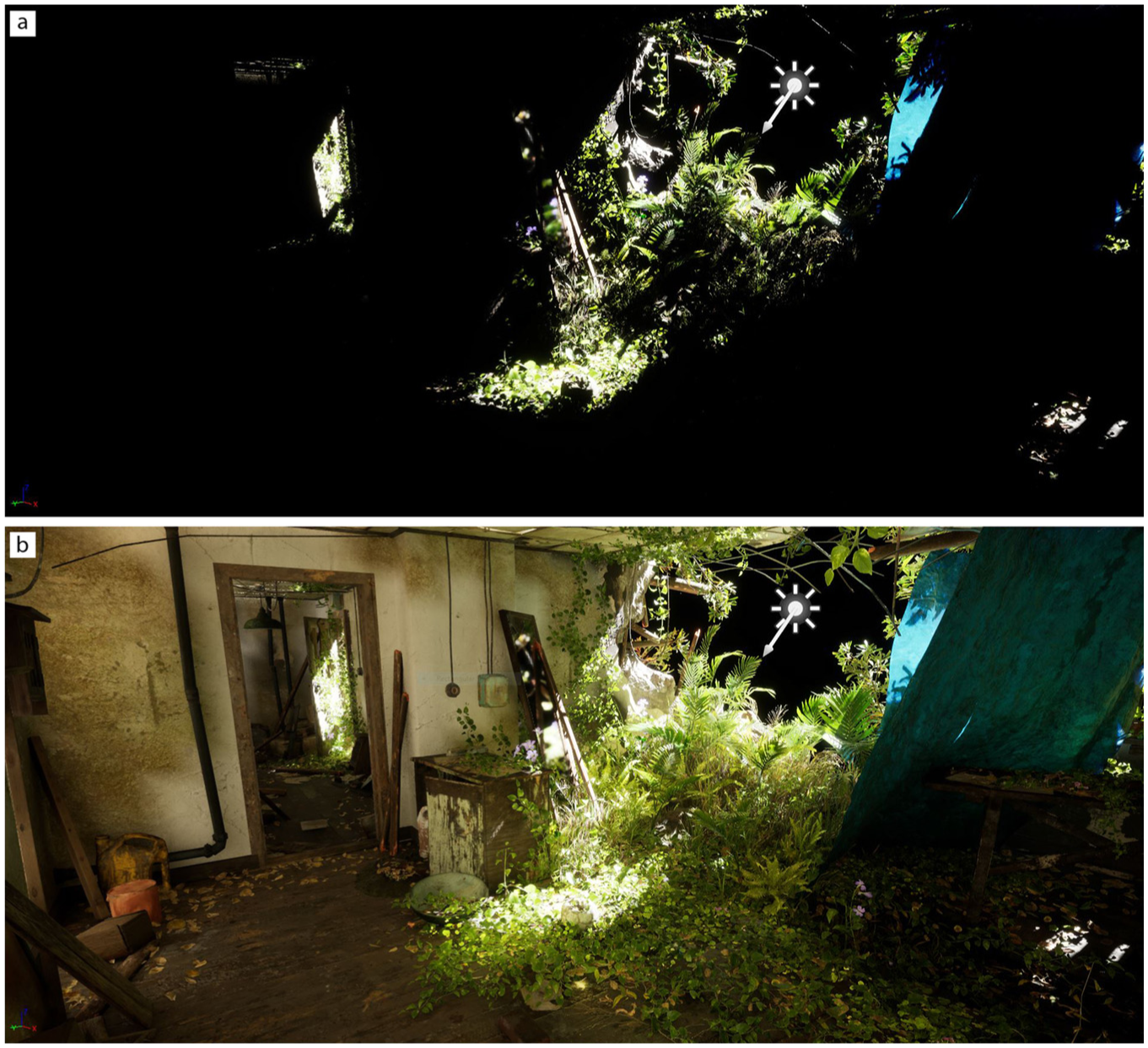
Illuminating the scene through the use of one directional light: (a) without Lumen as the built-in indirect light calculation for GI; (b) with Lumen; in Megascans Abandoned Apartment designed by Isac Crafoord, Unreal Engine 5.3; lighting test by the author
While earlier software achieved GI through offline rendering, modern solutions now integrate it in real-time as a built-in feature in platforms like Unreal Engine, Unity and CryEngine. These platforms, originally developed for videogame production, are now widely adopted by architects for dynamic lighting models. Such tools are suitable for immersive architectural walkthroughs and bridging the gap between architectural design and interactive digital experiences.
The GI model has evolved since its early mention in a 1979 paper by Whitted, where he discussed its use in large-scale rendered scenes.15,16 Following this early work, GI’s conceptualisation transitioned into a mainstream solution for achieving a holistic representation of light phenomena with a ‘one, simple do-it-all technique’. 17 Various algorithms implement GI across different software platforms; for example, ray tracing, path tracing, rasterisation, shadow mapping or probe-based methods. These algorithms assume the position of the camera to calculate penumbra, reflection, refraction, shadow quality, colour, brightness, darkness and surface glossiness, culminating in a hyper-realistic render (Figure 2).
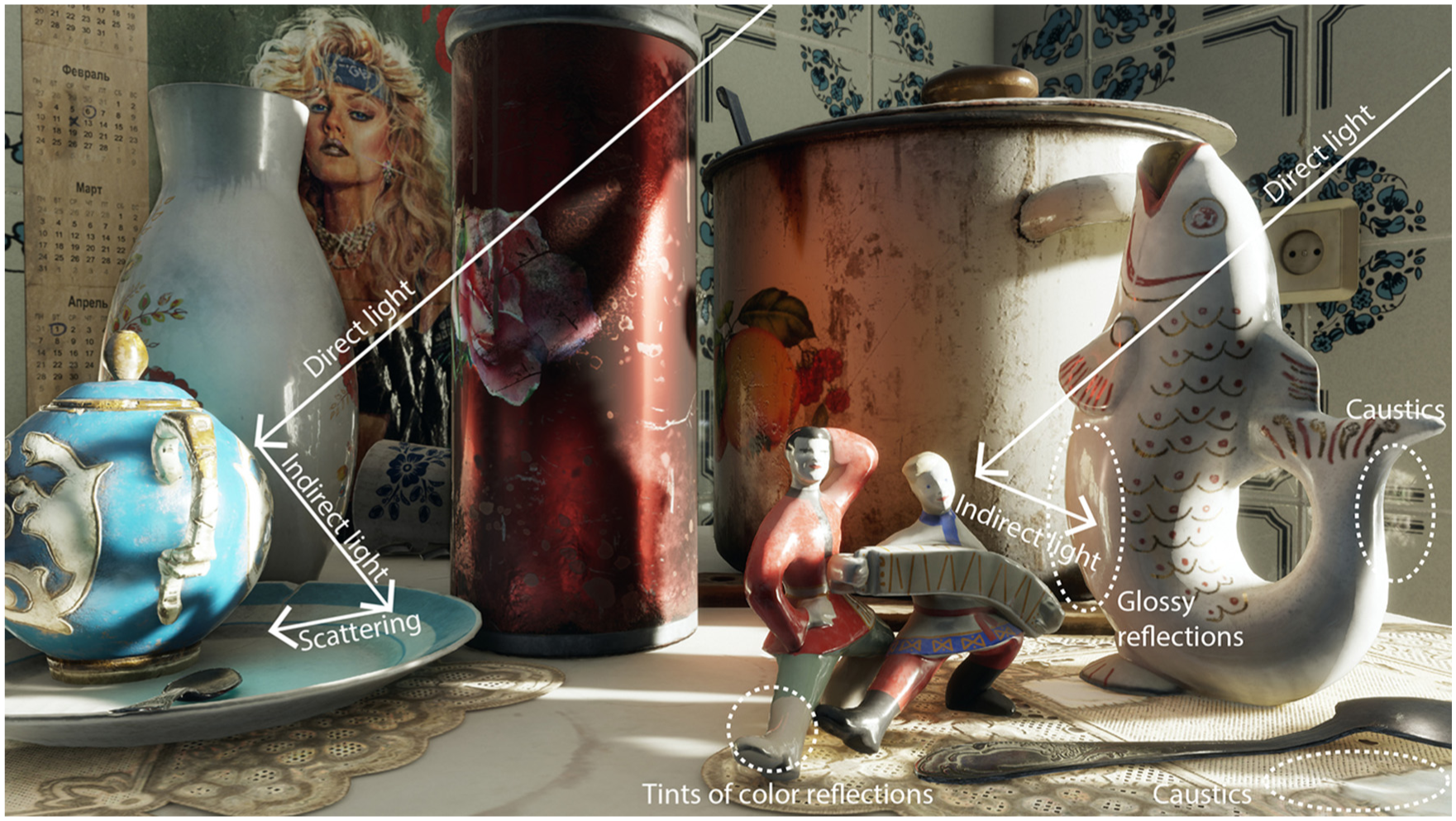
Light properties and the use of ray-traced GI (RTGI) to create a hyper-realistic render. The arrows illustrate the initial directional light rays and demonstrate how, through computational simulation, they reflect and scatter in a scene to generate effects such as surface glossiness, caustics and colour bleeding; image credit Deep Silver and 4A Games
Advanced methods of GI also contribute functionally to dynamic and responsive lighting conditions. Historically, two and three-dimensional videogames sought to emulate the output of GI by manually drawing pixels and rendering pre-calculated mappings on surfaces to emulate diffused lighting in a scene. 18 These environments are covered in a static veneer that does not respond to any changes within the world, such as objects in motion, the time of day or player movements from dim to brightly illuminated spaces. However, to achieve realistic images, interactive spaces require dynamic lighting. Real-time lighting through GI allows for production-ready lighting conditions that adapt to external changes, creating greater fidelity and realism at the core of development rather than using it solely as a finishing touch.
Real-time methods of GI contribute to eliminating manual manipulations of material properties and illumination features to shape the visual mood of a game’s scene. Karmalsky explained that legacy lighting approaches in Metro Exodus required manual lighting design. For instance, to reflect red tints from a rubber coating on the floor, designers would place invisible sources of red light individually, creating the illusion of reflected light. While being an artistic endeavour, these approaches are time-consuming and unreliable. With different team members working under varying time constraints, it is often difficult to ensure that lighting is consistent across all scenes (Karmalsky, personal oral communication, 6 January 2025). In Metro Exodus Enhanced Edition, while the team kept the primary direct light sources, they decommissioned ‘fake’ indirect ones and replaced them with real-time lighting calculations. This transition resulted in a more consistent and accurate indirect lighting with reflections, soft shadows and proper occlusion based on distance and depth (Figure 3).
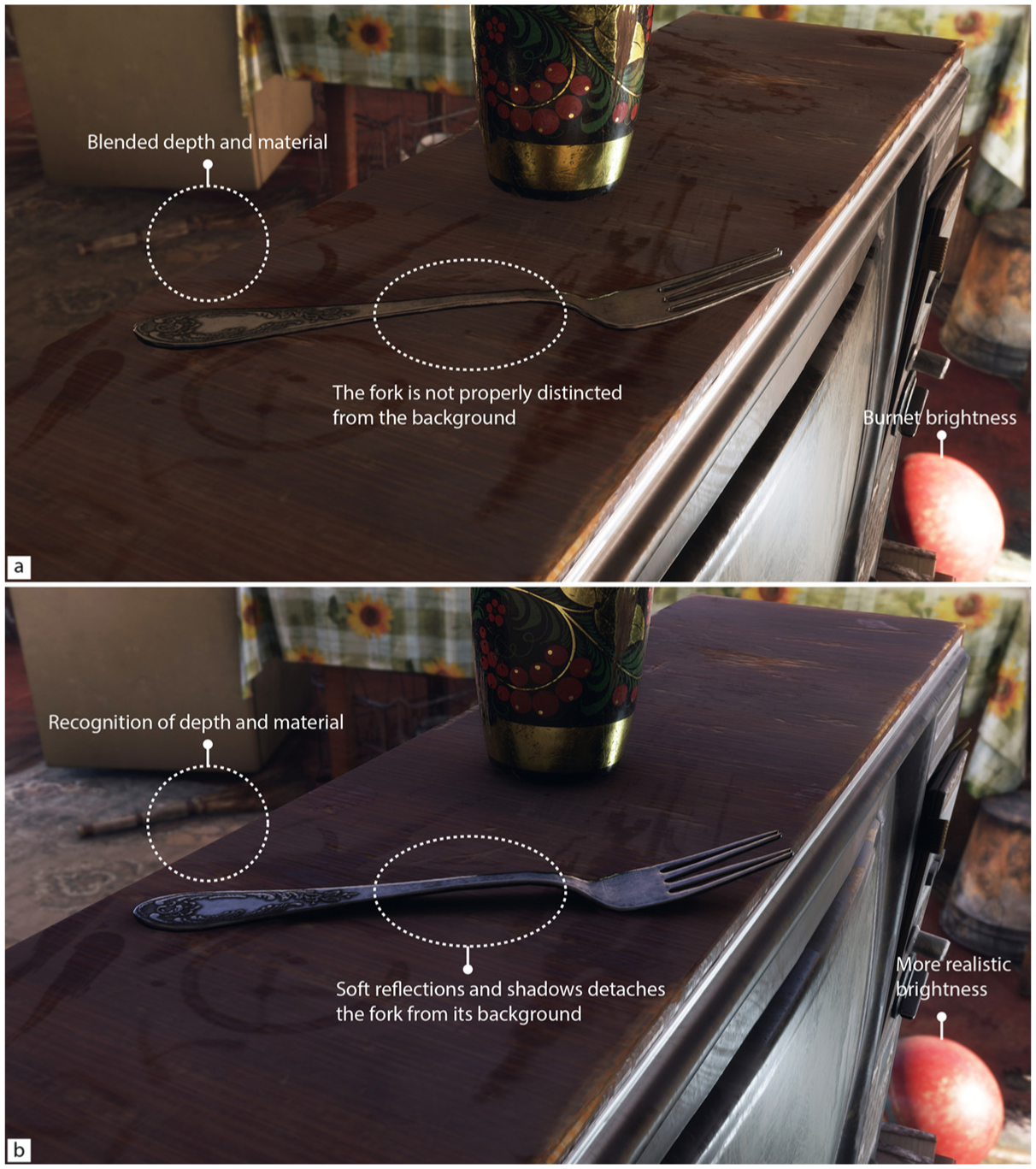
Transitions of the lighting algorithm from (a) Metro Exodus and (b) Metro Exodus Enhanced Edition; image credit Deep Silver and 4A Games
Battaglia asserts that while technical limitations previously associated with interactive lighting have now effectively been addressed, dynamic and real-time approaches bring their own complexities to design processes (Battaglia, personal oral communication, 6 March 2024). With calculations being time-consuming and resource-intensive, game designers attempt to optimise the purely dynamic lighting solutions. Therefore, developers opt for a more controlled lighting scheme by blending static and dynamic solutions to employ pre-calculated (baked) and real-time illumination. In this way, not all parts of videogame spaces need to be dynamically lit. Instead, this lighting is selectively applied to areas that require dynamism or must respond to player actions (Figure 4).
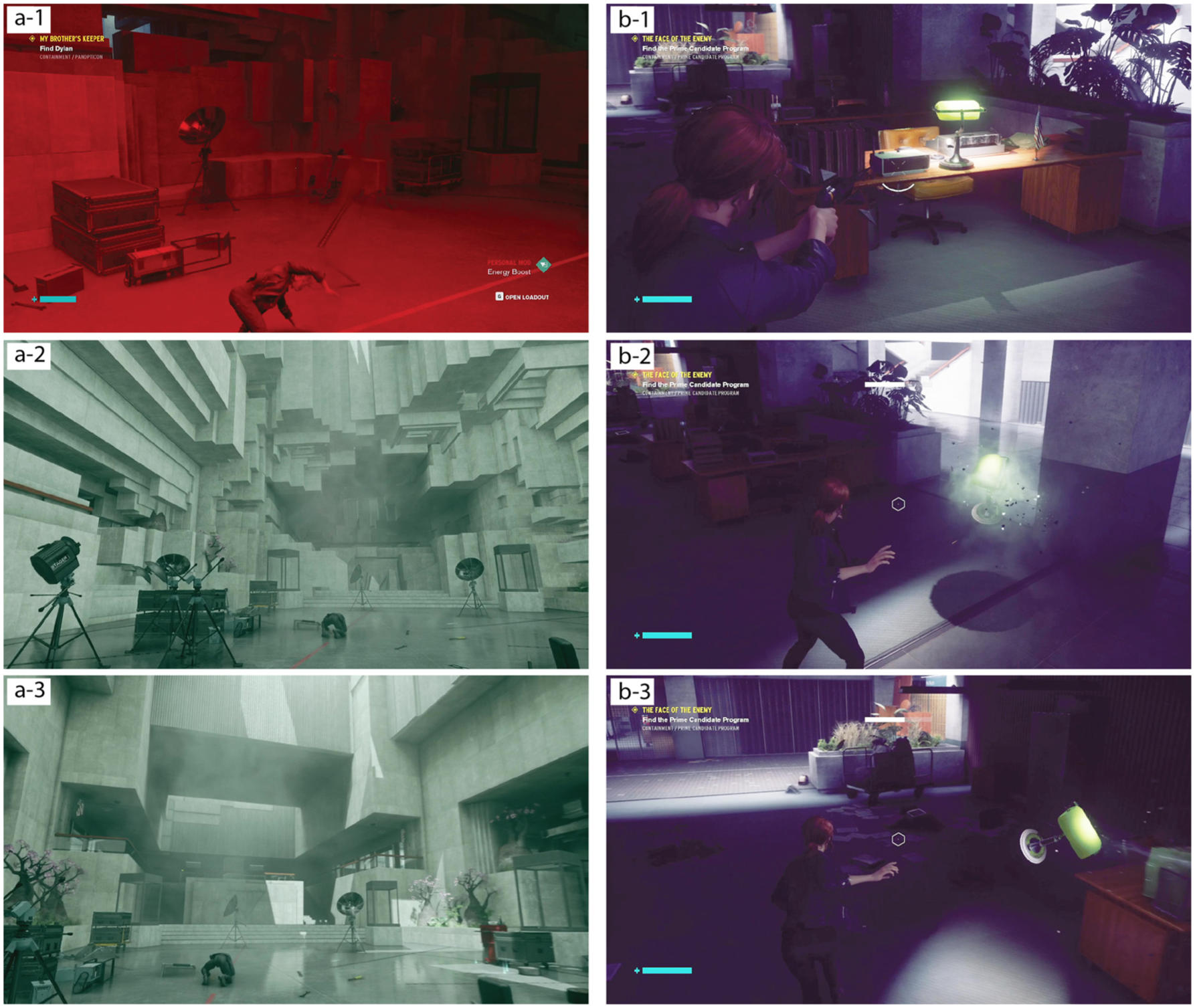
(a) Pre-calculated (baked) lighting in a cleansing scene: (a-1) the baked red ambient lighting corresponds to the New Weird narrative storyline, (a-2) the player changes the ambient light in a cleansing action, here real-time lighting accurately portrays the complexities of form-shifting as a scripted cut-scene, (a-3) as the scene becomes more stable and static, the game scene returns to its baked calculation from the light sources; (b) combination of baked and dynamic lighting in Control, (b-1) preloaded baked light cast from the lamp, (b-2) upon lifting the lamp, lighting system transitions to a dynamic one, (b-3) real-time lighting simulation continues according to the movements of the player; screenshots by the author; footage: https://youtube/zwh9XRThOM4, image credit Remedy Entertainment
Unlike all-static lighting in earlier videogames, dynamic illumination ‘privileges interaction, emotion, and dramatic content’ by engaging our cognitive perception of real spaces. 19 Effective lighting management – through the strategic use of direct and indirect light, the interactions of their properties with forms, surfaces and materials and the functional application of dynamic lighting – ensures consistent visual output across all scenes and sustains the intended experience.
3.2 Aesthetics of simulated illumination
Beyond being a technical tool for visualisation, simulated illumination serves aesthetic and atmospheric purposes to formulate spatial experiences. Videogame designers utilise the same lighting strategies applied in cinema, animation and theatre to depict time, evoke dramatic emotions, create depth, direct sight and reveal qualities of imaginary scenarios.20,21 While in these fields lighting is typically designed around predetermined camera angles to establish a fixed visual narrative, the player’s control over the dynamic camera in videogames makes the task of virtual illumination closely resemble architectural lighting design. 20 This presents a valuable opportunity for architects to understand how techniques and theories of simulated illumination overlap with those in architectural lighting to support interactivity.
Videogame scholars have advocated for a multidisciplinary approach, grounded in aesthetic theory and cognition, to better understand how light shapes emotional responses. Focusing on the psychological effects of lighting, they argue that dynamic patterns of light, such as shifts in colour, brightness and saturation, intensify player tension.19,22 In addition to its emotional impact, rendering virtual environments with intense warm and cool colour illumination can lead to distinct differences in gameplay performance. 23 Consequently, lighting qualities in games do not only define the style and visibility; they significantly contribute to determine the interactive narrative and player actions.22,24
Although videogame scholars examine the emotional effects of lighting on interactivity and game narrative, they typically do not specify the precise lighting qualities that generate these effects, nor their integration with environmental design and worldbuilding. Therefore, a framework categorising lighting qualities is crucial for analysing the intentional creation of unconscious interactive effects, one that manifests in both architecture and videogames. While architectural discourse, particularly phenomenological approaches to spatial design, acknowledges light’s role in shaping spatial atmospheres, it does not offer a dedicated framework for examining lighting itself.25–27 This analysis, therefore, draws on perspectives from architectural lighting designers, where lighting qualities are systematically categorised to articulate their effects.
In their theories of illumination, architectural lighting designers discuss the dual role of light, emphasising both functional necessity and atmospheric creation as key considerations to control spatial perception. Lighting design influences spatial experience by communicating a message about the cultural and contextual setting of a space. 28 Boyce, light researcher and author of Human factors in lighting (2003), argues that every lighting scheme conveys meaning beyond its functional role, shaping how people perceive and emotionally respond to their environments. This meaning is interpreted through individual cultural and personal lenses, framing lighting as a technical element and a communicative one that profoundly shapes spatial perception. Boyce critiques the tendency within lighting practice to rely heavily on quantifiable metrics, often at the expense of experiential qualities, including perceived brightness and spatial legibility. He consistently recommends a design approach that addresses both visual performance and psychological response, emphasising lighting’s role in defining atmosphere, mood and spatial usability. Similarly, light designer and researcher, Dugar warns that lighting designers frequently apply standardised solutions across different building types without considering their unique experiential or cultural meanings, where users may interpret the same lighting in vastly different ways depending on their backgrounds. 29 This marks the complexity of lighting design as both a technical and interpretive act, where atmosphere and user experience are shaped by context and perception. In this sense, lighting becomes a kind of spatial language: an expressive medium through which users come to understand space, emotion and mood.
Lighting designers form emotive relationships between inhabitants of a space and architecture through expressive lighting design. Drawing from poetic principles, Dugar identifies emotiveness, desirableness, timelessness, bounteousness and suppleness as key qualities through which lighting evokes emotional responses and enhances spatial experiences. 29 He advocates that designers employ their expertise in applying lighting principles to deliberately attain such evocative qualities. Emotiveness captures the expressive power of lighting by emulating the attributes of nature and fostering a sense of connection and well-being. In contrast, desirableness addresses the role of light in satisfying comfort by considering personal and cultural aspirations. Timelessness bridges past and present. It emerges when contemporary lighting technologies are subtly incorporated with traditional techniques, allowing an emotional connection with historical contexts. Lighting thus becomes an expressive medium that resonates with historical continuity and cultural memory. While these first three qualities focus on emotional, cultural and temporal depth, bounteousness shifts attention to sustainability and long-term value. Finally, suppleness enables spaces to adapt fluidly to different activities by determining the capacity of lighting conditions that support agency and psychological ease. Together, these qualities highlight the multidimensional nature of lighting design and underscore the crucial role of illumination for crafting experiential richness across time and context.
While technologies and design approaches have evolved, lighting research continues to engage with these enduring experiential themes, aiming not only for functional outcomes but also for lighting that can have ‘a profound effect in creating engaging, exciting, pleasant or sombre environments’. 30 In order to understand how lighting designers shape both the function and atmosphere of a space, it is essential to outline the frameworks that inform their work. Karlen and Benya, for instance, propose a layered approach to lighting design, distinguishing four layers of illumination, including ambient, task, focal and decorative. 31 Their classification examines the visual and perceptual phenomena of lighting through task performance, visual comfort and decorative purposes, intentionally combined to achieve a desired outcome. Similarly, but with a more metaphorical and poetic analysis, Kelly introduced three ‘light energy impacts’, including focal glow, ambient luminescence and play of brilliants. 32 In his theoretical framework, light as a means of conceiving and experiencing space takes precedence over its functional or decorative purposes, adding critical factors for ideal lighting design.33,34
These frameworks underscore the practical and experiential dimensions of lighting design, being relevant to both physical built environments and digital counterparts. For example, Kelly’s ‘focal glow’ and Karlen and Benya’s ‘task’ and ‘focal’ layers all emphasise directional lighting that is the primary consideration in every virtual space in digital software for realistic lighting design. In contrast, ‘ambient luminescence’ and ‘ambient layer’ describe a uniform, indirect propagation of light that softly fills a space. Lastly, ‘play of brilliants’ and the ‘decorative layer’ refer to the dynamic interplay of light with materials and surfaces, producing stylised and aesthetic effects that sparkle within architectural and digital contexts. By integrating these categorisations with technical aspects of lighting discussed earlier, the framework developed in this paper explores lighting effects based on the behaviour of light rays and their interactions in the virtual scene: direct lighting, indirect illumination and ornamental lighting effects.
4. Lighting for interactivity in spatial representations
Based on the categorisation outlined in the previous section, this part analyses light and dark’s experiential influences that help facilitate a sense of immersion in realistic spaces in videogames.
4.1 Direct lighting schemes
As the name suggests, direct lighting is defined as a light source illuminating a target with no obstructions between these two points. This presents itself as a spotlight, creating extreme contrast between the subject targeted and its surroundings that fall into shadow. Kelly’s focal glow that ‘separates the important from the unimportant’ and Karlen and Benya’s task and focal layers that ‘illuminate features’ fall into this categorical lighting technique.31,32
In architectural design, directional lighting schemes are about controlling darkness as much as managing light. They employ the binary visuals of light and dark, but also extend beyond simple contrast, being used as a material in spatial design. Architects manipulate spatial perception through strategic openings and careful orchestration of natural light and shadow, directing light to form patterns or highlighting spatial details. For instance, the woven bamboo façade of Villa Eila casts captivating shadow patterns that add a delicate touch to the interior hallway (Figure 5(a)). Additionally, architects explore the immateriality of light by accentuating form and texture, activating a deeper reading of spatial features. In The Church of Light, a single cruciform cut-out in the east wall directs the morning sunlight. This design emphasises the architectural form and heightens the light’s dramatic effect (Figure 5(b)). In arcades, on the other hand, the rhythmic arrangement of columns alternates light and shadow, guiding movements and creating a dynamic space (Figure 5(c)). Directional lighting effects establish spatial hierarchies by emphasising gradients to prioritise one area over another. In the Legorreta House, for example, the nuanced use of colour, light and shadow in its cubic form creates dominant viewpoints by spotlighting a zone (Figure 5(d)).
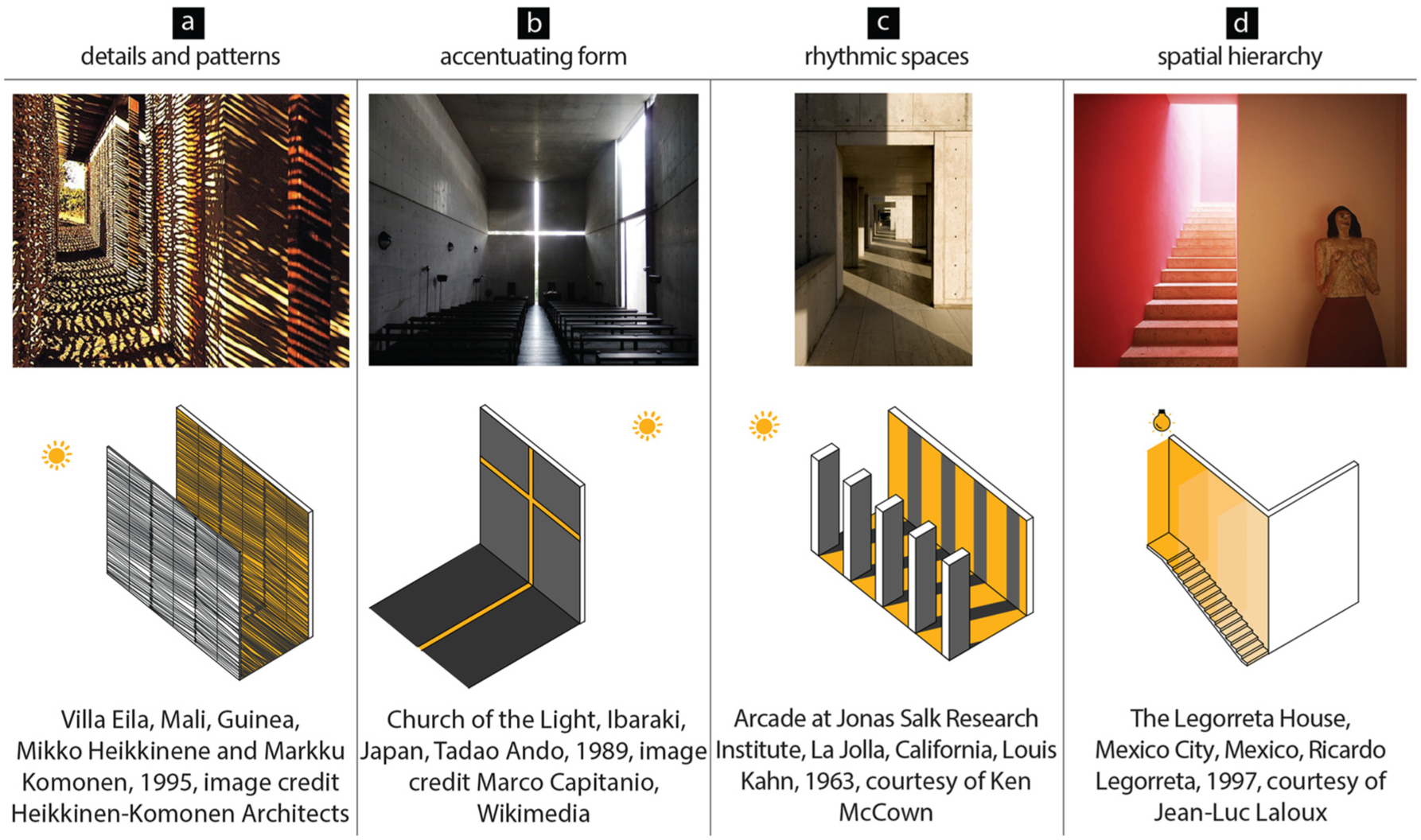
Architects use directional light as a design material, creating striking contrasts between light and dark: (a) Villa Eila, Mali, Guinea, Mikko Heikkinene and Markku Komonen, 1995, image credit Heikkinen-Komonen Architects, (b) Church of the Light, Ibaraki, Japan, Tadao Ando, 1989, image credit Marco Capitanio, Wikimedia, (c) Arcade at Jonas Salk Research Institute, La Jolla, California, Louis Kahn, 1963, courtesy of Ken McCown, and (d) The Legorreta House, Mexico City, Mexico, Ricardo Legorreta, 1997, courtesy of Jean-Luc Laloux
Directional light is primarily used to direct an individual’s sight by creating a point to focus on. This notion of controlling gaze is comparable to lighting schemes in theatre, where meticulous manipulation of lighting forces the viewer’s attention to demark key elements for a ‘selective visibility’. 35 Videogames also use this effect as a functional tool for steering. 19 Through directional lighting schemes, game designers highlight an object, space or building to make it stand out as a point-of-interest to draw attention and guide navigation.
Besides controlling sight, videogame designers embed extreme lighting conditions as a primary game mechanism to instil a strong emotional response; typically, one of unease or fear. Casting harsh, direct light onto walls, floors or other surfaces creates a sense of confinement and eeriness. These binary visuals simultaneously stimulate players’ imagination to fill in the gaps of missing information in the blackout areas. Both earlier games prior to advanced GI and modern titles use this lighting technique to convey such emotions, but to differing extents and outcomes.
The exemplary videogame Doom 3 (id Software, Richardson, TX, USA, 2004) shapes its gameplay around the stark interplay of binary contrast. Given the technological constraints of its era, the game relied solely on pure light and perfect shadow, which actively impacted players’ interactions, influencing their behaviours and gameplay style. This lighting design approach allows designers to experiment with creating rhythmic patterns in the environment to inconsistently hide surprises, resulting in players experiencing jump-scares erratically throughout the game. Therefore, players tend to approach each corner tentatively, even when there is no immediate threat, but they are emotionally charged to believe there could be. Battaglia explained in conversation that due to Doom’s pervasive darkness and the physical limitations of old CRT monitors, most players could only play the game in a darkened room (Battaglia, personal oral communication, 6 March 2024). This further heightened the atmospheric immersion of the game’s darkness and consolidated the designer’s ability to influence a player without direct control.
Although this use of lighting can be effective in appropriate genres to instil fear, contemporary games are less inclined to utilise this approach even within that same genre. Battaglia asserts that an old adage from film applies aptly to videogames here: the use of well-lit environments tends to diminish the fear factor, as heightened visibility allows for clearer identification, potentially reducing the sense of threat. Byles, the creative director of Until Dawn (Supermassive Games, 2015, Guildford, United Kingdom), agrees that creating a more refined emotional response than base fear caused difficulty where the ‘challenge for us was to get that same feel as film, to create a level of fear without just darkening everything down’. 36
The action-adventure videogame Control adopts a distinct approach to create a sense of unease, without simply dimming the surroundings. This game represents a cosmic horror genre through well-lit spaces, while in many scenes, strong directional light provides a visual anchor. In contrast to Doom, Control’s use of direct light is subtler, relying less on creating jump-scares through sharp delineation between light and shadow. Instead, game designers focus on evoking dramatic feelings by directing vibrant, coloured lighting and utilising its reflections on surfaces. Through GI, bounces of light rays allow the virtual space to be illuminated effectively by a single, powerful, directional light source while implementing a range of light and shadow gradients. This blending harmonises with the architectural layout and how it is rendered to convey environmental expression, mood and create rhythm in the game world during gameplay with different gradients of light (Figure 6).
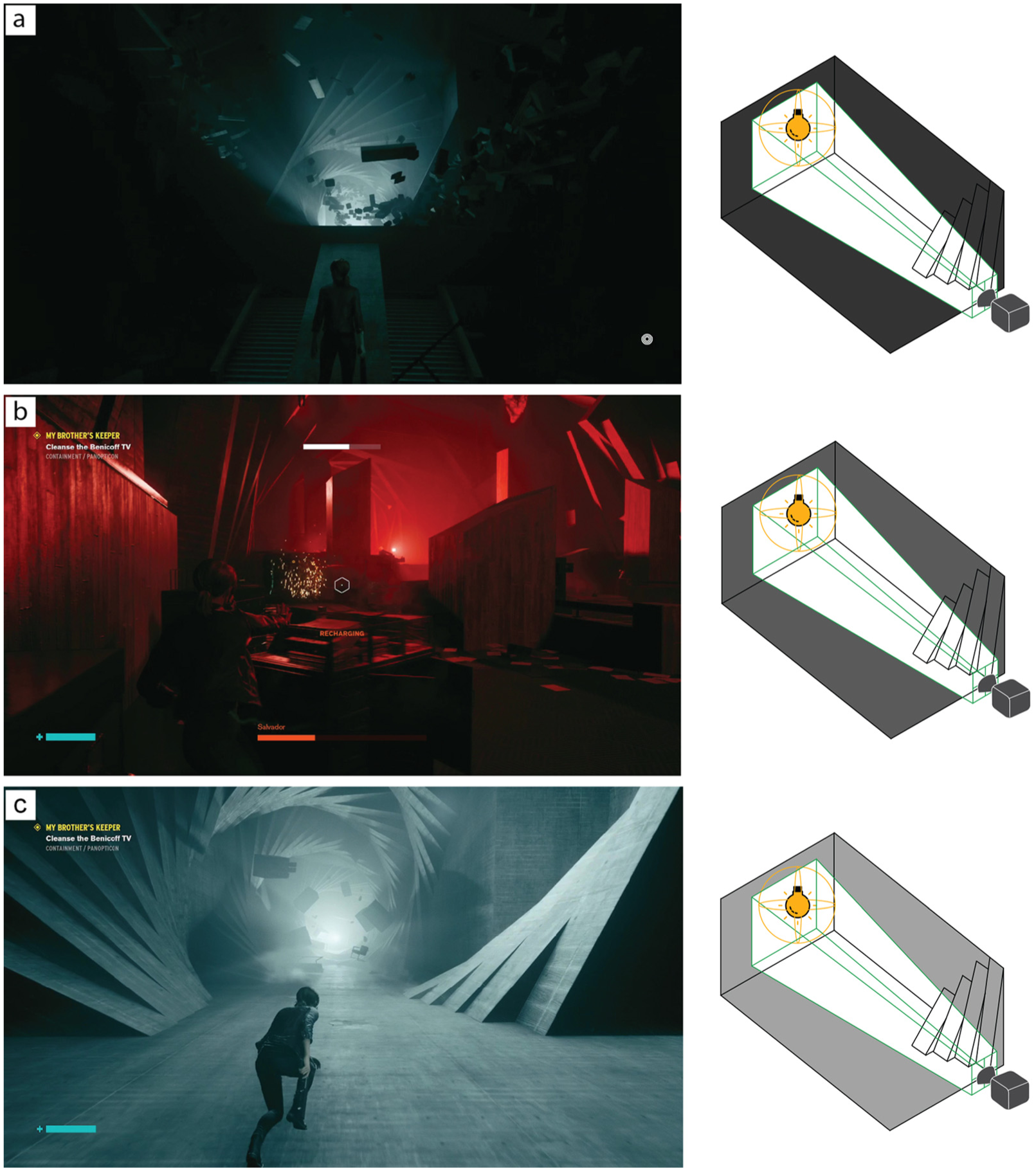
Gradients of stark light and dark from (a) to (c) reveal more spatial details in Control to create a visually expressive scene; screenshots by the author, image credit Remedy Entertainment
While infusing different colours into the direct light evokes sensory and performative qualities, as Knez and Niedenthal argue, the technique can define the environment that alludes to the narrative and events unfolding there. 23 Macdonald explained that the red light, inspired by the latest version of Suspiria (1977), aligns with the lore and serves as a shorthand for the supernatural, giving an otherworldly look to combat scenes that involve abnormal forces to stand in contrast to the naturalistic reality in that world (Macdonald, personal oral communication, 19 February 2024). In Control, different tints of colour light up each zone to represent a version of mundane or para-natural spaces which is trained into the player, allowing sudden shifts between these tints to act as a passively understood warning to the player of the upcoming encounter.
Direct light is a tool used by creators primarily to unobtrusively steer participants’ attentions and consequential pathfinding in their exploration of a space, yet it has evolved to guide an individual’s emotional sensibilities and encourage a designed connection to their experience.
4.2 Indirect illumination
Indirect illumination differs from the previously discussed direct lighting, which travels unimpeded from source to target, instead characteristically being diffused through a medium or reflected from another surface before reaching its destination. It is ambient light as defined by Kelly, Karlen and Benya, where its ultimate functionality is to ‘produce shadowless illumination’ and make everything visible hierarchically equal.31,32 In its abstraction, the GI rendering technique refers to indirect lighting schemes that create more realistic game scenes by naturally revealing more explicit environmental information. This notion in real-time software provides general illumination of the surroundings that makes everything visible and facilitates uniform activity in space.
In architecture, indirect illumination offers smooth, even lighting that minimises shadows and ensures objects and people in the space are readily visible. This lighting scheme diverges from the binary nature of directional light, instead creating a flat, consistent spread that softens dynamics to aid with the clarity of a space. Architects produce this practically by strategically designing forms, positioning openings and using materials that diffuse light. For example, the Menil Collection’s design incorporates a unique roof system that arranges glass and ferro-cement panels that bathe the space in soft illumination with natural light, an outcome typically not pursued by museums, as greater control is generally provided by artificial illumination (Figure 7(a)). The Bahá’í Temple in Chile employs light as a central design element in conjunction with translucent marble cladding. These were chosen as the interior materials to generate a glowing diffusion throughout the space that creates a serene and spiritual atmosphere (Figure 7(b)). Elsewhere, the iconic Breuer building employed a lighting strategy popular in the luminous ceiling concept of the 1960s and 1970s. Its lobby space features a textured ceiling filled with light bulbs and artificial light fixtures, designed to provide uniform illumination (Figure 7(c)).
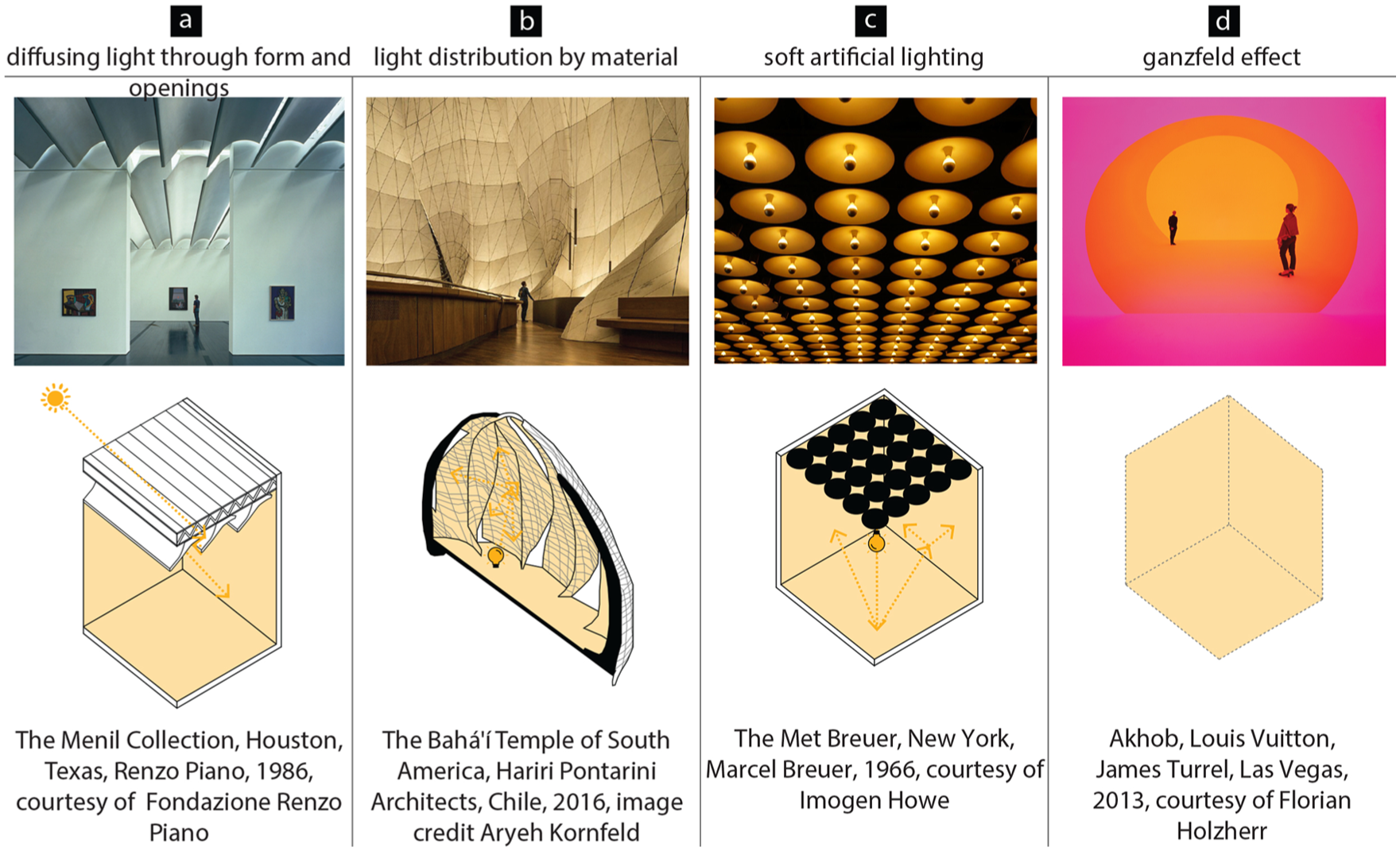
Effects of indirect illumination, luminosity and clarity of space through distributing light: (a) The Menil Collection, Houston, Texas, Renzo Piano, 1986, courtesy of Fondazione Renzo Piano, (b) The Bahá’í Temple of South America, Hariri Pontarini Architects, Chile, 2016, image credit Aryeh Kornfeld, (c) The Met Breuer, New York, Marcel Breuer, 1966, courtesy of Imogen Howe, and (d) Akhob, Louis Vuitton, James Turrel, Las Vegas, 2013, courtesy of Florian Holzherr
Indirect lighting in physical environments can be pushed to its absolute maximum, where it causes no shadows to create a homogeneous and unstructured visual field. This is referred to as the ganzfeld effect, or complete field. Originating from a scientific interest in the structure and function of this phenomenon in the history of aviation and the perceived optical apparitions as a homogeneous visual field, this optical deprivation diminishes the perception of distance, depth, boundaries and spatial gaps. Described as ‘no thing’, the ganzfeld vision recedes objects and surfaces to create a fanciful or hallucinatory experience. 37 By removing edge lines of a three-dimensional space, this effect immerses the viewer in a visually serene and boundaryless environment, which has been compared with hallucination and untamed imagination.38,39 James Turrell’s artistic light exhibitions manifest the abstract and imaginative space according to this effect of light (Figure 7(d)).
The application of indirect lighting in videogames to illustrate intricate details is most noticeable in first-person and third-person games that have unrestricted camera movements, as a thorough comprehension of the environment is imperative for their gameplay. The examination of this notion in videogames is most effectively achieved through a comparative analysis between Metro Exodus and its enhanced edition that uses advanced GI, while the former does not. The art team specifically used RTGI that allows it to work seamlessly with multiple light sources in a scene. Whether it is the sun, torches, flares, flashlights, flaming barrel, table lamps, glowing objects or any combination of them, RTGI compounds them into a range of indirect light and shadows, resulting in accurate propagation throughout the entire scene (Figure 8). 40
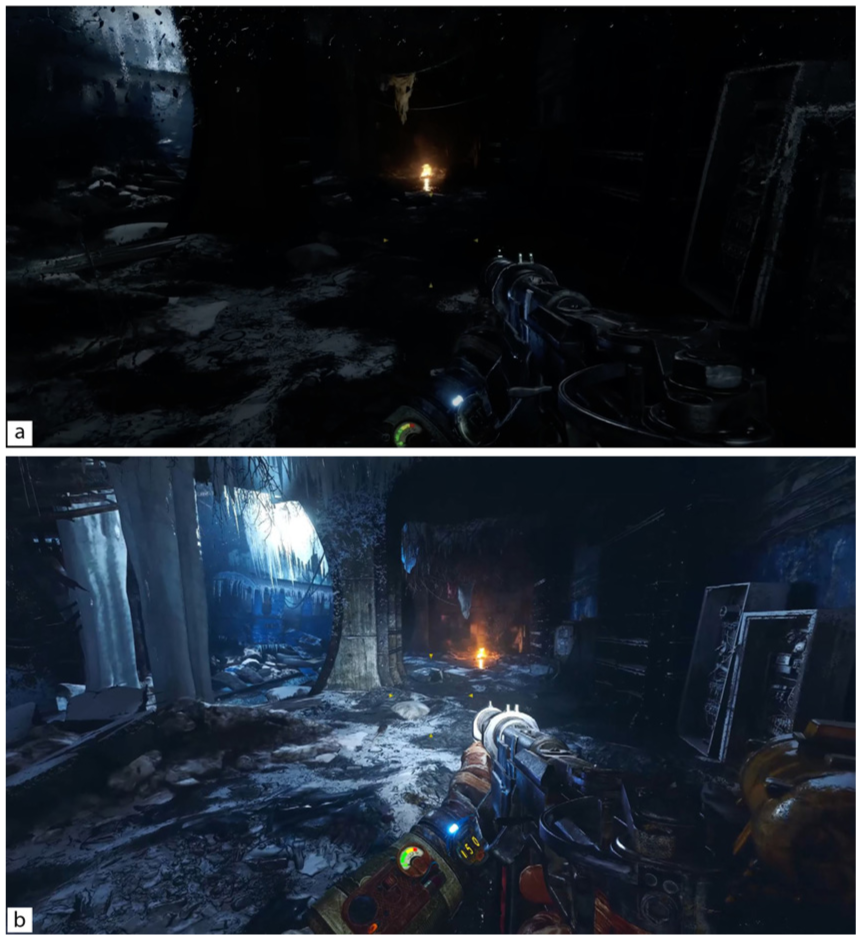
(a) Legacy lighting in Metro Exodus; (b) advanced GI in Metro Exodus Enhanced Edition; screenshot by the author, image credit Deep Silver and 4A Games
Evenly distributing illumination over a scene to give equal priority to everything within its limits the ability for direct light to serve as a guiding tool that aggressively points to the critical path. By limiting this effectiveness, ambient lighting encourages players to explore freely, entirely of their own volition; the open-world genre is defined by this property of interactivity. Control’s art direction intentionally avoided using conspicuous markers for steering, specifically to encourage disorientation, imitating the featureless mazes of real bureaucratic office buildings. In this way, indirect illumination places a greater onus on the environment’s design itself, broadly supporting environmental storytelling.
In both Metro Exodus Enhanced Edition and Control, GI calculations enable the environment to take on and propagate the hue of direct light from other surfaces (Figure 9). This can influence the mood of a scene in real time through the selection of materials based on colour rather than relying on colour correction during post-processing. Many scenes of Metro Exodus Enhanced Edition use these reflections from surfaces to provide a subtle tint of colour to provoke a specific mood, often pointing to a symbol of a safe zone or dangerous area. In Control, designers use the same technique for ambient differentiation of zones. In the Mail Room, which resembles a cathedral of information, GI directs light from multiple light sources and the colour of surfaces. Considering how powerful the bounce lighting is, orange mail tubes in this room heavily contrast against the pale white and grey surfaces of the floor beneath, and the tinted orange light combined with the arrangement of the lighting conveys contrasting emotions of this room to other bureaucratic parts of the Oldest House in which the game is happening (Figure 10).

Reflections of a shipping container located out of the frame in Metro Exodus Enhanced Edition; image credit Deep Silver and 4A Games
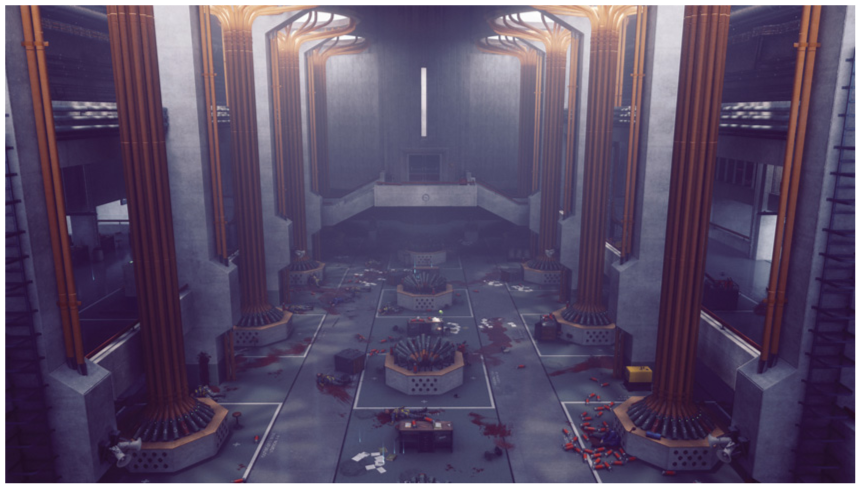
The Mail Room in Control; screenshot by the author, image credit Remedy Entertainment
The gaming industry universally understands that ‘good graphics doesn’t equal good gameplay’. 20 Nevertheless, according to Battaglia, visual design significantly impacts the perception of a game scene, its effective impacts, and how the user interacts with the space to explore (Battaglia, personal oral communication, 6 March 2024). Improvements in visuals through advanced lighting techniques in videogame remakes can incidentally alter the effective impacts and player interaction with the game space. For instance, more realistic nighttime darkness with naturally low light leads to improved visibility, changing how a player perceives the night. Conversely, these sophisticated simulation models can act as a hindrance to spatial perception and user engagement without careful consideration of design. Karmalsky noted in remaking Metro Exodus, GI caused ‘some challenges in locations where we got light [while] initially we didn’t want it to be’, which impacts the way a player perceives a space and interacts with it, but rather to the detriment of the game’s experience (Karmalsky, personal oral communication, 2025). Whilst generally visuals are not directly responsible for interactivity, their effective impact on space both positively and negatively is undeniably linked, which accentuates a player’s connection and sense of involvement, exploration and navigation.
An indirect illumination lighting scheme maximises elements of environmental storytelling to make them the cornerstone for designing interactivity within a space, by using this light to reveal all information available in a scene. With the strong lighting effects being restricted, all visual prompting from the world must be self-evident. This may manifest as candid details integrated in the world, such as simple signposts or desire paths in grass, architectural form and geometries. As this GI-powered scheme renders realistic light, designers are able to use the organically reflecting hues from within a scene to subtly enhance the character of an area, which passively communicates mood and defines the areas in the virtual world.
4.3 Ornamental effects of lighting
This lighting category explores how direct and indirect light interact with spaces, surfaces and materials to create mesmerising effects. In Kelly’s term, this type of light ‘excites the optic nerve’, while Karlen and Benya refer to it as the ‘jewellery of architecture’, the decorative layer with its primary role being to attract attention, offering moments of entertainment or even deliberate distraction.31,32
In architecture, the effectiveness of this approach depends on attentive manipulation of lighting through form and a comprehensive understanding of the materials and finishes. In the Kimbell Art Museum, a cycloid vault conceals the natural and artificial light, creating a soft silver glow through the reflections of light off the materials and into the space. The positioning and rotation of the forms, along with their material finishes, intensify the brilliance. Similarly, as we can see in The Four Seasons Hotel, interactions of light with materials can create fascinating outcomes according to the time of the day and the angle of light rays (Figure 11(a)). Conversely, the organically shaped oculus in Bruder Klaus Field Chapel allows shafts of sunlight and glimpses of night stars to illuminate the interior, creating a dynamic volumetric lighting effect that changes with the viewpoint and time of day. This design enhances the simplicity and profundity of the space, fostering a deep connection between the interior and the surroundings. In a similar way, the penetration, filtration and the fall of the natural light through window openings of the Notre Dame du Haut Chapel clearly create drama and atmosphere. Light’s interactions with brightly coloured stained glasses of these openings shape reflected colour (Figure 11(b)).
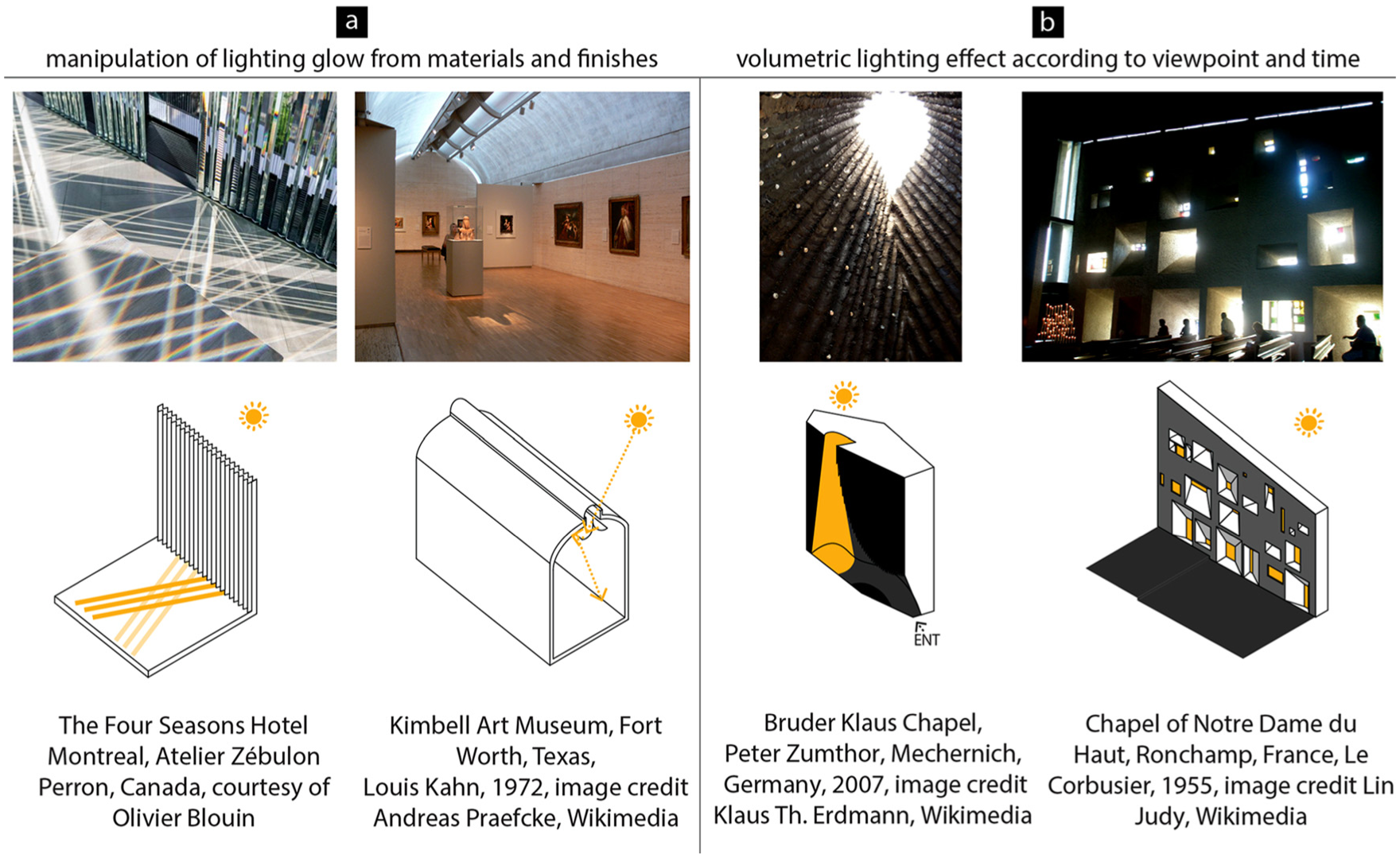
Ornamental effects of lighting, generating a sense of mysticism and ethereality: (a) The Four Seasons Hotel Montreal, Atelier Zébulon Perron, Canada, courtesy of Olivier Blouin; Kimbell Art Museum, Fort Worth, Texas, Louis Kahn, 1972, image credit Andreas Praefcke, Wikimedia and (b) Bruder Klaus Chapel, Peter Zumthor, Mechernich, Germany, 2007, image credit Klaus Th. Erdmann, Wikimedia; Chapel of Notre Dame du Haut, Ronchamp, France, Le Corbusier, 1955, image credit Lin Judy, Wikimedia
In their lighting schemes, videogames feature delicate lighting effects like volumetric effects or caustics that create captivating visual experiences to enhance the overall mood. In contrast to directional and indirect lighting schemes, in captivating and deceptive effects as a lighting scheme, light becomes a spatial ingredient that reacts to materials, surfaces and their properties. The atmosphere created through ornamental effects of lighting evokes transcendental emotions, often spiritual and magical, compared to the dramatic and focused atmosphere produced by a directional lighting scheme or uniformity of relative distribution of light in indirect illumination. In this lighting scheme, light reflects and refracts, shaping sophisticated sparks, glows and flickers. This approach emphasises elegance and appreciation, with functionality being secondary.
Open-world videogames, which perform as immersive spaces of free navigation and exploration, utilise in-game volumetric effects to prompt experiential, atmospheric and visual phenomena. Volumetric effects such as light shafts, fog volume, caustics or particles rely on calculating light rays permeating the participating media – particles that emit, absorb and scatter light rays. These effects are rendered according to the virtual camera angle. The computation of effects occurs within the camera frustum and stimulates the intricate physical interactions between particles and light rays. Volumetric effects are a powerful tool for enhancing the vibrancy and dynamism of game environments while also emphasising a particular perspective within the scenery of the game world. 41
In Metro Exodus and Control, Karmalsky and Macdonald explore the use of ornamental effects of lighting through form, scale and materials. Karmalsky explained that in Metro series ‘the lore of the game has indeed created some limitations for lighting’ (Karmalsky, personal oral communication, 2025). Since the game is set underground, lighting relies on local generators that logically fit the environment, such as a flaming barrel or table lamps, resulting in point lights and dim illumination. To enhance visibility, designers incorporate environmental storytelling elements that contribute to the general lighting conditions. For instance, openings in collapsed ceilings create skylights, allowing natural light to penetrate dark areas. These interventions produce soft light and God rays streaming through these openings, evoking a fantasy-like atmosphere and creating an uplifting experience, one which relieves the oppressive feeling of an underground setting (Figure 12).
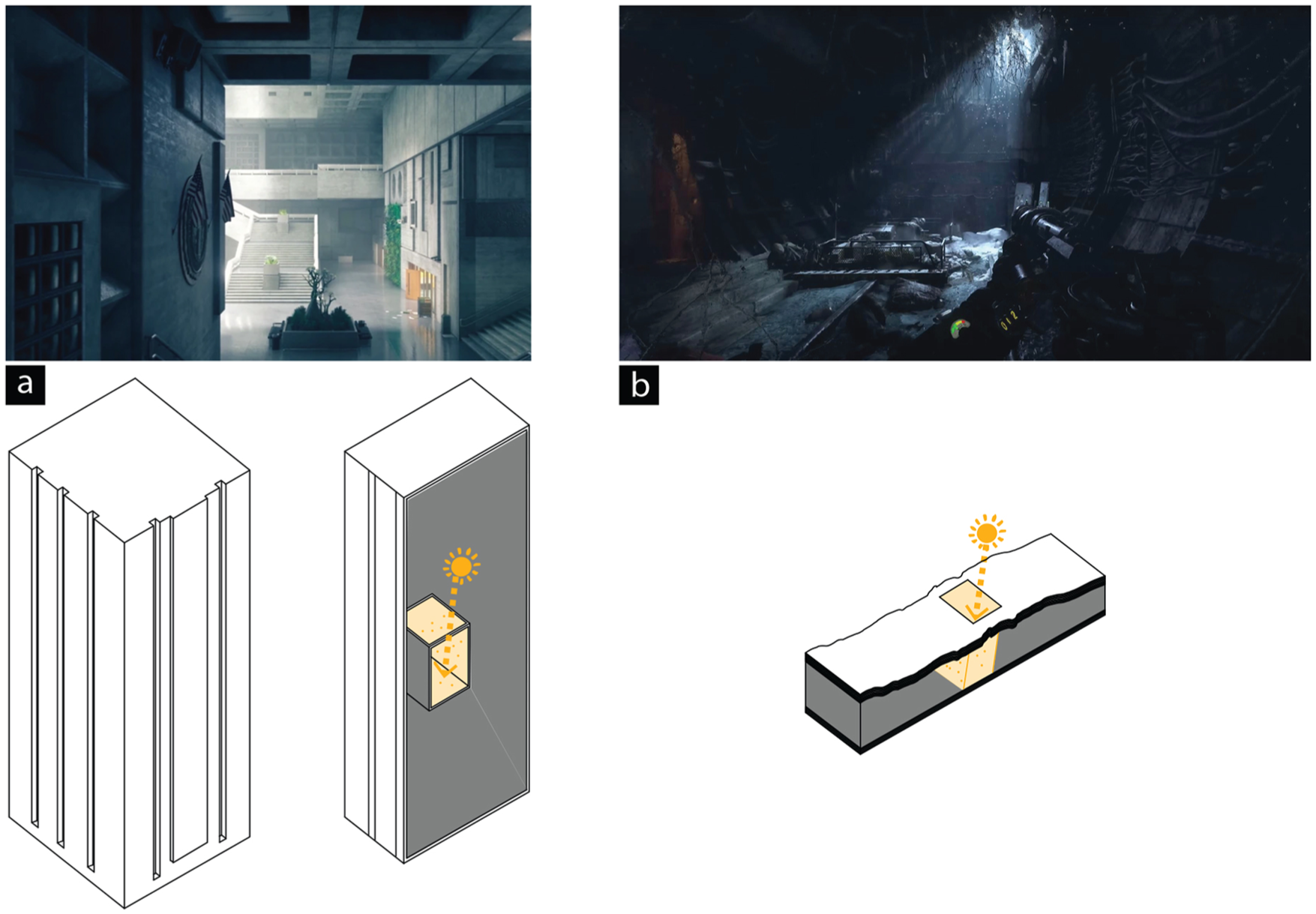
Skylight in (a) the atrium in The Oldest House in Control, image credit Remedy Entertainment; (b) in Metro Exodus, image credit Deep Silver and 4A Games
In Control, Macdonald advocated for the creation of a space known as The Quarry, which presents a truly unique and surprising experience. This room contrasts sharply with the mundane bureaucratic offices in the game. The architecture of The Quarry suddenly becomes surreal with a starry and alien constellation rising in the sky. This departure is heightened by the architectural scale, the choice of materials and lighting features that transform the sensation from natural to spiritual. The Quarry was designed as an extra-dimensional space contained within The Oldest House that conveys the crux of the narrative for this area. Macdonald explains that the use of these effects serves a specific purpose: Sometimes it was done just as a kind of beat to actually give some relief to the player or to give a moment that feels out with the rest of the game because thirty hours of just Brutalism would be so much to handle. It’s good to take these moments just to take some pressure off of that (Figure 13).
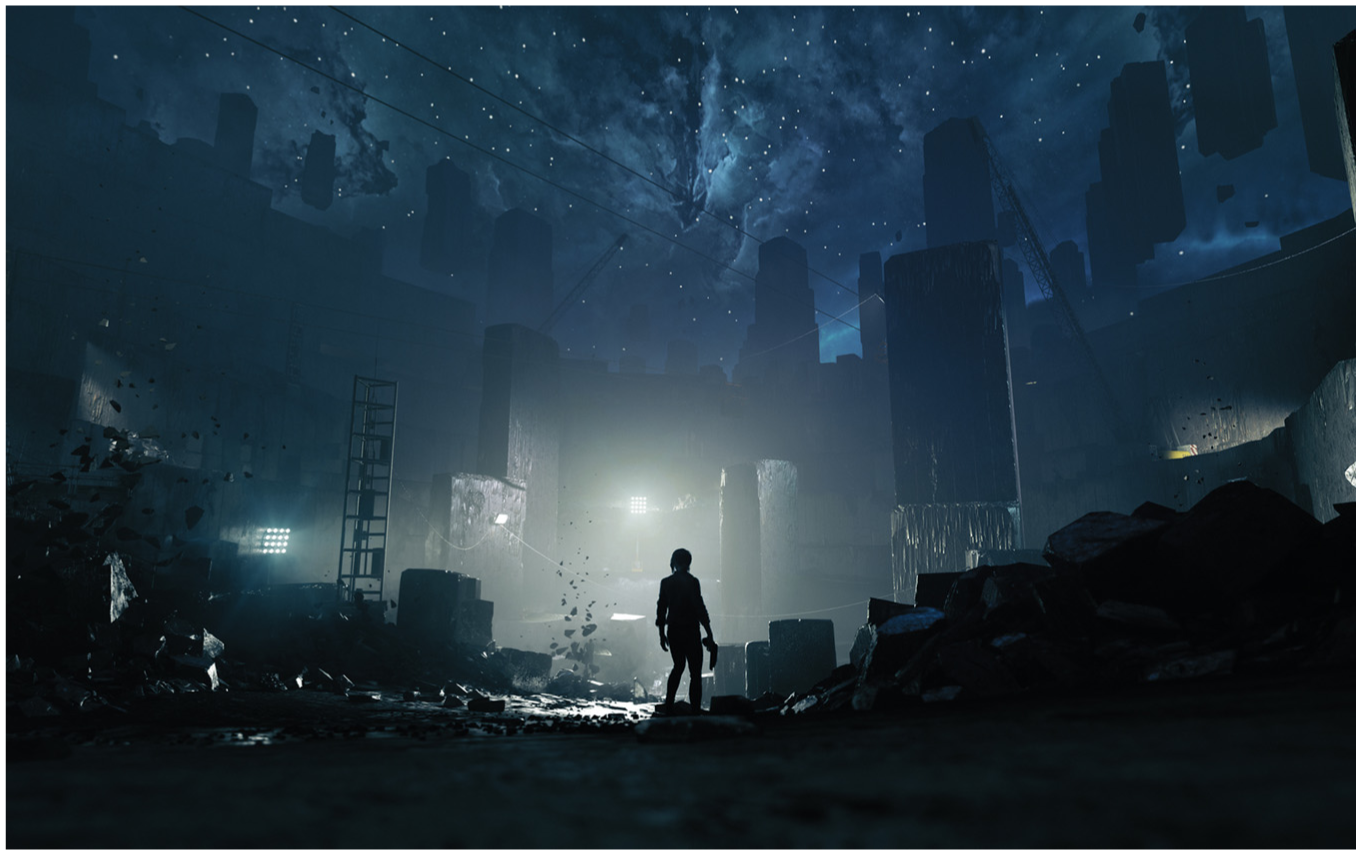
Ornamental effects of lighting in The Quarry, image credit Remedy Entertainment
Rather than primarily taking a functional purpose, this lighting scheme aims to enrich the virtual space and its narrative. It enhances interactivity by psychologically mitigating potential feelings of oppression or monotony, crafting impactful moments that sustain user engagement and exploration.
5. Conclusion
The adoption of videogames and videogame engines for spatial imagery encourages architects and interior designers to leverage the dynamic potential of representational components of this medium in order to create effective impacts and a sense of immersion. Light and dark are part of these design elements alongside narrative, environmental storytelling, game rules, sound and music that affect player gameplay and spatial perception. While videogame designers use the same principles of light and dark in their creations as architects, functions and aesthetical objectives of illumination in videogames extend to motivate the player to engage with the game world and enhance their sense of involvement within that virtual environment to explore, navigate and interact with objects and spaces. Game developers’ control over dynamic lighting design allows for the active influence of player behaviours and actions. A broader understanding of light as a building block in virtual worlds and its interactive capabilities is critical to the next step of evolution in architectural representation of digital spaces.
Light in games may not be the main design characteristic; however, in the spatial representation of many videogames, good lighting is a core aesthetic and ludic trait. Ongoing advancements in GI mathematical models for simulating light behaviours in the physical environment convey a compelling sense of realism. Throughout the evolution of rendering techniques, game designers have employed lighting to serve the narrative and spatial atmosphere without compromising the flow of the experience. However, advanced calculations offer a broader framework for the strategic and flexible application of design ideas to create effective atmospheres – an approach that holds significant value for architects and interior designers in shaping experiential and spatially resonant digital art-forms.
In videogames, light is principally a tool that encourages the player for an organic or controlled exploration. Direct lighting schemes entice a player to a spotlight, and indirect illumination facilitates intuitive way-finding in place of overt markers. While being a foundational element for sight, the interplay of light properties and the surrounding environment infuses the intentional mood and differentiates areas, communicating the information about the virtual world to the unconsciousness of the player. Ornamental lighting effects, on the other hand, prioritise mesmerising effects over functionality, aiming to connect the unconscious to realms beyond what the camera shows, suggesting a world awaiting to be explored.
These merits reciprocally apply to architecture expanding into digital worlds, where a new capacity for spatial exploration and engagement can be interwoven with its design. As GI technology continues to advance, the line between real and digital environments dissolves, offering architects and game designers new opportunities for cross-disciplinary innovation. Bridging these two fields through case studies and design precedents fosters a dialogue that deepens our collective understanding of light and its impact, all culminating as a tool that pushes the upper limits of creative environment design.
Future directions for this research can evolve with advancements in GI and paradigm shifts in lighting techniques, such as Physically Based Rendering or Physically Based Shading. These techniques are becoming a prevalent standardisation practice in game design. Such advancements will extend the discussion to analyse the depiction of various surface properties, including diffusion, specularity, transmittance and colour. Lighting design in game engines is more complex than simply calculating light rays and their bounces in a scene. It also includes surface representation by affecting the reflective and transmissive characteristics of different surface finishes. As Battaglia explains, lighting ‘standardisation in practice is a mathematical model, but it also [incorporates] artistic principles. […] It’s not just about the mathematics behind it, artists have to create libraries of materials that are used in games’.
Footnotes
Acknowledgements
The author would like to thank Sergei Karmalsky, Stuart Macdonald and Alex Battaglia for taking the time to meet her, as their insights were vital to the development of this paper. She would also like to thank Dr AnnMarie Brennan and Assistant Professor Alberto Pugnale for their extensive support and contribution.
Declaration of conflicting interests
The author declared no potential conflicts of interest with respect to the research, authorship, and/or publication of this article.
Funding
The author disclosed receipt of the following financial support for the research, authorship, and/or publication of this article: This research was undertaken while completing PhD thesis at the University of Melbourne, and the candidacy was supported through the university scholarship.
