



Abstract
The appropriate lighting conditions support concentration, cognitive performance and overall well-being. While this is especially true for daylight, many meeting rooms and co-working areas are in windowless, core areas of the buildings, making carefully designed artificial lighting even more critical. The spatial distribution of light has been documented to affect alertness and cognitive performance in simple tasks. However, its effect on more complex, creative challenges is largely unresearched. In this study, two distinct lighting conditions were tested in a simulated meeting room. The conditions represented either upper- or side-dominant lighting with a constant irradiance of 305 lx melanopic EDI at the eye level of participants. In a within-subject design, 35 participants completed a 2-h protocol involving tasks assessing various aspects of creative thinking (divergent, convergent and mental rotation), subjective sleepiness, room appraisal and mood. Results showed that side lighting significantly improved performance on the divergent creativity task but also led to increased subjective sleepiness over time. Conversely, upper lighting maintained stable sleepiness levels throughout the protocol. No significant effects were found for other dependent variables. Additionally, covariate analysis revealed a significant correlation between increased performance in creative tasks and extended time spent under daylight (indoors) prior to the experiment.
1. Introduction
Light forms a fundamental aspect of the built environment, aiding spatial orientation, visual task execution and the regulation of a healthy circadian rhythm, as evidenced by non-image forming (NIF) effects.1–3 These effects encompass various areas such as task performance, cognitive functions, subjective alertness, physiology of the body or emotional responses 4 are initiated by the interaction of radiation with the intrinsically photosensitive retinal ganglion cells (ipRGCs) in human retinas. Although circadian rhythm is controlled endogenously by the suprachiasmatic nuclei with an approximately 24.2 h cycle, the stimulus from natural daylight synchronises it to the 24 h solar cycle and promotes overall well-being.5–8 However, due to spatial constraints within indoor environments and the optimisation of climate control, electrical lighting often supplements – or even replaces – natural illumination and, as such, profoundly impacts the NIF effects.
The visual aspect of light can moderate the NIF responses through its influence on the appearance of space and, consequently, on the perceived atmosphere and room appraisal. In a conceptual model proposed by Veitch et al., 9 a 288-participant case study was used to document the chain of effects of lighting design on employee and organisational well-being. The model shows that the luminous conditions determine room appearance and consequently affect the mood of office employees. This, in turn, impacts health and environmental satisfaction. In addition, the authors extend the model by adding the effect of mood on creativity and motivation, deriving the data from other scientific evidence.
In another model based on experiments performed in simulated office spaces, 10 the authors mapped the linked mechanisms between lighting appraisal, well-being and performance. There, a similar chain of effect was documented – lighting conditions affecting the room appraisal and preference (like or dislike of the visual environment), having a subsequent effect on mood, health and well-being.
Concerning research on direct influence on the NIF responses, literature presents a large body of work on the moderating effect of light on NIF effects, primarily focusing on the manipulation of illuminance levels and spectral properties of light sources.11–13 Additionally, the focus is directed to the refined characteristics of the lighting design, expressed in so-called lighting patterns, 14 such as exposure duration, its timing or the light history (i.e. daily natural light exposure). Out of these patterns, the effect of directionality and spatial distribution of light within the field of view (FoV) remains relatively underexplored, particularly under diurnal conditions.
Scarce research in this domain concentrated on nocturnal effects reflected in melatonin secretion.15–21 The results suggest a correlation between light originating from the upper FoV and increased suppression of melatonin, as opposed to light from the lower FoV.18,19,21 Similarly, nasal retinal illumination resulted in greater stimulation than temporal retinal exposure.15–17 Melatonin, along with body temperature, plays a critical role in regulating sleep.22,23 However, the daytime relationship between light, sleepiness and cognitive functioning cannot be assumed to directly mirror the patterns of melatonin suppression observed in night-time studies. That is because the human circadian rhythm maintains naturally low, almost undetectable, melatonin levels during the day,22–24 with documented exemptions caused by circadian rhythm disruptions, that is, night-shift work. 25 Moreover, research suggests that even at night, the melatonin-suppressing effects of light do not directly align with its influence on sleepiness or alertness.8,26–28 Furthermore, the evidence on daytime effects of light shows that a specific light dose can indeed impact sleepiness or alertness in diurnal conditions.11–13 This indicates that melatonin suppression is possibly not directly linked to alertness.
Nevertheless, while acknowledging that the relationship to melatonin is not directly correlated to the effects investigated in this paper, the abovementioned night-time studies on light directionality reveal that certain light angles more effectively target circadian-sensitive cells in the retina. Due to the lack of comparable research tackling the daytime NIF effects, the hypotheses in this paper and our preceding publication 29 still draw from findings from night-time melatonin suppression, assuming that similar light angles can also activate NIF effects during the day.
A background for this assumption is linked to the anatomy of the eye and the uneven distribution of retinal neurons, including the ipRGCs.16,20,30–33 While rods and cones can also play a role in circadian phototransduction,8,34–36 it is widely agreed that ipRGCs are the primary mediators of these effects.1,8,14 Therefore, targeting the lighting stimulus on different areas of the retina with higher concentrations of ipRGCs can hypothetically yield increased amplitude of NIF effects. It is plausible that during night-time, the predominant influence of melatonin, given its significant role in regulating the circadian rhythm, may overshadow or inhibit the expression of other NIF effects. Conversely, during the daytime, in the absence of melatonin, these NIF effects may become more observable and measurable. Nevertheless, the specific impacts of light directionality during daytime conditions remain largely unknown.
Therefore, the objective of this study and its affiliated publication 29 was to investigate the topic of directionality in diurnal conditions with two different methodological approaches and a broad set of dependent variables. In the previous work, 29 an experiment was set up in a controlled lab environment with fixed gaze conditions and three defined light directionality settings: from the upper, lower and lateral FoV. All in a low-reflective environment devoid of items. The light settings all provided a homogenous light dose and exhibited similar spectral properties to ensure the isolation of one investigated parameter – the direction of light. The findings revealed increased subjective alertness and improved reaction time in a basic auditory cognitive task when participants were exposed to light originating from the upper FoV instead of illumination from lower- and lateral-FoV. Additionally, illumination from the upper FoV was perceived as less glaring compared to the light coming from the side and lower FoV (see Supplemental Materials accompanying the publication).
In the experiment described here, the goal was to go beyond the laboratory environment and establish a realistic setting that incorporates modern and practical lighting solutions. Building on the prior research outcomes and considering practical applications of lighting configurations, two main light directions were selected, forming the basis for the lighting scenarios. The first scenario emphasised illumination predominantly from the upper FoV. The second scenario had the primary light source situated on lateral FoV, representing emerging electric lighting products on the market that simulate windows/daylight. Solutions with frontal- or lower-FoV-based light exposure were deemed inappropriate and not included in this study.
Concerning the timing of the exposure, this study focused on targeting a specific timeframe during regular working hours in which an appropriate electric lighting solution could exhibit a beneficial effect. Naturally, the human circadian rhythm promotes higher levels of alertness and reduced sleepiness during the daytime.6,13,22,37,38 However, it is not rare to experience a drop in wakefulness or cognitive capacities in the middle of the day. That is due to a phenomenon called ‘post-lunch dip’, characterised by a natural decline in alertness.39,40 The exact timing of the post-lunch dip will differ between individuals. However, a recent publication reviewing data from 14 studies on the effect of circadian rhythms on different aspects of attention and cognition concluded that the average timing of post-lunch dip in performance falls between 14.00 and 16.00. 37
Looking at the measured outcomes or dependent variables, most work on NIF effects utilised methods of measuring cognitive performance in lab-specific tasks, which isolate one or few cognitive processes.11–13 This approach allows for deriving precise conclusions and eliminating biases, and as such, we utilised that in our initial work on directionality. 29 However, office workers or students often engage in tasks of higher complexity, which usually revolve around non-routine problem-solving and creative thinking.41,42 Moreover, creativity and innovation are essential in many areas of everyday life – from artistic and humanistic to highly technical engineering fields. 43 As much as a matter of an individual’s skill, creativity has been reported to be influenced by environmental factors or emotional state.42,44–49
For example, in a two-part experiment 44 consisting of a subjective experience-sampling case study of 102 participants and an experiment with 80 participants in a controlled lab environment with standardised tasks, the authors reported a beneficial effect of affective shift (from negative to positive state) on creativity. The results were especially pronounced for the group where negative affect was first induced, before the shift to the positive, as opposed to the group with the increase in positive affect only.
This is further confirmed by the concluding remarks of a meta-analysis of 72 studies on the relationship between mood and creativity, 47 where authors point out that positive mood enhances creativity. The effect, however, strongly correlates to the base mood state of the participants and the type of creative task executed.
Furthermore, a recent scoping literature review 50 has categorised significant elements of the physical environment impacting creativity into 15 attributes. Among others, the attributes include lighting conditions, to which authors present research reporting a positive effect of bright light, consistent lighting conditions and daylight access on the creative outputs. Moreover, various visual aspects of the interior design are also listed under the attributes, and their perceived appearance can be linked to the lighting design of the space.
Finally, some research also suggests that chemically induced increased levels of alertness (via caffeine) are linked to better performance in creative problem-solving.51–53 Whether such an effect is present with light-induced heightened states of alertness and vigilance remains unknown.
When looking into a possible indirect effect of light on NIF responses and creativity via the initial impact on mood or visual acceptance of space, it is essential to mention that lighting judgements can be influenced by anchoring mechanisms and other evaluation biases. Anchoring effects occur when initial information or a starting stimulus serves as a reference point for subsequent judgements, even if it is irrelevant to the tested hypothesis.54–56 In the field of lighting, it has been reported that experimental design aspects such as the pre-adjustment anchor or the stimulus range can have a significant effect on the lighting conditions preferences.57,58 Moreover, research shows that factors such as sleep quality – although with mixed results59–66– or light history prior to the experiment36,67–69 might likewise influence the variables of cognitive performance. This underlines the importance of considering these factors in experimental design and ensuring that the variable of interest is analysed with a simultaneous investigation of potential covariables influencing it.
Concerning the research on lighting, few publications have looked into the effects of light conditions on creativity; however, to the best of our knowledge, there has been no investigation into the specific effect of light directionality in this domain. It has been previously investigated through the work of De Vries et al.70,71 whether task illuminance or background wall luminance can affect the performance in creativity tasks through a change of the room appearance, however, without significant results. The experimental documentation in these publications made it possible to derive that the direction of light was either frontal-, or upper-FoV dominant in the wall-related investigation (with the majority of light originating from the ceiling with the low wall illuminance), or lower-FoV dominant in the case of the investigation of the desk illuminance effect.
Furthermore, another recent publication 72 highlighted the complex relationship between light, mood and creativity, where an increased performance in a verbal creative task was achieved under two contrasting lighting conditions of 2000 lx at 6000 K and 300 lx at 3000 K, to both of which a common effect was the induction of a higher positive mood state. However, in another task within the same experiment (figural creative task), the participants performed the best under the lighting condition, which was correlated with the lowest positive mood (2000 lx, 3000 K). The directionality of light in this study was not documented. However, the set-up description shows that the luminous environment comprised relatively uniform, diffuse light distribution from most of the upper half of the visual field as the room was fitted with ceiling-mounted luminaires, while the walls were painted white. On the contrary, another research with a different approach to creativity suggests that dim light conditions and darkness support the generation of creative ideas and enhance the feeling of freedom from constraints. 45 Another study 73 looked into the effect of correlated colour temperature (CCT) under constant illuminance of 1000 lx. The results showed that creativity was enhanced under the warm light of 3000 K (as compared to 4500 K and 6000 K), while concentration was highest under the cool lighting of 6500 K. There, the light was delivered frontally by a 650 mm × 250 mm panel light placed in front of participants at a distance of 300 mm.
However, neither of the aforementioned publications conducted an investigation into the directionality of the lighting, nor did the studies incorporate any manipulation of directionality. Therefore, an analysis with respect to the potential effect of spatial distribution of light on creative task performance was not appropriate. Moreover, given the limited number of publications, performing a meta-analysis of the influence of light direction was not possible either.
The tasks within the realm of creativity research are commonly categorised into two domains, each targeting a specific aspect of creative cognition: divergent and convergent thinking.43,46,74–77 Divergent thinking represents the ability to generate a wide range of ideas or solutions to a given problem. It involves exploring different possible pathways and perspectives without adhering to pre-established constraints. On the other hand, convergent thinking is a process of systematically narrowing down multiple solutions to identify the best-fitting one for the given problem. It is characterised by logical deduction and application of the established rules, and it often follows the phase of divergent thinking in a creative process.
An important aspect of creative, problem-solving thinking is also the mental spatial rotation ability. This skill is frequently assessed in students within the STEM fields to predict their academic performance. 78 Some of the most commonly used tests are the Purdue Spatial Visualisation Test: Rotation (PSVT:R) 79 and the Mental Rotation Test (MRT). 80 In such tests, the participants are asked to mentally rotate a three-dimensional (3D) figure drawn on a flat surface or screen and select correct images corresponding to the assigned rotation. We acknowledge that these tests are not without flaws, as it is difficult to objectively, and without biases, measure performance in such a complex task. 81 However, they are still commonly used testing tools, and thus, it was decided to include this type of task in the testing battery in this study. It was previously investigated whether the type of lighting technology – thus different spectral properties – has an influence on performance in the spatial rotation capacity,82,83 with mixed results. Nonetheless, similar to the studies on other creative tasks, light directionality was not reported in both these studies, and analysis with respect to this factor was not possible.
Considering all the above, the extensive evidence indicates that lighting affects circadian rhythm, cognitive performance, physiology and emotional well-being. While research on its influence on creative processes is relatively limited, given its established effect on mood and alertness, light may impact creativity in an indirect way. Therefore, we hypothesise a possible chain of relationship between light directionality and creativity, whether via a direct impact, or an indirect impact through the influence on the visual aspects of space and mood. The novelty of our research lies in the aspect of keeping a constant melanopic equivalent daylight illuminance (melanopic EDI) while modulating the method of its delivery through two different settings with varying dominant directions of light.
Thus, the hypothesis for this study is that the light from the upper part of FoV leads to increased performance in creative tasks compared to light from the side of the FoV, while keeping the vertical irradiance measured at the eye at the same level.
2. Method
2.1 Experimental set-up and apparatus
Two lighting conditions, Lighting Scene – Side light (LSS) and Lighting Scene – Top light (LST) were created in a real-scale mock-up of a windowless meeting room (Figure 1) located in the laboratory of the Chair of Lighting Technology at the Technische Universität Berlin (TU Berlin). The room accommodated a square-shaped black office table with chairs for four participants, and office decorations. The floor was covered with wood-like vinyl material, and the walls were white except for one, which was a fake curtain wall made of wood with silver-grey blinds. The interiors were created to simulate a realistic meeting room and increase the feeling of immersion. The lab was equipped with LED-backlit walls and ceiling, which provided ambient lighting in the experimental lighting scenes. Ambient lighting was utilised to reduce the contrast and the risk of glare from the luminaires in the experimental lighting conditions. The room was also equipped with cameras used by the researcher to supervise the experiment. The footage was not recorded and stored for data protection reasons, and participants were informed about the purpose of the cameras.
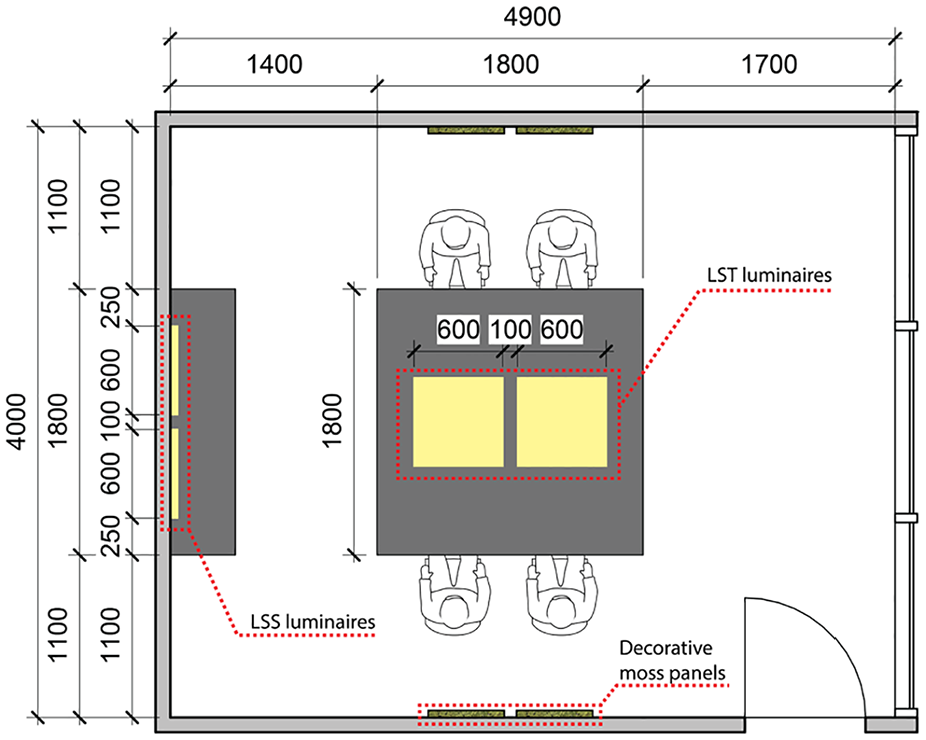
Plan of the experimental room. Dimensions are given in millimetres
The experimental lighting conditions in each Light Scene (LS) were provided by two 600 × 600 panel luminaires (ZUMTOBEL Light Fields LF3 A 5000-927-65 Q BC WH, ZUMTOBEL GMBH AUSTRIA). In LST, these luminaires were suspended at 2.1 m height from the floor, forming a pendant light centrally located above the table, and in LSS, they were mounted on the wall (Figures 1 and 2), referring to a modern office lighting solution with window-inspired luminaire for windowless spaces. In LST, the ambient lighting was provided via the backlit ceiling, and in LSS, dim light was provided from the backlit ceiling together with the backlit wall where the luminaires were mounted to reduce the luminance contrast and thus, the glare from the side of the FoV (Figure 3).
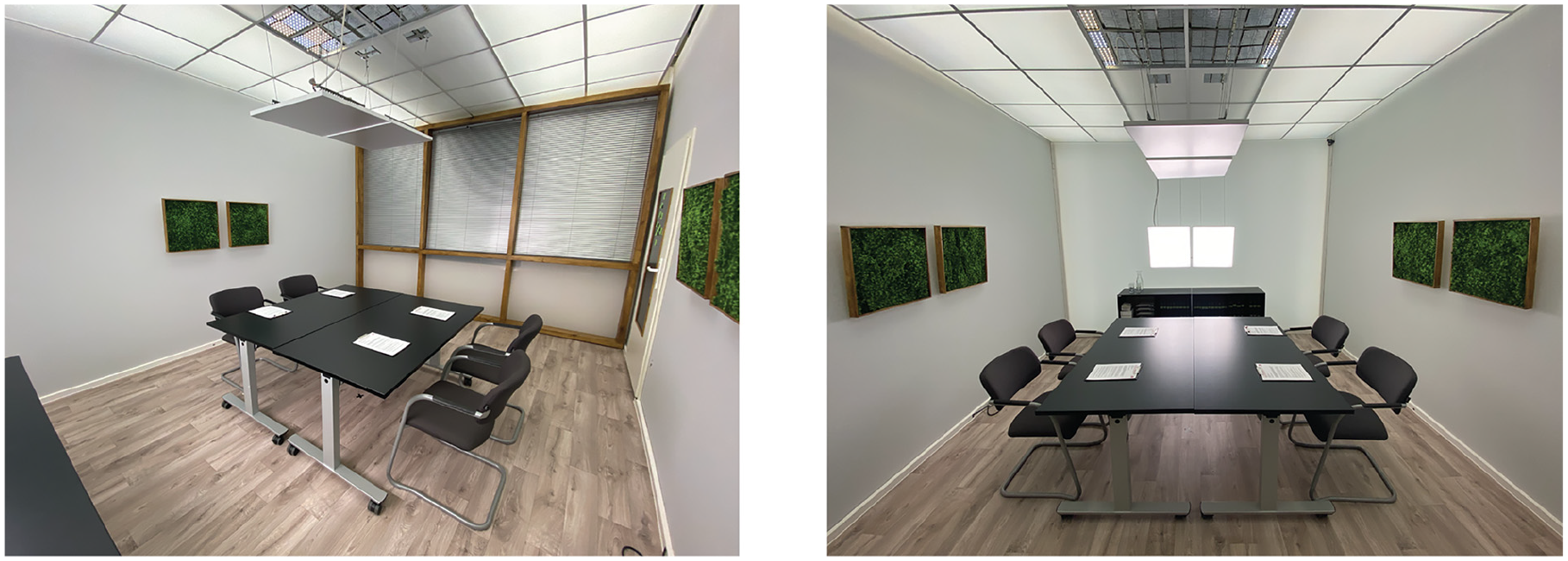
Photographs of the experimental room
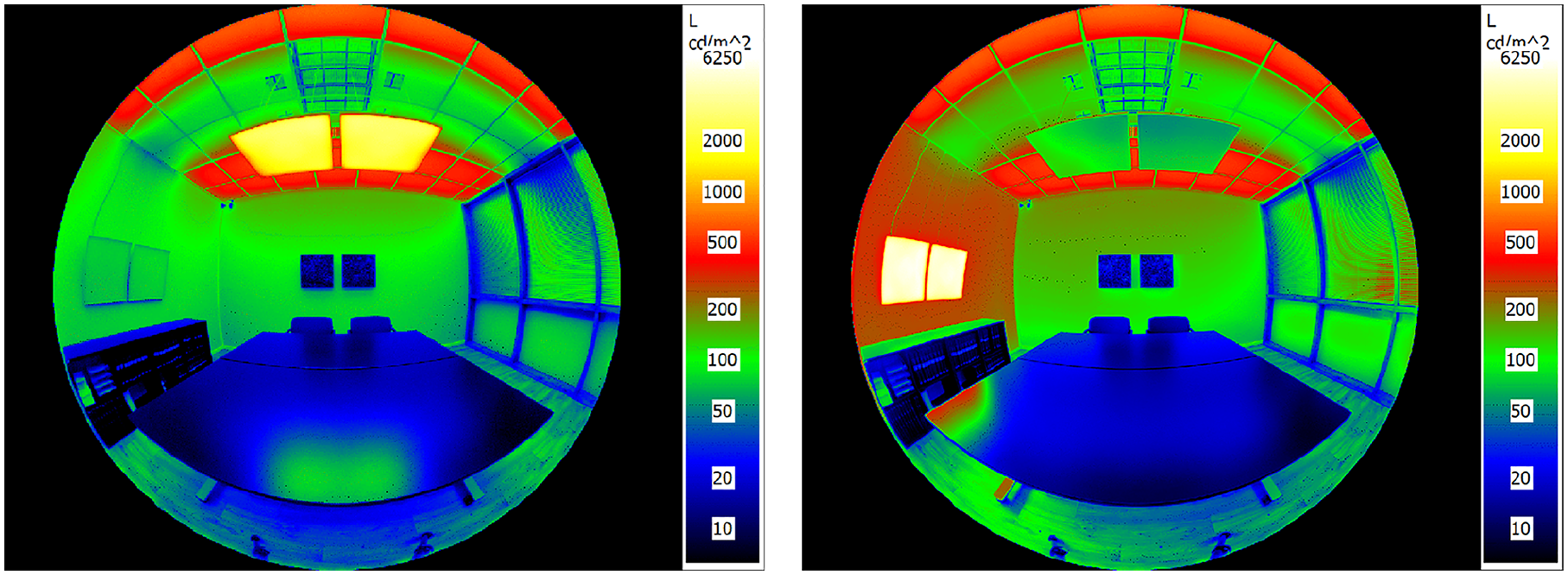
Fish-eye luminance images of the lighting scenes, taken from the position of eye height between two sitting participants
In LSS, the panels were positioned at a larger distance from the participants than in LST to keep the scenario more realistic and accommodate space for typical office furniture. As such, the luminance of the side luminaire had to be increased to meet the same light dose as in LST. In each LS, the inactive luminaires were switched off. The mean luminance of the light sources in LST was approximately 2168 cd m−2, and 4614 cd m−2 for LSS.
The conditions were viewed binocularly and provided a similar light dose measured vertically at the eye height of sitting test subjects with a spectroradiometer. There were variations in the light dose depending on where the participants sat at the table, and the measurement represents an average and was taken in the middle of the table between the participants. The experimental luminaire, together with the ambient lighting, provided a light dose of ca. 450 lx photopic illuminance measured at the eye with a CCT of approximately 4068 K, realising a melanopic EDI of approximately 300 lx and colour rendering index (CRI) of >90 (see Table 1 for the settings and spectral power distribution on Figure 4. The combined solid angle occupied by the two hanging light sources in LST was 0.25 sr and 0.11 in LSS. In both LSs, the light sources were entirely within the FoV as per the CIE S026 model, 1 while the participants kept the recommended position during the experiment. On each visit, the participants were positioned in the same seats and stayed there throughout the experiment. The initial and the closing questionnaires were performed on laptops, and the performance tasks parts were all pen-and-paper based, with voice guidance from the researcher.
Overview of the light dose provided at each lighting scene

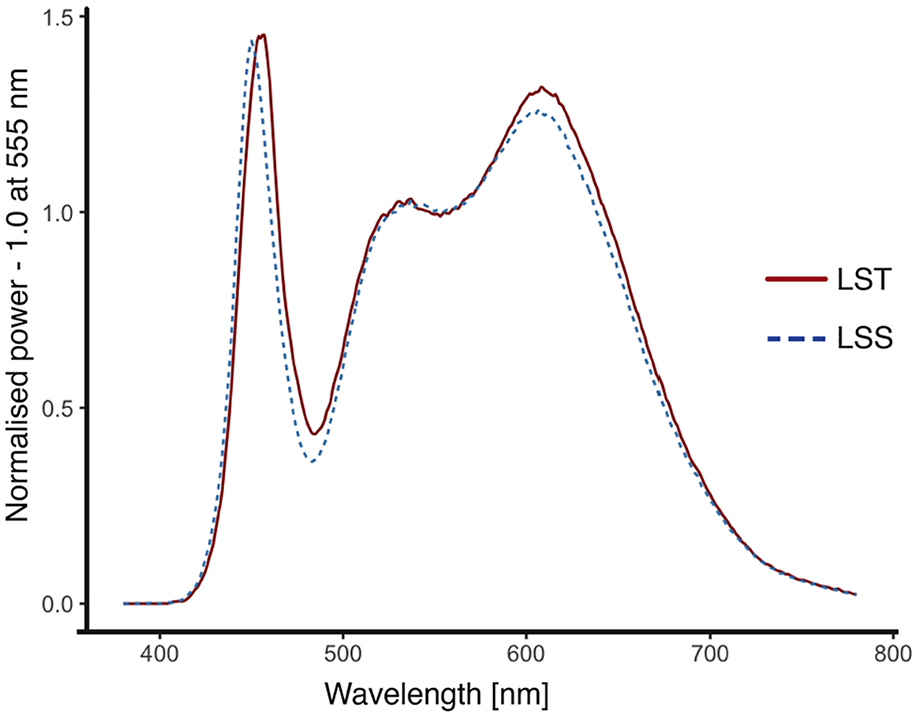
Spectral power distribution of the light sources used in this experiment, normalised at 555 nm
2.2 Participants
Thirty-eight participants were recruited for this study, of which 35 completed both scheduled visits (21 males, 14 females; median age 24 years, range = 21 years to 35 years). The participants were selected based on the following inclusion criteria probed in the registration questionnaire:
– Good mental and physical health, assessed with the SF-12 questionnaire (mental health score >35, physical health score >45). 84
– No significant indication of depression (score <10, probed with Patient Health Questionnaire (PHQ-9)). 85
– Normal or corrected vision.
– Normal contrast sensitivity of vision, assessed with Pelli–Robson chart. 86
– Normal visual acuity, assessed with the ‘tumbling E’ Snellen chart.
– No colour blindness, assessed with Ishihara test. 87
– No travel through multiple time zones up to two months prior to the experiment.
– No extreme chronotype, assessed with the D-MEQ (Morningness–Eveningness Questionnaire) 88 with a score between 32 and 65.
– Fair sleep quality, assessed with the Pittsburgh Sleep Quality Index (PSQI) questionnaire19 (score <10). 89
– No regular or excessive alcohol use (more than three times a week).
2.3 Procedure
The experiment took place between 27 November 2023 and 19 January 2024. While most participants completed the protocol in December, the additional weeks in January were organised to accommodate cancellations, postponements and a few additional participants. The participants came in groups of four (or less in case of cancellations), and lighting scenes were offered to eight participants (2 × 4) per day for two consecutive weeks.
During the experiment, the participants sat around one meeting table. The experiment was performed in a within-subject design, where the participants went through each of the conditions (LS) in separate sessions (visits to the lab), with a one-week wash-off period between the sessions. During each visit, the participants were randomly assigned to one of the two experimental LSs. The lighting condition within one session was kept the same, and the participants were not presented with the other LS only until the next session, one week later, to limit the possible priming effect. Furthermore, participants were asked not to drink coffee or consume other stimulating products up to 3 h prior to the session and to maintain a regular and healthy sleeping schedule throughout the experimental period. The experiment was performed in the early afternoon hours, starting either at 12.00 or 14.00, to benefit from the post-lunch dip phase.39,40 The experiment was approved by the Ethics Committee of the Faculty of Electrical Engineering, TU Berlin.
Each session consisted of the introduction questionnaire performed on the laptops, the first paper-based testing part consisting of block 1 of the three tasks with introductions and short breaks, a longer 10-min active break with self-assessment of performance, the second testing part with the same three tasks and the closing questionnaire. One full session lasted a maximum of 80 min to 90 min with minor time (...) variations (Figure 5).
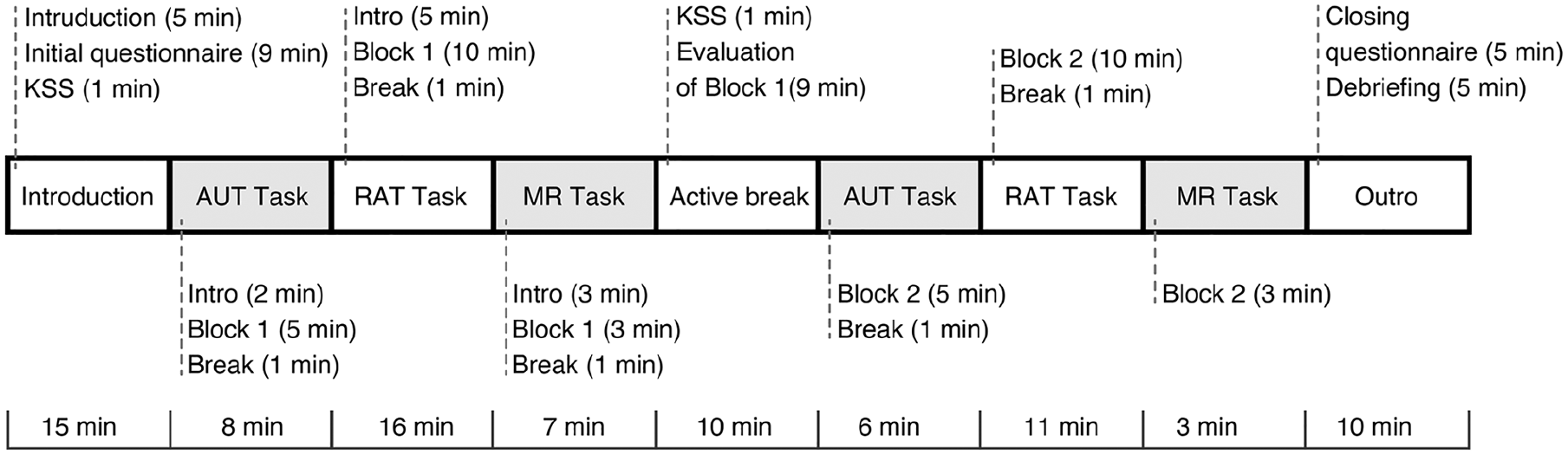
Protocol for each session
The initial questionnaire took 10 min and probed the following: momentary sleepiness (assessed with a nine-point Karolinska Sleepiness Scale – KSS 90 ), sleep quality on the day of the session (assessed with the PSQI questionnaire 89 ), light history of the 24 h preceding the visit (assessed with Harvard Light Exposure Assessment questionnaire 91 ), momentary mood state (assessed with the multidimensional well-being questionnaire MDBF 92 ), general well-being on the session day, food and beverage consumption on the day of the session, time spent outside and activities performed until the session.
After the questionnaire, the participants were given the paper forms with the tasks described in the next section. They were instructed about the importance of keeping the body and head position semi-fixed to allow for uninterrupted light exposure but still relaxed enough to mimic a realistic meeting/co-working room scenario.
From this moment, the participants followed the verbal instructions from the researcher and were guided through each page of the form and the tasks. Each page had a specific timing, and the participants were asked to progress to the next pages only after the signal from the researcher. All the tasks were solved individually; however, participants could discuss the contents of the first part during a 10 min break. Compliance with the protocol and the correct body posture were supervised using the camera and participants were reminded about it whenever necessary.
The paper form consisted of two parts separated by a longer 10-min active break. In the first part, there were three performance tasks, each preceded by an introduction with examples. In the second part, the different versions of the same tasks were repeated without the introductions and examples. Consequently, the first part lasted 31 min and the second 20 min. The tasks in each block included (in order of appearance) Alternate Uses Task (AUT 93 ), Remote Associates Task (RAT94,95) and MRT. 80 Between the testing blocks, there was a 10-min active break, during which the participants assessed their performance in two of the three tasks. This was to ensure that the instructions in these tasks were clear, and to validate the score in the RAT, which depends on the knowledge of the language. The performance in the AUT was only assessed by the researcher; thus, it was omitted from the self-assessment of performance. The second block of the cognitive tasks was performed to mitigate the learning effect and possible carry-over effects from consecutive tasks. Due to the complexity of the tasks in the first block, there was also a risk that participants could still not fully comprehend and get familiar with the instructions, even after the verbal confirmation. Therefore, in the statistical analysis, only the data from the second testing block of the performance tests were included. At the beginning, the end and during the active break, the participants also noted their level of subjective sleepiness using the KSS included in the form. After completing the paper form with tasks, in the last 10 min, the participants filled out the end questionnaires on the laptops. The end questionnaire probed the level of sleepiness, mood, room appraisals and lighting. The protocol was the same during the second visit.
Despite the wash-off period of one week, two versions of the paper-based questionnaires were prepared for each of the two sessions, given the one-time-use character of individual versions of the creative tests. To limit the bias coming from the subjective nature of the creative tasks, the versions were distributed in a randomised, balanced way among the participants.
2.4 Dependent variables
The dependent variables in this experiment included objective measures in the form of paper-based creativity tests and subjective measures in the form of questionnaires.
2.4.1 Performance tests
A 5-min version of the AUT was used to assess the divergent thinking aspect of creativity. The participants were presented with an everyday object and were asked to write down as many possible uses as possible. Scoring was based on four criteria: flexibility (range of ideas in different categories), fluency (number of ideas), elaboration (level of detail) and originality (how unusual the ideas are), and it was rated by the first author following the detailed scoring protocol. 75
A 10-min RAT was used to test the convergent thinking aspect of creativity. Scoring was based on total number of correct responses. In this task, the participants were presented with 20-word problems. Each problem was a set of three words, to which the fourth fitting word had to be found. This task relies on a good knowledge of a language. Therefore, it was available in both German 94 and English 95 as per individual preference. This was possible due to the within-subject character of this study. Given the one-time nature of the form (repeating the same word-problems on the second visit to the lab would be inappropriate), and the complex and subjective nature of language proficiency, unique but comparable in difficulty sets of word-problems for this task were given to participants each time they came to the lab. The estimated difficulty was assessed following the performance reports from the RAT-related publications.94,95
During the self-assessment forms, the participants were given the correct answers to the RAT exercises and indicated whether they knew these words. The final score of this task was the number of correct responses divided by the number of known words. This practice was inspired by the so-called aah-factor found in one study, 94 which describes whether the correct answer was clear to the participants after being shown the solution. In some cases, the participants were unaware of such possible word-combination or did not possess the given word in their vocabulary. Language proficiency is a factor that was not controlled for in this study.
A 3-min MRT was used to assess the spatial ability of rotating 3D objects in one’s imagination. 80 We used a modified version of the task, where participants were presented with 12 out of 24 available exercises (3D-problems) on the first visit, and the other half on the second visit, due to the limited available content from the original task. Thus, one block consisted of six 3D-figure problems, wherein each participant was presented with a reference figure and four additional figures. They were then asked to mark the figures that represent the exact figure as the reference but rotated along a random axis. A point was given only if both the selected figures were correct.
2.4.2 Subjective assessments
The level of subjective alertness was assessed with the KSS, 90 a nine-point Likert-type scale where number 1 on the scale means ‘extremely alert’, and number 9 equals ‘very sleepy, doing great efforts to stay awake’. The first KSS assessment was probed using the entrance questionnaire on the laptops. It was followed by three assessments in paper form, and the last assessment was done through the closing questionnaire, again on the laptop screen. Thus, there were a total of five assessment points throughout one session.
Room appraisal and lighting quality were assessed using Visual Analog Scales, where the participants had to select a score from 1 to 100 using a slider-selector during the end questionnaire. The scales used eight items from a modified version10,96 of the room appearance rating system. 97 The room appraisal was measured in the attractiveness dimension (RA-Attractiveness) using the following scales: Unattractive–Attractive, Ugly–Beautiful, Unpleasant–Pleasant, Dislike–Like, Somber–Cheerful, with the score averaged over the five scales. The illumination dimension (RA-Illumination) was based on three scales: Vague–Distinct, Dim–Bright, Gloomy–Radiant, and the score was also averaged over the three scales. In addition, the illumination was further assessed with two additional items considering the visual comfort: Glare (Glary–Glarefree) and Colour acceptance (Too cold–Too warm) scales.
2.5 Other covariates
The remaining responses to the various questionnaires were used to check for their role as potential covariates affecting the primary measured outcomes and to check for differences in participant states before the sessions.
2.6 Statistical analysis
To test the hypotheses, univariate and multivariate linear mixed model (LMM) analyses were performed to analyse the effects of categorical variables on the numerical response variables of the performance tasks and subjective assessments (Overview of variables in Tables A1.2 and A1.3 in Supplemental Material). In addition, a set of univariate models was computed for the analysis of the effect of potential covariates on the response variables of the performance tasks and subjective assessments. The significance of differences between estimated marginal means (EMMs) for categorical variables was calculated using contrast analysis with Tukey’s adjustment. For all LMMs, the subject ID was added as a random effect. Cohen’s d was calculated to analyse the effect sizes within TP between LS in the multivariate LMM model and the effect size within LS categories in the univariate models examining the effect on the response variables. The effects within the ±0.2 difference were considered similar when comparing effect sizes. The significance level of all statistical tests was set at a = 0.05. Interpretation of the results of the model effect sizes (d,
2.6.1 Multivariate model for subjective sleepiness
To estimate the effects of the categorical explanatory variables (LS and TP) on the numerical response variable KSS, multivariate LMM was fitted in the form of a factorial design with Restricted Maximum Likelihood and Boundary Optimizer Based on Quadratic Approximation. 99 The LS explanatory variable had two categories (LSS and LST), whereas the TP categorical explanatory variable had five categories (TP1 to TP5) for the KSS response variable. Estimation of the target interaction effect in the model was performed using contrast analysis within TB categories conditioned on LS.
2.6.2 Univariate models for performance tests and subjective assessments
The effects of the categorical explanatory variable LS on the numerical response variables of performance tasks’ markers (the AUT, RAT and MRT tasks) and subjective assessments (MDFB mood scales, Room Appraisal scores and Visual Comfort scores) were analysed using univariate LMMs, with two categories of the LS explanatory variable: LSS and LST. For the mood scales, the response variable was calculated as the difference between the last and first measurements.
2.6.3 Univariate models for covariates
The effects of the covariates PSQI score, LED light history, indoor daylight light history and time outside light history on the response variables KSS, AUT Fluency, AUT Flexibility, AUT Originality, AUT Elaboration, RAT Score and MRT Score were analysed using an additional set of univariate LMMs.
2.6.4 Statistical environment
Analyses were conducted using the R Statistical language 100 (on Windows 10 pro 64 bit (build 19045)), using the packages lme4, 101 Matrix, 102 purrr, 103 emmeans, 104 sjPlot, 105 report, 106 ggplot2, 107 dplyr, 108 tidyverse, 109 readxl, 110 lmerTest, 111 ggpubr 112 and rstatix. 113
3. Results
The overall explanatory power of the multivariate model for the response variable KSS, the univariate models for the response variables of performance tasks (AUT, RAT, MRT) and the univariate models for the subjective assessments (mood scales, room appraisal, visual comfort) was substantial, with interclass correlation coefficient (ICC) ranging between of 0.32 and 0.81 (Table C1.1 in Supplemental Material) except for the Mood scales, and the AUT: Elaboration variable, where ICC ranged between 0.18 and 0.21. The large difference between the coefficients of determination, together with the high values of the ICC, indicated a significant differentiation in the variation of the dependent variable between subjects, NsubjectID = 35. For the results of the contrast analysis, see Tables B.1.1 to B1.28 in Supplemental Material. The MDFB Calm–Restless scale model analysis revealed a singularity effect, having too similar data between the two categories of LS; thus, the model could not be fitted, and results will not be analysed.
3.1 Karolinska Sleepiness Scale
The EMM range of KSS values was [3.19 to 3.97]. The smallest KSS value for the LSS was noted in the TP1 category and for the LST in the TP2 and TP3 categories, where the recorded EMMs were the same [3.50]. The KSS values in LSS slightly increased throughout the TP categories, with the highest EMM values for the TP5, indicating a stable increase in subjective sleepiness over time. However, a significant contrast was found only between the TP1 and TP5 with the effect size of d = −0.69. In LST, there were no significant differences between the TP categories, indicating that participants under this lighting condition had a stable level of subjective sleepiness throughout the protocol (Tables 2 and 3).
EMMs for the KSS variable under each time point (TP)
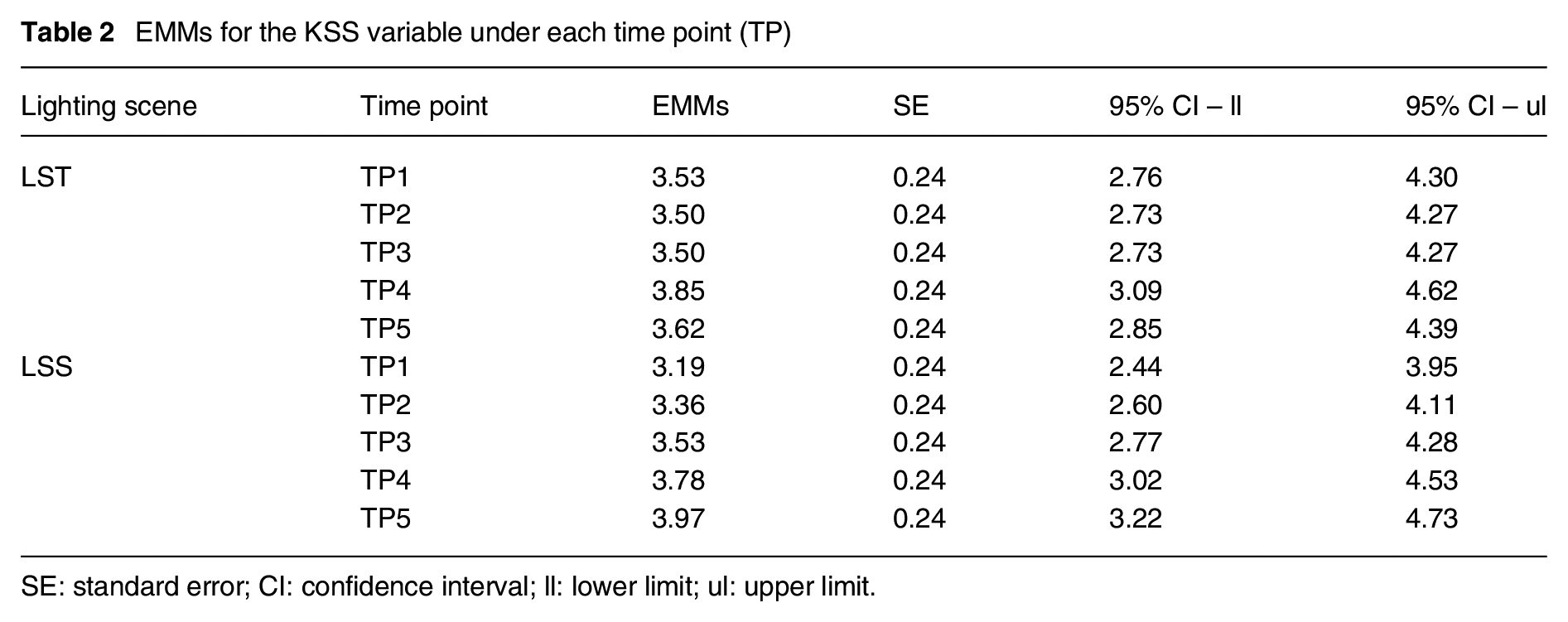
SE: standard error; CI: confidence interval; ll: lower limit; ul: upper limit.
Contrast analysis of the KSS multivariate model
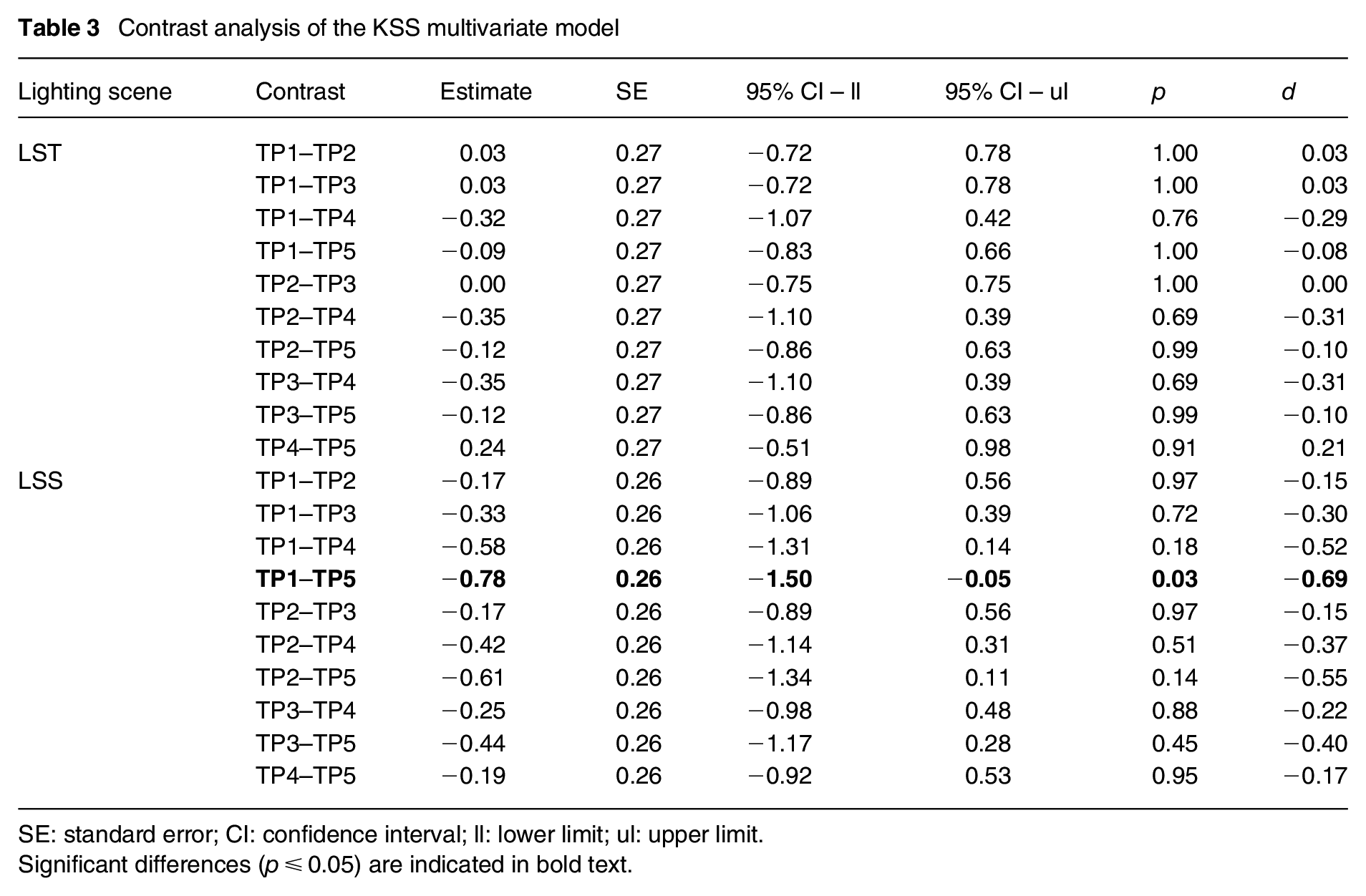
SE: standard error; CI: confidence interval; ll: lower limit; ul: upper limit.
Significant differences (p ≤ 0.05) are indicated in bold text.
3.2 Performance tasks: AUT, RAT and MRT
The EMM values for the scores in performance markers of AUT were the following: 6.58 for LSS and 5.59 for LST in Flexibility, 8.82 for LSS and 8.69 for LST in Fluency, 4.14 for LSS and 3.56 for LST in Originality and 18.57 for LSS and 18.81 for LST in the Elaboration. The contrast analysis showed a significant difference only in the AUT Fluency marker (estimate = 0.99, p = 0.03, d = 0.54), indicating better performance under the LSS condition.
The EMM values in the RAT Score were almost identical (0.39 for LSS and 0.40 for LST, with fractions representing percentages of correct answers), with contrast analysis showing no significant difference (p = 0.85)
The EMM values in the performance marker of MRT were 4.76 for LSS and 4.40 for LST, with contrast analysis also showing no significant difference (p = 0.13; Tables 4 and 5).
EMMs of response variables in the performance tasks
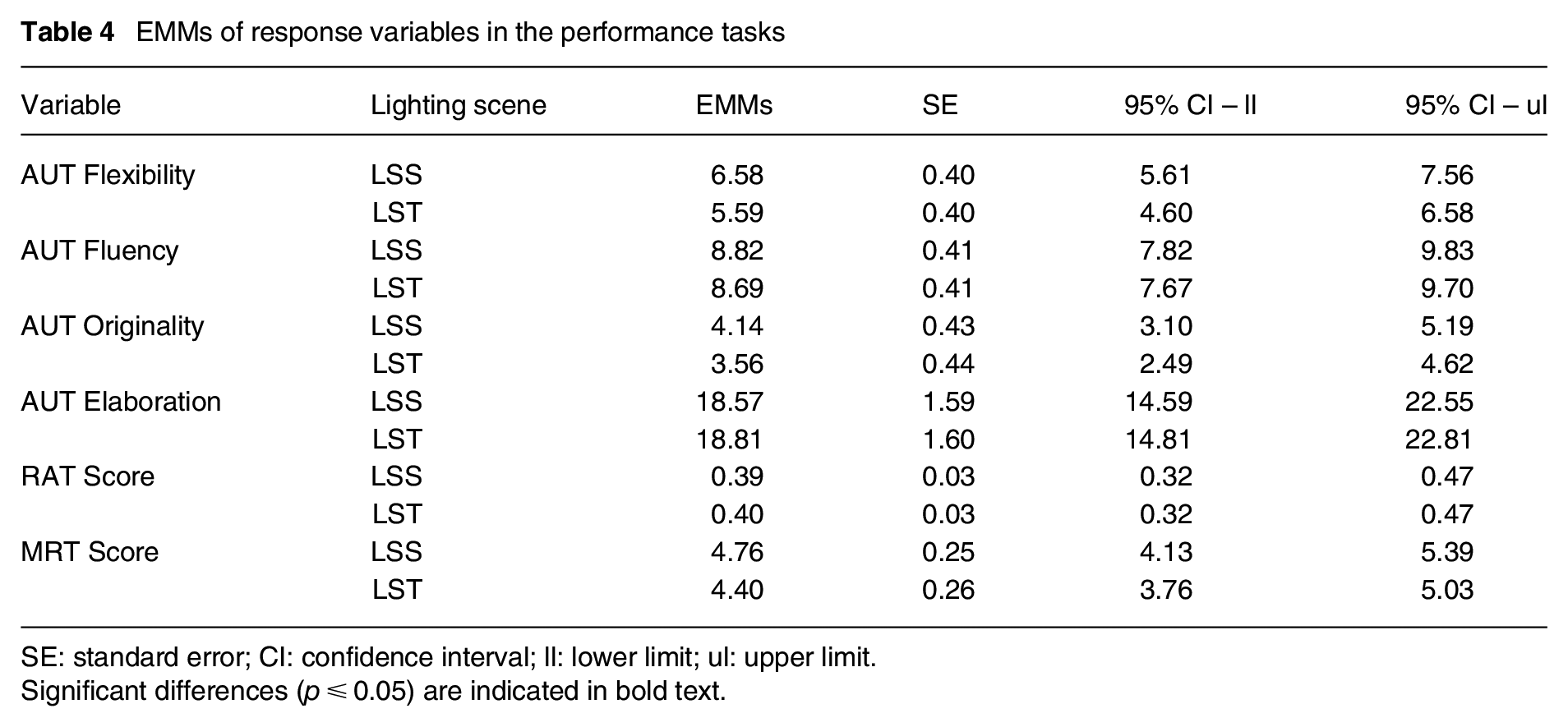
SE: standard error; CI: confidence interval; ll: lower limit; ul: upper limit.
Significant differences (p ≤ 0.05) are indicated in bold text.
Contrast analyses for the response variables of the performance tests
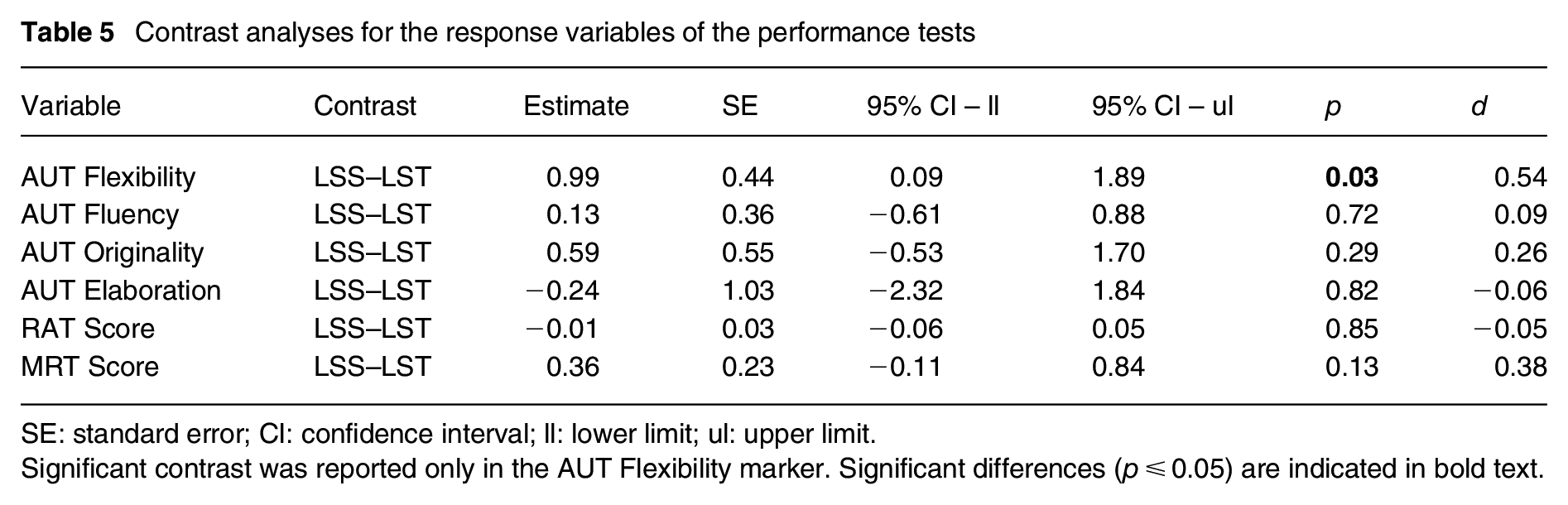
SE: standard error; CI: confidence interval; ll: lower limit; ul: upper limit.
Significant contrast was reported only in the AUT Flexibility marker. Significant differences (p ≤ 0.05) are indicated in bold text.
It is essential to add that the different language versions of the task had unique contents, as direct translation was seen to be inappropriate in retrospect, given the different way the languages are structured. Validated versions of the task were used to increase the credibility of the experiment. Albeit the contents were grouped and balanced in difficulty level in both language versions, in this specific task, there were essentially two groups, with 22 participants in the German version, and 13 in English. To account for that, an additional post-analysis of the results was performed with data split between the language versions. Nonetheless, there were no significant differences (p = 0.970 for the German group and 0.867 for the English group), indicating that lighting directionality did not affect convergent thinking, regardless of the language version.
3.3 Subjective assessments of room appraisal, visual comfort and mood
The EMM values for the subjective assessments of the room appraisal were 67.81 for LSS and 67.43 for the LST in the attractiveness, and 74.92 for LSS and 72.07 for the LST in the illumination. Contrast analysis showed no significant differences between the LS, indicating that the room and its illumination were perceived as similar under both conditions.
The EMM values for the subjective assessments of visual comfort were the following: 58.39 for LSS and 58.61 for the LST in the perceived glare, and 46.27 for LSS and 43.56 for the LST in the colour acceptance of lighting. Contrast analysis has shown no significant differences in either of the two variables.
The EMM values for the subjective assessments of mood were the following: 2.17 for LSS and 3.35 for the LST on the Good–Bad scale, and 2.44 for the LSS and 1.53 for the LST on the Wakefulness–Fatigue scale. Contrast analysis has shown no significant difference between the conditions. The results of these variables represent a change between the baseline and the ending measurement; therefore, these results indicate that under both of the lighting conditions, the participants reported a positive change in mood (increase in the ‘good’); however, they also more fatigued over time (increase towards the ‘fatigue’; Tables 6 and 7)..
EMMs of response variables in the subjective assessments
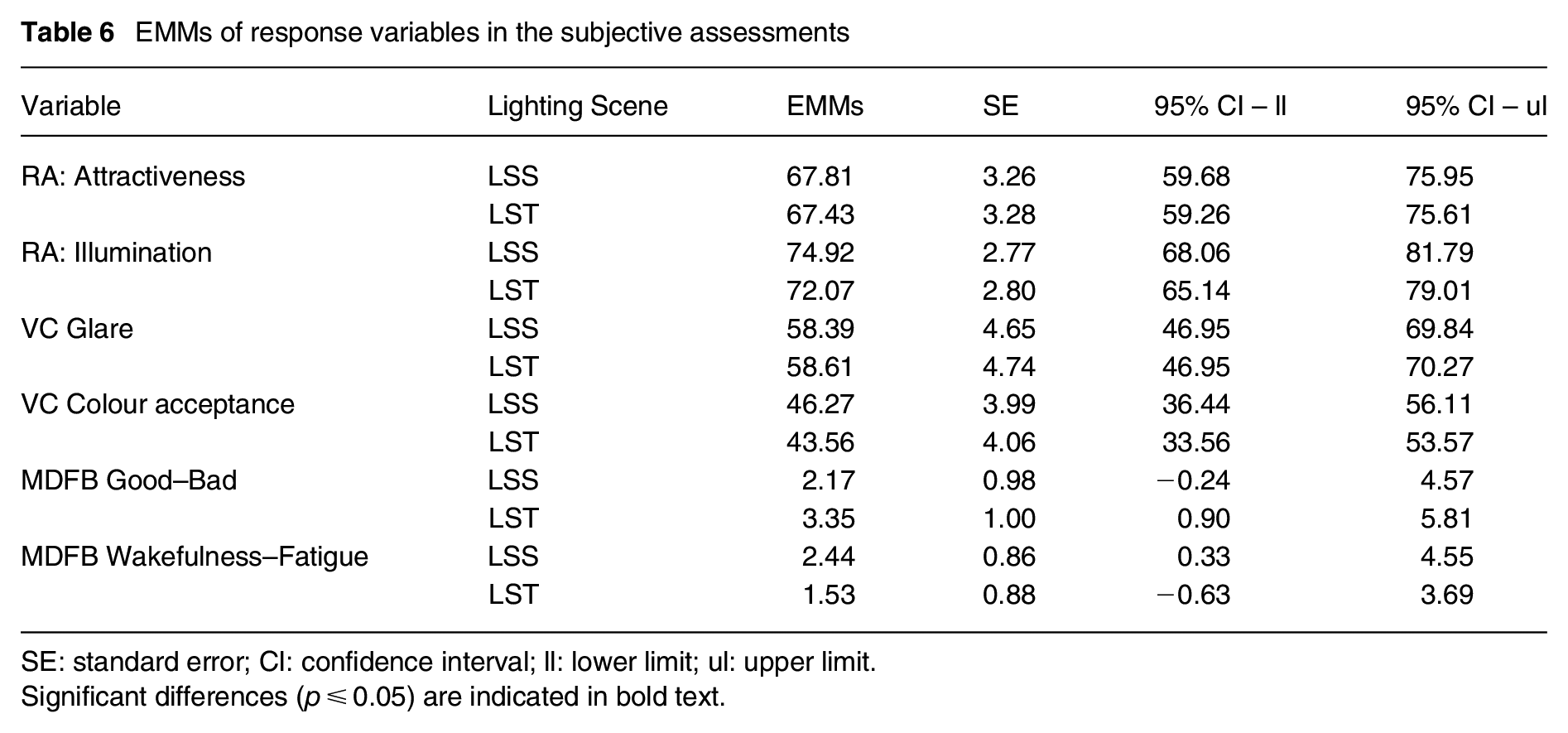
SE: standard error; CI: confidence interval; ll: lower limit; ul: upper limit.
Significant differences (p ≤ 0.05) are indicated in bold text.
Contrast analysis of the subjective assessments’ response variables
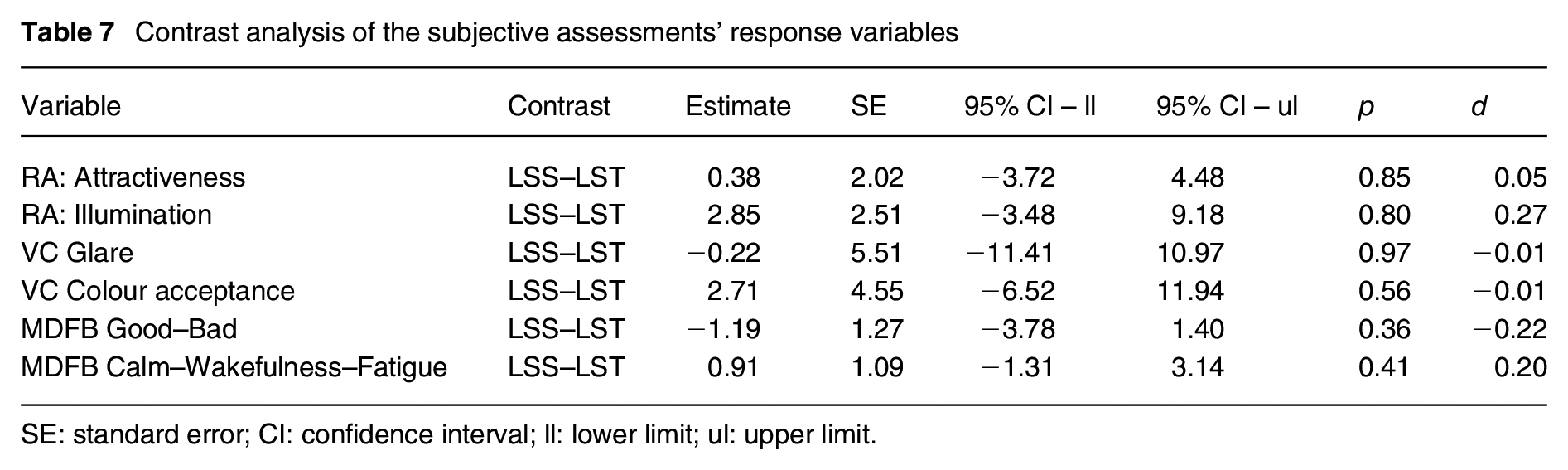
SE: standard error; CI: confidence interval; ll: lower limit; ul: upper limit.
3.4 Covariates
The significant effects of covariates are included in Table 8. The β-value represents the estimated change in the response variable for every unit increase in the covariate. Out of the four analysed covariates, indoor daylight exposure had a significant effect on three of the dependent variables of the analysed creativity tasks: the AUT Fluency (β = 0.23), AUT Elaboration (β = 0.70) and RAT Score (β = 0.02).
Results of the fitted models for the covariates – significant results only
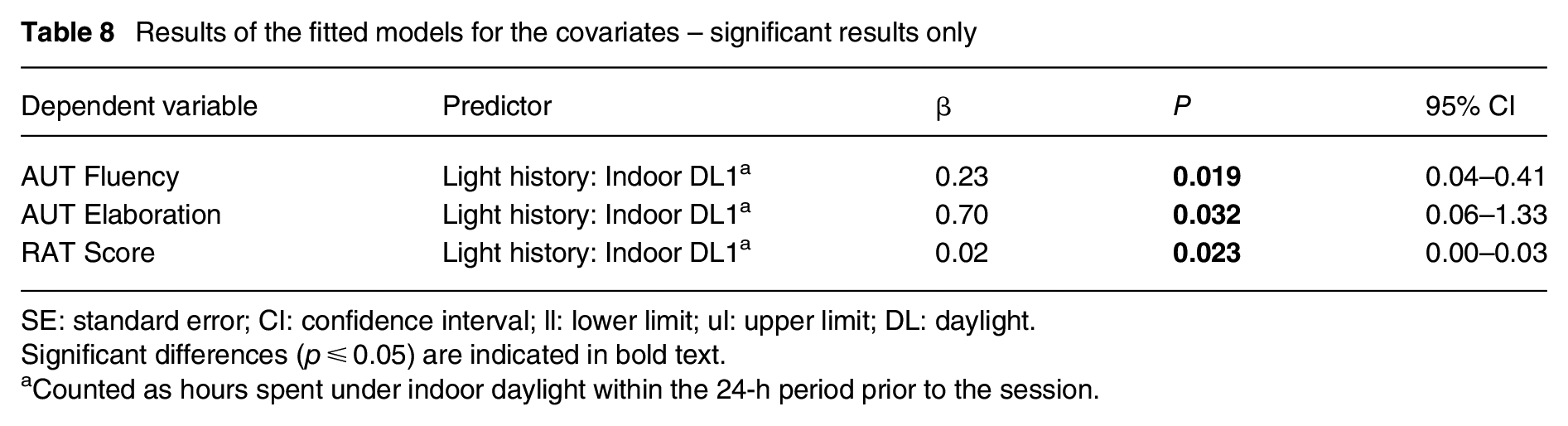
SE: standard error; CI: confidence interval; ll: lower limit; ul: upper limit; DL: daylight.
Significant differences (p ≤ 0.05) are indicated in bold text.
Counted as hours spent under indoor daylight within the 24-h period prior to the session.
The PSQI score (sleep quality on the day of the session), light history, LED exposure and time outside did not have a significant effect on any of the response variables.
4. Discussion and conclusions
In our previous work concerning the directionality of light and its effects on NIF responses, 29 we focused on assessing cognitive performance in tasks commonly discussed in literature from the field. The results showed a small effect reflected in reaction time in a simple auditory task Psychomotor Vigilance Task (PVT). As a continuation of this work, here we investigated the potential influence of light directionality on tasks associated with creative thinking. We hypothesised that the different lighting conditions affect the emotional state of participants due to the varied ambience and room appearance. This, in turn, could potentially moderate the creative performance, as indicated in the literature. To explore these hypotheses, we created two experimental light conditions in a set-up mimicking a realistic meeting/co-working space. The conditions had a dominant lighting source positioned either from the top or from the side of the FoV, and the light dose measured at the eye height of participants was similar in the two conditions. The results have shown that the dominant light directionality can still moderate the magnitude of NIF effects in such settings. These effects were evident in the subjective sleepiness levels and the flexibility performance marker of the AUT, corresponding to the generation of creative ideas across different categories.
Regarding subjective sleepiness, participants exposed to the light from the upper FoV reported consistent levels of sleepiness. In contrast, those under side lighting experienced a significant and steady increase in this subjective marker. This aligns with findings from our previous laboratory experiment on light directionality, where similarly, lighting from the upper part of the FoV had the most sleepiness-reducing effect in an early afternoon setting. 29 As mentioned in the introduction, other studies documenting the moderating effect of light directionality on NIF effects focused on melatonin suppression and were performed during night-time.15–18,20,21 Thus, our findings corroborate with research showing that the alerting effect of light can still be observed during daytime, even in the absence of melatonin manipulation. Furthermore, these results show, to our knowledge, for the first time, a diurnal effect of directionality.
A possible explanation for this effect may be rooted in evolutionary or psychological mechanisms. The human circadian system, as previously discussed, is optimised to promote alertness and enhanced cognitive performance during daylight hours.6,13,22,37,38 There are differences in the spatial light distribution under daylit conditions, with a typical outdoor setting characterised by a majority of luminous flux originating from the upper part of the FoV. 114 Consequently, lighting conditions that resemble these natural daylight patterns might be associated with the biological drive to maintain alertness and cognitive performance during the day. This assumption does not have solid literature-based backing; thus, we indicate it as a topic for further research. In the context of the visual system, humans demonstrate a ‘light-from-above’ prior – an inherent assumption that light originates from above (or slightly left-above) direction, which, although aided or overridden with additional environmental cues in realistic scenarios, plays a critical role in object recognition and interpretation.115–117 It cannot be ruled out that evolutionary associations with certain directions of light are anchored in human nature and can also contribute to the NIF effects.
As for the AUT, the results have shown that side lighting significantly enhanced the number of creative ideas generated, as reflected by the flexibility marker. The scarcity of other scientific evidence related to light directionality and divergent creativity performance does not allow for a decisive conclusion. However, this finding, combined with the effect on sleepiness, suggests that higher levels of subjective alertness do not necessarily correlate with increased creativity. Literature in this field is limited, suggesting that better sleep has a positive impact on creativity, while sleep deprivation – an unnatural state of increased sleepiness, also linked to a disruption in circadian rhythm – has a negative effect. 118 In the present experiment, sleepiness was not induced by such extreme measures but treated as a dependent variable, possibly moderated by the experimental lighting conditions. Thus, it is not appropriate to claim that our results contradict the findings from sleep-deprivation studies. Our results indicate that the level of sleepiness, which is not induced by poor sleep quality but rather by environmental conditions, can affect creativity. The interesting correlation found – higher sleepiness with better creativity – requires further investigation.
Furthermore, we looked at the room appraisal and mood ratings, as one possibility could have been that increased attractiveness or interest in the space triggered by side lighting contributed to heightened creative inspiration, as lighting appraisals, atmosphere and elements of interior design have been reported to have an effect on creativity. 50 However, we could not confirm this assumption as scoring on these response variables between the two lighting conditions was similar. In addition, the subjective glare assessments were also scored similarly despite more than a two-fold difference in the luminance of the light sources between the conditions. We assume that the conditions did not differ sufficiently to create a significant change in environmental perception, to affect creativity through room appraisal and possibly mood. At the same time, such a change would be difficult to achieve while fulfilling one of the main experimental criteria of this study, which was to keep the light dose at the eye similar between the conditions.
Regarding the RAT, there were no significant differences in the performance under the different lighting conditions. This was visible in the results when both were grouped together and separated by the language version. The lack of significant results could have been caused by the nature of the task design used in this study. Due to the limited available and validated contents (word-problems) of this task, a selection had to be made to fit the desired timeframes of the protocol. Languages evolve, and so do vocabulary-based tasks. This is anticipated by reviewing and developing databases and contents of the RAT and its translations. Here, in the self-assessment sheets, the participants were asked to give feedback on the word-problems to assess whether they were familiar with the used words. Thus, the actual score in this task was a percentage of the correct responses, out of all the known word-problems. Reducing the number of possible points to score by elimination of some word-problems also introduced a potential bias – if some participants only knew 19 out of 20 words, and their score was based on a fraction of the 19, and as such they had a higher chance of an increased score. To check for this potential bias, an additional analysis was performed with a model that took into consideration the score out of 20 responses, with even less significant results (p = 0.937). Thus, in the main analysis, the initial approach was kept. Few words were not known in the vocabulary of some of the participants, indicating that perhaps a more updated, or profession- or culture-specific set of word-problems could have shown different results. Another suggestion for future work is implementing a different, visual-based version of this task. 119
The performance in mental spatial rotation was not affected by light directionality either. Due to randomisation (division into two groups), task characteristics (the task content cannot be repeated in multiple sessions) and anticipation of the learning effect (only the second block was analysed), the contents of the task had to be divided, and only its short, 3-min part was evaluated. Moreover, the data analysis showed a skewed distribution, with many participants scoring 100% of the points. This suggests that a larger and more difficult dataset of problems to solve, or shorter time constraints, is needed to show significant differences between conditions.
Furthermore, the study’s task administration typology introduced a limitation, as the paper form with a fixed solving time was designed solely to measure the accuracy marker. A comparison of response times could have potentially revealed a difference between conditions since performance measured by this marker can still be statistically analysed even if the accuracy scores are skewed. This is something to consider for future research involving accuracy-based tasks.
A general limitation of the current experimental design was the fixed order of the tasks. Previous research suggests that the sequence in which tasks are administered can influence performance outcomes due to the effects of mental load, fatigue, carry-over effects, anchoring mechanisms or other factors.54,55,120–124 A possible solution to minimise this bias is to use a counterbalanced order of tasks distributed among participants; however, in this study, the protocol was kept constant across groups and sessions due to practical limitations.
The covariate analysis revealed that creative processes were significantly influenced by the increasing time under daylight exposure (indoors, thus through windows) in the 24-h period prior to the session. This was reflected in three performance markers of the creativity tasks. This finding indicates that daily exposure to natural light is beneficial for promoting creativity. A possible explanation of this effect could be linked to an indirect influence of healthy sleep patterns. It has been reported that exposure to natural light promotes healthy sleep, which in turn, reflects enhanced performance in creative tasks.125–127 A carry-over effect of daylight exposure from the previous day could also be linked back to reduced evening melatonin suppression thus improved circadian rhythm patterns, consequently affecting the well-being and mental performance.128,129 Nonetheless, the other analysed covariable in this study, the self-reported sleep quality (PSQI) on the session day, did not significantly affect the performance. Thus, if the effect was linked to the quality of sleep – it was not so evident to the participants. Another explanation could be linked to the effect of nature and access to view, which have been previously reported to enhance creative and cognitive performances.130–133 Considering present findings, light history should be considered in more depth in future research, with information not only on the exposure time but also on the type of view and experienced daylight during the day. The outdoor daylight exposure on the session day and the exposure to LED lighting (screens, indoor electric lighting) did not have a significant influence on any of the markers. It is important to note that the study was done in winter; thus, the outdoor daylight exposure was generally low among the participants.
In conclusion, this study provides novel insights into the effects of light directionality on NIF responses reflected in creative task performance and subjective sleepiness in a simulated office environment. While lighting originating mainly from the upper FoV was more effective at reducing sleepiness, side lighting enhanced the flexibility aspect of divergent creative thinking. The lack of significant results in other tasks may be attributed to task design limitations and the potential need for a more tailored design. The study also points to the role of daylight exposure in enhancing creative thinking, emphasising the importance of daily exposure to natural light. Finally, research in the field of light directionality is limited. Present findings, the nocturnal directionality studies, reporting guidelines 134 and the evidence of different spatial light distributions in everyday situations 114 emphasise the need to consider this variable in the experimental design, documentation and future studies.
Supplemental Material
sj-docx-1-lrt-10.1177_14771535251339672 – Supplemental material for The effect of light directionality on creative performance and subjective sleepiness in the early afternoon
Supplemental material, sj-docx-1-lrt-10.1177_14771535251339672 for The effect of light directionality on creative performance and subjective sleepiness in the early afternoon by N Derengowski, M Knoop and S Völker in Lighting Research & Technology
Footnotes
Acknowledgements
The design of this study was registered to OSF.io on 21 November 2023. The authors would like to thank M Leontopoulos, S Leontopoulos and L Bertram for all the help with the project.
Declaration of conflicting interests
The authors declared no potential conflicts of interest with respect to the research, authorship, and/or publication of this article.
Funding
The authors disclosed receipt of the following financial support for the research, authorship, and/or publication of this article: This research was performed within the European Training Network LIGHTCAP (project number 860613) supported by the Marie Sklodowska-Curie actions framework H2020-MSCA-ITN-2019.

Supplemental material
Supplemental material for this article is available online.
References
Supplementary Material
Please find the following supplemental material available below.
For Open Access articles published under a Creative Commons License, all supplemental material carries the same license as the article it is associated with.
For non-Open Access articles published, all supplemental material carries a non-exclusive license, and permission requests for re-use of supplemental material or any part of supplemental material shall be sent directly to the copyright owner as specified in the copyright notice associated with the article.
