



Abstract
The European Standard EN 17037 was first introduced in 2018 with the aim of encouraging building designers to ensure adequate daylight in buildings. Experience has shown that the standard’s criteria for daylight provision are generally perceived to be too challenging, and this in turn has hindered its implementation in national legislations. This paper proposes a revised illuminance-based criteria for daylight provision using the specific case of regularly occupied rooms in multifamily Swedish residential buildings as an example. In total, 3562 rooms representing typical Swedish residential design are assessed. Two sets of criteria for dwellings are proposed; one based on a fixed illuminance, another based on a fixed area fraction. Both have three levels of ambition, in which the lowest would result in approximately two-thirds of the investigated Swedish dwellings reaching compliance. This is the same compliance rate as for the current national legislation. The implications of three proposed criteria on residential design are also discussed. While results are given for the Swedish context, the proposed criteria could be generalized for use in other European countries. The intention of this proposal is to allow for a wider application of the daylight standard within residential construction across Europe.
1. Introduction
Daylight’s role in architecture and building performance is well known. Adequate daylight in buildings not only reduces electric lighting energy use1,2 but also positively impacts well-being, improves mood and supports circadian rhythm.3–6 Buildings with generous access to daylight are generally preferred amongst building users as daylight provides unique benefits not replicable by artificial light. 7 Furthermore, research shows that well-daylit spaces with direct sunlight can be of higher economic value.8–10 Prioritizing daylighting during the initial design phase is crucial to ensure healthy indoor environments. At the same time however, the urban population has been rising for decades and this trend is expected to continue. 11 It is generally understood that such growth leads to increased urban density and consequently often decreased access to daylight. To boost profitability and housing availability, taller buildings with deeper floorplates and reduced glazing have become increasingly common with the overall affect being a diminished access to indoor daylight in cities.12,13
In 2018, the European Committee for Standardization (CEN) introduced the first-ever European daylight standard, the EN 17037 ‘Daylight in Buildings’, followed by a minor update in 2021. 14 The standard encompasses four daylighting aspects intended to be used in all building types: (1) daylight provision, (2) sunlight access, (3) views out and (4) glare. Although initially welcomed by industry, the daylight provision requirements in the standard are now widely considered to be too stringent for both new and existing buildings; consequently, almost no European country as adopted the standard as calculation method in building codes. Especially for residential buildings in urban contexts the requirements are very difficult to meet. Research demonstrates that, despite compliance with local building codes, rooms in existing residential buildings commonly fall short of EN 17037 recommendations for minimum daylight provision.
In Sweden, about 69% of rooms of existing residential buildings meet current Swedish national building regulations ‘Boverkets ByggRegler’ (BBR). 15 The European Standard’s daylight criteria include separate compliance paths for daylight factor (DF) and an illuminance-based method. When evaluating rooms based on the European Standard’s daylight criteria, it is found that only 16% of rooms meet the criteria using the DF method, and 45% comply when assessed with illuminance-based method. 15 Overly ambitious recommendations for daylight provision potentially discourage a wider application of the standard and in particular the application of the standard for building code purposes. Furthermore, if requirements are set too high, a larger window-to-floor ratio (WFR) may be required, and this can potentially lead to overheating.16–19 Finding a compromise between daylight availability and compliance, particularly in relation to the specific building programme type, is essential for wider application of the standard on the European level and for avoiding conflicting requirements with respect to energy regulations and current urban planning trends. 20
Daylight evaluation in residential buildings is less studied than office buildings. 21 Current research suggests evaluation metrics for daylight provision in residential buildings such as DF or climate-based metrics like useful daylight illuminance (UDI), 22 Residential Daylight Autonomy (RDA) and Residential Daylight Score (RDS).21,23,24 While DF is ubiquitously used in practice, UDI has the advantage of providing a more comprehensive understanding of daylight sufficiency (and excess); however, target illuminances are largely based on research conducted in office spaces. The more recently proposed RDA and RDS provide a comprehensive approach covering daylight provision and direct light access, covering the multifaceted use of residential spaces and dynamicity of activities in different residential rooms. The approach proposes twelve results per room – at three times per day for the four seasons –, which could be of great support for design, but arguably harder to apply for legislative purposes.
The EN 17037 does not differentiate between building types and have adopted a spatial Daylight Autonomy (sDA) approach inspired by LM-83-12, 25 but with modifications of time period, to take into account the different climates in Europe and the different schedules for programme type. 26 Furthermore, while recommended, the inclusion of default shadings for mitigation of direct sun in the EN 17037 is not required. While from a practitioner’s point of view, it may be simpler to have one uniform daylight provision metric across all building types, and the approach might not be optimal for all building types.
This paper aligns with the goal-to-seek acceptable criteria for adequate daylight in residential buildings, using the current EN 17037 as starting point. It uses the Swedish case as subject for testing new calculation methods. The compliance rate of 30 Swedish residential buildings (and 3562 rooms) representative of the Swedish national building stock were analysed with respect to DF and different scenarios for illuminance-based definitions analogous to sDA. In particular, the sDA-based approaches in LM-83-12 25 and EN 17037 were tested, as well as sDA definitions with different combinations of illuminance thresholds (100 lx, 150 lx, 200 lx, 300 lx) and target area fractions (30% to 95% with 5% steps). Based on these results, this paper proposes different thresholds for compliance based on varied levels for minimum target illuminance or minimum target area fraction. The implications for room design are also discussed. Consistently with the current EN 17037, three levels of ambitions are proposed where the minimum level of ambition corresponds to a compliance rate similar to the current Swedish regulation (‘status quo’), and the highest level of ambition corresponds to a compliance rate similar to LM-83-12, applied without dynamic shading.
The guiding principle of the proposals included in this paper is to use the metrics already included in EN 17037 and to which practitioners are familiar. The intention is to encourage a wider application of the daylight standard within the residential sector by making requirements more aligned with the current building practice. This work is part of a larger initiative from the standardisation committee CEN TC169/WG11, where different building types are investigated with the same methodology as described in this paper.
2. Background
2.1 Daylight requirements
Within building codes of European countries, daylight provision is generally given limited consideration. Requirements for daylight sufficiency across European countries are generally consistent across building type but in some instances can be specific for residential application. Requirements are commonly given as minimum opening dimensions, but many countries also have compliance paths based on the DF. For example, in Italy, regulations for residential application mandate the inclusion of an openable window with a WFR exceeding 0.125, primarily for sanitary purposes. 27 Alternatively, an average DF surpassing 2% is also an option to demonstrate compliance. 27 For all building types in Poland, a WFR > 12.5% is required 28 ; in Slovenia, this is increased to 20% 29 ; in the Netherlands, WFR should be higher than 10%. 30 The Danish building regulations introduced a WFR requirement in 1995 and this was applicable to all building types. This was later supplemented in 2008 with an option for average DF of 2%. 31 In 2018, the Danish regulations were updated to include a compliance path for target illuminance, but the persistence of the WFR has largely undermined the uptake of the more advanced metric. In Norway, daylight became a part of the building code for all building types in 1997. At the time, the Norwegian regulations were largely based on the Swedish building code which had options for WFR or a point DF (DFp). The Norwegian building code was later updated in 2017 requiring an average DF of 2% for non-residential buildings with option for WFR for residential applications. 32 Generally speaking, due to ease of measurement and ease of compliance, daylight assessment methods based on WFR tend to dominate throughout Europe.
In Sweden, regulations from the Swedish work environment authority cite the EN 17037 standard as an example of how compliance for daylight and view can be demonstrated. The standard has not been adopted to the national building code; however, it is used as calculation method for BREEAM-SE 6.0 33 voluntary certification scheme, typically adopted by more ambitious projects. For new residential buildings, requirements in BREEAM-SE 6.0 are different per room type (living room, bedroom, etc.), and they are based only on target illuminance or DF over a targeted area fraction, namely removing the requirements of minimum target from EN 17037. Additionally, target illuminance and DF are lower than those recommended by EN 17037. 33 Daylight criteria in the Swedish building code were instead first adopted in 1976 34 with a requirement for a 1% DFp for all building types. The requirement was later appended in the late 1980s with an option to use a WFR with limitations for application and adjustments for such things as balconies and surrounding obstruction as per the SS 914201. 35 It is worth noting that, from 1993 to 2014 even though DF was needed for rooms which did not meet the basic conditions of the SS 914201, the term DF did not appear in the text of the code. 36 In recent years, the use of a median DF over the DFp has become accepted within industry as a more robust means to assess daylight within a room. 37 Compliance with the daylight requirement in the current Swedish building code is generally considered to be difficult, however. As a result, numerous research projects15,37,38 have been carried out potentially leading to valuable insights that accelerate the development of new metrics.
Given that regulatory frameworks are largely based on WFR, it is perhaps not surprising that European practitioners are generally not familiar with advanced daylight analysis. 39 In the best case, they are familiar with the general concept of DF, but calculation of DF is unlikely to be part of their daily workflow. Additionally, daylight design is generally not an area of focus in architectural and engineering schools, and this further suggests that future designers may also lack the skills to perform advanced daylight analysis. 40
2.1.1 Daylight provision in EN 17037
The European Standard EN 17037 provides three levels of recommendation, or ambition, for daylight provision: minimum, medium and high. 14 The standard offers two pathways to reach the recommendation: one based on target DFs, and one based on daylight illuminances. The standard’s illuminance-based method has a definition analogous to the one of sDA.
For sDA, the standard’s recommendation is that for 50% of daylight hours, a given target illuminance ET (lx) is reached for at least 50% of the floor area, while a minimum target illuminance ETM (lx) is reached for at least 95% of the floor area. Four target illuminance values for ET (lx) and ETM (lx) are adopted (100 lx, 300 lx, 500 lx, 750 lx), and the requirements change with the level of recommendation, as shown in Table 1.
Recommendations of daylight provision by daylight openings in vertical and inclined surfaces in EN 17037
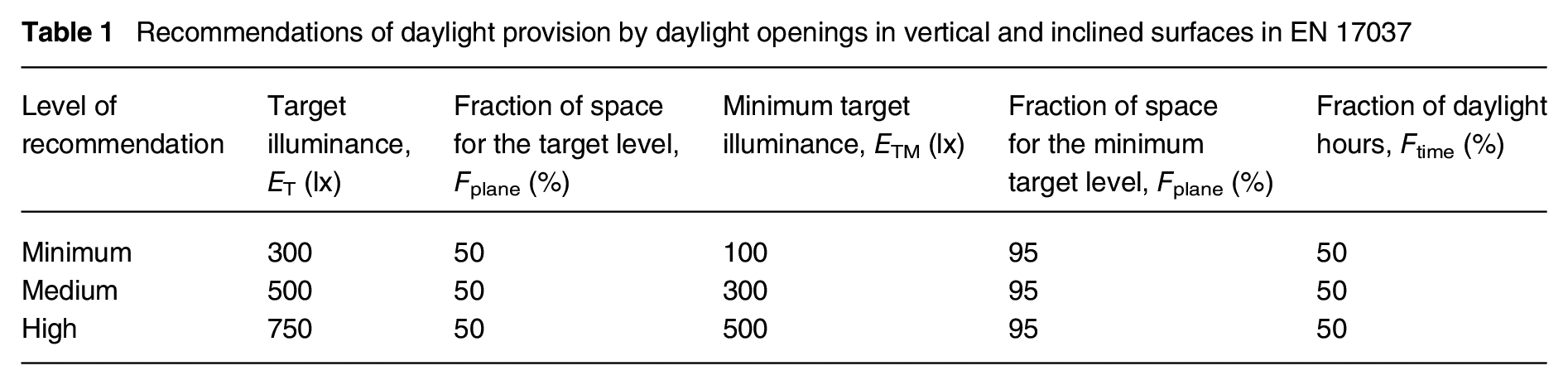
The DF approach is thought to be a simplified, practitioners-oriented pathway providing comparable results to the illuminance-based approach. For DF, the EN 17037 proposes target DFs D to exceed 100 lx, 300 lx, 500 lx or 750 lx during 50% of the daylight hours for a particular location. In Copenhagen, for example, the D to exceed 100 lx is 0.7%, while D to exceed 300 lx is 2.1%; therefore, a room reaches the minimum level of recommendation if D ≥ 0.7% for 95% of the floor area and D ≥ 2.1% for 50% of the floor area. As D is verified over several points, this requirement is thus more demanding than the current Swedish national building regulations.
2.1.2 IES approved method for daylight provision LM-83-12
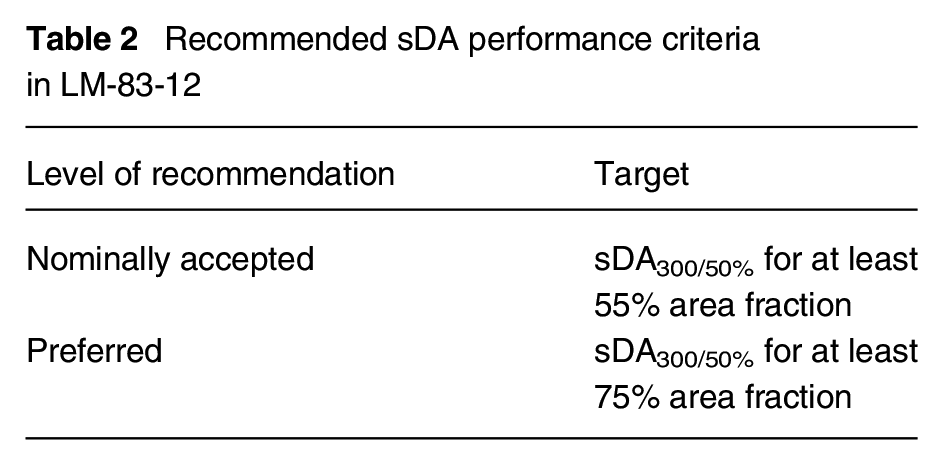
The IES approved method LM-83-12 is a daylight provision assessment based on sDA. 25 The document LM-83-12 provides details on how the sDA analysis should be carried out, including, for example specifications on the 3D model and surrounding, furniture in the model, analysis points, shading, etc. Target sDAs are then defined as in Table 2, for a period of analysis fixed from 08.00 to 18.00. Notably, LM-83-12 requires the use of dynamic shading devices, unless those are not specified in the design, or the annual sunlight exposure (ASE) reached a ‘nominally acceptable’ level for occupant comfort. In this study, the calculation – indicated with IES-sDA in this manuscript – has been modified to exclude the default shadings; hence, the only difference between this method and the EN 17037 method is the time period of analysis. The method in LM-83-12 is specifically developed for workplaces, therefore not directly applicable to residential architecture. However, since LM-83-12 is generally adopted for ambitious daylight projects – for example by the LEED voluntary certification scheme – the method was selected here to define the uppermost level of ambition for the proposed criteria. Please note that LM-83-12 is applied in a modified form in this manuscript, see Section 3.
Recommended sDA performance criteria in LM-83-12
2.2 The Swedish residential building typology
This paper uses regularly occupied rooms in Swedish dwellings as study object. Though the European daylight standard is applicable to all spaces with daylight openings, the approach used here examines the standard’s potential application for building code purposes. An overview of the Swedish residential building typology is provided below. These typologies are used as context for this study.
Multi-dwelling buildings, specifically residential structures with three or more apartments, represent the prevailing housing type in Sweden, accounting for 52% of the entire national housing inventory. 41 The residential typologies outlined by Björk et al., 42 as depicted in Figure 1, served in this paper as the basis for classification in both building selection process and their categorization. Björk et al. 42 recognized the following common residential typologies.
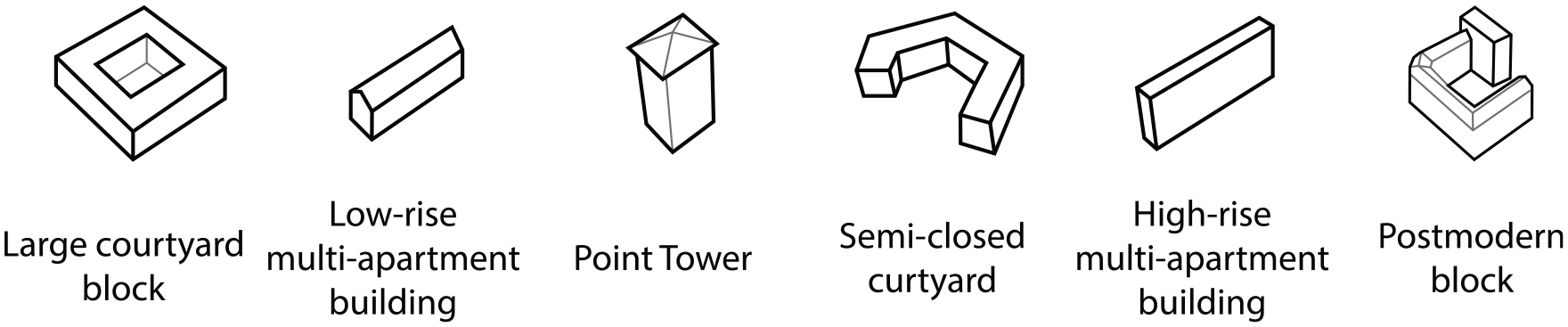
Typical Swedish residential building typologies
2.2.1 Large courtyard blocks (Stenstadskvarter and Storgårdskvarter)
This architectural category encompasses structures built around an inner courtyard, resulting in a block formation. These buildings typically reach heights of three to six stories with floor heights varying between 2.7 m and 3.0 m. Following the introduction of the new Town Planning Act in 1907, 43 construction within the courtyard was prohibited.
2.2.2 Low-rise multi-apartments building (Lamellhus)
During the period between the 1930s and 1970s, the prevailing architectural typology was the detached rectangular apartment block known as ‘Lamellhus’. Comprising two to four staircases and standing at a height of three to four stories, this style emerged alongside modernist urban planning trends in the 1930s. Floor-to-ceiling heights were generally around 2.7 m. This design was a result of an emphasis on ample daylight and access to balconies.
2.2.3 Point tower (Punkthus)
Since the 1930s and continuing to the present, the rapid urban expansion across many cities has frequently led to the establishment of new multi-dwelling structures on natural land situated next to existing urban developments, particularly in hilly terrains. Given this context, the construction of low-rise detached flats became unfeasible. Instead, a novel form of apartment building, known as a ‘point tower’, with floor-to-ceiling heights generally between 2.5 m and 2.7 m was introduced. These structures typically incorporate a singular staircase, housing four to six apartments per floor, with buildings often organized in clusters.
2.2.4 Semi-closed courtyard blocks (Lamellhus halvslutna gårdar)
During the 1940s and 1950s, a substantial migration to urban centres occurred, particularly post-Second World War, triggering a severe housing deficit. To address this influx of new inhabitants, a prevalent architectural style emerged on the outskirts of cities, typically consisting of three stories in height. This building typology evolved from a reimagining of low-rise detached apartment structures, giving rise to interconnected units that formed semi-enclosed courtyards. 38
2.2.5 High-rise multi-apartment building (Skivhus)
This form of apartment construction gained popularity during the 1960s and 1970s, characterized by rectangular-shaped units within the edifice. Differing from low-rise detached apartment structures, this type generally comprises eight to nine stories with floor-to-ceiling heights of around 2.5 m to 2.6 m. The buildings are commonly erected in parallel, boasting a uniform appearance. Additionally, the positioning and gaps between each building were determined by factors such as the angle of sunlight and building height, ensuring ample daylight within the apartments.
2.2.6 Postmodern blocks (Postmoderna reformkvarter)
Between 1975 and 1995, a distinct building style appeared in the housing market following the conclusion of the Million Programme (Miljonprogrammet), an ambitious public housing programme aiming at building a million of affordable dwellings in 10 years. 44 Typically situated within city confines, these structures were organized in a grid pattern to emulate the traditional urban design of historic neighbourhoods. Unlike expansive courtyard blocks, this variety exhibited differing heights and smaller windows, influenced by new energy regulations after the 1973 energy crisis. Financial considerations also frequently restricted room height to 2.4 m. 45
2.2.7 Dense city block
Commencing in 1995, a renewed housing scarcity impacted major urban centres, largely stemming from a notable drop in the construction of new residential properties prompted by the early 1990s economic crisis. To counter this, novel urban planning methodologies were adopted, focusing on repurposing lands previously allocated for other functions, including ports, industries and hospitals. These modern endeavours frequently exhibit increased building heights in contrast to established neighbourhoods, showcasing diverse aesthetics through a variety of construction materials.
3. Method
3.1 Selection of buildings
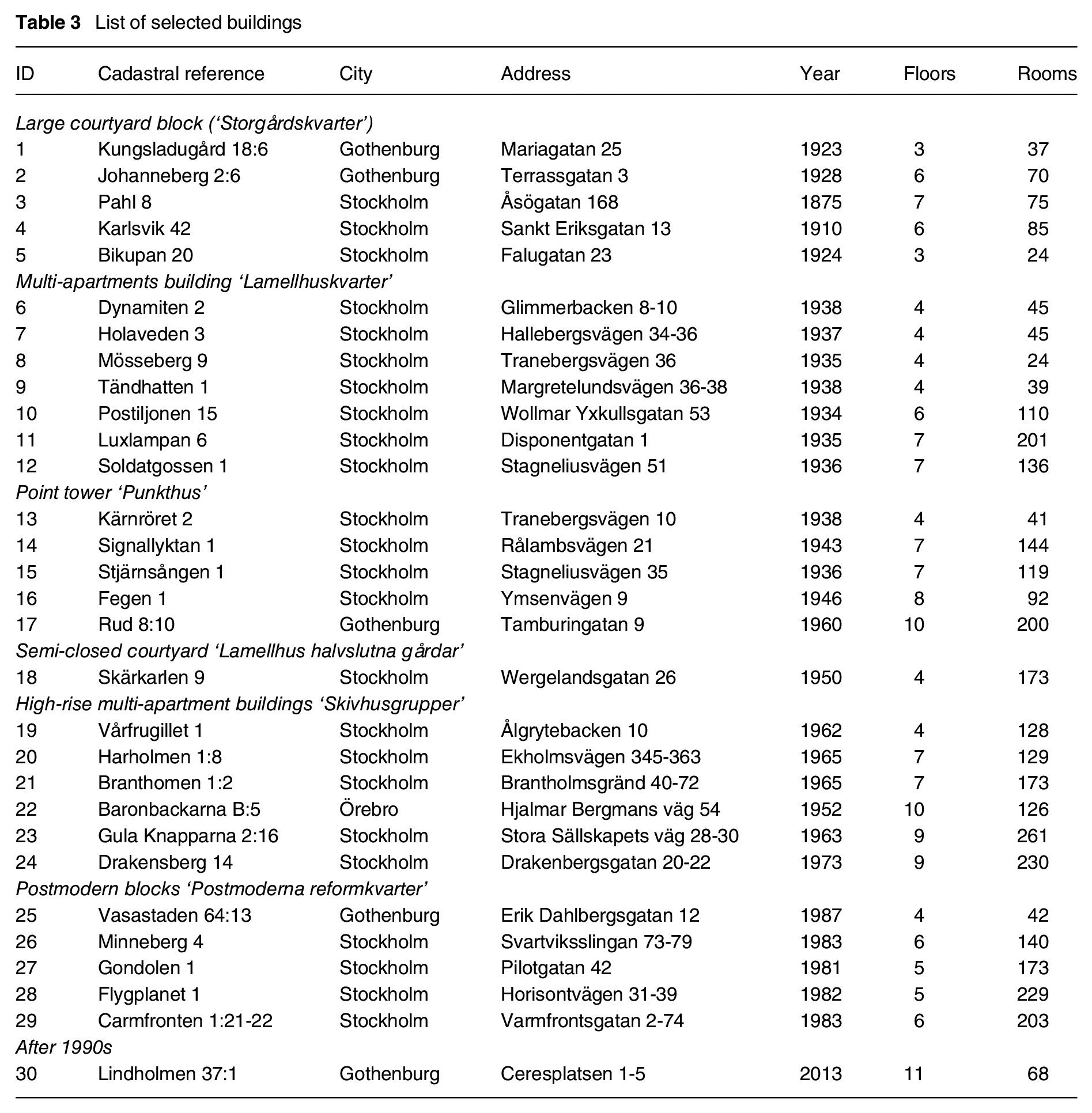
A set of 30 existing residential buildings was chosen from a compilation featured in a previous industry funded research project referred to as SBUF 13209. 37 Selection criteria were based on building typologies and construction years (Table 3), aiming to offer a faithful representation of the current Swedish building inventory as listed above. Variations in the availability of building models led to some differences in the chosen selection compared to the distribution of existing building typologies. The building geometry was derived from the original permit drawings. However, it is important to acknowledge that certain buildings may have undergone modifications in terms of interior wall partitioning and balconies. Furthermore, many of the buildings examined here may have had an increase in wall thickness or decreased glass area and/or reduced light transmittance as a result of energy retrofitting measures.
List of selected buildings
3.2 Daylight analysis
The building models were created using Rhinoceros 3D. The climate-based daylight simulations were configured and performed in Grasshopper using the Radiance-based plugins from Ladybug Tools; the Daylight Coefficient Method (The Two-Phase Method) was implemented, and the Radiance parameters used in the simulation is presented in Table 4. For the 3D models, details are presented in Figure 2. Information on surrounding buildings was retrieved from the city map, while the building models themselves were retrieved from an existing database. 37 The models include a standardized window frame width of 10 cm and wall thickness approximated from original permit drawings. The tested rooms were tagged as either bedroom, living room, kitchen or one-room apartment. Bathrooms were excluded as they are not considered to be regularly occupied, and in Sweden they are typically without windows. The values of reflectance and transmittance suggested by EN 17037 were assigned to the main surfaces (Table 5). For other surfaces, those specified in the SBUF 13209 models were adopted.
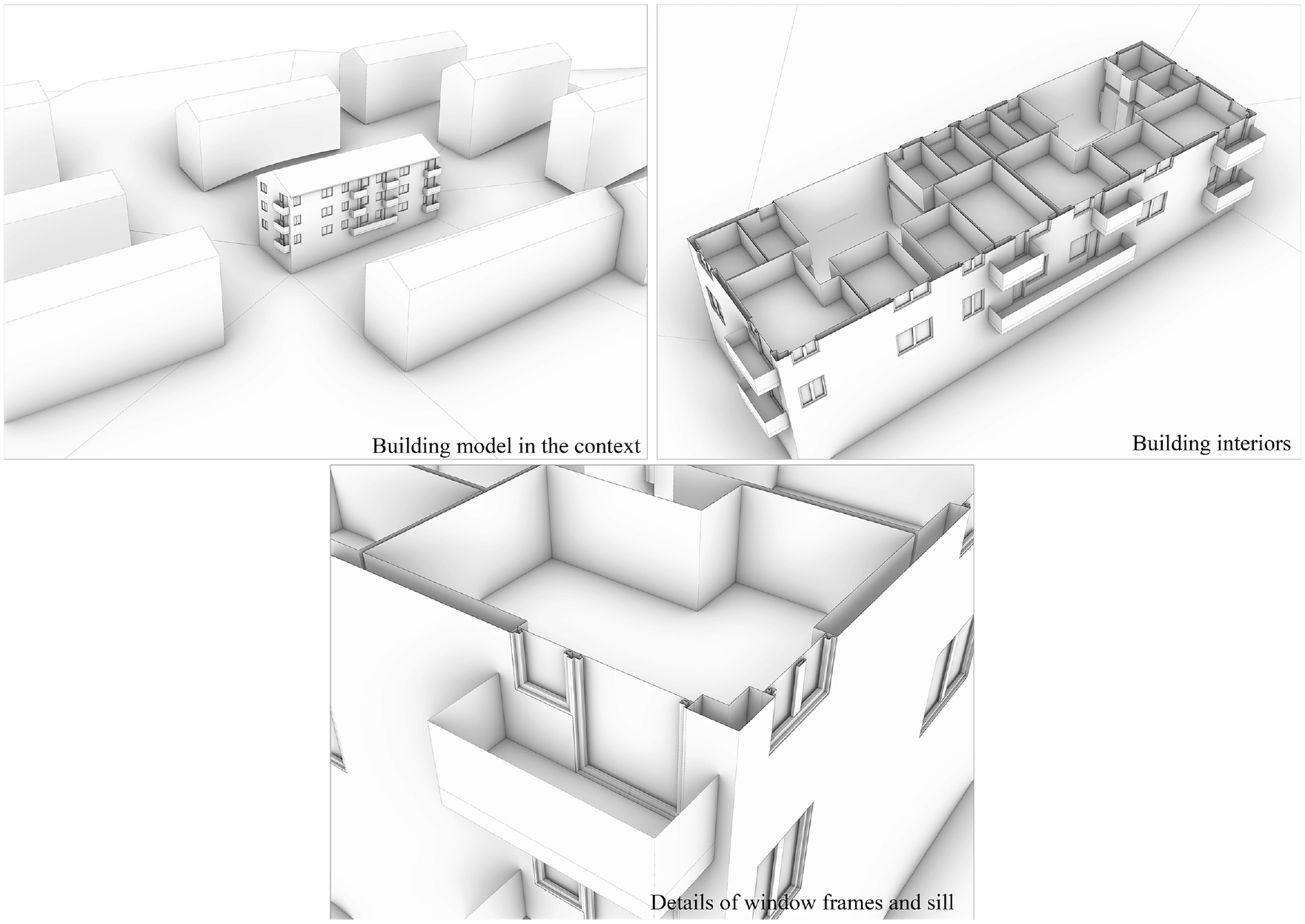
Model details for an exemplary building, from the context to the details of wall thickness, window frame and sill
Radiance settings used in the simulations

Surface properties

Five types of daylight analyses were conducted for the modelled rooms. The first four analyses are preliminary compliance tests with existing methods, namely:
Swedish building regulation method with daylight factor (BBR-DF). A static DF simulation under CIE standard overcast sky. The compliance rate was based on rooms passing the minimum requirement of median DF, DFm ≥ 1%. The traditional approach of the Swedish code (BFS 2011:6) is to require a DFp ≥ 1% located halfway into the room (from a window), 0.8 m above the floor and 1 m away from the darkest side wall, but calculation based on DFm ≥ 1% is also generally accepted in current practice.
EN 17037 Daylight factor method (EN-DF). A static DF simulation under CIE standard overcast sky following the EN 17037 recommendations. The compliance rate was based on the minimum level of recommendation for Copenhagen, corresponding to target DF (DFT) greater than 2.1% for at least 50% of space and minimum target DF (DFTM) greater than 0.7% for at least 95% of the space.
EN 17037 Illuminance method (EN-IL). A climate-based simulation with compliance rate based on a minimum level of recommendation, that is, ET ≥ 300 lx for 50% of room area and ETM ≥ 100 lx for 95% of room area.
LM-83-12 Modified method (IES-SDA). A sDA simulation as recommended by LM-83-12 but without blinds and shades, and without ASE analysis.
A fifth analysis was later conducted, consisting of a:
Parametric analysis with the illuminance method (PR-IL). Analogous analysis as per EN-IL, but for target illuminance (ET ) 100 lx, 300 lx, 500 lx, and 750 lx and considering targeted area fractions (ST) varying between 30% and 95% increased with 5% steps.
For all daylight analyses, the calculation grid was set at 0.75 m height from the floor (as per LM-83-12 25 ), 0.3 m between each point (as per original SBUF 13209 models 37 ) and including a 0.5 m offset from the walls. The same Copenhagen Airport weather file with radiation data for the period 1996 to 2015 46 provided by TC169/WG11 was used for all climate-based analysis, namely EN-IL, IES-SDA and PR-IL. The Copenhagen climate file was selected in agreement with some of the TC169/WG11 committee members, since this paper is part of a collective effort to revise the standard. The reason for the choice of the climate file was to have more comparable results between different tests done by the TC169 working group beyond the study presented here. In addition, the city of Copenhagen has the same latitude as the city of Malmö in Sweden and very similar climate.
The period of analysis differed. For EN-IL and PR-IL, the analysis period from the standard was taken into consideration. This consists of rank-ordering the 8760 values of diffuse horizontal illuminance and extracting the highest 4380 hourly values. For IES-SDA, the analysis period defined by LM-83-12 was taken into consideration. This consists of an occupancy schedule from 08.00 h to 18.00 h every day. The IES-SDA was included in the study, as this metrics is the only other standard available on daylighting, that is comparable to PR-IL in EN 17037.
None of the simulations included interior shading devices, such as roller blinds, venetian blinds or curtains. Automated shading is rarely used in residential applications in the Nordic region. In the Nordic region, direct sunlight in dwellings is typically appreciated during the winter, and it should also be clearly stated that in the European context, privacy concerns often take precedence over daylight access. As such, operation of shading in residential applications, as it is significantly influenced by human preference, is notoriously difficult to predict.
An overview of the analysis is provided in Table 6.
Overview of the conducted daylight analysis
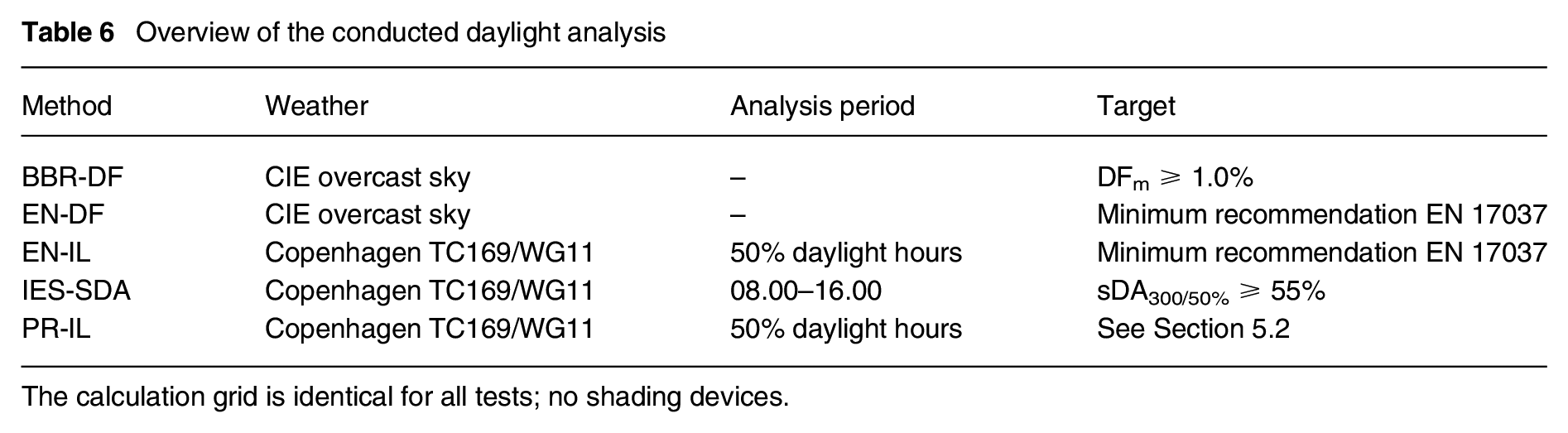
The calculation grid is identical for all tests; no shading devices.
The simulation results for BBR-DF, EN-DF, EN-IL and IES-SDA were processed in Excel to analyse compliance rates. In the next step, the focus was on the new proposed criteria. Firstly, different targets for compliance rates were defined based on informed assumptions, see Section 5 for the details. Secondly, the results of PR-IL were processed in Excel and Python to analyse which target illuminance, target area fraction or their combinations would reach the desired compliance rate.
4. Results
4.1 Compliance rate with existing methods
4.1.1 Compliance with BBR-DF and EN-DF
Figure 3 shows the results obtained for the compliance to BBR-DF and EN-DF. A total of 2367 rooms, corresponding to 66% of the dataset, complied with the current Swedish building regulation of DFm ≥ 1%, which is in line with previous research.15,38 For 22 out of 30 buildings, compliance was obtained for at least half of the rooms, while only one building (ID18) located in a low urban density area obtained compliance for all rooms.
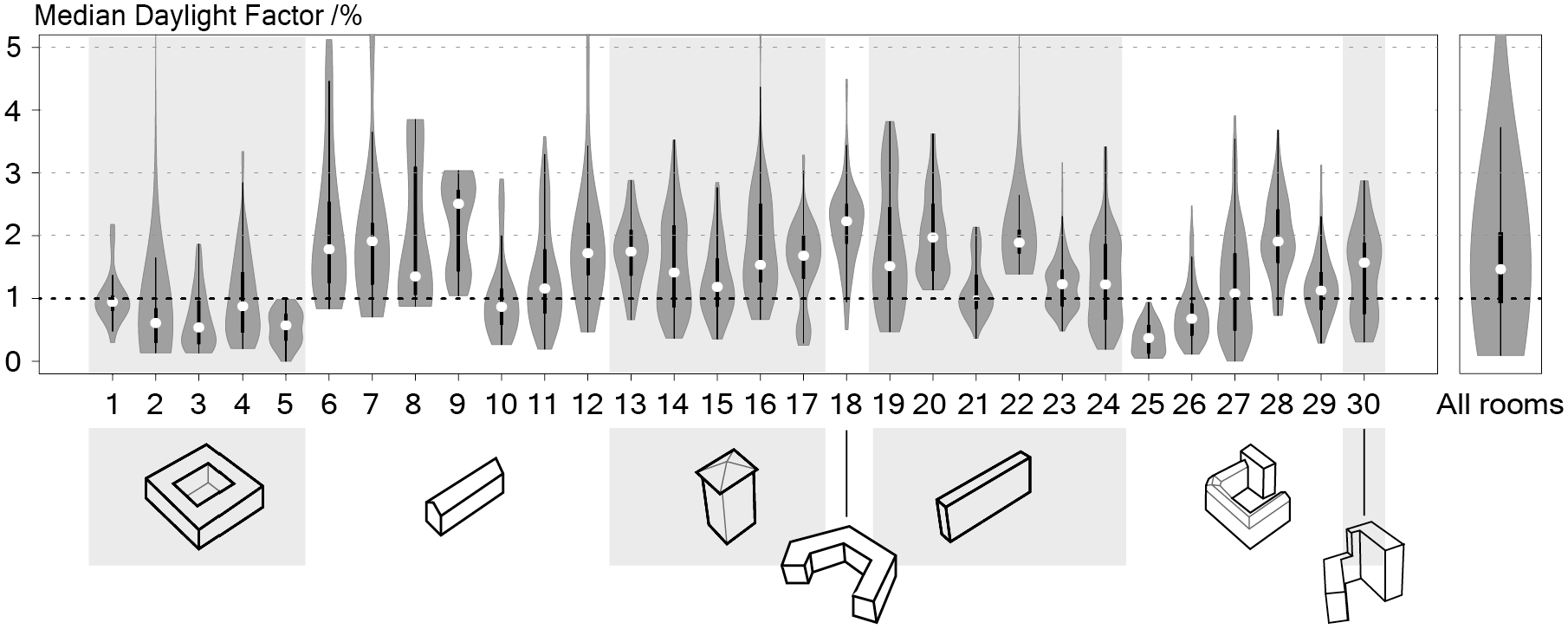
DFm for the tested rooms and buildings
The EN-DF requirements, which are more demanding, resulted in 16% of the rooms in the dataset reaching the minimum recommendation of DFT ≥ 2.1% and DFTM ≥ 0.7%. Additionally, only 1% and 0.5% of the rooms complied with medium and high level of recommendation, respectively, where the medium level requires DFT ≥ 3.5% and DFTM ≥ 2.1%, and the high level requires DFT ≥ 5.3% and DFTM ≥ 3.5%. None of the buildings were compliant with the minimum recommendations in all rooms. Compliant rooms were typically found in point towers and high-rise multi-apartment buildings.
4.1.2 Compliance with EN-IL
The illuminance method proposed by EN 17037 is generally understood to be less demanding than the EN-DF path. Indeed, 32% of the rooms complied with the minimum EN-IL level of ambition, that is, ET ≥ 300 lx for 50% of room area and ETM ≥ 100 lx for 95% of room area. Figure 5 shows that for the minimum level of ambition, the percentage of rooms passing EN-IL is higher than those passing EN-DF (Figure 4).
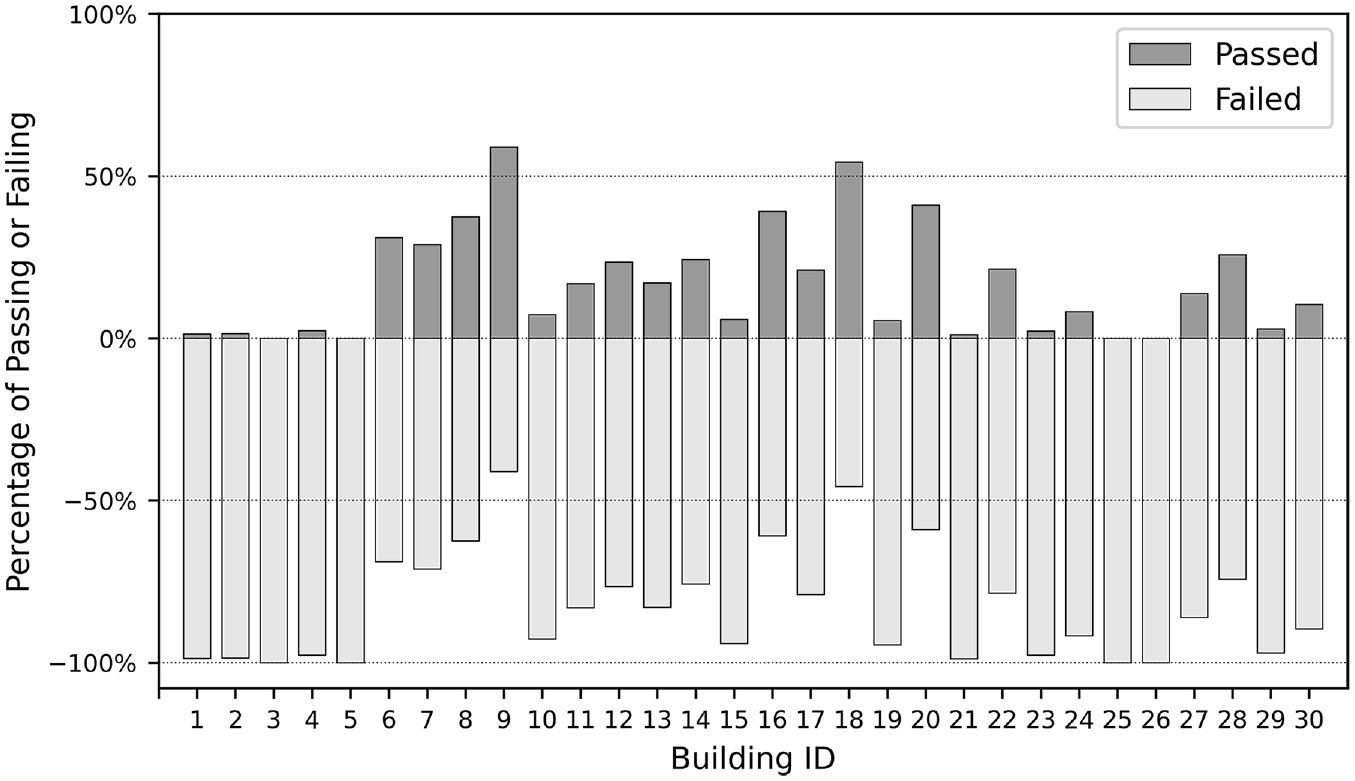
Compliance with EN-DF requirements for minimum level of recommendation
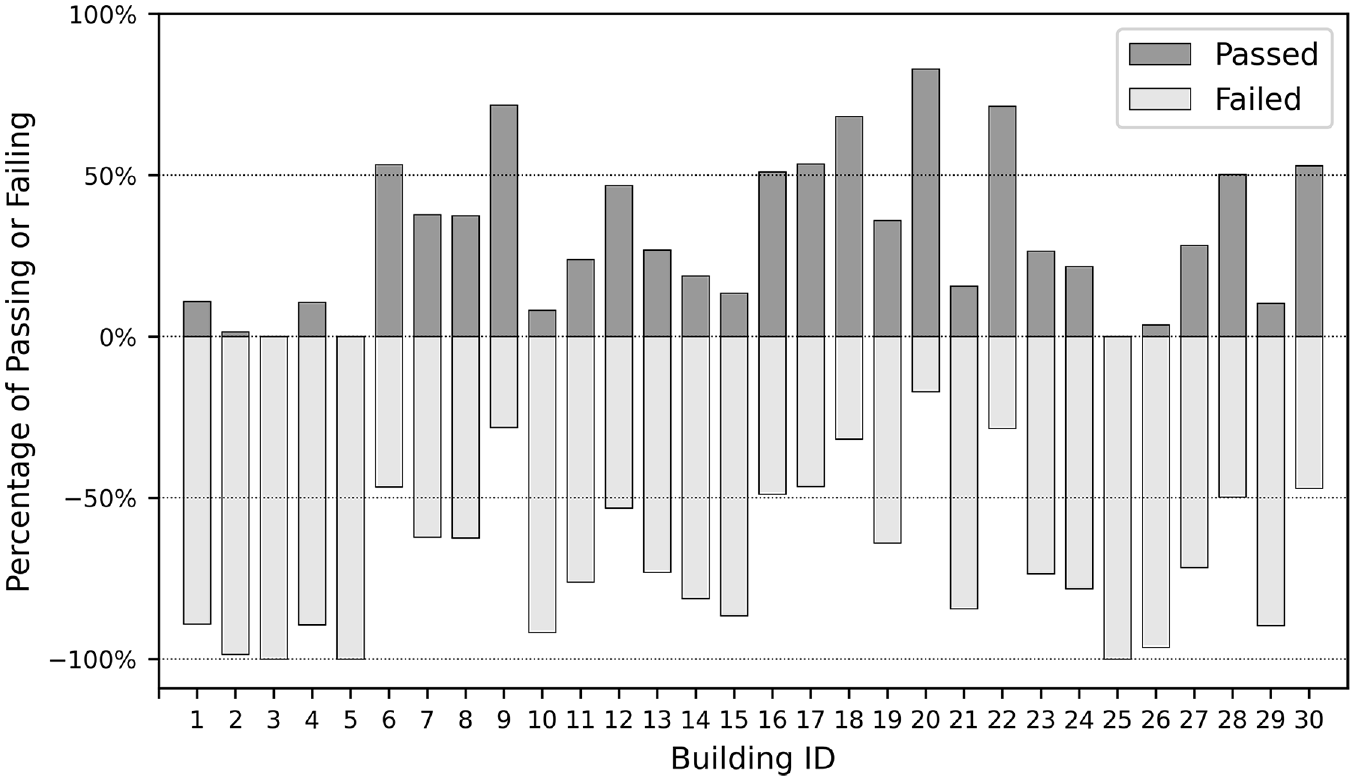
Compliance with EN-IL minimum level
4.1.3 Compliance with IES-SDA
Moving to the LM-83-12 method, the compliance rate was also relatively poor as only 34% of the rooms in the dataset reached a ‘nominally accepted’ daylight provision (Figure 6). Although building ID 20 and ID 22 performed well, none of the 30 buildings obtained compliance for all the rooms. Three buildings (ID 3, 5 and 25) did not obtain any compliant room. The shared attributes among these three buildings include: location within densely constructed urban zones, a central courtyard with self-shading at corners, relatively deep floor plans and predominantly north-facing windows with east- and west-facing windows subject to shading from nearby structures.
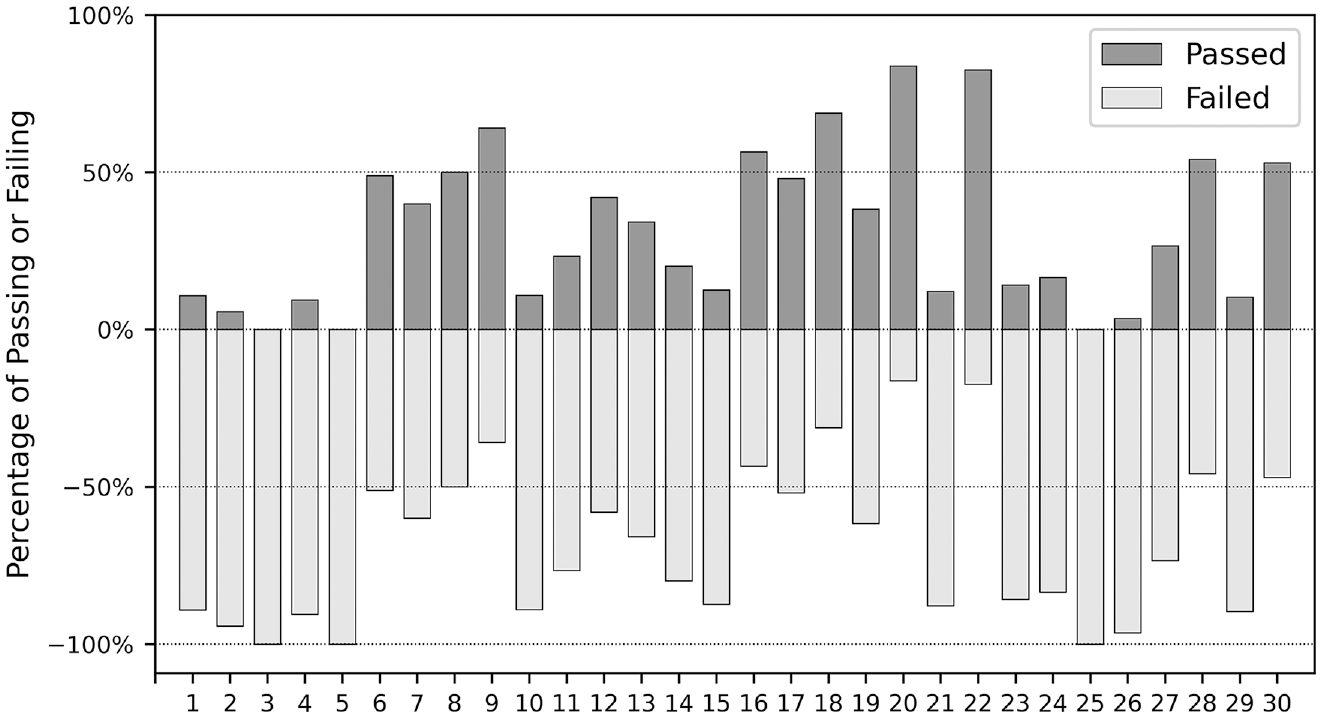
IES-SDA Compliance rate for nominally accepted daylight provision
4.2 Parametric study PR-IL
4.2.1 Area fractions reaching target illuminance
The results for the existing methods suggest that the 300 lx thresholds of EN-IL and IES-SDA represent a crucial illuminance level for the current building stock as higher illuminances dramatically reduce the compliance rate. With this in mind, a parametric study looking at other cut-off points for illuminance and area fractions was performed. The results are shown in Figure 7.
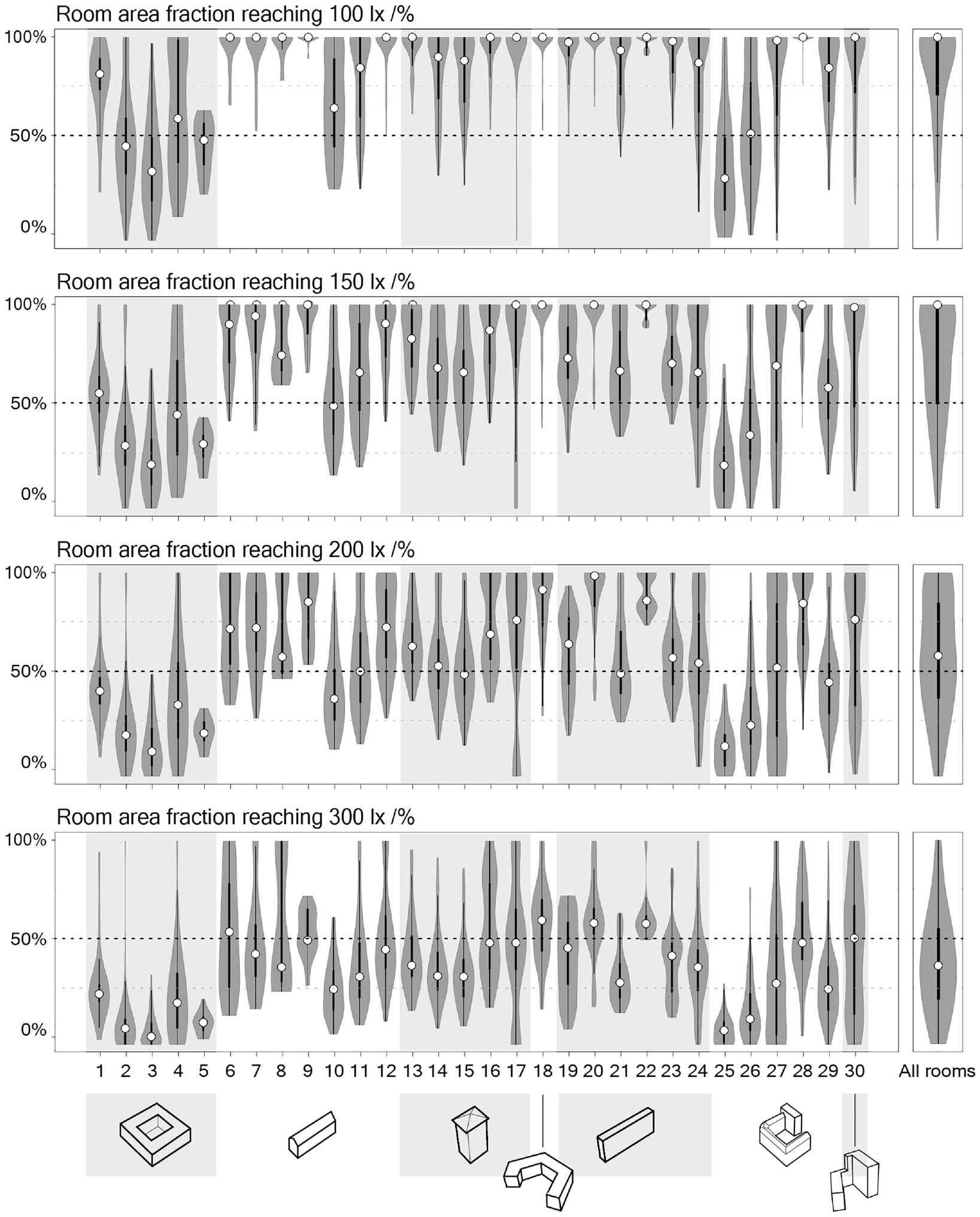
Room area fractions reaching 100 lx, 150 lx, 200 lx or 300 lx for half of the daylight hours in each room of the 30 tested buildings
Starting from target illuminance ET ≥ 100 lx, a substantial majority (88%) of rooms exceeded 100 lx over 50% of the assessed area (ST ≥ 50%) for more than half of the daylight hours. Moreover, more than half of the rooms (56%) reached the illuminance threshold for ST ≥ 95%.
However, when examining the daylight performance at the building level, distinct trends emerged. Notably, large courtyard blocks (building ID 1 to 5) and postmodern blocks (building ID 25 to 29) displayed comparatively lower overall daylight performance. This disparity can be attributed to the presence of self-shading within rooms facing the inner courtyards and the heightened susceptibility to shading due to the densely built surroundings in which these building types are situated.
In contrast, multi-apartment buildings (building ID 6 to 11), point towers (building ID 12 to 17) and high-rise multi-apartment buildings (building ID 19 to 24) obtained better overall daylight performance. Nevertheless, a subset of buildings within these typologies demonstrated variations in compliance area distribution. This divergence is primarily attributed to their location within denser urban contexts where taller adjacent structures gave a higher degree of obstruction. In these cases, rooms located lower down in these buildings were particularly affected.
At a benchmark illuminance of 150 lx, the majority of spaces (76%) maintained adherence to the objective of illuminating 50% of the targeted area, yet only 34% attained this level of illumination for ST ≥ 95%. Structures ID 18 and 20 were distinguished by their access to daylight when compared to other buildings in the study. Building ID 18 is characterized by a semi-enclosed design, which yielded high levels of daylight provision by reducing self-shading from the building itself and increasing light for rooms that face the courtyard (Figure 7). Despite similarities in location and orientation, buildings 20 and 21 obtained contrasting results. This variation is primarily attributed to the differing ratios of window-to-floor area (Figure 8). Considering the sharp decrease in daylight ingress moving from windows towards the interior, this ratio is a crucial determinant of light distribution, thus explaining the performance discrepancies observed between these buildings (Figure 9).
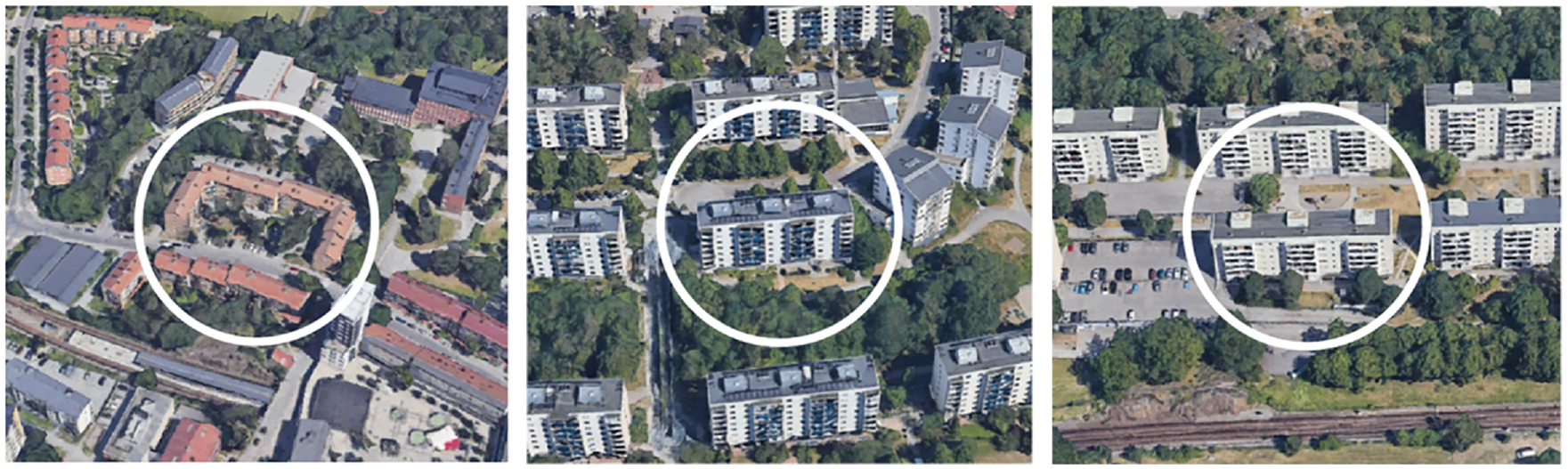
Aerial view of buildings 18 (left), 20 (middle) and 21(right) in their urban context
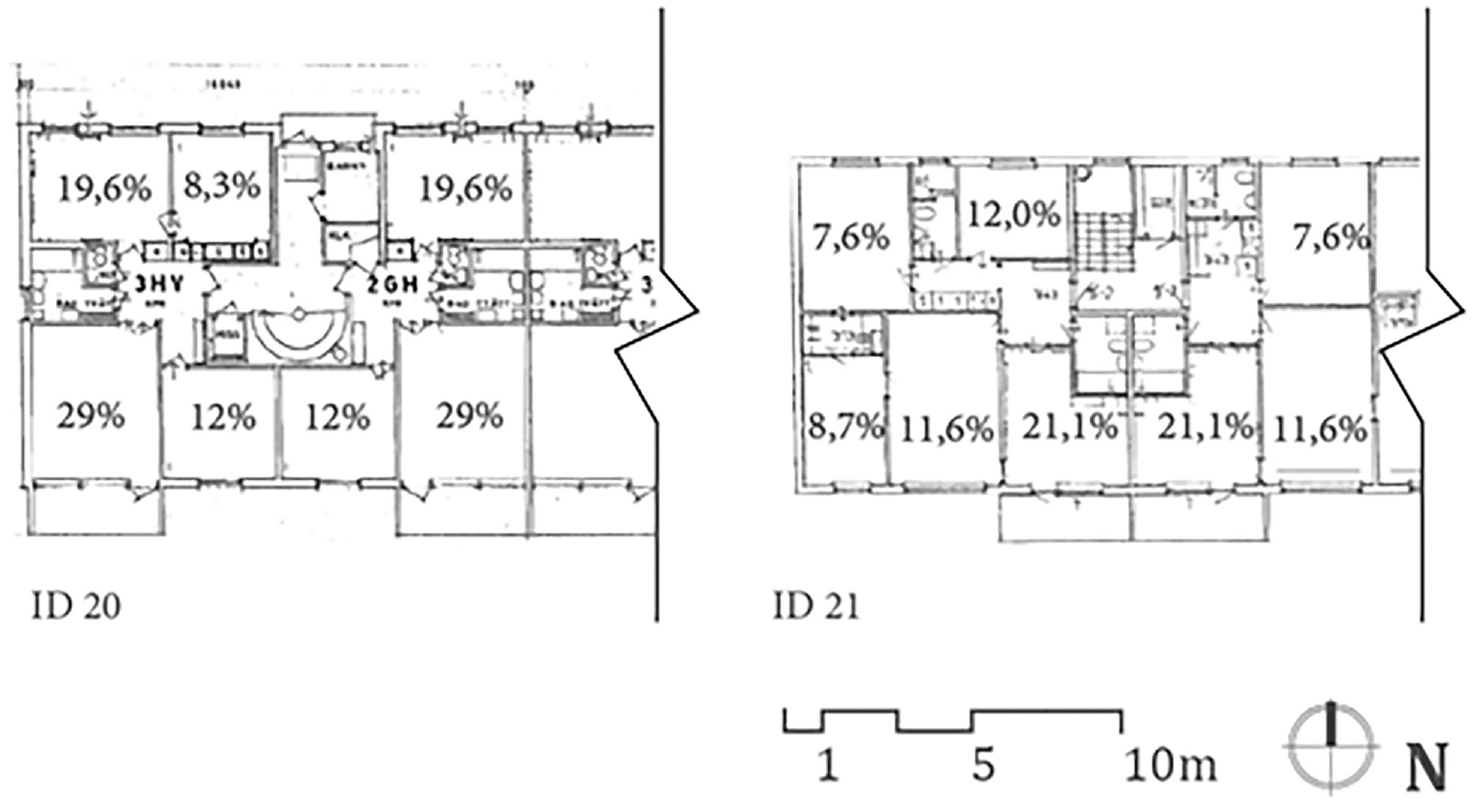
WFR for buildings ID 20 (left) and 21 (right)
When raising the illuminance to ET ≥ 200 lx, still more than half of rooms (62%) reached the illuminance threshold ST ≥ 50%, but only a minority (20%) reached it for ST ≥ 95%.
Under the illuminance threshold of ET ≥ 300 lx, only 34% and 4% of the rooms reached the target illuminance for ST ≥ 50% and ST ≥ 95%, respectively. Notably, a single building (ID 22, Figure 10) achieved full compliance across all its rooms. Building ID 22 is a high-rise multi-apartment building located in a low-density area, with lower surrounding buildings.
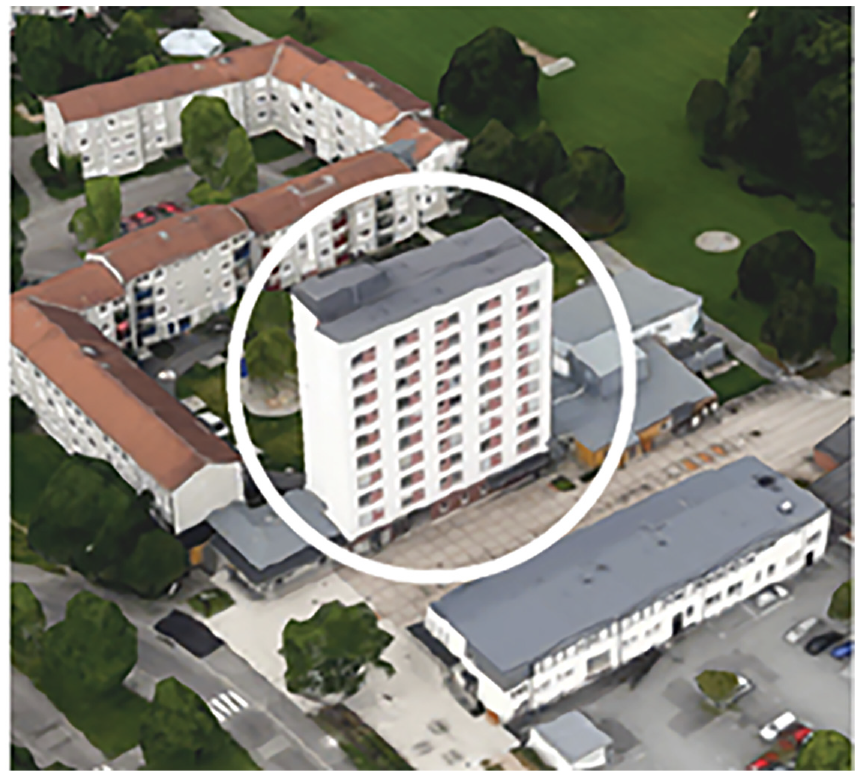
Aerial view of building 22 (Baronbackarna B:5) in its urban context
4.2.2 Compliance rates with illuminance thresholds and targeted area fractions
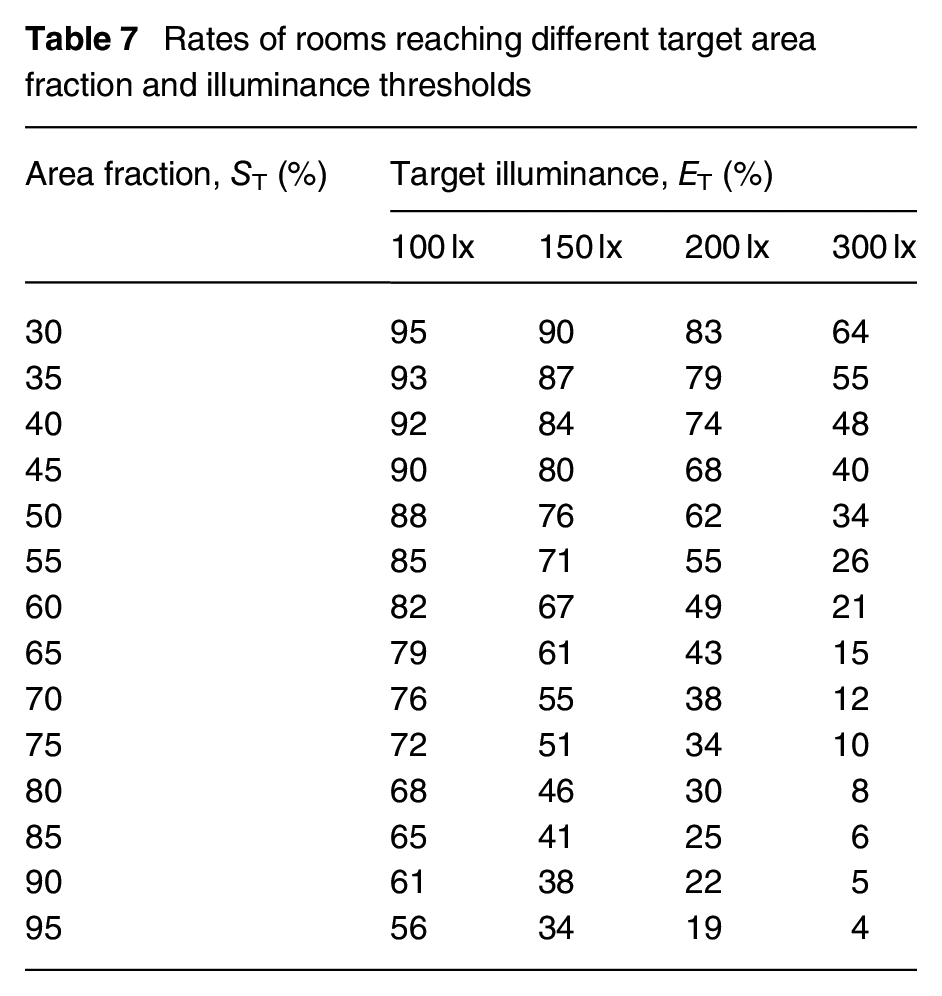
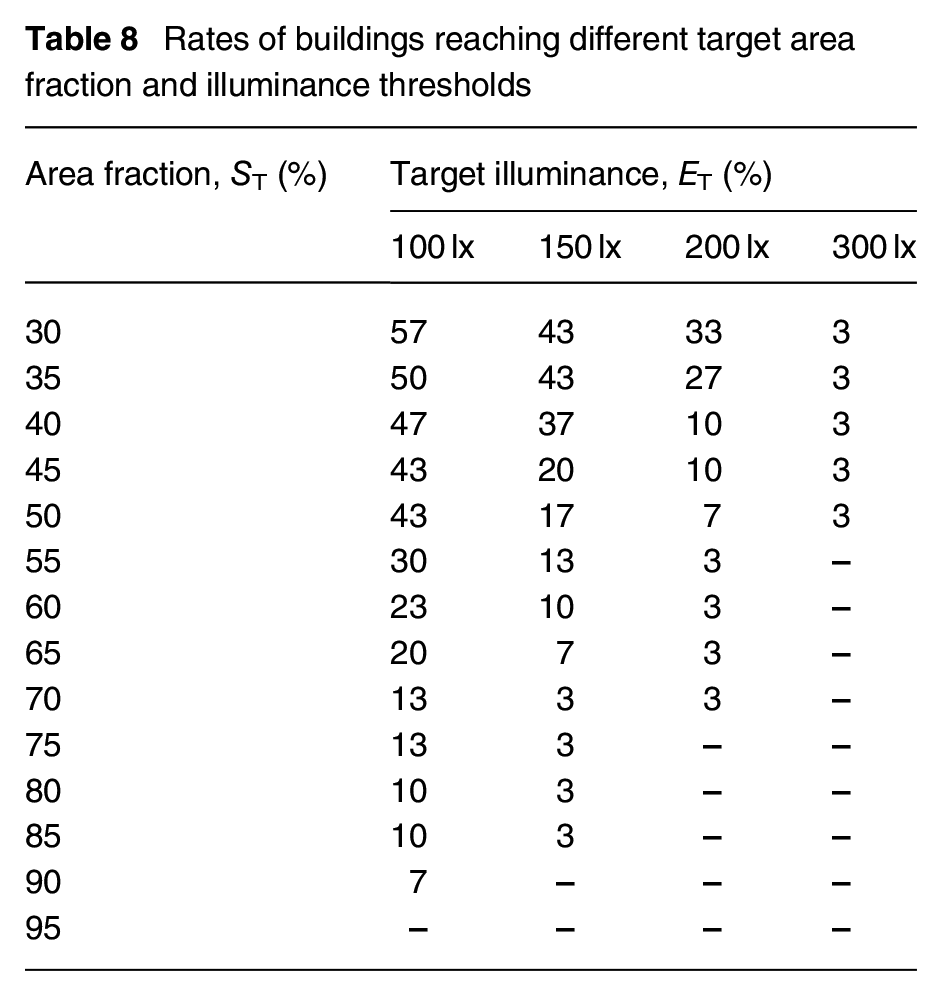
The results of the parametric study were aggregated at room and building level. Table 7 presents the results per room, and Figure 11 presents the same data in a graphical way. These results provide a general overview of daylight availability in Swedish residential buildings. Table 8 and Figure 12 present the results at building level. In such results, a building is intended to reach the requirements only when the target area fraction and illuminance thresholds are reached by all the rooms in the building.
Rates of rooms reaching different target area fraction and illuminance thresholds
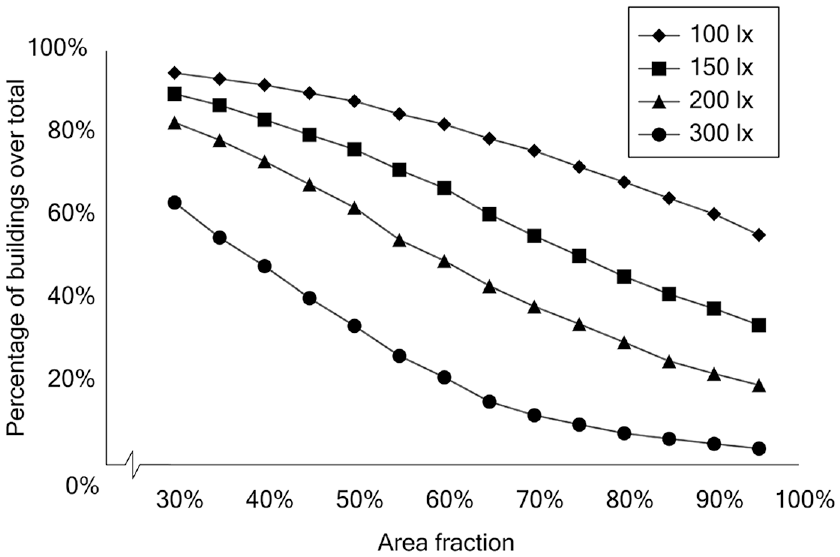
Rooms reaching different target area fractions for the tested illuminance thresholds
Rates of buildings reaching different target area fraction and illuminance thresholds
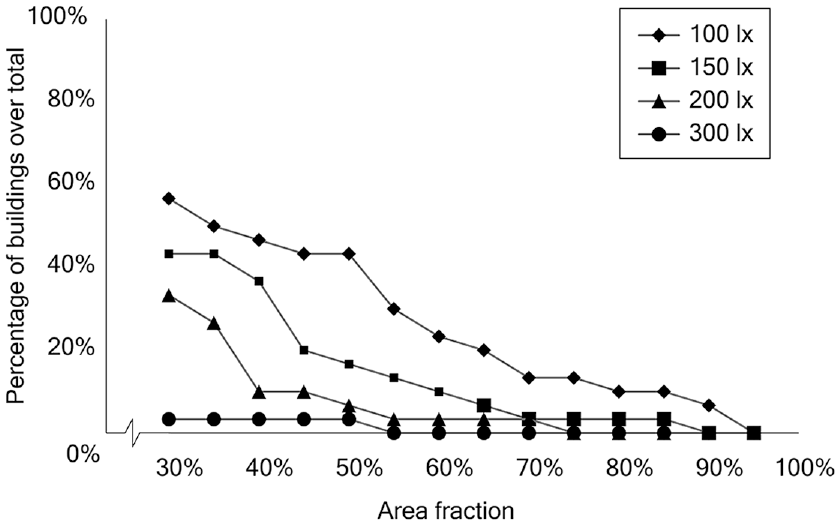
Buildings reaching different target area fractions for the tested illuminance thresholds
These results should be interpreted with caution. The observed adherence rate at lower area fractions, for example, ST = 30%, refers to a very small portion of the room. Commonly used spaces in residential buildings are relatively compact. Once a 0.5 m offset from the walls is accounted for, the 30% portion of the resulting calculation grid corresponds to a substantially small area within the overall room dimensions. Taking, for instance, a room measuring 3 m × 3 m; 30% of its calculation grid amounts to merely 1.2 m2, which constitutes a quite limited usable space. Although a full examination of the effect of room size on compliance is not considered here, results of the study bring attention to the issue that, if the standard is to be of practical use, the targeted area fraction must also yield an occupiable area of reasonable size in absolute terms. While the percentage of rooms reaching the requirements at 100 lx decreases almost linearly with increasing target area fraction, there seems to be a more marked decrease between 50% and 70% area fractions for 150 lx and 200 lx. This is more evident for illuminance of 300 lx, where target area fractions over 70% will not reduce much the percentage of room reaching the requirements. Looking at the building level, a marked drop in buildings reaching the requirement can be observed between 35% and 55%, depending on the required illuminance level.
5. Discussion
5.1 Compliance rates
Existing requirements for daylight provision in the European Standard EN 17037 are confirmed to be significantly more demanding than the existing Swedish building codes. For the existing standard, compliance at the whole building level, that is all rooms in the building are compliant, was close to zero for all the analyses conducted. It should be noted that only regularly occupied rooms were considered here. While EN 17037 does not specify to which room typologies the standard applies, it is common for national legislation to set daylight requirements only for regularly occupied rooms or rooms that are occupied more than occasionally. As for the compliance rate on the building level, experience and research18,47 suggests that these conclusions might be applicable also to other northern European countries as compliances rate were primarily a function of building shape and density of the surroundings.
The difference in compliance rates between room and building levels underscores the challenge in meeting daylight requirements throughout a building. In many cases, apartments in residential buildings receive daylight from a single side only, which means that compliance becomes heavily dependent on orientation. In addition, apartments on lower floors and densely built contexts have lower access to daylight. Mandating that all rooms meet set criteria can lead to over-illumination and oversized windows in some areas, risking overheating and compromised energy efficiency. Design considerations should perhaps prioritize room-level compliance to ensure acceptable daylighting and energy performance together. The result of this approach may consist of different levels of compliance for different rooms, for example stricter requirements for rooms typically occupied during daytime like living rooms.
When compared with the current EN-DF Swedish requirements, the minimum level of recommendation in EN-IL as well as the ‘nominally accepted’ level of IES-SDA would seem to give a more realistic assessment of the performance of the existing Swedish residential stock, with roughly a third of the rooms (32%) passing the requirements. Both EN-IL and IES-SDA methods rely on an illuminance threshold of 300 lx or less, down to 100 lx for EN-IL as minimum target (ETM). Therefore, a parametric study was undertaken to investigate the compliance rates between 100 lx and 300 lx for different targeted area fractions.
In reference to the parametric study, if either the illuminance threshold or the required compliance area increases, the compliance rate obviously decreases. However, a given compliance rate could be met with more than one combination of target area fraction and illuminance threshold. For instance, in Table 7, 55% of the rooms studied were able to comply with ET ≥ 300 lx of ST ≥ 35%. To maintain a similar compliance rate, the illuminance threshold could be lowered while increasing the targeted area fractions, such as a combination of ET ≥ 200 lx and ST ≥ 55%, ET ≥ 150 lx and ST ≥ 70%, or ET ≥ 100 lx and ST ≥ 95%. In other words, it is a matter of opting for more daylight in smaller areas of the room, or lower illuminance in a larger area. Following one or the other approach have consequences on the architectural design of the room, which is further discussed in the following sections.
5.2 Proposed criteria
It has been discussed how different combinations of ET and ST are likely to result in similar compliance rates. If both ET and ST are normed for two different ST, as for the case of the current EN 17037, this could be a hinder for architects and designers as alternatives for design could be unnecessarily limited. The current definition of daylight provision in the European standard aims at providing sufficient daylight over the entire room. This approach, however, is perhaps not best suited for dwellings, where a lower uniformity of daylight is likely to be acceptable, if not desirable.
The approach proposed in this paper, and which is intended for residential buildings only, is to norm either ET or ST for a desired compliance rate. A metric where only one of these variables change according to desired level of performance (i.e. either ET or ST) would be of advantage as it would simplify simulation and data handling. Also, this approach provides a degree of flexibility in design as the current EN 17037 requirements of 300 lx/55% with 100 lx/95% (minimum requirement) requires both brightness and uniformity and as such would seem to restrict room depth. Shifting focus to a single criterion potentially allows for a wider degree of design options such as marginally deeper rooms, slightly smaller windows or somewhat higher urban densities.
Concerning desired compliance rates, one approach could be to accept the status quo as ‘good enough’ and adapt ambitions in response. Failing to do so would lead to a large portion of the existing building stock being ‘non-compliant’; a condition which is likely to undermine a wider adoption of the standard. For the Swedish residential building case, it was found that:
About 16% of rooms and none of the 30 buildings complied with the current EN 17037 target DF DFT ≥ 2.1% and DFTM ≥ 0.7% as per the requirements of Copenhagen.
About 32% and 33% of rooms complied with the minimum level of ambition of EN-IL method of EN 17037 and the ‘nominally acceptable level’ of IES-SDA, respectively.
About 66% of rooms and 3 of the 30 buildings (10%) complied with the Swedish building regulation (BBR), which requires a DFm ≥ 1%.
The above results are used to inform the proposals for desired compliance rates examined here. The proposal maintains the existing structure of three ambition levels in the current EN 1703 standard. The three levels include:
Level I ‘Minimum’: The lowest ambition or minimum requirement.
Level II ‘Medium’: The mid-point between Level I and Level III.
Level III ‘High’: The highest ambition with regards to daylight provision.
The Swedish status quo, that is the current Swedish national building code, is set as Level I ‘Minimum’ recommendation. This corresponds to a compliance rate of 66%. Considering that IES-SDA method is adopted by leading voluntary certification schemes like LEED, and that EN-IL was proven to be quite ambitious, the compliance rates with these two methods (33%) could then be set as Level III ‘High’ of ambition. Level II ‘Medium’ would then correspond to a 50% compliance rate with respect to the tested dataset.
Two main criteria could be proposed, a fixed illuminance and a fixed-area fraction criterion.
5.2.1 Fixed illuminance proposal
The approach with fixed illuminance threshold requires that a specified ET should be maintained in over a certain ST, depending on the level of ambition. The compliance rates are set at 66%, 50% and 33% for Level I, II and III, respectively. The required ST can be deducted from Table 7. Two levels of ET are here considered: ET ≥ 150 lx and ET ≥ 200 lx, see Table 9.
Proposed target ST for the three level of recommendation at fixed illuminances
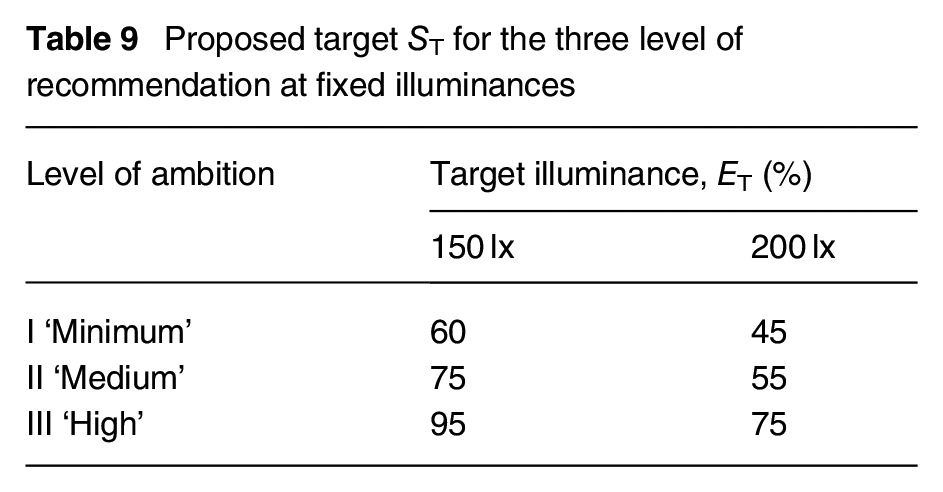
An illuminance ET ≥ 100 lx is excluded since it has a very low ambition. With respect to ET ≥ 300 lx, this illuminance would result in ST ≥ 30% – and it would not be entirely sufficient – for Level I, and ST ≥ 35% for Level II, see Table 7. As mentioned, very low ST could be misleading as the illuminance is assessed in very small portions of the room.
It is also important to understand what these numbers mean in practice. A horizontal illuminance of 300 lx is normally considered adequate for performing general office work. Even though the requirement is normally set at 500 lx for the task itself, research shows that levels could be lowered to 300 lx without much affecting visual performance, 48 and even lower illuminances are tolerated if provided by daylighting. 49 The ‘minimum’ level of ambition in the current EN 17037 seems to provide already enough or good daylighting according to office workers. 50 While these values refer typically to offices and office tasks, it should be noted that the proposal here is for residential spaces, where visual demanding tasks are likely to be less often performed. Consistent with the current EN 17037 method, the illuminances proposed are intended to be maintained for at least 50% of the daylight hours. In other words, lowering illuminance to ET ≥ 200 lx is most likely still providing a well-daylit room for task performed in dwellings.
5.2.2 Fixed area fraction proposal
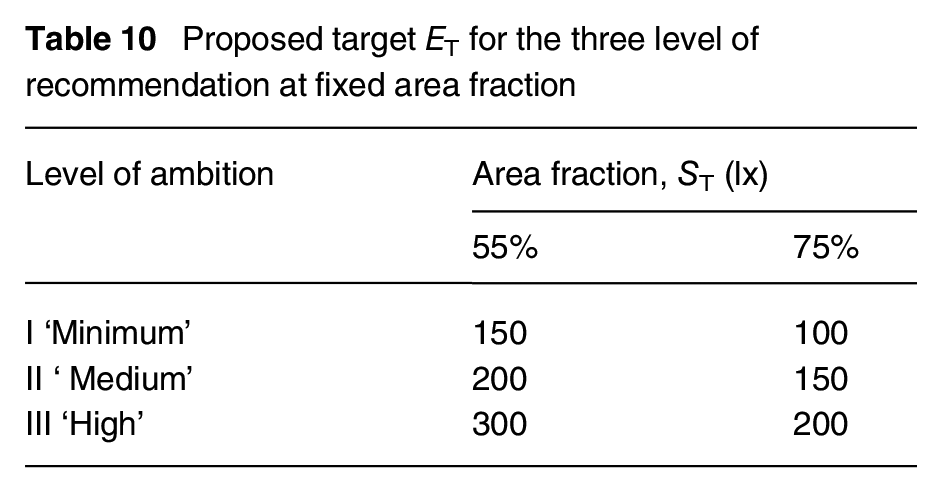
The approach with target area fraction requires that a specified ST should be supplemented with varying target illuminances depending on the level of ambition. The compliance rates are set at 66%, 50% and 33% for Levels of ambition I, II and III, respectively. The required ET can be deducted from Table 7. Two ST are hereby proposed: ST ≥ 55% and ST ≥ 75%.
The selection was made by allowing the highest ST while keeping the range of 100 lx ≤ ET ≤ 300 lx. Utilizing a spatial threshold where half the room is lit at varying illuminances – 150 lx, 200 lx and 300 lx – shows that the criterion was met in 76%, 62% and 34% of cases for Levels I, II and III, respectively (Table 7). These compliance rates surpass those proposed (66%, 50% and 33%) by narrow margin, reflecting a more attainable standard. The ST ≥ 55% approach offers a clear, easy to understand metric of daylight adequacy across about half of a given area. Moreover, the highest recommended level with 300 lx over 55% of the space aligns well with the current EN 17037 standard. The ST ≥ 75% covers a larger compliance area but reduces the maintained illuminance. This would result in darker but more uniformly daylit rooms compared to the ST ≥ 55%.
5.3 Implications for practice
The proposed criteria potentially have a direct effect on room design, which are presented here. These implications are intended to support discussion within the CEN TC169/WG11, while the authors do not take a stand in favour of one proposal over the other. Figure 13 shows a generic shoebox room with a fixed façade, with resulting room depth when applying the proposed criteria.
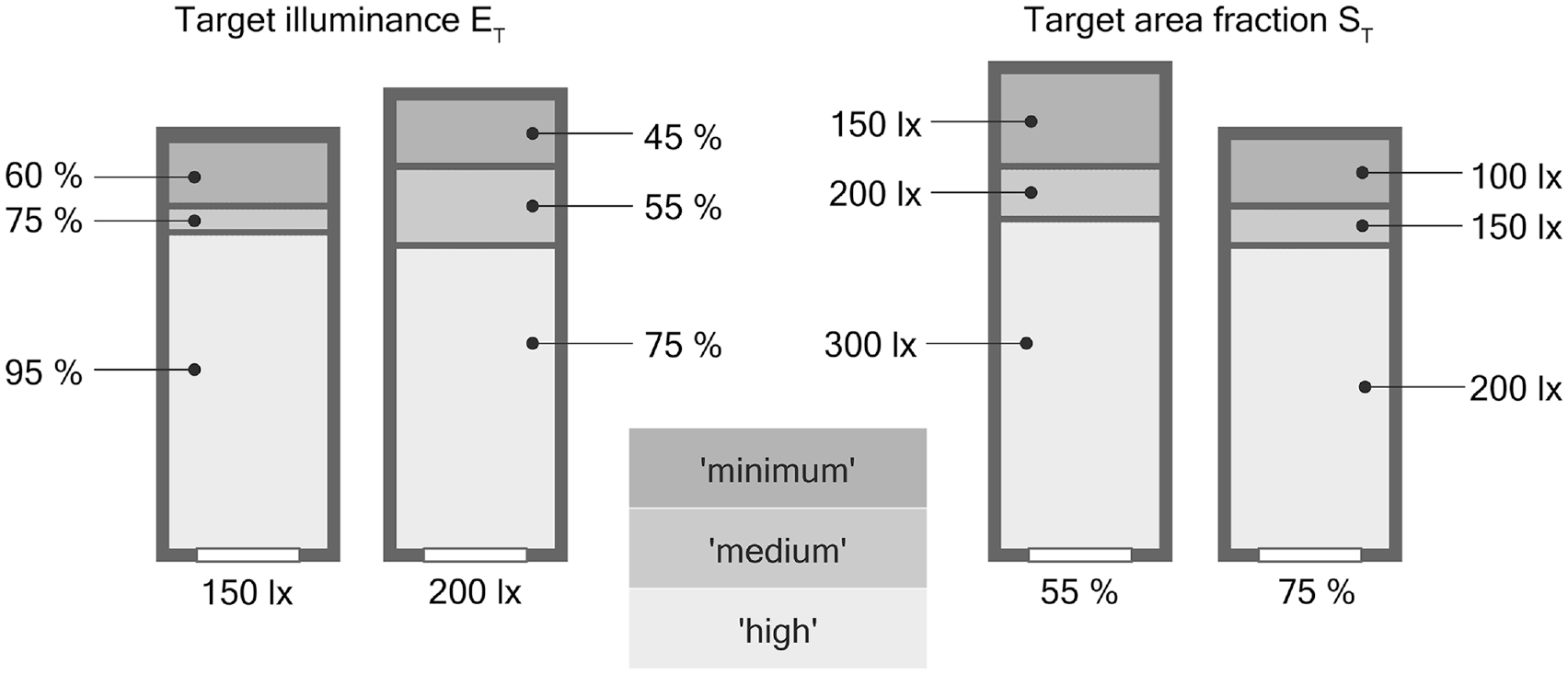
Resulting room depth at different levels of ambition according to the proposed criteria. The shoebox model has the same glazing-to-wall ratio
Both fixed illuminance and fixed area fraction proposals generally provide higher flexibility to the designer since the chosen level of ambition significantly affects room depth. For the fixed illuminance approach, allowing for ET ≥ 150 lx results in a larger compliant area ST with respect to the proposal based on ET ≥ 200 lx. This would improve uniformity at the expense of overall illumination. On the other hand, the proposal ET ≥ 200 lx results potentially in slightly deeper rooms compared to ET ≥ 150 lx, as the minimum level of ambition requires only ST ≥ 45% instead of ST ≥ 60%.
The fixed target area fraction approach is perhaps more intuitive. Lower ST allows for deeper room and slightly higher target illuminances, possibly at the expenses of light uniformity. While uniformity might not be critical for dwellings, the same cannot be said for example offices. A solution for a homogenous approach in future revisions of the daylight standard might be to adopt the criteria presented here for all building typologies (perhaps with different ET and ST) but setting uniformity requirements depending on the building programme.
While the examples in Figure 13 refer to a generic shoebox room in an unobstructed scenario, it is more and more often the case that dwellings are located in densely built contexts. Figure 14 reports the sDA for a 6 m deep × 3 m wide × 3 m high shoebox model with varying WFRs and obstruction angles, representing an ordinary living room. The sDA is calculated for the 150 lx, 200 lx, and 300 lx target from the proposed criteria, and for the four cardinal orientations of the shoebox, located in Copenhagen. In this case, the fixed illuminance and area fraction proposal are illustrated together, and they are referred as combination of ET/ST as for Tables 9 and 10.
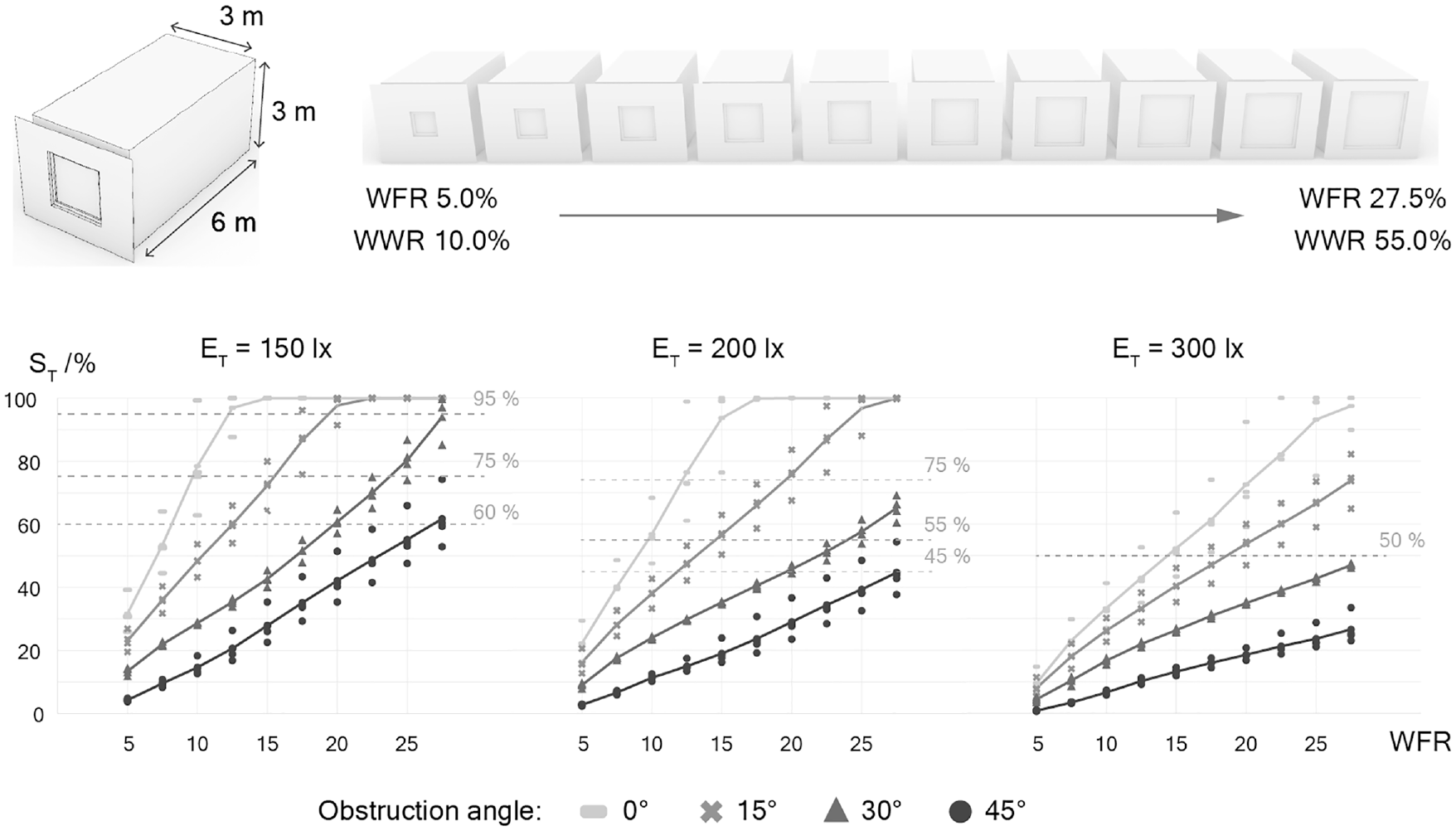
ST at ET 150 lx, 200 lx, and 300 lx for WFR 5 – 27.5 and obstruction angles 0 – 45°. Solid lines represent the average ST for the four cardinal orientations
Proposed target ET for the three level of recommendation at fixed area fraction
For the 150 lx/60% scenario, compliance with the minimum threshold is possible with obstruction angles up to 30°. With WFR < 15%, results show that even rooms up to 6 m in depth can be compliant with 150 lx over 100% of its area. Obstruction angles below 30° open for the possibility for rooms to comply with higher performance levels (‘medium’ and high’). However, above 30° obstruction, a WFR over 20% is likely needed for compliance with even the minimum level. It should be noted that for residential applications in northern Europe, WFR over 20% generally need either interstitial or external shading to avoid over heating for orientations 90° of South. Results also show that at the higher obstruction angles, southerly orientations perform better than other orientations and this potentially allows for reduction of glazing area for south-facing windows. However, in more dense contexts, namely with obstruction angles above 30°, compliance with even the minimum level is largely limited to the southerly orientations. It is worth restating that these simulations do not include shading devices.
Results are similar for the 200 lx/45% threshold as compliance with the minimum level is readily achievable for obstruction angles up to 30°. With this scenario, more glazing is of course required to achieve similar performance when compared with the 150 lx/60% scenario. For the unobstructed case with 15% WFR, all orientations could be expected to be compliant with the 200 lx/45% scenario over 100% of their area. However, for the 200 lx/45% threshold, an extra 2.5% WFR would be needed to reach this target. Furthermore, medium and high ratings become difficult to achieve with the 200 lx threshold.
Both the 150 lx/60% and 200 lx/45% readily allow for compliance at 30° obstruction angle. This is not the case for the 300 lx/55% scenario where at this obstruction angle compliance is not generally possible until WFR approaches 30%. As such, the 300 lx/55% scenario poses severe restrictions on the kind of urban developments which are possible. Similarly, this threshold suggests the use of large, glazed areas which potentially lead to increased energy use and/or place high demands on solar shading performance. For example, to avoid overheating in housing applications, an external or interstitial shading device would likely be required for orientations within 90° of south.
The 150 lx/60% proposal would seem to be the most feasible of the options examined here as this scenario more readily allows for compliance with obstruction angles above 30° as well as the possibility of glazing areas more in line with current industry praxis for multifamily housing. It should be noted that within northern Europe, urban areas with obstructions angles of more than 45° are common to both existing and newly planned settlements. Given that none of the options examined here readily permit this kind of density, it should be acknowledged that even the 150 lx/60% threshold may still be widely regarded by industry as too ambitious for use for building code applications.
A final reflection concerns barriers to the adoption of the proposed method in common practice. As previously noted, practitioners typically use basic methods like the WFR or DF analysis. The approach proposed here, which focuses on climate-based illuminance analysis, could still be seen as too complex. However, adopting a straightforward metric based on a single illuminance criterion might help to further the use of climate-based daylight analysis within the residential sector.
6. Conclusions
This paper examined how the Swedish residential building stock performs with respect to existing daylight standards and suggested revised criteria for daylight provision in dwellings based on the existing EN 17037. The guiding principle was to propose alternative thresholds for the three ambition levels ‘minimum’, ‘medium’ and ‘high’, within the framework of the current European Standard EN 17037. The goal was to propose a less strict criterion for daylight provision to encourage a wider application of EN 17037 across Europe.
Similarly to the current standard, the proposed criteria rely on illuminance-based analyses, but with either a fixed targeted illuminance or a fixed targeted area fraction.
For the existing Swedish residential building stock, the proposed criteria show an approximately two-thirds compliance rate with the minimum level. This is the same compliance rate as per current Swedish national regulation. For projects with more ambition for daylight, the proposed criteria show a compliance rate of approximately one-third for the current stock. This corresponds to the same compliance rate for a modified version of LM-83-12 standard without consideration for the effect of shading devices or, alternatively, the ‘minimum’ level of daylight provision prescribed by the current EN 17037 illuminance method.
According to the proposed criteria, to fulfil the minimum level, at least 150 lx must be guaranteed over 55% of a room’s area for half of the daylight hours. Other more ambitious combinations of targeted illuminance and targeted area fraction were also proposed. For a given room, two distinct strategies for the different levels of ambition could result in either more daylight over a smaller portion of the room or lower illuminance over a larger portion of the room. The second of these options allows for deeper rooms, potentially allowing increased flexibility in room layout. Although the criteria proposed here are less stringent than the current EN 17037, compliance is still largely dependent on the urban density. Obstruction angles over 30°, which are commonly found in northern European cities, are shown to require WFR > 20% to comply with even the proposed minimum level of ambition. With this amount of glazing comes increased risk for overheating or increased demand of shading performance. In general, the criteria proposed also allows for projects situated in moderate urban density to achieve compliance.
Future work is suggested to investigate whether the findings from the Swedish residential building stock could be generalized to other European countries. Given the interplay between daylight provision, urban density and window size, future work could also investigate more in-depth how the thermal performance of residential buildings is affected by different daylight requirements.
Footnotes
Acknowledgements
The authors wish to acknowledge the TC169/WG11 for providing the weather file and valuable discussions which shaped the approach adopted by this paper. Prof Marie-Claude Dubois is acknowledged for a fruitful initial discussion on the implication for practice of the proposed criteria. Betty Rogers is acknowledged for the language editing of this paper. Finally, the authors wish to acknowledge two anonymous reviewers for their excellent comments which shaped the final version of this paper.
Declaration of conflicting interests
The authors declared no potential conflicts of interest with respect to the research, authorship, and/or publication of this article.
Funding
The authors received no financial support for the research, authorship, and/or publication of this article.
