



Abstract
Standardized methods for generating angle-dependent, bidirectional, solar-optical properties for complex fenestration systems do not exist, which means that energy and daylight evaluations in building performance simulations often suffer from major inaccuracies. This position paper provides an overview of state-of-the-art data-driven methods for characterizing light scattering properties of fenestration materials and blind systems (e.g. fabrics, metal slats, patterned glazing), validation via laboratory, simulation and field tests, and salient issues in support of standardization of such methods via the International Standardization Organization (ISO). The ISO standard is intended to provide the fundamental underpinnings for recently mandated daylight standards that rely on bidirectional scattering distribution function data for climate-based daylight modelling and building performance simulations.
1. Introduction
Standardized methods for characterizing angle-dependent, solar-optical properties of transparent glazing for windows are well-established (i.e. visible and solar transmittance, absorptance, reflectance). Standardized methods do not exist however for ‘optically complex’ or light scattering, shading and daylighting systems, which in turn makes objective evaluation of energy performance, solar distribution, daylighting, comfort and other building performance qualities almost impossible. Simplified methods for characterizing complex fenestration systems (CFS) have been developed based on normal-normal, normal-hemispherical and diffuse-hemispherical transmittance and reflectance measurements. These methods have found their way into European standards (EN 14500, 1 EN 14501 2 ), and international standards (ISO 52022-1, 3 ISO 52022-3 4 ), but are of limited use and can contribute to significant errors in the assessment of daylighting, indoor environmental quality (e.g. glare, view out) and solar gain-related building energy performance. This article addresses methods used to derive bidirectional scattering distribution functions (BSDFs) for angle-dependent, solar-optical calculations involving CFS with a focus on daylighting. Methods for determining thermophysical properties (e.g. emittance, permeability) related to solar heat gains are not addressed in this article.
The bidirectional reflectance distribution function (BRDF) describes how radiation incident from one direction is reflected off a surface into another direction.
5
If the same concept is applied to scattering transmission, this is referred to as bidirectional transmittance distribution function (BTDF). BRDF and BTDF together form the BSDF.
6
If a surface is viewed from direction
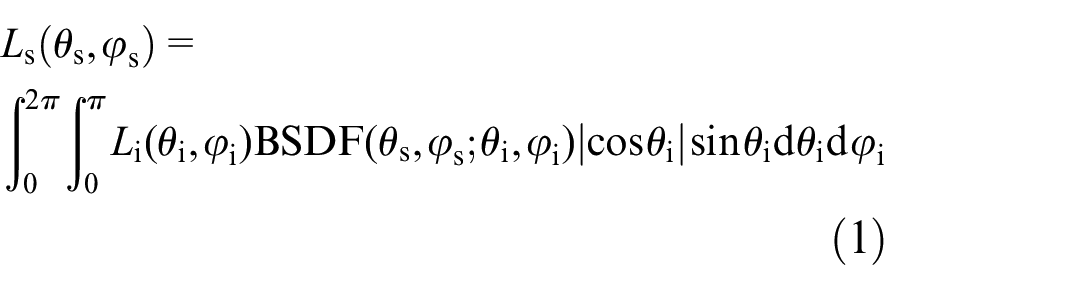
where
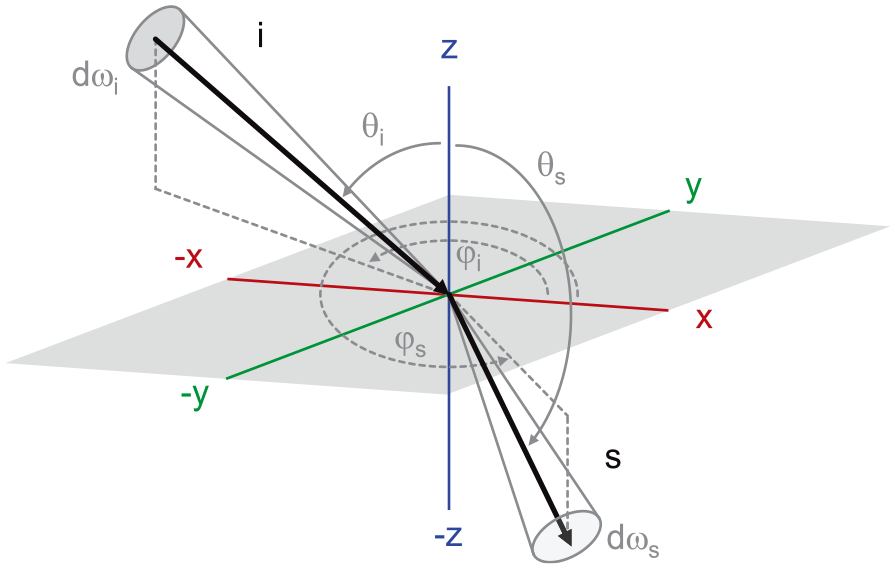
Incident (i) and scattered (s) directions
Re-written, the luminance can be described by the illuminance

or, for the BSDF expressed as in Equation (3):

Equation (3) shows that the BSDF has the unit
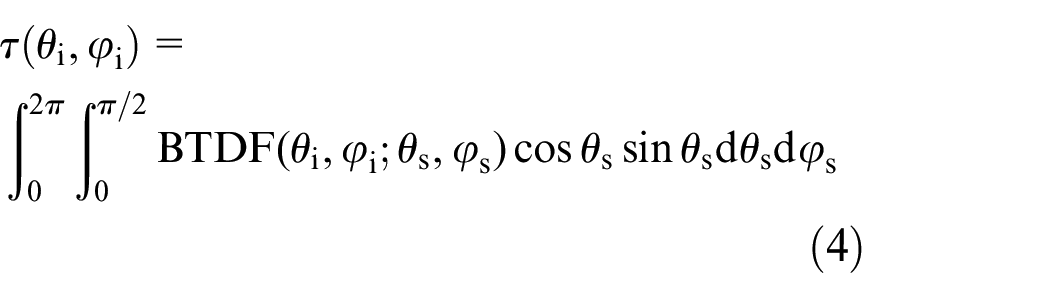
In 1994, Klems7,8 proposed to discretize the incident and exiting hemispheres of the BSDF, that is, the bidirectional, angle-dependent, solar-optical properties of CFS, by 145 regions each. The discretization aims at approximately equal projected solid angles for each region, reflecting their cosine-weighting in the calculation of transmittance and reflectance integrals. In 2000, the International Energy Agency (IEA) Solar Heating and Cooling (SHC) Programme Task 21 ‘Daylight in Buildings: Design Tools and Performance Analysis’ 9 proposed a refined hemispherical basis that better met the requirements for daylight performance analysis. The IEA21 discretization combines a regular set of 145 incident directions (applying the subdivision of the hemisphere proposed by Tregenza for sky luminance scans) with an irregular set of exiting directions that can adapt to the measured distribution. In contrast to the Klems basis, the equal solid angles of the incident regions give equal weight to all regions. To allow efficient sampling, the irregular exiting directions were resampled to an equidistant angular subdivision of 1297 regions (azimuth and elevation angles (θ, φ) at intervals of 5° each). 10 Numerous validation studies (cf. Section 3.2) have confirmed that evaluations of integral values (e.g. horizontal illuminance with Klems BSDF data) can be calculated with sufficient accuracy. In this area, the experts agree that these bases are sufficient and can be transferred to standardization with a clear conscience.
These rather coarse representations may however lead to significant errors with specular and forward scattering systems, or whenever detailed luminance-based evaluations (e.g. for daylight glare calculations) are needed. To overcome this, a variable resolution BSDF approach was introduced by Ward et al. 11 In 2018, Lee et al. 12 showed that this approach enables simulations of CFS at high accuracy. Since, for example, the consideration of small, very bright glare sources (e.g. the sun) is still a subject of ongoing research, recommendations for generation and application of high-resolution BSDFs are not yet ready for standardization and need further investigation.
In 2021, experts collaborating in the IEA SHC Task 61 Energy in Buildings and Communities (EBC) Annex 77 ‘Integrated Solutions for Daylighting and Electric Lighting’ 13 drew a distinction between analytical and tabulated BSDFs in a white paper, 14 excluding analytical BSDFs from the scope since the method for deriving analytical models cannot be generalized (see Section 4.4 for further discussion). Analytical BSDF models are described by an analytical function specifying the scattering properties of a system. Such models are widely used in computer graphics and include models for reflection, transmission or subsurface scattering, but are for the most part not intended to be photometrically accurate. Guarnera et al. 15 and Frisvad et al. 16 comprehensively summarize research in computer graphics on BRDF and BTDF models. The mismatch between the optical behaviour of CFS with irregular light scattering or redirecting properties (e.g. fabrics with partial openness and forward scattering behaviour) and the inherent assumptions of generic analytical models often renders a suitable parametrization impossible. An analytical model assuming a single peak in transmission, for example, cannot be fitted to the scattering properties of prismatic glazing. This deficiency is addressed instead by tabulated BSDFs, that rely solely on known (measured) data for a set of directions (i.e. are specified through a discrete set of samples of the scattering distribution function), which are then prepared as tabulated data sets and provided in data formats accepted by daylighting simulation software. If interpolation is necessary, the employed algorithms are agnostic to the sample and rely only on the provided BSDF data, which is the reason for such models being also referred to as ‘data-driven’. Compared to analytical models, this approach offers general applicability to any BSDF, but depends on the availability of a sufficient quantity of discrete BSDF data points to perform the interpolation. Measurements of the BSDF can be obtained directly using goniophotometers (e.g. scanning or imaging instruments17–19). Alternatively, if there are inherent physical limits of direct measurement (e.g. maximal sizes for measurement probes, instrument setup, collimated source), BSDFs can be generated using a virtual goniophotometer (i.e. simulation tools mimicking a goniophotometer setup, e.g. genBSDF in Radiance20,21). This approach uses a digital 3D model for representing the geometrical system characteristics and a material description (which again can be based on direct measurements).
In the white paper, 14 the terms ‘low-resolution BSDF’ and ‘high-resolution BSDF’ are also defined. In the present article as well as in the proposed standardization activity, the focus is on low-resolution BSDFs, which are defined as ‘tabulated BSDF with basis discretization using hemisphere subdivisions with average patch sizes covering solid angles corresponding approximately to cones with full opening angles of about 10° to 24°’. While BSDFs have found their way into climate-based daylight modelling (CBDM) and lighting and energy simulation tools (e.g. Radiance, ClimateStudio, Ladybug Tools or EnergyPlus, to name a few) and are used by established lighting design offices and energy consultants, the normative background on how to generate and apply BSDFs is still missing. In its latest revision, the ISO Standard 10916 ‘Calculation of the impact of daylight utilization on the net and final energy demand for lighting’ 22 introduces a new ‘Comprehensive hourly calculation’, that is based on the three-phase calculation method 23 and thus relies on BSDF data. The data are used in other critical industry applications, that is, innovative product research and development (R&D), building-to-grid control systems and policy development in support of greenhouse gas emission reduction goals. 24 This and the increased demand from daylight practitioners motivated the presentation of a case to the ISO Technical Committee 274 ‘Light and Lighting’ to initiate standardization of daylighting system BSDFs.
This position paper establishes the case for ISO standardization by delineating mandatory and voluntary CBDM-based codes and standards that are relevant to BSDFs, characterization methods for generating tabulated BSDFs with supporting validation and status of technical issues given recent advances in the field. A discussion on process issues and plans for ISO standardization is also included.
2. Background
2.1 Existing standards
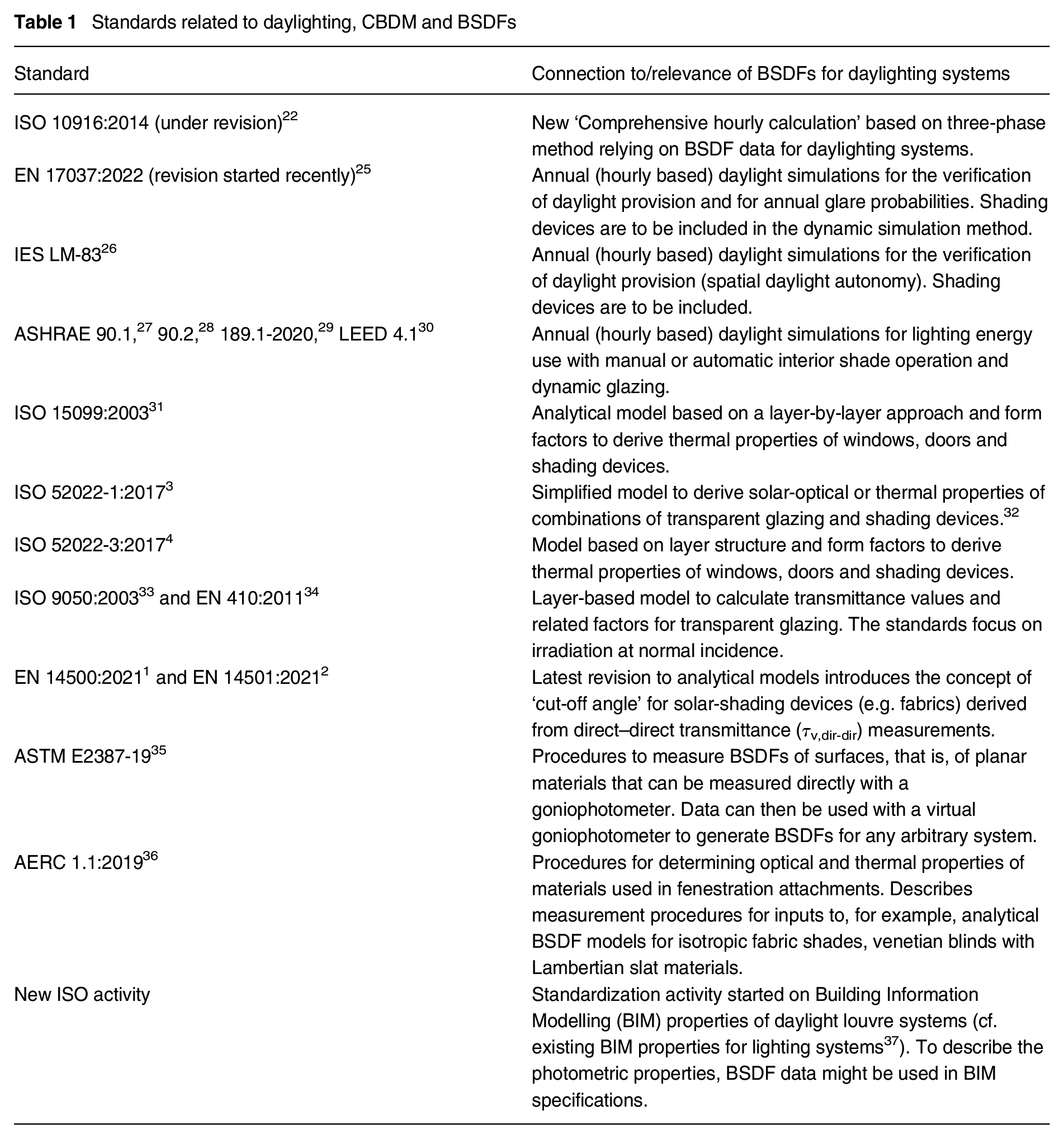
Standards and guidelines exist in various application areas that relate to daylighting or solar heat gains. In some, BSDFs are already anchored, or methods and metrics are used that can be supported by BSDFs. Of particular note here is the revision of ISO 10916 (now ISO/CIE 10916), which requires BSDF data in the newly introduced comprehensive hourly calculation (i.e. three-phase method). In several other standards, shading devices/CFS must be taken into account in standardized assessment methods, but often the detailed information on how they should be included is lacking. EN 17037, for example, requires: ‘If the actual space is expected to contain any moveable shading device (e.g. blinds) then the dynamic modelling of these should be included in the simulation’. 25 BSDFs offer an efficient possibility. In addition, BSDF data and associated generation methods can be used to complement or enhance simplified assessment methods and to derive corresponding parameters, simplified key figures or analytical model parameters. Table 1 lists existing standards and guidelines and their connection to BSDFs for CFS.
Standards related to daylighting, CBDM and BSDFs
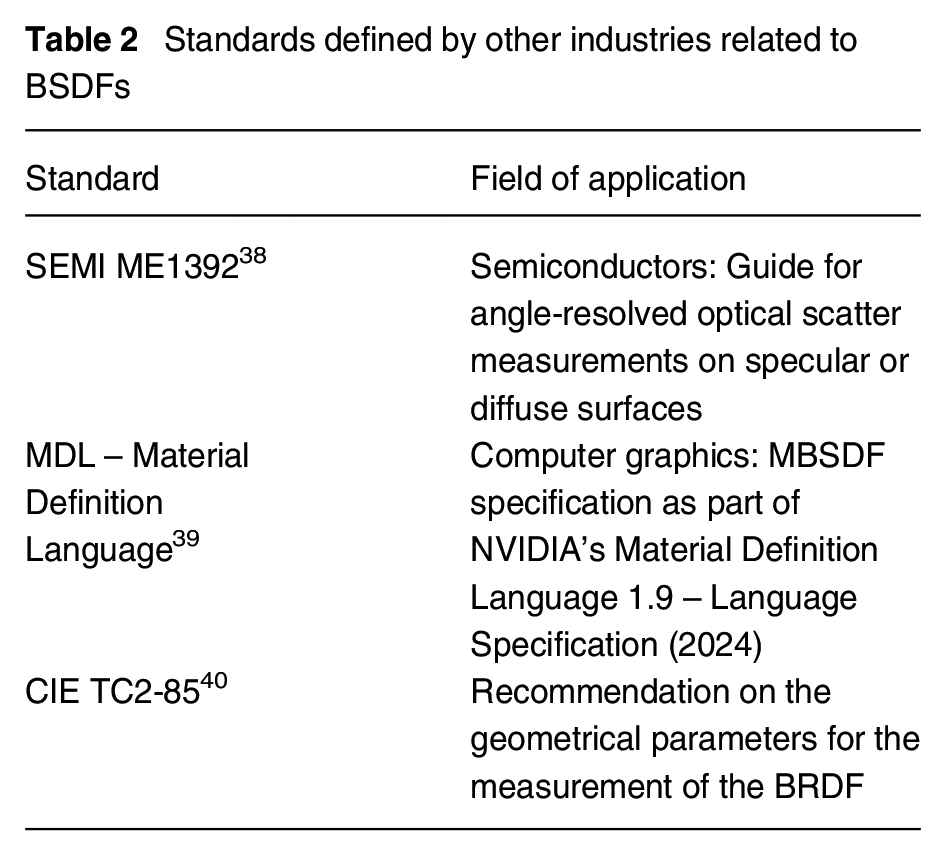
In addition, there are several standards in other areas of application that also deal with the characterization of scattering properties. 6 While these methods cannot be directly applied to daylighting systems, the concepts may be transferable. Basic considerations for the acquisition of the essential parameters are the same; distinctions are to be expected in the area of acceptable tolerances or even the necessary resolution. Table 2 lists standards from other areas that relate to characterization of scattering properties.
Standards defined by other industries related to BSDFs
2.2 Existing databases
To enable users to work with BSDF data, the appropriate methods must be implemented in software, and users must have access to BSDF datasets. Thus, it is important, not only to agree on a limited number of documented formats so that software applications can implement automated processing of such BSDF data (cf. ‘Data issues’ in Section 4.3) but also to make the data available.
At present, there are BSDF libraries publicly available to the building simulation community with varying levels of documentation on the procedures used to generate the data. BSDF data for special materials or innovative products may be available from manufacturers. For uncommon applications, engineering firms commission laboratories to measure and produce BSDF data or generate BSDF data in-house using proprietary methods.
The Lucerne University of Applied Sciences and Arts (HSLU) developed methods for generating data-driven tabulated BSDFs of high (tensor tree) and low (Klems) angular resolution from measurements using the pgII scanning goniophotometer.41,42 The work focused on daylight-redirecting materials and an initial library (BIMSOL 43 ) was produced including, for example, prismatic materials and retro-reflective louvre systems. Methods developed under the project were used to inform procedures delineated in the IEA Task 61 white paper and are of direct relevance to ISO standardization efforts.
To complement the widely used International Glazing Database (IGDB), 44 Lawrence Berkeley National Laboratory has developed the Complex Glazing Database (CGBD) 45 in collaboration with the Attachments Energy Rating Council (AERC), an industry organization.46,47 The CGDB has its origin in the area of solar heat gain coefficient calculations to enable energy-efficiency rating and labelling of common residential shading systems, such as louvred blinds, fabrics and honeycomb shades. It contains low-resolution solar-optical data (Klems format, photometric and solar), and usage of the data is intended for evaluations of integral values (solar gains, illuminance). At present, characterization methods rely on models with simplifying assumptions for material data (e.g. isotropic behaviour, Lambertian properties) based on limited measurements. Certified data are tagged in the database, indicating whether the BSDF is compliant with the AERC 1.1 Standard. 36 Methods defined in AERC 1.1 vary by CFS type. For example, BSDF data for fabric shades are based on spectrophotometer measurements at a single (normal) angle of incidence. For blinds, visible reflectance is measured at a single angle, assuming Lambertian diffusion, then used with a geometric model to produce BSDF data. WINDOW 48 enables users to input geometric and material parameters to produce BSDF layer data and combine it with transparent glazing to produce BSDFs for multi-layer systems. The Radiance genBSDF and rfluxmtx tools have been incorporated into WINDOW to generate BSDFs (rfluxmtx for non-coplanar systems, e.g. awnings). The resultant BSDF data are compatible with tools based on Radiance and EnergyPlus core engines.
Fraunhofer IBP provides BSDF data for more than 100 systems including venetian blinds, textile screens and roller shutters 19 and tools that produce BSDFs for multi-layer systems in formats compatible with DIALux Evo software 49 (IEA21 basis) and other WINDOW-reliant (Klems basis) tools. Fraunhofer IBP is currently developing a RESTful application programming interface (API) based webservice (‘IBPFacadeBuildingPhysics’) which will provide access to data sources and libraries, with a primary focus on CFS.
To connect databases from various sources worldwide, the product data network ‘buildingenvelopedata.org’50,51 is under development within joint research projects led by Fraunhofer ISE.52,53 With the standardized API, software developers and applications can easily access and use the BSDF files. Currently, the product data network contains BSDFs from the CGDB and from the TestLab Solar Façades, 54 but is planned to be extended to include more data sources of solar and daylight-related low-resolution and high-resolution BSDF. Both activities ‘buildingenvelopedata.org’ and ‘IBPFacadeBuildingPhysics’ are closely connected. For example, application examples, refer to the project website www.eqwinp.de.
3. BSDF generation methods
Accounting for the optical properties of different systems requires different BSDF resolutions, characterization methods and appropriate daylight simulation algorithms. As articulated in the Introduction, work towards ISO standardization of BSDF generation methods will focus on low-resolution data to support new building performance standards. Subsequent work on methods pertaining to high-resolution BSDF data is discussed in Section 4.
The requirements for accuracy also vary depending on the application and phase in the planning process. In the early design phase, uncertainties in planning are still large. Nevertheless, high accuracy should be aimed for whenever possible, as important decisions for the performance of the building are made in this phase.
Targeted deviations for illuminance in daylight simulation are a normalized mean absolute error (nMAE) of less than 15%, 55 normalized mean bias error (nMBE) of less than ±15% and normalized root mean squared error (nRMSE) of less than 32%. 56 Validation studies under controlled laboratory conditions report errors for matrix-based daylight methods in the range of ±20%,12,55 while errors of up to ±37% are reported in a real occupied space. 57 Similar accuracies should be achieved by tabulated BSDFs that employ a fixed basis of low resolution (e.g. Klems, IEA21). Greater levels of error at finer levels of resolution in simulated building zones are acceptable as long as the average workplane illuminance (within the region of an exiting Klems patch) is within 15%.
For new products or related R&D, characterization of systems should aim for greater accuracy to enable iterative improvements in design and ensure intended performance in the field.
3.1 Methods for tabulated, data-driven BSDFs
Early efforts to standardize the generation of BSDF data and to harmonize methods occurred within the IEA SHC Task 21. As a result, a report on the ‘Measurement of Luminous Characteristics of Daylighting Materials’ was written by international experts in the field. 9 Within the recently completed IEA SHC Task 61/EBC Annex 77, 13 a group of international experts summarized the state of the art in a white paper entitled ‘BSDF generation procedures for daylighting systems’. 14
Measurements capture not only one location but an extended area of the sample – the sampling aperture. To ensure a representative average, the relation between the dimensions of the sampling aperture and of sample features must be taken into account. The white paper’s methods for deriving data-driven, tabulated BSDF datasets are divided into applications for macroscopic and microscopic systems, respectively. A macroscopic system thereby describes a ‘daylighting or shading system that cannot be directly measured with currently available goniophotometers’ 14 because their spatial extent is too large for the measuring device and/or illuminated area. This assumes typical far-field measurements with a spatially integrating sensor; customized instrumentation that spatially resolves over the sample area have been demonstrated but are less commonly used. In contrast, a microscopic system describes a ‘daylight system that can be directly measured with a goniophotometer’. 14
Given differences in goniophotometer ‘instrument signature’ (i.e. opening angles of source and detector, type of illumination source, angular resolution, operating conditions) and internal procedures for measurement per institution, IEA SHC Task 61 experts documented approaches implemented by various institutes together with the results of an inter-laboratory round robin test. 19 It was shown that despite these differences, there was good agreement both in the BSDF data sets provided by the various laboratories as well as in the evaluations of daylight performance metrics based on these data sets. Such inter-laboratory verification is advised for qualifying laboratories that provide ISO-certified BSDF data entries.
Since the basis for daylight metrics is primarily illuminance (i.e. an integral value over the full hemisphere) and thus the total transmitted flux is most important, a separate step ‘Validation of direct-hemispherical transmittance values’ via independent integrating sphere measurements is also prescribed to ensure conservation of energy.
The white paper’s method relies on a set of Radiance tools that process measured goniophotometer data into final tabulated BSDF data (Figures 2 and 3). For systems involving scanning goniophotometer measurements, the program pabopto2bsdf, 58 for example, generates so-called Scattering Interpolant Representations (SIR) from sparse incident measurements. These SIRs are BSDF representations based on radial basis functions, 11 which define a full 4D function. The programs bsdf2klems 59 or bsdf2ttree 60 (which calls rttree_reduce to reduce tensor tree data to variable resolution) can then be used to generate tabulated BSDF data as XML files in either a Klems matrix representation, or a variable resolution, tensor tree representation, respectively. Basis representations are summarized in the white paper. These BSDFs are now either the final result for CFS for which the base material corresponds to the overall system (e.g. fabrics), or can be further used as a description of the base material in the configuration of the overall CFS in a virtual goniophotometer (e.g. slat finish for venetian blinds). For such systems involving geometric models and backwards (genBSDF) or forward ray tracing (Photon Map), interpolation per incident angle is not required. For both methods, tools to view and troubleshoot BSDF data are available,61–64 for example, check BSDFs for proper angle convention, anomalies (specular when should be diffuse) or errors in direct-hemispherical or direct-direct transmittance values for single incident directions or pairs of directions. Furthermore, the code that implements the loading and processing of BSDFs in Radiance is isolated in a set of files that allow it to be used as a library in other software, or accessed through the pyradiance module. 65
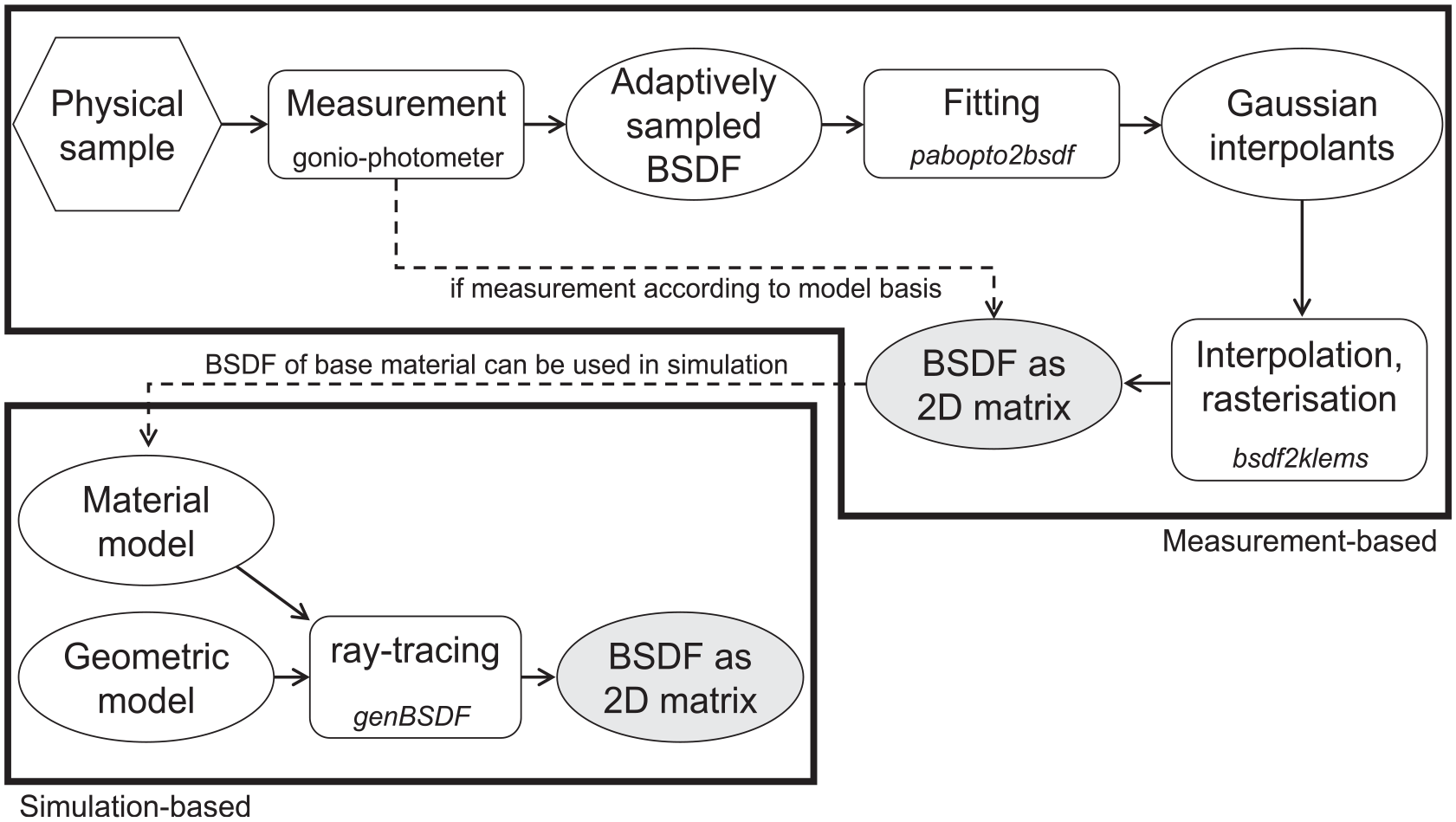
Workflow for generating tabulated BSDFs with a matrix (e.g. Klems) basis
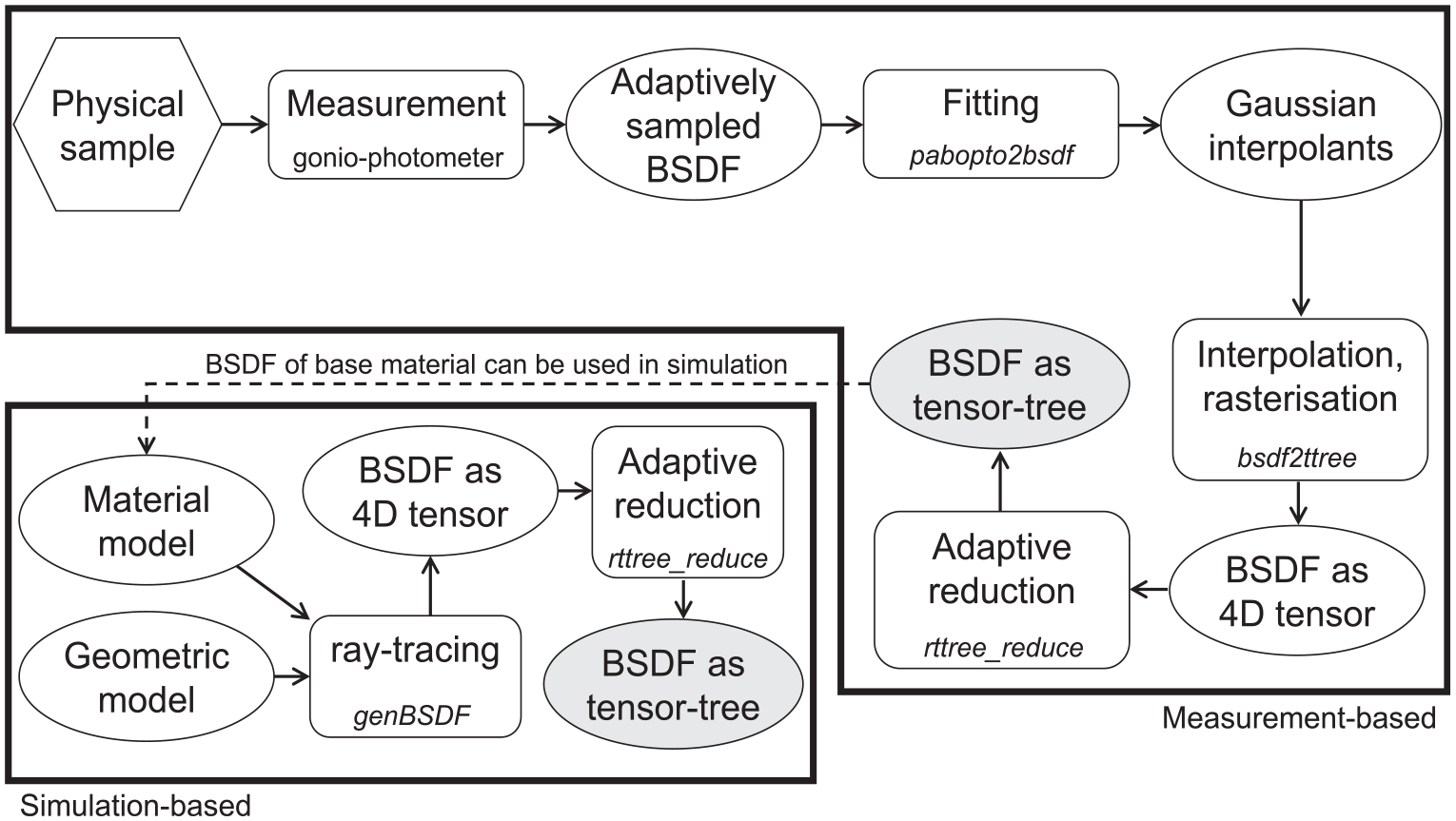
Workflow for generating tabulated BSDFs with a tensor tree basis
As noted above, various daylight and building energy simulation software already support BSDF data in Klems format (WINDOW, Radiance, Relux, Ladybug Tools, ClimateStudio, DIVA4Rhino, Fener, DALEC, LightStanza, COMFEN, IDA ICE, SPOT Pro, OpenStudio, vi-suite, EnergyPlus, TRNSYS). The IEA21 format (Tregenza basis for incident light, 5° regular grid on exiting side) is by far not as widespread (DIALux Evo, Relux). High-resolution BSDF data are supported in Radiance and in software tools that build upon Radiance (Honeybee, ClimateStudio, DIVA4Rhino, LightStanza). As mentioned earlier, the CGDB currently only contains low-resolution data in Klems format.
3.2 Validation of methods
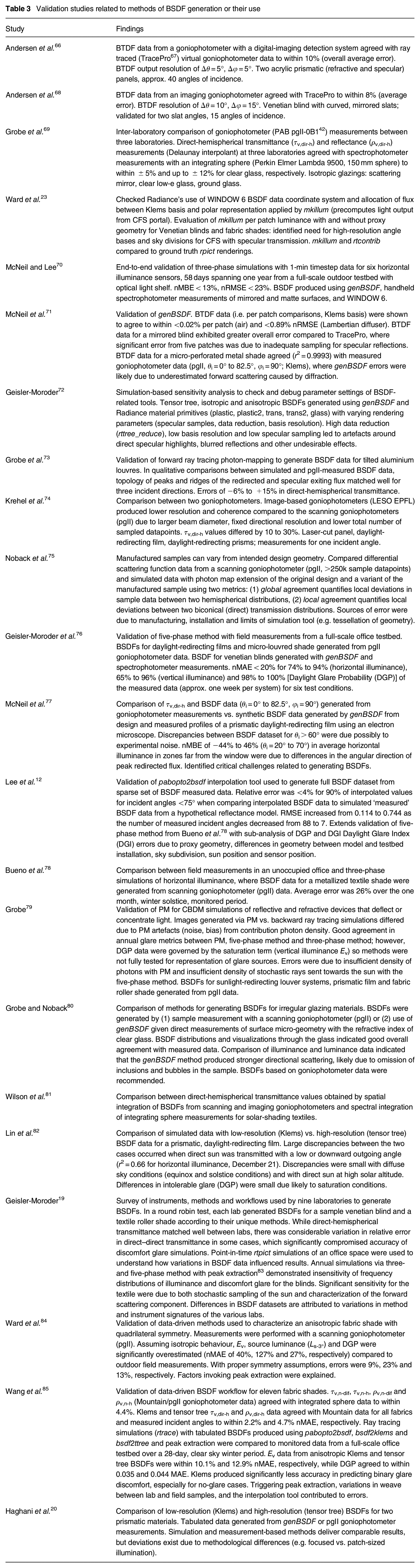
Validation of the workflow defined in the white paper 14 – tabulated BSDF measurement protocols, BSDF-related tools for checking, processing and interpolating measured data, and use in CBDM simulations – has been conducted to debug procedures and code, determine limitations of use and quantify errors. Table 3 provides a chronological summary of validation studies performed to date on various stages of the workflow, including complete end-to-end validation of multi-phase building simulation methods using backward and forward ray tracing (i.e. photon mapping (PM)). With these studies, researchers have been able to establish that the methods are sufficiently accurate (to within the 10% to 15% limits for illuminance calculations stated above) for three-phase calculations. There has also been considerable work to validate methods to model the direct component (e.g. for LM-83 ASE calculations of shade use). Including attributes related to modelling direct sunlight in ISO standardized methods such as proxy geometry or analytical models for illuminance-based metrics will be subject to discussion as the standard is developed (see Section 4). Validation of analytic models, which are outside the scope of the planned ISO standardization, are not investigated here.
Validation studies related to methods of BSDF generation or their use
4. Issues and open questions
There are still open points of discussion when it comes to BSDF characterization of daylighting systems and their application in simulation tools. The experts of IEA SHC Task 61 have summarized some of these points in the Discussion section of the white paper. 14 In addition, other and more far-reaching questions arise in this context. We try to address these and make clear that in some areas (e.g. high-resolution BSDF data for daylight glare evaluation) further research is needed before moving to standardization.
4.1 Intended uses of BSDF data
The overview in Section 3 summarizes BSDF characterization methods and related validation work and shows that there is broad consensus on the accuracy of such BSDFs for building performance and indoor environmental quality assessments based on illuminance or irradiance. The initial focus of ISO standardization work will therefore be on these methods. However, the methods do not appear to be well suited for modelling view, privacy and black-out capabilities.
For systems like fabrics and daylight-redirecting systems, with sharp, peaky reflection or forward-scattering transmission of specular sources (e.g. sun orb at 0.5° opening angle), BSDF models for daylight glare assessments are particularly important and challenging since they need to achieve high accuracy also in terms of directional resolution. The defined requirements and thus the specification and use of BSDFs in daylight glare evaluations are still open research questions. Industry will continue, however, to move forward on standards like EN 17037 that include glare ratings using practical means, for example, prescriptive specifications according to EN 14501. 2 For some systems, current methods can only produce binary assessments of glare/no-glare, for example, four-point scale, categorical assessments of discomfort glare were unreliable for textiles.85,86 In a recent investigation of subjective response to glare from the sun behind clear and tinted glass, 87 the sun was averaged over a diameter of 5.8° in order to allow comparisons between scenes. Analysis showed that imaging the sun in its real size (~0.5° diameter) can lead to completely different results in a glare evaluation. 88 This implies that for BSDFs, which average over certain solid angles due to their discretization, the question of which resolution is necessary and sufficient for glare evaluation cannot yet be answered and thus shall not be included in the current standardization efforts. In further work on this, the concept of BSDF peak extraction must also be included, which can help to improve the mapping of the direct peak component (see also Section 4.4).
Light and its spectral composition influence human health and well-being. The evaluation of non-visual lighting effects raises the question of the relevance and necessity of spectrally resolved BSDF data. Methods that handle XYZ colour data with BSDFs work well for rendering but not for the evaluation of circadian effects. Fully spectrally resolved BSDFs require considerable effort for both measurements and data processing (see also Section 4.2). This is still ongoing research and therefore will not be included in the initial efforts for standardization. Furthermore, validated BSDF concepts and methods are well suited for the determination of the angle-dependent irradiation and thus for the evaluation of the radiative part of solar gains as well as solar irradiation on the body for evaluation of thermal comfort, if the entire solar spectrum beyond the visible range is taken into account.
Depending on the optical properties of the systems and the simulations in which the data are used, there are different requirements for the data resolution and thus for the underlying simulation or measurement methods for generating BSDFs. The standard must therefore address which methods can be used to generate the BSDF data, for which types of systems and at what resolution. It must also clarify for which simulation methods or evaluations (metrics) the data can be used. Point-in-time and annual CBDM sensitivity analyses such as19,89,90 would be informative for these determinations.
4.2 Measurement and modelling issues
Measurement quality and limitations have been summarized in the IEA SHC Task 61 white paper. 14 The inter-laboratory comparison conducted under IEA SHC Task 61 19 demonstrated sufficiency of angle-resolved measurements between participating institutes. However, there are only a handful of institutes that possess the capabilities needed to make the measurements delineated in the white paper. Most research laboratories operate instruments that were not designed for standardized measurements and efficiency, but for general applicability and configurability. Once detailed characterizations have been performed, efficiency can be increased knowing the implications of simplifying assumptions on accuracy. For standardization, a procedure to ensure quality and repeatability of BSDF measurements could involve a test of each instrument setup using primary reference samples (‘gold standards’ with known BSDFs). Such procedures have already been developed for high-resolution BRDFs by some national metrology institutes. The comparison between BSDF datasets opens another question. For CFS the BSDF might include peaks, either by light that is transmitted directly without scattering, or by light that is reflected off specular surfaces. These ideal delta peaks in the theoretical true BSDF result in peaks of a finite width in the measured BSDF. The height and width of these measured peaks depend on the instrument signature. Direct comparison therefore requires a common instrument signature. These are common problems in all BSDF comparisons, but they are particularly pronounced with materials for daylighting that often feature sharp peaks due to mirror-like reflection or direct transmission. In the course of the standardization project this needs to be addressed, for example, by investigating whether and how existing approaches from related fields40,91 might be adopted.
New BSDF measuring devices have recently been or are currently being developed in various laboratories. Two are mentioned here as examples, both focusing on deriving BSDF data in Klems resolution. Researchers at RPTU Kaiserslautern and Fraunhofer CSP (Center for Silicon Photovoltaics) worked on a near-field measurement method to speed up acquisition of BSDFs using laterally extended structures with angular selectors. The measurement procedure is part of the expert recommendation VDI-EE 2068 92 published by The Association of German Engineers. Within the project MEZeroE, 93 researchers at the University of Innsbruck aim at generating BTDFs in a time and cost-efficient way by using a hemisphere equipped with 145 illuminance sensors located in the respective centres of the 145 Klems patches for simultaneous measurements.
It will take time and investment by industry to generate a comprehensive, standardized BSDF library of products of sufficient accuracy to meet the necessary error limits. As with any industry, trade-offs will need to be made between accuracy and the cost of producing characterization data. Initial efforts to create a BSDF library within practical limits are underway with the goal of making some data available to practitioners now, albeit limited in accuracy for some CFS. Until resolved, practitioners must be advised to use caution when using BSDF data and be proactive in understanding the limitations of such data. Example rules of thumb are: if the geometry of the CFS is regular and large in scale and the opaque surfaces of the material are of matte finish, practitioners can be confident that data produced using a virtual goniophotometer such as genBSDF are reasonably accurate; tabulated BSDF data are more accurate with an increased number of measured angles of incidence; assuming homogeneity of a material that is non-homogeneous or isotropic when clearly anisotropic will reduce accuracy. Industry can and should test the limits associated with simplifying assumptions for their systems via sensitivity analysis and continued validation studies.
As noted in Section 4.1, other applications require BSDF data for different spectral regions (UV, IR) or increased spectral resolution as provided by spectrophotometers. This poses challenges for both measurement infrastructure and methods. As long as the separation of scattering (i.e. spatial resolution) and colour (i.e. spectral resolution) is possible, the BSDF and the spectrum can be characterized separately. This is the case for most common daylight and shading systems. Although approaches for measuring spectrally resolved BSDFs using spectrophotometers or filters exist, they have not yet been commonly adopted into practical application in the field of CFS and are therefore not yet being considered for transfer into standardization.
In a purely simulation-based workflow, the 3D geometrical model of the daylighting system has a special significance. The model is usually theoretical in nature and originates from an idealized world. The manufactured product, on the other hand, is subject to manufacturing tolerances and thus may deviate from the model. The same applies to material and surface properties which may degrade in time due to oxidation, corrosion or other effects of weathering. If geometry and material data for a CFS are available at all, special attention must be paid to these issues as demonstrated in references 76,78,79,81.
Currently, there are no simulation tools available to generate BSDFs for CFS and daylighting systems with micro- or nano-scale materials. Due to the strong wave-like interactions exhibited by light at the micro-nanoscale, ray tracing methods are not applicable to these materials.
Generally, standardization can and shall provide requirements and methods for a defined set of applications, but specific measurement parameters depend on the sample – a one-fits-all approach would render the method either inefficient or inaccurate in many cases.
4.3 Data issues
4.3.1 Qualifying or certifying BSDF data
BSDFs are often generated in-house by engineering consultants and manufacturers. For regulatory agencies and consumer protection, there is an absolute need to have products certified to a standard level of quality. Software companies as well as end users (planners, architects, engineers), not just the experts, need to understand whether data sets are suitable for the intended application, that is, concerning the format and generation method. Existing BSDF libraries provide insufficient to no information on the method of derivation for data entries, making it difficult for end users to determine associated error. An ISO standard can ensure adequate quality and applicability of such BSDF data. In support of this objective, the product data network buildingenvelopedata.org 51 has enabled data formats and methods to be registered with a unique ID. This will allow end users’ software applications to search for certified records that are available in the product data network.
Standardization bodies, associations and institutions can define data formats and methods to create data. For data formats, schemas should be made available which can be used to validate with one single command whether a data set fulfils all requirements of the schema. The schema must contain all relevant requirements and should be designed such that software developers can easily understand and work with the data. For methods, a cryptographic signature can be used to verify that data sets have been created according to a certain method.
4.3.2 Meta-information in BSDF files
To enable end users to understand the purpose and quality of BSDF tabulated data, the source and methods of generating the data must be documented and attached as metadata to database entries. Just as one example, information on the measurement instrument and the instrument signature (see Section 4.2) should be included. This is needed to know whether direct comparisons with other BSDF measurement data are possible. The WINDOW XML format supports typical product data and is extendable. 94 Lanevski et al. 95 attempted to define a sharable JSON format for BRDF data, including metadata, together with approaches to make a standard format customizable. ISO standardization will also work on defining the metadata required for such entries for BSDF datasets.
The product data network buildingenvelopedata.org offers with its API specification 52 a JSON format for optical datasets in general. With the possibility to query the metadata via GraphQL, 96 users can efficiently retrieve data sets. The metadata of optical data sets currently includes the method which was applied to create the data set, the component which was measured, the institution which has created the data set, name, description and ID of the data set. In addition, a URL is stored via which the data set can be accessed. To make the origin traceable, (i) all methods and data formats must be described either in a document, in a software repository, or as a web service; (ii) methods need to be registered in a global dictionary and (iii) each method receives a unique identifier. Methods can be defined rather generically or in great detail. For example, a method can be defined by a certain standard or by one equation of a standard. Several detailed methods can be combined to define a more general method. A higher level of detail of the methods requires more effort in defining the methods but facilitates the search for suitable data sets.
For the integration with BIM, it is not recommended to store the BSDF data within the building components because the size of the model becomes too large. Instead, it is recommended to store the URL of the data source with each component together with the unique ID of the component. This allows software developers to access and automatically process the BSDF data of the building components. At the same time, parameter standardization to support open-BIM data exchange (e.g. via IFC) are in the new CEN/ISO standardization activity on BIM properties of daylight louver systems. In this regard, the newly established Global Lighting Data Format (GLDF) 97 data container for luminaires could be considered a blueprint for daylighting systems.
4.3.3 Data formats
Tabular formats, which are developed from the perspective of simulation tools, are typically assuming a regular grid of incident and exiting directions. On the other hand, formats developed by instrument developers (at least for scanning instruments) use an adaptive resolution matching the measured signal. When drafting a standard, care must now be taken to ensure that this circumstance is taken into account and that the two worlds of measurement and simulation are coordinated.
4.4 Further issues
Analytical models are broadly acknowledged to be more practical for characterizing products with hundreds or thousands of permutations (e.g. fabrics) since angle-dependent measurements can be costly and require significantly more complex instrumentation. The EN 17037 and EN 14501 standards for example have adopted the use of the adapted Roos model by Wienold et al. 98 for deriving look-up tables and prescriptive guidance for selecting fabric, textile shades. A field validation study was conducted with 11 fabric shades, demonstrating acceptable error for simulations of vertical illuminance (rtrace, tensor tree resolution), but not for luminance-based studies, when using the adapted Roos or Modified-Kotey analytical models. 86 While analytical models can be sufficient for some systems, the development and standardization of a general approach to derive analytical models from measurements presents a number of unresolved issues. Existing frameworks may be considered to link discrete and functional representations – the Alta BRDF library 99 being one example. These open questions warrant further investigation and suggest that the derivation of analytical models may not be covered in the first step in ISO standardization.
As described above, accurately modelling peak values such as the direct solar component is of major relevance. When the use of proxy geometry is not possible, analytical models may provide a smooth and less noisy alternative to data-driven approaches but not necessarily greater accuracy. They can preserve the magnitude of peak intensity, whereas tabular BSDFs reduce peak intensity through interpolation (e.g. SIR interpolant 84 for goniophotometer-derived BSDFs) and discretization into tabular formats. Peak extraction, 83 which is possible in Radiance with aBSDF, concentrates directly transmitted sunlight of a discretized BSDF region into the true solid angle of the sun. This is however problematic for materials with partial forward scattering, which is particularly the case if the BSDF has a coarse resolution (e.g. Klems) and combines much of the forward-scattered light together with the direct peak into one patch. The peak is then assigned the entire luminous flux and is thus overestimated. Further discussion on methods is needed prior to standardization efforts addressing the refined modelling of direct transmission.
For the application of BSDF data in daylight simulations, CFS must usually be combined with transparent glazing layers into a single, merged model. Additional complexity comes into play as soon as more than one layer with scattering behaviour is to be modelled. Methods were established (i.e. in WINDOW) for combining Klems layers for glazing and shading layers with dissimilar periods. Grobe 100 developed a tool that combines tensor tree layers into a single high-resolution BSDF dataset. ISO standardization will initially aim at characterizing the basic BSDF of the shading layer. The fusion with other layers or transparent glazing will follow later.
5. Conclusions
As an interface between interior and exterior spaces, facades have a special significance in buildings. For the area of daylight alone, they serve several purposes: daylight provision and distribution, solar control, glare protection and view to the outside. This is reflected in the corresponding building codes, standards and certificates. To account for this during design, daylighting systems must be adequately represented in building simulations. In this paper, we established that data-driven, tabulated BSDF models provide a general means to achieve accuracy and efficiency in simulations.
In Section 2, we highlighted that numerous standards and guidelines already reference or could be supported by BSDFs. A few BSDF databases are publicly available, some of which may be certified by organizations within a country for a particular purpose (e.g. solar gains). Due to the lack of required documentation, the methods used to generate the data are not transparent so associated accuracy is unknown. This underscores that a uniform approach to the production of BSDF data should be elaborated and normatively anchored. In Section 3, we refer to established methods for deriving data-driven, tabulated BSDF datasets that have been developed through international collaboration among experts in the field. We delineate empirical studies that validate the methods used to generate tabulated BSDF data and the simulation tools that use the BSDF data to produce daylight performance data. Continued validation is needed as new methods and tools become available. Section 4 summarizes open issues in the area of BSDF data generation and application, which still call for future research. Generating tabular data may be cost-prohibitive for some classes of shading systems. Resolving this challenge will involve further development of instrumentation or accepting compromises in accuracy.
Given the weight of evidence, standardization efforts can and should proceed to the ISO level. Standardization efforts shall initially focus on generally applicable methods for data-driven, tabulated BSDF characterization of CFS for evaluating the performance criteria based on integral radiation quantities (illuminance, solar irradiance) and thus on definitions and specifications for generating low-resolution BSDF data. There is no question that methods (e.g. analytical 86 ) must subsequently be derived in order to characterize some systems with a large number of variations. The content from the IEA SHC Task 61/EBC Annex 77 reports C2.1 14 and C2.2 19 is the main starting point for the standardization work. The topic was presented to the ISO/TC 274 ‘Light and Lighting’ where positive feedback was given to start a new standardization activity. The project was launched in mid-2024. Parts of the work on the ISO standard will be carried out under the new IEA SHC Task 70/EBC Annex 90 ‘Low Carbon, High Comfort Integrated Lighting’, 101 but we would also like to invite all those who can contribute to the topic to participate in the standardization work.
We also want to make clear that the goal is not to mandate that every daylighting system must be measured and BSDF data generated. Rather, the goal is to provide certainty and support for manufacturers and designers who need these data in order to perform high-quality simulations and evaluations for their projects.
Footnotes
Acknowledgements
The authors would like to thank the many brilliant minds worldwide who have contributed to the task of optical characterization of complex fenestration systems over the past several decades.
Declaration of conflicting interests
The authors declared the following potential conflicts of interest with respect to the research, authorship, and/or publication of this article: P Apian-Bennewitz has been working on BSDF measurements in research and industry since 1989, and specialises in scanning goniophotometers, including designing and marketing a model (pab PG2) since 2007. R Weitlaner at HELLA, a manufacturer of solar-shading products, is focusing on daylight and daylighting controls research and is providing BSDF data for daylighting simulation tools. The other authors declare no potential conflicts of interest with respect to the research, authorship and/or publication of this paper.
Funding
The authors disclosed receipt of the following financial support for the research, authorship, and/or publication of this article: This work was funded by the Austrian Federal Ministry for Climate Action, Environment, Energy, Mobility, Innovation and Technology (BMK) through the ‘IEA Research Cooperation’ programme, managed by the FFG, through Contract No. 900356 and through the ‘TECXPORT Bilateral Cooperation Austria – PRC/MOST 2022’ programme through contract FO999903877 ‘CFS4LowCarb’; the Assistant Secretary for Energy Efficiency and Renewable Energy, Building Technologies Office of the U.S. Department of Energy under Contract No. DE-AC02-05CH11231; the Daylight Fellowship at ETH Zurich supported by the Velux Stiftung; the German Federal Ministry for Economic Affairs and Climate Action under Grant 03EN1070A, based on a decision by the German Bundestag; and the National Key R&D Program of China under Grant No. 2023YFE0106700 and National Science Foundation of China under Grant Nos. 51978429 and 52378096.
