



Abstract
Current New Zealand (New Zealand Building Code), Australian (National Construction Code) and American (International Building Code) building codes include deemed-to-satisfy requirements for a given proportion of a house’s floor area (e.g. 10%) to be in windows. These, plus the current English Building Regulations, also require a proportion of windows to be openable (e.g. one-half or 5% of the floor area). A detailed summary table supported by code extracts is used to trace the evolution of these requirements. Even the architects of antiquity provided only rules for window proportions but not for window area or size based on room dimensions. The paper demonstrates the evolution of this 21st century requirement follows a direct line to the English 1859 model ‘Byelaws as to New Streets and Buildings’. Prior to that date, only two rules from 1842 (room volume based) and 1734 (height and volume based) have been found which gave a required window area based on room size. It is hypothesised that one of these led to the current rules. Although the current proportion rules may be appropriate, no empirical research-based origin has been identified.
1. Introduction
Where the dimensions of 1/10 and 1/20 came from is unknown, but this standard has been carried through to the present day, and the size requirements can be said to be historic rather than scientific
1
A 2022 editorial in Lighting Research and Technology asked about the development of the planning of daylighting of buildings, suggesting it was the time for a practical history. 2 This paper provides a history of one common daylighting building code requirement – one-tenth (10%) of the floor area as windows, half of which (5%) is openable. While this paper is focused on this codification of window area for daylighting, until the widespread adoption of air-conditioning, there was a strong link between the provision of both light and air. Thus the use of windows to provide natural ventilation also forms part of this story.
The Acceptable Solutions (in other countries, often termed ‘Deemed-to-Satisfy’) of the New Zealand Building Code (NZBC) detail window requirements in two places.
• Clause G7 Natural Light, Acceptable Solution G7/AS1 (dated 29 November 2021) Clause 2.1.2.1 ‘Vertical windows in external walls shall have: (a) An area of glazing of no less than 10% of the floor area, …’ 3
•Clause G4 Ventilation, Acceptable Solution G4/AS1 (dated 27 June 2019) Clause 1.2.2 ‘Natural ventilation of occupied spaces must be achieved by providing a net openable area of windows or other openings to the outside of no less than 5% of the floor area’. It also comments, ‘The net openable area of windows or doors is measured on the face dimensions of the building element concerned’. 4
The Australian National Construction Code (NCC) for housing provides deemed-to-satisfy provisions for the use of windows for lighting and ventilation. Part 10.5.1 requires ‘an aggregate light transmitting area measured exclusive of framing members, glazing bars or other obstructions of not less than 10% of the floor area of the room’. 5 If used for natural ventilation, part 10.6.2 deemed-to-satisfy option requires ‘a ventilating area not less than 5% of the floor area of the room’. 6
The original 1965 English Building Regulations included requirements for habitable rooms that ‘width and the window height equals one-tenth of the floor area of the room’ whether there were one or more windows in the room (Part K1(2) and (3)) and for ventilation of ‘one-twentieth of the floor area’ (Part K(4)). The ventilation requirement also applied to ‘sanitary accommodation’ (i.e. containing a water closet or urinal) (Part P(3)). 7 The current 2022 Building Regulations do not have such requirements for windows for natural lighting, but for natural (purge) ventilation provide the option of ‘Opening sash windows: to have a minimum total area of opening 1/20th of the floor area of the room’. Table 1 reproduces the ‘Purge ventilation opening’ table from Approved Document F. It differentiates between hinge and pivot windows which must be at least one-tenth (10%) of the floor area of the room and all other window types which only need to be one-twentieth (5%). 8
2022 Approved Document F, ‘Table 1.4 Purge ventilation openings’
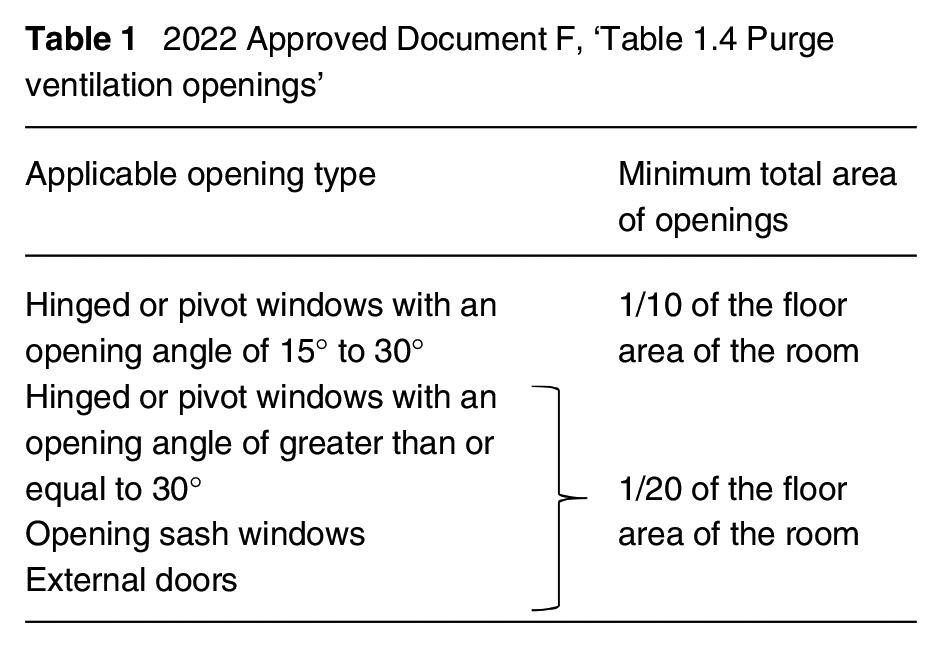
The American 2018 International Residential Code 9 and the 2012 International Building Code 10 set the window area at 8% and the openable area at 4%. However, the 1970 edition of one ancestor, the Uniform Building Code, required a window area of 10% with one-half openable. 11 The 1905 Building Code Recommended by the National Board of Fire Underwriters, 12 although principally for tenement buildings, also includes the same requirements.
All these codes use remarkably similar language, with two of the current codes establishing a requirement for window area of not less than 10% (one-tenth) of the floor area and all three for opening window area of not less than 5% (one-twentieth) of the floor area. But where did these requirements originate? To find this, it is necessary to track back in time, starting with current building controls.
2. New Zealand: Present day back to 1891
Prior to the implementation of the national NZBC in 1992, building by-laws were under the control of local territorial authorities. However, attempts had been made to provide a standard model building by-law for council adoption.
2.1 1964: NZSS 1900 New Zealand Standard Model Building By-law
NZSS 1900 was the immediate predecessor to the NZBC. The first edition of Chapter 4, Residential Buildings (NZSS 1900 Chapter 4:1964) section 4.7 set out requirements for ‘required windows’. These were defined as facing directly onto a ‘frontage, court, or inner court or … to a service room on {sic} to a service court’. The requirements differ from the 1992 version referring to aggregate (i.e. total including frame) window area rather than solely the glazing area. Here, and in later extracts,
4.7.2.1 The aggregate area of the required windows
4.7.2.2 Unless otherwise approved by the Engineer, the height of required windows shall not be less than 6 ft 6 in. from the floor level to the top of the ventilating portion of the window.
13
The requirements were unchanged in the 1985 revised edition. 14
2.2 1943: NZSS 95 New Zealand Standard Model Building By-law
Although building codes had previously been developed by the local council engineer or surveyor, following the 1931 Napier Earthquake, there was a move to nationally developed by-laws for local adoption – with or without modification. It took some years for the full NZSS 95 New Zealand Standard Model Building By-law Part VIII:1943, Residential Buildings, to be completed. It was the predecessor to NZSS 1900, with similar requirements but without specifying the window height:
808 (b) (i) The aggregate area of such required
windows
NZSS 95 Part VIII:1943 clause 807(a) sets the minimum room height as 8 ft (2.4 m). 16
2.3 1925: Model By-laws Under the NZ Health Act 1920
Central Government departments provided some guidance to local government to ensure critical issues were covered (or at least considered) in their by-laws. The 1925 NZ Government’s Department of Health ‘Model By-Laws Under the Health Act 1920 Relating to Dwellings and Buildings for Human Habitation’ was distributed widely to local authorities, although no records were kept of its adoption:
10. (1.) No person shall erect or rebuild any building intended for use wholly or in part as a dwellinghouse unless in regard to every room used or intended to be used for sleeping purposes there shall be made provision in respect to the following matters, that is to say-
(c) Every room used or intended to be used for sleeping purposes shall have in one wall at the least one or more windows opening directly to the open air.
[NOTE. -The window must be in a wall. The use of skylight is not satisfactory from the point of view of ventilation.]
(d) The aggregate space occupied by such window or windows
The model by-laws required a window – skylights were unacceptable – but allowed for fly-netting (also termed ‘flyscreen’) to reduce the nuisance and health hazard of flying insects. There is no mention of skylights in the 1912 by-laws, suggesting that under it, skylights had been offered instead of wall-mounted windows but were considered unsuitable.
2.4 1912: NZ Suggestions for By-laws
The 1912 Suggestions for By-laws Suitable for Adoption in Counties, Town and Road Districts were produced by the NZ Department of Public Health, Hospitals and Charitable Aid. As for the 1925 model by-laws, they were sent to all local councils. The draft clause required the window area to be one-eighth (12.5%) of the floor area.
15. Every person who shall erect a dwellinghouse shall provide that for every living-room therein there
The 1925 model by-laws decreased the window area to one-eighth (12.5%) to one-tenth (10%) of the floor area for rooms for human habitation but were otherwise unchanged.
2.5 1912: Dunedin City, NZ By-laws
The 1912 Dunedin City Council by-laws provide an example of this requirement in NZ by-laws. The language is sufficiently different to suggest they were not directly copied from the NZ Department of Public Health’s 1912 suggestions:
202 Every building for residential purposes to have sufficiency of windows; every habitable room to have window or skylight.
Every hotel, private hotel, boarding-house, dwelling-house, or other building erected for residential purposes shall have sufficient number of suitable windows to afford effectual means of ventilation by direct communication with the external air, and every habitable room in every such building shall have a window or windows or skylight equal in size (clear sash frames) to
2.6 1891: Wellington City, NZ By-laws
The first appearance of window requirements from a New Zealand local council, based on accessible materials, are in the Wellington City By-laws of 1891:
34 Ventilation of Buildings
Every building erected for residential purposes shall have a sufficient number of suitable windows to afford effectual means of ventilation by direct communication with the external air, and every habitable room, except as hereafter provided, every such building shall have a window or windows or skylight equal in size (clear of sash frames) to at
These required 10% of the floor area of habitable rooms to be windows or skylight, with one-half (i.e. 5% of the floor area) to be openable. The operative language is similar to the 1912 Dunedin by-laws. The minimum window height requirement was not used, but the opening is required to reach the top of the window, presumably assuming sash (rather than casement) windows.
Thus, a direct line has been demonstrated between the 1891 Wellington City Council by-law requirements and those of the current NZBC. However, from where did Wellington, New Zealand obtain these requirements?
3. Great Britain: 1899 to 1851
Based on previous analysis of the development of NZ building controls, the logical place to start is Great Britain. For example, the various London (or Metropolitan) building acts have been noted as source material for NZ building controls. 21 The period started with the repeal of an Act which limited the use of windows.
3.1 1894: London Building Act 1894
The London Building Act 1894 [57 & 58 Vict. Cap. CCXIII], Section 70(1)(c) required all habitable rooms (underground and above ground) to have a window area of at least one-tenth of the floor area and a minimum room height of 8 ft, unless in the roof. 22
70. (1) (a) Every habitable room except rooms wholly or partly in the roof shall be in every part at least eight feet six inches in height from the floor to the ceiling;
(b) Every habitable room wholly or partly in the roof of any building shall be at least eight feet in height from the floor to the ceiling throughout not less than one-half the area of such room;
(c) Every habitable room shall have
The 1894 Act also allowed for roof rooms to use a dormer window of one-twelfth the floor area (8.3%) with one-twenty-fourth of the floor area (4.2%) able to be opened.
3.2 1892: Burgh Police (Scotland) Act 1892
The Burgh Police (Scotland) Act 1892 [55 & 56 Vict. Cap. 55] introduced for Scotland a requirement for habitable rooms in dwelling houses to have at least one window and the window(s) to have a glazed area of at least one-tenth of the room area, with one-half openable: 173. Windows in Rooms. In every new or altered building to be used as a dwelling-house, every habitable room shall have at least one window, and the total area of glass in the windows, clear of the frame and sash, shall be (unless in any case the Commissioners otherwise determine) at least
The 1892 Act had a tortuous path through the Parliament, with bills introduced, and then rejected, in 1884, 1885 and 1888. 23 When first introduced on 10 May 1883, Section 217 required 1 ft2 of window per 10 ft2 of room area, with half openable. 24 Although this did not pass, the same requirement was given as Section 166 of the Burgh Police and Health (Scotland) Bill introduced on 4 April 1884. 25 When the requirement was discussed in the Select Committee, it mutated. On Friday 18 July 1884, the introduced clause required ‘Single apartments let as houses to be sufficiently lighted and ventilated’, with a ‘window of adequate dimensions and of proper construction, placed in an outer wall of the house or through the roof’, but this was rejected. A new proposal relating to ‘Penalty for excess of numbers’ was then introduced, which required adequate room volume ‘… in the proportion of one person for every three hundred cubic feet of space…’ was also rejected. Finally, an extensive proposal relating to the ‘Prevention of Overcrowding in Small Houses’ was introduced, which included the same requirements as in the Glasgow Police Act 1862 (see following), of 1 ft2/100 ft3 or 1 ft2/150 ft3 depending on room size. 25 Once again, ‘owing to the objections of a very limited number of the members of Parliament it was not allowed to pass’. 23
In 1892, although subject to ‘a most pertinacious opposition’ as a result of which the Act was ‘maimed and mutilated by members whose constituencies it did not affect’, it was ‘hurried through in the last hours of a dying Parliament’, 23 retaining the 1883 bill’s 1 ft2 of window per 10 ft2 of room area, with half openable.
3.3 1891 Public Health (London) Act 1891
Contemporary to the Wellington, New Zealand, by-law, The Public Health (London) Act 1891 [54 & 55 Vict. Cap. 76] included a requirement for one-tenth of the floor area as window with one-half opening, but only for rooms below ground level: (k) unless the room has one or more windows opening directly into the external air with a
3.4 1877: Model By-laws as to New Streets and Buildings
Harper
26
traces the London Building Act 1894 requirement back to the Local Government Board’s ‘Model By-Laws As To New Streets And Buildings 1877’, which states
27
: 57. Every person who shall erect a new building shall construct in every habitable room of such building one window, at the least, opening directly into the external air, and he shall cause the Such person shall also construct every such window so that
It is worth noting that the Local Government Board had received requests for a byelaw prescribing a minimum height for habitable rooms for the purpose of ventilation. The Board considered there were ‘so many serious considerations’ that in 1877 they requested a legal opinion. 27 Their 1881 report stated the legal opinion was that while there was no power to make byelaws regulating room height for ventilation, there could be ‘cases where reasonable regulations made with reference to the mode of ventilation would necessitate the rooms being of a certain height’. 28
3.5 1862: Glasgow Police Acts 1866 and 1862
Chronologically the next appearance of a window area based on building size was in the Glasgow Police Act 1866 [29 & 30 Vict. Cap. 273], which in turn had come directly from the Glasgow Police Act 1862 [25 & 26 Vict. Cap. 101].
The 1862 Act was significant in that Section 388 established the ‘ticket’ system based on room volume (ft3), which limited the number of people permitted to sleep in a room. Section 387 required the room ticket to record the number of cubic feet and the number of persons, whilst Section 388 required a minimum of 300 ft3 per person over the age of 8 years and 150 ft3 for each child under 8 years.
Glasgow had had Building Regulations relating to windows since 1625, limiting windows in walls facing a neighbour’s property which could be used to throw out household rubbish or sewerage, but not relating to ventilation. 29 In the 1862 Act Section 384 required the provision of one or more windows in sleeping rooms, of which at least one-third in total was openable. Window areas were set at 1 ft2/100 ft3 for rooms under 2500 ft3 in volume or 1 ft2/150 ft3 for rooms over 2500 ft3. No mention is made of room minimum floor area or floor-to-ceiling height.
This approach follows that of Gwilt in 184230 (see below). However, the use of window area per room volume (ft2/ft3) has not been found elsewhere.
3.6 1859: Byelaws as to New Streets and Buildings
The 1877 model by-laws requirement had its first appearance in the ‘Byelaws as to New Streets and Buildings 21 & 22 Vict. Cap. 98, Sec. 34’, published in the ‘First Annual Report on the Execution of the Local Government Act 1858’. 31
The Secretary of State for the Home Department provided in this first report ‘to support uniformity and reduce the costs to local boards’ a suggested set of model byelaws, which included
31
: 16. Every habitable room shall have at least one window, and
The minimum window top height was stated as 6 ft 7 in (2 m), but later byelaws based on this model give it as 7 ft 6 in (2.3 m), 32 suggesting a possible typographical error in the 1859 version.
The Local Government Act 1858 [21 & 22 Vict. Cap. 98] replaced the parts of the Public Health Act 1848 [11 & 12 Vict. Cap. 63] with respect to local byelaws, adding a requirement for ‘free circulation of air around buildings and ventilation’ (Section 34). A search of The National Archives (TNA) catalogue has not revealed any holding relating to the internal workings of the Local Government Board (part of the Home Office). However, there are many letters to and from local councils relating to the approval of their by-laws.
3.7 1857 Warming and Ventilation of Dwellings report
The 1857 ‘Warming and Ventilation of Dwellings: Report to General Board of Health by Commissioner’ dealt mainly with non-window methods of improving heating ventilation and efficiency improvements leading to the reduction of smoke from fires.
As well as improved fire grates, based on a range of experiments, the report recommended the use of double glazing –‘that double panes of glass be used in small rooms, and double sashes in large rooms; in which case there should be a stratum of air allowed, from five to six inches, between the two sashes’. 33 No rules for window area (fixed or opening) were provided.
3.8 1850s Sanitary reformers
Sanitary reformers were active during the mid-19th century, promoting improved housing quality, including using windows for light and ventilation. Florence Nightingale, perhaps the most well-known, in her 1859 publication on improving the sanitary conditions of hospitals, set out requirements for room height and width:
Natural ventilation, or that by open windows and open fireplaces, is the only efficient means for procuring the life-spring of the sick – fresh air. But to obtain this the ward should be at least sixteen feet high, and the distance between the opposite windows not more than thirty feet.
34
Nightingale also had clear views on the availability of sunlight in hospitals:
All hospital buildings in this climate should be erected so that as great a surface as possible should receive direct sunlight – a rule which has been observed in several of our best hospitals, but, I am sorry to say, passed over in some of those most recently – constructed. Window-blinds can always moderate the light of a light ward; but the gloom of a dark ward is irremediable.
34
Nightingale required one window for every two beds, with the window placed from 2 or 3 ft above the floor to within 1 ft of the ceiling and occupying one-third of the wall. 34 However, she did not suggest an appropriate window-to-wall ratio for hospitals nor give suggestions for housing.
The Ladies Sanitary Association was also active in the 1850s promoting the value of fresh (and clean) air for housing:
It is not possible to have too much fresh air IN A ROOM {sic}, provided only an uncomfortable and chilling draught is not allowed to blow upon the body of the inhabitant. You may easily prevent any discomfort or mischief from draught, even where a great abundance of air is admitted, by hanging a curtain to catch it and turn it aside.
35
Again, no rule or guidance from the Association has been found relating to room window size or opening areas.
3.9 1852 Hesketh’s quantity and effect
Robert Hesketh was active not only in design and inspection but also in the policy and theory of buildings. His 1880 obituary described him as an architect, surveyor, musician and well-known mathematician, with involvement in the development of the Metropolitan Building Act. 36 He was also the author of two publications on the Metropolitan Building Acts of 184437 and 1855. 38
In 1852, Hesketh presented a paper on daylighting which noted Palladio’s rule ‘the openings of windows should not exceed a fourth, nor be less than a fifth of the length of a side of a room, and should be in height two and one-sixth times the width’. He also stated Gwilt’s approach (see below) as ‘nearest approach to a definite rule that I have met with, which is to allow 1 foot of glass to 100 cubic feet of room’ he concludes that it requires a ‘more exact system of computation’. 39
Hesketh offered his own method to estimate the ‘quantity and effect’ of light entering a room through the openings, which he demonstrated through application to five buildings. The ‘numerical value of light’ was calculated as follows and reported as a value per 100 ft3:
I think the effect (though not the quantity) of light may be deemed to vary as the square root of the average distance through which it traverses a room. For ascertaining, then, the effective light, the numerical value of the proportionate quantity should be multiplied by the square root of the distance.
39
Hesketh also noted that ‘if a room be partially lighted, [the eyes] adapt themselves to the stronger partial light, and the other parts appear more gloomy’, as well as reflection from ‘white or light-coloured surfaces’. Where the light obtained was inadequate, he had invented a patented reflector (UK patent number 13 955) 40 to ‘throw the light from the portion of sky which remains unobstructed’. 39 Although potentially a valid (if complex) technique, it was not as simple as a window-to-floor-area rule.
3.10 1851 Repeal of Window Tax
The English ‘Window Tax’ legislation was at odds with any requirement for natural light. This tax was introduced in 1696 to cover revenue lost by the clipping of coinage. 41 The cost was borne by the dwelling house occupier or tenants (not the landlord). At the start, a dwellinghouse (excluding cottages) paid a base fee of two shillings a year; 10 to 20 windows cost an additional four shillings a year (i.e. 6 s in total); over 20 windows an additional 8 s plus the base (i.e. 10 s in total). 41 The tax changed in numerous and often complicated ways in the following years until its repeal. 42
While initially intended as a wealth tax, it applied to the whole building, not the individual households. For example, a building with 6 apartments, each with 2 windows, was taxed at a rate based on a building with 12 windows, making it especially burdensome for low-income apartment-dwelling households. One solution was to brick up windows till the number fell below the tax notch. 43
The Window Tax applied to any opening in a wall regardless of its size ‘unless the air can be admitted without any glimmer of light’.
44
In the words of one member of the House of Lords, ‘if they found a gimlet-hole they would take it’.
45
The Poor Law Commissioners’ 1842 report reported the impact of the Window Tax was even found in prisons:
One cause why the rooms in some prisons are so close is the window-tax, which the gaolers have to pay; this tempts them to stop the windows and stifle their prisoners.
46
By 1850 this ‘odious and vexatious tax’ generated £1.8 million per year (3.1% of the total United Kingdom Government receipts of £57.1 million47,48).
Pressure against the tax drew attention to its inequities 49 and deleterious effect on health. In 1860, Sir Robert Rawlinson, one of the 1848 Public Health Act’s first inspectors, wrote that ‘Sunlight is of the utmost importance: any plan which renders sunlight impossible is defective. Architectural grandeur cannot compensate for such defect’. 50 The Window Tax was repealed by the House Tax Act 1851. 51
Although the repeal of the Window Tax provided the opportunity for requiring windows and associated ventilation, there is no evidence that it led to the creation of rules for light and air, raising the possibility of a pre-1851 origin.
4. Great Britain: 1850 to 1696 Window conundrum
The mere existence of the Window Tax created a conundrum – if there was a tax on the number of windows in a building, how could there be a mandatory requirement for windows to provide light or ventilation? If there could be no requirement, then there was no need for any calculation rules. The 8 years from 1851, when the Window Tax was repealed, to the 1859 Model By-laws gave time for such regulations to be developed, but there was already window area guidance from earlier times.
4.1 1848: Public Health Act 1848
Earlier legislative instruments did not set out a minimum window-to-floor area ratio, although they did include aspects of light and ventilation. The Public Health Act 1848 [11 & 12 Vict. Cap. 63], Section 67 required any ‘vault, cellar, or underground room’ to have a minimum room height of seven feet (2.1 m) with an external window of ‘at least nine superficial feet’, that is 9 ft2 (0.8 m2) which was ‘made to open in such manner as shall be approved by the Surveyor’. There was no minimum, or maximum, specification for the room floor area. These requirements followed those of the Metropolitan Building Act of 1844.
As the Window Tax was still in place, this 1848 Act had to make allowance for its potential negative impact if it added one or more windows. Section 151 stated that if an additional window was required and this increased the number of windows to eight, that fact would not invoke the duty applicable for eight windows. This exemption would have been of limited benefit to a tenement house but would have been helpful in smaller dwellings.
4.2 1844: Metropolitan Building Act 1844
Under the Metropolitan Building Act 1844 [7 & 8 Vict. Cap. 84], the only specific window requirements were in Schedule K – Dwelling Houses. They were for lowermost rooms and cellars, not for all inhabited rooms: And there
The requirement for 9 ft2 of window of which half was opening was expressed in absolute terms, but as no minimum floor area was specified no floor area percentage can be calculated.
4.3 1844 to 1845: State of Large Town and Populous Districts reports
The detailed reports of the ‘Commissioners for Inquiring into the State of Large Towns and Populous Districts’ reviewed the then-current thinking concerning daylight and ventilation. When windows are mentioned, it is often in relation to the impact of the Window Tax minimising the number of windows and, consequently, the effect on the provision of ‘light and air’. 53 There was extensive interest in non-window ventilation systems, possibly as a consequence of the Window Tax. 53
Even so, the importance of windows was clearly expressed in evidence from W. E. Hickson, a former commissioner of the ‘Commissioners of Inquiry into the State of the Hand-loom Weavers’ (1837 to 1841), who advised that ‘every house built requires for light and air a certain number of openings in proportion to its cubic contents’. 54
Demonstrating an attitude that would not be out of place in the current century, the Commissioners were not of a mind to enforce ‘the introduction of a system of ventilation in private dwellings’ as it would lead to ‘interference with the privacy of domestic life most objectionable’. 55
4.4 1842: Poor Law Commissioners report
Edwin Chadwick’s 1842 ‘Report to Her Majesty’s Principal Secretary of State for the Home Department from the Poor Law Commissioners on an Inquiry into the Sanitary Condition of the Labouring Population of Great Britain’ undertook comprehensive consultation and inspection in England and Scotland. The report has considerable discussion of rooms with ‘bad’, ‘poor’, ‘defective’ and ‘want of’ ventilation, but provides no explicit definitions for these terms, nor are any window-based ventilation solutions provided. 46
4.5 1842: Gwilt’s Encyclopaedia of Architecture
Outside the legal system, architects and sanitary reformers (as noted) were also interested in establishing minimum requirements for providing light and air. The 1842 edition of the renamed ‘Encyclopaedia of Architecture’, edited by Joseph Gwilt, retained the historical information from Vitruvius and Palladio, Scamozzi and Philibert de l’Orme.
Gwilt argued that as each was dealing with different environments, they could be expected to have different guidance depending on ‘the climate, the temperature, the length of the days, the general clearness of the sky, the wants and customs of commerce and of life generally’.
30
Gwilt’s own rule was given as: 2748 … Our own notion on this subject is, that
One of Gwilt’s obituaries noted he contributed all the articles relating to architecture and music to the 1842 ‘Brande’s Dictionary of Literature, Science, and Art’.
56
Under the topic ‘Window’, he provides a rule for window area: Where it is required to ascertain the total area of light necessary for a room, the following empirical rule is frequently used: –
This suggests Gwilt may have a change of mind or approach as this is the rule offered by Robert Morris (see later), not the rule in the 1842 Encyclopaedia The 1867 edition of Brande uses the same formula, although with a new contributor, the Rev. George W. Cox. 58 It could be that Cox had copied the 1842 entry, as Gwilt died in 1863.
4.6 1842: Liverpool Public Health and Buildings Act 1842
Health legislation for large towns, often emphasising light and fresh air, was a feature of the 1840s.
59
The Liverpool Public Health and Buildings Act 1842 [5 Vict. Cap. 44] was the first to require every habitable room to have a window of minimum area.
26
Section 9 of the Act required openable windows area of at least 15 ft2 (1.4 m2), but in attic and cellar rooms, the window could be not less than 9 ft2 (0.8 m2): at least One Window, the Dimensions of which shall not be less than Five Feet in Height and not less than Three Feet wide, clear of the Sash Frame, or otherwise shall be of an
The same, or very similar, text was included in various English Acts from 1842 to 1862, as listed in Table 2. For ease of analysis, they are considered in this section. Apart from London, the other towns were close to Liverpool or connected by the Manchester Canal. They played a significant role in the Industrial Revolution, notably with the densification of living conditions.
Improvement Acts 1842 to 1855, window requirements for light and ventilation, minimum room area and height
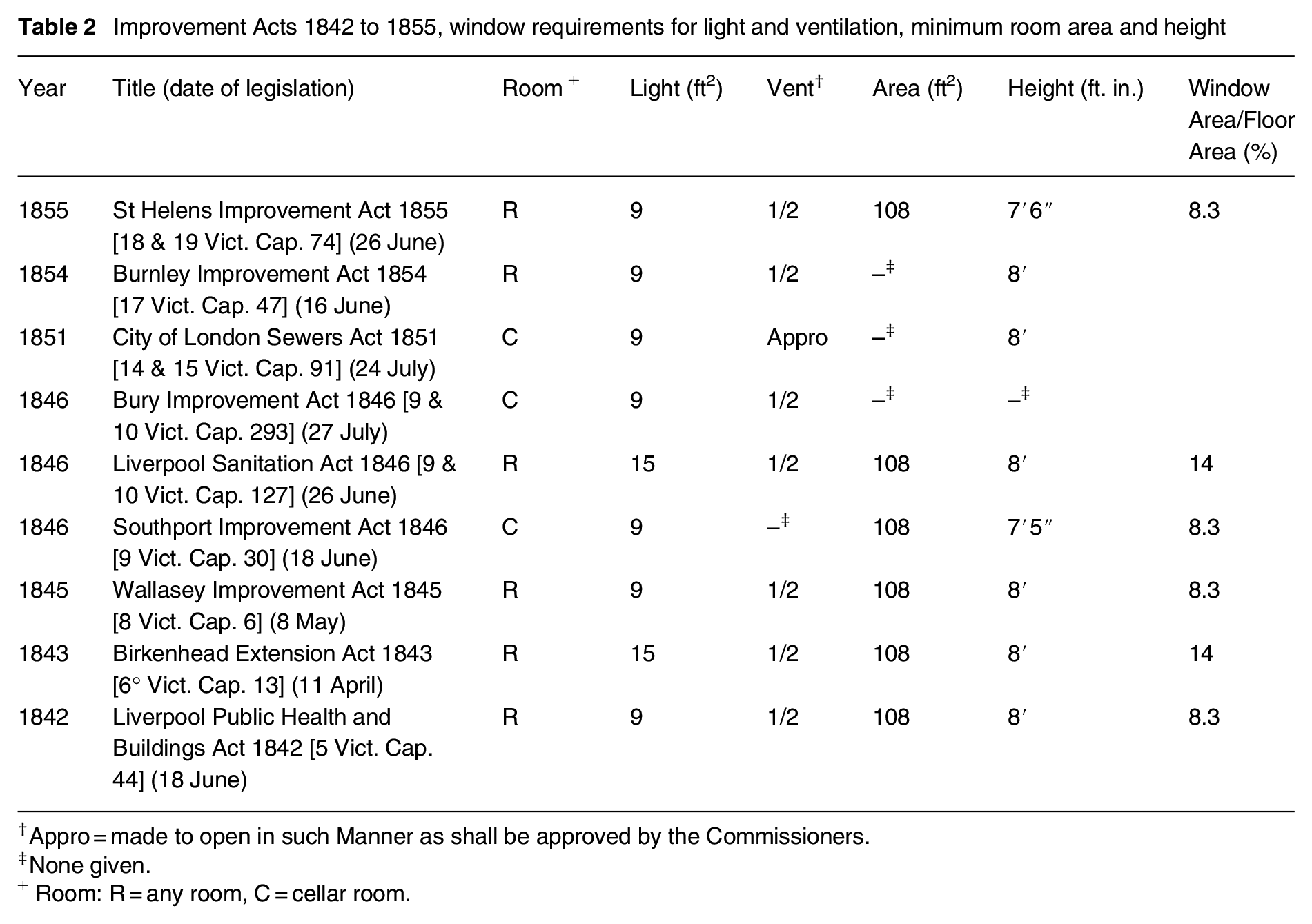
†Appro = made to open in such Manner as shall be approved by the Commissioners.
None given.
+Room: R = any room, C = cellar room.
Of the nine local acts, three deal with minimum requirements for cellar rooms (London, Bury and Southport), while the others cover all habitable rooms. All but two Acts required a minimum of 9 ft2 (0.8 m2) window, while Liverpool 1846 and Birkenhead required 15 ft2 (1.4 m2). Southport had no minimum requirement for the ventilation (opening) area. At the same time, London required the windows be ‘made to open in such Manner as shall be approved by the Commissioners’.
The same minimum room area (108 ft2, 10 m2) is required in all but three (Burnley, London and Bury). This permits the calculation of the best-case window-to-floor area ratio given in the rightmost column of Table 2 of 8.3% (9 ft2 window) or 14% (15 ft2 window), but again no simple formula is provided.
4.7 1841: Better Drainage and Improvement of Buildings in Large Towns and Cities Bill
This Bill, although not passed, introduced the idea of providing a room with a given window area related to the room’s floor area.
26
It required an opening window (sash or casement) and a minimum room floor area
61
:
Sect. 26. In every room containing one hundred and forty four square feet of flooring in any house built after the passing of this act in any such town or village there shall be
This window 4 ft 9 in high by 3 ft wide, has an area of 14.25 ft2 (1.5 m × 0.9 m = 1.4 m2). When used in the minimum area 144 ft2 (13.4 m2) room, this gives a window-to-floor-area ratio of 9.9% and 14% for the 108 ft2 (10 m2) room.
4.8 1791: Sir William Chambers
Chambers, an architect, was the primary author of the 1791 first edition of the encyclopaedic ‘A treatise on the decorative part of civil architecture’ (later editions were edited by Gwilt (see above)). Chambers noted the rules of Vitruvius and Palladio, also reporting the existence of a lighting rule based on the room area, height and depth of the room, which ‘neither determines the number of windows, the height of the room, nor the side on which the light is to be admitted’ but reports ‘I have seen a better rule, but cannot remember where’, finally offering
62
: In the course of my own practice I have generally
This rule of depth plus height divided by eight for a square room of 144 ft2 (13.4 m2) in area and 8 ft (2.4 m) in height would give a window width of 2 ft 6 in (0.8 m) compared to the 1841 Drainage Bill’s 3 ft (0.9 m).
4.9 1734: Robert Morris
The 18th-century English architect and writer Robert Morris developed rules ‘for proportioning of Light, according to the Magnitude of the Room’. Starting with multiplying the room length, breadth and height, he recommended that ‘the Square Root of that Sum will be the Area or superficial Content in Feet, &c. of Light required’. He provided an example for a room 20 ft long, 16 ft wide and 12 ft high, which is 3840 ft3 in volume (6.1 m × 4.9 m × 3.7 m = 109 m3), giving a result of 62. Assuming three windows, he concluded
63
: each Window will contain 20 Foot 8 Inches of superficial Light, and those will be found to be 3 Foot 2 Inches and one half broad, and 6 Foot 5 Inches high, which are Windows of two Diameters.
In this example – clearly not for a room in a worker’s house – the window-to-floor area ratio is 19.3%, but the proportion will change with room dimensions. Assuming a room of 108 ft2 area and 8 ft height gives 29.4 ft2 window area, or 27.2% of the floor area while increasing the room height to 10 ft gives 33 ft2 or 30.4%. Morris does not provide guidance to develop a simple ft2/ft2 or ft2/ft3 rule.
5. Pre-1696: Guidance of the ancients
Vitruvius, the Roman architect and engineer, provided rules and guidance, including dealing with the appropriate orientation (Book 1, Chap. 2, para 7), placement of windows (Book 5, Chap. 11, para 4) and the use of geometry to ensure good access to daylight (Book 6, Chap. 7, para 6 and 7). 64 Vitruvius provided no guidance regarding the window area in relation to the floor area.
Palladio, the 17th-century Italian renaissance architect influenced by Vitruvius, provided guidance to the window proportions in relationship to the room dimensions, but not the window-to-floor ratio (1st book, Chap. XXXV): 65
if the breadth be eighteen foot, the length should be thirty, and I divide the breadth into four parts and a half, one I give to the breadth of the void of the window, and two to the height, adding one sixth part of the breadth more; and according to the largeness of these I make those of the other rooms
No other rules have been found in other earlier codes or texts relating to window areas or placement. For example, Liber Albus the white book for the City of London, published in 1419, deals only with the ‘Obstruction of the View from windows’. 66 Rouse, 67 reviewing environmental management in medieval London, noted that in the ‘Assize of Buildings’ issues raised included ‘access to light, privacy violated, and people throwing waste out of apertures’. There was no consideration of window size.
6. Summary of findings
Table 3 summarises window requirements from 1734 to 2022 regarding natural light (total window area) and ventilation (openable window area). It can be seen the requirement is based on either a fixed (F) window area (e.g. 9 ft2), a volume (V) ratio (window area to room volume ft2/ft3) or an area (A) ratio (window area to floor area ft2/ft2).
Evolution of window requirements 1734–2022
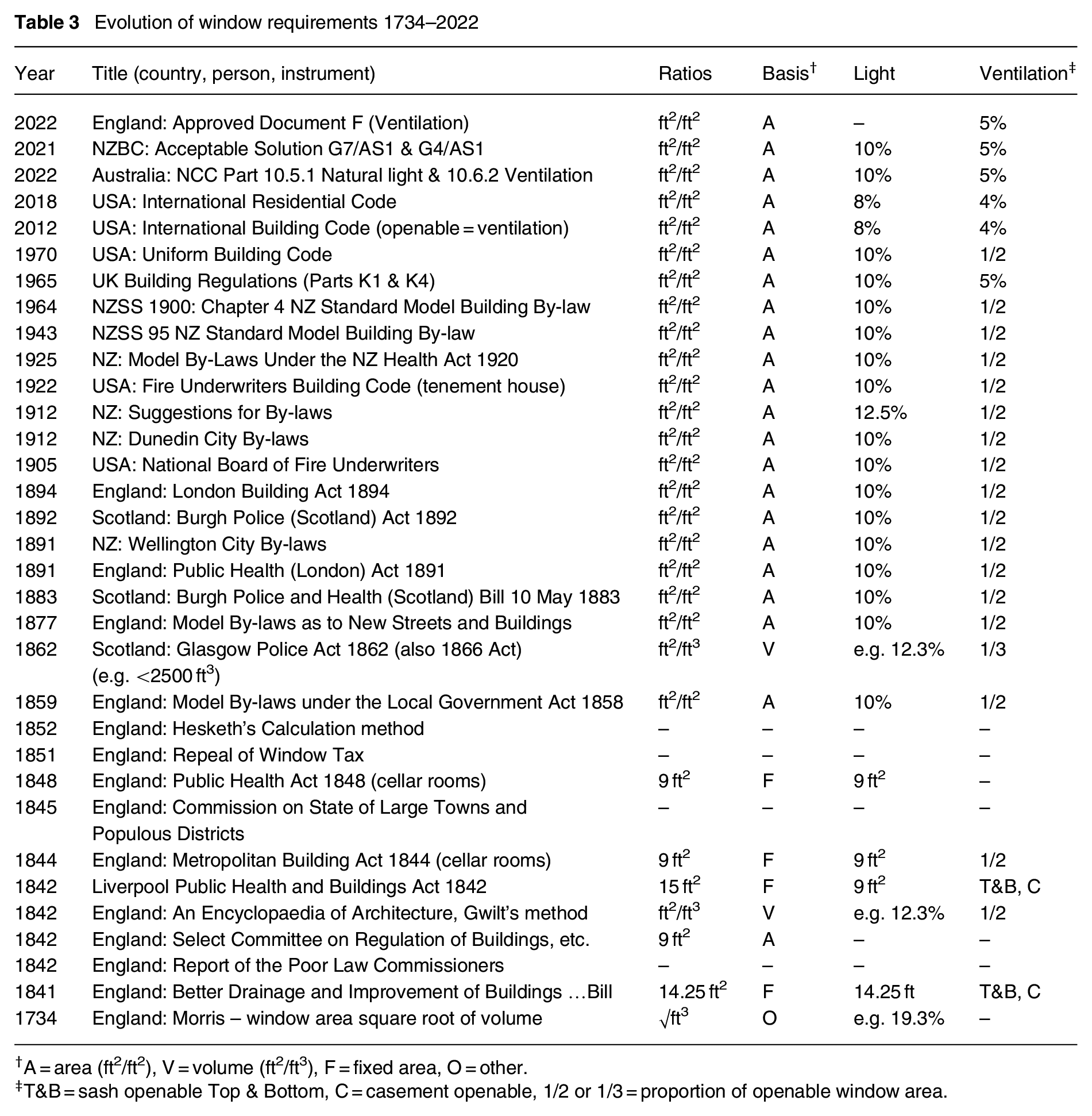
A = area (ft2/ft2), V = volume (ft2/ft3), F = fixed area, O = other.
T&B = sash openable Top & Bottom, C = casement openable, 1/2 or 1/3 = proportion of openable window area.
Table 3 shows that the first requirement for the window area to be one-tenth (10%) of the floor area and one-half of this (5%) to be openable was in the 1859 England: Model By-laws made under the Local Government Act 1858. As noted, the 1841 Better Drainage Bill fixed window area and minimum floor area gives a 1 ft2 window to 9.9 ft2 of floor area. This could be rounded to 10 ft2, but as the ratio varies with room size, it is unlikely to be the origin of the 10% requirement.
6.1 Formulae
Two earlier examples have been found which made use of a formula: Gwilt’s 1842 area-to-volume ratio (1 ft2/100 ft3); and Morris’ 1734 window area based on the square root of the room volume (√volume).
Converting Gwilt’s rule to Equation 1 to calculate the ratio of window to floor area gives:

Where A = floor area, V = room volume, H = height.
Thus, for measurement in feet, Gwilt’s rule will always give the wall height as a percentage of the floor area. A room of 10 ft (3 m) height will have 10% of its floor area in windows, regardless of the floor area, while a room of 12 ft (3.7 m) height would have 12%. This raises questions about the likely room heights which will be discussed later.
Converting Morris’s rule to Equation 2 gives the ratio of window to floor area RM gives:
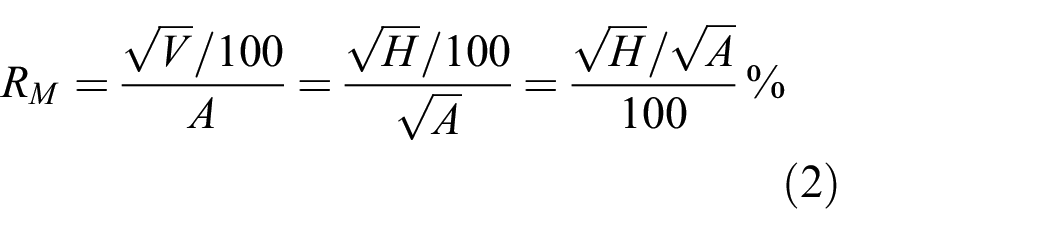
Where V = room volume, A = floor area, H = height.
Morris’s rule will always give the square root of the Height divided by the Floor Area as the percentage ratio. This will not convert to the simple rule required for the 1859 By-law as the ratio calculated varies depending on any (or all) of the room dimensions.
Only Gwilt’s calculation, also used in the 1862 Glasgow Police Act, can be resolved to the one-tenth method, as it depends on a single variable – the room height. But what were the room heights to be found in 1840s England?
6.2 Room heights
The issues around room heights are not simple. The trade-offs are clear: on one hand, lower ceiling heights allow more storeys, more rentable space and increased profits, while on the other hand, there is less volume per person and reduced ventilation. 16
The earliest room height limits appeared following the 1666 Great Fire of London, when the Rebuilding Act 1666 divided housing into four types based on location, with each allocated minimum habitable room heights – the more prestigious the dwelling, the higher the room heights. 68 For the first sort of ‘Houses fronting By Streets and Lanes’ excluding the cellar, the minimum height was set at 9 ft (2.7 m), for the second ‘Streets, Lanes of Note and River Thames’ for the first two storeys it was 10 ft (3 m) and 9 ft (2.7 m) for the third storey. For the third ‘High Streets and Lanes of Note’ it was 10 ft (3 m) for the first, 10.5 ft (3.2 m) for the second, 9 ft (2.7 m) for the third and 8.5 ft (2.6 m) for the fourth storey. Finally, the ‘Fourth and largest sort of Mansion houses for Citizens or other persons of extraordinary quality’, had no minimum height(s), but the house could be no more than four storeys. 68 No reasons have been found for these room heights, although they are probably related to issues of ventilation and health. Room heights were not included in the following 1774 Building Act. 26
It was not until the 1840s that the issue of minimum room heights again entered building legislation. The 1844 Metropolitan Building Act set a minimum room height of 7 ft (2.1 m), while in the attic at the centre, the 7 ft (2.1 m) minimum was required but with a minimum side wall height of 3 ft 6 in (1.1 m). 52 The Metropolitan Building Act 1855 continued the 7 ft (2.1 m) minimum, but in the attic 7 ft (2.1 m) was only required over half of the area. 69 The London Building Act 1894 had 8 ft 6 in (2.6 m) minimum and in the attic 8 ft (2.4 m) over at least half the area. 70 The paradox of a habitable room in the main body of a building having a minimum height, with that minimum reduced when under a sloping roof, was noted in the discussion of the time. 26
No estimate of room heights for the different house designs used in the 19th century has been found, although it is unlikely that all houses would have achieved just the legislated minimum. Chapman’s 1994 analysis for a national house energy model, although based on a small sample of houses, provides a single value of 8 ft 6 in (2.6 m) for pre-1900 buildings, as shown in Table 4. 71
Assumed storey heights for dwellings of different ages
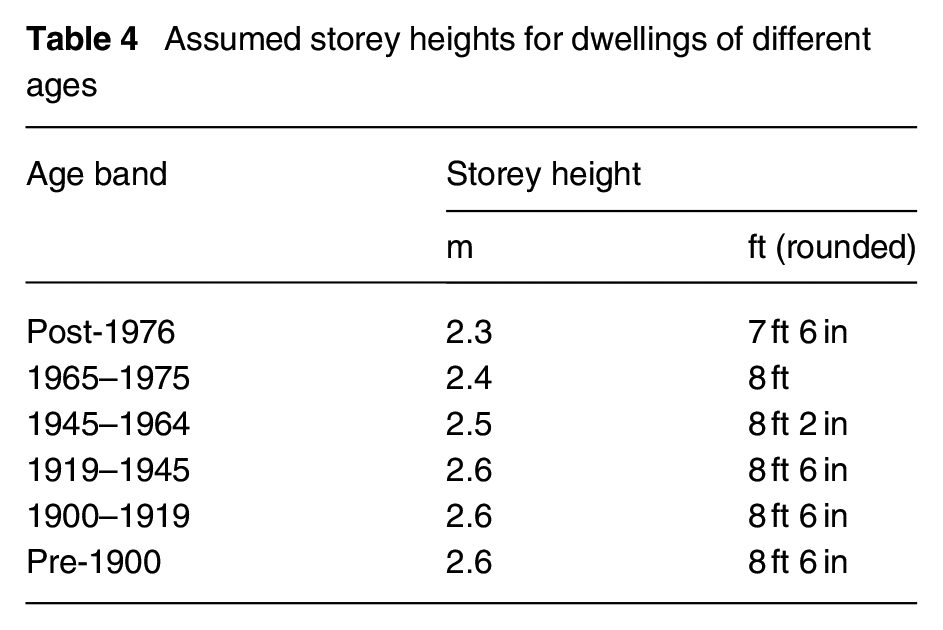
Gwilt possibly based his formula on higher social status housing that would have been expected to have a 10 ft (3 m) ceiling height or more.
7. Discussion
The functional objectives of a window relate primarily to the human need for three requirements: light, air and views.
72
Once these functional requirements started to be ignored by the developers of low-cost housing, even in the laissez-faire market of Victorian Britain, the need was recognised for appropriate rules. Although these started as a requirement for a minimum window area, it was not until the Liverpool Public Health and Buildings Act 1842 it was included in legislation and not until 1859 that this was included in a by-law.
This paper has traced the evolution of the requirement for daylight provision in housing, focusing on the development of the requirement for windows to be one-tenth (10%) of floor area, of which one-half (5%) is openable. It has shown a direct line between this requirement of the 21st century and its antecedents in the 20th and 19th centuries, and thence to the first model by-laws of 1859.
Examples from earlier in the 19th century show the development of rules for window areas. The earliest rule found is from 1734, and although architects before this provided rules for the proportions of windows, they did not provide guidance on either the window area or dimensions.
The examples discussed in this paper cannot be claimed to be a complete review of all window size guidance since ancient times. They do cover a wide range of published sources – whether direct (e.g. books or learned papers) or reports (e.g. trade journals). For example, in the 19th century, The Builder trade magazine had extensive coverage of building control issues, but even this publication provided only limited discussion of window area requirements.
No listing relating to the development of the 1859 model by-laws has been found in UK official archives. TNA contains material relating to the internal workings of the Local Government Board (then part of the Home Office), with many letters related to the Board’s approval of local by-laws. The TNA catalogue descriptions do not suggest anything else is held of relevance.
At the research level, George Henry Blagrove’s 1891 RIBA Silver Medal Essay 73 ‘The treatment and disposition of windows in civil and domestic buildings in the United Kingdom’, while comprehensive and written closer to 1859 than this paper, provides fewer examples than those given here on the development of window-to-wall ratio guidance.
8. Conclusion
It has been shown that although the text is modified, the 1891 Wellington, New Zealand, window area requirements closely match the 1859 English model byelaws, reflecting global transportation not only of goods but also building codes.
It is suggested that while many activities during the 1850s promoted greater availability of daylight and ventilation in housing, they followed the repeal of the despised Window Tax. It is hypothesised that until this tax on windows had been removed, the imposition of a requirement to have windows in poor households could not be considered. At some time, between the repeal of the Window Tax in 1851 and the issuing of the Model Bye-laws in 1859, the simple 10% window area with half (5%) opening rule was ‘invented’.
Based on accessible newspapers, journals and a wide range of other publications, no explicit origin for this window-to-floor area ratio requirement has been identified.
It could be hypothesised that Gwilt’s volume rule (1 ft2 window per 100 ft3 of room volume) formed the basis for the 10%/5% rules – all that would have been required was the assumption of a room height of 10 ft. Although this height differed from the minimum heights set by legislation (e.g. 9 ft), it is not uncommon for building controls to base analysis on a convenient rather than a minimum value. For example, NZBC Clause H1 Energy Efficiency uses an indoor temperature of 20°C when comparing the thermal performance of housing to demonstrate compliance, 74 when research has shown a more realistic indoor temperature would be 18°C. 75
Another possible hypothesis is that this rule was based on empirical evidence, possibly through measurement-based analysis of a number of acceptable buildings. Again, no evidence has been found that this approach was, or was not, used.
It is interesting to note that while Gwilt and others, including Morris and Hesketh, linked window area to room volume, the inclusion of the lighting rule in the 1859 model by-laws was based on room floor area. The reasons for this practical and philosophical shift have not been identified. Ventilation, even in the 21st century, has remained with room volume (e.g. air changes per hour or litres per second).
The fact that the 5% opening window is exactly half of the 10% window area is also an interesting requirement. A double-hung sash window can have one pane, or one half of the window area, fully opened to meet this requirement. This requirement has remained largely in place, as shown in Table 3, even though window styles have changed from sash to side-opening casement. Table 1, extracted from the England 2022 Approved Document F, shows the requirement has been refined rather than merely retained.
Building controls may be regarded by those who put them in place as a minimum requirement, but they are often viewed by those who use them as a maximum goal. Without a measurable requirement (e.g. half openable), implementation can conveniently be based merely on the presence rather than the intended result, for example, a tiny window rather than one which might provide an acceptable level of daylighting and/or ventilation.
Even with the modern ‘performance-based code’ used in England, Australia and New Zealand, no supporting research or measurements have been found to underpin this historical requirement. This raises a potentially more interesting question – if there is no research to justify a 10% window area rule, is it a suitable requirement?
The clear link from New Zealand’s 1964 requirements to the British 1859 model byelaws was not expected. However, even so the evolution of the requirements to include more tightly defined terms would not appear to be supported by the original Victorian era requirements or by 21st century research.
Future researchers may yet discover the reasoning behind the 10%/5% requirement lurking in the files of the Local Government Board, the minutes of local government or Standards Committees or even in the views of commentators in contemporary newspapers, magazines or other publications.
However, the evidence identified thus far suggests that the evolution of building control guidance on light and ventilation requirements is yet another example of the lack of empirical research evidence to support modern building controls. Similar findings have been made for code requirements for sub-floor ventilation 76 and habitable room heights. 16 It is to be hoped that those responsible for building codes will fund research to remedy this deficit.
However the question must be asked: is a simple rule that appears to produce acceptable results better than no rule at all?
Footnotes
Acknowledgements
The author would like to acknowledge the assistance of: Nina Baker (UK), Andre Brown (NZ), James Curran (UK), Michael Donn (NZ), Michael Dudding (NZ), Dean Hawkes (UK), Hentie Louw (UK), John Mardaljevic (UK), Philip Steadman (UK), Barbara Rouse (NZ) and Michael Tutton (UK).
Declaration of conflicting interests
The author declared no potential conflicts of interest with respect to the research, authorship, and/or publication of this article.
Funding
The author received no financial support for the research, authorship, and/or publication of this article.
