



Abstract
The widespread use of electric lighting has revolutionised society but brought unintended consequences, notably light pollution, impacting ecosystems and human circadian rhythms. Concerns about anthropogenic light at night (ALAN) have prompted innovative solutions, such as spectral tuning of light sources. In Europe, a recent focus involves the enforcement of red light in outdoor settings to minimise ALAN’s impact, particularly on bats. This mini review synthesises literature to provide an overview of the advantages and disadvantages of the use of red light outdoors. There is a need for further examination of the potential ecological consequences of red light, considering challenges in lighting design functionality and broader impacts on diverse species.
1. Introduction
Electric lighting has transformed our society but has also unintended consequences, such as light pollution, impacting ecosystems and human circadian rhythms. 1 Growing concerns about the effect of anthropogenic light at night on human health, 2 ecosystems and biodiversity 3 have led to innovative solutions, such as spectral tuning of light sources. 4 One recent approach gaining attention in Europe involves the use of red light in outdoor installations in protected areas or near sensitive species (Figure 1), aiming to minimise the impact of electric lighting on the nocturnal environment, with a specific focus on mitigating the effects on bats.5,6 Red light is hypothesised to induce less sky glow and glare along with a reduced impact on insects and bats in comparison to white light, making it a potentially effective approach for mitigating light pollution. However, its benefits and potential ecological advantages need further examination in the context of challenges arising from lighting design functionality and broader ecological impacts on other species. For this mini-review, we employed a qualitative approach, synthesising pertinent literature to provide a concise overview and analysis of key findings in the lighting field relevant to professionals and raise a question: Is it possible to balance the design functionality and ecological impacts of red light?
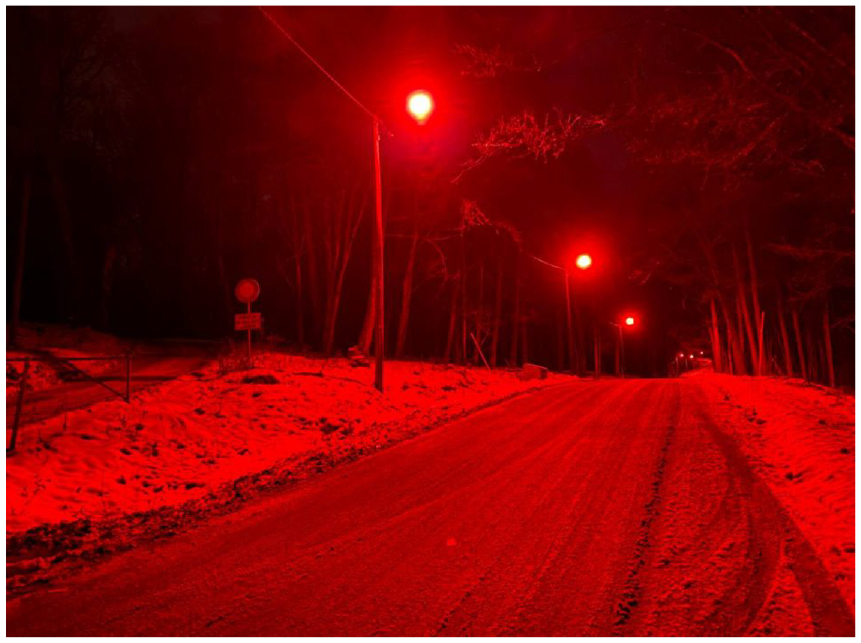
Red light has been promoted as a measure to mitigate light pollution. The exemplary photo was taken in Rya Åsar, Borås, Sweden
2. Benefits of red light
Light at longer wavelengths, that is perceived as red by most humans, scatters less in the atmosphere compared to light of other wavelengths, potentially reducing skyglow. Here, we use ‘red light’ as a simplified nomenclature keeping in mind that spectral red light is defined approximately between 625 nm and 780 nm, but infrared up to 1100 nm can be detected by humans. 7 Red light minimally suppresses melatonin, often referred to as a sleep-regulating hormone, resulting in less disruptive effects in wildlife and human circadian rhythms.8,9 Melanopsin photopigments expressed in intrinsically photosensitive retinal ganglion cells play a pivotal role in detecting light and transmitting signals to regulate melatonin suppression, thereby influencing the circadian rhythm and various non-visual responses to light. Although melanopsin photopigments are known to be most sensitive to light at around 479 nm, 10 studies indicate that daytime and nighttime red light exposure can increase objective and subjective measures of short-term alertness for humans,11,12 underlining the complex relationship between visual and non-image forming mechanisms. Red light also preserves human night vision, potentially reducing glare and preserving visual capabilities in low-light conditions. 13 Prey species, such as nocturnal moths, are not spectrally sensitive to longer wavelengths 14 ; therefore, red light is less attractive for predators’ (e.g. bats). Hence, it is considered an effective approach to preserve human dark adaptation while minimising potential disruptions to protected species.
3. Ecological perspective
The use of red light to protect wildlife has been motivated by the need to address the strict European legislation on bats (Habitats Directive 92/43/EEC). 15 Recent guidance (GN08/23) by the Bat Conservation Trust and the Institution of Lighting Professionals 16 suggests using red light to reduce adverse impacts on some bat species, but its effects vary. While some bats respond to red light similarly to darkness, others exhibit diverse behaviours. Some bat species, such as Pipistrellus pygmaeus and Pipistrellus nathusii, exhibit increased activity under red light during migration, indicating a positive phototactic response. Conversely, light-averse bat species, such as Rhinolophus hipposideros and species of the Myotis and Plecotus genera, may display avoidance behaviour when exposed to red light. In a controlled experiment, bat activity was reduced under all light colours, with red having the least impact. 17 The large variability in the response of bats to red light demonstrates an uncertainty and indicates that these responses may be species-specific and shaped by ecological characteristics and environmental contexts. Using specialised spectra, such as red lighting, can create unintentional ecological traps for species that are unable to detect it, potentially increasing their vulnerability to predation. 3 This, in turn, could lead to higher mortality rates among the very species that red lighting was intended to safeguard.
Furthermore, the effect of red light on species beyond bats are often overlooked. Even though animals, such as arachnids, insects, amphibians, reptiles, birds and mammals, do not have their peak spectral sensitivity in the long wavelength range, they can still detect red light. 14 For example, red light can disrupt the magnetic orientation of migratory birds, leading to disorientation and behaviours such as circling around the light source, which may increase the risk of collisions. 18 Additionally, migrating passerines exhibit reduced attraction to continuously emitted red light compared to other colours of light, with blinking light being even less attractive. 19 Red light may also alter the daily rhythm of certain bird species. Results from a controlled experiment indicate that both red and white light advances the onset of Blue Tits activity to a greater extent than green light, suggesting similar effects of red and white light. 20
4. Lighting design functionality
Despite its potential benefits, the use of red light offers limited design functionality for humans. Narrowband red light provides poor colour rendering, which can hinder accurate object identification including faces, potentially affecting perception of safety and security, compromising visual acuity, clarity and colour discrimination by reducing the local contrast in the visual environment.21,22 Under extremely chromatic light sources, chromatic adaptation breaks down, preventing occupants from completely adapting to lighting conditions, which is an important feature of human colour vision.23,24 Red light has been shown to reduce subjective evaluations of spaces, such as visual comfort and spaciousness. 25
In addition to its poor colour quality, red light has an innately low luminous efficacy of radiation due to its mismatch with the photopic and scotopic spectral sensitivity functions, thus resulting in an increase in required input power for the same light output. Although the radiant efficiency of red LEDs is not lower than green or amber LEDs, it is currently lagging behind blue LED’s power conversion rates. 26 For example, a commercially available streetlight designed for light pollution mitigation (emitting red light) provides 50% less luminous flux compared to white light that consumes similar power. 27
5. Conclusions
Advocating red light as an outdoor lighting solution to mitigate the adverse effects of light pollution on humans and ecosystems is well-intentioned. However, it is imperative to adopt a cautious approach to avert potential compromises in safety and visual performance in outdoor space as well as consider holistic ecological perspectives. Red light can be detected by a broad range of species and can have unforeseen consequences. The effectiveness of red light in mitigating ecological impacts remains uncertain, warranting caution against its use as a universal solution for mitigating impacts on insects and bats. It is also possible that very little or no light is more beneficial than red light in outdoors to mitigate light pollution. Hence, the question firmly remains. Is it possible to balance design functionality and ecological impacts of red light? Further research and meticulous monitoring are urgently needed before the widespread adoption of red lighting in outdoors.
Footnotes
Declaration of conflicting interests
The authors declared no potential conflicts of interest with respect to the research, authorship, and/or publication of this article.
Funding
The authors received no financial support for the research, authorship, and/or publication of this article.
