



Abstract
Cultural factors in Libya (and other Muslim countries) require female privacy to be maintained. Outside the home, females must wear clothing that reveals only the face and hands. When inside the home and located near windows, a similar degree of clothing cover or window treatment is required. This reduces exposure to natural daylight, with resultant reduction in health benefits of daylight. We are therefore investigating the degree to which window treatments offer sufficient privacy to permit relaxed clothing in the home. Two window treatments were tested: horizontal blinds and frosted glass, varying the free area and degree of frosting, respectively. The degree of privacy offered was operationalised by identification of the clothing level worn by a target behind the window treatment, the aim being to reduce identification to a chance level. For 0.3 s observations, only the extreme level of each treatment (horizontal blinds set to 3% free area and distortion level 20 for the frosted glass) led to chance levels of clothing identification, for both actors. For 3.0 s observations, there were significant differences in clothing identification, suggesting insufficient privacy.
1. Introduction
Cultural factors in countries such as Libya, which follow Muslim guidelines, require female privacy to be maintained. Outside of the home, females must wear clothing that reveals only their face and hands. A similar degree of visual privacy is required when inside the home but potentially visible to people outside of the family, such as when located near windows: in this case, either a similar degree of clothing cover or window treatment is required. Window treatments such as blinds, screens or obscured glass restrict views into the home from outside and can give Muslim women some flexibility regarding the modesty level of their clothing.
One problem with clothing cover or window treatment is that it reduces exposure of the skin to natural daylight, which means a reduced ability to gain the health benefits of daylight. One health benefit is vitamin D, which is manufactured with exposure to the UVB component of daylight. It is widely stated that glazing blocks UVB.1,2 A recent study by Serrano and Moreno 3 suggests, however, that this is not a sufficiently precise position: a person with pale white skin (type I on the Fitzpatrick scale 4 ) located behind smoked glass received sufficient UVB for vitamin D3 after 30 minutes of exposure, rising to 50 minutes for light brown skin (Fitzpatrick type III). These measurements were for 25% skin exposure: a longer period of exposure is necessary if a lower percentage of skin is exposed. Vitamin D deficiency is rising dramatically in Arabic countries such as the Middle East and Saudi Arabia. 5 Alagöl et al. 6 found that women wearing clothing covering the whole body, the hands and face, or near-total (covering the whole body except the hands and face) had vitamin D levels that were significantly lower than women wearing clothes giving a greater degree of skin exposure.
Visual privacy is defined as the capability to carry out daily activities inside one’s own home without being observed by strangers.7,8 One means of maintaining privacy is by the choice of clothing. Figure 1 shows a scale developed by the current authors to investigate expectations of clothing privacy in different contexts, extending the scales used in previous work.9,10 Each step of the scale represents a gradual change in skin exposure and/or the tightness of clothing to create a step change in privacy. These steps are described in Appendix A.
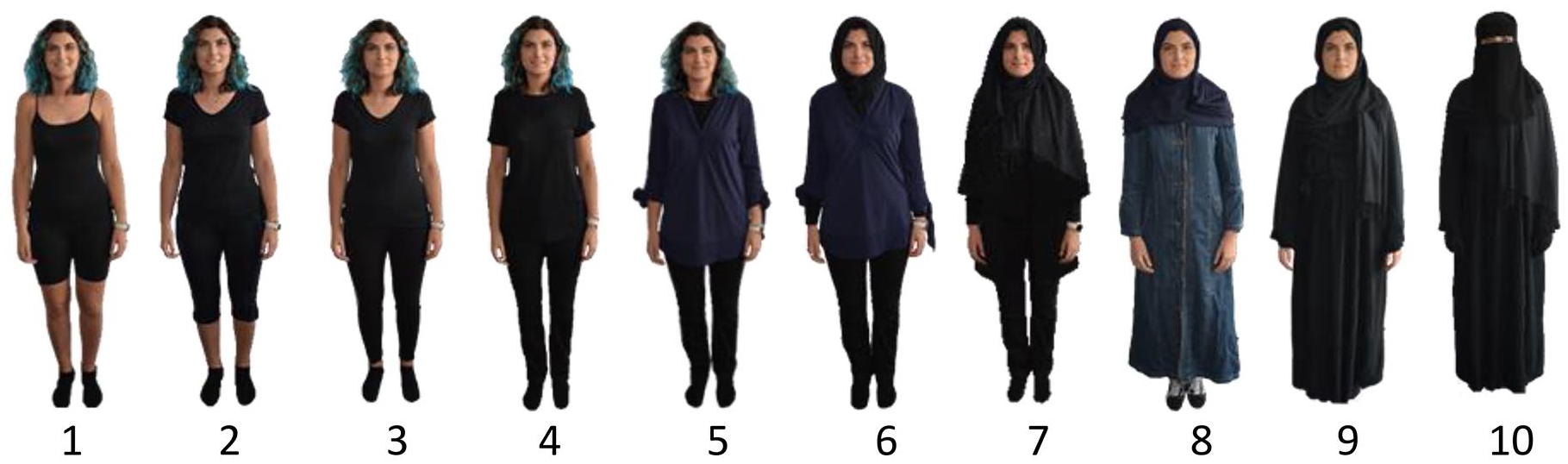
Scale developed to investigate the impact of clothing level on perceived privacy
In a pilot study using the new clothing scale, responses were gained from 90 females drawn equally from three home locations (Libya, Saudi Arabia and Europe) chosen to test expectations of privacy. For Libyan women, while clothing level 6 (a head scarf, arms and legs fully covered by a jacket and trousers) was the median expectation when inside the home but potentially visible to a stranger, this could be relaxed to level 2 (tighter-fitting clothing, greater degree of skin exposure) if visible only to members of the family. For women from Saudi Arabia, a nation with stricter controls on female modesty, the clothing level when visible to a stranger increased to 7. For European women, the median responses were clothing level 2 when visible to strangers and clothing level 1 for visibility only to the family. Along with other studies11,12 this demonstrates the need, or expectation, in some countries for preserving female modesty through the use of clothing which impedes the ability of others to see body feature details (hair, skin and body shape).
Instead of clothing choice, another approach to maintaining privacy in the home is by using window treatments. We use the term ‘treatments’ to included window surface films and mechanical devices that might be primarily used for shading. Here the compromise is to offer sufficient privacy but with minimal restrictions on the benefits of windows such as daylight and ventilation. The mashrabiyya, a perforated wooden screen traditionally used in Middle Eastern nations, and wooden shutters have been examined in some studies of daylighting, ventilation and privacy13–15 but traditional mashrabiyya are no longer a common choice. This paper reports an experiment conducted to investigate instead the privacy offered by two types of window treatments – horizontal blinds and frosted glass. Frosted glass is already a popular glazing choice for bathroom windows in the Middle East (and elsewhere) but horizontal blinds are less common.
The experimental design followed a similar approach to Hariyadi and Fukuda16,17 who investigated how variations in the design of sudare screens (a traditional Japanese screen of horizontal bamboo slats) affected the ability to recognise a person located behind the screen. This procedure was adapted for the current work to investigate the ability to correctly identify the clothing worn by actors with variations in slat angle of the blinds (operationalised here as the percentage of free area) and the degree of distortion offered by frosted glass. The experiment was conducted to find the conditions required for visual privacy, such that these can inform subsequent simulations of daylight (and ventilation), and hence to compare daylight exposure with different combinations of clothing and window treatment.
2. Method
Privacy was investigated using digital images projected onto a screen, to enable rapid and repeatable transition between levels of the independent variables and to enable control over other factors. Previous work 17 suggests this gives similar results to experiments using real windows and window treatments. The images comprised two actors with varying degrees of clothing (Figure 1 shows one of these actors). The images were layered behind simulated window treatments, with these set to different levels of privacy control, to examine the effect of changes in window treatment on the ability to discriminate the target person’s clothing. The experiments were conducted in a laboratory in which the interior lighting was switched on to simulate observations during daytime.
The actors were two females, one having a white skin tone (approximately type II of the Fitzpatrick scale) and the other having a dark brown to black skin tone (type VI). The same dark clothing was worn by both actors to explore the influence on identification of the contrast between their skin tone and the clothing. Each actor was photographed with each of seven levels of clothing (levels 1–7 in Figure 1). The photographs were taken against a uniform background so that this could be removed and the actor embedded into a typical interior background as shown in Figure 2.
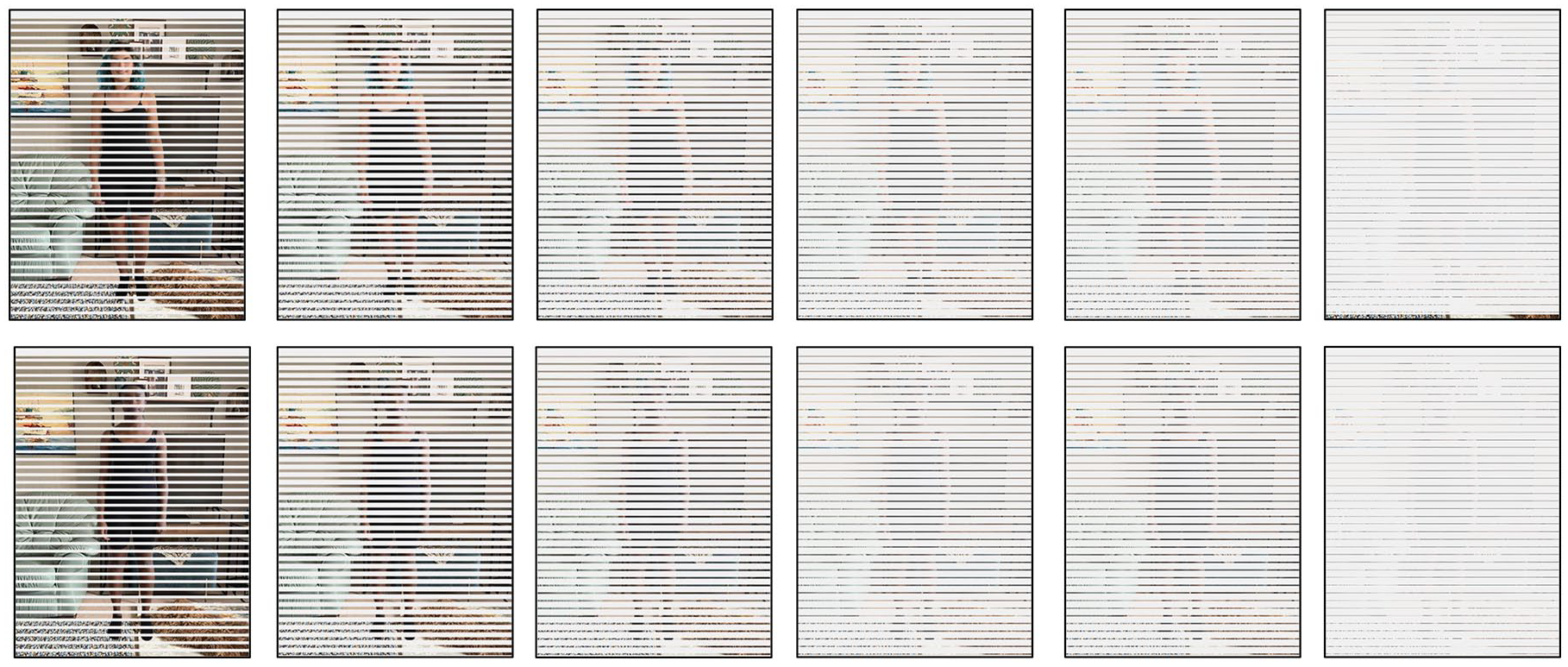
Examples test images for investigating visual privacy offered by horizontal blinds. The two rows show the two actors, and in each case, they are wearing clothing level 1. The six columns show different levels of free area, ranging from 3% to 60% with intervals of 0.25 log units. In these images the actors are placed at the middle horizontal position (X = 0). The vertical position of the blinds are set to eyes visible (top row) and eyes hidden (bottom row)
There were six levels of horizontal blind opening, as characterised by the percentage of free area (i.e. percentage of window area not obstructed by blinds in the plane of sight) ranging from 3% to 60% with intervals of 0.25 log units. This range was chosen, following pilot studies, with the expectation of extending responses from chance level to 100% correct identification of clothing level.
The geometric characteristics of blinds include the angle of tilt, their depth and spacing. The blinds represented in this work were of depth 50 mm, at spacings of 50 mm, the depth and spacing being that of blinds in the authors’ office, which are not atypical. The slats were assumed to be of negligible thickness and opaque following research of Chantrasrisalai and Fisher. 18 A perpendicular direction of view was assumed. We characterised the unobscured portion of the window by the percentage of free area because the findings can be translated to blinds of other characteristics and other directions of view. The percentage free areas used were 3%, 6%, 11%, 19%, 34% and 60% which represents blind angles of 75.9°, 70.1°, 62.9°, 54.1°, 41.3° and 23.6°, respectively. The slats were light grey rectangles drawn in Photoshop (95% lightness, R = 240, G = 240 and B = 240) to provide a layer which could be chosen at random and placed over the actor and background image.
Sequential images of the same actor against the same background might lead to unintended cues about the clothing level. Variations in vertical and horizontal positioning were therefore employed (Figure 3). The width of the background image was 663 px. The actors were placed in one of three horizontal positions either in the middle of the background image (X = 0), or offset to the left (X = −200 px) or to the right (X = 200 px). The horizontal blinds were placed in one of two vertical positions so that the opaque slats did not always obstruct the same features of the actor in successive images. The two positions (0 px and −11 px) represent a 25 mm vertical difference in the positions of the blind on the projected image, sufficient to either hide or reveal the actor’s eyes. In trials, each test participant responded to 42 photographs for each actor, comprising the six levels of free area and the seven clothing levels. For each combination of actor, clothing level and free area, the variations in vertical and horizontal position meant there were six image versions, with one version chosen at random for a specific trial.
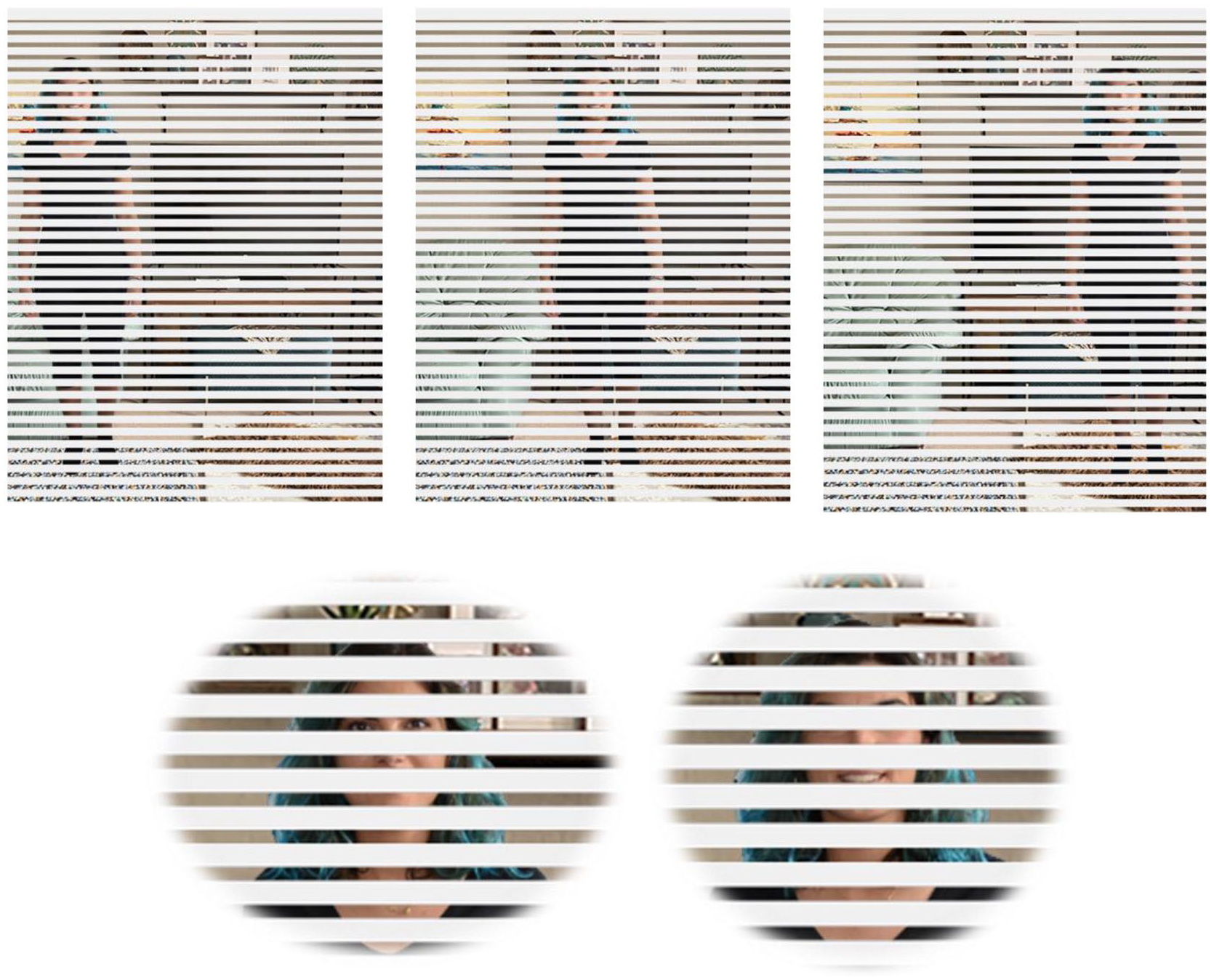
Illustration of variations in position for the horizontal blinds experiment. The top row shows the three variations in horizontal location of the actor. The bottom row shows enlarged details of the face to show changes in vertical position of the blind. In these images the blind is set to a free area of 34%, the actor has skin type is II and is wearing clothing level 2
The frosting effect in frosted glass is caused by exposing the flat glass to chemical and thermal treatments, causing surface roughness, which diffuses transmitted light.19,20 In this experiment, the degree of frosting was simulated using the distortion function in Microsoft Photoshop. Five distortion levels were used, ranging from 4 to 20 in steps of four distortion units. As with the degree of blind opening, the levels of distortion for the frosted glass were selected with the prediction that this range would yield correct responses ranging from chance level to near 100%.
The target images again used the two actors with each of the seven levels of clothing, embedded into the same domestic interior scene, and to these were applied the five levels of distortion. The actors again appeared at one of three horizontal locations. Figure 4 shows an example of images used for the frosted glass experiment.
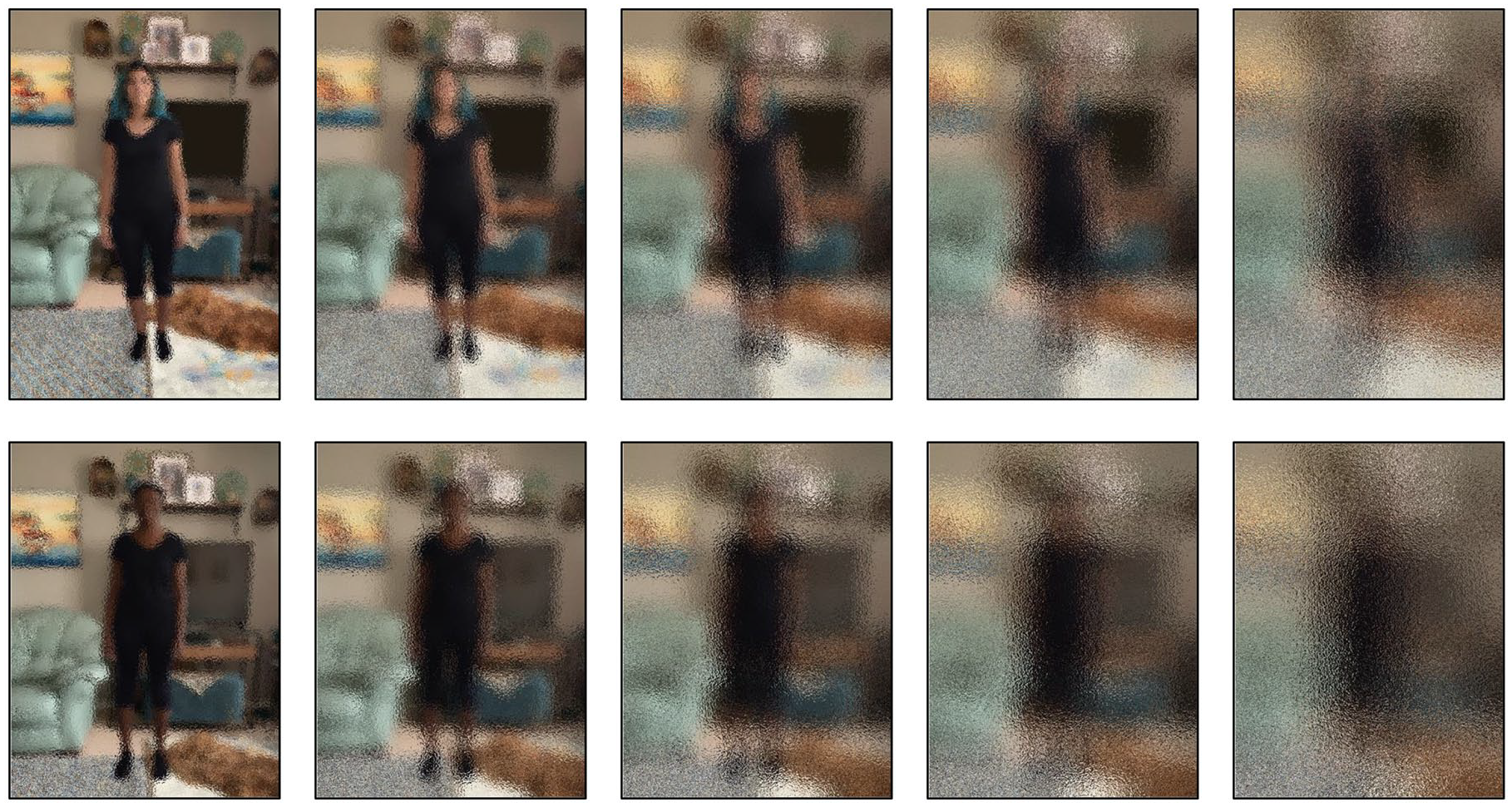
Examples of test images for investigating visual privacy offered by frosted glass. The two rows show the two actors, and in each case, they are wearing clothing level 1. The five columns show different levels of distortion level, ranging from 4 to 20 in steps of four distortion units. In all images, the actor is placed in the middle of the three horizontal locations
Evaluations were given using a category rating procedure with the images (84 for the horizontal blinds, 70 for the frosted glass) observed separately for a limited duration. Two observation durations were used, 0.3 s and 3.0 s, to explore the degree to which this mattered. The shorter duration represented a typical gaze fixation, 21 or a brief glance, and the longer duration represented a more purposeful stare. After each presentation, test participants were required to identify the level of clothing worn by the actor using the clothing scale (Figure 1, clothing levels 1 to 7).
The horizontal blinds and frosted glass experiments were run separately with independent samples. A total of 40 test participants were recruited for the horizontal blinds experiment (25 female, 15 male, approximate mean age 31 years) and 30 for the frosted glass experiment (16 female, 14 male, approximate mean age 36 years). Corrected-to-normal visual acuity was confirmed at the start of trials using a Landolt ring acuity test. Ethical approval for this experiment was received from the University of Sheffield Ethics Committee.
3. Results
Results for tests with the horizontal blinds are shown in Figure 5. Each graph shows the results for the four combinations of actor and observation duration. The data were not suggested to be drawn from a normally distributed population (and similarly for the frosted glass data) as assessed using measures of dispersion, graphical plots and the Shapiro–Wilks and Kolmogorov–Smirnov tests. Each graph in Figure 5 represents a different degree of blind opening and shows the median response of test participants plotted against the actual clothing level. If the clothing levels stated by test participants were correct, this would appear as a line of slope 1.0 in these graphs, as indicated by the dot-dash line in each graph.
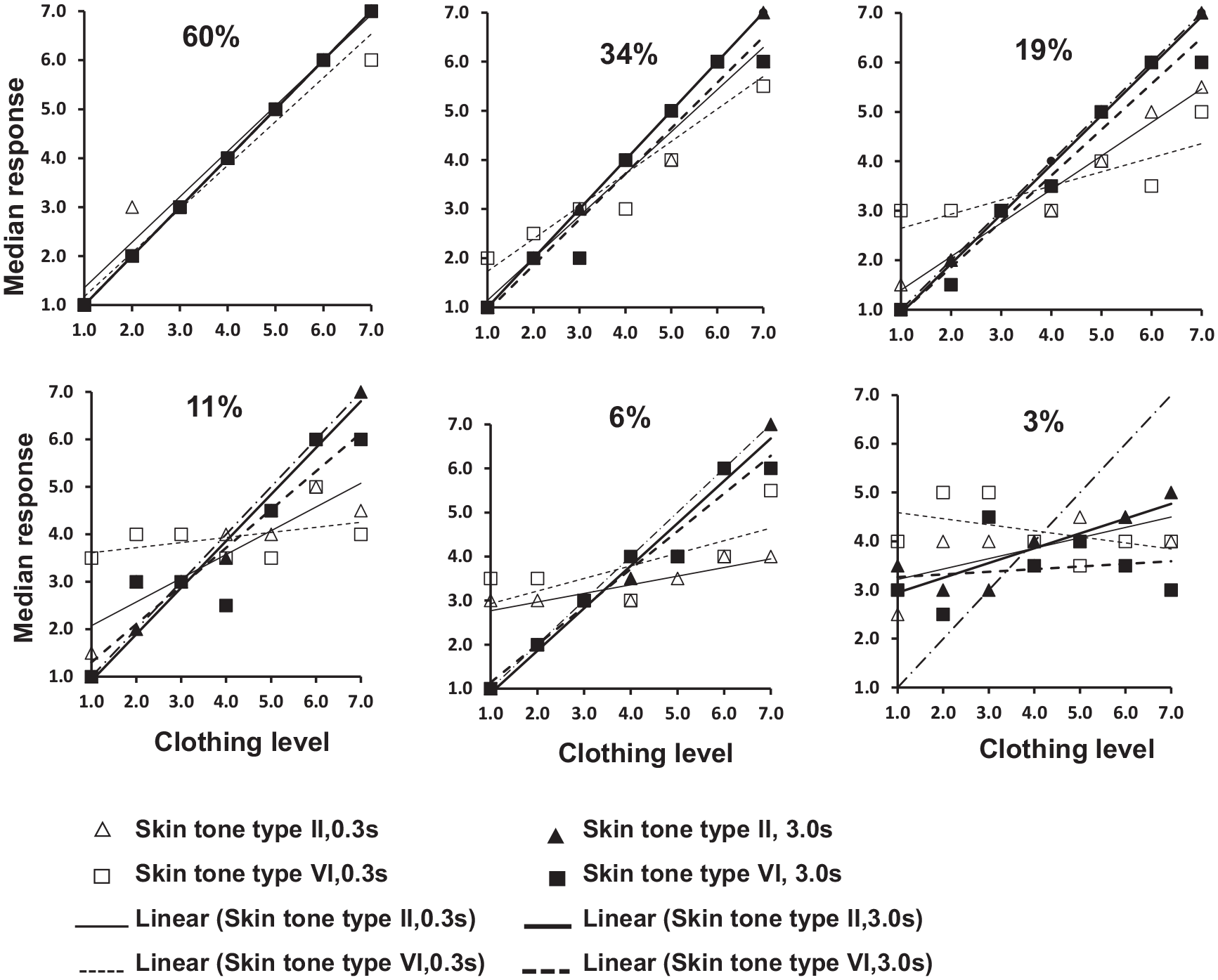
Median clothing level response plotted against actual clothing level for the six levels of open area (% shown in each graph). These results are for the two actors: a white skin tone (type II) and a dark brown to dark skin tone (type VI) and the 0.3 s or 3.0 s, observation durations. The dot-dash line indicates the response for correct identification of clothing level
For each level of blind opening (% free area) and for each combination of actor and observation duration, the Friedman test was used to compare responses to each clothing level. The desired level of privacy, chance level of clothing level identification, would mean each of the seven clothing levels received the same average clothing level reported by participants, as indicated by the Friedman test failing to reveal a significant difference. The results (Table 1) show that statistically significant results (p < 0.001) were obtained for free areas of 6% and greater, for both observation durations and for both actors. Only when free area was reduced to 3% were the differences not suggested to approach significance, although the difference remained highly significant for the actor of skin type II with the longer duration.
Significance of differences between reported clothing levels as tested using the Friedman test for different percentages of free area of horizontal blinds, for the two actors and the two observation durations
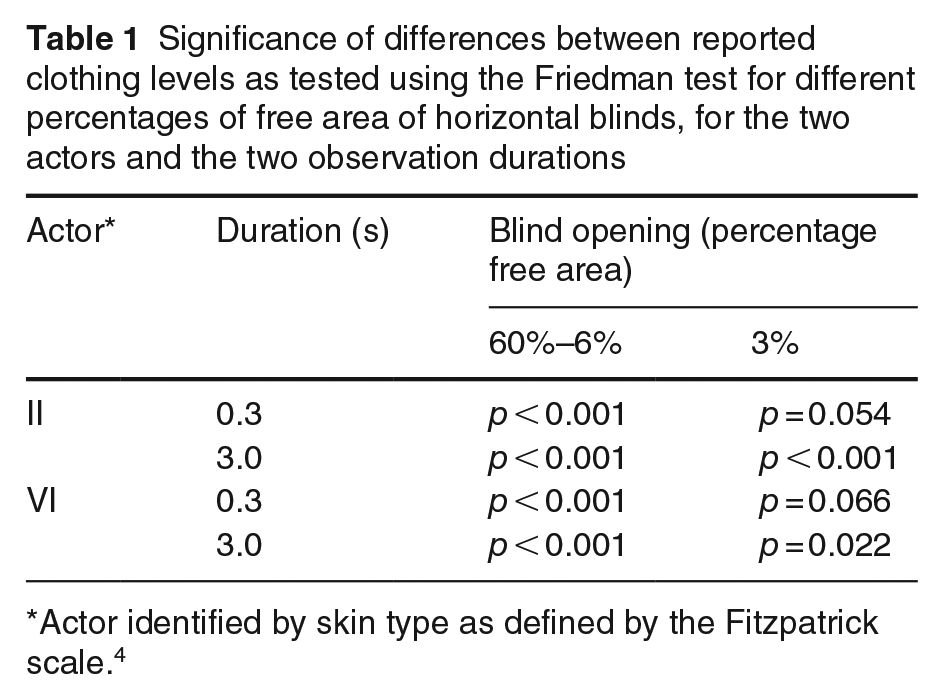
Actor identified by skin type as defined by the Fitzpatrick scale. 4
A chance level of clothing identification would result in a regression line of slope zero (a horizontal line) in the graphs included in Figure 5. To verify conclusions drawn using the Friedman test, t-test for the slope coefficient based on the line of best fit using simple linear regression was used to determine whether the slopes departed from zero (Table 2). For free areas of 6% or more, the slopes departed significantly from horizontal (p < 0.001) in all cases. For 3% free area, the slope was significantly different to zero for both actors with the 3.0 s observation, but did not depart significantly for the 0.3 s observation.
Significance of differences of the slope of the regression line from zero, for different percentages of free area of horizontal blinds, for the two actors and the two observation durations
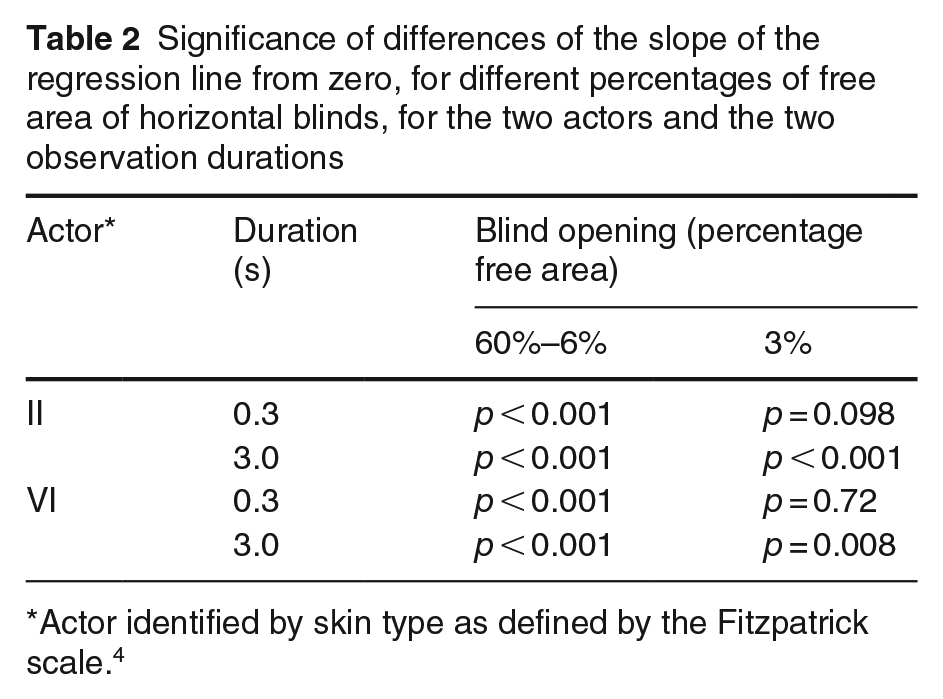
Actor identified by skin type as defined by the Fitzpatrick scale. 4
Figure 6 shows the results of trials using the frosted glass. As the distortion level increased, clothing identification decreased towards chance. Using the Friedman test to compare clothing identification across the seven levels of clothing (Table 3) suggests statistically significant differences (p < 0.001) for the four lower degrees of distortion (D = 4, 8, 12 and 16) for each combination of actor and observation duration. For the highest level of distortion (D = 20), differences in clothing identification were significant with 3.0 s observations, but were not suggested to be significant at 0.3 s observations. The slopes of the regression lines were tested for significant departure from zero (Table 4). For distortion levels 4–16, the slopes departed significantly from zero (p < 0.001) suggesting insufficient privacy. For the highest level of distortion (D = 20) the slopes were not suggested to depart from unity for both actors and both durations.
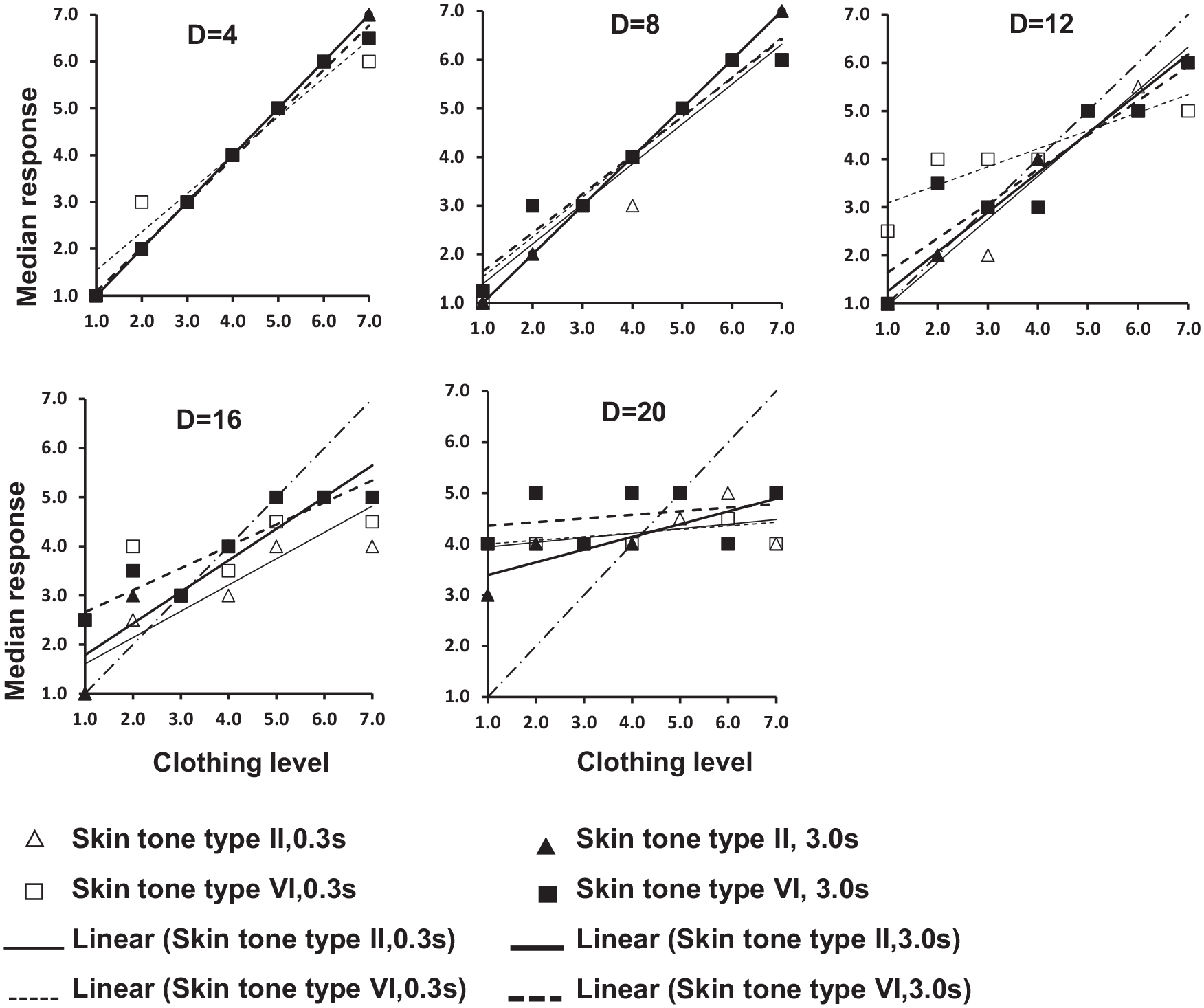
Median clothing level response plotted against actual clothing level for five distortion levels of frosted glass, ranging from 4 to 20 in steps of four distortion units (shown in each graph). These results are for the two actors: a white skin tone (type II) and a dark brown to black skin tone (type VI) and the 0.3 s or 3.0 s, observation durations. The dot-dash line indicates the response for correct identification of clothing level
Significance of differences between reported clothing levels as tested using the Friedman test for different levels of distortion for the frosted glass, for the two actors and the two observation durations
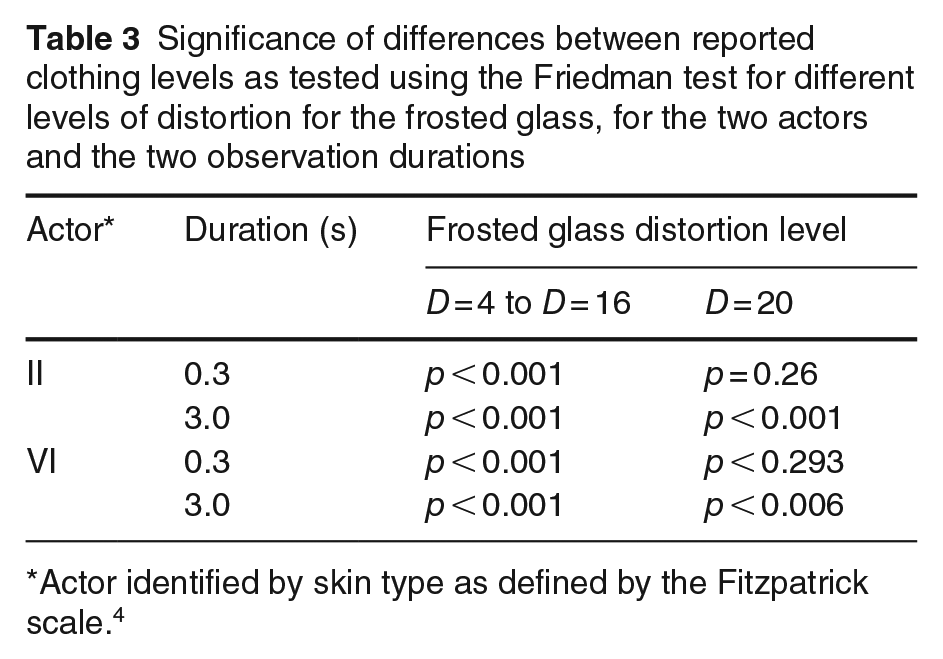
Actor identified by skin type as defined by the Fitzpatrick scale. 4
Significance of differences of the slope of the regression line from zero, for different levels of distortion for the frosted glass, for the two actors and the two observation durations
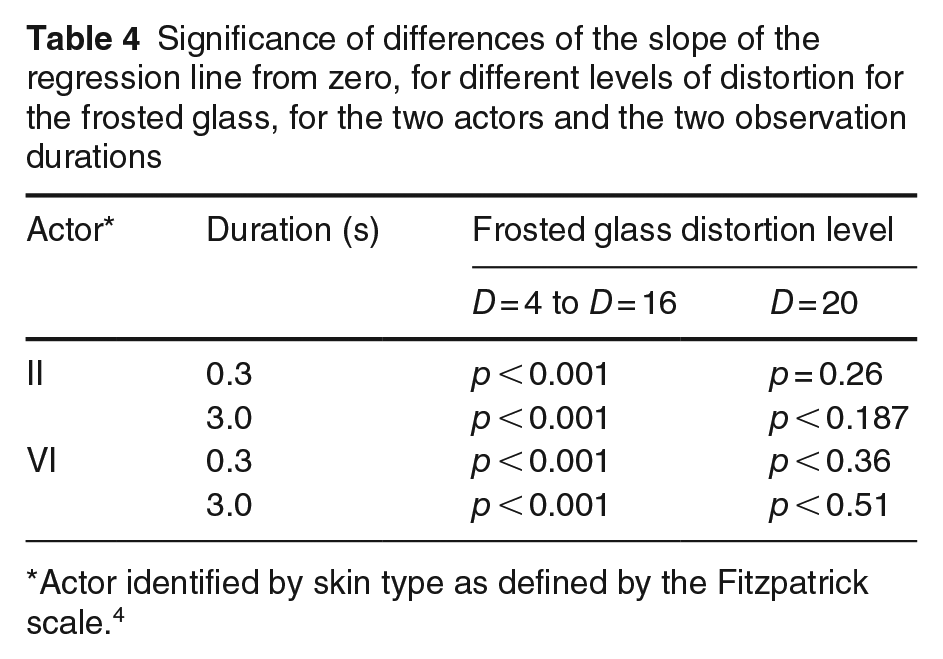
Actor identified by skin type as defined by the Fitzpatrick scale. 4
As shown in Figure 3, actors were located at one of three horizontal positions relative to the background (left, middle and right) as a precaution against changes in clothing being highlighted by a change in image if the actor was located always at the same location. This brings the risk that in some positions the exposed arms are easier to see than in others. To consider this, we conducted a further analysis of trials using one actor (actor II) at four levels of free area (3%, 11%, 19% and 60%) and one observation duration (0.3 s). These data did not suggest any variation in ability to identify clothing level with horizontal position.
4. Conclusion
Two experiments were conducted to compare the privacy afforded by two types of window treatments, horizontal blinds and frosted glass, by investigating ability to identify the level of clothing worn by actors. To consider generalisation, the experiment was conducted with two periods of observation and with actors of two skin tones. The target was to reduce clothing identification to chance level. For both window treatments, this was achieved only for the highest levels of window treatments considered here: horizontal blinds closed to a free area of 3% and frosted glass of distortion level D = 20. With a greater free area or with a lower level of distortion, it was possible to identify clothing at better than chance level, which is not considered to offer sufficient privacy. The desired level of privacy was found for 0.3 s observations, but with the longer duration (3.0 s) even these levels of window treatment did not offer sufficient privacy. Further work is needed to clarify which, if either, of the two durations used in this work is the more relevant for application.
The two actors used in the target images had different skin tones (white, and dark brown to black; types II and VI of the Fitzpatrick scale), presenting different skin-to-clothing contrasts. Despite this difference, the same conclusions regarding window treatment for sufficient privacy were drawn for both actors. In previous work investigating privacy and window treatments 16 or view to outside, 22 only one actor/mannequin was used so the influence of skin tone, if any, was not addressed.
In the current work, the target was scaled to present a distance of 4 m from the observer, with both at approximately the same horizontal level. This would represent a pedestrian walking along the pavement and looking through a ground floor window. Increasing the distance between the observer and the target would reduce the size of details subtended at the observer’s eyes: this could increase the difficulty of discerning detail and it would then be possible to increase the percentage free area of blind opening (or a lower level of distortion with frosted glass) to reach the same level of clothing recognition. At different positions within a room, the target may be differently illuminated due to their relative location to sources of daylight and electric lighting: in further work it would be useful to establish the worst-case position.
The experiments were conducted in a laboratory in which the interior lighting was switched on to simulate observations during daytime. Luminances are provided here to aid consideration of application. With no obstruction by window treatment, luminances on the face were approximately 170 cd/m2 for the actor of skin type II and 120 cd/m2 for the actor with skin type IV, and the centre of the torso had a luminance of 130 cd/m2. To each side of the actor in the central position was a dark surface on their left (TV screen, 140 cd/m2) and a lighter surface on their right (wall, 165 cd/m2). The simulated blinds had a luminance of 300 cd/m2. Observation in different contexts, such as when using real targets and window treatments rather than projected images, would provide a different pattern of luminances which might affect the ability to recognise clothing levels.
In this work, the chance level of clothing identification was used as the threshold for sufficient privacy. With the seven levels of clothing used in the current work, the chance level was 14.3%, and that is clearly dependent on the experimenters’ choice of the number of clothing levels included in the evaluation. Further work might explore alternative thresholds for defining sufficient privacy, for example, by setting a maximum probability for correct identification.
The ethnicities of test participants were not recorded. While the identification of clothing level is an objective evaluation and should not be affected by the observer’s ethnicity, there is a possibility that it might. In further work, it would be interesting to test that assumption. Kotabi 23 included participants of Middle East and Western origin and did not find a significant difference in their ability to perceive details (of an acuity chart and shapes) behind a mashrabiyya but those targets do not have the same cultural influence.
Footnotes
Appendix A
Acknowledgements
A version of this work was presented at the CIE 2021 Midterm Session. Please note also that since then the first author has changed their family name from Hussain to Elgadra.
Declaration of conflicting interests
The authors declared no potential conflicts of interest with respect to the research, authorship, and/or publication of this article.
Funding
The authors received no financial support for the research, authorship, and/or publication of this article.
