



Abstract
Ambient light level, one of the items recorded by police investigating a road traffic collision (RTC) was previously suggested to be incorrectly recorded in 5%–15% of cases. Significant erroneous categorisation of ambient light level, as suggested by the latter estimate, may lead to incorrect conclusions being drawn about the impact of light on RTCs which is critical where such data inform transport policy decisions. This study investigated the accuracy with which ambient light level was recorded in comparison to that determined using solar altitude at the time, date and location of the RTC. Data were drawn from the STATS19 database of RTCs in the UK for the period 2005 to 2015. Ambient light level was incorrectly reported in 103 021 (5.79%) of the 1 779 903 RTCs in that period. The percentage of errors was greater for RTCs occurring after dark than in daylight, and for RTCs where the scene was not attended by a police officer than those that were attended: ambient light level was incorrectly categorized in 8.72% unattended RTCs in darkness. The highest percentage of errors (57%) occurred within civil twilight; if these are omitted the overall percentage reduces to 2.81%, a similar error rate to that available for the determination of RTC location.
1. Introduction
One purpose of road lighting is to provide visual cues and reveal obstacles so that safe vehicular operation is possible. 1 A measure of the success of road lighting is, therefore, the degree to which the probability and/or severity of road traffic collisions (RTCs) after dark are reduced by road lighting, and this assumed benefit is used in the determination of whether or not to light a road.2,3 The mitigating effect of road lighting is therefore one basis for the design criteria recommended in guidance documents and standards.
One approach for establishing the potential for road lighting to be of benefit is to investigate the relationship between ambient light level and RTCs. Many studies have used ambient light level as an independent variable or to categorise cases when investigating RTCs involving a range of roads users, vehicle types and situational contexts [e.g.,4-9].
A source for such analyses are national databases of RTCs as might be compiled from police reports. In the UK, this database is compiled from STATS19, the police report form for RTCs. 10 The variables recorded in STATS19 include general information such as the time, date and location (longitude and latitude) of the RTC, casualty severity, location information such as whether the RTC occurred at a junction and the speed limit of a given road, and environmental information such as ambient light level and weather.
According to the apparent movement of the sun across the sky, the diurnal cycle of ambient light tends to flow from daylight, through twilight (dusk) to dark, and through a second twilight stage (dawn) back to daylight. Daylight is defined by a solar altitude of greater than 0° - i.e., the sun is above the horizon. 11 For solar altitudes of less than 0° daylight persists to some degree due to the reflection and scattering of sunlight towards the horizon of a terrestrial observer. 11 The twilight periods are thus not fully daylit nor dark but a gradual transition between the two as solar altitude decreases. There are three defined stages of twilight; civil twilight, nautical twilight and astronomical twilight. In civil twilight, where solar altitude is between 0° and −6°, in clear weather there is sufficient daylight illuminance to enable outdoor civil activity to continue unhindered without resorting to the use of electric road lighting. 11 Nautical twilight is the period where the solar altitude is between −6° and −12°. During this period, sailors are able to take reliable readings via well-known stars because the horizon is still visible, and outlines of terrestrial objects may still be visible but detailed outdoor activities are restricted without artificial light. 12 Finally, astronomical twilight is the period where the solar altitude is between −12° and −18°. In this period, the sky illumination is so faint that observers would regard the sky as fully dark, and the horizon is not discernible. 13
In some RTC databases ambient light level is categorised as either daylight or dark. In others, the civil twilight period is identified separately, and either included with one or other of daylight or dark, considered separately, or omitted to provide a clear distinction between daylight and dark. Some databases record whether the road was lit or unlit.
It is common for researchers to use in their investigation the ambient light levels as categorised by the police rather than to independently establish ambient light level according to solar altitude for the time, date and location of the RTC, even when these data are available in the database. There are only a few examples in previous research where ambient light levels were independently established [e.g.,14-17]. The precision of the categorisation of ambient light level, and hence conclusions drawn from the investigation, therefore depends on the accuracy with which ambient light level was recorded. Police RTC reports are the main source of data for road safety research, despite that such use may not have been their intended purpose, and despite that they are likely to contain missing or inaccurate information. 18
Shinar et al. 19 investigated the validity of police-reported RTC data by comparing a sample of reports against the data and conclusions of multi-disciplinary accident investigation teams who investigated the same RTCs. The expert investigators were assumed to provide the correct RTC data because the team comprised of four or more people (and these being specialists in vehicular, environmental and human factors) rather than, typically, a single police officer. The experts were also able to allocate more time to study each RTC than were the police. The data were 124 RTCs which had occurred in Monroe County, Indiana USA, between 1971 and 1975. Variables with the least reliable reporting included accident severity and speed limit, each misidentified by the police in about 30% of cases. Driver age was misclassified in about 12% of the cases. The variables most reliably reported were accident location, date, and the numbers of drivers, passengers and vehicles.
To give consideration to the accuracy of police-reported data such as RTC records requires a secondary source of data. One such source is hospital records, and these enable a comparison of injury severity following an RTC. Brubacher et al. 20 found poor agreement between police-reported RTC injury severity and hospital admission records, the focus being serious-injury RTCs defined as those requiring a night in hospital. Only about one-third (36%) of drivers who required hospital admission after the RTC had a police report which recorded major injury. In other words, for the remaining two-thirds of hospital admissions for a serious injury, the police record did not indicate a serious injury. In the reverse, only about half (56%) of drivers for whom the police indicated major injury actually required admission to hospital. Similarly, Tsui et al. 21 concluded that police tend to overestimate injury severity-casualties classified as seriously injured by the police but who were not really seriously injured.
A comparison of injury severity between police and hospital records may be unfair on the police. Injury severity is an expert judgement. The police officer at the scene of an RTC needs to attend to many issues and may make mistakes when recording injury severity. Furthermore, where hospital records define injury severity by length of stay, the reporting police officer will not know, a priori, how long the injured will remain in the hospital. 22
Consider the recording of ambient light level. Shinar et al. 19 found that this was incorrectly categorised in about 5% of their cases. The cause of error was suggested to be “probably due to misunderstanding of the coding procedures” but that proposal was not substantiated. However, this estimate was drawn from only a small sample of RTCs (n = 124) and they did not state the ambient light level recorded by the police nor describe how ambient light level at the time of the RTC was established by their expert investigators. A more recent study 15 found that RTCs occurring after dark were incorrectly categorised as being in daylight in 15% of 4677 cases. The primary focus of that work was the influence of ambient light level on motorcycle and four-wheel motor vehicle RTCs as recorded in STATS19 for the period 2005 to 2015. For Shinar et al. 19 it is not known whether their incorrectly categorised cases were in darkness or daylight. There is quite a difference between these estimates: an error in 15% of cases gives more cause for concern than an error in 5% of cases.
It may not always be straightforward to categorise the ambient light level as being daylight, twilight or dark. When reporting ambient light level in STATS19, the available categories are daylight or darkness, with darkness having four options for describing the presence of road lighting (lit, unlit, no lighting and unknown). The instructions state that darkness is the period which lies between half an hour after sunset to half an hour before sunrise: all other times are classified as daylight. 23 The inclusion of a 30-minute period after sunset and before sunrise means that civil twilight should be included within daylight. This approach could lead to accurate reporting if the reporting police officer knew the precise time of sunset (or sunrise) at that location and at that time of year, and also if they know the exact time at which the RTC occurred. On the other hand, a police officer may instead use judgement informed by observation: unlike injury severity, light level is not an expert judgement in most cases. Such judgement may be accurate in periods of definite daylight and darkness, but is more difficult at twilight. If the categorisation of ambient light level is made by on-site observation this may be more error-prone during civil twilight than during periods further away from the daylight and darkness thresholds.
If there is a tendency for ambient light level to be incorrectly categorised in police reports it would also be useful to consider when and why. Brubacher et al. 20 suggested that non-attendance of a police officer at the RTC is a reason for the under-reporting of major injuries, although they did not substantiate that proposal. As with any variable, ambient light level may be misreported due to human error (the wrong box was ticked) or because the available response categories did not offer the required option. 24
In summary, many studies investigating the effect of ambient light level on the frequency and/or severity of RTCs use the ambient light level as reported by the police rather than that determined independently according to solar altitude. Errors in the recorded ambient light category can be suspected because errors are found in other recorded variables. Incorrect categorisation of ambient light level may lead to incorrect conclusions being drawn about the effectiveness of lighting: this is critical where such data inform decisions. For example, the decision to install road lighting may be informed by a cost-benefit analysis2,3 where the benefit is the reduction in RTCs associated with installing (or improving) lighting.
The current study investigates the accuracy of the ambient light level recorded in STATS19 by comparing this with the light level determined using the time, date and location of the RTC. These data are first used to establish the prevalence of error, thus to arbitrate between previous findings that ambient light level was incorrectly categorised in 5%, 19 or 15%, 15 of cases. To extend previous work 15 the analysis includes RTC data across the whole day and the whole year to provide a better estimate of the prevalence for incorrectly reporting ambient light level. The analysis includes comparison of the tendency to make this error in attended and absent RTC scenes, and at different periods of the day.
2. Method
Data were drawn from the STATS19 database of UK RTCs recorded by the police between the years 2005 and 2015. These data are openly accessible via the UK Government Web site. 10 This resulted in 1 780 515 individual RTCs. For each RTC, solar altitude was calculated using the National Oceanic and Atmospheric Administration (NOAA) method. 25 This method calculates the precise solar altitude for each RTC using the date and time of the RTC, and the longitude and latitude at the location of the RTC, variables which are recorded in STATS19.
The data were filtered to categorise RTCs by ambient light according to solar altitude. RTCs that occurred when the solar altitude was less than −6° were categorised as occurring in dark and those when the solar altitude was greater than 0° were categorised as occurring in daylight. Of the 1 780 515 RTCs, 1 682 292 (94.5%) occurred in dark or daylight, the remaining 98 223 RTCs (5.5%) were those occurring in civil twilight.
Police-reported categorisation of ambient light level at the time of the RTC is that given in the STATS19 variable ‘light condition’. The five categories are daylight (1 304 387 RTCs, 73.26%), darkness-lights lit (349 697 RTCs, 19.64%), darkness-lights unlit (8182 RTCs, 0.46%), darkness-no lighting (98 937 RTCs, 1.08%) and darkness-lighting unknown (19 312 RTCs, 1.08%). There were no cases where the ambient light level was missing or out of range. For the current analysis, four categories were collated into one labelled darkness (darkness-lights lit, darkness-lights unlit, darkness-no light and darkness-lighting unknown), this representing 476 128 (26.74%) cases.
STATS19 offers three categories to record attendance of a police officer at the scene of an RTC: a police officer attended the scene of an RTC, a police officer did not attend the scene of RTC but filled in the corresponding STATS19 form, and a police officer did not attend scene of RTC and the STATS19 form was completed by the driver or other member of the public involved in the RTC. Of the 1 780 515 RTCs in the 2005 to 2015 period, 1 438 782 (80.81%) were attended by a police officer who completed the STATS19 record. In the current analysis, these are labelled as attended RTCs. In 341 121 cases (19.16%) the RTC was not attended by the police but a police officer filled in the corresponding STATS19 form; these are here labelled as absent RTCs.
Of the remaining cases, 335 (0.02%) were self-reported, where the RTC was not attended by the police and the STATS19 form was completed by a member of the public involved in the RTC. In a further 277 cases (0.01%) RTC attendance was recorded as unknown. These two categories were not included in the current analysis.

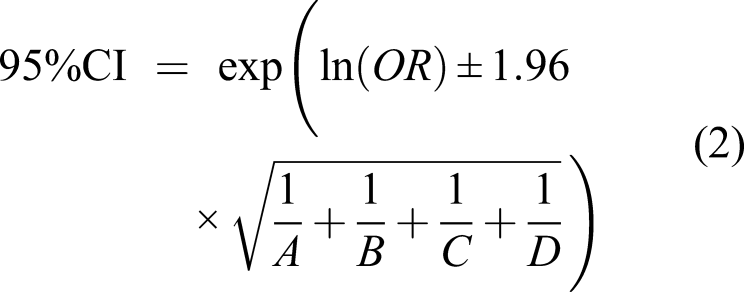
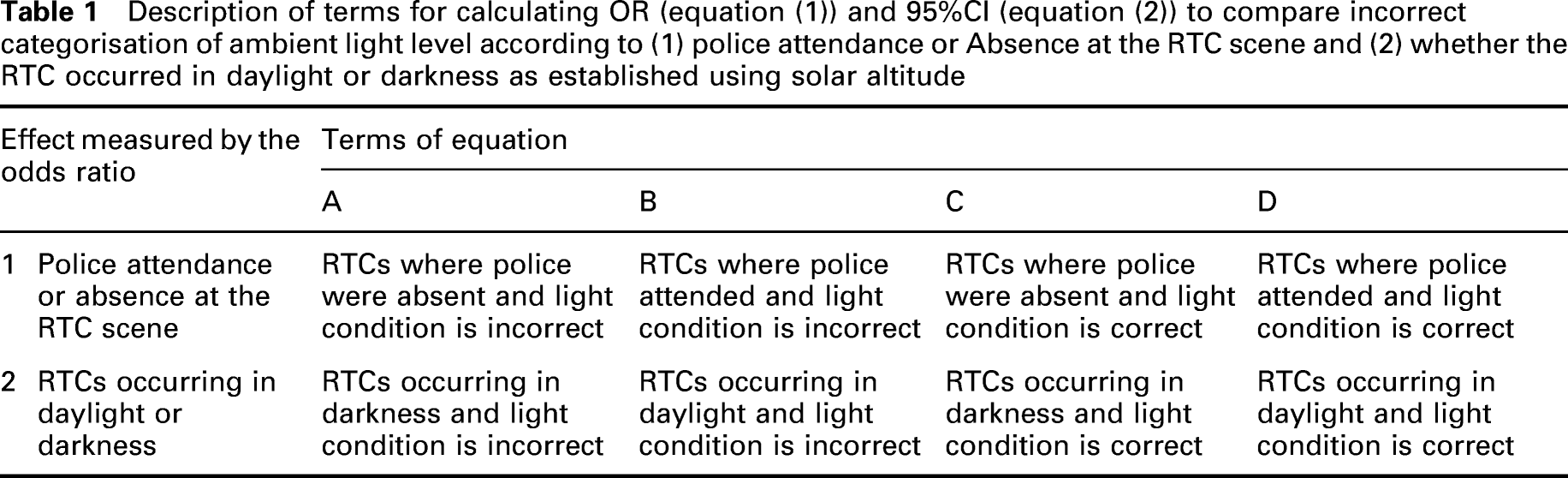
3. Results
Numbers of RTCs grouped by ambient light level as defined by solar altitude, and the numbers (and percentages) of these where STATS19 incorrectly reports light condition, as a function of police attendance at the RTC (absent or attended)
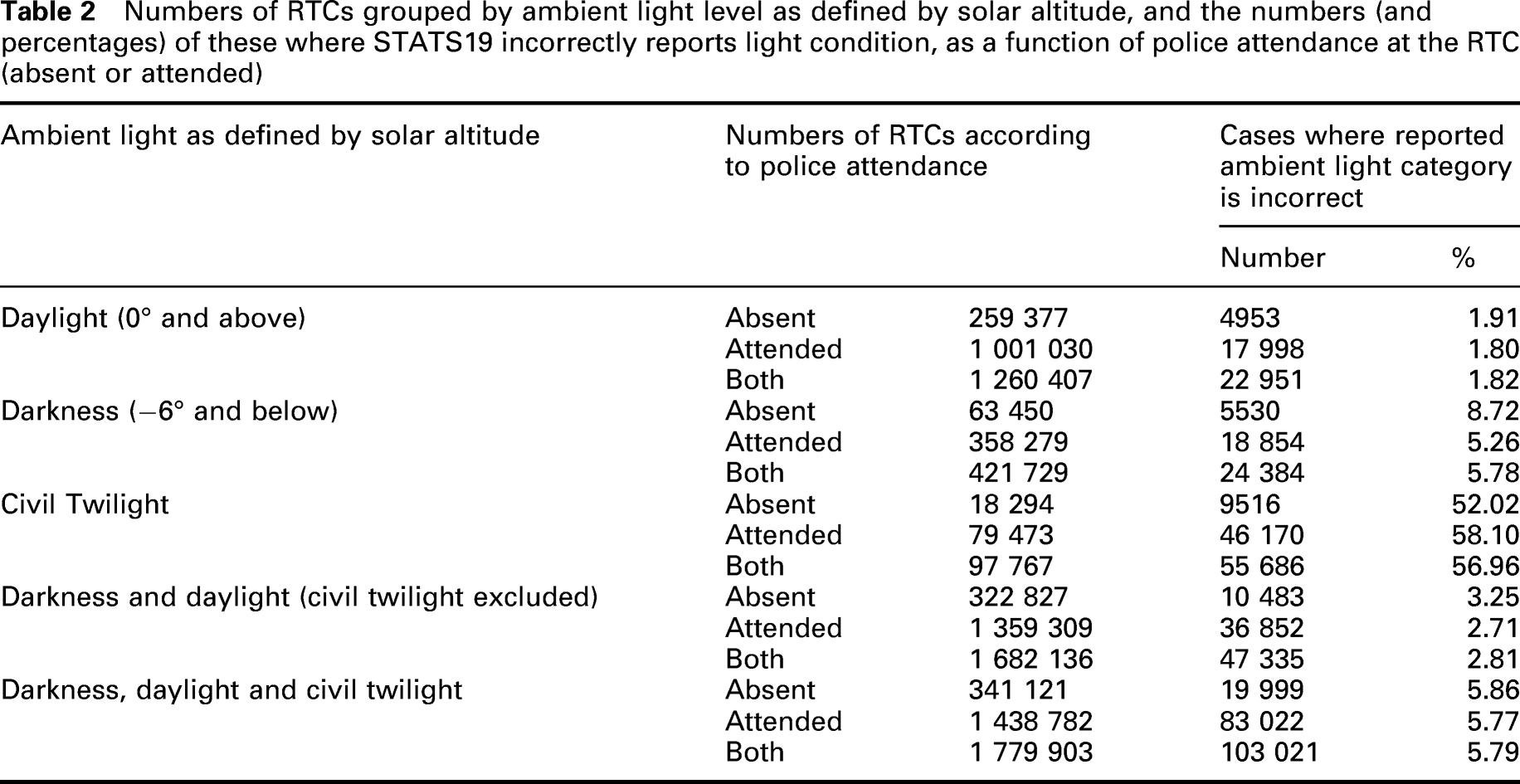
Ambient light level was incorrectly categorised in 5.79% of all cases. The greatest proportion of errors (56.96%) is found in civil twilight, where cases that should have been recorded as daylight were instead recorded as darkness. The percentage of incorrect categorisations is slightly higher for attended than absent cases. Outside of civil twilight, the greatest percentage (8.72%) of incorrectly classified ambient light levels occurs with unattended RTCs in darkness.
ORs, 95% CIs and associated p-values comparing accuracy of reported ambient light level according to police attendance and absence at RTCs
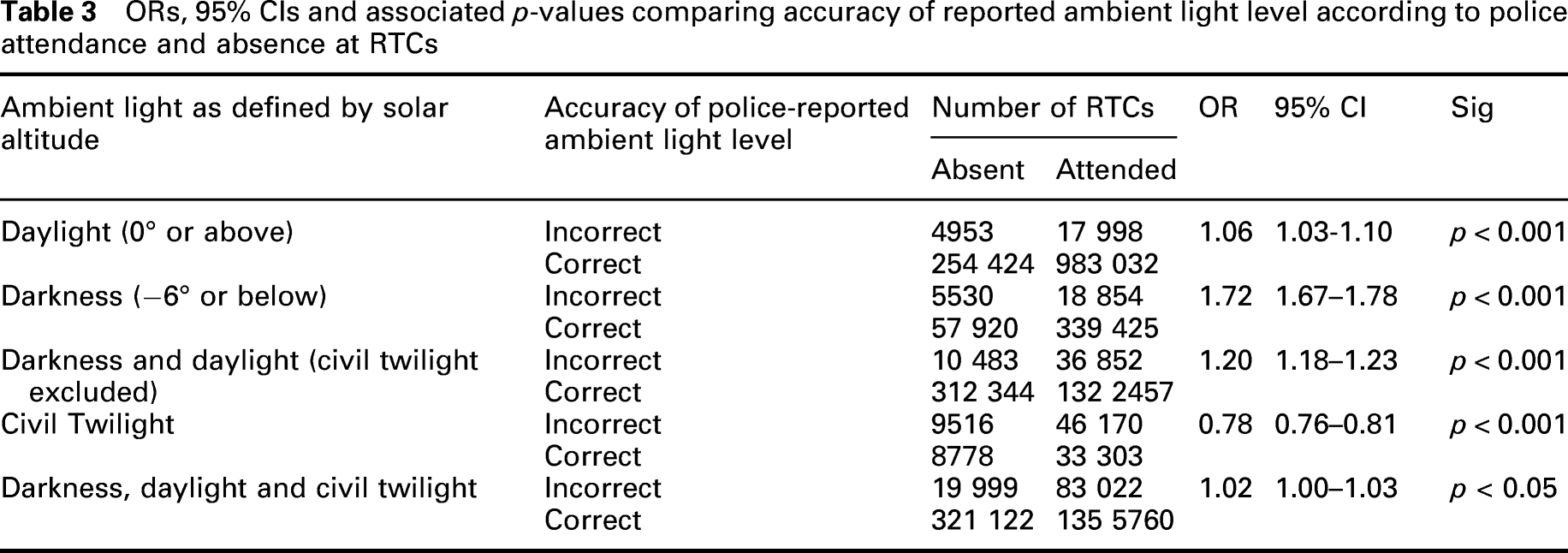
Figure 1 shows the percentages of incorrect ambient light level categories for each half-hour period of the day. These data are for the four-week periods centred on the 22nd day of December, March and June, marking the solstices and equinox. The autumn equinox in September, not shown in Figure 1, displays a very similar trend to that of the spring equinox in March. The greater percentages are found at around the times of civil twilight, with these percentages being greater for the evening than the morning civil twilight periods. Percentage of RTCs in each half-hour interval for which ambient light level was incorrectly recorded in STATS19. These data are for the four-week periods centred on the 22nd day of the stated month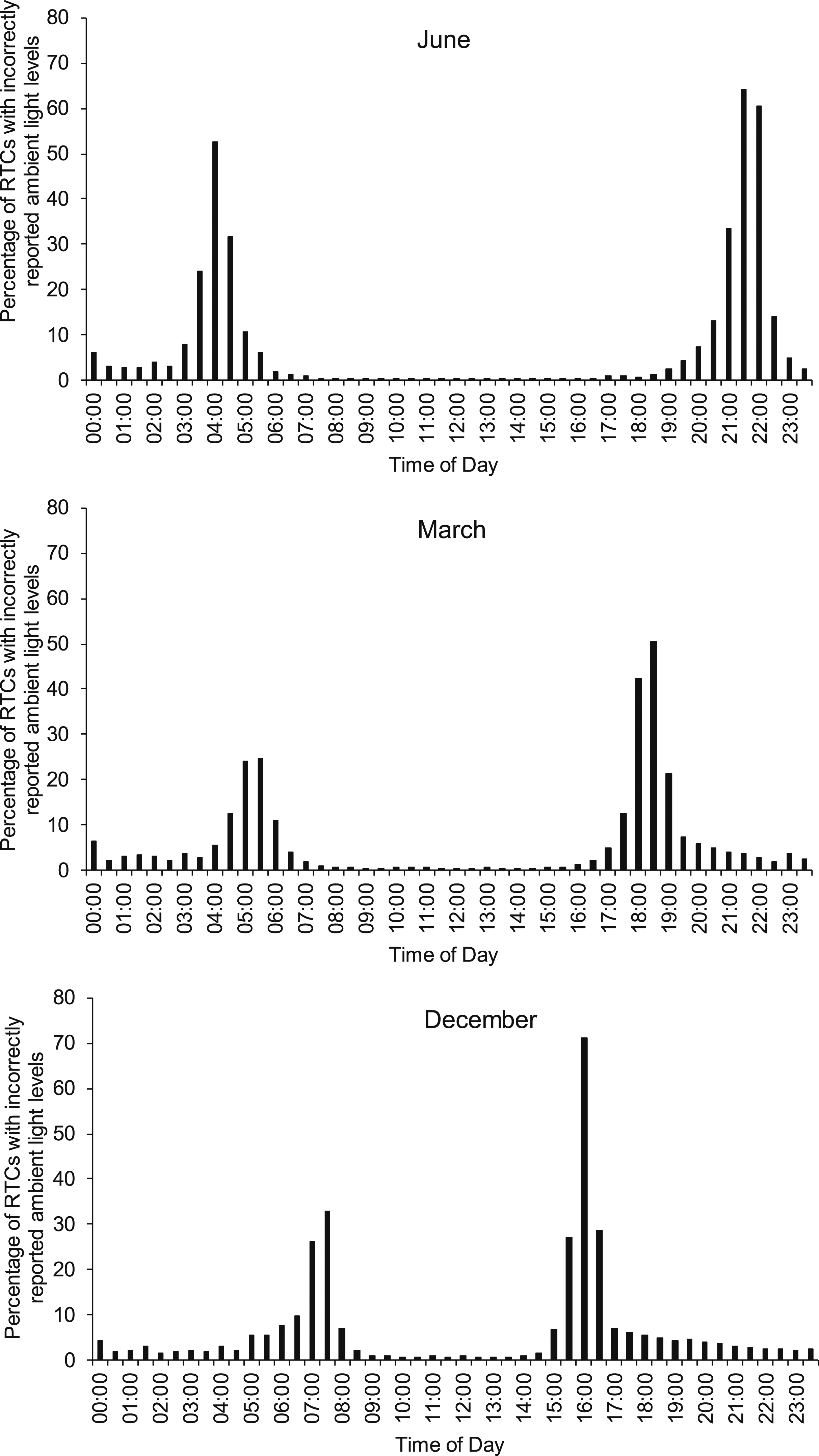
ORs, 95% CIs and associated p-values for ambient light level as determined using solar altitude, compared to categories reported by police reports

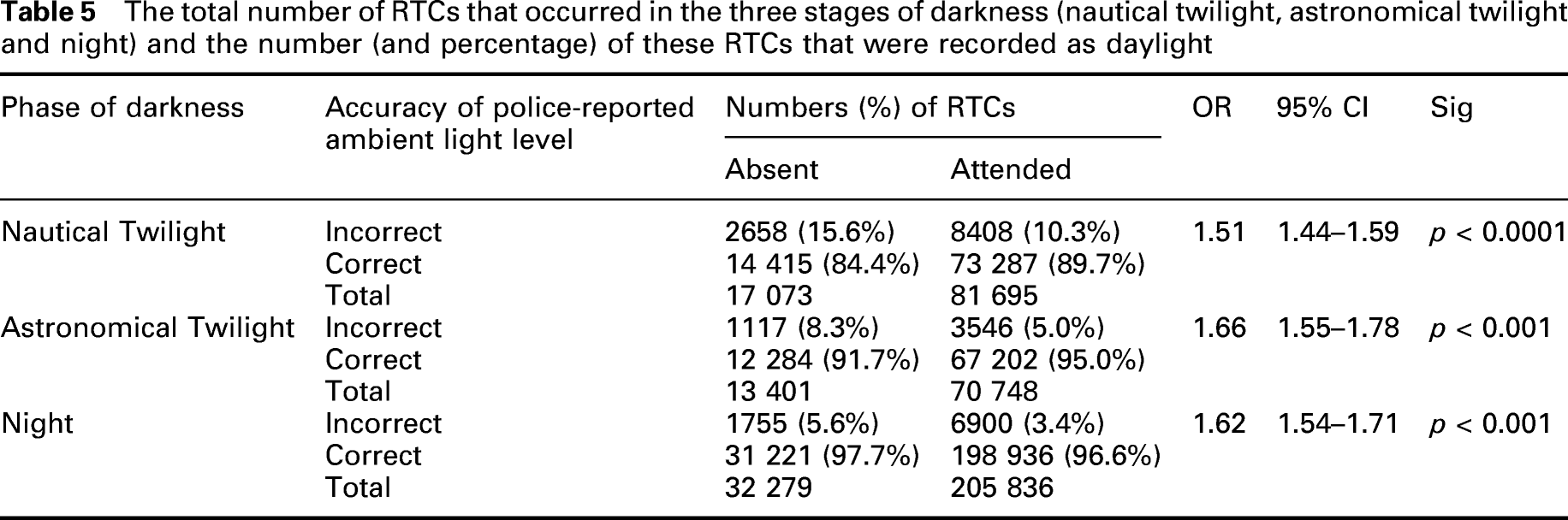
The total number of RTCs that occurred in the three stages of darkness (nautical twilight, astronomical twilight and night) and the number (and percentage) of these RTCs that were recorded as daylight
4. Discussion
4.1 Percentage error
Of the 1 779 903 RTCs recorded in STATS19 in the period 2005 to 2015 for which absent or attended status is known, ambient light level at the time of the RTC was incorrectly categorised in 103 021 cases (5.79%). We did not encounter any reason why this error would be specific to STATS19 and would hence differ significantly for ambient light levels reported by the police for other national records.
The greatest proportion of errors (56.96%) is found for RTCs occurring in civil twilight, cases which should have been recorded as daylight according to STATS19 guidance but which were erroneously recorded as darkness. Outside of civil twilight, the tendency to incorrectly categorise ambient light was greater for RTCs that occurred in darkness (5.78%) than in daylight (1.82%).
The overall percentage of errors (5.79%) is similar to that (5%) reported by Shinar et al. 19 The percentage of errors in darkness (5.78%) is, however, smaller than that (15%) reported previously 15 despite use of the same data set (STATS19) for the same period of time (2005–2015). One reason for this is that the previous analysis included only those data within time windows (ranging in duration from 1 minute to near 60 minutes) chosen to ensure a definite daylight-to-darkness (or vice versa) difference in the weeks before and after clock change: it was therefore a smaller sample, located near, but not within, civil twilight, and omitted those cases within astronomical twilight and night which suggest a lower degree of error (Table 5). The incorrect cases in nautical twilight, for absent and attended RTC scenes combined, represent 11.2% of the total nautical twilight cases, which more closely matches the previous finding.
For RTCs in daylight or darkness, incorrect categorisation of ambient light level is more likely in absent (3.25%) than attended (2.71%) cases (Tables 2 and 3). While this trend is retained for the three phases of darkness (Table 5), the reverse situation is found in civil twilight, with a greater tendency of incorrectly reporting ambient light level for attended RTCs than for absent.
4.2 Alternative analysis
The results shown in Tables 2–5 considered RTCs occurring across the whole year, which is the data set used in some investigations.28,29 Other studies, however, have considered only the one,14,15 two,17,30 or 5 weeks31,32 immediately before and after the biannual clock changes. In these studies, a time window is chosen that is in darkness before clock change and daylight after clock change (or vice versa) and RTCs in these before and after periods are compared against changes in RTCs for control periods. Doing so aims to isolate the effect of ambient light from other factors such as seasonal change in weather and driver demography.
The overall percentage of RTCs were the ambient light level was incorrectly categorised, according to light condition calculated by solar altitude, for daylight RTCs, civil twilight and darkness RTCs, for both the whole year analysis and the clock change weeks

4.3 Limitations
For each RTC, STATS19 records the ambient light level, the date, time and location. In the current study, ambient light level was also independently determined according to solar altitude, as established from the date, time and location reported in STATS19. Where the recorded and determined light categories disagree, the current analysis assumes the determined categories are correct. This assumption itself assumes that the date, time and location of the RTC were accurately reported in STATS19, despite assumed error in the ambient light category. This is consistent with Shinar et al. 19 who found in their comparison of police and expert reports that the most reliably reported police data were those concerned with accident location, time, date and number of drivers.
Others have raised the potential for errors in the recording of time and location. A study of RTCs in Croatia found that the location was incorrect in 33.5% of the 8550 cases. 33 The main error was that police officers incorrectly recorded the street name: assuming that the metropolitan area (city, town or village) was correctly recorded then this would be unlikely to influence significantly the determined ambient light level.
Regarding time, RTC records may round this (in particular where determined from witness statements) rather than time being reported at the minute-level of accuracy. Imprialou and Quddus
18
found that crash times recorded in STATS19 tend to be rounded to the nearest 5-minute point. They analysed data for 2014 only and found the minute indication ended with a 0 or 5 in 66.4% of cases, with further bias to the 0- and 30-minute points. Checking this using STATS19 data for the period 2005 to 2015 reveals a near-identical pattern (Figure 2). For most of the day, this rounding would not be of relevance. Minute of the hour at which RTCs were reported to occur as recorded in STATS19 for the period 2005 to 2015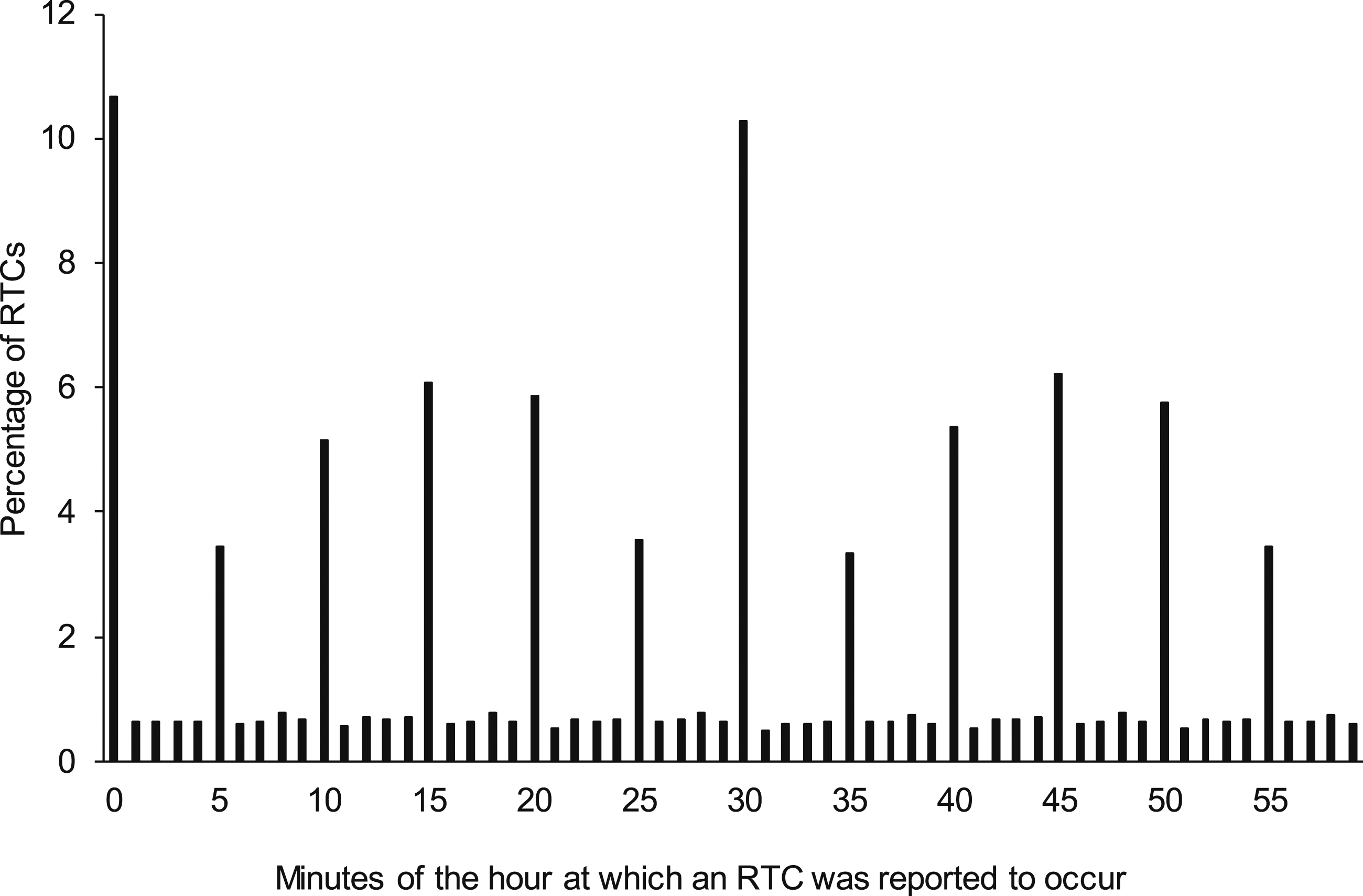
Where it becomes significant is at the thresholds of civil twilight (0° and −6°): for the solstices, solar altitude changes by about one half of a degree in 5 minutes (estimated for London, latitude 51.5°) which would lead to some RTCs occurring in daylight being categorised as darkness (and vice versa). What is not known, however, is whether there is a tendency to round up or to round down to the nearest preferred five-minute interval: if this is assumed to be equally distributed then time rounding would not influence the numbers of RTC cases in each ambient light category.
Previous studies have determined ambient light level according to the solar altitude for a specific RTC using the date, time and location of the RTC rather than using the reported categories.15-17 Doing so does not, however, ensure perfect categorisation of ambient light level. Following previous work, 28 one study 17 used a binary day/dark categorisation, the distinction being a solar altitude of 0°, and thus included civil twilight in the dark period. Subsequent analysis demonstrated that this underestimates the effect of ambient light on RTC risk.14,34 Twisk and Reurings 16 established solar altitude for the time of an RTC but they did so only for one location, the centre of their study region, The Netherlands. For a northerly (Leeuwarden) and Southerly (Maastricht) city in the Netherlands, differences in the times of evening civil twilight (for example) range from about 2 to 19 minutes, depending on the time of year. While this is sufficient to incorrectly categorise the ambient light level for a specific RTC, it may be self-counterbalanced for analyses of data across the year and across the nation. Furthermore, categorisation of ambient light level by solar altitude alone may be misleading; for example, obstructions such as high-rise buildings might reduce ambient light levels to darkness that might otherwise be defined by solar altitude as daylight. In further work this might be investigated at a macro level by comparing data from urban and suburban areas, or at a micro level by checking the environment at each RTC location.
There may also be an influence of weather conditions. For example, mist and fog reduce visibility35,36 and cloud cover will reduce the amount of daylight 37 which may lead to an evaluation that the ambient light level category is darkness when solar altitude would otherwise indicate it to be daylight.
An additional analysis was conducted to investigate whether the police were more likely to incorrectly categorise RTCs in adverse weather compared to clear weather (Supplemental file 2). STATS19 includes five categories of adverse weather: raining, no high winds; snowing, no high winds; raining, high winds; snowing, high winds; and fog or mist. Clear weather includes two categories: fine, no high winds; and fine, high winds. Weather conditions labelled as other or unknown were omitted from this analysis. For RTCs occurring in darkness, an incorrect categorisation is to label this as daylight: this error is less likely to be made in adverse weather. For RTCs occurring in daylight, an incorrect categorisation is to label this as darkness: this error is three times more likely to be made in adverse weather. RTCs were more likely to be incorrectly categorised when the police officer was absent than when they attended the scene with this difference being significant (p < 0.001) in clear weather in daylight and darkness and adverse weather in darkness, but was not suggested to be significant (p = 0.68) for RTCs occurring in adverse weather in daylight.
A police officer is more likely to attend a fatal RTC than an RTC with only slight injury. 38 Therefore, incorrect categorisation of ambient light level could change as a function of accident severity. However, such an analysis was not possible with the current data as there were insufficient sample sizes for some cases (e.g., unattended fatal RTCs).
Finally, we raise the possibility that the reporting form, STATS19, might itself prompt errors. The available categories are daylight, darkness-lights lit, darkness-lights unlit, darkness-no lighting and darkness-lighting unknown. There are no options for road lighting to be lit or unlit during daylight which may lead to the attending police officer to assume that if the road lighting is lit it must be darkness. While road lighting should not be lit in daylight, faults or incorrect settings in the control gear may mean that it is, leading to an incorrect conclusion that the ambient light level is darkness.
4.4 What might be done
We consider here whether the error is of significance and what to do about it.
As to whether the error in categorisation of ambient light level is of significance, consider it alongside the percentages of errors found in other factors recorded about RTCs. Errors have been found in a range of RTC data. Injury severity is underestimated by the police compared with hospital records in 15% 39 to 64% 20 of cases; similarly, reports of major injury are an overestimate of severity in about half of those cases. 20 There are also errors in location information. Loo 40 examined RTCs in Hong Kong between 1993 and 2004 and found that road names and districts were incorrect in 12.7% and 9.7% of cases respectively. Austin 41 found that carriageway type was incorrectly coded or located in 21% of RTCs examined in the Humberside region of the UK. Chung and Chang 42 considered the use of vehicle black box systems to investigate accuracy of location information for RTCs in Korea and found that 68% of RTCs were within 50 m of the reported location and 88% were included within 150 m of the reported location. Imprialou et al. 43 examined 10 520 motorway and trunk road RTCs reported in STATS 19 for the year 2012 and found an error in 7.3%. They suggested using fuzzy logic to improve RTC location reporting, and this reduced the error to 1.1%. Similarly, Deka and Ouddus 44 used artificial neural networks to reduce RTC location errors to 2.9% of cases.
Regarding what to do about it, we propose two courses of action. For researchers, ambient light level should be determined using solar altitude rather than relying on reported categories. Where there is no option but to use reported categories, then those RTCs occurring in civil twilight should be omitted, although this assumes that civil twilight is included as a separate category to daylight and dark, which is not the case for STATS19. Civil twilight is the phase of ambient light where the percentage of errors is greatest, and removing these cases reduces the daily error rate from 5.79% to 2.81% (Table 2) which is a similar error rate to that obtained for location using fuzzy logic or neural networks. These data hence support the decision in some studies to omit RTCs occurring in civil twilight.14,30
For the process of recording RTC data at the scene of an RTC we suggest that the police continue to record both the ambient light level and the time of the crash. When recording ambient light level, we suggest that guidance related to the time of sunset and sunrise is omitted, this giving a potentially false sense of accuracy, and instead rely on the observation of the attending police officer. For absent (non-attended) cases, ambient light level should be either estimated from the time of day but with a caveat that the event was not attended, or should not be recorded at all. The time at which an RTC occurred should be established with the greatest accuracy possible, ideally to the nearest minute rather than 5-minute rounding. When police reports are entered into the database, ambient light level according to solar altitude should be determined according to location, time and date; where this computed light level disagrees with the police-observed light level, then this should be flagged to be checked by the reporting police officer.
To reduce the risk of assumed association between lit and unlit road lighting and daylight or darkness, the STATS19 report form should offer sub-categories of categories of daylight similar to those for darkness: lights lit, lights unlit, no lighting and lighting unknown.
5. Conclusion
This study investigated the tendency for ambient light level (daylight or darkness) to be incorrectly reported in police records of RTCs. An incorrect categorisation is one which disagrees with that determined according to solar altitude. Estimates in previous studies suggested an error in 5%–15% of RTCs.
Of the 1 779 903 RTCs reported in STATS19 in the period 2005 to 2015, ambient light level was incorrectly reported in 103 021 cases (5.79%). In that period 421 819 RTCs occurred after dark, of which 24 384 (5.78%) were incorrectly reported as being in daylight; 1 260 407 RTCs occurred in daylight of which 22 951 (1.82%) were incorrectly reported as being in darkness. Errors after dark are three times more likely than errors in daylight.
According to the instructions for STATS19, RTCs occurring in the 30-minute periods before sunrise and after sunset, approximately representing civil twilight, should be recorded as daylight. Over 50% of RTCs occurring in civil twilight were incorrectly recorded as occurring in darkness. This high degree of error supports the decision of some studies to omit RTCs occurring in civil twilight.
One explanation for incorrect categorisation is that the police did not attend the RTC. For RTCs in daylight or darkness (but not in civil twilight) the data suggest a significantly greater risk of incorrectly reporting ambient light level when a police officer did not attend the RTC (absent cases) than for attended cases. The greatest percentage (8.72%) of incorrectly categorised ambient light levels is those that occurred in darkness and which were not attended by a police officer. However, even for attended RTC scenes, errors persist.
Supplemental Material
sj-pdf-1-lrt-10.1177_14771535211069028 – Supplemental Material for Incorrect categorisation of ambient light level at the time of a road traffic collision
Supplemental Material, sj-pdf-1-lrt-10.1177_14771535211069028 for Incorrect categorisation of ambient light level at the time of a road traffic collision by S Fotios and CJ Robbins in Lighting Research & Technology
Supplemental Material
sj-pdf-2-lrt-10.1177_14771535211069028 – Supplemental Material for Incorrect categorisation of ambient light level at the time of a road traffic collision
Supplemental Material, sj-pdf-2-lrt-10.1177_14771535211069028 for Incorrect categorisation of ambient light level at the time of a road traffic collision by S Fotios and CJ Robbins in Lighting Research & Technology
Footnotes
Declaration of conflicting interests
The authors declared no potential conflicts of interest with respect to the research, authorship, and/or publication of this article.
Funding
The authors disclosed receipt of the following financial support for the research, authorship, and/or publication of this article: This work was supported by the Engineering and Physical Sciences Research Council (EPSRC), grant reference EP/S004009/1.

Supplemental material
Supplemental material for this article is available online.
References
Supplementary Material
Please find the following supplemental material available below.
For Open Access articles published under a Creative Commons License, all supplemental material carries the same license as the article it is associated with.
For non-Open Access articles published, all supplemental material carries a non-exclusive license, and permission requests for re-use of supplemental material or any part of supplemental material shall be sent directly to the copyright owner as specified in the copyright notice associated with the article.
