




Abstract
The main reason lighting control is being applied is to reduce energy consumption. However, there are many more reasons for lighting control to be optimised in buildings. Lighting systems can be controlled to enhance or optimise effects beyond vision. Automatic control of electric lighting systems or daylight systems is one way of adjusting someone’s personal lighting conditions. In addition, it is relevant for office workers to know how they can adjust their personal lighting conditions themselves in order to optimise their effects beyond vision (e.g. alertness). Therefore, this article describes a process of identifying predictors that influence personal lighting conditions. The dataset used in this article is gathered during a field study in the Netherlands in spring 2017. This article describes linear mixed models for daily mean illuminances and correlated colour temperatures both throughout the entire day and only at work. These models demonstrated that weather conditions, fixed and flexible personal conditions, office worker’s daily schedule and workspace characteristics influence personal lighting conditions. Weather conditions and fixed and flexible personal conditions though are difficult or impossible to control by the office workers themselves. However, adjustments in personal lighting conditions can be accomplished by the office workers themselves by changing their daily schedules and the workspace characteristics. The findings show that these two predictor categories may explain 4% to 20% of the variance in personal lighting conditions.
1. Introduction
The main reason for applying lighting control is to reduce energy consumption.1–4 However, there are many more reasons for lighting control to be optimised in buildings. While investigating energy savings, many studies focused simultaneously on maintaining visual comfort for the occupants.5,6 Next to the energy saving targets and the visual effects, lighting systems can be controlled to optimise effects beyond vision (e.g. work performance, circadian phase alignment). Although literature is not consistent on what type of light is required for initiating specific effects beyond vision, it is clear that there are at least six factors of light relevant for initiating these effects. 7 Light quantity, light spectrum, light directionality, timing of light exposure, duration of light exposure, and history of light exposure are the factors proven to be relevant. In order to be able to control these factors of light, it is essential to know how these factors are now contributing to individual’s personal lighting conditions. A previous article describes the interpretation of personal lighting conditions based on four of these factors of light. 8 The term personal lighting conditions was introduced as continuously measured lighting conditions at the individual level (i.e. light that enters the individual’s eyes). 9
Both daylight and electric light contribute to individual’s personal lighting conditions. 10 Therefore, adjusting personal lighting conditions in order to optimise someone’s work performance, health, wellbeing or alertness needs to focus on controlling someone’s exposure to daylight as well as to electric light. Nowadays, individual control over the electric lighting conditions in offices is often available and implemented. 11 Increasingly office buildings are equipped with lighting systems, which allow each office worker to select her/his desired lighting condition by controlling the electric light sources in her/his vicinity. Unfortunately, the grid of luminaires often does not match the furniture layout of a building and therefore changes in the lighting emitted by these luminaires may influence personal lighting conditions of multiple building occupants. A consensus needs to be built for the multiple users using the same lighting control system. 12 Besides these complexities, it is also rather complicated for an individual to control the electric lighting at locations other than the work or home environment. For example, it is less common to adjust the electric lighting conditions in a restaurant or a sport facility. In addition to controlling electric lighting conditions, the exposure to daylight may be controlled. The amount of daylight entering a building can be automatically controlled by using sun shading devices or by changing the transmittance of the glazing.
Next to the automatic or manual controls for electric light or daylight exposure, an individual could adjust their personal lighting conditions themselves as well. The possibilities for individuals to adjust their personal lighting conditions themselves is the main focus of this article. Although there are still unknowns in what the individual’s exact personal lighting conditions need to be for a specific task for a specific time of the day, it is essential to know how individuals could adjust their own personal lighting conditions.
The current article describes a field study conducted in a Dutch office.
8
The main purpose is to identify predictors of personal lighting conditions of office workers (e.g. similar to the results of the study of Heil and Mathis where they also identified determinants for bright light exposure).
13
Therefore, the current article addresses the following two research questions: 1. Which variables have an influence on the personal lighting conditions of office workers? 2. By only regulating the variables which are controllable by the office workers themselves, how well can the personal lighting conditions of an office worker be controlled?
1.1. Theoretical framework
Figure 1 illustrates the theoretical framework and hypotheses for the study. It is hypothesised that there are multiple categories of predictors of personal lighting conditions: A. Weather conditions. Constantly varying weather conditions and sun positions throughout the day cause variations in personal lighting conditions.
14
In addition, previous studies showed differences in lighting conditions across seasons (i.e. higher light quantities in summer compared to winter in the Northern Hemisphere).15–20 B. Fixed personal characteristics (i.e. age, gender, chronotype).
21
C. Flexible personal conditions (e.g. self-reported health-related issues, eye discomfort, sensitivity to seasonal affective disorder).
21
D. The daily schedule of the office worker. The light quantity and the light spectrum differ significantly between locations (i.e. outdoor illuminance range: 1000–10 000 lx and correlated colour temperature (CCT) > 5000K, indoor illuminance range: 50–1000 lx and CCT < 5000K).20,22 E. Workspace characteristics. For example, the distance to the closest window,
23
viewing direction,
24
orientation of the office building, obstruction near the daylight opening and the presence of sun shading devices)
25
may influence the personal lighting conditions since individuals differ in their work behaviour and in their preferences regarding lighting conditions.5,26–28 Theoretical framework to demonstrate the hypotheses and perspective of the current article. The first arrow indicates the hypothesised relationships between weather conditions (A), fixed personal characteristics (B), flexible personal conditions (C), daily schedule of the office worker (D), workspace characteristics (E) and personal lighting conditions. The second part of the figure, the relationships between personal lighting conditions and effects beyond vision, was not investigated in the current article
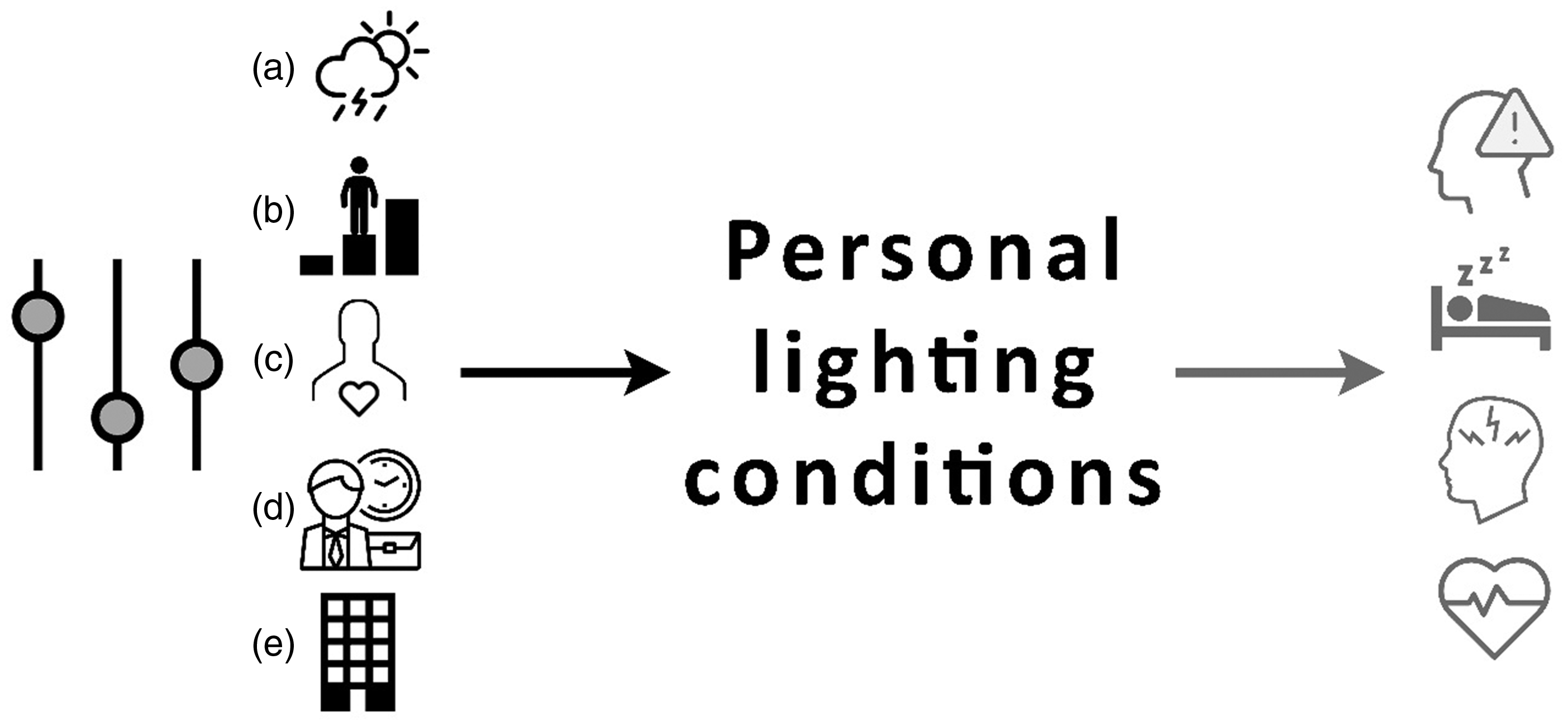
The second arrow of Figure 1 demonstrates the relevance of adjusting the personal lighting conditions of office workers: the effects of light initiated by personal lighting conditions. This topic is beyond the scope of this article.
2. Method
2.1 Study design
The current article describes a field study including 62 participants (mean age: 49.7 ± 11.4 years) in a Dutch office. 8 The office building consisted of five floors with fully glazed facades and an atrium situated at the south façade. The workspaces of the office workers participating in the field study were on average 5.1 ± 4.0 m away from the nearest window. The open plan offices of the ground, first, second, and third floors were equipped with dimmable fluorescent lamps (OSRAM 1 FQ 49 W/830). On the fourth floor, a different type of dimmable fluorescent lamp was installed (PHILIPS HFP WH, 58 W/83). Sun shading devices were not equipped at every façade and in addition, some blinds were automatically controlled and others manually.
The participants were asked to participate 10 working days and on these 10 days they were asked to: - wear a person-bound light measurement device (Lightlog
29
) from the moment they awoke until the moment they went to sleep again; - fill in a diary (D); and - fill in four questionnaires per day (Q1–Q4).
In addition to the daily study procedures, the participants were asked to fill in a general questionnaire (GQ) at the start of their participation. The general questionnaire contained questions regarding demographics, chronotype (Munich ChronoType Questionnaire (MCTQ 30 )), seasonal affective disorder (SAD) sensitivity Seasonal Pattern Assessment Questionnaire (SPAQ 31 ) and general health (36-Item Short Form Health Survey: SF-36 32 ).
The Lightlogs were attached to the clothes at the right-hand side of the chest and, therefore, measured lighting conditions in the vertical plane, comparable to the vertical direction of light entering the eye. Therefore, when illuminances (E) and CCT are mentioned in this article, they refer to vertically oriented measurements.
More information regarding the method of this field study (e.g. the office environment, the study deign, the objective measurements with the Lightlog, the participant sample, or the recruitment process) can be found in a prior publication. 8
2.2 Data analysis
The data analysis in the current article concerns the identification of predictors of personal lighting conditions of office workers. All data analyses were performed using MATLAB R2017a and SAS 9.4.
In order to investigate which input variables have an influence on personal lighting conditions, higher level statistical analysis were performed. The multi-level structure within the dataset was taken into account. Personal lighting conditions were analysed expressed as: - Daily average illuminance in lx ( - Daily average CCT in Kelvin ( - Daily average illuminance at work in lx ( - Daily average CCT at work in Kelvin (
The four light measures are included in the analysis as dependent variables. Since the human eye has a logarithmic characteristic and is able to adjust to a wide range of lighting conditions, 33 the light measures are assumed to be lognormal distributed. Therefore, the data were applied in lognormal distribution in order to model the predictors of personal lighting conditions.
Overview of all 35 input variables included in the data analysis to investigate predictors of personal lighting conditions. The category letters correspond to the ones in Figure 1

A: weather conditions, B: fixed personal characteristics, C: flexible personal conditions (health-related issues), D: daily schedule of the office worker, E: Workspace characteristics; SF-36: 36-Item Short Form Health Survey, MCTQ: Munich ChronoType Questionnaire; SAD: seasonal affective disorder; SPAQ: seasonal pattern assessment questionnaire; OLS: office lighting survey. The abbreviations GQ, Q1, Q2, Q3, Q4, and D in the third column stand for general questionnaire, the first to fourth daily questionnaire, and the diary the participants had to fill in.
All input variables were screened separately for a correlation with each of the light measures (significance level p = 0.05). The input variables found to correlate significantly with the light measures (i.e. the predictors) were included into one statistical model. Backward elimination was executed (significance level p = 0.05) to obtain the final model for the analysis. In all analyses, a linear mixed model (LMM) was applied using a random intercept for subject and spatial correlation for the repeated measurements over days within subjects. The parameter estimates are converted back to relative rates for the original scale of the aspects of personal lighting conditions. The mixed effects model for personal lighting conditions Yij for subject i at day j can be formulated as demonstrated in equation (1)
where Yij is the estimated light measures (i.e. one of the four) for subject i at day j, e.g. [lx], or [K]; β0 is an intercept; βh is the coefficient for predictor h (with xij the value of predictor h for subject i at day j); bi is a random effect for subject i, with bi ∼ N(0,σS2); eij is the residual for subject i at day j, with eij ∼ N(0,σR2) and autoregressive covariance COV(eir, eis) = σR 2 exp {-α |s - r|}.
Association βh for predictor h with the logarithmic individual aspect of personal lighting conditions are reported by a relative rate exp{βh} for the aspect in its original scale. The relative rate represents the expected multiplicative change in the individual aspect of personal lighting conditions for one unit change in the predictor h.
The percentages of increase or decrease in the light measures due to varying predictors were calculated using equation (2). This shows, for example, that 
Input variables that were identified as predictors of the four measures of personal lighting conditions. The estimates are demonstrated as relative rates in the original scale of the light measures (exp{βh}) to enable easy interpretation
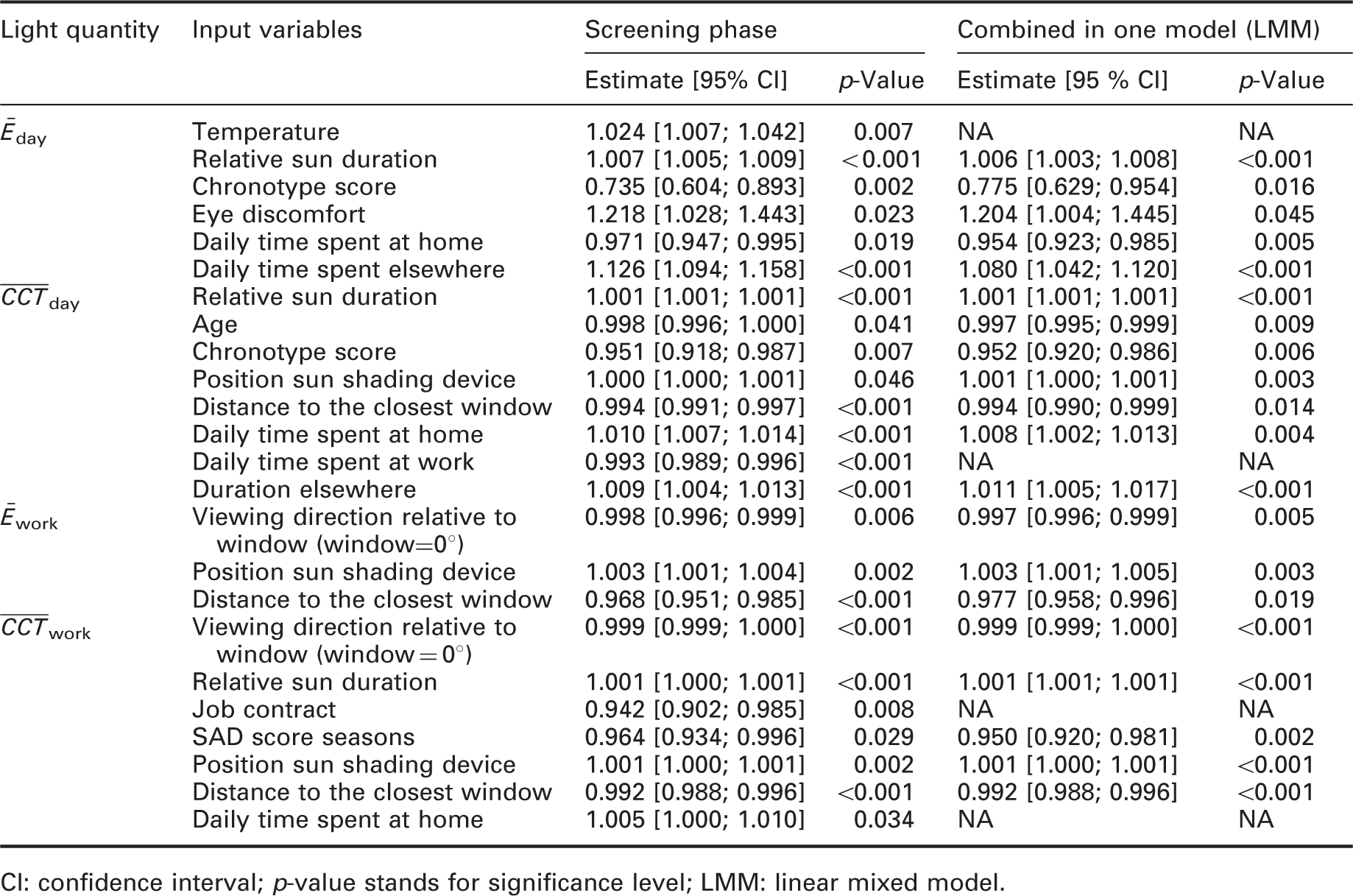
CI: confidence interval; p-value stands for significance level; LMM: linear mixed model.
In addition, the dataset was separately investigated to identify predictors of personal lighting conditions for subgroups within the participant sample as well. These sub groups are explained in more detail in a prior publication. 8 First, an overall likelihood ratio test was performed to test the influence of the subgroup on the model parameters. In the case this test was found to be significant, individual variables were judged at the significance level of p = 0.05.
3. Results
3.1 Identifying predictors on personal lighting conditions
The first set of results presented in Table 2 demonstrates the predictors that were identified in the first phase; the screening phase. In addition, the predictors were demonstrated that kept having a significant influence on the light measures when all predictors were simultaneously inserted into one model. Weather conditions (relative sun duration), fixed personal characteristics (chronotype and age), flexible personal conditions (eye discomfort, headache and SAD score season), the daily schedule of the office worker (duration elsewhere and duration at work) and workspace characteristics (position sun shading device, distance to the closest window and viewing direction relative to the window) were all found to influence the four light measures (
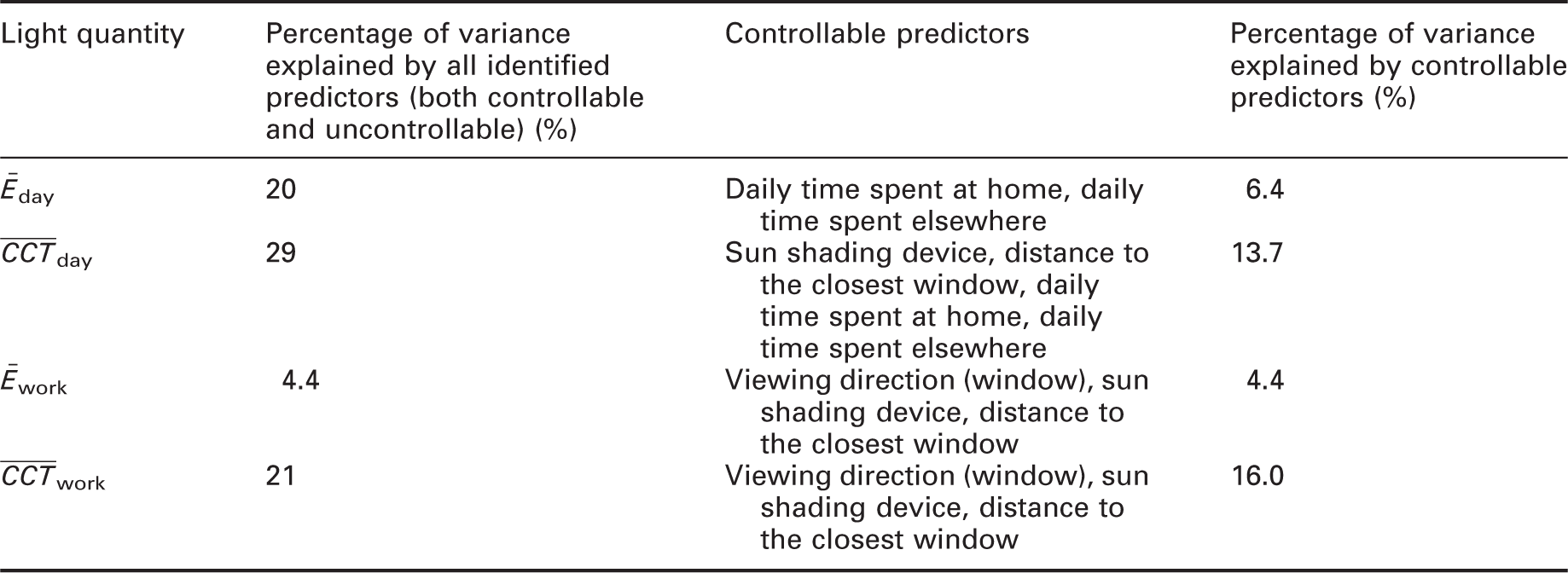
Only 5 out of the 10 identified predictors of personal lighting conditions are controllable by the office workers. Weather conditions (relative sun duration), fixed personal characteristics (age and chronotype of office workers) and flexible personal conditions (eye discomfort and SAD score seasons) are predictors that are difficult or impossible to be (directly) controlled by the office workers themselves. Some of these can be adjusted by others (e.g. a treatment can potentially cause a change in SAD score). The time the office workers spent at a certain location (daily time spent at home or elsewhere) or their selected workspace characteristics (sun shading device, viewing direction relative to the closest window and the distance to the closest window) are predictors of personal lighting conditions that are controllable by office workers themselves and therefore the focus of this article.
Percentages of the variance of personal lighting conditions explained by the identified (controllable) predictors (see Table 2)
3.2 Exploring the influence of predictors on personal lighting conditions of subgroups
The differences between the model parameters (estimates) for the two subgroups: full-time contract and part-time contract. The likelihood ratio test significance level shows whether job contract has a statistical significant influence on the model parameters. The estimates are demonstrated as relative rates in the original scale of the light measures (exp{βh}) to enable easy interpretation
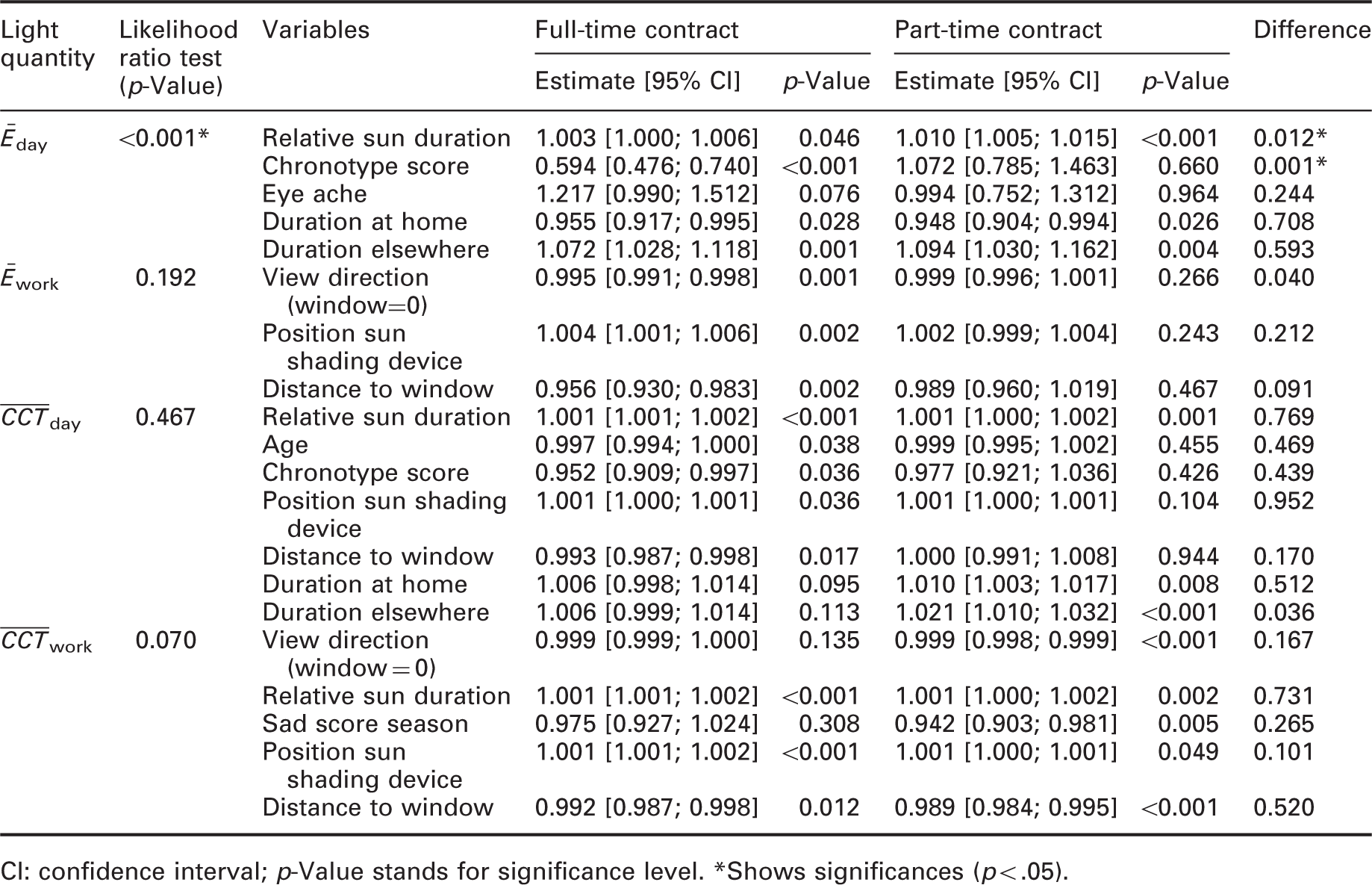
CI: confidence interval; p-Value stands for significance level. *Shows significances (p < .05).
The likelihood ratio test for testing the influence of job contract on the model parameters for
4. Discussion
Personal lighting conditions for an entire day (
Relative sun duration was associated with personal lighting conditions. Higher relative sun durations related to higher personal lighting conditions. This is in accordance with multiple other studies demonstrating higher lighting conditions in summer compared to winter. 18
Two types of fixed personal characteristics were found to associate with personal lighting conditions. A lower chronotype score related to higher daily personal lighting conditions. This means that morning persons (i.e. individuals with a lower chronotype score) were exposed to higher average personal lighting conditions throughout the day compared to moderate or evening chronotypes. In addition, age was found to slightly associate with
Eye discomfort was identified as health-related issue to associate with average illuminance throughout the entire day. The presence of eye discomfort related to a 20% higher
The daily schedule of the office worker was found to associate with daily personal lighting conditions. It was mentioned before that illuminance levels are often significantly higher at the location elsewhere compared to the locations at work or at home.
8
The CCTs were also significantly lower at work or at home compared to the location elsewhere.
8
The CCT at home was found to be significantly higher than the CCT at work. These previous results may explain an 8% increase in
Workspace characteristics were associated with the average CCT over the entire day as well. A change of position for the sun shading device from open to half open or from half open to closed (100% to 50% or 50% to 0% openness) resulted in a 5% decrease in
In addition, the personal lighting conditions specifically at work were investigated. These were found to be associated with weather conditions, flexible personal conditions and workspace characteristics. The adjustment in position for the sun shading device from open to half open or from half open to closed (100% to 50% or 50% to 0% openness) would result in a 5% decrease in
Furthermore, the percentages of the variance of personal lighting conditions explained by the identified predictors are calculated. This resulted in a percentage of 4% to 29%. Only considering the identified predictors that are controllable by the office workers themselves, percentages of variance of personal lighting conditions of 4% to 16% were found to be explained. Although these numbers show that it is possible to predict individual’s personal lighting conditions to some extent, there is still much research to be performed on this field.
The differences in personal lighting conditions between fulltime and part-time office workers resulted in a small difference in predictors of the mean illuminance throughout the day (
4.1 Practical implications
4.1.1 Recommendations for office workers
It was demonstrated that office workers can adjust their personal lighting conditions themselves by controlling their daily schedule and some of their workspace characteristics. Since the lighting conditions elsewhere are significantly higher than at work or at home, 8 it is recommended for an office worker to spend more time outside their home or workplace if he/she prefers higher personal lighting conditions. However, Roenneberg et al. 37 reported that the time people spent outside is decreasing over the years. For office workers, it is highly recommended to spend work breaks outdoors to get an increase in personal lighting conditions. In addition, many offices are nowadays transforming from individual office spaces to multi-user open plan offices. On one hand, within these open plan offices, the office worker can often select his or her own (flexible) workplace and therefore select his or her preferred workplace characteristics. On the other hand, an office worker working in an individual office may also have the choice to locate his or her workspace at a certain position within the office space and therefore select his or her preferred workspace characteristics. The choice for the location of the workspace can be based on, for example, reasons such as view or privacy, but also on the office worker’s needs or preferences with regards to their effects beyond vision (e.g. alertness). Firstly, an office worker working closer to the window will get exposed to slightly higher personal lighting conditions compared to an office worker working further away from the window. Similarly, an office worker facing towards the window will receive more light than when faced the side or rear wall. Lastly, opening the sun shading device will result in significantly higher personal lighting conditions.
4.1.2 Recommendations for building designers
The findings in this article demonstrated that the position of workspaces within the office environment (distance to the closest window and the orientation towards the window) determines the personal lighting conditions of office workers. This may request some attention from interior designers regarding the furniture layout in an office environment. In addition, building designers may consider these findings since these findings may imply a preference for smaller and higher office buildings over broader and lower office buildings. A lighting engineer and/or a lighting designer should take into account the amount and type of light exposure an office worker receives at eye level.
4.2 Limitations
The statistical LMMs that were developed to identify the predictors of personal lighting conditions and to develop the recommendations as demonstrated in Section 4.1 were based on data obtained during spring time only. The photoperiods including periods with direct sunlight are longer for spring and summer compared to autumn and winter; therefore, the relative sun duration was included in the analysis of this article rather than the absolute sun duration. Furthermore, the prevalence of sun hours in summer is, on average, higher compared to winter (e.g. 192 sun hours in winter 2020 compared to 677 sun hours in summer 2020 in the Netherlands38,39) and the daily maximum horizontal illuminance for clear skies is higher in spring and summer compared to autumn and winter. 40 However, even in autumn and winter situations, daylight quantities are still significantly higher than indoor light quantities. The recommendations based on the models to spend more time outside to increase personal lighting conditions may differ throughout the day and may be different during winter time than they were now in the spring conditions. In addition to the fact that the LMMs were developed during spring time only, it needs to be mentioned that these depend on the specific study (environment) as well. The identified predictors (see Table 2) do not represent a generic importance of the variables.
Since the location elsewhere includes all locations except the workplace and home conditions, 8 it is difficult to develop a suggestion based on the time spent elsewhere. Outdoor conditions are included in the elsewhere conditions and strongly influence the lighting conditions elsewhere. Therefore, suggestions based on time spent elsewhere were mainly based on time spent outdoors. In follow-up studies, a distinction between at work, at home, outside and other indoor environments is recommended.
Daily personal lighting conditions were investigated in this article. Since it is still unknown which aspects of light (i.e. average personal lighting conditions or peaks in personal lighting conditions) have the highest influence on effects beyond vision, it may be relevant to investigate which input parameters influence shorter-term personal lighting conditions in addition to the current investigation of daily personal lighting conditions. This analysis was not included in this article since the uncertainty in measuring with the person-bound device (i.e. Lightlog) was too high.41,42
4.3 Future research directions
As briefly mentioned in the limitations (Section 4.2), gathering personal lighting conditions in different seasons or at different locations may result in other or stronger recommendations to increase personal lighting conditions. Therefore, it is highly relevant to repeat this field study in autumn/winter conditions. In addition, since the variance of the personal lighting conditions can only be explained for 4–20% by the controllable predictors, it is valuable to investigate whether there are more controllable variables, which may influence the personal lighting conditions or whether uncontrollable variables can become more controllable. One of the aspects, which was not considered in this study, was the possibility to adjust the electric lighting system. It is topic for further research to what extent these changes in electric lighting conditions influence someone’s personal lighting conditions. And lastly, since it is proven that lighting conditions can have an influence on effects beyond vision (e.g. alertness), it is highly interesting to know to what extent office workers can influence these effects beyond vision themselves by adjusting their personal lighting conditions. On one hand, giving the office worker the freedom to adjust their personal lighting conditions may also counteract since people are usually not aware of the effects of light so they do not necessarily select the optimal light setting for their effects beyond vision. On the other hand, by giving them the chance to influence their personal lighting conditions, their alertness may be optimised while working.
5. Conclusion
The current article identified predictors of personal lighting conditions to provide recommendations for office workers as well as for building designers. Workspace characteristics (i.e. distance to the closest window, viewing direction relative to the window, and the position of the sun shading device) and the daily schedule of the office worker (i.e. time spent at work, at home or elsewhere) were identified as predictors of personal lighting conditions controllable by the office workers themselves. For example, a workspace closer to the window or more time spent outside the work or home environment resulted in higher personal lighting conditions. It should be mentioned that higher personal lighting conditions are not always the optimal conditions for the office worker. However, this article provides recommendations for the moments the office workers would like to adjust their personal lighting conditions. Workspace characteristics and the daily schedule of the office worker can be controlled by the office workers themselves and may explain 4–20% of the variance of personal lighting conditions. It is topic for further research to verify whether effects beyond vision may be optimised by controlling personal lighting conditions.
Footnotes
Acknowledgements
This research was performed within the framework of the strategic joint research program on Intelligent Lighting between TU/e and Koninklijke Philips N.V. and the Impuls II SPARK program. The municipality of Alphen aan den Rijn, the Netherlands and its employees were recognised for participation in this study. In addition, the doctoral committee members reviewing the PhD dissertation of Juliëtte van Duijnhoven are acknowledged for their feedback on this article.
Declaration of conflicting interests
The author(s) declared no potential conflicts of interest with respect to the research, authorship, and/or publication of this article.
Funding
The author(s) received no financial support for the research, authorship, and/or publication of this article.
