



Abstract
One of the aims of outdoor lighting in public spaces, such as pathways and subsidiary roads, is to help pedestrians to evaluate the intentions of other people. This paper discusses how a pedestrians' appraisal of another persons' intentions in artificially lit outdoor environments can be studied. We review the visual cues that might be used, and the experimental design with which effects of changes in lighting could be investigated to best resemble the pedestrian experience in artificially lit urban environments. Proposals are made to establish appropriate operationalisation of the identified visual cues, choice of methods and measurements representing critical situations. It is concluded that the intentions of other people should be evaluated using facial emotion recognition; eye-tracking data suggest a tendency to make these observations at an interpersonal distance of 15 m and for a duration of 500 ms. Photographs are considered suitable for evaluating the effect of changes in light level and spectral power distribution. To support investigation of changes in spatial distribution, further investigation is needed with three-dimensional targets. Further data are also required to examine the influence of glare.
1. Introduction
Imagine that you are walking alone, after dark, along a road. Ahead you can see another person or group of people: what visual cues inform your decision of whether or not to continue walking in the same direction or to take action to avoid approaching any closer?
Lighting in public spaces such as pathways and subsidiary roads is designed primarily to meet the needs of pedestrians and making an appraisal about the intentions of other people is an assumed critical visual task for pedestrians.1–4 Support for this assumption has been found in studies using eye tracking. When looking at static images, observers will tend to look at other people if present in a scene with an area-weighted frequency significantly greater than chance. 5 In natural outdoor settings, there is a probability of over 80% that another person in the field of view will be fixated at least once6,7 and fixations on other people can be sufficiently important to demand significant cognitive attention. 8 In these studies, the use of an area-weighted analysis 5 or a dual task to focus cognitive attention 8 suggests some confidence that fixations upon other people are important.
This paper reviews the current literature on pedestrians' responses to encounters with other people in artificially lit outdoor environments. Based on a theory of human–environment interaction (HEI) the extent to which the lit environment supports the appraisal of the other persons' intentions is discussed. Moreover, the visual cue(s), the operationalisation and choice of method(s) and specific measurement(s) that might be used in experimental studies to best resemble pedestrian experience in artificially lit urban environments are considered. The contribution of this work is to discuss the extent to which ecologically valid methods are used in research leading to recommendations presented in guidance for outdoor lighting.
People are in constant interaction with their surroundings. In this interaction or transaction, people's experience of the environment shapes their behaviour, and their behaviour in turn will affect the environment. 9 The HEI model 10 offers a framework to systematically analyse these relationships between people and the physical and social dimensions of the environment, and has previously been used to study mobility in urban areas.11–14 The HEI model is based on the theory that emotional processes are affected by different levels of appraisal of stimuli in the external natural and social environment.10,15 Therefore, different outcomes of the emotional process, in terms of approach or avoidance response, are expected depending on the outcome of the interplay between the physical and social environment, the activity at hand, and the individual's characteristics, values, attitudes and prior experiences.
From a HEI perspective, there is a concern when evaluating environmental quality 16 with respect to the degree of congruence between expert, technical or objective evaluations and lay, observational or subjective evaluations. The former are based on objective physical measures – i.e. light, noise or experts' judgements – and the latter on the users' observations and perceptions that are shaped by social constructions and experience of the places. 17 Both perspectives aim to assess the environment in which people live, but different values, ideals and goals underlie the experts' and the laypersons' observational assessments, pointing to the importance of using different methods in the evaluation of the environment. 16 This implies that we need a thorough understanding of what are the relevant stimuli to address, the associated measurement(s) available and the appropriate procedure(s) required to discern the effect of the environment on an individual's appraisal of other people in the outdoor lit environment, i.e. in making interpersonal judgements. From a research perspective, it becomes important to choose the most relevant stimuli (visual cues), find a suitable operationalisation and use appropriate methods and measurements of sufficient ecological validity.
2. Relevance: What do we look at?
A wide range of visual cues are used to communicate between people in social interactions.18–20 These present a range of visual and cognitive demands, leading to a need to determine which is/are the most appropriate for investigating effects of road lighting for pedestrians' appraisal of other people's intent.
Past studies of lighting and facial identity recognition.
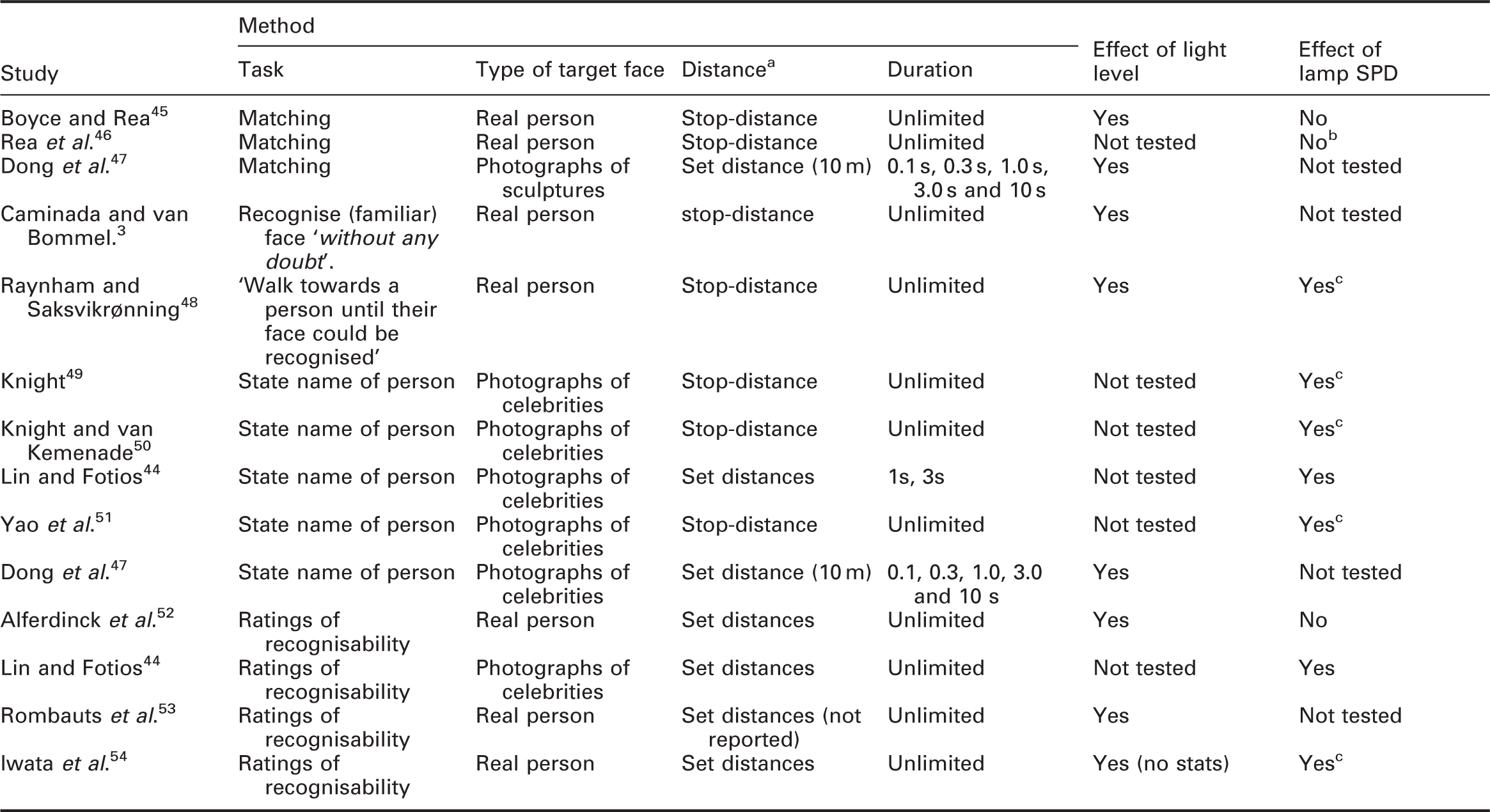
SPD: spectral power distribution.
aStop-distance: the test participant walks toward the target and stops at the point when the identification judgement can be made – distance is the proxy for performance. Set distance: the task is repeated at one or more locations pre-determined by the experimenter.
bIt is reported that there was no significant difference between the MH and HPS, but the article does not provide any numeric results for this test nor the method of statistical analysis.
cIn these studies, there was a reported trend for SPD to affect recognition distance but this is not supported by a statistical analysis of differences.
Body posture provides an additional source of information about other people's emotions,19,26,27 but which is the more significant stimulus for pedestrians' appraisal of other people, the face or the body? This has been examined in identity recognition studies by comparing performance when the whole body is visible with performance when only the head or body are visible.28,29 These studies show that judgements made with observation of only the head are of about the same accuracy as for whole body, with both being more accurate than judgements made with the body only. For example, in one study, 28 a correct responses rate of approximately 90% for whole body images was reduced to 80% when the body was obscured but reduced to 30% when the face was obscured: in further analysis of these data using only the first trial to reduce learning effects, the face-obscured response reduced to approximately 15%. In a further study using face and body composite images, it was found that approachability judgments were driven largely by the facial expression. 19 Observation of the face is thus suggested to be more important than the body for evaluating other people. Note, however, that these studies tended to use dynamic images (videos) rather than static images (photographs): the difference may be less prevalent for static images. 30 There may be an interaction with distance: the body contribution may become more significant at larger distances when face details become too small to be useful to the evaluation, while the face dominates at shorter distances. 29
The hands may be a specifically important part of the body to take into consideration as hand gestures are a physical action by which people may purposefully reveal their state of emotion. Although their meanings do not appear to be universally recognised, there are many commonly used gestures. 31 There are as yet no studies investigating how lighting affects recognition of a hand gesture, but given that the hand and face are of similar size, it may be safe to assume that lighting which enables satisfactory acuity for facial details also provides satisfactory acuity for hand gestures.
The eyes and the direction of gaze can be used to exert social control. 32 Humans are skilled at detecting the direction of gaze, perhaps because this gives the observer an indication of a person's mental state, their focus of attention and their goals. 23 For example, direct gaze is associated with approach motivation and averted gaze with avoid motivation.18,20,33 Angry faces are considered less approachable when displaying direct eye gaze than averted eye gaze. 20 Gaze direction is also used as a cue to the intended travel path of an approaching pedestrian such that one's own direction is adjusted to steer clear and reduce the risk of walking into one another. 34
There is a fear of direct gaze: looking someone in the eye is only seen as friendly if the looker is talking to the person or knows them. 18 Laidlaw et al. 35 found that a person seated alone in a waiting room looked toward a video screen of another person more frequently than they did when the real person was present. Having the impression that one is the recipient of a gaze can be decisive in many social interactions. 36 A person is acutely aware of when they are, and are not, being looked at by another person and this ability tends to decline with increasing distance.36,37
While gaze direction may be a useful cue to social interactions, the target features (the eyes) are, however, small, and under the reduced visibility conditions of road lighting, that lighting may not be of benefit. Fotios et al. 38 explored gaze direction and found that a face luminance of at least 1.0 cd/m2 was needed to ensure a probability of correct identification above chance level at an observation distance of 2 m, but for observation distances of 4 m and 10 m, performance did not rise above chance level. It is therefore concluded that gaze direction is not a suitable focus for research of road lighting.
In the appraisal process, our individual characteristics as well as values, norms, expectations and stereotyping shape our interpretation of certain stimuli. In these interpretations, people tend to use heuristics based on for example out-group characteristics associated with threat. 39 Therefore, factors such as gender – and skin colour, the formation of people in small groups etc – add to pedestrians' appraisal of other people's intent and associated feelings of danger/fear in the environment.
From this point of view, females may feel threatened by the presence of males.40,41 One female stated that ‘If I’m walking alone at night, and you are a man between the ages of 20 and 60 and your gait looks even remotely confident, I’m terrified of you’.
42
A study of aural responses suggested that the sound of male footsteps and conversation aroused anxiety whilst female footsteps and conversation promoted reassurance.
43
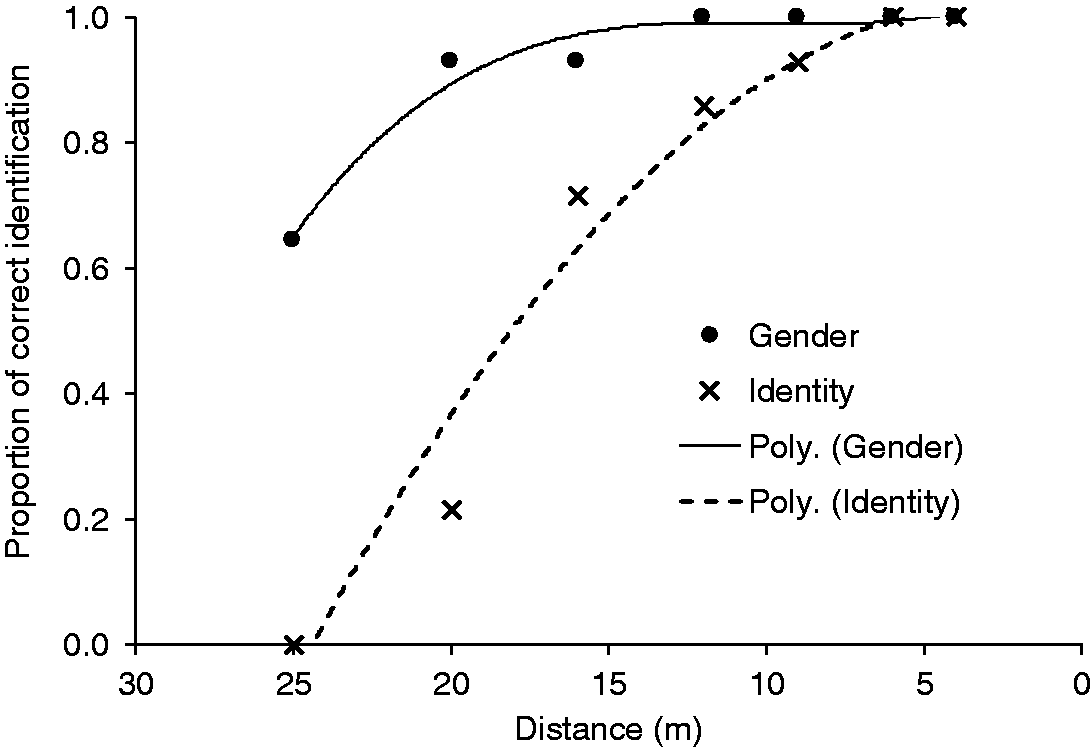
The chance of correctly recognising the gender of a remote person tends to be greater than the chance of recognising their identity (Figure 1).
44
Hence using gender identification as a representative task would underestimate the lighting needed for a more difficult task such as identity recognition.
Proportion of correct facial identity and gender judgements plotted against distance under metal halide (MH) lighting.
44
Taken together, previous research suggests that the face may serve as the most important stimulus. The face provides cues to identity, emotion, age and gender and it is what people tend to look at. The face appears to be more influential than the body, presents greater difficulty than gender identification, and facial details subtend a similar visual size to the hands. We next need to know how to use the face in empirical research to gain valid and reliable information about how well differently lit outdoor environments support pedestrians.
3. Operationalisation: What is being evaluated?
Several studies of lighting have used the face as the key stimulus to understand pedestrians' appraisal of other people's intent (Table 1).3,44–54 These studies operationalised the stimulus as facial identity recognition.
Three methods have been used in these studies: identification, matching and rating. Identification requires participants to state the name of the target person, with these studies typically using photographs of celebrities. Matching requires participants to match the target person with one from a sample of faces displayed in a reference set. Rating requires the degree of recognition to be reported, using a scale of, perhaps, zero (absolutely not recognisable) to 100 (completely recognisable). Both photographs and real people have been used as targets in these studies. Given that different experimental methods are available, it should be asked whether the choice matters, i.e. whether the method used affects the conclusions drawn regarding the effect of changes in lighting. If so, which measurement(s) has the highest ecological validity and best resembles the behaviour of a pedestrian?
Different experimental methods present different levels of difficulty.44,55 Following review of past studies, Lin and Fotios 44 observed that a relatively difficult task – a name the celebrity identification task – required targets to be closer for identification and that the spectral power distribution (SPD) of the light had a significant effect while a relatively easy task (matching) could be completed at a greater distance – or, smaller targets at the same distance – and that the SPD was not a significant factor. In an experiment carried out subsequently to test this proposal, Dong et al. 47 confirmed that the identification task was more difficult than the matching task. These results are in line with previous research showing that in memory, retrieval of information is a more complex process than recognition of information (e.g. Ellis and Hunt 56 ). Here, we have used the term task difficulty on the basis that the more difficult task is the one that requires a larger (closer) target for the task to be completed correctly: this may alternatively be considered as the information content involved in the choice, with the small number of target photos in a matching array being a smaller load than the myriad faces held in one's memory.
When making identification judgements, factors such as expectation and familiarity can affect performance. A higher proportion of correct responses is gained in a celebrity naming task if observers are primed before observing target photographs. 57 The size of this expectation benefit is such that primed identification performance matched un-primed performance despite targets that were more visually difficult – 24.5% smaller, or 22.8% more blurred). Familiar faces can be recognised in a rapid and effortless process 58 such that recognition performance is significantly better when the targets are familiar than when they are unknown.28,58–60 The absence of familiarity leads to poor identification: one study demonstrated relatively poor person recognition performance from a test sample comprising police officers. 28 These factors are, however, given little consideration in past experiments in lighting: the use by Caminada and van Bommel 3 of familiar targets in a recognition task may have underestimated performance with unfamiliar targets, affecting their recommendations regarding road lighting criteria. This distinction is relevant if it is assumed pedestrians are more likely to encounter unfamiliar people.
Summary of methods used to investigate face-based social evaluations.
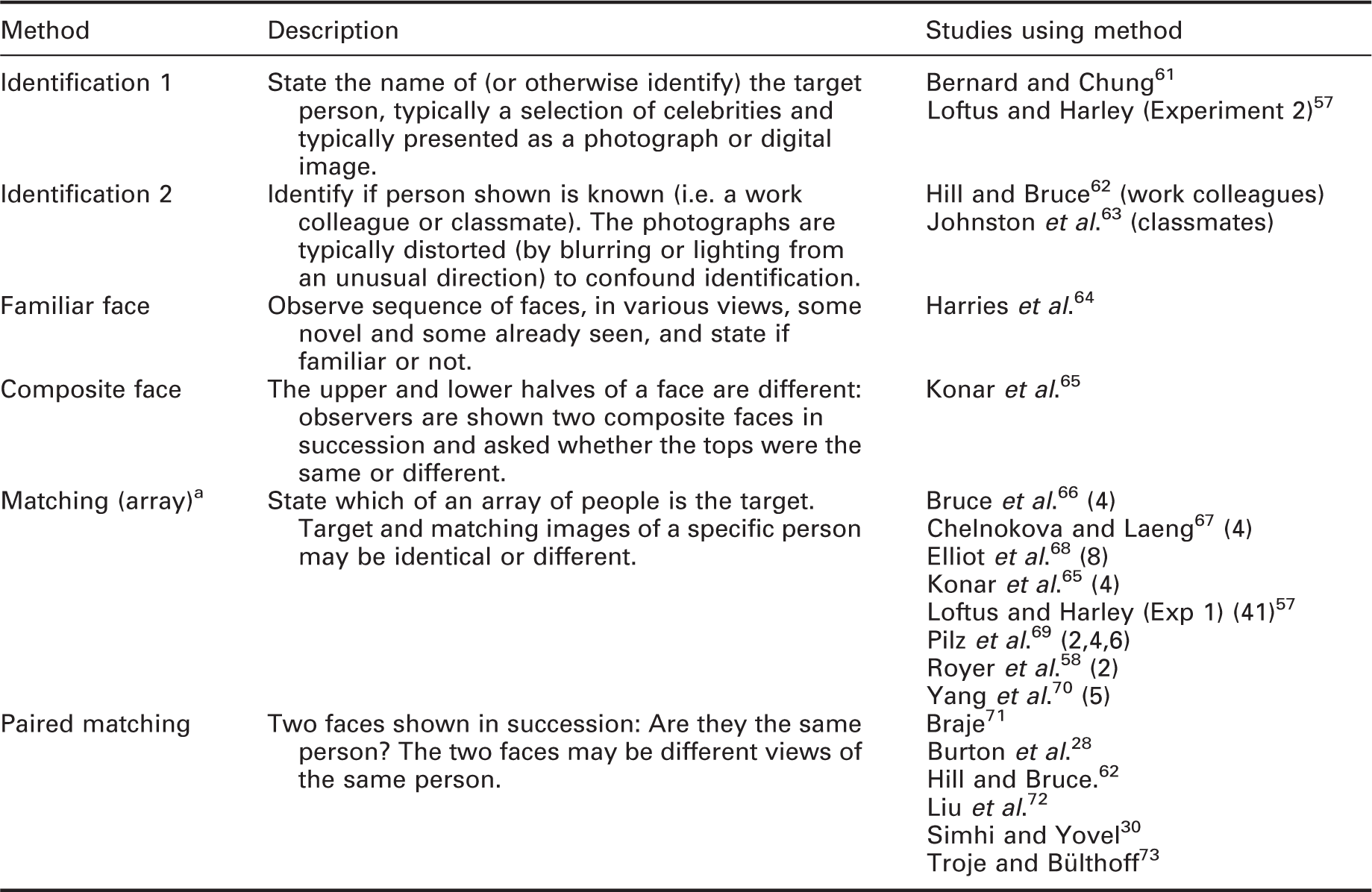
aNumbers in brackets refer to number of faces in the array.
Facial identity recognition is unlikely to be the only, nor most essential, evaluation made about other people when walking after dark. What may be more critical is the decision on whether it is safe to approach another person or whether they should be avoided. Recognition of emotion from facial expression – facial emotion recognition (FER) – might be a more representative task74,75 as this is more likely to reveal the behavioural intentions of the encountered pedestrian. 25 Confirmation of this proposal can be found in Willis et al. 19 who found that faces exhibiting angry expressions were considered less approachable than those with happy expressions – and similarly so for emotions conveyed by body posture. Approachability was defined by Willis et al. as the willingness to approach a stranger in a crowded street to ask for directions, which might be considered the opposite of a judgement of threat intent and the resulting motivation to avoid.
There are several photographic databases of facial emotional expressions, for example Ekman, 76 FACES 77 and NimStim. 78 These are photographs of actors/models using facial expression to portray what is considered to be a universally recognised emotion – such as happiness, fear, anger and disgust, – the success of this portrayal being confirmed by subsequent evaluations. These standardised expressions are not equally well recognised, with the proportion of correct identification tending to be high (≥0.95) for happy and low (0.68) for disgust. Given these different levels of difficulty, it might be expected that expression choice matters; however, the post-hoc analysis of FER studies did not find evidence that expression choice affected conclusions drawn about changes in luminance or SPD of lighting on the target face. 79
FER is suggested to be a more complex cognitive task than is recognition of identity from memory or from a reference image. 21 More details are needed to recognise facial expression than to recognize facial identity and as a result, identity may be easier to recognise than expression under conditions that degrade the transmission of higher spatial frequencies in a face image such as large distances and poor lighting. 80 In contrast, the results of a study 68 which used both identification and expression recognition tasks revealed that expressions could be identified at a greater distance than could identity, suggesting FER to be the easier task, but this difference existed only for the test participants undergoing cataract surgery (pre-op and post-op trials) and was not apparent in the control group.
It is concluded that FER better resembles pedestrian needs than do facial identity recognition. This is not to say that FER is the only evaluation that matters, but that it offers a suitable representative task for how pedestrians appraise other people and is unlikely to be affected by familiarity.
4. Ecological validity: How representative is the pedestrian situation investigated?
The generalisability of study results to the urban environment depends not only on the choice of relevant stimuli and adequate methods and measurements, but also which conditions are studied. Ecological validity concerns the degree to which the conditions used in an experiment represent those of the intended setting in which they would naturally occur. In the case of pedestrians' appraisal of other people in an artificially lit environment, the literature suggests that there are in particular three issues that should be addressed: (i) the representativeness of the presentation of the key stimuli, the face and its setting; (ii) the measurement procedures in terms of the relevancy of distance and the duration of observation; and (iii) the potential impact of disability glare.
4.1. Representation: Photos, moving pictures or real persons?
Some studies19,20 exploring social evaluations based on facial expression have used photographs of people rather than live actors as targets. One advantage of photographs – specifically, those from recognised databases76–78 – is that the emotion portrayal has been independently validated under good lighting conditions. In other words, the image tends to convey the message it is intended to.
In photographs, the target is static, typically solitary and set within a non-complex scene. In real social interaction, the target may be dynamic, possibly accompanied by other people, and probably within a complex scene. Walking, or other physical activity, leads to movement of the body and face. We are able to evaluate the gender and identity of people from movements such as the speed, rhythm and amount of arm swing, or gait and stride length. 81 There is a better than chance ability to make correct recognition judgements from walking movement,82,83 in particular for familiar targets. 84 Movement attracts attention, in particular for the onset of movement 85 and unexpected changes in direction 86 which might change the attention given to other cues in the environment.
Movement changes the position of the target relative to sources of light. For example, at a simplistic level, walking between two lamp posts will tend to lead to a lower average luminance on the face at the mid-point, it will vary the formation of shadows and vary the face-to-background contrast, which together may reduce facial identification ability. 87 At a more complex level, the interaction between the spatial distribution of light and facial geometry means that the face has a range of luminances, and a region of the face in shadow immediately beneath a lamp post could have higher luminance when further away from the lamp post. Studies in lighting have tended to present a frontal view of the target. Movement, however, changes the profile visible to the observer. Research of this change has not led to consistent evidence, with one study suggesting that profile and full-face views result in poorer recognition performance than the 3/4 view, 73 while a second study comparing full face, 3/4 profile, back 3/4 and full back views suggested little difference between views except for behind view. 64
People walk differently when they are alone or when they are in groups. 88 The number of people and how they walk together may therefore affect judgements made of other people. This should also be considered together with the finding that crowds may be perceived as more threatening than solo people, 89 especially if they express out-group characteristics. Thus, similar to gender, if the visual task of discriminating between individuals and groups is less demanding than that of making a facial evaluation, this would underestimate the lighting needed.
A laboratory setting is often purposefully uniform, with extraneous variables held constant and with little or no chance of unexpected events: the observer is able to concentrate upon the experimental task without distraction or expectation of distraction. Real-world settings are complex: the visual environment may be spatially and temporally dynamic and there may be approaching cars, dogs and other people, each offering their own risk.
Real people also have the possibility of social reciprocity, to look back at the observer and to alter their behaviour in response to the observer's actions.23,90 Peterson et al. 90 examined the individual differences in face fixation behaviour, and found these behaviours to be consistent when looking at either photographs of faces or during real-world encounters with other people. This means that when test participants are instructed to evaluate the photograph of a face, their visual behaviour is similar to that used in a real encounter.
In general, photographs provide a useful tool in environmental simulation as they allow for a high degree of control of the presentation of stimuli and also allow for representation of the complex backgrounds typical of subsidiary roads (e.g. Nasar 91 ). Still more information is needed with regard to the effect of the interplay between figure and background as the perceived quality of the background may colour the appraisal of other people's face, as discussed in the classical study of Maslow and Mintz. 92 This must be considered in the use of photographs as well as moving pictures and methods are available to systematically describe the natural as well as the built environment (e.g. Gifford 9 ).
Regarding the medium by which target faces are presented to observers, there are advantages in using photographs of people rather than video recordings or real people directly for FER evaluations. One critical factor is validity of the emotion portrayed, this being independently validated in established databases,76–78 but this is not the case for observation of naïve people and in videos which relies on the ability of the actor. For example, in the gaze-following experiment of Gallup et al., 93 there was no reported attempt to validate the actor's ability to create and replicate a certain facial expression. A literature search has not revealed evidence that photographs do not work in terms of the ability to make an evaluation.
What is critical for the current review is the interaction between lighting and the target face, and this interaction depends on the parameter of interest: photographs may be useful if the aim is to reveal the relative effect of changes in light level but are unlikely to be of use in studies where the aim is to vary the direction of light, for which a three-dimensional (3D) target is required.
The technology of immersive virtual reality (VR) studies is becoming easier to use and more easily available, e.g. by means of goggles. VR presents a new alternative to move real settings into the laboratory, although there remain challenges for the representation of lighting. 94
4.2. Observation duration
Cook 18 quotes from the novelist Kingsley Amis who referred to ‘the unspoken code which prohibits the eye from resting on a stranger for more than two seconds’. In a conversation between two people, the average length of gaze is 3.0 s, reduced to 1.2 s for mutual gaze when both parties look at one another. 18
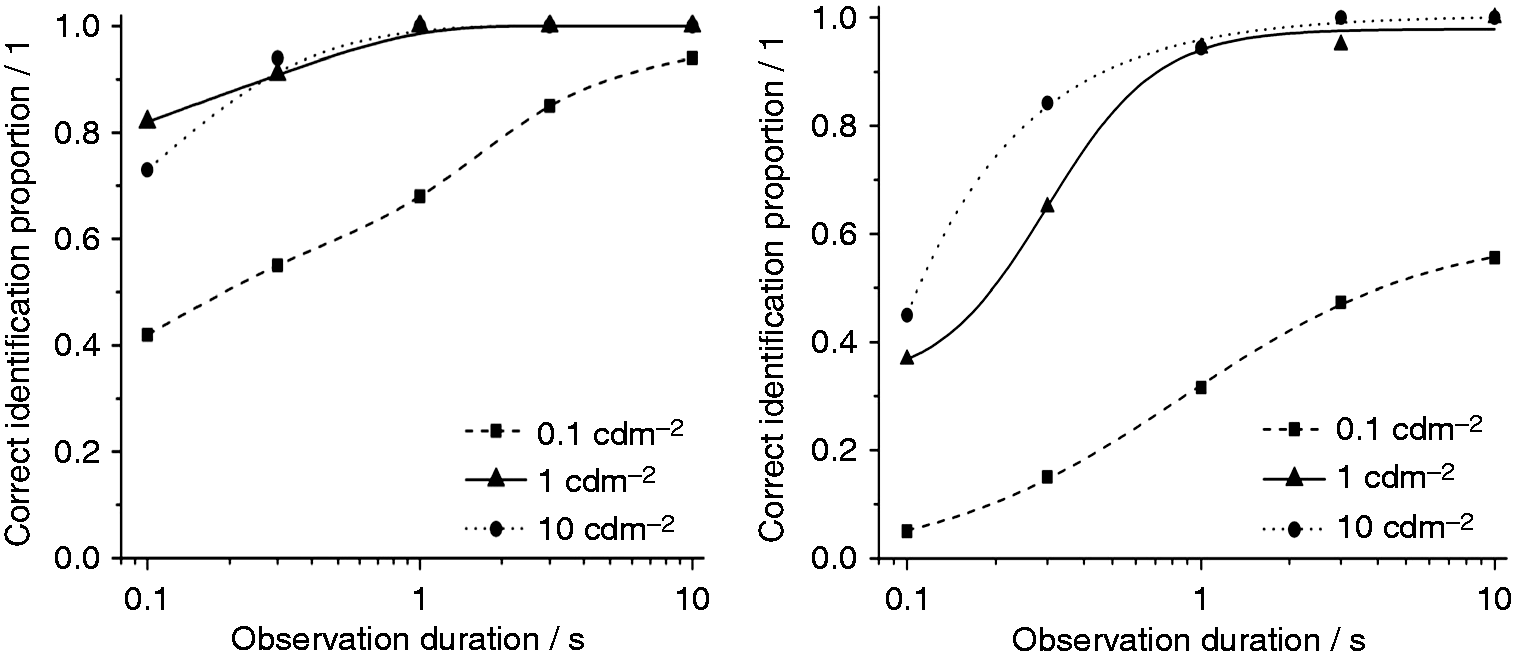
Dong et al.
47
investigated facial identity recognition using two methods (matching and celebrity identification) with five durations of observation (0.1 s, 0.3 s, 1.0 s, 3.0 s and 10 s) at three luminances (0.1 cd/m2, 1.0 cd/m2 and 10.0 cd/m2). The results are shown in Figure 2. Duration was suggested to be a significant factor for all three luminances and both procedures, with longer durations increasing the proportion of correct responses, although performance tends towards a ceiling at higher luminances.
Proportion of correct facial identification plotted against observation duration for three luminances. Left: proportion correctly identified with a matching procedure; Right: proportion correctly identified using an identification procedure.
47
Given that duration matters, there is a need to identify an appropriate duration with which to investigate changes in lighting. First consider evidence as to the minimum time needed to make an evaluation. Carey 95 suggests a familiar face can be recognised in 500 ms, but does not, however, cite evidence to support this. Hsiao and Cottrell 96 examined the influence of the number of eye fixations on face recognition performance. With only one fixation, performance was above chance; performance increased with two fixations but there was no further increase for more than two fixations, which suggests two fixations to be optimum. Todorov et al. 97 reports two experiments where judgements of trustworthiness were made after brief observations of a series of faces and these yes/no responses were compared with ratings of trustworthiness made without time restraint. In a first experiment, the targets were presented for 50 ms, 100 ms or 500 ms. There was a significant difference between the three durations; people are able to make trustworthy judgement after 50 ms but they are better in 100 ms. A second experiment used durations of 17 ms, 33 ms, 50 ms, 67 ms, 100 ms, 167 ms and 500 ms. Comparing these with judgements made without time restraint revealed a plateau reached at 167 ms. Similarly, Willis and Todorov 98 used 100 ms, 500 ms and 1000 ms durations in personality judgements including trustworthiness using a yes/no response. Comparing these to separate judgements made using a nine-point response scale without time limit shows high correlation even for the 100 ms duration. Clearly, these results address reliability of judgements and not their validity – that the same judgement was given with both methods does not mean they were correct judgements, only consistent judgements. These results demonstrate an ability to form reliable judgements of others with very thin slices of information. 99
Consider next evidence as to the typical time desired for looking at other people. Two studies100,101 investigated this using the data recorded in a pedestrian eye-tracking study, 8 including the duration of visual fixations towards other people. These studies reported a median of 480 ms, 100 and a mean of 475 ms, 101 the latter using a larger data set comprising 5955 fixations towards 2496 pedestrians. For convenience, this might be rounded to 500 ms. Further evidence that 500 ms is a typical duration of observation is found in an additional eye-tracking study in which test participants walked around an oval circuit in a laboratory in the opposite direction to target pedestrians. 102 The first of their 48 laps of the circuit best simulated real situations, i.e. before behaviour was influenced by learning of the behaviour patterns of target pedestrians, and for these laps, the fixation duration was also approximately 500 ms.
Given that observation duration affects the chance of correct facial identity recognition, 47 then further research should at least include a duration of 500 ms. Eye-tracking data suggest a mean tendency to look at other people 2.4 times, 101 although the nature of these repeated fixations was not established. Overall, this is 1.2 s observation, which indicates that the stop-distance procedure used in some past studies of lighting (Table 1) is not realistic as it instructs an observation of longer (likely continuous) duration.
4.3. Observation distance
The inter-personal distance at which an evaluation is made affects the visual size of the target and thus the ability to discriminate detail. The accuracy of recognition judgements is affected by distance, becoming more accurate for closer targets 29 and this appears to be a function of image size rather than the longer duration of observation likely for an approaching person.
Some studies (see Table 1) have used a stop-distance procedure, in which the test participant and/or the target person walk towards one another until the test participant stops walking (or otherwise indicates) the point at which the required identification can be made. A problem with this approach is that it reveals when a judgement can be made, but not if that is a desirable distance for the judgement to be made. It also means the task is completed at a somewhat random size. Evidence is sought here for the desirable distance. This distance may be sensitive to the cultural context, since people raised in different parts of the world seems to prefer different distances when communicating with other persons. 103
Current lighting recommendations for pedestrians were established by Caminada and van Bommel, 3 and for evaluating other people they adopted the inter-personal distances described by of Hall. 104 The minimum distance at which an alert subject would be able to take evasive or defensive action if threatened was suggested to be 3.7 m (12 feet), an ideal facial recognition distance being 10 m. Fotios et al. 100 reviewed Hall and concluded that the evidence was not sufficiently robust and furthermore that Hall had not intended its use in such a manner.
Two studies105,106 have attempted to investigate comfortable interpersonal distances but a comparison of the results with the size of the test environment hints at an influence of range bias – the smaller laboratory room led to the smaller estimate of comfort distance 100 – and thus that the findings are not generalizable.
An estimate of desirable fixation distances was made by further analysis of pedestrian eye tracking recorded in natural settings, 8 and this suggested that fixations took place at a mean distance of 14.0 m. 101 For the purposes of investigating the effects of lighting on interpersonal judgements, this was rounded to 15 m with consideration to other evidence. It is a practical distance, being shorter than that (23 m) at which the rate of correct facial identity recognition reduces to only 25%, 57 it falls within the ‘action space’ zone (2 m–30 m) of Cutting and Vishton 107 and agrees with Townshend's finding of the preferred comfort distance after dark (15 m). 108 It is longer than the distances (4 m and 10 m) adopted by Caminada and van Bommel 3 but agrees better with opinion from design guidance texts which propose there should be an ability to have a good look at other people at distances from 12 m to 25 m.109–111
4.4. Disability glare
Glare arises from an extremely non-uniform distribution of light in the visual field. As light sources have become more efficient and as optical control has improved, road lighting has tended to use smaller but brighter lamps, these offering ideal conditions for disability glare. As a pedestrian walks and changes their location relative to road lighting fixtures, there may be a change in the relative amount of glare. The headlamps of oncoming vehicles and bicycles, domestic security lamps and shop displays may also induce disability glare.
Disability glare is an impediment to the visual system caused by light scattered in the eye forming a luminous veil over the retinal image; the likely result is that this will reduce the luminance contrasts of the retinal image and thus reduce the visibility of the scene. 112 For older subjects, there is a significant effect of glare on low contrast visual acuity. 68 Disability glare is therefore likely to hinder visual information sought by observing other people, although the magnitude of this may be less than predicted by a consideration of the decrease in effective contrast alone. 113
There is little research available which directly relates to the influence of glare on interpersonal judgements. Caminada and van Bommel 3 investigated the influence of glare using a stop-distance recognition procedure, and found that with glare – 8 < Threshold Increment < 15 – recognition required a slightly shorter distance than without glare – Threshold Increment < 2 – for the same light level. The results suggest this effect diminishes at higher light levels; the use of familiar targets may have made the task too easy and thus hiding a greater effect of glare; in any case, the apparent difference was not confirmed by statistical analysis.
Kohko et al. 87 used a luminance adjustment task to find the target luminance needed to identify the facial features of a dummy under different combinations of background luminance and glare (veiling) luminance. These results suggest that the face luminance required for identification increases as the veiling luminance increases; specifically, the luminance required for facial identification correlated well (r2 = 0.995) with the combination of veiling luminance and background luminance. The central tendency expected with an adjustment task114–117 may, however, have influenced these data.
Although there is some evidence that the presence of disability glare reduces performance on a facial identification task, further data are required to confirm and quantify the effect.
5. Summary
One of the aims of outdoor lighting public spaces such as pathways and subsidiary roads is to help pedestrians to evaluate the intentions of other people. This paper discusses how the effect of changes in lighting on pedestrians' appraisal of another persons' intentions in artificially lit outdoor environments can be studied.
We propose that the face is a suitable visual target. Much past work in lighting has examined facial identity recognition; this work gives mixed conclusions as to the effect of SPD which can be explained by the different levels of difficulty presented by the different experimental procedures used in those studies.
To make progress, there is a need to consider which procedure(s) best represent pedestrians' visual needs when walking after dark. To discern the effect of the outdoor lit environment on an individual's ability to appraise the intentions of other people, there is a need to understand what are the relevant visual cues, how are they operationalised, what are the associated measurement(s) available and what are the appropriate procedure(s). Review of the literature suggested that appropriate conditions for lighting experiments are evaluation of the face using a FER procedure rather than identity recognition, with targets scaled to represent a distance ahead of 15 m, and observed for 500 ms.
We propose FER as a representative task for further studies in research of outdoor lighting. We do not suggest that pedestrians always look at the faces of other people, nor that facial expression is the sole cue to determination of the likely intentions of other people. It is known, for example, that the context will influence how we appraise people 92 and that the interpretation of an expression can be influenced by context (such as an angry expression being interpreted as afraid in a frightening situation).25,118,119 What we do suggest is that FER is a suitable task for evaluating changes in lighting because it has a higher degree of ecological validity than an abstract foveal task such as Landolt ring gap identification and is a better defined task than facial identity recognition. There may be a range of cues when evaluating others, such as gender, number of people and direction of travel; if we can see a persons' facial expression, it is plausible that these other cues can also be determined.
One critical question is the medium by which target faces are observed. Photographs offer many advantages, including the ease of providing randomised, brief, presentations.
While dynamic images – e.g. videos – offer cues associated with motion, such cues are relevant only for familiar people but not unfamiliar people. However, while photographs may be suitable for investigating the effect of changes in light level or SPD, they may have limited use when investigating changes in the spatial distribution; where 3D target faces are employed then care is needed to ensure expressions are consistent. Repeatable 3D targets have become possible through the use of 3D printing or immersive virtual environments, but these tools require further work to become useable for FER studies and have not yet – to our knowledge – been used in reported work.
Past studies of lighting and facial emotion recognition in the context of outdoor lighting.
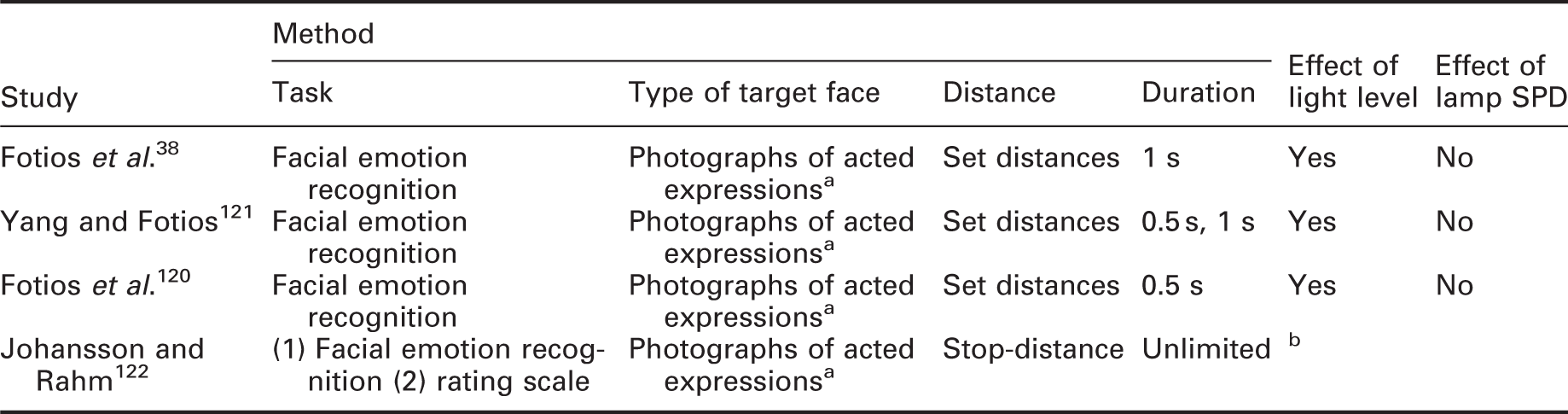
SPD: spectral power distribution.
aPhotographs of acted expressions: this refers to photographs of people portraying one or more of the universally recognised expressions rather than of celebrities, and where taken from a database such as FACES (Ebner et al. 77 ) the emotion portrayal is validated – confirmed repeatable – by testing under good conditions.
bBoth SPD and light level varied in the three scenes examined and thus the separate effects of light level and SPD are confounded: it was found that with light source C the emotion could be identified at a longer distance. Source C had higher correlated colour temperature (CCT) and S/P ratio than did sources A or B.
More reliable and valid data can be obtained for adequate outdoor lighting if studies are founded on knowledge of relevant visual cues and employ informed methods and procedure to assess people's appraisals of other people. We need to understand the individual's response to other people in relation to the physical and social context of public spaces including pathways and subsidiary roads and including prevailing cultural norms and lighting preferences. The appraisal of other people is only one of several tasks that are important to pedestrians. Perceived safety from threats by other people is, however, a key issue for pedestrians and an argument for many installations of artificial outdoor lighting in urban pedestrian environments. Further research is needed to understand to what extent these measures are associated with perceived safety and increased walking in such environments.
One further consideration is the purpose of walking. People walk for many purposes but they tend to overlap and transform during the walk. 123 While some trips are flexible and can be post-poned or avoided if one does not feel confident in the environment – e.g. a recreational walk in the evening – others are fixed with regard to time and place – e.g. an early morning walk to catch a train to work – and are done regardless of how confident one feels in the environment. 124 In the latter case, it could be expected that the pedestrian is more alert and sensitive to the visual cues in the environment. Eye-tracking studies might help to identify such differences.
The assessment of outdoor lighting for pedestrians demands multidisciplinary approaches to accurately define appropriate lighting designs meeting both pedestrians' needs and goals to reduce energy use. In other words, the development and evaluations of such lighting installations should combine current psychological knowledge of human appraisal of other people in diverse pedestrian settings with an understanding of urban planning and design and the development and use of energy efficient lighting technology.
Footnotes
Declaration of conflicting interests
The authors declared no potential conflicts of interest with respect to the research, authorship, and/or publication of this article.
Funding
The authors disclosed receipt of the following financial support for the research, authorship, and/or publication of this article: Steve Fotios' contribution was supported by the Engineering and Physical Sciences Research Council (EPSRC) grant number EP/M02900X/1. Maria Johansson's contribution was supported by Lighting Metropolis EU Inter-reg project NYPS 20200430.