




Abstract
The aim of this paper is to elucidate how occupants perceive their lit environments in a university setting and how they interact with lighting controls using qualitative methods. Semi-structured interviews were carried out with academic teaching and research staff. Thematic analysis identified four main themes: control and choice, connection with the outdoors, concentration and comfort. Participants were largely able to control and adapt their lighting using small power lighting in office spaces and they perceived this as beneficial to comfort and concentration. Participants expressed frustration with the light switches in classrooms, and a lack of consistency in lighting controls across the university buildings was particularly notable. Installers should consider how piecemeal upgrades on large estates affect the perception of buildings where occupiers face multiple control systems. The management of the lighting in classroom spaces including the type and location of blinds, lack of regular window cleaning in some buildings and difficulty in minimising light on projection screens in upgraded classrooms were cited as areas for improvement. Wider implications for lighting control and management highlighted by this study include most notably that a lack of end users consultation has serious consequences on their perception of lighting upgrades and their willingness to employ ‘workarounds.’
1. Introduction
In the first six years of Reading University’s carbon management programme which started in 2009, lighting retrofit projects made up 12% of the total carbon energy efficiency projects and the nine lighting upgrades cost a total of £810,532 and achieved savings of £164,951 per annum and 800 tCO 2 e. Lighting incurs a significant financial and carbon cost: although engineering standards for lighting specifications and codes of practice detail optimum and quality lighting solutions 1 there is little attention paid to how these lighting systems perform in practice. 2 While the Chartered Institution of Building Services Engineers (CIBSE) guidance suggests training should be given in the use of lighting controls, the theoretical and practical impact of training 4000 staff and invited public speakers indicates that intuitive lighting controls are essential in all university spaces and could negate the need for training if designed properly. Although this issue is most salient for higher education institutions dealing with a large annual turnover of staff and students, it clearly also arises for any large organisation, in particular ones in the public sector where large numbers of visitors are interacting with lighting and, potentially, lighting controls. The use of the university’s buildings and subsequently their lighting vary greatly over time and – because of age, maintenance and management – may differ substantially from what was anticipated at the point of initial design. Despite UK guidance on lighting for education being available, and this includes explicit design options for whiteboard and projection screens, 1 without project managers adopting these guides there are many opportunities for poor lighting upgrades. In 2015 it was reported that the UK public sector faced the risk of being ‘locked-in’ to old technologies, 3 although UK universities are seen as being private sector they still have the ability to operate as if they are public sector. Even over shorter time periods the intentions of lighting designers might not be realized in the day-to-day experience of building users. One of the most obvious ways in which building users interact with lighting is the use of a control switch, researchers have found significant effects in lighting use, daily patterns and energy consumption in public sector buildings by varying the design of the light switch, 4 but lighting control itself is still only part of the lighting experience. User experiences of lighting control technologies are investigated in this paper.
Light switching behaviour has been shown to alter following the introduction of lighting control technologies, particularly automation, and can in some circumstances lead to greater, not less, electricity consumption if individuals come to rely upon the automated systems to turn off lights (which they will do after a delay) rather than turning them off manually more promptly.5,6 A key outcome of researchers investigating LED versus fluorescent T5 lighting in classrooms was that, crucially, LED lighting is not synonymous with energy savings, the LED lighting in this study actually incurred up to an additional 30% of energy use through parasitic losses. 7 In offices, best practice guidance and careful design can afford both control to individuals and an indirect lighting system to balance the non-visual lighting needs of occupant’s wellbeing and still achieve energy savings of up to 70%. 8 Previous qualitative survey-based research has investigated office workers use of lighting controls and results indicated that, unsurprisingly, people had a preference for daylight but also, and more worryingly, 72% of this study’s respondents did not know how to find the lighting remote control keys underneath a sliding cover. 9
This study makes use of a qualitative research approach to examine aspects of user experience and beliefs not easily captured by more traditional quantitative methods. Semi-structured interviews allow researchers to gain insight into the diverse range of views and experiences of individuals including their rationales behind decision making, habits and behaviours. 10 The focus of this research is how occupants perceive their lit environments in the campus spaces they frequent and how they interact with lighting controls. These occupants thus constitute ‘end users’ of the building space and the lit environment provided for them.
2. Method
2.1. Recruitment
Participants were directly recruited via staff email group lists. Nine academic teaching staff participated. Seven of the nine staff were researchers in the built environment. During recruitment and in the briefing sheet provided participants were informed that the purpose of the study was to explore their lighting preferences in their working environments. Academic teaching and research staff were selected as they represent a less transient population than undergraduate or postgraduate students and are more likely to have experience manipulating the light and lighting conditions in a variety of university spaces. A small sample was appropriate because this research aimed to collect a rich description of detailed information about each individual’s experiences and views. Data collection is deemed sufficient when theoretical saturation is achieved at a point where no new themes emerge from interviews.
2.2. Data collection
2.2.1. Interviews
Participants were interviewed at a convenient time and date in their own offices or a location convenient to them. Being able to conduct the interview in the individual’s offices allowed the occupants to directly show the interviewer their preferences. Participants had typically occupied offices within the same buildings for periods between 3 and 26 years. In two interviews the recording was split into two separate periods, one because the participant started to talk again about light and lighting after the interview finished, this discussion was paused and recording resumed; the other because the participant wanted to relocate to their laboratory to demonstrate their difficulty with using the retractable light switches that were linked to the automated lighting sensors.
A semi-structured interview procedure was formulated from a previous pilot study. The questions were decided upon as specifically focusing on lighting, lighting behaviour and the use of campus spaces. The topic guide comprised eight main areas:(1) Automation in corridor areas; (2) Corridor dimming, sensitivity and timing; (3) Orientation of building; (4) Office daylight, blinds and artificial lighting; (5) Office lighting habits and patterns of behaviour; (6) Seasons/weather; (7) Classroom lighting controls – examples of excellent and poor designs; (8) Views and blind use. The questions were not limited in scope and the researcher actively sought to keep the question open ended to encourage opinions and further examples to be expressed.
Lighting automation (topics 1 and 2) in the corridor areas was chosen as this was found to be a topic generated by an earlier pilot study conducted with four postgraduate students and two staff members in initial semi-structured interviews. The orientation of the building (topic 3) is a factor linked to daylight and artificial lighting design. Questions were also posed about the individual’s working environment (topic 4), their office, whether that is open or single occupancy and how much control they have other the lighting in this space. As seven out of nine participants were recruited from the School of the Built Environment, they were mostly familiar with the 2013 lighting upgrades in corridor and classroom areas as part of the university’s Carbon Management Plan. Two participants were deliberately sought from other independent Departments to triangulate the collected data and provide insights from a wider range of participants. Their usual patterns of behaviour and habit (topic 5) were also explored in both their office environment and familiar classrooms. Seasonality (topic 6) was included as this impacted their use of blinds and artificial light – especially when teaching – and varied according to the daylight availability. Topic 7 related to their classroom spaces and was investigated by asking participants if they could recall specific examples of good lighting controls that were easy to use and understand, and also those that suffered from poor design and were difficult to use in practice. Finally, participants were asked about their perception of their office and classroom views (topic 8) and how this related to their blind use.
The interviews were recorded using a Sony ICD-PX312 audio recorder. The audio files in .mp3 format were sent via a file sharing site to an external agency for transcription. The written transcription was received by the researchers and then checked thoroughly, three times in total, for errors whilst the researcher listened to the audio file. Notes were also made during the interview.
2.2.2. Field information
The 30 teaching and learning buildings on this university’s main campus amount to 122,000 m2 of the gross internal area floor space. Reporting the individual offices, hundreds of centrally bookable classrooms and their respective corridor floor plans, lighting levels and light sources was outside of the scope of this study. The focus of this study was instead on the participant’s responses to their lit environment in all of those spaces. All of the spaces mentioned were lit with fluorescent lighting, re-commissioning infrequently took place in practice as specialist external commissioning engineers charged up to £1000 per day. The quality of good lighting has been discussed alongside the very real goals of time and budget constraints, whilst acknowledging that indifferent, adequate and even bad lighting is unfortunately a norm for some. 11
2.3. Data analysis
A thematic analysis approach and initial coding method was used. This assumes the researcher has no preconceived theories about how people use their space or how they choose to light it. There are no hypotheses given as it starts from an open point of view about letting the participants speak candidly about their position and viewpoint. The process of data analysis followed the flow chart detailed in Figure 1. The initial analysis was conducted using process coding (also known as ‘action coding’),
12
to identify the main categories found when summarising participant responses.
Process of conducting thematic analysis of this study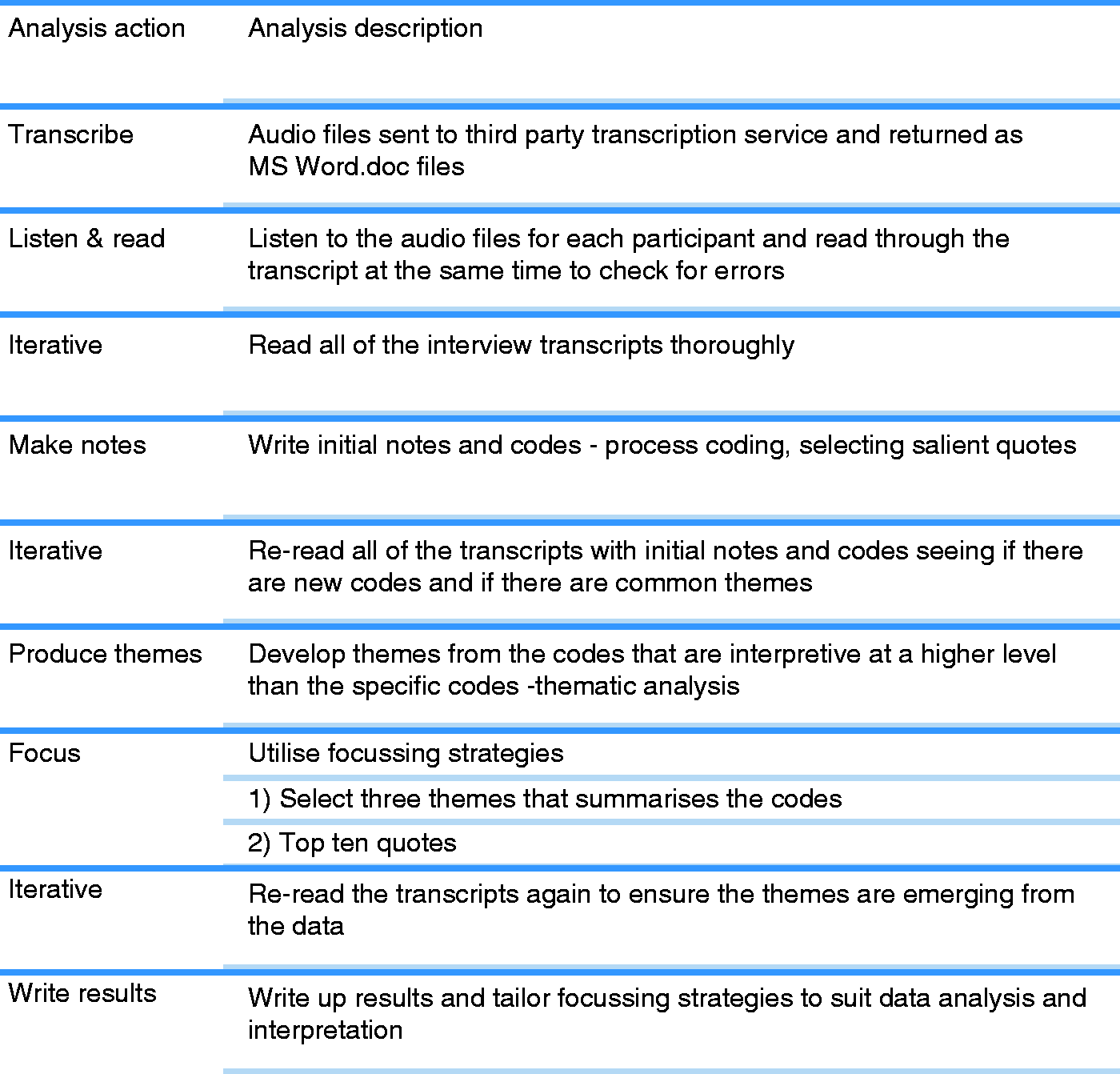
Thematic analysis uses initial codes which are then collated and developed into themes from the data. Outputs were refined using two focusing strategies, 12 which sought three main themes and a top 10 list of extracted quotes that were particularly relevant. The results were reviewed through iterative stages to identify a total of four themes that emerged from the data as the strategy was a starting point to further develop the interpretations as the analysis progressed.
2.3.1. Rigour, validity and limitations
The British Medical Journal’s checklist for qualitative research 13 was followed. A key characteristic of qualitative research is the desire to seek a personal opinion and judgement from the participant. Using topic guide questions and open-ended questions inherently alters the perspective and answers of the participants. If the researcher wanted to remain outside of the research they would choose surveys and quantitative statistical methods that seek to be unbiased. The interviewer’s background in physics, surveying and specialism in lighting controls meant that focus was on how people used the controls in campus buildings and whether these were functioning as intended. In eliciting responses from participants the interviewer tried to refrain from using any building jargon and instead used the participant’s language to further conversations. The participants chosen were not unbiased in their prior knowledge and ability to describe the built environment as many were from the School of the Built Environment. However, the two participants that were not ‘experts’ in this field provided similar insightful and comprehensive accounts of their use of light and lighting in their spaces.
Negative findings and divergent cases are also reported here, for example when a participant’s contribution did not fit the general conclusions arrived at once analysis was completed. A comprehensive paper trail of interview notes, initial codes, themes, interpretations and findings was developed throughout the analysis. Validation was achieved through means of an in-house seminar where intermediate analysis was presented to the participants and they were invited to give private feedback to the researchers.
3. Results
Participants were encouraged to discuss specific examples, such as buildings and classrooms. Photographs of some of these are given below to illustrate participants’ observations. Four major themes naturally emerged from the data on light and lighting: control and choice, connection with the outdoors, concentration and comfort.
3.1. Control and choice
One of the most commonly asserted themes was having control over the light and lighting. Previous work has suggested blind use is linked to direct sunlight and solar gain prevention.
14
This study raised the issue of window blind use with academic staff who occupied offices. These interviews demonstrated that blind use was not only affected by these two elements but also management practices in different buildings across campus. For example, the different university buildings are subject to different window cleaning frequencies, which are managed by individual Schools and their respective budget constraints, rather than centrally. Interviewer: ‘And your blinds, they’re half open at a bit of an angle now, do you alter them between the seasons at all or?’
Participant 9: ‘Not really, sometimes in the summer I just open them completely so I can gaze at the blue sky but they’re only there because the windows are fairly ugly so they’re edge on to take your eye away from the blind aluminium finish of these ugly windows. It’s pockmarked, when the glass is dirty the university doesn’t pay for window cleaning, the windows are dirty, the aluminium is stained and past its best so I want to see the view but if I’m focusing on the window frame the vertical blinds pull my eyes to the blinds rather than the window frame. It’s strange isn’t it really but they add to the feeling of, I suppose it’s a feeling of being in control of the environment, overriding the decisions that were taken by some faceless building services engineer in Estates and Facilities who’s got no idea what these things feel like to work in.’ [Expert in the built environment, academic]
The use of direct control over lighting has been suggested to increase office worker’s satisfaction with their physical environment.
15
The small indirect uplighters and direct task reading lamps allowed them to create different moods and areas for carrying out different tasks.
Participant 2: ‘Yes, so this Anglepoise lamp is very much here at the work station so it’s very much a reading lamp. The one in the corner is purely an ambient lighting thing to make it look pretty. The other one on the desk is that, because they’re all compact fluorescent bulbs and they’re quite low wattage CFLs they don’t give out masses of light, so without that one on, then you’re coming to this kind of grey area between a nice ambient environment and sitting in the dark, and so that one on the table is very important in the sense that when I have students coming in that I supervise, the idea is that that table is normally empty and the only thing on it is the lamp and it’s purely to get them feeling relaxed so that we can have a conversation. I do feel that having that nice mellow lighting helps to put them in a calmer frame of mind, that’s the idea, and that’s why I’ve got the nice pictures around there as well.’ [Expert in the built environment, academic]
Interviewees also explained their difficulties with using the light switches when controlling lighting for teaching/lecturing in classrooms. They described their habit of selecting the appropriate artificial light levels by trial and error at the beginning of the lecture period. The theory of planned behaviour, which is based in rational choice theory is widely established, yet there is still a gap between automatic unconscious habitual patterns of behaviour and the end result.18,19 The lack of consistency and continuity with the light switch interface across different buildings and teaching spaces was repeatedly raised. Despite explicitly mentioning classrooms recently upgraded with dimmable T5 fluorescent classroom lighting, only one interviewee reported being able to use these in practice as they were fitted with retractable switches, a situation discovered by the interviewee through trial and error.
Participant 8: ‘If they were dimmable I probably didn’t know. So I would probably just use as on or off. Now, like if there is a slider that goes up and down, that’s pretty obvious that I can control that, but no, if the switch looks just on or off I would probably just use it like on or off.’
Participant 5: ‘I just know how to use them through trial and error. One of my particular complaints about these things is in some parts of the university you have an on off switch which is simply there and what you don’t realise about that on off switch is if you hold the on switch, it brings the lights up and if you press the light switch off it brings the lights down. Great once you discover it but it is entirely by
Interviewer: Accident?
Participant 5: Accident that you find that out, and that’s just irritating apart from anything else.’ [Non-expert in the Built Environment]
Chemistry lecture theatre light switch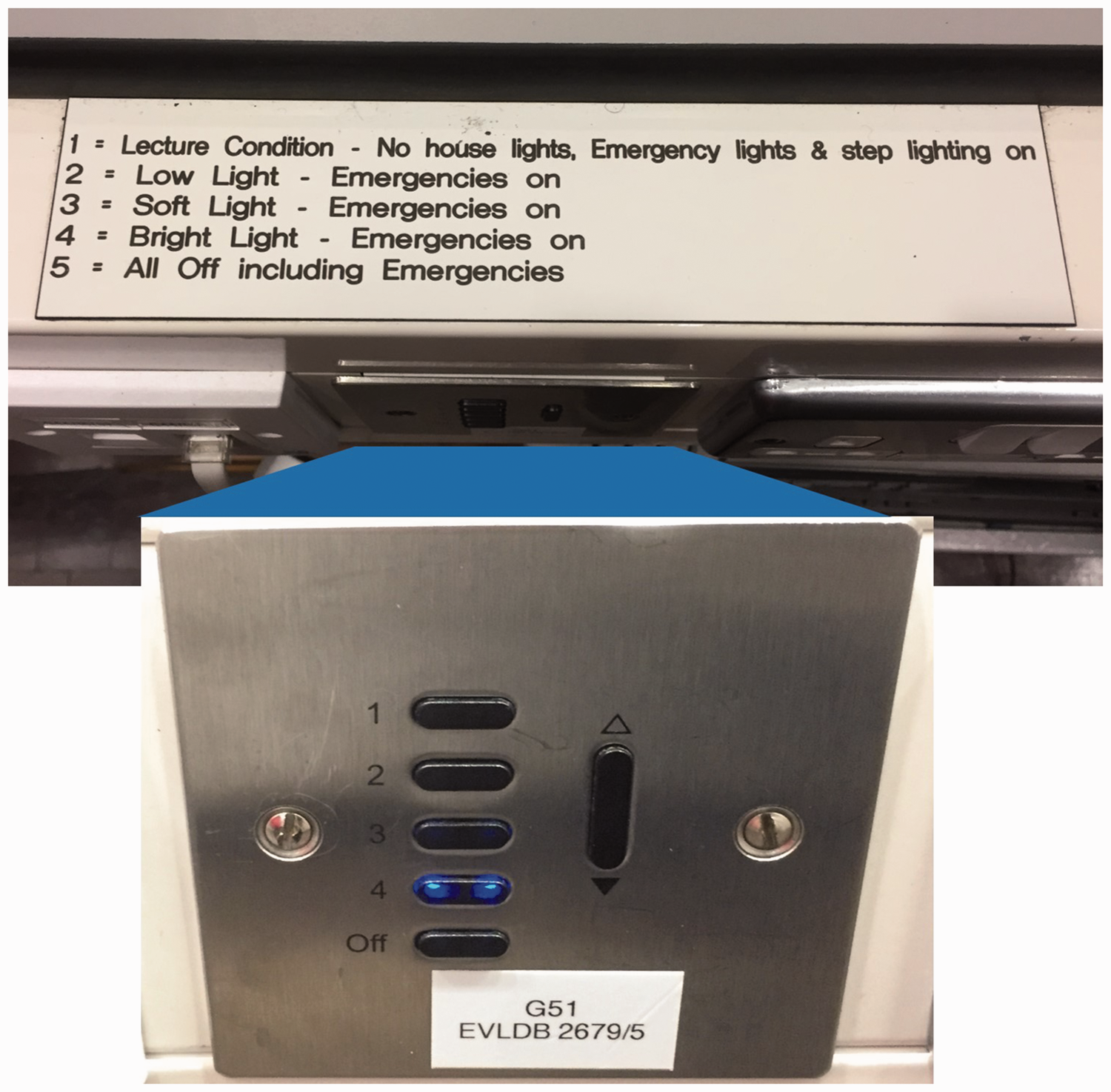
Finally, the participants mentioned that their use of multiple teaching tools: video, presentation, exams, group and individual exercises necessitated different lighting conditions and control over these different teaching styles was often made difficult by the design of the lighting controls.
Participant 5: ‘It’s really quite important, especially as I tend to use video clips and other tools in my lectures that I can actually vary the lighting in the room. The difficulty being is if you want to show a clip you need the lighting to be right on the screen, there’s no point in showing people a clip if the, it’s, the screen is possibly washed out by an unnecessary light.’ [Non-expert in the built environment, academic]
3.2. Connection with the outdoors
Unsurprisingly, the participants had a preference for daylight in their offices and classrooms. Their enthusiasm for occupying a space that had access to daylight was not only important for themselves but also their students. Previous research has shown that for children in classrooms the effect of daylight impacts non-visual effects such as health outcomes and circadian response,
20
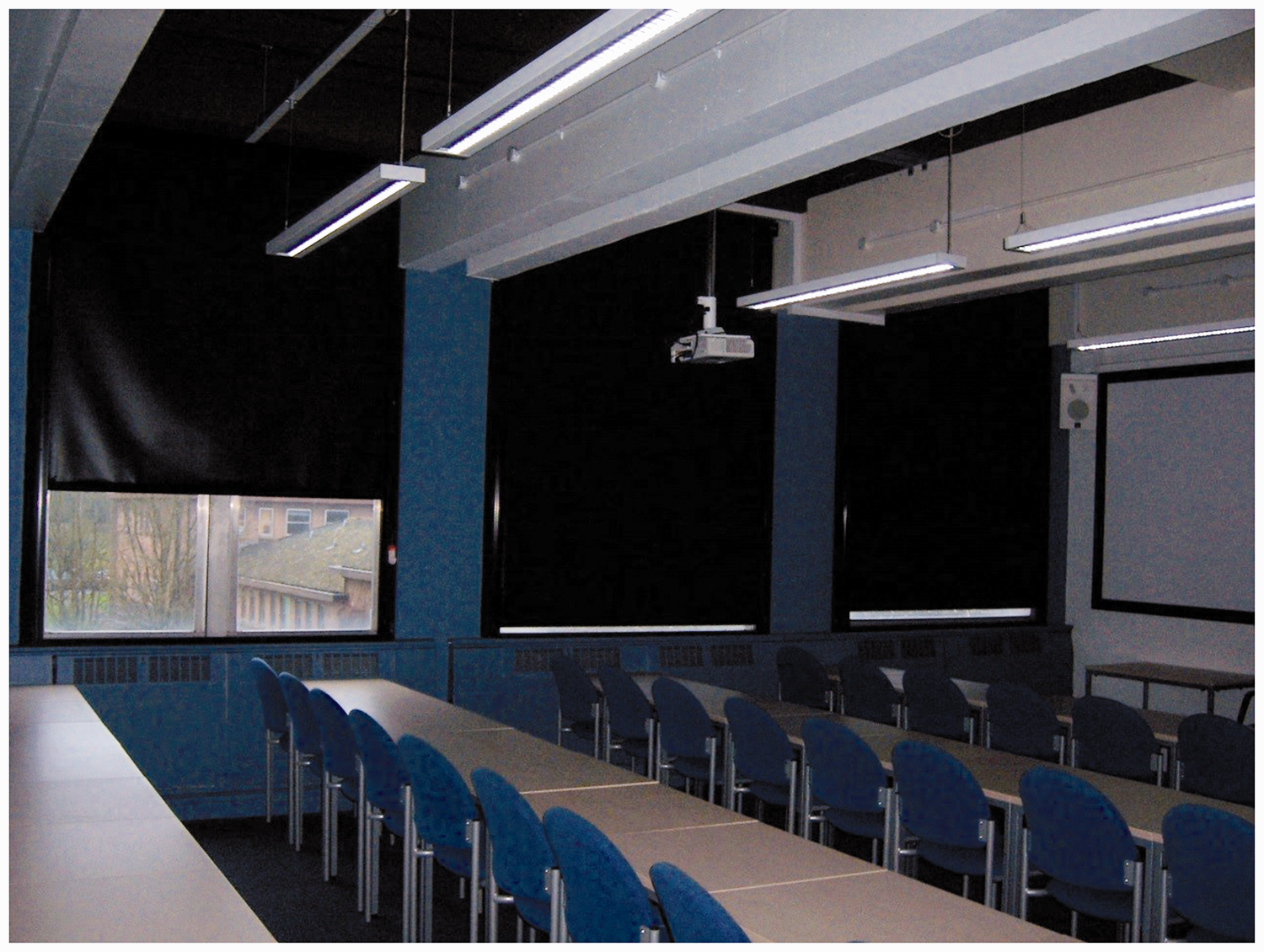
and it is reasonable to assume that the same may be true for adult learners and teachers. There was a willingness to consider teaching outside as a viable option for lesson plans. The lighting in the classroom spaces and student’s ability to see the screen, make notes and see the lecturer was perceived as important to participants. Some of the classrooms specifically referenced are located in 1960’s and 1970’s style buildings with few or no windows, or conversely large south facing windows with black blackout blinds (Figure 3). These spaces were depicted in some of their opinions as oppressive environments for both lecturer and student, particularly when teaching for a full week, 8 hours a day.
Participant 1: ‘So I mean it’s horrible for lots of reasons, one of them being there’s no sense of connection with the outdoors. Now if your lectures stimulating enough and interesting enough, perhaps it’s something that you can forget about but they’re in there all day and also you might be teaching them all day as well. And I just think from that perspective it’s nice to see, have a connection with the outdoors, to see how the day is progressing you know. Not going in at nine and it sort of quite dim outside and then leaving at five and its dark.’ [Expert in the built environment, academic]
Classroom used for lunchtime research seminars in the School of the Built Environment
Participant 6: ‘One of the classrooms I was describing to you in systems engineering, that’s where I would have those six hours with the students, and it’s horrendous. They’re falling asleep within the first 20 minutes. I could be doing breakdancing on the stage, they’d still fall asleep because of the environment that they’re placed in. But outside they’re absolutely on it, engaged, interested etc, so they’re wide awake.’ [Expert in the built environment, academic]
Participant 3: ‘It’s not only trees and birds and flowers and nice things it’s, even the road, there's a road just out there. I think part of the job of being an academic is daydreaming, you've got to think of things, you've got to imagine things, you've got to try and come up with ideas and resolve issues in your mind and I think a good way of doing that is to look at things outside.’ [Expert in the built environment, academic]
3.3. Concentration
Some individuals explained how their perceived concentration was affected by the daylight and artificial lighting in their offices. Allowing office occupants to have this flexibility of control over their task lighting offers different opportunities for concentration and productive work outputs.
Participant 4: ‘I’ve got a desk lamp there, so if I need to read something on, I would still rather read it on paper than on the screen. Now, I’ve got quite a big screen. So, if I’m really doing some serious marking of something I will sit under that, and I’ve got an old fashioned bulb.’ [Non-expert in the built environment, academic]
Interviewer: ‘And you would choose that over the preinstalled?’
Participant 4: ‘Yeah, I like a really bright light on the paper. And it’s down there. I, there’s the light, here’s the paper.’
Participant 2: ‘but then I want to show a video and so I want to reduce down the light even more and so I start fiddling, I’ve got no idea which buttons to press and then you end up all of the lights go up in the classroom and then they all go off and it’s a nice distraction and people find it funny, but realistically this digital light switch thing is a nonsense, because even though I’ve been here two and a half years I’ve never actually been shown how to use these switches properly’ [Expert in the built environment, academic]
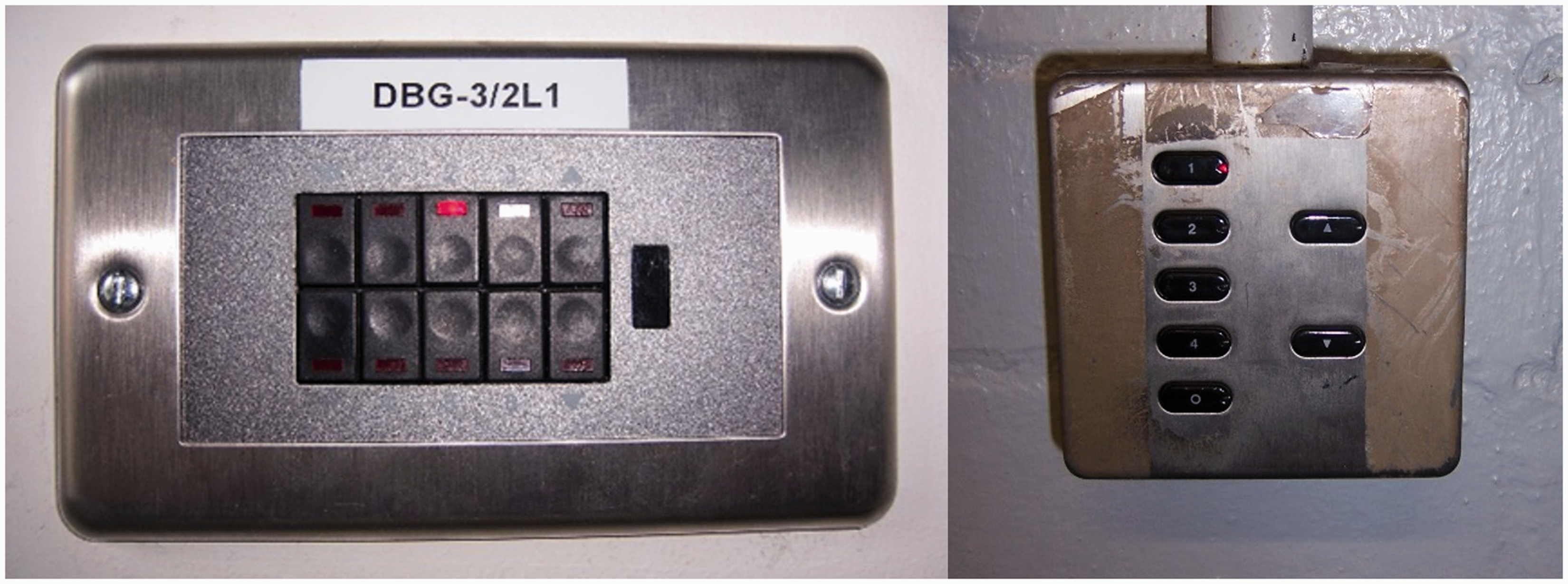
Two specific examples of poor classroom light switches that were explicitly mentioned in relation to participant’s difficulty using the controls
Participant 9: ‘So I imagine the student’s performance would also suffer. They can see it on their faces, they’re sat there and they’re just desperately trying to stay awake and struggling to, with the environment, it’s awful, no fresh air, no fresh light, no daylight, not even, there’s no air con I don’t think. If there is it doesn’t work. But they’re stuffy and unbelievably uncomfortable rooms.’ [Expert in the built environment, academic]
Participant 9: ‘I know the room from the lunch time seminars [classroom within the School of the Built Environment, with 3 metre tall south facing single glazed windows]. It’s a horrible room … you’ve then got people wanting to close the blinds to make it even more claustrophobic and uncomfortable. Now, if the classroom is moving, like on water you’d have everything to be uncomfortable, wouldn’t you? You’d have, you’d be nauseous. And I know, we’ve sat in there for lunch time seminars, and it’s been, people have wanted all the lights off, and other people haven’t. I don’t know. It’s quite high ceilings there as well actually, which probably has some kind of impact, I suppose. But you don’t have fixed desks either. Those desks can all be moved in that room, so the room can be configured differently, but you go into some of the classrooms or some of the lecture theatres and all the seating is fixed, so you’ve got to work with that order unless you’re going to do something serious and move everything. But that as a classroom and as a presenting room, it’s too long, too thin, terrible heating, poor windows, and yeah, black out blinds, it’s not nice.’ [Expert in the built environment, academic]
3.4. Comfort
Specifically, considering how the office occupants personalised their office space the subject of cosiness was frequently cited. Participants wanted to create a sense of comfort and consequently used their lighting, artwork, plants and books to reflect a room, which encourages a calm state of mind and ambience.
Participant 8: ‘Yeah, don’t everybody, well, most people like to personalise their office, but I’m very sensitive to creating a cosy environment, and lighting is a big part of it. I’m very particular about lighting that stimulates me to sit and work or makes me want to leave as soon as possible.’ [Expert in the built environment, academic]
Participant 7: ‘I think the flowers has [sic] been the key to personalise my office, and that poster. The books will definitely absorb a lot of light, so that’s not where I want to sit. I want to sit away from the books because that side will always absorb the lighting.’ [Expert in the built environment, academic]
4. Discussion
Two elements connect the four themes above: design and management, but discussion of these must be preceded by an acknowledgement of pre-existing constraints to action.
4.1. Constraints
This study has discussed the opinions of a small number of academics in this UK University, other user groups clearly need to be part of the wider discussion about the four themes highlighted and it would be interesting to study the views of the more vulnerable users who have additional access and support requirements. The views of the original designers, administrative staff who acted as building managers, and maintenance team although valid would not have provided the insights of the end users, an important factor for designers to remember and apply in practice. There are limitations to implementing lighting changes across an environment (such as the one documented), which comprises a large estate spread over three campuses in the UK and contains listed buildings alongside many newer educational buildings. Notably, few of the lighting retrofit upgrade buildings were amongst those cited as poor in their control systems, but there were clear discrepancies between building users’ ability to use the controls and the ‘design intent.’
The financial implications of retrofitting classroom spaces to standardise the control systems has not been investigated. It is a current requirement that the university’s energy efficiency retrofits must achieve between a 5 - and 8-year payback period to be considered financially acceptable and this form of financial constraint is common. Replacing lighting control interfaces, such as switch plates, on an estate wide basis is unlikely to achieve this payback period as the savings would prove difficult to quantify or empirically measure in practice. The lack of consistency in replacing and upgrading only parts of a lighting system within a large building highlights the financial pressures constraining management decisions but nonetheless it has observable consequences.
4.2. Design
The design of the control interfaces for light switches is one of the most consistent outputs of this qualitative research with participants reporting their many trial-and-error patterns of behaviour in classrooms and lack of ease controlling the light on the screen. It is frequently left to the contractor to decide upon the location, style and complexity of the light switches as reported by Participant 9. As reported the light switches in classrooms regularly confuse and delay the building users from achieving their desired light settings.
Participant 9: Nobody seems to have thought about lighting at all, they just throw these lights in and put some switches in without really thinking. It’s the same mentality that leads us to have projector screens in front of whiteboards. So again you can’t use both, it’s really weird that people are installing things into teaching spaces where the folks who are installing them have never spoken to anybody that uses them or imagined how they might be used, it’s terrible. The lighting is appalling. [Expert in the Built Environment]
Together with many different control settings that differ between classroom and also building, the user faces the difficulty of learning each new system shown in Figure 4. Hence, it is not surprising that many asked if they could be standardised and consistent throughout not only the classrooms and buildings but amongst the different campuses across this university’s estate. It is well-established that consistency is a key component of learnability of many systems.
25
A key implication for the wider lighting profession is to draw upon the cognitive mechanisms at work when artificial lighting is used or daylight is controlled through blinds, these involve explicitly acknowledging the differences between intention, execution and habitual behaviour.
26
Interviewer: Do you think you’d change anything about these controls if you had a chance? What would you want to change about the lighting?
Participant 5: I’d standardise it, I’d standardise it across the university so in one go everything works in the same way in all the rooms, I think that’s one aspect of it. And I think clear instructions and yeah, as much feedback built into the device and as much intuitiveness in the design, so you don’t have to think too much about it and that it makes sense. So I think I would imagine that would take quite a lot of trialling, however I think maybe there are some parts of the university as the one that we’ve already talked about, in Building 22, there’s already some good practice there that maybe even could just be rolled out. [Non-expert in the Built Environment]
Lack of inclusive thinking and a thorough design process, has led to frustration and adaptive behaviours amongst the interviewees, who comment upon how this has affected their teaching and student learning, the most notable of which was one individual’s preference for teaching outside as they believe this assists with their student’s concentration. This belief cannot be assessed given the absence of direct evidence but it does provide some interesting elements to the discussion of including the academic teaching staff within the design process, which is not without precedent and there is evidence that – within higher education – building users can substantially influence the design with positive effects. 27
4.3. Management
CIBSE best practice guidance emphasises that lighting controls require qualified commissioning engineers and adequate training should be provided to building users to operate these controls. 1 Conversely, if prior design and lighting knowledge of occupancy patterns and building orientation was used by pre-commissioning the controls and sensors this could potentially reduce the installation time. Intuitive well designed lighting controls negates the need for training, 28 which may be impractical to provide, particularly in a transient environment where there are multiple system users and lighting controls are simple in function even if the few functions intended are not adequately conveyed by their appearance. Norman 28 explains the use of signifiers, constraints, mappings and a conceptual model in the ‘Gulf of Execution’ where a user tries to understand how it works and what it does; and the use of feedback and a conceptual model in the ‘Gulf of Evaluation’ where a user assesses what current state the system is in and if their actions achieved the intended goal.
Utilising human centred design concepts, Figure 5 illustrates the gulf between the designer and user’s conceptual system models of how a retractable light switch functions in practice.
Two conceptual models for a retractable light switch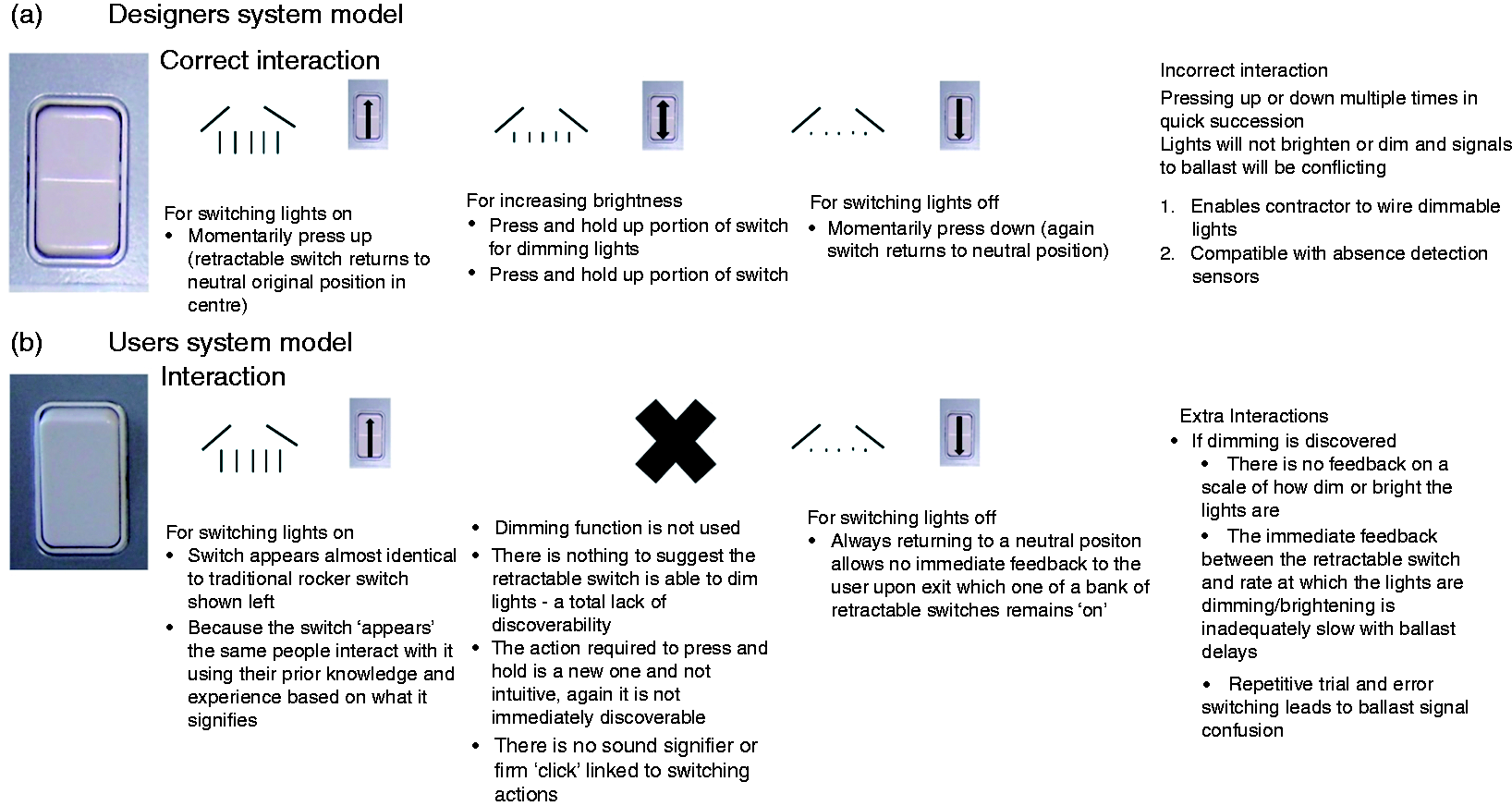
The management practice of installing retrofit lighting upgrades only in specific parts of the building (e.g. corridors) where the payback was under a 5-year period, also resulted in an experience of inconsistency. Failing to ensure blind controls were functioning and of suitable style, colour and quality, and a lack of a consistent window cleaning strategy impacted upon the building users control and comfort in both offices and upgraded classrooms. Management decisions resulting in an inconsistent end-user experience have unintended consequences for occupant behaviour. Broken blind controls and dirty windows can lead to a sense of occupying a neglected and poorly managed building. The lack of maintenance of office light fittings and blinds frequently led to occupants adapting their behaviour and personalising their offices to maintain what they perceived to be a suitable level of comfort. Adaptive behaviour in the built environment in relation to blinds and lighting controls includes covering illuminance sensors with tape in automated lit environments to override the control systems. 29
These results suggest that the opinion of academic staff is that the student learning experience is impacted upon by the light and lighting in university classrooms. Access to a view and daylight for student comfort and concentration was deemed valuable by most of the participants. Designers need to consider the multiple users of the space and the flexibility that these spaces afford for different scenarios by different users, be it students, academics, guest speakers, cleaners or administrative staff.
The control over classroom lighting was articulated by six of the participants who described trial-and-error events at the beginning of every lecture slot to set the lighting to their satisfaction. The fluorescent lamps installed in the university’s classrooms take a minimum of 2 minutes to reach an almost constant light level, if like Figure 4 there are many possible permutations (scene settings and on or off), this would require arriving early pre-lecture time to find the appropriate setting. The blinds in classrooms also prevent a connection with the outdoor space and despite enjoying daylight, the use of blackout blinds creates claustrophobic feelings and spaces that are deprived of sensory experiences. The influential work of Leaman and Bordass 30 still continues to educate designers by grounding itself in systems being simple, intelligible, affording feedback and crucially designers respecting people’s comments when evaluating building performance.
5. Conclusions
This paper aimed to elucidate how occupants perceive their lit environments in university buildings and how they interacted with lighting controls using a qualitative research approach. A strength of this paper is the collection of rich descriptions from building occupants – the end users. Revealing the difficulties in a tightly constrained financial environment and how this impacted the feelings of neglect, frustration and adaptive behaviours it reveals a voice that is seldom given exposure in end user’s own words. A weakness was the use of a case study which highlights bespoke campus specific management and design issues which might not be transferable to other campuses. Nonetheless, conducting interviews with staff rather than designers or project managers allowed for opinions and experiences to be expressed openly especially as the study started from an exploratory, inductive reasoning position with no prior assumptions. The lighting community could take away a number of insights based upon human centred design and using small sample interviews as a method of post occupancy evaluation. Without the end user’s voice in the conversation of lighting design, gulfs between the designer’s conceptual model of lighting and the users’ (Figure 6.15) are not only unbridged but unacknowledged. The user sample employed here incorporates a wide range of experiences because many end users were experts in the built environment. It is plausible that the built environment experts perceived and overtly judged the poor management and design with a more critical eye than staff from other schools; however, there is no direct evidence for this, and we note that the lighting environment experienced by these users is common to all. Arguably, experts in the built environment are the most informative group to approach because their expertise enables them to articulate concerns common across multiple users. The lighting profession should consider all the vulnerabilities and difficulties end users perceive and experience when interacting with lighting controls rather than ignoring them. Explicitly exploring the switch plates, control and management strategies at the very start of the design process with end users being included in the discussion would enable a solution with meticulous attention to detail. This study highlights the gap between the designer’s intent and actual use of lighting and occupancy, which will be further explored in a quantitative study.
Footnotes
Declaration of Conflicting Interests
The authors declared no potential conflicts of interest with respect to the research, authorship, and/or publication of this article.
Funding
The authors disclosed receipt of the following financial support for the research, authorship, and/or publication of this article: This project was supported by the Energy Team, Estates & Facilities, University of Reading, UK; and The Engineering and Physical Sciences Research Council, Grant EP/G037787/1.
Acknowledgements
Thank you to Dan Fernbank, Energy Manager at the University of Reading for funding and support.