




Abstract
When conducting Participatory Action Research (PAR), we risk invalidating the experiential knowledge of people in poverty. Their contributions might only be seen as legitimate when put through a formal PAR process. We have thus developed a “woven collective analysis” approach, intertwining experiential, practical and academic knowledge. Diverse stakeholders reflect together and combine their voices, while ensuring that the experiential knowledge of people living in poverty remains the primary focus. Using the weaving process as a metaphor and a food-autonomy project as an example, we explore the steps involved in this data analysis approach: warping (or the need to recognize different types of knowledge and identify the actions required to use and communicate them); threading (or how to put into place a series of frameworks to allow information on social patterns to emerge, while combining varied knowledge); and sleying (or using targeted collective analysis to tighten up the information, in a recurring and systematic way). These combined operations contribute to the weaving process and the emergence of a new fabric of complex, social and transformational Common knowledge.
Keywords
“It is not because we have less money that we have less brains.” Expert by experience of poverty (translated from French)
For decades, our Participatory Action Research (PAR) projects to address poverty have included people experiencing poverty in all aspects of research. However, we realized that we risked invalidating their experiential knowledge. Their contributions were often only seen as legitimate when put through a formal PAR process and validated by academic researchers, thereby accentuating epistemic injustice.
To address this dilemma, we created spaces for collective analysis, and considered power relations in knowledge production. To intertwine experiential, practical, and academic knowledge, we developed a “woven collective analysis” approach that puts the experiential knowledge of people living in poverty front and centre. This practice reshapes the links between actors and allows them to focus on addressing structural issues to combat poverty.
After presenting our practice’s epistemological and theoretical foundations, we explain what we mean by a woven collective analysis, using a food-autonomy PAR project as an example.
Participation and knowledge of people living in poverty in participatory action research: Key epistemological and theoretical elements
Our practices have their origins in PAR, i.e., research approaches that have “a tendency to combine community participation in decision-making with methods of social investigation” (Hall et al., 1982, p. 21). The authors were made aware of PAR practices when working with researchers and partners from the Global South (LG & SD) and as a community organizer (JR). They explored PAR practices from various stances, as institutional, community, practitioner, or university-based researchers in community settings. PAR can have several different meanings, in accordance with different foundational principles and notions. Furthermore, there are dozens of names other than PAR for transformative and critical research practices that have at their core the idea of working in a participatory mode WITH the people experiencing the issue at stake (Gélineau et al., 2022). Our notion of PAR combines the appropriation of research processes by the members of the affected community with awareness-raising aims (Fals-Borda & Rahman, 1991; see also Wallerstein et al., 2018; Stoecker & Falcon, 2022), through a variety of research modes (Banks et al., 2013): research co-produced and co-managed with co-researchers from different backgrounds; research controlled by communities who hire professional scientific researchers; research carried out entirely by a community in the absence of academics; and research controlled by academic researchers with a greater or lesser degree of community partnership. The critical consciousness (or conscientização) dimension of our vision refers to the realization that knowledge is power (Tandon, 2000) and that the production of knowledge is a lever for the transformation of society from a social-justice perspective (Freire, 1973).
We also highlight four rights in knowledge production (Gélineau et al., 2012) for citizens living in poverty: (1) the right to speak, i.e., to be anchored in their expertise of lived poverty, to formulate it and value it; (2) the right to act, i.e., partake in the steering of the research process and participate in its different dimensions as legitimate co-researchers; (3) the right to think, including participation in the analysis of the data collected; and (4) the right of citizenship, i.e., to make the knowledge produced one’s own and to use it in the public domain so that this knowledge can be used as a lever and can also contribute to structural change.
Over the years, the framework of understanding epistemic injustice as “a wrong done to someone specifically in their capacity as a knower (…)” (Fricker, 2007, p. 1) has become increasingly integrated into our practices (Godrie et al., 2020). We pay particular attention to testimonial injustice which, as formulated again by Fricker (2007, p. 1), “[…] occurs when prejudice [or for us a power relationship] causes a hearer to give a deflated level of credibility to a speaker’s word”. But above all, we pay attention to hermeneutical injustice, which “[…] occurs at a prior stage, when a gap in collective interpretive resources [or we would say a desire to control access to the production of knowledge] puts someone at an unfair disadvantage when it comes to making sense of their social experience” (Fricker, 2007, p. 1).
Initially, we saw PAR as a means for non-academics to have ownership in knowledge production. We promoted collaborative research, to recognize the voices and expertise of those who are excluded, while producing meaningful and robust scientific knowledge in the field of social research. PAR allows communities of interest and experience to access conceptualization tools, facilitating a better understanding of their social experience of oppression and helping to identify and publicize hidden issues. We thus saw PAR as a means of reducing epistemic injustice.
However, we began to wonder if, by prioritizing the appropriation by others of the scientific method of knowledge production as a means of countering hermeneutical injustice, we were paradoxically ignoring, or even invalidating, other types of knowledge, such as practical, experiential, traditional or aesthetical, therefore reinforcing testimonial injustice by favouring the scientific method. Also, given that academic researchers are in a position of power, usually directing the discussion and influencing what is retained or not in the analysis, they potentially controlled PAR knowledge production. Like others (Reyes Cruz, 2008; see also Tsekoura, 2016), we were questioning how research processes can increase vulnerability through the instrumentalization and reproduction of inequalities within the research process. Even more so, we questioned whether we were undermining the cultural integrity of non-academic co-researchers and their communities, and in our case, people living in poverty.
Over the years, to address both hermeneutic and testimonial injustice, we developed a PAR approach, focusing on collective analysis and shared governance (Dupéré et al., 2022), that formally recognizes knowledge diversity, and ultimately produces knowledge for the Common good (Association science et bien commun, 2021). We named this approach: woven collective analysis.
The woven collective analysis approach
Collective analysis integrating various types of knowledge
Miles and Huberman (1994) identify three moments of analysis operations: when researchers reduce the fields of possibilities, whether during the formulating of a research question, identifying codes, or writing up results; when they format and present the results in the form of diagrams or tables; and when they elaborate and verify the conclusions. Sometimes these operations are collective, whereby researchers, in a spirit of open dialogue, focus their attention to allow the convergence and integration of various perspectives in the analysis and interpretation. This collective approach aims for a broader understanding of the phenomenon under study or even the emergence of meta-knowledge (inspired by Cornish et al., 2013; Mukamurera et al., 2006).
In our case, we conduct the process of collective analysis guided by principles of rights and social justice – looking at the structures that perpetuate social inequality (Dupéré et al., 2022). We try to systematically integrate various types of knowledge and perspectives. To do so, we draw inspiration from a variety of sources: Merging of Knowledge and Practices approach (Groupe de recherche Quart Monde-Université, 1999) and Knowledge Hubs (CAPMO, 2022), critical awareness-raising practices (Humbert, 1976; see also Ventelou et al., 1983), sociocratic approaches (Charest, 2007); Participatory Learning and Action and Rapid Rural Appraisal (Kenton, 2015; see also Chambers, 2015), and the group analysis method (Campenhoudt et al., 2005). By combining various types of knowledge and expertise other than academic, we endeavoured to highlight patterns and themes, which otherwise would have remained diffuse; explore the highlighted variations of these patterns; focus attention on the stories associated with them, pointing to new fields to explore; and finally, explore how these results shake up not only social knowledge but also experiential and practical knowledge (Berkowitz, 1997).
We have worked with the following types of knowledge over the years: experiential knowledge of those directly affected (especially of people living in poverty); practical knowledge (especially of community organizers, health professionals and municipal actors); traditional knowledge (stored in the tales of popular oral tradition); and academic knowledge from various disciplines.
By experiential knowledge, we refer, as Wresinski (1980, pp. 2–5) did, to “the knowledge which the poor and excluded have, from their first-hand experience, of the twin realities of poverty and the surrounding world which imposes it on them. (…) It covers everything that that signifies: facts, suffering, but also the resilience and hope called forth by those facts”. What makes us stand out, we believe, is that we have decided that the experiential knowledge of people living in poverty, rather than academic knowledge, should be the reference knowledge. In other words, the red thread, or Ariadne’s thread that guides us in our methodological, analytical and intervention choices, is the lived experience of poverty.
The weaving metaphor
The power of using metaphor is well noted. Dumez defends the idea that a vivid metaphor gives rise to novelty, creativity, and a clearer path to action. Metaphor allows us to examine a situation from a new angle, to look at a phenomenon which “is asked to be cleared up, explained, straightened out (…) Establishment of a symbolic relation provides a focus for change and a program for exploring change, where change was not concretely thinkable before.” (Schön, 1963) in Dumez (2018, pp. 48–49); translated from original). For Dumez, the metaphor thus makes it possible to generate new ideas through a program of action or experiences.
As authors, we searched long and hard for a metaphor to illustrate our collective-analysis approach. At one point, we used the onion skin as a metaphor. However, while illustrating the depth of knowledge developed, built on the layers of various types of contributions, the concern to keep the knowledge of people living in poverty at the core was not sufficiently well considered. The weaving metaphor emerged progressively as a more appropriate description, while writing, communicating, and exchanging with co-researchers. The fact that the mother of one of the authors (LG) was a weaver is perhaps not unrelated to this choice: as a child, she was immersed in the smells of raw wool and dyes, in the patient assembly of the warp on the loom, in the musicality of the frames, reed and shuttle, and in the beauty of the patterns and fabric created by this skilful assembly.
For those less familiar with the art of weaving, the following video illustrates the use of a traditional French-Canadian loom: http://www.leclerclooms.com/video/Compact_2019.html
Weaving, while mostly a form of traditional lay knowledge, also refers to a variety of practical and computer knowledge that illustrates the spirit of this form of collective analysis. At the same time, the combination of the two basic weaving components – the warp and weft threads – allows the creation of a piece of fabric without losing the specificity of each element. Similarly, from the point of view of epistemic inequality, it is crucial to create “legitimate” knowledge not by dissolving input and giving it a “scientific” form, but by creating something new, respecting the contributions of each form of knowledge, and thus creating a unique fabric, made possible only by the intersection of these various forms.
Through the weaving metaphor, in the words of Dumez, we wish to emphasise collective analysis, to uncover an epistemic shift and create a space for creativity and novelty, and thus identify a program of action that is coherent with PAR.
The VAATAVEC project as an illustration
To better understand our forthcoming illustration of the weaving metaphor, let us briefly describe the PAR VAATAVEC project (Dupéré et al., 2014). In 2010, a prior PAR project led by the community with the support of LG as a community researcher looked at healthy lifestyles and how public health officials depicted the behaviour of people living in poverty (Partenariat Solidarité-Famille-Limoilou & Gélineau, 2011). At the end of the project, the community stakeholders wished to deepen their reflections on food autonomy. They submitted a project in response to a call launched by an academic research funding agency looking for community-academic partnerships in the fight against poverty and exclusion. The nature of the call resulted in SD joining the project as an academic researcher, and acting as project trustee.
The objective of VAATAVEC was to increase understanding of food-access strategies of people living in poverty, by highlighting structural factors. Research participants were people living in poverty in the province of Quebec, Canada, residing in an urban setting in rural or semi-rural areas. One of the goals was to identify courses of action to improve services, programs and policies facilitating food autonomy for all.
Project governance consisted of two working bodies: the Équipe de recherche AVEC - ERA (WITH research team) and the Comité de recherche - CR (research committee). ERA, which carried out the day-to-day research activities, was composed of four experts by experience of poverty: two experts from practice and two from academia. Between 2012 and 2015, ERA held more than 100 meetings. As a follow-up committee to ERA, the CR provided input to the research process, serving as a decision-making space for each stage of research. The CR was made up of the ERA members as well as 14 other stakeholders: seven delegates from community groups acting to combat poverty and enhance food security; one provincial health and social services representative; two citizens other than those working in ERA; and four students. It held more than 30 one-day meetings.
The four operations of woven collective analysis
The act of weaving involves four significant operations (Black, 1957): warping, threading, sleying and weaving itself. There are two sets of threads: the warp threads mounted on the loom and the weft thread interwoven with the warp threads with the help of a shuttle. The interaction of the two produces a piece of fabric.
Warping: Selecting and pre-organizing the fibres
The warp threads are measured and prepared on a warping device in advance of their installation on the loom. Decisions must be made at this stage about the weft thread to be used. In our woven collective analysis approach, this refers to the need to recognize different types of knowledge and the processes required to help express and format them. Just as wool needs to be carded, spun and dyed to become yarn, experiences, whether of life, practice, or research, need to be disentangled (carding), to be synthesized, reinforced and lengthened (spinning) and find their colour (dyeing).
Collective analysis requires everyone to reflect on their field of expertise; not only their personal experience (including for the academic researchers) but also on the knowledge gained from sharing, confronting, reflecting on and connecting experience. In the early stages, homogenous groups (i.e., people with the same type of knowledge) can be important to allow this knowledge to take shape, with empathy and without judgement (Dufour & Gélineau, 2012; see also Dupéré et al., 2022) and thus facilitate a shift from “I” to “us”.
Several co-researcher experts by experience of poverty shared in many of our projects that they did not normally have the luxury of participating in spaces that allowed them to collectively reflect and to see their contribution as knowledge.
A preliminary exploration with co-researcher experts by experience has allowed us to better understand what their knowledge of poverty consists of and in what way they consider it knowledge. This knowledge emerges from a reflexive process undertaken with others, i.e., from reflection on one’s experience during exchanges with another person living in poverty. In doing so, experiences intertwine with those of the other, then of others. Realizing what appears when shared, returning to what resonates in oneself, then with another then others: this process is recreating an understanding of an expanded “we”. Questioning relations with the rest of society or examining the shared causes of their stories and difficulties, allows them to understand the structural reasons for this collective experience. It is an intellectual approach, akin to the hermeneutic circle, where knowledge increases dialectically by passing from the whole to the parts and from the parts to the whole (Morin, 1985).
However, who can talk about this experiential knowledge of poverty? According to our fellow co-researcher experts by experience, it is those who have had direct experience of it, and for some, it is only those who are experiencing it at the time of sharing it. These experts also identified rigorous criteria to determine the “value” of this knowledge: having first-hand experience with the subject in question (credibility of speech); ensuring comments made echo the experience of other experts present (confirmation), while recognizing that each other’s experiences are also variable according to gender and other markers of social identity such as racialized status, class, sexual orientation, age, ethnicity, religion, disability, place of residence; the knowledge is shared, not with a view to possible benefits for oneself, but for everyone (justice).
In the VAATAVEC project, initiators were particularly concerned with involving people with lived experience of poverty as co-researchers. They first invited women who had contributed, as participants, to the initial research project on healthy lifestyles (Partenariat Solidarité-Famille-Limoilou & Gélineau, 2011). Thus, these women arrived at the VAATAVEC project with knowledge of collective experience related to food access strategies. The research committee (CR) designed places to allow co-researcher experts by experience to come together, train, equip and familiarize themselves with other forms of knowledge while continuing to explore the richness of their own knowledge, aided by a community organizer.
Threading: Selecting and pre-organizing the threads
At this stage, it is important to think about how the threads will intersect so that the desired patterns appear. For the woven collective analysis approach, it is thus necessary to choose a series of frameworks, and to see how to combine the various forms of knowledge, to allow social patterns to emerge. These “frames” can use narratives (Campenhoudt et al., 2005; see also Ganz, 2009), poetry (Stapleton, 2021), drawing, group interviews, observations or any other means that make social patterns appear. The assembly of each frame, and place of expression of each type of knowledge, alone or combined, must be considered.
In the VAATAVEC project, four frames helped organize various elements of the data collection and analysis. The first was a participatory mapping strategy (Chambers, 2006). The broader research committee (CR) proposed this strategy to better understand the logic of food-access strategies in specific territories, given that the research would involve people with low literacy skills. A map, used as a visual aid, could anchor the exchange of ideas and experiences about day-to-day realities. Testing ideas around map use, the research team (ERA) pinpointed challenges with map literacy, spatial perception, and time management. They proposed the use of a hand-preformatted map, with crucial geographical and cultural landmarks already on it, not to scale, to be completed by research participants. ERA also created a pictogram kit adapted to the cultural background, as well as the framework for interviewing and facilitating. The CR then tested the overall method (Figure 1). CR and students testing the mapping method during the VAATAVEC project. Note. Photo taken by M. Labrie, 2012.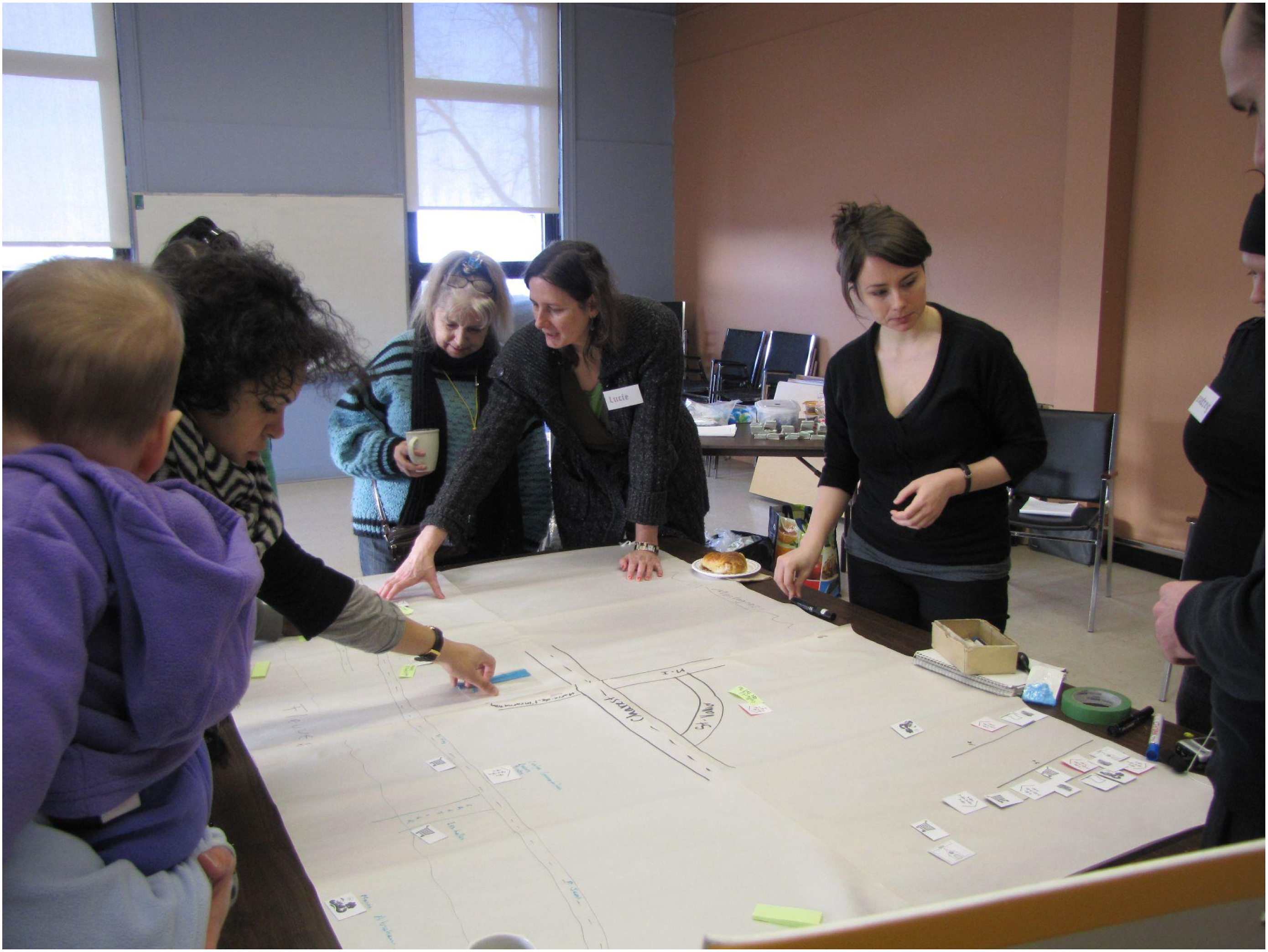
During data collection, ERA used co-facilitation strategies. Having experts with day-to-day lived experience of poverty as co-researchers was a way to better decode and analyze realities from the marginalized standpoint. One co-researcher said: “Our participation as co-facilitator created trust due to our shared experience of poverty.”
The second frame was the Geographic Information System (GIS) transposition of the maps produced (see Figure 2). This shed light on other patterns of (non-) use of resources relating to their dispersion in space. It led to a reflection on temporality and walking access, as well as the relationship to geomorphological characteristics (e.g., hills), public transport services, artificial barriers (e.g., highways), and food deserts. This mapping served as a basis for exchanges during ERA and CR meetings and workshops with community partners. Where men 18–35 years old get their food in the Limoilou neighbourhood of Quebec City. Note. Map by B. Lalonde, 2013.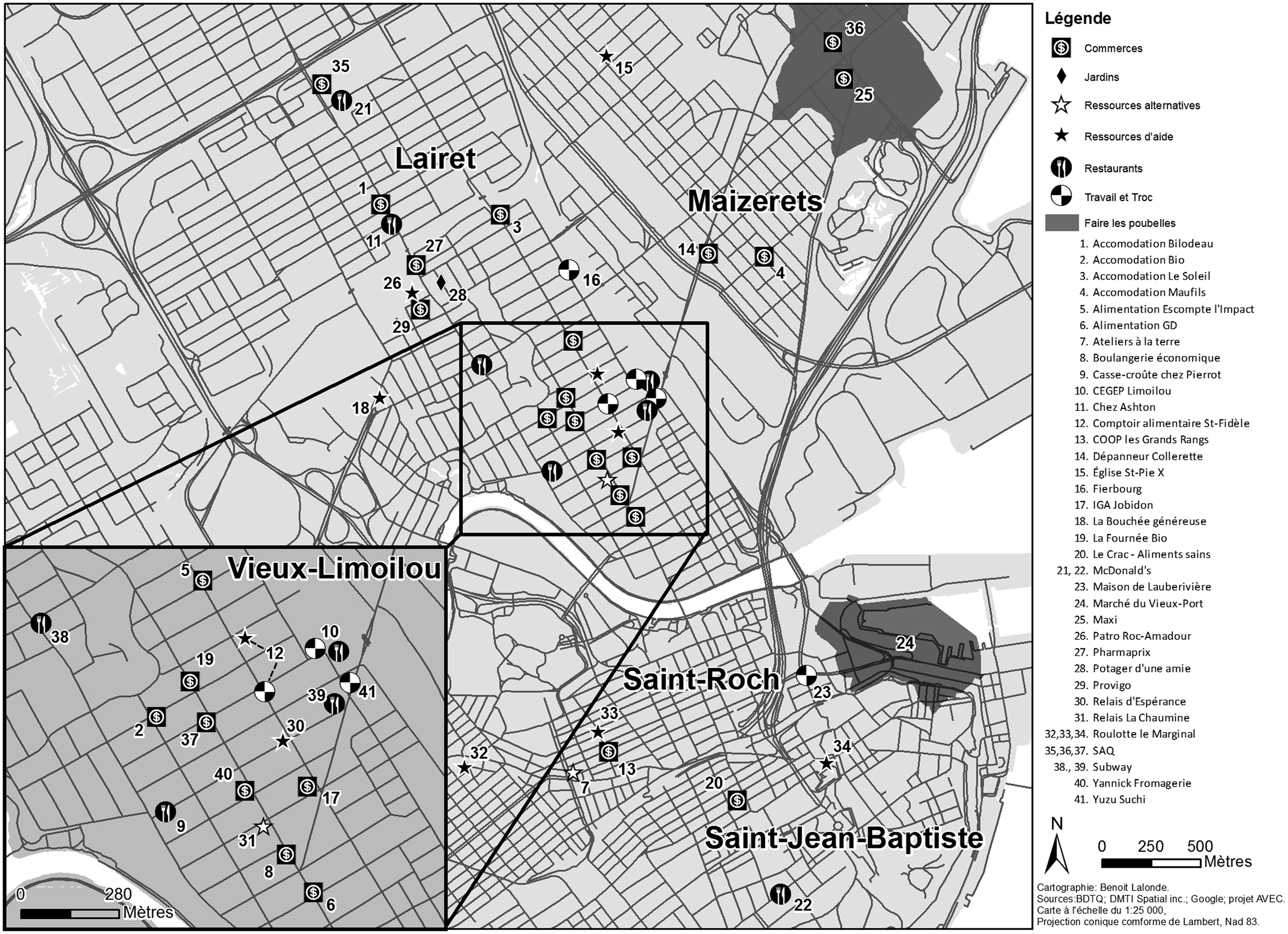
The third frame was participant observation. Continuing discussions as a team late into the night during field activities, and making connections between what the ERA’s members had heard and their actual experiences when spending time in each territory, were essential elements to understanding local realities. “Roadtrip” interviews were carried out with key community stakeholders to help understand the physical reality of poverty in rural areas.
These autoethnographic observations and stories enabled the ERA to prepare interviews, reflect on recruitment and participation, and prepare the mapping material. It also helped the team, during the analysis, to better understand complexity.
The fourth frame referred to the attention given to how participants were welcomed. Co-researcher experts by experience considered it crucial to establish a safe space where participants could feel free to open up, given that the difficulty of feeding oneself and one’s family is a very sensitive subject, part of a wider context of survival and suffering. The ERA gave participants VIP treatment, preparing hearty and carefully chosen meals according to local customs; the scents of a homemade stew went a long way to making participants feel welcome. The CR team always conducted meetings around a potluck, where everyone was encouraged to bring something and share recipes, often part of family traditions.
Sleying: Overlapping moments of analysis
Sleying consists of passing the warp threads through a reed, which is like a large comb. The weaver then uses the reed to tighten the weft yarn after each back-and-forth movement of the shuttle. These weft threads are intertwined with the warp threads, and patterns emerge as the movement of the pedals activates the frames. The sleying metaphor thus refers to the need for targeted collective analysis to solidify information periodically and systematically through data collection. The weft yarn is the knowledge shared by people living in poverty who are involved in the PAR as research participants.
As examples, we present four of the multiple ways established to undertake a collective data analysis session in the VAATAVEC project. The first was deeper understanding and appropriation of data during the collective interviews. Group interviews were not seen solely as a data-collection strategy. Instead, ERA considered them legitimate places of collective analysis, allowing the emergence of dialectical analysis, drawing on one’s own story and then the emergence of a collective story (Campenhoudt et al., 2005; see also Ganz, 2009). Participatory mapping activities, using collective intelligence, helped to better understand the use of resources (e.g., what stands out on the map, what resonates with our experience?) and raise consciousness (e.g., How do we explain what we see on the map? Why do we share common life issues?) (see Figure 3). The discussion thus moved from an “I” to a “We” perspective by linking with the broader social system, sometimes helping to prompt mobilization. Deeper understanding and appropriation of data during the collective interview through mapping. Note. Photo taken by M. Labrie, 2013.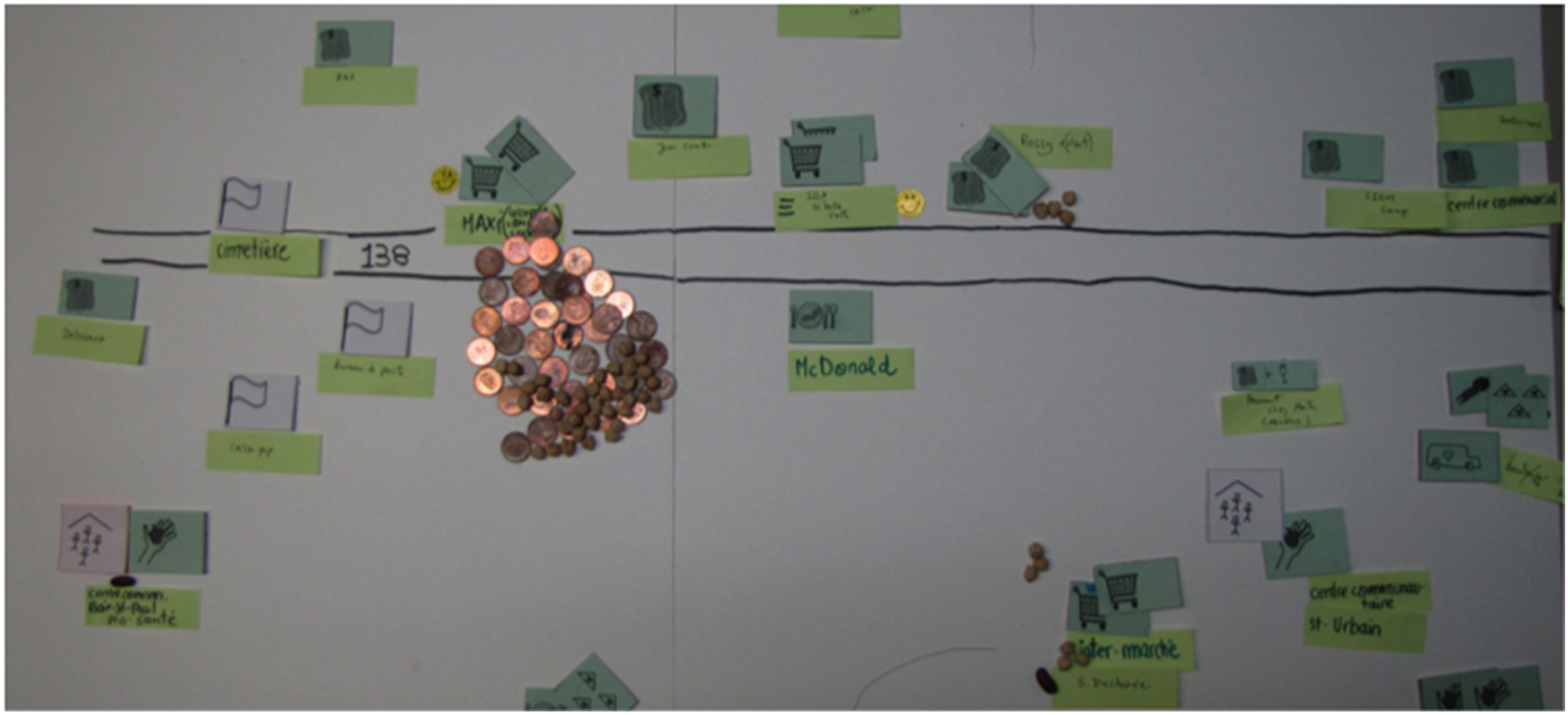
The second way was deeper understanding and appropriation of data in a multi-expertise team. Collective appropriation activities were undertaken with the ERA team, allowing an exchange of perspectives. They took many forms: verbatim collective reading, where everyone highlighted important elements related to their expertise; data coding as a group using computer-assisted qualitative data analysis software (CAQDAS) such as Dedoose; and interaction during collaborative sessions of manual coding, to see how associations are built and the questions that are thus raised (see Figure 4). These activities were designed to ensure that expertise, especially of academic researchers, did not “crush” other knowledge. Illustration of a collective appropriation activity. Note. Photo taken by L. Gélineau, 2014.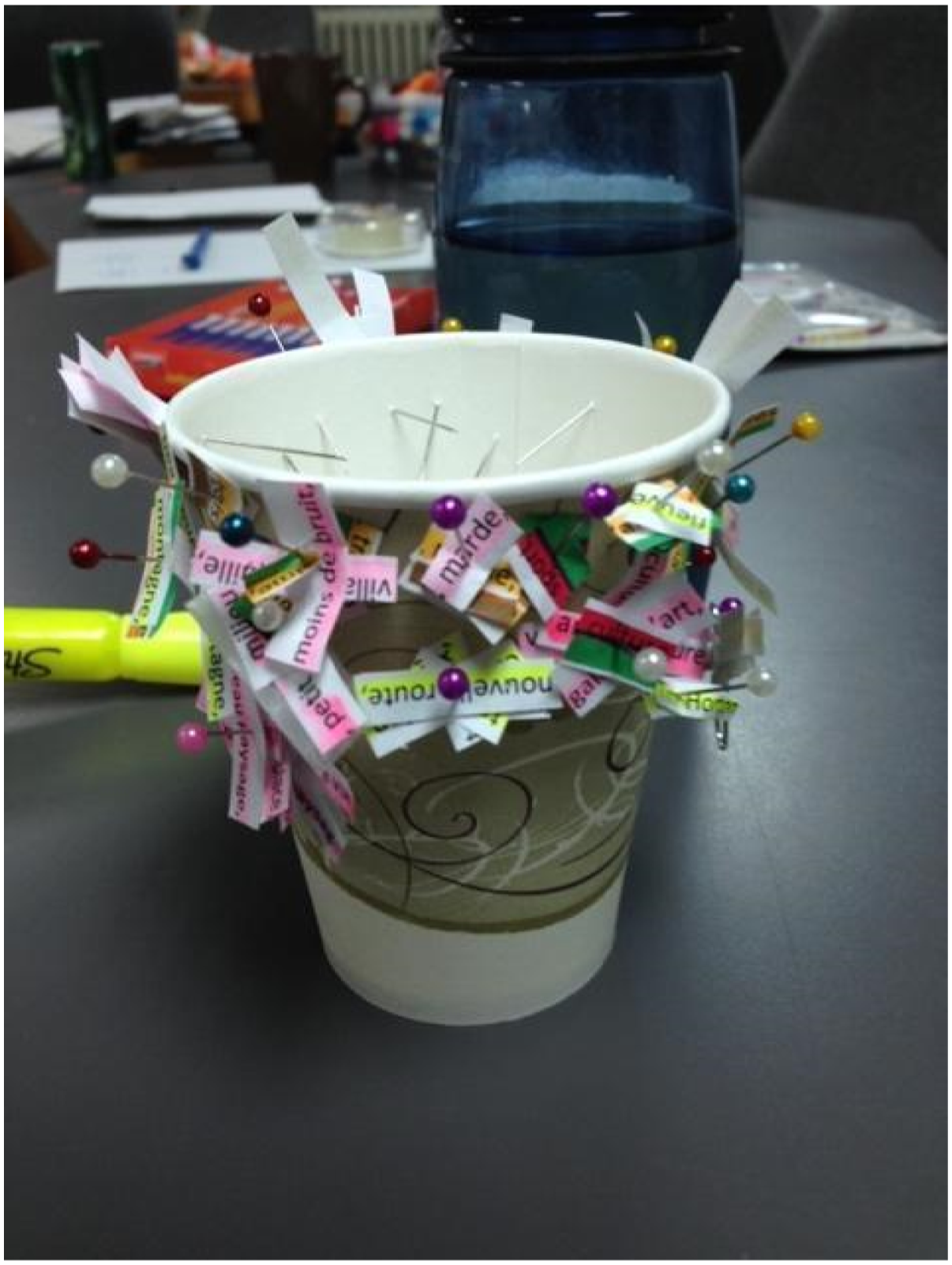
The third means of undertaking collective data analysis was the deeper understanding and appropriation of data in extended teams with invited partners. At different times, the CR and ERA held in-depth discussions on sharing emerging results with various community partners: stores and food providers; food producers; local and regional government officials; women’s and senior citizens’ groups; public-health representatives; social-services providers (including housing and food services); religious representatives; and academic specialists. Three “resonance group” activities were held, allowing 20 to 80 members of the targeted communities to formulate questions and hypotheses. The ERA team then returned to the research participants to deepen their understanding of food autonomy in the second block of group interviews.
A fourth way involved dialogical analysis during collective-writing periods. CR and ERA were open to a variety of writing skills and formats. For example, experts by experience of poverty produced a portfolio documenting the research experience and compiling the results and spin-offs of the project using photos, cartoon bubbles and artifacts (Figure 5). Excerpt from the ERA portfolio.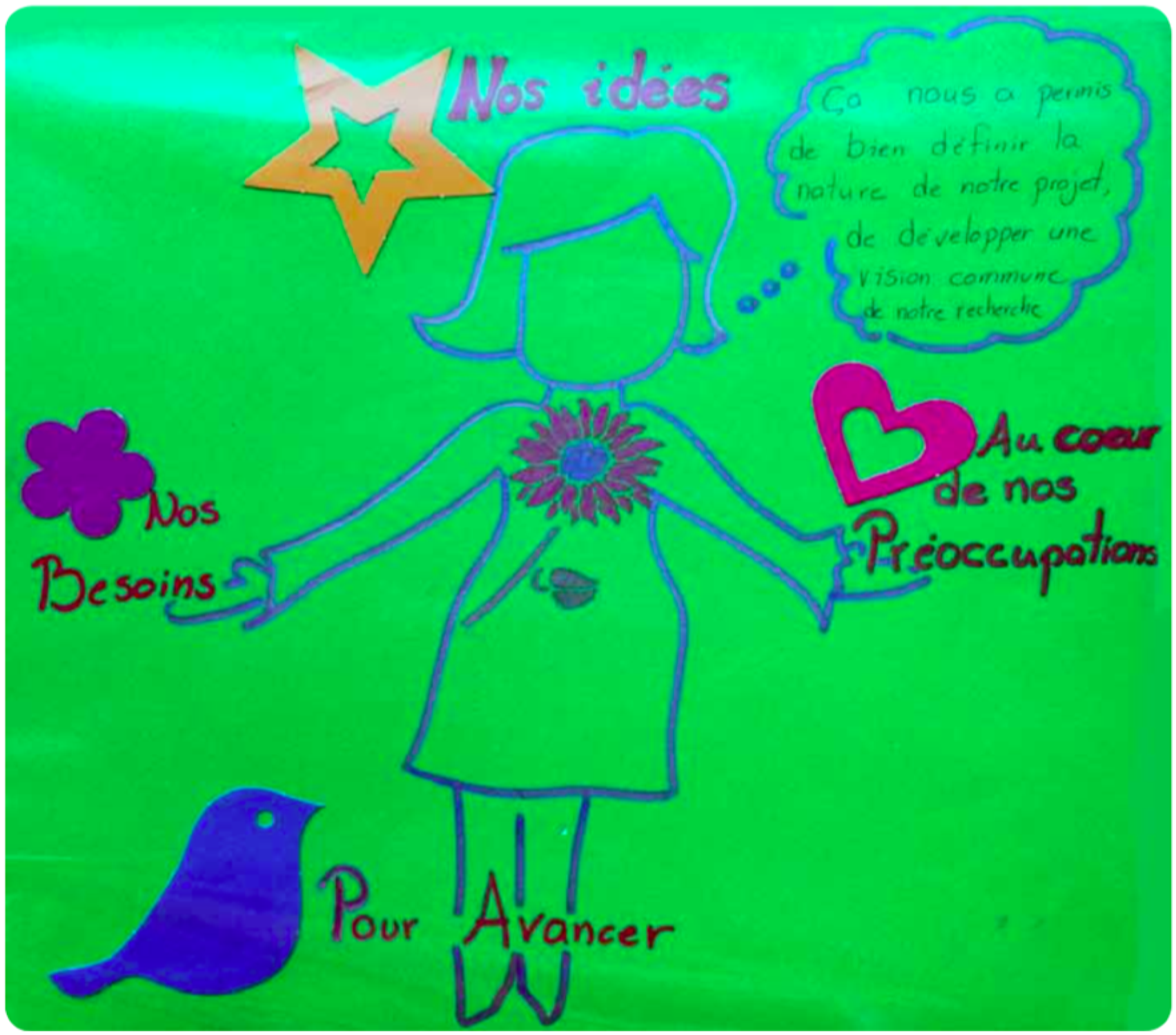
Weaving in itself
The combined interaction of the warp-thread movement in the frames, activated by the pedals, with the shuttle’s movement carrying the weft thread between the warp threads, and with the back-and-forth of the reed, allows the fabric to emerge. Within the woven collective analysis framework, linking the knowledge of participants' lived experiences to various types of knowledge helps to rigorously produce a fabric of Common knowledge – appealing to the concept of Common good.
In the VAATAVEC project, the separated threads of the co-researchers’ knowledge, constituted the warp threads. The frames allowing the emergence of patterns were: participatory mapping, the GIS transposition of the maps produced, participant observations, and the creation of welcoming spaces. The weft threads were the experience of people living in poverty participating in the research. The interweaving of warp and weft threads made it possible to bring out social patterns as the data collection frameworks were put into action. The combing, or movement of the reed, applied to the analytical activities dotted throughout: the analytical thinking integrated into the very heart of the collective data-collection activities; the understanding and appropriation of data in ERA and CR teams and, eventually, extended partners; and the collective writing periods. Thus, we wove the fabric of VAATAVEC’s Common knowledge on food autonomy when living in poverty little by little, modulated according to territorial affiliation.
The fabric that emerged
However, what is the nature of this fabric? Woven collective analysis makes it possible to grasp both the complexity and singularities of social phenomena, in this case food autonomy. Under the leadership of an expert by experience, members of the CR identified a revamped definition of food autonomy, considering different dimensions of the experience of poverty: “By food autonomy, the VAATAVEC project means: the right and power of individuals and communities to eat healthy, safe, sufficient, sustainable and varied food providing them with overall well-being and allowing them to live an active and healthy life with a view to their full participation in the political, economic, cultural and social life of society.” (translated from French; Bélisle et al., 2017, p. 72).
The report highlighted the following dimensions (Dupéré et al., 2014): (1) The importance of self-subsistence strategies, linked to traditional and domestic knowledge, as well as the challenges of deploying them considering the costs of access to land or raw materials (2) The dynamics of self-exclusion, or the establishment of behaviours “where one throws oneself out, before being thrown out”, to fully understand the issues related to (non-) access to specific resources (3) The importance, in policy development, of looking at the micro levels: thinking in terms of cents and not dollars; centimetres and not kilometres; of micro-local action and not just public policies
Moreover, how could this fabric be used? Members of the ERA and CR carried out approximately 50 knowledge dissemination activities, which were carefully planned to maximize impact. Members representing the three areas of expertise and knowledge (lived experience of poverty, practical and academic) carried out most of the activities together and even sought training to develop skills (Dupéré et al., 2022). As a result, each member became an ambassador for the VAATAVEC vision for food autonomy and the participatory approach. The project’s results came to life in multiple ways. The fabric led, for example, to: (1) the development of territorial alliances; (2) local knowledge production projects on food self-sufficiency in urban areas, which, in turn, prompted the emergence of urban-agriculture projects and markets on wheels; (3) new appreciation of participatory approaches in research; (4) emergence of a peer-helper practice in research; (5) the co-writing of a guide at the request of co-researcher experts by experience to share participatory research and intervention practices developed within the VAATAVEC framework (Collectif VAATAVEC et al., 2014).
The weaver
“It is gratifying to be able to say that we have a role in the decision-making process, that we can see and analyze the data, even though we do not have the same level of education as others.” Expert by experience of poverty (translated from French)
One question remains with this approach: Who is the weaver? Who makes the decisions concerning the forms and methods of warping, threading, sleying and weaving? In the woven collective analysis approach, the weaver is a collective. Everyone participates in decision-making (orientation decisions, methodological choices, analytical strategies and resulting action), though contributions vary according to expertise, time, and personal issues. In our project, everyone’s responsibilities were assigned after careful consideration and formalized in a letter of agreement (Morin, 1992), along with the rules for shared decision-making and authorship (Dupéré et al., 2022). It is not easy to establish this type of collective in academia: the academic researchers had to spend long hours negotiating about ethical considerations and recognition so that the names of the collective and the co-researchers could appear on the VAATAVEC project report.
Entangled threads
Difficulties were encountered, particularly regarding the basic dynamics that determine an effective weavers’ collective, such as the long-term commitment of each co-researcher, communication, and decision-making (Dupéré et al., 2022; see also Collectif VAATAVEC et al., 2014).
Since woven collective analysis takes place over time, commitment is central. Beyond the mechanisms to support participation (such as food, transportation and compensation), the collective must assume that there will be absentees. In this example, the CR team established the principle that collective choices made in the absence of a participant – but with all types of knowledge represented – were not subsequently picked apart, while allowing that there would always be further opportunity to influence what followed.
Communication is crucial in the presence of multiple forms of knowledge, and therefore, multiple referents. We established rules for stopping an exchange when there was a lack of understanding (e.g., by raising a red card or holding rounds of clarification questions) and to encourage fair discussion (e.g., by accumulating LEGO® blocks each time someone spoke). Moreover, it is important to have the courage to face conflict situations; to recognize that in interpersonal conflict, certain values, aspirations or needs cry out. Daring to name and consider them often helps to make the conflict constructive. “Conflict is a midwife”, a colleague once told us.
Issues related to decision-making, and therefore inherent methodological choices, arose. We were careful to consider the balance of knowledge in these choices. Collectively identifying “gatekeepers” from among all the experts, to ensure we did not lose sight of key elements, such as rigour or transformative social action, has been invaluable.
Allowing choices, then, requires the flexibility and creativity to rework project elements. In doing so, the rules of the game guarantee success: use the principles of non-violent communication, and establish a collaboration agreement that remains the shared reference point. The fact that members of our teams were involved in cooperative movements, autonomous community action, popular education groups, or feminist collectives were not without positive spin-offs, thus putting to good use their experience in sociocracy, shared governance, collective intelligence or WITH practices.
Questions arising from the weaving metaphor
The weaving metaphor helps us better understand our collective-analysis approach: its stages, methods and process.
Nevertheless, we need to continue to examine the challenges that arise at different points, to refine the details of our metaphor, and to train better together in collective PAR analysis. Some of the questions still to be explored include: • When a research collective combines academic and practical knowledge with lived realities that can be traumatic, what strategies must be considered? • How can we identify when the creativity involved produces a mass of tangled threads and no longer serves the collective-analysis endeavour? • What are the risks of skipping certain stages when the processes are less sophisticated, or the collective has access to fewer resources (human, financial, time)? What are the impacts on the richness of the fabric patterns? • What happens to the weaving collective once it has finished its piece? How should the collective accompany its members as the woven collective analysis approach comes to an end and afterwards? Many, especially people living in poverty – participants and co-researchers – who found safe spaces that gave them recognition, experienced a form of mourning. • How can we reinvest the knowledge of the weaving collective in other spaces with other types of knowledge (i.e., economic stakeholders, aesthetic, Indigenous)? • Furthermore, regarding the transmission of such practices, who can learn the craft of woven collective analysis, and how and where? We wonder if the weaving metaphor resonates with those who are not familiar with a loom.
We want to see this metaphor evolve and be able to use it to continue questioning our collective-analysis practices.
“The message? Keep the antennae open. Maybe not for our little selves… but for others.” Experts by experience of poverty (translated from French).
Conclusion
To our knowledge, few academic articles have detailed collective-analysis methods that involve people in situations of poverty and exclusion as co-researchers. Even fewer have explained the practices implemented to ensure epistemic justice, not only in terms of facilitating access to academic knowledge production but also regarding recognition of the knowledge associated with the lived experience of poverty. Thus, with great humility, and acknowledging the multiple sources that have inspired us to concoct our approach, we have presented the steps and concrete tools that we have used to carry out what we call a woven collective analysis approach, illustrated with one of our PAR projects. We hope this metaphor can help PAR researchers/users to work together to produce a Common knowledge beneficial to the structural fight against poverty while recognizing and protecting other types of knowledge production, in particular that which stems from lived experience of poverty.
“We did a good job. It is something to be really proud of.” (Expert by experience of poverty; translated from French)
Footnotes
Acknowledgments
Special thanks to the co-researchers, colleagues, student, participants, administrative staff, and community partners with whom we have worked or encountered in several reflection groups, and to Michel O’Neill and Helen Kinsella for translation and linguistic revision. Finally, to Lucie’s mother, the weaver.
Declaration of conflicting interests
The author(s) declared no potential conflicts of interest with respect to the research, authorship, and/or publication of this article.
Funding
The author(s) disclosed receipt of the following financial support for the research, authorship, and/or publication of this article: The VAATAVEC project used as an example was funded by the Fonds de Recherche du Québec – Société et Culture (FRQSC) (2012-PC-164470).
