




Abstract
Early childhood is a critical period for shaping long-term developmental outcomes, yet in fragile contexts like Haiti, state systems often lack the capacity to deliver comprehensive early childhood development (ECD) services. This study examines the Leveraging the Home, School, and Church (L3) initiative in Northern Haiti, a whole child development (WCD) intervention implemented with the Catholic Church. Using the Qualitative Impact Protocol (QuIP), we explored how the L3 intervention influenced caregiver, teacher, and church leader behaviors across the interconnected domains of home (lakay), school (lekòl), and church (legliz), as well as which specific components of the intervention participants attributed those changes to. Findings reveal significant self-reported changes in parenting and teaching practices, particularly in the areas of positive discipline, home learning, and social-emotional learning, with participants consistently attributing these shifts to their involvement in L3 training. While the church served as a vital platform for convening and lent symbolic legitimacy to WCD messaging, its role in directly driving behavior change was limited. These results highlight the potential of integrated, systems-based approaches to support child development in low-resource settings and point to the need for further research on optimizing the role of faith-based institutions in ECD programing.
Keywords
Introduction
Extensive research underscores the critical importance of early childhood in shaping long-term outcomes. This period represents a sensitive window in which environmental experiences profoundly influence developmental trajectories, with interactions between children and caregivers serving as a core driver of development early in life (Black et al., 2017; Richter, 2015). Neuroscience findings reveal that responsive and enriching early environments can shape brain development in ways that foster cognitive, social, and emotional growth across the lifespan (Fox et al., 2010; Shonkoff et al., 2012).
The rapid development and neuroplasticity of the early years also make them particularly receptive to interventions that can buffer the effects of adverse conditions such as socioeconomic hardship, trauma, abuse, or neglect (Britto et al., 2017; Shonkoff et al., 2012). Evidence from around the world demonstrates that high-quality, nurturing care interventions can yield significant benefits in both childhood and adulthood (Barnett and Frede, 2017; Britto et al., 2011; Gertler et al., 2014; Kagitcibasi et al., 2009; Yousafzai et al., 2014). Comprehensive or multi-component interventions—those that integrate health, nutrition, education, and psychosocial support—tend to be more effective than standalone approaches (Aboud and Yousafzai, 2015; Britto et al., 2017). In fact, early childhood development (ECD) efforts have evolved beyond assessing individual interventions to examining the scalability and sustainability of services across multiple sectors (Britto et al., 2014).
Despite significant advancements in both research and service provision for young children and their families, many of which have been rigorously evaluated and proven effective (Engle et al., 2011), a large proportion of the world’s youngest children still do not have access to high-quality ECD programs (UNICEF, 2012). This persistent gap is in part attributed to weak coordination at the systems level and the fragmented, inconsistent strategies employed in program scale-up efforts (Britto et al., 2014). The overall strength and functionality of systems play a crucial role in enabling progress toward desired developmental outcomes (Berman and Bitran, 2011). Enhancing ECD services requires strengthening the broader systems in which they operate. Adopting a systems-level perspective enables a deeper understanding of how to scale interventions effectively and integrate them into the dynamic and interconnected systems that deliver services to young children and their families (Britto et al., 2014).
While there is growing consensus that effective ECD programing requires systemic, cross-sectoral approaches (Urban et al., 2018), evidence on how to implement such approaches remains scarce, particularly in low-resource and crisis-affected settings. Fragile contexts present unique challenges: the success of ECD efforts depends not only on what services are delivered, but critically on the systems through which they are provided. In such settings, formal systems related to child development are often weak or nonexistent, and local faith communities (LFCs) sometimes play a central role in children’s learning and development by supporting families, managing educational institutions, and shaping moral and social values (D’Agostino et al., 2021; Wilkinson et al., 2019). Recognizing this potential, international organizations and scholars have, in recent years, increasingly focused on the role of LFCs in promoting children’s holistic development. The assumption is that integrating whole child development (WCD) messaging into religious structures may enhance uptake by reinforcing values already present in spiritual teachings, increasing perceived legitimacy, or expanding reach through existing faith networks. However, more research is needed to examine the extent to which LFCs function as systems that support—or impede—child development and learning (D’Agostino et al., 2021).
Haiti represents a particularly compelling case study for exploring the role of LFCs and systems-level approaches to ECD. In a country where public sector infrastructure is extremely limited and public funding for education is virtually nonexistent, the Catholic Church has emerged as one of the few stable and deeply rooted national institutions. Embedded within the daily social ecologies of children, the Church operates an extensive network of preschools and primary schools and facilitates community outreach. At the parish level, it acts as a nexus of care, providing a rare, functioning platform for WCD interventions. Studying Haiti thus offers an opportunity to better understand how faith-based systems might be leveraged to support integrated, sustainable ECD programing in fragile contexts where traditional state mechanisms are weak or absent.
Building on this context, this study assessed system activation and behavior change resulting from the Leveraging the Home, School, and Church (L3) initiative in Northern Haiti. Implemented through the Catholic Church, the L3 intervention aimed to embed WCD practices across the interconnected domains of home, school, and faith-based settings. Specifically, we addressed the following interrelated research questions: To what extent do caregivers, teachers, and church leaders change their practices as a result of the L3 intervention? What observable shifts in caregiver, teacher, and church leader practices are linked to which components of the L3 intervention? These questions are rooted in the need to understand how and which specific intervention components contribute to observable change in behavior across key system actors. While systems strengthening efforts are often perceived as abstract, observable changes in the practices of frontline actors, such as caregivers, teachers, and church leaders, can serve as tangible indicators that the system is functioning differently. These behavioral shifts reflect the uptake, translation, and application of WCD principles, which are critical markers of meaningful systems change.
Study design
Study setting
Most Haitian children grow up in high-poverty, stress-inducing, and inequitable environments that severely hinder their ability to thrive. These challenges are compounded by limited or absent government structures needed to support children’s educational, nutritional, and health needs are largely absent (Pellegrini and Arocha, 2022). Rather than providing essential services, Haiti’s state apparatus has often functioned to extract resources for the benefit of political elites (Fatton, 2000, 2006). Haiti’s situation is frequently described as “acute on chronic,” a context of ongoing crisis, periodically exacerbated by natural or man-made disasters that push families into deeper vulnerability (Farmer, 2012).
Haiti’s turbulent history as the French colony of Saint-Domingue—built upon one of the most brutal and profitable slave regimes in the world—is widely held to be the foundational cause of its modern livelihood struggles and has significantly shaped the culture, including strict parenting practices. The legacy of slavery and subsequent international isolation perpetuates a landscape of structural underdevelopment and pervasive poverty (Dubois, 2012), intertwined with historical legacies of slavery and colonialism, which have shaped prevailing childrearing norms that often emphasize obedience and harsh disciplinary practices (Schuenke-Lucien et al., 2022). Two out of three Haitian children report experiencing violence from a caregiver or authority figure during childhood (Flynn-O’Brien et al., 2016). Such conditions create a layered context of both material and psychosocial adversity, with lasting implications for children’s development.
This widespread absence of public provision has created a critical service gap, particularly in ECD and education. With only 14% of schools operating within the public system (Elias et al., 2019), the education sector is dominated by private institutions that charge tuition. In this vacuum, the Catholic Church, through the Commission Episcopale pour l’Education Catholique (CEEC), has emerged as the country’s largest provider of education services, running an extensive network of preschools, primary schools, and outreach programs. Deeply embedded in the community and daily lives of families, the Church is one of the few national institutions with the infrastructure and legitimacy to deliver WCD support. Within the Catholic education system, priests serve not only as spiritual leaders but also as the chief administrators of schools under canon law. Principals report directly to priests, who oversee school operations and navigate the daily challenges of school management.
Interventions
At the local parish level, the Catholic Church serves as the primary nexus of care and the most functional system supporting WCD for young children in Haiti. Within Catholic parishes, three core environments—home (lakay), school (lekòl), and church (legliz)—form the social ecology where young children regularly interact with individuals who shape their growth and development. This concept, referred to as L3, recognizes the integrated influence of these three domains on early childhood outcomes.
Building on the Church’s deep-rooted presence and influence across homes, schools, and broader community life, the University of Notre Dame’s Global Center for the Development of the Whole Child (GC-DWC) partnered with five parish communities within the Diocese of Cap-Haïtien in Northern Haiti. These parishes were purposively selected based on the demonstrated enthusiasm and commitment of their priests to implement the L3 programing, as expressed during diocesan workshops introducing the L3 approach to clergy across the region. 1 The goal of the L3 intervention was not only to increase the prevalence of WCD messaging and promote behavior change within homes, schools, and churches but also to coordinate these efforts across settings to ensure greater continuity of care. Programing aimed to address the holistic needs of young children (ages 0–6) and structured around five key thematic areas—responsive caregiving, positive parenting and discipline, nutrition, playful learning, and social and emotional development—each linked to specific behaviors caregivers could adopt to support children’s healthy growth and thriving. Within each domain—home, school, and church—Rapid Evaluation, Assessment, and Learning Methods (REALM) were employed to iteratively refine and strengthen programing (Global Center for the Development of the Whole Child, n.d), with each intervention component undergoing two to five cycles of adaptation prior to the present study.
Home (Lakay)
To strengthen support for parents, the L3 initiative designed and implemented parent training and support initiative. GC-DWC local staff in collaboration with priests and lay leaders in the Diocese of CapHaitien developed parent training materials and delivered the program through a series of training sessions spanning 10 consecutive weekends. The training curriculum emphasized the synergies between Catholic Social Teaching (CST) and the science of early childhood development and covered key topics essential to whole child development, including the importance of the parent–child relationship, providing consistent and responsive care, understanding the links between social, emotional, and cognitive development, promoting caregiver well-being and self-care, practicing positive discipline, improving nutrition, and integrating play into daily interactions with children. To encourage continued engagement beyond the in-person sessions, parents also received audio recordings and printed handouts from Ti Lekòl Lakay.
Preschools (Lekòl)
The L3 initiative developed and implemented a series of trainings to teachers and school directors across the five innovation communities. Local staff employed by the Diocese of Cap Haitien’s Office of Catholic schools conducted educator training with support from local staff employed by the GC-DWC. These trainings focused on incorporating play-based learning, positive discipline, and social and emotional learning (SEL) into school culture and classroom practices. Following the initial training sessions, participating teachers received Supplemental Materials to support implementation, including SEL-themed books and an SEL teacher guide. Teachers also benefited from regular supervision and coaching visits, which reinforced the training content and provided opportunities for feedback and reflection. Additional refresher trainings were offered to ensure ongoing skill development and support.
To assess the effectiveness of this intervention, a cluster randomized controlled trial was conducted with a sample of 881 pre-primary students (D’Sa et al., 2022), which demonstrated a statistically significant positive impact on children’s social and emotional learning outcomes.
Church (legliz)
Baptism preparation provides a strategic opportunity to integrate WCD messaging into church activities, as baptism training is already a standard practice in Catholic communities in Haiti. The theology of love, care, and nurturing of God’s children aligns closely with the scientific principles underpinning WCD, offering a natural entry point for integration. The L3 initiative collaborated with leaders in the five innovation parishes to co-develop a standardized WCD guide for baptism preparation—designed for scalability across dioceses—with modules on nutrition and social care, school readiness, and positive parenting. Baptism preparation facilitators in the five parishes received training on the new modules through a training-of-trainers model.
Importantly, the intervention also anticipated that priests would apply their enhanced understanding of WCD more broadly, in their sermons, pastoral counseling, and day-to-day interactions with parents and educators. This broader integration was encouraged based on the recognition that priests hold sustained influence over family and community behaviors and often serve as cultural and moral authorities on child rearing. Leveraging these multiple touchpoints was intended to deepen the reach of WCD messages and reinforce key behaviors across home, school, and church settings.
Methods
To understand the L3 interventions effectiveness in activating systems of care and changing participant behaviors, we employed the Qualitative Impact Protocol (QuIP). QuIP is a participant-centered qualitative methodology developed to generate credible evidence of attribution in complex development contexts (Copestake, 2025). Instead of using statistical inference to establish causality, the QuIP approach draws on narrative data gathered through in-depth semi-structured interviews with participants to assess impact based on self-reported attribution (Copestake, 2025; Copestake et al., 2018, 2019).
A key strength of QuIP lies in its design to mitigate against potential response bias, ensuring that interviewers and interviewees are unaware (“blindfolded”) of the specific interventions being evaluated (Copestake et al., 2018). The use of blindfolding is intended to minimize pro-program confirmation and courtesy bias in participants’ responses. Respondents are encouraged to describe changes they’ve experienced across key life areas relevant to the program being evaluated over a specified period without being asked directly about the program, allowing for an open-ended, inductive exploration of what they believe caused those changes. This approach uses broad, non-program-specific open-ended questions to capture participants’ own perspectives on what shifted and why.
Sample
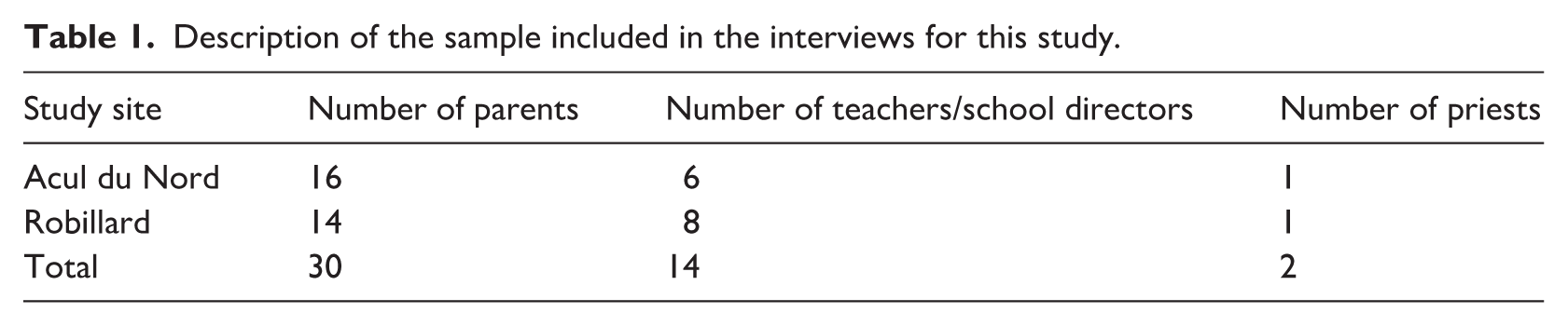
The QuIP study was implemented in two of the five L3 innovation communities, Acul du Nord and Robillard. These two communities were purposively selected because they had the most programing prior to the QuIP study. To compose a sample of interviewees, parents, teachers/ school directors, and priests were invited to participate. In each L3 parish, there was only one parish school. The school director and all teachers who had received L3 training were invited to participate in the interviews, along with the parish priest. Parents who had participated in more than one L3 intervention were purposively identified as information-rich cases and randomly selected within this group to participate in the QuIP study. A total of 46 anonymized individual interviews were conducted: 30 parents, 14 educators (12 teachers and 2 school directors), and 2 priests (Table 1).
Description of the sample included in the interviews for this study.
Data collection
Data collection took place in June and July of 2022, after the resumption of L3 program activities. A total of four data collectors, selected from a pool of recent university graduates with experience in field interviewing, participated in an 8 day in-person training focused on QuIP interviewing techniques and practice fieldwork.
Interview protocols were designed to capture any changes participants had experienced in the previous 6 months across key domains of interest (parenting practices, teaching practices), as well as the factors they believed contributed to those changes. In accordance with the QuIP methodology, data collectors and respondents were not informed of the specific intervention being studied. They were told that the purpose of the study was to explore the development of children in their community and to understand any new practices or changes that had occurred in children’s lives over the past 6 months. Informed consent was obtained from all participants, who were informed that participation was voluntary and that they could withdraw from the interview at any time.
All interviews were conducted in Haitian Creole, audio-recorded, transcribed verbatim, and translated into English to facilitate analysis by non–Creole-speaking researcher team members.
Analysis
The transcripts were uploaded to the Casual Map App and analyzed using a thematic analysis approach (Braun and Clarke, 2006), with the objective of identifying explicit causal pathways linking observed behavior change to L3 interventions. One author conducted the coding, organizing the data into three categories: (i) drivers of change, derived inductively by classifying participants’ explanations for observed changes or outcomes; (ii) outcomes, also identified through inductive analysis of the narrative data; and (iii) attribution claims, signaling the strength of participants perceived links between outcomes and the L3 interventions (Copestake et al., 2019). The codebooks for both drivers of change and outcomes were developed iteratively based on patterns emerging from the data.
This analysis generated a causal map based on frequency counts of coded causal claims to provide an overview about drivers of change, outcomes and the relationship between the two. However, frequency counts were used only as one indication of the importance of different coded drivers or outcomes. We also analyzed the emphasis respondents place on them, including the depth of their description and how often they are repeated in the same interview.
Findings
Figure 1 presents a causal map illustrating participant-reported pathways of change. The map synthesizes self-reported outcomes shared during in-depth interviews with parents and teachers, highlighting how both groups attributed specific behavioral and attitudinal changes to their participation in the L3 interventions. In total, 17 unique outcomes were identified, linked to two primary drivers of change: attendance at the teacher training and the parent training workshop. No other drivers of change outside the L3 interventions were identified by participants. Arrows connecting the drivers to outcomes reflect the number of participants who independently made each attribution, offering insight into both the breadth and salience of reported effects. Describing each outcome in detail would be beyond the scope of this article; instead, we describe each thematic family and outcomes within that family with highest frequency counts.
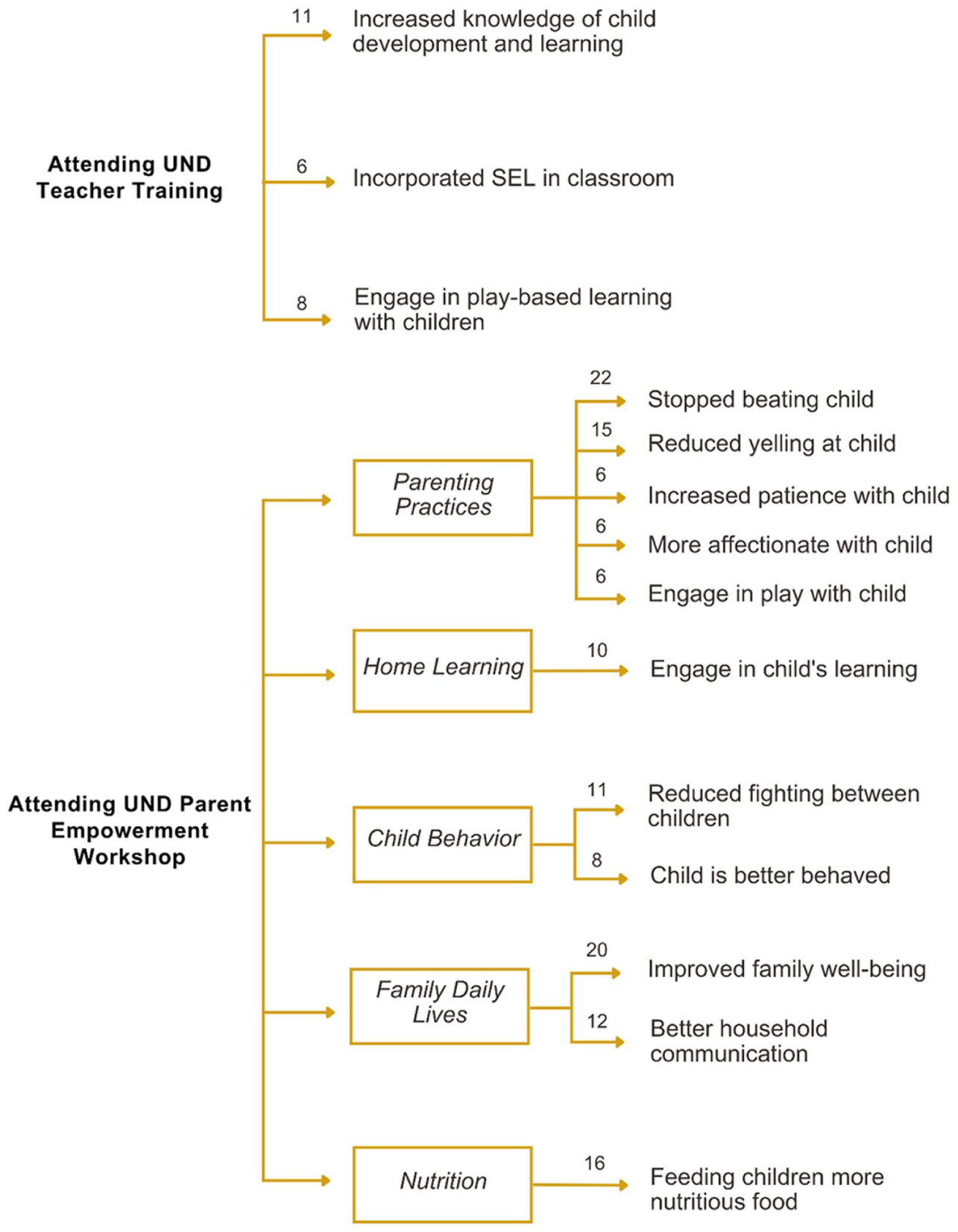
Causal map of perceived pathways of change.
Home environment
Parents and caregivers described a wide range of positive shifts in parenting behavior and household dynamics and attributed these changes to participation in the parent training workshops facilitated through the L3 initiative. In addition to the explicit links to the training workshops, a few parents did mention hearing about WCD from priests at church, but did not attribute changes in their knowledge or behavior to what they heard. Most parents indicated they attended church regularly and listened to sermons, but when probed, were unable to identify any specific teachings that prompted behavioral change. Several parents did note that the training they received took place in the church itself and were promoted by priests. Priests’ endorsement of the L3 program seemed to help increase community trust and engagement.
Parenting practices
Across interviews, parents consistently attributed meaningful changes in their disciplinary practices—specifically the cessation or significant reduction of physical and verbal punishment—to their participation in parenting workshops. Of the 30 parents interviewed, 22 explicitly reported that they had stopped beating their children. “I used to beat [my children] all day, insult them, and their father. Now I don’t do that anymore since I learned this from the [parenting] program. I’m not into insults, I’m not into anything like that anymore” (Parent, Acul du Nord). Additionally, 15 parents reported that, prior to the training, they frequently yelled at or scolded their children in response to misbehavior. After the training, however, they began using calm dialog and active listening instead of shouting.
The most cited mechanism for these shifts in parenting behavior was the realization, gained through the workshops, that physical punishment is harmful to children’s development. Parents described gaining new knowledge about child development and nonviolent communication, which led to the adoption of alternative strategies such as discussion and explanation. “I used to whip my children. If he reacted badly, then I just whipped him. I did not take the time to discuss and explain to him how to react differently. Now I have been trained. If he has bad behavior, I take my time to explain to him what to do and he understands me better.” (Parent, Acul du Nord). Many expressed a clear before-and-after contrast in their behavior: where they previously relied on hitting or yelling in response to misbehavior, they now engage in dialog, emotional regulation, and positive reinforcement.
Some parents highlighted that participation in the parent training workshops led to a noticeable increase in their patience when interacting with their children (n = 6), which supported changes in their disciplinary approach. A parent reflected, “Sometimes I became impatient and beat the child for no reason, but since I received the training, I have learned to be patient and I became more at ease with my children” (Parent, Robillard). Alongside greater patience, some parents described becoming more affectionate and nurturing (n = 6). They began to listen more, speak calmly, and engage in acts of warmth and tenderness, such as hugging, gift-giving, or simply spending more quality time together.
Six caregivers also highlighted that they now play with their children more often as a direct result of the parent training workshops. One parent shared, “I didn’t even know how to play with them. . . after the training, I create time, I play with them, they understand me” (Parent, Robillard). Others described activities like bathing together in the river or playing at home as new routines that they incorporated.
Home learning
Ten parents reported a significant increase in their engagement with their children’s learning following participation in the parent training workshops. Some parents acknowledged that before the training, they lacked the skills or awareness to help their children effectively, resulting in limited engagement with schoolwork. One caregiver reflected, “Before I didn’t have enough skills. . . but after I attended the training, now I know how to encourage him to learn better at school” (Parent, Robillard). Following the workshops, these caregivers reported actively participating in their children’s learning, from creating time to help with homework, to teaching lessons at home, to using playful methods to reinforce memorization. Some mentioned that they now help their children read and count, especially on weekends. One parent explained, “I didn’t create time to give them lessons, now I create time for it. Do homework with them” (Parent, Acul du Nord).
These findings may indicate a stronger alignment between home and school, as some parents adopted strategies that mirrored classroom practices, particularly around play-based learning. One caregiver shared, “My child changes because now he memorizes his lessons better. I was trained to help him memorize his lesson playing games with the lesson as a strategy. Now he wants to study in this gaming way, and I take my time now to assist him, and he understands better and quickly” (Parent, Acul du Nord).
Child behavior
Some caregivers described notable improvements in their children’s behavior, both individually and in interactions with others, and attributed this to their participation in the parent training workshops. Eight caregivers reported that their children were more respectful, listened better, and were calmer and more cooperative. Some attributed these shifts to their own changed approaches, moving away from yelling or punishment and instead using calm dialog and positive reinforcement.
In addition to improved individual behavior, 11 caregivers described a significant reduction in fighting between siblings and with other children, with children were now playing more peacefully and resolving conflicts with less aggression. Parents linked these changes to the values and strategies they learned during the training, particularly the emphasis on empathy, nonviolence, and modeling respectful communication.
Although no parents explicitly attributed changes in their children’s behavior to the preschool component, the positive behavioral outcomes they described align with the improvements in social and emotional skills observed in the evaluation of the SEL preschool program (D’Sa et al., 2022).
Family daily lives
Parents and caregivers consistently reported that participation in the parent training workshops led to changes in their families’ lives. Central to these changes was improved communication within the household (n = 12), which contributed to enhanced family well-being (n = 20). Most respondents noted improved relationships, reduced conflict, and more harmonious family dynamics. Rather than resorting to arguments or silence, parents and caregivers described sitting down to talk through problems with spouses and children alike. Several noted that they no longer insult or ignore one another, and that family members are now more inclined to share concerns and help each other. As one parent described: “Everyone is more comfortable. They all live well at home now. If one has something, it’s the other’s concern. We talk to each other. We understand each other.” (Parent, Robillard).
Nutrition
Sixteen caregivers reported that the training workshops expanded their understanding of how to prepare nutritious meals using local, affordable ingredients. They explained that they previously lacked knowledge about the nutritional value of certain foods or believed that feeding children well required significant financial resources. Caregivers reported learning that even with limited means, they could create balanced meals by incorporating vegetables, beans, leaves, natural juices, and local staples like millet, cassava, or spinach. “In the training they say that you can give the child vegetables, beans, natural juices, things that contain more vitamins. Then when you have a glass of peanuts, bananas, you can make them with orange juice, natural things, leaves, carrots, etc.” (Caregiver, Robillard).
School environment: Teachers’ application of WCD practices
Teachers and school directors described changes in their knowledge of child development and classroom practices around SEL and play-based learning and attributed these changes to the L3 training program. While none of the teachers attributed change to their interactions with priests, some mentioned that priests promoted the educator training sessions and personally encouraged teachers to attend the training and even provided transportation in some cases, ensuring they could participate.
Knowledge of child development
Eleven out of 13 educators reported a significant increase in their knowledge of child development and learning due to the L3 training, which influenced both their instructional practices and classroom interactions. Educators described gaining a deeper understanding of how children grow, learn, and respond to their environment, beginning as early as in the womb. Several educators highlighted that the training shifted their perspective from discipline-based methods (such as using punishment or shouting) to approaches grounded in communication as a way to foster better learning outcomes. “Speaking is more important. It is not the beatings; it is not the stick that will make the child learn. . .” (PreK Teacher, Robillard). Others emphasized the importance of using concrete hands-on materials and interactive methods to engage children, noting that learning is more effective when it involves visuals, games, and conversations about familiar objects or experiences.
Integration of SEL
Six teachers described a shift toward integrating social and emotional learning (SEL) into their classroom practices and attributed it to the L3 training. Teachers reported learning how to promote positive behavior and emotional expression among students. A teacher noted that the training helped them and their students “I deepened when I, as the teacher, and the students, we know when to control our emotions, how to make children control their emotions, how to get kids involved in their learning” (PreK Teacher, Robillard). Several teachers highlighted the use of structured routines like the “morning circle” as a key SEL practice introduced during the training. Another concept described by the teachers was the “5 points of emotion,” which helped them understand the importance of self-awareness, emotional control, and respectful communication: “. . .the newest thing for me is the 5 points of emotion. So, you have to know how to manage yourself so that you can manage others. Secondly, you have to be able to learn to listen and dialog, everyone has the right to speak. This is what we get in respect for each other without discrimination” (PreK Teacher, Acul du Nord).
Play-based learning
Eight teachers described a shift toward incorporating play-based learning into their classrooms and attributed the change to participating in the L3 teacher training. They described learning the importance of allowing children to play as part of the learning process. One teacher noted that rather than interrupting play for instruction, she now builds learning around play. Teachers reported using games, songs, poetry, and group activities to introduce academic concepts and maintain student engagement. For example, one teacher explained using a chant-based game to help students memorize the four seasons, while another described games designed to improve psychomotor skills and cooperation among peers.
Church environment: Priests’ roles and challenges
The two priests interviewed reported being deeply engaged in community life, playing a central and proactive role in connecting the church, school, and home to support WCD. As one priest explained: “. . . the collaboration; it brings a lot of success because we sit together (School Director, teachers, Priest, parents) to overcome the challenges.” (Parish Priest, Robillard). Both demonstrated strong involvement in the schools by organizing (and sometimes delivering) teacher training and monitoring student well-being and intervening when needed. Both priests interviewed demonstrated a sophisticated understanding of whole child development and voiced strong support for integrating WCD messaging into church functions, including baptism preparation, home visits, mass and parent meetings. “We conducted a lot of meetings with the parents to talk with them on how they should raise a child. Some parents changed their behavior, but others are keeping their inappropriate behavior, but change is patience. We also use the ritual mass on Sunday or the other days to let them aware of their role as a parent” (Parish Priest, Robillard).
However, it remains unclear whether the priests’ promotion of WCD across the church, home, and school was influenced by their participation in the L3 intervention or if it reflected pre-existing practices. While both priests recognized the L3 intervention’s contribution to supporting WCD, neither explicitly attributed changes in their own practices or behavior to the program. Moreover, although the church’s potential as a platform for advancing WCD was also acknowledged, the findings pointed to a gap between the priests’ commitment and knowledge and their tangible influence on household practices. As noted in earlier sections on changes in the home environment, parents largely attributed shifts in their parenting to participation in the workshops, without explicitly referencing church sermons, priest-led home visits, or baptism sessions. This may reflect a sampling gap—perhaps not enough parents of recently baptized young children were interviewed—or may point to structural limitations. Many parishes are led by a single priest, limiting the reach and consistency of engagement. As one priest noted: “It’s not that I don’t want to do more. But with one priest for so many families, there are not enough hands to reach every home or classroom. Still, we use the church space, and I talk about these things in my homilies” (Parish Priest, Robillard).
Discussion
The findings demonstrate that the L3 model successfully catalyzed changes in caregiving and teaching practices that align with WCD principles. Our findings revealed that the home-school/lakay-lekòl elements of the L3 ecosystem were being activated to support development of young children in Northern Haiti. Parents, teachers, and school directors reported changing their beliefs and behaviors to support WCD.
While meaningful behavior change was evident among both parents and teachers, leveraging the full potential of the church as a delivery system for WCD remains largely aspirational. Although some participants recalled hearing WCD messages during church services, few directly attributed behavioral changes to church-based activities, suggesting that the legliz pillar currently functions more as a source of symbolic legitimacy than as a driver of behavior change. This highlights an important opportunity for future program strengthening. Priests reported being knowledgeable and supportive of WCD, but the translation of their knowledge and support into the homes and schools under their care and supervision needs to be strengthened. Because priests are in charge of the Catholic school in their parish and work closely with the school directors, the school-based influence they have may be more significant than the impact they are able to have on parents through their sermons, baptism courses, and occasional home visits. Structural constraints, such as the centralized authority of priests and the absence of robust parish-level mechanisms for outreach, may be limiting the church’s capacity to catalyze broader systemic change.
Despite these limitations, the data reveal important cross-domain connections and evidence of system activation. Parents and teachers consistently referenced receiving training within church buildings, which may reinforce the symbolic authority and legitimacy of WCD teachings through spatial association. Furthermore, educators, caregivers, and priests from the same parishes often used shared language when discussing child development, emotional regulation and discipline practices, indicating diffusion of key WCD themes across the lakay, lekòl, and legliz pillars. While the church’s influence was primarily implicit, its role in anchoring WCD messaging across these multiple spaces contributed to continuity of care and message coherence in the lives of young children.
Implications for policy and practice
Beyond the immediate context of Northern Haiti, the findings of this study offer transferable insights for the design and implementation of integrated, systems-based WCD initiatives in other Haitian dioceses and in fragile settings globally, particularly where state infrastructure is limited and faith-based institutions serve as central social and educational actors. Notably, the activation of the home-school (lakay-lekòl) interface emerged as a key driver of behavior change aligned with WCD principles. Caregivers and teachers reported meaningful shifts in beliefs and practices, suggesting that interventions which simultaneously engage families and educators may be particularly effective. Caregivers also reported encouraging learning at home, indicating alignment between school and home practices. This finding aligns with previous research demonstrating that, in resource-constrained settings, programs that integrate parenting support with early childhood education are often more effective in improving child outcomes than those that focus solely on enhancing classroom quality (Özler et al., 2018). These results reinforce the importance of investing in capacity-building efforts that foster shared understanding of child development, promote collaboration between caregivers and teachers, and strengthen communication between home and school as a means of sustaining continuity of care and reinforcing developmental gains across settings.
Second, while the church (legliz) emerged as a symbolically important component of the L3 ecosystem, its current role as an active delivery channel for WCD messaging remains limited. This highlights an opportunity to reconceptualize the function of religious institutions within WCD programing. Rather than positioning the church merely as a source of endorsement, policy frameworks and implementation strategies could explore how faith-based structures might serve as intentional platforms for behavior change interventions. Strengthening the capacity of clergy to serve as institutional anchors for WCD, through targeted professional development, practical guidance, and ongoing accompaniment, could enhance the coherence and reach of program messages across the L3 domains. However, the findings also point to structural constraints that may limit the church’s operational flexibility, including centralized governance and the absence of parish-level mechanisms for systematic outreach. Addressing these barriers may require policy innovations that promote more decentralized and participatory models of church engagement, such as empowering lay leaders or establishing parish-based WCD committees.
Limitation
While the QuIP is well-suited for identifying direct attribution pathways in complex interventions, it has limitations in capturing more subtle, diffuse, or indirect influences on behavior change. For example, whole child development (WCD) messages delivered through sermons or informal guidance provided by preschool teachers may shape attitudes and practices gradually over time. These influences are often embedded in daily interactions and may not be consciously recognized or explicitly recalled by participants during interviews, making them less likely to be attributed to the intervention. In addition, although QuIP generated rich qualitative data on self-reported behavior change and perceived attribution, it was not designed to systematically measure the strength, quality, or direction of relationships between actors and institutions within the L3 system (home, school, church). As a result, the study provides limited insight into the dynamics of interaction, communication flow, or coordination among key stakeholders across the three domains.
Directions for future research
While this study highlights the symbolic and infrastructural importance of the Church within the L3 model, its role as an active driver of behavior change remains underexplored. One priority area for future research is the institutional structure of parishes, particularly the centralization of authority around priests. Future research should investigate how different models of church leadership, lay involvement, and decentralized governance can facilitate more consistent delivery of WCD messaging and services. Research could explore models that enable broader participation from lay leaders, catechists, or parish-based committees to operationalize WCD programing beyond sermons or baptism preparation courses. Second, further research is needed to assess the added value of faith system activation within integrated WCD interventions. While our findings suggest that the legliz (church) pillar may reinforce learning across settings, it is unclear whether similar outcomes in parenting and teaching behaviors could have been achieved with a simplified intervention targeting only the home (lakay) and school (lekòl). Experimental studies could help isolate the added value of activating the faith system by comparing multi-component interventions (home + school + church) to simplified models (e.g. home + school only). Third, research should examine how information and practices diffuse across the L3 ecosystem. Applying methods such as social network analysis or participatory systems mapping could reveal how messages flow between domains and identify key leverage points for improved coordination and scaling.
Conclusion
This study demonstrates that the L3 initiative successfully activated key components of the early childhood development ecosystem in Northern Haiti, catalyzing meaningful changes in parenting and teaching practices that align with WCD principles. While the home (lakay) and school (lekòl) domains emerged as primary drivers of behavior change, the church (legliz) played a more symbolic and infrastructural role, reinforcing WCD messaging through its trusted presence in the community. These findings highlight the potential of integrated, cross-sectoral approaches to improve developmental outcomes in fragile contexts where formal state systems are weak or absent. They also underscore the importance of aligning program design with local systems and social ecologies, including faith-based networks, to promote coherence and continuity of care. As efforts to scale and sustain early childhood interventions continue, future programing should explore how to strengthen the operational role of faith institutions, deepen collaboration across the L3 ecosystem, and rigorously test the comparative value of each domain in driving sustained systems strengthening and behavior change.
Footnotes

Funding
The authors disclosed receipt of the following financial support for the research, authorship, and/or publication of this article: This research was funded by Porticus. No additional financial support was received for the authorship or publication of this article.
Declaration of conflicting interests
The authors declared no potential conflicts of interest with respect to the research, authorship, and/or publication of this article.