




Abstract
Knowledge of developmental milestones allows parents to support the developmental needs of their children and monitor their behaviour. Many available developmental resources, however, do not apply to culturally, economically, and linguistically diverse communities in low– and middle-income countries. There is a need to adapt established resources to improve contextual relevance. As primary stakeholders, parents should contribute to the adaptations. An existing developmental milestone resource was adapted for parents from low-income communities in South Africa using a mixed-method research design. In phases 1 and 2, a six-member expert panel reviewed and adapted the existing resource for the parents of children aged 2–47 months using a questionnaire and focus group. In phase 3, 18 parents of young children from low-income communities were interviewed to gain their perspectives on the adapted milestone. Most developmental milestones were deemed applicable, but they require adaptation to be relevant for use in low-income communities. The four themes identified were: language use, access to materials indicated in the resource, context and developmental literacy. Parents found the adapted resource relevant to promoting developmental literacy. International developmental milestone resources require contextual adaptation for diverse communities. Parents were included in developing the resource, increasing its relevance. The adapted resource should be trialled to evaluate the effectiveness of promoting parents’ developmental literacy.
Keywords
Introduction
In low- and middle-income countries (LMICs), such as South Africa, approximately 250 million children under 5 years are at risk of not achieving their developmental potential (Britto et al., 2017). Medical advances have improved child survival, but environmental risks such as poverty and inequality continue to contribute to developmental delay in LMICs like South Africa (Black et al., 2017; Draper et al., 2024). Early childhood development (ECD) and access to relevant resources are increasingly recognised as vital to childcare, particularly in countries like South Africa (O’Keeffe et al., 2022).
South Africa is considered an upper-middle-income country due to its gross national income; however, high poverty levels and large areas of low-income populations are similar to LMICs (Statistics South Africa, 2020). Approximately 59.9% of South African children from birth to 4 years are multidimensionally poor (Statistics South Africa, 2020). Supportive child-parent interactions can help mitigate the negative impact on developmental outcomes (Balton et al., 2019; Frongillo et al., 2017).
Knowledge of developmental literacy allows parents to respond appropriately to children’s developmental needs using supportive caregiving skills (Draper et al., 2024). Parental practices can ameliorate the impact of risk factors to encourage ECD and developmental surveillance, leading to timely therapeutic intervention (Frongillo et al., 2017; Meintjes and Van Belkum, 2013). It is important to note, when discussing parents’ role in ECD, that the typical nuclear family is not common within the South African context, similar to other countries that are multilingual and multicultural (Balton et al., 2019). The term ‘parent’ is used in this article, to refer to a variety of family members, including grandparents, parents, siblings, aunts, uncles and community members, involved in the development of the child (Louw and Louw, 2019). Early stimulation and developmental surveillance can promote future academic success and positively affect children and their families (Ngoun et al., 2020).
Parents report needing information regarding children’s development, yet struggle to obtain transparent, trustworthy information (Jeyaseelan and Sawyer, 2017). Existing developmental resources often lack cultural, economic, and linguistic applicability to diverse communities in LMICs (Sajady et al., 2018). Research indicated that children from different populations develop at different paces based on their exposure to stimuli, daily activities and cultural expectations (Black et al., 2017; Nyongesa et al., 2022). Adapted resources may allow parents to increase their developmental literacy. Developmental information resources need to consider not only culture but also contextual factors like family dynamics, education and social interactions, as they form an integral part of the context in which children develop (Ngoun et al., 2020; Rademeyer and Jacklin, 2013) influencing parents’ expectations of the milestones their children should achieve (Balton et al., 2019; Karasik and Robinson, 2022). Although there are accessible and recognised resources from countries like the United States of America, the direct application of high-income country (HIC) resources within other settings can be unsuitable, thus requiring adaptation (Ngoun et al., 2020).
Locally developed milestone resources in South Africa include the Road to Health Booklet (RtHB) and the MomConnect programme. MomConnect is a digital platform that provides primary parents with information about their gestational and ECD periods (Skinner et al., 2018). The comprehensiveness of these resources regarding the detail and age range coverage has been questioned (Naidoo et al., 2018). Parents in diverse settings require contextually relevant and comprehensive ECD resources to enhance their developmental literacy and optimally support their children (Jeyaseelan and Sawyer, 2017; Ngoun et al., 2020). Consequently, a call has been made to investigate relevant and comprehensive resources adapted for parents from diverse, low-income communities (Slemming and Bamford, 2018).
Parents’ perspectives have not been included when developing or adapting developmental milestone resources, despite their role as the primary recipients of such resources (Sajady et al., 2018). They are key stakeholders in their children’s development, and their perspectives should be considered when developing resources (Matsopoulos and Luthar, 2020). There is a current trend towards a grassroots approach to research that is more responsive and collaborative with the populations included in studies, which improves the scalability and sustainability of ECD-focused interventions (Buccini et al., 2023).
Improving the developmental literacy of parents of young children in low-resourced, diverse communities would counter the lack of access to health services in LMICs that hinders developmental surveillance and timeous intervention (Black et al., 2017; Draper et al., 2024; Jeyaseelan and Sawyer, 2017). There is a need to contextually adapt, and review established international developmental milestone resources for parents of young children from culturally, economically, and linguistically diverse communities, as found in South Africa (du Toit et al., 2024).
Method
Research aim and design
The study aimed to adapt and review an established international developmental milestone resource for South African parents of young children from diverse, low-income communities. An exploratory mixed-method design, with qualitative and quantitative aspects, more specifically a four-phase iterative design, was applied. Across the four phases, data were collected from (1) an expert panel via a questionnaire, (2) a focus group, and then (3) an interview schedule with parents to obtain their perspectives regarding the adapted resource. Thereafter, the milestone was further adapted and finalised (4).
Participants
Expert panel in Phases 1 and 2
Two participant groups were included in the study. In phases 1 and 2, an expert panel was identified to adapt the developmental milestone resource. The panel included five healthcare professionals and a parent from a low-income community (n = 6). The professionals had to have a formal qualification in their respective fields and specialised knowledge in ECD, with 5 years or more of experience in low-income communities. The expert panel consisted of P1 – educational psychologist, P2 – speech-language therapist (SLT), P3 – occupational therapist (OT), P4 – family medicine doctor, P5 – parent and P6 – physiotherapist (PT). Experts were identified through an online search and contacted to inquire whether they met the inclusion criteria. Four of the five female professionals on the expert panel had more than 10 years of experience in their respective fields within low-income communities. A professional contact identified the parent of a child in the relevant age range from a low-income community as an expert. She was a first-language Sepedi-speaking mother who was unemployed at the time of data collection and was residing in a low-income community with her 2-year-old child.
Parent interviews in Phase 3
Parents of young children attending two inner-city early learning programmes made up the second participant group. They were invited to participate in the study if they were the adult parents or primary caregivers of children between birth to 3 years and 11 months old, residing in Tshwane or surrounding areas, with an understanding of conversational English to read the adapted developmental milestone resource. Eighteen parents, primarily mothers (88.89%), consented to participate. Most parents were 29–38 years old (66.67%), 22.22% were 39–48, and 11.11% were 18–28 years old. Their educational qualifications varied, with 38.89% holding degrees, 22.22% having diplomas or postgraduate studies and 11.11% with matriculation. Most parents (83.33%) were employed, with 16.67% unemployed. Their children ranged in age, with most being 36–42 months old (33.33%), with smaller groups in other age brackets. Half of the children were second-born (50%), while others were first-born (22%) or third-born (23%).
Measures and procedures
Developmental milestone resource
The Center for Disease Control and Prevention (CDC) developmental milestone checklist was selected for adaptation and review. This early age range (2 months to 3 years 11 months) was selected as it plays a critical role in subsequent development (Richter et al., 2019). The checklist includes four domains: social-emotional, language-communication, cognitive, and movement-physical. This resource was selected as it is a globally, freely accessible, research-based, and parent-friendly resource on ECD that places parents at the centre of their children’s development (Center for Disease Control and Prevention (CDC), 2017).
Phase 1: Questionnaire
Based on the Item Translation and Adaptation Review Form by Hambleton and Zenisky (2011), a self-developed questionnaire was provided to the expert panel to identify milestones in the CDC resource that required contextual adaptation. It aims to provide a comprehensive, transparent, and validated review to standardise checking translated and adapted items (Hambleton and Zenisky, 2011). The questionnaire included four sections, one for each developmental domain in the resource for the selected age range (2 months to 3 years 11 months). The questionnaire focused on two core areas to delineate why the expert panel believed a milestone might require adaptation to be contextually applicable to South African children. The first area was their expert opinion regarding the contextual relevance of the milestone, and the second was on how the developmental milestone aligned with the context-specific adaptations of the parents (Karasik and Robinson, 2022). If experts flagged a milestone for adaptation, they were requested to elaborate on their responses. The expert panel was given 10 days to complete and return the questionnaire. A reminder was sent to all participants 8 days into the data collection period.
Phase 2: Focus group
Two focus group discussions were held for experts to reach consensus on suggested adaptations to the developmental milestones resource. The focus groups were held on two dates. All developmental milestones flagged in phase 1 were tabulated and presented to the experts during these discussions. Additional milestones with similar wording and characteristics to those flagged by the experts were included in the discussions.
Phase 3: Interviews
Once the developmental milestone resource had been adapted according to the expert panel’s recommendations, semi-structured interviews were held with parents of young children from low-income communities after they had reviewed the adapted resource. The interview process involved obtaining parent perspectives on the adapted resource. Collecting parent perspectives of the adapted milestone guide was considered important because target populations should be allowed a voice in the development of materials that are developed for their use (Sajady et al., 2018). Interviews consisted of closed- and open-ended questions probing parents’ perspectives on the resource’s applicability regarding linguistic accessibility, dissemination and accessibility of materials.
Phase 4: Finalisation
The data collected from various stakeholders over the three previous phases were integrated to adapt the CDC developmental milestone resource. This resulted in the development of a resource that was comprehensive, culturally, and linguistically responsive to the context.
Data analysis
The data collected was analysed quantitatively and qualitatively. In phase 1, quantitative data related to the milestones that had been flagged were analysed using descriptive statistics. In phase 2, inductive thematic analysis was used to analyse qualitative data from the focus group with the support of ATLAS – ti version 9 software (Terry et al., 2017). In phase 3, the quantitative aspects, from close-ended interview questions, were analysed using frequency distributions, while qualitative data were analysed using thematic analysis. Iterative, mixed-method approaches support the collection of data that is contextually and linguistically responsive (Isler et al., 2019).
Results
Phase 1: Survey with the expert panel
Participants identified developmental milestones that were either (1) not applicable to children in South Africa or (2) not contextually relevant for use by South African parents in low-income communities. Most experts (n = 5) believed that all milestones were applicable to children in South Africa but not contextually relevant for use by South African parents in low-income communities.
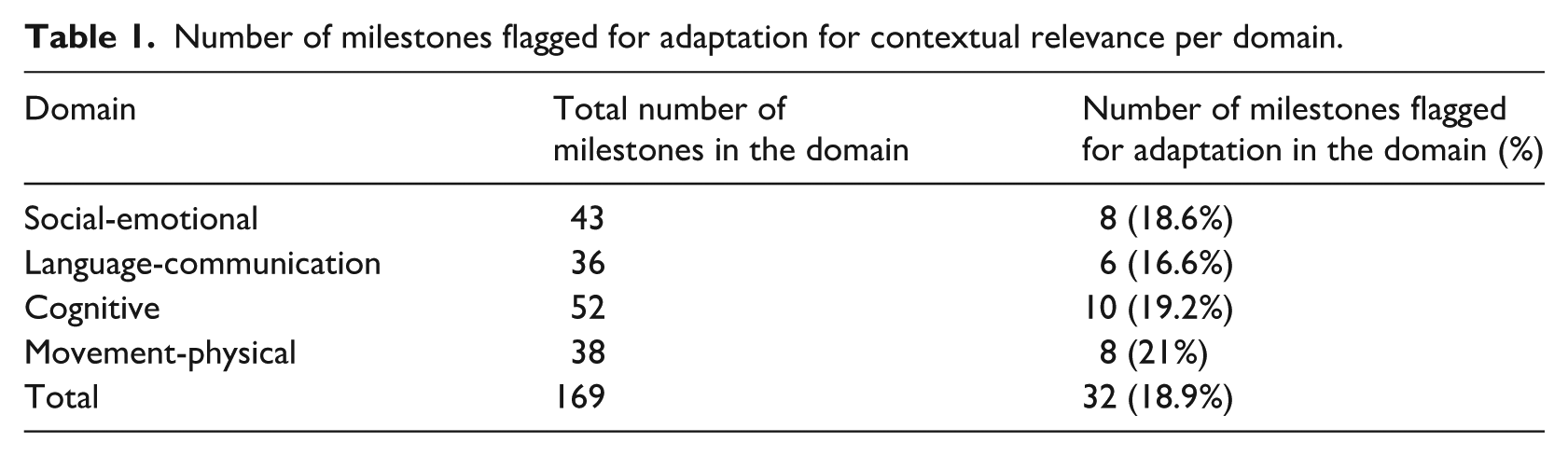
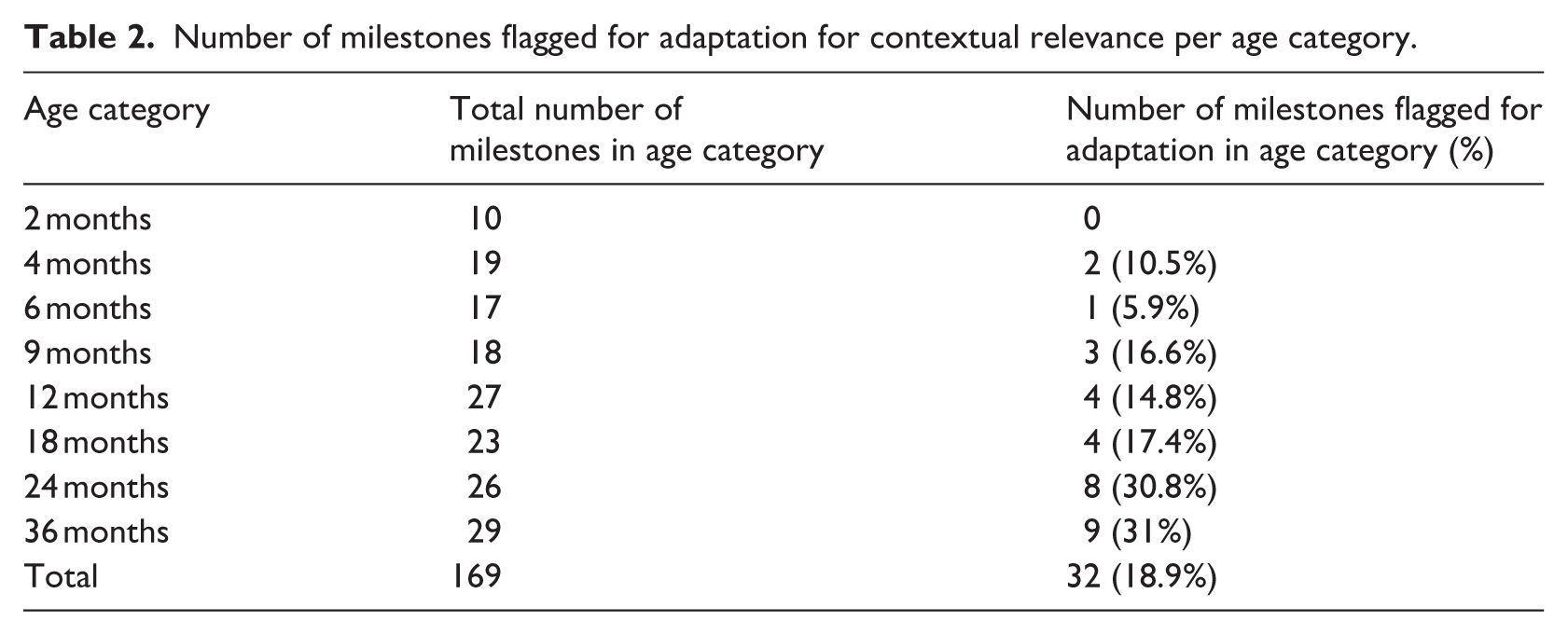
Out of the 169 milestones across the four domains, 32 specific milestones were flagged as requiring adaptation to improve contextual relevance for use by parents in low-income communities within South Africa. Multiple participants flagged four milestones, while the rest were each flagged by a single expert. The cognitive domain contained the highest number of milestones flagged for adaptation, with 10 milestones flagged out of a total of 52 milestones (Table 1). The milestones were flagged in the 9-,12-, 18- and 24-month age ranges, with the 36-month age category having the highest number of milestones needing adaptation (Table 2).
Number of milestones flagged for adaptation for contextual relevance per domain.
Number of milestones flagged for adaptation for contextual relevance per age category.
Experts’ justifications for flagged milestones in the questionnaire were categorised into four themes: (1) Language use, (2) Access to materials indicated in the resource, (3) Context and (4) Developmental literacy. The most prevalent theme for flagging milestones was access to materials. The themes identified in Phase 1 were elaborated on and clarified during Phase 2.
Phase 2: Focus group with the expert panel
The expert panel suggested adaptations for each milestone flagged during Phase 1 until consensus was reached. Many of these milestones (n = 47) were adapted. One milestone was removed, as experts could not create a milestone to assess the skill with a different item. Thus, the consensus was to remove ‘Pedals a tricycle’ from the movement-physical domain. The four themes identified in Phase 1 were clarified and elaborated on during Phase 2.
Theme 1: Language use
The most common theme identified in phase 2 was language use. This theme was most prominent across participant responses. The expert panel found the language used to describe the milestones to not be relevant to parents in low-income communities for five distinct reasons:
Clarification of the words used to describe the milestones and clear language was needed. For example, the milestone ‘Begins to babble’ was clarified and adapted to ‘Begins to make repeated sounds such as ‘ba-ba-ba”.
Elaboration or examples were needed to enhance the readers’ understanding of the milestones. For example, the milestone ‘Plays make-believe with dolls, animals, and people’ was elaborated on and adapted to ‘Plays pretend games with people/toys such as ‘teacher-teacher’ and ‘mommy-child”.
General terms were recommended so milestones could be applied across various contexts. For example, the word ‘blocks’ was changed to ‘item’ in the milestone referring to building a tower.
Changes in terminology were recommended as the terms used in the original milestones differ from the South African terms for the same or similar items. For example, the word ‘closet’ is not used in South African English.
Two milestones were flagged for differences in language structure between English and various African languages. These milestones are related to the understanding and use of preposition words like ‘in’, ‘on’, and ‘under’. The expert panel could not reach a consensus on the adaptations needed as they did not feel competent in African languages. An expert in linguistics with a master’s degree in African languages and a PhD in linguistics was consulted for assistance. The word count for describing a specific position can range from a single word in English to several words in an African language for the same concept. Understanding and applying these concepts, however, is a crucial milestone for all children to reach across languages. The wording of the milestones was therefore adapted to emphasise that the significant milestone is the understanding and use of position concepts rather than the specific words ‘in’, ‘on’ or ‘under’.
Theme 2: Access to materials indicated in the resource
The second most common theme was limited access to the materials needed to stimulate the indicated milestones. For example, milestones with dolls, books, and toys with buttons and levers were flagged. According to the participants, reasons for limited access were linked to financial constraints and a lack of applicable or relevant resources, such as home language storybooks. Suggestions focused on including everyday household objects such as magazines and newspapers.
Theme 3: Context
The expert panel found that South African parents and children in low-income communities live in a context different to what children and parents from HICs would experience, making some milestones difficult to stimulate or apply. Milestones relating to children’s reactions to strangers were flagged, as in low-income community contexts, there are often multiple caregivers involved in the care of children, which may impact their reactions to people. Hence, the word ‘parent’ replaced ‘mom’, ‘dad’ and ‘parent’. Attention was given to how cultural norms and expectations shape the context of children’s development in these scenarios. Milestones relating to climbing up and down stairs were adapted, as stairs are not a common feature in low-income homes.
Theme 4: Developmental literacy
The expert panel reported that there are varying levels of knowledge among parents regarding their developmental literacy and how to foster their development. The experts believed it was important that developmental resources stimulate parents’ developmental knowledge to foster it in the community. Adaptations were made to improve contextual relevance without losing valuable developmental information. For example, although puzzles are not readily available in low-income communities, experts believed it was necessary to retain the concept of building a puzzle to foster parents’ knowledge of this developmentally supportive skill. The milestone was adapted from ‘Does puzzle with 3- or 4-pieces’ to ‘Does puzzle with 3- or 4-pieces (e.g. puts together a picture cut into 3 or 4 pieces)’.
Phase 3: Interviews with parents
The majority (88.8%; 16/18) of the parents responded positively to the adapted resource and found it beneficial to have it available in South Africa. Two participants (11.1%, P18 and P3), however, deemed the resource to be non-inclusive of neurodivergent children. The two participants were parents of children with additional developmental needs.
Based on parents’ feedback and perspectives of the resource, additional adaptations were made to seven of the 46 items in the resource. A domain on feeding skills (birth through 30 months) was added, contributing 19 new items. This resulted in 66 items in the final version of the linguistically and contextually adapted resource. 1 The domains that required adaptations were the social-emotional domain, where two changes were made and the language-communication domain, where one change was made. The changes in the domains resulted in four main themes derived from the participant responses. The themes include (i) accessibility to developmental information, (ii) linguistic complexity and diversity, (iii) developmental literacy and (iv) contextual relevance. Two themes – linguistic complexity and diversity, and contextual relevance – provided additional insight on further amendments to the adapted resource to make it more user-friendly.
Accessibility to developmental information
Most participants reported that they had not sought information regarding their children’s development, and the remainder had sought information from healthcare workers and their research. The prominent reason most participants (83.3%, n = 15) did not use a developmental resource previously was a lack of awareness of its existence. Most participants (72.2%, n = 13) indicated that their preferred dissemination mode of the adapted resource was email; however, other modes, such as WhatsApp and hard copy, were preferred.
Regarding frequency, most participants (P3, P4, P7, P13, P15, P16 and P17) suggested that the adapted resource should be received once a month. Other participants, P11, P14 and P18, preferred to receive it once-off, while the remaining participants preferred to receive it when an update was made.
Developmental literacy
Developmental literacy was identified as a theme, as it labelled participants’ remarks regarding the adapted developmental milestone supporting their knowledge of ECD. The majority (55.5%; n = 10) of participants said the adapted resource was invaluable in increasing their understanding of their children’s development. Six (33.3%) participants stated that it was slightly helpful, and two participants (11.1%; n = 2), P12, an ECD Practitioner, and P18, a parent with a neurodiverse child, reported that it was not helpful.
Linguistic complexity and diversity
Most participants (88.9%, n = 16) found the language in the adapted developmental resource easy to understand. Just over half of the participants (55.5%; n = 10) indicated that some words and/or abbreviations used in the adapted resource were difficult to understand. Suggestions to change certain words were therefore made.
Contextual relevance
The contextual relevance of the developmental resource should consider the appropriateness of the objects used to elicit milestone/s and the correlated age to attain the specific milestones. Most participants (94.4%; n = 17) reported that they had the objects mentioned in the adapted resource and that no additional resources were needed. Most participants (77.7%; n = 14) felt the milestones correlated with what they observed in their own children’s development.
Discussion
Developmental tools currently available are typically created for HICs and are not culturally and linguistically applicable to the South African context (du Toit et al., 2024). Experts in this study highlighted the need to adapt developmental milestones to better align their relevance to children and parents in low-income settings (Fetvadjiev et al., 2015; Karasik and Robinson, 2022). Based on participants’ responses, there was an overall agreement with the information in the adapted resource and consensus that it could be used in South Africa (du Toit et al., 2024). Despite this overall consensus, the parents’ perspectives provided additional amendments to the adapted resource to further increase its linguistic and contextual appropriateness (du Toit et al., 2024).
Applicability of developmental milestones
Milestones in the CDC developmental milestone resource adapted in this study use an age range at which more than 50% of children would be expected to achieve the milestone (Zubler et al., 2022). While the selection of developmental milestones and the ages at which children are expected to develop are often based on Western milestone norms, African Indigenous caregiving practices have been found to promote ECD and some milestones may be met earlier than expected (Karasik and Robinson, 2022; Richter et al., 2019). For example, children in South Africa, where independence is encouraged, like to drink from a cup at a median age of 8 months, whereas children in Argentina reach this milestone at approximately 16 months (Ertem et al., 2018). There has been the suggestion to move away from normative-focused, specific developmental milestones towards describing developmental sequences and activities that are more context-specific (Balton et al., 2019). The value of contextually responsive resources forms the rationale for the current study. Milestones can still be helpful and applicable as a guide (Draper et al., 2024; Karasik and Robinson, 2022), especially in contexts where there are high incidences of developmental delay and low rates of developmental literacy, to avoid late identification.
Most milestones from the CDC milestone resource were found to apply to low-income contexts. Experts chose to leave most age categories unchanged, as using lower age ranges as the expected age for developmental milestones to be achieved can lead to unnecessary parent stress (Meintjes and Van Belkum, 2013). One milestone, however, ‘Copies movements and facial expressions like smiling and frowning’, was adjusted to an earlier age. Using a developmental monitoring resource, a study conducted across South Africa, Argentina, Türkiye, and India on 4949 healthy children between 0 and 42 months found that 76% of milestones assessed were attained at similar ages across the countries (Ertem et al., 2018). These findings reinforce evidence that children across diverse contexts often meet developmental milestones at similar ages, with variations attributable to caregiving practices and exposure rather than genetic factors (Ertem et al., 2018; Karasik and Robinson, 2022).
Contextual relevance
The context in which children in low-income communities in South Africa grow up strongly correlates with the prevalent themes in both phase 1, access to materials indicated in the resource, and phase 2, language use. Materials in the original milestones, such as toys, stairs and books, were all flagged as inaccessible for parents in low-income settings. Often, children in low-income communities do not have a range of toys, if any at all. Stairs are not common in low-income households and communities, and African home-language books are limited (Ertem et al., 2018). Presenting milestones with inaccessible or unfamiliar materials limits the reach of developmental surveillance and family empowerment that these milestone resources aim for (Zubler et al., 2022). Adaptations that were made emphasised the use of readily available household objects (e.g. replacing ‘blocks’ with ‘items’) to improve usability within everyday contexts. Although the adaptation was in response to limited resources in the low-income communities, the use of natural materials and household objects is acknowledged as beneficial for ECD for children from all income contexts (Balton et al., 2019).
Some terms were adapted to account for cultural-contextual differences in what is considered a ‘typical’ family setting in the South African low-income community context. The terms ‘mom’, ‘dad’ and ‘parent’ were changed to ‘caregiver’ across all domains and milestones. In many African families, community and extended family members play a significant role in raising children (Richter et al., 2019). This family structure can be linked to contextual factors in that parents in the African context most often need to seek employment further from home and do not spend every day with their children (Hatch and Posel, 2018). Milestones such as ‘may be afraid of strangers’ were flagged as children’s exposure to multiple caregivers may impact their development of social-emotional behaviour, and their reactions to people may differ (Otto et al., 2014). The term ‘afraid’ was elaborated to ‘shy/nervous/afraid’ to account for reactions that may be more fitting. The adaptations made to the items where the expert panel were uncertain of the contextual relevance, focused on using broader terminology encompassing a wider range of skills to account for the difference in learning opportunities children may be exposed to.
During the interviews, all parents indicated that the examples of objects in the resource and the developmental milestones were contextually relevant to the South African context. They agreed that the milestones correlated with what they observed in their own children’s development. Consequently, when parents agree with the developmental milestones in the adapted resource, it increases the likelihood of them using it of their own volition (Zubler et al., 2022).
Linguistic complexity and diversity
The experts also considered the use of relevant and clear language and terminology a priority. Resources that include everyday terminology to improve understanding and inclusivity are key for linguistic accessibility for all, especially parents (Vorster et al., 2022). Research has shown that direct translation of screening and assessment resources into the individuals’ language is, for the most part, inappropriate as it often fails to account for the cultural and contextual intricacies of society (Fetvadjiev et al., 2015). Furthermore, multiple terms for a single concept are often a challenge in translation due to the lack of terminological planning evident in many African languages (Vorster et al., 2022). Millions of South Africans use English in daily communication, the language of instruction in most South African schools (Khokhlova, 2015).
Many terms in the original milestone resource, however, did not resonate with local South African English. The experts discussed that different terms may describe the same item in South African communities. For example, terms such as ‘pat-a-cake’ were deleted due to being unfamiliar with the South African context, and other terms such as ‘peek-a-boo’ were elaborated on to assist parents’ understanding of the term. Research has found that milestone lists often provide insight to families but not clarity (Zubler et al., 2022). Using terminology that is self-explanatory to parents may assist in providing clarity.
The overall perspective of parents was that the language used was linguistically appropriate. Some parents indicated that the adapted resource should be available in the different South African languages due to the multicultural nature of the South African context. In contrast to our findings, studies in South Africa suggest that South Africans prefer reading information in English to their primary language (Fyvie et al., 2021). English was, however, preferred by most parents due to its widespread use and ease of understanding unfamiliar concepts (Fyvie et al., 2021). This finding is congruent with a study that was conducted, whereby most participants preferred different screening tools to be in English, despite South Africa’s multilingual context, as English is a dominant language used in educational sectors (Vorster et al., 2022).
Developmental literacy
Differentiating between what the experts believed was important for children to achieve and the expectations parents may have of their children was a challenge in this study. Experts in the study agreed that some skills, such as dressing and undressing, were relevant but often not reached by the suggested age of 36 months in the low-income community populations they work with. It was uncertain if this milestone was often not reached due to parents being unaware that it should be stimulated or if, culturally, this independence was not encouraged or desired at that age.
Contextual adaptations attempt to account for the unique diversity in how ECD in South Africa is understood (Richter et al., 2019). There is an underlying assumption in African communities that much of early development happens automatically without stimulation. Thus, accurate information is needed to foster developmental literacy (Richter et al., 2019). The final theme identified in this study is varying levels of developmental literacy among parents.
A study conducted by Brown et al. (2022) found that overall, there was a significant improvement in parents’ developmental literacy using both mHealth and conventional awareness campaigns, demonstrating that providing information in any form can impact developmental literacy and support positive parenting practices that foster development. Experts in this study strived to advocate for the active involvement of parents in stimulating their children through enhancing parent developmental literacy. The milestone resource adapted in this study may complement the existing information in resources such as the RtHB and MomConnect programmes. Having parents involved in further refining these milestones will be crucial given the expanding global understanding of parents’ key role in ECD across contexts (Richter et al., 2019).
After the interview, it was evident that parents required additional support to further their developmental literacy in certain areas, such as language-communication, cognitive, and feeding skills. Parents in LMICs have limited developmental literacy due to focusing on growth rather than development (Akkineni and Kondaparthi, 2020). Additionally, they are unaware of where to obtain information regarding developmental milestones for their children, often leading to no exploration of information (Akkineni and Kondaparthi, 2020). Based on the feedback from parents and previous research, receiving information about children’s developmental outcomes resulted in increased parent awareness, which led to behaviours that supported children’s development (Akkineni and Kondaparthi, 2020). It can, therefore, be deduced that the adapted resource would increase the developmental literacy of parents in South Africa, as all parents must be informed about age-expected ECD (Sajady et al., 2018).
Feedback from parents, including those with neurodivergent children, supported the resource’s relevance but underscored the need for disclaimers regarding developmental delays and variations. Disclaimers on how to use the adapted resource were added. For example, corrected age should be used for preterm infants until 24 months old and when to seek referrals, with suggested professions. For neurodivergent children, the developmental sequence can still be followed, although the age of acquisition may differ (StatPearls, 2025).
Accessibility for parents in low-income contexts
Parents reported seldom seeking out developmental information from healthcare professionals and other resources. This is mainly due to limited awareness regarding the existence of tools that can support parents and their children during the early years. Some parents did not consider the RtHB as a developmental information tool. Previous research indicated that parents from LMICs are less likely to enquire about developmental information surrounding their children as parents’ perceptions are formed by comparative deductions that they make about their children’s development with family and friends’ children due to the lack of awareness and accessibility to such a tool (Akkineni and Kondaparthi, 2020). Furthermore, parents are more aware and knowledgeable about the motor milestones of their children because these are aspects that can be explicitly seen (Alghamdi et al., 2023). The participants who sought information regarding their children’s development mostly used Internet sources, although there was uncertainty about the accuracy of the information (Ohonba et al., 2019).
Parents familiarising themselves with the availability of materials within the home environment is important to align resources with what is available within their microsystems (Balton et al., 2019). When asking about dissemination, a digitised format of the resource sent via email was the most preferred (72.2%) method of dissemination, as parents believed it would be better for safekeeping. As the world is progressing towards having documents digitally, this is preferred as the likelihood of the document being lost or damaged is low, and it could be distributed easily amongst other parents. Furthermore, parents have shown an interest in using a mobile device to obtain information relating to their health, as evidenced by the 95% of registered users on MomConnect (Skinner et al., 2018). The dissemination of the adapted resource in a digitised format may be facilitated by wide access to open Wi-Fi zones across various public and educational spaces (Mathane and Gumbo, 2023).
Conclusion
The primary focus of this research was the review and adaptation of an existing developmental milestone resource by experts in the field, after which parents reviewed it. Developmental milestone resources must be adjusted and contextualised through review to address the unique challenges and circumstances that children in low-income communities face. It is essential to use terminology and language that are relevant and easily understood in the targeted population, as well as materials that are easily accessible and relevant to the context. Developmental milestone resources that are adapted for a specific context may still hold potential for application in other multilingual and multiculturally diverse contexts globally (Balton et al., 2019; Ertem et al., 2018). Feedback from the experts and parent review indicated adjustments to ensure contextual relevance for culturally, economically, and linguistically diverse communities. The adapted resource can assist parents in identifying early developmental concerns more accurately and guide them to facilitate developmentally supportive environments due to increased developmental literacy. The development of the adapted developmental milestone resource is novel in its inclusion of parents as the primary recipients of such resources. This preparatory step in developing appropriate resources helps establish a solid foundation for future implementation and comprehensive trialling.
Supplemental Material
sj-docx-1-ecr-10.1177_1476718X251406872 – Supplemental material for Adaptation of a developmental milestone resource for parents from diverse, low-income communities in South Africa
Supplemental material, sj-docx-1-ecr-10.1177_1476718X251406872 for Adaptation of a developmental milestone resource for parents from diverse, low-income communities in South Africa by Renata Eccles, Maria du Toit, Ashley Bellini, Kabuba Masule, Palesa Molongoana, Mbali Masekela, Zeneera Bahadoor, Shabnam Abdoola and Jeannie van der Linde in Journal of Early Childhood Research
Footnotes
ORCID iDs

Ethical considerations
The studies involving human participants were reviewed and approved by IRB. Written informed consent was provided by the participants to participate in this study.
Funding
The authors received no financial support for the research, authorship, and/or publication of this article.
Declaration of conflicting interests
The authors declared no potential conflicts of interest with respect to the research, authorship, and/or publication of this article.
Data availability statement
The datasets generated for this study are available upon request from the corresponding author.
Supplemental material
Supplemental material for this article is available online.
Notes
References
Supplementary Material
Please find the following supplemental material available below.
For Open Access articles published under a Creative Commons License, all supplemental material carries the same license as the article it is associated with.
For non-Open Access articles published, all supplemental material carries a non-exclusive license, and permission requests for re-use of supplemental material or any part of supplemental material shall be sent directly to the copyright owner as specified in the copyright notice associated with the article.
