




Abstract
Early childhood is a critical life stage for the development of child wellbeing. Early education and care experiences (ECEC) support children’s wellbeing, and curriculum documents and frameworks across the world include wellbeing outcomes and foci. However, a dominant neoliberalism discourse has resulted in a ‘push down’ of academic agendas, centring policy and practices on traditional literacy (reading and writing) over play-based and multi-literacy approaches. Instrumental early childhood pedagogues have called for a re-conceptualisation of early education. Wellbeing science proffers a new literacy, that of wellbeing literacy, that can support this reconceptualization and underpin ECEC pedagogies. Focus groups with 28 early childhood professionals (teachers, pedagogical leaders, mentors and coaches) in Australia examined wellbeing literacy and its five-component capability model to understand how it may inform, reflect, expand and/or underpin ECEC professionals’ wellbeing conceptions, practices and pedagogy. Alternate and debating views about the application of wellbeing literacy were raised. Using Template Analysis, hierarchical findings included themes of ‘a shared language and lens’, ‘a learning and planning tool’, ‘another layer – going deeper, further, expanding’ and ‘applicability and value’. Integrative themes of ‘resonance’, ‘relevance’ and ‘utility’ reflected participants’ views that wellbeing literacy is ‘the crux of what we do’ in early childhood education. Wellbeing literacy and the five-component capability model can offer an additional, vital and contemporary literacy in ECEC, and a framework for conceptualising wellbeing and focusing pedagogy on children’s wellbeing skills. This study also addresses the paucity of research and literature about wellbeing literacy in the context of ECEC, contributing to discourse in early childhood education and wellbeing science.
Introduction
This article examines how early childhood education and care programs can support children in these critical years in today’s complex world, particularly in the acquisition of skills for wellbeing. There is consensus in research that early childhood is a critical life stage impacting learning, development and wellbeing (Gromada et al., 2020; National Scientific Council on the Developing Child [NSCDC], 2007; OECD, 2024). Generally regarded as birth to 8 years of age, these early years are important per se, but because of their impact on children’s futures - pathways to success across broad domains, including health biomarkers, psychosocial functioning, cognition and intelligence, educational attainment and wage-earning potential, begin in early childhood (Campbell et al., 2014; Clark et al., 2017; Grantham-McGregor et al., 2007; National Research Council [NRC], 2000). Research also supports the notion that children’s trajectories and attainment of their potential are impacted by education opportunities in early childhood (Black et al., 2017; Shuey and Kankaraš, 2018). International evidence has confirmed that high quality early childhood education and care (ECEC) experiences in the years before school positively predict health, learning, development and wellbeing across the lifespan (Barnett and Jung, 2021; Johnson et al., 2023; OECD, 2017; Shonkoff, 2010; Shuey and Kankaraš, 2018).
Influences on early childhood education and care
Early childhood education and care (ECEC) services afford children sustained, planned educational activities, provided by educators with pedagogical qualifications, in the years prior to compulsory schooling (OECD, 2024). Neuroscientific evidence in recent decades concerning the importance of early education and its outcomes has become a focus of education policies, government agendas and public attention across the globe (Walsh et al., 2024; Wasmuth and Nitecki, 2017). However, accompanying this public attention, there has been a dominance of neoliberalism discourse, resulting in narrow and reductive thinking around early education’s purpose (Sousa and Moss, 2024). Free marketisation, commodification and corporatisation of ECEC, views of education as human capital production, standardised testing, complex workforce issues and the devaluing of ‘care’ professions are now prevalent (Diaz-Diaz et al., 2019; Mahon, 2016; Sousa and Moss, 2024). In addition, a worldwide ‘Global Educational Reform Movement’ (GERM), emphasising competition, standardisation of teaching and learning; test-based accountability; and a focus on reading, maths and science has been present since the 1990s (Sahlberg, 2016). Sims (2017) argues this has had ‘a devastating impact on the early childhood sector with its focus on standardisation, push-down curriculum and its positioning of children as investments for future economic productivity’ (p.1).
ECEC and wellbeing
Wellbeing is within the remit of global early education (OECD, 2017) and many ECEC curriculums and significant frameworks across the world have wellbeing outcomes and foci (e.g. Australian Government Department of Education [AGDE], 2022; Ministry of Education (MofE), 2017; DfE/UK, 2021). However, there is room for increased policies and practices in ECEC that focus not only on traditional literacies (of reading and writing; Razfar and Gutiérrez, 2013), but additional, contemporary literacies (such as digital or financial literacy) as well as wellbeing pedagogies to equip children for success in their complex worlds. In fact, education scholars are inviting a reconceptualization of ECEC, moving away from the impacts of neoliberalism and towards democratic, inclusive, relational and socially just frameworks to ‘realise the rich potentiality of children’ (Moss, 2017, p.24; Mayor and Sema, 1997). Moreover, in the fields of wellbeing science and positive education there is a call for education to not only seek academic goals but wellbeing outcomes for all children (Norrish et al., 2013; White, 2023).
Inspired by Malaguzzi’s idea of a living early education pedagogy (Cagliari et al., 2016), Moss’s (2017) concept of the potentiality of ECEC and the provocation of ‘fresh thinking’ by Shonkoff (2010), this article proffers an additional literacy – wellbeing literacy – to explore within the context of ECEC. Not to replace traditional literacy, which is important for success in the world, but to support much-needed child wellbeing development and to resist curriculum ‘push down’ in ECEC.
Wellbeing literacy
Wellbeing literacy is defined as the ‘capability to comprehend and compose wellbeing language, across contexts, with the intention of using such language to maintain or improve the wellbeing of oneself, others or the world’ (Oades et al., 2021, p.4). In line with socio-cultural views of literacy as constructing and making meaning within and between people, influenced by constructivism and contextualism, wellbeing literacy draws attention to the language people have and use around their wellbeing (Baker et al., 2021). Baker et al. (2021) assert wellbeing literacy is a necessary and relevant construct to apply to ECEC, particularly considering neoliberalist views and their impact on pedagogy and practice.
Wellbeing literacy, as the mindful use of language about and for wellbeing, is the ability to communicate intentionally about and for wellbeing, involving language skills that are used for the direct purpose of wellbeing creation, adapted to context (Oades et al., 2021). These skills, or necessary components, form the capability of wellbeing literacy (see Table 1).
The wellbeing literacy capability model.
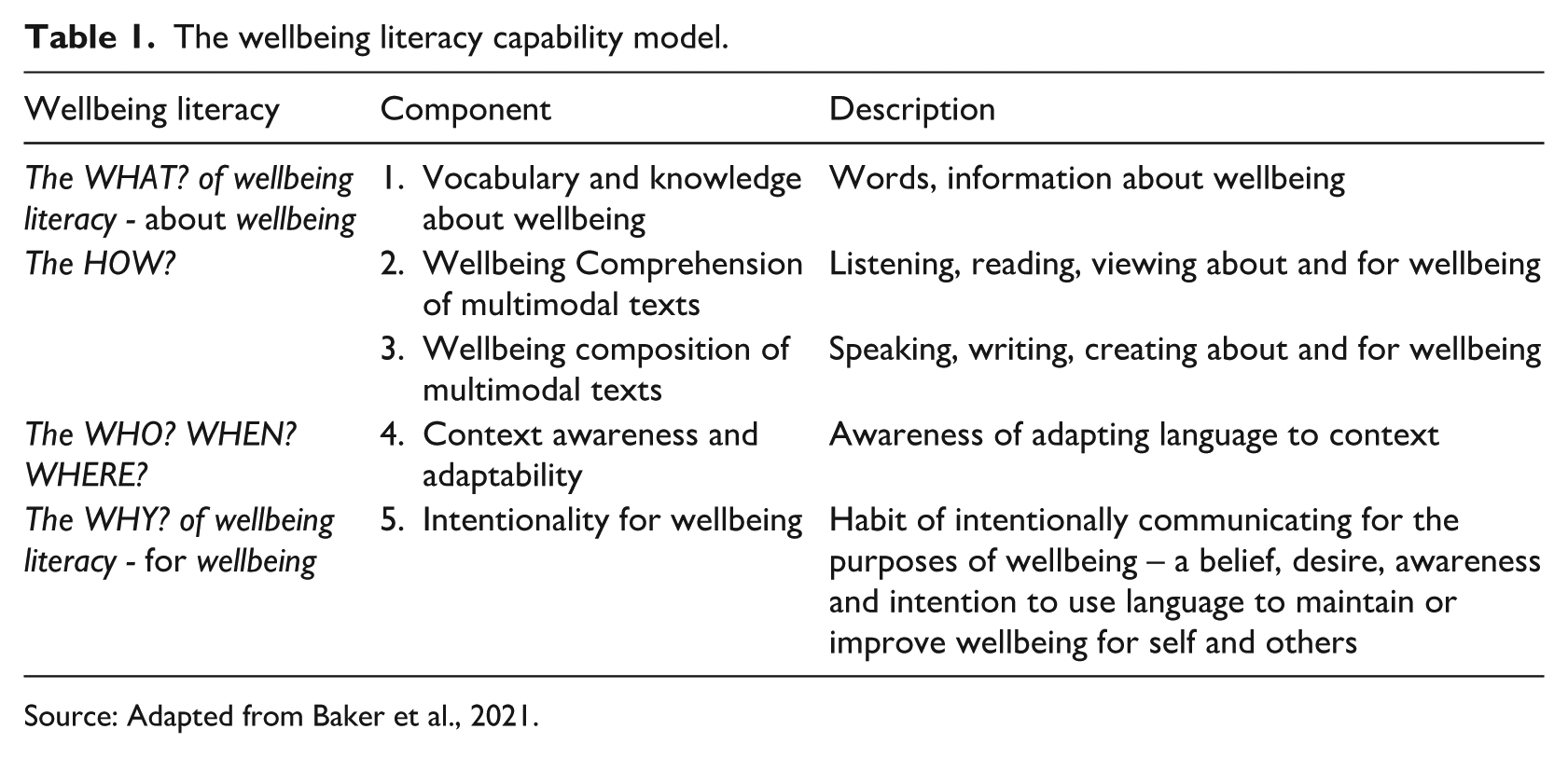
Source: Adapted from Baker et al., 2021.
Wellbeing literacy has been studied with primary school children (Francis et al., 2020; Waters et al., 2022; Waters and Charles Higgins, 2021), higher education students (An et al., 2023; Huang et al., 2020; Johnston et al., 2017; Lemon et al., 2024) and adult populations (e.g. Burns et al., 2024; Chng et al., 2022). Many opportunities exist to further understand, explore and apply wellbeing literacy across the lifespan and in diverse contexts and cultures, particularly in early education (Baker et al., 2021; Waters et al., 2022). Synergies exist between wellbeing literacy and ECEC regarding prioritising wellbeing outcomes and this study aims to continue exploring opportunities to apply wellbeing literacy to early education, beginning with the perspectives of ECEC professionals.
The current study
This article finds its rationale in exploring ways Australian ECEC professionals (teachers, educators, pedagogical leaders, mentors, etc.) can continue to support children’s developing wellbeing and multiple literacies within their micro-contexts despite macro-level education discourse and geopolitical influences. Also, the research reported here addresses the wellbeing literacy research gap and possible application in ECEC. Specifically, this study sought to hear from professionals working in Australian ECEC about their child wellbeing practices to achieve the national Early Years Learning Framework (EYLF) Learning Outcome of ‘Children have a strong sense of wellbeing’ (AGDE, 2022, p.29). In addition:
how the wellbeing literacy capability model might further inform, reflect and/or underpin ECEC professionals wellbeing conceptions, practices, pedagogy and policy;
how wellbeing literacy might expand ECEC professionals’ knowledge, theories, pedagogy and practices and what alternative or debating views exist about the application of wellbeing literacy to the context of ECEC
Methodology
Qualitative study design
A qualitative, interpretivist approach using focus groups was adopted to elicit responses from ECEC professionals. Qualitative research explores human experiences, and the meanings individuals assign to phenomena or issues (Creswell and Creswell, 2023). An interpretivist approach seeks to understand subjective meanings participants bring to a discussion, generating deeper interpretations of contexts and social worlds (Saunders et al., 2019).
Participants
Twenty-eight early childhood professionals, working in or with Australian ECEC settings, participated in the research reported here, recruited through known networks, social media (email, Facebook, LinkedIn) and resultant snowball sampling. All participants had taught or were teaching children between the ages of 3–5 years, with one participant additionally teaching toddlers and babies. Those not in teaching positions were in pedagogical/service leader, ECEC consultant, coach, and/or mentor roles. Teaching experience ranged from 1 year to 26+ years in ECEC services including private/for-profit, council/community/non-profit, long daycare and kindergarten/preschool settings. Participants were female except for one person who preferred not to identify their gender. This represented a convenience sample providing informed and important perspectives and caveats to applying wellbeing literacy to ECEC pedagogy and practices. However, the findings reported here may not generalise across all ECEC professionals or contexts.
Data collection
We held five online focus groups (average 90 minutes each) to allow for the collection of extensive data on participants’ shared understanding of wellbeing literacy. Participant recruitment and focus groups were conducted between June and August 2024. The purpose and structure of the focus groups were twofold – to inform participants about wellbeing literacy and the capability model, and to elicit their responses to its potential ECEC application, including any alternate or debating views. LMB managed all participant communication throughout the study. We conducted two pilot tests, extensively reviewed questions and prompts and made necessary adaptations to refine the focus group structure before implementation. Given the nascent nature of wellbeing literacy research, participants received information about the capability model (see Table 1) in advance and an introduction to wellbeing literacy at the start of each focus group. Key terms of ‘wellbeing’, ‘literacy’ and ‘wellbeing literacy’ were also introduced with definitions from the relevant literature and the EYLF (AGDE, 2022; Oades et al., 2021). Audio and visual recording was undertaken with participant consent via the Zoom platform.
At the beginning of each focus group, LMB established rapport, explained the purpose of the group, shared her personal interests in the research and any known connections within each group. The presence of others (members of the research team and additional non-participatory co-moderators) was acknowledged along with brief participant introductions. To elicit participant’s responses, and insights and probe for understanding and debating or alternate views, two vignettes of ‘everyday’ ECEC practices were shared. One vignette concerned strategies for behaviour guidance via zones of regulation and the other, included here, was about children regulating their bodies though the concept of ‘engines’: Sue is a kindergarten teacher in an integrated program of twenty-five 3–5-year-old children. There are several children who have difficulty settling into indoor experiences, sometimes racing from one area to another or yelling loudly across the room. There is also a child who is withdrawn and rarely gets involved in play. At a group time, Sue introduces the concept of ‘engines’ to the children, reading a book about racing cars. She introduces the idea that their bodies and brains are like engines that have many speeds, sometimes needing to go faster and sometimes needing to go slower. Sue explains to the children that to learn well and feel good, they need their engines to be ‘just right’ for wherever they are. She plays fast-paced music and encourages the children to move their bodies quickly pretending to be cars or machines, saying ‘turn up your engines!’ and ‘you are the boss of your body’. Sue encourages the children to feel their hearts beating and their breath increasing as they move, asking ‘how’s your engine running?’ Sue then plays softer, slower music, inviting the children to lie down and twinkle their toes and fingers gently. She prompts them to feel and think about how their engines’ are running now. Throughout the day, during indoor, outdoor, rest and routine times, Sue continues to remind the children about their engines, asking them to reflect on how they are moving and changing. At pack up time, she encourages some children to ‘turn up’ their engine so they can join in, and all the jobs can get done before lunch. Later, when some children are distracted at rest time, Sue asks them how they could ‘turn down’ their engines so they can rest their bodies. In other conversations, Sue encourages the children to compare what engines they need when running outside and what is the best engine for bedtime at home. As a group, the children begin using the language of ‘engines’ each day, some suggesting to their peers when it’s time to check their engines. Some children tell their families that at kindergarten, they are the boss of their bodies, and they can change their engines whenever they need to.
Possible connections between these scenarios and the wellbeing literacy capability model were used to stimulate discussion and debate during each focus group (Skilling and Stylianides, 2020). Prompts following the information and vignettes included asking participants how they may or may not see wellbeing literacy reflecting or underpinning their own wellbeing practices. In addition, how their thoughts about wellbeing and literacy pedagogy and practice may or may not be expanded or informed with this new wellbeing literacy information. Participants were also prompted to think about how they may apply information about wellbeing literacy or components of the capability model to their work moving forward.
For credibility, informal and formal member checking was conducted during and after the focus groups (Lincoln and Guba, 1985) with high-level themes and anonymized extracts from each focus group emailed to participants for their comments/feedback/correction after each group. Access to verbatim transcripts was also offered and following each focus group participants received a retail voucher to thank them for their time. We made field notes during the focus groups (LMB and BR) and compared these afterward to reflect on the facilitation of the groups and potential researcher bias. Transcriptions were checked against the audio files following each focus group. Consistent with a qualitative approach and thematic analysis literature, we made situated and interpretive judgments about ‘saturation’ (number of focus groups, information redundancy, code and meaning saturation) and when to cease focus groups and coding (Hennink et al., 2019).
Researcher reflexivity
We have backgrounds in ECEC, wellbeing science and psychology. Reflexivity was maintained throughout data analysis via frequent revisiting of the data, debriefings between LMB, BR and LGO and an audit trail and reflective log (Shaw, 2010). The influence of these backgrounds in the focus group prompts, discussion and interpretation of the findings is acknowledged, along with the usefulness of LMB being able to ‘know’ (to understand from an ECEC background) the context of participant’s applications to practice discussion and perspectives.
Ethical considerations
Procedures were approved by the relevant University Human Research Ethics Committee (ID # 25979) and conducted per the Australian National Statement on Ethical Conduct in Human Research (National Health and Medical Research Council, Australian Research Council and Universities Australia, 2023). Focus group participation was voluntary. Participants were informed of the purpose, risk and benefits and written consent obtained. Participants were instructed to avoid specific identifiers, maintain confidentiality and were informed of the inherent limitations of anonymity in focus group settings. Data was stored and deleted according to University data management protocols.
Data analysis
Qualitative thematic analysis of the data was undertaken primarily by LMB guided by King and Brooks (2017) six-step Template Analysis (TeA) – (1) familiarisation with data (2) preliminary coding (3) clustering (4) producing an initial template (5) applying and developing the template and (6) final interpretation, This is now described below.
Step 1 (familiarisation) included transferring data from audio recording to text, firstly via zoom transcription then line-by-line reading and correcting against the video. Each focus group transcript was read in hardcopy in its entirety (LMB and BR) and patterns in the text and extracts of interest were noted and discussed. Preliminary coding (Step 2) was undertaken through the NVivo platform (https://lumwellbeingivero.com/). Consistent with an interpretivist stance and considerations from TeA, ‘soft’ (tentative) a-priori themes were developed from the research questions and used flexibly and reflexively throughout coding and template development.
During Steps 2–4, the a-priori themes as well as inductive codes were used on focus groups 1 and 5 (for diversity of data). Moving backwards and forwards between the Steps generated an initial template, erring on the side of inclusion of codes and to control for quality. A resultant initial template was developed (Step 5) and applied iteratively to the remaining focus groups to reach a final template (Step 6). A-priori themes and new themes were generated, moved or modified through the hierarchical structure of template versions as the data guided deeper interpretations. We then discussed these iterations as a research team. At Step 6 (final interpretations) all themes were reviewed against the data for coherence and the final template developed to represent patterns across the data set. Central organising concepts were written and refined (LMB).
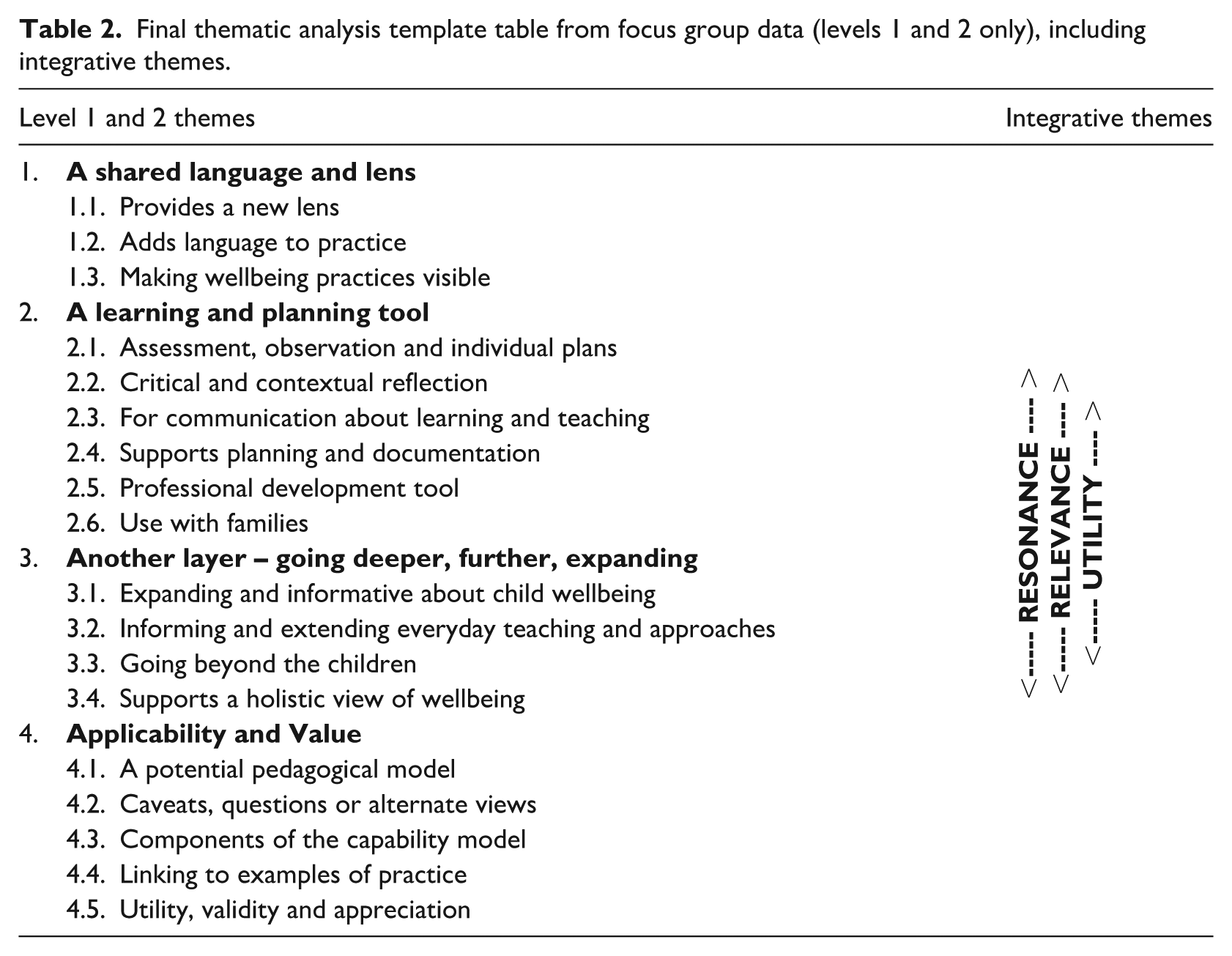
According to Brooks et al. (2015) TeA may also generate integrative themes – lateral relationships permeating across clusters that may be thought of as common threads or undercurrents. We agreed upon three integrative themes as pervading the participants’ discussions across focus groups and added these themes to the final template. Noting in TeA, the template(s) are not the findings of the data analysis but part of the process of analysis and a tool for making sense of the data, assisting with communication of the process (King and Brooks, 2017). The final template is included here. TeA is also characterised by hierarchical indexing of themes and depth rather than breadth. Therefore for brevity of this article, Table 2 outlines only the first two levels of the template. Deeper hierarchical levels can be accessed as Supplemental Material.
Final thematic analysis template table from focus group data (levels 1 and 2 only), including integrative themes.
Findings
As a result of the TeA process, four overarching themes, multiple hierarchical subthemes and three integrative themes were generated. In the following section, each theme and relevant subtheme are briefly discussed, and supporting data extracts that best represent each theme are provided. Congruent with a qualitative approach, quantification of participants and/or individual responses is not presented. However, during the TeA process, quality checks were undertaken for internal theme clarity and to ensure the final themes represented meaningful interpretations of the whole dataset (King and Brooks, 2017).
Theme 1 – ‘A shared language and lens’
This theme captures participants’ responses that knowledge of wellbeing literacy could support them in introducing and sharing a new language with colleagues and families around wellbeing practices, learning outcomes and play-based pedagogy. This theme also represents the core idea that wellbeing literacy can provide a new lens, making wellbeing practices visible and valuable. One participant said: This capability model just provides us with the language to be able to break down wellbeing and explain it to the parents, so that they understand it. . .break it down in a way that is clear and concise and something that is understood by everyone. So yeah, I think it really really creates that shared language. (P1, FG5).
Subthemes (Table 2) represented views that wellbeing literacy could provide a new lens on literacy and play; planning and documentation; policies and frameworks; and reframing children’s behaviours and skills. Participant ideas representing these views and how wellbeing literacy can reflect and inform Australian ECEC practices, such as play-based pedagogy and approaches to literacy included: I don’t know where it comes from, but this real push for academics when it’s a very play based environment. . . So I see this model being fabulous because it’s set out so clearly that I could . . . say “Look, this is what it is.” And I feel, because it’s not so much amorphous, it’s really laid out clearly, that it might be really beneficial to get those educators more on board for understanding the value in that. (P1, FG4) I like the idea of chucking on a new like a pair of glasses, and you’re putting it on and it just builds on what you’re looking at, feeling, seeing all those kind of things in the eyes of wellbeing and opening it up. (P2, FG4)
Subthemes under ‘a shared language and lens’ reflected perspectives of wellbeing literacy and the capability model may add visibility and framing to existing practice and pedagogy, as it could be shared with families and co-educators, bringing professional and consistent language to a complex concept. Participants expressed their belief wellbeing literacy could underpin and inform their child wellbeing practices saying: I think it’s a good framework. I think that helps to organise something that’s so complex. . .being alongside children and feelings - is complex messy work. (P1, FG2) I think actually having it set out that way and having the different components and skills and giving parents the language early on, I think, I’m hoping and anticipating, it might make my job easier because they’re going to see and recognise a lot more of the work that we’re doing and be able to support that on the back end at home as well. (P2, FG4)
Theme 2 – ‘A Learning and planning tool’
This theme explored the views that the wellbeing literacy capability model and the language of wellbeing literacy could be used as tools for ECEC professionals to observe, plan for and assess individual children, for critical reflection and as a professional development, learning and documentation tools (see Table 2). Ideas of wellbeing literacy underpinning and expanding goal setting, evaluating practice, planning and documentation were evident. Wellbeing literacy also resonated with participants as professional development tools for teams to consider and talk through all aspects of wellbeing, cross reference planning and interactions (like a map or matrix), to challenge themselves and go to a deeper level to embed wellbeing practices: And in terms of like sharing it with a team and whatnot I know one thing that my team likes to do is kind of challenge ourselves with a new topic or a new thing weekly and really deep dive into that. And you know, this component gives us the ability to break it down into 5 areas and challenge ourselves in that space. It might be we’re challenging the children because they’re not, you know, understanding component 3 as much as Number 1, or it may be our practice. So I feel like it just really gives the perfect map and the perfect shared language for us to be able to do that. (P1, FG5)
Specifically, participants believed the capability model had utility as it went ‘beyond a formula’ and could be a resource for communicating about the importance of wellbeing teaching and learning: I’m thinking is that it’s more of a framework. And sometimes what happens is there’s a formula that people are using with good intention but without developing our own knowledge and connection around things like comprehension, composition skills, those discrete aspects of wellbeing. Yeah, that’s what kind of excites me about reading this, it’s not a formula. (P1, FG2) I think it might help us see the importance of what we’re doing with young children. It’s a good opportunity - every interaction that we have with children is so important - and we can be explicit in our discussions, in our understandings, it helps. It probably would be useful to share with the team, to see the importance of every interaction that we have through all the play that is planned and unplanned throughout the day. (P1, FG3)
Theme 3 – ‘Another layer – going deeper, further, expanding’
In this third theme, participants explored how wellbeing literacy and the capability model add another layer to ECEC work, taking thinking and everyday practices deeper and further, informing and expanding them. One participant commented that wellbeing literacy: Definitely expands what I want to do in future. And yeah, just having this knowledge, I think will definitely support me in implementing this a little bit further with children and making me really reflect on my practice, going further with it. (P1, FG1)
Subthemes (Table 2) reflected how wellbeing literacy could expand and inform ECEC professionals’ knowledge, practices and perceptions of child wellbeing, taking it beyond emotions and elevating the importance of teaching. In addition, the concept of wellbeing literacy could extend everyday teaching practices to deepen thinking about areas such as inclusion, body safety and empowering children, indigenous cultural practices, differentiated teaching, music and art, nature-play and the outdoors, relationships and attachment. For example: If I had this model, then I could think about a bit more deeply and be bit more intentional about the wording that I give the children, the prompts that I give to the children and the asking the questions about their drawings. (P1, FG2) I can see it being used as a tool for inclusion . . .having it clearly defined as the wellbeing literacy capability model will support teams of teachers and educators to ensure they are teaching children all the skills they need for wellbeing and centring it when it comes to specific efforts to meet children’s emotional needs. (P1, FG4)
Participants also shared their views that wellbeing literacy supports a holistic view of wellbeing, providing language and a framework to validate their views that wellbeing is individual and different approaches need to be implemented. Also, that children play a part in their wellbeing, children have voice and agency, and child wellbeing is vast and multifaceted. One participant commented: We’ve put in all of the supports to give them the language, to give them the skills to be able to use in different contexts and adapt in different contexts so that they can really take ownership and have that agency to guide their own wellbeing. (P3, FG3)
Also in this theme, participants signalled the concept of wellbeing literacy could be used ‘beyond the children’ and would not only support and guide professionals in their work, bringing meaning to interactions, but also ways to think about their own wellbeing literacy: I always think about how can we support educators to have more meaningful interactions with children? And I think this model could be a really great way of supporting that thinking. (P3, FG4) I think it’s not just about wellbeing literacy for children, it’s wellbeing literacy for us. It’s us understanding what we’re hoping literacy is, and how we can be intentional about that, that’s it’s that’s how it’s coming across to me (P2, FG1)
Theme 4 – ‘Applicability and value’
Finally, participants reflected on ways in which wellbeing literacy is relatable and applicable, adding value to complex wellbeing work. Participants specifically linked examples of their current wellbeing practices to the capability model (words and information; composition/expressive language; comprehension/receptive language; context adaptability and intentionality; see also Table 1) and shared how it resonated with them: I think it does encapsulate a lot of what we are already doing, but it gives again it being called literacy and coming under that umbrella, does give a bit more weight and purpose. (P2, FG4) I see this model being fabulous because it’s set out so clearly that I could go to the educators . . . and say ‘Look, this is what it is’. And I feel, because it’s not so much amorphous, it’s really laid out clearly, that it might be really beneficial to get those educators more on board for understanding the value in that, if that makes sense. (P1, FG3)
The focus group prompts encouraged participants to share alternate or debating views regarding how wellbeing literacy may or may not be applicable or useful in ECEC. This theme additionally represents that while participants felt there were many avenues for wellbeing literacy utility with children, families, co-educators and teams, caveats exist to its use and contextualisation in ECEC. Cautions were raised about ensuring a model is not implemented without intention or understanding, and ECEC professionals respond to children, considering their individual needs and age: I do often find children are at that composition skill level first as you said they may have some words and everything, but they’re not able to articulate that yet. So it’s just an observation and being aware of where children are on that scale. (P3, FG1)
Participants also reflected that the ability to teach children wellbeing literacy skills through providing practices that support this capability would be dependent upon the wellbeing literacy of the educator. One participant questioned: Does it rely on the experience of the educator and the knowledge? . . .And if you are a quality educator, does that mean that you’re really great at wellbeing literacy? (P3, FG4)
Integrative themes
Three integrative themes (‘resonance’, ‘relevance’ and ‘utility’, Table 2) permeate the higher and lower order hierarchical themes, reflecting lateral relationships amongst the data: ‘Resonance’ relates to the participants views that the concept of wellbeing literacy and the capability model resonates with them, connecting to their beliefs and experiences. Not only did participants appreciate the knowledge of wellbeing literacy, but it echoed their practices and philosophies of wellbeing, resonating with their values of the foundational importance of child wellbeing. ‘Relevance’ reflects frequent responses from participants that wellbeing literacy is relevant to the work they do every day in supporting children’s wellbeing, aligning with their teaching practices and could be immediately used in their planning, professional interactions and conversations. ‘Utility’ represents the pervading thread that the knowledge of wellbeing literacy and its component parts would be a valuable addition to ECEC pedagogy and practice. Participants articulated the utility and potential impact of the model for their documentation, planning, professional development and communications with families and colleagues.
While ‘relevance’ and ‘utility’ were explicitly voiced by participants across multiple focus groups and in relation to many thematic clusters and levels, ‘resonance’ was implicit, described by King and Brooks (2017) as an undercurrent running through participants accounts. Combined with the many hierarchal themes and subthemes generated from the data, the integrative themes support the findings that wellbeing literacy and the five-component capability model have the potential to expand and inform ECEC professionals (teachers, educators, pedagogical leaders, mentors, etc.) thinking and practices around child wellbeing. Additionally, the data signals wellbeing literacy reflects and underpins wellbeing practices and pedagogy of ECEC professionals. Areas of policy were less explicitly discussed, although reference to the Learning Outcomes of the Australian EYLF (AGDE, 2022) were made. One participant comment perhaps sums up much of the data and the three integrative themes of resonance, relevance and utility: I think we know all this but maybe we forget? But by reframing it in this wellbeing literacy, we’re refocusing on it through a different lens. And I really think that maybe that’s what some educators need, because they’re exhausted with the framework, they’re exhausted with outcomes. But this is the crux of what we do. (P3, FG4)
Discussion
The positive reception to the wellbeing literacy model by ECEC professionals suggests its potential to enhance current pedagogical practices. Findings illustrated wellbeing literacy resonates in ECEC and would be relevant and useful in practical areas from curriculum planning to professional development.
Young children are growing up in a volatile and uncertain world where the benefits of early education and wellbeing learning are vital. Educational opportunities in early childhood for children to develop wellbeing literacy capabilities have never been more important. A ‘polycrisis’ of climate change, war, inflation, pandemics, mental health concerns and other global issues (Lawrence et al., 2024) requires education to attend to wellbeing outcomes with as much vigilance as has been given to traditional literacy. ECEC professionals are mandated to work towards both wellbeing and literacy outcomes for young children and wellbeing literacy offers a way these can be conceptualised and attended to.
At a time when academic-driven approaches to literacy, numeracy and ‘school readiness’ dominate ECEC policy and discourse (Moss, 2017), wellbeing literacy can expand thinking, broadening views of literacy in line with contemporary multiliteracies (Gee, 2015). Rather than bend to neoliberal constraints and inappropriate ‘pushed down’ curricula prioritising children’s academic success and future workforce worth (Harmon and Viruru, 2018), ECEC professionals can expand their focus and underpin their practices with wellbeing literacy. Jalongo et al. (2004) argue decisions about pedagogy and curriculum must be governed by the needs of children rather than replicating or racing towards test-driven academic outcomes. These needs include teaching children the skills to understand wellbeing concepts, express and receive wellbeing communication and be adaptable and intentional about and for their wellbeing (Baker et al., 2021; Oades et al., 2021).
Further value of wellbeing literacy to ECEC comes in the conceptualisation of wellbeing. While wellbeing definitions are varied, literature concurs it is an intangible, complex, multidimensional and nuanced concept (Dodge et al., 2012). Child wellbeing is a particularly dynamic and elusive notion; difficult to measure and define as it changes over time and is impacted by cultural and contextual limits, expectations and opportunities and along with children’s relative interdependence and vulnerability in the world (Dirwan and Thévenon, 2023; Pollard and Lee, 2003).
Findings reported here concur, describing wellbeing as amorphous, and ECEC wellbeing pedagogy as complex and messy. Wellbeing literacy and the five-component model presents a way for ECEC professionals to conceptualise wellbeing as a capability that can be learned and taught. Skills of developing wellbeing knowledge and vocabulary and being able to comprehend and compose intentional, adaptable wellbeing communication (Baker et al., 2021), can be fostered and potentially measured in early childhood in ways useful and relevant for young children. Rather than nebulous wellbeing conceptions, wellbeing literacy offers practical, visible, and teachable skills that can be embedded in ECEC programs, practices, philosophies and interactions.
Wellbeing literacy is a language-based resource that can support education settings and professionals to scaffold children’s skills of wellbeing communication, building life-long and ongoing capabilities transferable across contexts and time. In practice, the five components of the wellbeing literacy capability model can be used to underpin curriculum planning, expand language interactions with children, inform pedagogical conversations and professional development, and support play-based, multi-modal pedagogies.
Strengths, limitations and future directions
Limitations of this study are acknowledged in its focus group method, including issues such as group dynamics influencing participant responses, restricted depth of individual exploration, potential moderator bias or participant social desirability bias, and ethical concerns of confidentiality (Krueger, 2014). Conversely, by utilising focus groups this study has collected rich, in-depth data from ECEC professionals about the real-world potential applications of wellbeing literacy to their work. This addresses a current gap in the literature and opens future directions for further consultation with ECEC professionals and exploration of wellbeing literacy in this educational context.
Conclusion
ECEC settings and professionals are increasingly important in the lives of young children not just to support academic outcomes, but via their role in enhancing wellbeing and other life skills. Scholars have called for the reconstruction of ECEC and its potentiality for change based on contemporary conditions and discourses (Cagliari et al., 2016; Moss, 2017; Sousa and Moss, 2024). Given the resonance, relevance and utility of wellbeing literacy and the capability model to ECEC, wellbeing literacy offers a valid arrow in the quiver of reconceptualising early education pedagogy and practice. With wellbeing literacy as an additional perspective on literacy and wellbeing, ECEC professionals may well ‘push back’ on forces that ‘push down’ academics and traditional literacy. Relational, play-based and multi-modal practices that support child wellbeing are the crux of quality early education – these can be underpinned, expanded and informed by championing wellbeing literacy for young children.
Supplemental Material
sj-docx-1-ecr-10.1177_1476718X251369233 – Supplemental material for ‘This is the crux of what we do’: Australian early childhood education professionals’ perspectives of wellbeing literacy
Supplemental material, sj-docx-1-ecr-10.1177_1476718X251369233 for ‘This is the crux of what we do’: Australian early childhood education professionals’ perspectives of wellbeing literacy by Lisa M Baker, Bridie Raban and Lindsay G Oades in Journal of Early Childhood Research
Footnotes
Author contributions
All authors contributed to the study conception and design. Material preparation, data collection and analysis were performed by Lisa M Baker. Review of data analysis was undertaken by all authors. The first draft of the manuscript was written by Lisa M Baker and all authors commented on previous versions of the manuscript. All authors read and approved the final manuscript.
Declaration of conflicting interests
The authors declared no potential conflicts of interest with respect to the research, authorship, and/or publication of this article.
Funding
The authors disclosed receipt of the following financial support for the research, authorship, and/or publication of this article: This research is supported by an Australian Government Research Training Program (RTP) Scholarship.
Ethical approval
Ethical approval for this study was obtained from the University of Melbourne Human Research Ethics committee (ID # 25979). This study was conducted in accordance with the Australian National Statement on Ethical Conduct in Human Research (National Health and Medical Research Council, 2018).
Informed consent
Written informed consent was obtained for anonymised participant information to be published in this article.
Disclosures and disclaimer
All authors certify that they have no affiliations with or involvement in any organization or entity with any financial interest or non-financial interest in the subject matter or materials discussed in this manuscript.

Supplemental material
Supplemental material for this article is available online.
References
Supplementary Material
Please find the following supplemental material available below.
For Open Access articles published under a Creative Commons License, all supplemental material carries the same license as the article it is associated with.
For non-Open Access articles published, all supplemental material carries a non-exclusive license, and permission requests for re-use of supplemental material or any part of supplemental material shall be sent directly to the copyright owner as specified in the copyright notice associated with the article.
