




Abstract
Guided by the Differential Susceptibility to Media Effects model, we examined the relations between parents’ anxiety over their children’s futures and their attitudes toward playful media for children and media featuring principles of direct instruction, as moderated by parent race (N = 600, quota sampled for race, children ages 3–7). Research has demonstrated that parents’ anxiety surrounding their children’s futures influences their attitudes toward different curricular programs as well as their children’s media use. Here, we apply this research to attitudes toward children’s application (app) use. We consider both media that is playful, allowing for children to explore their own ideas in an open-ended environment, as well as media aligned with principles of direct instruction, which provides explicit presentation of information, has right and wrong answers, and does not encourage exploration. Further, research has demonstrated that racially and ethnically minoritized (REM) parents may experience greater anxiety surrounding their children (relative to white parents) due to structural systems of racism. Results demonstrate no relation between parents’ anxiety about their children’s futures and their difference in attitudes toward direct instruction media and playful media. Further, race did not moderate this relation, demonstrating a lack of support for one potential reason (parent anxiety) for past findings that show differential parent attitudes toward media by race. Theoretical and practical implications are discussed.
Introduction
Play and learning are co-constructive processes that support young children’s development (Sandberg and Ärlemalm-Hagsér, 2011). Research on parents’ perceptions of their children’s play and learning, however, suggests that parents do not see these constructs as supporting one another and that parents do not value play as enhancing children’s academic skills (Kane, 2016). In contrast, research demonstrates that play does promote learning across domains for young children (Pramling Samuelsson and Johansson, 2006; Zosh et al., 2018). Over the past two decades, children’s play has come to include digital environments, with children commonly using smartphone or tablet applications (apps; Rideout and Robb, 2020). Though research suggests that play supports young children’s learning, many apps marketed for learning emphasize elements of direct instruction, where answers are provided explicitly and exploration is not encouraged (Hirsh-Pasek et al., 2015; Lennon et al., 2022). In contrast, other apps emphasizing play features provide children opportunities for exploration and discovery, much like playful activities in the physical world (Hirsh-Pasek et al., 2015). In the context of the classroom, research shows conflicting results as to whether direct instruction or playful exploration produces greater learning, especially over time (Dean Jr and Kuhn, 2007). However, parents who are anxious about their children’s future success sometimes report feelings of greater comfort with a direct instruction curriculum, as it appears more obviously connected to learning outcomes through its explicit presentation of educational content (Golann et al., 2019). Because parent anxiety is associated with these attitudes toward play and learning activities, like school, it is important to assess how parent anxiety might differ, and connect this anxiety to parents’ attitudes about different types of media.
Considering past research on parents’ differing attitudes toward media use practices by race (Katz et al., 2018; Rideout and Robb, 2020; Top, 2016), we focus on race specifically to understand why these differences emerge, and examine anxiety about children’s futures as one potential reason. Anxiety about children’s futures may be heightened for racially and ethnically minoritized (REM) parents in the United States, as systemic racism negatively affects children’s development (Iruka et al., 2022). In the current study, we examine how parent characteristics relate to their attitudes toward interactive media spaces. Here we consider how parent anxiety about their children’s (ages 3–7) futures relates to parents’ (N = 600) preferences for their children’s app use, as moderated by race, using the Differential Susceptibility to Media effects Model (DSMM; Valkenburg and Peter, 2013). Further, we use a novel measure to assess parents’ attitudes toward playful and direct instruction media. Parents in the current study responded to survey measures about their conceptualizations of play and learning in digital environments as well as their anxiety about their children’s future success.
Differential susceptibility to media effects
To understand the associations between parent anxiety about their children’s future and parents’ preferences for their children’s app use, we reference the DSMM (Valkenburg and Peter, 2013). The DSMM suggests that media effects are conditional and depend on three types of susceptibilities: dispositional, developmental, and social (Valkenburg and Peter, 2013). Dispositional susceptibilities refer to trait differences, such as temperament, personality, or race/ethnicity, which are understood as antecedents or moderators to the selection of and response to media. Developmental susceptibilities refer to the effect of individuals’ development on their selection of and response to media. Finally, social susceptibilities refer to social-contextual factors, such as location, that can influence media use and responses. Using Bronfenbrenner’s ecological theory of child development, social susceptibilities range from the micro (e.g. family relationships) to macro levels (e.g. cultural norms; Bronfenbrenner and Evans, 2000). We note, however, that the DSMM primarily focuses on these traits for the individual consuming media. However, when considering the context of young children, it is important to recognize that parents’ dispositional susceptibilities (e.g. parent’s race/ethnicity, or parent’s anxiety about their child’s future) can manifest as social susceptibilities for children. For example, parents’ moral considerations have been linked to parents’ differential preferences for children’s educational and entertainment media (Cingel et al., 2023). Likewise, parents often set rules around children’s media and technology use (Shawcroft et al., 2023a), and parents’ implicit gender stereotypes have been linked to children’s engagement with gendered media (Shawcroft et al., 2023b). In all these ways, parents’ susceptibilities, from moral considerations to gender stereotypes, shape the micro-level social milieu within which children select and consume media. As such, the current study explores how parents’ dispositional susceptibilities of race and anxiety about their children’s futures relate to their attitudes toward children’s interactive media.
We focus on race due to past research findings that parental attitudes toward media differ by race (Katz et al., 2018; Top, 2016), as demonstrated in the latest nationally-representative survey of parents’ views on media (Rideout and Robb, 2020). However, these findings do not demonstrate the reasons behind these differences. As we will explicate, lived experience in the United States varies as a function of systemic racism. Thus, parent attitudes toward different parenting practices may vary by race. Researchers struggle to disentangle findings about race from those of socioeconomic status in past research (for review, see Hightower, 2020). However, even when considering socioeconomic status, experiences and attitudes still differ by race. Thus, we focus on race to understand documented differences in parental attitudes and perhaps explain them within the larger social climate.
Play and learning as co-constructive processes
Though sometimes considered separately, play and learning have considerable overlap during early childhood (Pramling Samuelsson and Johansson, 2006). Play can be defined as freely sought activities that are pursued for enjoyment; it is considered important for children’s development in cognitive, social, and emotional domains (APA Dictionary of Psychology, 2022). Learning refers to acquisition of novel information, skills, or behaviors through observation or practice (APA Dictionary of Psychology, 2022). Young children create meaning through play and thus learn about the world through their own experiences, making play and learning intertwined (Pramling Samuelsson and Johansson, 2006).
Parents’ and practitioners’ views on play and learning
While theory and empirical evidence support the ideas of play and learning as co-constructive processes for children, parents and practitioners see these constructs as separate. Findings from a survey study (with open-ended measures) of parents of preschoolers (3.5–5-years-old) in the United States demonstrated that parents think of play and learning as separate and that play was less important than developing literacy and numeracy skills. This study’s results illuminated parents’ anxieties about their children’s academic performance, a potential driving factor for why parents may de-emphasize play and over-emphasize direct instruction (Kane, 2016). Another study of mothers and child development professionals in the United States demonstrated similar findings (Fisher et al., 2008). Mothers saw more value in structured play (most similar to direct instruction) as opposed to unstructured play. Professionals took the opposite stance. Mothers who saw learning value in structured play, however, engaged their children in this activity more often, which has implications for the breadth of knowledge children are able to acquire through play since structured play often has narrowly prescribed outcomes (Fisher et al., 2008). Thus, parents are important to consider when designing curriculum to foster children’s learning.
Parent anxiety on children’s futures
Parents worry about their children’s futures, expressing anxiety over their children’s potential ability to become financially independent, earn college degrees, and have jobs or careers that they enjoy (Pew Research Center, 2023). This worry can influence parents’ attitudes toward children’s learning environments, such as school. Qualitative research demonstrates that parents consider how school curricula signal academic expectations to children. For example, when looking at a “no-excuses” charter school following principles of direct instruction (characterized by focus on discipline, structure, and academic proficiency demonstrated through high test scores) and a Montessori school (characterized by student independence, open-ended materials, and teachers taking a peripheral role in the classroom), parents expressed positive feelings about the strictness in the no-excuses 1 school as signaling high academic expectations (Golann et al., 2019). This distinction is important because parents choose schools for their children based on their perception of the school’s academic reputation (Bosetti and Pyryt, 2007). This is not to say that parents do not care about children’s happiness or social ties in school; these factors also influence parents’ decisions (Bosetti and Pyryt, 2007). These relations demonstrate that this anxiety extends beyond school, where academic reputation can be assessed more easily through social networks and publicly available standardized test records. In this way, parent anxiety fuels the educational opportunities parents provide to their children, whether that be through selection of a school or enrollment in sports, music lessons, and other extracurriculars.
A more recent development in educational opportunity for children comes through interactive, digital media, such as smartphone and tablet apps. Parents generally see media as having value in supporting children’s learning (Rideout and Robb, 2020), but it is unclear how parent anxiety might relate to children’s media use. There is some qualitative evidence to suggest that parents who are anxious about their children’s academic success also require children to use interactive media, such as a desktop computer, for educational purposes exclusively (Tripp, 2011). Research has not yet considered how parents examine the actual content of these interactive media. One way to differentiate types of interactive media is to apply principles of curricular foci to these digital spaces. Past research has examined digital games differentiated by structure (Lennon et al., 2022). Games with open-ended designs allow children to explore content and ideas without these decisions to explore being considered erroneous (Papadakis et al., 2018). These types of apps are most aligned with unstructured play, like building with blocks or playing with dolls; there are not rules or correct/incorrect answers (Zosh et al., 2018). Other digital games are structured; they have specific learning goals and a focus on selecting correct answers. These games are most aligned with a direct instruction curricular focus, which is not considered part of play (Zosh et al., 2018). In direct instruction settings, children are explicitly told how something works or what information is meant to be known (Hirsh-Pasek et al., 2015). Research has demonstrated that parents view play and learning as separate constructs (Fisher et al., 2008), and thus parents may differentiate between digital spaces emphasizing play and digital spaces that have the structure of direct instruction, such as a traditional school classroom. Further, research has demonstrated that parents who are anxious about their children’s futures de-emphasize play (Kane, 2016). Considering how parent anxiety relates to parent preferences for education as well as play and learning activities, we ask:
Race and parent anxiety
Parents have substantial influence on their children’s academic success (Dornbusch et al., 2016; Ingram et al., 2007). Further, research supports that parenting philosophies about educational achievement vary by race (Robinson and Harris, 2013). For example, when a child has inadequate academic performance, more White than Black parents noted a preference for non-punitive responses (Robinson and Harris, 2013). This is important because differences in parental response to inadequate academic performance impact children’s academic outcomes. Findings reveal that under authoritative parenting (e.g. setting clear expectations and having open discussions about these expectations with children), Latino and White adolescents had higher grade point averages in comparison to Asian and Black adolescents (Dornbusch et al., 2016). However, in general, research finds that providing children autonomy through an emphasis on independence is positively associated with self-initiated regulation in the classroom, perceived competence, and academic achievement (for review, see Guay, 2022). Concerns, or worries, about a child’s future and lack of comfort with how schools operate (e.g. contacting instructors, etc.) likely create a sense of obligation to regulate inadequate achievement through punitive measures (Robinson and Harris, 2013). A lack of parental involvement in school settings for REM parents may stem from the negative historical experiences of REM parents with the U.S. school system (Cross, 2003). These concerns are more prone for lower-income parents equipped with weaker school-specific social networks (Cox et al., 2021). A perceived lack of competence in their interactions with schools, along with limited time, resources, or information negatively impact parental school involvement (Hill et al., 2004) which may create greater parental anxiety about their children’s educational outcomes. Parents who have high anxiety about the possibility of negative outcomes or harm to their child, tend to adopt more overprotective/controlling behaviors to protect the child from potential threats (Hadwin and Field, 2010) that often come from macro-level influences that foster a system of racism and inequality.
Racism is a multidimensional system of oppression and exclusion that is a foundational part of the United States (Iruka et al., 2022), and REM parents are likely dealing with increased and consistent concerns about negative outcomes for their children. Racism is a system of privilege and hierarchy based on skin color (i.e. race; Delgado and Stefancic, 2017) and is one of the most pernicious factors impacting the healthy development of U.S. children (Saleem et al., 2020; Trent et al., 2019). Several leading organizations (e.g. the Society for Research in Child Development, the American Academy of Pediatrics) have given increased attention to the impact of racism on children’s development and learning. Racism affects children’s health, development, and learning opportunities through a negative effect on various factors including economic stability and security and educational opportunities and outcomes (Iruka et al., 2022). Children’s access to high-quality early care and education programs is limited by racial disparities (Latham et al., 2021), and data suggest unfair, biased, and harsh treatment of REM children by education professionals such that suspension and expulsions are racially disproportionate (Gilliam et al., 2016). Experiences of racial discrimination, generally, have been associated with higher levels of reported generalized anxiety (Gee et al., 2007; Tran, 2014). Therefore, REM parents might be more anxious about their children’s futures due to the impact of racism on children’s development and learning. We thus ask the following:
Method
Participants
Eight-hundred-ninety-seven parents of 3–7-year-olds in the United States were recruited via the survey company Dynata. Participants consented to the study prior to answering questions. This study was approved by the Institutional Review Board at the University of California, Davis (#1973266-2), and data are available on Open Science Framework (OSF; https://osf.io/4syjf/). Researchers did not have access to personal information about the participants (such as names, contact information) as this information is stored separately by the survey company. Researchers paid the company, and then the company paid participants. As such, there is no way to link the data to personal information. Further, the protocol was approved by the Institutional Review Board at the University of California, Davis that is dedicated to protecting the rights and welfare of human subjects. While questions (such as asking about worries or opinions) may be sensitive, they were deemed appropriate for research and not harmful to subjects by the review board.
We quota sampled for approximately equal numbers of Asian, Hispanic, Black, and white parents. Two hundred sixty-four parents were excluded due to completing the survey too quickly (under 7 minutes, the average time it took investigators to read through the survey). Eight parents were excluded for low-quality data on open-ended questions, and 25 were excluded for failing attention checks. Thus, the final sample included 600 parents.
On average, parents were 36.72 years old (SD = 8.14). Two-hundred parents were white (33.33%), 142 were Black (23.67%), 114 were Asian (19.00%), 116 were Hispanic (19.33%), and 28 identified with multiple races (4.67%). Three-hundred-seventy-three parents identified as men (62.17%), 192 identified as women (32.00%), one identified as non-binary (0.17%), one preferred to write in another option for gender (0.17%), and 33 parents did not disclose their gender (5.50%). On average, parents reported living in households with an annual salary between $50,000 and $74,999. The average level of education for parents was an associate degree or completion of trade school. Children on which parents reported were 5.25 years old on average (SD = 1.42). Parents reported on 221 boys (36.83%), 339 girls (56.5%), and four non-binary children (0.67%). Thirty-six parents did not disclose their child’s gender (6.00%).
Measures
Parents answered questions about anxiety about their children’s futures as well as their attitudes toward different characteristics of media. To ensure that appropriate comparisons could be made across racial groups, we conducted invariance testing to demonstrate that the items in each measurement were interpreted similarly across groups (for more information on invariance testing, see Milfont and Klein, 2018). See Supplemental Materials for invariance testing statistics. Overall, statistics showed configural, metric, and scalar invariance across racial groups, suggesting that each measure maintained similar structure, meaning, and scale usage across the four racial groups included in the study.
Parent anxiety about their child’s future
Parents responded to four items about their anxiety for their child’s future success on a five-point scale ranging from 1—Strongly Disagree to 5—Strongly Agree (Sun et al., 2022). All items (such as “I worry that my child will not be able to find a satisfactory job”) are listed in the Supplemental Materials. Items had acceptable internal reliability (α = 0.90) and were averaged (M = 3.71, SD = 0.61).
Parents’ preferences for playful versus direct instruction media
One methodological contribution of this paper is the development of a measure to assess parent attitudes toward media emphasizing elements of play compared to media emphasizing elements of direct instruction. This measure builds off our previous work in development of a measure to assess parent attitudes toward education and entertainment television (Cingel et al., 2023). Apps, as compared to television, do not have as clear a distinction between media that is educational and media that is purely for entertainment. Apps are instead considered in terms of the style of curriculum or game (Lennon et al., 2022). As noted in our literature review, parents do not always see play as supporting learning. As such, parents may see games and apps that have more structure (aligned with direct instruction principles) differently from apps that are more playful (open-ended opportunities). Our measure uses statements that reflect researchers’ understandings of playful apps and direct instruction apps (Lennon et al., 2022). The authors discussed an initial draft of the measure and revised it before sending it to a small number of non-researcher parents for evaluation. Using community feedback, the authors revised the measure and agreed on the items before distributing the survey.
Parents responded on a seven-point scale ranging from 1—Disagree Strongly to 7—Agree Strongly to 10 statements. Five statements related to apps focused on playful media, and five statements related to direct instruction apps (see Supplemental Materials). A factor analysis was conducted to ensure that items loaded well onto each construct. Items were independently averaged for attitudes toward playful media (M = 5.61, SD = 0.93, α = 0.78) and media emphasizing direct instruction (M = 5.68, SD = 0.99, α = 0.81). Then, we subtracted scores of parents’ attitudes toward playful media from their attitudes toward media emphasizing direct instruction (M = 0.07, SD = 0.86).
Analytical approach
Research questions were addressed with a paired one-sample t-test as well as a series of Hayes’ PROCESS models (Hayes, 2017). PROCESS models use regressions run sequentially (rather than simultaneously) to test a variety of specified effects, including moderation. PROCESS has predefined models tailored to specific analyses. A t-test addressed RQ1 as to whether parents differentiated between apps that emphasized play and apps that emphasized direct instruction. PROCESS Model 1 was used to test for moderation of parent race. Covariates included child age (See Table 1 for correlations) as well as household income to ensure that effects were not driven by income rather than race. When assessing student achievement scores, explanations often center on correlations with race or family income (Duncan and Magnuson, 2005), while other explanations look at school-level factors such as school environment and teacher makeup (Ehren and Visscher, 2008; Redding, 2019) and disproportionate disciplinary practices (Gilliam et al., 2016). Thus, we wanted to ensure that we controlled for potential attitudes toward learning opportunities based on income, rather than race. Direct relations between parent anxiety and attitudes toward media were assessed to address RQ2. The moderating effect of parent race was assessed to address RQ3. Four models were run independently to compare Black, Hispanic, and Asian parents to the reference group of white parents. In this way, we could dummy code the moderator variable to be appropriately used in the PROCESS R package, which only accepts dichotomous variables when using categorical moderators. We used white parents as a reference group because systemic racism in the United States affects REM parents and children in adverse ways, and so thus the comparison is made between Black, Hispanic, and Asian parents without assuming that all REM groups have equivalent experiences that would warrant creating one group of REM parents.
Correlations.
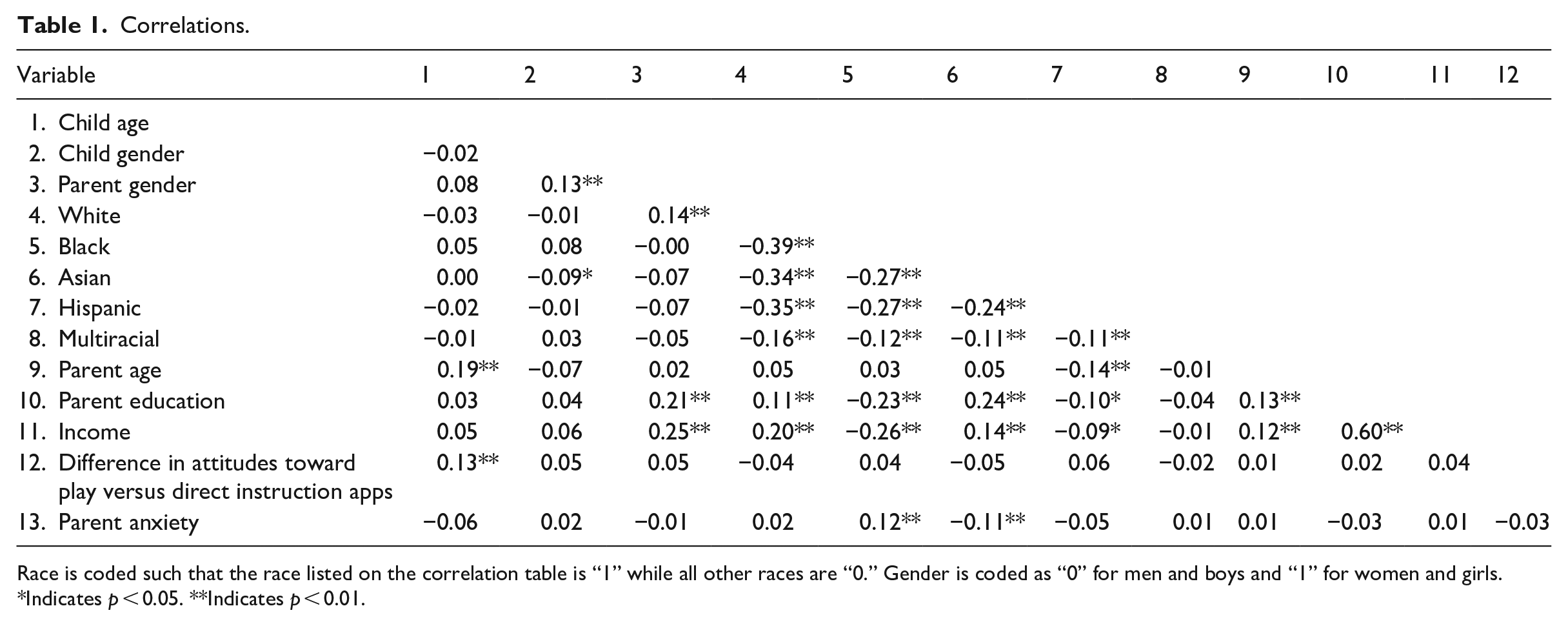
Race is coded such that the race listed on the correlation table is “1” while all other races are “0.” Gender is coded as “0” for men and boys and “1” for women and girls.
Indicates p < 0.05. **Indicates p < 0.01.
Results
Play versus direct instruction
A paired one-sample t-test was conducted to address RQ1. Parents’ averaged responses to items about apps that emphasize play were compared to parents’ averaged responses to items about apps that emphasize direct instruction. The t-test revealed no significant difference between parents’ attitudes toward apps emphasizing direct instruction (M = 5.68, SD = 0.99) as compared to apps emphasizing play (M = 5.61 SD = 0.93; t(571) = 0.758, p = 0.45).
Black parents and white parents
PROCESS Model 1 was used to assess if race (coded as 1 for white parents and 0 for Black parents) moderated the relation between parent anxiety and attitudes toward media. The overall model was not significant, R = 0.19, R2 = 0.04, F(5, 286) = 2.13, p = 0.06. Neither parent anxiety, β = −0.11, SE = 0.13, t = 0.87, p = 0.38, nor the interaction between parent anxiety and race, β = −0.30, SE = 0.18, t = 0.72, p = 0.47, were significantly related to attitudes toward media, however. No other terms were significant.
Asian parents and white parents
PROCESS Model 1 was used again to assess if race (coded as 1 for white parents and 0 for Asian parents) moderated the relation between parent anxiety and attitudes toward media. The overall model was significant, R = 0.23, R2 = 0.05, F(5, 267) = 2.90, p = 0.01. The relation between parent anxiety and attitudes toward media (β = 0.02, SE = 0.08, t = 0.29, p = 0.77), and the interaction between parent anxiety and parent race were not significant (β = −0.22, SE = 0.17, t = −1.31, p = 0.19). Household income was significant (β = 0.08, SE = 0.03, t = 2.81, p = 0.005).
Hispanic parents and white parents
PROCESS Model 1 was used again to assess if race (coded as 1 for white parents and 0 for Hispanic parents) moderated the relation between parent anxiety and attitudes toward media. The overall model was significant, R = 0.24, R2 = 0.06, F(5, 272) = 3.30, p = 0.006. Neither parent anxiety, β = 0.01, SE = 0.13, t = 0.10, p = 0.92, nor the interaction between parent anxiety and race, β = −0.23, SE = 0.17, t = −1.31, p = 0.19, were significantly related to attitudes toward media. Household income was significant (β = 0.08, SE = 0.03, t = 2.81, p = 0.005).
Discussion
The current study addresses questions about how parent race might interact with anxiety about children’s futures to influence differential attitudes toward playful media and direct instruction media. We found that parents do not differentiate between these types of media. Further testing revealed neither significant moderation of race on parent anxiety and attitudes toward media nor significant relations between parent anxiety about their children’s future and media attitudes. Here we will discuss potential explanation for these null findings, the implications of this work, as well as strengths, limitations, and future directions.
Theoretical implications
We situated the current study under the Differential Susceptibility to Media Effects Model (DSMM; Valkenburg and Peter, 2013). The current study expands upon this theorization by suggesting a link within the family where parents’ dispositional susceptibilities can serve as children’s social susceptibilities for media use. Previous work has demonstrated that parent characteristics, such as their moral foundation salience (Cingel et al., 2023) and race (Rideout and Robb, 2020), are associated with parents’ attitudes toward their children’s media use. Here, we included a variable to assess parent anxiety about their children’s futures to further assess the relations between race and parent attitudes. Past qualitative work has suggested that parent anxiety about children’s academic and career success shapes their views on media (Tripp, 2011), but we did not find these same relations. The measure used for this assessment was taken from a study conducted in China to assess a growing trend of parental anxiety over their children’s academic abilities and experiences (Sun et al., 2022). In our study, many parents responded about children who were of preschool age, and even the oldest children reported on would still be in the early years of elementary school. While anxiety was not low in our sample (M = 3.71 with a minimum score of 1 out of 5), the original study using the measure surveyed parents of children ages 6–15. It is possible that parents in the United States are not stressed about their children’s success, but it is also possible that the children considered in their reporting are still too young for this stress to have settled in a way that manifests with relation to using media for education. Thus, considering the DSMM, young children’s social susceptibilities to media use are not driven by parents’ anxiety about their futures.
Further, we did not find a significant moderating effect of race on differences in parental attitudes toward playful apps as compared to apps featuring principles of direct instruction. Past research has demonstrated that parent attitudes toward both school curriculum (Golann et al., 2019) and media use for children (Rideout and Robb, 2020) vary by race. Explanations for these differences have not been examined quantitatively, however. Because of systems of racism in the United States, it is possible that REM parents are more concerned (relative to white parents) about negative outcomes for their children. Our data show some significant correlations with race and parent anxiety (see Table 1) such that Black parents report more anxiety about their children’s futures (and Asian parents report less anxiety) than parents of all other races in the sample. However, we did not find a moderating role of race on parents’ attitudes toward the types of apps their children use. In general, parents in our sample did not differentiate between playful and direct instruction apps. Thus, past findings (Rideout and Robb, 2020) that suggest parents’ attitudes toward their children’s media use differ by race may be exclusive to broad categories or intentions, such as using media for educational purposes, rather than more minute differences, such as the specific curriculum of an app. Here, we focused on parent anxiety as a potential mechanism behind these attitudinal differences, but it is possible that this anxiety drives broad choices, such as giving children media at all, rather than more nuanced ones.
Practical implications
We situated the current study in literature on parents varying attitudes toward media for their young children (Cingel et al., 2023; Rideout and Robb, 2020) as well as education more generally (Golann et al., 2019). Based on these bodies of literature, we expected to find differences in parents’ preferences for children’s media use by race, as a function of parent anxiety about their children’s futures. Because we did not find differences, we conclude that parents have general, overarching attitudes toward media, such that they do not discriminate between types of curriculum. Thus, we would suggest that media makers create apps that have more playful and open-ended features. Because play and learning are co-constructive processes for young children (Pramling Samuelsson and Johansson, 2006) and because play is increasingly digital for young children, it is important that children can engage in more unstructured play in digital spaces. Though parents do differentiate to some degree between digital spaces for play and for learning, our data suggest that these differences are minimal, and thus parents might be more comfortable with spaces that are unstructured than assumed. Many extant apps meant to support children’s learning feature more principles of direct instruction, rather than unstructured play, and thus we suggest that more apps feature principles of play, such as the PBS Play and Learn app. Though it is not clear whether playful curriculum or direct instruction produces greater learning outcomes in the classroom (Dean Jr and Kuhn, 2007), research comparing playful media to direct instruction media does not show differences (Lennon et al., 2022), demonstrating that both play and direct instruction can support young children’s learning.
Strengths, limitations, and future directions
Strengths of this paper include the development of a new measure for assessing parent attitudes toward apps as well as a racially diverse sample. Our measure assessing parents’ attitudes toward playful and direct instruction media factored well and had good internal reliability. Future research can take these items and compare parents’ attitudes to children’s actual media use to further validate this measure. Many extant parental attitude measures are specific to video media or only assess media more generally. Thus, having a measure that can assess parent attitudes toward the most common form of gaming (mobile gaming) for young children can further our understandings of parent influence on media consumption, particularly with regard to content. Further, we quota-sampled parents with the aim of having equal numbers of parents across the most populous racial groups in the United States to have a greater understanding of why past research has shown differing parental attitudes by race. Having this diverse sample elevates data from parents who are often understudied in children and media research.
As for limitations, these data are self-reported, thus parents might have felt the need to report in socially desirable ways (Van de Mortel, 2008), which may have skewed our data to demonstrate more positive attitudes toward children’s media or lower anxiety. For example, public discourse often focuses on the negative effects of media use (Wolfers et al., 2024), while parents tend to report that their young children frequently use media (Rideout and Robb, 2020). Parents express guilt over screen use (Wolfers et al., 2024) and may potentially report more positive attitudes about its effects to assuage this guilt. However, some researchers suggest that participants are less likely to give socially desirable answers in web surveys (relative to surveys conducted in person) due to higher perceptions of anonymity (Booth-Kewley et al., 2007; Fang et al., 2014).This effect may have been greater for REM parents for the systemic reasons described in our literature review, but our data do not suggest a social desirability bias by race. We do not believe there are effects of social desirability in our survey overall, especially in such a way to not trust our null findings, but it is an important limitation to consider.
Future research should continue to examine the role of parent susceptibilities, including race, in attitudes toward children’s media use. Researchers have theorized about the differences in app structure that we highlighted here, and future research should continue to examine if parents identify and care about these structural differences. For example, future research could ask parents to rate a series of apps in terms of their playfulness and direct instruction approaches alongside their beliefs about the app’s ability to help their children learn. Additionally, future research should compare parents’ attitudes toward their children’s actual media use. Though parents do have great influence on children’s activities, children are gaining access to their own devices (Rideout and Robb, 2020), and parent attitudes may have less influence if children experience less parental mediation. Finally, researchers should continue to examine why parental attitudes toward media sometimes differ by race. While these differences are documented, there is not a consistent explanation for why they occur. Here we attempted to understand if parent anxiety about their children’s futures might be the driving force behind these differences, as hinted at in qualitative research (Tripp, 2011), but we did not find support for a relation between parent race, anxiety, and media attitudes in any direction. We suggest that future research examine parent attitudes qualitatively.
Conclusion
This study contributes to literature on parent attitudes toward children’s media use by examining the potential roles of parent anxiety about children’s futures and race on these attitudes. We found no relation between parent anxiety and their attitudes toward playful media and direct instruction media nor does race moderate this relation. The current study thus suggests that one potential explanation for why differential attitudes by race emerge.
Supplemental Material
sj-docx-1-ecr-10.1177_1476718X251344513 – Supplemental material for Parents’ differential attitudes toward children’s media use by race and anxiety about children’s futures
Supplemental material, sj-docx-1-ecr-10.1177_1476718X251344513 for Parents’ differential attitudes toward children’s media use by race and anxiety about children’s futures by Allyson L Snyder, Jane Shawcroft, Jeanette B Ruiz and Drew P Cingel in Journal of Early Childhood Research
Footnotes
Funding
The authors received no financial support for the research, authorship, and/or publication of this article.
Ethical considerations
The Institutional Review Board at the University of California, Davis approved our survey (#1973266-2) on 02 November 2022. Respondents gave electronic consent (written) before starting the survey. Researchers did not have access to personal information about the participants (such as names, contact information, etc.) as this information is stored separately by the survey company. Researchers paid the company, and then the company paid participants. As such, there is no way to link the data to personal information. A racially diverse group of undergraduate students, graduate students, faculty members, and parents in our local community reviewed all survey questions to ensure that questions did not feel invasive and would accurately capture our variables of interest. Further, participants could skip individual questions. Researchers also had in-depth conversations about how to interpret our results and how to frame our research questions to ensure that we accurately reported our findings.

Supplemental material
Supplemental material for this article is available online.
Notes
References
Supplementary Material
Please find the following supplemental material available below.
For Open Access articles published under a Creative Commons License, all supplemental material carries the same license as the article it is associated with.
For non-Open Access articles published, all supplemental material carries a non-exclusive license, and permission requests for re-use of supplemental material or any part of supplemental material shall be sent directly to the copyright owner as specified in the copyright notice associated with the article.
