




Abstract
The recommendation to introduce shared book reading during the child’s first year of life is widely acknowledged. While prior research has focused on the benefits for children, recent studies instead examine the impact on the reader. Studies have found a positive effect on parenting skills and parental well-being. Further, parents express that the joint activity fosters physical and emotional closeness as well as parent sensitivity. The present study explores parents’ experiences of interactive shared reading with their infants, aged 8–18 months. Through an intervention, parents learned and implemented reading techniques such as gestures, onomatopoeia, and vocalizations and encouraged infant participation. Interviews were conducted with 11 parents, and data were analyzed using Thematic Analysis. Two overarching themes emerged, each with two subthemes. The first theme “Playful Reading” includes (1) the parent’s pleasure of reading in the interactive approach and (2) sharing a moment of emotional closeness with my infant. The second theme, “Discovering and learning about my baby’s way to communicate,” explores (1) observing and ascribing significance to the infant’s communication and (2) feelings of wonder attributed to the infant’s capabilities. Sharing books is a mutually enjoyable activity for both parents and infants. Parents appreciated the playful approach during the reading activity and the emotional bond that developed. Additionally, using the interactive shared reading techniques helped parents recognize and value their infant’s communicative abilities. Future studies examining how interactive shared reading affects the reading activity as well as the parent are discussed.
Keywords
Introduction
Shared reading is an activity that enables parents and children to spend time together. Parents are recommended to begin reading books during the infant’s first year (Debaryshe, 1993; Muhinyi and Rowe, 2019; Niklas et al., 2016). Early literacy interventions encourage parents to read to their infants, and several reading programs have been provided to families from less privileged areas. These interventions typically include book distribution and parental guidance on effective reading techniques, provided through home visits or during health check-ups. Outcomes show gains in child language development (de Bondt et al., 2020; Klass et al., 2009; Prahl, 2023; Wade and Moore, 1998). Shared reading involves two parties, hence, effects on both the child and the parent are to be expected. For children, reading together with an adult elicits more emotions compared to reading alone (Avelar et al., 2022) and parents are inclined to continue book sharing when they observe their child’s positive emotions and enjoyment in the reading activity (Preece and Levy, 2020). The presence of emotions during reading sessions seems to enrich the experience for both parties and could serve as a motivator to maintain shared reading routines over time. Hence, understanding parents’ perspectives during shared reading becomes important to provide effective and well-directed instructions in early literacy interventions. To broaden the knowledge within the research field this study concerns parents’ experiences of reading together with their pre-verbal infant while using interactive shared reading techniques.
Parents’ experiences of literacy interventions and shared reading
Participating in reading programs and learning specific reading techniques is generally expressed as a positive experience (Zevenbergen et al., 2018). First, reading together provides a calm and emotionally warm environment where the parent engages in conversations with their children (Bergman Deitcher et al., 2019; Egan et al., 2022; Kucirkova and Grøver, 2024; Zevenbergen et al., 2018). Second, parents appreciate how shared reading provides learning opportunities (Bergman Deitcher et al., 2019; Kucirkova and Grøver, 2024; Zevenbergen et al., 2018). Both moral- and knowledge-based learning were considered aspects of shared reading that were valued (Bergman Deitcher et al., 2019). When selecting books, parents consider their children’s emotional state and the emotional content of a book (Bergman Deitcher et al., 2019). Additionally, some parents value the pleasure of reading a book they enjoy (Bergman Deitcher et al., 2019). However, challenges are described, such as the frustration parents feel when learning new reading techniques (Kotaman, 2007) and difficulties in implementing them (Zevenbergen et al., 2018).
Parental sensitivity in the shared reading activity
Parental sensitivity refers to a parent’s ability to perceive, interpret, and respond to their infant’s cues (DePasquale and Gunnar, 2020). When reading interactively, caregivers are instructed to observe and follow the infant’s interests (Bergström et al., 2024). Parents who learn to use interactive reading techniques, where infant participation is encouraged, tend to be more sensitive to their infant’s cues and interests in the reading session as compared to parents in a control group (Dowdall et al., 2021; Murray et al., 2016). Promisingly, sharing books regularly seems to foster positive parenting practices, and the positive impact on parental sensitivity persists beyond the reading activity itself (Canfield et al., 2020). Further engaging in reciprocity also increases for parents who share books in an interactive way (Dowdall et al., 2021). Both parental sensitivity and reciprocity are present in the reading session as well as during free play (Dowdall et al., 2021). Another way parents portray sensitivity can be seen in the way interactions and communication adapt in line with the child’s development (Chang and Luo, 2020). For example, when reading to infants, parents use techniques that allow non-verbal responses and avoid asking questions that require a verbal response (Chang et al., 2022). As the child’s language skills develop, parents use more demanding reading techniques, such as asking open-ended questions and distancing (Zevenbergen and Whitehurst, 2003).
Shared reading, emotions, and the parent-child relationship
Reading together promotes connections between the parent and the infant, it allows for physical and emotional closeness (Bergman Deitcher et al., 2019; Egan et al., 2022; Kucirkova and Grøver, 2024; Rabinowitz et al., 2021; Swain et al., 2017; Zevenbergen et al., 2018), as well as intimacy and bonding (Kucirkova and Grøver, 2024). In shared reading, adults who read aloud to children describe the activity as more enjoyable compared to adults who read aloud to themselves (Rabinowitz et al., 2021). For both children and parents, reading together leads to heightened emotions and physiological arousal, and children who read with their parents display both interest and happiness (Avelar et al., 2022). In turn, children’s visible enjoyment during reading acts as a positive reinforcement to the parent (Kucirkova and Grøver, 2024; Preece and Levy, 2020). In the reading activity, there is a reciprocal interaction between parents and their children. In a case study, Morgan (2005) depicted the interaction of three dyads in the shared reading activity. In one dyad, the child received praise for active participation and, in turn, showed confidence, which appeared to enhance the interaction. Even when parenting is difficult due to external factors such as giving birth preterm and spending time in a neonatal intensive care unit, parents find value in the activity (Lariviere and Rennick, 2011). Parents express that they experience intimacy and normalcy in the otherwise traumatic situation (Lariviere and Rennick, 2011).
The present study
Shared reading between parents and children has a positive effect on both parties and is easily implemented as a family activity. In a survey rapport from Sweden, Nordlund and Svedjedal (2020) expressed concern regarding the decline in the total time parents spend reading aloud to their children. Hence, when designing early literacy interventions, the contents need to be based on factors that encourage and support sustained reading over time. Some factors are known; infants’ shown enjoyment (Preece and Levy, 2020), reoccurring coaching sessions as a reminder to keep up with the reading (Bergström et al., 2024), and having a personal coach and individualized information when learning and implementing language activities (Dyne et al., 2024). Nevertheless, understanding more mechanisms that drive parents to initiate and maintain reading experiences with their infants becomes important, and adding findings from qualitative studies can provide a more comprehensive picture of the shared reading activity. Therefore, this study aims to explore how parents describe their participation in an interactive shared reading intervention. The research question asks, “How do parents experience using the interactive reading techniques with their infants?”
Method
Positionality
The study was guided by a social constructionist ontology and a constructivist epistemology. We are clinical child psychologists and researchers, who bring an understanding of the importance of fostering positive early parent-child relationships. The clinical expertise encompasses roles such as maternal and child health psychologist, child and adolescent psychiatry psychologist, and child psychologist with special knowledge in developmental assessment and the identification of reading and writing difficulties.
Ethical considerations
During the planning phase of the study, several aspects were considered. First, the potential impact of the research team’s multiple roles on the participants was carefully considered and discussed. Second, special consideration was taken regarding the pre-verbal infants and their non-verbal communication. If signs of tiredness or lack of focus were observed during intervention sessions, the coaching was ended, and any remaining instructions were delivered to the parent through modeling and verbal explanations.
This study adhered to ethical research standards, safeguarding the protection of participants’ identities through strict confidentiality measures. Parents were given both oral and written information about the intervention, the interview process, data handling, and the presentation of results in a scientific journal before the intervention and the interviews. Written consent was obtained before the intervention, and a new consent form was signed by each participant before the interview. Participants were informed that they could withdraw from the study at any time without providing a reason.
Due to Covid-19 restrictions, the interviews were conducted over the phone and participants were informed that the conversations would be recorded. All recordings and transcripts were securely stored in line with ethical guidelines. While phone interviews might miss visual cues indicating participants’ emotional reactions, they can also provide a greater sense of freedom, as participants are not being observed directly.
The study was granted ethical approval by Regionala etikprövningsnämnden i Linköping, drn 2017/582-31.
Participants
Eleven families participated in the intervention and interview. At the time of the intervention, six parents had one child, four parents had two children, and one parent had three children. All participants were residents from the same region in the southern part of Sweden. Eight parents lived in a medium-sized city and three parents lived in small rural communities. All parents spoke Swedish, one parent was bilingual. All interviews were conducted in Swedish. Four parents had completed high school and seven participants had attended college/university.
Procedure
This qualitative study is part of a larger project involving 88 families (Bergström et al., 2025). Participants were recruited by their child health services nurse during the 8-month check-up. All families received questionnaires to complete and return by mail to the research team. For this study, 11 parents (nine mothers and two fathers) were randomly selected from this larger sample. The selection process involved choosing every third envelope received, and the corresponding parent was then invited to participate in the extended intervention. Recruitment ended when 12 families had accepted participation. One family opted to terminate before the intervention started.
This shared reading program was inspired by Dialogic Reading (Whitehurst et al., 1988) but designed for pre-verbal infants. The shared reading techniques were composed of communicative prompts used to encourage and support the infant’s participation (Bergström et al., 2024). Each parent-infant dyad received four visits in their homes by a coach when the infants were 10, 12, 14, and 16 months. Each session began by recapitulating previously presented reading techniques and a discussion of how the shared reading had progressed. The coach then introduced and modeled the new reading techniques after which the parent used the reading techniques together with the infant. Sessions took about 60 minutes each.
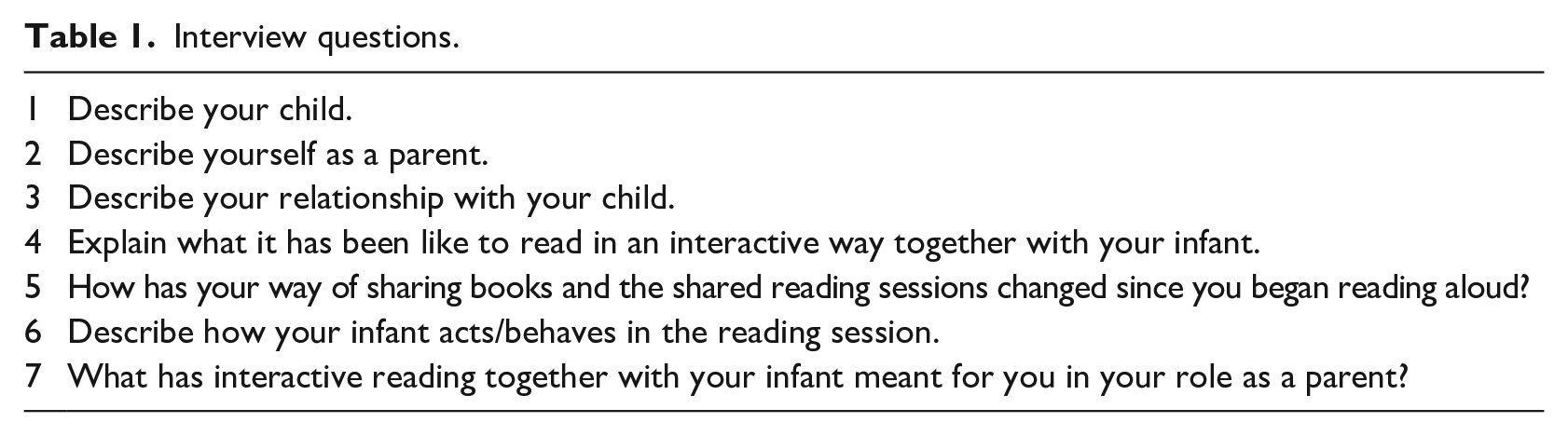
The interviews were conducted 12 months post-intervention when the participating infants were 30 months old. Due to COVID-19 restrictions, the interviews were conducted using a speaker phone and were audio recorded. All parents answered the same initial interview questions, however, follow-up questions varied. The interviews were conducted in Swedish and transcribed verbatim by a professional transcriber. Selected citations presented in the manuscript were translated. The translations were initially verified and subsequently checked using a text generator (AI). For interview questions see Table 1.
Interview questions.
Intervention content
In session one, the parent was asked to reposition the child to promote eye contact. Further, the parent was asked to create a fun and positive environment by sharing the book according to the infant’s interests. The books were read at a suitable pace for each infant, allowing time for the infant to process and respond. Parents were encouraged to talk about the illustrations using vocalizations, onomatopoeia, and gestures to support the verbal information. Lastly, parents were instructed to allow the infant to handle the book with little or no restrictions. Giving contingent and positive responses to the infant’s participation was encouraged. The reading was to end in time with the infant’s lessened interest and concentration. The second session began by repeating previous techniques before adding any new instructions. Parents were encouraged to use pointing and naming when reading the books. They were also asked to more directly encourage the infant to participate through imitation, using gestures or sounds, all the while providing positive feedback. Lastly, parents were asked to use expansions. Besides continuing to use the already learned techniques, in the third session, parents learned how to use wh-questions (what, where, who) and how to expand the text to involve objects in the infant’s environment. The last session began with a repetition of the previously used techniques. Parents were instructed to read the text with a focus on actions or emotions in the book, while continuing to use expansions.
Data analysis
Analysis was conducted using Reflexive Thematic Analysis as described by Braun and Clarke (2022). Thematic Analysis was chosen as it best fit the research questions. It identifies patterns and themes in the data, aiming to clarify complex phenomena from the participants’ perspectives. We used a descriptive, inductive approach using semantic coding of data. The analysis was based on the concept that reality is constructed through social interaction and language. It emphasizes how meaning is derived from interactions and how our interactions shape reality. The aim is to understand the participants’ perspectives and experiences of sharing books interactively with their pre-verbal infants.
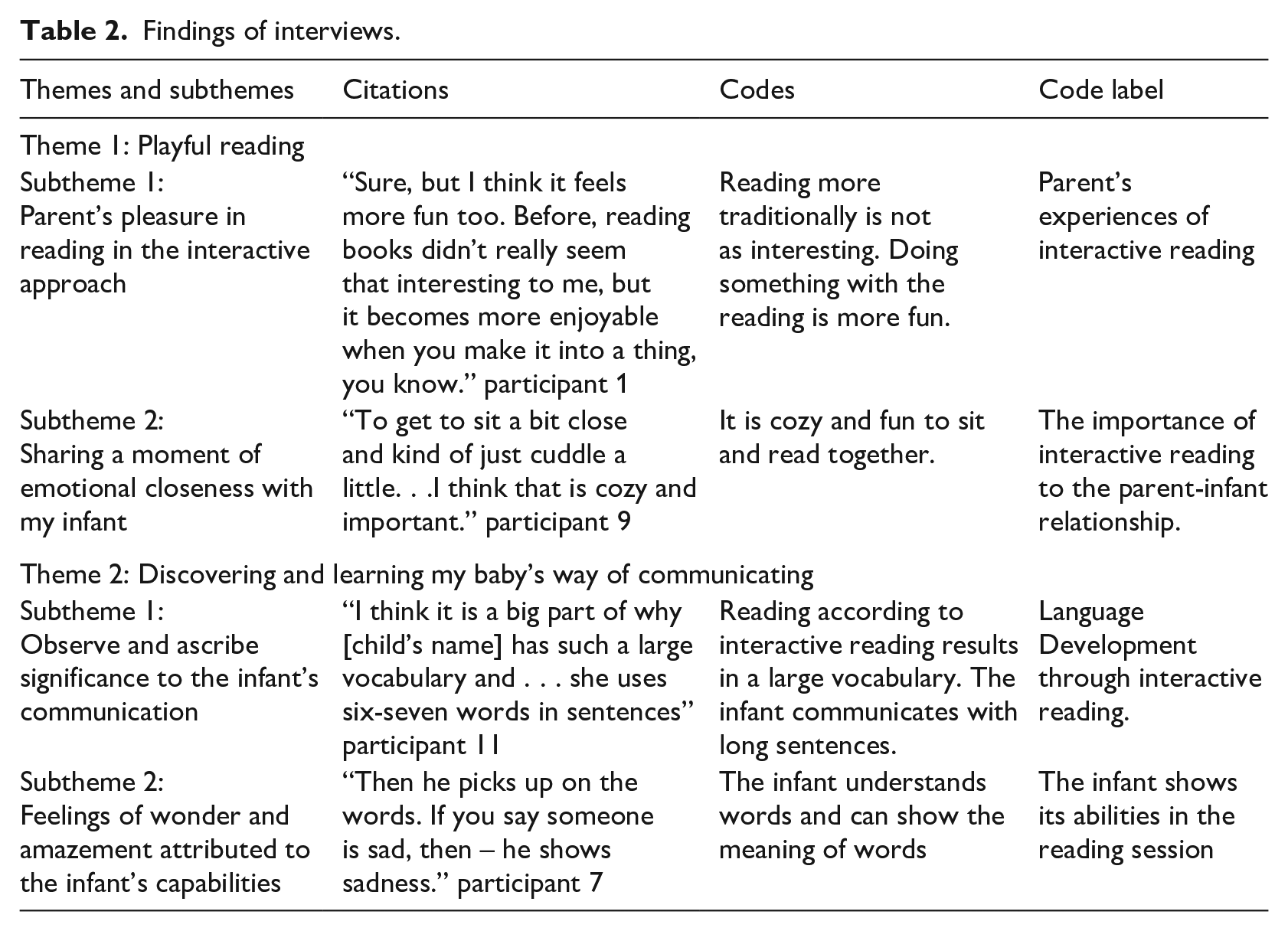
The analytic process began with familiarization with the data. Each transcribed interview was read and reread several times. The recordings of the interviews were listened to. Working from the transcriptions, sentences were given initial codes. The initial codes lay close to the content of the original statements. These codes were reworked and given code labels. First, three themes were identified where the statements could be related to the parent, the infant, and the parent-infant relationship. These themes were reviewed through discussions and the code labels were reorganized into more overlying themes. The themes were named to be descriptive and include the subthemes. See Table 2 for a step-by-step analysis of the final themes.
Findings of interviews.
To ensure an open mind and minimize preconceptions during data collection and analysis, several steps were taken. The research team maintained frequent and regular communication to reduce the influence of preunderstanding on intervention and data. Each step of the analysis was initially conducted independently, followed by close collaboration to establish theme selection. Reflective discussions were conducted throughout the process. The quotes included in the paper were chosen as they best represented and supported the identified themes.
Findings
The qualitative analyses identified two main themes: (1) playful reading and (2) discovering and learning my baby’s way of communicating.
Playful reading
This theme involves two subthemes: (1) the parent’s pleasure of reading in the interactive approach and (2) sharing a moment of emotional closeness together with my infant.
Parents who had previously engaged in traditional reading practices described a distinct change in their behavior when adopting interactive reading techniques with their infants. These parents described greater enjoyment in the reading activity and the activity was less tedious. Parent 4 expressed, “. . .with my first child I just read the text and eventually it was boring to read the book. But when we talked about the pictures, there was something new each time.” Further, using techniques such as vocalizations, and gestures while encouraging infant participation was described as fun. Some parents mentioned that they could focus on different parts of the illustrations allowing for a more engaging reading experience. Parents also learned to implement the reading techniques and enjoyed sharing books in a way that they were not accustomed to, it allowed for greater freedom in the shared reading activity. As stated by one parent, “. . .I try to read with more enthusiasm, and I don’t always feel as confined by the text” (participant 5). Followed by parent 8, “I can dramatize more than I normally would. I’m not usually theatrical, but when I read, I can be more vivid, I can pretend. I’ve become better at that.” Another parent described that they could emphasize and put meaning to aspects in the book, for instance, “if someone is sad, you can, like, become more explicit and show that they are sad, not just read.” (participant 5). Overall, most parents were positive, however, one parent described a nuisance when the infant was too active during the reading sessions. Another parent had focused on reading the text more traditionally, gaining the infant’s attention in other ways.
The second sub-theme that emerged highlighted parents’ emotional connection to their infant in the shared reading activity. Many parents described that they felt close to their children and that the shared reading provided affectionate moments. Further, parents expressed that the infants actively participated, which added pleasure and enjoyment to the experience. As stated by participant 4, “. . .it has become a shared time for me and [child].” Other parents mentioned that sharing books became a time to unwind and to connect with their infant, “Well, I think we connect more with each other in this peaceful moment where we talk about a book” (participant 10). One parent described that he/she became better at interpreting their infant’s needs and adjusting their reading accordingly. This helped parents attune to the infant’s state of mind, “. . .and some days when he is tired, we read in a simpler way. . . .one sees what he can manage” (participant 10). The intimacy is described to go both ways. Another parent described how the infant wanted to connect by looking at them during the reading activity. Even for the infants, in the shared reading activity, the relationship with the parent is prominent. Participant 11 expressed, “She’s sitting next to me now. . .or she’s sitting on my lap and still might want to look, you know, at my face and stuff like that. . . .”
Discovering and learning my baby’s way of communicating
This thematic exploration encompasses two parts. The first reveals how parents observe and ascribe significance to their infant’s communication. The second pertains to parental feelings of wonder and amazement attributed to the infant’s capabilities.
Some parents described that participating in the sessions and learning how to read with their infant led them to observe and take notice of their child’s behavior in ways they had not done before the intervention, such as how their infant’s language improved. Some parents expressed this in general terms by referring to language development. Others were more specific in their acknowledgment of the language improvements by the infant’s active participation in reading as well as increased use of new vocabulary. One parent said that her child learned more when they shared books in this way. Another parent expressed appreciation, “I think it is so exciting and fun that reading can do so much for a child. I think [interactive reading] has helped his language into what it is” (participant 4). Parents enjoyed watching and learning about their infants’ way of using language and expressing themselves. Participant 6 mentioned, “I’m so fascinated about her language development, and I wonder if we, well, we have always read a lot but now we have read even more and we have thought about these things, to apply sounds and movements, and if [reading this way] has resulted in her being so verbal, or if it is a coincidence. Well, it’s exciting.” Another thing parents noticed was how their infant had become interested in books because of the great amount of reading. One parent had come to the realization that language and a rich vocabulary are important and that sharing books allowed for gains in infant language.
Further, parents observed that their infant’s communicative and language abilities changed over time. These parents mentioned that when they first shared books using specific reading techniques, the infants learned to communicate with gestures and sounds. As the infants matured, they participated by using words and sentences. Parents believed that reading books helped their infant’s language development. For example, one parent could identify changes in her reading behavior when noticing changes in the infant’s language advancement. Initially employed strategies such as using sound-words and gestures shifted to more advanced reading techniques. Participant 6 expresses, “Now we don’t use movements as much since she has such a rich vocabulary, so we speak instead. . . . we let words guide the story and we adjust to her interest and vocabulary. We speak more freely about the books and actions.” Other parents described their infant’s behavior in the reading session. When older, the infants were active, they asked questions and used words to describe pictures. One parent mentioned that when sharing familiar books, their infant took the book from them and retold the story.
The book-reading activity was initiated by both parties. Parents initiated book reading according to their infant’s needs and reactions to the reading session. Some infants became alert and active when sharing books, these parents initiated reading during the daytime. One parent expressed that they could not interrupt play time to share a book since the infant would have a harder time focusing on the reading activity. Other parents described that their infants wound down and reading fit best at bedtime. Further, many parents expressed that in the reading session, the children decided which books to read. Some parents described that this required them to take a step back, observe the infant, and follow the infant’s lead. Even 12 months post-intervention, some parents described that they still allowed their child to make decisions both regarding book selection but also what to focus on within the reading session.
Finally, many parents expressed appreciation for how their infants used the books to communicate. One parent described that when the child brought a book it meant that they wanted to be read to. Another parent discovered that their infant used the book to communicate understanding and fetched objects during the shared reading, “. . .read a book about a wolf or something, then he can fetch his wolf [stuffed animal] . . . .he makes these connections” (participant 5). A third parent reflected on the infants’ ability to communicate emotions, “. . .they [the characters] become frightened, then he becomes frightened and runs around in the room” (participant 3). According to the parents, the book became an instrument through which the infants could communicate both simpler and more advanced ideas.
Discussion
The present study aimed to describe parents’ experiences of learning about and sharing books in an interactive way with their pre-verbal infants. One theme centered on the theatrical, enjoyable, and emotional experience that evolved in the shared reading session. Parents described Playful reading, in part due to reading in an interactive way as well as finding themselves in an emotional connection with their infant when reading. A second theme that emerged shed light on Discovering and learning my baby’s way of communicating. The theme could further be described by parents’ understanding and appreciation of the infant’s communicative skills and feelings of wonder ascribed to this.
Parents enjoyed learning about and using the interactive shared reading techniques when sharing books with their infants. There was an appreciation of reading with the freedom to dramatize and be less strict in the reading approach. Parents in this study mentioned that sharing books in an interactive manner presented them with more diversity in how the story was told, something that added value to them. Similar findings have been described by Preece and Levy (2020) who found that parents could talk about illustrations allowing the story to be told in new ways or adapt the reading to evoke laughter. Parents appreciate the freedom of not reading the written text verbatim but instead sharing books more creatively (Bergström et al., 2024).
Further, the results from the present study shed light on how shared reading promotes physical closeness between parents and their infants, which aligns with previous studies. Being physically close during reading sessions enhances the connection and intimacy between the parent and child (Swain et al., 2017; Zevenbergen et al., 2018). In addition to physical proximity, parents reported experiencing a deeper emotional bond with their infants. Caregivers valued how an emotional connection to their infant evolved when sharing books in an interactive way. The opportunity to sit close and spend time together often included moments to snuggle. Notably, even in cases where parents view their infants as unsocial, shared reading sessions can still be used to foster positive interactions and build rapport (Kucirkova et al., 2018). Several of the reading techniques in the intervention were specifically chosen to target these outcomes. For example, parents were instructed to sit comfortably with their infant and to create an emotionally warm and positive reading environment. This approach mirrors findings from studies with preschool children, where parents similarly express enjoyment in spending quality time through various activities (Hannon et al., 2006).
The shared reading activity was described by parents as a fun activity. Finding pleasure in the activity supports sustained shared reading over time (Swain et al., 2017). Further, earlier research pinpoints how children’s emotions emerge when an adult reads to them (Avelar et al., 2022). Interestingly, parents’ enjoyment and motivation for reading with their infants are closely connected to their infant’s portrayal of enjoyment (Preece and Levy, 2020). Hence, the parent and the infant play equally important roles in supporting each other with positive reinforcement during the reading session. Another reinforcing reading technique taught to the parents was to timely respond to the infant’s communicative attempts. The positive, encouraging, and rewarding undertones when providing contingent responses in the reading activity could add to the encouraging feedback and increase infant participation. Further, when parents provide contingent feedback, it helps the infant to understand that language is used for communication (Tamis-LeMonda et al., 2014). This bidirectional interaction, where both the parent and the infant equally participate and mutually enjoy, can potentially develop into a positive spiraling effect. This is an interesting hypothesis, one that could be important to consider when designing early literacy interventions. However, future research projects need to examine if emotions within the shared reading session have a bidirectional effect.
Parents also observed and mentioned several gains in infant language development throughout the project. When the infant’s language proficiency increased, the parents matched this by using more advanced reading techniques and verbal language. Earlier research findings on parental reading behavior demonstrate how parents adjust to align with their children’s language proficiency levels (Chang and Luo, 2020; Leung et al., 2021). Parents believed and expressed that their infant’s advanced language skills were a result of the total amount of reading that had occurred throughout the study. Lastly, parents could observe and were impressed with how the infants could communicate within the reading session and they expressed a sense of amazement at their infant’s abilities and developmental gains. Post-intervention infant language gains, as a result of participating in a Dialogic Reading intervention, have been described in several studies (Cooper et al., 2014; Mol et al., 2008; Vally et al., 2015; Whitehurst et al., 1988). However, the research findings on parent appreciation of their infant’s language development and language use are scarce. To our knowledge, only Zevenbergen et al. (2018) revealed parents’ appreciation of their children’s language learning.
Further, in our study, parents expressed that learning about and sharing books in an interactive manner led them to understand and value their infant’s communicative abilities. One important reading technique presented in the intervention sessions instructed parents to observe and follow the infant’s interests as well as use a pace during the reading activity that suited the infant. The reading activity became more individualized. Reducing the reading pace allowed the infant time to respond and participate in the reading activity. These two prompts might aid parents to be more observant and attuned to their infant’s communication, hence, discovering all the infant’s communicative skills. For example, caregivers in this study discovered how the infants used the book as a tool and the reading session as a means of communicating by using gestures and sounds. Interestingly, parents noticed that the infants could express more complex subjects, such as emotions with help from the picture book.
Many literacy interventions have been provided for families from less privileged areas (de Bondt et al., 2020; Klass et al., 2009; Prahl, 2023; Wade and Moore, 1998; Zuckerman and Khandekar, 2010). Morgan (2005) found that parents from non-mainstream families employ a variety of reading practices, including advanced techniques, challenging earlier research findings (Ninio, 1980). Several factors support universal home-based interventions. First, many parents feel uncertain about how to read aloud to their infants (Brown et al., 2017). Second, universal interventions achieve higher participation rates (Hannon et al., 2006). Lastly, home-visiting programs are prone to engage both parents (Morgan et al., 2009) which is beneficial to the infant. The declining trend of book sharing in families is concerning (Nordlund and Svedjedal, 2020) and highlights the need for both targeted interventions for children at risk and universal interventions. The design and objectives of universal interventions differ from those aimed at infants at risk. The necessity of both types of interventions calls for future studies.
Methodological considerations
One strength of the study is that the participants were randomly selected, which reduces the risk of self-selection bias. Several actions were taken to ensure that results reflect interview content. First, the research and analysis process has adhered to the Thematic Analysis according to Braun and Clarke (2022). The team has strived to secure valid data collection, analysis, and written reports. The interviews were transcribed verbatim by a professional transcriber. The data was analyzed and controlled. A reflective discussion within the research team was recurring throughout the study. The coding process underwent several phases where codes were considered and re-considered. The dataset revealed primarily similarities but also some differences in theme content compared to previous studies. Additionally, it provided some unexpected results that bring new insight into the research area. Lastly, participating parents in this study were positive to the intervention.
Several aspects of the research process require consideration. One member of the research team designed the intervention, served as the coach during sessions, and conducted the interviews. To minimize biases, close collaboration, continuous discussions, and active involvement by all team members existed throughout the study. Additionally, social desirability bias may have influenced parents’ responses during interviews as coaching and interviews were conducted by the same team member which could have affected how freely the parents felt they could speak. While this poses a risk, it might also be a strength, as familiarity could encourage more honest responses. The presence of both positive and negative responses in the interviews suggests that parents felt comfortable sharing their true opinions. Further, the timing of the interview, conducted 12 months post-intervention, is another limitation. Parents had to rely on memory when answering questions about the progression of the shared reading sessions. Nevertheless, the timing also allowed parents to reflect on and describe how the reading techniques were used several months past the intervention, which provided valuable information.
The findings in this study reflect the experience of Swedish parents. In Sweden parents have 18 months of parental leave, meaning that participants did not face the stress and challenge of balancing work with childcare throughout the intervention. These factors may have contributed to the ease at which parents changed their reading behaviors and experienced positive outcomes using novel reading techniques. Further research is needed to understand how the shared reading techniques work across different cultural contexts, among parents from various socioeconomic backgrounds, and together with children at risk or with disabilities.
Conclusions
Results from this study support that shared reading affects parents. Parents expressed how they enjoyed learning and using this playful, non-restrictive, and theatrical approach when sharing books with their infants. Further, parents took notice of and felt admiration for their infant’s communicative skills. The findings are in line with previous research, suggesting that sharing books with infants is an activity where both the parent and the infant have fun, where emotional closeness is promoted, and where the infant’s language development is supported. Using shared reading, not only for gains in child language development but also as a way of enhancing parent-infant interaction is an enticing thought and could be incorporated when designing and implementing early shared reading interventions. However, future studies are warranted to fully understand the potential of using the reading activity as an intervention for enhancing parenting skills, parental well-being, and fostering parent-infant relationships.
Footnotes
Acknowledgements
The authors would like to thank the participating parents for their valuable contribution.
Data availability statement
The datasets generated during and/or analyzed during the current study are available from the corresponding author on reasonable request.
Declaration of conflicting interests
The authors declared no potential conflicts of interest with respect to the research, authorship, and/or publication of this article.
Funding
The authors received no financial support for the research, authorship, and/or publication of this article.
Ethical approval
This study was performed in line with the principles of the Declaration of Helsinki. Approval was granted by Regionala etikprövningsnämnden I Linköping (Dnr: 2017/582-31).
Informed consent
Written informed consent was obtained from all adult participants included in the study.
